White Rose Research Online URL for this paper: http://eprints.whiterose.ac.uk/114166/
Version: Accepted Version
Monograph:
Prescott, T.J. orcid.org/0000-0003-4927-5390 and ibbotson, C. (1997) The early evolution of spatial behaviour: robot models of trace fossils. Technical Report. Manchester University , Manchester. ISSN 1361-6161
[email protected] https://eprints.whiterose.ac.uk/ Reuse
Unless indicated otherwise, fulltext items are protected by copyright with all rights reserved. The copyright exception in section 29 of the Copyright, Designs and Patents Act 1988 allows the making of a single copy solely for the purpose of non-commercial research or private study within the limits of fair dealing. The publisher or other rights-holder may allow further reproduction and re-use of this version - refer to the White Rose Research Online record for this item. Where records identify the publisher as the copyright holder, users can verify any specific terms of use on the publisher’s website.
Takedown
If you consider content in White Rose Research Online to be in breach of UK law, please notify us by
Tony J. Prescott and Carl Ibbotson Department of Psychology
University of Sheffield Western Bank Sheffield S10 2TP
email: [email protected] http://www.shef.ac.uk/~abrg/tony/
7/4/97
Abstract
The evolutionary history of nervous systems can provide useful insights for biologically-inspired robot design. The study of trace fossils, the fossilised remains of animal behaviour, reveals interesting parallels with recent research in behaviour-based robotics. This paper reports robot simulations of the meandering foraging trails left by early invertebrates which demonstrate that such trails can be generated by mechanisms similar to those used for robot wall-following. We conclude with the tentative suggestion that the capacity for intelligent behaviour shown by current behaviour-based robots is similar to that of animals of the early Cambrian period approximately 530-544 million years ago.
Introduction
Biology is widely regarded as an important source of inspiration for robotics. Animals are seen as offering working examples of robust, embedded autonomous agents, and their neural circuitry, and sensor and motor structures, are viewed as providing models for designing similar components for robots. The premise of this paper is that robotics can gain further insights from biology by taking a closer interest in evolutionary historyÑthe study of the phylogenetic relationships between animals and the nature of evolutionary change from one animal form to another. Invaluable insights for robotics should be gained if we can understand how complex neural circuits were derived from simpler ones, a question that can only answered by
*
Proc. AISB workshop on "Spatial Reasoning in Mobile Robots and Animals", Manchester 1997.
Technical Report Series, Department of Computer Science, Manchester University, ISSN 1361 - 6161.
investigating the evolutionary history of nervous systems. Of course, brains and behaviour don't make good fossils. This gives evolutionary neurobiologists the difficult task of inferring the architecture of early nervous systems from clues found in comparative and developmental studies. Only occasionally does the fossil record provide any direct evidence of the behaviour of ancient animals. Here, however, we are concerned with fossil evidence of exactly this sort which has provided important insights into the early evolution of animal spatial behaviour. Perhaps unsurprisingly, we see that the first nervous systems generated behaviour with some remarkable similarities to that of recent behaviour-based robots.
Trace Fossils
The common ancestor of all modern, bilaterally symmetric, metazoans (multicellular animals) was probably a roundish worm that lived on the ocean floor during the Precambrian period 550 to 600 million years ago (mya) (Valentine, 1994). Such creatures left no actual fossils as they had virtually no hard body-parts. Fortunately, however, they did leave a fossil record of sortsÑ some of the tracks, trails, and burrows that these early invertebrates left in the sediment were preserved forming what are now called trace fossils. The commonest forms of trace fossil record foraging trails left on, or just below, the ocean bed. The earliest traces reflect simple ÔscribblingÕ behaviours, with tracks that often cross themselves, and indicate relatively crude and inefficient foraging methods. By the early Cambrian however, 530-544 mya, more regular trails appear that form spirals or ÔmeandersÕ that loop back on themselves without crossing. Complex burrows also begin to appear around this time with multiple levels and branches. These changes reflect three important developments: an increase in the diversity of animals, improvements in burrowing capabilities, and most importantly, an increase in the complexity of neural circuits. The beginning of the Cambrian is, of course, also recognised as marking the origin of the contemporary metazoan phyla. The Cambrian ÔexplosionÕ saw the rapid emergence, over the course of ten to twenty million years, of a diversity of body forms equipped with relatively complex sensory and nervous systems. Trace fossils therefore represent our primary source of insights into the sequence of evolutionary events that anticipated the appearance of the modern fauna.
Computer models of trace fossils
In attempting to infer the perceptuo-behavioural capabilities of the ancient animals that left fossil traces, it seems reasonable to seek the simplest mechanisms that will reproduce the observed patterns. Following BraitenbergÕs (1986) advice that "when we analyze a mechanism we tend to overestimate its complexity" the methodology of synthetic psychologyÑbuilding model systems that generate similar behavioursÑseems an appropriate strategy. In fact, synthetic approaches were applied some time ago to the understanding of trace fossil behaviour, the computer simulations of Raup and Seilacher (1969) standing out as an early, and rarely acknowledged, example of what might now be termed Artificial Life.
movement a meandering pattern also helps to keep the animal within its preferred environment and may reduce the likelihood of encountering predators. Raup and Seilacher based their models of these trace fossils on a combination of three reactive behaviours: thigmotaxis that makes the animal stay close to previously formed tracks; phobotaxis that causes it to avoid crossing existing tracks; and strophotaxis that causes it to make 180¡ turns at various intervals. Their simulations demonstrated that the interaction between these behaviours is sufficient to generate the tightly coiled meandering patterns characteristic of many foraging trails. Figures 1-3, taken from Raup and Seilacher (1969), show some typical foraging trails generated by their program together with the trace fossils they were designed to emulate.
The principle of a complex behaviour pattern emerging from the competitive interaction of a number of simple reactions is a characteristic that Raup and Seilacher's work clearly shares with the behaviour-based robotics approach of Brooks and others (e.g. Brooks, 1986, Maes, 1992). Indeed, the meandering behaviour generator is not unlike a robot wall-following mechanism in which the object being followed, rather than being a fixed contour, is the trail of disturbed sediment generated by the animalÕs own movements.
Figures 1-3. Trace fossil meanders and comparable computer output. (From Raup & Seilacher, 69)
inefficient foraging behaviour, a characteristic of early fossils, is taken by Raup and Seilacher as evidence that thigmotaxis and phobotaxis are "genetically distinct behavioural reactions". Like wall-following in behaviour-based robots (see, e.g. Maes, 1992) the foraging meander is seen as an emergent pattern arising from the environment-mediated interaction of two distinct behavioural competences. Evidence for flexibility in the foraging behaviour is demonstrated by the fact that the "lobes" of the meandering patterns (the straight sections between turns) are not always of constant length. Seilacher (1967) speculated that this may sometimes be due to contact with an obstacle which triggers a higher priority "avoid" behaviour. It therefore seems likely that the activity of these animals was controlled by a hierarchy of behavioural competences.
Seilacher (Seilacher, 1967; Raup and Seilacher, 1969; Seilacher, 1986) suggested a number of further models for different types of foraging trace, and proposed that the variation between some fossil traces, and their increased efficiency over the course of evolution, can be modelled by manipulating key parameters of the various component reactions. For instance, the turning radius of the animal, the mean distance between tracks, and the relative strengths of phobotaxis and thigmotaxis, can each be varied to generate trails with different characteristic patterns and varying degrees of foraging efficiency. One of the implications of these studies is that evolution operated as much on the sensory and motor systems used to implement the reactive behaviours as on the behaviours themselves.
Robot models of trace fossils
Figure Four: The Lego Robot. The motorised dispenser on the back of the robot releases a stream of paper when the robot is moving. Two light detectors on each of the side arms measure reflected light from the floor and control the thigmotaxis (toward track) and phobotaxis (away from track) behaviours.
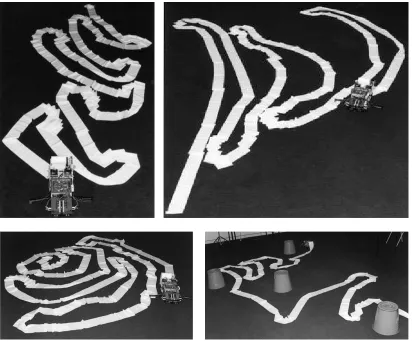
[image:7.612.175.443.78.288.2]Figure 5 shows a simulation of behaviour generated by the combination of phobotaxis (avoid track re-crossing) and thigmotaxis (follow existing track). Thigmotaxis is triggered when the value of the outermost sensor drops below a threshold, and phobotaxis when the value of the innermost sensor goes above a threshold. Without strophotaxis (U-turns) the robot's behaviour is simply to spiral outwards following the pattern of its paper trail (compare figure 6, a spiralling trace fossil).
[image:7.612.155.458.482.680.2]Figure 7 shows the effect of adding the strophotaxis (U-turns) behaviour. Changes in the parameters of the behaviours, particularly the relative strengths of thigmotaxis and phobotaxis generate meanders of varying compactness. In the bottom right picture an avoid behaviour has been added that overrides the meandering behaviour in the vicinity of an obstacle.
Figure 7: Meanders generated using thigmotaxis, phobotaxis, strophotaxis, and (bottom-right only) avoid obstacle behaviours.
A 'Cambrian explosion' of behaviour-based robots?
The value of these demonstrations perhaps lies less in discovering that relatively simple mechanisms can be used to implement robot 'foraging' trails and more in simply pointing out the similarities between the sensorimotor behaviour of ancient animals and that of simple reactively-controlled behaviour-based robots. This similarity locates the behaviour of such robots at a grade similar to animals of the early Cambrian1
. This period of perhaps less than twenty million years
1
[image:9.612.102.514.140.482.2]saw the explosive development of many different body forms and complex nervous systems. The organisms of this fauna achieved a great diversity of methods of locomotion, had an abundance of different sensory mechanisms including compound eyes, and possessed a wide range of behavioural repertoires including predation (Conway Morris, 1989; Miklos, 1993). In other words, many of these animals had very mobile and active lifestyles, were capable of effective sensing in different modalities, and exhibited complex and appropriate reactions to varied stimuli. Comparative and paleo-neurobiological studies indicate that 'groundplans' for the neural circuitry of the different phyla were established in this period that placed significant constraints on subsequent evolution. For instance, the basic pattern of insect nervous systems was probably present in Arthropod ancestors of the Cambrian, and has since shown primarily quantitative rather than qualitative change2
. It also appears likely that the basic plan for the vertebrate nervous system was established at an early stage (Jerison, 1973; Stahl, 1977; Sarnat and Netsky, 1981; Hodos, 1982), and within 100 million years of the initial Cambrian explosion. Miklos (1993) who has referred to this period of rapid evolution as a Òbig bangÓ in the evolution of complex nervous systems, suggests that:
"Complex brains were unlikely to have been painstakingly 'wired-up' synapse by synapse over hundreds of millions of years. We are faced with the exciting prospect that nervous systems can be constructed rapidly".
That the evolution of nervous systems in the early Cambrian metazoa proceeded at such a cracking pace should give encouragement to the designers of robot control systems. However, a number of cautions should be entertained with regard to the prospect of an imminent 'explosion' of behaviour-based robots. First, we should recognise that robotics currently lacks building materials with the versatility and intelligence of the eukaryotic cell (itself the outcome of three billion years of evolution). Second, much work in the design of robot control circuitry is not far above the level of specifying individual synapsesÑsuch methods can expect slow progress and bear few similarities with the sophisticated development processes that control gene expression in neural circuitry3
. Finally, we might consider whether an explosion of behaviour-based robots has already occurred in that a wide variety of platforms that exhibit mobility and reactive behaviour have already been built and demonstrated. This is not to suggest that we have achieved the morphological or neural complexity of the early Cambrian fauna, but we may not be far off replicating their grade of intelligent behaviour.
Conclusion
2
Edwards (Edwards, 1977; Edwards and Palka, 1991) describes the evolution of the nervous systems of insects as having been Òastonishingly conservativeÓ, despite remarkable variations in body plans, with perhaps the most signficant trend being towards miniaturization of the neural circuitry in some species, and the most variation being in the relative volume of sensory processing.
3
References
Braitenberg, V. (1986). Vehicles: experiments in synthetic psychology. Cambridge, MA, MIT Press.
Brooks, R. A. (1986). A robust layered control system for a mobile robot. IEEE Journal on Robotics and AutomationRA-2: 14-23.
Brooks, R. A. (1991). New approaches to robotics. Science253: 1227-1232.
Conway Morris, S. (1989). Burgess shale faunas and the Cambrian explosion. Science246: 339-346.
Crimes, T. P. (1992). Changes in the trace fossil biota across the proterozoic phanerozoic boundary. Journal Of the Geological Society149(Pt4): 637-646.
Dellaert, F. and R. D. Beer (1996). A developmental model for the evolution of complete autonomous agents. From Animals to Animats 4: Proceedings of the Fourth International Conference on Simulation of Adaptive Behavior. P. Maes, M. J. Mataric, J.-A. Meyer, J. Pollack and S. W. Wilson. Cambridge, MA, MIT Press.
Edwards, J. S. (1977). One organism, several brains: evolution and development of the insect central nervous system. Annals New York Academy of Sciences299: 59-72.
Edwards, J. S. and J. Palka (1991). Insect neural evolutionÑa fugue or an opera. Seminars in Neuroscience3: 391-398.
Hodos, W. (1982). Some perspectives on the evolution of intelligence and the brain. Animal MindÑHuman Mind. D. R. Griffin. Berlin, Springer-Verlag.
Jerison, H. (1973). Evolution of the Brain and Intelligence. New York, Academic Press.
Maes, P. (1992). Behaviour-Based Artificial Intelligence. From Animals to Animats 2: Proceedings of the Second International Conference on Simulation of Adaptive Behaviour. J.-A. Meyer, H. L. Roitblat and S. W. Wilson. Cambridge, MA, MIT Press.
Miklos, G. L. G. (1993). Molecules and cognition: the latterday lessons of levels, language, and Iac. Journal of Neurobiology24(6): 842-890.
Raff, R. A. (1996). The Shape of Life: Genes, Development and the Evolution of Animal Form. Chicago, Chicago University Press.
Raup, D. M. and A. Seilacher (1969). Fossil foraging behaviour: computer simulation. Science166: 994-995.
Sarnat, H. B. and M. G. Netsky (1981). Evolution of the nervous system. Oxford, Oxford University Press.
Seilacher, A. (1967). Fossil Behaviour. Scientific American217: 72-80.
Seilacher, A. (1986). Evolution of behaviour as expressed in marine trace fossils. Evolution of Animal Behaviour. M. H. Nitecki and J. A. Kitchell. Oxford, Oxford University Press.
Stahl, B. J. (1977). Early and recent primitive brain forms. Annals of the New York Academy of Sciences299: 87-96.