Avoiding dative overgeneralisation
errors: Semantics, statistics or
both?
ARTICLE · SEPTEMBER 2014 DOI: 10.1080/01690965.2012.738300
CITATIONS
12
READS
133
5 AUTHORS, INCLUDING:
Julian Mark Pine
University of Liverpool
109PUBLICATIONS 2,813CITATIONS
SEE PROFILE
Caroline F Rowland
University of Liverpool
59PUBLICATIONS 1,367CITATIONS
SEE PROFILE
Avoiding dative overgeneralisation errors: Semantics,
statistics or both?
Ben Ambridge
1, Julian M. Pine
1, Caroline F. Rowland
1,
Daniel Freudenthal
2, and Franklin Chang
15 AQ1 1University of Liverpool, Liverpool, UK
2Department of Health and Society, Institute of Psychology, University of
Liverpool, Liverpool, UK AQ2
How do children eventually come to avoid the production of overgeneralisation errors, in 10 particular, those involving the dative (e.g.,*I said her ‘‘no’’)? The present study addressed this question by obtaining from adults and children (5!6, 9!10 years) judgements of well-formed and over-general datives with 301 different verbs (44 for children). A significant effect ofpre-emption*whereby the use of a verb in the prepositional-object (PO)-dative construction constitutes evidence that double-object (DO)-dative uses are not 15 permitted*was observed for every age group. A significant effect of entrenchment*
whereby the use of a verb in any construction constitutes evidence that unattested dative uses are not permitted*was also observed for every age group, with both predictors also accounting for developmental change between ages 5!6 and 9!10 years. Adults demonstrated knowledge of a morphophonological constraint that prohibits Latinate 20 verbs from appearing in the DO-dative construction (e.g.,*I suggested her the trip). Verbs’ semantic properties (supplied by independent adult raters) explained additional variance for all groups and developmentally, with the relative influence of narrow- vs broad-range semantic properties increasing with age. We conclude by outlining an account of the formation and restriction of argument-structure generalisations designed to accommo-25 date these findings.
Keywords: Child language acquisition; Retreat from overgeneralisation; Entrenchment; Pre-emption; Semantic verb class hypothesis.
A central question in psycholinguistics is that of how children attain adult competence 30 in their native language. The hallmark of adult linguistic competence is the ability to
produce utterances that are entirely novel, yet they are regarded as grammatically acceptable by fellow native speakers. Thus, an account of how children acquire this ability will form the core of any successful theory of language acquisition.
Correspondence should be addressed to Ben Ambridge, School of Psychology, University of Liverpool, Eleanor Rathbone Building, Bedford St South, Liverpool L69 7ZA, UK. E-mail: Ben.Ambridge@ Liverpool.ac.uk
This research was supported by grants from the Economic and Social Research Council (RES-062-23-0931) and the Leverhulme Trust (RPG-158).
0000, 00 (00), 1!37
#2012 Psychology Press, an imprint of the Taylor & Francis Group, an Informa business
This problem is complicated by what is sometimes known as ‘‘Baker’s paradox’’ 35 (Baker, 1979). On the one hand, children must form generalisations that allow them to
extend verbs that have been attested in one particular construction into nonattested constructions. On the other hand, children must somehow avoid extending certain verbs into nonattested constructions, in order to avoid producing utterances that would be viewed as ungrammatical by adult speakers. For example, many verbs that 40 appear in the prepositional-object (henceforth PO) dative construction (e.g.,Bill gave
a present to Sue) may also appear in the double-object (henceforth DO) dative construction (e.g., Bill gave Sue a present). The formation of this generalisation, therefore, allows children to produce novel utterances. For example, a child who heard John texted the directions to Mary (PO) could produce an utterance such as John 45 texted Mary the directions(DO) without having ever encountered the verbtextin the
DO-dative construction. However, children must somehow avoid applying this generalisation to verbs for which it would yield an ungrammatical ‘‘overgeneralisation error’’ (e.g., I said ‘‘no’’ to her 0 *I said her ‘‘no’’).1 Although overgeneralisation errors of exactly this type have been observed in studies of children’s spontaneous 50 speech (e.g., Bowerman, 1988; Pinker, 1989), Baker’s paradox applies equally to
children who do and do not produce such errors. The question is how children either retreat from such errors or avoid them altogether, whilst retaining the capacity for productivity that characterises mature linguistic competence
AQ3 .2
Current attempts to answer this question can be divided into three basic types: 55 semantics-based, statistics-based, and hybrid-based approaches. The aim of the
present study is to attempt to clarify precisely the type of semantics-based and statistics-based learning mechanisms that are needed to account for participants’ grammaticality judgement data, and how best to integrate them into an account of learning and development.
1A reviewer asked when children typically acquire the PO-/DO-dative distinction. The age at which
children acquire the subtly different semantic properties of the two constructions is one of the questions investigated in the present study. But at what age are children able to correctly use and understand the two constructions in a more general sense (i.e., understand that the PO-dative places the theme before the recipient, whilst the DO-dative displays the opposite pattern)? Studies of spontaneous speech (e.g., Campbell & Tomasello, 2001; Gropen, Pinker, Hollander, Goldberg, & Wilson, 1989; Snyder & Stromswold, 1997) suggest that both emerge in production at around 2;0. There is some suggestion that the DO-dative appears earlier, though this likely largely reflects the use of semi-productive chunks such asGimme X. A recent forced-choice comprehension study (Rowland & Noble, 2010) found that 3-4 year-olds demonstrated more robust performance with PO- than DO-datives, but could still correctly interpret DO-dative sentences when given additional cues (e.g., when the recipient was a proper noun).
2Baker’s paradox is also sometimes known as the ’no negative evidence’ problem (e.g., Bowerman, 1988;
60
SEMANTICS-BASED APPROACHES
Verbs that may and may not appear in particular constructions do not form wholly arbitrary lists, but generally share certain semantic properties (and, in some cases, properties related to other factors such as morphophonology or pragmatics). For example, it has often been observed that verbs that are more felicitous in the PO- than 65 DO-dative are associated with the meaning of the THEME being caused to go to a
LOCATION, often in a particular manner.
[AGENT] [VERB] [THEME] to [LOCATION/RECIPIENT]
John lowered the package to Sue. (cf. *?John lowered Sue the package) John pulled the box to Sue. (cf. *?John pulled Sue the box)
70 John whispered the secret to Sue (cf. *?John whispered Sue the secret)
Conversely, verbs that are more felicitous in the DO- than PO-dative are associated with the meaning ofthe RECIPIENT being caused to possess (or to no longer possess)
the THEME:
[AGENT] [VERB] [RECIPIENT] [THEME] 75 John tipped Sue $5 (cf. *?John tipped $5 to Sue)
John’s advice saved Sue a lot of money (cf. *?John’s advice saved a lot of money to Sue) John cost Sue a fortune (cf. *?John cost a fortune to Sue).
Verbs that alternate between the two constructions (e.g.,give, send, pass) do so because they have elements of bothcausing to goandcausing to havein their meanings. Corpus 80 studies suggest that these are not hard-and-fast prohibitions, but a graded
phenomenon whereby the use of a verb in a construction with which it is less than optimally compatible is deemed to be less than fully acceptable (e.g., Bresnan, Cueni, Nikitina, & Baayen, 2007).
The claim of semantics-based approaches is that learners restrict their generalisations 85 by acquiring the semantic restrictions exhibited by particular constructions. A
particularly well-specified proposal for how this might be done is provided by Pinker (1989). Pinker proposed that to be a candidate for appearing in the PO- and DO-dative, a verb must be consistent with the broad-range ‘‘thematic core’’ of each construction: causing to goandcausing to have, respectively. This is a necessary, but not sufficient, 90 criterion. Actual appearance in each construction is contingent on membership of a
relevant narrow-range semantic class. For example,giveandhandare members of a class of verbs (‘‘verbs of giving’’; p. 110) that appear in the DO-dative construction (e.g.,I gave/handed him the box).Lowerand pullare not members of such a class (they are members of the PO-only class of ‘‘accompanied motion’’), and hence may not appear in 95 this construction, notwithstanding that they are potentially compatible with the
broad-range rule for the DO-dative (possession transfer). Children form classes*and hence constrain their generalisations*by extending observed properties of particular verbs (e.g., thatgiveappears in the DO-dative construction) to ‘‘other verbs with the same grammatically relevant semantic structure’’ (e.g.,send,pass).
100 Both the broad-range rules and the narrow-range classes have proved controversial.
The broad-range rule, whereby the PO-dative denotescausing to goand the DO-dative causing to haveis often invoked to explain contrasts such as:
105 In the first example, the package is caused to go to Chicago; Chicago is not caused to
possess the package. Hence only the PO-variant is grammatical. In the second example, Paul is caused to possess a headache; the headache is not transferred from the noise to Paul. Hence only the DO-variant is grammatical. However, a number of recent studies have found that such ‘‘violations’’ are relatively frequent in large 110 corpora and that*for both adults and children*dative choice in production is
determined largely by factors such as the relative animacy, accessibility, definiteness, and length of the recipient and theme (e.g., Bresnan, 2007a, 2007b; Bresnan & Nikitina, 2007; Bresnan et al., 2007; de Marneffe, Grimma, Arnon, Kirby, & Bresnan, 2011; Krifka, 2004). For example, the grammaticality of a sentence of the form*The 115 noise gave a headache to Paul is much ameliorated if the recipient is a long and
complex noun phrase, as such NPs are generally placed sentence-finally for processing reasons (e.g.,*?The noise gave a headache to anyone who was unfortunate enough to be in the room at the time). This raises the possibility that the broad-range semantic constraints proposed by Pinker (1989) may be of relatively minor importance, or even 120 entirely epiphenomenal, arising entirely from these discourse and processing factors.
There has also been considerable scepticism in the literature with regard to Pinker’s (1989) narrow-range classes. For example, Braine and Brooks (1995) argue that it is implausible to suppose that children are sensitive to such fine-grained distinctions as that between (for example),tell, which may appear in the DO-dative construction, and 125 say, which may not (e.g.,He told/*said me something funny; cf.He told/said something
funny to me; for Pinker, the distinction is that only the former implies successful transfer of information). Bowerman (1988) argues that it is not clear what would cause children to form and continually refine these narrow-range classes, given that the broad-range rules allow them to understand and produce the relevant utterances 130 (of course, a central part of Baker’s paradox is that children do not know if or when
they are producing errors).
One recent grammaticality judgement study provides support for Pinker’s (1989) semantic verb class hypothesis with respect to the dative constructions, but only for adults. In this study (Ambridge, Pine, Rowland, & Chang, 2012), adults and children 135 aged 5- to 6-year-olds and 9- to 10-year-olds were taught novel verbs consistent with
PO-only semantic classes (e.g., similar in meaning to pull/drag) and alternating semantic classes (e.g., similar in meaning togive/send). Adults respected the semantic class of the novel verbs, rating PO-datives as more acceptable than DO-datives for the novelpull/dragverbs (e.g.,Marge tamed the box to Homer !Marge tamed Homer the 140 box), but not the novelgive/sendverbs (e.g.,Bart blicked the package to Marge"Bart blicked Marge the package). Neither of the child groups showed this pattern, rating PO- and DO-dative sentences as approximately equally acceptable for all novel verbs. However, this may be due in part to the fact that the semantic distinction between PO-only and alternating verb classes is relatively fine-grained. Similar studies involving 145 overgeneralisation errors into the transitive-causative construction (e.g., *The funny
clown giggled Lisa) have found that both 9- to 10-year-olds and 5- to 6-year-olds display at least some semantic-class effects with novel verbs (Ambridge, Pine, & Rowland, 2011; Ambridge et al., 2008).
The first aim of the present study was to investigate in more detail the effects of 150 verb semantics on dative overgeneralisation errors. The first question of interest is
155 semantic verb classes (as under Pinker’s account), or whether a more probabilistic
learning mechanism is required. One reason to consider the latter possibility is the finding that verb frequency effects are pervasive in the literature on the retreat from overgeneralisation errors, and it is debatable whether Pinker’s account, at least in its present form, can explain such effects. It is to proposals seeking to explain these effects 160 that we now turn.
STATISTICS-BASED APPROACHES
The simplest statistics-based approach is theentrenchmenthypothesis (e.g., Ambridge et al., 2008; Braine & Brooks, 1995; Brooks, Tomasello, Dodson, & Lewis, 1999; Theakston, 2004; Tomasello, 2003). Although, slightly more advanced versions have 165 been proposed (e.g., Stefanowitsch, 2008), the most commonly assumed mechanism
requires learners simply to tally in the input language (1) the total number of occurrences of a particular verb (e.g.,say) and (2) the number of occurrences of this verb in the target construction (e.g., the DO-dative). Provided that (2) remains essentially zero (i.e., the occasional speech error notwithstanding), each additional 170 count of (1) contributes to a probabilistic inference that the use of the verb in this
construction is ungrammatical (e.g.,*I said her no). This is a classic ‘‘inference from absence’’ (Hahn & Oaksford, 2008
AQ36 ) of the type that is captured by Bayesian rational-learning models (e.g., Alishahi & Stevenson, 2008; Chater & Vitanyi, 2007; Dowman, 2000; Hsu, 2009; Hsu & Chater, 2010; Onnis, Roberts, & Chater, 2002; Perfors, 175 Tenenbaum, & Wonnacott, 2010).
The pre-emption hypothesis (e.g., Boyd & Goldberg, 2011; Clark & Clark, 1979; Goldberg, 1995Goldberg, 2011) is similar to entrenchment, but with one important difference. Under this account, the use of a verb in a particular construction contributes to the inference that a particular nonattested usage is ungrammatical 180 only if this target usage was at least as felicitous, given the discourse context and
functional demands of the situation.3For example, all other things being equal, a PO-dative use of say(e.g.,I said ‘‘no’’ to her) contributes to the inference that the DO-dative equivalent (*I said her ‘‘no’’) is ungrammatical, because this target formulation is at least as felicitous, given the speaker’s intended message. Occurrences of sayin 185 other constructions (e.g., the simple transitive as inI said ‘‘no’’) are irrelevant, because
they are not competing with the target utterance to express (virtually) the same meaning. This contrasts with entrenchment, under which hearing a verb in any construction contributes to the inference that nonattested uses are not permitted.
Dissociating the mechanisms of entrenchment and pre-emption is important, given 190 the wider debate about which aspects of language can be learned on a purely statistical
basis (e.g., Saffran, Aslin, & Newport, 1996) and which also require meaning and discourse function to be taken into consideration. However, it is extremely difficult to
3In the corpus analysis conducted as part of the present study, we make the simplifying assumption that
do so with corpus data, since the two predictors are inevitably highly correlated (r" 0.9 for the present dataset) (though see Goldberg, 2011; Stefanowitsch, 2008, 2011). 195 Thus whilst, in the present study, we attempt to do so as best we can, we acknowledge
that dissociating these two mechanisms will likely require direct experimental manipulation. Note that most existing experimental studies that are described as testing either entrenchment (e.g., Ambridge, Pine, Rowland, Jones, & Clark, 2009; Ambridge et al., 2008, 2011, 2012
AQ4 ; Brooks et al., 1999; Perfors et al., 2010
AQ5; ; Theakston,
200 2004; Wonnacott, 2011; Wonnacott et al., 2008) or pre-emption (Brooks & Tomasello,
1999) do not in fact attempt to dissociate between the two proposals (exception are Boyd & Goldberg, 2011; Brooks & Zizak, 2002).
SEMANTICS VS STATISTICS
The third aim of the present study is to test different proposals regarding the relative 205 contributions of semantics and statistics. The main positions that have been taken on
this issue are as follows.
Semantics only
Under Pinker’s (1989) semantic verb class hypothesis, the formation of narrow-range semantic verb classes is the sole mechanism by which children retreat from error. Of 210 course, frequency effects are not necessarily incompatible with this approach, in
principle. For example, one can imagine a version of this theory under which low-frequency verbs take longer to be assigned to the correct semantic class (though Pinker himself does not discuss this possibility). However, the theory as it currently stands includes no role for any type of statistical inference-from-absence (i.e., 215 entrenchment/pre-emption). A different type of semantics-only proposal was outlined
by Ambridge et al. (2009), who suggested that children retreat from error by refining their knowledge of the semantic properties of particular verbs and constructions, to the point where they can detect any mismatch between the two (held to be the source of the ungrammaticality of some generalisations). Frequency effects were argued to be 220 entirely epiphenomenal, arising from the fact that more frequent verbs simply have
better-learned semantics.
Statistics only
This position is exemplified by Stefanowitsch (2008, p. 527), who argues that ‘‘speakers might uncover certain semantic motivations for these constraints (for 225 example, the ‘narrow-class rules’ suggested in some lexicalist approaches, e.g., Pinker
1989), but those semantic motivations are not necessary for learning the constraint in the first place’’. Under this view, semantic considerations might explain why the language is the way that it is, but children learn verbs’ argument-structure privileges on a purely distributional basis, via entrenchment or pre-emption.
230
Semantics with statistics for exceptions
A closely related position is that whilst certain argument-structure restrictions have a semantic basis, which children may identify and make use of in learning, some restrictions are purely arbitrary and can be learned only by entrenchment and/or pre-emption. This position is exemplified by Boyd and Goldberg (2011 p. 58), who argue
while motivation for restrictions is often available, we need to keep in mind that this type of explanation does not predict the illformedness of [certain] examples. . .
AQ33 . This is
evidenced by the fact that expressions that share closely related semantics, pragmatics and phonological properties are fully acceptable.
240 It is almost certainly true that some verbs have some entirely idiosyncratic selection
properties (e.g.,manage to do; succeed in doingvs*succeed to do;*manage in doing). The position exemplified by Boyd and Goldberg (2011) treats more abstract constructions in the same way. This partly motivated, partly idiosyncratic view is probably the most widely held in the literature. For example, both Bowerman (1988) 245 and Braine and Brooks (1995, p. 366), whilst acknowledging some role for verb
semantics, argue that Pinker’s classes are ‘‘riddled with exceptions’’.
Statistics then semantics
Tomasello (2003, p. 180) argues that ‘‘entrenchment works early . . . and semantic subclasses begin to work later, perhaps not until about 4;6 or so’’. Similarly, Perfors, 250 AQ6Tenenbaum, and Regier (2011, p. 636) argue that their study ‘‘suggests the possibility
that although semantic information is ultimately used, syntactic information may be more important initially’’. Wonnacott (2011, p. 14), whilst appearing to advocate ‘‘at least some arbitrary lexical specification’’ (see above), notes that: ‘‘it is also clear that adults andolderchildren [emphasis added] are sensitive to semantic and phonological 255 regularities’’. A number of findings provide support for this view. For example, Brooks
and Tomasello (1999) found that children aged 4;5
AQ34 and above produced more
transitive-causative utterances for novel verbs from an alternating semantic class (e.g., The mouse tamed ["span] the ball) than an intransitive-only class (e.g.,*The mouse meeked ["ascended] the ball), but a younger group aged 2;5 showed no such effect. 260 However, in a similar study (Brooks et al., 1999), children aged 3;4 and upwards
showed frequency (i.e., entrenchment/pre-emption) effects with real English verbs (e.g., *The funny clown laughed/giggled the mouse). Similarly, in the dative study of Ambridge et al. (2012)
AQ7 , all age groups displayed an effect of entrenchment/pre-emption, with only the adults displaying an effect of semantic verb classes (see also 265 Ambridge et al., 2008, for transitive-causative errors).
A problem with these studies, however, is that they do not compare like with like. In order to display a semantic effect, children must demonstrate a particular pattern of production/judgements with novel verbs. In contrast, children can display an entrenchment/pre-emption effect simply by showing different performance with two 270 familiar verbs (e.g., *The funny clown laughed/giggled Lisa). This is a fundamental
problem because any apparent finding that entrenchment/pre-emption emerges before effects of verb semantics may, in fact, simply reflect increased task difficulties associated with novel verbs. Indeed, in a study using only novel verbs whose semantics and frequency were manipulated experimentally, children aged 5*6 years displayed 275 an effect of semantics but not frequency (Ambridge et al., 2011). This is not to argue
that semantics aremoreimportant than frequency early in development, but simply to illustrate that the relative likelihood of observing each effect varies as a function of the task. In the present study, we aim to achieve as level a playing field as possible by comparing the effects of entrenchment/pre-emption and verb semantics on a large set 280 of familiar verbs.
overgeneralisation errors involving the locative alternation (e.g.,Lisa poured water into 285 the cup;*Lisa poured the cup with water;*Bart filled water into the cup;Bart filled the
cup with water). For every age group, the optimal statistical model included both semantic and statistical predictors. With regard to semantics, the influence of both the broad- and narrow-range rules increased with age, and roughly in parallel. With regard to statistics, although both entrenchment and pre-emption were significant 290 predictors of participants’ judgements independently, entrenchment was the only one
of the two predictors to explain additional variance above and beyond that explained by the other (although the two predictors were highly correlated, r"0.70, pB.001, making it extremely difficult to estimate the independent contributions of each). On the assumption that essentially the same learning process occurs for all types of verb 295 argument-structure restrictions, the expectation is that a very similar pattern will be
observed in the present study.
Summary
The present study investigates how children retreat from, or avoid, argument-structure overgeneralisation errors involving the dative constructions (e.g.,*I said her ‘‘no’’). In 300 particular, the study has two aims. The first is to investigate whether adults and
children are sensitive to the types of broad- and narrow-range semantic verb properties proposed by Pinker (1989) and, if so, whether this is best captured by positing discrete verb classes or a more probabilistic learning mechanism. The second is to compare different proposals regarding the relative contributions of semantics and 305 statistics at different points in development (semantics only;statistics only;semantics,
with statistics for exceptions;statistics then semantics).
In order to allow for investigation of these various factors, we obtained*for each of 301 dative verbs*measures of entrenchment and pre-emption (from the British National Corpus) and measures of the extent to which each verb instantiates 310 particular broad- and narrow-range semantic properties (from independent adult
raters). We then assessed the ability of these different predictors to account for judgements of PO- and DO-dative uses of (for adults) all 301 verbs or (for children) a representative set of 44 verbs.
Before proceeding, a note is in order regarding our choice of paradigm. The 315 phenomenon under investigation is that (some) children make overgeneralisation
errors in production, which has generally been taken as evidence of incomplete underlying grammatical knowledge. Our method assumes that grammaticality judgements tap into this underlying knowledge (of course, somewhat indirectly), and share some meaningful relationship with production (i.e., that children who judge 320 particular errors as relatively acceptable would produce them, given an appropriate
context). This assumption has often been challenged on a prioritheoretical grounds. For example, Edelman and Christiansen (2003) argue that judgement tasks assess metalinguistic knowledge of language, rather than language as it is actually used by speakers. Empirically, however, as Gibson and Fedorenko (2011, p. 5) point out 325 ‘‘results from acceptability judgement experiments are highly systematic across
speakers and correlate with other dependent measures, presumably because the same factors affect participants’ responses across different measures’’ (Schutze, 1996; Sorace & Keller, 2005). Indeed, the goal of the present study is to elicit judgements of exactly the type of errors that have been observed in spontaneous production data 330 (e.g., Bowerman, 1988). Whilst we acknowledge that the judgement paradigm does
there exists any paradigm that provides a more direct measure. For example, in even apparently straightforward production tasks, children’s responses are heavily affected by the particular prompts used by the experimenter (e.g., Arnon & Clark, 2011). 335 That said, it is important to be mindful of the potential confounds introduced by
the judgement task, and, in particular, the possibility that children may approach the task in a qualitatively different way to adults. In the present study, we attempt to minimise the effect of such confounds by tightly controlling the stimuli (e.g., each DO-/PO-sentence pair uses the same NPs), normalising the data on a participant-340 by-participant basis (i.e., using z-scores), and confirming that children’s judgements
are relatively adult-like in cases where we would expect them to be so (e.g., when rating unambiguously grammatical sentences).
METHOD
Participants
345 Participants were 36 children aged 5;2!6;1 (M"5;7), 36 children aged 9;2!10;1
(M"9;8), and 30 adults aged 18!21, with an equal number of males and females at
each age. A further 15 adults were recruited to provide ratings of verbs’ semantic (and morphophonological) properties, as detailed below. All participants were normally developing monolingual speakers of British English, and were primarily from a 350 AQ8middle-class background (though detailed SES information was not collected).
Children were tested at their school in the North West of England. The adults were first year undergraduate Psychology students. None had studied language acquisition or linguistics.
Materials and procedure
355 Items
The study included all 301 verbs listed as dative by either Pinker (1989) or Levin (1993), subsequently referred to as the extended set. According to the classification of these authors, this comprised 145 alternating verbs, 131 PO-only verbs and 25 DO-only verbs.4However, it is important to note that these classifications were not used in 360 the statistical analysis (with one exception); rather, objective ratings of the extent to
which verbs exhibit particular semantic properties relevant to the class definitions were used. For each verb, adults rated the acceptability of one PO-dative and one DO-dative sentence using a written questionnaire. Two complete sets of PO-/DO-sentence pairs*1 for each of the 301 verbs*were created. Within a given set, each PO-/DO-365 pair used the same NPs, but different NPs to those used in the corresponding pair in
the other set. For example, considering the verb give, half of the participants rated both Homer gave a book to Bart (PO) and Homer gave Bart a book (DO), whilst the other half rated both The shopkeeper gave a bag to the customer (PO) and The shopkeeper gave the customer a bag(DO). Within each set, three different pseudo-370 random presentation orders were used.
4For the purposes of these descriptive counts, a verb was classified as PO-only or DO-only if either or
Forty-four verbs (subsequently referred to as the core set) were selected for use with children, divided equally between PO-only and alternating verbs, as classified by Pinker/Levin (though it is important to remember that these classifications are descriptive only, and play no role in the main statistical analyses):
375 Alternating: feed, give, pass, sell, post, send, hit, kick, throw, toss, bring, take, award,
offer, owe, promise, read, show, teach, tell, email, telephone.
PO-Only: carry, haul, pull, push, drag, drop, heave, hoist, lift, lower, raise, mumble, scream, shout, whisper, yell, mention, say, state, entrust, present, supply.
380 Care was taken to ensure that all the semantic classes listed by Pinker (1989) and
Levin (1993) were represented in this selection. Although this entailed the inclusion of some verbs that are likely to be unfamiliar to children (particularly the younger group), this was considered preferable to leaving some classes unrepresented. Furthermore, the inclusion of some unfamiliar verbs could even be seen as desirable, 385 as Pinker’s (1989) semantic verb class hypothesis predicts that children will make
errors precisely because they have yet to acquire the exact meanings of some verbs (some broad sense of each verb’s meaning should be inferable from the syntactic context and the accompanying animation). That said, we did not include DO-only verbs*e.g., bet, wager*as these are likely to be conceptually unfamiliar to young 390 children. They also represent something of a marginal phenomenon, making up only
8% of the verbs rated by adults.
The 44 PO-/DO-sentence pairs were split into two sets of 22 pairs, with each child rating both the PO- and DO-sentence in each pair. As for adults, three different pseudo-random orders were used within each set. To make the study more engaging 395 for children, each sentence was spoken by a talking dog puppet, who the children were
‘‘helping to learn English’’, and accompanied by a cartoon animation presented on a laptop computer.
Rating scale
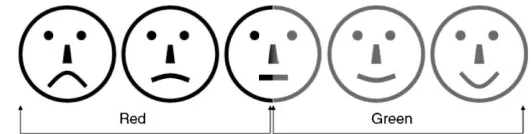
Adults rated the acceptability of sentences using a 7-point Likert scale. Children used a 400 5-point ‘‘smiley face’’ scale (see Figure 1). Details of this procedure can be found in
[image:11.482.105.371.559.626.2]Ambridge et al. (2008) and Ambridge (2011). In brief, children indicate the perceived degree of (un)acceptability by placing a red or green counter on a particular face. Nine training sentences containing correct past-tense forms and overgeneralisation errors (e.g.,Lisa ate/*eated the ice cream) were used to train participants in the appropriate 405 use of the scale.
Statistical predictors
Two corpora were used to derive the statistical predictors: the (adult!adult) British National Corpus (subdivided into all texts and spoken only) and the child-directed-speech portion of the post-Manchester Corpus (Rowland & Theakston, 2009). As 410 both corpora are tagged for part-of-speech categories, the counts for the entrenchment
predictor*the raw number of VERB uses of each verb*were extracted automatically (then log N#1 transformed).5 Two additional modifications were necessary. The entrenchment hypothesis predicts that the higher the frequency of a particular verb in all attested constructions, the stronger the inference that the use of this verb in a 415 particular target construction is not allowed,unless it has been independently attested.
Therefore, for any verb attested in both the PO- and DO-dative constructions, frequency was set to zero. Second, the sign of the log-transformed entrenchment predictor was set to positive for verbs that appear in the corpus in PO-datives only, and negative for verbs that appear in the corpus in DO-datives only. This is because 420 the outcome variable (difference score) is positive for verbs that participants consider
to be more acceptable in the PO- than DO-dative and negative for verbs that display the opposite pattern.
The pre-emption measure was calculated in exactly the same way, except that the counts were based on the number of occurrences of each verb in the relevant dative 425 construction as opposed to overall. For any given corpus, the entrenchment and
pre-emption predictors are inevitably highly correlated, as the latter counts are a subset of the former (for the present extended set in the BNC
AQ9 , the correlation is
r"0.90,pB.001). In order to allow us to investigate whether entrenchment and
pre-emption explain independent variance, we created an entrenchment measure 430 residualised against pre-emption, and vice versa. Because neither the BNC nor the
post-Manchester corpus is syntactically parsed (and the largest parsed corpus, ICE-GB
AQ10 , is too small for our purposes, with 227 of the 301 verbs unattested, as opposed to just 10 in the BNC) counts were extracted using a computer program custom written by the final author (see Section A of the online supplementary 435 material for details).
Semantic predictors
A separate group of 15 adults rated the extent to which they considered each verb to exhibit each of 18 semantic predictors relevant to Pinker’s (1989, p. 82) broad-range rules for the 2 constructions and each of 14 semantic predictor relevant to Pinker’s 440 (1989, pp. 110!113) narrow-range classes (see Section B of the online supplementary material for details for details). A written questionnaire was used, with the verbs and properties presented in a different pseudo-random order for each participant. Participants provided their ratings using a 9-point numerical scale, and were paid £50. The aim of collecting these ratings was not to test the psychological validity of the 445 particular broad- and narrow-range classes proposed by Pinker (1989). As Pinker
points out, the make-up of individual classes is of no particular theoretical importance, and the classifications posited are not intended to be exhaustive or definitive. Rather, the aim was to investigate whether participants’ grammaticality judgements are sensitive to the types of feature posited under the semantic verb class
5The log transformation of frequency counts is standard practice in psycholinguistics as these data
450 hypothesis, and*more generally*any account under which semantics plays a key role in restricting argument-structure generalisations. This means that it would not have been appropriate to use narrow-range semantic class membership as a categorical predictor. Furthermore, as an anonymous reviewer noted, to do so would be to introduce an unacceptable degree of circularity, since both Pinker’s and Levin’s classes 455 were explicitly formed on the basis of verbs’ alternation behaviour as well as
semantics.
Morphophonological predictors
Following Green (1974) and Oehrle (1976), Pinker (1989) argues that, for at least some semantic classes, verbs that are of Latinate origin are restricted to the PO-dative 460 construction, with DO-datives ungrammatical (e.g., John suggested the trip to Sue;
*John suggested Sue the trip). The claim is that when Latinate French words entered the English language, they brought with them their argument-structure ([AGENT] [VERB] [THEME]a`/to[RECIPIENT]), and resisted assimilation into the argument-structure pattern exhibited by native Germanic verbs such asgive([AGENT] [VERB] 465 [RECIPIENT] [THEME]). The claim is not that speakers are sensitive to etymology
per se. Latinate verbs can be identified by their stress pattern (disyllabic with second-syllable stress [e.g., donate] or trisyllabic [contribute]), and perhaps by their use of certain morphemes (e.g., -ify, -ate), whereas native Germanic verbs are mostly monosyllabic (e.g., give,tell) or have first-syllable stress.
470 Despite some scepticism in the recent literature (e.g., Felbaum, 2005), there is
evidence that this constraint is psychologically real for adult English speakers. Ambridge et al. (2012)
AQ11 showed that adults (but not children aged 9!10 or 5!6) rejected as ungrammatical DO-dative uses of novel Latinate verbs (e.g.,Bart orgulated Marge the package) but not novel native-like verbs (e.g., Bart naced Marge the package). 475 Because this previous study found no evidence that children have acquired this
constraint, and because the core set of verbs rated by children was necessarily of a limited size, the present study did not systematically investigate the Latinate morphophonological constraint for children. However, in order to investigate, and control for, any such effect in the extended verb set rated by adults, we included a 480 measure of Latinate status. Classifying verbs objectively is not straightforward, as
some Latinate verbs have Anglicised stress patterns (e.g., promise), and the relative contribution of stress and Latinate-sounding morphemes (e.g., -ify, -ate) is unclear. We, therefore, asked the adults who completed the semantic rating task to additionally rate each verb for the extent to which:
485 . The verb is Latinate (a Latinate verb is a verb that comes from Latin, usually via
a language such as French or Italian; examples includeinvestigate,conceal, and deceive).
. The verb is formal, ‘‘classical’’ or ‘‘learned’’ (this means that the verb is one that would generally be used in formal written speech, as opposed to everyday casual 490 speech. For example, conceal is a relatively formal version that can be used in
place of the more everyday verb hide).
495
RESULTS
The aim of the present study was to investigate the extent to which measures of entrenchment (raw number of verb uses), pre-emption (number of PO- vs DO-verb uses), broad- and narrow-range semantic properties, and morphophonological properties (all obtained from independent adult raters) could predict participants’ 500 preference for PO- over DO-dative verb uses. This prediction was tested using a series
of linear mixed effects regression (lmer) models in the statistics packageR.
Before these analyses were conducted, principal components analysis (PCA) was used to condense the 18 broad-range rule predictors (7 relating to the PO-dative; 11 to the DO-dative) into a more manageable number. The Eigenvalue!1 criterion (Kaiser, 505 1960) was used, resulting in the extraction of a single factor relating to the broad-range
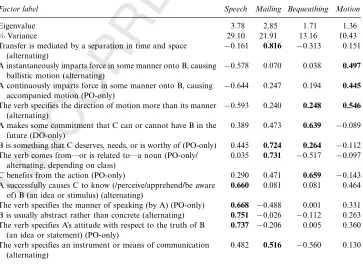
rule for the PO-dative (Eigenvalue"4.11, accounting for 58.67% of total variance) and two factors relating to the broad-range rule for the DO-dative (Eigenvalues"4.68 and 1.65, accounting for 46.82% and 16.54% of variance, respectively). The same method was used to extract four factors relating to the narrow-range rules, as summarised 510 in Table 1, and a single factor relating to the proposed Latinate restriction on the
DO-dative (Eigenvalue"1.96, accounting for 88.01% of variance).
[image:14.482.62.425.362.626.2]All analyses were conducted on difference scores, calculated, for each participant, by subtracting the rating for each DO-dative (e.g.,Homer gave Bart a book) from the rating for its PO equivalent (e.g., Homer gave a book to Bart). This controls for any
TABLE 1
Factors relating to Pinker’s (1989) narrow-range rules extracted using principle components analysis
Factor label Speech Mailing Bequeathing Motion
Eigenvalue 3.78 2.85 1.71 1.36
% Variance 29.10 21.91 13.16 10.43
Transfer is mediated by a separation in time and space (alternating)
$0.161 0.816 $0.313 0.151
A instantaneously imparts force in some manner onto B, causing ballistic motion (alternating)
$0.578 0.070 0.038 0.497
A continuously imparts force in some manner onto B, causing accompanied motion (PO-only)
$0.644 0.247 0.194 0.445
The verb specifies the direction of motion more than its manner (alternating)
$0.593 0.240 0.248 0.546
A makes some commitment that C can or cannot have B in the future (DO-only)
0.389 0.473 0.639 $0.089
B is something that C deserves, needs, or is worthy of (PO-only) 0.445 0.724 0.264 $0.112 The verb comes from*or is related to*a noun (PO-only/
alternating, depending on class)
0.035 0.731 $0.517 $0.097
C benefits from the action (PO-only) 0.290 0.471 0.659 $0.143
A successfully causes C to know (/perceive/apprehend/be aware of) B (an idea or stimulus) (alternating)
0.660 0.081 0.081 0.464
The verb specifies the manner of speaking (by A) (PO-only) 0.668 $0.488 0.001 0.331 B is usually abstract rather than concrete (alternating) 0.751 $0.026 $0.112 0.263 The verb specifies A’s attitude with respect to the truth of B
(an idea or statement) (PO-only)
0.737 $0.206 0.005 0.360
The verb specifies an instrument or means of communication (alternating)
0.482 0.516 $0.560 0.130
515 baseline (dis)preferences participants may have for particular verbs. To test the
predictions under investigation, linear mixed effects regression models were fitted to this difference-score rating data. For every model, participant and verb were included as random effects. As detailed below, adding by-participant random slopes had virtually no effect on thetvalues for the fixed effects and did not improve model fit. 520 Hence they are not included in the main analysis presented. To control for differences
in the scales used by the adults and children, difference scores were converted into z-scores on a participant-by-participant basis. Consequently, the coefficients shown in all results tables are standardised coefficients (i.e., units of standard deviation). The predictor variables were not standardised as it is unclear how frequency counts and 525 semantic ratings can meaningfully be transformed into comparable units.
All verbs (N
"
301 for adults,
N
"
44 for children)
The first analysis was conducted on all ratings combined. That is, it included data from both adults (for the extended set of 301 verbs) and children (for the core set of 44 verbs). Uneven data sets (caused here by the presence of items rated by adults only) 530 do not constitute a problem for linear mixed effects regression analysis. In order to
investigate the independent contributions of (1) broad-range rules, (2) narrow-range semantic classes, (3) the Latinate morphophonological constraint, (4) pre-emption, and (5) entrenchment, we started with a single-predictor model and investigated whether adding each subsequent predictor yielded improved coverage of the data. For 535 the optimal model, we then investigated whether adding (1) by-participant random
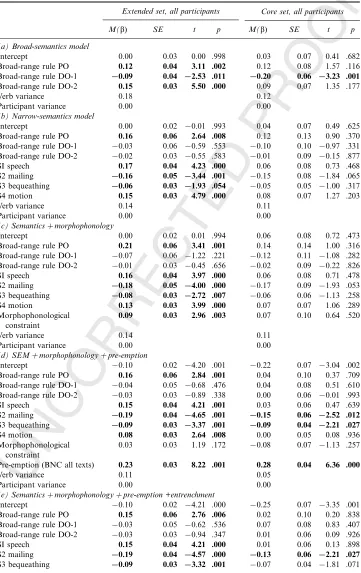
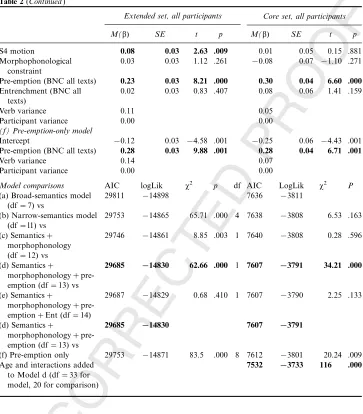
slopes for each effect (see Barr, Levy, Scheepers, & Tiley, submitted) and (2) interaction terms improved model fit. Models were compared using likelihood ratio tests, where lower log likelihood and Akaike’s Information Criterion (AIC) values indicate better model fit. The model comparison procedure is described in detail in Section C of the 540 online supplementary material, with the models shown in Table 2 (left hand columns)
The optimal model (Table 2d) included one of the broad-range semantic predictors (the broad-range rule for the PO-dative), all four of the narrow-range predictors and emption (or entrenchment; both explain largely the same variance, though the pre-emption predictor slightly more; see Section C of the online supplementary material 545 for details). In general, adding random slopes and interactions did not improve the
model (see Section C of the online supplementary material for details). The morphophonological predictor did not explain a significant amount of variance in this model, though it did if entered before pre-emption (again, see Section C of the online supplementary material for details), suggesting that it may initially be learned 550 on a verb-by-verb basis.
The first narrow-range predictor, speech, was derived primarily from semantic features thought to characterise PO-only classes (e.g., manner of speaking), but also some alternating classes (e.g., A successfully causes C to know B). Thus, since the dependent measure reflects participants’ preference for PO- over DO-dative uses, one 555 would expect this predictor to have a significant positive correlation with the outcome
measure. This pattern was observed. Similarly, the narrow-range predictormotionwas derived from alternating classes and from the PO-only class ‘‘A continuously imparts force in some manner onto B, causing accompanied motion’’, and hence was also significantly correlated with participants’ preference for PO- over DO-uses. The 560 bequeathing predictor was something of a mixed bag, with loadings from both
TABLE 2
Results for all participants combined; full and core set AQ30
Extended set, all participants Core set, all participants
M(b) SE t p M(b) SE t p
(a) Broad-semantics model
Intercept 0.00 0.03 0.00 .998 0.03 0.07 0.41 .682
Broad-range rule PO 0.12 0.04 3.11 .002 0.12 0.08 1.57 .116
Broad-range rule DO-1 !0.09 0.04 !2.53 .011 !0.20 0.06 !3.23 .001
Broad-range rule DO-2 0.15 0.03 5.50 .000 0.09 0.07 1.35 .177
Verb variance 0.18 0.12
Participant variance 0.00 0.00
(b) Narrow-semantics model
Intercept 0.00 0.02 $0.01 .993 0.04 0.07 0.49 .625
Broad-range rule PO 0.16 0.06 2.64 .008 0.12 0.13 0.90 .370
Broad-range rule DO-1 $0.03 0.06 $0.59 .553 $0.10 0.10 $0.97 .331
Broad-range rule DO-2 $0.02 0.03 $0.55 .583 $0.01 0.09 $0.15 .877
SI speech 0.17 0.04 4.23 .000 0.06 0.08 0.73 .468
S2 mailing !0.16 0.05 !3.44 .001 $0.15 0.08 $1.84 .065
S3 bequeathing !0.06 0.03 !1.93 .054 $0.05 0.05 $1.00 .317
S4 motion 0.15 0.03 4.79 .000 0.08 0.07 1.27 .203
Verb variance 0.14 0.11
Participant variance 0.00 0.00
(c) Semantics#morphophonology
Intercept 0.00 0.02 0.01 .994 0.06 0.08 0.72 .473
Broad-range rule PO 0.21 0.06 3.41 .001 0.14 0.14 1.00 .316
Broad-range rule DO-1 $0.07 0.06 $1.22 .221 $0.12 0.11 $1.08 .282
Broad-range rule DO-2 $0.01 0.03 $0.45 .656 $0.02 0.09 $0.22 .826
SI speech 0.16 0.04 3.97 .000 0.06 0.08 0.71 .478
S2 mailing !0.18 0.05 !4.00 .000 $0.17 0.09 $1.93 .053
S3 bequeathing !0.08 0.03 !2.72 .007 $0.06 0.06 $1.13 .258
S4 motion 0.13 0.03 3.99 .000 0.07 0.07 1.06 .289
Morphophonological constraint
0.09 0.03 2.96 .003 0.07 0.10 0.64 .520
Verb variance 0.14 0.11
Participant variance 0.00 0.00
(d) SEM#morphophonology#pre-emption
Intercept $0.10 0.02 $4.20 .001 $0.22 0.07 $3.04 .002
Broad-range rule PO 0.16 0.06 2.84 .001 0.04 0.10 0.37 .709
Broad-range rule DO-1 $0.04 0.05 $0.68 .476 0.04 0.08 0.51 .610
Broad-range rule DO-2 $0.03 0.03 $0.89 .338 0.00 0.06 $0.01 .993
SI speech 0.15 0.04 4.21 .001 0.03 0.06 0.47 .639
S2 mailing !0.19 0.04 !4.65 .001 !0.15 0.06 !2.52 .012
S3 bequeathing !0.09 0.03 !3.37 .001 !0.09 0.04 !2.21 .027
S4 motion 0.08 0.03 2.64 .008 0.00 0.05 0.08 .936
Morphophonological constraint
0.03 0.03 1.19 .172 $0.08 0.07 $1.13 .257
Pre-emption (BNC all texts) 0.23 0.03 8.22 .001 0.28 0.04 6.36 .000
Verb variance 0.11 0.05
Participant variance 0.00 0.00
(e) Semantics#morphophonology#pre-emption +entrenchment
Intercept $0.10 0.02 $4.21 .000 $0.25 0.07 $3.35 .001
Broad-range rule PO 0.15 0.06 2.76 .006 0.02 0.10 0.20 .838
Broad-range rule DO-1 $0.03 0.05 $0.62 .536 0.07 0.08 0.83 .407
Broad-range rule DO-2 $0.03 0.03 $0.94 .347 0.01 0.06 0.09 .926
SI speech 0.15 0.04 4.21 .000 0.01 0.06 0.13 .898
S2 mailing !0.19 0.04 !4.57 .000 !0.13 0.06 !2.21 .027
predictor showed only a small (!0.09) negative correlation with the outcome variable, indicating a slight preference for DO- over PO-uses. Surprisingly, the mailing 565 predictor, derived primarily from alternating (e.g., Transfer is mediated by a
separation in time and space) and PO-only classes (B is something that C deserves, needs, or is worthy of), was also associated with a significant preference for DO- over PO-dative uses.
This pattern would seem to suggest that Pinker’s (1989) proposal is accurate with 570 regard to the types of fine-grained semantic features that determine verbs’ dative
argument-structure properties, but is inaccurate in its characterisation of precisely how they do so. One possibility is that the narrow-range classes proposed need to be redrawn. This would have no particular consequences for the theory; indeed Pinker (1989) acknowledges that the class assignments proposed are unlikely to be definitive. 575 Another possibility, however, is that narrow-range classes are not quite the right way
[image:17.482.61.424.58.472.2]to characterise verbs’ behaviour. This is an issue to which we return in the discussion. Table 2(Continued)
Extended set, all participants Core set, all participants
M(b) SE t p M(b) SE t p
S4 motion 0.08 0.03 2.63 .009 0.01 0.05 0.15 .881
Morphophonological constraint
0.03 0.03 1.12 .261 $0.08 0.07 $1.10 .271
Pre-emption (BNC all texts) 0.23 0.03 8.21 .000 0.30 0.04 6.60 .000
Entrenchment (BNC all texts)
0.02 0.03 0.83 .407 0.08 0.06 1.41 .159
Verb variance 0.11 0.05
Participant variance 0.00 0.00
(f) Pre-emption-only model
Intercept $0.12 0.03 $4.58 .001 $0.25 0.06 $4.43 .001
Pre-emption (BNC all texts) 0.28 0.03 9.88 .001 0.28 0.04 6.71 .001
Verb variance 0.14 0.07
Participant variance 0.00 0.00
Model comparisons AIC logLik x2 p df AIC LogLik x2 P
(a) Broad-semantics model (df"7) vs
29811 $14898 7636 $3811
(b) Narrow-semantics model (df"l1) vs
29753 $14865 65.71 .000 4 7638 $3808 6.53 .163
(c) Semantics# morphophonology (df"12) vs
29746 $14861 8.85 .003 1 7640 $3808 0.28 .596
(d) Semantics#
morphophonology# pre-emption (df"13) vs
29685 !14830 62.66 .000 1 7607 !3791 34.21 .000
(e) Semantics#
morphophonology# pre-emption#Ent (df"14)
29687 $14829 0.68 .410 1 7607 $3790 2.25 .133
(d) Semantics#
morphophonology# pre-emption (df"13) vs
29685 !14830 7607 !3791
(f) Pre-emption only 29753 $14871 83.5 .000 8 7612 $3801 20.24 .009
Age and interactions added to Model d (df"33 for model, 20 for comparison)
In summary, when looking at all data combined (i.e., from 301 verbs for adults, 44 for children), optimal coverage is achieved by a model that contains broad- and narrow-range semantic predictors and pre-emption/entrenchment, but not the 580 hypothesised morphophonological Latinate constraint.
Core set (44 verbs, all participants)
The observed finding of significant effects of verb semantics and pre-emption/ entrenchment raises the question of whether all these predictors are important at all ages, or whether their relative importance differs with age. As a first step towards 585 investigating this issue, we reran the analysis above, this time including only the core
set of verbs (N"44) rated by all age groups, and investigated whether adding age and its associated interaction terms to the model would yield significantly improved coverage (see rightmost columns of Table 2). Details of this analysis are presented in Section D of the online supplementary material. The important point for our purposes 590 is simply that adding the interactions of age by each of the predictor variables
significantly improved model coverage, with 11 significant interactions observed. Thus, there is ample evidence to suggest that the influence of these predictors changes with age. To investigate this pattern of development, we conducted the analysis described above for each age group separately.
595
By-age analyses (core set, 44 verbs)
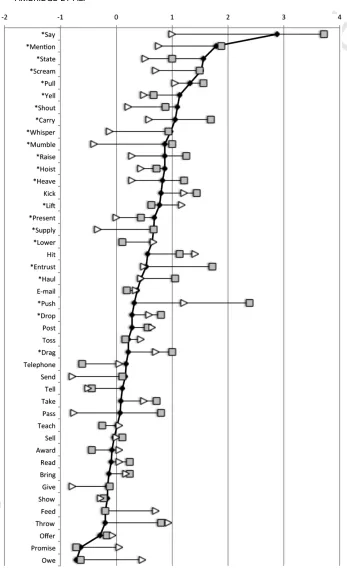
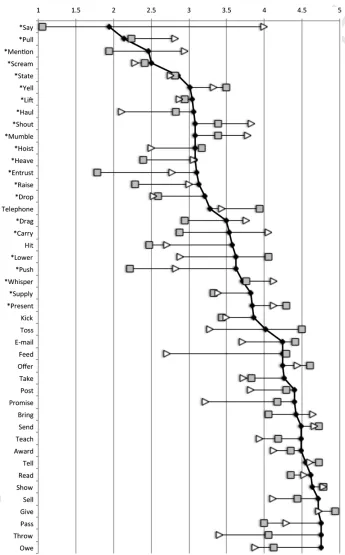
Figures 2 and 3, respectively, illustrate (1) the mean preference for PO- over DO-dative sentences (difference scores) and (2) the mean rating for DO-dative sentences, by age group and verb, shown in the original units (points on the 5-point scale). Note that the core set includes both PO-only verbs and alternating verbs, but no DO-only verbs. 600 The plots are arranged so that the acceptability of DO-dative uses, as rated by adults* (1) relative to PO-dative uses and (2) in absolute terms*increases travelling downwards. Verbs that are PO-only (non-alternating) according to Pinker (1989) and Levin (1993) are marked with an asterisk (*). All except three (push,drop, anddrag) are in the top half of Figure 2, suggesting that these classifications are largely accurate. Visual inspection of 605 Figure 2 suggests that, taking adult judgements as a reference, the 5- to 6-year-olds*but not the 9- to 10-year-olds*are making judgements that correspond to overgeneralisa-tion errors. That is they display lower difference scores than adults for non-alternating verbs, but not for alternating verbs. A 2%3 (verb type%age) by-items ANOVA yielded a significant interaction [F(2, 84)"10.75, pB.001, g2
p¼:20], confirming this pattern.
610 Planned comparisons revealed no by-age differences for the alternating verbs, but
confirmed that, for the non-alternating verbs (using, for this analysis only, the Pinker/ Levin classifications), mean difference scores were significantly lower for 5- to 6-year-olds (M"0.49, SE"0.11) than for both 9- to 10-year-olds (M"1.22, SE"0.15; pB.001) and adults (M"0.97, SE"0.10, p".001). Unexpectedly, mean difference
615 scores were slightly greater for 9- to 10-year-olds than for adults (M"0.97,SE"0.10,
p".03), indicating that these older children were*if anything*hypersensitive to
overgeneralisation errors (or perhaps more willing to use the ends of the scale). Importantly, the finding that the younger children’s judgements did not differ from those of older children or adults for the alternating verbs allows us to be confident that 620 these children were using the scale in a reasonably adult-like way, and, thus, that the
overgeneralisation errors in production, for example, assigning ungrammatical DO-uses 625 ofsay,pull,mention,yell,shout, andmumbleratings at least 0.5 points higher than those
given by adults. A statistical analysis investigating the roles of the semantic and statistical predictors in these developmental changes is presented in a section that follows the by-age analyses presented here.
For these by-age analyses, the intention had been to remove any semantic predictor 630 that loaded primarily on DO-only classes, which were not included in this core set.
However, there was no semantic predictor of this type, presumably because only one of the original semantic features related to DO-only verbs (A makes some commitment that C can or cannot have B in the future). The morphophonology predictor was not included in this analysis, as native/Latinate status was not systematically manipulated 635 in the core set (and a preliminary analysis found that it did not explain any variance
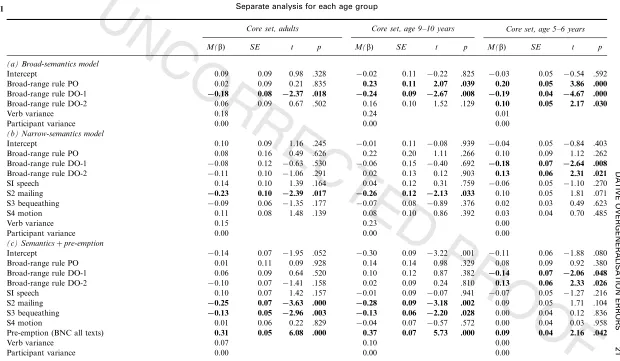
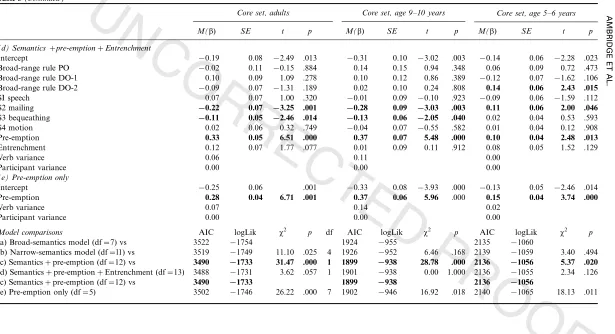
for any age group). The by-age analyses are shown in Table 3.
Adults (core set only)
For adults (see Table 3, first column), the optimal model (c) included the narrow-range semantic predictors (of which two,mailingandbequeathing, were significant) and pre-640 emption/entrenchment. As for the main analysis, whichever of the two predictors is
entered first explains significant variance, with the second adding no significant improvement (x2"0.68,p".40, when adding the residualised pre-emption predictor to an entrenchment-only model), though, in this case, entrenchment is closer than pre-emption to explaining significant additional variance when entered as a residualised 645 predictor (p".06 for the model comparisons). The broad-range semantic predictors were no longer significant once the narrow-range predictors were added to the model. However, even if the broad-range rules add nothing to the statistical model, this is not to say that they can be omitted from Pinker’s (1989) theoretical account. Under this account, the broad-range rules specify the types of semantic features to which the 650 narrow-range rules are sensitive. For example, the broad-range rule for the DO-dative
specifies possession transfer, and the narrow-range classes different extents, kinds or manners of transfer. Thus, if we were to take a purely data-driven approach and omit the broad-range rules, we would be left with no explanation of why the learning mechanism that forms narrow-range classes is sensitive only to certain features. In the 655 general discussion, we will outline an account that dispenses with the distinction
between broad- and narrow-range semantics, and that hence renders moot the question of the relative contributions of each. Although numerous interactions were observed, they do not affect the observation that the broad- and narrow-range semantic classes, as well as entrenchment/pre-emption are important predictive factors 660 for adults. Thus, we reserve discussion of these interactions (and the effect of adding
by-participant slopes) for the online supplementary material (Section E and Table S1 of the online supplementary material).
Age 9
!
10 (core set only)
This analysis was exactly equivalent to the adult analysis described above. An 665 alternative version of the analysis used entrenchment and pre-emption counts
Core set, adults Core set, age 9!10 years Core set, age 5!6 years
M(b) SE t p M(b) SE t p M(b) SE t p
(a) Broad-semantics model
Intercept 0.09 0.09 0.98 .328 $0.02 0.11 $0.22 .825 $0.03 0.05 $0.54 .592
Broad-range rule PO 0.02 0.09 0.21 .835 0.23 0.11 2.07 .039 0.20 0.05 3.86 .000
Broad-range rule DO-1 !0.18 0.08 !2.37 .018 !0.24 0.09 !2.67 .008 !0.19 0.04 !4.67 .000
Broad-range rule DO-2 0.06 0.09 0.67 .502 0.16 0.10 1.52 .129 0.10 0.05 2.17 .030
Verb variance 0.18 0.24 0.01
Participant variance 0.00 0.00 0.00
(b) Narrow-semantics model
Intercept 0.10 0.09 1.16 .245 $0.01 0.11 $0.08 .939 $0.04 0.05 $0.84 .403
Broad-range rule PO 0.08 0.16 0.49 .626 0.22 0.20 1.11 .266 0.10 0.09 1.12 .262
Broad-range rule DO-1 $0.08 0.12 $0.63 .530 $0.06 0.15 $0.40 .692 !0.18 0.07 !2.64 .008
Broad-range rule DO-2 $0.11 0.10 $1.06 .291 0.02 0.13 0.12 .903 0.13 0.06 2.31 .021
SI speech 0.14 0.10 1.39 .164 0.04 0.12 0.31 .759 $0.06 0.05 $1.10 .270
S2 mailing !0.23 0.10 !2.39 .017 !0.26 0.12 !2.13 .033 0.10 0.05 1.81 .071
S3 bequeathing $0.09 0.06 $1.35 .177 $0.07 0.08 $0.89 .376 0.02 0.03 0.49 .623
S4 motion 0.11 0.08 1.48 .139 0.08 0.10 0.86 .392 0.03 0.04 0.70 .485
Verb variance 0.15 0.23 0.00
Participant variance 0.00 0.00 0.00
(c) Semantics#pre-emption
Intercept $0.14 0.07 $1.95 .052 $0.30 0.09 $3.22 .001 $0.11 0.06 $1.88 .080
Broad-range rule PO 0.01 0.11 0.09 .928 0.14 0.14 0.98 .329 0.08 0.09 0.92 .380
Broad-range rule DO-1 0.06 0.09 0.64 .520 0.10 0.12 0.87 .382 !0.14 0.07 !2.06 .048
Broad-range rule DO-2 $0.10 0.07 $1.41 .158 0.02 0.09 0.24 .810 0.13 0.06 2.33 .026
SI speech 0.10 0.07 1.42 .157 $0.01 0.09 $0.07 .941 $0.07 0.05 $1.27 .216
S2 mailing !0.25 0.07 !3.63 .000 !0.28 0.09 !3.18 .002 0.09 0.05 1.71 .104
S3 bequeathing !0.13 0.05 !2.96 .003 !0.13 0.06 !2.20 .028 0.00 0.04 0.12 .836
S4 motion 0.01 0.06 0.22 .829 $0.04 0.07 $0.57 .572 0.00 0.04 0.03 .958
Pre-emption (BNC all texts) 0.31 0.05 6.08 .000 0.37 0.07 5.73 .000 0.09 0.04 2.16 .042
Verb variance 0.07 0.10 0.00
Participant variance 0.00 0.00 0.00
DATIVE
OVERGENERALISATION
ERRORS
21
{PLCP}articles/PL
CP738300/PLCP_A_738300_O
.3d[x]
15-10-2012
[image:22.709.51.671.67.428.2]M(b) SE t p M(b) SE t p M(b) SE t p
(d) Semantics#pre-emption#Entrenchment
Intercept $0.19 0.08 $2.49 .013 $0.31 0.10 $3.02 .003 $0.14 0.06 $2.28 .023
Broad-range rule PO $0.02 0.11 $0.15 .884 0.14 0.15 0.94 .348 0.06 0.09 0.72 .473
Broad-range rule DO-1 0.10 0.09 1.09 .278 0.10 0.12 0.86 .389 $0.12 0.07 $1.62 .106
Broad-range rule DO-2 $0.09 0.07 $1.31 .189 0.02 0.10 0.24 .808 0.14 0.06 2.43 .015
SI speech 0.07 0.07 1.00 .320 $0.01 0.09 $0.10 .923 $0.09 0.06 $1.59 .112
S2 mailing !0.22 0.07 !3.25 .001 !0.28 0.09 !3.03 .003 0.11 0.06 2.00 .046
S3 bequeathing !0.11 0.05 !2.46 .014 !0.13 0.06 !2.05 .040 0.02 0.04 0.53 .593
S4 motion 0.02 0.06 0.32 .749 $0.04 0.07 $0.55 .582 0.01 0.04 0.12 .908
Pre-emption 0.33 0.05 6.51 .000 0.37 0.07 5.48 .000 0.10 0.04 2.48 .013
Entrenchment 0.12 0.07 1.77 .077 0.01 0.09 0.11 .912 0.08 0.05 1.52 .129
Verb variance 0.06 0.11 0.00
Participant variance 0.00 0.00 0.00
(e) Pre-emption only
Intercept $0.25 0.06 .001 $0.33 0.08 $3.93 .000 $0.13 0.05 $2.46 .014
Pre-emption 0.28 0.04 6.71 .001 0.37 0.06 5.96 .000 0.15 0.04 3.74 .000
Verb variance 0.07 0.14 0.02
Participant variance 0.00 0.00 0.00
Model comparisons AIC logLik x2 p df AIC logLik x2 p AIC logLik x2 p
(a) Broad-semantics model (df"7) vs 3522 $1754 1924 $955 2135 $1060
(b) Narrow-semantics model (df"l1) vs 3519 $1749 11.10 .025 4 1926 $952 6.46 .168 2139 $1059 3.40 .494
(c) Semantics#pre-emption (df"12) vs 3490 !1733 31.47 .000 1 1899 !938 28.78 .000 2136 !1056 5.37 .020
(d) Semantics#pre-emption#Entrenchment (df"13) 3488 $1731 3.62 .057 1 1901 $938 0.00 1.000 2136 $1055 2.34 .126
(c) Semantics#pre-emption (df"12) vs 3490 !1733 1899 !938 2136 !1056
(e) Pre-emption only (df"5) 3502 $1746 26.22 .000 7 1902 $946 16.92 .018 2140 $1065 18.13 .011
ET
AL.
{PLCP}articles/PL
CP738300/PLCP_A_738300_O
.3d[x]
15-10-2012
[image:23.709.60.675.69.403.2]corpus more than compensates for any lack of representativeness. The same is true for the analysis of the younger children’s data presented in the subsequent section.
The results of this analysis are shown in the middle columns of Table 3. The results were almost identical to those of the adults, with significant effects observed for two 675 narrow-range predictors (mailingandbequeathing) and pre-emption (indeed, theband
tvalues are very similar across the two age groups). The only major difference is that, whilst adding the residualised entrenchment predictor to a model including pre-emption explained precisely no additional variance (x2"0.00, p"1, see Table 3), adding the residualised pre-emption predictor to a model including entrenchment 680 yielded a significant improvement (x2"5.30, p".02). Thus, it may be that for the older children, pre-emption is slightly more important than entrenchment, with the reverse true for adults. However, given the fact that the two measures are so highly correlated (r"0.90, pB.001), it is probably sensible to conclude no more than that both predictors are important for both age groups. Finally, it was again verified that 685 removing the semantic predictors for a pre-emption-only model yielded a significantly
worse fit (see final two rows of Table 3). The effect of adding interactions and random slopes is explored in Section E and Table S1 of the online supplementary material (again, these do not affect our overall conclusions).
Age 5
!
6 (core set only)
690 The younger children (see Table 3, right hand columns) displayed a very different
pattern to that observed for the two older groups. For these children, two of the three broad-range semantic predictors, but none of the four narrow-range semantic predictors, were associated with significant effects. This is precisely the pattern predicted by an account under which children first learn broad-range semantic 695 constraints on the constructions and hone these constraints until relatively late in
childhood (presumably somewhere between 6 and 9 years), such as that of Pinker (1989). There was nothing to choose between pre-emption and entrenchment; whichever predictor was entered first explained a significant proportion of variance, with the other explaining no significant additional variance (x2"0.29,p".59 for the 700 comparison between the entrenchment models with and without residualised
pre-emption). Finally, it was again demonstrated that removing the semantic predictors from the model yielded a significantly worse fit to the data (see final two rows of Table 3). The effect of adding interactions and random slopes is explored in Section E and Table S1 of the online supplementary material (again, these do not affect our 705 overall conclusions).
Developmental analysis
The analysis above investigates the roles of the broad- and narrow-range semantic predictors, entrenchment and pre-emption at three snapshots of development, but does not directly investigate their role in development. For the final analysis, we, 710 therefore, calculated difference-change scores by calculating the mean by-verb
difference score for each age group and subtracting the scores given by (1) 5- to year-olds from 9- to 10-year-olds, (2) 9- to 10-year-olds from adults, and (3) 5- to 6-year-olds from adults. We then ran by-items regression analyses to investigate how the broad- and narrow-range semantic predictors, entrenchment, and pre-emption predict 715 these developmental changes in participants’ ratings (as measured by the
Analysis of developmental-change scores
AQ32
Change scores 5!6 to 9!5-year-olds
Change scores 9- to 10-year-olds to adults
Change scores 5- to 6-year-olds to adults
M SE t p M SE t p M SE t p
(a) Broad-semantics model
Intercept 0.33 0.16 2.08 .044 $0.01 0.10 $0.09 .932 0.32 0.14 2.30 .027
Broad-range rule PO 0.05 0.16 0.29 .770 !0.35 0.10 !3.46 .001 !0.30 0.14 !2.13 .039
Broad-range rule DO-1 $0.06 0.13 $0.42 .677 0.13 0.08 1.58 .122 0.08 0.12 0.65 .518
Broad-range rule DO-2 0.11 0.15 0.73 .472 $0.17 0.09 $1.86 .070 $0.07 0.13 $0.51 .615
(b) Narrow-semantics model
(Intercept) 0.38 0.14 2.74 .009 $0.02 0.10 $0.19 .853 0.36 0.12 3.15 .003
Broad-range rule PO 0.24 0.25 0.96 .342 $0.26 0.18 $1.42 .165 $0.01 0.21 $0.07 .946
Broad-range rule DO-1 0.20 0.20 1.00 .325 0.00 0.14 0.04 .972 0.20 0.16 1.24 .224
Broad-range rule DO-2 $0.18 0.17 $1.11 .275 $0.20 0.12 $1.67 .103 !0.38 0.14 !2.80 .008
SI speech 0.19 0.16 1.24 .224 0.14 0.11 1.21 .233 0.33 0.13 2.55 .015
S2 mailing !0.61 0.16 !3.93 .000 0.07 0.11 0.61 .548 !0.55 0.13 !4.22 .000
S3 bequeathing $0.14 0.10 $1.37 .178 $0.02 0.07 $0.26 .796 $0.16 0.08 $1.89 .068
S4 motion 0.07 0.12 0.54 .595 0.04 0.09 0.50 .618 0.11 0.10 1.09 .285
(c) Semantics#pre-emption
Intercept 0.08 0.14 0.54 .591 0.07 0.12 0.63 .531 0.15 0.12 1.22 .230
Broad-range rule PO 0.16 0.21 0.75 .460 $0.23 0.18 $1.29 .206 $0.07 0.19 $0.39 .702
Broad-range rule DO-1 0.37 0.17 2.14 .039 $0.05 0.14 $0.32 .748 0.32 0.15 2.12 .041
Broad-range rule DO-2 $0.18 0.14 $1.27 .213 $0.20 0.12 $1.72 .095 $0.38 0.12 $3.08 .004
SI speech 0.15 0.13 1.11 .276 0.15 0.11 1.36 .184 0.30 0.12 2.56 .015
S2 mailing !0.64 0.13 !4.84 .000 0.07 0.11 0.68 .504 !0.56 0.12 !4.85 .000
S3 bequeathing !0.20 0.09 !2.32 .026 0.00 0.07 0.00 .997 !0.20 0.08 !2.63 .013
S4 motion $0.06 0.11 $0.57 .575 0.08 0.09 0.91 .367 0.02 0.10 0.23 .818
Pre-emption (BNC all texts) 0.39 0.10 4.01 .000 $0.12 0.08 $1.45 .157 0.27 0.08 3.16 .003
ET
AL.
{PLCP}articles/PL
CP738300/PLCP_A_738300_O
.3d[x]
15-10-2012
[image:25.709.61.672.88.408.2]M SE t p M SE t p M SE t p
(d) Semantics#pre-emption#Entrenchment
(Intercept) 0.11 0.15 0.78 .441 0.05 0.14 0.40 .69 0.14 0.13 1.09 .284
Broad-range rule PO 0.19 0.22 0.86 .396 $0.24 0.18 $1.28 .21 $0.08 0.19 $0.41 .687
Broad-range rule DO-1 0.33 0.18 1.84 .074 $0.03 0.15 $0.22 .82 0.33 0.16 2.08 .045
Broad-range rule DO-2 $0.19 0.14 $1.33 .192 $0.2 0.12 $1.70 .10 !0.38 0.12 !3.02 .005
SI speech 0.18 0.14 1.29 .207 0.15 0.12 1.33 .19 0.29 0.12 2.40 .022
S2 mailing !0.66 0.14 !4.91 .000 0.06 0.11 0.56 .58 !0.56 0.12 !4.61 .000
S3 bequeathing !0.22 0.09 !2.47 .019 $0.02 0.07 $0.22 .83 !0.20 0.08 !2.44 .020
S4 motion $0.07 0.11 $0.61 .544 0.06 0.09 0.69 .50 0.02 0.10 0.24 .811
Pre-emption 0.38 0.10 3.91 .000 $0.04 0.05 $0.80 .43 0.27 0.09 3.12 .004
Entrenchment $0.12 0.13 $0.90 .377 0.03 0.12 0.22 .831
(e) Pre-emption only
Intercept 0.07 0.14 0.48 .635 $0.06 0.10 $0.58 .569 0.01 0.14 0.05 .963
Pre-emption 0.30 0.10 2.95 .005 $0.14 0.08 $1.79 .081 0.16 0.10 1.62 .114
Model comparisons
df SS F p df SS F p df SS F p
(a) Broad-semantics model vs
(b) Narrow-semantics model vs 4.00 7.62 6.03 .001 4.00 1.07 1.22 .321 4.00 7.39 7.37 .000
(c) Semantics#pre-emption vs 1.00 5.03 15.95 .000 1.00 0.47 2.14 .153 1.00 2.43 9.70 .004
(d) Semantics#pre-emption#Ent 1.00 0.25 0.80 .377 1.00 0.37 1.70 .201 1.00 0.01 0.05 .831
(c) Semantics#pre-emption vs
(e) Pre-emption only (df"5) !7.00 !8.97 4.08 .002 $7.00 $3.47 2.22 .056 $7.00 $11.15 6.53 .000
(c) Semantics#pre-emption vs
(c) Semantics#pre-emption#interactions 19.00 7.06 1.52 .203 19.00 4.83 1.36 .271 19.00 5.96 1.95 .091
DATIVE
OVERGENERALISATION
ERRORS
25
CP738300/PLCP_A_738300_O
.3d[x]
15-10-2012
[image:26.709.58.670.77.409.2]