UP
PADOVA
PHRG
Peace Human
Rights Governance
Volume 2, Issue 2, July 2018
Article first published online July 2018
Research Articles
DOI:
10.14658/pupj-phrg-2018-2-1
How to cite:
Landman, T. (2018) ‘Out of the Shadows: Trans-disciplinary Research on Modern Slavery’, Peace Human Rights Governance, 2(2), 143-162.
Out of the Shadows: Trans-disciplinary Research on
Modern Slavery
Out of the Shadows: Trans-disciplinary Research on
Modern Slavery
Todd Landman*
Abstract
This article argues that the phenomenon of modern slavery is underdeveloped
in the international law of human rights, but is akin to many other topics in human rights that have been increasingly the focus of transdisciplinary research. In outlining the research programme of the Rights Lab at the University of
Nottingham, the article discusses the contested nature of modern slavery as a
concept, locates it in international human rights and other international law, and then outlines several ways in which the Rights Lab is researching modern
slavery with a view to contributing to its abolition by 2030. The Rights Lab
work discussed here includes cross-national comparative statistical analysis, the application of geospatial and remote sensing techniques to estimate
potential sites of slavery across different sectors, and techniques for monitoring,
evaluation, and impact assessments of anti-slavery interventions.
Keywords: human trafficking, slavery, servitude, agency, freedom, human rights
* Professor of Political Science, School of Politics and International Relations, Pro-Vice Chancellor, Faculty of Social Sciences; and Executive Director, The Rights Lab University of Nottingham; e-mail: [email protected].
Introduction and Background
Freedom from servitude and the prohibition of slavery are fundamental human rights enshrined in a variety of human rights instruments extending from the 1948 Universal Declaration of Human Rights through the two international covenants and the 1998 Rome Statute for the International Criminal Court. This ‘legalisation’ (Meckled Garcia 2005) of slavery into human rights instruments was preceded by the 1926 Slavery Convention, which has been characterised as the ‘first true international human rights treaty’ (Sieghart 1983, 13). Such legal achievements and developments, however, reflect a much larger social struggle for abolitionism that has occurred over four major historical ‘waves’ of mobilisation, the most recent of which began in the early 1990s and one that focusses on ‘modern’ forms of slavery (Bales 2005, 2007; Bales, Trodd, and Williamson 2009; Wright 2017). And yet, like many other human rights violations, despite these struggles and the many achievements along the journey to abolition, the problem of slavery persists. Estimates of the prevalence of slavery have varied over the past few years, and in 2016 the Walk Free Foundation announced the figure of 45.8 million in its third annual Global Slavery Index (GSI)1. The GSI shows further that this prevalence varies considerably around the world, with higher overall figures in India (18.4 million), China (3.4 million), Pakistan (2.1 million), Bangladesh (1.5 million), and Uzbekistan (1.2 million). The phenomenon is not only isolated to developing or middle income countries, where estimates for the United Kingdom range from 10,000 to 13,000 slaves (see Bales, Hesketh and Silverman 2015) across 17 different categories (Copper et al. 2017), while in Europe, estimates for human trafficking range from fewer than 100 in countries such as Luxembourg, more than 100,000 in Poland and Ukraine, to more than 500,000 in the Russian Federation (Datta and Bales 2013: 827).
As the first social problem to be framed as a human rights issue in the 19th Century, the problem of slavery in all its forms shares many of the same attributes, qualities, and dimensions as other human rights problems. First, fundamentally, slavery involves the question of human dignity and the value of a human being, which under conditions of slavery is reduced to property,
1 The next GSI will be released in July 2018. However, in September 2017, the International
possession, or a subject of control by another that fundamentally denies that person true social and political agency (see Ignatieff 2001)2. Second, there are social, political, economic, and cultural dimensions of slavery that make it a problem in need of transdisciplinary research approaches that bring together theories and methods across a wide range of fields of expertise. Third, the problem of slavery is included in the Sustainable Development Goals (8.7)3 alongside other relevant SDGs, as well as other related human rights, which locates the problem as one of broad international concern in need of urgent redress. Finally, growing public interest in the problem coupled with national legislative anti-slavery acts and other programmes has brought together different communities of scholars and practitioners seeking to combine their knowledge and expertise to help end slavery by 2030.
In order to show how research and advocacy in the area of slavery can be addressed through transdisciplinary research, this paper sets out the main elements of the Rights Lab at the University of Nottingham, the first dedicated large scale research platform on modern slavery that involves over 130 academics working across five faculties and many disciplines. The first section of the paper begins with further explication of the concept of slavery as it is understood legally and through the social construction of norms by slavery scholars, and then how such a conceptualisation maps onto international human rights law. The second section discusses several main areas of interest in which the Rights Lab is conducting its work on slavery, including a strand of work on measurement and analysis of large-scale data sets, the use of geospatial and remote sensing techniques for researching ‘slavery from space,’ and the application of monitoring, evaluation and impact assessment techniques to anti-slavery interventions. The final section provides a series of summary observations and implications for the future of transdisciplinary slavery research and human rights.
1. The Concept of Slavery
There has been an evolution in the concept of slavery that has moved it from a narrow understanding grounded in the kind of slavery practices
2 For Ignatieff (2001: 57), human rights protect agency, by which he means ‘the capacity of
each individual to achieve rational intentions without let or hindrance.’ He argues further that ‘Human rights is a language of individual empowerment, and empowerment for individuals is desirable because when individuals have agency, they can protect themselves against injustice.’
3 SDG target 8.7 calls for the world to ‘[t]ake immediate and effective measures to eradicate
common during the transatlantic slave trade from the middle of the 15th Century to the end of the 19th Century to a newer understanding that
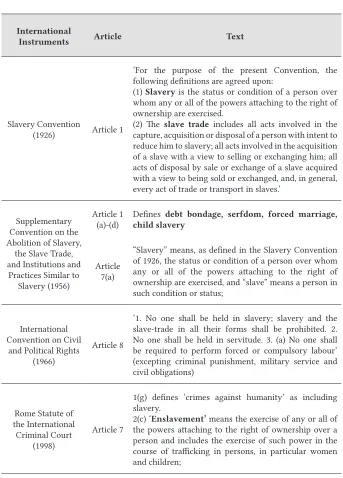
captures the phenomenon in its current forms. The new conceptualisation, however, is not uncontested (see O’Connell Davidson 2015) and involves a combination of strict legal definitions relating to treating people as property and possessions to broader conceptions involving the denial of agency and the inability for people to escape their conditions of enslavement. Article 1(1) of the 1926 Slavery Convention defines slavery as ‘… the status or condition of a person over whom any or all of the powers attaching to the right of ownership are exercised’, where the ideas of ownership and property are given primacy. Additional legal developments have further articulated the definition of slavery, such as the 1956 Supplementary Convention on the Abolition of Slavery, the Slave Trade, and Institutions and Practices Similar to Slavery (Article 7a), the 1998 Rome Statute (Article 7.2.c), which established the International Criminal Court (ICC), the International Tribunal for the Former Yugoslavia (Article 5c), the 2000 United Nations Palermo Protocol on Trafficking in Persons and the 2005 Council of Europe Convention on Action against Trafficking in Human Beings.
Alongside these legal definitions, scholars and practitioners working on modern slavery have developed through consensus what have become known as The Bellagio-Harvard Guidelines on the Legal Parameters of Slavery (2012), which bring these various legal strands together, both in terms of the right to ownership, the powers attached to the right of ownership, and the notion of possession. In focussing on these elements as foundational to slavery, the guidelines emphasise the notion of control and lack of agency for victims of slavery, where different forms of coercion maintain power over individuals (Cockayne et al. 2016; Choi-Fitzpatrick 2017). The key phrase from the guidelines with respect to ownership at the heart of this concept of modern slavery asserts that it constitutes ‘control over a person in such a way as to significantly deprive that person of his or her individual liberty, with the intent of exploitation through the use, management, profit, transfer or disposal of that person.’ This notion of ownership is then linked to possession, which is an extreme form of control that goes far beyond any understanding of reasonable labour relations and management of workers.
and trapped in different power relations, which are reified through broader cultural and structural conditions. The critique argues that attempts to draw boundary conditions for labelling certain practices as slavery have thus far failed, while the rise of ‘new abolitionists’ combatting modern slavery are still nonetheless embedded within market capitalist structures (see Chuang 2015). Liberation in this sense may be illusory, as one form of modern slavery may well be replaced by another. Such a critique asks us to think ‘beyond slavery’ in conceptualising the precarity of many marginalised groups who may well not be called ‘slaves’ per se.
Figure 1: Relative agency, free labour, and modern slavery
Table 1. International and Regional Instruments that make reference to slavery
International
Instruments Article Text
Slavery Convention
(1926) Article 1
‘For the purpose of the present Convention, the
following definitions are agreed upon:
(1) Slavery is the status or condition of a person over
whom any or all of the powers attaching to the right of
ownership are exercised.
(2) The slave trade includes all acts involved in the capture, acquisition or disposal of a person with intent to reduce him to slavery; all acts involved in the acquisition of a slave with a view to selling or exchanging him; all acts of disposal by sale or exchange of a slave acquired with a view to being sold or exchanged, and, in general, every act of trade or transport in slaves.’
Supplementary Convention on the Abolition of Slavery,
the Slave Trade, and Institutions and
Practices Similar to Slavery (1956)
Article 1 (a)-(d)
Defines debt bondage, serfdom, forced marriage,
child slavery
Article 7(a)
“Slavery” means, as defined in the Slavery Convention
of 1926, the status or condition of a person over whom
any or all of the powers attaching to the right of ownership are exercised, and “slave” means a person in
such condition or status;
International Convention on Civil
and Political Rights (1966)
Article 8
‘1. No one shall be held in slavery; slavery and the slave-trade in all their forms shall be prohibited. 2. No one shall be held in servitude. 3. (a) No one shall be required to perform forced or compulsory labour’ (excepting criminal punishment, military service and civil obligations)
Rome Statute of the International
Criminal Court (1998)
Article 7
1(g) defines ‘crimes against humanity’ as including
slavery.
2(c) ‘Enslavement’ means the exercise of any or all of
the powers attaching to the right of ownership over a
person and includes the exercise of such power in the
course of trafficking in persons, in particular women
International
Instruments Article Text
Statute of the International Tribunal for the Former Yugoslavia
Article
5(c) Lists enslavement as a crime against humanity.
Protocol to Prevent, Suppress and Punish
Trafficking in
Persons Especially Women and Children (2000) – ‘Palermo Protocol’
Article 3(a)
“Trafficking in persons” shall mean the recruitment,
transportation, transfer, harbouring or receipt of persons, by means of the threat or use of force or other forms of coercion, of abduction, of fraud, of deception, of the abuse of power or of a position of vulnerability or of the giving or receiving of payments
or benefits to achieve the consent of a person having
control over another person, for the purpose of exploitation. Exploitation shall include, at a minimum, the exploitation of the prostitution of others or other forms of sexual exploitation, forced labour or services, slavery or practices similar to slavery, servitude or the removal of organs
International Convention on the Protection of the Rights of All Migrant Workers and Members of their Families (1990)
Article 11
‘No migrant worker or member of his or her family shall be held in slavery or servitude. 2. No migrant worker or member of his or her family shall be required to perform forced or compulsory labour.’
International Labour Organisation Forced Labour Convention
(No. 29) (1930)
Forced or compulsory labour is:
‘all work or service which is exacted from any person under the threat of a penalty and for which the person
has not offered himself or herself voluntarily.’
Regional
Instruments Article Text
European Convention on Human Rights
(1950)
Article 4
‘1. No one shall be held in slavery or servitude.2. No one shall be required to perform forced or compulsory labour.’
Charter of Fundamental Rights
of the European Union (2000)
Article 5
Prohibition of slavery and forced labour 1. No one shall be held in slavery or servitude.
2. No one shall be required to perform forced or compulsory labour.
3. Trafficking in human beings is prohibited.
Council of Europe Convention on Action against Trafficking in Human Beings (2005) Article 4(1)
“Trafficking in human beings” shall mean the
recruitment, transportation, transfer, harbouring or receipt of persons, by means of the threat or use of force or other forms of coercion, of abduction, of fraud, of deception, of the abuse of power or of a position of vulnerability or of the giving or receiving of payments
or benefits to achieve the consent of a person having
control over another person, for the purpose of exploitation. Exploitation shall include, at a minimum, the exploitation of the prostitution of others or other forms of sexual exploitation, forced labour or services, slavery or practices similar to slavery, servitude or the removal of organs;
American Convention on Human Rights
(1969)
Article 6
‘1. No one shall be subject to slavery or to involuntary servitude, which are prohibited in all their forms, as are
the slave trade and traffic in women.’
African Charter of Human and People’s
Rights (1981)
Article 5
‘Every individual shall have the right to the respect of the dignity inherent in a human being and to the recognition of his legal status. All forms of exploitation and degradation of man, particularly slavery, slave trade, torture, cruel, inhuman or degrading punishment and treatment shall be prohibited.’
Arab Charter on Human Rights
(1994)
Article 31
2. Researching Slavery
There remains much conceptual, legal, and human rights work to be done on slavery, how it is located in a larger rights tradition, and its framing as a criminal justice issue, a human rights problem, and/or a challenge for sustainable development. For its work, the Rights Lab at the University Nottingham adopts the Bellagio-Harvard guidelines as its starting point and is motivated by four main research questions:
How many slaves and where? Why does slavery persist? What works to end it?
What difference does freedom make?
2.1 Measuring Slavery
Since the late 1970s and early 1980s, scholars and practitioners have been developing measures of human rights across their different categories and dimensions using a variety of different kinds of data, including events-based data, standards-events-based data, survey-events-based data, socio-economic and administrative statistics, and ‘big’ data (see Landman and Carvalho, 2009; Landman and Kersten 2015; Landman 2018b). Work on modern slavery has focused on measures of prevalence, expressed as the estimated total number or proportion of slaves in the population. Like estimating the number of extra-judicial killings, arbitrary detentions, or disappearances, counting the number of slaves is fraught with methodological problems, since slavery practices are often unobservable, records of slavery vary, are incomplete, and partially overlap. Through piecing together different records and accounts of slavery, however, it is possible to triangulate data sources, use the degree of overlap between and among sources, and combine different methods to begin to estimate the number of slaves in countries, regions, and the world.
For example, Bales, Hesketh and Silverman (2015) used a collection of different ‘lists’ of victims of slavery in the United Kingdom gathered through different agencies and groups working on combatting slavery and a statistical method of estimation popular for hard to find populations to provide the first estimate of slaves in the UK. The adoption of multiple-systems estimation (MSE), a technique originally devised for estimating fish populations and later applied to a large number of data projects featured in truth commissions around the world (see Ball, Asher, Sulmont and Manrique 2003; Landman 2006, 2013; Landman and Carvalho 2009; Landman 2018a), allowed for an analysis of the degree of overlap between and among these different lists of reported victims of slavery and the ratio of probabilities for them being recorded to estimate that the UK has between 10,000 and 13,000 slaves. Using original estimations of trafficking in Eastern Europe based on household survey data, Datta and Bales (2013) extrapolated from the original calculations to provide prevalence measures for a wider set of European countries. Walk Free, an Australian anti-slavery NGO uses a similar combination of methods and approaches to estimate the prevalence of slavery for 166 countries around the world, and in 2017 joined forces with the International Labour Organisation to work on measuring and combatting slavery.
multivariate explanatory models that incorporate key variables that have proved to be important in explaining the variation in civil and political rights, and so-called ‘physical integrity rights’ (see Poe and Tate 1994; Poe, Tate and Keith 1999). For example, preliminary modelling carried out in the Rights Lab shows that there is a strong positive correlation between the estimated prevalence of slavery and levels of government response, where those countries with more anti-slavery laws, policies, and programmes tend to have a lower levels of slavery prevalence. In addition to government response, the multivariate models reveal that there are statistically significant relationships between slavery prevalence and levels of economic development, democracy, protection of other human rights, and the absence of conflict (see Landman 2018b).
2.2 Slavery from Space
Beyond aggregate measures of slavery prevalence at the country level and the development of macro-explanatory models using quantitative analysis, the Rights Lab has applied geospatial and remote sensing applications from the science of ‘earth observation’ (EO) to create a strand of work known as ‘Slavery from Space’. In January 2016, I met with the scientists at the Nottingham Geospatial Institute (NGI) in the Faculty of Engineering to discuss the ability for earth observation techniques to be applied to human rights issues. I knew that the American Association for the Advancement of Science (AAAS), a pioneer in the application of statistics to human rights (see Ball, Spirer and Spirer 2000), had been using satellite imagery to document cross border conflict, such as the 2008 incursion of Russian troops into Georgia (AAAS 2015). I also knew that the United Nations had teamed up with actor George Clooney and Google to use satellites to sense conflict and gross human rights violations in South Sudan, work that drew on earlier efforts led by AAAS and Amnesty International (Spotts 2010). Coupled with the development of the Rights Lab and its focus on modern slavery, colleagues from the NGI joined forces with colleagues from the School of Geography in the Faculty of Social Sciences to start to work on the geospatial analysis of slavery practices and probable sites of slavery activity (see Boyd et al. 2018).
The first project using satellites to detect slavery activity involved the UNESCO-recognised cultural heritage site in Bangladesh, the Sundarbarns National Park, where satellite images showed large structures in areas of territory that were technically protected in which any kind of development was prohibited (McGoogan and Rashid 2016). The images revealed large areas of cleared foliage, networks of buildings, and other structures. Organisations on the ground complemented the remote sensing work to reveal that these structures were in fact fish drying racks and other productions facilities. More importantly for the work of the Rights Lab, however, was that these facilities had also been using child slave labour in processes of drying and production (McGoogan and Rashid 2016; Boyd et al. 2018).
This preliminary work led to a new and more sustained project examining sites where the prevalence of slavery is known to be relatively high. Across India, Pakistan, and Nepal, the production of bricks takes place in a network of brick kilns, the configuration and shape of which are visible from space. They tend to be elliptical in shape, have large chimneys from which plumes of smoke are detectable from space, and have roads and other infrastructure surrounding them. The Rights Lab established a crowd sourcing platform on Zooniverse (https://www.zooniverse.org/) where images from across the region were uploaded and users were asked to help identify brick kilns. Repeated samples were made available to judge the ability for brick kiln recognition and to cross check the identification process. The area was then divided into geo-coded hexagons (typical of remote sensing applications to environmental research), from which random samples of images were taken. Based on the number of brick kilns identified in these random samples, the team were able to use inferential statistics to estimate the total number of brick kilns across this very large area known as the ‘brick belt’, the first time any such estimation had every been done (Boyd et al. 2018). The area itself is 1,551,997 km2 from which a sample of 320 100 km2 areas was drawn. Across the samples, 1141 kilns were counted with an average of 3.569 kilns per sample area, and a total of 55,387 kilns estimated on this basis for the whole brick belt area (Boyd et al. 2018, 4-5).
the size, extent, and nature of slavery related sites and practices, this work can assist organisations on the ground to help liberate people trapped in these conditions, providing useful insights and targets for their work. This approach now forms part of the Rights Lab tool chest for estimating slavery prevalence alongside other forms of data collection and measurement.
2.3 Analysing Anti-slavery Interventions
The third main research question that motivates the Rights Lab focusses on what interventions actually work to end modern slavery. There are numerous anti-slavery organisations, and public and private initiatives to end slavery, but there remains a dearth of efforts to understand in a systematic way, what actually works. Anti-slavery organisations vary considerably in size and focus and in many ways are very similar to organisations within the broader human rights community. There are inter-governmental and governmental agencies, as well as international, national, and local NGOs. Like the human rights movement, anti-slavery NGOs comprise a ‘transnational advocacy network’ (Keck and Sikkink 1998; Risse, Ropp and Sikkink 1999), in which organisations at the local level transcend national boundaries and work with international NGOs and inter-governmental organisations. Large international NGOs like Anti-Slavery International and the Freedom Fund work with smaller and more local organisations in countries with high slavery prevalence, while the UK’s Independent Anti-Slavery Commissioner works with both domestic and international organisations. The remit of the Commissioner includes tackling conditions in those countries from which a large proportion of the UK’s enslaved population originate4.
There is no clear picture of how many organisations currently work in the anti-slavery field. The several databases that aim to list the variegated actors differ in their counting exercise: End Slavery Now counts 1047 active organisations5, a recent academic study reached 1861 (Limoncelli 2016) while
the Global Modern Slavery Directory, run by Polaris, increases the number to 27466. Despite the variation in total number of organisations, the type of
organisations, and the exact activities in which they are engaged, their work and collaborative interventions to combat slavery are susceptible to different forms of monitoring, evaluation, and impact assessment.
4 As part of the Commissioner’s Priority Area 5 - International Collaboration. See
Independent Anti-Slavery Commissioner (2015).
5 End Slavery Now Database, available at http://www.endslaverynow.org/connect, last accessed 13th February 2018.
Monitoring, evaluation and impact assessment are ways to judge the relative success any anti-slavery interventions may have. All good project design should include a well specified set of objectives, milestones within the overall framework, key performance indicators (KPIs), outcomes, and impact, along with a budget broken down into categories of expenditure over time. The process of monitoring is dedicated to periodic collection of information on the different aspects of the project to see if it is on course to deliver its main outcomes and impact, and whether its activities are within budget. Monitoring is a continuous process that should be a regular part of project management. Monitoring is typically carried out by those within the implementing organisation who are directly involved in the project.
Evaluation is related to monitoring, but adds an additional focus on project relevance, efficiency, effectiveness, impact and sustainability, as well as demonstrable evidence that can be assessed and analysed. (OECD/DAC, 1991, 2010) Relevance refers to whether the project actually addresses the original problem that had been identified. Efficiency concerns the ways in which staff, budgets, and other resources are used in the delivery of the project. Effectiveness refers to whether the planned activities achieve their intended result, while impact gauges the longer-term implications of the project outcomes for the issue that the project sought to address (see Landman and Abraham 2004; Vogel 2012). Sustainability answers the critical question of whether achievements are sustainable in the longer run. An evaluation thus seeks to answer the following three questions. (1) What does the project seek to achieve? (2) Did the project achieve what it set out to achieve? (3) Can the organisation prove that the project achieved what it set out to achieve? The first question is answered through well-specified aims and objectives set out in the project plan. The second question is answered through the on-going monitoring and a final report on all activity. The third question is more difficult to answer and focuses on whether the project did what it said it would do and whether it can provide evidence for so doing. The evidence needs to move beyond a mere reporting of activity to gauging the relative impact and effect of that activity.
are typically carried out by independent third party organisations who remain impartial and who can consult with staff in an objective and fair manner.
The Rights Lab is taking these principles and developing them to apply to anti-slavery work, and its toolkit and approach are integrated into its own work, as well as being used by key stakeholders in the fight against slavery, including the UK Home Office, the Foreign and Commonwealth Office, and the UK Department for International Development. Crucial to this work is a direct link, or at least the attempt to provide demonstrable evidence of a direct link, between the intentional and purposive interventions designed to reduce slavery and the actual reduction in slavery. Establishing such links is fraught with methodological difficulties relating to general ‘theories of change’ as well as disentangling the knotty problem of attribution and contribution with respect to the degree to which any intended activities actually led to the intended outcomes and impact.
Summary
References
Adcock, R. and Collier, D. (2001) ‘Measurement Validity: A Shared Standard for Qualitative and Quantitative Research’, American Political Science Review, 95(3), 529-546.
Bales, K. (2005) Understanding Global Slavery: A Reader, Berkeley: University of California Press.
Bales, K. (2007) Ending Slavery: How We Free Today’s Slaves, Berkeley: University of California Press.
Bales, K., Trodd, Z. and Williamson, A. K. (2009) Modern Slavery, Oxford: Oneworld.
Bales, K. Hesketh, O., and Silverman, B. (2015) ‘Modern Slavery in the UK: How Many Victims?’ Significance, June, 16-21.
Ball, P., Asher, J., Sulmont, D., and Manrique, D. (2003) ‘How Many Peruvians Have Died?’ Washington DC: American Association for the Advancement of Science (AAAS), http://shr.aaas.org/hrdag/peru/ aaas_peru_5.pdf
Boyd, D., Jackson, B., Wardlaw, J., Foody, G., Marsh, S., Bales, K. (2018) ‘Slavery From Space: Demonstrating the Role for Satellite Remote Sensing to Inform Evidence-Based Action Related to UN SDG 8.7’
ISPRS Journal of Photogrammetry and Remote Sensing, https://doi. org/10.1016/j.isprsjprs.2018.02.012.
Choi-Fitzpatrick, A. (2017) What Slaveholders Think: How Contemporary Perpetrators Rationalize What They Do, New York: Columbia University Press.
Chuang, J.A. (2015) ‘Giving as Governance? Philanthrocapitalism and Modern Day Slavery Abolitionism,’ UCLA Law Review, 62, 1516-1556. Cockayne, J. Grono, N., and Panaccione, K. (2016) ‘Slavery and the Limits
of International Criminal Justice’ Journal of International Criminal
Justice, 14(2), 253-267.
Datta, M. and Bales, K. (2013) ‘Slavery in Europe: Part 1, Estimating the Dark Figure,’ Human Rights Quarterly, 35(4), 817-829.
Donnelly, J. (1999) ‘The Social Construction of Human Rights’ in Dunne, T. and Wheeler N. (eds.) Human Rights in Global Politics, Cambridge: Cambridge University Press, 71-102.
Flyvbjerg, B. Landman, T. and Schram, S. (2012) (eds.) Real Social Science:
Applied Phronesis, Cambridge: Cambridge University Press.
Hay, C. (1995) ‘Structure and Agency’, in Marsh, D. and Stoker, G. (eds.)
Theories and Methods in Political Science, London: Macmillan, 189-206. Hay, C. (2002) Political Analysis, London: Palgrave.
Hopgood, S. (2013) The Endtimes of Human Rights, Ithaca: Cornell University Press.
Ignatieff, M. (2001) Human Rights as Politics and Idolatry, Princeton: Princeton University Press.
Keck, M. and Sikkink, K. (1998) Activists beyond Borders: Advocacy Networks in International Politics, Ithaca, NY: Cornell University Press.
Landman, T. (2005a) ‘Review Article: the Political Science of Human Rights’,
British Journal of Political Science, 35(3), 549-572.
Landman, T. (2005b) Protecting Human Rights: A Global Comparative Study, Washington DC: Georgetown University Press.
Landman, T. (2006) Studying Human Rights, Oxford and New York: Routledge. Landman, T. (2016) ‘Rigorous Morality: Norms, Values and the Comparative
Politics of Human Rights,’ Human Rights Quarterly, 38(1), 1-20.
Landman, T. (2018a) ‘Hidden in Plain Sight: A Cross-National Analysis of Modern Slavery Prevalence, Rights Lab Working Paper, University of Nottingham.
Landman, T. (2018b) ‘Quantitative Analysis,’ in McConnell, L. and Smith, R. (eds.) Research Methods in Human Rights, London: Routledge, 121-145. Landman, T. and Abraham, M. (2004) Evaluation and Assessment of Nine
Human Rights NGOs, The Hague: Ministry of Foreign Affairs of the Netherlands.
Landman, T., and Carvalho, E. (2009) Measuring Human Rights, Oxford and London: Routledge.
Landman, T., and Carvalho, E. (2017) Issues and Methods in Comparative Politics: An Introduction. 4th Edition. Oxford and London: Routledge. Landman, T. and Kersten, L. (2016) ‘Measuring Human Rights,’ in Goodhart
M. (ed.) Human Rights: Politics and Practice. 3rd Edition. New York: Oxford University Press, 127-144.
March, J.G. and Olsen, J.P. (1984) ‘New Institutionalism: Organizational Factors in Political Life’, American Political Science Review, 78(3), 734-749.
McGoogan, C. and Rashid, M. (2016) ‘Satellites Reveal ‘Child Slave Camps’ in UNESCO-Protected Park in Bangladesh, 25 October 2016, https:// www.telegraph.co.uk/technology/2016/10/23/satellites-reveal-child-slave-camps-in-unesco-protected-park-in/
Members of the Research Network on the Legal Parameters of Slavery (2012) ‘Bellagio-Harvard Guidelines on the Legal Parameters of Slavery”, in Allain, J. (ed.) The Legal Understanding of Slavery: From the Historical to the Contemporary. Oxford: Oxford University Press, 375-380. Retrieved from: www.law.qub.ac.uk/schools/SchoolofLaw/FileStore/ Filetoupload,651854,en.pdf.
Meckled-Garcia, S. (2005) The Legalization of Human Rights: Multi-Disciplinary Approaches, London: Routledge.
Mitchell, N.J. and McCormick, J.M. (1988) ‘Economic and Political Explanations of Human Rights Violations’, World Politics, 40(4), 476-498.
O’Connell Davidson, J. (2015) Modern Slavery: The Margins of Freedom, London: Palgrave Macmillan.
OECD Development Assistance Committee (1991) DAC Principles for Evaluation of Development Assistance, Paris: OECD Publishing.
OECD Development Assistance Committee (2010) DAC Guidelines and Reference Series: Quality Standards for Development Evaluation, Paris: OECD Publishing.
Office of the High Commissioner for Human Rights (OHCHR) (2012) Human Rights Indicators: A Guide to Measurement and Implementation, Geneva: United Nations.
Poe, S.C. and Tate, C.N. (1994) ‘Repression of Human Rights to Personal Integrity in the 1980s: A Global Analysis’, American Political Science Review, 88(4), 853-872.
Poe, S.C., Tate, C.N. and Keith, L.C. (1999) ‘Repression of the Human Right to Personal Integrity Revisited: A Global Cross-national Study Covering the Years 1976–1993’, International Studies Quarterly, 43(2), 291-313. Risse, T., Ropp, S.C. and Sikkink, K. (eds.) (1999) The Power of Human Rights:
Schram, S. and Caterino, B. (eds.) (2006) Making Political Science Matter: Debating Knowledge, Research, and Method, New York: New York University Press.
Sieghart, P. (1983) The International Law of Human Rights, Oxford: Oxford University Press.
Vogel, I. (2012) ‘Review of the Use of “Theory of Change” in International Development’, prepared on behalf of the UK Department for International Development (DFID); http://www.theoryofchange.org/ pdf/DFID_ToC_Review_VogelV7.pdf