White Rose Research Online URL for this paper: http://eprints.whiterose.ac.uk/3417/
Article:
Haworth, Claire M. A., Harlaar, Nicole, Kovas, Yulia et al. (8 more authors) (2007) Internet cognitive testing of large samples needed in genetic research. Twin Research and Human Genetics. pp. 554-563. ISSN 1832-4274
https://doi.org/10.1375/twin.10.4.554
Reuse
Items deposited in White Rose Research Online are protected by copyright, with all rights reserved unless indicated otherwise. They may be downloaded and/or printed for private study, or other acts as permitted by national copyright laws. The publisher or other rights holders may allow further reproduction and re-use of the full text version. This is indicated by the licence information on the White Rose Research Online record for the item.
Takedown
If you consider content in White Rose Research Online to be in breach of UK law, please notify us by
Universities of Leeds, Sheffield and York
http://eprints.whiterose.ac.uk/
This is an author produced version of a paper published in Twin Research and
Human Genetics.
White Rose Research Online URL for this paper: http://eprints.whiterose.ac.uk/3417/
Published paper
Internet Cognitive Testing of Large Samples Needed in Genetic Research
Claire M. A. Haworth1, Nicole Harlaar1, Yulia Kovas1, Oliver S. P. Davis1, Bonamy R.
Oliver2, Marianna E. Hayiou-Thomas3, Jane Frances1, Patricia Busfield1, Andrew
McMillan1, Philip S. Dale4, and Robert Plomin1
1
Social, Genetic and Developmental Psychiatry Centre, Institute of Psychiatry, King’s
College London, London, UK.
2
Forensic Mental Health Science,Institute of Psychiatry, King’s College London,
London, UK.
3
Department of Psychology,University of York, York, UK.
4
Department of Speech and Hearing Sciences,University of New Mexico, Albuquerque,
USA.
Address for Correspondence: Claire Haworth, SGDP Centre, P080, Institute of
Psychiatry, King’s College London, De Crespigny Park, London SE5 8AF, UK.
Tel: +44 (0) 20 7848 5401
Fax: +44 (0) 20 7848 0895
Email: [email protected]
Running Head: VALIDATION OF INTERNET TESTING IN CHILDREN
Date of submission: 19th February 2007
Internet Cognitive Testing of Large Samples Needed in Genetic Research
Quantitative and molecular genetic research requires large samples to provide
adequate statistical power, but it is expensive to test large samples in person, especially
when the participants are widely distributed geographically. Increasing access to
inexpensive and fast internet connections makes it possible to test large samples
efficiently and economically online. Reliability and validity of internet testing for
cognitive ability have not been previously reported; these issues are especially pertinent
for testing children. We developed internet versions of reading, language, mathematics
and general cognitive ability tests and investigated their reliability and validity for 10-
and 12-year-old children. We tested online more than 2500 pairs of 10-year-old twins
and compared their scores to similar internet-based measures administered online to a
subsample of the children when they were 12 years old (>759 pairs). Within 3 months of
the online testing at 12 years, we administered standard paper and pencil versions of the
reading and mathematics tests in person to 30 children (15 pairs of twins). Scores on
internet-based measures at 10 and 12 years correlated .63 on average across the two
years, suggesting substantial stability and high reliability. Correlations of about .80
between internet measures and in-person testing suggest excellent validity. In addition,
the comparison of the internet-based measures to ratings from teachers based on criteria
from the UK National Curriculum suggest good concurrent validity for these tests. We
conclude that internet testing can be reliable and valid for collecting cognitive test data on
Internet Cognitive Testing of Large Samples Needed in Genetic Research
A practical problem in conducting genetic research is that large samples are
needed but it is expensive to test large samples in person, especially when the participants
are distributed over a wide area. In an attempt to address this problem we have
developed cognitive tests that can be administered via the internet; these tests make it
possible to assess large samples efficiently and economically.
The idea of using computers to aid the collection of data is not a new one (see for
example Kiesler & Sproull, 1986; Welch & Krantz, 1996). The technological advances in
computing and the invention of the World Wide Web in the last twenty years (Abbate,
1999) have made computerized and internet testing possible on a large scale. Researchers
can use the internet as a tool for recruiting participants as well as administering
questionnaires and tests via the internet. One concern about internet testing is that the
characteristics of internet samples might differ from samples collected by more
traditional methods. In fact, research has shown that internet samples are reasonably
representative in terms of adjustment (Gosling et al., 2004). Internet samples are also
generally more diverse in respect to gender, socioeconomic status and age than traditional
samples that are often drawn from undergraduate university students (Gosling et al.,
2004).
Although there is some consensus that internet testing is feasible, few studies
have considered the validity and reliability of internet testing, and how results from
internet tests compare to results from paper and pencil tests. All the work in this area to
Findings suggest that, with regard to questionnaire data, the internet is a valid and reliable
tool (see for example Meyerson & Tryon, 2003; Pettit, 2002). An internet-based
neurocognitive screening for adult head injuries has been developed (Erlanger et al.,
2003; Erlanger et al., 2002), but we are unaware of any study that has validated the use of
cognitive internet-based tests in adults or children.
Large samples for genetic research:
Quantitative and molecular genetic research requires large samples. This is
becoming increasingly pertinent to molecular genetic studies as it becomes accepted that
most genetic influence for complex traits involves many quantitative trait loci (QTLs)
each with very small effect sizes (Cardon & Bell, 2001), which will require samples sizes
in the thousands and possibly tens of thousands to be adequately powered. In-person
cognitive testing entails considerable costs arising from employing and training
personnel, time and travel expenses incurred by personnel or participants, as well as the
costs of data entry. In our experience using UK-wide samples, our average cost per test
session in the home is about 170 GBP, which quickly becomes untenable with samples in
the thousands, particularly for longitudinal research.
Internet tests have three major advantages over traditional methods. Firstly,
although moderately costly to prepare, internet tests can be used repeatedly at no
additional expense which is ideal for testing very large samples (Naglieri et al., 2004).
Secondly, scoring is done automatically and immediately, saving time and money and
also eliminating data-entry errors (Kraut et al., 2004; Naglieri et al., 2004). Finally,
facilitate the collection of data from diverse samples from all around the world (Naglieri
et al., 2004).
The present study:
Can internet testing be used as a reliable and valid tool for cognitive testing of
children? The present study assessed the reliability and validity of internet testing of
reading, language, mathematics and verbal and non-verbal cognitive abilities in 10- and
12-year-old twins. In addition to examining internal consistency of all measures at both
ages, we also investigated two-year stability from 10 to 12 years. As a direct test of the
validity of the 12-year internet testing, we compared internet testing of reading and
mathematics to similar tests administered in person. Finally, as an index of concurrent
validity, we compared internet testing to teacher reports of achievement in reading and
mathematics based on criteria from the UK National Curriculum.
Materials and Methods
Sample:
The sampling frame for the present study was the Twins’ Early Development
Study (TEDS), a study of twins born in England and Wales in 1994, 1995, and 1996
(Oliver & Plomin, 2007; Trouton et al., 2002). The TEDS sample has been shown to be
reasonably representative of the general population (Kovas et al., in press b; Oliver et al.
2007).
In TEDS, 80% of the families have daily access to the internet (based on a pilot
with 100 randomly selected TEDS families), which is similar to the results of market
surveys of UK families with adolescents. Most children without access to the internet at
home have access in their schools and local libraries. At 10 years 73% of those with
internet at home were known to have a broadband internet connection, and at 12 years
this rose to 81%. There was no correlation between internet speed (i.e. broadband versus
dial-up connection) and socio-economic status (SES) at 10 or 12 years. The SES measure
is a composite of parental education, occupation and the age of mother at the birth of first
child.
Estimates of average completion time for the 10-year battery, for children with a
broadband connection and those with a dial-up connection, were 82.2 minutes (SD =
33.3), and 122.1 minutes (SD = 36.2) respectively. At 12 years, average completion time
for the whole battery is 97.9 minutes (SD = 27.3) for children with a broadband
connection, and this is much longer for those children with a dial-up internet connection
(mean = 148.6 minutes, SD = 49.0). Due to the length of the 12-year battery, it was
separated into two parts, A and B. Information about which tests are in part A and B is
included in Table 1. Part B included the language tests, which take longer to download
due to the amount of audio streaming required. For this reason, those twins known to
have a broadband internet connection were given part B first and then encouraged to
complete part A. Those families with a dial-up internet connection completed part A first,
and then were given access to part B. Again, these families were encouraged to complete
both parts of the internet battery, although they were informed that the download times
Procedure for contacting TEDS families:
For the 10-year study the parents of the twins were contacted and asked for
consent. Families were then sent log-in packs and information about the internet battery.
A freephone number was available to the families in case of any problems or technical
difficulties with the battery. Each family was assigned a caller, who briefly telephoned
the family at the beginning of testing, and was able to monitor the twins’ progress online.
The 10-year study was the first time the TEDS twins had used a test battery on the
internet, and many of the families had technical questions about the internet and their
computers. At 12 years the procedure for contacting the families was the same. Most of
the families had already done the internet testing for the 10 year study and consequently
11% finished the 12-year battery before they were contacted by their caller.
10-year sample. From the 1994 and 1995 cohorts of the TEDS sample, 4135 families
agreed to participate in the 10-year testing (71%). Of these, 5404 individuals (including
2635 pairs) completed the entire internet battery (65%). Data were collected for roughly
equal numbers of males and females (45% male; 55% female) and of zygosity groups
(36% MZ; 32% DZ same sex; 32% DZ opposite sex).
12-year sample.
From the 1994 cohort of the TEDS sample, 1549 families agreed to participate in
the 12-year testing (71%). Of these, 1908 individuals (954 pairs) completed part A of the
internet battery (62%) and 1480 individuals (740 pairs) completed part B of the internet
These completion rates are based on all the measures included in each part of the test
battery – therefore the N for each individual measure is larger because not all of the
children completed all of the tests. The sample was 44% male and included data from all
zygosity groups (37% MZ; 33% DZ same sex; 30% DZ opposite sex). The 12-year data
only includes children born in 1994; testing of the 1995 and 1996 cohorts is on-going.
12 year sub-sample. Thirty of the children (15 twin pairs) were re-assessed in person
within 3 months of completing the internet-based tests at 12 years. Participants from
across the distribution of scores were selected on the basis of the internet battery.
Measures:
In designing our internet-based battery, it was important that we guarded against
potential problems associated with research on the internet. For example, the testing was
administered by a secure server in the TEDS office, which also provided a secure site for
data storage; identifying information was kept separately from the data. Appropriate
safeguards were in place that prevented children from answering the same item more than
once. We provided technical support and assigned a caller to each family, who contacted
the family at the start of testing and provided support and encouragement throughout
testing. Furthermore, our toll-free telephone number was available to parents and children
in case of any problems or questions.
Parents supervised the testing by coming online first with a user name and
password for the family, examining a demonstration test and completing a consent form.
Then parents allowed each twin to complete the test in turn. Each twin has a unique ID
answers and we are confident that most parents complied with this requirement,
particularly given that families have been participating in the study for some time, and
reliability and validity data for previous measures have been supportive of this
assumption (Oliver et al., 2002; Saudino et al., 1998). There is also limited supervision
provided by the family caller.
A set of adaptive branching rules was developed, so that all the children started
with the same items, but then were branched to easier or harder items depending on their
performance (see Kovas et al., in press b, for details). As with many psychological tests
that use branching (e.g., Wechsler Intelligence Scale for Children (WISC-III-UK),
Wechsler, 1992), the generic scoring rules were as follows: 1 point was recorded for each
correct response, for each unadministered item preceding the child’s starting point, and
for each item skipped through branching to harder items. After a certain number of
failures, a discontinue rule was applied within eachcategory, andno points were
recorded for all items after discontinuation. As with other psychological tests with items
of increasing difficulty and using similar rules, this scoring system is equivalent to that in
which all children attempt all items, allowing us to calculate total number and proportion
of correct responses for each child, as well as testing the internal consistency of each
category. Specific branching and discontinuation rules are available from the authors.
Adapting to the children’s competence increases their engagement, while limiting the
number of items that need to be answered (Birnbaum, 2004). The test battery is
self-paced, and can be completed over a period of several weeks. Each child’s performance is
monitored online and families are telephoned by their caller to provide support and
skewness well under one, suggesting that these measures are discriminating at the low
and high ends of the distribution.
To create the internet test battery, we worked with Planet Three Publishing
(www.planet3.co.uk) and e-Business Systems (www.e-businesssystems.co.uk). For
further details on the design and use of internet test batteries, including the TEDS battery,
contact Sean Heraghty of e-Business Systems ([email protected]).
The costs of our internet-based testing were largely due to the costs in creating the
10-year battery because we chose to develop our own battery rather than using
commercially available products. The cost was much less for the 12-year battery because
much of the battery was the same. The production costs of course depend on how much
one is willing to invest in creating the battery, especially in terms of graphics that make
the tests more interesting to children. Other investments that we chose to make even
though they are not intrinsic to internet-based testing include our callers who intervened
if the children had problems with the online testing, and who also monitored the
children’s progress (internet-based testing makes this easy to do) and encouraged the
children if their progress was flagging. Another expense was that we provided vouchers
for the children after they completed the testing, although this is an expense we would
have incurred even if we had tested the children in person in their homes. If commercial
online tests are available, the costs of the tests are likely to be comparable to the use of
traditional paper-and-pencil tests or tests administered by computer. Thus, the difference
between internet testing and in-person testing lies in the time and expense involved in
traveling to the children’s homes for testing or having them travel to our laboratory. The
samples. In contrast, the production and running costs for internet-based testing are
amortized across the number of subjects tested, which is ideal for testing very large
samples.
10 year internet battery:
Reading. At age 10, the twins completed an adaptation of the reading comprehension
subtest of the Peabody Individual Achievement Test (Markwardt, 1997), which we will
refer to as PIATrc. The PIATrc assesses literal comprehension of sentences. The
sentences were presented individually on the computer screen. Children were required to
read each sentence and were then shown four pictures. They had to select the picture that
best matched the sentence they had read using the mouse. All children started with the
same items, but an adaptive algorithm modified item order and test discontinuation
depending on the performance of the participant. The internet-based adaptation of the
PIATrc contained the same practice items, test items and instructions as the original
published test. Test-retest reliability of the PIATrc across 7 months was estimated as .66
in a sub-sample of 55 twin pairs in TEDS (Harlaar et al., in press).
Mathematics. In order to assess mathematics, we developed an internet-based battery that
included questions from three different components of mathematics. The items were
based on the National Foundation for Educational Research 5-14 Mathematics Series,
which is linked closely to curriculum requirements in the UK and the English Numeracy
Strategy (NferNelson Publishing Co.Ltd, 1999). The presentation of items was streamed,
were done within each category. The items were drawn from the following three
categories: Understanding Number, Non-Numerical Processes and Computation and
Knowledge. A composite score was created by calculating the mean of the three
mathematics scores. The mathematics battery is described in more detail elsewhere
(Kovas et al., in press a).
General cognitive ability (g). At age 10, the twins were tested on two verbal tests,
WISC-III-PI Multiple Choice Information (General Knowledge) and Vocabulary Multiple
Choice subtests (Wechsler, 1992), and two non-verbal reasoning tests, the WISC-III-UK
Picture Completion (Wechsler, 1992) and Raven’s Standard Progressive Matrices (Raven
et al.,1996). We created a g score with equal weights for the four tests by summing their
standardized scores.
12 year internet battery:
The 12-year internet battery included the same PIATrc as at 10 years but added
another test of reading comprehension and a test of reading fluency. The tests of
mathematics were similar although items of greater difficulty were added at 12 years.
The same four verbal and non-verbal cognitive tests were used, although a few items of
greater difficulty were added to the Raven’s measure. Two tests of spatial reasoning
were also added. The biggest change at 12 years was the inclusion of three tests of
Reading. Three measures of reading ability were used at 12 years: two measures of
reading comprehension and a measure of reading fluency.
Reading comprehension. At 12 years, the same PIATrc was used to assess reading
comprehension. As well as the PIATrc, we assessed reading comprehension at age 12
using the GOAL Formative Assessment in Literacy for Key Stage 3 (GOAL plc, 2002).
The GOAL is a test of reading achievement that is linked to the literacy goals for children
at Key Stage 3 of the National Curriculum. Questions are grouped into three categories:
Assessing Knowledge and Understanding (e.g. identifying information, use of
punctuation and syntax), Comprehension (e.g. grasping meaning, predicting
consequences), and Evaluation and Analysis (e.g. comparing and discriminating between
ideas). Evaluation and analysis is deemed the highest order of the three skills. Within
each category, questions about words, sentences, and short paragraphs are asked. Because
we were primarily interested in comprehension skills, we used questions from the two
relevant categories, Comprehension, and Evaluation and Analysis (20 items from each
category). Correct answers were summed to give a total comprehension score.
Reading fluency. At 12 years, reading fluency was assessed using an adaptation of
the Woodcock-Johnson III Reading Fluency Test (Woodcock et al., 2001). This is a
measure of reading speed and rate that requires the ability to read and comprehend simple
sentences quickly e.g. "A flower grows in the sky? - Yes/No". Low performance on
reading fluency may be a function of limited basic reading skills or comprehension. The
online adaptation consists of 98 yes/no statements; children need to indicate yes or no for
each statement, as quickly as possible. There is a time limit of 3 minutes for this test.
Language. In order to assess receptive spoken language, standardized tests were selected
that would discriminate children with language disability as well as being sensitive to
individual differences across the full range of ability. Furthermore, an aspect of language
that becomes increasingly important in adolescence – and which shows interesting
variability at this age - is metalinguistic ability, i.e. knowledge about language itself
(Nippold, 1998). For this reason, the three measures selected for testing included one
with low metalinguistic demands designed to assess syntax (Listening Grammar) and two
with higher demands that assess semantics (Figurative Language) and pragmatics
(Making Inferences).
Syntax. Syntax was assessed using the Listening Grammar subtest of the Test of
Adolescent and Adult Language (TOAL-3) (Hammill et al., 1994). This test requires the
child to select two sentences that have nearly the same meaning, out of three options.
The sentences are presented orally only.
Semantics. Semantics were assessed using Level 2 of the Figurative Language
subtest of Test of Language Competence - Expanded Edition (Wiig et al., 1989), which
assesses the interpretation of idioms and metaphors; correct understanding of such
non-literal language requires rich semantic representations. The child hears a sentence orally
and chooses one of four answers, presented in both written and oral form.
Pragmatics. Level 2 of the Making Inferences subtest of the Test of Language
Competence (Wiig et al., 1989) assessed an aspect of pragmatic language, requiring
causal relationships presented in short paragraphs. The child hears the paragraphs orally
and chooses two of four responses, presented in both written and oral form.
Mathematics. A revised version of the 10-year mathematics internet test was
administered that followed the same format, but included more advanced questions to
reflect the age of the twins. The three mathematics categories were the same as in the 10
year battery (Understanding Number, Non-Numerical Processes and Computation and
Knowledge).
General cognitive ability (g). At 12 years the same verbal and non-verbal tests were used
(general knowledge, vocabulary, picture completion and Raven’s matrices). Raven’s
matrices test was updated to include more difficult items from the Advanced Progressive
Matrices (Raven et al., 1998). We created a g score with equal weights for the four tests
by summing their standardized scores.
Spatial reasoning tests. The spatial reasoning tasks are intended to complement the two
nonverbal reasoning tests described earlier in relation to g (these tests are not included in
the g score). The Spatial Reasoning series (NferNelson Publishing Co.Ltd, 2002c;
NferNelson Publishing Co.Ltd, 2002b; NferNelson Publishing Co.Ltd, 2002a) assesses a
range of cognitive tasks that involve shape and space, such as mentally combining and
rotating shapes, or imagining how a shape would look from different viewpoints. The
tests do not require reading, the instructions are very simple, and the tests are not
Hidden shapes. Children search for a specific shape embedded in one of four
more complex shapes.
Jigsaws. Children decide which shape can be made by combining all four
available ‘jigsaw’ pieces.
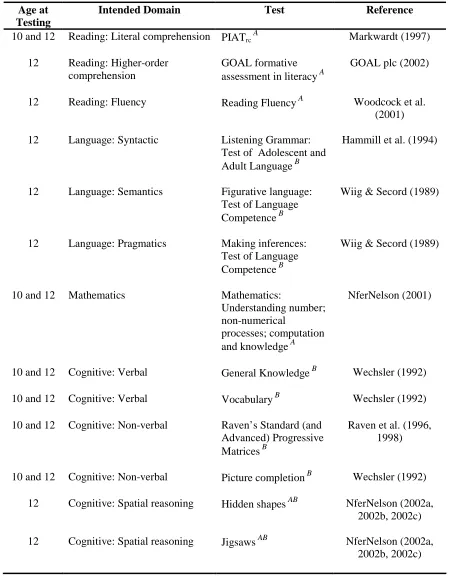
Table 1 provides a summary of the internet measures used at 10 and 12 years and
their references.
---
Insert Table 1 about here
---
Tests administered in person:
Age-appropriate standard versions of the reading comprehension (PIATrc and
GOAL), reading fluency, and mathematics tests were administered using standard test
protocol to a sub-sample of 30 children at the Social, Genetic and Developmental
Psychiatry Centre. The standard versions of these tests are much longer than our
branched internet tests, which limit the number of questions each child has to answer.
Due to time constraints we were unable to administer the entire cognitive battery. The
total testing time was approximately three hours for each participant. Testing was done
within 3 months of completion of the 12-year internet battery (Mean = 65 days, SD = 22).
National Curriculum (NC) measures:
As for all UK children at 10 and 12 years, the twins’ academic performance was
National Curriculum (NC), the core academic curriculum developed by the Qualifications
and Curriculum Authority (QCA). The NC Teacher Assessments consist of teachers
giving a score on the basis of the child’s performance throughout the school year.
Reminders of the NC criteria used to select the appropriate attainment level were
provided as part of the questionnaire. Further details about these measures have been
published previously (Haworth et al., 2007; Walker et al., 2004). At 10 and 12 years NC
measures of reading and mathematics were collected. Of the teacher questionnaires sent,
at 10 years, 6129 individual forms (79%) were returned complete, and at 12 years, 2312
individual forms (71%) were returned complete.
Analyses:
Internal consistency reliability. Cronbach’s alpha coefficients were calculated for the
internet-based measures using one randomly selected member of each twin pair. For the
mathematics and general cognitive abilities scales, internal consistency reliability was
calculated for the items within each subscale.
Bivariate correlations. Bivariate correlations between pairs of measures were calculated
using a phenotypic analysis in the structural equation software Mx, (Neale et al., 1999)
that controlled for the twin-pair structure of the data, and therefore used the entire dataset.
These correlations are equivalent to Generalized Estimating Equation (GEE) correlations.
This analysis was similar to that of a recent report (Sluis et al., 2006). Correlations using
one randomly selected member of a twin pair produced the same pattern of results. These
are the tests measuring what they were designed to measure) and their reliability (the
extent to which the tests are stable). Bivariate correlations were used to investigate three
relationships:
1. The stability of internet scores in reading comprehension (PIATrc),
mathematics and g from 10 to 12 years.
2. The relationship between internet-based measures at 12 years and their
equivalent versions administered in person for reading comprehension (PIATrc
and GOAL), reading fluency and mathematics.
3. The relationship between internet-based measures of reading comprehension
(PIATrc) and mathematics versus NC teacher-rated measures of reading and
mathematics.
Results
Reliability: Internal consistency:
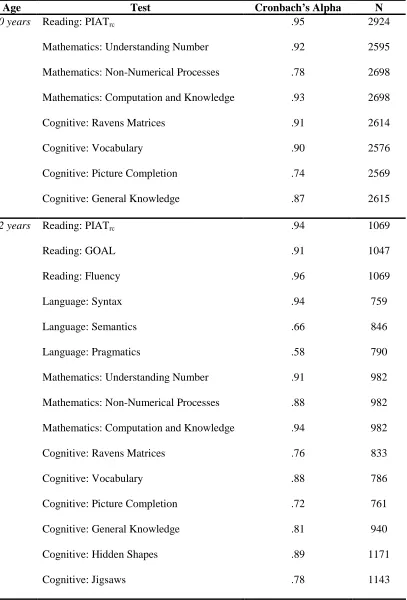
The internal consistency of the internet-administered measures was examined,
yielding high Cronbach’s alpha coefficients, as shown in Table 2. The median of
coefficients was .89 (range: .58 - .96). Tests administered at 10 and 12 years show similar
results for internal consistency.
---
Insert Table 2 about here
---
Stability of internet measures of reading comprehension, mathematics and g from 10 to
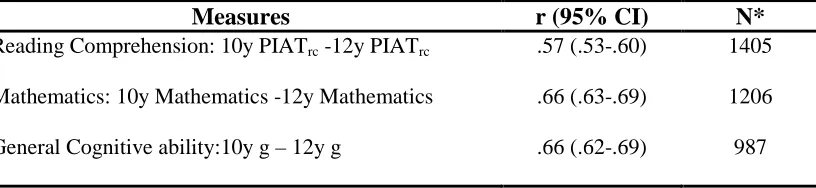
As indicated in Table 3, the two-year stability of scores on internet-based tests of
reading comprehension, mathematics and g are .57, .66 and .66, respectively.
---
Insert Table 3 about here
---
Validity: Correlations between internet-based and in-person testing:
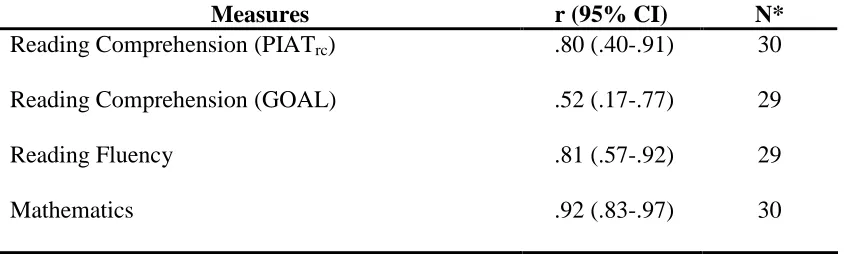
The correlations between internet-based scores and scores derived from in-person
testing are shown in Table 4 with their 95% confidence intervals. The correlations
between these very different testing formats is .80 for PIATrc Reading Comprehension,
.52 for GOAL Reading Comprehension, .81 for Reading Fluency, and .92 for
Mathematics. The lower correlation for the GOAL (.52) is discussed later.
---
Insert Table 4 about here
---
Concurrent Validity: Correlations between internet-based measures and teacher ratings
of reading and mathematics:
In order to assess concurrent validity, we correlated children’s composite
measures of internet-based performance in reading and mathematics to composite
measures of reading and mathematics performance in the classroom as assessed over the
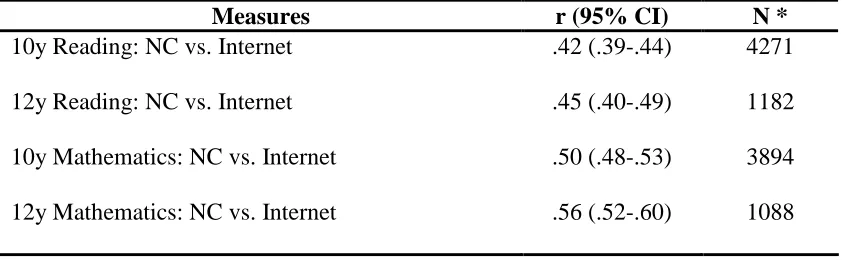
school year by their teachers on the National Curriculum Criteria. As indicated in Table
5, the correlation was .42 for reading and .50 for mathematics at 10 years and .45 and .56,
considerable differences in the content and methods of the internet-based tests and the
teacher ratings.
---
Insert Table 5 about here
---
Discussion
The aim of this study was to investigate the extent to which internet testing can be
used to assess cognitive abilities in children as young as 10 years. Our results show that
internet testing is both a reliable and valid method for collecting such data. In terms of
internal consistency, all of the internet-based measures yielded high Cronbach’s alpha
coefficients, with a median coefficient of .89. However, internal consistency is not the
ideal indicator of reliability for a measure that utilizes a new method (as opposed to new
items), because the reliable variance might be, in effect, method variance. In addition, the
branching in our study might inflate the internal consistency, because children answer
fewer questions when branching is used.
Scores on the internet-based measures show long-term stability from 10 to 12
years, with an average correlation of .63 for measures of reading (PIATrc), mathematics
and g. This correlation suggests substantial stability for scores on these measures that
were administered two years apart, in contrast to conventional test-retest intervals of two
or three weeks.
Most importantly, we directly assessed validity by comparing performance on our
internet-based measures of reading and mathematics to performance on traditional
average correlation between performance on the internet-based and in-person tests was
.76, despite the fact that the two test sessions were on average two months apart.
However, the GOAL test of higher reading comprehension yielded a significantly lower
correlation (r = .52) than the tests of reading fluency and mathematics (Cohen, 1988),
even though the GOAL has high internal consistency (α = .91) and correlates moderately
with other reading internet tests. The in-person version of the GOAL also correlated
highly with the other in-person tests of reading and mathematics, and also with the other
internet tests. In fact, the in-person version of the GOAL correlated more highly with the
internet tests of reading than it does with the internet version of the GOAL, questioning
the validity of the internet-based version of the GOAL.
Finally, correlations between our internet measures of reading and mathematics
and teacher reports averaged .48. This suggests substantial validity because these
measurement methods – objective internet tests at a single brief measurement occasion
and teacher ratings based on wide range of performance during the entire academic year –
are as different in format as two tests could be. We would not expect these correlations to
be as high as those between the direct tests, because the teacher reports encompass many
other indicators of performance, such as motivation and interest. The teacher reports are
also based on an entire year’s performance in stark contrast to the snapshot impression of
performance from scores on a single measurement occasion. The moderate correlation
between the internet measures and the teacher reports lends support to the validity of the
internet measures – and this is further confirmed by the comparison with validated
Advantages and disadvantages of internet testing:
Disadvantages of internet testing include the costs of creating such tests, as
discussed above. Another limitation is that multiple-choice questions suit the internet
format better than open-ended responses. On the internet, questions that would normally
be read aloud to the child require audio streaming, and this greatly increases the
download times for each question. Also the mode of response for in-person testing (e.g.
pointing, writing or speaking) may be different from responses collected via computers
(e.g. clicking, and typing), and it is unknown what differences in test scores, if any, this
creates. These factors should be taken into consideration when adapting paper and pencil
tests for internet use. For example, if during in-person testing a child would normally
give the answer orally, then they should not be penalized for spelling mistakes if they
must type the answer for the internet version. In such a case the scoring procedure must
accept possible spellings of the correct response. The difficulties in adapting tests for
internet-based testing are shared with the growing number of tests adapted for computer
administration. Tests adapted for computer administration are widely available
commercially and tests adapted for the internet are also increasingly available which will
alleviate these problems for researchers in the future.
Market surveys of UK families with adolescents and our own study show that in
the UK approximately 80% of adolescents have daily access to internet at home, and
practically all have access to it at schools and libraries. Although the internet is not
readily available to all twins in TEDS, the TEDS internet sample remains representative
Finally, the format of internet testing results in a lack of supervision and control
over the testing environment which may be considered a disadvantage. However, the
positive side to this is that the social pressure or embarrassment that might be present in
face-to-face testing is reduced (Birnbaum, 2004; Kraut et al., 2004). In our introduction
to the internet testing, we stress that the tests should be taken at a quiet place and time. In
any case, the high correlations between our internet-based measures and supervised
in-person testing suggest that children are not cheating during internet testing, and that the
issue of supervision is not important in this sample. Researchers considering the use of
internet testing should bear in mind that TEDS children have been part of the study since
infancy and thus may be more motivated to comply with our instructions.
The main advantage of internet testing is that data from large widely dispersed
samples can be collected quickly, cheaply, and as we show here, reliably and validly.
Internet-based data collection is less error prone because it does not require human
transcription and data entry (Kraut et al., 2004; Naglieri et al., 2004). The medium is
well suited to older children, most of whom are competent computer users. It is
interactive and enjoyable for children to complete; the test questions are easy to
understand with suitable on-screen text, voice instructions, graphics and practice items.
Additional games were included in our battery to keep the children interested and to
reward them for their efforts. Another major benefit of internet testing is generally true
of computerized testing: adaptive branching. Adaptive branching makes it possible to
include a very large pool of items – for example, to assess the extreme low and high ends
of the distribution – allowing children to complete a relatively small number of items.
questions that are well below their ability level or disheartened by having to answer
questions well above their ability level.
Conclusions:
We conclude that, due to the advances in computing and the widespread
availability of high speed internet connections, it is now possible to use internet testing to
assess cognitive ability in children as young as 10 years. Data gathered via internet
testing is both reliable and valid, and this testing approach is a cheap, quick and efficient
method for collecting data on large and diverse samples. Internet testing is therefore a
Acknowledgement: We gratefully acknowledge the ongoing contribution of the parents
and children in the Twins’ Early Development Study (TEDS). TEDS is supported by a
program grant (G0500079) from the UK Medical Research Council; our work on
mathematics is supported in part by the US National Institute of Child Health and Human
Development and the Office of Special Education and Rehabilitative Services (HD
46167); and our work on school environments is supported in part by the US National
Institute of Health (HD 44454). We thank Paul Southcombe of Planet Three Publishing
(www.planet3.co.uk) and Sean Heraghty of e-Business Systems
(www.e-businesssystems.co.uk) for working with us to create the TEDS internet-based test
Reference List
Abbate, J. (1999). Inventing the Internet. Cambridge, Massachusetts: MIT Press.
Birnbaum, M. H. (2004). Human research and data collection via the internet.
Annual Review of Psychology, 55, 803-832.
Cardon, L. R. & Bell, J. (2001). Association study designs for complex diseases.
Nature Genetics, 2, 91-99.
Cohen, J. (1988). Statistical power analysis for the behavioral sciences. (2nd ed.)
Hillsdale, New Jersey: Lawrence Erlbaum Associates.
Erlanger, D., Kaushik, T., Cantu, R., Barth, J. T., Broshek, D. K., Freeman, J. R.,
Webbe, F. M. (2003). Symptom-based assessment of the severity of a concussion.
Journal of Neurosurgery, 98, 477-484.
Erlanger, D. M., Kaushik, T., Broshek, D., Freeman, J., Feldman, D., & Festa, J.
(2002). Development and validation of a web-based screening tool for monitoring
cognitive status. Journal of Head Trauma Rehabilitation, 17, 458-476.
GOAL plc (2002). GOAL Formative Assessment: Key Stage 3. London: Hodder
& Stoughton.
Gosling, S. D., Vazire, S., Srivastava, S., & John, O. P. (2004). Should we trust
web-based studies? A comparative analysis of six preconceptions about internet
Hammill, D. D., Brown, V. L., Larsen, S. C., & Wiederholt, J. L. (1994). Test of
Adolescent and Adult Language (TOAL-3). Austin, TX: Pro-Ed.
Harlaar, N., Dale, P. S., & Plomin, R. The ART of reading: Genetic and shared
environmental mediation of the association between reading experience and reading
achievement in 10-year-old twins. Journal of Child Psychology & Psychiatry, (in press).
Haworth, C. M. A., Kovas, Y., Petrill, S. A., & Plomin, R. (2007). Developmental
Origins of Low Mathematics Performance and Normal Variation in Twins from 7 to 9
Years. Twin Research and Human Genetics, 10, 106-117.
Kiesler, S. & Sproull, L. S. (1986). Response effects in the electronic survey.
Public Opinion Quarterly, 50, 402-413.
Kovas, Y., Haworth, C. M. A., Petrill, S. A., & Plomin, R. Mathematical ability of
10-year-old boys and girls: Genetic and environmental etiology of normal and low
performance. Journal of Learning Disabilities, (in press a).
Kovas, Y., Haworth, C. M. A., Dale, P. S., & Plomin, R. The Genetic and
Environmental Origins of Learning Abilities and Disabilities in the Early School Years.
Monographs of the Society for Research in Child Development. (in press b).
Krantz, J. H. & Dalal, R. (2000). Validity of Web-based psychological research.
In M.H.Birnbaum (Ed.), Psychological experiments on the Internet (pp. 35-60). San
Kraut, R., Olson, J., Banaji, M., Bruckman, A., Cohen, J., & Couper, M. (2004).
Psychological Research Online. American Psychologist, 59, 105-117.
Markwardt, Jr. F. C. (1997). Peabody Individual Achievement Test-Revised
(Normative Update) Manual. Circle Pines: American Guidance Service.
Meyerson, P. & Tryon, W. W. (2003). Validating Internet Research: A test of the
psychometric equivalence of Internet and in-person samples. Behavior Research
Methods, Instruments & Computers, 35, 614-620.
Naglieri, J. A., Drasgow, F., Schmit, M., Handler, L., Prifitera, A., Margolis, A.,
Velasquez, R. (2004). Psychological testing on the Internet: new problems, old issues.
American Psychologist, 59, 150-162.
Neale, M. C., Boker, S. M., Xie, G., & Maes, H. (1999). Mx: Statistical Modeling
(5th ed.). VCU Box 900126, Richmond, VA 23298: Department of Psychiatry.
NferNelson Publishing Co.Ltd (1999). Mathematics 5-14 series. Windsor, UK.
NferNelson Publishing Co.Ltd (2002a). Spatial Reasoning Age 12 -14. NFER.
NferNelson Publishing Co.Ltd (2002b). Spatial Reasoning Age 10 and 11. NFER.
NferNelson Publishing Co.Ltd (2002c). Spatial Reasoning Age 8 and 9. NFER.
Nippold, M. A. (1998). Later language development: The school-age and
Oliver, B., Dale, P. S., Saudino, K. J., Petrill, S. A., Pike, A., & Plomin, R.
(2002). The validity of a parent-based assessment of cognitive abilities in three-year olds.
Early Child Development and Care, 172, 337-348.
Oliver, B. R. & Plomin, R. (2007). Twins Early Development Study (TEDS): A
multivariate, longitudinal genetic investigation of language, cognition and behavior
problems from childhood through adolescence. Twin Research and Human Genetics, 10,
96-105.
Pettit, F. A. (2002). A comparison of World-Wide Web and paper-and-pencil
personality questionnaires. Behavior Research Methods, Instruments & Computers, 34,
50-54.
Raven, J., Raven, J. C., & Court, J. H. (1998). Manual for Raven's Advanced
Progressive Matrices. Oxford: Oxford Psychologists Press Ltd.
Raven, J. C., Court, J. H., & Raven, J. (1996). Manual for Raven's Progressive
Matrices and Vocabulary Scales. Oxford: Oxford University Press.
Saudino, K. J., Dale, P. S., Oliver, B., Petrill, S. A., Richardson, V., Rutter, M.,
Simonoff, E., Stevenson, J., & Plomin, R. (1998). The validity of parent-based
assessment of the cognitive abilities of 2-year-olds. British Journal of Developmental
Psychology, 16, 349-363.
Sluis, S. v. d., Posthuma, D., Dolan, C. V., Geus, E. J. C. d., Colom, R., &
Boomsma, D. I. (2006). Sex differences on the Dutch WAIS-III. Intelligence, 34,
Trouton, A., Spinath, F. M., & Plomin, R. (2002). Twins Early Development
Study (TEDS): A multivariate, longitudinal genetic investigation of language, cognition
and behaviour problems in childhood. Twin Research, 5, 444-448.
Walker, S. O., Petrill, S. A., Spinath, F. M., & Plomin, R. (2004). Nature, nurture
and academic achievement: A twin study of teacher ratings of 7-year-olds. British
Journal of Educational Psychology, 74, 323-342.
Wechsler, D. (1992). Wechsler intelligence scale for children - Third Edition UK
(WISC-IIIUK) Manual. London: The Psychological Corporation.
Welch, N. & Krantz, J. H. (1996). The World-Wide Web as a medium for
psychoacoustical demonstrations and experiments: Experience and results. Behavior
Research Methods, Instruments & Computers, 28, 192-196.
Wiig, E. H., Secord, W., & Sabers, D. (1989). Test of Language Competence -
Expanded Edition. San Antonio, TX: The Psychological Corporation.
Woodcock, R. W., McGrew, K. S., & Mather, N. (2001). Woodcock-Johnson III
Table 1: Summary of Internet Measures at 10 and 12 Years
Age at Testing
Intended Domain Test Reference
10 and 12 Reading: Literal comprehension PIATrc A Markwardt (1997)
12 Reading: Higher-order
comprehension
GOAL formative assessment in literacy A
GOAL plc (2002)
12 Reading: Fluency Reading Fluency A Woodcock et al.
(2001)
12 Language: Syntactic Listening Grammar:
Test of Adolescent and Adult Language B
Hammill et al. (1994)
12 Language: Semantics Figurative language:
Test of Language Competence B
Wiig & Secord (1989)
12 Language: Pragmatics Making inferences:
Test of Language Competence B
Wiig & Secord (1989)
10 and 12 Mathematics Mathematics:
Understanding number; non-numerical
processes; computation and knowledge A
NferNelson (2001)
10 and 12 Cognitive: Verbal General Knowledge B Wechsler (1992)
10 and 12 Cognitive: Verbal Vocabulary B Wechsler (1992)
10 and 12 Cognitive: Non-verbal Raven’s Standard (and
Advanced) Progressive Matrices B
Raven et al. (1996, 1998)
10 and 12 Cognitive: Non-verbal Picture completion B Wechsler (1992)
12 Cognitive: Spatial reasoning Hidden shapes AB NferNelson (2002a,
2002b, 2002c)
12 Cognitive: Spatial reasoning Jigsaws AB NferNelson (2002a,
2002b, 2002c)
A
= test is in part A of the 12 year battery.
B
[image:33.612.81.531.98.676.2]AB
Table 2: Internal Consistency Reliability of Web-Based Measures – Cronbach’s Alpha Coefficients
Age Test Cronbach’s Alpha N
10 years Reading: PIATrc .95 2924
Mathematics: Understanding Number .92 2595
Mathematics: Non-Numerical Processes .78 2698
Mathematics: Computation and Knowledge
.93 2698
Cognitive: Ravens Matrices .91 2614
Cognitive: Vocabulary .90 2576
Cognitive: Picture Completion .74 2569
Cognitive: General Knowledge .87 2615
12 years Reading: PIATrc .94 1069
Reading: GOAL .91 1047
Reading: Fluency .96 1069
Language: Syntax .94 759
Language: Semantics .66 846
Language: Pragmatics .58 790
Mathematics: Understanding Number .91 982
Mathematics: Non-Numerical Processes .88 982
Mathematics: Computation and Knowledge
.94 982
Cognitive: Ravens Matrices .76 833
Cognitive: Vocabulary .88 786
Cognitive: Picture Completion .72 761
Cognitive: General Knowledge .81 940
Cognitive: Hidden Shapes .89 1171
Table 3: Stability of Internet Measures of Reading Comprehension, Mathematics and g from 10 to 12 Years
Measures r (95% CI) N*
Reading Comprehension: 10y PIATrc -12y PIATrc .57 (.53-.60) 1405
Mathematics: 10y Mathematics -12y Mathematics .66 (.63-.69) 1206
General Cognitive ability:10y g – 12y g .66 (.62-.69) 987
Note. PIATrc is a measure of reading comprehension; g = general cognitive ability. * N
Table 4: Validity: Correlations Between Internet and In-Person Testing
Measures r (95% CI) N*
Reading Comprehension (PIATrc) .80 (.40-.91) 30
Reading Comprehension (GOAL) .52 (.17-.77) 29
Reading Fluency .81 (.57-.92) 29
Mathematics .92 (.83-.97) 30
Table 5: Concurrent Validity: Correlations Between Internet Measures and Teacher Ratings of Reading and Mathematics
Measures r (95% CI) N *
10y Reading: NC vs. Internet .42 (.39-.44) 4271
12y Reading: NC vs. Internet .45 (.40-.49) 1182
10y Mathematics: NC vs. Internet .50 (.48-.53) 3894
12y Mathematics: NC vs. Internet .56 (.52-.60) 1088