this print for content only—size & color not accurate
spine = x.xxx" xxx page count
BOOKS FOR PROFESSIONALS BY PROFESSIONALS
®Foundations of Security: What Every Programmer Needs to Know
Dear Reader,Chances are that unless we all learn something about security, the Internet will continue to be a very vulnerable place in which cybercriminals thrive. If you write code that runs on the Web, and you don’t know allthe material in this book, your code can probably be quite easily hacked. If you do learn all the material in this book, your code will not only be more robust in the face of attacks, but you will also become more marketable to companies and potential employers because you will know more about how to keep their customers and users safe from cyber-attacks.
This book takes a principled approach to helping you design and implement your applications to be secure from the ground up, and illustrates these princi-ples using running examprinci-ples of web applications throughout the book. Just as you might use object-oriented design principles to achieve extensibility and code reuse, you need to learn about security design principles, such as the principle of least privilege, fail-safe stance, and securing the weakest link, to achieve security—all of which is covered in this book.
This book does not just focus on merely teaching you “tips” and “tricks” that allow you to “band-aid” the security of your systems. Instead, it illustrates how security principles can be employed to prevent some of the most significant, current-day attack types, such as cross-site scripting (XSS) and SQL injection, as well as more traditional attack types such as buffer overflows. We also cover session and password management, and show you how you can use cryptogra-phy to help achieve various security goals.
This book is based on the curriculum for the Stanford Center for Professional Development (SCPD) Computer Security Certification. Many programmers and companies have already benefited from the curriculum, and we hope and expect that many more will benefit from this book.
Sincerely,
Neil Daswani, PhD (www.neildaswani.com)
US $39.99 Shelve in Computer Security User level: Beginner–Intermediate
Dasw
ani,
Ker
n,
Kesa
va
n
Security
THE EXPERT’S VOICE
®IN SECURITY
Neil Daswani, Christoph Kern,
and
Anita Kesavan
Foreword by Vinton G. Cerf
Foundations of
Security
What Every Programmer Needs to Know
CYANMAGENTA
YELLOW BLACK PANTONE 123 CV
ISBN-13: 978-1-59059-784-2 ISBN-10: 1-59059-784-2
9 781590 597842
5 3 9 9 9
Companion eBook Available
What Ever
y Prog
rammer
Needs to Kno
w
What every programmer needs to know about security,
illustrated with running examples of web applications
and stories of what’s gone wrong in the past.
Foreword by
Vint Cerf
,
a Founding Fatherof the Internet
Foreword by
Vint Cerf,
a Founding Father of the Internet
www.apress.com
SOURCE CODE ONLINE
Companion eBook
See last page for details on $10 eBook version
THE APRESS ROADMAP
Pro PHP Security
Foundations of Security
Pro ASP.NET 2.0 Security Expert Web Services Security
in the .NET Platform
Foundations of
Neil Daswani, Christoph Kern,
and Anita Kesavan
Foundations of Security
What Every Programmer Needs
to Know
Foundations of Security: What Every Programmer Needs to Know Copyright © 2007 by Neil Daswani, Christoph Kern, and Anita Kesavan
All rights reserved. No part of this work may be reproduced or transmitted in any form or by any means, electronic or mechanical, including photocopying, recording, or by any information storage or retrieval system, without the prior written permission of the copyright owner and the publisher.
ISBN-13 (pbk): 978-1-59059-784-2 ISBN-10 (pbk): 1-59059-784-2
Printed and bound in the United States of America 9 8 7 6 5 4 3 2 1
Trademarked names may appear in this book. Rather than use a trademark symbol with every occurrence of a trademarked name, we use the names only in an editorial fashion and to the benefit of the trademark owner, with no intention of infringement of the trademark.
Lead Editor: Jonathan Gennick Technical Reviewer: Dan Pilone
Editorial Board: Steve Anglin, Ewan Buckingham, Gary Cornell, Jason Gilmore, Jonathan Gennick, Jonathan Hassell, James Huddleston, Chris Mills, Matthew Moodie, Dominic Shakeshaft, Jim Sumser, Matt Wade
Project Manager: Kylie Johnston Copy Edit Manager: Nicole Flores Copy Editor: Damon Larson
Assistant Production Director: Kari Brooks-Copony Production Editor: Ellie Fountain
Compositor: Dina Quan Proofreader: Liz Welch Indexer: Julie Grady
Artist: Kinetic Publishing Services, LLC Cover Designer: Kurt Krames
Manufacturing Director: Tom Debolski
Distributed to the book trade worldwide by Springer-Verlag New York, Inc., 233 Spring Street, 6th Floor, New York, NY 10013. Phone 1-800-SPRINGER, fax 201-348-4505, e-mail [email protected], or visit http://www.springeronline.com.
For information on translations, please contact Apress directly at 2560 Ninth Street, Suite 219, Berkeley, CA 94710. Phone 510-549-5930, fax 510-549-5939, e-mail [email protected], or visit http://www.apress.com. The information in this book is distributed on an “as is” basis, without warranty. Although every precaution has been taken in the preparation of this work, neither the author(s) nor Apress shall have any liability to any person or entity with respect to any loss or damage caused or alleged to be caused directly or indi-rectly by the information contained in this work.
The source code for this book is available to readers at http://www.apress.comin the Source Code/ Download section.
This book is dedicated to Dad, who provided me my foundations, and Mom, who taught me what I needed to know.
Contents at a Glance
Foreword
. . . xvAbout the Authors
. . . xviiAbout the Technical Reviewer
. . . xixAcknowledgments
. . . xxiPreface
. . . xxiiiPART 1
■ ■ ■
Security Design Principles
■
CHAPTER 1
Security Goals
. . . 3■
CHAPTER 2
Secure Systems Design
. . . 25■
CHAPTER 3
Secure Design Principles
. . . 61■
CHAPTER 4
Exercises for Part 1
. . . 77PART 2
■ ■ ■
Secure Programming Techniques
■
CHAPTER 5
Worms and Other Malware
. . . 83■
CHAPTER 6
Buffer Overflows
. . . 93■
CHAPTER 7
Client-State Manipulation
. . . 107■
CHAPTER 8
SQL Injection
. . . 123■
CHAPTER 9
Password Security
. . . 139■
CHAPTER 10
Cross-Domain Security in Web Applications
. . . 155■
CHAPTER 11
Exercises for Part 2
. . . 197iv
PART 3
■ ■ ■
Introduction to Cryptography
■
CHAPTER 12
Symmetric Key Cryptography
. . . 203■
CHAPTER 13
Asymmetric Key Cryptography
. . . 221■
CHAPTER 14
Key Management and Exchange
. . . 227■
CHAPTER 15
MACs and Signatures
. . . 239■
CHAPTER 16
Exercises for Part 3
. . . 251PART 4
■ ■ ■
Appendixes
■
APPENDIX A
Defense-in-Depth: The FLI Model
. . . 255■
APPENDIX B
Source Code Listings
. . . 261■
REFERENCES
. . . 267■
INDEX
. . . 277Contents
Foreword
. . . xvAbout the Authors
. . . xviiAbout the Technical Reviewer
. . . xixAcknowledgments
. . . xxiPreface
. . . xxiiiPART 1
■ ■ ■
Security Design Principles
■
CHAPTER 1
Security Goals
. . . 31.1. Security Is Holistic
. . . 31.1.1. Physical Security
. . . 41.1.2. Technological Security
. . . 41.1.3. Policies and Procedures
. . . 61.2. Authentication
. . . 71.2.1. Something You Know
. . . 71.2.2. Something You Have
. . . 81.2.3. Something You Are
. . . 101.2.4. Final Notes on Authentication
. . . 111.3. Authorization
. . . 121.3.1. Access Control Lists (ACLs)
. . . 131.3.2. Access Control Models
. . . 141.3.3. The Bell-LaPadula Model
. . . 151.4. Confidentiality
. . . 171.5. Message/Data Integrity
. . . 181.6. Accountability
. . . 191.7. Availability
. . . 201.8. Non-repudiation
. . . 211.9. Concepts at Work
. . . 22■
CHAPTER 2
Secure Systems Design
. . . 252.1. Understanding Threats
. . . 252.1.1. Defacement
. . . 262.1.2. Infiltration
. . . 262.1.3. Phishing
. . . 272.1.4. Pharming
. . . 282.1.5. Insider Threats
. . . 282.1.6. Click Fraud
. . . 292.1.7. Denial-of-Service (DoS)
. . . 292.1.8. Data Theft and Data Loss
. . . 302.2. Designing-In Security
. . . 302.2.1. Windows 98
. . . 312.2.2. The Internet
. . . 312.2.3. Turtle Shell Architectures
. . . 342.3. Convenience and Security
. . . 352.4. SimpleWebServer Code Example
. . . 352.4.1. Hypertext Transfer Protocol (HTTP)
. . . 352.4.2. Code Walkthrough
. . . 362.5. Security in Software Requirements
. . . 442.5.1. Specifying Error Handling Requirements
. . . 442.5.2. Sharing Requirements with Quality Assurance (QA)
. . . 462.5.3. Handling Internal Errors Securely
. . . 472.5.4. Including Validation and Fraud Checks
. . . 482.5.5. Writing Measurable Security Requirements
. . . 502.5.6. Security or Bust
. . . 502.6. Security by Obscurity
. . . 512.6.1. Flaws in the Approach
. . . 512.6.2. SimpleWebServer Obscurity
. . . 522.6.3. Things to Avoid
. . . 552.7. Open vs. Closed Source
. . . 572.8. A Game of Economics
. . . 582.9. “Good Enough” Security
. . . 59■
CHAPTER 3
Secure Design Principles
. . . 613.1. The Principle of Least Privilege
. . . 613.2. Defense-in-Depth
. . . 633.2.1. Prevent, Detect, Contain, and Recover
. . . 633.2.2. Don’t Forget Containment and Recovery
. . . 643.2.3. Password Security Example
. . . 65■C O N T E N T S viii
3.3. Diversity-in-Defense
. . . 653.4. Securing the Weakest Link
. . . 663.4.1. Weak Passwords
. . . 663.4.2. People
. . . 663.4.3. Implementation Vulnerabilities
. . . 673.5. Fail-Safe Stance
. . . 673.5.1. SimpleWebServer Fail-Safe Example
. . . 673.5.2. Attempted Fix 1: Checking the File Length
. . . 693.5.3. Attempted Fix 2: Don’t Store the File in Memory
. . . 693.5.4. Fix: Don’t Store the File in Memory, and Impose
a Download Limit
. . . 703.6. Secure by Default
. . . 713.7. Simplicity
. . . 723.8. Usability
. . . 733.9. Security Features Do Not Imply Security
. . . 74■
CHAPTER 4
Exercises for Part 1
. . . 77PART 2
■ ■ ■
Secure Programming Techniques
■
CHAPTER 5
Worms and Other Malware
. . . 835.1. What Is a Worm?
. . . 835.2. An Abridged History of Worms
. . . 845.2.1. The Morris Worm: What It Did
. . . 845.2.2. The Morris Worm: What We Learned
. . . 855.2.3. The Creation of CERT
. . . 865.2.4. The Code Red Worm
. . . 865.2.5. The Nimda Worm
. . . 875.2.6. The Blaster and SQL Slammer Worms
. . . 875.3. More Malware
. . . 89■
CHAPTER 6
Buffer Overflows
. . . 936.1. Anatomy of a Buffer Overflow
. . . 936.1.1. A Small Example
. . . 946.1.2. A More Detailed Example
. . . 946.1.3. The safe_gets() Function
. . . 986.2. Safe String Libraries
. . . 1006.3. Additional Approaches
. . . 1016.3.1. StackGuard
. . . 1016.3.2. Static Analysis Tools
. . . 1026.4. Performance
. . . 1036.5. Heap-Based Overflows
. . . 1036.6. Other Memory Corruption Vulnerabilities
. . . 1036.6.1. Format String Vulnerabilities
. . . 1046.6.2. Integer Overflows
. . . 104■
CHAPTER 7
Client-State Manipulation
. . . 1077.1. Pizza Delivery Web Site Example
. . . 1087.1.1. Attack Scenario
. . . 1107.1.2. Solution 1: Authoritative State Stays at Server
. . . 1127.1.3. Solution 2: Signed State Sent to Client
. . . 1147.2. Using HTTP POST Instead of GET
. . . 1177.3. Cookies
. . . 1197.4. JavaScript
. . . 121■
CHAPTER 8
SQL Injection
. . . 1238.1. Attack Scenario
. . . 1248.2. Solutions
. . . 1308.2.1. Why Blacklisting Does Not Work
. . . 1308.2.2. Whitelisting-Based Input Validation
. . . 1328.2.3. Escaping
. . . 1328.2.4. Second Order SQL Injection
. . . 1338.2.5. Prepared Statements and Bind Variables
. . . 1348.2.6. Mitigating the Impact of SQL Injection Attacks
. . . 136■
CHAPTER 9
Password Security
. . . 1399.1. A Strawman Proposal
. . . 1399.2. Hashing
. . . 1419.3. Offline Dictionary Attacks
. . . 1439.4. Salting
. . . 144■C O N T E N T S x
9.5. Online Dictionary Attacks
. . . 1509.6. Additional Password Security Techniques
. . . 1519.6.1. Strong Passwords
. . . 1519.6.2. “Honeypot” Passwords
. . . 1519.6.3. Password Filtering
. . . 1519.6.4. Aging Passwords
. . . 1529.6.5. Pronounceable Passwords
. . . 1529.6.6. Limited Login Attempts
. . . 1529.6.7. Artificial Delays
. . . 1529.6.8. Last Login
. . . 1539.6.9. Image Authentication
. . . 1539.6.10. One-Time Passwords
. . . 154■
CHAPTER 10
Cross-Domain Security in Web Applications
. . . 15510.1. Interaction Between Web Pages from Different Domains
. . . 15610.1.1. HTML, JavaScript, and the Same-Origin Policy
. . . 15610.1.2. Possible Interactions of Documents from Different
Origins
. . . 15710.1.3. HTTP Request Authentication
. . . 15910.1.4. Lifetime of Cached Cookies and HTTP Authentication
Credentials
. . . 16010.2. Attack Patterns
. . . 16110.2.1. Cross-Site Request Forgery (XSRF)
. . . 16210.2.2. Cross-Site Script Inclusion (XSSI)
. . . 16410.2.3. Cross-Site Scripting (XSS)
. . . 16510.3. Preventing XSRF
. . . 16910.3.1. Inspecting Referer Headers
. . . 17010.3.2. Validation via User-Provided Secret
. . . 17010.3.3. Validation via Action Token
. . . 17110.3.4. Security Analysis of the Action Token Scheme
. . . 17310.4. Preventing XSSI
. . . 17610.4.1. Authentication via Action Token
. . . 17610.4.2. Restriction to POST Requests
. . . 17710.4.3. Preventing Resource Access for Cost Reasons
. . . 17710.5. Preventing XSS
. . . 17810.5.1. General Considerations
. . . 17910.5.2. Simple Text
. . . 18010.5.3. Tag Attributes (e.g., Form Field Value Attributes)
. . . 18110.5.4. URL Attributes (href and src)
. . . 18310.5.5. Style Attributes
. . . 18510.5.6. Within Style Tags
. . . 18610.5.7. In JavaScript Context
. . . 18610.5.8. JavaScript-Valued Attributes
. . . 18910.5.9. Redirects, Cookies, and Header Injection
. . . 19010.5.10. Filters for “Safe” Subsets of HTML
. . . 19110.5.11. Unspecified Charsets, Browser-Side Charset
Guessing, and UTF-7 XSS Attacks
. . . 19210.5.12. Non-HTML Documents and Internet Explorer
Content-Type Sniffing
. . . 19310.5.13. Mitigating the Impact of XSS Attacks
. . . 194■
CHAPTER 11
Exercises for Part 2
. . . 197PART 3
■ ■ ■
Introduction to Cryptography
■
CHAPTER 12
Symmetric Key Cryptography
. . . 20312.1. Introduction to Encryption
. . . 20412.1.1. Substitution Ciphers
. . . 20412.1.2. Notation and Terminology
. . . 20512.1.3. Block Ciphers
. . . 20512.1.4. Security by Obscurity: Recap
. . . 20812.1.5. Encrypting More Data
. . . 20812.1.6. AES Code Example
. . . 21012.2. Stream Ciphers
. . . 21712.2.1. One-Time Pad
. . . 21712.2.2. RC4
. . . 21712.3. Steganography
. . . 21912.3.1. What Is Steganography?
. . . 21912.3.2. Steganography vs. Cryptography
. . . 220■C O N T E N T S xii
■
CHAPTER 13
Asymmetric Key Cryptography
. . . 22113.1. Why Asymmetric Key Cryptography?
. . . 22113.2. RSA
. . . 22313.3. Elliptic Curve Cryptography (ECC)
. . . 22313.4. Symmetric vs. Asymmetric Key Cryptography
. . . 22413.5. Certificate Authorities
. . . 22413.6. Identity-Based Encryption (IBE)
. . . 22513.7. Authentication with Encryption
. . . 225■
CHAPTER 14
Key Management and Exchange
. . . 22714.1. Types of Keys
. . . 22714.1.1. Identity Keys
. . . 22714.1.2. Conversation or Session Keys
. . . 22714.1.3. Integrity Keys
. . . 22814.2. Key Generation
. . . 22814.2.1. Random Number Generation
. . . 22914.2.2. The rand() function
. . . 23014.2.3. Random Device Files
. . . 23014.2.4. Random APIs
. . . 23114.3. Key (Secret) Storage
. . . 23114.3.1. Keys in Source Code
. . . 23114.3.2. Storing the Key in a File on Disk
. . . 23314.3.3. “Hard to Reach” Places
. . . 23314.3.4. Storing Secrets in External Devices
. . . 23314.4. Key Agreement and Exchange
. . . 23514.4.1. Using Asymmetric Keys
. . . 23614.4.2. Diffie-Hellman (DH)
. . . 236■
CHAPTER 15
MACs and Signatures
. . . 23915.1. Secure Hash Functions
. . . 23915.2. Message Authentication Codes (MACs)
. . . 24015.2.1. CBC MACs
. . . 24015.2.2. HMAC
. . . 24115.3. Signatures
. . . 24215.3.1. Certificates and Certificate Authorities (CAs)
. . . 24315.3.2. Signing and Verifying
. . . 24615.3.3. Registration Authorities (RAs)
. . . 24615.3.4. Web of Trust
. . . 24715.4. Attacks Against Hash Functions
. . . 24715.5. SSL
. . . 24715.5.1. Server-Authenticated-Only
. . . 24815.5.2. Mutual Authentication
. . . 249■
CHAPTER 16
Exercises for Part 3
. . . 251PART 4
■ ■ ■
Appendixes
■
APPENDIX A
Defense-in-Depth: The FLI Model
. . . 255A.1. Protecting Against Failure
. . . 256A.2. Protecting Against Lies
. . . 257A.3. Protecting Against Infiltration
. . . 257A.4. Other Techniques
. . . 258A.5. Using an FLI-like Model
. . . 258A.6. References
. . . 258■
APPENDIX B
Source Code Listings
. . . 261■
REFERENCES
. . . 267■
INDEX
. . . 277■C O N T E N T S xiv
Foreword
W
hen Neil Daswani and Christoph Kern invited me to write a foreword to the book you are reading now, I accepted without hesitation and with a good deal of pleasure. This timely vol-ume is solidly grounded in theory and practice and is targeted at helping programmers increase the security of the software they write. Despite the long history of programming, it seems as if bug-free and resilient software continues to elude us. This problem is exacerbated in networked environments because attacks against the vulnerabilities in software can come from any number of other computers and, in the Internet, that might mean millions of poten-tial attackers. Indeed, the computers of the Internet that interact with each other are in some sense performing unplanned and unpredictable tests between the software complements of pairs of machines. Two machines that start out identically configured will soon become diver-gent as new software is downloaded as a consequence of surfing the World Wide Web or as updates are applied unevenly among the interacting machines. This richly diverse environ-ment exposes unexpected vulnerabilities, some of which may be exploited deliberately by hackers intent on causing trouble or damage and who may even have pecuniary motivations for their behavior. So-called bot armies are available in the millions to be directed against chosen targets, overwhelming the defenses of some systems by the sheer volume of the attack. In other cases, known weaknesses are exploited to gain control of the target machines or to introduce viruses, worms, or Trojan horses that will do further damage.Programmers writing for networked environments have a particularly heavy responsibil-ity to be fully aware of the way in which these vulnerabilities may come about and have a duty to do everything they can to discover and remove them or to assure that they are eliminated by careful design, implementation, and testing. It takes discipline and a certain amount of paranoia to write secure software. In some ways it is like driving defensively. You must assume you are operating in a hostile environment where no other computer can be trusted without demonstrating appropriate and verifiable credentials. Even this is not enough. In a kind of nightmare scenario, someone with a USB memory stick can bypass all network defenses and inject software directly into the computer. Such memory sticks emulate disks and can easily pick up viruses or worms when they are used on unprotected computers, and when reused elsewhere, can propagate the problem. All input must be viewed with suspicion until cleared of the possibility of malformation.
Vulnerability can exist at all layers of the Internet protocol architecture and within the operating systems. It is naive to imagine that simply encrypting traffic flowing between pairs of computers on the Internet is sufficient to protect against exploitation. An obvious example is a virus attached to an e-mail that is sent through the Internet fully encrypted at the IP layer using IPsec. Once the message is decrypted packet by packet and reassembled, the virus will be fully ready to do its damage unless it is detected at the application layer by the e-mail client, or possibly by the mail transport agent that delivers the e-mail to the target recipient.
It is vital to understand not only how various attacks are carried out, but also how the vul-nerabilities that enable these attacks arise. Programs that fail to check that inputs are properly
■F O R E W O R D xvi
sized or have appropriate values may be vulnerable to buffer overruns leading to application or even operating system compromise. Failure to verify that input is coming in response to a request could lead to database pollution (this is one way that Domain Name System resolvers can end up with a “poisoned” cache). Among the most pernicious of network-based attacks are the denial-of-service attacks and the replay attacks that resend legitimately formatted information at the target in the hope of causing confusion and malfunction.
In this book, Daswani and Kern have drawn on real software vulnerabilities and network-based threats to provide programmers with practical guidelines for defensive programming. Much of the material in this book has been refined by its use in classroom settings with real programmers working on real problems. In the pursuit of security, there is no substitute for experience with real-world problems and examples. Abstracting from these concrete examples, the authors develop principles that can guide the design and implementation and testing of software intended to be well protected and resilient against a wide range of attacks.
Security is not only a matter of resisting attack. It is also a matter of designing for resilience in the face of various kinds of failure. Unreliable software is just as bad as software that is vul-nerable to attack, and perhaps is worse because it may fail simply while operating in a benign but failure-prone setting. Fully secure software is therefore also designed to anticipate various kinds of hardware and software failure and to be prepared with remediating reactions. Good contingency planning is reliant on imagination and an ability to compose scenarios, however unlikely, that would render false the set of assumptions that might guide design for the “nor-mal” case. The ability to anticipate the possible, if unlikely, situations—the so-called “corner” cases—is key to designing and implementing seriously resilient software.
It is a pleasure to commend this book to your attention. I share with its authors the hope that it will assist you in the production of increasingly secure and resilient software upon which others may rely with confidence.
Vinton G. Cerf
Vice President and Chief Internet Evangelist, Google
About the Authors
■NEIL DASWANI, PHD, has served in a variety of research, development, teaching, and manage-rial roles at Google, NTT DoCoMo USA Labs, Stanford University, Yodlee, and Telcordia Technologies (formerly Bellcore). While at Stanford, Neil cofounded the Stanford Center Pro-fessional Development (SCPD) Security Certification Program. His areas of expertise include security, peer-to-peer systems, and wireless data technology. He has published extensively in these areas, he frequently gives talks at industry and academic conferences, and he has been granted several US patents. He received a PhD in computer science from Stanford University. He also holds an MS in computer science from Stanford University, and a BS in computer science with honors with distinction from Columbia University.
■CHRISTOPH KERNis an information security engineer at Google, and was previously a senior security architect at Yodlee, a provider of technology solutions to the financial services indus-try. He has extensive experience in performing security design reviews and code audits, designing and developing secure applications, and helping product managers and software engineers effectively mitigate security risks in their software products.
■ANITA KESAVANis a freelance writer and received her MFA in creative writing from Sarah Lawrence College. She also holds a BA in English from Illinois-Wesleyan University. One of her specializations is communicating complex technical ideas in simple, easy-to-understand language.
About the Technical Reviewer
■DAN PILONEis a senior software architect with Pearson Blueprint Technologies and the author of UML 2.0 in a Nutshell. He has designed and implemented systems for NASA, the Naval Research Laboratory, and UPS, and has taught software engineering, project management, and software design at the Catholic University in Washington, DC.
Acknowledgments
T
here are many who deserve much thanks in the making of this book. Firstly, I thank God for giving me every moment that I have on this earth, and the opportunity to make a positive con-tribution to the world.I thank my wife, Bharti Daswani, for her continuous patience, understanding, and sup-port throughout the writing process; for her great attitude; and for keeping my life as sane and balanced as possible while I worked to finish this book. I also thank her for her forgive-ness for all the nights and weekends that I had to spend with “the other woman”—that is, my computer! I’d also like to thank my parents and my brother for all the support that they have provided over the years. Without my parents’ strong focus on education and my brother’s strong focus on giving me some competition, I am not quite sure I would have been as driven.
I’d like to thank Gary Cornell for taking on this book at Apress. I remember reading Gary’s
Core Java book years ago, and how much I enjoyed meeting him at the JavaOne conference in
2001. Even at that time, I was interested in working on a book, but I had to complete my PhD dissertation first! I’d like to thank my editor, Jonathan Gennick, for always being so reasonable in all the decisions that we had to make to produce this book. I’d like to thank Dan Pilone, my technical reviewer from Apress, for his critical eye and for challenging many of my examples. I thank Kylie Johnston for bearing with me as I juggled many things while concurrently writing this book; she was instrumental to keeping the project on track. Damon Larson and Ellie Fountain deserve thanks for their diligent contributions toward the copy editing and produc-tion preparaproduc-tion for the book.
This book has benefited from a distinguished cast of technical reviewers. I am grateful for all their help in reviewing various sections of this book. The book has benefited greatly from all their input—any mistakes or errors that remain are my own fault. The technical reviewers include Marius Schilder, Alma Whitten, Heather Adkins, Shuman Ghosemajumder, Kamini Mankaney, Xavier Pi, Morris Hoodye, David Herst, Bobby Holley, and David Turner.
I’d like to thank Vint Cerf for serving as an inspiration, and for taking the time to meet with me when I joined Google. I didn’t mind having to defend my dissertation all over again in our first meeting! I’d like to thank Gary McGraw for introducing me to the field of software security and providing a technical review of this book. I thank Amit Patel for his technical review of the book, and for trading stories about interesting security vulnerabilities that we have seen over the years.
I’d like to thank Dan Boneh for giving me my first project in the field of security, and for the experience of burning the midnight oil developing digital cash protocols for Palm Pilots early in my career at Stanford. I thank Hector Garcia-Molina, my dissertation advisor, for teaching me to write and reason, and about many of the nontechnical things that a scientist/ engineer needs to know.
I thank my coauthors, Christoph Kern and Anita Kesavan, for making the contributions that they have to this book. Without Christoph’s in-depth reviews and contributed chapters, this book would have probably had many more errors, and could not provide our readers with
as much depth in the area of cross-domain attacks and command injection. Without Anita’s initial help in transcription, editing, and proofreading, I probably would not have decided to write this book.
I’d like to thank Arkajit Dey for helping proofread, edit, and convert this book into differ-ent word processing formats. I was even glad to see him find errors in my code! Arkajit is a prodigy in the making, and we should expect great things from him.
We would like to thank Filipe Almeida and Alex Stamos for many fruitful discussions on the finer points of cross-domain and browser security. The chapter on cross-domain security would be incomplete without the benefit of their insights.
I would like to thank Larry Page and Sergey Brin for showing the world just how much two graduate students can help change the world. Their focus on building an engineering organi-zation that is fun to work in, and that produces so much innovation, reminds me that the person who invented the wheel was probably first and foremost an engineer, and only second a businessperson.
Finally, I thank my readers who have gotten this far in reading this acknowledgments section, as it was written on a flight over a glass of wine or two!
Neil Daswani, Ph.D.
■A C K N O W L E D G M E N T S xxii
Preface
D
r. Gary McGraw, a well-known software security expert, said, “First things first—make sure you know how to code, and have been doing so for years. It is better to be a developer (and architect) and then learn about security than to be a security guy and try to learn to code” (McGraw 2004). If you are interested in becoming a security expert, I wholeheartedly agree with him. At the same time, many programmers who just need to get their job done and do not necessarily intend to become security experts also do not necessarily have the luxury of pursuing things in that order. Often, programmers early in their careers are given the respon-sibility of producing code that is used to conduct real business on the Web, and need to learn security while they are continuing to gain experience with programming. This book is for those programmers—those who may have (at most) just a few years of experience program-ming. This book makes few assumptions about your background, and does its best to explain as much as it can. It is not necessarily for people who want to become security experts for a living, but it instead helps give a basic introduction to the field with a focus on the essentials of what every programmer needs to know about security.One might argue that our approach is dangerous, and that we should not attempt to teach programmers about security until they are “mature” enough. One might argue that if they do not know everything they need to know about programming before they learn about security, they might unknowingly write more security vulnerabilities into their code. We argue that if we do not teach programmers something about security, they are going to write vulnerabilities
into their code anyway! The hope is that if we teach programmers something about security early in their careers, they will probably write fewer vulnerabilities into their code than they would have otherwise, and they may even develop a “spidey sense” about when to ask security professionals for help instead of writing code in blissful ignorance about security.
That said, the goal of this book is to provide enough background for you to develop a good intuition about what might and might not be secure. We do not attempt to cover every possible software vulnerability in this book. Instead, we sample some of the most frequent types of vulnerabilities seen in the wild, and leave it to you to develop a good intuition about how to write secure code. After all, new types of vulnerabilities are identified every day, and new types of attacks surface every day. Our goal is to arm you with principles about how to reason about threats to your software, give you knowledge about how to use some basic defense mechanisms, and tell you where you can go to learn more. (Hence, we have included many references.)
Chief information and security officers can use this book as a tool to help educate soft-ware professionals in their organizations to have the appropriate mindset to write secure software. This book takes a step toward training both existing and new software professionals on how to build secure software systems and alleviate some of the common vulnerabilities that make today’s systems so susceptible to attack.
Software has become part of the world’s critical infrastructure. We are just as dependent upon software as we are on electricity, running water, and automobiles. Yet, software engi-neering has not kept up and matured as a field in making sure that the software that we rely
on is safe and secure. In addition to the voluminous amount of bad press that security vulner-abilities have generated for software companies, preliminary security economics research indicates that a public software company’s valuation drops after the announcement of each vulnerability (Telang and Wattal 2005).
Most students who receive degrees in computer science are not required to take a course in computer security. In computer science, the focal criteria in design have been correctness, performance, functionality, and sometimes scalability. Security has not been a key design cri-terion. As a result, students graduate, join companies, and build software and systems that end up being compromised—the software finds its way to the front page of press articles on a weekly (or daily) basis, customers’ personal information that was not adequately protected by the software finds its way into the hands of criminals, and companies lose the confidence of their customers.
The rampant spread of computer viruses and overly frequent news about some new vari-ant worm or denial-of-service attack are constvari-ant reminders that the field has put function-ality before security and safety. Every other major field of engineering ranging from civil engi-neering to automobile engiengi-neering has developed and deployed technical mechanisms to ensure an appropriate level of safety and security. Every structural engineer learns about the failures of the Tacoma Narrows bridge.1Automobile engineers, even the ones designing the
cup holders in our cars, think about the safety and security of the car’s passengers—if the car ends up in an accident, can the cup holder break in a way that it might stab a passenger?
Unfortunately, it might be hard to argue that the same level of rigor for safety and security is taught to budding software engineers. Safety and security have taken precedence in other engineering fields partially because students are educated about them early in their careers. The current situation is untenable—today’s software architects, developers, engineers, and programmers need to develop secure software from the ground up so that attacks can be pre-vented, detected, and contained in an efficient fashion. Computer security breaches are expensive to clean up after they have happened. Corporate firewalls are often just “turtle shells” on top of inherently insecure systems, and in general are not enough to prevent many types of attacks. Some simple attacks might bounce off the shell, but a hacker just needs to find one soft spot to cause significant damage. Most of these attacks can be stopped.
To complement other software security books that focus on a broader or narrower a range of security vulnerabilities, this book closely examines the 20 percent of the types of vulnerabil-ities that programmers need to know to mitigate 80 percent of attacks. Also, while this book does not focus on various tips and tricks that might encourage a “band-aid” approach to secu-rity, it does teach you about security goals and design principles, illustrates them through many code examples, and provides general techniques that can be used to mitigate large classes of security problems.
Our focus on teaching you how to have a paranoid mindset will also allow you to apply the design principles and techniques we cover to your particular programming tasks and challenges, irrespective of which programming languages, operating systems, and software
■P R E FA C E xxiv
1. The original Tacoma Narrows bridge was a suspension bridge built in 1940 in Washington State that employed plate girders to support the roadbed instead of open lattice beam trusses. The bridge vio-lently collapsed four months after its construction due to a 42-mile-per-hour wind that induced a twisting motion that was not considered when the bridge was first designed. The structural collapse was captured on video (see www.archive.org/details/Pa2096Tacoma), and is still discussed to this day in many introductory structural and civil engineering classes.
environments you use. Unlike most software books, which are dry and filled with complex technical jargon, this book is written in a simple, straightforward fashion that is easy to read and understand. This book contains many, many examples that allow you to get a deeper practical understanding of computer security. In addition, we use a running example analyz-ing the security of a functional web server to illustrate many of the security design principles we discuss.
This book is based on the tried-and-tested curriculum for the Stanford Center for Profes-sional Development (SCPD) Computer Security Certification (see http://proed.stanford. edu/?security). Many companies and software professionals have already benefited from our course curriculum, and we hope and expect that many more will benefit from this book.
Who This Book Is For
This book is written for programmers. Whether you are studying to be a programmer, have been a programmer for some time, or were a programmer at some point in the past, this book is for you. This book may also be particularly interesting for web programmers, as many of the examples are drawn from the world of web servers and web browsers, key technologies that have and will continue to change the world in ways that we cannot necessarily imagine ahead of time.
For those who are studying to be programmers, this book starts with teaching you the principles that you need to know to write your code in a paranoid fashion, and sensitizes you to some of the ways that your software can be abused by evil hackers once it has been deployed in the real world. The book assumes little about your programming background, and contains lots of explanations, examples, and references to where you can learn more.
This book is also written to be read by those who have been programming for some time, but, say, have never been required to take a course in security. (At the time of writing of this book, that probably includes more than 90 percent of the computer science graduates in the world.) It is written so that it can be the first book you read about computer security, but due to its focus on what security should mean for application programmers (as opposed to system administrators), it will help you significantly build on any existing knowledge that you have about network or operating systems security.
Finally, if you used to be a programmer (and are now, say, a product manager, project manager, other type of manager, or even the CIO/CSO of your company), this book tells you what you need to do to instill security in your products and projects. I’d encourage you to share the knowledge in this book with the programmers that you work with. For those of you who are CIOs or CSOs of your company, this book has been written to serve as a tool that you can provide to the programmers in your company so that they can help you mitigate risk due to software vulnerabilities.
How This Book Is Structured
This book is divided into three parts, and has exercises at the end of each of the parts. The first part focuses on what your goals should be in designing secure systems, some high-level approaches and methodologies that you should consider, and the principles that you should employ to achieve security.
The second part starts with a chapter that covers worms and other malware that has been seen on the Internet. The chapter is meant to scare you into understanding how imperative security is to the future of the entire Internet. While many feel that the topic of worms may be sufficiently addressed at the time of writing of this book, I am not quite sure that I see any inherent reason that the threat could not return in full force if we make mistakes in designing and deploying the next generation of operating system, middleware, and applications soft-ware. The chapters following that discuss particular types of vulnerabilities that have caused much pain, such as buffer overflows and additional types of vulnerabilities that have sprung up over the past few years (including client-state manipulation, secure session management, command injection, and cross-domain attacks). In the second part of the book, we also include a chapter on password management, as the widespread use of passwords coupled with badly designed password management systems leads to easily exploitable systems.
The third part of the book provides you with an introduction to cryptography. Cryptography can be an effective tool when used correctly, and when used under the advice and consulta-tion of security experts. The chapters on cryptography have been provided to give you a fluency with various techniques that you can use to help secure your software. After you read the cryptography chapters in this book, if you feel that some of the techniques can help your software achieve its security goals, you should have your software designs and code reviewed by a security expert. This book tells you what you need to know about security to make sure you don’t make some of the most common mistakes, but it will not make you a security expert—for that, years of experience as well as additional instruction will be required. At the same time, reading this book is a great first step to learning more about security.
In addition to reading the chapters in this book, we strongly encourage you to do the exercises that appear at the end of each part. Some of the exercises ask concept-based ques-tions that test your understanding of what you have read, while others are hands-on program-ming exercises that involve constructing attacks and writing code that defends against them. In the world of security, the devil is often in the details, and doing the exercises will give you a much deeper, more detailed understanding to complement your readings. Doing these exer-cises will help you to walk the walk—not just talk the talk.
If you are an instructor of a computer security course, have the students read the first three chapters and do the exercises. Even if you don’t have them do all the exercises at the end of each part of the book, or if you perhaps provide your own complementary exercises, I would recommend that at least some of the exercises that you give them be programming exercises. Chapter 5 could be considered optional, as it is meant to provide some history—at the same time, learning history helps you prevent repeating mistakes of the past. This book is meant to be read from cover to cover, and I believe it holds true to its title in that every pro-grammer should know all of the material in this book, especially if they will be writing code that runs on the Web and handles real user data.
To help those of you who will be teaching security courses, we provide slides based on the material in this book for free at www.learnsecurity.com. Each slide deck corresponds to a chapter, and illustrates the same examples that are used in the text, such that the students’ readings can reinforce the material discussed in lectures. If you choose to use this book as a required or optional text for your course, the slides can help you save time so that you can focus on the delivery of your course. If your institution has decided to beef up its security training, and you need to get yourself trained so that you can teach the students, I would highly recommend completing both the Fundamental and Advanced Security Certifications at the Stanford Center for Professional Development. There are also many other security training
■P R E FA C E xxvi
programs in the market, and you are free to choose from any of them. However, due to the young state that the field is in, I would encourage you to choose cautiously, and understand the goals of any particular training program. Is the goal to simply give students a label that they can put on their résumés, or does the program have enough depth to enable to students to solve the real, underlying software security problems that an organization faces?
Conventions
In many parts of this book, we use URLs to refer to other works. Such practice is sometimes criticized because the Web changes so rapidly. Over time, some of the URLs that this book refers to will no longer work. However, as that happens, we encourage readers to use Internet archive-like services such as the Wayback Machine at www.archive.orgto retrieve old versions of documents at these URLs when necessary. Now, let’s just hope that the Wayback Machine and/or other Internet archives continue to work!
Although we may refer to UNIX or Linux in various parts of the text, comments that we make regarding them generally hold true for various flavors of UNIX-based operating systems.
This book has a lot of information, and some of the content has subtleties. We try to point out some of the subtleties in many cases in footnotes. I would recommend reading the foot-notes the second time around so that you don’t get distracted during your first read through this book.
Prerequisites
This book has no prerequisites, except that you have an interest in programming and security, and have perhaps done some small amount of programming in some language already.
Downloading the Code
All the code examples in this book are available at www.learnsecurity.com/ntk, as well as in ZIP file format in the Source Code/Download section of the Apress web site.
Contacting the Authors
Neil Daswani can be contacted at www.neildaswani.comand [email protected]. Christoph Kern can be contacted at [email protected].
Anita Kesavan can be contacted at www.anitakesavan.comand [email protected].
Security Design
Principles
P A R T 1
Security Goals
T
he two main objectives in the first three chapters of this book are to establish the key goals of computer security and to provide an overview of the core principles of secure systems design.Chapter 1 focuses on the role that technological security plays in the design of a large secure system, and the seven key concepts in the field of security:
• Authentication
• Authorization
• Confidentiality
• Data/message integrity
• Accountability
• Availability
• Non-repudiation
After discussing these concepts, we will then illustrate the role they play in the scope of a larger system by looking at an example of a web client interacting with a web server, and examining the contribution these key concepts make in that interaction.
1.1. Security Is Holistic
Technological security and all the other computer security mechanisms we discuss in this book make up only one component of ensuring overall, holistic security to your system. By technological security, we mean application security, operating system (OS) security, and net-work security. In addition to discussing what it means to have application, OS, and netnet-work security, we will touch upon physical security, and policies and procedures. Achieving holistic security requires physical security, technological security, and good policies and procedures. Having just one or two of these types of security is usually not sufficient to achieve security: all three are typically required. An organization that has advanced technological security mecha-nisms in place but does not train its employees to safeguard their passwords with care will not be secure overall. The bulk of this book focuses on technological security, and we briefly com-ment on physical security and policies and procedures in this chapter, as security is holistic. However, our coverage of physical security and policies and procedures do not do the topics
justice—for more information, we would encourage you to do the following: 3
C H A P T E R 1
• Read standards such as ISO 17799 (see www.iso.org/iso/en/prods-services/popstds/ informationsecurity.htmland www.computersecuritynow.com).
• Visit sites such as the SANS Security Policy Project (www.sans.org/resources/policies) for more information on security policies and procedures.
• Read Practical UNIX and Network Security, by Simson Garfinkel, Gene Spafford, and Alan Schwartz, for more on operating system and network security.
1.1.1. Physical Security
Physically securing your system and laying down good policies for employees and users is often just as important as using the technological security mechanisms that we cover in this book. All of your servers should be behind locked doors, and only a privileged set of employees (typically system and security administrators) should have access to them. In addition, data centers used to house farms of servers can employ cameras, card reader and biometric locks, and even “vaults” of various kinds, depending upon the sensitivity of data stored on the servers.
In addition to mechanisms that limit access to a physical space to prevent asset theft and unauthorized entry, there are also mechanisms that protect against information leakage and document theft. Documents containing sensitive information can be shredded before they’re disposed of so that determined hackers can be prevented from gathering sensitive informa-tion by sifting through the company’s garbage. Such an attack is often referred to as dumpster diving.
1.1.2. Technological Security
In addition to physical security, there are many technical levels of security that are important. Technological security can be divided into three components: application security, OS secu-rity, and network security.
Note that our use of the word technological to group together application, OS, and
net-work security may not be the best of terms! Clearly, various types of technology can also be used to achieve physical security. For example, employees can be given electronic badges, and badge readers can be put on the door of the server room. The badges and readers clearly employ technology—but here, we use the term technological security to refer to
software-related application, OS, and network security technology.
Application Security
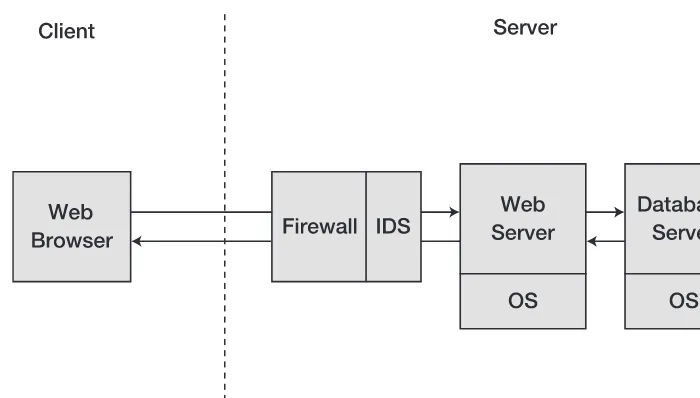
A web server is an example of an application that can suffer from security problems. In this chapter, and throughout the rest of the book, we use web servers to illustrate many application-layer security vulnerabilities. The deployment scenario that we have in mind for a web server is shown in Figure 1-1.
C H A P T E R 1 ■ S E C U R I T Y G OA L S 4
Figure 1-1.A typical web server deployment scenario
Consider a scenario in which a web server is configured to allow only certain users to download valuable documents. In this scenario, a vulnerability can arise if there is a bug in how it ascertains the identity of the user. If the user’s identity is not ascertained properly, it may be possible for an attacker to get access to valuable documents to which she would not otherwise be granted access.
In addition to ensuring that there are no flaws in the identity verification process used by a web server, it is also important that you configure your web server correctly. Web servers are complicated pieces of software that have many options that can be turned on or off. For instance, a web server may have an option that, when turned on, allows it to serve content from a database; or when turned off, only allows it to serve files from its local file system. Administrators must ensure that their web servers are configured correctly, so as to minimize the possible methods of attack.
By restricting a web server to only serve files from its local file system, you prevent an attacker from taking advantage of vulnerabilities in how a web server uses a back-end data-base. It is possible for a malicious user to trick a web server into sending user-submitted data to the database as a command, and thereby take control of the database. (One example of such an attack is a SQL injection attack—we cover such attacks in Chapter 8.)
However, even if a web server is not configured to connect to a database, other configura-tion opconfigura-tions might, for instance, make available files on the local file system that a web server administrator did not intend to make accessible. For instance, if a web server is configured to make all types of files stored on its file system available for download, then any sensitive spreadsheets stored on the local file system, for example, could be downloaded just as easily as web documents and images. An attacker may not even need to probe web servers individu-ally to find such documents. A search engine can inadvertently crawl and index sensitive documents, and the attacker can simply enter the right keywords into the search engine to discover such sensitive documents (Long 2004).
Another example of an application that could have a security vulnerability is a web browser. Web browsers download and interpret data from web sites on the Internet. Some-times web browsers do not interpret data in a robust fashion, and can be directed to download data from malicious web sites. A malicious web site can make available a file that exploits a vulnerability in web browser code that can give the attacker control of the machine that the web browser is running on. As a result of poor coding, web browser code needs to be regularly “patched” to eliminate such vulnerabilities, such as buffer overflows (as discussed in Chapter 6). The creators of the web browser can issue patches that can be installed to eliminate the vul-nerabilities in the web browser. A patch is an updated version of the software. The patch does
not have to consist of an entirely updated version, but may contain only components that have been fixed to eliminate security-related bugs.
OS Security
In addition to application security, OS security is also important. Your operating system— whether it is Linux, Windows, or something else—also must be secured. Operating systems themselves are not inherently secure or insecure. Operating systems are made up of tens or hundreds of millions of lines of source code, which most likely contain vulnerabilities. Just as is the case for applications, OS vendors typically issue patches regularly to eliminate such vul-nerabilities. If you use Windows, chances are that you have patched your operating system at least once using the Windows Update feature. The Windows Update feature periodically con-tacts Microsoft’s web site to see if any critical system patches (including security patches) need to be installed on your machine. If so, Windows pops up a small dialog box asking you if it is OK to download the patch and reboot your machine to install it.
It is possible that an attacker might try to exploit some vulnerability in the operating sys-tem, even if you have a secure web server running. If there is a security vulnerability in the operating system, it is possible for an attacker to work around a secure web server, since web servers rely on the operating system for many functions.
Network Security
Network layer security is important as well—you need to ensure that only valid data packets are delivered to your web server from the network, and that no malicious traffic can get routed to your applications or operating system. Malicious traffic typically consists of data packets that contain byte sequences that, when interpreted by software, will produce a result unex-pected to the user, and may cause the user’s machine to fail, malfunction, or provide access to privileged information to an attacker. Firewalls and intrusion detection systems (IDSs) are two types of tools that you can use to help deal with potentially malicious network traffic.
1.1.3. Policies and Procedures
Finally, it is important to recognize that even if your system is physically and technologically secure, you still need to establish a certain set of policies and procedures for all of your employees to ensure overall security. For example, each employee may need to be educated to never give out his or her password for any corporate system, even if asked by a security administrator. Most good password systems are designed so that security and system admin-istrators have the capability to reset passwords, and should never need to ask a user for her existing password to reset it to a new one.
C H A P T E R 1 ■ S E C U R I T Y G OA L S 6
Attackers can potentially exploit a gullible employee by impersonating another employee within the company and convincing him (say, over the phone) to tell him his username or password. Such an attack is called a social engineering attack, and is geared at taking
advan-tage of unsuspecting employees. Even if your applications, operating systems, and networks are secure, and your servers are behind locked doors, an attacker can still conduct social engi-neering attacks to work around the security measures you have in place.
As evidenced by the threat of social engineering, it is important to have policies and pro-cedures in place to help guard sensitive corporate information. Writing down such policies and procedures on paper or posting them on the company intranet is not enough. Your employees need to be aware of them, and they need to be educated to be somewhat paranoid and vigilant to create a secure environment. A combination of physical security, technological security mechanisms, and employees who follow policies and procedures can result in improved overall security for your environment.
It is often said that “security is a process, not a product” (Schneier 2000). There is much more to security than just technology, and it is important to weigh and consider risks from all relevant threat sources.
ARCHETYPAL CHARACTERS
We are going to spend the rest of this chapter illustrating seven key technological security goals (authentica-tion, authoriza(authentica-tion, confidentiality, message/data integrity, accountability, availability, and non-repudiation). We will do so with the help of a few fictitious characters that are often used in the field of computer security. The first two fictitious characters are Alice and Bob, who are both “good guys” trying to get some useful work done. Their work may often involve the exchange of secret information. Alice and Bob unfortunately have some adversaries that are working against them—namely Eve and Mallory.
Another person that we will occasionally use in our examples is a gentleman by the name of Trent. Trent is a trusted third party. In particular, Trent is trusted by Alice and Bob. Alice and Bob can rely on Trent to help them get some of their work accomplished. We will provide more details about Alice, Bob, Eve, Mallory, and Trent as necessary, and we encourage you to learn more about them by reading “The Story of Alice and Bob” (Gordon 1984).
1.2. Authentication
Authentication is the act of verifying someone’s identity. When exploring authentication with
our fictitious characters Alice and Bob, the question we want to ask is: if Bob wants to commu-nicate with Alice, how can he be sure that he is communicating with Alice and not someone trying to impersonate her? Bob may be able to authenticate and verify Alice’s identity based on one or more of three types of methods: something you know, something you have, and something you are.
1.2.1. Something You Know
The first general method Bob can use to authenticate Alice is to ask her for some secret only she should know, such as a password. If Alice produces the right password, then Bob can
assume he is communicating with Alice. Passwords are so prevalently used that we dedicate Chapter 9 to studying how to properly build a password management system.
There are advantages and disadvantages to using passwords. One advantage is that pass-word schemes are simple to implement compared to other authentication mechanisms, such as biometrics, which we will discuss later in this chapter. Another advantage of password security systems is that they are simple for users to understand.
There are, however, disadvantages to using password security systems. First, most users do not choose strong passwords, which are hard for attackers to guess. Users usually choose passwords that are simple concatenations of common names, common dictionary words, common street names, or other easy-to-guess terms or phrases. Attackers interested in hack-ing into somebody’s account can use password-crackhack-ing programs to try many common login names and concatenations of common words as passwords. Such password cracking programs can easily determine 10 to 20 percent of the usernames and passwords in a system. Of course, to gain access to a system, an attacker typically needs only one valid username and password. Passwords are relatively easy to crack, unless users are somehow forced to choose passwords that are hard for such password-cracking programs to guess. A second disadvantage of pass-word security systems is that a user needs to reuse a passpass-word each time she logs into a system—that gives an attacker numerous opportunities to “listen in” (see Section 1.4) on that password. If the attacker can successfully listen in on a password just once, the attacker can then log in as the user.
A one-time password (OTP) system, which forces the user to enter a new password each time she logs in, eliminates the risks of using a password multiple times. With this system, the user is given a list of passwords—the first time she logs in, she is asked for the first password; the second time she logs in, she is asked the second password; and so on. The major problem with this system is that no user will be able to remember all these passwords. However, a device could be used that keeps track of all the different passwords the user would need to use each time she logs in. This basic idea of such a device naturally leads us from the topic of “something you know” to the topic of “something you have.”
1.2.2. Something You Have
A second general method of authenticating a user is based on something that the user has.
OTP Cards
OTP products generate a new password each time a user needs to log in. One such product, offered by RSA Security, is the SecurID card (other companies have different names for such cards). The SecurID card is a device that flashes a new password to the user periodically (every 60 seconds or so). When the user wants to log into a computer system, he enters the number displayed on the card when prompted by the server. The server knows the algorithm that the SecurID card uses to generate passwords, and can verify the password that the user enters. There are many other variations of OTP systems as well. For instance, some OTP systems gen-erate passwords for their users only when a personal identification number (PIN) is entered. Also, while OTP systems traditionally required users to carry additional devices, they are sometimes now integrated into personal digital assistants (PDAs) and cell phones. C H A P T E R 1 ■ S E C U R I T Y G OA L S
8