Active Graph Reachability Reduction for Network Security and Software
Engineering
Alice X. Zheng
Microsoft Research
Redmond, WA
[email protected]
John Dunagan
Microsoft
Redmond, WA
[email protected]
Ashish Kapoor
Microsoft Research
Redmond, WA
[email protected]
Abstract
Motivated by applications from computer network security and software engineering, we study the problem of reducing reachability on a graph with unknown edge costs. When the costs are known, reachability reduction can be solved using a linear relaxation of sparsest cut. Problems arise, however, when edge costs are unknown. In this case, blindly applying sparsest cut with incorrect edge costs can result in suboptimal or infeasible solutions. In-stead, we propose to solve the problem via edge classification using feedback on individual edges. We show that this approach outperforms compet-ing approaches in accuracy and efficiency on our target applications.
1
Introduction
Graph reachability reduction aims to remove edges from a graph so that it becomes more difficult to reach the rest of the graph starting from any source node. This has natural applica-tions in many fields of science and engineering. In this paper, we concentrate on two such applications in the field of com-puter science, namely, that of protecting a comcom-puter network from security attacks, and that of reducing software binary dependency in order to limit the scope of potential failure.
Graph reachability reduction can be understood as per-forming a partial graph cut. In the classic graph-cut setup, the goal is to find a set of edges such that removing them will render the graph disconnected. The sparsest cut variant aims to cut the set of edges with minimum cost, where each edge is weighted with the cost of cutting that edge. However, in practice, edge costs can often be difficult to quantify be-cause they indicate un-parametrizable preferences. The prob-lem is exacerbated in large graphs with many edges where it is impractical to specify the cost of each edge. In such cases, blindly applying graph cut algorithms without knowing the right edge costs can result in cuts that are infeasible or other-wise undesirable.
In this paper, we demonstrate how such problems can be solved through binary edge classification with active learning. We apply our method to our target applications and demon-strate that it is much more efficient than the alternative
ap-proach of iterating between learning edge cost and perform-ing sparsest cut.
We start by introducing our applications of interest in Sec-tion 2, then define the problem and soluSec-tion approaches in Section 3. We verify the accuracy and efficiency of our solu-tion on a synthetic graph as well as the real-world applicasolu-tions in Section 4.
2
Applications to Network Security and
Software Engineering
Consider this potential attack method on a computer net-work that employs an organization-wide authentication scheme [Dunaganet al., 2009]:
1. Eve, the attacker, gains control of a single machine and lies in wait.
2. Unsuspecting user Alice logs on to the compromised machine and exposes her identity key to the attacker. 3. Eve impersonates Alice using her identity, thereby
gain-ing access to other machines on the network on which Alice has administrative privilege.
4. Eve repeats the process starting from the newly compro-mised machines.
In this way, an initial compromise can snowball into a much larger compromise—anidentity snowball attack.
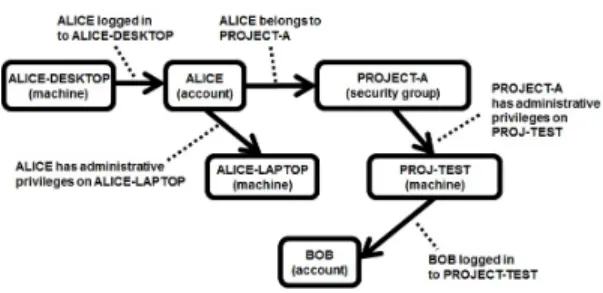
To protect the network from these attacks, one may wish to modify existing security policies so that an initial attack would not spread to too many other machines [Dunagan et al., 2009], but in a way such that the network still remains connected. This can be modeled as a graph reachability re-duction problem. The relevant entities in an identity snowball attack can be captured in anattack graph ([Sheyneret al., 2002; Ouet al., 2005]) where nodes represent network enti-ties (machines, users, or user groups) and edges represent in-teractions such as a user logging onto a machine or belonging to a group, or a user or group having administrative privileges on a machine. The direction of an edge indicates control, e.g., a log-in action gives the machine control over the user’s iden-tity. (See Figure 1 for an example.) Reachability in an attack graph implies potential compromise: if machine B is reach-able from machine A through a sequence of login and admin edges, then machine B may be compromised if machine A
is compromised. Hence, reducing reachability on the attack graph limits the scope of such attacks.
Figure 1: An example attack graph on a computer network. Nodes represent entities on the network (machines, users, user groups) and edges represent interactions. The direction of an edge indicates control, e.g., a log-in action gives the machine control over the user’s identity.
However, it is difficult to specify the edge costs in this set-ting because they represent the implementability of security policy changes. For example, it might be easy to remove an edge that grants administrative privilege on a machine to all members of a large user group, because not all members of the group in fact need that privilege. But it would not be okay to bar a user from logging onto her own desktop machine. These decisions often need to be made on an edge-by-edge basis, and thus it is very difficult to specify cost for all the edges in a large attack graph.
Fortunately for the learning algorithm, the users of this algorithm—the network experts who are in charge of protect-ing the network—can provide a limited amount of feedback on a few edges. When presented with a small group of edges, the expert may be able to choose a few of them as “Ok to cut” and the rest “keep for now.” The challenge remains how to find good edges to cut without knowing all of the edge costs in the graph.
As another example of graph reachability reduction, con-sider the software engineering task of reducing binary module dependencies. Large software systems are often divided into modules, each containing many classes or functions. A de-pendency is created when a function in module A calls a func-tion in module B. Such dependencies between binary mod-ules are necessary and useful, just like connections between networked computers and users are necessary. But binary de-pendencies can also raise reliability concerns: If the callee function fails and the error is not handled well, the caller could also fail. For this reason, it is often desirable to reduce the number of dependencies [Nagappan and Ball, 2007].
Although dependencies are easy to identify, determining the cost of removing a dependency is expensive, as it involves estimating the effort required in modifying the code. This can be done on a case-by-case basis for each dependency, but is difficult to do for all dependencies. Hence, it has tradition-ally taken significant manual work to determine the set of de-pendencies to remove. In this paper, we cast this as another instance of reachability reduction on a software dependency graph with unknown edge costs.
3
Solution Approaches
3.1
Background on Graph Algorithms
Intuitively, reducing reachability corresponds to making it harder to get from one starting point in a graph to another. There have been many formalizations of the notion of the reachability of a graph, many of which have been shown to be related to within a constant factor [Aroraet al., 2004]. One possible definition of graph reachability is the maxi-mum concurrent flow [Shahrokhi and Matula, 1990] achiev-able within a graph. With this definition, reachability reduc-tion corresponds to removing edges such that this maximum achievable flow is decreased. It is well-known that the set of edges that limits the maximum concurrent flow is also the set that yields the sparsest cut (or balanced cut). More formally, the dual LP to maximum concurrent flow is the sparsest cut LP [Shahrokhi and Matula, 1990].
Consider a graphG= (V, E), whereV denotes the set of vertices andEthe set of directed edges. Letc(e)denote the cost of cutting edgee. Assume there exists a set ofdemands between a set of source nodes and a set of target nodes in the graph. For example, in modeling the network security application, we can specify a unit demand between every pair of machine nodes, and in the binary dependency reduction application, there is demand between each pairs of binaries. The goal of sparsest cut is to determine the smallest set of edges whose removal would cut all non-zero demand. Here is one possible formulation of the sparsest cut LP:
mind(e) Pe∈Ec(e)d(e) (1)
subject to P
e∈Eb(e)d(e) = 1 (2)
d(e)≥0. (3) Here,d(e)represents an edge distance assignment, where a greater distance denotes a more favorable edge to cut. The quantityb(e) is equal to the number of shortest paths (be-tween node pairs with non-zero demand) that pass throughe; it can be interpreted as the “benefit” of cutting edgee.1
Fig-ure 2 essentially encodes the sparseness constraint of cutting edges (i.e., settingd(e)): under a fixed budget of 1 for the weighted sum of distances, it incentivizes the optimization procedure to setd(e)higher for more central edges along the collection of shortest paths between nodes with non-zero de-mand.
3.2
Previous Approaches: Alternate
The above formulation of graph cut assumes all edge costs are known. When they are not known, one natural approach is to alternate between learning the edge costs (based on user feedback) and performing graph cut. Dunaganet al.[2009] describes the following algorithm called Heat-ray for prevent-ing identity snowball attacks. We denote this algorithm as Alternate-HR. The algorithm first initializes the edge costs
c(e)to be uniform. Then, each iteration first runs sparsest cut
1
In this formulation of sparsest cut,b(e)depends on path lengths which are defined usingd(e). Hence the formulation as presented here is not an LP, but it does have an equivalent LP relaxation form. We choose to present this formulation for its readability.
Algorithm 1:Alternate-Heat-ray (Alternate-HR)
Input : GraphG= (V, E), α.
Output: GraphG0 = (V, E0).
InitializeG0←Gcostsc(e)←1fore∈E. repeat
Stage 1:
d(e), b(e)←SparsestCutLP(G, c(·)) Rank edges by descendingmax(b(e),−b(e)c(e))
Stage 2:
R←user feedback on edges
c(e)←UpdateCost(R) using Eqn (6)
untilReachability(G0)≤αor all edges queried
(cf. Eqn (1)–(3)) to rank the edges. This ranked list is pre-sented to the user, who selectively labels a subsetR of the top-ranked edges as “cut” or “keep.” The feedback is then in-corporated into a second set of linear constraints to solve for new estimates of edge cost.
b(e)−c(e) ≤ −1 ifeis to be kept, (4)
b(e)−c(e) ≥ 1 ifeis to be cut. (5) Each edge is represented by a vector of edge featuresxe. The
cost function is modeled as a linear function of the features:
c(e) =wTx
e. Letyedenote the feedback on edgee:ye= 1
ifeis to be cut, andye=−1if it is to be kept. Alternate-HR
finds thewthat minimizes the hinge loss of unsatisfied con-straints, regularized by the norm of the weight vector (akin to linear SVMs): min w X e∈R max(0,1−ye(b(e)−wTxe)) +λwTw. (6)
After learning the new cost functionc(e), the updated costs are used in the next round of sparsest cut optimization.
We can also formulate a much simpler version of the alternate approach. We call the algorithm Alternate-SimpleUpdate (Alternate-SU). It initializes all edges to have uniform costµ. In the first stage, it computes the LP relax-ation of sparsest cut and ranks the edges according tod(e). The top edges are presented to the user for feedback. The costs of “cut” edges are then updated toγ, and those of “keep” edges are updated toκ, whereγ≤µ≤κ. Alternate-SU then recomputesd(e)and repeats.
3.3
New Approach: ARRG
So far, our problem statement contains an interesting mixture of two disparate tasks: performing sparsest cut on a graph and learning the edge cost. Conceptually, graph reachability reduction is the end goal. However, the application requires that all edge cut decisions be feasible. In a graph cut set-ting, feasibility is modeled by the (unknown) cost of cutting an edge. Previous approaches solves the problem by folding the task of edge cost learning into an outer loop of sparsest cut. We now propose to instead fold the problem of graph reachability reduction into the process of learning the user’s edge cut preference function, which may depend on its utility in the graph cut setting, as well as a number of other features.
Algorithm 2:Alternate-SimpleUpdate (Alternate-SU)
Input : GraphG= (V, E), µ, γ, κ, α.
Output: GraphG0= (V, E0).
InitializeG0←Gandc(e)←µfore∈E. repeat
Stage 1:
d(e)←SparsestCutLP(G, c(·)) Rank edges by descendingd(e)
Stage 2:
R←user feedback on edges
foreachedgeeinRdo
ifR(e) =Cutthenc(e)←γ,E0←E0\e
else ifR(e) =Keepthenc(e)←κ
untilReachability(G0)≤αorE0=∅
In this case, it is likely the user herself does not have perfect knowledge of which edges should be cut. While the question of a noisy oracle is interesting from a theoretical perspective, in this paper we use active learning as a practical solution to the problem of helping an imperfect oracle in making better decisions, and, at the same time, efficiently and accurately learning from such oracles. As our experiments show, ARRG is much quicker at solving the problem than Alternate, be-cause it makes more direct use of available features and feed-back.
LetDc:E→ {0,1}be the indicator function for the
opti-mal cut-set underc(e), i.e.,Dc(e) = 1if and only ifeshould
be removed. Sparsest cut tries to obtain the entireDcthrough
global optimization. We propose to approximateDc(e)
edge-by-edge with a classifierf(xe), wherexeis a set of features
for edgee. We train the classifier using active learning, where edge labels are provided by the user’s feedback.
We call this method Active Reachability Reduction on Graphs (ARRG). In this paper, we investigate ARRG using active learning techniques for the Gaussian process classi-fier (GPC) and support vector machine (SVM). LetXL =
{(x1, y1), . . . ,(xn, yn)}, denote a set of labeled training data
andXU = {xn+1, . . . ,xn+m} a set of unlabled data for
which the oracle may provide feedback. Active learning aims to select the unlabeled sample whose labeling would most improve the classifier. Numerous active learning criteria have been proposed for various classifiers. In our experiments, we use the margin (distance to the closest point) for SVM and the entropy for GPC. SVM: x∗= arg max x∈XU |fSV M(x)| (7) GPC: x∗= arg max x∈XU H(qGP C(x)) (8)
Here, H(·) denotes entropy, |fSV M(x)| denotes the SVM
margin, andqGP C(x)denotes the posterior distribution over
the label of x inferred by Gaussian process classification (GPC).
ARRG-SVM and ARRG-GPC each has strengths and drawbacks. While the active learning criterion for SVM is simple to compute, the GPC criterion can provide better per-formance. This is because GPC provides the full posterior
Algorithm 3:ARRG
Input : Edge feature listE={x1,x2, . . . ,xM}.
Output: Classifierf(x).
Initialize training setT ← {(xe1,1),(xe2,−1)}with
one “cut” edge and one “keep” edge. repeat f(·)←TrainClassifier(T) e←ActiveLearningTopEdge(f, E) ye←user feedback one T ←T∪ {(xe, ye)} untilconvergence
predictive distribution over the labels, thereby taking into ac-count both the distance from the boundary as well as the vari-ance around the estimate. Another notable difference is that SVM has the added complexity of choosing the kernel hyper-parameters and the regularization parameter. Gaussian Pro-cesses on the other hand can simply use marginal likelihood to determine additional parameters (if any).
Like many classification approaches, the performance of ARRG depends on the quality of features. When available features correlate well with the feasibility of edge cuts, the user oracle can make better decisions, and ARRG is able to make better predictions. In our experiments, we use graph-based as well as non-graph-graph-based features. Graph-graph-based fea-tures measure the local or global role of the edge in the graph. Examples include (unweighted) in- and out-degrees ofuand
v, and the number of shortest pathselies on (orb(e)from Eqn (2)). Non-graph-based features can be attributes for the edge or its two end nodes. They represent any additional knowl-edge we have about entities in the graph that may have bear-ings on the edge cost. In the identity snowball attack preven-tion example, we include features such as edge type (login, admin, or group membership), and the function of the ma-chine (normal user mama-chine or server).
4
Experiments
We compare ARRG against Alternate and two other base-lines on one synthetic dataset and our target applications in network security and software dependency reduction. The Marginal baseline is the classification accuracy of the simple marginal classifier that predicts all labels to be the more pop-ular label. In all of our experiments, most of the edges are to be kept, and hence this baseline sets a high bar for ARRG to beat. We also compare against the performance of spars-est cut with uniform cost, which represents the baseline of ignoring edge costs.
Previewing our results, we find that ARRG outperforms its competitors both in efficiency (in terms of the amount of edge feedback needed) and in accuracy (which edges should be removed).
For the Alternate algorithms, we use the implementation of the sparsest cut LP as detailed in Dunaganet al.[2009], which modifies the objective to eliminate one of the constraints and transformsd(e)to ensure non-negativity. We experimentally found that simple batch gradient descent converges to a
us-able solution within 10 steps with a step size of 0.01. For Alternate-SU, we rank the edges according tod(e)and mark the topkedges as needing to be cut. Herekis taken to be ground truth number of edges that are labeled as “cut,” giv-ing sparsest cut an additional advantage over ARRG-GPC, which has no knowledge of the correct number of edges to cut. Note that this is equivalent to comparing ARRG against (close to) optimal sparsest cut solutions with varying strate-gies for learning edge cost.
For experiments with ARRG, we use the Gaussian process implementation of Rasmussen and Williams [2007] and the support vector machine implementation in libsvm [Chang and Lin, 2009]. Both classifiers are initialized with two randomly chosen examples, one from the positive (cut edge) class and one from the negative (keep edge) class. In our implementa-tion, the mean and variance parameters in GPC are approx-imated using expectation propagation [Minka, 2001]. The regularization parameterC for SVM is tuned using leave-one-out cross-validation over a grid of values. All reported ARRG results are averaged over 20 runs with different ran-dom initializations. To improve readability, we omit plotting the standard errors, which in most settings are very tight. All experiments are conducted on the same sets of training and test data.
All experiments are conducted on a 3.0 Ghz dual Pentium Xeon machine with 8 GB of RAM running a 64 bit Windows Vista operating system and Matlab. Running time ranged from under a minute on the small synthetic graph to 30 min-utes (for 300 edge queries) on the large identity snowball at-tack graph.
4.1
Experiment on a Synthetic Graph
First, we perform a sanity check using a simple synthetic graph of three clusters with roughly equal number of con-nections between clusters 1 and 2, and between 2 and 3. Each node has a position in the 2-D plane as well as a color. Edge cost (unknown to the algorithms) depend on the colors of the nodes. Clusters 2 and 3 have the same type and cluster 1 has another type. Hence the right cut is between clusters 1 and 2. The edge features used in ARRG for edgee = (u, v)are the in- and out-degrees ofuandv, the number of all-pairs shortest paths thatelies on, the x- and y-positions ofuandv, and the colors ofuandv.
We first compare the performance of ARRG-SVM against ARRG-GPC, both with a linear kernel. We also look at the performance of GPC and SVM when edge queries are se-lected randomly (Random GPC and Random SVM). We find that both ARRG-GPC and ARRG-SVM reach perfect predic-tion accuracy, but ARRG-GPC enjoys two advantages over ARRG-SVM. First, ARRG-GPC requires slightly fewer edge labels. Second, ARRG-SVM performance fluctuates widely with few edge samples. This is due to the fact that when the number of labeled examples is low, cross-validation has dif-ficulty determiningC, the regularization parameter in SVMs. Consequently, we observe high variation in performance in the initial rounds of active learning. Performance of Random GPC and Random SVM are noticeably worse than their ac-tive learning counterparts. Overall all four algorithms quickly
pass the marginal baseline, and we find that ARRG-GPC pro-vides the best combination of efficiency and accuracy.
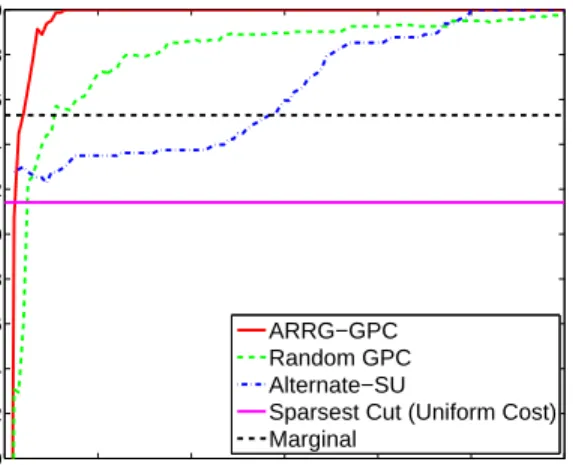
Next, we compare ARRG-GPC against multiple iterations of Alternate-SU, which on each iteration receives informa-tion about the edge chosen by ARRG-GPC. Since the true edge cost is known for the synthetic graph, it is revealed to Alternate-SU. As shown in Figure 2, Alternate-SU takes much longer to find the correct cut than ARRG-GPC, even with the added benefit of knowing the true cost of the edge queried by ARRG-GPC as well as the total number of edges that should be cut. Alternate-SU requires around 100 edges (over 60% of edges in the graph) to reach 100% accuracy while ARRG-GPC requires only 13 edges. ARRG-GPC does suffer a bit with fewer than 5 labeled edges; it has lower ac-curacy than sparsest cut with uniform cost.
0 20 40 60 80 100 120 80 82 84 86 88 90 92 94 96 98 100
Number of Edges Queried
% Accuracy
Comparison of ARRG vs. Alternate on Synthetic Graph
ARRG−GPC Random GPC Alternate−SU
Sparsest Cut (Uniform Cost) Marginal
Figure 2: Comparison of classification accuracy of ARRG-GPC and Alternate-SC.
4.2
Reducing Software Module Dependencies
In this experiment, we study a set of modules in a large soft-ware system which has undergone continuous development over several years. As part of the development cycle, an effort was made to significantly reduce dependencies. We take two snapshots of the software, one before the dependency reduc-tion effort and one after. The nodes in the graph are a porreduc-tion of the modules that appear in both snapshots. If an edge from module A to module B is present in the before-shot but not the after-shot, that means module A no longer depends on mod-ule B in the new version of the software. All the algorithms we evaluate operate on edges present in the before-shot and try to predict which ones are no longer present in the after-shot. There are 400 nodes and 1004 edges, 287 of which are removed. Edges features are the in- and out-degrees of each module, the number of all-pairs shortest paths contain-ing the edge, the frequency of calls from one module to the other, and cyclomatic complexity of the two modules. Cyclo-matic complexity is a measure of source code complexity [T. McCabe, 1976]. Prior research has suggested that higher cy-clomatic complexity leads to a higher likelihood of module
failure; hence it becomes less desirable for other modules to depend on it.
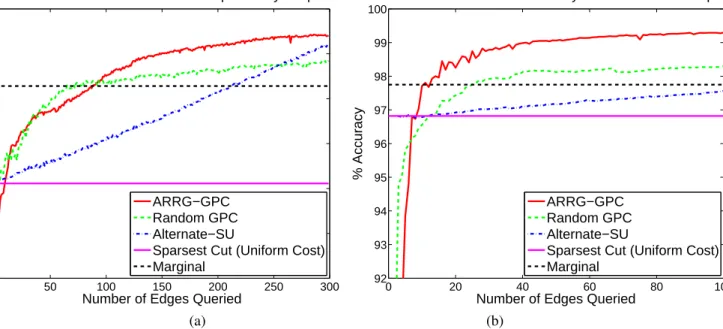
Experimental results on the software module dependency graph are presented in Figure 3(a). The marginal baseline is 71.4%, whereas sparsest cut with uniform cost achieves 60.6% accuracy. As in the synthetic experiment, the per-formance of Alternate-SU steadily improves with more edge queries. but it does not exceed the marginal baseline until well after 200 edge queries. As before, ARRG-GPC starts out with low accuracy when very few edges are labeled, quickly exceeds Alternate-SU within 10 queries, and exceeds both the marginal baseline and Random GPC within 100 queries. The relative ranking of the various algorithms are roughly the same as before. ARRG-GPC is again the overall winner, but overall prediction accuracy is worse. This is because the clas-sification task is much harder. The decision to remove certain software module dependencies was often based on considera-tions other than source code complexity. Hence the available features do not sufficiently represent the classification crite-ria. This is evident during training: the two classes of edges are not linearly separable, necessitating the use of a polyno-mial kernel of degree 2 in GPC as opposed to the linear kernel employed for the two previous experiments. This makes for a more difficult training process, which explains why ARRG-GPC requires more edge queries to exceed the baseline in this experiment. However, it is reasonable to expect overall accu-racy to improve with more helpful features such as the failure rate of the software modules. Overall, the performance shows that ARRG is much more efficient than previous approaches at incorporating user feedback; it can provide better predic-tion results much sooner than competing algorithms.
4.3
Preventing Identity Snowball Attacks
In this experiment, we study an identity snowball attack graph based on data collected at a large organization. The graph contains login actions and administrative privileges recorded over the period of eight days. The full graph contains over 350K nodes of type machine, user, and group. The network activities constitute over 4.5 million edges. Table 1 lists de-tailed statistics.
For our first experiment, we take a subgraph of the full graph and compare ARRG-GPC against Alternate-SU as well as our simple baselines. This subgraph contains 3794 nodes (3037 machine nodes, 757 user nodes, and no group nodes) and 5597 edges (1291 login edges, 4306 user admin edges, and no group membership or group admin edges). A net-work security expert labeled 126 edges as being desirable to remove. As features for classification, an edge(u, v)is rep-resented by the in- and out-degrees ofuandv, the number of machine-to-machine shortest paths passing through the edge, the types ofuandv(machine or user node), whether the ma-chine acts as a server mama-chine, and the number of times the user logs onto the machine (if it’s a login edge).
Figure 3(b) plots results from running ARRG-GPC, Ran-dom GPC, and Alternate-SU on the identity snowball at-tack graph. As before, the y-axis denotes classification ac-curacy percentage over the entire graph and the x-axis de-notes the number of edges queried. The marginal baseline of the majority label predictor is 97.7%. Sparsest cut with
0 50 100 150 200 250 300 50 55 60 65 70 75 80
Number of Edges Queried
% Accuracy
ARRG vs. Alternate on Software Dependency Graph
ARRG−GPC Random GPC Alternate−SU
Sparsest Cut (Uniform Cost) Marginal 0 20 40 60 80 100 92 93 94 95 96 97 98 99 100
Number of Edges Queried
% Accuracy
ARRG vs. Alternate on Identity Snowball Attack Graph
ARRG−GPC Random GPC Alternate−SU
Sparsest Cut (Uniform Cost) Marginal
(a) (b)
Figure 3: (a) Edge removal accuracy on the software dependency graph. (b) Edge removal accuracy on a subgraph of the identity snowball attack graph.
Machines 197,631 Accounts 91,563 Security Groups 62,725 Total Nodes 351,919 Unique Logins 130,796 AccountIsAdminOnMachine 309,182 SecurityGroupIsAdminOnMachine 380,320 AccountIsMemberOfSecurityGroup 3,695,878 Total Edges 4,516,176
Table 1:Statistics of the identity snowball attack graph. uniform cost achieves 96.8% accuracy. As Alternate-SU re-ceives more help with setting edge costs based on the ARRG-GPC edge selections2, its classification accuracy improves steadily, but it never exceeds the marginal baseline within 100 edge queries. ARRG-GPC, on the other hand, starts out with very low accuracy when only two edges are labeled (59.2%), but quickly improves as more edges are labeled. Its average performance exceeds sparsest cut and Alternate-SU within 9 edge queries, and exceeds the marginal baseline at 13 queries. ARRG-GPC reaches an average accuracy of 99% within 45 queries. Random GPC fares relatively poorly; its average exceeds the sparsest cut uniform cost baseline at 12 edge queries and marginal baseline at 25 edge queries, but it never reaches 99% within 100 queries. All results are signifi-cant based on standard errors computed from 20 runs of each algorithm (starting with two randomly selected labeled edges each time).
In our second experiment with the identity snowball
at-2
In the synthetic experiment, we know the true cost of all edges. In the two real applications, however, we do not have information about the true cost; instead, Alternate-SU sets the edge cost to be a small fixed number (0.01) if the oracle says “cut this edge” and a large fixed number (100) if the oracle says “keep this edge.”
0 50 100 150 200 250 300 65 70 75 80 85 90 95 100
Number of Edges Queried
% Accuracy
ARRG Performance on the Full Identity Snowball Attack Graph
ARRG−GPC Random−GPC Marginal
Figure 4:ARRG performance on the identity snowball attack graph.
tack graph, we compare ARRG-GPC against Alternate-HR. The goal of this experiment is to study their relative effi-ciency, measured as the number of edge queries needed to reach a certain level of accuracy. In order to facilitate feed-back gathering from the network security expert, the edges are generalized into edge groups – all the outgoing edges or all the incoming edges of a node. The network security ex-pert is asked to supply one label for each edge group. The full graph is labeled based on feedback obtained in 10 itera-tions of Alternate-HR, where the expert was presented with a total of 6000 incoming and outgoing edge groups. Based on his feedback, 24804 edge groups were determined to be ok to remove and 184698 edge groups to be kept. Edge fea-tures include the number of shortest paths going through the edge, the type of the edge (login, group/user admin, or group
Predicted Labels
True Labels Keep Cut
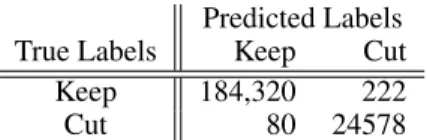
Keep 184,320 222
Cut 80 24578
Table 2:Average confusion matrix of ARRG-GPC on the full identity snowball attack graph test set.
membership), the in- and out-degrees of the node counted by edge type, and a binary indicator for outgoing edge group or incoming edge group. ARRG-GPC was trained using a polynomial kernel of degree 2. The sparsest cut stage of Alternate-HR is run with demand between only pairs of ma-chine nodes. Due to the large size of the group, Alternate-HR computes b(e) using shortest paths sampled from 100 ran-domly selected starting nodes.
The results are shown in Figure 4. After querying only 300 edges, ARRG-GPC is able to reach an average edge classifi-cation accuracy of 99.9%. In other words, after labeling on 4% of the number of edges required by Alternate-HR, our algorithm is able to provide edge cuts with close to 100% ac-curacy. Table 2 lists the confusion matrix averaged over 20 runs. To understand the high accuracy achieved by ARRG-GPC, we talked to the network security expert who labeled the edges and found that he looked for users who log on to many machines and removed all login privileges except for those to essential servers and the machines to which they log on most frequently. He also removed admin privileges for groups of large size. These criteria are well captured by the edge features.
5
Conclusion
In this paper we study applications of graph reachability re-duction in network security and software engineering. We formulate the problem with unknown edge costs and propose a solution based on binary classificaiton with active learn-ing (ARRG). We show that, on two real-world applications, ARRG clearly wins over competing approaches at the task of identifying good edges to cut in a graph with unknown (and non-uniform) edge costs. Our approach may seem intuitive in hindsight. However, all prior work in related areas have in-stead focused on the strategy of alternating between learning the metric and solving the main objective (graph cut in this case). Our success highlights the importance of aligning the learning algorithm with the type of available feedback.
References
S. Arora, S. Rao, and U. Vazirani. Expander Flows, Geomet-ric Embeddings and Graph Partitioning. InSymposium on Theory of Computing (STOC), 2004.
Chih-Chung Chang and Chih-Jen Lin. LIBSVM—A Library for Support Vector Machines, Nov 2009.
John Dunagan, Alice X. Zheng, and Daniel R. Simon. Heat-ray: Combating identity snowball attacks using machine learning, combinatorial optimization and attack graphs. In Symposium on Operating Sytems Principles (SOSP), 2009. T. Minka. Expectation Propagation for approximate Bayesian
inference. InUncertainty in Artificial Intelligence (UAI), 2001.
N. Nagappan and T. Ball. Using Software Dependencies and Churn Metrics to Predict Field Failures: An Empiri-cal Case Study. InInternational Symposium on Empirical Software Engineering and Measurement (ESEM), 2007. X. Ou, S. Govindavajhala, and A.W. Appel. MulVAL: A
Logic-based Network Security Analyzer. In USENIX Se-curity, 2005.
Carl Edward Rasmussen and Christopher K. I. Williams. Documentation for GPML Matlab Code, June 2007. F. Shahrokhi and D. Matula. The Maximum Concurrent Flow
Problem. Journal of the ACM (JACM), 37(2):318–334, 1990.
O. Sheyner, J. Haines, S. Jha, R. Lippmann, and J. Wing. Automated Generation and Analysis of Attack Graphs. In IEEE Security and Privacy (IEEE Oakland), 2002. T. McCabe. A Complexity Measure. IEEE Transactions on