Article
Printed Thai Character Recognition using Shape
Classification in Video Sequence along a Line
Sirikwan Chaiwatanaphan
a,*, Charnchai Pluempitiwiriyawej
b, and Somkiat Wangsiripitak
cDepartment of Electrical Engineering, Faculty of Engineering, Chulalongkorn University, 254 Phayathai Road, Pathumwan, Bangkok 10330, Thailand
E-mail: a[email protected] (Corresponding author), b[email protected], c[email protected]
Abstract. This paper presents a novel method for recognition of 68 printed Thai characters in image sequences captured along a line of characters, based on their shape appearance such as the height and width, the top, bottom, and right edges, the numbers and positions of the circles (head of Thai characters) and the end points. Since each character appears in more than one frame of the image sequence that moves along the line, an algorithm to identify the arrangement of the characters in each line is necessary for accurate recognition results. We tested our system on image sequences with four different Thai fonts. The recognition rate is about 85.64% correct.
Keywords: Character recognition, printed Thai character, text group recognition.
ENGINEERING JOURNAL Volume 21 Issue 6 Received 28 August 2017
1.
Introduction
Computer Vision is camera image processing (similar to like human eyes) to be able to remember and classify things like humans. Currently, computer vision is more involved in various fields. For example, in security systems, computer vision is used to enhance the security and monitor crime. For industrial areas, computer vision is used for product sorting and quality check. In addition, computer vision has begun to be use for educational purposes such as help in reading book for the visually impaired or pronunciation practice with children. We realize the importance of education, so we want to develop a system which uses camera to read the text along the line and process the character recognition, then convert into the speaking voice to facilitate the visually impaired in reading books. Character recognition system designed for this study focuses on reading the Thai Alphabet along the line continually via video camera which is different from character recognition system processing the text from camera (or scan) image taking the whole page in single shot. By camera shooting method, there will be only one image for analyzing, and the image may not be clear caused by many factors such as unstable light conditions, shading, and blurry text from shaking camera. Thus, these factors considerably affect character recognition. Moreover, text need to be sorted out line by line before processing, so this makes it a time-consuming process. Besides, single image processing need high resolution picture that can clearly show every single letter on page, but most normal camera cannot take enough resolution image.
In this study, we decided to create a recognition system for analyzing a sequences of images from the video camera in normal resolution capturing character continually in each line of text due to many advantages: (1) The system could take advantage from the character that appear in more than one frame of the image sequence, so the results of character recognition is more precise; (2) The system does not require line separating process as in image analysis because video camera capture text along the line as well; and (3) High resolution camera that can clearly capture the whole page in single time is not require.
2.
Related Concepts
Characters of the Thai alphabet that we analysed consist of 44 consonant letters, 9 vowel letter and 5 tone marks, total 68 characters. We test our recognition system with text image sequences in 4 fronts which are; Angsana New, Cordia New, Tahoma and TH Sarabun New. Our recognition system consist of 3 main processes which are: (1) The preparing of image sequences before character recognition process [1]; (2) Recognition process of each character; [2–5] and (3) The grouping of characters in each line and display text recognition [1].
2.1. The Preparing of Image Sequences before Character Recognition Process Related Concepts
We use camera that has resolution 240*320 pixel and frame rate is 30 FPS. Video for processing must detect continuous text along a line. A sequence of images from video cameras at a short period consists of several and similar tiled frames. The processing of every frame of image sequences consistently will takes a very long time, be redundant and also lead to the inability to give real time result of recognition, so we choose only some frames for processing. We found that by moving camera along the line in rate of about 0.9 mm per second, the proper rate for choosing a frame to process is in every 20 frames. In other words, the system will select the 1st, 20th, 40th frames from image sequence to analyze to get real time recognition
of text along the line from the system. With this frame selecting rate, we found that the same character will appear in analysed frame at least 3 frames continuously.
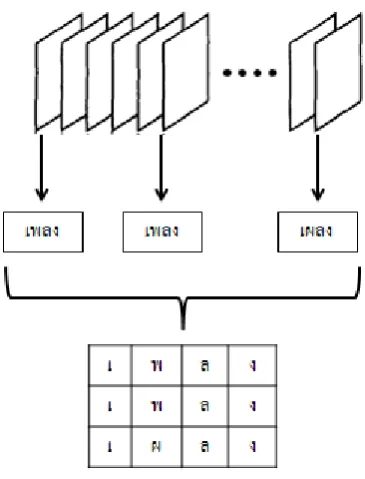
Then, the system will send each character through character recognition algorithm which is described in the next section. After that, keep the recognition results in sets as in Fig. 2 which each row assigned to be segmentation and recognition character from each frame. The result from next frames will be placed in new row until all the frames are processed. The number of frames and rows will be used in character arrangement algorithm later [1].
Fig. 1. Delete character which recognize error: (a) Image from video; (b) Image from deleting character.
Fig. 2. Select image and rearrange in matrix.
2.2. Character Recognition
[image:3.595.165.431.156.271.2] [image:3.595.204.387.322.562.2]1. The height and width
2. The top, bottom, and right edges
3. The numbers and positions of the circles (head of Thai characters)
5. Direction from circles
We will use these appearances to classify characters into four main groups as the following first [4, 5].
Group 1อะ อิ อี อึ อื อุ อู อา อ่ อ้ อ๊ อ๋ อ็ อ์
Group 2ข ฃ ง จ ช ซ ธ บ ป ย ร ว ษ อ ฮ ฤ ฦ อา เ โ ใ ไ ๆ
Group 3ก ค ฅ ฆ ฉ ญ ฎ ฑ ด ต ถ ท น ผ ฝ พ ฟ ภ ม ล ศ ส ห ฬ
Group 4ฌ ฏ ฒ ณ
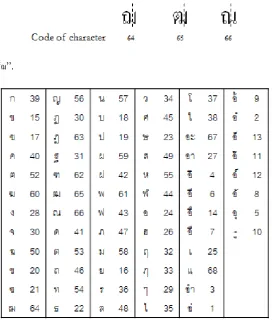
Then make sub-classifications of recognition by using unique shape appearance above until get the result of recognition for each character. For example in Group 4 which includes ฌ ฒ ณ, we use positions of the circles to classify 3 characters again. As we can notice that character “ณ” is only one in group that has circle on the right side, we can distinguish “ณ” from others and code it 66 as showed in Fig. 3. Each character are coded and shown in Fig. 4.
Fig. 3. Recognition “ฌ”.
[image:5.595.162.435.411.736.2]In this process, there are 4 special characters; “อะ”, “อ ำ”, “แอ”, “ญ” and “ฐ”, so the system has to re-check to find these characters, with different conditions as follows. “อะ” and “แอ”, when system find adjacent “อั” or “เอ”, the code will be changed into “อะ” and “แอ” and the code second character as 0. “อ ำ”, when the system finds code 3, code next character as 0 because “อ ำ” is divided into “๐” and “ำ” and result in recognition error. ญ, when the system finds code 56, code next character as 0 because “ญ” is divided into two characters. “ฐ”, when the system finds code 31, the previous and next character will be checked. If they are below 15, they will be recoded as 0 because ฐ is divided into two characters and can be checked from side character, and we cannot identify location of character.
2.3. Grouping and Display the Character Recognition on Each Line
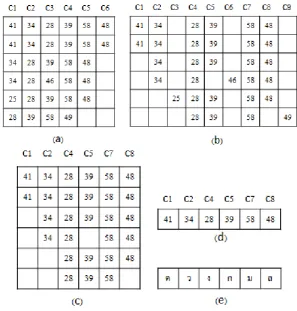
After make thee code of each character, we will group and order them to increase the accuracy of each character. We use the code of each character for grouping. If similar codes are not found, system will create a new group and delete the member that contains less than 2. Then system will calculates the mode of each group and shows the character of each line as shown in Fig. 5 [1].
Fig. 5. Grouping and display: (a) Result of recognition; (b) Grouping same code; (c) Select group; (d) Select code per group; (e) Convert code to character.
3.
Results and Discussion
[image:6.595.147.445.290.602.2]Table 1. Result of character recognition processing.
The analysis found that the process of recognition errors may be due to several reasons, which are: (1) The same letter with some different looks in each font may cause classification error in recognition, for example, “ช” from each font showed in Fig. 6 are different with circle; (2) Errors in the recognition may lead from the effects of characters segmentation process are incomplete, as shown in Fig. 7 which the right edge of “อ” is disappeared; (3) The characters are overlapped, for example, สระอิ is overlapped with the end point of “ป” as shown in Fig. 8; (4) The errors may be due to the quality of the video that capture the character caused by light and shadow, so it is not easy to capture the text clearly.
Fig. 6. Font of character: (a) Angsana New; (b) Cordia New; (c) Tahoma; (d) TH Sarabun New.
Fig. 7. Character is not complete.
[image:7.595.184.405.327.393.2] [image:7.595.203.393.429.533.2] [image:7.595.223.375.578.727.2]In the character grouping process using 1598 characters from each frame results in four categories: (1) Characters that can be classified all correctly as shown in Fig. 9(a); (2) Characters with some classification errors such as “ข” in ขวดน ำ are classified as “ขช”, then become ชวดน ำ as shown in Fig. 9(b); (3) Characters with all correct classification, but there are other characters that should not appears, for example, “ช” appear between “ข” and “ว” in ขวดน ำ as shown in Fig. 9(c); (4) Characters set but some are missing or cannot be classified as shown in Fig. 9(d).
Fig. 9. The result of character selection and showing.
The results of the character recognition from an image sequence from the camera moving along the line, as presented in this research, especially the three types of errors are shown in Table 2. The analysis of similar images from video give more accurate result when making the group, but putting them into a sentence may not be correct because characters that cannot be classified will group together and showed in text, and lead to errors in text order. Missing character often come from the beginning and the end of the sentences. Because when shooting video, the areas will have less collected data than other areas, so the system cannot group these characters accurately.
Table 2. Result of character selection and showing the result process.
4.
Conclusion
References
[1] T. Mita and O. Hori, “Improvement of video text recognition by character selection,” in Proceedings of Sixth International Conference on Document Analysis and Recognition, 2001, pp. 1089-1093.
[2] M. U. Akram, Z. Bashir, A. Tariq, and S. A. Khan, “Geometric feature points based optical character recognition,” in Industrial Electronics and Applications (ISIEA), 2013 IEEE Symposium on, 22-25 Sept. 2013, pp. 86-89.
[3] S. Bhooshan, V. Kumar, A. K. Singh, T. Negi, and J. Miglani, “Character recognition using geometrical features of alphabet: A novel technique,” in Communication Software and Networks, 2009. ICCSN '09. International Conference on, 27-28 Feb. 2009, pp. 119-125.
[4] A. Thammano and P. Duangphasuk, “Printed Thai character recognition using the hierarchical cross-correlation ARTMAP,” in Proceedings of the 17th IEEE International Conference on Tools with Artificial Intelligence, 2005, pp. 695–698.