Article
Analytic Hierarchy Process for Stakeholder
Participation in Integrated Water Resources
Management
Jirattinart Thungngern
1,a, Thavivongse Sriburi
2, and Saowanee Wijitkosum
2,3,b,*1 Interdisciplinary Program of Environmental Science, Graduate School, Chulalongkorn University,
Bangkok 10330, Thailand
2 Chula Unisearch, Chulalongkorn University, Bangkok 10330, Thailand
3 Environmental Research Institute, Chulalongkorn University, Bangkok 10330, Thailand
E-mail: a[email protected], b[email protected] (Corresponding author)
Abstract. This paper focuses on the applying the Analytic Hierarchy Process (AHP) to Integrated Water
Resource Management (IWRM) to develop a model for water resource management in the Pranburi watershed by using stakeholder participation. The hierarchy model structure of the Pranburi watershed was developed by the experts based on IWRM and classified into 4 criteria, 15 sub-criteria, and 3 alternatives. The questionnaire method was the tool used for obtaining a weighing for comparison between the pairs of criteria obtained from community representatives. The finding revealed that the important criteria are the environmental factors. The highest ranked of the alternatives is the watershed planning strategy. These results implied that community focused stakeholder participation in the decision-making process for water resources in Pranburi watershed gave a positive outcome. This research clearly presented the capability of the AHP approach integrates with IWRM principle for water resource planning. The AHP approach can analyze the community representative’s relevant data before decision making, by applying pairwise comparison of the AHP technique, can reduce bias during decision making. More importantly, the government should support collaboration with local officers and the community in the decision making policy on water resource planning.
Keywords: Analytic hierarchy process (AHP), integrated water resources management
(IWRM), Pranburi watershed.
ENGINEERING JOURNAL Volume 21 Issue 7
1.
Introduction
In Thailand, water resources are important for all sectors because of extensive population growth in cities and sustainable development in both the agricultural and industrial sectors. In addition, water resource problems are related to natural resources that have been affected by water resource management. According to [1] the factors that affected to the dynamic behavior of the watershed ecosystem involved with the social components, which can generate economic and institutional systems. That is an essential factor for manipulating and driving to the watershed hydrological process. Therefore, watershed management in Thailand is an important implement for solving water resource problems.
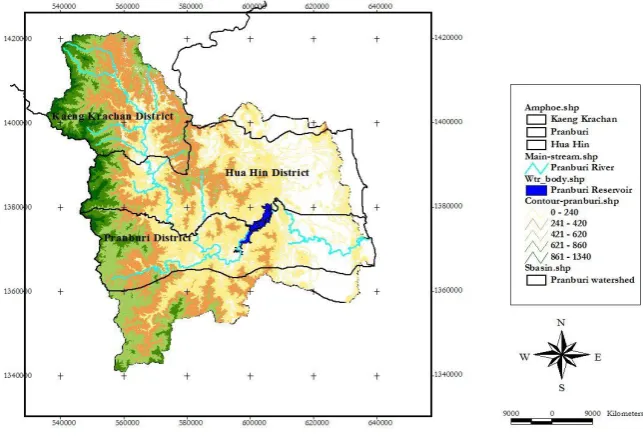
Pranburi watershed is a branch of the Prachuap Khiri Khan Coastal watershed which had faced problems of water resource management. The origin of the Pranburi River is in Kaeng Krachan National Park and flows into the Gulf of Thailand. The topography of the upper Pranburi watershed comprises of the highlands and an undulating plain. It covers an area of about 2,991.10 km2, which is in parts of Kaeng Krachan and Hua Hin Districts Petchaburi Province, Pranburi District Prachuap Khiri Khan Province and Kui Buri District Prachuap Khiri Khan Province (Fig. 1).
Fig. 1. Pranburi watershed.
The topography of the upper Pranburi watershed comprises of highlands and an undulating plain. The residents of this area are mostly farmers, cultivating crops such as pineapple, corn, lime, durian, and vegetables. Production is mostly rainfedrain fed, with only a few small reservoirs and weirs which are in adequate forto support local farming agriculture demand. According to [2] reports that land use in the Pranburi watershed is distributed as follows: forest (66%) and agriculture (30.02%).
Although the Kaeng Krachan National Park occupies a large part of the watershed, there is significant encroachment of into forest areas for agricultural use, adversely impacting on quality of the ecosystem, especially in the watershed level 1A and 1B. Encroachment also causes land erosion, especially on steeper slopes. Farming on such slopes without suitable soil and water conservation measures leads to major soil and ecosystem loss, and degradation of soil cover and fertility. Water scarcity is also a serious problem because most agricultural areas in the upper Pranburi watershed have no irrigation systems. The existing small reservoirs are insufficient to meet demand, so that most farmers in the area depend on the rain for farming [3].
[image:2.595.133.455.281.501.2]systematic process for the development and management of water, land and related resources within watersheds in order to maximize the resultant economic and social welfare in an equitable manner without compromising the sustainability of vital ecosystems” [4]. In Thailand, the IWRM principles were applied in 1995 by national policy to local communities. It has been technically recognized as a means to achieve sustainable water resource management, and this concept has been incorporated with institutional responsibility. To address the challenges of water resource management in Thailand, particularly at the local level, stronger leadership and commitment of key government agencies and effective cooperation of water users are important [5]. However, the distinction in the effective implementation of the IWRM principle have been found: (i) lack of integrated tools to support planning and management decisions; (ii) segmentation of institutions responsible for water resource planning and management; (iii) limited participation of stakeholders in the decision making process; and (iv) lack of interesting self-assessment and improved mechanisms for water resource management and economic impact measurements [6].
According to this research, the most important element of water resource planning is the decision-making process by the stakeholders in the watershed. The Analytic Hierarchy Process (AHP) is an effective approach developed by [7] that can be used to solve complex problems and enable effective decision making. Many researches had been applied in several fields, for example, in engineering [8], industry [9], economics [10], environmental management, and water management [11-16].
Many researchers have applied AHP to decision-making concerning water resource management. [11, 12] focusing on criteria relating to social, economic and environmental factors. This is because these criteria are the key factors affecting water resource planning and management. Accordingly, [12] proposed a fuzzy methodology for solving the decision problems about the assessment of water management plans with criteria, sub-criteria and alternatives. However, [11] set the cost criterion for the evaluation project because this criterion includes the cost of the investment, maintenance and administration after the realization of the project. In addition, the goal of this research used the AHP and PROMTHEE for the project evaluation in water resources planning. The findings of ranking the project were similar as was the effectiveness of both methods. However, the importance of the application of multi-criteria methods is based on the ability of the decision makers.
The findings of [13] showed that the Analytic Hierarchy Model for decision making in the planning the Global Water Productivity (GWP) of irrigation networks in Iran. It can be used to aggregate preferences for obtaining a group decision to improve the choice problems by considering effectively the relevant criteria in the decision making process. The model can also be applied to evaluate the distributive consequences of policy decisions. This research indicated that it is applied as a comprehensive and practical decision-making tool with the aim of improving the performance of such systems. Furthermore, [14] and [15] provided AHP for watershed planning by the evaluation of stakeholders. The objective of this research [14] to develop and apply decision aid for evaluating watershed. Watershed planning process should provide information to stakeholders with clear scientific information about physical and socioeconomic processes. However, planning processes must give stakeholders adequate time to consider issues that may not have been addressed by existing scientific models and data sets.
Therefore, this research focuses on the decision making process by the stakeholders collaborating with their community-based organizations to make decisions about water resource management strategies. Because stakeholder participation is a key point of the IWRM approach. The empowered community has responsibility to address local issues in a coordinated and integrated way [17]. For this reason, the objective of this research was to apply IWRM and apply it to the AHP model for selecting the suitable alternatives for water resource management in the Pranburi watershed by the representatives of the community.
2.
Methodology
The objective of this research is to contribute to the IWRM decision-making process by using an AHP approach. This section demonstrates the approaches that were applied in this research.
2.1. Basis of Integrated Water Resources Management (IWRM)
The integrated water resources management approach helps to manage and develop water resources in a sustainable and balanced way, taking account of social, economic and environmental interests. It recognizes many different and competing interest groups, the sectors that use and abuse water, and the needs of the environment. The integrated approach co-ordinates water resource management across sectors and interest groups, at different scales, from local to international. It emphasizes the involvement of national policy and law making processes, establishing good governance and creating effective institutional and regulatory arrangements as routes to more equitable and sustainable decisions. A range of tools, such as social and environmental assessments, economic instruments, and information and monitoring systems, support this process [18].
2.2. Basis of Analytic Hierarchy Process (AHP)
The Analytic Hierarchy Process (AHP), introduced by Thomas Saaty (1980), is an effective tool for analyzing complex decisions with multiple attributes and may aid the decision maker set priorities and make the best decision by the experts. This approach can reduce complex decisions to a series of pairwise comparisons, and then synthesizing the results. AHP helps to capture both subjective and objective aspects of a decision. In addition, AHP incorporates a useful technique for checking the consistency of the decision maker’s evaluations, thus reducing the bias in the decision making process [7].
2.3. Application the Principle of IWRM to the Decision-making Process by Using an AHP Model
The steps apply from AHP approaches are as follows [19]:
Step 1: Define the problem and determine the kind of knowledge sought.
The problem is decomposed into a hierarchy of goal, criteria, sub-criteria and alternatives. This step defines the water resources problems in the upper part of Pranburi watershed by surveys and stakeholder interviews based on the principle of IWRM. Next, determine the problem groups based on natural resources that affect the Pranburi watershed.
Step 2: Structure the decision hierarchy from the top with the goal of the decision.
Step 3: Construct a set of pairwise comparison matrixes.
This step sets the square matrixes for estimating stakeholder priorities in the Pranburi watershed. Each element in an upper level is used to compare with the elements in the level immediately below, with respect to it. The value of all comparisons input to Matrix A [aij] that is an n x n matrix shown in Fig. 2.
Fig. 2. Example of the values in matrix comparison.
The value of the comparison with the same criteria is always 1, the decision maker fill up the upper triangular matrix. To fill the lower triangular matrix, use the reciprocal values of the upper diagonal in Eq. (1).
aij = 1/aij (1)
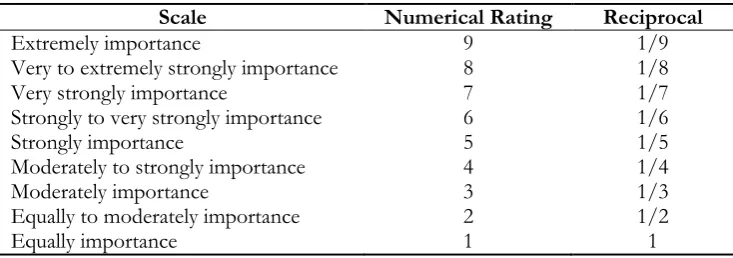
Each level was used to compare the criteria, sub-criteria and alternatives by using stakeholder participation for decision making in the Pranburi watershed. The decision makers’ opinions of the relative importance of each criterion, sub-criterion and alternative were determined by pairwise comparisons method with the weighing shown in Table 1 [7].
Table 1. Saaty’s scale of measurement in pair-wise comparison.
Scale Numerical Rating Reciprocal
Extremely importance 9 1/9
Very to extremely strongly importance 8 1/8
Very strongly importance 7 1/7
Strongly to very strongly importance 6 1/6
Strongly importance 5 1/5
Moderately to strongly importance 4 1/4
Moderately importance 3 1/3
Equally to moderately importance 2 1/2
Equally importance 1 1
Accordingly, the questionnaire method is a tool for obtaining a weight to the comparison between pairs of criteria based on the scale of values, a comparison matrix of criteria. Data were obtained by directly questioning the decision makers in the Pranburi watershed, followed by the AHP model described in step 2.
Step 4: Use the priorities obtained from the comparisons to weigh the priorities in the level immediately below.
This step was used for every element. Then for each element in the level below add its weighed values and obtain its overall or global priority. This process of weighing was continued until the final priorities of the alternatives in the bottom most level were obtained.
Step 5: Estimate the consistency ratio (CR)
[image:5.595.182.423.158.205.2] [image:5.595.114.481.405.534.2]number, which depends on matrix size (number of parameters). The consistency in decisions can be estimated by using the following Eq. (2).
CI = λmax - n
n-1 (2)
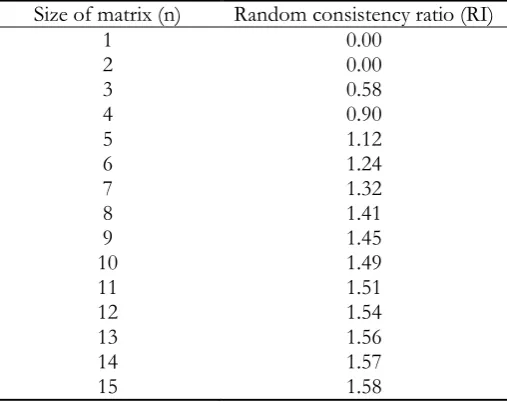
where λmax is the principal eigenvalue obtained from the priority matrix, and n is the size of the comparison matrix. The random consistency index (RI) depends on matrix size (n) and after generating a reciprocal matrix of various sizes. The average random consistency ratios (RI) for different sizes of matrix are given by Saaty [7] in Table 2:
Table 2. Random Consistency Index (RI).
Size of matrix (n) Random consistency ratio (RI)
1 0.00
2 0.00
3 0.58
4 0.90
5 1.12
6 1.24
7 1.32
8 1.41
9 1.45
10 1.49
11 1.51
12 1.54
13 1.56
14 1.57
15 1.58
If the consistency ratio (CR) is less than 0.1, subjective evaluation of the decision may be considered consistent [7].
2.4. Type of Participants
Purposive sampling technique was used for selecting the participants in two phases. The participants were dividing into 2 groups; 1) the experts who were considering the structure of the hierarchy model in the Pranburi watershed and 2) the decision makers who were weighing the criteria, sub-criteria, and alternatives. The requirements for the participants are shown in Table 3.
Table 3. The requirements for the participants.
Type of Participants Requirements
1. Experts 1. Specializes in the related field of watershed
management
- environment science or natural resources management
- agriculture science or agricultural resources management
- water resources engineering
2. Experiences in related field of watershed management at least 10 years
[image:6.595.172.426.236.437.2] [image:6.595.60.531.598.768.2]Type of Participants Requirements
- Experience in agricultural resources management
- Experience in water resources management or Water resources engineering
3. Experiences in the administrator at least 2 years
- Chief executive of the Sub-district Administrative Organization
2. Decision Makers 1. Living in Pranburi watershed for over 10
years
2. Experience in administration in the Pranburi watershed for at least 4 years
- Village Chief
- Committee of water users group - Responsibility of water resource
management in the Pranburi watershed
Then, this step can select the type of participants in AHP model are as follows:
1) The totals of eight experts who are working in the Ministry of Agriculture and Cooperatives, the Department of Water Resources, the Royal Irrigation Department, the Faculty of Environment and the Faculty of Engineering at Kasetsart University, and the Chief Executive of the Sub-district Administrative Organization (SAO) in Petchaburi and Prachuap Khiri Khan provinces took a part in the Pranburi watershed process.
2) The total of 17 decision makers gave the weight of each criterion, sub-criteria, and alternatives for water resource management were as follows; village chief and committee of water user groups (Table 4).
Table 4. Decision makers in Pranburi watershed.
Decision Maker Location Role
1 Baan Pa Deng Naeu Village Chief
2 Baan Raum Jai Pattana Village Chief
3 Baan Pa Dang Village Chief
4 Baan Pa Deng Tai Village Chief
5 Baan Haui Sat Yai Village Chief
6 Baan Pang Mai Village Chief
7 Baan Chalermkiat Phattana Committee of Water User Groups
8 Baan Fah Pratan Committee of Water User Groups
9 Baan Pa La U Committee of Water User Groups
10 Baan Haui Peung Committee of Water User Groups
11 Baan Chalerm Phorn Committee of Water User Groups
12 Baan Konom Phattana Village Chief
13 Baan Klong Noi Committee of Water User Groups
14 Baan Chalermrat Phattana Committee of Water User Groups
15 Baan Kao Chao Village Chief
16 Baan Beung Nakhorn Village Chief
[image:7.595.75.521.489.718.2]3.
Results and Discussion
The results can be divided into two sections. The first section is the process on the structuring of the hierarchical model from IWRM concept to AHP model in Pranburi based on the experts’ opinions. The second section presents the result of the ranking of criteria, sub-criteria and the priority of alternatives for water resource management by the representatives of community in the Pranburi watershed.
3.1. Establishment of the Hierarchical Model Structuring by the Experts
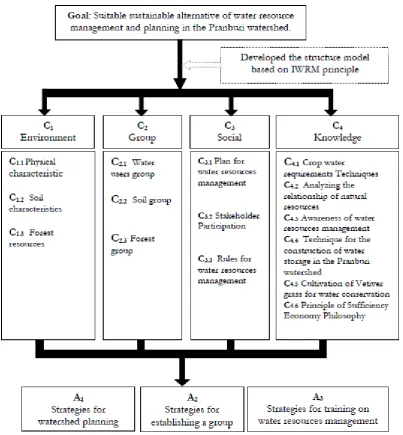
These results of structuring of the hierarchy model were developed by the eight experts, considering many factors affecting the water resource management base using the IWRM concept. The results of experts revealed that the hierarchy structure model consisted of the following four levels as follows:
1) The first level: goal was the top of the hierarchy model, which determined the suitable sustainable alternative of water resource management and planning in the Pranburi watershed. This was because the IWRM means that all the different uses of the water resource are considered together. Water allocations and management decisions consider the effects of each use on the others. They are able to take account of the overall social and economic goals, including the achievement of sustainable development [21]. Many researchers [6, 17, 18, 22, 23] that studied the IWRM presented that the key of the application of IWRM in the watershed is the sustainable environmental, social, and economic factors. This was the reason that why the goal of this model follows the key of IWRM, which was sustainable watershed management in the Pranburi watershed.
2) The second level was the major criteria, which were based on literature of the IWRM concept [17, 21, 24-33] and then the experts identified and classified it into four criteria.
IWRM can be applied in many more communities and widely scaled-up. Within a community, the guidelines concern one cycle of a participatory process of planning, implementing and maintaining water interventions. Repetition over-time can lead to village water development planning, which in turn updates the district development plans. Initially, a participatory planning and implementation process in a community [34]. From the concept of IWRM, the experts classified the criteria based on the IWRM key and general information in the Pranburi watershed [3].
Environmental criteria (C1): According to [21] explained that terrestrial and aquatic ecosystems need water to maintain their functioning in the watershed ecosystem. In addition, natural resources in the Pranburi watershed influenced managing water quality and water discharge into the watershed areas. The upper part of the Pranburi watershed area is located in the Kaeng Krachan National Park [1]. Consequently, the environmental factors are the criteria that the experts selected in the decision-making process for water resource management in the Pranburi watershed.
Group criteria (C2): According to [22] of the FAO, “supporting stakeholders in managing their water resources means supporting stakeholders to make choices and to reach a common understanding on the necessary arrangements for sharing and equitable allocation of water related goods and services”.
Methods to involve stakeholders depend on many factors: how often stakeholders need to be involved, the kind of society, the nature of information the basin organization needs from them, the type of representation that is appropriate, the political value of engaging pressure groups and access to the basin organization and decision makers [25]. Therefore, the empowerment of these groups is important for water resource management in the Pranburi watershed. This is because water resource management involves various stakeholders with multiple objectives in the decision-making process.
Knowledge criteria (C4): Knowledge for water resources management (C4) was the criteria that the experts considered that is an essential for enhancing the efficiency in water resource management and development. This is because specialized knowledge is the key factor for supporting the empowerment in the community for water resource management. According to [24] explains that the important factors for IWRM is the knowledge and information on the water resource inventory and human resources of the basin is desirable. Including scientists as water resource managers can help maintain and accrue sound knowledge of the natural resources.
3) The third level had 15 sub-criteria, which were related to the major criteria and data analysis in the Pranburi watershed. Previous research [3] investigated the soil and water quality in agricultural, and farmer’s practices in utilization of agricultural resources in the Pranburi watershed. The results indicated that the diverse pattern of land use and agricultural practices across the watershed had an impact on natural resources management, which were many and varied. Soil problems in the Pranburi watershed were related to low levels of soil organic matter, because most farmers’ lack of awareness of the importance of soil. Furthermore, soil erosion was a key problem faced by farmers in the upper part of the watershed, affecting water turbidity and conductivity inflow to the Pranburi River. Therefore, the community should plant Vetiver grass for soil and water conservation. In terms of the problem of water usage, the finding also revealed that the most farmers used water from natural water resources, which was inadequate for agricultural activities. Therefore, the farmer should dig small water retention dams in the area. However, the findings also revealed that many farmers still lack knowledge in terms of integrated natural resources for watershed management. Therefore, farmers require training on irrigation, soil and water conservation, methods of soil improvement, and self-soil quality testing. In addition, the guideline of the Sufficiency Economy Philosophy (SEP) for integrated natural resource management in the Pranburi watershed. These data analysis classify input to sub-criteria for the hierarchy model in the Pranburi watershed.
4) The fourth level had three alternatives, which followed the previous research of the pranburi watershed [3].
A1: Strategies for watershed planning The goals of this strategy are as follows;
1) To motivate local people for contribution to the process of watershed planning.
2) To identify and engage relevant stakeholders for addressing water problems that related the component of the Pranburi watershed.
3) To plan and set the regulations for water usage in the Pranburi watershed at each level, from village to national level.
A2: Strategies for establishing a group involved with water resources management. The goals of this strategy are as follows;
1) To focus each various group of stakeholders to implement the natural resources plan in the Pranburi watershed.
2) To monitor and evaluate the implementation strategies.
3) For all stakeholders to participate in solving problems in each group in the Pranburi watershed. 4) To encourage the leadership of each groups in water resource management.
A3: Strategies for training in water resource management and the techniques. The goals of this strategy are as follows;
1) To enhance knowledge about the natural resources that are related to the Pranburi watershed 2) To promote and improve local peoples’ knowledge about the technical processes
3) To increase awareness of water usage and water conservation.
Fig. 3. Hierarchy structure model in Pranburi watershed.
The results of the hierarchical model structure establishment indicated that the experts can identify the problems based on IWRM concept input to the AHP model for setting the goals, criteria, sub-criteria and alternative water resource management and planning in the Pranburi watershed. Furthermore, experts’ opinion in many fields can help to determine the complex factors that are comprehensive to water resource management and reduce bias because this hierarchical model analysed several aspects determined by the experts. This process is consistent with [35] that using expert knowledge to model known extreme hydrologic variability in complex hydrologic systems with lack of data. Modelling distributed water demands considering all sources such as surface and ground water resources and interaction between them when regarding lack of data and information is difficult which is why we surveyed in this study.
[image:10.595.109.513.76.512.2]systematic process for sustainable development, allocation and monitoring of water resource use in the context of social, economic and environmental objectives [21].
3.2. Ranking of Criteria, Sub-criteria and the Priority of Alternatives for Water Resources Management in the Pranburi Watershed
This section presented the finding of ranking of criteria; sub-criteria by the decision makers in Pranburi watershed. The results had3 parts are as follows:
3.2.1. Relative weights of criteria
This section proposes the criteria evaluation for water resource management by using the comparison matrix technique. The decision makers totalled 17, who were the representatives of the Pranburi watershed expressed their opinions regarding the relative weights of the criteria using pairwise comparisons. This process is important for comparison matrix by the stakeholder in community. According to [36] this process focused on a group decision making procedure, based on the analysis of individual rankings with the aim of choosing an appropriate alternative for a water resources problem. The alternative found to be the best compromise from the points of view of all the actors involved in the decision problem. The structure of the method is set out for its application to the water resources problem. During this process; providing information of each criterion is important for consideration having a significant impact on the result. In addition, the weighing score of pairwise comparison of each criterion were analysed for consistency ratio (CR). The value of the CR must be lower than 0.1before it can be applied for calculating the hierarchy. Geometric mean methods are used to calculate group decision making. The finding of relative weight of criteria is presented in Table 5.
Table 5. The relative weight of criteria.
Decision Makers Criteria λ
max CI CR
C1 C2 C3 C4
1 0.421 0.141 0.236 0.203 4.24 0.081 0.090 2 0.134 0.389 0.248 0.229 4.16 0.053 0.058 3 0.380 0.132 0.239 0.249 4.24 0.082 0.091 4 0.360 0.142 0.240 0.258 4.21 0.071 0.079 5 0.400 0.152 0.238 0.210 4.21 0.070 0.078 6 0.400 0.210 0.238 0.152 4.21 0.070 0.078 7 0.249 0.132 0.239 0.380 4.24 0.082 0.091 8 0.132 0.380 0.239 0.249 4.24 0.082 0.091 9 0.405 0.137 0.238 0.220 4.24 0.079 0.088 10 0.138 0.290 0.241 0.331 4.21 0.069 0.077 11 0.421 0.202 0.236 0.141 4.24 0.080 0.089 12 0.164 0.427 0.237 0.172 4.20 0.068 0.075 13 0.202 0.141 0.236 0.421 4.24 0.080 0.089 14 0.210 0.152 0.238 0.400 4.21 0.070 0.078 15 0.316 0.159 0.245 0.280 4.12 0.039 0.043 16 0.340 0.174 0.243 0.243 4.12 0.041 0.045 17 0.132 0.249 0.239 0.380 4.24 0.082 0.091
Geometric mean 0.273 0.205 0.250 0.272
[image:11.595.124.472.413.665.2]of the watershed, which is composed of biotic and abiotic resources that affected to quality and quantity in Pranburi watershed. The activities of humans also relate to the natural resources in this study area. Therefore, the majority decision makers are to focus on the natural resources in Pranburi watershed.
This result confirms the finding by [16, 23] proposed and developed the AHP base on economic, social and environmental criteria. Research of [23] applied a Multi-Criteria Decision Analysis (MCDA) in the Lake Poopo basin. The major criteria of the decision hierarchy indicated that mainly environmental criterion were more important than social and economic criteria. Furthermore, the research of [16] presented that the application of AHP for the development of a vulnerability evaluation index system is mainly the comprehensive evaluation of natural and socioeconomic attributes. This evaluation index system was set up according to the index characteristics of productivity, stability and the capacity of the system, which made the evaluation process comparatively comprehensive. The evaluation results of the water resource vulnerability accorded comparatively with the actual conditions of the two cities. The combination of natural and man-made factors acts as a barrier to development. The vulnerability of water resources is of special significance and needs a lot of attention by researchers and policy makers.
3.2.2. Relative weights of sub-criteria
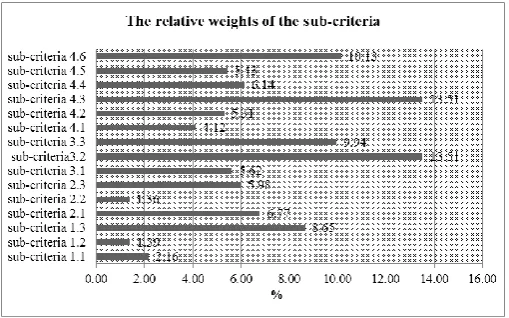
This level has been divided into 15 sub-criteria based on major criteria and decision makers’ weight by using a comparison matrix. Figure 4 showed the results of the relative weights of sub-criteria.
Fig. 4. The relative weights of the sub-criteria.
The first priority of sub-criteria affecting sustainable water management of the upper Pranburi watershed ranked by the community representatives were the awareness campaign for ongoing sustainable water management and participation of stakeholders within the Pranburi watershed which were both 13.51%. The finding indicated that the communities focus on stakeholder participation for achieving sustainable water resource management, including the promotion of conscious of the local people who utilize the water resource.
The second priority was the application of Sufficiency Economy published by King Bhumibol Adulyadej of Thailand as the guideline for water resource management (10.13%). It is also essential that the decision makers know this theory in order to integrate farming with water management and soil conservation. New theories lead to sustainable agriculture and self-reliant community development in the Pranburi watershed. This finding is consistent with [37] the Sufficiency Economy Philosophy and can lead sustainable integrated community development and activities managing common resources, this can be used to drive other community development activities.
3.2.3. Priority of alternatives for water resource management in the Pranburi watershed
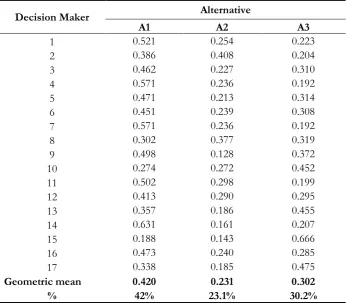
The analysis results on priority of alternatives of water resource management in the Pranburi watershed consisted of three alternatives as follows (Table 6).
[image:12.595.189.444.326.485.2]Alternative 3 (A3): strategies for training in water resource management and techniques.
Table 6. Priority of the alternative on water resource management in the upper Pranburi watershed.
Decision Maker Alternative
A1 A2 A3
1 0.521 0.254 0.223
2 0.386 0.408 0.204
3 0.462 0.227 0.310
4 0.571 0.236 0.192
5 0.471 0.213 0.314
6 0.451 0.239 0.308
7 0.571 0.236 0.192
8 0.302 0.377 0.319
9 0.498 0.128 0.372
10 0.274 0.272 0.452
11 0.502 0.298 0.199
12 0.413 0.290 0.295
13 0.357 0.186 0.455
14 0.631 0.161 0.207
15 0.188 0.143 0.666
16 0.473 0.240 0.285
17 0.338 0.185 0.475
Geometric mean 0.420 0.231 0.302
% 42% 23.1% 30.2%
The priority of the alternatives for water resource management were the strategies for watershed planning (A1) accounting for 42%, strategies for training in water resource management and techniques (A3) 30.2%, and strategies for establishing a group (A2) 23.1%. The results indicated that the decision makers focused on watershed planning by community participation involved that the setting rules and analysing the watershed eco-system, because this strategy is an important step for the principle of watershed management for developing and supporting water users. The alternative 1 concentrated on participation by setting rules and analysing the watershed eco-system. Rule on the use of water and other resources in the Pranburi watershed led to corporate planning at all level e.g. village level to watershed level in order to gain the understanding and realization of role and the importance of participation that can introduce the conservation and utilization of water and other resources in the area. However, alternative 3 is important for the utilization of water resource in the Pranburi watershed including soil, water, and forest and promoting awareness of utilization and conservation of water resource in the local area. While, alternative 2 emphasized on establishing a group involved with water resources management via the selection of representatives from both official and unofficial community leaders including those with local knowledge who are influential representatives of the community in order to perform water resource management and utilization in the Pranburi watershed. It can be concluded from the weighing of the decision-makers to realize the strategy participation in watershed management is the first priority for the best alternatives in the Pranburi watershed.
4.
Conclusion
[image:13.595.125.473.129.432.2]by the decision makers to set the implementation strategies. This results is consistent with [38] that developing action plans and evolving toward the integration of the participatory processes for decision-making. Participatory processes regarding water infrastructure decisions are examined. Furthermore, [39] proposed concluded that the sustainable regional water resource system should pay attention to the sustainability of water resources, society, the economy, and the environment.
In this paper, it is indicated that the AHP approach can be applied to the decision making process by stakeholder participation in each step. In the first step, the experts can determine the complex problems and classify the goal, criteria, sub-criteria, alternatives based on the IWRM concept and the research of the Pranburi watershed [3] to the AHP model in the Pranburi watershed. The second step, decision makers who are the representative community in the Pranburi watershed can determine the best alternative from several criteria.
For each step, the decision makers should be knowledgeable and experienced in the study area. Then the data obtained by the analysis can be developed through AHP that can measure the score of the decision level efficiently, resulting in the decision that is as suitable as possible with the goal. The determination of relative weights was applied by classifying problems as the hierarchy e.g. goal, criteria, and alternatives then conducting pairwise comparison for evaluating weight of alternatives of each criteria and weight of criteria. Then the weighing score are calculated, ranking the priority of all alternatives, and selecting the alternative that has the highest weighing score. This process includes the validation of data consistency attained from the weighing to gain the reliability. However, the obstacle of the AHP approach for decision making is it can be time-consuming to consider the criteria, sub-criteria, and alternative and weighing the score by pair-wise comparison. Furthermore, AHP is a tool that can gather complicated and various data for classification of the criteria group. Therefore, its application in the Pranburi watershed resulted in the type of relevant criteria more clearly because there was a systematic process for analysing soil, water and population in the watershed [3]. For the purpose of the application the IWRM and AHP approach for water resource management and planning in the upper Pranburi watershed can be concluded as follows;
1) The decision makers can consider the complex problems about water resources under the application of the methodology of comparison matrix in the AHP model for the Pranburi watershed. This revealed that the AHP approach can establish the community representative’s relevant data before making the decision. The respondents who are the decision maker should have experience in this study area for considering each criterion. The decision-makers’ experience is important in the process of weighing the score for each criteria and alternatives. In addition, the information of each criterion should be in order to ease judgments in the pairwise comparison.
2) In terms of sustainable watershed management it should be conducted with the participation of both people inside and outside the community. They should be invited to join in the setting and decision making process of policy, plans, and any measures in the villages, community, and watershed level because the water resource management in the watershed area involves various related factors. This is important for water resource management in the Pranburi watershed because the AHP can be applied for the consideration and systematic decision making using fundamental information and knowledge of resources in the community in order to find suitable alternatives in the priority setting of plans or projects launch in the area.
More importantly, the decision makers can consider the overview of water resource management from upstream, midstream, and downstream before make the decision. The AHP approach can reduce bias on decision making by applying pairwise comparison of the AHP technique, which makes the decision maker consider criteria or factors from the other viewpoint. Furthermore, the data used for making the decision can assist the decision making to be meticulous and systematic. In the future, the government should support and attend along with local officer and community representatives in the decision making process of water resource planning.
Acknowledgement
References
[1] N. Tangtham, “Status of socio-economics-institutional research and identification of needed researches for watershed management in Thailand,” Kasetsart Journal (Social Science), vol. 7, pp.217-226, 1986.
[2] Land Development Department, “Plan of landuse: Pranburi Watershed,” (in Thai) Land Development Department, Ministry of Agriculture and Cooperatives, 2001.
[3] J. Thungngern, T. Sriburi, and S. Wijitkosum, “Land–water–population model: Developing an agricultural resources management in the upper part of Pranburi Watershed,” Applied Environmental
Research, vol. 39, no. 1, pp. 49-64, 2017.
[4] Global Water Partnership, “Integrated water resources management,” Sweden, Stockholm, 2000. [5] World Bank. Thailand Environment Monitor: Integrated Water Resources Management—A Way Forward
[Online]. Available: http://documents.worldbank.org/curated/en/367151468303847751/Thailand-environment-monitor- integrated-water-resources-management-a-way-forward [Accessed: 6 January 2017].
[6] G. Anzaldi, E. Rubion, A. Corchero, R. Sanfeliu, X. Domingo, J. Pijuan, and F. Tersa, “Towards an enhanced knowledge-based decision support system (DSS) for integrated water resource management (IWRM),” in Proc. the 6th Water Distribution System Analysis Conference, WDSA 2014—Urban Water Hydroinformatics and Strategic Planning, Bari, Italy, July 14-17, 2014, pp. 1097-1104. doi:
10.1016/j.proeng.2014.11.230
[7] T. L. Saaty, The Analytic Hierarchy Process. New York, McGraw-Hill, 1980.
[8] P. Rezakhani, “Fuzzy MCDM model for risk factor selection in construction projects,” Engineering
Journal, vol. 16, no. 5, pp. 81-93, 2012. doi: 10.4186/ej.2012.16.5.79
[9] F. Dweiri, S. Kumar, S. A. Khan, and V. Jain, “Designing an integrated AHP based decision support system for supplier selection in automotive industry,” Expert Systems with Applications, vol. 62, pp.273– 283, 2016. doi:10.1016/j.eswa.2016.06.030
[10] A. Riahi, and M. Moharrampour, “Evaluation of strategic management in business with AHP case study: PARS house appliance,” Procedia Economics and Finance, vol. 26, pp. 10-21, 2016. doi: 10.1016/S2212-5671(16)30011-9
[11] K. P. Anagnostopoulos, C. Petalas, and V. Pisinaras, “Water resources planning using the AHP and PROMETHEE multicriteria methods: The case of Nestos River-Greece,” presented at the 7th Balkan Conference on Operational Research, Constanta, Romania, May 25-28, 2005.
[12] B. Srdjevic and Y. D. P. Medeiros, “Fuzzy AHP assessment of water management plans,” Water
Resources Management, vol. 22, pp. 877-894, 2008. doi: 10.1007/s11269-007-9197-5
[13] A. Montazar and E. Zadbagher, “An analytical hierarchy model for assessing global water productivity of irrigation networks in Iran,” Water Resource Management, vol. 24, pp. 2817–2832, 2010. doi: 10.1007/s11269-010-9581-4
[14] D. Bosch, J. Pease, M. L. Wolfe, C. Zobel, J. Osorio, T. D. Cobb, and G. Evanylo, “Community DECISIONS: Stakeholder focused watershed planning,” Journal of Environmental Management, vol. 112, pp. 226-232, 2012. doi: 10.1016/j.jenvman.2012.07.031
[15] J. Gallego-Ayala and D. Juízo, “Integrating stakeholders’ references into water resources management planning in the Incomati River Basin,” Water Resource Management, vol. 28, pp. 527–540, 2014. doi: http://dx.doi.org/10.1007/s11269-013-0500-3
[16] R. Shabbir and S. S. Ahmad, “Water resource vulnerability assessment in Rawalpindi and Islamabad, Pakistan using Analytic Hierarchy Process (AHP),” Journal of King Saud University—Science, vol. 28, no. 4, pp. 293–299, 2016. doi: 10.1016/j.jksus.2015.09.007
[17] J. I. Matondo, “A comparison between conventional and integrated water resources planning and management,” Physics and Chemistry of the Earth, vol. 27, pp. 831-38, 2002. doi: 10.1016/S1474-7065(02)00072-4
[18] E. Boutkan and A. Stikker, “Enhanced water resource base for sustainable integrated water resource management,” Natural Resources Forum, vol. 28, pp. 150-154, 2008. doi: 10.1111/j.1477-8947.2004.00082.x
[19] T. L. Satty, “Decision making with the Analytic Hierarchy Process,” International Journal of Services
[20] T. L. Saaty, Fundamentals of Decision Making and Priority Theory with the Analytic Hierarchy Process. RWS Publication, 2000.
[21] Tutorial on Basic Principles of Integrated Water Resources Management [Online]. Available:
http://www.pacificwater.org/userfiles/file/IWRM/Toolboxes/introduction%20to%20iwrm/Tutorial _text.pdf [Accessed: 6 January 2017].
[22] C. Hermans, J. Erickson, T. Noordewier, A. Sheldon, and M. Kline, “Collaborative environmental planning in river management: An application of multicriteria decision analysis in the White River Watershed in Vermont,” Journal of Environmental Management, vol. 84, no. 4, pp. 534-546, 2016. doi: 10.1016/j.jenvman.2006.07.013
[23] A. Calizaya, O. Meixner, L. Bengtsson, and R. Berndtsson, “Multi-criteria decision analysis (MCDA) for integrated water resources management (IWRM) in the Lake Poopo Basin, Bolivia,” Water Resources
Management, vol. 24, no. 10, pp. 2267–2289, 2010. doi: 10.1007/s11269-009-9551-x
[24] Government of India. Guidelines for Integrated Water Resources Development and Management [Online]. Available: http://www.cwc.gov.in/main/downloads/IWRM_Guidelines.pdf [Accessed: 5 Jan 2017]. [25] Global Water Partnership (GWP) and the International Network of Basin Organizations (INBO), “A
Handbook for Integrated Water Resources Management in Basins”, Available: http://www.unwater.org/downloads/GWP-INBOHandbookForIWRMinBasins.pdf, [Accessed: 5 Dec 2016].
[26] UNEP Collaborating Center on Water and Environment. Addressing Environmental Aspects and Ecosystem
Issues in Integrated Water Resources Management: Merging IWRM and the Ecosystem Approach [Online].
Available: http://www.unepdhi.org/-/media/microsite_unepdhi/publications/documents/ unep_dhi/2007%20addressing%20environmental%20aspects%20of%20iwrm.pdf?la=en [Accessed: 23 Dec 2016].
[27] World Bank. Strategic Environmental Assessment and Integrated Water Resources Management and Development [Online]. Available: http://siteresources.worldbank.org/INTRANETENVIRONMENT/Resources/ ESW_SEA_for_IWRM.doc [Accessed: 25 Dec 2016].
[28] World Bank. Thailand Environment Monitor Integrated Water Resources Management: A Way Forward [Online]. Available: http://documents.worldbank.org/curated/en/367151468303847751/Thailand-environment-monitor-integrated-water-resources-management-a-way-forward [Accessed: 25 Dec 2016] [29] Mekong River Commission. Manual for Training Trainers in Integrated Water Resources Management in
Mekong Basin [Online]. Available: https://cmsdata.iucn.org/downloads/
implementing_iwrm__rm_changes_130510___2_.pdf [Accessed: 18 Dec 2016].
[30] A. Anukularmphai. Implementing Integrated Water Resources Management (IWRM): Based on Thailand’s
Experience [Online]. Available: https://cmsdata.iucn.org/downloads/implementing_iwrm
__rm_changes_130510___2_.pdf [Accessed: 18 Dec 2016].
[31] G. L. Bagdi and R. S. Kurothe, “People’s participation in watershed management programmes: Evaluation study of Vidarbha region of Maharashtra in India,” International Soil and Water Conservation
Research, vol. 2, no. 3, pp. 57-66, 2014. doi: 10.1016/S2095-6339(15)30023-X
[32] H. Helene and N. Andreas. Participation of Local People in Water Management: Evidence from the
Mae Sa Watershed, Northern Thailand [Online]. Available:
http://ageconsearch.umn.edu/bitstream/60326/2/eptdp128.pdf [Accessed: 18 Dec 2016].
[33] J. S. Thomas and B. Durham, “Integrated water resource management: Looking at the whole picture,”
Desalination, vol. 156, pp. 21-28, 2003. doi: 10.1016/S0011-9164(03)00320-5
[34] International Water Management Institute. Guideline for Local Level Integrated Water Resources Management [Online]. Available: http://www.iwmi.cgiar.org/Publications/Other/PDF/Guidelines_for_local-level_integrated_water_resource_management.pdf [Accessed: 18 Dec 2016].
[35] H. R. Safavi, M. H. Golmohammadia, and S. Sandoval-Solisb, “Expert knowledge based modeling for integrated water resources planning and management in the Zayandehrud River Basin,” Journal of
Hydrology, vol. 528, pp. 773–789, 2015. doi: 10.1016/j.jhydrol.2015.07.014
[36] D. C. Morais and A. T. de Almeida, “Group decision making on water resources based on analysis of individual rankings,” Omega, vol. 40, no. 1, pp. 42-52, 2012. doi: 10.1016/j.omega.2011.03.005
[38] K. Faust, D. M. Abraham, and D. DeLaurentis, “Assessment of stakeholder perceptions in water infrastructure projects using system-of-systems and binary probit analyses: A case study,” Journal of
Environmental Management, vol. 128, pp. 866-876, 2013. doi: 10.1016/j.jenvman.2013.06.036