1
The 17th International Conference on Parallel and Distributed Computing, Applications and Technologies (PDCAT-16), December 16-18, 2016,
Guangzhou, China, Sponsored by Sun Yat-Sen University Geoffrey Fox December 17, 2016
[email protected]
http://www.dsc.soic.indiana.edu/, http://spidal.org/ http://hpc-abds.org/kaleidoscope/ Department of Intelligent Systems Engineering
School of Informatics and Computing, Digital Science Center Indiana University Bloomington
Indiana – Sun Yat-Sen Collaboration?
• In 2014, we set up Masters in Data Science at Indiana University – From 0 to 549 students in 2 years
– A cross department (Statistics, Computer Science, Information Science, Library Science, Informatics, ISE) program. There is no department of Data Science
• In 2016, we set up Department of Intelligent Systems Engineering ISE
– Intelligent Systems includes Deep learning, Big data, Clouds etc.
– Computer Engineering includes HPC, datacenters, embedded systems – Cyberphysical Systems: Robotics, Internet of Things, Smart-X
– Bioengineering and Neuroengineering
– Nanoengineering
• ISE has curricula in Systems Engineering, Modeling & Simulation, Big Data • ISE research includes Intel MIC chips as used in Tianhe-2
• ISE well aligned with School of Data and Computer Science at Guangzhou
2
Why Connect (“Converge”) Big Data and HPC
• Two major trends in computing systems are
– Growth in high performance computing (HPC) with an international exascale initiative (China in the lead)
– Big data phenomenon with an accompanying cloud infrastructure of well publicized dramatic and increasing size and sophistication.
• Note “Big Data” largely an industry initiative although software used is often open source
– So HPC labels overlaps with “research” e.g. HPC community largely
responsible for Astronomy and Accelerator (LHC, Belle, BEPC ..) data analysis • Merge HPC and Big Data to get
– More efficient sharing of large scale resources running simulations and data analytics
– Higher performance Big Data algorithms
– Richer software environment for research community building on many big data tools
– Easier sustainability model for HPC – HPC does not have resources to build and maintain a full software stack
3
Convergence Points (Nexus) for
HPC-Cloud-Big Data-Simulation
•
Nexus 1: Applications
– Divide use cases into
Data
and
Model
and compare characteristics separately in these two
components with
64 Convergence Diamonds
(features)
•
Nexus 2: Software
– High Performance Computing (HPC)
Enhanced Big Data Stack HPC-ABDS. 21 Layers adding high
performance runtime to Apache systems (Hadoop is fast!).
Establish principles to get good performance from Java or C
programming languages
•
Nexus 3: Hardware
– Use Infrastructure as a Service IaaS and
DevOps to automate deployment of software defined systems
on hardware designed for functionality and performance e.g.
appropriate disks, interconnect, memory (
HPC Cloud 3.0
?)
4
SPIDAL Project
Datanet: CIF21 DIBBs: Middleware and
High Performance Analytics Libraries for
Scalable Data Science
• NSF14-43054 started October 1, 2014
• Indiana University (Fox, Qiu, Crandall, von Laszewski)
• Rutgers (Jha)
• Virginia Tech (Marathe)
• Kansas (Paden)
• Stony Brook (Wang)
• Arizona State (Beckstein)
• Utah (Cheatham)
• A
co-design
project: Software, algorithms, applications
6
02/07/2020
Software: MIDAS HPC-ABDS
Main Components of SPIDAL Project
• Design and Build Scalable High Performance Data Analytics Library
• SPIDAL (Scalable Parallel Interoperable Data Analytics Library): Scalable Analytics for:
– Domain specific data analytics libraries – mainly from project. – Add Core Machine learning libraries – mainly from community. – Performance of Java and MIDAS Inter- and Intra-node.
• NIST Big Data Application Analysis – features of data intensive Applications deriving 64 Convergence Diamonds. Application Nexus.
• HPC-ABDS: Cloud-HPC interoperable software performance of HPC (High
Performance Computing) and the rich functionality of the commodity Apache Big Data Stack. Software Nexus
• MIDAS: Integrating Middleware – from project.
• Applications: Biomolecular Simulations, Network and Computational Social Science, Epidemiology, Computer Vision, Geographical Information Systems, Remote Sensing for Polar Science and Pathology Informatics, Streaming for robotics, streaming stock analytics
• Implementations: HPC as well as clouds (OpenStack, Docker) Convergence with common DevOps tool Hardware Nexus
7
Application Nexus
Use-case Data and Model
NIST Collection
Big Data Ogres
Convergence Diamonds
Data and Model in Big Data and Simulations I
• Need to discuss
Data
and
Model
as problems have both
intermingled, but we can get insight by separating which allows
better understanding of
Big Data - Big Simulation
“convergence” (or differences!)
• The
Model
is a user construction and it has a “
concept
”,
parameters
and gives
results
determined by the computation.
We use term “model” in a general fashion to cover all of these.
•
Big Data
problems can be broken up into
Data
and
Model
– For clustering, the model parameters are cluster centers while the data is set of points to be clustered
– For queries, the model is structure of database and results of this query while the data is whole database queried and SQL query
– For deep learning with ImageNet, the model is chosen network with
model parameters as the network link weights. The data is set of images used for training or classification
9
Data and Model in Big Data and Simulations II
•
Simulations
can also be considered as
Data
plus
Model
–
Model
can be formulation with particle dynamics or partial
differential equations defined by parameters such as particle
positions and discretized velocity, pressure, density values
–
Data
could be small when just boundary conditions
–
Data
large with data assimilation (weather forecasting) or when
data visualizations are produced by simulation
•
Big Data
implies Data is large but Model varies in size
– e.g.
LDA
with many topics or
deep learning
has a large model
–
Clustering
or
Dimension reduction
can be quite small in model
size
•
Data
often static between iterations (unless streaming);
Model
parameters
vary between iterations
•
Data
and
Model Parameters
are often
confused
in papers as term
data used to describe the parameters of models.
10
51 Detailed Use Cases:
Contributed July-September 2013
Covers goals, data features such as 3 V’s, software, hardware
• Government Operation(4): National Archives and Records Administration, Census Bureau • Commercial(8): Finance in Cloud, Cloud Backup, Mendeley (Citations), Netflix, Web Search,
Digital Materials, Cargo shipping (as in UPS)
• Defense(3): Sensors, Image surveillance, Situation Assessment
• Healthcare and Life Sciences(10): Medical records, Graph and Probabilistic analysis, Pathology, Bioimaging, Genomics, Epidemiology, People Activity models, Biodiversity
• Deep Learning and Social Media(6): Driving Car, Geolocate images/cameras, Twitter, Crowd Sourcing, Network Science, NIST benchmark datasets
• The Ecosystem for Research(4): Metadata, Collaboration, Language Translation, Light source experiments
• Astronomy and Physics(5): Sky Surveys including comparison to simulation, Large Hadron Collider at CERN, Belle Accelerator II in Japan
• Earth, Environmental and Polar Science(10): Radar Scattering in Atmosphere, Earthquake, Ocean, Earth Observation, Ice sheet Radar scattering, Earth radar mapping, Climate simulation datasets, Atmospheric turbulence identification, Subsurface Biogeochemistry (microbes to
watersheds), AmeriFlux and FLUXNET gas sensors • Energy(1): Smart grid
• Published by NIST as http://nvlpubs.nist.gov/nistpubs/SpecialPublications/NIST.SP.1500-3.pdf
with common set of 26 features recorded for each use-case; “Version 2” being prepared
11 02/07/2020
Sample Features of 51 Use Cases I
•
PP (26)
“All”
Pleasingly Parallel or Map Only
•
MR (18)
Classic MapReduce MR (add MRStat below for full count)
•
MRStat (7
) Simple version of MR where key computations are simple
reduction as found in statistical averages such as histograms and
averages
•
MRIter (23
)
Iterative MapReduce or MPI (Flink, Spark, Twister)
•
Graph (9)
Complex graph data structure needed in analysis
•
Fusion (11)
Integrate diverse data to aid discovery/decision making;
could involve sophisticated algorithms or could just be a portal
•
Streaming (41)
Some data comes in incrementally and is processed
this way
•
Classify
(30)
Classification: divide data into categories
•
S/Q (12)
Index, Search and Query
12
Sample Features of 51 Use Cases II
• CF (4) Collaborative Filtering for recommender engines
• LML (36) Local Machine Learning (Independent for each parallel entity) – application could have GML as well
• GML (23) Global Machine Learning: Deep Learning, Clustering, LDA, PLSI, MDS,
– Large Scale Optimizations as in Variational Bayes, MCMC, Lifted Belief
Propagation, Stochastic Gradient Descent, L-BFGS, Levenberg-Marquardt . Can call EGO or Exascale Global Optimization with scalable parallel algorithm
• Workflow (51) Universal
• GIS (16) Geotagged data and often displayed in ESRI, Microsoft Virtual Earth, Google Earth, GeoServer etc.
• HPC(5) Classic large-scale simulation of cosmos, materials, etc. generating (visualization) data
• Agent (2) Simulations of models of data-defined macroscopic entities represented as agents
13
7 Computational Giants of
NRC Massive Data Analysis Report
1) G1:
Basic Statistics e.g. MRStat
2) G2:
Generalized N-Body Problems
3) G3:
Graph-Theoretic Computations
4) G4:
Linear Algebraic Computations
5) G5:
Optimizations e.g. Linear Programming
6) G6:
Integration e.g. LDA and other GML
7) G7:
Alignment Problems e.g. BLAST
14
02/07/2020
HPC (Simulation) Benchmark Classics
•
Linpack
or HPL: Parallel LU factorization
for solution of linear equations;
HPCG
•
NPB
version 1: Mainly classic HPC solver kernels
– MG: Multigrid
– CG: Conjugate Gradient
– FT: Fast Fourier Transform
– IS: Integer sort
– EP: Embarrassingly Parallel
– BT: Block Tridiagonal
– SP: Scalar Pentadiagonal
– LU: Lower-Upper symmetric Gauss Seidel
15
02/07/2020
13 Berkeley Dwarfs
1) Dense Linear Algebra 2) Sparse Linear Algebra 3) Spectral Methods
4) N-Body Methods 5) Structured Grids 6) Unstructured Grids
7) MapReduce
8) Combinational Logic 9) Graph Traversal
10) Dynamic Programming 11) Backtrack and
Branch-and-Bound 12) Graphical Models
13) Finite State Machines
16
02/07/2020
First 6 of these correspond to Colella’s
original. (Classic simulations)
Monte Carlo dropped.
N-body methods are a subset of
Particle in Colella.
Note a little inconsistent in that
MapReduce is a programming model
and spectral method is a numerical
method.
Need multiple facets to classify use
cases!
Classifying Use cases
17
Classifying Use Cases
• The Big Data Ogres built on a collection of 51 big data uses gathered by the NIST Public Working Group where 26 properties were gathered for each application.
• This information was combined with other studies including the Berkeley dwarfs, the NAS parallel benchmarks and the Computational Giants of the NRC Massive Data Analysis Report.
• The Ogre analysis led to a set of 50 features divided into four views that could be used to categorize and distinguish between applications.
• The four views are Problem Architecture (Macro pattern); Execution Features (Micro patterns); Data Source and Style; and finally the
Processing View or runtime and algorithm features.
• We generalized this approach to integrate Big Data and Simulation applications into a single classification looking separately at Data and
Model with the total facets growing to 64 in number, called convergence diamonds, and split between the same 4 views.
• A mapping of facets into work of the SPIDAL project has been given.
18
19
64 Features in 4 views for Unified Classification of Big Data
and Simulation Applications
20
Simulations Analytics (Model for Big Data)
Both
(All Model)
(Nearly all Data+Model)
(Nearly all Data)
(Mix of Data and Model)
Examples in Problem Architecture View PA
• The facets in the Problem architecture view include 5 very common ones describing synchronization structure of a parallel job:
– MapOnly or Pleasingly Parallel (PA1): the processing of a collection of independent events;
– MapReduce (PA2): independent calculations (maps) followed by a final consolidation via MapReduce;
– MapCollective (PA3): parallel machine learning dominated by scatter, gather, reduce and broadcast;
– MapPoint-to-Point (PA4): simulations or graph processing with many local linkages in points (nodes) of studied system.
– MapStreaming (PA5): The fifth important problem architecture is seen in recent approaches to processing real-time data.
– We do not focus on pure shared memory architectures PA6 but look at hybrid architectures with clusters of multicore nodes and find important performances issues dependent on the node programming model.
• Most of our codes are SPMD (PA-7) and BSP (PA-8).
21
6 Forms of
MapReduce
Describes
Architecture of - Problem (Model reflecting data)
- Machine - Software
2 important
variants (software) of Iterative
MapReduce and Map-Streaming
a) “In-place” HPC
b) Flow for model and data
22
Clouds, HPC Clouds
Simulations, Big Data
Considerations on Big Data v. Clouds/HPC
• “High Performance” seems natural for Big Data as this needs a lot of processing and HPC could do it faster?
• Cons: But much big data processing involves I/O of distributed data and this dominates over computing accelerated by HPC
– Other problems (such as LHC data processing) are compute dominated but this is pleasingly parallel and so parallel computing and nifty HPC algorithms irrelevant
– Other problems (like basic databases) are essentially MapReduce and also do not have tight synchronization constraints addressed by HPC • Pros: Andrew Ng notes that a leading machine learning group must have
both deep learning and HPC excellence.
– Some machine learning like topic modelling (LDA), clustering, deep
learning, dimension reduction, graph algorithms involve Map-Collective
or Map-Point to Point iterative structure and benefit from HPC
– HPC (MPI) often large factors (10-100) faster than Hadoop, Spark, Flink, Storm
24
Why HPC Cloud architectures?
• Exascale simulations needed as have differential equation based models that need small space and time steps and this leads to numerical
formulations that need the memory and compute power of an exascale machine to solve individual problems (capability computing)
• Big data problems do not have differential operators and it is not obvious that you need a full exascale system to address a single Big Data problem • Rather you will be running lots of jobs that are sometimes pleasingly
parallel/MapReduce (Cloud) and sometimes small to medium size HPC jobs which in aggregate are exascale (HPC Cloud) (capacity computing)
– Deep learning doesn’t exhibit massive parallelism due to stochastic gradient descent using small mini-batches of training data
– But deep learning does use small accelerator enhanced HPC clusters. • Note modest size clusters need all the software, hardware and algorithm
expertise of HPC.
• Systems designed for exascale HPC simulations, should be well suited for
HPC cloud if I/O handled correctly (as in traditional clouds)
25
Comparison of Data Analytics with Simulation I
• Simulations (models) produce big data as visualization of results – they are data source
– Or consume often smallish data to define a simulation problem – HPC simulation in (weather) data assimilation is data + model
• Pleasingly parallel often important in both • Both are often SPMD and BSP
• Classic Non-iterative MapReduce is major big data paradigm
– not a common simulation paradigm except where “Reduce” summarizes pleasingly parallel execution as in some Monte Carlos
• Big Data often has large collective communication
– Classic simulation has a lot of smallish point-to-point messages – Motivates MapCollective model
• Simulations characterized often by difference or differential operators leading to nearest neighbor sparsity
• Some important data analytics can be sparse as in PageRank and “Bag of words” algorithms but many involve full matrix algorithms
Comparison
of Data Analytics with Simulation II
• There are similarities between some
graph problems and particle
simulations
with a particular
cutoff force.
– Both are
MapPoint-to-Point
problem architecture
• Note many big data problems are “
long range force
” (as in
gravitational simulations) as all points are linked.
– Easiest to parallelize. Often full matrix algorithms
– e.g. in DNA sequence studies, distance
(
i
,
j
) defined by BLAST,
Smith-Waterman, etc., between all sequences
i
,
j.
– Opportunity for “fast multipole” ideas in big data. See NRC report
• Current Ogres/Diamonds do not have facets to designate
underlying
hardware
: GPU v. Many-core (Xeon Phi) v. Multi-core as these
define how maps processed; they keep map-X structure fixed; maybe
should change as ability to exploit vector or SIMD parallelism could
be a model facet.
Comparison
of Data Analytics with Simulation III
• In image-based deep learning, neural network weights are block sparse (corresponding to links to pixel blocks) but can be formulated as full
matrix operations on GPUs and MPI in blocks.
• In HPC benchmarking, Linpack being challenged by a new sparse conjugate gradient benchmark HPCG, while I am diligently using non-sparse conjugate gradient solvers in clustering and Multi-dimensional scaling.
• Simulations tend to need high precision and very accurate results – partly because of differential operators
• Big Data problems often don’t need high accuracy as seen in trend to low precision (16 or 32 bit) deep learning networks
– There are no derivatives and the data has inevitable errors
• Note parallel machine learning (GML not LML) can benefit from HPC style interconnects and architectures as seen in GPU-based deep learning
– So commodity clouds not necessarily best. Need HPC Cloud
02/07/2020 29
Clustering and Visualization
• The SPIDAL Library includes several clustering algorithms with sophisticated features
– Deterministic Annealing
– Radius cutoff in cluster membership
– Elkans algorithm using triangle inequality • They also cover two important cases
– Points are vectors – algorithm O(N) for N points
– Points not vectors – all we know is distance (i, j) between each pair of points i and j. algorithm O(N2) for N points
• We find visualization important to judge quality of clustering
• As data typically not 2D or 3D, we use dimension reduction to project data so we can then view it
• Have a browser viewer WebPlotViz that replaces an older Windows system • Clustering and Dimension Reduction are modest HPC applications
• Calculating distance (i, j) is similar compute load but pleasingly parallel
30
31
2D Vector Clustering with cutoff at 3
σ
32
02/07/2020
LCMS Mass Spectrometer Peak Clustering. Charge 2 Sample with 10.9 million points and 420,000 clusters visualized in WebPlotViz
Software Nexus
Application Layer
On
Big Data Software Components for
Programming and Data Processing
On
HPC for runtime
On
IaaS and DevOps Hardware and Systems
•
HPC-ABDS
•
MIDAS
•
Java Grande
35
02/07/2020
Functionality of 21 HPC-ABDS Layers
1)
Message Protocols:
2)
Distributed Coordination:
3)
Security & Privacy:
4)
Monitoring:
5)
IaaS Management from HPC to
hypervisors:
6)
DevOps:
7)
Interoperability:
8)
File systems:
9)
Cluster Resource
Management:
10)
Data Transport:
11)
A) File management
B) NoSQL
C) SQL
36
02/07/2020
12)
In-memory databases & caches /
Object-relational mapping / Extraction
Tools
13)
Inter process communication
Collectives, point-to-point,
publish-subscribe, MPI:
14)
A) Basic Programming model and
runtime, SPMD, MapReduce:
B) Streaming:
15)
A) High level Programming:
B) Frameworks
16)
Application and Analytics:
17)
Workflow-Orchestration:
Lesson of large number (350). This is a rich software environment that HPC cannot “compete” with. Need to use and not regenerate
Using “Apache” (Commercial Big Data)
Data Systems for Science/Simulation
• Pro: Use rich functionality and usability of ABDS (Apache Big Data Stack) • Pro: Sustainability model of community open source
• Con (Pro for many commercial users): Optimized for fault-tolerance and
usability and not performance
• Feature: Naturally run on clouds and not HPC platforms
• Feature: Cloud is logically centralized, physically distributed but science data typically distributed.
• Question: how do science data analysis requirements differ from those commercially e.g. recommender systems heavily used commercially
• Approach: HPC-ABDS using HPC runtime and tools to enhance commercial data systems (ABDS on top of HPC)
– Upper level software: ABDS – Lower level runtime: HPC
– HPCCloud Hardware: HPC or classic cloud dependent on application requirements
37
Java Grande
Revisited on 3 data analytics codes
Clustering
Multidimensional Scaling
Latent Dirichlet Allocation
all sophisticated algorithms
38
Java MPI performs better than FJ Threads
128 24 core Haswell nodes on SPIDAL 200K DA-MDS Code
39 02/07/2020
Best FJ Threads intra node; MPI inter node
Best MPI; inter and intra node
MPI; inter/intra node; Java not optimized
Speedup compared to 1
Investigating Process and Thread Models
40
02/07/2020
• FJ Fork Join Threads lower performance than Long
Running Threads LRT
• Results
– Large effects for Java – Best affinity is process
and thread binding to cores - CE
– At best LRT mimics performance of “all processes”
Performance Dependence on Number of
Cores inside 24-core node (16 nodes total)
• Long-Running Theads LRT Java
– All Processes
– All Threads
internal to node – Hybrid – Use one
process per chip
• Fork Join Java
– All Threads
– Hybrid – Use one process per chip
• Fork Join C
– All Threads
• All MPI internode
41
02/07/2020
Java
versus
C
Performance
• C and Java Comparable (if you use best Java approach) with Java doing better on larger problem sizes
• All data from one million point dataset with varying number of centers on 16 nodes 24 core Haswell
42
HPC-ABDS
DataFlow and In-place Runtime
43
HPC-ABDS Parallel Computing
• Both simulations and data analytics use similar parallel computing ideas • Both do decomposition of both model and data
• Both tend use SPMD and often use BSP Bulk Synchronous Processing • One has computing (called maps in big data terminology) and
communication/reduction (more generally collective) phases
• Big data thinks of problems as multiple linked queries even when queries are small and uses dataflow model
• Simulation uses dataflow for multiple linked applications but small steps such as iterations are done in place
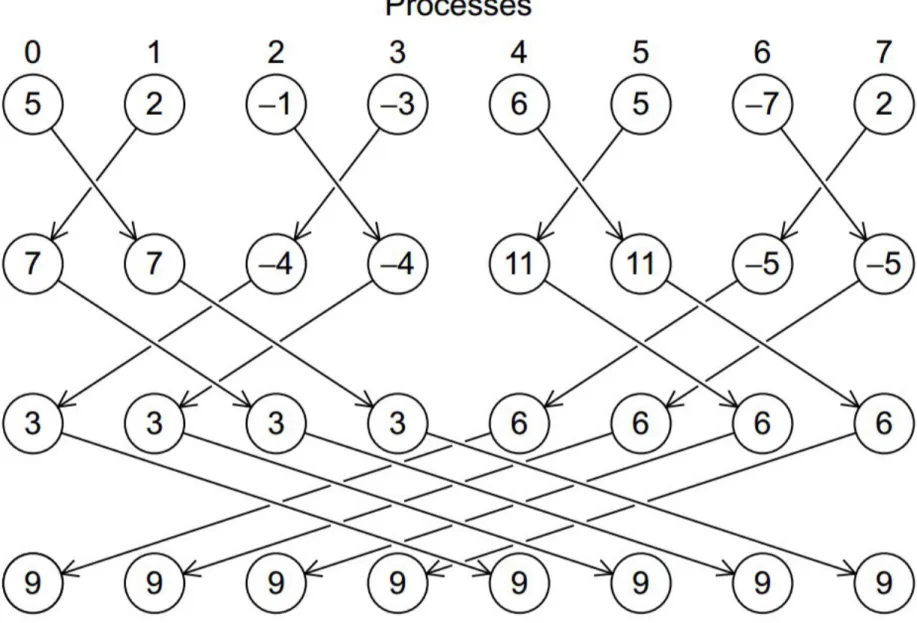
• Reduction in HPC (MPIReduce) done as optimized tree or pipelined communication between same processes that did computing
• Reduction in Hadoop or Flink done as separate map and reduce processes using dataflow
– This leads to 2 forms (In-Place and Flow) of Map-X mentioned earlier • Interesting Fault Tolerance issues highlighted by Hadoop-MPI comparisons
– not discussed here!
44
Illustration of In-Place AllReduce in MPI
45
Breaking Programs into Parts
46
02/07/2020
Coarse Grain
Dataflow
HPC or ABDS
Fine Grain Parallel Computing
K-Means Clustering in Spark, Flink, MPI
47
02/07/2020
K-Means total and compute times for 1 million 2D points and 1k,10,50k,100k, and 500k centroids for Spark, Flink, and MPI Java LRT-BSP CE. Run on 16 nodes as 24x1.
K-Means total and compute times for 100k 2D points and1k,2k,4k,8k, and 16k centroids for Spark, Flink, and MPI Java LRT-BSP CE. Run on 1 node as 24x1.
K-Means total and compute times for 1 million 2D points and 1k,10,50k,100k, and 500k centroids for Spark, Flink, and MPI Java LRT-BSP CE. Run on 16 nodes as 24x1.
Map (nearest centroid calculation) Reduce (update centroids) Data Set <Points>
Data Set <Initial Centroids> Data Set <Updated Centroids>
Broadcast
Flink vs MPI
DA-MDS
Performance
02/07/2020 48
Total time of MPI Java and Flink MDS implementations for 96 and 192 parallel tasks with no of points ranging from 1000 to 32000. The graph also show the computation time.
No of points
1000 2000 4000 8000 16000 32000
Time in Seconds in Log 10 sca le 1 10 100 1000 10000
Flink vs MPI for MDS
•
MPI
designed for fine grain case and typical of parallel computing
used in large scale simulations
–
Only change in model parameters
are transmitted
–
In-place
implementation
– Synchronization important as parallel computing
•
Dataflow
typical of distributed or Grid computing workflow paradigms
– Data sometimes and model parameters certainly transmitted
– If used in workflow, large amount of computing and no
synchronization constraints
– Caching in iterative MapReduce avoids data communication and
in fact systems like TensorFlow, Spark or Flink are called dataflow
but usually implement
“model-parameter” flow
•
HPC-ABDS Plan:
Add in-place implementations when best to ABDS
keeping ABDS Interface as in next slide
50
02/07/2020
Harp (Hadoop Plugin) brings HPC to ABDS
• Judy Qiu: Iterative HPC communication; scientific data abstractions
• Careful support of distributed data AND distributed model
• Avoids parameter server approach but distributes model over worker nodes and supports collective communication to bring global model to each node
• Have also added HPC to Apache Storm and Heron; working on adding Parallel Computing Runtime to Distributed computing model built into Apache Spark, Flink, Beam
51
02/07/2020
Shuffle M M M M Collective Communication M M M M
R R
MapCollective Model MapReduce Model
YARN MapReduce V2
Harp MapReduce
Clueweb
52 02/07/2020
enwiki
Bi-gram
53
02/07/2020
Improvement of Storm (Heron) using HPC
communication algorithms
Original Time
Speedup Ring
Speedup Tree
Speedup Binary
Latency of binary tree, flat tree and bi-directional ring implementations compared to serial
Infrastructure Nexus
IaaS
DevOps
Cloudmesh
HPCCloud 2.0 Software Defined Systems
• Significant advantages in specifying job software with scripts such as Chef, Puppet, Ansible – “Software Defined Systems” (SDS)
– Choose Ansible as Python based
• Less voluminous than machine images; easier to ensure latest version; easy to recreate image on demand after crashes
• In work with NIST, we looked at 87 applications from two of our “big data on cloud” classes and from NIST itself (6)
• The 6 NIST use cases need 27 Ansible roles (distinct software subsystems) and full set of 87 needed 62 separate roles (average 4.75 roles per use case)
• https://docs.google.com/spreadsheets/d/1e8-pzWn-7lz47-gIAra0VzCX6IkAypa8Cu5YG5MES_4
• With NIST Public Big Data group, looking at mapping SDS to system architecture • Preparing Ansible specifications of many subsystems and use cases
• Note many public Ansible roles (Andible Galaxy collection) do NOT expose full functionality of software and/or have errors
• Microservices, HPCCloud 3.0 and serverless computing build on SDS
https://youtu.be/iNN9KAsQ3G8?t=8m Amin Vahdat (Google)
– Amazon Lambda, Google Cloud Functions, Microsoft Azure Functions, IBM OpenWhisk; WOSC2017 workshop June 2017
55
Ansible Roles and Re-use in 6 NIST use cases
56
5/17/2016
ID
6 NIST Use Cass Hadoop Mesos Spark Storm Pig Hive Drill HDFS HBase Mysql MongoDB RethinkDB Mahout D3,
Tableau
nltk MLlib Lucene/S
olr
OpenCV Python Java maven Ganglia Nagios spark
supervisord
zookeeper AlchemyA
PI
R
1 NIST Fingerprint
Matching x x x x x x x x x x x x
2 Human and Face
Detection x x x x x
3 Twitter Analysis x x x x x x x x x x
4 Analytics forHealthcare Data/Health Informatics
x x x x x x x x x
5 Spatial BigData/Spatial
Statistics/Geograph ic Information Systems
x x x x x x x
6
Data Warehousing and Data Mining
x x x x x x x x x x x x
Cloudmesh HPCCloud 2.0 DevOps Tool
• Model: Define software configuration with tools like Ansible (Chef,Puppet); instantiate on a virtual cluster
• Save scripts not virtual machines and let script build applications
• Cloudmesh is an easy-to-use command line program/shell and portal to interface with heterogeneous infrastructures taking script as input
– It first defines virtual cluster and then instantiates script on it – It has several common Ansible defined software built in
• Supports OpenStack, AWS, Azure, SDSC Comet, virtualbox, libcloud supported clouds as well as classic HPC and Docker infrastructures
– Has an abstraction layer that makes it possible to integrate other IaaS frameworks
• Managing VMs across different IaaS providers is easier • Demonstrated interaction with various cloud providers:
– FutureSystems, Chameleon Cloud, Jetstream, CloudLab, Cybera, AWS, Azure, virtualbox
• Status: AWS, and Azure, VirtualBox, Docker need improvements; we focus currently on SDSC Comet and NSF resources that use OpenStack
57
02/07/2020
Cloudmesh Architecture
• We define a basic virtual cluster which is a set of instances with a common security context • We then add basic tools including languages Python Java etc.
• Then add management tools such as Yarn, Mesos, Storm, Slurm etc …..
• Then add roles for different HPC-ABDS PaaS subsystems such as Hbase, Spark – There will be dependencies e.g. Storm role uses Zookeeper
• Any one project picks some of HPC-ABDS PaaS Ansible roles and adds >=1 SaaS that are specific to their project and for example read project data and perform project analytics • E.g. there will be an OpenCV role used in Image processing applications
58
02/07/2020
Software
Summary of
Big Data - Big Simulation
Convergence?
HPC-Clouds convergence? (easier than converging higher levels in stack)
Can HPC continue to do it alone?
Convergence Diamonds
HPC-ABDS Software on differently optimized hardware
infrastructure
HPCCloud Convergence Architecture
• Running same HPC-ABDS software across all platforms but data
management machine has different balance in I/O, Network and Compute from “model” machine
– Note data storage approach: HDFS v. Object Store v. Lustre style file systems is still rather unclear
• The Model behaves similarly whether from Big Data or Big Simulation.
60 02/07/2020
Data
ManagementModel
for Big Data and Big SimulationHPCCloud
Capacity-style
Operational Model
matches hardware
features with
• Applications, Benchmarks and Libraries
– 51 NIST Big Data Use Cases, 7 Computational Giants of the NRC Massive Data Analysis, 13 Berkeley dwarfs, 7 NAS parallel benchmarks
– Unified discussion by separately discussing data & model for each application; – 64 facets– Convergence Diamonds -- characterize applications
– Characterization identifies hardware and software features for each application across big data, simulation; “complete” set of benchmarks (NIST)
• Exemplar Ogre and Convergence Diamond Features
– Overall application structure e.g. pleasingly parallel – Data Features e.g. from IoT, stored in HDFS ….
– Processing Features e.g. uses neural nets or conjugate gradient – Execution Structure e.g. data or model volume
• Need to distinguish data management from data analytics
• Management and Search I/O intensive and suitable for classic clouds
– Science data has fewer users than commercial but requirements poorly understood • Analytics has many features in common with large scale simulations
– Data analytics often SPMD, BSP and benefits from high performance networking and communication libraries.
– Decompose Model (as in simulation) and Data (bit different and confusing) across nodes of cluster
Summary of Big Data HPC Convergence I
• Software Architecture and its implementation
– HPC-ABDS: Cloud-HPC interoperable software: performance of HPC (High
Performance Computing) and the rich functionality of the Apache Big Data Stack. – Added HPC to Hadoop, Storm, Heron, Spark; could add to Beam and Flink
– Could work in Apache model contributing code in different ways – One approach is an HPC project in Apache Foundation
• HPCCloud runs same HPC-ABDS software across all platforms but “data management” nodes have different balance in I/O, Network and Compute from “model” nodes
– Optimize to data and model functions as specified by convergence diamonds rather than optimizing for simulation and big data
• Convergence Language: Make C++, Java, Scala, Python (R) … perform well • Training: Students prefer to learn machine learning and clouds and need to be
taught importance of HPC to Big Data
• Sustainability: research/HPC communities cannot afford to develop everything (hardware and software) from scratch
• HPCCloud 2.0 uses DevOps to deploy HPC-ABDS on clouds or HPC • HPCCloud 3.0 delivers Solutions as a Service
Summary of Big Data HPC Convergence II
Abstract I
• We review several questions at the intersection of Big Data, Clouds and
HPC (high performance computing) with the large scale simulations usually run on supercomputers and the target of the exascale initiative
• We base this on an analysis of many big data and simulation problems and a set of properties -- the Big Data Ogres -- characterizing them where we distinguish data and model properties.
• We consider broad topics:
• What are the application and user requirements?
– e.g. is the data streaming, how similar are commercial and scientific requirements?
• What is execution structure of problems? – e.g. is it dataflow or more like MPI?
– Should we use threads or processes? – Is execution pleasingly parallel?
63
Abstract II
• What about the many choices for infrastructure and middleware? – Should we use classic HPC cluster, Docker or OpenStack?
– Where are Big Data (Apache) approaches superior/inferior to those familiar from Grid and HPC work?
– The choice of language -- C++, Java, Scala, Python, R highlights performance v. productivity trade-offs.
• What is actual performance of Big Data implementations and what are good benchmarks?
• Is software sustainability important and is the Apache model a good
approach to this? The difference between capability and capacity computing on HPC clusters.
• We introduce HPC-ABDS High Performance Computing enhanced Apache Big Data Stack and HPCCloud 3.0
• We discuss how this HPC-ABDS concept allows one to discuss
convergence of Big Data, Big Simulation, Cloud and HPC Systems.
See http://hpc-abds.org/kaleidoscope/
64