Open Cloud Networking:
Unlocking the Full Potential
of Cloud Computing
Page ii THIS WHITE PAPER IS FOR INFORMATIONAL PURPOSES ONLY, AND MAY CONTAIN TYPOGRAPHICAL
ERRORS AND TECHNICAL INACCURACIES. THE CONTENT IS PROVIDED AS IS, WITHOUT EXPRESS OR IMPLIED WARRANTIES OF ANY KIND.
© 2011 Dell Inc. All rights reserved. Reproduction of this material in any manner whatsoever without the express written permission of Dell Inc. is strictly forbidden. For more information, contact Dell. Dell, the DELL logo, and the DELL badge, PowerConnect, and PowerVault are trademarks of Dell Inc.
Symantec and the SYMANTEC logo are trademarks or registered trademarks of Symantec Corporation or its affiliates in the USand other countries. Microsoft, Windows, Windows Server, and Active Directory are either trademarks or registered trademarks of Microsoft Corporation in the United States and/or other countries. Other trademarks and trade names may be used in this document to refer to either the entities claiming the marks and names or their products. Dell Inc. disclaims any proprietary interest in trademarks and trade names other than its own.
Page iii
Contents
The Lagging Network Layer ... 2
Open Cloud Networking... 3
Open Architectures... 4
Open Automation ... 5
New features of Open Automation 2.0 ... 6
Open Ecosystems ... 6
Conclusion ... 7
Figures
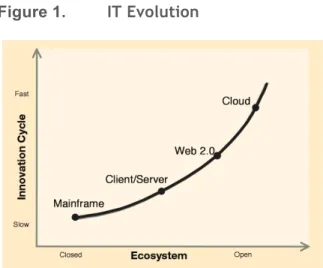
Figure 1.IT Evolution ... 2
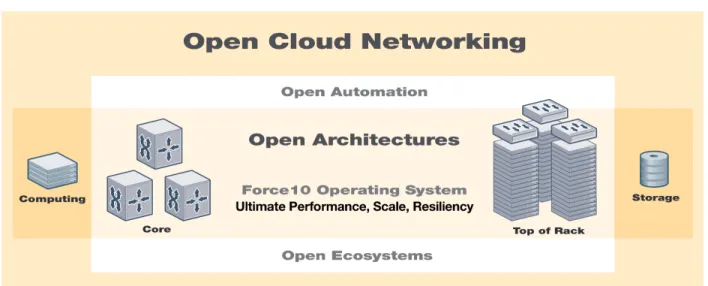
Figure 2.
Force10 Open Cloud Networking (OCN) Framework ... 3
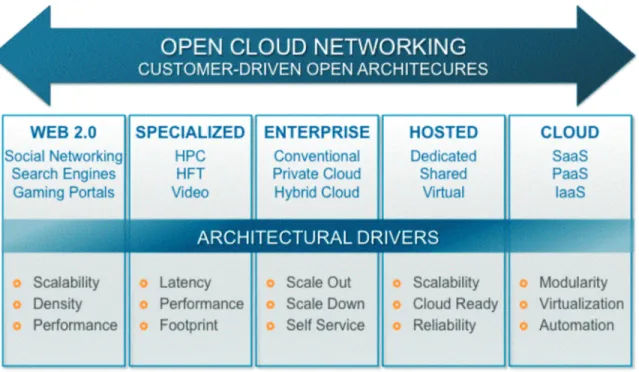
Figure 3.
Changing Network Ecosystems ... 4
Figure 4.
OCN means customer-driven open architectures & stacks ... 4
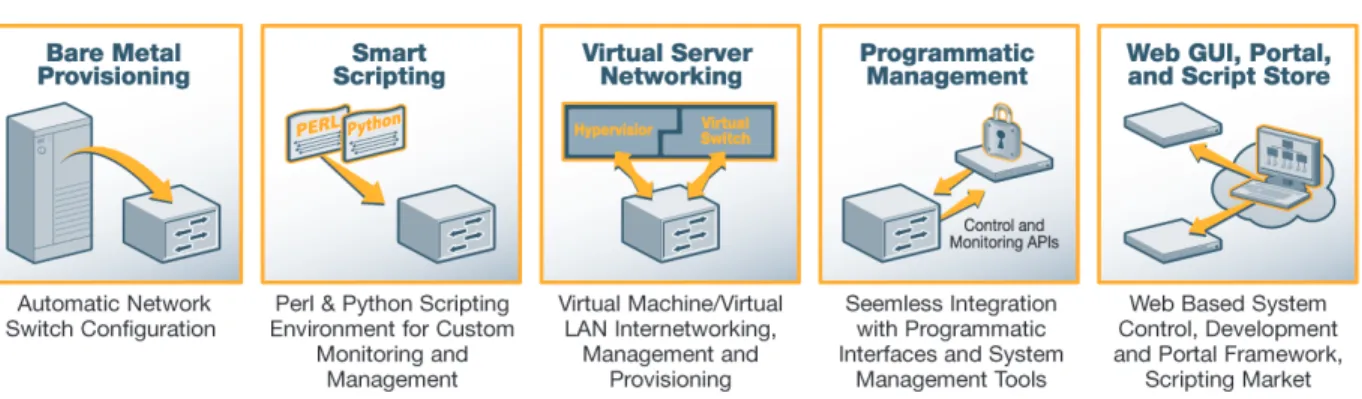
Figure 5.
Force10 Open Automation Framework... 5
Page 2 Cloud computing is an emerging computing model that promises a new era of flexibility and control in providing data center resources. In the cloud model, data center managers can mix and match computing, storage, and networking resources to provide an agile and highly flexible resource for customer applications. To realize the full potential, this paradigm requires open, standardized
interfaces between data center layers of compute resources, the network, and storage elements. While the industry has moved toward open computing and storage layers over the past few years, networking has remained largely proprietary. Force10’s Open Cloud NetworkingSM framework is intended to unlock the network layer so data center operators can get the most out of their data center architectures and, in turn, get the most out of their cloud deployments.
The Lagging Network Layer
The history of computing has been one of movement from proprietary to open standards. From the mainframe days in which computing, network, and storage resources were all proprietary, the industry has moved inexorably toward open, standards-based layers in the data center. For example, server and software vendors have embraced Intel X86 architectures with standard operating systems such as Windows, Linux, VMWare, and others. In the same way, storage vendors have coalesced around the standards of Fibre Channel, FCoE, and iSCSI.
Page 3 measured in multiple years because all three layers of the data center stack came from the same vendor. Now, with a whole ecosystem of standards-based products in development, the pace of change is measured in months.
In this environment, customers are less willing to be tied down to the pace of innovation of just one vendor. Industry leaders from the world’s largest social networking, search engine and gaming portal sites are advancing the state of networking at a phenomenal pace by combining open products in their own way, rather than expecting a vendor to tell them how to build a data center.
Ultimately, all layers of the data center stack – computing, storage, and networking – should be open to deliver the maximum customer choice and flexibility. Architectures, automation, and ecosystems should all be open to support the widely varied needs of data center owners.
This move toward openness has made it easier to build dynamic, virtualized data centers in which compute resources can be created or decommissioned on the fly – the essence of cloud computing. Unfortunately, the network layer has not kept pace in the drive toward openness. Each of the largest networking vendors has developed proprietary software, control plane, or interconnect technology that limits user choices when it comes to compute servers and storage units. By limiting choice, the closed network layer forces users to build data centers in a specific way that may not meet their needs. In contrast, an open ecosystem enables architects to build data centers flexibly and quickly using the most advanced technologies.
Figure 2.
Force10 Open Cloud Networking (OCN) Framework
Open Cloud Networking
Force10’s Open Cloud Networking framework unlocks the network to provide greater flexibility, performance, and manageability to cloud and conventional data centers. Based on an expanding portfolio of hardware, system and automation software, and partner/customer ecosystem services, the Open Cloud Networking framework enables data center architectures that are driven by customer needs rather than vendor needs. Open Cloud Networking is based on three elements: open architectures, open automation, and open ecosystems.
Page 4
Open Architectures
The Open Cloud Networking infrastructure relies on open, standards-based technology for interfaces, interconnect, control plane, and other aspects of network operations. The network thus supports any computing or storage solution that also supports open standards. This approach gives data center owners unrivaled flexibility in choosing solutions for their specific needs. Force10 realizes that no two data centers are exactly the same, so in providing this flexibility the Open Cloud Networking approach meets varied data center needs as no other approach can.
Figure 3.
Changing Network Ecosystems
The Open Cloud Networking architectures include solutions for the core and the top-of-rack (ToR). Data center operators can choose from Force10’s multi-terabit fixed-configuration and chassis-based Z-Series Core platforms and the top-performing S-Z-Series Top-of-Rack platforms, including the next-generation S7000. The Force10 operating system (FTOS) that powers the switches provides customer-proven, ultra-scalable, ultra-reliable software ensuring maximum performance with maximum uptime. This plus a 100% standards-based, open approach frees data center architects to mix and match at every layer of the data center stack.
Page 5 hierarchical architecture designed for traditional data centers and a next-generation distributed
architecture optimized for fabric deployments. Both architectures are standards-based, capable of advancing any existing environment with higher performance and lower cost structures.
Figure 5.
Force10 Open Automation Framework
Open Top-of-Rack Networking – Force10’s S7000 opens the top of rack (ToR) by combining
networking, applications, and storage networking. The S7000 eliminates extra servers and appliances by combining four flexible application bays with non-blocking 10/40GbE ports, bringing a new level of convergence to the ToR. Additionally, any of the Ethernet ports can also be configured for native Fiber Channel or Fiber Channel over Ethernet (FCoE) in software. The application bays can include blade servers that enable users to run load balancing, firewall, or other applications directly on the switch to reduce complexity and streamline operations in the data center.
Open Automation
Force10’s Open Automation™ (OA) framework has led the industry in providing standards-based automation for data center operations. The first iteration of OA introduced automated bare metal provisioning to Force10 switches, along with the ability to automate other control or monitoring
functions with Perl or Python scripts. OA 2.0 extends this vision with several new services and features. Automation is critical for data centers of any size as it allows operators to dynamically stitch together network, compute and storage resources. For maximum choice, automation shouldn’t be something
Page 6 that forces users down a single vendor path. Open automation allows users to automate with their choice of solutions.
With the adoption of virtualization, data centers have become more responsive but more complex. IT managers must now manage hundreds to thousands of virtual machines and their associated storage and networks. Data center infrastructure must be more responsive, quickly adapting to changes in application requirements. Additionally, server, storage and network infrastructure can no longer be managed as separate silos, but rather as a single, dynamic environment.
Open Automation addresses these challenges using industry standards and common industry technology, allowing IT managers to deploy virtualized environments using best-of-breed technology.
New features of Open Automation 2.0
DevExchange™ – The DevExchange is an open forum for exchanging Smart Scripting and information about other automation features of Force10 products. Designed as an application store and a series of forums for Force10 users and support personnel, DevExchange will spur the development and use of new Smart Scripting.
ScriptStore™ – Supported Force10 products can be automated through the use of Smart Scripting, which can be written in Perl or Python. The ScriptStore will be an online store through which users can access Smart Scripting. Additional user forums on the site will serve as information exchanges about Open Automation-related topics.
Open Fabric Manager – FTOS now includes a unified, open fabric manager that allows data center managers to control multiple Force10 switches as if they are a single switch.
Web GUI – Force10 is introducing support and an advanced and extensible web GUI for its
switch/router platforms. The GUI provides significant ease of use for platform access and control. Users no longer need to be CLI-conversant to understand and manage Force10 equipment. An intuitive out-of-the-box implementation, the GUI solution is extensible for both channel and customer-facing enhancements. Drag-and-Drop features provide for quick and efficient changes in GUI functionality and skin design.
Open Ecosystems
Force10 is bringing together leading makers of standards-based go-to-market solutions and technology to offer unrivaled flexibility and choice in the selection of best-of-breed solutions for the data center.
Page 7 of data center deployments. Simply put, there is safety in numbers – the more people trying to solve problems and innovate, the better. Ultimately, choice comes from having the broadest ecosystem. Force10 is enabling open ecosystems and participating in open ecosystems, presenting a set of networking solutions to the broader industry and fitting in with other leading open compute and storage solutions.
In addition, Force10 is active in open cloud computing standards and is a founding member of the Open Networking Foundation. Force10 is also a member of the Open Data Center Initiative (ODCI) sponsored by Intel.
Conclusion
Cloud computing is rapidly gaining acceptance as the primary model for delivering flexible compute resources with high agility and reduced management costs. However, the vision of cloud computing can’t be realized to its fullest potential unless the computing, networking and storage layers of the data center are all derived from open, standardized interfaces and software. Force10’s Open Cloud Networking framework delivers the openness required at the network layer combined with flexible open automation software allowing data center managers maximum choice with uncompromised price and performance.