This is a repository copy of Mechanistic analysis and computer simulation of impact breakage of agglomerates: Effect of surface energy .
White Rose Research Online URL for this paper: http://eprints.whiterose.ac.uk/1104/
Article:
Moreno-Atanasio, R. and Ghadiri, M. (2006) Mechanistic analysis and computer simulation of impact breakage of agglomerates: Effect of surface energy. Chemical Engineering Science, 61 (8). pp. 2476-2481. ISSN 0009-2509
https://doi.org/10.1016/j.ces.2005.11.019
Reuse See Attached
Takedown
If you consider content in White Rose Research Online to be in breach of UK law, please notify us by
White Rose Consortium ePrints Repository
http://eprints.whiterose.ac.uk/
This is an author produced version of a paper published in Chemical
Engineering Science. This paper has been peer-reviewed but does not include final publisher proof-corrections or journal pagination.
White Rose Repository URL for this paper: http://eprints.whiterose.ac.uk/archive/00001104/
Citation for the published paper
Moreno-Atanasio, R. and Ghadiri, M. (2006) Mechanistic analysis and computer simulation of impact breakage of agglomerates: Effect of surface energy.
Chemical Engineering Science, 61 (8). pp. 2476-2481.
Citation for this paper
To refer to the repository paper, the following format may be used:
Moreno-Atanasio, R. and Ghadiri, M. (2006) Mechanistic analysis and computer simulation of impact breakage of agglomerates: Effect of surface energy.
Author manuscript available at: http://eprints.whiterose.ac.uk/archive/00001104/ [Accessed: date].
Published in final edited form as:
Moreno-Atanasio, R. and Ghadiri, M. (2006) Mechanistic analysis and computer simulation of impact breakage of agglomerates: Effect of surface energy.
MECHANISTIC ANALYSIS AND COMPUTER SIMULATION OF IMPACT
BREAKAGE OF AGGLOMERATES: EFFECT OF SURFACE ENERGY
R. Moreno-Atanasio and M. Ghadiri
Institute of Particle Science and Engineering, University of Leeds, Leeds,
ABSTRACT
Agglomerates are ubiquitous as intermediate or manufactured products in chemical,
pharmaceutical and food industries. During handling and processing they may suffer
breakage if they are weak. On the other hand, if they are too strong, their dispersion
and disintegration could be difficult. The control of their mechanical strength is
therefore highly desirable. However, the analysis of agglomerate strength is complex
due to the large number of parameters that influence agglomerate behaviour, such as
the primary particle size, density and elastic modulus, and the interparticle bond
strength.
A simple mechanistic model is presented here which relates the number of broken
contacts in agglomerate due to impact velocity, interparticle adhesion energy and the
particle properties of the particles forming the agglomerate. The model is based on
the hypothesis that the energy used to break contacts during impact is proportional to
the incident kinetic energy of the agglomerate. The damage ratio defined as the ratio
of broken contacts to the initial number of bonds is shown to depend on the
dimensionless group, , in the form ( V2D5/3E2/3)/ 5/3, where V is the impact velocity,
E the elastic modulus, D the particle diameter, the particle density and the
interface energy. This dimensionless group, , incorporates the Weber number,
( DV2/ ), which was previously shown to be influential in agglomerate breakage, and
The predicted dependency of the damage ratio on the surface energy has been tested
using Distinct Element Method (DEM). Four different agglomerates have been
formed and impacted against a target for three different values of the surface energy
of the primary particles. The simulation results show that the effect of surface energy
is better described by the above mechanistic model than by the Weber number alone,
as previously used to characterise the impact strength of agglomerates.
Keywords: Agglomeration; Granulation; Impact; Modelling; Simulation; Surface
Energy.
1. Introduction
There are many factors that influence agglomerate strength but one of the most
important one is the interparticle bond strength. Depending on the method of
agglomeration, the bond strength is brought about by the presence of a binder or
interparticle cohesion.
There are two widely cited models regarding this topic that have been developed by
Rumpf (1962) and Kendall (1988). Rumpf (1962) defined the strength of
agglomerates as the force that is required to break all contacts simultaneously on a
prescribed failure plane. Kendall (1988) defined agglomerate strength as the
resistance of the agglomerate to crack propagation based on the linear elastic fracture
mechanics. These two models apply to the cases in which agglomerates show a
form of detachment of small debris and not necessarily by fragmentation.
Furthermore, the application of the models of Kendall and Rumpf to the case of
impact is not straightforward, since agglomerates can develop different patterns of
breakage depending on the impact velocity and agglomerate properties (Moreno et al.
2004, Moreno et al. 2003, Subero, 2001).
For agglomerates which can store elastic strain energy, Kendal’s model is consistent
with the Griffith criterion for crack propagation, whilst Rumpf’s model may be more
applicable to cases involving plastic deformation as the model is based on a simple
force balance. Experimental data reported in the literature show consistency with
either or both models. There is no detailed analysis of the applicability of the above
models in the literature. However, Subero (2001) has shown that in so far as the
dependency of the packing fraction is concerned both models predict numerically
similar values, albeit from very different functional relationships as given by these
models.
The analysis of agglomerate strength by continuum mechanics has not been
successful so far due to the degree of freedom arising from the structure of
agglomerates. Recently, significant progress has been made by the use of DEM
(Kafui and Thornton, 1993). The main advantage of this method is its versatility,
allowing an easy variation of any material property without affecting the others. A
further advantage of DEM is the possibility of quantifying the effect of impact on the
number of interparticle contacts which break within the agglomerate, a feature that
interparticle cohesion on the impact breakage of agglomerates using the above
method.
The first work analysing the effect of bond strength on agglomerate breakage using
DEM was carried out by Kafui and Thornton (1993). They analysed the effect of the
surface energy on the strength of regularly-packed agglomerates having a face centred
cubic and a body centred cubic structures, and related the breakage of interparticle
contacts to the Weber number, We, as defined by
Γ
ρ 2
DV
We= (1)
where is the particle density, D the primary particle diameter, V the impact velocity
and is the interface energy which is defined by the Dupré equation (Israelachvili,
1985) as:
B A B
A γ γ
γ
Γ = + − (2)
where A and B are the surface energies of two particles made of different materials,
A and B, in contact with each other and
B
ABis the interaction energy between them.
For surfaces of the same material AB is zero and therefore =2 .
Kafui and Thornton (1993) carried out simulations of impact breakage of
damage ratio as the ratio of broken contacts to the initial number of bonds and
expressed it as a function of the Weber number for a range of impact velocities and
surface energies. They found that the curves corresponding to the values of surface
energy between 0.1 J/m2 and 1.0 J/m2 were reasonably unified by the use of Weber
number. However, in a later work, Thornton et al. (1996) obtained a better
unification by modifying the Weber number and defining a lower limit of impact
velocity, V0,below which no contact is broken, as given by Eq. 3.
Γ −
= 0 2
' D(V V )
We ρ (3)
The above analysis was also carried out for a 2-D ordered packing with the surface
energy in the range between 0.3 and 3.0 J/m2. Later, Subero et al. (1999) carried out
simulations using three-dimensional (3-D) motion of the particles and analysed the
effect of the surface energy in the range 0.5 to 5.0 J/m2 in randomly packed
agglomerates using Eq. 3. They plotted the damage ratio as a function of and
found the results in agreement with the work of Thornton et al. (1996), i.e. a good
unification of data for different surface energies was obtained. However, the range of
surface energies used in the above simulations covered only one order of magnitude
variations. In a later work, Moreno (2003) varied the surface energy by two orders of
magnitude and found that the use of the modified Weber number no longer unified the
data adequately. Therefore an alternative analysis is proposed here based on the idea
that the damage suffered by agglomerates during impact is related to the incident
'
kinetic energy and also to the physical and mechanical properties of the agglomerates.
The basis of the model is described in the following section.
2. Mechanistic Model of Agglomerate Breakage
The model development is based on the consideration that the work required to break
interparticle contacts varies linearly with the incident kinetic energy. Associated with
each contact breakage is an amount of work to furnish the required surface energy and
therefore the higher the incident energy the larger will be the number of broken
contacts. The incident kinetic energy, EK, before impact is given by
2
K mV
2 1 N
E = (4)
where N is the number of particles in the agglomerate, m is the mass of a primary
particle and V is the impact velocity of the agglomerate. The case of normal impact is
considered here. If the total number of broken contacts after impact is NB, the work
for breaking these contacts, W, assuming that all contacts have the same contact area,
A, is:
B
A N
W = BΓ (5)
Let us consider that the total work spent in breaking NB bonds is proportional to the
incident kinetic energy of the agglomerate with k being the proportionality factor.
2
B mV
2 1 kN A
N Γ = (6)
Rewriting Eq. 6 and expressing the particle mass as a function of particle density, ρ,
and particle diameter D,NB,B, can be expressed as:
A D DV N k NB 2 2 12 1 Γ ρ π = (7)
The contact area, A, depends on the interface energy and mechanical properties of the
contact. Therefore, the dependency of the number of broken contacts on the interface
energy is not fully determined by the exponent of –1 of the interface energy in Eq. 7.
In order to analyse the full dependency on the surface energy, the model of Johnson et
al. (1971) is used to describe the relationship between the contact area and surface
energy. The model provides an expression for the contact area radius, a, which is
similar to the expression provided by Hertz analysis, but substituting the actual
external load, P, by an effective load, PEFF, which depends on the absolute value of
the pull-off force, POFF:
EFF 3 P * E 4 * R 3 a ⎟ ⎠ ⎞ ⎜ ⎝ ⎛ = (8) 2 / 1 2 OFF OFF OFF
EFF P 2P (4PP 4P )
P = + + + (9)
* R 2 3
where, R* and E* are the reduced radius and reduced elastic modulus of the two
particles in contact as defined by the Eqs. 11 and 12, respectively.
2 1 R 1 R 1 * R 1 + = (11) 2 2 2 1 2 1 E 1 E 1 * E
1 ν −ν
+ −
= (12)
Considering that before impact the external forces acting on the contacts are small as
compared to POFF, the value of the effective force, PEFF, is approximately equal to
4POFF and Eq. 9 can be rewritten as:
OFF
EFF 4P
P = (13)
and substituting Eq. 10 into Eq. 13, the following equation is obtained:
* R 6
PEFF = πΓ (14)
If the agglomerate is made of monodispersed particles R* = R/2 and the particles are
all of the same material E* = E/2(1- 2), where is Poisson’s ratio, Eqs 8 and 14 are
EFF 2 3 P E 4 ) 1 ( R 3 a ⎟⎟ ⎠ ⎞ ⎜⎜ ⎝ ⎛ −
= ν (15)
R 3
PEFF = πΓ (16)
Substituting Eq. 16 into Eq. 15, the radius of the contact area is expressed as a
function of the primary particle properties and the interface energy from which the
contact area, A, is calculated:
3 2 2 3 2 2 3 5 3 4 2 1 4
3 / / /
/ E D ) ( a A ⎟⎟ ⎠ ⎞ ⎜⎜ ⎝ ⎛ − ⎟ ⎠ ⎞ ⎜ ⎝ ⎛ =
=π π ν Γ (17)
Finally, if the value of the contact area A is introduced in Eq. 7 and the terms are
rearranged, the number of broken contacts after impact can be expressed as:
3 / 2 3 / 5 2 3 / 5 3 / 2 2 3 / 2 3 / 7 3 / 1 B E V D ) 1 ( 1 N 3 4 k N Γ ρ ν π −
= (18)
Equation 18 relates the number of broken contacts in the agglomerate with the
primary particle properties (particle density, ρ, particle diameter, D, and particle
elastic modulus, E), the interparticle interaction, the agglomerate properties (the
number of particles in the agglomerate, N) and the characteristics of the test (i.e.
Now, considering the definition of damage ratio, it is necessary to relate the initial
number of bonds in the assembly, N0, to the number of particles in the agglomerate.
This can be carried out using the coordination number of particles in the assembly, Z.
The relationship between N, N0 and Z is given by:
Z N
N = 2 0 (19)
Therefore, Eq. 18 can be rewritten in the form,
3 / 2 3 / 5 2 3 / 5 3 / 2 2 0 3 / 2 3 / 7 3 / 2 B E V D ) 1 ( 1 Z N 2 3 2 k N Γ ρ ν π −
= (20)
and damage ratio can be given in the form
3 / 2 3 / 5 2 3 / 5 3 / 2 2 3 / 2 3 / 7 3 / 5 R E V D ) 1 ( 1 Z 1 3 2 k D Γ ρ ν π −
= (21)
Now considering the terms in Eq. 2.1 it is possible to define a new dimensionless
number, , as given by Eq. 22, incorporating particle density, particle diameter,
elastic modulus and interface energy.
3 5 2 3 2 3 5 / /
/ E V
D
Γ ρ
Following Thornton’s (2001) suggestion this number can be written as a product of
two primary dimensionless groups, the Weber number, We, and the elastic adhesion
index, Ie, which is defined by Eq. 23:
⎟ ⎠ ⎞ ⎜ ⎝ ⎛ =
Γ ED
Ie (23)
Therefore the damage ratio, DR, is given by:
(24)
3 2/ e
R WeI
D α
It will now be of interest to explore if such a relationship prevails in the numerical
simulation of agglomerate breakage and this is described below.
3 Simulations of Agglomerate Breakage
3.1 Simulation details
In order to analyse the effect of bond strength on the agglomerate breakage behaviour,
four agglomerates of 3000 primary particles were formed in exactly the same way, but
with different initial configurations of the primary particle positions. The primary
particle properties are given in Table 1 and the size and properties of the four
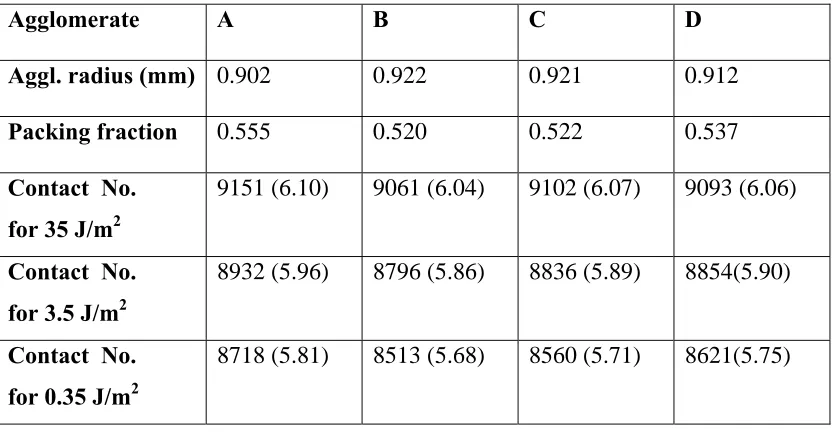
bracket next to the value of the contact number. The surface energy was varied
within a range of two orders of magnitude.
The simulations were carried out by using DEM whereby the primary particles
accelerations, positions and velocities were calculated using Newton’s laws of motion
and updated cyclically, details of which are described by Moreno (2003). The
particles deformed elastically according to the Hertz model for normal contact
interactions (see Johnson, 1985) and Mindlin and Deresiewicz (1953) and Thornton
and Randall (1988) for tangential contact interactions. When the surface energy was
assigned to the particles in contact with each other the models of Johnson et al. (1971)
and Savkoor and Briggs (1977) were used to determine the normal and tangential
contact forces respectively.
The agglomerates were formed by randomly positioning 3000 particles within a
spherical space. A centripetal field was applied and the particles were brought
together in order to form a dense spherical agglomerate. During this first stage the
particles were frictionless and non-cohesive, which allowed an easy agglomeration of
the particles. Once the assemblies reached a stable number of interparticle contacts,
friction and surface energy were introduced slowly in small steps in order to avoid the
accumulation of residual stresses. The four agglomerates A, B, C and D have
therefore nearly the same characteristics, but have been generated with different
For each impact velocity the mean and standard deviation of the number of broken
contacts were determined for the four agglomerates. Each agglomerate was impacted
in a range of impact velocities from full elastic rebound with no breakage of contacts
to the disintegration of the agglomerate into small fragments. The number of broken
contacts in the agglomerates was analysed by using the modified Weber number, We’
and the new dimensionless group, .
3. 2 Analysis of Damage Ratio
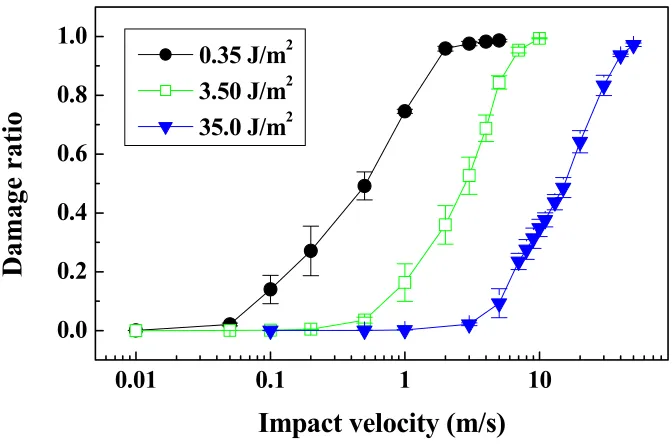
Figure 1 shows the average damage ratio as a function of the impact velocity for the
impact of the agglomerates reported in Table 2. At low impact velocities the damage
ratio is not sensitive to the impact velocity, but once a threshold velocity is exceeded
the damage ratio quickly rises and eventually approaches unity in an asymptotic way.
An increase in the impact velocity implies an increase in the incident kinetic energy
and consequently more energy is available in the system for breaking contacts.
However, at high impact velocities the process of breakage of contacts slows down
and the damage ratio becomes again insensitive to the impact velocity. In general, the
dependency of the damage ratio with the impact velocity is in agreement with the
previous results of Thornton et al. (1996) and Subero et al. (1999).
For a given impact velocity, the damage ratio decreases as the surface energy is
increased (Fig. 1). This is due to linear dependency between the force required to
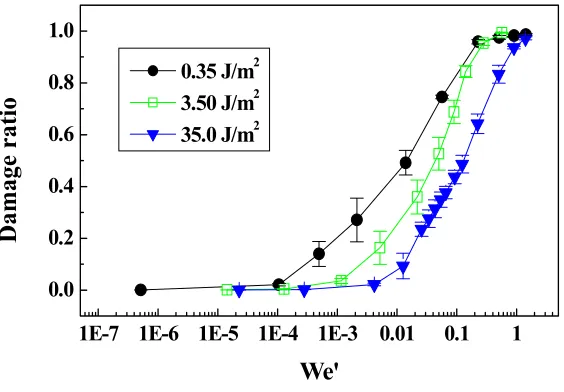
In Fig. 2, the damage ratio has been plotted as a function of the modified Weber
Number as given by Eq. 3. There is some normalisation of the data with different
surface energies although it is still possible to distinguish one curve from another and
furthermore each curve is out of the limits of the error bars of the other curves for
intermediate values of the modified Weber number. Thornton et al. (1996) and
Subero et al. (1999) showed a good unification of the data when the modified Weber
number was used. The difference with the previous work is thought to be mainly due
to the wider range of surface energies tested here. The simulations carried out here
cover two orders of magnitude of the surface energy, in contrast to previous work,
where the values of surface energy were within approximately one order of
magnitude. Furthermore, differences in the agglomeration method could produce
slightly different structures and packings.
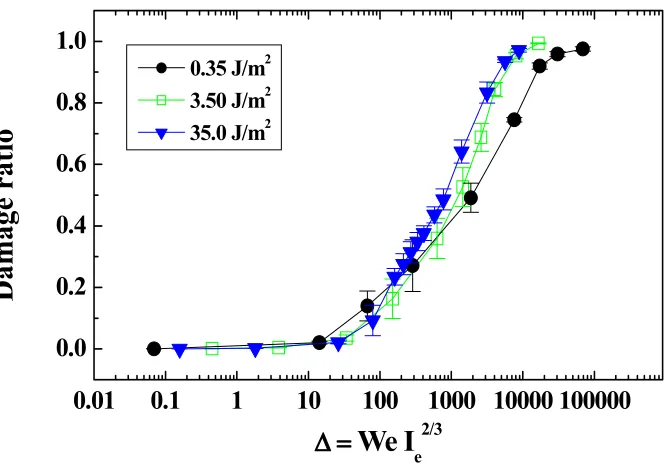
Figure 3 shows the damage ratio as a function of the new dimensionless group, . As
it can be seen a much better unification of data is obtained as compared to Fig. 2. At
low values of the dimensionless group, , each curve is now within the error bars of
the other curves. However, at high values of the abscissa, the unification is not as
good as for the rest of the curves for the case of lower surface energy (0.35 J/m2)
although the curves for larger values of surface energy are reasonably well unified.
The lack of good unification of the smallest value of surface energy (0.35 J/m2) at
4. Discussion and Conclusions
The main assumption made in the model presented in section 2 is the consideration
that the work for breaking contacts is proportional to the incident kinetic energy. This
leads to Eq. 18, in which the number of broken contacts is related to the primary
particles properties (elastic modulus, Poisson’s ratio, particle density, particle
diameter and bond strength), agglomerate properties (number of particles in the
agglomerate and coordination number) and external parameters (impact velocity).
The analysis of the simulation results clearly shows that the dimensionless group, ,
describes the effect of the surface energy on the agglomerate strength much better
than the Weber number, We, and its modified form, We’. Other factors such as the
agglomeration process, the level of residual stresses in the agglomerate, the range of
the surface energy are undoubtly influencial in the results. Therefore, an accurate
comparison with the previous work is not strictly feasible. However, the new
dimensionless group is based on an energy balance and should in principle have more
predictability.
Another point that needs to be highlighted is related to the minimum velocity under
which no breakage of contacts is observed, V0, and to the modified Weber number,
We’. In the simulations reported here it has been observed that the subtraction of V0 ,
from the impact velocity does not significantly improve the fit for the curves of
damage ratio versus . Furthermore, the subtraction will only affect the data at low
impact velocities where V and V0 are comparable. However, in this range already
subtracting V0 from V is unclear and we have therefore opted for not including such a
modification in the dimensionless group, .
In summary, a new mechanistic model of the impact breakage of agglomerates has
been presented relating the number of broken interparticle contacts to the interparticle
bond strength as represented by surface energy. The model is based on the assumption
that the work required for breaking contacts is proportional to the incident kinetic
energy. A new dimensionless group incorporating the Weber number and the elastic
adhesion index has been obtained. According to this new group the number of broken
contacts varies with the surface energy to the power index of -5/3. This is in contrast
with the previous work reported in the literature that uses the Weber number as a
dimensionless group in the analysis of the effect of bond strength on agglomerate
breakage due to impact.
The results of the computer simulations have corroborated the relationship between
the surface energy and number of broken contacts as predicted by the new model.
Acknowledgments
The authors gratefully acknowledge ICI plc and the Engineering and Physical
Sciences Research Council for the sponsorship of this work. Special thanks are also
due to Prof. R. Oliver and Dr D. Sutton for coordination of the project at ICI. We are
also grateful to Dr C. Thornton for his helpful comments on the mechanistic model
Nomenclature
A Area of a contact m2
a Contact area radius m
D Particle diameter m
DR Damage ratio -
EK Incident kinetic energy of an agglomerate J
E Elastic modulus Pa
k Proportionality factor
-Ie Elastic adhesion index -
m Particle mass kg
N Number of particles in an agglomerate -
NBB Number of broken contacts -
N0 Initial number of bonds in an agglomerate -
P External load in a contact N
PEFF Effective force in JKR model N
POFF Force to break a contact N
R Particle radius M
T Tangential force N
V Particle velocity m/s
V0 Velocity under which no contacts are
broken in agglomerates
m/s
W Work for breaking contacts J
We Weber Number -
'
Z Coordination number -
Greek characters
New dimensionless group
-Interface energy J/m2
γ Surface energy J/m2
Porosity -
Friction coefficient -
ν Poisson’s ratio -
Particle density kg/m3
Packing fraction -
References
Israelachvili, (1985). Intermolecular & Surface Forces. London Academic Press.
Johnson, K. L. (1985). Contact Mechanics. Cambridge University Press, Cambridge.
Johnson, K. L., Kendall, K., and Roberts, A. D.(1971). Surface energy and the
contact of elastic solids. Proceedings of the Royal Society of London A., 324,
Kafui, K. D. and Thornton, C. (1993). Computer simulated impact of agglomerate.
Powders & Grains 93, the proceedings of the 2nd International Conference on
Micromechanics of Granular Media. C. Thornton (Ed.), A. A, Balkema, Rotterdam,
401-406.
Kendall, K. J. (1988). Agglomerate strength. Powder Metallurgy, 31, 28-31.
Mindlin, R. D. and Deresiewicz, H. (1953). Elastic spheres in contact under varying
oblique forces. Journal of Applied Mechanics, 20, 327-344.
Moreno, R. (2003). Computer simulation of impact of spherical agglomerates using
Distinct Element Method. PhD thesis. University of Surrey, Guildford, UK.
Moreno, R. and Ghadiri, M., (2004). Computer simulation analysis of the effect of
bond strength on the breakage pattern of agglomerates. PARTEC. Nuremberg, Paper
3.5.
Moreno, R., Ghadiri, M. and Antony, S. J., (2003). Effect of the impact angle on the
breakage of agglomerates. Powder Technology, 130, pp. 132-137.
Savkoor, A. R. and Briggs, G. A. D (1977). The effect of the tangential force on the
contact of elastic solids in adhesion. Proceedings of the Royal Society of London, A.,
Subero, J. (2001). PhD Dissertation. Impact breakage of agglomerates. Surrey
University, Guildford, U.K.
Subero, J., Ning. Z., Ghadiri, M. and Thornton, C. (1999). Effect of interface energy
on the impact strength of agglomerates. Powder Technology, 105, 66-73.
Thornton, C. (2001). “Comments on the mechanistic model”. Personal
communication.
Thornton C., Yin, K. K. and Adams M. J. (1996). Numerical simulation of the impact
fracture and fragmentation of agglomerates. J. Phys. D: Appl. Phys. 29, 424-435.
Thornton, C. and Randall, C. W. (1988). Applications of theoretical contact
mechanics to solid particle system simulation. Micromechanics of Granular
Table 1 Single particle properties
Young's modulus (GPa) 31
Poisson’s ratio 0.3
Density (kg/m3) 2000
Friction coefficient 0.35
Table 2 Agglomerate properties. The coordination number, Z, is given within each bracket next to the value of the contact number.
Agglomerate A B C D
Aggl. radius (mm) 0.902 0.922 0.921 0.912
Packing fraction 0.555 0.520 0.522 0.537
Contact No.
for 35 J/m2
9151 (6.10) 9061 (6.04) 9102 (6.07) 9093 (6.06)
Contact No.
for 3.5 J/m2
8932 (5.96) 8796 (5.86) 8836 (5.89) 8854(5.90)
Contact No.
for 0.35 J/m2
0.01 0.1 1 10 0.0
0.2 0.4 0.6 0.8 1.0
0.35 J/m2 3.50 J/m2 35.0 J/m2
D
amag
e r
ati
o
[image:26.595.144.480.146.369.2]Impact velocity (m/s)
1E-7 1E-6 1E-5 1E-4 1E-3 0.01 0.1 1 0.0
0.2 0.4 0.6 0.8 1.0
0.35 J/m2 3.50 J/m2 35.0 J/m2
D
amage
r
ati
o
[image:27.595.145.427.181.377.2]We'
0.01 0.1 1 10 100 1000 10000 100000 0.0
0.2 0.4 0.6 0.8 1.0
0.35 J/m2 3.50 J/m2 35.0 J/m2
D
amage
r
ati
o
We I
e [image:28.595.134.468.160.395.2]2/3