Based on wideband precoding (WBP) in the multiple-input multiple-output orthogonal frequency division multiplexing system, an adaptive nonuniform codebook is presented in this paper. The relationship between the precoder distribution and spatial correlation is analyzed at first. A closed-form expression based on overlapped isosceles triangles is proposed as an approximation of the precoder distribution. Then, the adaptive codebook design is derived with the approximate distribution to minimize quantization errors. The capacity and bit error rate performance demonstrate that the adaptive codebook with WBP outperforms the conventional fixed uniform codebook.
Keywords: MIMO, OFDM, precoding, spatial correlation, quantization.
Manuscript received Jan. 28, 2012; revised May 18, 2012; accepted June 1, 2012. This work was supported by the National Science Foundation for Post-doctoral Scientists of China (20110490329) and National Basic Research Program of China (973 Program) (2012CB316005).
Hang Long (phone: +86 10 6119 8066-4, [email protected]) is with the School of Electronics Engineering, Beijing University of Posts & Telecommunications, and also with the the Wireless Signal Processing and Network Lab., Key Laboratory of Universal Wireless Communication, Ministry of Education, Beijing University of Posts & Telecommunications, Beijing, China.
Kyeong Jin Kim ([email protected]) was with the UWB Wireless Communications Research Center, Inha University, Incheon, Rep. of Korea, and now is with the Mitsubishi Electric Research Laboratories, Boston, MA, USA.
Wei Xiang ([email protected]) is with the Faculty of Engineering and Surveying, University of Southern Queensland, Toowoomba, Australia.
Jing Wang ([email protected]) and Wenbo Wang ([email protected]) are with the Wireless Signal Processing and Network Lab., Key Laboratory of Universal Wireless Communication, Ministry of Education, Beijing University of Posts & Telecommunications, Beijing, China.
Yuanan Liu ([email protected]) is with the School of Electronics Engineering, Beijing University of Posts & Telecommunications, Beijing, China.
http://dx.doi.org/10.4218/etrij.12.0112.0072
I. Introduction
Multiple-input multiple-output (MIMO) technology has been proven to be able to tremendously improve the spectral efficiency in rich scattering environments [1]. The orthogonal frequency division multiplexing (OFDM) technique has been in widespread use in high data rate wireless communication systems due to its high spectrum efficiency and tolerance of inter-symbol interference [2], [3]. Hence, MIMO-OFDM systems have attracted significant worldwide research efforts [4].
In MIMO systems, the precoding technique is able to enhance the system reliability and capacity [5]. Conventional precoding schemes are usually designed for narrowband MIMO systems with flat fading, which are not suitable for MIMO-OFDM systems with frequency-selective fading. A wideband precoding (WBP) scheme is presented in [6] and [7], where only one precoder is used for all the subcarriers in the MIMO-OFDM system. The precoder is obtained from a subcarrier independent channel matrix constructed through the temporal channel vectors. The channel state information feedback overhead can be significantly reduced especially if the number of subcarriers is large. Based on the work in [6] and [7], the relationship between the subcarrier independent channel matrix and the temporal/frequency channel matrices is investigated and an improved WBP scheme is proposed for arbitrary subcarrier grouping in [8]. The idea of WBP is extended to the MIMO-OFDM cooperative system with a relay node in [9]. However, the precoder distribution for WBP is still an open problem, which is important for the use of WBP in the system with limited feedback.
On the other hand, the codebook-based precoding technique is suitable for practical implementation with reduced feedback
Precoder Distribution and Adaptive Codebook
in Wideband Precoding
overhead [10]-[12]. For codebook-based precoding, the quantization of a potential precoder is a challenging problem in the codebook design. For independent and identically distributed (i.i.d.) MIMO channels, the conventional precoder (right singular vectors of the channel matrix) is isotropically distributed in the set of unitary matrices [12]-[14]. Therefore, the codebook design is usually considered to be a classical Grassmanian packing problem, as in [11] and [12]. In practical applications, uniform quantization in the set of unitary matrices is simple and useful for the codebook design. The precoder distribution under spatially correlated channels is analyzed in [14], and an adaptive nonuniform codebook design is proposed for MIMO systems, where the codebook is designed in consideration of the correlation coefficient.
In this paper, based on WBP in MIMO-OFDM systems under spatially correlated channels, the precoder distribution is analyzed and found to be affected by the spatial correlation coefficients of all the resolvable taps of the channel, which is different from the narrowband MIMO system. Then, the distribution is approximated by multiple overlapped isosceles triangles. An adaptive nonuniform codebook is designed for WBP accordingly. Simulation results demonstrate that the proposed adaptive codebook is able to reduce quantization errors and outperforms the fixed uniform codebook in system capacity and reliability.
The remainder of this paper is organized as follows. The system model is described in section II. The WBP scheme is reviewed in section III. The precoder distribution is analyzed and the approximate expressions are presented in section IV. Accordingly, the adaptive codebook is designed in section V. Simulation results are given in section VI. Finally, section VII concludes this paper.
Notation. The transpose and conjugate-transpose of matrix are denoted by A
A T and AH, respectively. The n×n identity
matrix and m×n all-zero matrix are denoted by In and Om,n,
respectively. Mathematical expectation is denoted by E(·), and denotes the Kronecker product of two matrices. The vector space of all m×n complex matrices is denoted by . The largest integral smaller than x is denoted by
⊗
n m× ^ x
⎢ ⎥
⎣ ⎦.
II. System Model
We consider the MIMO-OFDM system with the discrete Fourier transform (DFT) of size N and L input spatial streams. Equipped at the transmitter and receiver are NT and NR
antennas, respectively. The maximum path delay is assumed to be shorter than the length of the cyclic prefix (CP), NT≥L, and
NR≥L.
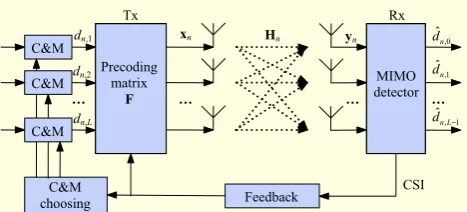
[image:2.595.306.540.89.195.2]The equivalent MIMO system over the n-th subcarrier can be written as
Fig. 1. Illustration of MIMO system over n-th subcarrier.
Precoding matrix
F
MIMO detector C&M
Feedback CSI
C&M choosing
Rx
xn
Tx
C&M
C&M dn,1
dn,2
dn,L
yn dˆn,0
,1 ˆ
n
d
, 1 ˆ
n L
d −
…
… …
Hn
…
),
N
, {0,1,..., 1},
n = n n+ n n∈ N−
y H x z (1)
where and are the transmitted and
received signal vectors, respectively, z
T1
N n
× ∈
x ^ NR 1
n × ∈
y ^
n is the additive white
Gaussian noise at the receiver R R and
is the MIMO channel matrix over the n-th subcarrier.
,1 2
~ ( ,σ
zn CN 0N I
R T
N N
n∈ ×
H ^
The equivalent MIMO system is illustrated in Fig. 1, where dn,i is the symbol of the i-th spatial data stream to be sent over
the n-th subcarrier, i∈{1, 2,…, L}. That is, dn=[ dn,1, dn,2,…, dn,L]T is the data vector before precoding.
H '
,
1/ ',
( ) ·
'.
L n n
L L
L n n
E
n n =
⎧
=⎨
≠
⎩
I d d
0 (2)
The precoder over all the N subcarriers is F, and xn=Fdn.
As described in [6]-[8], Hn can be denoted by the temporal
channel ,q l
p
h , which is the temporal channel of the l-th tap between the p-th transmit and the q-th receive antennas, where l∈{1, 2,…, Nf}, p∈{1, 2,…, NT}, and q∈{1, 2,…, NR}. The
channel order Nf is determined as
max/
τ
=⎢⎣ Δ +⎥⎦
f
N t 1,
T
R
N
(3)
where τmax is the maximum path delay and ∆t is the temporal
sampling interval. The temporal channel vector between the p-th transmit and the q-th receive antennas is given by
,
, , ,
1 2
[ , p q,..., f ] .
p q p q p
N q
h h h
=
h (4)
Using (4), Hn can be expressed in terms of hp,q [6], [7]:
T
R T
,
T T
T T
1 1,1
1, ,
n n
n n
N
n
N N
⎡ ⎤
⎢ ⎥
=⎢ ⎥
⎢ ⎥
⎣ ⎦
w h w h
H
w h w h
"
# % #
"
, (5)
where
2π·( )/
2π/ 2π·2/ 1 T
[1,e j n N,e j n N,...,e j n Nf N] .
n
− ⋅
− ⋅ −⋅ −
=
w (6)
III. Wideband Precoding Review
the subcarriers. Equation (5) can be rewritten as T
( NR n
n = ⊗
H I w H) ,
R
N
⎥ ⎥
−
}
(7)
where
T
R T
,1 1,1
1, ,
N
N N
⎡ ⎤
⎢
=⎢
⎢ ⎥
⎣ ⎦
h h
H
h h
"
# % #
"
(8)
is the subcarrier independent channel matrix. The singular value decomposition of H is obtained at the receiver as
H.
=
H UΣV (9) The first L right singular vectors are used as the precoder:
T T ,
[ ,L L N −L] ,n {0,1,...,N 1}.
= ∈
F V I 0 (10)
The relationship between H and the temporal/frequency MIMO channel matrices is given in [8]. The temporal MIMO channel matrix of the i-th tap is constructed by{ ,
lp q
h as
T
R T R
,1
( )
1, ,
1,1
{1, 2,. .
, . ,
N
t
f
N N
i i
N
i i
i
h h
i
h h
N
⎡ ⎤
⎢ ⎥
=⎢ ⎥
⎢ ⎥ ∈
⎣ ⎦
H
"
# % #
"
}.
. t
P
i
P
, i
(11)
It is summarized in [8] that
( ) H ( 1
0
)
H f [ ]
N
i i
t
i − = =
∑
H H H H (12) That is, the covariance matrix of the subcarrier independent channel is the sum of the covariance matrices of the temporal MIMO channel matrices [8].
Based on WBP reviewed previously, codebook-based WBP under spatially correlated channels is investigated below. The major contributions of this paper can be summarized as follows:
1) The precoder distributions of WBP under correlated channels are given under various channel assumptions. Then, a unified approximate expression of the precoder distribution is presented in section IV. The proposed approximate expression can also be used for narrowband precoders.
2) An adaptive codebook for WBP is designed in section V with the proposed approximate expressions in section IV. Simulation results in section VI demonstrate that the proposed adaptive codebook outperforms the conventional fixed codebook both in the bit error rate (BER) and the capacity.
IV. Precoder Distribution under Correlated Channel
The spatial correlation matrices of the i-th tap at the transmitter and receiver are defined as
( ) H ( )
T {[ it ] it} i
i
E H H = R (13) and
( ) ( ) H
R { t [ t ] }
i i
i
E H H = R , (14) respectively. In (13) and (14), Pi is the average power of the i-th
tap. According to [14], the receiver correlation matrix RRi does
not affect the precoder distribution. Hence, it is assumed in the sequel that
R
Ri = N ,∀ ∈i {1, 2,...,Nf}.
R I (15)
For brevity of exposition, it is assumed that NT=2, so that the
spatial correlation matrix at the transmitter can be written as
* T
1
, | | e
1
i
i i
j i
i
ϕ
β β β
β
⎡ ⎤
=⎢ ⎥ =
⎣ ⎦
R (16)
where βi is the correlation coefficient at the transmitter of the
i-th tap. As shown in (10), F is related to V. A generalized expression of V is given as [14]
2 2
1 1
2 ( ) 1
1 1
cos sin
, 0, , [ ,
sin ejθ cos ejθ π 2
θ θ θ π θ
θ θ + π π
⎡ ⎤ ⎡ ⎤
=⎢ ⎥ ∈⎢⎣ ⎥⎦
⎣ ⎦
V ∈ − ). (17)
Here, V can be uniquely identified with θ1 and θ2. Thus, the
precoder distribution is equivalent to the distribution of θ1 and
θ2. The precoder distribution in the narrowband MIMO system
can be found in [14], which is related to the correlation coefficient β. The distribution of θ1 is not affected by the angle
of β. The adaptive nonuniform codebook amounts to the adaptive quantization of θ2 according to β [14]. Hence, we
focus on the distribution of θ2 in this study. It is also assumed
that L=1. That is, the precoder is the first column of V. The results in this study can be easily extended to the case of L=2.
1. Distribution of Right Singular Vector
If |β =i| 0, i∈{1, 2,…, Nf}, that is, under the i.i.d. fading
channel, the precoder distribution is identical to that in the i.i.d. narrowband MIMO systems [12]-[15]. That is, V is isotropically distributed in the set of unitary matrices. This means that cos2 θ
1 and θ2 are uniformly distributed in the
intervals of [0, 1] and [–π,π), respectively [14].
In narrowband precoding, the distribution center of θ2 is
related to the angle of the correlation coefficient [14]. We can also readily see that the distribution of the wideband precoder under the spatial correlated channel is related to φi.
A. Equal Correlation Coefficient for All Taps
In this case, the correlation coefficients of all the taps are assumed to be identical, that is, βi=β, ∀i∈{1, 2,…, Nf}. The
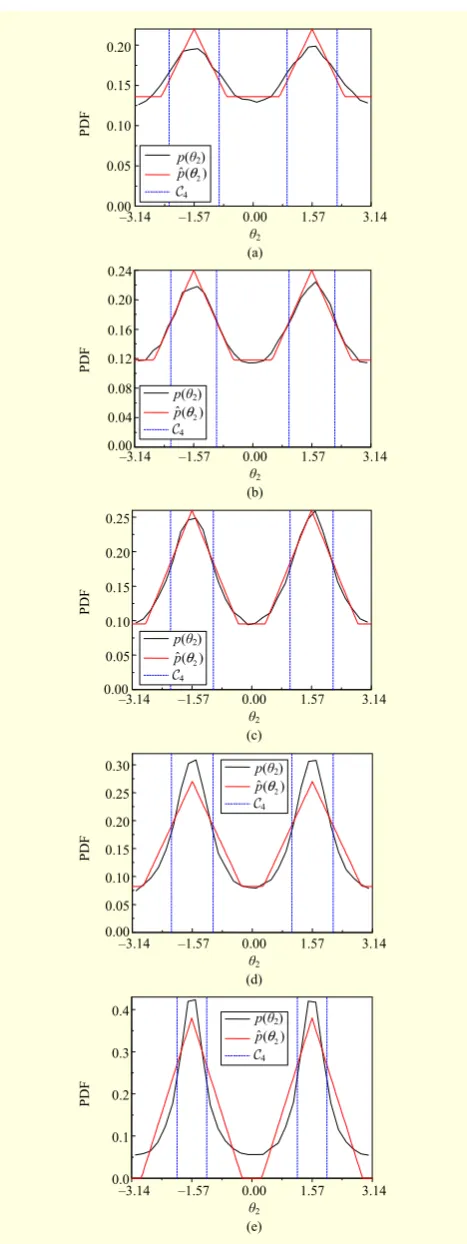
precoder distributions are the same as those in narrowband MIMO systems. The probability density function (PDF) of θ2, p(θ2) is obtained with Monte Carlo simulations, which is
Fig. 2. Precoder distribution for (a) βi=β=0.5ejπ/2, (b) βi=β =0.6ejπ/2, (c) βi=β=0.7ejπ/2, (d) βi=β=0.8ejπ/2, and (e) βi=β=0.9ejπ/2.
0.0 0.2 0.4 0.6
–3.14 –1.57 0.00 1.57 3.14
θ2
PD
F
p(θ2) 2 ˆ ( ) pθ C2 C4
–3.14 –1.57 0.00 1.57 3.14
θ2 0.0
0.2 0.4 0.6
PD
F
0.8 p(θ2) 2 ˆ ( ) pθ
(a)
(b)
–3.14 –1.57 0.00 1.57 3.14
θ2 (c) 0.0
0.2 0.4 0.6 0.8 1.0
PD
F
p(θ2) 2 ˆ ( ) pθ
–3.14 –1.57 0.00 1.57 3.14
θ2 (d) 0.3
PD
F
0.6 0.9 1.2 1.5 p(θ2)
2 ˆ ( ) pθ C2 C4
C2 C4
C2 C4
0.0
–3.14 –1.57 0.00 1.57 3.14
θ2 (e) 0.5
1.0 1.5 2.0
PD
F
[image:4.595.55.271.84.690.2]p(θ2) 2 ˆ ( ) pθ C2 C4 0.0
Fig. 3. Precoder distribution for P1=Pl=0.5, φ1=–π/2, φl=π/2: (a)
|β1|=|βl|=0.5, (b) |β1|=|βl|=0.6, (c) |β1|=|βl|=0.7, (d)
|β1|=|βl|=0.8, and (e) |β1|=|βl|=0.9. 0.00
–3.14 –1.57 0.00 1.57 3.14
θ2 (a) 0.05
0.10 0.15 0.20
p(θ2) 2 ˆ ( ) pθ C4
–3.14 –1.57 0.00 1.57 3.14
θ2 (b) 0.00
0.04 0.08 0.12 0.16 0.20 0.24
p(θ2)
2 ˆ ( ) pθ C4
0.00 0.05 0.10 0.15 0.20 0.25
–3.14 –1.57 0.00 1.57 3.14
θ2 (c) p(θ2)
2 ˆ ( ) pθ C4
0.00 0.05 0.10 0.15 0.20 0.25 0.30
–3.14 –1.57 0.00 1.57 3.14
θ2 (d)
p(θ2)
2 ˆ ( ) pθ C4
0.0 0.1 0.2 0.3 0.4
–3.14 –1.57 0.00 1.57 3.14
θ2 (e)
C4
p(θ2)
Fig. 4. Precoder distribution for P1=0.6, Pl=0.4, φ1=–π/2,
and φl=π/2: (a) |β1|=|βl|=0.5, (b) |β1|=|βl|=0.6, (c)
|β1|=|βl|=0.7, (d) |β1|=|βl|=0.8, and (e) |β1|=|βl|=0.9.
0.00
–3.14 –1.57 0.00 1.57 3.14
θ2 (a) 0.05
0.10 0.15 0.20
PD
F
–3.14 –1.57 0.00 1.57 3.14
θ2 (b) 0.00
0.05 0.10 0.15 0.20 0.25 0.30
PD
F
p(θ2) 2 ˆ ( ) pθ
0.0
–3.14 –1.57 0.00 1.57 3.14
θ2 (c)
PD
F
0.4
PD
F
–3.14 –1.57 0.00 1.57 3.14
θ2 (d) 0.25
p(θ2) 2 ˆ ( ) pθ
0.1 0.2
0.3 p(θ2)
2 ˆ ( ) pθ
0.2
0.0
p(θ2) 2 ˆ ( ) pθ
0.0
–3.14 –1.57 0.00 1.57 3.14
θ2 (e)
PD
F
0.2 0.4 0.6
p(θ2)
2 ˆ ( ) pθ
Fig. 5. Precoder distribution for P1=0.7, Pl=0.3, φ1=–π/2,
and φl=π/2: (a) |β1|=|βl|=0.5, (b) |β1|=|βl|=0.6, (c)
|β1|=|βl|=0.7, (d) |β1|=|βl|=0.8, and (e) |β1|=|βl|=0.9.
–3.14 –1.57 0.00 1.57 3.14
θ2 (a)
PD
F
–3.14 –1.57 0.00 1.57 3.14
θ2 (b)
PD
F
p(θ2) 2 ˆ ( ) pθ
0.0
–3.14 –1.57 0.00 1.57 3.14
θ2 (c)
PD
F
PD
F
–3.14 –1.57 0.00 1.57 3.14
θ2 (d) 0.3
0.1 0.2 0.3 0.0 0.1 0.2
0.3
0.0 0.1 0.2
p(θ2) 2 ˆ ( ) pθ
0.4 p(θ2)
2 ˆ ( ) pθ
0.0 0.1 0.2 0.3 0.4
0.5 p(θ2)
2 ˆ ( ) pθ
0.0
–3.14 –1.57 0.00 1.57 3.14
θ2 (e)
PD
F
0.2 0.4 0.6 0.8
p(θ2)
[image:5.595.267.534.82.700.2]and p(θ2) is similar to those relationships summarized in [14]: p(θ2) is a symmetrical function of which the symmetrical axis
is θ2=φ; the distribution of θ2 is mainly near φ, and the variance
of θ2 decreases as| |β increases.
B. Different Correlation Coefficients for All Taps
As shown in (12), H and V are independent of the delay of all the taps and related to power Pi and correlation coefficient βi
of each tap. For our investigation, a two-tap channel with P1>0, Pl>0, Pl'=0, 1<l, l'≤Nf, l'≠l, and P1+Pl =1 is considered.
a. Equal Power Case
The precoder distributions with P1=Pl=0.5 are shown in
Fig. 3 with the black line. As can be seen from the figures, two peaks of p(θ2) exist near φ1=–π/2 and φl=π/2. The variance of θ2
around φ1 and φl also decreases with the increase of |β1| and |βl|. It is easy to know the envelope of the PDFs under other assumptions of φ1 and φl.
b. Nonequal Power Case
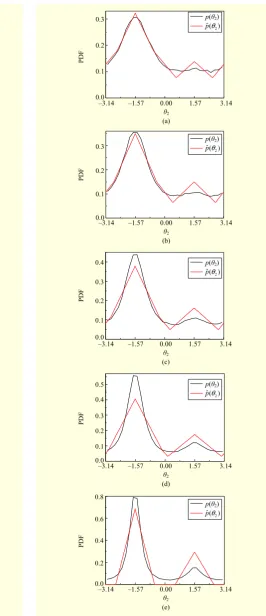
Different powers at the taps are considered for the cases of P1=0.6 and P1=0.7. The precoder distributions are given in
Figs. 4 and 5. The two peaks of the PDF still exist, and the one around φ1=–π/2 is higher and wider than the one around φl=π/2.
2. Approximation of Precoder Distribution
Figures 2 through 5 show some characteristics of p(θ2) under
four different scenarios.
•The peaks are related to the channel taps.
•The locations of the peaks are equal to φi.
•The height and the area under each peak are related to Pi,
and the area under the peak increases as Pi increases. •The height of each peak is also related to|βi|.
The envelope of each peak of the PDF can be represented by an isosceles triangle, as shown in Figs. 2 through 5. As a result, we can use the following isosceles triangle function to approximate the distribution related to each tap:
2
2 2
2
2 2
2
2 ( ) , [ 1/ (2 ), ]
( ) 2 ,
2 ( ) , [ , 1/ (2 )]
i i
i i
i i i
h h h
f P
h h
θ i
h
ϕ θ ϕ ϕ
θ
θ ϕ θ ϕ ϕ
⎧ − + ∈ −
⎪
= ⎨
− − + ∈ +
⎪⎩ (18)
where h is a variable to optimize the approximation and 2Pih is
the height of the peak. It is noted that the period of θ2 is 2π.
Additionally, the PDF of θ2 is approximated as the sum of the
functions related to all the taps:
2 2 2 2
1
ˆ( ) ( ), ˆ( ) 1.
f f
N N
i i i
p f π p d P
π
θ θ θ θ
= −
=
∑
∫
=1 i=
=
∑
(19)As can be seen from (18) and (19), h is the only variable to
Table 1. Optimum variable values for βi=β.
| |β h
0.5 0.34
0.6 0.43
0.7 0.57
0.8 0.78
0.9 1.19
Table 2. Optimum variable values for equal power, P1=Pl=0.5, φ1=–π/2, and φl=π/2.
1
|β |,|βl| h
0.5, 0.5 0.22
0.6, 0.6 0.24
0.7, 0.7 0.26
0.8, 0.8 0.27
0.9, 0.9 0.38
Table 3. Optimum variable values for non-equal power, φ1=–π/2
and φl=π/2.
h
1
|β |, |βl|
1 0.6, l 0.4
P= P= P1=0.7,Pl=0.3
0.5, 0.5 0.22 0.23
0.6, 0.6 0.24 0.25
0.7, 0.7 0.26 0.27
0.8, 0.8 0.27 0.29
0.9, 0.9 0.37 0.49
minimize the approximation error of the approximate PDF in (19). For the numerically obtained PDFs in Figs. 2 through 5, the optimum value of h can be obtained by minimizing the approximation error:
2 2
1/(2 )
ˆ
arg min ( ) ( ) ,
π
π π θ θ
≥ −
=
∫
−h
h p p dθ2 (20)
where the absolute value of the difference between the exact and approximate PDFs is used to measure the accuracy of the approximation. Other approximation error metrics can also be adopted. The approximate distributions are plotted with the red line in Figs. 2 through 5, and the corresponding optimum values of h under all the scenarios are listed in Tables 1 through 3.
V. Adaptive Codebook Design for WBP
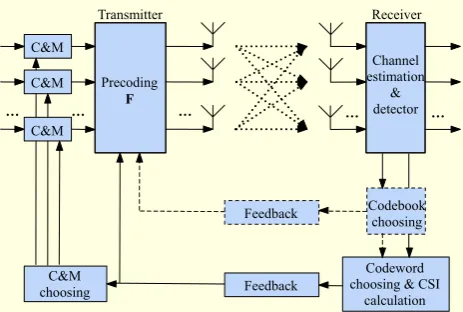
Fig. 6. Adaptive codebook in the MIMO-OFDM system.
Precoding
F
Channel estimation
& detector C&M
Feedback
CSI C&M
choosing
Receiver Transmitter
C&M
C&M
…
… … …
…
Feedback Codebook choosing
Codeword choosing & CSI
calculation
systems is proposed in [14]. The spatial correlation coefficient is calculated according to the average at the receiver over a long period of time and sent back to the transmitter. Then, the current codebook is chosen. The use of the adaptive nonuniform codebook in the MIMO-OFDM system is illustrated in Fig. 6, where the codebook is adaptive to the correlation coefficients of the multi-path channel. Compared with Fig. 1, a new feedback link from the receiver to transmitter is used for the current codebook index. The feedback period of the codebook index is much longer than that of the codeword index. Hence, the system overhead increase due to the new feedback link is acceptable.
In the adaptive codebook design, θ1 is fixed as π/4; hence, a
codebook is equivalent to a quantization of θ2. According to the
approximate precoder distribution in subsection IV.2, adaptive quantization of θ2 can be easily implemented. Let ci be the i-th
precoder (codeword) in codebook C, which comprises M precoders. The distance between angles is defined as
2 2
1 Z 1
( , ) min 2 .
k
dψ ψ = ∈ ψ ψ− + πk (21) For codebook C, the quantized angle of θ2 is obtained through
minimizing (21) as
2
ˆ arg min ( , )
i
c C i
d c
θ ∈
= θ2
h
, (22)
which is the codeword selection in the codebook. The quantization error is . The codebook design problem with the approximate precoder distribution is equivalent to the average quantization error minimization problem below:
2 ˆ2 ( , )
dθ θ
2 ˆ2 arg min [ ( , )].E d θ θ =
C
C (23)
The adaptive nonuniform codebook designs for two classic scenarios are taken as examples to explain the use of adaptive codebook design based on the approximate precoder distribution in subsection IV.2.
1. PDF with a Single Peak
If there is only a single peak in the envelope of the precoder distribution, that is, βi=β, the symmetrical axis of p(θ2) is θ2=
φ=angle(β), as shown in Fig. 2. According to (18) and (19), the approximate precoder distribution is given by
2
2 2
2 2 2
2
4 ( ) 2 , [ 1/ (2 ), ]
ˆ ( ) .
4 ( ) 2 , [ , 1/ (2 )]
i
i
h h h
p
h h
θ ϕ θ ϕ ϕ
θ
θ ϕ θ ϕ ϕ
⎧ − + ∈ −
⎪
=⎨
− − + ∈ +
⎪⎩ (24)
If M=2, the quantization of θ2 is also symmetrical around φ
and the codebook is represented by C2={φ–t, φ+t}. As the
precoder distribution and the codebook are both insensitive to angle rotation, we can assume that φ=0. Based upon this knowledge, the quantization error becomes a function of t as
3 2
2 2
2
8 1
ˆ
( ) ( , ) 4 .
3 6
R t E d h t ht t
h θ θ
⎡ ⎤
= ⎣ ⎦= − + − + (25)
The optimum value of t can be obtained as
2 2
arg min ( ) .
4
t
t R t
h −
= = (26)
The blue dashed line in Fig. 2 shows C2 obtained with (26). As
can be seen from (26), the distance between the quantization orders and the symmetrical axis is related to h, and the product of h and t is constant.
For M=4, the codebook is denoted by C4={φ–t2, φ–t1, φ+t1,
φ+t2}. The quantization error becomes
2
2 3 2 3 2 2 2 2
1 2 1 1 2 1 2
2
1 2 1 2
2 2
7 7
( , )
3 3
1
3 3 2 .
6
R t t h t h t h t t h t t
ht ht ht t t h
= − − + +
+ + − − +
(27)
The optimization problem can be solved with an exhaustive search in the interval of [0, 1/(2h)] as
2
1 1 2
( , ),0 1/(2 )
1 1 2
( , ) arg min ( ) (0.08 ,0.27 ).
t t t t h
t t R t h h
< < <
− −
= = 1 (28)
Figure 2 also plots C4, represented by the pink dashed line.
2. PDF with Multiple Peaks
For the scenario of P1=Pl=0.5, φ1=–π/2, and φl=π/2, the
design of C2 is straightforward, that is, C2={φ1,φl}. If M=4 and
the two peaks of the precoder distribution do not overlap as shown in Fig. 3(e), that is, h>1/π, the proposed codebook design in subsection V.1 for M=2 can be directly extended to
4= ±{ π/ 2 (2± − 2) / (4 )}h
C . (29)
shown in Figs. 3(a) to 3(d), the codebook can be obtained as . The quantization error function contains t as a variable. If
4 = ±{ π/2±t
C }
1 2 t
h
π
< − , (30)
then
2 3 2 4
( ) 2 ,
3
1 2
R t = − h t + ht − t+" (31) where the constant independent of t is ignored. The quantization error is minimized as follows:
2
arg min ( ) 2.
4 t
t R t
h
−
= = (32)
Integrating (32) into (30) gives rise to the necessary condition of the codebook design in (30) as
2
4 .
4
h π −
> (33)
On the other hand, if
1 2
t
h π
> − , (34)
then
2 2 2 2
( ) (
2
4 4 ) 4 4 h 1
R t = h− hπ t +⎛⎜ π h − π t+
⎝ + ",
⎞ ⎟
⎠ (35)
where the constant independent of t is ignored. The quantization error is minimized when
2 2
2
8 8 .
16 1
1 6
h t
h h
h
π π
π −
− −
= (36)
Substituting (36) into (34) gives rise to the necessary condition of the codebook design in (34) as
2 4
. 4
h π −
< (37)
Combining (32), (33), (36), and (37), the codebook design for the two-peak precoder distribution function can be summarized as
4 2 2
2
2 2
1
2 , 4
2 4 4
8 8 , 1 4
2 16
2 2
16
h
h h
h
h
h h
π π
π π
π π
π π
π
⎧ ⎧⎪ − ⎫⎪ −
± ± ≤ <
⎪ ⎨ ⎬
⎪ ⎪
⎪ ⎩ ⎭
=⎨
⎧ ⎫ −
⎪
± ± < <
⎨ ⎬
⎪ −−
⎩
−
⎭ ⎩
C
1
4
. (38)
As can be seen from (29) and (38), the codebook design for (4 2 (4) / )
h≥ − π is identical.
VI. Simulation Results
The system performance of the proposed adaptive nonuniform codebook for WBP is evaluated in this section, where the conventional fixed uniform codebook is taken as a comparative baseline scheme. The proposed adaptive nonuniform codebook is adaptive quantization of the precoder and related to the correlation coefficients of all the channel taps. Therefore, apparent reduction on the quantization error at the expense of a slight increase of the feedback overhead can be achieved with the proposed adaptive codebook.
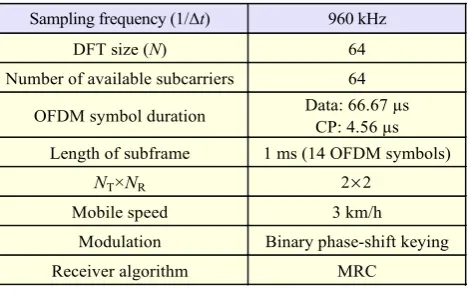
[image:8.595.309.544.580.728.2]The MIMO-OFDM system with WBP and the adaptive codebook is evaluated with the system parameters listed in Table 4. The ergodic capacity and BER are adopted as two performance metrics. The system ergodic capacity is defined as
[
21 1
log (1 ) ,
C N
n C
a n
C E
N = γ
=
∑
+]
Table 4. System parameters for performance evaluation. (39)
where γn is the post signal-to-noise ratio (SNR) over the n-th
subcarrier after maximum ratio combining (MRC).
In our simulations, each channel tap is generated with an i.i.d. channel matrix and the correlation coefficient according to (13) and (14) in [14]. According to (5), the channel matrices of all the subcarriers can be obtained. Then, the optimum precoder is computed with (10), and the corresponding angle is achieved with (17). The quantized angle , that is, the precoder in the codebook, is selected with (22). The post SNR over each subcarrier can be computed with the selected precoder and H
2
θ
2 ˆ
θ
n. The two-tap channel in section IV is also
adopted in this part, and l=4.
1. Equal Power and Correlation Coefficient for All Taps
Assume P1=Pl=0.5 andβ=0.5ejπ/2. Two adaptive codebooks
Sampling frequency (1/Δt) 960 kHz
DFT size (N) 64
Number of available subcarriers 64
OFDM symbol duration Data: 66.67 µs CP: 4.56 µs Length of subframe 1 ms (14 OFDM symbols)
NT×NR 2 2×
Mobile speed 3 km/h
Modulation Binary phase-shift keying
[image:8.595.59.291.637.703.2]Fig. 7. (a) BER performance and (b) capacity performance for β=0.5ejπ/2.
F in (10) CF2 C2 C4
2 4 6 8 10 12 14
10–3 10–2 10–1
SNR (dB)
BE
R
(a)
2 4 6 8 10 12 14
1.5 2.0 2.5 3.0 3.5 4.0 4.5 5.0
C
apa
city (bit/c
ha
nne
l us
e)
SNR (dB) (b)
Fig. 8. (a) BER performance and (b) capacity performance for
β=0.9ejπ/2.
F in (10) CF2 C2 C4
2 4 6 8 10 12 14 10–3
10–2 10–1
SNR (dB)
BE
R
(a)
2 4 6 8 10 12 14 1.5
2.0 2.5 3.0 3.5 4.0 4.5 5.0
C
apac
ity (bit/c
ha
nne
l us
e)
SNR (dB) (b)
Table 5. SNR gains in dB over CF2 for equal correlation
coefficient (BER=10–2, C
a=3.0 bits/channel use).
β BER Capacity
/2
0.5ejπ 0.51 0.88
2
C
/2
0.9ejπ 2.07 2.26
/2
0.5ejπ 0.67 0.96
4
C
/2
0.9ejπ 2.07 2.26
are constructed according to subsection V.1: 1) C2={1.14, 2.00}
and 2) C4={0.78, 1.34, 1.81, 2.36}. The fixed uniform
quantization codebook (CF2={0, π}) is also taken for
comparison. Additionally, the results based on (10) are plotted in the figures, which are equivalent to a codebook with an infinite size.
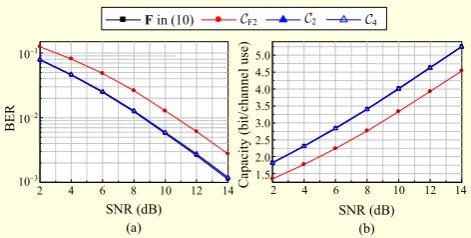
The BER and capacity results are given in Fig. 7. Obviously, the precoder in (10) performs the best without quantization errors. The adaptive nonuniform codebook, C2, outperforms the
fixed one, CF2, by about 0.6 dB in the BER and 0.9 dB in
capacity, as shown in Figs. 7(a) and 7(b), respectively. The difference between C2 and C4 is less than 0.2 dB.
The performance with β=0.9ejπ/2 is also evaluated, where
Fig. 9. (a) BER performance and (b) capacity performance for
β1=0.6e–jπ/2 and βl=0.6ejπ/2.
F in (10) CF2 C F4 C4
2 4 6 8 10 12 14
10–3 10–2 10–1
SNR (dB)
BE
R
(a)
2 4 6 8 10 12 14
1.5 2.0 2.5 3.0 3.5 4.0 4.5 5.0
C
apa
ci
ty (bit/c
ha
nne
l us
e)
SNR (dB) (b)
Fig. 10. (a) BER performance and (b) capacity performance for
β1=0.9e–jπ/2 and βl=0.9ejπ/2.
F in (10) CF2 C F4 C4
2 4 6 8 10 12 14
10–3 10–2 10–1
SNR (dB)
BE
R
(a)
2 4 6 8 10 12 14
1.5 2.0 2.5 3.0 3.5 4.0 4.5 5.0
C
apa
city (bit/c
ha
nne
l us
e)
SNR (dB) (b)
C2={1.45, 1.69} and C4={1.34, 1.50, 1.64, 1.80}. The results
are given in Fig. 8. As can be observed from Fig. 2(e), p(θ2) is
close to φ=π/2, so that precoding based on C2 and C4 performs
almost the same as the noncodebook precoder. The feedback overhead can be extremely reduced without obvious performance loss in this scenario.
The SNR gains in dB of C2 and C4 over CF2 in Figs. 7 and 8
are listed in Table 5. The improvement in the capacity with the proposed adaptive codebook over the conventional fixed codebook is more apparent than that in the BER.
2. Equal Power and Different Spatial Correlations
Various tap correlation coefficients are considered in this scenario. The BER and capacity results for P1=Pl=0.5,
β1=0.6e–jπ/2, and βl=0.6ejπ/2 are shown in Fig. 9. The fixed
codebook is included for comparison.
According to (37), we have The
performance of C
F4= ±{ π/ 4,±3π/4
C }
4= ±{ 0.96, 2.18}.±
C
F2 is far from the performances of the other
schemes. As shown in Fig. 9(a), C4 performs closely to CF4 at
the low SNR region and outperforms it at high SNRs. For β1=0.9e–jπ/2 and βl=0.9ejπ/2, the BER and capacity results
[image:9.595.55.288.87.212.2] [image:9.595.307.541.88.213.2] [image:9.595.53.289.263.382.2] [image:9.595.305.541.263.383.2]Table 6. SNR gains in dB over CF2 and CF4 for different
correlation coefficient (BER=10–2, C
a=3.0 bits/channel
use).
β1, βl BER Capacity 0.6e–jπ/2, 0.6ejπ/2 1.02 0.63 CF2
0.9e–jπ/2, 0.9ejπ/2 2.31 1.14 0.6e–jπ/2, 0.6ejπ/2 0.10 0 CF4
0.9e–jπ/2, 0.9ejπ/2 0.48 0
accordance with (29). The capacity results with CF4, C4, and the
noncodebook precoding are similar. However, C4 outperforms
CF4 by about 1.4 dB in terms of BER, as shown in Fig. 10(a).
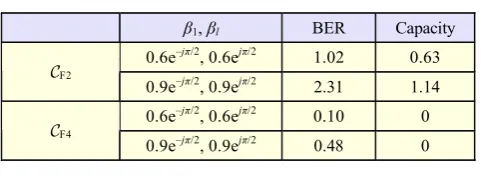
Similarly, the results in Figs. 9 and 10 are summarized in Table 6. For the channels with different correlation coefficients, the proposed adaptive nonuniform codebook is capable of reducing quantization errors and improving on the system reliability and capacity. The SNR gains at the same levels of the BER are more apparent than those in capacity, which is different from the observation in Table 5. The results in Tables 5 and 6 clearly demonstrate the advantage of the proposed adaptive codebook over the conventional codebook.
VII. Conclusion
In this paper, we studied the precoder distribution with WBP under the spatially correlated channel, which was shown to be related to the average power and spatial correlation coefficient of each channel tap. Then, a unified approximate expression of the precoder distribution function was proposed, where the PDF related to each tap was approximated by an isosceles triangle and the precoder distribution was approximated by the overlapped functions of all the taps. Based on the proposed approximation, an adaptive nonuniform codebook design for WBP was presented. The BER and capacity performances obtained via Monte Carlo simulations clearly demonstrated the advantage of the proposed adaptive codebook.
References
[1] G.J. Foschini and M.J. Gans, “On Limits of Wireless Communications in a Fading Environment When Using Multiple Antennas,” Wireless Personal Commun., vol. 6, no. 3, Mar. 1998, pp. 311-335.
[2] 3GPP TS 36.211 v8.8.0, “Physical Channels and Modulation,” Sept. 2009. Available at: http://www.3gpp.org/ftp
[3] IEEE P802.11n/D1.04, “Wireless LAN Medium Access Control (MAC) and Physical Layer (PHY) Specifications: Enhancements
for Higher Throughput,” Sept. 2006.
[4] S. Liu and J.-W. Chong, “Improved Design Criterion for Space-Frequency Trellis Codes over MIMO-OFDM Systems,” ETRI J., vol. 26, no. 6, Dec. 2004, pp. 622-634.
[5] A. Scaglione, S. Barbarossa, and G.B. Giannakis, “Filterbank Transceivers Optimizing Information Rate in Block Transmissions over Dispersive Channels,” IEEE Trans. Inf. Theory, vol. 45, no. 3, Apr. 1999, pp. 1019-1032.
[6] K.J. Kim, M.O. Pun, and R.A. Iltis, “QRD-Based Precoded MIMO-OFDM Systems with Reduced Feedback,” IEEE Trans. Comm., vol. 58, no. 2, Feb. 2010, pp. 394-398.
[7] K.J. Kim, M.O. Pun, and R.A. Iltis, “QRD-Based Precoded MIMO-OFDM Systems with Reduced Feedback,” Proc. IEEE ICC, Beijing, China, May 2008, pp. 708-712.
[8] H. Long et al., “Improved Wideband Precoding with Arbitrary Sub-Carrier Grouping in MIMO-OFDM Systems,” ETRI J., vol. 34, no. 1, Feb. 2012, pp. 9-16.
[9] K.J. Kim et al., “A Reduced Feedback Precoder for MIMO-OFDM Cooperative Diversity Systems,” IEEE Trans. Veh. Technol., vol. 61, no. 2, Feb. 2012, pp. 584-596.
[10] J.C. Roh and B.D. Rao, “Transmit Beamforming in Multiple-Antenna Systems with Finite Rate Feedback: A VQ-Based Approach,” IEEE Trans. Inf. Theory, vol. 52, no. 3, Mar. 2006, pp. 1101-1112.
[11] D.J. Love, R.W. Heath, Jr., and T. Strohmer, “Grassmannian Beamforming for Multiple-Input Multiple-Output Wireless Systems,” IEEE Trans. Inf. Theory, vol. 49, no. 10, Oct. 2003, pp. 2735-2747.
[12] D.J. Love and R.W. Heath, Jr., “Limited Feedback Precoding for Spatial Multiplexing Systems,” Proc. IEEE Globecom, vol. 4, San Francisco, CA, USA, Dec. 2003, pp. 1857-1861.
[13] A.T. James, “Distributions of Matrix Variates and Latent Roots Derived from Normal Samples,” Annals Math. Statistics, vol. 35, June 1964, pp. 475-501.
[14] H. Long et al., “Precoding Vector Distribution under Spatial Correlated Channel and Nonuniform Codebook Design,” Proc. IEEE ICC, Beijing, China, May 2008, pp. 4506-4510.
[15] Y. Fu, C. Tellambura, and W.A. Krzymien, “Limited-Feedback Precoding for Closed-Loop Multiuser MIMO OFDM Systems with Frequency Offset,” IEEE Trans. Wireless Commun., vol. 7, no. 11, Nov. 2008, pp. 4155-4165.
Hang Long received his BS and PhD from
[image:10.595.53.294.130.218.2]Kyeong Jin Kim received his MS from the Korea Advanced Institute of Science and Technology (KAIST), Daejeon, Rep. of Korea, in 1991 and his PhD in electrical and computer engineering from the University of California, Santa Barbara, Santa Barbara, CA, USA, in 2000. From 1991 to 1995, he was a research engineer at the Video Research Center of Daewoo Electronics Ltd., Rep. of Korea. In 1997, he joined the Data Transmission and Networking Laboratory at the University of California, Santa Barbara, USA. After receiving his degrees, he joined the Nokia Research Center in Dallas as a senior research engineer. From 2005 to 2009, he worked with the Nokia Corporation in Dallas, TX, USA, as an L1 specialist. From 2010 to 2012, he was a professor by invitation for Inha University, Incheon, Rep. of Korea. Currently, he is working as a member of the senior principal research staff at Mitsubishi Electric Research Laboratories (MERL), Cambridge, MA, USA. His research has focused on transceiver design, resource management, and scheduling in the wireless communication systems. He serves as an editor for IEEE Communications Letters.
Wei Xiang received his BEng and MEng, both
in electronic engineering, from the University of Electronic Science and Technology of China, Chengdu, China, in 1997 and 2000, respectively, and his PhD in telecommunications engineering from the University of South Australia, Adelaide, Australia, in 2004. In January 2004, he joined the Faculty of Engineering and Surveying, University of Southern Queensland, Toowoomba, Australia, where he was first an associate lecturer in the Department of Computer Systems Engineering from 2004 to 2006, then a lecturer from 2007 to 2008, and currently holds a faculty post as a senior lecturer. In 2008, he was a visiting scholar at the School of Electrical and Electronic Engineering, Nanyang Technological University, Singapore. From October 2010 to March 2011, he was a visiting scholar at the University of Mississippi, Oxford, MS, USA. He was awarded a prestigious Queensland International Fellowship in 2010. He received the Best Paper Award at the 2011 IEEE WCNC. Most recently, he was awarded an extremely competitive three-year Smart Futures Fellowship by the Queensland Government of Commonwealth Australia for the period of 2012 to 2015 and an internationally prestigious Endeavour Research Fellowship by the Australian Government. As such, he was recently appointed by the University of Hong Kong as a visiting associate professor for the period of September 2012 to March 2013 to undertake his Endeavour Research Fellowship project. His research interests are in the broad area of communications and information theory, particularly coding and signal processing for multimedia communications systems.
Jing Wang received her BS from Beijing
University of Posts and Telecommunications (BUPT), Beijing, China, in 2011. Since 2011, she has been working toward her MS at BUPT. Her current research interests are in the field of wireless physical layer techniques.
Yuanan Liu received his BS, MS, and PhD
from the University of Electronic Science and Technology of China, Chengdu, China, in 1984, 1989, and 1992, respectively. He is currently a professor at and the dean of the School of Electronic Engineering, Beijing University of Posts and Telecommunications (BUPT), Beijing, China. His research interests include mobile communications and electromagnetic compatibility.
Wenbo Wang received his BS, MS, and PhD
from Beijing University of Posts and Telecommunications (BUPT), Beijing, China, in 1986, 1989, and 1992, respectively. He is currently a professor at and the dean of the Graduate School, BUPT. His research interests include signal processing, mobile communications, and wireless ad hoc networks.