
Through the looking glass
167
0
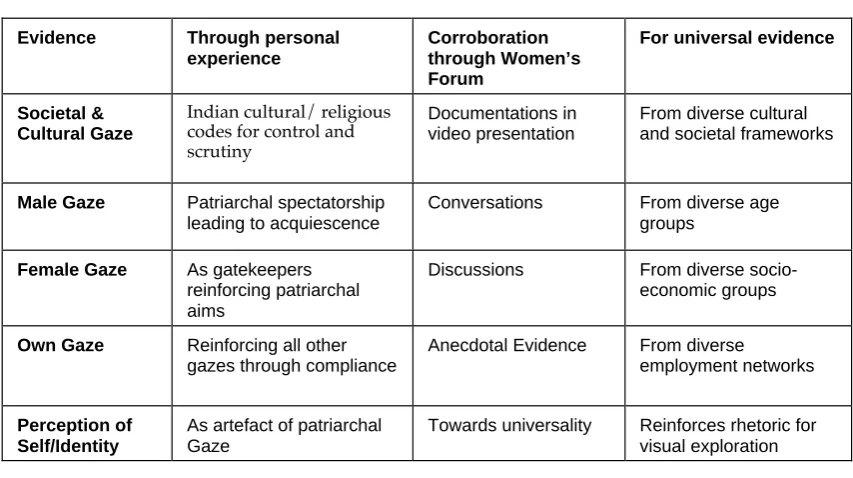
0
Full text
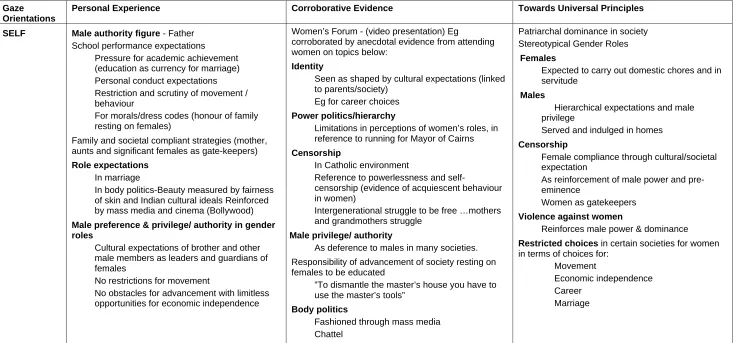
(2) CHAPTER 7 Processes towards the Exhibition. 152.
(3) CHAPTER 7:. Processes towards the Exhibition. Where does one begin? As the King of Hearts said, “Begin at the beginning…” (Carroll, 1996:114) 7.1. Video Documentation of the Women’s Forum. (Appendix B). To actively defy the gaze and create visibility for women, I planned to document the current voices of the women from the North of Queensland using the headings explored in this thesis. I had considered using a series of questionnaires or record observations of individual women in the Cairns area. What appeals to my female sensibility is the more casual North Queensland practice of holding an informal gathering with a diverse group of women of varying ages and social backgrounds. My final choice is a relaxed social environment, more suited to address the topics in this thesis. By documenting this forum I provide a local context, create interaction and develop awareness for a dialogue towards empowerment. A video film of a forum examining the role of women in North Queensland is then presented for viewing at the exhibition. It links all headings discussed in the thesis, to the experiences in the lives of the women attending. By examining the headings visually I also include current, local rhetoric for the headings violence, power, authority, internal dialogue and empowerment. The loop tape is set to play throughout the exhibition to increase visibility of women from the Far North Queensland and include their thoughts and experiences of the issues discussed, consistent with the aims of the research. 7.2. Rationale for Process. This chapter documents the different stages in process for creating this exhibition, the conceptual analyses that drive the work and the technical experiments that resulted in my final decisions for the presentation of this exhibition. It also examines the rationale underlying the final decisions for choice of venues, installation and hanging.. 153.
(4) 7.2.1. Choice of Venue. When the Cairns Regional Gallery called for artists’ proposals for its exhibitions under the Community Artists Program in 2004. I submitted an application that was successful and resulted in an exhibition timeslot in April 2004. The choice of venues impacts on the final decision making process for the exhibition with constraints placed through lack of equipment and the availability of space and layout that may require changes and modifications for the final presentation of work. I also started investigating a touring schedule and asked for expressions of interest from other regional galleries in Queensland. I had prior experience in touring exhibitions and knew how far ahead an artist needs to plan to book the venues, negotiate artists’ fees and seek funding for touring. To fulfil academic requirements and remain consistent with arts funding policies I kept the touring program separate. As a result, six tours were planned for the year 2005 and 2006. The venues were chosen for the existing infrastructure as part of the Regional Galleries Association, with an inbuilt professional framework, clear contracts and efficient promotional facilities familiar to me from previous tours. To coincide with the touring exhibitions and as a strategy for inclusion I also planned workshops for audience building with diverse communities such as the Migrant Settlement Services to enable me to reach people from other communities who are not likely to access the mainstream art networks. The tour had specific conditions where solutions for installation were according to individual size and layout. Accordingly, each gallery had specific requirements for the design of invitations for printing. However, due to the large financial outlay in repeated printing costs, I chose to keep the catalogue only as a single printing run. At each venue, the logos would be printed individually as labels to fulfil requirements for the sponsors and funding bodies. 7.2.2. Decision Making. I acknowledge, that for the purpose of this documentation, it is appropriate to provide an ordered and logical approach although that is not the way I always work. Indeed, the aesthetic process does not necessarily take a direct problemsolving path, beginning with an issue to which the artist applies skills and techniques to find solutions. The order in which decisions are made may be haphazard and is not always linear, sometimes based on chanced findings. 154.
(5) Sometimes answers present themselves after one is committed to a different path. It is then another part of the decision making to make the choice to reexamine the whole work to find the best outcome. The decisions to enlist speakers at the opening were made according to their knowledge base and the contribution to further dialogue on the gaze. The opening speaker by Anneke Silver (Associate Professor, College of Music and Visual Arts) was made in her capacity as supervisor with knowledge of process and the Honourable Desley Boyle MP, (Minister for Local Government, Planning, Environment and Women) was appropriate choice as Minister for Women to formally declare the exhibition open. The third speaker was my daughter as the third generational gaze for her input, looking at me, looking at my mother While the conceptual decision itself points to particular qualities in materials to support the work, it is nevertheless, the decisions in execution, arrangement and placement over which one has final control. Decisions are taken to create art works from principles derived as personal strategies over years of exhibiting where the focus is on communicating the exhibition aims most effectively to an audience. There are also occasions when decisions for installations have to be revised because a venue lacks equipment necessary for the initial decision. For example in the Cairns Regional Gallery there were no digital projectors to show the Bollywood film. I had designed the film to be reflected over the installation so that it reflected back from the mirror. I compromised by using slides available in this gallery and isolating the image in darkness away from the other installations. I had to modify and move away from my initial decision to suit conditions in the gallery. This problem emerged again in Townsville and this installation had to be modified according to conditions in each location. In some cases, the decision not to take a particular path seems as important as the path to which, one finally commits. For example, I had examined the works of Norman Rockwell, particularly, Girl at the Mirror (Plate 6.4.3) to examine the play between positions of the object and the subject through the male gaze and the dialogue about self -image. I found a convex mirror like the one used on roads to see around corners and worked directly on it to emulate the same interaction of the subject and object 155.
(6) but found the style too painterly. It detracted from the inherent message by focussing on the application rather than the underlying content. The process was also too dated as a style for the contemporary analysis I was seeking to convey and would have stood out within the body of work. I abandoned it preferring work that uses a system of semiotics that relies on the tension inferred between imagery and text or by making metaphorical links as discussed earlier. (Plate 5.4.3, Reprocessing Perceptions) 7.2.3. Text as Visual Imagery. As a printmaker I am fascinated by text as images, much like the calligraphic text is to the Arabic world. (Plate 7.2.1) I have seen them in Muslim religious shops with embellished colours and framed as representations of the word of God.. . Plate 7.2.1:. Arabic text ‘God is Great’. Much later I chanced upon the illuminated texts from the West where I made the same visual connections of the elevated status of textual imagery. The use of text also embeds meanings in the work and is a device used to elicit visual response in the viewer as discussed in Chapter 6.4.1. This strategy can use language to impart in an essence or an insight to cue the audience, for example for the verbal and cultural context of the Koranic texts in Cultural Window. (Plate 8.1.17) The text, even if undecipherable, is recognised as Islamic text sufficient to cue Western audiences, while still relevant to the Islamic audiences in Australia. I also group words to find differences and similarities between them. I deliberately seek doing words that convey restrictions, violence and reflect power relationships in complicit behaviour and subservience. I make a running list in my diary for later use, for example from the words below, the title Con words was constructed to focus attention on the conditions endured by women. Each word beginning with Con as prefix, also insinuates that women are duped 156.
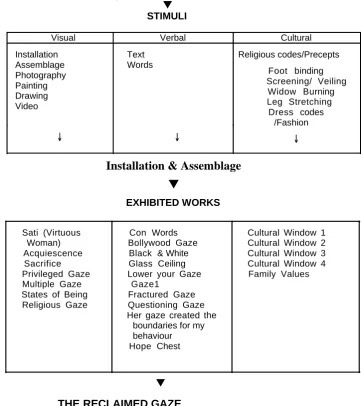
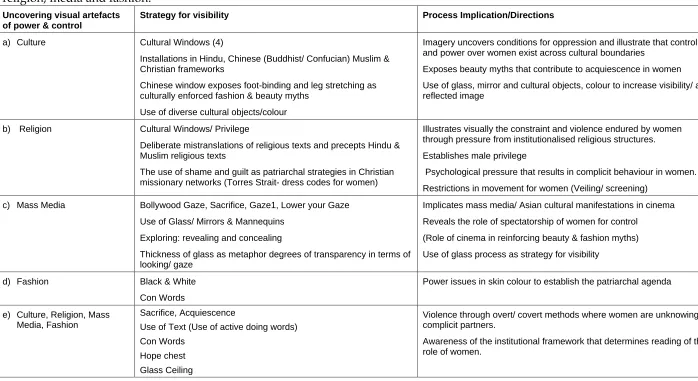
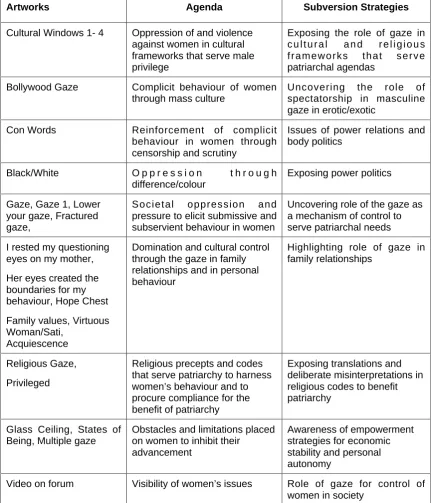
(7) or conned. Through humorous puns, the deliberate play on words uncover patriarchal agenda.. conform. contain. confine. constrict. confuse. constrain. concede. condescend. conceal. control. 7.3 Conceptual Analyses towards Iconography The global hangers in the conceptual framework presented in 6.4.2 translate into visual iconography for this exhibition. Figure 7.3.1 below documents the visual translation from the concepts to individual pieces of work. 157.
(8) THE GAZE . GOAL: To subvert through Art Practice STIMULI Visual. Verbal. Installation Assemblage Photography Painting Drawing Video. Text Words. Cultural Religious codes/Precepts • • • • •. ↓. ↓. Foot binding Screening/ Veiling Widow Burning Leg Stretching Dress codes /Fashion ↓. Installation & Assemblage EXHIBITED WORKS • Sati (Virtuous Woman) • Acquiescence • Sacrifice • Privileged Gaze • Multiple Gaze • States of Being • Religious Gaze. • • • • • • • • •. Con Words Bollywood Gaze Black & White Glass Ceiling Lower your Gaze Gaze1 Fractured Gaze Questioning Gaze Her gaze created the boundaries for my behaviour • Hope Chest. • • • • •. Cultural Window Cultural Window Cultural Window Cultural Window Family Values. 1 2 3 4. . THE RECLAIMED GAZE. Figure 7.3.1: Conceptual Analysis towards Visual Iconography 7.3.1. Exploration of the Gaze. One is aware of the variety of responses in looking and conscious that its analysis depends on the experience and internal dialogue of the audience. In The Visual Dialogue, Knobler (1966) argues that interaction cannot take place between an art object and observer unless certain conditions are met: These conditions are the ability of the observer to perceive and comprehend those aspects of the object or experience that contributes. 158.
(9) to aesthetic satisfaction and a receptive attitude on the part of the observer. (Knobler, 6:1966) As the main objective of the artist is to communicate with the audience, the artist requires the work to provide clarity, depth and to be presented in an environment where the audience is able to engage effectively by grasping the intent of the artist. The clear conceptual intent dominates this body of visual research. 7.3.2. Unpacking the Methodological Positions. Chapter 6 on methodology sets out various positions like, the subject, the object, the narrator and the protagonist from the theoretical analysis and my visual research to create a cohesive visual analysis. To illustrate my research visually, these positions in looking have to actively involve the audience. As an exercise, translating concepts into art and turning intangibles to create a meaningful exchange with the audience is fraught with danger. I have researched other artists who have actively dealt with aspects of reclaiming bodies and images in historical and contemporary sources to arrive at my own solutions. I realise that when I use imagery using universal concepts, there is a danger of continuing the reinforcing of cultural stereotypes and in body politics. There is also an inherent struggle between public and private domains and my challenge is to integrate them in the context of my rhetoric, to clarify subjective and objective positions. 7.4. Visually Unpacking the Gaze: As Subject. To find the context of the gaze, the eyes are the primary source of the gaze and thus the starting point of my realisation of self as a child. To support John Berger’s (1972) statement: Soon after we can see, we are aware that we can also be seen. The eye of the other combines with our own eye to make it fully credible that we are part of the visible world. (Berger, 1972: 9). 159.
(10) I decide on a childhood photograph, (Plate 7.4.1) which displays an open enquiring stare as a context for the chronological point in the narrative. I draw on the same iconographic codes that I used to inform past works on my identity in the exhibition Alice in the Interface (1998). In doing so, I maintain continuity from past works, where I had used the same image as a context of innocence and curiosity for my identity as the child Alice.. Plate 7.4.1:. Myself as the Child Alice, 1954, photograph detail. The processes that unfold the conceptual analysis and the technical provisions for hanging are described later. 7.4.1. Questioning Gaze (Plate 8.1.2). My decisions for the following artworks are derived from conceptually unpacking personal narratives in the thesis to form visual imagery. In this exhibition, the sole focus is the gaze so I decide to use the cropped image of my eyes from the above reference to illustrate the first encounter of the gaze in my narrative. The phrases, ”I begin this narrative by remembering… the way, as a child”; “I rested my questioning gaze upon my mother, not always understanding her actions,” written at the beginning of my thesis are chosen as text to underpin the meaning for the work and provides the leader into the narrative.. 160.
(11) In my art diary I experiment with various positioning and arrangements for the eyes, (Plate 7.4.2) to impart a child’s ‘questioning gaze’. So I trace back to a moment in my memory to encapsulate it in visual form. A photograph of myself as a child was used previously to articulate innocence. I try working with just the eyes but it is not enough to capture the innocence of a child’s open gaze. I then include a larger section to capture the necessary countenance. (Plate 8.1.2). Plate 7.4.2: 7.4.2. Diary Notes 1. Her Gaze Created the Boundaries for my Behaviour. (Plate: 8.1.3). A piece of roundel glass had surfaced during my collecting phase. It is a piece of glass that fell off a moulded glass container and cut my daughter’s foot badly. Like a bower- bird, while cleaning the floor of the blood and glass I had kept the glass roundel, knowing that it could be of use later. The glass mimics a convex lens of the eye and the text builds the relationship in the visual dialogue between my mother and myself. It has restrained simplicity and has high impact; the arresting gaze of the child holds the gaze of the onlooker. I could have used a flat circular form but this method aptly provides 161.
(12) the distortion in the image so vital to indicate filters in looking. I also use binder medium to assemble the various components and to combine text with imagery on the flat surface. The possibilities for mounting are discussed below. A set of works forms a relationship with each other as a visual metaphor for the relationship between my mother and me. Within the power discourse of mother and child, it naturally follows that my mother’s gaze is the next point of reference as her attitudes and values defined my behaviour as a child. To make obvious the connections between the two works, I decide to keep the two in the same format and style. The roundels of found glass still stand alone as self-contained objects and create a deliberate metaphor for the eye. Similar to the piece discussed previously, I use binder medium and assemble a fragment of the photograph of my mother’s eyes and combine it with text. (Plate 7.5.1) This image is necessary to establish the power relations between the two subjects. I decide to convey the difference between the two objects and impart the difference in time through sepia tones. Given the need to develop a safe strategy for hanging this mixed media piece, I investigate different hanging systems like plate hangers and wire and try a variety of glues to adequately keep the works together. With each method resulting in failure, I design a bracket welded in sheet metal that then holds the piece to be, neatly, hung. 7.4.3. Family Values (Plate 8.1.4). Keeping the circle as consistent format for the gaze, I identify the values that scaffold our family’s behaviour. The words family honour, obedience, duty and sacrifice ring loud as the main elements, far surpassing love and happiness. I use these words as the underpinning text. I use mixed media and collage techniques to wrap the words, family honour, obedience, duty and sacrifice, around a circle. I print the words on acid free rice paper for its archival properties. This gives a seamless image when layered. I assemble the final image on to a chine collé print on gold paper. The choice of gold, used sparingly, is a deliberate and tried strategy in printmaking to seduce the audience, to draw attention to the small work.. 162.
(13) 7.4.4. Gaze 1 (Plate 8.1.5). While there were many other points of references for dissonance in perceptions for my adult gaze, I select a photograph chosen as a significant moment in my memory when the gaze played a vital role. This image, however, succinctly made connections between myself, my culture and demonstrates the power relations in my family. My imminent wedding to a white foreigner caused a major stir in my family where cultural boundaries were challenged. On the night before my wedding, the family mafia had the opportunity to make their attitudes felt. They voiced displeasure at being compelled to attend a cross-cultural travesty (the wedding) at this family gathering. Although they did not want to sanction my deviation from traditional values in the society by their attendance they did not want to miss the curiosity show. They were making pointed comments aloud about whether they should indeed attend. The heightened awareness of the multiple gazes of my kinfolk and the curious displeasure of my elders remain etched in my mind as a reminder of the rigidity of society’s gaze. Many processes could have signposted this moment as a fragment of visual memory. My decision to use glass to best represent the dialogue on perceptions wins over all the other processes like printmaking or drawing. This is because the transparency of glass lends itself to assemblage so that the work is viewed through the slumped glass. I use the text ‘gaze’ as the essence of the meaning to provide the visual clue on the glass. I assemble the digital photo image of myself on canvas, wearing the Indian wedding paraphernalia and showing the necessary averted gaze (discussed later) to position my cultural difference. (Plate 7.4.3) As a device it gives the cultural cues for the gaze and frames the reference to time. I also decide to use the pre-slumped glass and frame the entire assemblage over a slab of glass as a fragment.. 163.
(14) Plate 7.4.3: 7.4.5. Diary Notes 2. Lower your Gaze (Plate 8.1.6). This work was created to highlight areas of gender inequality. The cultural requirement is for a woman to take a subordinate posture during the wedding ceremony and the look of obeisance is mandatory in the ceremony to indicate purity, chastity and obedience. This was pointed out to me just before the ceremony. No such requirement existed for my male counterpart. I use the same photograph, digitally transferred on to canvas, (Plate 8.1.6), under an old found bevelled mirror frame that clearly includes the reflection of the gaze of the onlooker thus including both positions in looking. Again I employ text, ‘Lower your Gaze’, to convey the cultural requirement for subservience to the audience. 7.4.6. Fractured Gaze (Plate 8.1.7). I search for visual means to communicate the lack of transparency and the many covert perceptions in society. I first experiment with plastics and layer 164.
(15) them by gluing them together to create varying degrees of transparency. The results are messy with the glue more visible than the suggestion I am trying to make. I continue to experiment with this by assembling varying thickness of glass. When working with glass I chanced upon layers of cracked glass slivers on the newspaper, covering worktable to protect the table. Looking at text through cracked glass revealed distorted images. I found this an appropriate visual image to impart the covert nature of the gaze to unpack the theoretical issues that remain embedded in the gaze. I decide to use sharp fragments or shards of glass to impart the danger contained in the gaze and position them on another grided plane of assembled glass to decrease the visibility further. I add the word gaze at the centre of the slab yet again to provide a consistent visual clue for the audience. (Plate 8.1.7) This time the image is only just visible. Degrees of subtleties can be imparted through various levels of opacity of the glass. Using fusing techniques, I tack the assembled fragments on a layer of glass in the kiln for firing. The work needed to be mounted on a wall to be viewed from a distance with unobstructed, clean lines to view the subtleties embedded in this work. I investigate a variety of options for hanging… expensive stainless steel lugs that could give the work a contemporary look or welded steel brackets to hold the glass so that they are each mounted individually. The cost of the stainless steel was prohibitive for the many pieces of work I intend to make, and the steel brackets interfered with the final image. So I settle instead on finally assembling work onto a 10 mm tablet of glass, (400 x 280 mm), getting all the slabs predrilled for mounting straight onto the wall to achieve consistency for hanging. With minimum interference to the image and for maximum impact, I used cheaper bathroom mirror screws (easily available in hardware shops), to simplify the hanging. 7.4.7. Religious Gaze (Plate 8.1.8). I decide to include religious codes, from a Hindu precept, widely seen on entrance doorways in Indian homes. As an idea it has its origins from images of tabernacles and tablets from the movie The Ten Commandments. Without being too overt, I decide to embed a brass mantra, available from Indian grocery supplies, into a glass slab. I take a chance (the fusing of metal in glass. 165.
(16) has different annealing temperatures and can shatter) and slump the beaten metal in layers of glass to elevate the religious word 7.4.8. Thread Testing Glass for Compatibility. The compatibility (coefficient of thermal expansion rating) is important so that when fusing glass the pieces of glass become a single entity and react to the cooling as one. Varying coefficients create a strain on the glass when contracting. Glass has its own peculiarities and it is important to take notice of the process hence I test the process; heat, pull off and create a thread. Unequal coefficients will curve. Equal coefficients remain straight. I fuse long pieces of cut clear glass and add a subtle nuance of coloured glass to lift the image. I test fire it in the kiln and it worked sufficiently, to be included for the final work. The open weave of glass shards allow some reading of the brass mantra, however, sections of it melt and flatten so that some impressions of the intaglio remain faint. The results have a unique alchemic appeal. To embellish it, I tie gold threads on to the work before mounting it on to the predrilled tablet. (400 x 280 mm) 7.4.9. Privileged Gaze (Plate 8.1.9). Krishna occupies a privileged position in the Mahabharata (300 B.C.-200A.D) and is the role model for many Hindu boys who grow up with stories of his antics. He is portrayed as the lover who flirts incorrigibly with the Gopis or milkmaids and steals their heart. The irresistible sound of his flute is the call for devotion (or bakti) to him. I examine the many Hindu epics for a similar portrayal of a female antithesis and I find none. To highlight this inequality in religious texts, I take an open latex cast of a wooden Krishna with his Gopis to make an open mould using casting techniques in glass. As my anxiety increases, I realise it is due to the lack of expertise rather than lack of confidence. I decide to relax and let the process drive the result. I become more methodical and measure carefully the dry mixture to water. After many attempts I put my failures down to the humidity during the Queensland wet season. The moulds drying on shelves in my verandah are also ruined by the onset of sudden driving rain. The moulds also absorb moisture from the air and ruin the texture of the mould and reveal a need for finite balance between dry mixture and water. 166.
(17) There is no better way to learn than to immerse myself in this complex process. As an alternative I investigate a commercial compound called gelfix that gives a better definition. The gelfix is available as a solid block, when heated becomes a creamy liquid latex. (Plate 7.4.4) This material produces good definition. This is poured over the positive impression to create a negative form for a defined wax cast. The refactory mould is cast over this and the wax is steamed out to receive crushed glass to be kiln formed.. Plate 7.4.4. Gelfix Latex Moulds. 167.
(18) Plate 7.4.5:. Leaking Molten Glass. Occasionally, the unpredictable molten glass leaks out in the kiln. (Plate 7.4.5) To avoid the arduous task of grinding back, one has to take extra care with containing the shape as effectively as possible. 7.4.10. Sacrifice (Plate 8.1.10). At the gate of Meherangarh, a fort in Jodhpur, are clusters of handprints of women, each a symbol of Sati. Sati literally means ‘virtuous woman’. As a voluntary act of immolation the wife sacrifices herself on the husband’s funeral pyre to redeem herself and the sins of her husband. As the wife left their home to the funeral pyre each sati would place her handprint on the wall. The imprint was carved into stone and anointed with red dye and silver lead. These handprints left a lasting impression on my mind on a visit to India. I clearly remembered myself saying, ’Are there any instances where a man has committed a similar sacrifice for a woman?’ There was only silence. During the research on sacrifice the handprints of the women in Jodhpur stayed in my mind and I decided to include them, to highlight the role of women and the sacrifice imposed on them by society. I first decided to make the image in 168.
(19) papier maché and colour it with pigments but, when I chose glass as the medium, I looked for other glass processes that best represented the sacrifice. To demonstrate the notion of sacrifice as an acquiescent role for women I wanted this image to be in the exhibition. Interestingly as an image there were parallels between these symbols on the walls and the henna stencils used in Hindu marriage ceremony. I saw the paradox between the sacrifice and the celebration of the wedding where emphasis is placed on women to demonstrate loyalty, virtue and devotion, through sacrifice, by giving up even, one’s life. Three wax casts of plastic henna hand-stencils are made to form the impression of three open palms to demonstrate the values revered in Hindu women. On the two palms, I carve the words loyalty and virtue (as negative sculpture forms) and to the third, I add a wax impression of Durga, goddess of strength. To make a plaster cast of this assemblage, these are all arranged as a positive 3-D image on a flat baking tray about 4 cm in depth. The plaster and silica mix is poured over this. When the mould is dry, a week later, the wax is melted out with sharp bursts of steam from a cappuccino maker to which I attach a fine tube for accuracy. Using this method, I carefully flush the corners with more steam and clean the mould thoroughly. I then fire the refractory mould with a mound of glass. To vary the opacity of the glass in the work to highlight the figure, I use fine powder size ground glass and gradually increase the size of larger chips of glass because the finer the glass, the more opaque the results. The Goddess Durga is portrayed in red and yellow tones and I choose the same colours for visual recognition. (Plate 8.1.10) The final mounting is secured with UV glue on the standardized sized glass tablet (400 x 280 mm). 7.4.11 Multiple Gaze (Plate 8.1.11) At the beginning of my research as an inclusive strategy for the women in the forum, I start collecting images of eyes as the basis for the universal theme of multiple gazes. I photograph and include the eyes of every female with whom I have dialogue on the subject of the gaze. Later, I decide to include women from various age groups and diverse cultures to represent a universal application. I narrow the image to the eyes, as it is the focal point of investigation. This is a conscious decision to remove the body and to give anonymity to faces and avoid references to body politics. I plan to include them assembled in a tiled 169.
(20) composition. The black and white version has a stronger impact than the coloured one. Digitally, I rework the photos through Adobe Photoshop to sharpen the images so that the printout on the canvas is of high resolution. To achieve a large-scale image, the assembled eyes are then printed on canvas on a large commercial printer to be mediated further and remain consistent as a body of work. When I framed it onto a stretcher, I found the image too clean when placed with all the other works. I decided to collage onto it, the same cotton hand loomed fabric used on the mannequin as a method of uniting the body of works. I stained the edges a neutral grey to reduce the graphic quality of a white edge and worked back into the original image. 7.4.12. Acquiescence (Plate 8.1.12). This image was the last photograph I had taken of my mother with my father. I selected this image as a metaphor for her life as I perceived it. In the photograph, she looks away, locked in her own dreams of release from this life. My father’s gaze is dominant and his presence takes centre stage, while she sits as the insignificant other. I used three frames to impart this progression to insignificance and digitally worked them as one image. In each subsequent frame my mother fades further as an image and this is printed on canvas using a large commercial printer. 7.4.13. Sati: Virtuous Woman (Plate 8.1.1). This work was made during my grieving for my mother. I use a photo of her that is chosen for its quiet dignity and reflect on the final moments of her time. It is my final goodbye to a parent. The photograph of my mother is digitally overlayed into a Persian design and mounted on a silk-screened mirror to reflect the gaze of the community and to include the audience as reflection. The word sati (virtuous woman) frames her image and restores her status. 7.5. Visually Unpacking the Gaze: As Object. To unpack body politics and convey its dominance in woman’s life I had fossicked around for fashion industry representations of the ideal figure to. 170.
(21) mediate and found five black mannequins in a second hand shop in Mackay, Queensland and drove them back to Cairns. From these, I choose three mannequins and place them in front of three mirrors to create an installation to emphasise the visual analysis of the variety of positions in looking. Apart from the position of the object and subject described previously in Chapter Two, I also include the gaze from the audience as the third entity. The psychoanalysis of internal dialogue from the positions in looking, I translate through reflecting self as well as others that project in the mirrors and provide further directive cues and context using text on mirrors to engage with the audience. 7.5.1. Bollywood Gaze (Plate 8.1.13). The artist (I) as protagonist in the narrative uses both positions of the object and the subject in this installation through the placement of the mirror and mannequin. A stereotypical Bollywood image stares back at the audience. I immerse myself as subject to suggest the role of cinema in my life, by using a papier maché cast of my body, attached to the mannequin to cast the present as a physical time capsule. The whole installation reflects all the visual, stereotypical notions of Indianess with tacky jewellery, holi14 pigments and images from slides or film of Bollywood screen on the work. This is to reinforce wider psychological influence of the mass culture. In mirrored text, I add my internal reflections on growing, aging and resembling the shape of my mother. The text reads: I gaze at myself; I have evolved, changed and comfortably slipped into this body that I do not even recognise as mine. It refuses to accommodate or adjust; it can no longer function as an object of shame, duty or desire. It has outgrown many forms and many identities in its journey. It now begins to resemble that familiar shape of sadness and acquiescence…of my mother.. 14. An Indian spring festival throwing coloured pigments or coloured water on friends and strangers alike. 171.
(22) Yet, it is different…it is aware of many choices, but which one should it make? (Victoire, Diary Notes) These words are collaged on the front of the torso. On the back of the torso are collaged posters of the Bollywood classic Mother India. This film is chosen deliberately as a popular reflection of idealistic values of sacrifice and the way roles of women are reflected in the film. Consistent with Mulvey’s (1975) film theories, these films reinforced popular patriarchal values. I remember seeing it in the cinema as a child with my mother. She constantly referred to it as examples, in her endless lectures on Indian values and the sacrifices a mother carried out for the family. 7.5.2. Con Words, (Plate 8.1.14). In con words, playing on the prefix con, I sandblast a mirror with the words listed below to describe the body politics through the subject and object. This strategy is described in Chapter 7.2.3 on text as visual imagery. All these words echo sentiments of patriarchal control that impact covertly on women’s internal dialogue, conform, confine, confuse, conceal, contain, constrict, constrain, condescend, control The mannequin gazing into the mirror wears a corset reflecting the ever tightening straps of society that coerce women into submission. Stereotypical ideals of ‘chastity, purity and ideals,’ are printed on one side, as opposed to dire warnings as caricatures for fallen women on the other side of the bodice. 7.5.3. Black and White (Plate 8.1.15). A similar installation with two positions of subject and object and mirror echoes the position of the black woman, from the position of difference. Through the treatment of the surface of the mannequin, using cotton woven fabric used previously as a unifying device, tension is created between the colours white and black. The words printed on the mannequins reflect the political position of the black female as being in terms of the white female. In the Black Female Body, (Willis and Williams, 2002:1) Lorraine O’Grady describes the position of the black female body as an oppositional one instead of having her own rights. The. 172.
(23) words below are printed on the mannequin body to serve as explanation for the treatment of the surface: The female body in the West is not a unitary sign. Rather, like a coin, it has an obverse and a reverse: on the one side, it is white, on the other, not-white or, prototypically, black. The two bodies cannot be separated, nor can one body be understood in isolation from the other in the West’s metaphoric construction of ‘woman’. (O’Grady, 2002: 1) 7.6. As Narrator and Protagonist: Windows as Metaphor. My knowledge of religious constraints placed on women are derived from my childhood experience in cosmopolitan Malaysia which brought me in direct contact with Islam, the melding of Confucianism and Buddhism, and Christianity (in a Catholic school). Hinduism was the religion of my family and my knowledge of its practice is intermingled with the culture in which I grew up. As visual analyses of these four main religions in my research, I investigate the four religions that I explore and experiment with four constructed cedar windows. With each window it is necessary to reflect in its own cultural style. I try using specific colours, rice paper patterns and design to reflect the religions. The windows are shadow boxes divided into sections, each able to be seen as stand-alone work and I decide on nine compartments. Collectively, they are able to provide insight into the four explored cultures. 7.6.1. Cultural Window 1 (Plate 8.1.16) Confucianism, Tao and Buddhist principles dominate Chinese culture. Women assume subservient roles, remaining in roles where duty and service rule their life essentially for the pleasure and benefit of their men folk. The centre panel portrays the Chinese stereotypical female holding a looking glass with a border of the tiled eyes used earlier in the multiple gazes. The eyes can reflect the ever- restrictive gaze on women by society. For the compartments, I experiment with casting glass, as looking glass hand mirrors in an open mould that continues the theme of the exhibition of the Looking Glass. I arrange the kiln glass -fired hand mirrors on stands, moulded with text that echo words as the terms of endearment! As the protagonist, using the title, the terms of endearment, I use the text, Object of Desire, Chattel, Commodity and 173.
(24) Artefact. By playing on the words, I comment on the role of women in society and convey the inherent power issues. Facing the window, the first shelf to the left holds a pair of three-inch shoes. It is the Chinese ideal size for women’s feet where the woman is endowed the title of Golden Lily supposedly as it promised higher sexual gratification for men. Foot binding was carried out on women to make them desirable to their suitors and thus to fetch a higher bride price. The remnants of this brutal practice are still found among immigrant Chinese in Malaysia. As a fashion, the custom of foot binding served to limit the movement of women for the service of men and may still be found in Melaka, (Malaysia) among the very elderly Chinese females. Below, on canvas are painted images of bandages and feet with the text, Bind, along with the portrayal of the stereotypical female as advertisement for cosmetic products. This work supports the initial comment on fashion and body politics. On the other side is a similar stereotypical advertisement. However, this shows the current brutal practice of bone stretching that is carried out in contemporary China to achieve Western height, to comply with the demands of the modern fashion models’ market. Chinese society demands that women are obedient and dutiful as a hierarchical strategy to restore and maintain social order in the Chinese household. This stratified use of power is practised on a larger scale in government with civil servants ((Williams, 1998). Behind the lower central panel, to highlight the idea that society require women to serve a lifetime of duty I experiment with crescent-shaped glass, made by casting an open refractory mould using the text duty to frame this notion, binding women to a position of service rather than personal fulfilment. I also investigate all my Chinese found objects that can be mediated to inform the notion of Chinese culture. Chinese spoons glazed with images of eyes that relate back to the gaze and I place them to sit directly underneath on both corners. As red is the colour widely used by the Chinese to signify good luck and celebrations, I experiment with using cinnabar red as the predominant colour in this work. The backing in the shelf is lined with red Chinese brocade 174.
(25) and I include hand drawn, feminist symbols, as a reminder of the rhetoric behind this work. 7.6.2. Cultural Window 2 (Plate 8.1.17). In this window, Moorish colours (shades of blue, turquoise) are extensively used to reflect Islamic tradition. The window analyses concealment and screening within the Islamic context. The politics of power moves from the object that is looked at, to the spectator who is actively looking and creates two positions, namely the act of being veiled, and the act of veiling. Apart from veiling for reasons of modesty and honour in dress, the word also means to conceal or cover so that the object or person who is veiled is also denied access or actively refuses access. The paradox in the perception of concealment as adornment as opposed to concealing nakedness is seen in the Qur’an, where, more emphasis is placed on behaviour and attitudes of the wearer than the clothing itself. The intention in this work is to reflect the perception of the position of women in Islamic societies as subordinate. As a plan, I assemble it to the middle panel in mixed media (Plate 7.6.1) and work on canvas to convey the text behind as a central theme in this work to impart the denial of visibility for women. To reflect the intricate jali pattern used in the Middle East and North Indian architecture, I seek any objects that resemble the pattern and find that jelly moulds fit the pattern adequately. In my research on the hijab or purdah, the requirement for women to cover up to save men from temptation stood out as an area for comment where women are assigned the responsibility for men’s behaviour in society. I continue in my search for objects that can be used to reflect degrees of concealment through the keywords, screen, veil, restrain and curtain for the four corners of the window. (See Plate 8.1.17). Using commercial sieves to house the intended text, objects began to serve as alternatives to frames and provide added interest for the work underneath. To highlight the practice in society where women are made to assume responsibility the texts, the honour of the family rests with their women and also that women are socially equal, but morally inferior, are added to the work. In the long, narrow, end panels, I experiment with using minimal gold calligraphic text that God is Great to give context to the religious edicts. (Plate 7.2.1) 175.
(26) Plate 7.6.1: 7.6.3. Diary Notes 3. Cultural Window 3 (Plate 8.1.18). To echo Indian cultural affiliations, this window is covered with saffron coloured paisley print silk with a recognisable Indian design. It immediately provides the Indian context without detracting from the subject matter. In the two niches at either end, I decide on the sculptural images seen on temples entrances of apsaras or celestial nymphs who flank the gates of temples in a servile pose with no alternative, male image. I intend to use a similar image in the window box to impart female servitude; I select two brass door handles I had collected previously in my travels, to cast into refractory moulds for this image. When experimenting with the moulds the fine details in the handles translate well in open cast glass and I decide to reflect the same character as the temple apsaras. 176.
(27) The casting process is described under kiln-fired processes. (Chapter 6.7.1) I decide to tack fuse the result on to a bed of fused, muted slab of coloured glass for hanging. For the top centre shelf of the window, I choose the word acquiescence and make it into a tablet like commandment. It is carved out of wax and then cast into a mould to be ready for glass. Here I experiment with red opaque glass to highlight the words and deep amber for the background. I also create two holes to hang the work instead of risking drilling mishaps. Glass is an unforgiving material, where time and effort may be lost if the planning stages are not thorough. In the centre panel, I decide to subvert the often-displayed religious images that show women in obeisance to male deities. None exists in sacred imagery for the feminine counterpart to reinforce the need for men to show respect toward women in society. I choose to reverse these roles, with a man in obeisance. The work is reinforced with the text: ‘Perhaps! Perhaps! Perhaps!’ These words, a deliberate play on a Doris Day song, reflects the power play in waiting for a male to make decisions that affect women in relationships with men. The work on the left establishes that the canonical texts honours the role of women: Where women verily are honoured there the gods rejoiced; where however they are not honoured there all sacred rights prove fruitless…(Manu) (Narasimhan: 29) The right section of the window investigates the way, in Indian culture, male hegemony, translates honour into sacrifice (widow burning) through immolation by fire (Plate 7.6.2) as the ultimate act of devotion to her husband thus invalidating the life of the wife. The text from Shuddhitattva that attests to this sentiment I use to support the imagery for the window: All the actions of a woman should be the same as that of her husband. If her husband is happy, she should be happy, if he is sad she should be sad, and if he is dead she should also die. Such a wife is called pativrata. (Narasimhan: 11). 177.
(28) Plate 7.6.2. Immolation by Fire. The middle lower shelf looks at patriarchy as a covert system of domination. A looking glass/hand mirror is added to provide the consistent linking narrative thread in the analyses and provide the continuity to link the works. 7.6.4. Cultural Window 4 (Plate 8.1.19) I examine the introduction of shame and guilt as strategies of control and domination by the arrival of missionaries to Islander culture. To create a reliance on Western framework for survival, institutionalised religion used guilt and shame to dismantle a thriving Islander culture. The Mother Hubbard dress is the national dress of the Islanders (Wilson, 1933: 143). It has been unquestioningly adopted as appropriate attire even though babies cannot be fed directly because there is no front opening on the dress. Indeed it signifies that the self–sufficiency and health they once enjoyed have been undermined by the dominant colonial system. The women now turn to commercial milk formula for convenience giving greater power to multinationals for basic sustenance. The covert acceptance of a dominant 178.
(29) religion, acquiescence and assimilation of dominant values have created a loss of their culture. Consistent with Torres Islander aesthetic, I look at the design of a Mother Hubbard dress for a large linocut, and investigate text in Islander language to connect with the culture. I also spend some time researching Islander artefacts to maintain a consistent visual language to investigate and visually highlight the confinement of women. Uncle Friday’s woven coconut palm dolls and woven palm birds at Rusty’s Markets (Cairns) provide the idea for representing women to be placed in hand made fish traps and in the centre panel. The window frame is covered with photocopies of palm matting as reference to Islander culture and I use the Torres Strait pigeon to represent flight and hope. 7.7. Defying the Gaze. As an outcome of the research on the gaze I look for ways to imprint the need for empowerment and the reasons for finding strategies to defy the gaze as stated in the Chapter Four of this research. My final statement through my art making is a deliberate reinforcement of the need for active measures against complacency and compliance. The following artworks are developed as visual responses for reinforcing the need for positive strategies for women’s growth and wellbeing. I explore rituals that perpetuate universal myths on womanhood and decide to find ways to visually highlight them. 7.7.1. Hope Chest (Plate 8.1.20). In this work I examine the hopes versus reality of women in three stages of life. The words and images play on the word chest with images of the changed shape of breasts at the three different stages of a woman’s life. It was a difficult decision to use the image of breasts and to avoid the connotations of seduction in the politics of male gaze. I was careful to crop the photo so that all identifying features were removed to create a clinical image. The text overlaid relates to the body politics and the woman’s dialogue at the three stages of women’s life. All these impressions have been taken from various newspaper articles from mass media collected on the role of women at each stage. The text at the teenage stage states that: 179.
(30) Their teen years were spent essentially as brand slaves. You had to fit in the politics of the playground… this was pretty stressful. The middle- aged text notes that: A woman is discriminated against as a daughter, a wife, a widow, at home, out in society, food, health-care, sexuality, inheritance- in all matters, in every respect, throughout her entire life. At the final stages, it is observed that: In our lives we do earn many of the wrinkles and the imperfections that line our skins and mark our bodies, and sometimes even our diseases. We should embrace ourselves, and our decisions with abundant acceptance. On the tray on the open camphor box I decided to use my mother’s wedding saree that is interestingly of feminist colours, purple and green, and the object (chain with the symbol of uniting) of a cultural ritual of blessing. The tali that symbolises a union of a couple takes place when the groom ties around the bride’s neck. (As a child I called it ‘the noose around the woman’s neck’ and saw it as the symbol of constraint in women’s lives). In the wedding ritual the accompanying music reaches a crescendo with uncooked saffron rice thrown like confetti on the couple to bless the union. The exchange of rings in a ceremony is only a recent addition. While the tali is worn by married women there is no symbolic constraint on men to indicate their lack of availability in society. 7.7.2. Glass Ceiling (Plate 8.1.21]. For a sense of entrapment and to work on the idea of the glass ceiling encountered by women, I had initially designed three women encased as glass sculptures in glass capsules. After many experiments with wax I decided that the figures did not reflect the light free form I wanted to imply. These works displayed a static quality and lacked the flexibility to fit into the three tall, upturned glass vessels I wanted to use. I decided to change this installation to use three wire sculptures instead. They were more flexible but still reflected lightless and strength. Each vessel is sandblasted with the words gender, age and race to imply inherent obstacles to empowerment. I coloured the wire appropriately to highlight age and race and 180.
(31) to differentiate each from another and to emphasize racial diversity and universality. 7.7.3. States of Being (Plate 8.1.22). As I walked through the markets in Kuala Lumpur, I looked for little cricket cages made of bamboo that children used to play with when I was a little girl. It always filled me with dread to see little crickets trapped in these cages. I feel the same when I see women trapped in circumstances from which they are unable to free themselves These cages were no longer available so instead I set out to look for cages to keep small birds. To my amusement, I found a different streamlined, less intricate, version with pink edges that would suit. Upon arrival at the baggage counter at the Cairns Customs counter, the officers gave me peculiar looks when I hurriedly explained my intentions. I thought that I would have probably taken away on suspicion for trading in some illicit trafficking of wild life! As the shapes create an interesting installation and held spaces that could include additional material inside, I mediate the cages as 3-D drawings to resemble caged women in societal traps, victimised in patriarchal environments. Individual cages include text to serve as apt metaphors for levels of restriction in the lives of women. I positioned them in variety of designs and found an interesting rhythm with shadows created on the wall, in stepping them up in ascending order with the doors on the last three cages left open, reflecting positive outcomes to signify freedom and growth. The final decisions for the works, now, were in terms of the best grouping and also the best sites to place them in the gallery, to create a flow in the narrative for the audience. Much preparation goes into an exhibition; the order of events is set out in chronological sequence for the exhibition. 7.8. The Catalogue (Appendix C). The catalogue is an artist’s big financial outlay and serves as an advertisement and promotional material, for future exhibitions. To reflect continuity with past work, I had thought of returning to the Alice character but the cultural diversity. 181.
(32) of my investigations could not be adequately represented by the image of the English Alice. For the front of the catalogue, a variety of images could have been used but keeping the aims in mind, I decided to include my gaze as a child, cropped and layered on the photos of the multiple gazes of the women whose eyes have been used for the work Multiple Gaze. While supporting the visual context for The Looking Glass, under the feminist notion ‘personal is indeed political’, it also relates to the universal and immerses me in the dialogue. The images are also supported by explicit use of text in the rhetoric. In the accompanying catalogue more information is provided. Previous exhibition on concepts unfamiliar to Australia audiences have not been understood and I am now careful to leave as many clues as possible to elucidate my work. The foreword by Anneke Silver, Associate Professor, College of Music, Visual Arts and Theatre, James Cook University, provides background information and introduces my work. As supervisor, she is familiar with my processes and aims and has been in dialogue with me during the art making process. This is followed by the Artist’s Statement which underpins the whole exhibition and provides analysis of the research for the art making. 7.9. Invitations (Appendices D.1 to D.6). To be consistent, as in the catalogue, I use the cropped image of the eyes used previously. As this image is easily identified by the Cairns arts community because it of its extensive use for all promotional material for the women’s forum, the image became more viable. To make the eyes more visible I chose a restrained metallic grey card and kept the text black. Some of the touring venues maintained the image of the eyes for the invitations but were flexible to use their own preferred format, colours and card as in the invitation at Umbrella Studio Contemporary Arts (Appendix D.2). 182.
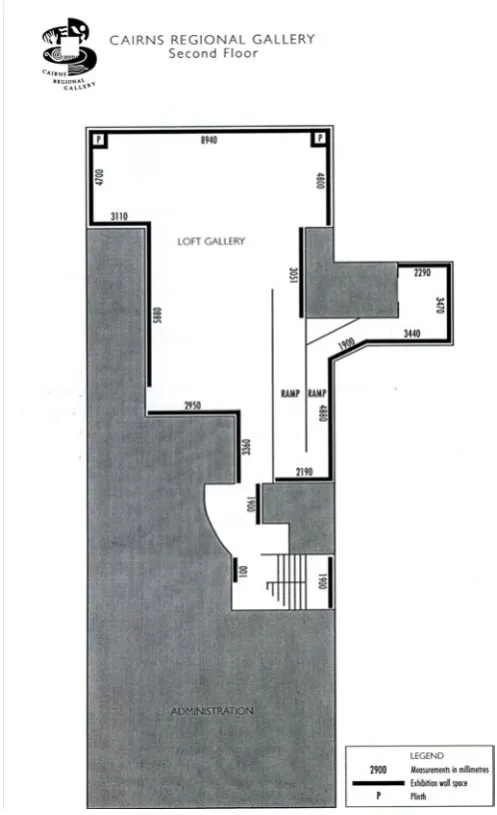
(33) 7.10. The Layout and Decisions for Installation (Placement and Hanging Methods). Figure 7.10.1: Layout of the Loft Gallery, Cairns Regional Gallery The problematic layout of the Loft Gallery (see Figure 7.10.1) due to confining, narrow walkway, drop in levels to the stairwell and lift access needed careful planning to give access and space necessary for the traffic and distance for the perusal of the art works. Also the architectural restrictions like columns and beams interfered with the hanging. It was also difficult to create intimacy with this layout. So the main plan was to divide the works into sections.. 183.
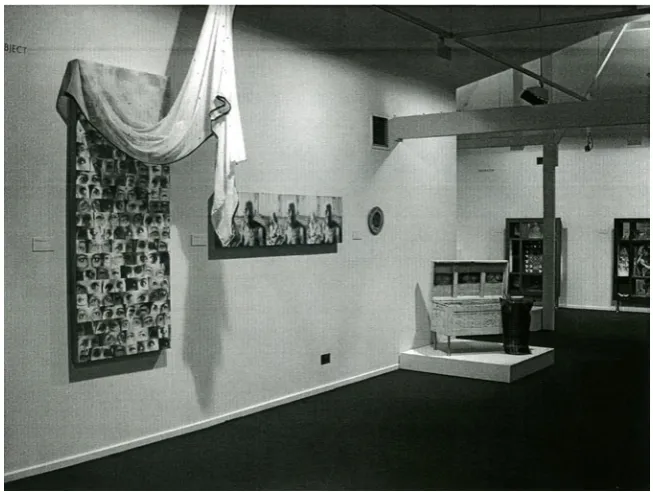
(34) Figure 7.10.2: Set Up in the North End of Gallery. Figure 7.10.3: Set Up in the South End of Gallery The exhibition targeted the needs of the audience by creating a clear narrative using didactics to support the works. An order is created in the looking by separating the works into three discrete sections consistent with the methodological basis for my enquiry. I group the works by leading the audience’s gaze through my narrative and clarify the three positions of the subject, narrator and protagonist, using vinyl didactics. By linking the gaze 184.
(35) from these positions, the audience is able to make the dialogical connections intended in the work. Under the heading, subject, works relating to personal stories link my family experiences to my enquiry and explain my initial motivation. The work dedicated to the memory of my mother Sati (Plate 8.1.1) is pivotal to the research and separated from the rest, to hang alone on the main wall to honour her contribution to this research. It commands a presence natural and fitting to her memory. (Assessed through comments made at the opening!) The reflection of the onlookers in the screen-printed mirror, reflect back at themselves thus creating the desired positions and players in looking to unpack the context of the gaze. I support it with vinyl didactics that refer to the introduction in my catalogue: Unknowingly, I saw my mother’s gaze for the last time; yet something made me look at her. It was to memorize this last gaze… (Artist Statement. Catalogue, Through the Looking Glass, 2004) The works, Questioning Gaze (Plate 8.1.2) and Her Gaze Created Boundaries for my Behaviour (Plate 8.1.3) hang together because of their dialogical relationship to each other and examine my position as subject and object. The installations on the body politics under the heading protagonist (a role similar to that of the camera lens in film theory) dismantle existing power structures in body politics by using three life size mirrors. For the installation, Bollywood Gaze (Plate 8.1.13), the space needed to be isolated. The extreme end of the room was chosen so that the corner through the removal of spotlights could be suitably darkened. Slide images representing the roles of women in Bollywood films were shown from an electricity source onto this installation. It is necessary to place the mannequin at the right distance to enable the reading of reflected text through the mirror. The alluring female figure on the mirror is illuminated from secondary sources through reflected light. In Con Words (Plate 8.1.14) sandblasted text on the mirror creates the context for the dialogue between the mannequin and the mirror as it does, similarly, in Black and White. (Plate 8.1.15) Under the heading, narrator, the installation, Cultural Windows 1,2,3, & 4, gives the audience a visual representation by exploring the role of women in four 185.
(36) different cultures. They occupy the larger arena at the end of the walkway and by creating enough distance between each work, allowed each to be viewed, individually. Kiln-formed works are mounted on glass tablets, (Plates 8.1.4 to 8.1.10). They are of consistent size and are screwed easily into the wall with bathroom screws. Simple washers are used to set them away from the wall. Light is able to reflect up through the glass to increase the luminosity and also allow intimate scrutiny by the audience. All works on stretched canvases require ease of handling and make the hanging process very simple for the gallery and also for packing. To create unity and harmony between all the works for hanging, Multiple Gaze (Plate 8.1.11) uses the same hand woven cotton, black and white fabric used throughout the exhibition. It frames the work loosely on the top edge of the canvas and acts as a reference to the veiling of women from opportunities in society. Freestanding pieces like Glass Ceiling (Plate 8.1.21) on the plinth provided allows the audience greater visibility, able to walk around and inspect the works. The Hope Chest (Plate 8.1.20) due to its rectangular shape and mediated work in the box also responds to being elevated off the floor to increase the visibility of the contents by the audience. I avoid using the walls near the stairwell as much as possible because it is unwieldy. Only the end wall is used for two little pieces. The corner viewed from above the landing makes a perfect niche for the wire sculptures in the installation, Glass Ceiling. (Plate 8.1.21) For the installation States of Being, (Plate 8.1.22) I set up different arrangements to see if they convey my intention of taking control of personal growth. By presenting them attached to the wall in ascending steps, I am able to infer the value of empowerment as a progressive upward move. I also decide to close the doors of the first three cages to reflect entrapment. The audience is required to discern the words subordination, violence and acquiescence and view its supporting imagery through the metal screen cage. The remaining three cages are left open with more positive text: honour, respect and empowerment. They alert the audience to the positive strategies for self- esteem that are necessary to enhance the position of women.. 186.
(37) CHAPTER 8 The Exhibition – Through the Looking Glass. 187.
(38) CHAPTER 8: 8.1. The Exhibition – Through the Looking Glass. The Artworks. This section presents the final selection of 22 plates described in the last chapter to support this thesis. The first exhibition was held in the Loft Gallery at Cairns Regional Gallery at from 28th August to 10th October 2004.. 188.
(39) Plate 8.1.1:. Sati (Virtuous Woman) 2004, 120 x 84 cm, digital image on canvas mounted on screen-printed mirror. 189.
(40) Plate 8.1.2. Questioning Gaze, 2004, 18 cm diameter, mixed media in glass. 190.
(41) Plate 8.1.3:. Her Gaze Created the Boundaries for my Behaviour, 2004, 18 cm diameter, mixed media in glass. 191.
(42) Plate 8.1.4:. Family Values, 2004, 25 cm diameter, mixed media. 192.
(43) Plate 8.1.5:. Gaze 1, 2004, 40 x 28 cm, mixed media under slumped glass. 193.
(44) Plate 8.1.6:. Lower your Gaze, 2004, 40 x 28 cm, mixed media & bevelled mirror frame. 194.
(45) Plate 8.1.7:. Fractured Gaze, 2004, 40 x 28 cm, mixed media under slumped glass. 195.
(46) Plate 8.1.8:. Religious Gaze, 2004, 40 x 28 cm, mixed media under slumped glass. 196.
(47) Plate 8.1.9:. Privileged Gaze, 2004, 40 x 28 cm, open cast glass. 197.
(48) Plate 8.1.10:. Sacrifice, 2004, 40 x 28 cm, slumped glass. 198.
(49) Plate 8.1.11:. Multiple Gaze, 2004, 182.5 x 75 cm, digital image and mixed media on canvas. 199.
(50) Plate 8.1.12:. Acquiescence, 2003, 151 x 40 cm, digital image and mixed media on canvas. 200.
(51) Plate 8.1.13:. Bollywood Gaze, 2004, 203 x 80 cm, mixed media on mirror. 201.
(52) Plate 8.1.14:. Con Words, 2004, 203 x 80 cm, installation, sand blasted text on mirror & mediated mannequin. 202.
(53) Plate 8.1.15:. Black and White, 2004, 203 x 80 cm, installation, sandblasted text on mirror & mediated mannequin. 203.
(54) Plate 8.1.16:. Cultural Window 1, 2004, 159 x 104 x 19 cm, mixed media installation. 204.
(55) Plate 8.1.17:. Cultural Window 2, 2004, 159 x 104 x 19 cm, mixed media installation. 205.
(56) Plate 8.1.18:. Cultural Window 3: 2004, 159 x 104 x 19 cm, mixed media installation. 206.
(57) Plate 8.1.19:. Cultural Window 4, 2004, 159 x 104 x 19 cm, mixed media installation. 207.
(58) Plate 8.1.20:. Hope Chest, 2004, 88 x 43 x 37 cm, mixed media on chest. 208.
(59) Plate 8.1.21:. Glass Ceiling 2004, installation, 15 cm diameter x 60cm h, sandblasted text on 3 glass cylinders & wire figure. 209.
(60) Detail. Plate 8.1.22:. States of Being, 2004, Installation 6 x wood, wire cages & mixed media on plastic glass mirror. 210.
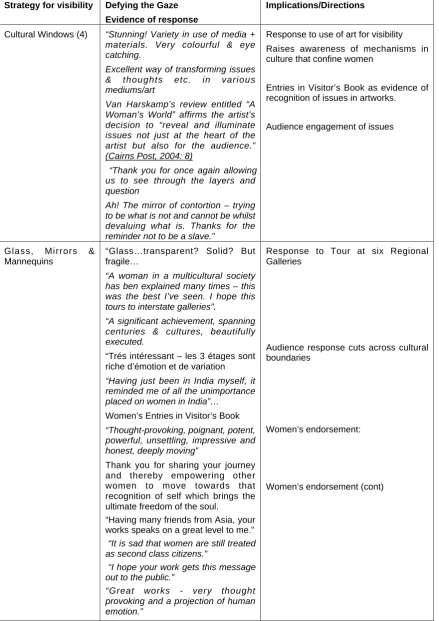
(61) 8.2. The Opening. On 28 August 2004, the exhibition opening of Through the Looking Glass was preceded by the artist talk. The audience was given a brief introduction of the works, the artist’s intentions for doing them and also answering questions from the floor. It was followed by the opening formalities by Desley Boyle MP at 2.30 pm at the Loft Gallery, Cairns Regional Gallery (Appendix D.1: Invitation) and followed by other speakers. 8.2.1. Opening Formalities. Professor Diana Davis then Head of School of Music, Visual Arts and Theatre, James Cook University presided as Master of Ceremonies at the Cairns Regional Gallery. 8.2.2. Formal Opening by the Honourable Desley Boyle MP, Minister for Local Government, Planning, Environment and Women. The insightful speech by the Honourable Desley Boyle MP, (Appendix E.1.) brought together all the threads in the exhibition. She related to the content at a personal as well as political level. Her skill and grasp of the issues before her was clearly visible in her speech and she showed empathy and dedication for the betterment of women in her electorate by promoting awareness of issues that require political response. She also confirmed the effect of the gaze in her professional life and her attempts to defy the effects of stereotypical notions. She confirmed that the exhibition highlighted issues that still needed to be addressed: And I should have been more mindful of that agenda, because it is still needed. Sasi’s work reminds us of that. Sasi’s work reminds us that it is too easy, for those of us who have nearly made it, to forget the internal dialogue, to push it aside, to pass it off, to not put it out on the table, to not bring it out in the open. In conclusion, she added that this exhibition should tour throughout Queensland’s regional areas.. 211.
(62) 8.2.3. Opening Speech by Anneke Silver (Associate Professor, College of Music and Visual Arts). In her speech, Anneke Silver (Appendix E.2) explained the reasons behind my exploration and exhibition. She declared that migration to Australia has created conditions for dissonance in my gaze and the awareness of difference. She explains: And I think for so many of us, the decision to leave one’s cultural background, which applies to many, many people in Australia, has got a very special effect on one, because in many ways, it makes you see other cultures very clearly, but also your own culture. And, I think also that decision to, I guess, to go possibly against one’s background, and the expectations of their parent’s generation, and your culture, you know, sort of sets up within you an internal dialogue that is with you forever. She added that the internal dialogue of women under subordinate social conditions results in complicit behaviour that interferes with the development of their identity and she highlights glaring patriarchal manipulations in the lives of women across many cultures. The effect on women is conformity to certain expectations. While it is true that migration had created a collision of cultures for me, I had already been aware of existing inequalities due to social constraints but I did not have the power to address them. It is through art that I can address these issues that have had festering implications in my internal dialogue. 8.2.4. Anousha Victoire (Appendix E.3). My daughter’s contribution on the reflection on her own internal dialogue for the choices she makes in her life is the next step in the rhetoric. She declares her position in the rhetoric and provides valuable insight into the choices she sees for herself: Having a mother who has achieved much despite the conflicting constraining forces of her culture, upbringing and environment, I have to say that I am very lucky to not have felt such conflicts too much myself. She explains her position as being different. 212.
(63) Growing up with different, unusual parents and a different cultural mix at home, I learnt that it wasn’t such a bad thing to be different, and got used to standing out. Studying the issue of the gaze myself when, as Arts student at uni, to me it resonated more with 1970’s feminism and women in less individualistic societies than our own, than it did with me. She continued to unfold her position in terms of her choices; I was in that cohort of young women told: ‘Girls can do anything!’ in their classroom, who actually believed it. We were encouraged to move into male dominated fields, to be leaders and agents of social change, to question the values we were taught and refine them. Our main difficulty was learning that, just because girls can do anything, doesn’t mean you have to do everything! This conclusion resonated with the audience and posited a strengthened role for women with the capacity to make choices in their lives. It served to break the cycle of oppression and reminded us not to go overboard by making choices that may be yet, a different form of compliance. The position of male counterparts is also raised in her speech: Meanwhile our male colleagues were struggling with their own societal castration and defining new ways to become men. Perhaps the next challenge is to see how gender roles, shaped in society through the media and social norms, offer contradicting and confusing messages of male and female identities, thus providing no place for defining one’s own identity as distinct from that binary opposition. Subsequent tours had similar openings; Professor Diana Davis then Head of School of Music, Visual Arts and Theatre, James Cook University opened the exhibition at Umbrella Studio Contemporary Arts, Townsville. Her speech is documented within the touring component in Appendix E.4.. 213.
(64) CHAPTER 9 Reflections, Implications and Directions. 214.
(65) CHAPTER 9: 9.1. Reflections, Implications and Directions. Reflections. While the raison d’être for this research and the artist’s personal circumstances are inextricably intertwined in this exhibition, on reflection it is appropriate that each is, to some degree separated. 9.1.1. Personal Obstacles and Ways Forward. Despite the strong social imperative of this research personal obstacles intervened to impede it, and, to some extent, these changed its trajectory. The most significant, unexpected and shocking of these was the death of the artist’s mother in her home country- and the resultant confusion and grieving process. As this occurred during the height of preparation for the exhibition, it led to a blurring of the clarity that had been the driving force. Now, in retrospect, it is clear that this research has provided a way towards resolving problematic relationships and reconciling the artist’s identity in terms of choices available to her. Losing a mother in the middle of the project became instrumental in a cathartic re-examination of the artist’s roles as child, wife, mother, artist and self. The artist has needed to face up to locating her own values within her own cultural and personal identity. While the gaze upon and from her mother has indeed been instrumental in creating this body of work as presaged in Chapter 1, it has given the artist the capacity to discern what in her culture is positive for her growth. The underpinning research has given her the means to question values that are held up as cultural blueprints for behaviour and accept that these retard selfrealization and thence for happiness in her own life. The research also reveals that there are still women who cannot see the relevance of the rhetoric within their own lives and choose to remain in the comfort zone of acquiescence. The reason for this requires further investigation. 9.1.2. Visual Cues. The photograph of the artist as a child (discussed in chapter 7.3) that was used in the invitations for the opening of the exhibition was deliberately chosen as the eyes signify the child’s gaze that is then juxtaposed against. 215.
(66) the photographed eyes of the women who attended the forum and whose gazes represent the universal. The deliberate intersection of the personal and the universal is a powerful visual cue. The repeated use of eyes as visual metaphor for the gaze also provides the continuity necessary in the narrative. The focus remains on the visual narrative for various visual interpretations of the Gaze. The construction of the narrative begins at the level of a child, from the artist’s observation of inequalities and the frustrations in her mother’s life and her perceived lack of personal fulfilment. However, as intimated earlier, while constructing the narrative for this exhibition, the sudden death of her mother catapulted a range of mixed emotions and changes in direction. The artist worked in an intensified atmosphere struggling to keep focus while grieving for the passing of a vital keystone in her personal life as well as in her rhetoric. Moreover, her death meant that the various positions that demonstrated the power play in family relationships could not be generated from a taped conversation as previously planned. The analysis of the power positions in the family necessarily, shifted from direct dialogue with her mother to a retrospective position after her death. The resulting dialogue is visual, constructed through mediated photographs taken during what turned out to be the final visit to her mother (Acquiescence, Plate 8.1.12) 9.1.3. Limitations. Many limitations including time, weather, decision making for processes, finances and life itself are restrictions artists contend with and problem-solve to achieve the aims of an exhibition. 9.1.3.1 The Challenge of Glass as a Medium On reflection, considering the time constraints and crisis, the decision to use glass was naive and foolhardy. But the seduction of glass and the determination to learn yet another process enticed the artist on. Through the experiments, however, an essential piece of advice, gleaned from the Techniques of Kiln-formed Glass served as a glaring reminder to stay true to the concept. It stated: No matter how unusual the process, rare the material or exquisite the craft skills, the lack of basic formal imagination and aesthetic enquiry will always show once the novelty has worn off. (Cummings, 1997: 48) 216.
Figure
+5
Related documents