Research report
City Strategy:
Final Evaluation
Department for Work and Pensions
Research Report No 783
City Strategy: Final Evaluation
Anne E. Green and Duncan Adam
© Crown copyright 2011.
You may re-use this information (not including logos) free of charge in any format or medium, under the terms of the Open Government Licence.
To view this licence, visit http://www.nationalarchives.gov.uk/doc/open-government-licence/ or write to the Information Policy Team, The National Archives, Kew, London TW9 4DU, or email: [email protected].
This document/publication is also available on our website at: http://research.dwp.gov.uk/asd/asd5/rrs-index.asp
Any enquiries regarding this document/publication should be sent to us at:
Department for Work and Pensions, Commercial Support and Knowledge Management Team, Upper Ground Floor, Steel City House, West Street, Sheffield S1 2GQ
First published 2011.
ISBN 978 1 908523 41 9
iii
Contents
Contents
Acknowledgements ... vi
The Authors ... vii
Summary ...1
1 Introduction ...7
1.1 Background to the City Strategy initiative ...7
1.2 Overview of the Phase 1 evaluation ... 10
1.3 Aims of the evaluation ... 11
1.4 Evaluation challenges ... 11
1.5 Methodology ... 12
1.6 Scope and structure of the report ... 13
2 Economic and policy developments over the lifetime of the City Strategy initiative ... 14
2.1 Economic change ... 14
2.2 The changing policy context for the operation of City Strategy ... 16
2.2.1
Introductory overview ... 16
2.2.2
Timeline of key strategy documents and associated policy changes ... 16
2.2.3
DAF partnerships in Wales ... 19
2.3 Overview ... 20
3 Local and sub-regional partnership working ... 22
3.1 The importance of local and sub-regional partnership working ... 22
3.2 The work of partnerships in the aligning and pooling of funding and resources ... 23
3.3 Features of successful/effective partnership working ... 29
3.4 Barriers to partnership working ... 36
3.5 The role of information sharing in partnership working ... 38
3.6 The essence of partnership ... 39
4 The impact on worklessness at the local level ... 41
4.1 Measuring impact ... 41
iv
Contents
4.3 Progress towards reducing benefit counts and increasing employment rates ... 47
4.4 Overview ... 57
5 Central-local relations, localisation and devolution ... 59
5.1 Introductory overview to key concepts ... 59
5.2 The evolution of central-local relations ... 62
5.3 The experience of co-commissioning and lessons going forward... 64
5.4 Appropriate geographical scales for intervention and the development and
implementation of locally delivered initiatives ... 65
5.5 Overview ... 67
6 Conclusions ... 68
6.1 Introduction ... 68
6.2 Assessment ... 68
6.2.1
Introduction... 68
6.2.2
Headline messages ... 68
6.2.3
Macro effects ... 69
6.2.4
Reflections on the evidence base ... 70
6.2.5
Micro effects and successes ... 71
6.3 Looking forward ... 73
List of tables
Table 3.1
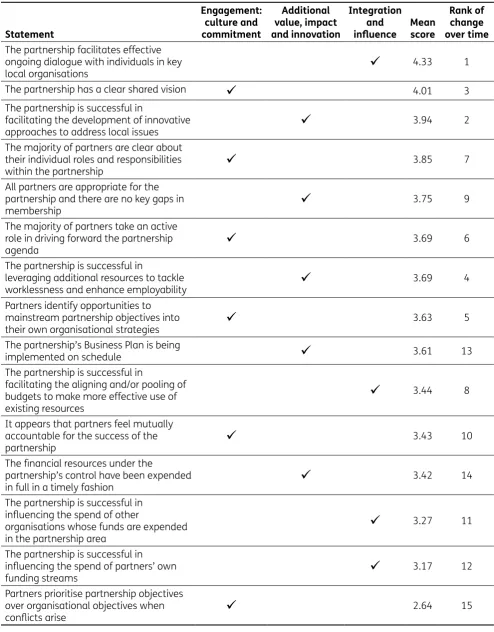
Mean scores for statements relating to partnership working issues ... 33
Table 3.2
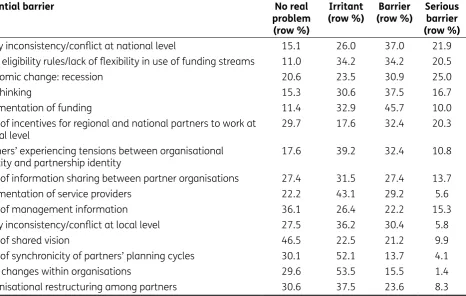
Severity of potential barriers to partnership working ... 36
List of figures
Figure 1.1
City Strategy process logic chain ...8
Figure 2.1
Timeline of key policies, drivers and delivery shifts (adapted from City
Strategy Learning Network, 2010) ... 17
Figure 3.1
Word cloud of partnership descriptors ... 40
Figure 4.1
Employment rate aged 16-64, June 2006 to December 2010 – for all
CSP areas, comparator area and Great Britain ... 48
Figure 4.2
Employment rate aged 16-64, June 2006 to December 2010 – gap
with Great Britain for all CSP areas and comparator area ... 49
v
Contents
Figure 4.4
Index of count of benefit claimants (May 2006=100), May 2006 to
February 2011 – for individual CSP areas ... 51
Figure 4.5
Percentage of working-age population on main out-of-work benefits,
May 2006 to February 2011 – for all CSP areas, comparator area and
Great Britain ... 53
Figure 4.6
Percentage of working-age population on main out-of-work benefits,
May 2006 to February 2011 – CSP areas ... 54
Figure 4.7
Percentage point gap between in the proportion of the working-
age population (16-64) claiming the main out-of-work benefits in
the worst performing neighbourhoods and the rest of the CSP area
vi
Acknowledgements
Acknowledgements
vii
The Authors
The Authors
Anne E. Green is a Professorial Fellow at the Institute for Employment Research, University of
Warwick. A geographer by background, Anne has substantial experience of researching employment and skills, non-employment, regional and local labour market issues, migration and commuting, and associated policy issues. She has contributed to several evaluation and public policy studies.
1
Summary
Summary
Introduction
The City Strategy (CS) concept was first announced in the 2006 Welfare Reform Green Paper – A new deal for welfare: Empowering people to work. CS was designed at a time of growth in the national economy to combat enduring pockets of entrenched worklessness and poverty in urban areas by empowering local institutions to come together in partnerships to develop locally sensitive solutions. It was premised on the idea that developing a better understanding of the local welfare to work arena would allow partnerships to align and pool funding and resources to reduce duplication of services and fill gaps in provision. The ‘theory of change’ underlying CS suggested that such an approach would result in more coordinated services which would be able to generate extra positive outcomes in terms of getting people into jobs and sustaining them in employment over and above existing provision.
CS was initially set to run for two years from April 2007 to March 2009 in 15 CS Pathfinder (CSP) areas, varying in size from five wards in one town through single local authority areas to
sub-regional groupings of multiple local authority areas, across Great Britain. In July 2008, the Secretary of State for Work and Pensions announced an extension for a further two years to March 2011. In April 2009, two local areas in Wales, which were in receipt of monies from the Deprived Areas Fund (DAF), were invited by the Department for Work and Pensions (DWP) to form local partnerships with a similar remit to the CSPs, albeit more limited in scope – to develop locally sensitive solutions to economic inactivity, to the CSPs.
During the period that the CS initiative was operational, economic conditions changed markedly with a severe recession, followed by fragile recovery. The CSPs had to cope with ongoing changes in policy throughout the lifetime of the CS initiative, including a General Election and a new Coalition Government at Westminster early in the fourth year. While policy changes are a fact of life for local practitioners operating in the welfare to work arena, the global recession in 2008/09 marked a fundamental change in the context in which local partnerships operated.
Aims
Key aims of the local partnerships established by CS and the DAF partnerships in Wales were:
• to improve employment rates, particularly among the most disadvantaged people in the most
disadvantaged neighbourhoods;
• to ensure that individuals were better able to find and remain in work; and • to improve the skills of individuals so that they could progress in work.
2
Summary
The national evaluation of the CS initiative is concerned not only with outcomes per se, but also with process issues focused on local/sub-regional partnership working, including questions such as:
• Does local/sub-regional partnership working contribute to better worklessness outcomes? • Does greater autonomy result in better worklessness outcomes?
• What is best practice for ‘good partnership working and greater autonomy’ with regard to worklessness support?
• Does being a CSP/DAF partnership area improve the chances of ‘good partnership working and greater autonomy’ with regard to worklessness support?
As well as addressing these questions, the evaluation seeks to identify key lessons relevant to future initiatives where sub-regional and local partnership working is employed to address worklessness.
Methodology
The national evaluation takes the form of a meta-evaluation, where evidence from a number of sources is collated, synthesised and assessed. These sources include:
• business plans, monitoring returns submitted to DWP, and other documentary evidence –
including local evaluation reports;
• interviews and surveys involving national stakeholders, key local partnership contacts and
partners to provide in-depth information on specific themes;
• workshop discussions;
• case studies of specific activities; and • interviews with national stakeholders.
Local and sub-regional partnership working
Common challenges that CSP partnerships faced at the outset included lack of coordination in the provision and planning of services; multiple and confused points of contact for residents and employers; a lack of personalised focused provision with few referrals between providers and no system tracking or supporting an individual’s progress through the system; and disjointed employer engagement.
CS partnerships played an important role in orchestrating a multiplicity of agencies at a variety of spatial scales, with responsibilities in fields relevant to tackling worklessness. In general, they were successful in mapping existing service provision and identifying gaps therein. They also had some successes in aligning funding sources so as to reduce duplication and achieve a more coherent services offer. Experience of partnership working pointed to the importance of:
• a strong central team to lead and provide the secretariat for the partnership;
• representation on partnership boards and wider consortia from public, voluntary and private
sectors; and
• a division in responsibility whereby the partnership board focused on a strategic overview and
3
Summary
The structure of both partnerships and their governance developed over time, as partnerships found what worked and what did not, and made adjustments accordingly. In general, partnerships were dominated by public sector agencies. Although progress was made in Phase 2 of the initiative, arguably more could have been done at an earlier stage to engage the private sector and bring more employers on to boards. Where employers took an active role on partnership boards, this tended to be regarded as beneficial in focusing greater attention on employer needs and labour demand issues more generally.
The development and evolution of local/sub-regional partnership working is one of the successes of the CS initiative. Partners found added value in understanding the aims, perspectives and ambitions of other partnership members, and restrictions on their operations. They appreciated that because addressing worklessness often involved concerted action in a number of policy domains (such as skills, health, housing, transport, etc) there were important gains from working together.
The reach and gains of partnership working extended beyond formal partnership meetings to informal networking.
Partnership key contacts and selected partners from the different CSPs and DAF partnerships met periodically to discuss progress at the CS Learning Network (CSLN). Participants thought this forum was an invaluable opportunity to come together to learn from one another, to share ideas and best practice, and to both hear about new central government initiatives from departmental officials and to provide feedback to them. The relationship which CSPs had with DWP improved over time, and CSPs appreciated the opportunity to have their voice heard by Whitehall policy makers. Sharing of information and experiences between CSPs continued after the end of the initiative.
The CS initiative was premised on giving local partnerships flexibility to foster new ways of working and to tailor interventions to particular sub-groups of clients in particular local areas. In the event, the degree of local flexibility which CSPs received was less than some expected at the outset of the initiative and arguably this could have impeded, at least to some extent, their ability to develop innovative practices and solutions. While some CSPs might have been unrealistic about the freedoms and flexibilities that could be offered to them, the experience of the CS initiative highlights the
importance of ensuring clarity about freedoms and flexibilities, and of managing expectations at the outset.
Nevertheless, the partnerships engaged in a wide variety of activities over the course of the CS initiative in which they addressed local needs in a targeted and joined-up manner. In general, local partners felt that they were innovative because among their activities they were trying ways of working and delivery approaches which were ‘new’ to their area. However, national stakeholders tended to adopt a more ‘global’ view and indicated that innovation was rather limited in the sense that radically ‘new’ approaches that were ‘different’ from anything that had gone on before did not emerge, with the possible exception of the development of some ‘client-tracking databases’ that resulted in mixed success.
4
Summary
Impact on worklessness at local level
CSPs struggled to meet the initial targets for benefit reduction and increase in employment rates set by DWP for the end of the first two years of the initiative. Attempts to do so were thrown wildly off course by the global economic recession and the subsequent lack of demand across the economy. For the second phase, DWP set relative targets whereby CSP performance was compared with the performance of the Great Britain economy. The national evaluation additionally developed a comparison area, composed of other areas of high worklessness which were not in CSPs. Comparing CSP areas in aggregate against Great Britain and the comparison area, indicated that the gaps for employment rates and benefit claimants’ rates had remained stable. In other words, the CSPs in aggregate did not fare worse than Great Britain or the comparison area. Given that the CSPs covered areas with some of the highest and most entrenched levels of worklessness in Great Britain, this may be regarded as a favourable outcome.
Attributing success to CS is challenging, given the fact that the initiative had multiple objectives and the diffuse nature of the interventions associated with it. Some of these interventions were discrete and new, whereas others were concerned with making existing provision work better. Sometimes this was done by developing local infrastructure to better support ongoing activities.
CS was intended to work with those furthest from the labour market in the areas designated, and as such it would have been difficult to observe an aggregate effect even without the economic position altering radically over the lifetime of the initiative. Local evaluations are able to provide some
evidence relating to project activities, outputs and outcomes. However, in many instances lack of a baseline means it is not possible to determine the added value of CSP interventions. It is also difficult to discern, when looking at the data, whether the outcomes would have occurred anyway (i.e. a deadweight outcome which would have happened without CSP/DAF partnership support).
Some of the questions about the effectiveness and costs of CSP provision could have been answered more successfully if the tracking systems, in which some CSPs invested, had been used to their full potential. These systems were not ubiquitous and in general, where they did exist, they were utilised predominantly in an operational rather than strategic sense. This may have partly been down to the time available within the initiative to get the systems operational and where partnerships chose to focus their resources. Partnerships were also mindful that their tracking systems did not cover mainstream provision and also that some projects were only part-funded by CSPs, and that it would be difficult to separate out the CS element.
Central-local relations and appropriate geographical scales
for intervention
Local partnerships were given the opportunity to manage welfare to work services in their local areas, operating within nationally determined eligibility requirements and practices. They were able to develop locally sensitive interventions to worklessness, often by complementing mainstream services with local wraparound provision and addressing gaps in mainstream provision. Some attempted to shape the provision in their area through co-commissioning, either with local arms of national agencies (such as Jobcentre Plus) or with other local partners. Most were positive about such experiences.
5
Summary
engagement with individuals and groups most distant from the labour market was best organised and implemented at local level with partners in other policy domains. There was recognition that the city-region scale was more appropriate for engagement with employers.
Conclusions
There is little evidence of macro-level effects of CS and it would have been unrealistic and
unreasonable to expect otherwise given the scale, focus, timescale and context within which the CS initiative operated. Partnerships provided plenty of evidence that they believed that the joined-up approach at local/sub-regional level is beneficial for services and their clients, but it is difficult to support this with evidence about ‘the bottom line’ – on numbers into jobs and costs vis-à-vis existing provision.
There is a great deal of positive evidence for process changes made by CSPs and DAF partnerships which have been positive for supporting workless individuals. There are numerous micro level individual and project success stories, and outcomes including:
• working together across policy domains, often with new providers and stakeholders; • more joined-up approaches to tackling worklessness;
• greater ability to respond to new opportunities because of the foundations set by
CS partnership working;
• the sharing of information between local partners and between local partnerships; • nurturing new ways of working.
CSPs and DAF partnerships provided a focal point for activities to address worklessness, so helping to concentrate efforts in a streamlined way. They sought to create and establish coherent and accessible pathways to education, training and employment opportunities. In so doing they helped raise the self-esteem and aspiration of some workless residents.
Partnership working at local and sub-regional levels was enhanced when partnership working also took place at the national level. One of the main examples which was cited was the Fit for Work programme, which brought together DWP and the Department of Health.
Better partnership working was central to positive process and micro level outcomes. Partners themselves perceived positive outcomes from partnership working and from greater sharing of experience as partnerships matured. The evaluation also points to worklessness becoming more prominent in the policy agenda in CSP and DAF partnership areas and a growing appreciation of the value of working across policy domains. Progress was made in the alignment of funding streams. Overall, partnerships played a positive catalytic role in accelerating change and in helping other partnerships to work better, so placing those concerned in a better position to cope with policy change during the lifetime of the initiative and to take forward related challenges in the current policy context.
6
Summary
Lessons from the CS initiative that are of wider relevance include:
• the importance of giving initiatives time to make a difference given the scale of the challenges to
be addressed;
• local baselines need to be set at the outset so that impact can be measured;
• the need for joining up between central government departments to best support sub-regional/
local initiatives;
• the need for national policy to work in the same direction as local policy, and vice versa – to
reinforce each other’s aims;
• the importance of ‘managing expectations’ from the outset, especially with regard to the extent
of autonomy and the scope of any enabling measures;
• central government can play a helpful role by participating in ongoing debates and deliver
guidance on key and complex issues that are important for enhancing partnership working;
• learning networks can be valuable mechanisms for organisational learning through the
dissemination and sharing of good practice and lessons about local activity in partnership areas, both among partnerships themselves and to central government;
• recognition that different geographical scales are important for different types of interventions; • discretionary funding can play an important role in helping partnerships to provide services to
address local needs;.and
7
Introduction
1 Introduction
This chapter provides an introduction to the City Strategy (CS) initiative and describes the scope of the evaluation report. First the background to, and policy objectives of, the CS initiative are set out (Section 1.1). Secondly, the main challenges and themes identified in the Phase 1 evaluation (Green
et al., 2010)1 covering the initial two years of CS from April 2007 to March 2009, and emerging developments over the subsequent period to September 2009 are outlined (Section 1.2). Then the aims of the final evaluation are presented (Section 1.3), followed by discussion of key evaluation challenges, including the complex nature of the CS initiative in a fast-changing economic and policy context and the diversity of the 15 CS Pathfinders (CSPs) (Section 1.5). The methodology for the study is described in Section 1.5. Section 1.6 outlines the scope and structure of the remainder of the report.
1.1
Background to the City Strategy initiative
The CS initiative was first announced in the Welfare Reform Green Paper – A new deal for welfare: Empowering people to work – of January 2006.2 The context was the growing concern about the persistence of pockets of entrenched worklessness in specific local areas, despite a prolonged period of sustained economic growth.
The CS initiative was intended to combat worklessness in urban areas by empowering and
mobilising local partnerships comprising major stakeholders – including local authorities, employers, learning and skills councils, regional development agencies, primary care trusts, Jobcentre Plus and other agencies – to work together to develop local solutions to improve economic regeneration through employment, skills and health, taking account of existing local partnership structures and patterns of deprivation.
The rationale for a partnership model was that the intractability and complexity of issues to be tackled required a multi-agency approach to addressing them, and that the proliferation of agencies and quasi-state agencies at a variety of scales with responsibilities in regeneration, employment, skills, education, training, etc, required orchestration.
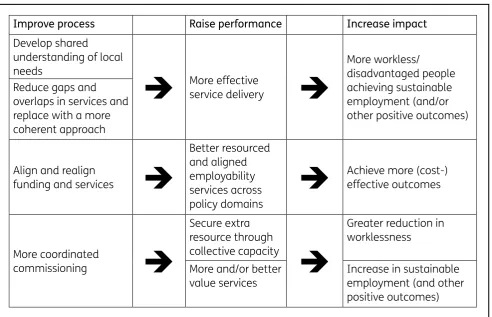
The underlying notion was that by aligning and promoting synergy between different services local partnerships could secure greater value, in terms of moving people into sustainable employment, from any given level of resource, through adopting more coherent approaches and reducing duplication. As such, the CS initiative represented a wider Government commitment to reform the welfare system by offering a greater degree of local flexibility to partners at local level, on the basis that tackling the most entrenched localised pockets of worklessness requires action appropriate to the needs of local areas and the individuals within them, as outlined in Figure 1.1.
1 Green A. E., Adam D. and Hasluck C. (2010). Evaluation of Phase 1 City Strategy, DWP Research Report 639, CSO. Leeds. http://research.dwp.gov.uk/asd/asd5/rports2009-2010/rrep639.pdf 2 DWP (2006). A New Deal For Welfare: Empowering People to Work, Cm 6730, London, TSO.http://
8
Introduction
Figure 1.1 City Strategy process logic chain
With local and sub-regional partnership working at its heart, the CS aimed to test:
• how best to combine the work of government agencies, local government and the private and
voluntary sectors in a concerted local/sub-regional partnership to provide the support workless people need to find work and sustain and progress in employment;
• whether stakeholders can deliver more by combining and aligning their efforts behind shared
priorities; and
• whether freedom to innovate and tailor services in response to local needs generates
enhanced outcomes. The intended outcomes were:
• to deliver a significant improvement in employment rates among those of working age, with a
particular focus on the most disadvantaged;
• to ensure that such disadvantaged individuals were better able to find and remain in work; and • to improve the skills of individuals to enable them to progress once in work.
Hence, the CS vision was multi-faceted. In practice, this meant that there was potential for different aspects of the vision to be prioritised by different people, at different times and in different places. From responses to invitations to submit an ‘expression of interest’ to take part in the CS initiative and from specific nominations, 15 areas were selected to be pathfinders, initially for a two-year period from April 2007 until March 2009, although subsequently a two-year extension for a ‘Phase 2’ was announced.
Improve process Raise performance Increase impact
Develop shared
understanding of local needs
More effectiveservice delivery
More workless/
disadvantaged people achieving sustainable employment (and/or other positive outcomes) Reduce gaps and
overlaps in services and replace with a more coherent approach
Align and realign
funding and services
Better resourced and aligned employability services across policy domains
Achieve more (cost-) effective outcomesMore coordinated
commissioning
Secure extra resource through collective capacity
Greater reduction in worklessness
More and/or better
9
Introduction
These CSPs were:
• England:
(1) Birmingham, Coventry and Black Country (BCBC); (2) Blackburn with Darwen;
(3) East London;
(4) Greater Manchester; (5) Leicester;
(6) Merseyside (Liverpool City Region); (7) Nottingham;
(8) South Yorkshire; (9) Tyne & Wear; (10) West London;
• Scotland: (11) Dundee; (12) Edinburgh; (13) Glasgow;
• Wales:
(14) Heads of the Valleys; (15) Rhyl.
The 15 CSPs varied greatly in size: some encompassed several local authority districts (e.g. BCBC; East London, Greater Manchester; Heads of the Valleys, Liverpool City Region, South Yorkshire, Tyne & Wear, West London), while others are focused on a single local authority district (albeit many of them large cities) (e.g. Blackburn with Darwen, Dundee, Edinburgh, Glasgow, Leicester, Nottingham) and one covered five wards within a single local authority area (Rhyl). Subsequently, the coverage of some CSPs changed, taking account of changes in local authority boundaries (e.g. Tyne & Wear), changes in the focus of local and sub-regional partnership working (e.g. the Blackburn with Darwen CSP was extended to encompass the wider Pennine Lancashire sub-region) and initial plans to extend the geographical scope of the CSP (e.g. from Nottingham to encompass Nottinghamshire also). There were also some variations in the nature of spatial targeting and sub-group targeting applied by the CSPs, in the nature of governance arrangements, and in the relative emphasis on project delivery or strategic concerns and their public or private sector ethos3 (see Table 2.1 in Green et al., 20104). The flexibility built into the CS initiative allowed CSPs to develop and grow in different ways.
In 2009, two areas in Wales – Mon Menai and Swansea Bay – in receipt of Deprived Areas Fund (DAF) monies were invited by the Department for Work and Pensions (DWP), in a move supported and facilitated by the Welsh Government, to submit a business plan for administration of the DAF by DAF partnerships. As outlined in Section 2.2.3, the DAF partnerships had control of the DAF allocation 3 Albeit most had a public sector ethos.
10
Introduction
to take a flexible approach to moving economically inactive people nearer to work. The Phase 2 evaluation brief involved consideration of the experience of these DAF partnerships alongside the CSPs.
1.2
Overview of the Phase 1 evaluation
The Phase 1 evaluation outlined partnership in practice in the first two years of the CS initiative and outlined key features of CSP activities. It also presented evidence of the impact of CS and challenges and issues going forward. In summary, it demonstrated that although they started at different points (given local variability in the existence and nature of local partnership structures which could be built upon), all CSPs created partnerships which continued to evolve, generally in the direction of greater focus, during the first two years of the CS initiative. Absence of key partners taking an active role in partnerships presented difficulties for CSPs, but none of the partnerships became moribund, which could have been the case. Central core teams and strong organisational and individual leadership played a key role in driving partnerships forward, although in some instances difficulties were experienced in translating strategic decisions into actions.
Tensions between centralising and localising forces were apparent. More limited enabling measures than initially envisaged by the local partnerships limited freedom of action and caused frustration, while central control of much government policy curtailed the ability of CSPs to create truly local strategies. Difficulties of data sharing also presented challenges. In terms of data sharing much preparatory work was done by DWP to develop memorandums of understanding to facilitate such activity, but this work was stalled in light of high profile incidents involving losses of government data. Nevertheless, CSPs recognised that CS partnership working was starting to foster a longer-term process of cultural change, with partners from traditionally different policy areas coming together and/or working together in new ways in a more coordinated fashion, with greater appreciation of different organisational perspectives. The CS initiative was positive in helping prioritise worklessness on the policy agenda of local/sub-regional partners.
The role of CSPs was generally accepted to be to support mainstream provision, to plug gaps and to offer supplementary services, so that local services were improved and were better tailored to local needs. Partnership working helped to stimulate thinking about how to improve synergies between different activities in employment, skills and related policy domains. All CSPs used the opportunity to assess welfare provision in their areas, and to deliver evidence-based interventions. Most concentrated primarily on supply-side interventions, rather than on employer engagement. Some progress was made towards alignment of funding, although ‘territorialism’ among some partners – which was symptomatic of a more general tension between competition and cooperation, and historical and structural factors impeded progress in some instances.
11
Introduction
1.3
Aims of the evaluation
This evaluation is concerned with exploring how local/sub-regional CSP consortia and DAF
Partnerships in Wales have come together to develop a shared vision and set out a business plan to work in partnership to support workless people in finding and progressing in employment. It is also about looking at their experiences of combining and aligning their efforts behind shared priorities and tailoring and implementing services to meet local needs in areas of persistently
high worklessness.
Key questions relating to these process issues are:
• What is best practice for ‘good partnership working and greater autonomy’ with regard to worklessness support?
• Does being a CSP/DAF partnership area improve the chances of ‘good partnership working and greater autonomy’ with regard to worklessness support?
The evaluation seeks to identify key lessons relevant to future initiatives where sub-regional and local partnership working is employed to address worklessness.
Desired outcomes from CS are couched in terms of ‘better worklessness outcomes’. Indicators of these could be enhanced employability, a reduction in people claiming out-of-work benefits, an increase in employment rates and more sustainable employment. Key evaluation questions relating to outcomes are:
• Does local/sub-regional partnership working contribute to better worklessness outcomes? • Does greater autonomy result in better worklessness outcomes?
Answers to these questions and lessons going forward are presented in Chapter 6, based on assessment of the evidence in the preceding chapters.
1.4
Evaluation challenges
Evaluation is most straightforward when a policy involves a simple intervention, standardised across local areas of similar size defined in the same way and targeted at a particular eligible group, with a single clear goal which is easy to measure. The CS initiative fulfilled none of these criteria:
• it was a complex initiative within a fast-evolving policy context in which changes in the welfare
reform agenda and new initiatives in employment, skills and related domains had implications for CSP activities;
• it concerned a diverse set of CSPs operating across sub-regions and local areas ranging greatly in
size (as outlined in Section 1.1); and
• it involved non-standardised interventions and new ways of working, with multiple goals relating
to behaviour and outcomes (as set out in Section 1.3).
12
Introduction
Generating quantitative outcome measures of the success of the CS initiative is not easy either. To determine a counterfactual to measure what would have happened in the absence of the CS initiative is not straightforward because the CSP areas were chosen explicitly due to their atypical employment and benefit profiles. Even where positive outcomes have been achieved in changes in workless benefit claimants and employment in absolute or relative terms, it is difficult to know the extent to which they are attributable to the activities of CSPs, alongside changes in the wider economy or the impact of other policies operating in the same areas and with the same sub-groups.
1.5
Methodology
Evaluation is the process of generating systematic evidence relating to policies and initiatives in regard to how those policies have been implemented and delivered and what the outcomes and impacts were. It is a key step in determining the extent to which a policy is meeting its objectives. As set out in the Phase 1 evaluation there are different types of evaluation, notably:
• ex ante evaluation – which refers to an assessment of the likely consequences of policy before implementation (what might be expected to happen);
• formative or process evaluation – which is concerned with the way that the policy was actually implemented and delivered and asks questions such as how, why, and under what conditions does the policy intervention work, or fail to work; and;
• ex post, summative or impact evaluation – this asks questions about the impact of policy on specific targets.
All three types of evaluation are of relevance to the CS initiative and to CSPs.
The national evaluation of the CS takes the form of a meta-evaluation in which evidence from a number of sources is collated, assessed and synthesised. The main sources drawn upon for this report are:
• Local evaluations commissioned by CSPs – these take a variety of forms and have different foci.5
• Documentary evidence – including strategy documents, business plans, and reports, notes and news posted on CSP and other websites;
• Electronic surveys of CSP and DAF Partnership key contacts and partners on a range of issues, including partnership working, aligning and pooling of funding, tracking systems and central-local relations.
• In-depth interviews with key partnership contacts (covering both strategy and delivery) on key topics (as noted above), emerging issues and concerns.
• Case studies of particular projects\activities.
• Material from workshop discussions and presentations at the CS Learning Network (CSLN) (see
Chapter 3 for further details) which was a forum for organisational learning and the dissemination of good practice among local partnerships and to central government.
• Monitoring reports submitted by CSPs and DAF partnerships to DWP, generally on a quarterly basis.
13
Introduction
• Interviews with national stakeholders – providing a perspective on CS and related activities from central government and devolved administration perspectives.
• Publicly available data on benefit claims and employment rates available via Nomis.6
1.6
Scope and structure of the report
The remainder of this report sets out the findings from the evaluation of the CS initiative. There is a particular focus on the second two years of the initiative, but assessment and reflections draw on the four-year life of the initiative in formal terms, and developments to early October 2011.
The report is organised as follows:
• Chapter 2 is concerned with economic and policy developments over the lifetime of the CS
initiative. It highlights the implications of recession and subsequent economic fragility for attempts to address worklessness. It also focuses on the shifting organisational and policy context for the operation of the CS initiative.
• Chapter 3 addresses local and sub-regional partnership working. Following an introduction
outlining the importance and nature of partnership working it considers the work of partnerships in the aligning and pooling of funding and resources. It seeks to identify features of successful/ effective partnership working and the added value of CS partnerships. Barriers to partnership working are discussed also, and the role of information sharing in partnership working is assessed.
• Chapter 4 assesses evidence of the impact of CS on worklessness at local level. Approaches
to, and difficulties of, measuring impact are outlined. CSPs’ aspirations for, and experience of, utilising tracking systems to monitor outcomes are discussed. The main focus is on progress made towards increasing employment rates and reducing benefit counts.
• Chapter 5 considers central-local relations, devolution and localisation. It traces the evolution of
central-local relations over the lifetime of the CS initiative and assesses the experience of co-commissioning, with a focus on lessons for current policy and future sub-regional/local initiatives. Appropriate geographical scales for intervention are discussed in the light of the CS experience. The role of CS in the development and implementation of locally delivered initiatives is assessed also.
• Chapter 6 reviews and assesses the evidence presented in previous chapters in light of the high
level ‘process’ and ‘outcome’ research questions associated with the CS initiative. It distinguishes between scant evidence for macro-level effects and a great deal of evidence for positive
changes at the micro level. Looking forward, it highlights longer-term lessons arising from the CS experience.
14
Economic and policy developments over the lifetime of the City Strategy initiative
2 Economic and policy
developments over
the lifetime of the City
Strategy initiative
The context for City Strategy (CS) changed both in terms of the wider economic situation and also with regard to the policy agenda, including a change in government at Westminster in the final year of the initiative. Despite these changed circumstances, which presented challenges to CS Pathfinders (CSPs), it is important to identify lessons from the experience of CS which are germane to wider debates about localisation within the welfare-to-work arena. Hence, this chapter sets the context for more detailed discussion of the CS experience in subsequent chapters.
2.1
Economic change
CS was conceived at a time when the economy was growing. Despite that growth there remained localities where worklessness was entrenched. CS was designed to combat this by targeting the local communities with the lowest employment rates and also by investing in those furthest from the labour market such as hard to help groups or those who had been on long-term incapacity benefit. At the start of CS up until autumn 2008, economic performance at Great Britain level was good, and this was partly reflected in the reductions in benefit claimant numbers which were observed across the CSP areas (as outlined in Chapter 4).
Since the recession hit, the numbers out of work increased dramatically (as discussed in Chapter 4). Early in the recession, some commentators had predicted a ‘middle class recession’ anticipating the areas which would be hardest hit to be London and the South East. As it has turned out, these claims did not prove wholly accurate. Certainly there were highly-qualified individuals with previously uninterrupted work histories who found themselves out of work, but as with previous recessions it was those with poorer skills who suffered most (Hasluck, 2011)7. This is not uncommon reflecting the fact that employers will try harder to retain those with higher skill levels, particularly if these skills have been acquired at the company’s expense. Furthermore, those with higher skills levels are able to ‘bump down’ and carry out some of the lower level skilled tasks as a temporary measure to ensure continued employment. Given the above there are concerns that the recession may exacerbate pre-existing inequalities, and for areas of high worklessness to be worst hit.
The recession has had implications for CSPs’ activities and also for evaluation of their success and the success of the initiative more widely:
• Benefit reduction targets , expressed in absolute terms, became more difficult to achieve. • Because of the recession and the fact that initial targets became much more challenging, the
targets for the second two years (i.e. from April 2009 to March 2011) were set in relative terms (as outlined in Chapter 4) and greater emphasis was placed on narrowing the gap between the worst performing wards and the average. Despite the shift to focus on relative performance, the 7 Hasluck C. (2011) Low Skills and Social Disadvantage in a Changing Economy, UK Commission
15
Economic and policy developments over the lifetime of the City Strategy initiative
targets slipped down the priority list – CSP representatives and national stakeholders preferred to talk about other aspects of the initiative, such as partnership working or the localisation agenda.
• Recession hit first in the private sector and some CSPs focused their attention to a greater extent
than formerly on placing workless people in jobs in the public sector and in social enterprises. As time went on, the recession and associated spending cuts also hit the public sector causing job losses and freezes in recruitment.8 At the formal end of the initiative the public sector cuts had yet to be fully realised in terms of the job losses which will emanate from the reduced funding. Contraction in public sector employment was particularly relevant for CSPs because, as for many (but not all) local areas with relatively high levels of worklessness, the public sector accounts for a large proportion of total employment (see Beatty et al., [2010]9 and Green [2011]10 for further discussion).
• Those who have most recently left employment are expected to be the ones who are most likely
to quickly re-enter the labour market based on the ‘inverse-queuing principle’ as those who have been out of the labour market for a long time become relatively less attractive to employers compared with those who have recent work experience. This situation may increase the risks of long-term unemployment for some groups and individuals.
• Youth unemployment and the scarring effect which it could exert on a young person’s career
became more relevant to CSPs as large numbers of school, college and university leavers were workless.11 In general, CSPs focused more attention on young people than had been the case formerly.
• CSPs faced a choice as to whether to concentrate on those furthest from the labour market or
to try to help those who were more job ready. In the main, CSPs continued to work with those furthest away, a strategy which may not generate short-term results in terms of numbers into jobs.
• Due to the fact that immediate employment prospects of the long-term workless became poorer,
skills and training became more important for when the economy begins to grow more strongly. The changed economic climate certainly presented challenges for CSPs; absolute targets became virtually impossible to hit and maintain from autumn 2008 (see Chapter 4 for further details – including the replacement of absolute targets with relative targets) and CSPs were faced with the challenge of deciding how best to focus their resources when the numbers of short-term unemployed increased sharply.
In addition to the shifting economic situation, during the lifetime of CS there were also many important policy changes which resulted in changes to the welfare-to-work agenda and the policy context under which CS operated. The policy context is discussed in Section 2.2.
8 It is true that large proportions of Future Jobs Fund employment was located in the public sector, but employment created through this is outweighed by its temporary nature and the cutbacks across the public sector as a whole.
9 Beatty, C., Fothergill, S., Gore, T. and Powell, R. (2010) Tackling Worklessness in Britain’s Weaker Local Economies, CRESR, Sheffield Hallam University, Sheffield.
10 Green A.E. (2011) Spatial Inequality and Skills in a Changing Economy, UK Commission for Employment and Skills, Wath-upon-Dearne and London.
16
Economic and policy developments over the lifetime of the City Strategy initiative
2.2
The changing policy context for the operation of City Strategy
2.2.1
Introductory overview
Along with the economic challenges posed by recession, CSPs also faced challenges because of the shifting policy context under which they operated.
Welfare reform as conceived in a broad sense was one of the main programmes of the previous Labour Government and is also recognised as the key reform being introduced by the Coalition Government. These reforms brought about changes to the way in which services were delivered to out-of-work benefit claimants, but they also brought about changes to benefit categorisations and also to the balance between the rights and responsibilities of benefit claimants. Overall, the changes meant tackling worklessness among those on inactive benefits, who traditionally had very little contact with Jobcentre Plus offices and little, if any, expectation placed on them as regards making preparations for work, came more to the fore. Reforms aimed at producing a more active benefits regime, placing greater responsibility on individuals to be actively seeking work, or otherwise taking steps to prepare for the world of work. Examples of the latter might be such things as skills training or, for those furthest from the labour market, accessing confidence-building sessions to then allow progression into skills-based training.
One of the clearest examples of the changed policy landscape came about in the final year of the four-year initiative with the General Election of May 2010, and the Coalition Government’s priority of reducing the budget deficit12, which in turn had implications for resources – for both central government departments, associated agencies and local authorities. The demise of the regional tier of governance in England and restructuring of agencies in a range of policy domains served to alter not only the personnel, but also the dynamic of some partnerships. Although the Coalition Government has talked about the ‘revolutionary’13 aspects of their policy reforms – and the payment by results and ‘black box’ design of the Work Programme (WP) marks a step change – there are some aspects of the approach which can be traced back to previous administrations. During the time of the preceding Labour Government there were shifts in policy which affected the context for CSPs; in short the context may overall be described as a blend of continuity and change.
The following discussion addresses the questions of how well the local partnerships coped with the changes they faced, and whether it was the volume of change or specific policy initiatives that proved most problematic for them.
2.2.2
Timeline of key strategy documents and associated policy changes
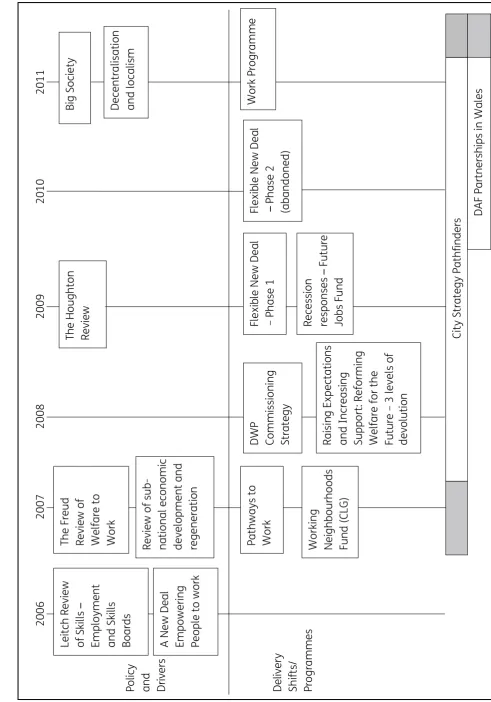
The key policies and delivery shifts that occurred in the period immediately preceding the CS
initiative and during its lifetime are shown in the form of a time line (in Figure 2.1).14 The list of policy and delivery changes is illustrative, rather than exhaustive, and documents the most major changes, particularly those which have had an impact on the CS initiative. This serves to illustrate the
continual development and flux in the welfare-to-work arena, with which CSPs needed to engage.
12 HM Treasury (2010) Spending Review 2010 Cm 7942, TSO, Norwich.
13 For example, when launching the programme, Employment Minister Chris Grayling
commented: ‘The Work Programme will tackle the endemic worklessness that has blighted so many of the country’s communities for decades. It is revolutionary in the way it tailors support to jobseekers’ individual needs and pays organisations primarily for getting people into sustained employment:’ (http://conservativehome.blogs.com/platform/chris_grayling_mp/
accessed 22/07/2011)
17
Economic and policy developments over the lifetime of the City Strategy initiative
Figur
e 2.1
Timeline of k
ey policies, driv
ers and deliv
ery shifts (adapt
ed f
rom City Str
at
egy L
earning Netw
ork, 2010)
20 06 20 07 20 08 20 09 20 10 20 11 Po lic y an d Dr iv er s De liv er y Sh ift s/ Pr og ra m m es Le itc h Re vi ew of S ki lls – Em pl oy m en t an d Sk ill s Bo ar ds A N ew D ea l Em poweri ng Pe op le to w or k Th e Fr eu d Re vi ew o f W el fa re to W or k Re vi ew of sub-na tio na l e co no m ic de ve lo pm en t a nd re ge ne ra tio n Th e Houghton Re vi ew Big Societ y De ce nt ra lis at io n an d lo ca lis m Pat hw ay s toWork Wor
[image:25.595.65.557.89.792.2]18
Economic and policy developments over the lifetime of the City Strategy initiative
Some of these policies and delivery shifts were important in setting and/or changing the strategic and policy environment in which the CSPs operated. The implications of some of these policies and delivery shifts, and whether they were helpful or problematic for CSPs, are set out below.
For instance:
• The Leitch Review of Skills emphasised the role of skills development in combating worklessness and set out a role for the Employment and Skills Boards which played an important role in some CSP areas.
• The review of sub-national economic development and regeneration (in England) contained the announcement of proposals for the development of Multi Area Agreements (MAAs) – which would allow groups of local authorities to agree collective targets for issues of economic development, and of statutory sub-regional arrangements to enable a permanent pooling of responsibilities for economic development policy areas. Many CSPs in England spent time developing proposals as to how they could develop into the employment and skills arm of MAAs and Greater Manchester subsequently received statutory city-region status.
• Likewise, the Houghton Review was helpful to CSPs making the case for greater interventions for those furthest from the labour market and in arguing that worklessness should be pushed higher up the policy agenda, with local authorities and other interest groups working in partnership to tackle it. The Houghton Review also recommended that a ‘challenge fund’ should be put in place to create temporary employment for long-term claimants in the most vulnerable economies; this came into being as the Future Jobs Fund, where some CSPs took responsibility for coordinating and implementing bids.
By contrast, the Working Neighbourhoods Fund (WNF), which replaced the DAF in England in Phase 2 of the CS initiative, posed some difficulties as money which had formerly been allocated to CSPs was allocated to local authorities with high levels of worklessness. Although CSPs sought to influence the spending of the WNF alongside other funds, this was easier in some areas than in others (as outlined in Section 3.2). While allocation of the WNF money to CSPs was never an option, the change in the way DAF money was allocated presented a challenge for those CSPs affected, that would not have arisen if it had not been for this specific delivery shift.
The DWP Commissioning Strategy in 2008 set out the delivery shift towards larger and longer contracts, organised around a group of ‘top tier’ providers managing complex supply chains. Flexible New Deal (FND) was subsequently delivered through this model. Concerns arose for CSPs when the geographies for commissioning were not coterminous with CSP areas. Several CSPs worked closely with central government in preparing for the delivery of FND Phase 2. This proved positive – for CSPs and those involved with commissioning in central government – and there was some disappointment and frustration that Phase 2 of FND was not implemented.
19
Economic and policy developments over the lifetime of the City Strategy initiative
the local areas in which they operated and brought a range of operators around the table to ensure that this was achieved. The WP represents a new start for welfare to work. It is not being brought in to run alongside existing programmes. Key programmes for the previous government were terminated.
Structural changes to the institutional arrangements in which CSPs operated include the abolition of the Regional Development Agencies (RDAs) in England15 which had the mandate to promote economic development and regeneration and improve employment prospects. CSPs had worked closely with RDAs, and in some cases the RDAs had provided an important source of funding for the CSPs.
Some of the main responsibilities which were previously handled by the RDAs in England were transferred to Local Enterprise Partnerships (LEPs). This was outlined in the Coalition’s programme for government:
‘We will support the creation of Local Enterprise Partnerships – joint local authority-business bodies brought forward by local authorities themselves to promote local economic development – to replace Regional Development Agencies (RDAs). These may take the form of the existing RDAs in areas where they are popular.’
(HM Government, 2010).16
The rationale behind this move was to provide a format for local authorities and businesses to work together to promote local economic development in functional local economic areas. The particular focus of LEPs is on facilitating growth, and foremost concerns are with enhancing productivity rather than addressing worklessness. Alongside the change of scales so that CSPs may be working with multiple LEPs rather than a single RDA, CSPs faced the task of rebuilding relationships as personnel changed. As noted in Chapter 3, partnership working relies as much on the personalities as it does the structures. The LEPs took time to get embedded, and at the same time CSPs had to deal with planned changes in funding for skills and reorganisation in the health service.
Overall, the main thrust of the changes to policy outlined above has been inspired by the belief that some decisions should be moved away from Westminster to a more local level. In general, the CSPs felt that through their local and sub-regional partnership arrangements and dialogue with DWP (and other central government departments at the CS Learning Network (CSLN) (discussed in Section 3.5)) they were better equipped to deal with ongoing policy changes than they would have been otherwise, so placing their areas at an advantage vis-à-vis areas without such partnerships.
2.2.3
DAF partnerships in Wales
The Deprived Area Fund (DAF) was operational across Great Britain at the start of the CS initiative. DAF was devolved to CSPs (see Section 3.2 for further discussion), and in areas not covered by CS, DAF was managed by Jobcentre Plus. Although DAF was incorporated into the WNF in England17, it continued in Scotland and Wales. In 2009, partnerships in two areas in Wales which received DAF were invited by the Department for Work and Pensions (DWP) (in a move supported and
15 By the end of March 2012 at the latest.
16 HM Government (2010) The Coalition: Our Programme for Government, Cabinet Office, London. Available at:
http://www.direct.gov.uk/prod_consum_dg/groups/dg_digitalassets/@dg/@en/documents/ digitalasset/dg_187876.pdf
20
Economic and policy developments over the lifetime of the City Strategy initiative
facilitated by the Welsh Government) to submit a business plan for administration of the DAF by DAF partnerships. These partnerships operated in the Swansea Bay and Mon Menai18 areas. In both cases, the partnerships pre-existed the award of DAF; they had been outlined in the Welsh Government’s spatial plan.
Recognising similarities and differences between the CSPs and the DAF Partnerships in Wales this evaluation is concerned with the experiences of the two models. In common with CS, these DAF partnerships had control of the DAF allocation to take a flexible approach to moving people nearer to work. DAF partnerships brought together key local stakeholders with an interest in economic activity, but also like CS sought to widen those involved in the partnership membership to
incorporate those whose primary focus lay elsewhere, but nevertheless were concerned with the problem of worklessness, often as providers of other services which workless people were heavy users.
Unlike CS, the DAF partnerships did not receive seedcorn money to enable them to embed their partnerships or to pay for dedicated support for partnership coordination. The two partnerships were also on a smaller scale than most of the CSPs, and in the main did not seek to lever additional funding (at least during most of their formal lifetime); the main purpose of the partnerships was to organise and to spend DAF monies in a way which would add to the services which were already provided. The narrow focus of the partnerships on DAF monies may have been a consequence of the reduced time frame for these partnerships; they operated for two years and this placed an immediate pressure on them to get projects up and running in a short time frame.
So the model for the DAF partnerships in Wales was similar to that for CS, though the scale varied considerably from most CSPs. The DAF partnerships were given a shorter timescale to operate which coupled with the smaller geographical scale, may have resulted in a more operational, as opposed to strategic, focus. The experience of the DAF partnerships is instructive as it is another example of local actors being given responsibility for funding in a way which places local actors at the heart of decision making. It also placed funding with agencies/bodies which might be more able to access some of the harder to help groups compared with a statutory body such as Jobcentre Plus. In both DAF partnerships, the emphasis was predominantly on small scale projects to assist particular groups of economically inactive people towards employment, with a particular emphasis on involving the voluntary sector.
2.3
Overview
The most significant change facing the CSPs during the lifetime of the CS initiative was the onset of recession after a prolonged period of economic growth. The CS initiative was conceived and commenced in economic circumstances very different from those that the partnerships faced within about 18 months of the formal start of their programmes of activities. The recession changed both the demand for labour and the supply of labour from which employers could recruit. It also made the achievement of benefit reduction and employment rate targets much more challenging. Throughout their lifetime, the local partnerships were faced with changes in the policy and partnership landscape in which they were operating and needed to adjust to these changes. It is difficult to determine whether the volume of change experienced was very different from
21
Economic and policy developments over the lifetime of the City Strategy initiative
that experienced over other four-year periods, but those individuals with substantial experience of working in local authorities and other parts of the public sector commented less about the sheer volume of change than partners with less experience of working for or with public sector organisations. For those with less experience, the volume and pace of change was seen as a key challenge. Some of the shifts in strategy and delivery represented continuities with what had gone before and others were more fundamental changes. Those that shared the ethos and went ‘with the grain’ of the CS initiative were helpful, adding to the impetus of CSPs’ activities. Others were much less so and complicated the role of partnerships in orchestrating the joining up of funding streams and of partners’ activities, and in developing local services to wraparound mainstream initiatives. In most instances, the more fundamental policy changes were regarded as frustrations, as opposed to fundamental blockages to the work programmes of the CSPs. In general, the
22
Local and sub-regional partnership working
3 Local and sub-regional
partnership working
This chapter explores City Strategy Pathfinders’ (CSPs’) and Deprived Area Fund (DAF) Pathfinders’ experiences of local and sub-regional partnership working. Following a review of the importance of partnership working in policy and practice (Section 3.1), the chapter presents and assesses evidence on experiences of partnership working drawn from documentary evidence – including monitoring reports submitted by City Strategy (CS) and DAF partnerships to Department for Work and Pensions (DWP) and local evaluation reports, as well as interviews with, and electronic surveys of, partners and key contacts.
Key themes discussed in this chapter include the work of partnerships in aligning and pooling of resources as part of an effort to improving welfare-to-work provision by reducing duplication and identifying and plugging local gaps in provision (Section 3.2), identifying features of successful/ effective partnership working at local and sub-regional levels (Section 3.3), barriers to partnership working and how they may be overcome (Section 3.4), and the role of information sharing in partnership working (Section 3.5). The chapter concludes with a review of self-ascribed features of CS partnerships and an overview of key messages regarding partnership working and its role in effecting cultural change in the way in which worklessness has been and is tackled (Section 3.6).
3.1
The importance of local and sub-regional
partnership working
Over the last two decades, partnership has become a defining characteristic of policy in Britain and other advanced economies, particularly in relation to combating social exclusion and area regeneration.19 This has resulted from recognition that such issues, including worklessness, are too severe and complex to be resolved by any one agency or organisation acting alone; hence a multi-agency approach is required. The need for orchestration of a multiplicity of agencies and quasi-state agencies at a variety of spatial scales with responsibilities in fields relevant to tackling worklessness has added further impetus for a partnership approach.
In the case of CS it was envisaged that local partnerships would enhance the effectiveness of attempts to help people into employment by jointly determining key priorities for the local/sub-regional area, by aligning funding and activities and by working in a more integrated way. More specifically, common challenges that CSP partnerships needed to overcome included lack of coordination in the provision and planning of services; multiple and confused points of contact for residents and employers; a lack of personalised focused provision with few referrals between providers and no system tracking or supporting an individual’s progress through the system; and disjointed employer engagement.
As such partnership working lies at the heart of the CS initiative, and has tried to test whether employability support that:
• is designed and implemented locally; and
• operates as much as possible on the basis of joint working between local partners;
23
Local and sub-regional partnership working
Can be more effective than uncoordinated local initiatives or centrally designed programmes without enhancement by local ‘wraparound’ services.
The bidding guidance for CS consortia was explicit in inviting local partners with a shared interest in raising local employment rates and improving the local economy to form consortia to improve support for workless people by working together and aligning their activities. It was expected that partners would include local authorities, employers, Learning and Skills Councils (LSC), Regional Development Agencies (RDAs), Primary Care Trusts and Jobcentre Plus, and that account would be taken of existing local partnership structures when developing proposals. This underlines the place of CS as one of many partnership initiatives, and the necessity for the CSPs of taking account of what had gone on before. In practice, there were similarities in key partners across CSPs:
most notably relevant local authorities (or from a representative grouping thereof in the case of some multi-agency CSPs), Jobcentre Plus, regional LSCs (in England), RDAs and regional/national government where relevant (notably in Wales and Scotland). Other representatives included the Connexions service (in England), further education colleges, and representatives of community and voluntary sectors and employers (either through local employer coalitions, large employers and/ or representatives of small business). In the Phase 1 evaluation of CS it was noted that partnership with private sector employers could best be described as ‘patchy’, but in Phase 2 representation of employers had generally improved. This highlights the recognition by local partnerships of the need to focus on both labour market demand and supply issues in a strategic approach to tackling worklessness and represents an important achievement, especially given that in a recession it might be expected that employer resources would be particularly difficult to capture.
As highlighted in the evaluation of Phase 1 of CS and outlined in Section 1.1, the CSP areas differed markedly in size and scale. In most cases, the CSP areas remained constant in size throughout the lifetime of CS, but there were some exceptions (see Section 1.1). In Blackburn with Darwen the scope of interest of the partnership extended beyond Blackburn with Darwen to the area covered by the Pennine Lancashire Multi Area Agreements (MAA), while in accordance with the original Business Plan, the Nottingham CSP was extended to include Nottinghamshire. These two cases mark a tendency over time towards a greater emphasis on sub-regional partnership working. There was a clear recognition by local partnerships in England that the MAA process was helpful in tackling worklessness in a way that the previous Local Area Agreement (LAA) process focused on individual local authority areas could not by focusing on broader functional economic areas. The ability of some CSPs to ‘grow’ geographically is indicative of the success of the policy and of the partnerships concerned. Although all CSP partnerships were involved in both strategy and delivery, in broad terms the larger CSPs tended to have a greater strategic emphasis than smaller ones, while the latter (and also the DAF partnerships) had a greater emphasis on delivery with a project-based approach. The experience of local and sub-regional partnership working in CS and DAF partnerships discussed below has wider relevance for the decentralisation agenda, localisation and the Big Society, in
highlighting some examples of good practice in innovative local approaches to tackling worklessness and challenges faced in ensuring that nationally developed policies meet local needs.
3.2
The work of partnerships in the aligning and pooling of
funding and resources
24
Local and sub-regional partnership working
The direct funding from DWP for CSPs comprised:
• ‘seedcorn’ money – split evenly across CSPs to be used in a flexible way to kick start the
development of consortia, to help build capacity and support the planning process (£5m); and
• ‘reward’ funding – again split evenly across CSPs to be used in a flexible way, (up to £5m
was available).
By far the main source of DWP funding which CSPs controlled at the outset of the initiative, was the DAF – a flexible pot of money from DWP, intended to add value to current mainstream services offered by Jobcentre Plus, allocated to deprived areas (at ward level) across Great Britain. The size of the DAF was roughly proportional to the number and size of disadvantaged neighbourhoods within the CSP area, such that the larger CSPs received more DAF funding than smaller ones. The total funding received by CSP areas was to be £32m in 2007/08 and £33m in 2008/09). Importantly, in November 2007 the Government announced a new Working Neighbourhoods Fund (WNF) in England (as discussed in Section 2.2.2), incorporating DAF (along with the Neighbourhood Renewal Fund (NRF)), to come into effect from 2008/0920, as part of a non-ring-fenced general Area Based Grant paid to local authorities to tackle worklessness and low levels of skills and enterprise in their areas. In Wales and Scotland DAF remained a separate funding stream; and it was this funding stream that the two DAF partnerships in Wales controlled.
The direct funding for CSPs from DWP was comparatively small relative to the scale of the worklessness challenge faced. Hence of crucial importance for CSPs were:
• funding directed to CS from partners;
• additional funding that CSPs were able to lever/secure