In-House Research
Evaluation of the Jobcentre Plus Intensive
Activity trial for substance misusing customers
Department for Work and Pensions
In-House Research No 2
Evaluation of the
Jobcentre Plus Intensive
Activity trial for substance
misusing customers
Cate Fisher
© Crown copyright 2011.
You may re-use this information (not including logos) free of charge in any format or medium, under the terms of the Open Government Licence.
To view this licence, visit http://www.nationalarchives.gov.uk/doc/open-government-licence/ or write to the Information Policy Team, The National Archives, Kew, London TW9 4DU, or email: [email protected].
This document/publication is also available on our website at:
http://research.dwp.gov.uk/asd/asd5/rrs-index.asp
Any enquiries regarding this document/publication should be sent to us at:
Department for Work and Pensions, Commercial Support and Knowledge Management Team, Work and Welfare Central Analysis Division, Upper Ground Floor, Steel City House, West Street, Sheffield S1 2GQ
First Published 2011
ISBN 978-1-84947-593-8
Contents:
Acknowledgements……… 5
The Author………... 6
Abbreviations……….. 7
Glossary………... 8
Executive Summary……….... 10
1. Background……….
15
2. Aims and Methodology………. 17
2.1 Aims ………...17
2.2 Methodology ……….17
2.2.1 Qualitative strand ………...17
2.2.2 Quantitative strand………...18
3. Intensive Activity Trial………. 20
3.1 Jobcentre A………...20
3.1.1 Jobcentre description……… 20
3.1.2 Treatment provider description ………20
3.1.3 IA trial description………...20
3.2 Jobcentre B………...23
3.2.1 Jobcentre description………23
3.2.2 Treatment provider description……… 24
3.2.3 IA trial description………...24
3.3 Jobcentre C………...26
3.3.1 Jobcentre description………26
3.3.2 Treatment provider description……… 26
3.3.3 IA trial description……….. 26
4. Qualitative Findings………. 30
4.1 Initial Reactions………...30
4.2 What worked well………... 31
4.2.1 Treatment provider presence………... 31
4.2.2 Closer working / familiarisation period……… 33
4.2.3 DDC and Drug Champion Contribution……….. 34
4.2.4 Outreach in the treatment provider premises……… 35
4.2.5 Training……… 36
4.2.6 Caseloading to a dedicated Adviser………... 37
4.2.7 ‘Are you missing out?’ form……….. 38
4.2.8 Other positive processes and activities……….. 39
4.3 What worked less well / problems encountered……… 40
4.3.1 Health and safety risk assessments………... 40
4.3.2 Adviser productivity……… 42
4.3.3 Communications……… 43
4.3.4 JCP management buy-in………..44
4.3.5 Other elements that worked less well………. 44
4.4 Overall success……….. 45
4.4.1 Confidence, motivation and skills of JCP staff………. 45
4.4.2 Improvement in service and relationships with substance misusing customers……….. 45
4.4.3 Risk assessment issues………...46
4.4.4 (Limited) increases in disclosures and referrals……….. 46
4.5 Sustainability over the longer term……….. 47
4.5.1 JCP perspective……… 47
4.5.2 Treatment provider perspective……….. 47
4.6 Key lessons and advice………. 48
4.6.1 Preparation and planning………..48
4.6.2 JCP senior management buy-in……….. 48
4.6.3 Intensive start and good communications………. 49
4.6.4 Training……… 49
4.6.5 Being open-minded and non-judgemental………. 50
4.6.6 Other advice……… 50
5. Quantitative Findings: Referrals and PDU Markers………... 51
5.1 Jobcentre A……….. 51
5.2 Jobcentre B……….. 53
5.3 Jobcentre C……….. 54
6. Conclusions and Recommendations……… 55
6.1 Conclusions………. 55
6.1.1 Evidence gaps………... 57
6.2 Recommendations………. 58
6.2.1 Extending IA to other Jobcentres………... 58
6.2.2 Lessons for best practice when developing an IA initiative… 59 6.2.3 General lessons for best practice in JCP……….. 63
References……… 68
Appendices………... 69
Appendix A – Stakeholder & front-line JCP staff discussion topic guide………. 69
Appendix B – Treatment provider discussion topic guide………...71
Appendix C – ‘Are you missing out?’ form……… 73
Appendix D – JCP C Q&A sheet for personal advisers ………. 74
Appendix E – JCP C drugs quiz ……… 76
Appendix F – JCP C referral process memory aide……… 78
List of Tables:
Table 1: Referrals in JCP A, B and C by time period in which they
were made……….. 13
Table 2: Referrals, starts to a discussion and starts to treatment in
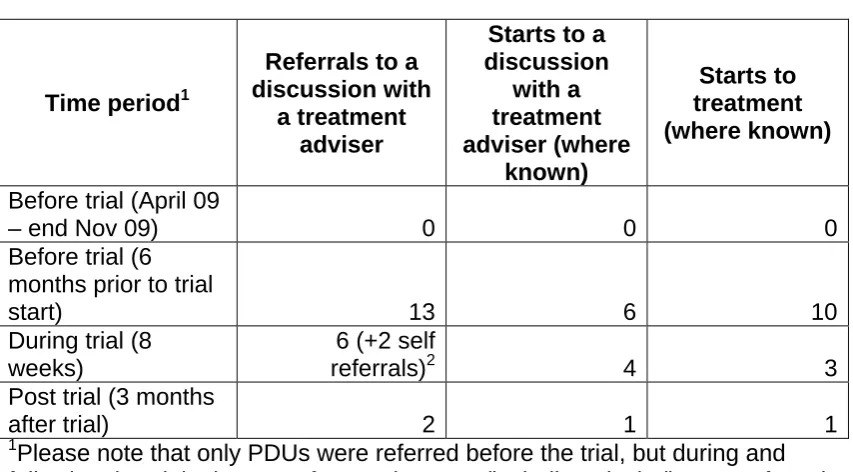
JCP A by time period in which they were made……… 52
Table 3: PDU markers in JCP A by time period in which they were set...52
Table 4: Referrals, starts to a discussion and starts to treatment in
JCP B by time period in which they were made………... 53
Table 5: PDU markers in JCP B by time period in which they were set...53
Table 6: Referrals, starts to a discussion and starts to treatment in
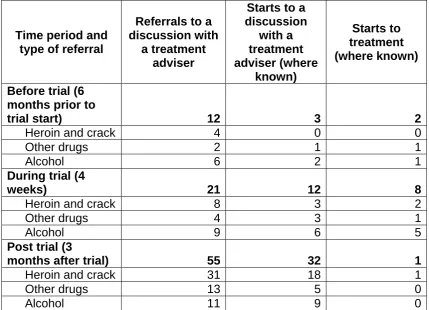
JCP C by time period in which they were made………...54
Table 7: PDU markers in JCP C by time period in which they were set...54
Acknowledgments:
I would like to thank everyone at Jobcentre Plus and at the treatment provider organisations who participated in the research, including those who helped to set-up the focus groups and interviews, and those who provided me with the Management Information included in this report. At DWP I would like to thank Antony Billinghurst for assisting me with the fieldwork, Laura Andrews for assisting with the data analysis, and Alex Dawe for peer reviewing the report.
The Author:
Cate Fisher is a Senior Research Officer in the Drug and Alcohol Research and Evaluation Team in the Department for Work and Pensions. She has previously worked as a government social researcher in the area of pension reform at DWP, at Her Majesty’s Revenue and Customs and at the Legal Services Research Centre, where she co-authored a report on an evaluation of money advice outreach pilots. She has a BA in Social and Political Sciences from the University of Cambridge and an MA in Communication, Culture and Society from the University of London.
Abbreviations:
ASM Advisory Services Manager BDC Benefit Delivery Centre BME Black and Minority Ethnic
CSOM Customer Service Operations Manager D(A)AT Drug (and Alcohol) Action Team
DDC District Drug Co-ordinator
DERM District External Relations Manager DWP Department for Work and Pensions ESA Employment and Support Allowance IA Intensive Activity
IB Incapacity Benefit JCM Jobcentre Manager JCP Jobcentre Plus
JSA Jobseeker’s Allowance LMS Labour Market System
NTA National Treatment Agency for Substance Misuse PDU Problem Drug User
RDSL Regional Drug Strategic Lead
TU Trade Union
Glossary:
Caseloading - Managing Jobcentre Plus Personal Adviser time to achieve regular contacts between a customer and a specific Adviser.
District Drug Co-ordinator - Introduced in Jobcentre Plus in England from April 2009 along with the RDSLs (see description below). DDCs were the local partnership managers responsible for: developing and strengthening relationships with external agencies in the drugs field; raising awareness amongst them of JCP’s programmes and services; and ensuring that JCP staff have the skills and support necessary to identify, refer and work effectively with substance misusing customers. The funding for the DDC role came to an end in March 2011, however the key functions of this role are still being carried out. Jobcentre Plus Districts now have the flexibility to decide how best to deliver them in light of their local priorities and resource.
Drug (and Alcohol) Action Teams - Multi-agency partnerships, responsible for the local implementation of the drug (and, where applicable, alcohol) strategy.
Drug Champion – Jobcentre Plus local office front-line staff (for example Personal Advisers) who have agreed to take on responsibility for supporting drug strategy activities in their office in addition to their other duties. Activities include raising awareness of the voluntary referral process amongst colleagues, supporting them in identifying and working effectively with substance misusing customers, and supporting the work of their DDC. There should be at least one Drug Champion in each JCP office.
Labour market system - The computer system used by Jobcentre Plus to record customer details.
Personal Advisers - Members of front-line staff in Jobcentre Plus responsible for holding interviews with customers, deciding on the best way forward for them and working with them to move them into or closer to the labour market.
Regional Drug Strategic Lead – Introduced in Jobcentre Plus in England from April 2009 along with the DDCs, RDSLs were responsible for the drug agenda within JCP on a regional level, and oversaw the work of the DDCs. The funding for the RDSL role came to an end in March 2011.
PDU markers – Markers contained on individual customer records in the LMS system which Personal Advisers can use to record disclosures by customers of heroin and/or crack cocaine use, and whether or not the customer is in treatment.
National Treatment Agency for Substance Misuse – The National Health Service special health authority established to improve the availability, capacity and effectiveness of drug treatment in England.
Outreach – Services provided by Jobcentre Plus staff in locations other than the Jobcentre. In this report, JCP outreach refers to sessions conducted by a Personal Adviser in a drug treatment provider’s premises.
Problem Drug User – An individual who uses heroin (or other opiates) and/or crack cocaine.
Voluntary referrals – From April 2009, Jobcentre Plus customers in England who were in receipt of either JSA or ESA and disclosed a problem with heroin and/or crack cocaine but were not in treatment for this problem were eligible for a voluntary referral to a discussion of treatment options with a local treatment provider. Voluntary referrals have now been opened up to JCP customers receiving any benefit who have a problem with any substance, where the use of that substance represents a barrier to work.
Executive Summary
Background
The Department for Work and Pensions’ (DWP) is committed to helping individuals tackle their substance misuse problems. As part of this commitment Jobcentre Plus (JCP) introduced a system of voluntary referrals for customers to a discussion with a treatment provider in April 20091. It was hoped that these referrals would help to significantly increase the number of people being referred to treatment providers, and subsequently engaging in treatment.
Although this initiative has seen some success, with 2,500 referrals made by August 2010, stakeholders were concerned that only a small proportion of those customers who would benefit from this opportunity had taken it up2. The Intensive Activity (IA) trial was developed in response to this, to explore whether a model of closer working between JCP and treatment providers could increase the number of disclosures of substance misuse by customers to JCP and the number of voluntary referrals; and improve the service offered by JCP to substance misusing customers.
Three Jobcentres were selected for the trial on the basis of their having a high estimated number of customers who are substance misusers and not in treatment, but a relatively low number of achieved referrals. The trial, which took place between May and July 2010, lasted 8 weeks in two of the Jobcentres and four weeks in a third. It involved a treatment provider presence in the Jobcentre for multiple sessions per week, as well as a variety of other supporting activities.
This report contains the findings from the evaluation of the IA trial. It explores:
whether IA can produce an increase in the numbers of disclosures and referrals;
what the main positive and negative elements of the trial were;
best practice when implementing IA; and
best practice when working with substance misusing customers more generally.
The evaluation consists of qualitative evidence derived from focus groups and interviews with key stakeholders in JCP, the treatment providers and the local D(A)ATs, as well as front-line JCP and treatment provider staff involved in the initiative. Fieldwork was conducted between June and September 2010. Management Information on the number of disclosures of substance misuse3
1
Voluntary referrals were introduced to Jobcentres in England only.
2
The Department estimates that there are around 30,000 users of heroin and/or crack cocaine in England who are in receipt of Jobseeker’s Allowance (JSA) or Employment and Support Allowance (ESA) but are not in treatment. The voluntary referral system was originally only open to users of heroin and/or crack cocaine on JSA or ESA, but during the trial was opened up to users of any substance on any benefit.
3
This is measured using the proxy of the number of problem drug use (PDU) markers that were set on the Labour Market System (LMS), which is the computer system used by JCP to record customer details.
and the number of voluntary referrals recorded by the three Jobcentres before, during and after the trial was also collected.
Qualitative Findings
What worked well
Stakeholders broadly felt that the model of closer working between JCP and treatment providers trialled was successful and central to any increase in referrals that occurred during the trial period. JCP front-line staff said they were more comfortable raising the issue of substance misuse with customers knowing that the provider was on hand to take over any difficult discussions. Stakeholders from both JCP and the treatment provider reported having a better understanding of the support offered by the other party and, as a result, were better placed to deliver more informed advice.
Outreach by JCP staff in the treatment provider premises was felt to be a good way of engaging with hard-to-reach customers in an environment in which they felt comfortable and unafraid of stigma.
The trial was successful in raising awareness within Jobcentres of the importance of staff broaching the issue of substance misuse with customers, and in supporting them to do so. The contribution of the District Drug Co-ordinators4 and Drug Champion/s5, training for staff on how to ask customers about substance misuse and deal with disclosure, and enabling JCP staff to ‘case conference’6 within their teams were thought to be particularly valuable.
Caseloading substance misusing customers to the Drug Champion was seen as positive both for the customers, who benefited from greater continuity and more intensive support, and for those JCP staff who said they were not comfortable discussing substance misuse with customers.
What worked less well / problems encountered
Due to concerns around JCP staff safety, JCP Health and Safety risk assessments required before the treatment provider sessions in the
4
District Drug Co-ordinators were the local partnership managers in JCP responsible for developing and strengthening relationships with external agencies in the drugs field; raising awareness amongst them of JCP’s programmes and services; and ensuring that JCP staff have the skills and support necessary to identify, refer and work effectively with substance misusing customers.The funding for the DDC role came to an end in March 2011, however the key functions of this role are still being carried out. Jobcentre Plus Districts now have the flexibility to decide how best to deliver them in light of their local priorities and resource.
5
Drug Champions are JCP local office front-line staff (including Advisers) who have agreed to take on responsibility for supporting drug strategy activities in their office in addition to their other duties. Activities include raising awareness of the voluntary referral process amongst colleagues, supporting them in identifying and working effectively with substance misusing customers, and supporting the work of their District Drug Co-ordinator.
6
Case conferencing involves JCP front-line staff discussing with their team how best to work with individual customers who have disclosed, or who they suspect have, substance misuse issues.
Jobcentres resulted in significant restrictions being placed on the activities treatment providers could carry out whilst in two of the trial Jobcentres7. For example, treatment providers were not allowed to approach customers or advertise their presence in the office, and Jobcentre Plus front-line staff were not permitted to visit the treatment provider’s premises. Stakeholders in these two offices reported that this was frustrating and damaging to the trial.
Operational pressures also represented a barrier to the success of the trial. Advisers were concerned about raising the issue of substance misuse with customers in case a disclosure, and lengthy discussion with them around it, prevented them from dealing with the other issues they are required to cover during their time-limited appointments. Additionally many were not released to attend training sessions on working with substance misusing customers due to operational pressures, despite having a skills gap in this area.
Productivity targets around starts to training and employment were a significant issue for the Drug Champions who were responsible for conducting outreach sessions in the treatment provider premises and caseloading substance misusing customers. They found it difficult to achieve their targets whilst also devoting increased time to working with substance misusing customers, who require more intensive support than most customers to achieve the same outcomes.
Having effective communications within the Jobcentre was an additional barrier in two of the offices. Due to the lack of all-staff meetings, stakeholders reported difficulty in finding the right platform through which to raise awareness of the trial and the treatment provider’s presence amongst staff.
Overall success and sustainability over the longer term
Views about the overall success of the IA trial were mixed. There was widespread agreement that the trial period was relatively short and any success represented only the start of what could be achieved over the longer term. Stakeholders in two of the trial offices felt that the success of the trial had not been reflected in the limited increase in disclosures and referrals.
However, on the whole stakeholders were positive about the overall impact of the trial, citing improvements in:
the confidence, motivation and skills of JCP staff in working with substance misusing customers;
the profile of the substance misuse agenda within JCP;
working relationships between the JCP office and the treatment sector; and
7
These restrictions are not reflective of Jobcentre Plus (or DWP) Health and Safety Policy, which allows for such activities to take place provided that suitable risk assessment processes have been followed and any necessary control measures or risk mitigations put in place, but instead were a result of decisions taken at the local Jobcentre Plus office level.
the standard of service provided by JCP to substance misusing customers.
The exception to this view was held by some stakeholders in one of the offices who felt that the trial had not been successful, largely as a result of the outcome of the Health and Safety risk assessment.
Following the trial period, maintaining IA over the longer term was thought to be realistic from the point of view of the JCP staff resource required, in spite of operational pressures and targets. The treatment providers reported having to reduce the amount of time they spent in the Jobcentre due to resource constraints, and an insufficient increase in the number of referrals during the trial to justify sustaining the activity on that scale. However, all three intended to continue working more closely with JCP, and two intended to maintain one session a week in the Jobcentre.
Quantitative Findings
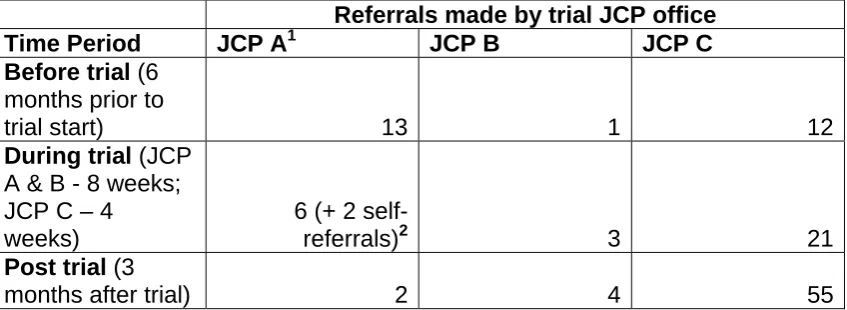
[image:15.595.88.512.418.573.2]Table 1 contains details of the number of customers voluntarily referred to a discussion with a treatment provider achieved by each Jobcentre before, during and after the trial period. They should be understood in the context of the qualitative findings.
Table 1: Referrals in JCP A, B and C by time period in which they were made
Referrals made by trial JCP office
Time Period JCP A1 JCP B JCP C
Before trial (6 months prior to
trial start) 13 1 12
During trial (JCP A & B - 8 weeks; JCP C – 4
weeks)
6 (+ 2
self-referrals)2 3 21
Post trial (3
months after trial) 2 4 55
1Only PDUs were referred before the trial, but during and following the trial misusers
of any substance (including alcohol) were referred. Also note that closer working was already taking place in JCP A prior to the trial period, although in a less intensive form.
2 ‘Self-referrals’ are customers who visited the treatment provider to discuss treatment
options after finding out about them through the Jobcentre, but who were not officially referred by JCP.
Conclusion and Recommendations
The impact of the trial on disclosures and referrals to a treatment provider was variable, but increases were seen in all three Jobcentres. However, even in Jobcentre C which saw the largest increase, the number of referrals was still substantially smaller than the estimate
which JCP hoped could be achieved8, indicating that these estimates may need to be revised downwards.
Given the limited increase in referrals achieved during the trial and its resource intensive nature, it is unlikely that in the current climate many JCP offices will be able to justify adopting intensive activity on this scale with a view to increasing the volumes of such referrals.
Lessons for best practice for those JCPs who do wish to adopt such a model include: involving the treatment provider early on in the design of the activity; securing buy-in from JCP senior management; developing standard guidance for conducting Health and Safety risk assessments in advance of the activity; and ensuring good communications with JCP staff around the trial.
Importantly, the evaluation also identified various lessons for best practice within JCP around supporting substance misusing customers more generally. These include: having effective and dedicated Drug Champions within each Jobcentre; the importance of close partnerships between the treatment sector and JCP; ensuring JCP staff receive training on raising the issue of substance misuse and dealing with disclosures; JCP outreach at treatment provider premises; caseloading substance misusing customers to a Drug Champion or other skilled Adviser; and tailoring productivity targets for any dedicated advisers working with this group.
8
JCPs estimates were as follows: JCP A – 143 customers who are heroin and/or crack cocaine users, in receipt of JSA or ESA and not in treatment; JCP B – 113 customers who are heroin and/or crack cocaine users, in receipt of JSA or ESA and not in treatment; JCP C – 92 customers who are heroin and/or crack cocaine users, in receipt of JSA or ESA and not in treatment. Estimates of the number of customers addicted to any substance (including alcohol) and on any benefit (but not in treatment) would be substantially higher. These figures were derived from published DWP estimates (Hay, G., and Bauld, L. (2008) Population estimates of Problematic Drug Users in England who access DWP benefits. DWP Working Paper No. 46) and treatment take-up information.
1. Background
The Coalition Government has stated that it is committed to tackling drug and alcohol addiction, which it views as one of the most damaging root causes of poverty. The Government believes in an approach to tackling addiction that is firmly rooted in the concept of recovery and reintegration; a process through which an individual is enabled to overcome the symptoms and causes of their dependency, and become an active and contributing member of society. The Department for Work and Pensions (DWP) have joint responsibility for the ‘recovery and reintegration’ strand of the 2010 Drug Strategy ‘Reducing demand, restricting supply, building recovery: supporting people to live a drug-free life’9. This strand is concerned with enabling the development of a system whereby treatment, employment, education and skills programmes, family support, probation and wider health services around treatment are delivered in a holistic, person-centred fashion to support sustained recovery for substance misusers.
As part of DWP’s commitment to helping individuals tackle their substance misuse problems, a system of voluntary referrals to a discussion of treatment options with a treatment provider was introduced into Jobcentre Plus (JCP) in April 2009. The voluntary referral was initially designed to be offered to JCP customers in England who are in receipt of Jobseekers Allowance (JSA) or Employment and Support Allowance (ESA) and are a Problem Drug User (PDU), meaning that they use heroin and/or crack cocaine. If a customer agrees that they would benefit from a discussion with a treatment provider, an appointment with a local treatment provider to discuss available treatment options is then arranged for them.
District Drug Coordinators (DDCs), who were also introduced into JCP in April 2009, were the local partnership managers responsible for supporting the drug strategy on the ground. This included raising awareness of the voluntary referral process amongst JCP staff, arranging training for staff on substance misuse issues and the process of making a referral, and ensuring that the process is working successfully10. From April 2009 to the end of August 2010, in England 10,300 customers were identified as PDUs and had the relevant marker set on their Labour Market System (LMS)11 records. Nearly 8,000 of these customers were in treatment at the time the marker was set and 2,400 were not in treatment. In the same time period a total of 2,500 referrals were made, which resulted in 861 recorded discussions with a treatment advisor12. Given that DWP estimates put the number of PDUs in England accessing JSA
9
Home Office (2010)
10
Funding for the DDC role came to an end in March 2011. The key functions of this role are still being carried out, but Jobcentre Plus Districts have the flexibility to decide how best to deliver them in light of their local priorities and resource. In some Districts these functions are being encompassed into a new role which has a wider remit to consider all excluded and disadvantaged groups.
11
LMS is the computer system used by JCP to record customer details.
12
Due to restrictions around data sharing between treatment providers and JCP without the customers’ consent, the actual number of discussions that have taken place are not known but are likely to be higher than the recorded number.
or ESA and not in treatment at 30,00013, the number of referrals made by August 2010 stood at just over 8% of the total potential number of PDU referrals which we estimate JCP could make14.
Concern about the low number of identifications and referrals being recorded led to the development of the Intensive Activity (IA) trial. The purpose of the trial was to explore whether a model of closer working between JCP and substance misuse treatment providers could potentially increase the numbers of disclosures of drug and alcohol misuse by customers to JCP and of voluntary referrals being made to a treatment provider; and improve the service offered by JCP for substance misusing customers15.The decision was taken to extend voluntary referral offer in the trial areas to customers on any benefit and misusing any substance, including illegal drugs, prescription drugs, and alcohol. This decision reflected the Coalition Government’s focus on helping customers for whom the abuse of any substance is a barrier to employment to overcome their problems and move back into work.
Three Jobcentres were selected for the trial on the basis of their having a high estimated number of customers who are PDUs and not in treatment (and are therefore eligible for referral to a treatment provider), but a relatively low number of achieved referrals. The trial took place between May and July 2010, lasted 8 weeks in two of the Jobcentres and four weeks in the third. It involved a treatment provider presence in the Jobcentre for multiple sessions per week, as well as a variety of other supporting activities. Further information about these three Jobcentres and the activities that took place in them during the IA trial period can be found in Chapter 3.
13
This estimate is based on those contained in the following DWP report: Hay, G., and Bauld, L. (2008) Population estimates of Problematic Drug Users in England who access DWP benefits. DWP Working Paper No. 46.
14
This calculation assumes that individuals who are already in treatment would not be referred by JCP staff, although there may be situations in which a referral would still be judged to be valuable.
15
Independently-conducted research commissioned by DWP highlighted the negative experiences that many substance misusers report in relation to JCP. These included dealing with advisers who they felt were not sufficiently responsive to and understanding of their circumstances and needs, and who they felt were not supportive enough in helping them to resolve problems with their benefits: Bauld, L., Hay, G., McKell, J., and Carroll, C. (2010)
Problem Drug Users’ experiences of employment and the benefit system. DWP Research Report No. 640; Bauld, L., Carroll, C., Hay, G., McKell, J., Novak, C., Silver, K., and
Templeton, L. (2010) Alcohol misusers’ experiences of employment and the benefit system. DWP Research Report No. 718.
2. Evaluation Aims and Methodology
2.1 Aims
The key aims of the evaluation were:
To explore the views of JCP staff and treatment sector professionals on the effectiveness, efficiency and sustainability of the key elements of the IA trial;
To assess whether IA has the potential to increase the numbers of disclosures of drug and alcohol misuse being made by customers to Jobcentre staff and voluntary referrals being made to a treatment provider;
To explore qualitative measures of success including (but not limited to) improved working relationships between JCP and treatment providers, and increased JCP staff skills in working with substance misusing customers; and
To produce recommendations for good practice when designing and implementing an IA initiative, and when working with substance misusing customers more generally.
2.2 Methodology
The main element of the evaluation consisted of qualitative research with key stakeholders exploring their perceptions of the impact of the trial and its success, or lack of it. Limited quantitative data in the form of Management Information was also collected to enable comparison of the number of referrals and disclosures taking place before, during and after the trial. However, this data should be interpreted with caution due to the very small number of trial sites involved and the relatively brief duration of the trial. These two strands of the evaluation are discussed in more detail below.
The final report was peer reviewed by a DWP Principal Research Officer working in a different policy area.
2.2.1 Qualitative Strand
The main strand of the evaluation utilised qualitative methods to explore in depth stakeholders’ perceptions of the impact of the trial, including which elements worked well and were successful, which were less successful, what issues were encountered during the trial and how any problems were overcome, and the feasibility of sustaining IA over the longer term. The fieldwork took place between June and September 2010 following the end of the official IA trial period in each Jobcentre. A mixture of focus groups (lasting between one and a half and two hours) and face-to-face and telephone semi-structured interviews (lasting between 20 minutes and one hour) was employed to elicit views from key stakeholders involved in the trial. These
included staff at various levels from each trial Jobcentre (including those with a specific remit around the drug strategy), as well as the treatment provider staff who took part in the trial, and representatives from the National Treatment Agency for Substance Misuse (NTA), and the local Drug (and Alcohol) Action Teams (D(A)ATs) who commission treatment services.
In addition, two focus groups with JCP front-line staff (predominantly Personal Advisers) were also conducted in each trial site. Care was taken to ensure that a range of Advisers were recruited so that the diversity of opinion was captured. This included advisers from different teams, of different levels of experience, and with different degrees of involvement in the trial.
Semi-structured topic guides were used during the focus groups and interviews to ensure that the key issues were explored with all participants (see Appendices A and B). Detailed notes were taken during the course of all focus groups and interviews as it was not possible to record the interactions. These notes formed the basis of the information which has been analysed and reported on in Chapter 4. The information was analysed using thematic analysis techniques.
2.2.2 Quantitative Strand
This element of the research took the form of a before-and-after comparison of the number of referrals being made to a treatment provider in each of the three Jobcentres, and the number of disclosures of substance misuse being made, before, during and after the trial. This latter outcome was measured using the proxy of the number of Problem Drug Use markers that were set on LMS. This measure is likely to be an undercount of the number of disclosures taking place as it only includes those customers who have admitted to using heroin or crack cocaine, and only those who have agreed to JCP placing this information on their record. However, it is likely to give a broad indication of any increase or decrease in the number of disclosures being made.
The before-and-after evaluation design represents a very simple method of measuring the impact of an intervention. It does not involve the consideration of a counterfactual (in other words, what would have happened if the intervention was not introduced) and therefore is subject to a number of criticisms. These include the fact that outcomes, in this case the numbers of disclosures and referrals recorded, could have increased or decreased during the trial period for a reason unrelated to the trial itself. For example, a change in patterns of drug use or benefit uptake during the period of the trial could have an impact on the numbers of disclosures and referrals taking place. One way of deriving a counterfactual, thereby producing a more robust evaluation, is to identify Jobcentre sites which are very similar to those involved in the trial but are not introducing IA to serve as a comparison. However, as there was no robust way of identifying such comparison sites the before-and-after design was the only feasible option.
As a result of these limitations, and due to the very small scale of the trial, care should be taken not to place too much emphasis on the quantitative evaluation findings. Additionally, for the same reasons, robust cost-benefit
analysis that could be extrapolated to other Jobcentres could not be produced, and hence information of this nature is not provided here.
3. Intensive Activity Trial
This section provides a brief description of the Jobcentres selected for the trial, the treatment providers who took part in each area, and the activities that were undertaken as part of the IA. The exact nature and extent of the IA initiative was left to the trial Jobcentres and treatment providers to develop and agree in each area, the only stipulation being that it should involve closer working between JCP and treatment providers with the treatment provider having a greater presence in the Jobcentre. The three sites developed broadly similar models with variations resulting from differing local needs and resource.
As mentioned above, the JCP offices involved in the trial were selected on the basis of their having a high estimated number of customers who are PDUs and not in treatment (and therefore are eligible for referral to a treatment provider), but a relatively low number of achieved referrals.
3.1 JCP A
3.1.1 Jobcentre description
Jobcentre A is situated in one of the most deprived areas of a large city, with high levels of unemployment. The office has a large customer base including around 5,000 customers claiming JSA and 12,000 claiming ESA and IB. JCP A has 140 staff including 5 Adviser Team Managers (ATMs) and 1 Jobcentre Manager (JCM).
The area has a large number of residents with English as a second language, a high prevalence of crack cocaine users, and contains a higher than average proportion of people with no qualifications. The main sources of employment are the local authority and the retail sector.
DWP estimates suggest that the office has a total of 143 potential referrals16.
3.1.2 Treatment provider description
The treatment provider who participated in JCP A’s IA trial provides a service where crack cocaine and poly-drug users can receive information and advice to help them deal with issues relating to their substance misuse. They run a drop-in centre offering individual and group counselling, one-to-one key working sessions, a needle exchange, complimentary therapies, computer access, and hot meals, amongst other services.
3.1.3 IA Trial description
The IA trial in JCP A ran for a period of eight weeks, starting on the 24th May and ending on the 23rd July 2010. A scoping meeting involving Jobcentre Plus
16
This figure was derived from published DWP estimates (Hay, G., and Bauld, L. (2008)
Population estimates of Problematic Drug Users in England who access DWP benefits. DWP Working Paper No. 46) and treatment take-up information, and relates to the number of individuals in England who are dependent on heroin and/or crack cocaine, in receipt of JSA or ESA and not in treatment.
managers and team leaders, the District Drug Co-ordinator (DDC) and Regional Drug Strategic Lead, as well as NTA and DWP representatives, was held prior to the start of the IA to agree the programme of activities that would take place. It is important to note that JCP A already had a close working relationship with their local treatment provider, and that the provider had been providing a presence once a week in the Jobcentre for approximately 8 months prior to the start of the trial – although only when the DDC was present. During these sessions the provider spoke to customers about their services, and had appointments with customers who had been referred to them for a discussion about treatment options. Prior to the trial only PDUs in receipt of JSA or ESA were referred to the treatment provider, and at the initial meeting stakeholders decided to keep the focus on this group during the trial. However, soon after this and before the start of the trial the decision was taken to extend the referrals to include misusers of other drugs and alcohol who were in receipt of other benefits. For this Jobcentre, unlike the two others, the IA represented an extension of a closer working initiative that was already in place. As a result there was no need for a new health and safety risk assessment for this element of the trial, as having the treatment providers attend the office and interact with customers was already covered by the existing risk assessment.
The first week of the trial consisted of a familiarisation phase, during which two Advisers from each of the customer stages (10 Advisers in total) attended the treatment provider premises during an open day. During this day they found out more about the services the provider offered, and about the nature of substance misuse and treatment. The Advisers then fed this back to the rest of their teams. The treatment provider also delivered a workshop along with a local provider of alcohol treatment services to 12 JCP staff to raise awareness of drug and alcohol issues. This workshop covered signs of drug or alcohol abuse to look out for, how to broach the issue of substance misuse with customers in a sensitive way, and how to manage conflict with and emotional breakdown from customers in relation to this issue. The workshop involved presentations, discussions and role plays. Those treatment provider staff who had not already been attending the Jobcentre familiarised themselves with the office during this week.
Two review meetings involving key stakeholders took place during the course of the trial to monitor progress against its key aims and to make revisions or improvements to the operating model if necessary. These took place at the end of the first week (during which an action plan for the rest of the trial was drawn up) and at the end of week 5.
During weeks 2 to 8 two staff from the treatment provider were involved in attending JCP A three times per week, with one member of staff attending during each session. The sessions were held on different days each week to maximise the number of customers who had the opportunity to speak to the treatment provider. During these sessions the treatment provider floor-walked, unaccompanied by a member of JCP staff, and approached customers to raise awareness of the treatment services on offer. They also sat in on and observed customer interviews, provided the agreement of the customer was
secured beforehand, to gain a better understanding of what happens during them. The treatment provider had a desk in a prominent position in the JCP office on which they were able to set up a display of leaflets and literature, however they often lacked a private space in which to have discussions with customers when referrals were made. The treatment provider was allowed to conduct team meetings and take breaks in the staff canteen, and was encouraged to approach and engage with staff in all teams, including the Fortnightly Job Review (FJR) and Crisis Loan teams.
Another key element of the trial involved a JCP Adviser conducting outreach sessions at the treatment provider premises. The Adviser who undertook this role was already familiar with the treatment provider as a result of volunteering with them in her own time for several months prior to the start of the trial. She had also nominated herself for the Drug Champion role within JCP A at a similar time, and was very interested in working with substance misusing customers. During the IA trial she conducted outreach sessions one afternoon a week, for a total of five weeks, on behalf of JCP at the treatment provider. The first of these was a scoping session involving a group of service users to canvass their views on what they wanted to get out of the sessions, and how they would prefer them to be run and structured. Due to confidentiality issues she saw customers on a private, one-to-one basis in the following four sessions. The treatment provider booked appointments on her behalf with customers who wished to see her, then called her to let her know who she was scheduled to see and what they wanted to talk about. This enabled her to prepare for the appointments by looking up the customers’ LMS records before the outreach sessions to get a better picture of their history and current situation.
A Health and Safety risk assessment was required before the outreach activity could go ahead to ensure that it would not pose any serious risks to the Drug Champion. An Adviser from the Lone Parents team who was experienced at conducting assessments for outreach at children’s centres attended the treatment provider premises, along with the Drug Champion and the manager of the treatment provider, to undertake the risk assessment a week prior to the start of the outreach sessions. She ensured that all appropriate risks relating to the working environment were explored, including the risk of substance misusers who aren’t stable in treatment potentially displaying aggressive or violent behaviour. Flexibility on the part of the treatment provider was necessary to find an alternative room to that originally proposed for the outreach sessions which had an easier exit route for the Drug Champion should she feel threatened during her appointments. The treatment provider also agreed to install a panic alarm in this room for the Drug Champion to use if necessary. Following these adjustments the Adviser gave approval for the outreach to go ahead.
Additional supporting actions that were undertaken as part of the IA trial included promoting the use of the locally produced ‘Are you missing out’ form (see Appendix C) to help staff raise the issue of drug and alcohol use in the context of other barriers to work, and without having to ask this question out loud. Case-conferencing within teams took place, in which Advisers had the
opportunity to discuss with colleagues and their team leader (ASM) how best to handle any cases where they believed or knew a customer to be a substance misuser. Guidance on Adviser flexibility around sanctions for non-compliance with benefit conditionality (eg. in the case of JSA, fortnightly signing and proof of job search activity) when drug or alcohol misuse was involved was re-issued.
Coinciding with the start of the IA trial was a four-week exercise to increase the number of Disadvantage Markers being recorded on LMS. This involved Advisers being encouraged to ask all new Stage 3 New Deal customers whether any of the disadvantages (including ex-offender, homeless, refugee and drug or alcohol misuser) applied to them, and recording them on LMS if they did (provided the customer consented). Advisers were instructed to encourage customers who disclosed drug or alcohol misuse to take up the offer of a referral to a treatment provider. Additionally, the exercise involved a one-off drive to ask all stock Stage 3 New Deal customers about whether any of the disadvantages applied to them, and similarly to encourage those customers who did disclose substance misuse to take up the voluntary referral opportunity.
Following the end of the trial the treatment provider reduced their attendance at the JCP back down to one session a week as a result of resource constraints on their part. The JCP outreach at the treatment provider premises stopped during the summer holiday period as the Drug Champion conducting it only worked during term time, and it wasn’t deemed feasible to train up another Adviser to cover this role while she was away. However, it was anticipated that the activity would resume when she returned in the autumn, and discussions were due to take place then about the possibility of the Adviser conducting outreach at another local treatment provider who had expressed an interest in becoming a JCP outreach site.
3.2 JCP B
3.2.1 Jobcentre description
JCP B is a purpose built Jobcentre Plus office and was the pathfinder office for the District. Its current register contains approximately 4,000 customers. The Jobcentre employs around 100 staff, including 4 ATMS and one JCM.
It is situated in an urban area close to an area of high deprivation, with a high rate of teenage pregnancy and substance misuse. There is very little infrastructure in the local area at the moment to provide employment. JCP B was selected for the trial on the recommendation of the DAAT Joint Commissioning Manager due to the high prevalence of injecting heroin users in the area.
DWP estimates suggest that the office has a total of 113 potential referrals17.
17
This figure was derived from published DWP estimates (Hay, G., and Bauld, L. (2008)
Population estimates of Problematic Drug Users in England who access DWP benefits. DWP Working Paper No. 46) and treatment take-up information, and relates to the number of
3.2.2 Treatment provider description
The treatment provider who took part in the IA trial at JCP B offers support, advice and treatment for individuals misusing any drugs, including prescription drugs. They do not currently conduct any formal outreach in any other settings, however they are willing to be flexible with regard to visiting service users in their preferred location. Alongside treatment and support they also offer harm reduction services, for example a needle exchange, and vaccinations against Hepatitis B.
3.2.3 IA trial description
The IA trial in JCP B ran for a period of eight weeks, from 10th May to 2nd July 2010. As with JCP A, a scoping meeting, in this case chaired by the DERM and involving Jobcentre Plus managers and team leaders, the DDC, Drug Champion and a JCP Work Psychologist, as well as the DAAT Joint Commissioning Manager, was held prior to the start of the trial to agree the programme of activities that would take place. It was agreed that during the IA period the treatment provider would attend the Jobcentre for four half-day sessions a week. Four treatment provider staff were involved in these sessions, with one member of staff attending during each session. The DDC spent a significant amount of time in JCP B for the duration of the trial. One review meeting involving key stakeholders took place at the end of week 3 to monitor progress to make revisions or improvements to the IA operating model if necessary.
An initial familiarisation period of around a week saw the treatment provider sitting in on interviews with customers from various stages, including Crisis Loan interviews, and talking to a variety of Advisers and staff at all levels to gain experience of how JCP works and what standard customer interviews are like. They also attended the team meetings of several (though not all) teams, and delivered an up-skilling session for front-line staff. This covered how to raise the question of substance misuse with customers, and how to deal with disclosures when they are made. In addition the treatment provider offered to have one-to-ones or small group sessions with Advisers to discuss any outstanding issues they may have. The Drug Champion also attended an up-skilling session arranged by the DAAT during the trial.
The DDC and Drug Champion facilitated and supported the treatment provider’s engagement with JCP staff, and also helped to raise staff awareness of their presence during team and Spotlight meetings, and by emailing the dates of their sessions to staff.
A Health and Safety risk assessment, conducted prior to the start of the IA trial, restricted the treatment provider’s activities during the first four weeks of the trial. The treatment provider was not allowed to reveal their identity to customers as a provider of services for substance misusers, unless the
individuals in England who are dependent on heroin and/or crack cocaine, in receipt of JSA or ESA and not in treatment.
customer had specifically requested to have a referral to them. They were therefore not allowed to wear their usual name badges or to identify themselves to customers whose interviews they were sitting in on. They were also not allowed to approach customers or advertise their presence, but instead sat in a private room during their sessions in the JCP, ready to see customers if they were referred to them during this time. However, due to stakeholders’ dissatisfaction at this situation a second risk assessment was proposed at the review meeting and then conducted during week 4 of the trial. JCP senior managers also took the opportunity to meet with the TU representative responsible for carrying out the risk assessment to clarify the aims and objectives of the IA trial. A representative from the DAAT attended the second assessment in order to provide expert guidance and input.
As a result of this second assessment some of the restrictions that were placed on the treatment provider were lifted. For example, after this point they were allowed to have a desk near the front of the Jobcentre on which to display leaflets, posters and a banner to make customers aware of their presence, although they were not allowed to man this desk. They were also allowed to wear their badges from this point, however were not permitted to approach customers. JCP staff were still not allowed to visit the treatment provider’s premises to find out more about the services they offer and substance misuse generally, as had been originally planned.
As mentioned above, the treatment provider supplied leaflets containing information on drug misuse and treatment for Advisers to display on their desks and for customers to take away if they wished. These leaflets contained the treatment provider’s contact details and information about their services. Their details were also added to a sheet given to Crisis Loan applicants containing information about local support services. Additionally the Drug Champion provided FRANK18 booklets for the Advisers to display and distribute to customers where appropriate.
In addition to the treatment provider presence in the Jobcentre, the use of a form similar to the locally produced ‘Are you missing out?’ form (see Appendix C) to identify customers’ barriers (including drug and alcohol misuse) was encouraged. These were used primarily by the 18-24 teams (both by Advisers and Signers) but some other teams adopted the use of them as well.
Following the end of the trial, the treatment provider stopped regularly attending JCP B, although they were willing to come into the office for pre-booked referral appointments as and when necessary. They also offered to deliver up-skilling sessions to staff whenever there was felt to be sufficient need. The JCP had decided to move from a model of one Drug Champion for the whole office to one per team, as in JCP C (see below). Additional planned activity, time and resource permitting, included the Disability Employment
18
FRANK is the Government’s campaign aimed predominantly at young people to provide them with advice and information about drug use and treatment. Launched in 2003, they offer a 24-hour confidential telephone helpline, an online chat facility and a service providing callers/visitors to their website with details of local counselling and treatment services.
Adviser undertaking an exercise to try and identify any PDUs in their caseload.
3.3 JCP C
3.3.1 Jobcentre description
JCP C is a large office situated in a heavily deprived inner city area. It has a JSA claimant count of 5,000, and the longest average duration of claim as well as the worst performance on-off flows in the region. The Jobcentre employs 100 staff, including 3 ATMs and one JCM.
JCP C serves a very diverse customer group including a large BME population, amongst whom English language skills are a big issue. Evidence suggests that there is a high prevalence of substance misuse in the area.
DWP estimates suggest that the office has a total of 92 potential referrals19.
3.3.2 Treatment provider description
The treatment provider engaged with the IA trial in JCP C offers services and treatment for people who have problems with any drug (including alcohol), although their main remit is to work with users of Class A drugs. They aim to be able to support service users at every stage of their recovery. Their services include engagement on the streets and in communities; harm reduction measures at drop-in centres; structured day programmes; residential rehabilitation; supported resettlement; and services within prisons. They employ a dedicated outreach worker to engage with substance misusers in the community, and it was this member of staff who visited JCP C during the IA trial. This individual was also involved in outreach projects at a hostel and in various other locations at the time of the trial. In addition to treatment services the provider also offers personal development programmes to help service users gain skills, confidence, motivation, and employment.
3.3.3 IA trial description
The IA trial in JCP C lasted for four weeks, starting on 21st June and ending on the 19th July 2010, making it half the length of the trial in the other two sites. As with the other sites, a scoping meeting involving key stakeholders was held prior to start of the trial to develop and agree the programme of activities that would be taking place. The key strand of the trial was having a local treatment provider attend the JCP, in this case for 2 sessions or ‘surgeries’ a week lasting around three and a half hours each time. During these surgeries the dedicated outreach worker from the treatment provider sat in a private room or screened area waiting to see customers as and when they were referred. When the treatment provider was not in the Jobcentre, customers wanting a referral were asked whether they would prefer to have
19
This figure was derived from published DWP estimates (Hay, G., and Bauld, L. (2008)
Population estimates of Problematic Drug Users in England who access DWP benefits. DWP Working Paper No. 46) and treatment take-up information, and relates to the number of individuals who are dependent on heroin and/or crack cocaine, in receipt of JSA or ESA and not in treatment.
an appointment booked with the treatment provider during their next session in the JCP, or have their details passed to the DAAT who would then contact the customer to arrange a meeting with a local treatment provider. The DDC spent most of their time at JCP C during the trial to support the IA, and was always present during the treatment provider surgeries. One review meeting involving key stakeholders took place half-way through the trial at the end of week 2 to monitor progress and to make revisions or improvements to the operating model if necessary.
The treatment provider spent four days during the first week of the trial familiarising themselves with JCP C, and spent time sitting with Advisers observing interviews at different stages in the customer claim, including Crisis Loan interviews. They also spent time with the DDC who talked them through the customer journey, and the services and support JCP offers to customers. In order to increase staff awareness of the IA trial and the treatment provider’s presence in the Jobcentre, the provider attended an early morning Spotlight meeting and gave a short presentation about their services and the trial. Following this initial session the treatment provider attended as many Spotlight sessions and team meetings as possible that were taking place during the surgeries. Throughout the course of the trial the treatment provider made time to sit and talk to staff in between their interviews to discuss and raise awareness of substance misuse issues and treatment, setting markers on LMS when customers disclose substance misuse, and to give them advice on how to raise the issue of substance misuse with customers.
A ‘whole office’ approach to the trial was adopted, which involved a member of front-line staff from each team being appointed a Drug Champion. There were five Drug Champions in total. Their role was to promote the drug and alcohol misuse agenda and raise awareness of the IA trial throughout the office, and within their own team in particular. The DDC conducted a workshop with the Champions prior to the start of the trial to give them more information about the agenda and explain what their role would entail. All five Champions had previously attended drug awareness training arranged by the DAAT. One of these Advisers - who had been the Drug Champion for the office since referrals were introduced in April 2009 and had attended a significant amount of training in working with substance misusing customers - was appointed the Lead Drug Champion, and was given the role of caseloading customers who were known to have, or suspected of having, substance misuse issues. This Adviser had one afternoon a week allocated to focusing on these customers, during which she saw them in booked appointments, or called them to chase up on progress including, where relevant, whether they had attended their referral to the treatment provider. During these afternoons the regular restrictions around the length of customer interviews was lifted and the Adviser was allowed to see the customers for longer periods of time to enable her to have a fuller discussion with them about their current situation and any support needs. She also saw them more regularly to enable her to monitor their progress more closely. The Lead Drug Champion spent her time between appointments sitting with other staff during their interviews and offering advice on raising the issue of substance misuse with customers. Although it had originally been hoped that the Lead
Champion would also be able to conduct outreach sessions at the treatment provider premises, the District felt that they could not support this activity and as a result it didn’t go ahead.
As in JCP B, a Health and Safety risk assessment meant that there were restrictions on the activities that could take place as part of the IA trial. A planned trip for the Drug Champions to the treatment provider premises and to a hostel in which the provider conducts outreach work – to give them a greater understanding of substance misuse and treatment – could not go ahead. Concerns were also expressed during the risk assessment about the treatment provider observing interviews; using a desk in the front of the JCP rather than sitting in a private room or screened area; and putting leaflets and posters up in the office to increase awareness of their presence. However, as a result of negotiations prior to the start of the trial the issues were resolved and these activities were allowed to go ahead.
The DDC created a number of other activities and materials to support the IA and raise awareness of the relevant processes. Advisers were provided with a question and answer sheet (Appendix D) to help them respond accurately and effectively to customer queries about substance misuse and JCP services for misusers, and was encouraged to complete a drugs quiz (Appendix E) to increase their knowledge. Additionally, the DDC organised referral marker walk-through sessions to inform Advisers about the referral process and provided the Advisers with a referral process guide to keep on their desks as a memory aid (Appendix F). The DDC also encouraged Advisers to keep copies of the locally produced ‘Are you missing out?’ form (Appendix C) on their desks for customers to complete. Customers in the Back to Work group sessions were also asked to complete these forms.
The DDC also spent time looking through the LMS records of customers with forthcoming appointments for signs that they may have substance misuse issues, including for example having had a marker set in the past, having made frequent applications for Crisis Loans or having frequently been sanctioned for non-compliance with their benefit regime. When such cases were identified the DDC made the Adviser the customer was due to see aware so that they could discuss the issue of substance misuse and voluntary referrals, if appropriate, during the appointment.
Following the four-week trial, the treatment provider scaled back their presence in the Jobcentre to one morning a week, during which he is able to see up to 6 clients in booked appointments. However, the provider aimed to be as flexible as possible and come straight down to the JCP to see customers as soon as they had been referred, if he was available and in the area. He also offered to deliver this service to two other local Jobcentres. This commitment was being reviewed regularly in light of any changes in the number of referrals being achieved, and in the capacity of the treatment provider, to monitor whether his attendance should be increased or reduced. Since the trial the treatment provider has been recognised for this work by the local DAAT who awarded them a partnership award. The provider also made use of his new contacts and organised workshops for unemployed clients on
their Structured Day Programme through the local Next Step20 provider. These workshops were held on the provider’s premises and included information and advice on career options, CV writing, interview techniques and job search advice.
The Lead Drug Champion has been able to continue caseloading substance misusing (or potentially substance misusing) customers following the end of the trial, and has also continued to give advice and guidance to colleagues on identifying and referring substance misusers when needed, raising awareness of the agenda amongst all staff. She has attended other JCP offices following the end of the IA trial period to share best practice in working with this customer group. The Lead Drug Champion was achieving the most referrals and starts in the District and as a result was nominated and awarded the Regional Employee of the month award.
20
Jobcentre Plus contracted out employment provision.
4. Qualitative Findings
This section presents the findings from the focus groups and interviews which were conducted with key stakeholders in each JCP following the end of the IA trial. Stakeholders included the RDSLs, DDCs, Drug Champions and senior management as well as front-line staff at the Jobcentres, treatment provider staff, and representatives from the D(A)ATs and NTA. The focus groups and interviews explored stakeholders’ perceptions of the trial and its impacts, the degree of success it achieved, and whether or not it would be sustainable over the longer term. Findings are structured according to key themes.
4.1 Initial Reactions
Initial reactions on hearing about the IA trial and what it would involve varied across stakeholders and JCP offices. In JCP A treatment provider sessions in the office had already been taking place successfully for a number of months in advance of the trial, so the prospect of increasing this activity during the trial period and raising its profile was largely greeted with enthusiasm and positivity by key stakeholders. Nonetheless some front-line staff expressed concerns about the additional pressures that might be placed on them as a result of the trial. Staff who hadn’t made a referral to a treatment provider or who didn’t feel comfortable discussing substance misuse with customers said they were particularly worried about what they might be required to do as part of the IA trial.
Reactions were also mixed in JCPs B and C, where closer working of this nature between their respective offices and the treatment provider was newer territory. The RDSL and DDC in JCP B reported feeling very positive about the trial and keen to start implementing it, saying that they felt it represented an excellent opportunity to try and improve the service JCP provides for substance misusing customers. The same stakeholders at JCP C reported reacting in a similar way. However, although some front-line staff in JCPs B and C were equally positive, as in JCP A others felt more uncertain and had concerns about the additional pressure and burden that this project might place on them. In the context of the current high customer count being experienced at most Jobcentres, these staff felt that they were already being asked to do an increasing amount but with limited time and resource, and that the IA trial represented yet another demand on the brief amount time that they have to see each customer.
Although stakeholders commented that most JCP staff in all three offices were on board with the aims of the trial, they also felt that some staff had entrenched negative views about substance misusers which would be difficult to change, and which meant they were less likely to engage positively in the trial. Some front-line staff also voiced the concern that substance misusing customers might become violent at the Jobcentre if they felt they were being targeted or pressurised into entering treatment.
The treatment providers in JCPs B and C reported feeling both positive and enthusiastic about the new challenge presented by working more closely with