Small Area Estimation under Informative Probability Sampling
of Areas and Within the Selected Areas
Danny Pfeffermann, Hebrew University and University of Southampton
Michail Sverchkov, Bureau of Labor Statistics and BAE Systems IT
ABSTRACT
In this article we show how to predict small area means and obtain valid MSE
estimators and confidence intervals when the areas represented in the sample are
sampled with unequal probabilities that are possibly related to the true (unknown) area
means, and the sampling of units within the selected areas is with probabilities that are
possibly related to the outcome values. Ignoring the effects of the sampling process on
the distribution of the observed outcomes in such cases may bias the inference very
severely. Classical design based inference that uses the randomization distribution of
probability weighted estimators cannot be applied for predicting the means of
nonsampled areas. We propose simple test statistics for testing the informativeness of
the selection of the areas and the sampling of units within the selected areas. The
proposed procedures are illustrated by a simulation study and a real application of
estimating mean body mass index in counties of the U.S.A, using data from the
NHANES III survey.
Key Words: Body mass index, Bootstrap, Design based inference, Sample
distribution, Sample-complement distribution, Sampling weights.
Acknowledgement: Opinions expressed in this paper are of the authors and do not
constitute a policy of the Bureau of Labor Statistics. The authors thank the referee for
very thoughtful comments that improved the article very significantly and Lester
Curtin from the National Center of Health Statistics in the U.S. for providing the data
1. INTRODUCTION
The problem of small area estimation is how to predict the area means or other
quantities of interest and assess the prediction errors when the sample sizes in these
areas are too small (or zero) to warrant the use of direct design-based estimators. It is
generally accepted that small area estimation should be based in such cases on
statistical models that define ways of borrowing information across areas or over time.
See the book by Rao (2003) for a comprehensive account of available methods.
However, all the models and estimators considered so far assume either that all the
areas are represented in the sample or that the sampled areas are selected with equal
probabilities. A few studies consider the case where the sampling of units within the
selected areas is with unequal selection probabilities that are related to the outcome
values, see, Kott (1990), Arora and Lahiri (1997) and Prasad and Rao (1999), but these
studies only treat the case where the input data consist of the direct estimators of the
area means. Malec et al. (1999) consider unit level observations and use marginal
likelihoods and Bayesian methods for inference. We refer to this study in Section 10.
In this article we fill this gap by considering situations where the selection of the
areas is with unequal probabilities that are possibly related to the true area means, and
the sampling of units within the selected areas is with probabilities that are possibly
related to the outcome values, even when conditioning on the model covariates. The
problem with this kind of sampling designs is that the model holding for the population
values no longer holds for the sample data, giving rise to what is known in the
sampling literature as ‘informative sampling’. As illustrated in this article, failure to
account for the effects of an informative sampling scheme biases the predictors and
increases their root mean square error. For example, the NHANES III survey that is
the target variable of interest (body mass index in our application) is related to
ethnicity, then any valid inference procedure should account for the sample selection.
In theory, the effect of the sample selection can be controlled by including among
the model covariates all the design variables used for the sample selection. However,
this is often not practical either because some or all the design variables may not be
known or available at the inference stage, or because there are too many of them,
making the fitting and validation of such models formidable. One could attempt to add
instead to the model the sampling weights as surrogates for the design variables, but
the weights may not summarize the information in the design variables adequately, and
this proposition is not operational if the sampling weights are not available for the
nonsampled areas or units, which is often the case in a secondary analysis. As
mentioned before, direct design based estimators are highly variable in sampled areas
because of the small sample sizes, and no design based theory exists for the prediction
of the means of nonsampled areas because design based theory uses the randomization
distribution of an estimator over repeated sampling from a fixed finite population as
the basis for inference. This theory can be used therefore for estimating the population
quantities of interest, but not for predicting nonsampled values.
We use relationships between the ‘population distribution’, the ‘sample
distribution’ and the ‘sample-complement distribution’ of an outcome variable
developed in Pfeffermann and Sverchkov (1999) and Sverchkov and Pfeffermann
(2004), in order to derive approximately unbiased predictors of the means in sampled
and nonsampled areas under informative sampling of areas and within the areas. We
develop estimators for the variances of these predictors and propose simple test
statistics for testing the informativeness of the sample selection. The proposed
procedures are illustrated by a simulation study and a real application that considers the
Section 2 defines the three distributions and shows the relationships between them.
Section 3 defines the optimal predictors in sampled and nonsampled areas and Section
4 shows the bias resulting from ignoring an informative sampling scheme. In Sections
5 and 6 we establish the theory underlying the proposed prediction procedure, with
Section 5 showing step by step how to obtain the predictors of the small area means
under a particular model identified for the sample data and Section 6 developing
appropriate variance estimators. Section 7 extends the theory to general sample
models. In Section 8 we present test statistics for testing the informativeness of the
sample selection. The simulation results are studied in Section 9, which also examines
the performance of confidence intervals for the unknown area means. Section 10
considers the prediction of BMI county means in the U.S. We conclude with a brief
summary in Section 11.
2. THE SAMPLE AND SAMPLE-COMPLEMENT DISTRIBUTIONS
Consider a finite population of N units belonging to M areas, with Ni units in area
i
. Let y define the target variable with valuey
ij for unit j in areai
, and denote byx
ijthe values of corresponding covariates. In what follows we consider the population y
-values as outcomes of the following two-level random process:
1. First level values (random effects)
{ ...
u u
1 M}
are generated independently fromsome distribution with probability density function (pdf)
f u
p( )
i for which,( ) 0 p i
E u = , E up( )i2 =
σ
u2, where Ep defines the expectation operator.2. Second level values { ...1 }
i
i iN
y y are generated independently from some distribution
with pdf
f y
p(
ij|
x
ij, )
u
i , fori
=
1...
M
.We assume a two-stage sampling design by which in the first stage m areas are
from area
i
selected in the first stage with probabilities πj i| =Pr(j s i s∈ i | ∈ ). Notethat the sample inclusion probabilities at both stages may depend in general on all the
population or area values of y and x, and possibly also on the population values of
design variables z used for the sample selection. Denote by Ιi and Ιij the sample
indicator variables for the two sampling stages (Ι =i 1 iff
i s
∈
and similarly for Ιij),and by
w
i=
1/
π
i andw
j i|=
1/
π
j i| the first and second stage sampling weights.Following Pfeffermann et. al (1998), we define the conditional first level sample
pdf of
u
i, that is, the pdf ofu
i for areai s
∈
as,( )
def( |
1) Pr(
1 ) ( ) / Pr(
1)
s i i i i i p i i
f u
=
f u
Ι = =
Ι =
u f u
Ι =
. (2.1)The conditional first level sample-complement pdf of
u
i, that is, the pdf ofu
i for areai s
∉
is defined in Sverchkov and Pfeffermann (2004) as,( )def ( | 0) Pr( 0 ) ( ) / Pr( 0)
c i i i i i p i i
f u = f u Ι = = Ι = u f u Ι = . (2.2)
Note that the population, sample and sample-complement pdfs of
u
i are the same if,Pr(Ι =i 1 | ) Pr(ui = Ι = ∀i 1) i, in which case the area selection is noninformative.
The conditional second level sample pdf and sample-complement pdfs of
y
ij in asampled area are defined similarly to (2.1) and (2.2) as,
( | , , 1) ( | , , 1, 1)
Pr( 1 , , , 1) ( , , 1)
Pr( 1 , , 1)
def
si ij ij i i ij ij i i ij ij ij ij i i p ij ij i i
ij ij i i
f y u f y u
y u f y u
u
Ι = = Ι = Ι =
Ι = Ι = Ι =
=
Ι = Ι =
x x
x x
x
, (2.3)
( | , , 1) ( | , , 1, 0)
Pr( 0 , , , 1) ( , , 1)
Pr( 0 , , 1)
def
ci ij ij i i ij ij i i ij
ij ij ij i i p ij ij i i ij ij i i
f y u f y u
y u f y u
u
Ι = = Ι = Ι =
Ι = Ι = Ι =
=
Ι = Ι =
x x
x x
x
Here again the population, sample and sample-complement pdfs are the same if,
Pr(
Ι =
ij1
y
ij,
x
ij, ,
u
iΙ =
i1)
=
Pr(
Ι =
ij1
x
ij, ,
u
iΙ = ∀
i1)
j
. The model defined by (2.1)and (2.3) defines the two-level sample model that corresponds to the population model
defined by
f u
p( )
i andf y
p(
ij|
x
ij, )
u
i ; see also Pfeffermann et al. (2006).The following relationships between the population pdf, the sample pdf and the
sample-complement pdf are established in Pfeffermann and Sverchkov (1999) and
Sverchkov and Pfeffermann (2004) for general pairs of random variables
v v
1,
2measured for elements i of a population P. The symbols E Ep, s and Ec define
respectively the expectations under the three distributions and
{ , }
π
iw
i denotes thesample inclusion probabilities and the corresponding sampling weights
w
i=
1/
π
i.1 2 1 2 1 2 1 2 2
( ) ( | , ) ( , ) ( ) / ( )
s i i i i p i i i p i i p i i
f v v = f v v i s∈ =E π v v f v v E π v , (2.5)
1 2 1 2 2
( ) ( ) / ( )
p i i s i i i s i i
E v v =E wv v E w v ; Ep(πi v2i) 1/= E ws( i v2i), (2.6)
1 2 1 2
1 2 1 2
2
1 2 1 2
2
[(1
)
,
] (
)
(
)
(
,
)
[(1
)
]
[(
1)
,
] (
)
[(
1)
]
p i i i p i i
c i i i i
p i i
s i i i s i i
s i i
E
f
f
f
i s
E
E w
f
E w
π
π
−
=
∉ =
−
−
=
−
v v
v v
v v
v v
v
v v
v v
v
, (2.7)
1 2 1 2
2
[(1
)
]
(
)
[(1
)
]
p i i i c i ip i i
E
E
E
π
π
−
=
−
v v
v v
v
1 2 2[(
1)
]
[(
1)
]
s i i is i i
E w
E w
−
=
−
v v
v
. (2.8)Defining
v
1i=
u
i,
v
2i=const yields the relationships holding for the random areaeffects
u
i. Definingv
1ij=
y
ij;v
2ij=
( , ,
x
iju
iΙ =
i1)
and substitutingπ
j i| andw
j i| fori
π
and wi respectively, yields the relationships holding for the observationsy
ij.3. OPTIMAL SMALL AREA PREDICTORS
The target population parameters are the small area means Ni1
/
i j ij i
Y
=
∑
=y
N
for1...
( , )i j ∈s;xkl,
( , )
k l
∈
U
}
define the known data. Note that we do not assumeknowledge of the sampling weights of nonsampled units or areas. The MSE of a
predictor ˆYi with respect to the population pdf, given Ds and Ιi is,
2 2
ˆ ˆ ˆ
( |i s, )i p[( i i) | s, ] [i i p( |i s, )]i p( |i s, )i
MSE Y D Ι =E Y Y− D Ι = Y −E Y D Ι +V Y D Ι . (3.1)
The variance V Y Dp( |i s, )Ιi does not depend on the form of the predictor and hence
the MSE is minimized when ˆYi=E Y Dp( |i s, )Ιi .
In what follows we make the following mild assumption (see Remark 1 below):
Ass.1- f y D uci( il| s, ,i Ι = =i 1) f yci( il|xil, ,ui Ι =i 1), implying that unobserved outcomes
in a sampled area are independent of the observed outcomes and their sampling
weights when conditioning on the area random effect and the covariates.
Ass.1 is satisfied under the following two conditions:
(a) f y y u( ,il ij| , , , Ii x xil ij il =0, Iij= =1) f y u( il| , , Ii xil il =0) (f y uij | , , Ii xij ij=1),
(b)
f
(
π
j i|| , , , , ,I
u y y
i il ijx x
il ij il=
0,I
ij= =
1)
f
(
π
j i|| , , ,I
u y
i ijx
ij ij=
1)
.The first condition is very mild since the population outcomes are independent given
the random effect, and the area selection probability under informative sampling is
related to the area mean ( | ,E Y ui i Xi), where Xidenotes the area covariates, and not to
individual deviations from the mean, such that by conditioning on the random effect
the independence of the outcomes is preserved. The second condition also seems mild
for the common situation in small area estimation of large areas and small samples.
Remark 1. In the paper we only use the weaker assumption, E yci( ik |D us, ,i Ιi =0)
i
( | , ,Ι 0)
ci ik ik i
E y u
= x = . Note also that E E ysi[ ci( ik |D us, ,i Ιi =0) |xik, , Iui i =0]
i
( | , ,Ι 0)
ci ik ik i
E y u
= x = , such that the second expectation ‘predicts’ the first even if the
As shown above, the optimal predictor for a given area
i
is, ˆYi =E Y Dp( |i s, I )i .If the area is sampled
(I
i=
1)
, then by (2.7) and Ass.1,1
1
( | , 1) {[ ( | , , 1)] | , =1}
1 { [ ( | , , 1) | ]}
i
i i
N
p i s i p l p il s i i s i i
ij s ci il il i i s j s l s
i
E Y D E E y D u D
N
y E E y u D
N
=
∈ ∉
Ι = = Ι = Ι
= + Ι =
∑
∑
∑
x(3.2)
For a nonsampled area
(I
i=
0)
, if E yp( ik|xik, ,ui Ιi =0)=E yp( ik |xik, ,ui Ιi=1) (seebelow), then,
( |
,
0)
p i s iE Y D
Ι =
1 Ni1 [ ( | , ,Ιi 0) | ,Ιi 0)]p p ik s i s k
i
E E y D u D
N =
=
∑
= =i 1
1 Ni [ ( | , ,Ι 0) | ]
c p ik ik i s k
i
E E y u D
N =
=
∑
x = 1 Ni1 [ ( | , ,Ιi 1) | ]c p ik ik i s k
i
E E y u D
N =
=
∑
x = , (3.3)with the first expression on the second line following from the fact that the outcomes
ik
y
are in a nonsampled area. The condition E yp( ik |xik, ,ui Ιi=0)i
( | , ,Ι 1)
p ik ik i
E y u
= x = is not restrictive since as discussed with regard to Ass.1, the
area selection probabilities are related to the area mean and are not dependent on
individual deviations from the mean.
4. BIAS OF SMALL AREA PREDICTORS WHEN IGNORING AN INFORMATIVE SAMPLING SCHEME
Consider first a sampled area. Ignoring the sampling scheme within a selected area
implies an implicit assumption that the sample-complement model in the area is the
same as the sample model such that,
,
1
ˆ { [ ( | , , 1) | }
i i
i IGN j s ij l s s si il il i i s i
Y y E E y u D
N ∈ ∉
=
∑
+∑
x Ι = (compare with 3.2). Hence,, ,
ˆ ˆ
( i IGN) p[( i IGN i) | s, i 1] Bias Y =E Y −Y D Ι =
1
[
(
|
, ,
1) |
]
i s si il il i i s
l s i
E E y
u
D
N
∉=
∑
x
Ι =
1
[
(
|
, ,
1) |
]
i s ci il il i i s
l s i
E E y
u
D
N
∉| |
( , | , , 1) 1
[ | ]
[( 1) | , , 1]
i
si il l i il i i
s l s s
i si l i il i i Cov y w u
E D
N ∉ E w u
Ι = = −
− Ι =
∑
xx , (4.1)with the last equality following from (2.8). Thus, if the outcomes
y
il and the samplingweights
w
l i| are correlated given the covariates and the random effect, ignoring thesampling scheme yields biased predictors.
Next consider a non-sampled areas. By (3.3),
, ,
ˆ ˆ
( i IGN) p[( i IGN i) | s, i 0] Bias Y =E Y −Y D Ι =
1
1
[ (
|
, ,I
1) |
]
i
N
s p ik ik i ik s k
i
E E y
u
D
N
==
∑
x
=
i1 1
[ ( | , ,Ι 1) | ]
i
N
c p ik ik i s k
i
E E y u D
N =
−
∑
x = . (4.2)Adding and subtracting
1
Ni1[
(
|
, ,I
1) |
]
c p ik ik i ik s k
i
E E y
u
D
N
∑
=x
=
and applying (2.8)and (2.6) yields,
, 1
|
1 |
( ( | , , I 1), | )
1 ˆ
( )
[( 1) | ]
( , | , , 1)
1 [ | ]
[ | , , 1]
i
i
N s p ik ik i ik i s i IGN k
i s i s
N
si ik k i ik i i
c s
k
i si k i ik i i
Cov E y u w D
Bias Y
N E w D
Cov y w u
E D
N E w u
= = = = − − Ι = − Ι =
∑
∑
x x x. (4.3)
The first covariance reflects thebias induced by the informative selection of areas. The
second covariance reflects the bias induced by the informative sampling within the
selected areas (compare with 4.1). In Section 8 we propose simple tests for testing
whether the covariances in (4.1) and (4.3) are zero, such that ignoring the sample
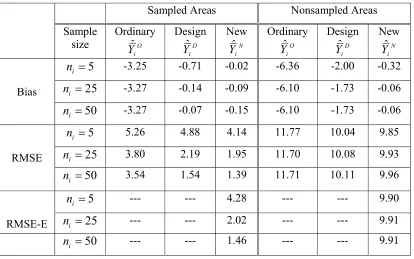
selection does not bias the predictors. See also the simulation results in Section 9.
5. PREDICTION OF SMALL AREA MEANS
Our approach requires specifying the two-level sample model,
i ( ) ( | I 1)
s i i
f u = f u = (Eq. 2.1) and
f y
si(
il|
x
il, ,
u
iΙ =
i1)
(Eq. 2.3), and theconditional sample expectations, E wsi( j i| |xij, , ,y uij i Ι =i 1), all of which can be identified
and tested using the observed data since they refer to sample models. We do not
assumptions regarding the selection of areas or the model holding for the area sampling
weights. In order to facilitate the presentation of our approach, we consider in Sections
5 and 6 a particular sample model and sampling scheme within the selected areas. In
Section 7 we outline the basic steps of computing the predictors under a general model
fitted to the sample data with continuous or discrete outcomes and fixed and random
effects, and a general sampling scheme within the selected areas.
The first step of our approach is therefore to fit a model to the sample data, which of
course is a necessary step in any small area estimation application. Note that although
we consider informative sampling, the sample model can be identified and estimated
from the sample data using standard techniques, see Rao (2003) for small area model
identification and diagnostic methods. In this and the next section we assume that the
sample model for the outcome values is the ‘nested error regression model’,
2
; | 1 ~ (0,ind ) ,
ij ij i ij i i u
y =x′β+ +u e u Ι = N σ | 1 ~ (0,ind 2)
ij ij e
e Ι = N σ . (5.1)
Suppose that the sampling weights,
w
j i|=
(1/
π
j i|)
within the selected areas satisfy,| |
(
|
, , ,
1)
(
|
, ,
1)
si j i ij ij i i si j i ij ij iE w
x
y u
Ι = =
E w
x
y
Ι =
=
k
iexp(
x a
ij′
+
by
ij)
, (5.2)where 1
1exp( ) /
i
N
i i i j ij ij i
k N n− by N
= ′
=
∑
−x a− (follows from (2.6)), anda
andb
are fixed(unknown) constants. (If
x
i0=
const, we assumea
0=
1
for uniqueness). Note that forlarge areas, Ni1exp( ) /
ij ij i j= − ′ −by N
∑
x a1
[ Ni exp( ) / ]
p j ij ij i
E = ′ by N const
≅
∑
−x a− = , such that( / )
i i i
k ≅ N n ×const. As becomes evident below, for sufficiently small sampling
fractions the predictors for sampled and nonsampled areas do not depend on
a
andk
i.Remark 2: It follows from Pfeffermann et al. (1998) that under the sampling scheme
(5.2) the population model is also of the form (5.1) but with different parameters, if the
i i ui
θ =X′β+ are the area means,
z
i represents area level design variables and (γ
0,
γ
)are fixed coefficients. The model (5.1) is in common use for small area estimation
under noninformative sampling (in which case the population and sample models
coincide), see, e.g., Battese et al. (1988). However, as emphasized above, we only
assume knowledge of the forms of the sample model (5.1) and the conditional
expectations in (5.2), but not the form of the population model or the relationship
between the area selection probabilities and the area means.
Remark 3: As with the sample model (5.1), the expectation in (5.2) refers to the sample
distribution within the sampled areas. The relationship in the sample between the
sampling weights and the outcomes can be identified and estimated therefore from the
sample data, see Skinner (1994) and Pfeffermann and Sverchkov (1999, 2003) for
discussion and examples. On the other hand, the relationship between the sampling
weights
w
i and the area means is more difficult to identify since the area means are notobservable, and we do not model this relationship. See Pfeffermann et al. (2006) for
examples of modeling the area selection probabilities. Kim (2003) assumes the model
(5.1) for the population values and a similar model to (5.2) for the sampling
probabilities within the areas, but his article assumes implicitly that all the population
areas are sampled.
The analysis that follows assumes known model parameters. In practice, the
unknown model parameters are replaced under the frequentist approach by sample
estimates, yielding the corresponding ‘empirical predictors’. Maximum likelihood
estimation of the model parameters has to be based in the present case on the sample
distribution of the sample outcomes. Alternatively, the model parameters can possibly
be estimated by the ‘method of moments’, depending on the underlying model. See the
As established in Section 3, the optimal predictor for a sampled area
i
is,( |
,
1)
p i s iE Y D
Ι = =
{
[
(
|
, ,
1) |
]}/
i ij i s ci il il i i s i
j s∈
y
+
l s∉E E y
u
Ι =
D
N
∑
∑
x
. In order tocompute (E yci il|xil, ,ui Ι =i 1) note that by (2.7), (5.1) and (5.2),
(
, ,
1)
ci il il i if y
x
u
Ι =
||
[
(
, , ,
1) 1] (
, ,
1)
(
, ,
1) 1
si l i il il i i si il il i i si l i il i i
E w
y u
f y
u
E w
u
Ι = −
Ι =
=
Ι = −
x
x
x
21
(
)
1
ij il e il
il e e
y
u
b
σ
λ
φ
λ
σ
σ
−
−
=
−
1
1
(
)
1
il ilil e e
y
u
φ
λ
σ
σ
−
−
−
, (5.3)where
u
il=
x
iill′
β
+
u
i, 2 2exp[( / 2) ]
il ki b e il buil
λ
=σ
+x a′ +=
E w
si(
l i||
x
il, ,
u
iΙ =
i1)
andφ
is the standard normal pdf. In the special case whereb
=
0
(the selectionprobabilities within the sampled areas only depend on the x-values so that the
sampling is noninformative), the pdf in (5.3) reduces to the sample normal density
(5.1). By computing the expectation under the sample-complement pdf (5.3) we find,
2
[ ( | , , 1) | ] [( ) | ]
1 il
s ci il il i i s s il e s il
E E y u D E u
λ
bσ
Dλ
Ι = = +
−
x . (5.4)
The expectation in the right hand side of (5.4) is with respect to the sample
distribution of
u D
i|
s,
Ι =
i1
. Under the sample model (5.1),2
ˆ
|
,
1 ~ ( ,
)
i s i i i i
u D
Ι =
N u
σ γ
, (5.5)where
u
ˆ
i=
γ
i[
y
i−
x
′
iβ
]
; ( , ) ni1( , ) / i i j ij ij iy x =
∑
= y x n are the sample means of( , )
y
x
insampled area i,
γ
i=
σ
u2/[
σ
u2+
σ
i2]
andσ
i2=
σ
e2/
n
i=
Var y u
s( | )
i i . Thus, the expectation [E E ys ci( il |xil, ,ui Ι =i 1) |Ds] is obtained by computing the expectation inthe right hand side of (5.4) with respect to the normal distribution (5.5). We get,
[ ( | , , 1) | ]
s ci il il i i s
E E y x u Ι = D ( ˆ) 2 [(1 1) |1 ] il ui b E
σ
e sλ
il Ds− −
′
= x β+ + − . (5.6)
Note that if b=0 (noninformative sampling within the area),
[
(
|
, ,
1) |
]
s ci il il i i sThe expectation [(1 1) |1 ] s il s
E −λ− − D can be computed numerically. Alternatively, in
the practical case where the sampling fractions within the selected areas are small,
|
(
|
, , =1)
ilE w
s l i ilu
i iλ
=
x
Ι
is typically much larger than 1 and hence we mayapproximate, [(1 1) |1 ] 1
s il s
E −λ− − D ≅ , in which case by (5.6),
[
(
|
, ,
1) |
]
s ci il il i i sE E y
x
u
Ι =
D
ˆ
2;
ˆ
ˆ
il e il il i
u
b
σ
u
′
u
≅
+
=
x
β
+
. (5.7)It follows from (3.2), (5.6) and (5.7) that for given parameters
{ , ,
β
b
σ σ
u2,
e2}
, themean Yi of sampledarea i can be predicted as,
( |
,
1)
p i s iE Y D
Ι = =
1 ˆ{( ) [ ( ) ]
i i i i i i i i
N− N −n
θ
+n y + X −x ′β(
)
2}
i i eN
n b
σ
+
−
, (5.8)where
θ
ˆ
i= +
u
ˆ
iX
′
iβ
is the optimal predictor of the sample model meani i
u
iθ
=
X
′
β
+
=
E Y
si( |
iX
i, )
u
i . The last term in (5.7) corrects for the sample selectioneffects, that is, the difference between the sample-complement expectation and the
sample expectation in sampled areas. For b=0, the predictor (5.8) reduces to the
optimal predictor under noninformative sampling (Rao, 2003, Eq. 7.2.37). Note that
the predictor (5.8) does not depend on Ki and
a
featuring in the expectation (5.2).The optimal predictor for nonsampled areas is defined in (3.3) to be,
( |
,
0)
p i s iE Y D
Ι =
1 Ni1 [ ( | , , I 1) | ]c p ik ik i i s k
i
E E y u D
N =
=
∑
x = . By (2.8) and (2.6),i
[
(
|
, ,
Ι
1) |
]
c p ik ik i sE E y
x
u
=
D
[( 1) ( | , ,Ιi 1)| ]( | ) 1 i p ik ik i
s s
s i s
w E y u
E D
E w D
− = = − x | |
( | , , =1)
{ [( 1) | ]}/[ ( | ) 1]
( | , , =1) si k i ik ik i i
s i s s i s
si k i ik i i
E w y u
E w D E w D
E w u
Ι
= − −
Ι
x
x . (5.9)
Computing the expectations Esi( )⋅ in the numerator and the denominator, using (5.1)
and (5.2) yields after some algebra,
i
[
(
|
, ,
Ι
1) |
]
c p ik ik i sE E y
x
u
=
D
=x
′ +
ikβ
b
σ
e2[
(
1)
|
]
(
|
) 1
i i
s s
s i s
w
u
E
D
E w D
−
+
Estimating the two sample expectations in the right hand side of (5.10) by the
corresponding sample means and substituting
u
ˆ
i=
γ
i[
y
i−
x
i' ]
β
foru
i yields thefollowing estimator for
E
ik=
E E y
c[
p(
ik|
x
ik, ,
u
iΙ
i=
1) |
D
s]
,2
ˆ
ik ik e
E
=
x
′
β
+
b
σ
+
(
i1) /
ˆ
i(
i1)
i s i s
w
u
w
∈ ∈
−
−
∑
∑
. (5.11)It follows from (3.3) and (5.11) that for given parameters
{ , ,
β
b
σ σ
u2,
e2}
, the meani
Y of area
i
not in the sample can be predicted as,ˆ ( | ,p i s i 0)
E Y D Ι = = 2
e bσ
′ +
Xiβ +
[
(
i1) /
ˆ
i(
i1)]
i s i s
w
u
w
∈ ∈
−
−
∑
∑
. (5.12)The last term of (5.12) corrects for the fact that the mean of the random effects for
areas outside the sample is different from zero under informative selection of areas.
6. MSE ESTIMATION
Estimating
MSE Y D
( |
ˆ
i s,I )
i=
E Y
p[(
ˆ
i−
Y
i) |
2D
s,I )]
i for the predictors considered in section 5 requires strict model assumptions that could be hard to validate. In orderto deal with this problem, we estimate instead, MSE Y( | , )ˆi X I =
ˆ
[ ( | , ) | , ]
p i s i
E MSE Y D Ι X I , where
X
=
{ ,( , )
x
iji j
∈
U
}
andI
=
{I ,I ,( , )
i iji j
∈
U
}
is theset of first and second stage sample indicators. Note that
MSE Y D
( |
ˆ
i s, )
Ι
i can beviewed as random, such that MSE Y( | , )ˆi X I defines its ‘best predictor’ under the mean
square loss function over the distribution | ,
s
D
f
X I.Denote by ˆYi the predictor defined by (5.8) if
i s
∈
or by (5.12) ifi s
∉
. For whatfollows in this section only, we make the following additional mild assumptions:
Ass.2 Cov y yp[ ,ij mk | ,X Ι = Ι =i 1, m 0] 0 ;= Cov y yp[ ,ij ik | , ,X ui Ι = Ι = Ι =i 1, ij ik 0] 0= ;
implying that outcomes in sampled areas are uncorrelated with outcomes in
uncorrelated when conditioning on the random effect. The first assumption generally
holds if the random effects are independent between the areas. The second assumption
is also not restrictive because the population outcomes are conditionally independent
given the random effect and by extending Remark 2 of Sverchkov and Pfeffermann
(2004) to the case of a joint distribution for a pair of units, it follows that for small
sampling fractions the joint sample-complement distribution and the population
distribution are approximately the same.
Ass.3
Co
v [ ,
py y
ij ik| , ,
X
u
iΙ =
i0] 0
=
; implying that the outcomes in a nonsampled area are uncorrelated conditionally on the random effect. This assumption holds if thearea selection probability only depends on the area mean. (See the discussion below
Ass.1)
Ass.4 The predictor
Y
ˆ
i,i s
∉
is approximately unbiased for E Yp( | ,i X Ι =i 0) in thesense that, E Yp( | , )ˆ X Ι ≅E Yp( | ,i X Ι =i 0) (follows from Section 5).
Consider first sampled areas. Denote
i
Ri i j s ij
Y = −Y
∑
∈ y where Yi =N Yi i, such thatˆ ˆ
i
Ri i i j s ij
Y =N Y −
∑
∈ y . It is shown in Appendix A that under Ass.1 and Ass.2,2
ˆ
[( ) | , ]
p i i
E Y Y− X I =E G u Dp[ ( ,i s) | , ]X Ι ; (6.1)
( ,
i s)
G u D
=
[ˆ ( 2)]21 i
il
Ri il e
l s il
Y u λ bσ
λ
∉
− + +
−
∑
2 2 42
( )
( 1)
i
il l s il
b ε
ε
λ σ σ
λ
∉
− −
∑
, (6.2)where, as before,
u
il=
x
il′
β
+
u
i and exp[( 2 2/ 2) ]il ki b e il buil
λ
=σ
+x a′ + . Note that theexpectation in the right hand side of (6.1) is with respect to the pdf ( ,f u Di s| ,X Ι). All
the terms in (6.2) are either fixed values or functions of the data
D
s and the random2
[ ( , ) | , ]/
p i s i
E G u D N
= X Ι can be estimated by the following parametric bootstrap
procedure (see Remark 4 below):
1. Estimate
a
, , , ,
b k
iβ
σ σ
u2,
e2 (see Section 9),2. Generate B bootstrap samples
{
,
b}
ij b i
y
u
, i=1,...,m,j
=
1,...,
n
i from the samplemodel (5.1) with parameters
ˆ ˆ ˆ
,
2,
2u e
σ σ
β
, using the covariatesx
ij,( , )
i j
∈
s
. Compute,|
ˆ
exp(
ˆ
ˆ
)
b b
j i i ij ij
w
=
k
x a
′
+
by
.3. Re-compute the predictors ˆb
Ri
Y i=1...m,b=1,...,B (with new parameter estimates)
and compute b( ,b b)
i s
G u D ; the new parameter estimates are only used for computing
ˆb Ri
Y , the other terms of b( ,b b)
i s
G u D use the original parameter estimates.
4. Estimate,
ˆ
ˆ ( | , ,I 1)i i
MSE Y X I = = B1 b
( ,
b b) /
2/
i s i b=G u D
N
B
∑
(6.3)Remark 4: The estimator (6.3) ignores the contribution to the variance from estimating
the hyperparameters
{ , , , ,
β
k
ia
b
σ σ
u2,
e2}
. Accounting for this extra source of variationrequires a ‘double bootstrap’ procedure. See Hall and Maiti (2006) for bootstrap bias
corrections in small area estimation that warrant MSE estimation of order O(1/m2).
Next consider nonsampled areas. Under Ass.2 and Ass.4,
2
ˆ
{( ) | , }
p i i
E Y Y− X I {[ˆ ( | , )] | , }ˆ 2
p i p i
E Y E Y
≅ − X I X I [ ( | , )] | , }2
p i p i E Y E Y
+ − X I X I
ˆ ( | , )
p i Var Y
= X I +Var Yp( | , )i X Ι (6.4)
The first variance in (6.4) can be estimated similarly to the estimation of
ˆ
( | , , Ii i 1)
MSE Y X I = in (6.3), that is, by applying the first 3 steps of the bootstrap
procedure to obtain realizations ˆ ,b
i
Y i s∉ , and then estimating,
ˆ
ˆ ( | , )p i
Var Y X I 2
, 1
1 ˆ ˆ
( )
B b i i A b Y Y
B =
=
∑
− ; ˆ, 1 B1ˆbi A b i
Y Y
B =
Note that Yˆi, like
G u D
( ,
i s)
in (6.2) only uses the sample data and hence it is onlyneeded to generate data from the sample model.
In order to estimate the second variance in (6.4) we use the decomposition,
( | , ) [ ( | , , ) | , ]+ [ ( | , , ) | , ]
p i p p i i p p i i
Var Y X I =Var E Y u X I X I E Var Y u X I X I . (6.6)
By Ass.3, the second component in (6.6) is simply,
[ ( | , , ) | , ]
p p i i
E Var Y u X I X I 2/ e Ni
σ
= . (6.7)
This result follows from a result in Pfeffermann et al. (1998), implying that under the
sample model (5.1) and (5.2),
E e u
p( | , ,
ij iX
I
i=
0)
=
const
andVar y u
p(
ij| , )
ix
ij(
| , )
si ij i ijVar y u
=
x
2e
σ
=
.Next consider the first term of (6.6). Again, under the sample model (5.1) - (5.2),
i
[ ( | , , I 0) | , ] ( | , 0)
p p i i p i i
Var E Y u X = X I =Var u X Ι = . (6.8)
It is shown in Appendix B that the latter variance can be estimated as,
ˆ ( | ,
p i i0)
Var u
X
Ι =
2
2 ˆ
1 ˆ 1 ˆ 1
[ ]
( 1) ( 1)
i i e
i i
i s i s i s
i i i
i s i s
w w
r r
w w m n
σ
∈ ∈ ∈
∈ ∈
− −
= − −
− −
∑
∑
∑
∑
∑
, (6.9)where
ˆ ˆ
,
2e
σ
β
are sample estimates of,
2e
σ
β
and ˆ 1 ( ˆ)i
i j s ij ij i
r y
n ∈ ′
=
∑
−x β . Adding theestimator ˆ /2
e Ni
σ for (6.7) to (6.9) yields the estimator of the second variance in (6.4).
7. PREDICTION OF SMALL AREA MEANS UNDER A GENERAL SAMPLE MODEL AND SAMPLING SCHEME
In Section 5 we consider a particular two-level sample model (Eq. 5.1) and a
particular relationship between the unit sampling weights and the outcome values
within the selected areas (Eq. 5.2). Below we outline the basic steps in computing the
predictors under a general two-level sample model fitted to the sample outcomes (Eqs.
2.1 and 2.3), with continuous or discrete outcomes and fixed and random effects, and a
general relationship between the unit sampling weights and the outcomes. As in
sampling weights have been identified and estimated based on the sample data. See,
Rao (2003) for identification, estimation and diagnostic procedures in common use.
The computations in Section 5 follow the same steps but take advantage of the
normality assumptions in some of the derivations. We assume informative sampling of
areas and within the areas and maintain Ass.1 of Section 3.
First consider a sampled area. By (3.2), computation of the predictors of the area
means requires estimating [E E ys ci( il|xil, ,ui Ι =i 1) |Ds]. By (2.7),
[
(
|
, ,
1) |
]
s ci il il i i sE E y
x
u
Ι =
D
[
( ) |
]
il
s i s
E H
u
D
=
x , (7.1)where |
|
(
|
, , ,
1) 1
( )
(
|
, ,
1)
(
|
, ,
1) 1
il
si l i il il i i
i il si il il i i il
si l i il i i
E w
y
u
H
u
y
f y
u
dy
E w
u
Ι = −
=
Ι =
Ι = −
∫
x
x
x
x
.The integral
( )
il i
H
xu
depends on the sample modelf y
si(
il|
x
il, ,
u
iΙ =
i1)
and theexpectation
E w
si(
l i||
y
il, , ,
x
ilu
iΙ =
i1)
, which as stated above are identified andestimated from the sample data. The integral can be computed either analytically or, if
necessary, using numerical approximations. The expectation [ ( ) | ]
il
s i s
E Hx u D in (7.1)
is with respect to the sample distribution
f u D
s( |
i s,
Ι =
i1)
, which is obtained fromthe sample model defined by the Eqs. (2.1) and (2.3). This allows in principle to
compute [ ( ) | ]
il
s i s
E Hx u D (with unknown parameters replaced by sample estimates). In
practice it would often be sensible to assume
E w
si(
l i||
y
il, , , =1)
x
ilu
iΙ
i|
(
|
, , =1)
si l i il il iE w
y
=
x
Ι
, as in (5.2).Alternatively, [ ( ) | ]
il
s i s
E Hx u D can be estimated as,
ˆ [ ( ) | ]
il
s i s
E Hx u D ( ) /ˆ
il i
i s∈ H u n
=
∑
x , (7.2)where
u
ˆ
i is the sample estimator ofu
i under the sample model. (See below (5.5) forthe estimator
u
ˆ
i under the sample model (5.1)). Having estimated[
( ) |
]
il
s i s
E H
xu
D
,Next consider nonsampled areas. By (3.3), predicting the means in such areas
requires estimating, E E yc[ p( ik|xik, ,ui Ιi =1) |Ds]. By (5.9),
i
[ ( | , ,Ι 1) | ]
c p ik ik i s E E y x u = D =
|
|
{ | , , , =1} ( | , , =1)
[( 1) | ]/[ ( | ) 1]
{ | , , , =1} ( | , , =1)
[( 1) ik( )| ]/[ ( | ) 1] ik( )
si ki ik ik i i ik si ik ik i i ik
s i s s i s
si ki ik ik i i si ik ik i i ik
s i i s s i s s
E w y u y f y u dy
E w D E w D
E w y u f y u dy
E w K u D E w D K D
Ι Ι
= − −
Ι Ι
= − − =
∫
∫
x x
x x
x x , (7.3)
where
( )
ik i
K
xu
is the ratio of the two integrals. This ratio again only depends on thesample models
f y
si(
ik|
x
ik, , =1)
u
iΙ
i andE w
si(
k i||
y
ik,
x
ik, ,,
u
iΙ =
i1)
, and it can be computed numerically if necessary. The last expectation in (7.3) can be estimated as,ˆ ( ) ( 1) ( ) /ˆ ( 1)
ik s r ik r r
r s r s
K D w K u w
∈ ∈
=
∑
−∑
−x x . (7.4)
Note that no model is assumed for the area sampling weights so that Kxik(Ds) can not
be computed analytically under the joint distribution of ( , ) |w ui i Ds (see Eq. 5.11).
8. TESTING FOR PREDICTION BIAS
Evidently, predicting the small area means under informative sampling is more
complicated and possibly less stable than under noninformative sampling. Thus, it is
important to test the informativeness of the sample selection and if found
noninformative, use standard optimal procedures. In what follows we propose simple
test statistics for testing whether ignoring the sample selection biases the predictors.
8.1 Testing whether ignoring the selection of areas biases the predictors.
By (4.3), the selection of areas does not bias the predictors used under
noninformative selection if [ Ni1 ( | , , I 1), ] | ] 0
s k p ik ik i ik i s
Cov
∑
= E y x u = w D = . However,one only needs to test
Corr u w D
s( ,
i i|
s) 0
=
because if the true area mean is a functionalso of area covariates Xi, say, the mean Ni1 /
i=
∑
j= ij NiX x as under the model (5.1),
sample pdf of the area mean,
θ
i is by (2.5) and (2.6),( | )
s i i
f θ X =E ws( |i Xi) ( |fp θi Xi) /E ws( | ,i θi Xi), and if E ws( | ,i θi Xi)=E ws( |i Xi),
( | ) ( | )
s i i p i i
f θ X = f θ X . This is true for general population models.
For testing H Corr w u D0: s( , |i i s) 0= we would ideally regress
w
i againstu
i but therandom effects are unobservable. Thus, we regress instead
w
i against the estimatesu
ˆ
ias computed under the sample model. For the model (5.1), the estimates are defined in
Section 5 as,
u
ˆ
i=
γ
ˆ
i[
y
i−
x
i′
β
]
. Writingu
ˆ
i= +
u
iη
i, it can be safely assumed that( , ) 0
i iCov w
η
=
, such that testingH
0 can be implemented by regressing0
ˆ
i i i
w
=
δ
+
δ
u
+
ς
and testingH
0:
δ
=
0
.Assuming that the
ς
i are iid normal deviates, one can test H0 using the t-statistic,ˆ / ˆ (ˆ )
A
OLS OLS
t =δ Var δ , (8.1)
which has then a
t
-distribution with (m−2) degrees of freedom underH
0 (holdingthe estimates
u
ˆ
i fixed). The null hypothesis refers to the sample distribution, thusjustifying estimating δ by OLS. For large number of sampled areas (large m), the
statistic
t
A retains approximately the t distribution (effectively the standard normaldistribution) even without the normality assumption, since the estimator
δ
ˆ
OLS hasasymptotically a normal distribution based on the central limit theorem. Indeed, the
empirical distribution of the statistic
t
A in the simulation study described in Section 9is extremely close to the nominal t-distribution, even though the distribution of the
disturbances
ς
i is in this case nonnormal (see table 3). On the other hand, one isobviously not restricted to using a t-test and other, more robust test procedures can be
used instead, see, for example, Salibián-Barrera (2005). We mention also that