Transductive Data-Selection Algorithms for Fine-Tuning Neural Machine
Translation
Alberto Poncelas and Gideon Maillette de Buy Wenniger and Andy Way ADAPT Centre, School of Computing,
Dublin City University, Dublin, Ireland {firstname.lastname}@adaptcentre.ie
Abstract
Machine Translation models are trained to translate a variety of documents from one language into another. However, models specifically trained for a particular char-acteristics of the documents tend to per-form better. Fine-tuning is a technique for adapting an NMT model to some domain. In this work, we want to use this technique to adapt the model to a given test set. In particular, we are using transductive data selection algorithms which take advantage the information of the test set to retrieve sentences from a larger parallel set. In cases where the model is available at translation time (when the test set is pro-vided), it can be adapted with a small sub-set of data, thereby achieving better perfor-mance than a generic model or a domain-adapted model.
1 Introduction
Machine Translation (MT) models aim to gener-ate a text in the target language which corresponds to the translation of a text in the source language, the test set. These models are trained with a set of parallel sentences so they can learn how to gener-alize and infer a translation when a new document is seen.
In the field of MT, Neural Machine Translation (NMT) models tend to achieve the best perfor-mances when large amounts of parallel sentences are used. However, relevant data is more useful than having more data. Previous studies (Silva
c
2019 The authors. This article is licensed under a Creative Commons 4.0 licence, no derivative works, attribution, CC-BY-ND.
et al., 2018) showed that models trained with in-domain sentences perform better than general-domain models.
However, training models for domains that are distant from general domains, such as scientific documents, is not always a simple task as paral-lel sentences are not always available. In addition, identifying the domain adds complexity if the do-main of the document to be translated is too spe-cific. The alternative explored in this work is to build models adapted to a given test set.
In order to build task-specific models, data se-lection algorithms play an important role as they retrieve sentences from the training data. Data se-lection methods can be classified (Eetemadi et al., 2015) according to the criteria considered to select sentences (e.g. select sentences of a particular do-main, good quality sentences, etc.). In this work, we use the transductive (Vapnik, 1998) data selec-tion methods which use the document to be trans-lated to select sentences that are the most relevant for translating such text.
In some cases, the organizations in charge of translating a document are also the owner of the translation model and training data. Therefore, knowing the test set is an advantage that can be helpful for adapting the generic MT model towards the test set (Utiyama et al., 2009; Liu et al., 2012). The approaches presented here consist of build-ing a sbuild-ingle NMT model and delay part of the pro-cess of training data for adapting the model when the test set is available. Although this implies in-creasing the time involved in translating a docu-ment, it also has some benefits.
translation is also avoided. In addition, due to the fine-grained adaptation, other characteristics that may have not been foreseen (e.g. formal or in-formal register, technical or literal vocabulary, the gender of the speaker etc.) are also considered.
This paper presents the performance of three transductive data selection algorithms (TA), ap-plied to NMT models, showing how these models can be improved by adapting them with a small set of data. The TAs are executed using the test set as seed, but there are other approaches such as us-ing an approximated target-side (Poncelas et al., 2018a; Poncelas et al., 2018c).
The remainder of this paper is structured as fol-lows. In Section 2, we state the research ques-tions that we want to investigate. Section 3 con-tains some insights of other works that are related to this and Section 4 describes the data selection methods used in the experiments. In Section 5 we perform an analysis of fine-tuning and in Section 6 we build the models used as baselines in later ex-periments. The results of the main experiments are explained in Section 7 and finally, in Section 8, we conclude and indicate further research that can be carried out in the future.
2 Research Questions
In this work, we are using a general-domain data set to build an NMT model. Then, this model will be adapted, performing fine-tuning, to two differ-ent test sets in two domains: news and health. The data used to adapt the model is retrieved by the al-gorithms described in Section 4. These methods will retrieve sentences from: (i) the general do-main data; (ii) different in-dodo-main datasets; and (iii) from a concatenation of both the general do-main and in-dodo-main set. Therefore the research questions we propose to explore are the following three:
1. Can a model fine-tuned with a subset of data outperform the model trained with general domain data?
The work of Poncelas et al. (2018b) showed that performing fine-tuning on a subset of data (used to build the model) yields small improvements (and not statistically signifi-cant at level p=0.01). A limitation in their ex-periments is that, as BPE is not applied, the vocabulary of the adapted model remains the
same as the general model. As in these exper-iments we are processing the data using BPE, the limitation of the vocabulary should disap-pear (as sub-words are considered rather than complete words). We are interested in ex-ploring whether performing fine-tuning with a subset of the data (in which BPE was ap-plied) can improve the base model.
2. Can a model fine-tuned with a subset of in-domain data outperform the model fine-tuned with the complete data set?
The general uses of fine-tuning (Luong and Manning, 2015; Freitag and Al-Onaizan, 2016) consist of using in-domain data set to adapt a model. However, we want to in-vestigate whether applying data selection in smaller in-domain set can also lead to im-provements.
3. Can a model fine-tuned with a dataset mix-ture of general-domain and in-domain data outperform the previous-mentioned models?
By considering both datasets (general and in-domain data), the number of candidate sentences is increased. This also poses a challenge to the transductive algorithm as most of the candidate sentences are not in-domain. We are interested in exploring whether these algorithms can successfully re-trieve sentences that lead to improvements.
3 Related Work
There are several adaptation techniques for NMT. Chu and Wang (2018) structure them into two main groups, data centric (techniques which in-volve augmenting or modifying the training data) andmodel centric(techniques which involve mod-ifying the architecture or the procedure with which the model is trained). In this paper, we use a com-bination of both as we use data selection methods (data centric) and fine-tuning (model centric).
The technique of fine-tuning (Luong and Man-ning, 2015; Freitag and Al-Onaizan, 2016) con-sists of training an NMT model with a general do-main data set until convergence, and then using an in-domain set for the last epochs.
in-domain) data each epoch achieves improve-ments over a model trained with all data. Their experiments include weighting the sentences using Cross Entropy Difference (Axelrod et al., 2011), and then, each epoch e the top-Ne sentences are used as training data whereN1 ≥Ne ≥Nlast
A proposal in which they use the test set to adapt the model is the work of Li et al. (2018). In particular, they fine-tune a pre-built NMT model for each sentence in the test set. They use three methods to retrieve the sentences that are the most similar to a sentence of the test set: (i) Leven-shtein distance (LevenLeven-shtein, 1966); (ii) cosine similarity of the average of the word embeddings (Mikolov et al., 2013); and (iii) the cosine sim-ilarity between hidden states of the encoder in NMT. The main difference with our work is that they adapt the model sentence-wise (one model for each sentence) whereas the adaptations presented here are document-wise (one model for each test set). Although performing adaptations sentence-wise gives more fine-grained adaptations, it also has several disadvantages: (i) the computational cost is higher as there are several iterations (as many as sentences in the test set) of selecting data and fine-tuning; (ii) the usage of the data is less ef-ficient as a same sentence can be extracted multiple times (in different iterations); and (iii) using differ-ent models for each sdiffer-entence has the potdiffer-ential risk of performing translations that are not consistent throughout the entire document.
4 Transductive Data Selection Algorithms
In this work, we investigate data selection meth-ods that exploit the information of the test set to retrieve sentences. These methods select a subset of from the parallel set(S, T)used as training data.
In particular, they select sentences based on over-laps ofn-grams between the test setStest and the source side of the parallel dataS. In this work, we
explore the following three techniques:
TF-IDF Distance Method: Distance methods measure how close two sentences are by using metrics as Levenshtein distance (which computes the minimum number of insertion, deletions or substitutions of characters that are necessary to transform one sentence into the other) to score the similarities. Hildebrand et al. (2005) propose TF-IDF distance i.e. to use cosine between TF-IDF (Salton and Yang, 1973) vectors as distance
metric. In their work, for each stest ∈ Stest the top sentences fromS are selected. Although they are aware that the resulting set contains duplicated sentences, in their experiments the models contain-ing duplicated sentences achieve slightly better re-sults.
TF-IDF measures the importance of the terms in a set of documents. Each document D can be represented as a vector of terms wD =
(w1, w2, . . . w|V|), where|V|is the size of the
vo-cabulary. Eachwkis calculated as in (1):
wk =tfk∗log(idfk) (1)
where tfk is the term frequency (TF) of the k-th term in D, i.e. the number of occurrences, and idfk is the inverse document (IDF) frequency of the k-th term, as in (2):
idfk=
#documents
#documents containing term k (2)
The similarity between two sentences a and b
is computed as the inverse of the cosine distance of their TF-IDF vectors, wa andwb, as in Equa-tion (3):
sim(a, b) = 1−cos(wa,wb) = 1−
wa·wb |wa||wb|
(3) In the TFIDF transductive method, each sen-tencesin theCandidate dataSis scored according
to the highest similarity with a sentencerfrom the
test setStestcomputed as in Equation (4):
score(s) = max
r∈Stestsim(s, r) (4)
Infrequentn-gram Recovery (INR): Parcheta et al. (2018) propose extracting those sentences containingn-grams from the test set that are con-sidered infrequent (Gasc´o et al., 2012) (so fre-quent words such as stop words are ignored).
A sentencesis scored according to the number
of infrequent n-grams shared with the set of sen-tences of the test set Stest. It is computed as in
Equation (5):
score(s) = X
ngr∈{StestTs}
max(0, t−CL(ngr))
already). t is the number of occurrences of an
n-gram to be considered infrequent. If the num-ber of occurrences ofngris above the thresholdt
thenngris considered frequentn-gram (the
com-ponentmax(0, t−CS(ngr))is 0) and it does not contribute for scoring the sentence. When a sen-tence is added to the selected pool the count of the n-gram in the candidate dataCL(ngr) is updated (Gasc´o et al., 2012).
Feature Decay Algorithms (FDA): Feature De-cay Algorithms Bic¸ici and Yuret (2011) selects data trying to maximize the variability ofn-grams in the selected data by decreasing their value as they are added to a selected poolL, which
eventu-ally becomes the selected data.
In order to do that, the n-grams in the test set are extracted and assigned an initial value. Each sentence in the set of candidate sentences has an importance score (i.e. the normalized sum of the score of itsn-grams) of being selected.
Then, iteratively, the sentence with the highest score in the candidate data is selected and added to a set of selected poolL. In addition, the values of
then-grams of the selected sentence are decreased to ensure a variability ofn-grams. The values are decreased according to the decay function in Equa-tion (6):
decay(f) =init(f) d
CL(ngr)
(1 +CL(ngr))c (6)
whereCL(ngr)is the count of then-gramngrin
L.canddare parameters of FDA. By default they
have a value of0and0.5, respectively.
The decay(ngr) function in Equation (6)
indi-cates the score of the feature ngr at a particular
iteration, so it is dependent on the set of selected sentencesL.
The sentence s is scored as a normalized (by
length of the sentence) sum of the scores of the features. Considering the default values in tion (6), the resulting score function is as in Equa-tion (7):
score(s, L) =
P
ngr∈Fs0.5CL(ngr) # words in s (7) whereFsis the set ofn-grams in sentences.
Once the selected pool L contains the desired
amount of sentences, the sentences are retrieved as selected data.
5 Experimental Setup
The data sets used in the experiments are based on the ones used in the work of (Bic¸ici, 2013):
We build German-to-English NMT model using the data provided in the WMT 2015 (Bojar et al., 2015) (4.5M sentence pairs). We consider this data set as the general-domain training data to build the non-adapted NMT (BASE). As development data, we use 5K randomly sampled sentences from de-velopment sets of previous years.
The BASE model is adapted to two domains: news and health. Therefore we also use two test sets and two in-domain training set (for the re-search question 2 and 3 explained in Section 2):
• News Domain: We use the test set provided in WMT 2015 News Translation Task, and the in-domainrapid20161data set (1.3M
sen-tence pairs) provided in WMT 2017 News Translation (Bojar et al., 2017).
• Health Domain: German-to-English parallel text from the European Medicines Agency (EMEA)2 (Tiedemann, 2009) (361K
sen-tence pairs). For health domain test set we use the Cochrane 3 dataset provided in
WMT 2017 biomedical translation shared task (Yepes et al., 2017).
Note that the general-domain set contains sen-tences from a corpus such as Europarl (Koehn, 2005) which causes the domain to be closer to the news domain.
All data sets are tokenized, truecased and Byte Pair Encoding (BPE) (Sennrich et al., 2016) is applied with 89500 merge operations (the num-ber of operations used in the work of Sennrich et al. (2016)). The models have been built using OpenNMT-py (Klein et al., 2017). We keep the default settings of OpenNMT-py: 2-layer LSTM with 500 hidden units, vocabulary size of 50000 words for each language.
We use different evaluation metrics to evaluate the performance of the models built in the experi-ments. These models are evaluated on the test sets using several evaluation metrics: BLEU (Papineni et al., 2002), TER (Snover et al., 2006) and ME-TEOR (Banerjee and Lavie, 2005). The scores as-signed by this metrics indicate an estimation of the
1https://tilde.com/
2http://opus.nlpl.eu/EMEA.php
quality of the translation (compared to a human-translated reference). Higher scores of BLEU and METEOR indicate better translation quality. TER is an error metric, therefore lower scores indicate better performance.
In each table, scores that are better than the base-line are shown in bold. Furthermore, scores that constitute a statistically significant improvement at level p=0.01 over the baseline are marked with an asterisk. This was computed with multeval (Clark et al., 2011) using Bootstrap Resampling (Koehn, 2004).
6 Baseline Results
6.1 Baseline Results with General-domain Data
BASE12 BASE13
BLEU 26.16 26.34
TER 54.41 54.41
METEOR 30.00 30.09
Table 1: Results of the model BASE12 and BASE13 evalu-ated on the news test set.
BASE12 BASE13
BLEU 33.29 33.14
TER 46.11 46.79
METEOR 34.62 34.57
Table 2: Results of the model BASE12 and BASE13 evalu-ated on the health test set.
Table 1 presents the results evaluated with the news test set evaluated in the 12th epoch of the base model (BASE12) and the 13th epoch (BASE13). Similarly, Table 2 presents the re-sults evaluated with the test set in the health do-main. These results help to confirm that the mod-els trained for 12 epochs are close to convergence: In Table 1 the increment in performance from the 12th to the 13th epoch is just of 0.0018 BLEU points and in Table 2 the performance is worse in the 13th epoch.
6.2 Baseline Results With In-domain Data
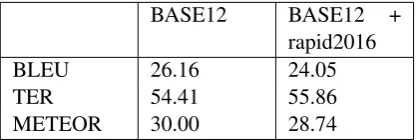
Following the work of Luong and Manning (2015; Freitag and Al-Onaizan (2016) we adapt the base system (BASE12) by performing the 13th iteration in a different, smaller, in-domain data set. We cre-ate two new models, one adapted to the domain of
BASE12 BASE12 +
rapid2016
BLEU 26.16 24.05
TER 54.41 55.86
[image:5.595.312.521.71.141.2]METEOR 30.00 28.74
Table 3: Results of the model BASE12 fine-tuned with the in-domain news set.
BASE12 BASE12 +
EMEA
BLEU 33.29 34.69
TER 46.11 44.43
[image:5.595.309.520.187.257.2]METEOR 34.62 34.99
Table 4: Results of the model BASE12 fine-tuned with the in-domain health set.
news (BASE12 + rapid2016) and another one to the health domain (BASE12 + EMEA).
We see, in Table 4, how using in-domain data for fine-tuning can increase the performance with more than 2 BLEU points. However, the data set chosen for performing fine-tuning is important, as in Table 3 we see the performance of the model be-comes worse after fine-tuning with the rapid2016 dataset. This also indicates that the addition of new data is not necessarily good.
7 Main Experiments
In order to answer the questions in Section 2, we perform three set of experiments: fine-tune the BASE12 model with a subset of the general do-main data (Section 7.1), with a subset of in-dodo-main data (Section 7.2), and with a subset of data re-trieved from both general domain data and in-domain data (Section 7.3).
We use the default configuration of the data se-lection methods. We use d = 0.5, c = 0 and
3-grams as features in FDA (Equation (6)).
In the INR method we also use 3-grams asngr
(in Equation (5)). In order to find a value of the threshold for the experiments, in this paper we ex-ecute several runs of INR using different values of
t, multiplying by two in each execution (we try 10,
20, 40, 80 ...). In the experiments we use the high-est value oftthat fulfills one of the following crite-ria: (i) the execution time should be under 48 hours or (ii) the number of sentences retrieved at least 500K. Accordingly, the value oftin news domain
7.1 Results of Models Trained in a Subset of General-Domain Data
BASE13 BASE12 + TFIDF
BASE12
+ INR BASE12+ FDA
100K lines BLEU 26.34 26.41 26.49 26.49
TER 54.41 54.45 54.19 54.21
MET. 30.09 30.14 30.21* 30.21*
200K lines
BLEU 26.34 26.33 26.44 26.55*
TER 54.41 54.41 54.35 54.17*
MET. 30.09 30.03 30.12 30.24*
500K lines
BLEU 26.34 26.44 - 26.40*
TER 54.41 54.40 - 54.47
[image:6.595.71.293.113.314.2]MET. 30.09 30.11 - 30.10*
Table 5: Performance on the news test for the BASE12 model, fine-tuned with subsets of the training data.
BASE13 BASE12 + TFIDF
BASE12
+ INR BASE12+ FDA
100K lines
BLEU 33.14 33.95* 33.52* 33.68*
TER 46.79 45.99* 45.92* 45.97*
MET. 34.57 34.96* 34.77 34.71
200K lines
BLEU 33.14 33.97* 33.88* 33.96*
TER 46.79 46.03* 45.90* 45.64*
MET. 34.57 34.89* 34.94* 35.01*
500K lines
BLEU 33.14 34.14 - 33.75*
TER 46.79 45.60* - 45.92*
MET. 34.57 34.96* - 34.92*
Table 6: Performance on the health test for the BASE12 model, fine-tuned with subsets of the training data.
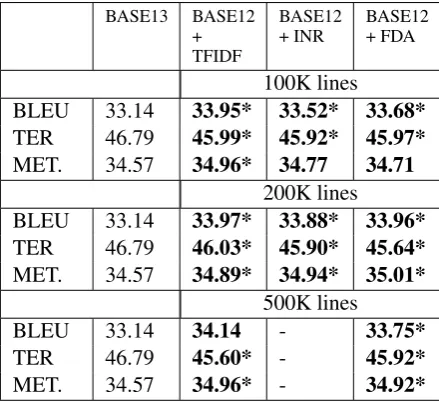
In order to investigate the first question men-tioned in Section 2 we select a subset of sentences of the general-domain data (the data set used to build BASE12). We extract subsets of three dif-ferent sizes: 100K, 200K, and 500K lines. The only exception is the INR method which, with the established configuration, retrieves at most 230K sentences and 275K sentences using the news and health test, respectively. The BASE12 model is fine-tuned for a 13th epoch using the subset of data extracted.
In Table 5 and Table 6 we show the performance of the base model in the first column (BASE13 col-umn) and then the model in which the last epoch is fine-tuned using data selected by one of the three data selection algorithms. As we can see, fine-tuning the model with the selected data leads to improvements for most of the experiments (num-bers in bold).
The vocabulary considered in the fine-tuning is the same used for building the BASE12 model. However, as BPE has been applied, this restriction is less strict. For example, in the sentence of the news test set “das Bildungsministerium teilte mit, etwa ein Dutzend Familien sei noch nicht zur¨uck-gekehrt.” (according to the reference, “the Educa-tion Ministry said about a dozen families still had not returned.”) the word “Bildungsministerium” (“Education Ministry”) would have been left out (even if in the selected data there are several occur-rences) if BPE was not applied because it is infre-quent in the general domain set. As in these exper-iments we use BPE, the adapted models achieves improvements in terms of fluency.
The non-adapted, BASE13 model translates the above-mentioned sentence as “the Ministry of Ed-ucation said, for example, that a dozen families did not return.”. In this sentence, the phrase “for ex-ample” has been added. The model adapted using TFIDF (100K lines) generates a similar sentence (i.e. “the Ministry of Education said, for example, that a dozen families had not returned.”), but this problem is corrected by the model adapted using INR and FDA (100K lines) as both of them gen-erate the same translation: “the Ministry of Ed-ucation said, about a dozen families have not re-turned.”. Here the phrase “for example” added by BASE13 model is removed.
7.2 Results of Models Trained with a Subset of In-Domain Data
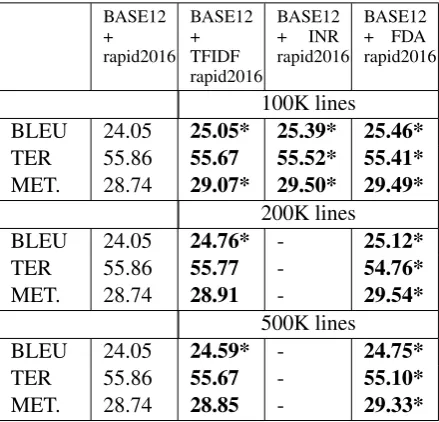
In order to answer the second research question stated in Section 2, we also execute the same trans-ductive algorithms (using the same configuration) in the in-domain set (i.e. rapid2016 and EMEA). We retrieve the same amount of sentences: 100K, 200K and 500K lines for news domain; and 100K and 200K for the health domain (as EMEA only has 361K sentences).
[image:6.595.72.292.375.577.2]BASE12 + rapid2016
BASE12 + TFIDF rapid2016
BASE12 + INR rapid2016
BASE12 + FDA rapid2016
100K lines
BLEU 24.05 25.05* 25.39* 25.46*
TER 55.86 55.67 55.52* 55.41*
MET. 28.74 29.07* 29.50* 29.49*
200K lines
BLEU 24.05 24.76* - 25.12*
TER 55.86 55.77 - 54.76*
MET. 28.74 28.91 - 29.54*
500K lines
BLEU 24.05 24.59* - 24.75*
TER 55.86 55.67 - 55.10*
[image:7.595.73.293.136.347.2]MET. 28.74 28.85 - 29.33*
Table 7: Performance on the news test for the BASE12 model, fine-tuned with subsets of the rapid2016 data set.
BASE12 + EMEA
BASE12 + TFIDF EMEA
BASE12 + INR EMEA
BASE12 + FDA EMEA
100K lines BLEU 34.69 35.11 35.22 35.18
TER 44.43 45.09 43.60 44.94 MET. 34.99 35.17 35.25 35.15
200K lines
BLEU 34.69 35.55 - 35.11
TER 44.43 44.18 - 43.66
[image:7.595.72.293.517.673.2]MET. 34.99 35.70* - 35.28
Table 8: Performance on the health test for the BASE12 model, fine-tuned with subsets of the EMEA data set.
rapid2016 set (also presented in Table 3). The other columns contain the evaluation scores af-ter fine-tuning BASE12 model with subsets of rapid2016. Similarly, Table 8 indicates the per-formance of the model fine-tuned with theEMEA dataset and different subsets (evaluated with health test). Note also that the number of sentences re-trieved by INR (using the same configuration as in the previous section) is less than 200K lines, so those experiments are not executed.
Using a subset of in-domain data can improve the performance as again, most of the scores in Table 7 and Table 8 are marked in bold. We see that the impact of the models evaluated in the news domain (Table 7) is higher as all experiments achieve statistically significant improvements at level p=0.01 for at least one evaluation metric. De-spite that, none of the models improve the BASE13 model (column BASE13 in Table 1).
7.3 Results of Models Trained with a Mixture of General-Domain and In-Domain Data
As we have seen in previous sections, applying fine-tuning with subsets of data can perform bet-ter than using the complete dataset. In this section, we aim to explore the performance of models fine-tuned on data retrieved from a mixture of the two datasets used in previous sections: data used for building the BASE12 model, and in-domain data (rapid2016 or EMEA datasets). These experiments are particularly interesting in the case of news test because using an external dataset led to worse re-sults.
TFIDF INR FDA news test
100K lines 52% 89% 86% 200K lines 50% 88% 87%
500K lines 46% - 86%
health test
100K lines 27% 67% 69% 200K lines 29% 70% 71%
500K lines 31% - 74%
Table 9:Percentage of base training data lines retrieved.
[image:7.595.314.513.526.656.2]meth-ods are capable of identifying better sentences. As shown in Table 3, the sentences from the base dataset are more useful for the news test as us-ing the rapid2016 set for tunus-ing the model leads to worse results.
If we perform a (column-wise) comparison of the three methods, we can observe that the INR and FDA methods retrieve a similar amount of sen-tences from the base set. By contrast, the TFIDF method seems to retrieve a smaller amount of sen-tences from the general domain data (the percent-ages in column TFIDF of Table 9 are much lower than the other columns).
BASE13 BASE12 + rapid2016
BASE12
+ TFIDF BASE12 +INR BASE12 +FDA
100K lines BLEU 26.16 24.05 26.42 26.56 26.65* TER 54.41 55.86 54.57 53.92* 54.23 MET. 30.09 28.74 30.06 30.21 30.25*
200K lines BLEU 26.16 24.05 26.14 26.40 26.59 TER 54.41 55.86 54.72 54.25 54.22 MET. 30.09 28.74 29.95 30.13 30.13
[image:8.595.74.291.518.705.2]500K lines BLEU 26.16 24.05 26.24 - 26.23 TER 54.41 55.86 54.53 - 54.27 MET. 30.09 28.74 29.99 - 30.02
Table 10: Performance on the news test for the BASE12 model, fine-tuned with subsets of a combination of the BASE and rapid2016 data sets.
BASE13 BASE12 +
EMEA BASE12 +TFIDF BASE12 +INR BASE12+ FDA 100K lines BLEU 33.29 34.69 34.48 34.96 34.89 TER 46.11 44.43 45.28 44.68 44.95 MET. 34.62 34.99 35.30 35.35 35.21
200K lines BLEU 33.29 34.69 35.57 35.56 35.59 TER 46.11 44.43 44.23 44.59 45.54 MET. 34.62 34.99 35.59 35.77* 35.54
500K lines BLEU 33.29 34.69 36.79* - 35.78 TER 46.11 44.43 43.30* - 44.88 MET. 34.62 34.99 36.05* - 35.99
Table 11: Performance on thehealthtest for the BASE12 model, fine-tuned with subsets of a combination of the BASE and EMEA data sets.
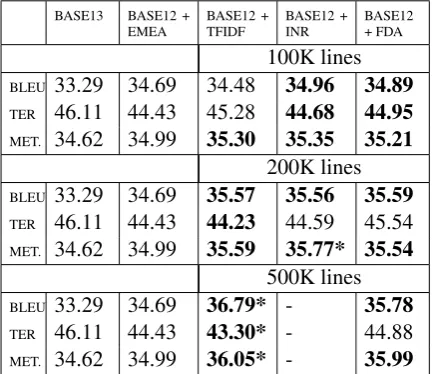
In Table 10 and Table 11 we show two
base-lines: (i) column BASE13 shows the model built performing 13 epochs; and (ii) column BASE12+rapid2016 and BASE12+EMEA present the results observed in Table 3 and Table 4, respec-tively. In those tables we indicate in bold those scores that are better than both baselines.
The models adapted to the news test (Table 10) using INR and FDA tend to perform better than both the BASE13 and the BASE12+rapid2016 models. This is especially true for smaller datasets (the adaptation with 100K lines achieves statisti-cally significant improvements at p=0.01) but be-comes closer to BASE13 when more sentences are retrieved (500K lines subtable). For the TFIDF method, despite the fact that it achieves better re-sults than the BASE12+rapid2016 model, most of the scores are worse than the BASE13 model. As mentioned earlier, TFIDF tends to retrieve more sentences from the rapid2016 set (Table 9), and as we saw before using more sentences from this set leads to worse performing models.
In the health domain (Table 11), by contrast, TFIDF performs slightly better (the only exper-iment that achieves statistically significant im-provements at p=0.01 for the three evaluation met-rics).
8 Conclusion and Future Work
In this work, we have shown how general domain models can be adapted to a test set by fine-tuning not only to a particular domain but also to a special subset of sentences (retrieved from in-domain or out-of-domain data) that are closer to a test set and achieve better results.
We have seen that fine-tuning a model using a subset of data can achieve better performance than the model trained with the full training set. This is also applicable when using an additional set of in-domain sentences. Nonetheless, the best results are observed when augmenting the candidate tences (i.e. combining general and in-domain sen-tences) as presented in Section 7.3.
other TA we could retrieve 500K parallel lines. Moreover, in this work we have used the same val-ues oftfor all the experiments, which have been
determined following the most restrictive assump-tion of not knowing the in-domain data. In the future, we want to evaluate the models fine-tuned with data retrieved from INR using different values oft.
TFIDF technique, although achieving compara-ble results, we find to be the weakest of the TA ex-plored. The main differences with the other two is that is not a context-dependent (i.e. it does not con-sider the selected pool to retrieve new sentences) and in addition, each sentence is considered in-dependently. This caused that for larger test set suchnews, the improvements tend to be smaller or not to find statistically signifficant improvements at p=0.01 (e.g. tables 5 and 10).
The experiments carried out in this paper can be further expanded using different language pairs, different domains and different selected-data sizes. Moreover, other configurations of data selection algorithms could be investigated. For example, us-ing n-grams of higher order, executing INR with different values oft, in Equation (5), or FDA with
different values ofdandc, in Equation (6)
(Pon-celas et al., 2016; Pon(Pon-celas et al., 2017).
The techniques explored here can also be used in combination with other approaches aiming to adapt models towards a particular domain. The models presented in Section 7.3 can be further ex-panded by adding a tag in the source sentences in-dicating the domain explicitly (Chu et al., 2017; Poncelas et al., 2019b), using a target-side seed or using synthetic sentences (Chinea-Rios et al., 2017; Poncelas et al., 2019a).
Acknowledgements
This research has been supported by the ADAPT Centre for Digital Content Technology which is funded under the SFI Research Centres Pro-gramme (Grant 13/RC/2106) and is co-funded un-der the European Regional Development Fund.
This work has also received funding from the European Union’s Horizon 2020 re-search and innovation programme under the Marie Skłodowska-Curie grant agreement No 713567.
References
Axelrod, Amittai, Xiaodong He, and Jianfeng Gao. 2011. Domain adaptation via pseudo in-domain data selection. InProceedings of the 2011 Conference on Empirical Methods in Natural Language Processing, pages 355–362, Edinburgh, Scotland, UK.
Banerjee, Satanjeev and Alon Lavie. 2005. Meteor: An automatic metric for MT evaluation with improved correlation with human judgments. InProceedings of the ACL workshop on intrinsic and extrinsic evalu-ation measures for machine translevalu-ation and/or sum-marization, pages 65–72, Ann Arbor, Michigan. Bic¸ici, Ergun and Deniz Yuret. 2011. Instance
selec-tion for machine translaselec-tion using feature decay al-gorithms. InProceedings of the Sixth Workshop on Statistical Machine Translation, pages 272–283, Ed-inburgh, Scotland.
Bic¸ici, Ergun. 2013. Feature decay algorithms for fast deployment of accurate statistical machine transla-tion systems. In Proceedings of the Eighth Work-shop on Statistical Machine Translation, pages 78– 84, Sofia, Bulgaria, August.
Bojar, Ondˇrej, Rajen Chatterjee, Christian Federmann, Barry Haddow, Matthias Huck, Chris Hokamp, Philipp Koehn, Varvara Logacheva, Christof Monz, Matteo Negri, Matt Post, Carolina Scarton, Lucia Specia, and Marco Turchi. 2015. Findings of the 2015 Workshop on Statistical Machine Translation. InProceedings of the Tenth Workshop on Statistical Machine Translation, pages 1–46, Lisboa, Portugal. Bojar, Ondˇrej, Rajen Chatterjee, Christian Federmann,
Yvette Graham, Barry Haddow, Shujian Huang, Matthias Huck, Philipp Koehn, Qun Liu, Varvara Lo-gacheva, et al. 2017. Findings of the 2017 confer-ence on machine translation (wmt17). In Proceed-ings of the Second Conference on Machine Transla-tion, pages 169–214, Copenhagen, Denmark.
Chinea-Rios, Mara, Alvaro Peris, and Francisco Casacuberta. 2017. Adapting neural machine trans-lation with parallel synthetic data. InProceedings of the Second Conference on Machine Translation, pages 138–147, Copenhagen, Denmark.
Chu, Chenhui and Rui Wang. 2018. A survey of domain adaptation for neural machine translation. arXiv preprint arXiv:1806.00258.
Chu, Chenhui, Raj Dabre, and Sadao Kurohashi. 2017. An empirical comparison of domain adap-tation methods for neural machine translation. In Proceedings of the 55th Annual Meeting of the As-sociation for Computational Linguistics (Volume 2: Short Papers), volume 2, pages 385–391, Vancouver, Canada.
Meeting of the Association for Computational Lin-guistics: Human Language Technologies (Volume 2: Short Papers), page 176–181, Portland, Oregon.
Eetemadi, Sauleh, William Lewis, Kristina Toutanova, and Hayder Radha. 2015. Survey of data-selection methods in statistical machine translation. Machine Translation, 29(3-4):189–223.
Freitag, Markus and Yaser Al-Onaizan. 2016. Fast domain adaptation for neural machine translation. arXiv preprint arXiv:1612.06897.
Gasc´o, Guillem, Martha-Alicia Rocha, Germ´an Sanchis-Trilles, Jes´us Andr´es-Ferrer, and Francisco Casacuberta. 2012. Does more data always yield better translations? InProceedings of the 13th Con-ference of the European Chapter of the Association for Computational Linguistics, pages 152–161, Avi-gnon, France.
Hildebrand, Almut Silja, Matthias Eck, Stephan Vo-gel, and Alex Waibel. 2005. Adaptation of the translation model for statistical machine translation based on information retrieval. InProceedings of the 10th Annual Conference of the European Association for Machine Translation, pages 133–142, Budapest, Hungary.
Klein, Guillaume, Yoon Kim, Yuntian Deng, Jean Senellart, and Alexander M. Rush. 2017. Open-nmt: Open-source toolkit for neural machine trans-lation. InProceedings of the 55th Annual Meeting of the Association for Computational Linguistics-System Demonstrations, pages 67–72, Vancouver, Canada.
Koehn, Philipp. 2004. Statistical significance tests for machine translation evaluation. In Proceed-ings of the 2004 Conference on Empirical Methods in Natural Language Processing, pages 388–395, Barcelona, Spain.
Koehn, Philipp. 2005. Europarl: A parallel corpus for statistical machine translation. Machine Translation Summit, 2005, pages 79–86.
Levenshtein, Vladimir. 1966. Binary codes capable of correcting deletions, insertions and reversals. In Soviet Physics Doklady, pages 707–710.
Li, Xiaoqing, Jiajun Zhang, and Chengqing Zong. 2018. One sentence one model for neural machine translation. In Proceedings of the Eleventh Inter-national Conference on Language Resources and Evaluation (LREC 2018), pages 910–917, Miyazaki, Japan.
Liu, Lemao, Hailong Cao, Taro Watanabe, Tiejun Zhao, Mo Yu, and Conghui Zhu. 2012. Locally training the log-linear model for smt. InProceedings of the 2012 Joint Conference on Empirical Methods in Nat-ural Language Processing and Computational Natu-ral Language Learning, pages 402–411, Jeju, Korea.
Luong, Minh-Thang and Christopher D Manning. 2015. Stanford neural machine translation systems for spoken language domains. InProceedings of the International Workshop on Spoken Language Trans-lation, pages 76–79, Da Nang, Vietnam.
Mikolov, Tomas, Ilya Sutskever, Kai Chen, Greg S Cor-rado, and Jeff Dean. 2013. Distributed representa-tions of words and phrases and their compositional-ity. InAdvances in neural information processing systems, pages 3111–3119.
Papineni, Kishore, Salim Roukos, Todd Ward, and Wei-Jing Zhu. 2002. Bleu: a method for automatic evaluation of machine translation. In Proceedings of 40th Annual Meeting of the Association for Com-putational Linguistics, pages 311–318, Philadelphia, Pennsylvania, USA, July.
Parcheta, Zuzanna, Germ´an Sanchis-Trilles, and Fran-cisco Casacuberta. 2018. Data selection for nmt us-ing infrequent n-gram recovery. InProceedings of the 21st Annual Conference of the European Associ-ation for Machine TranslAssoci-ation, page 219–227, Ala-cant, Spain.
Poncelas, Alberto, Andy Way, and Antonio Toral. 2016. Extending feature decay algorithms using alignment entropy. In International Workshop on Future and Emerging Trends in Language Technol-ogy, pages 170–182, Seville, Spain.
Poncelas, Alberto, Gideon Maillette de Buy Wenniger, and Andy Way. 2017. Applying n-gram align-ment entropy to improve feature decay algorithms. The Prague Bulletin of Mathematical Linguistics, 108(1):245–256.
Poncelas, Alberto, Gideon Maillette de Buy Wenniger, and Andy Way. 2018a. Data selection with feature decay algorithms using an approximated target side. In15th International Workshop on Spoken Language Translation (IWSLT 2018), pages 173–180, Bruges, Belgium.
Poncelas, Alberto, Gideon Maillette de Buy Wenniger, and Andy Way. 2018b. Feature decay algorithms for neural machine translation. InProceedings of the 21st Annual Conference of the European Association for Machine Translation, pages 239–248, Alacant, Spain.
Poncelas, Alberto, Andy Way, and Kepa Sarasola. 2018c. The ADAPT System Description for the IWSLT 2018 Basque to English Translation Task. In International Workshop on Spoken Language Trans-lation, pages 72–82, Bruges, Belgium.
Poncelas, Alberto, Kepa Sarasola, Meghan Dowling, Andy Way, Gorka Labaka, and I˜naki Alegria. 2019b. Adapting NMT to caption translation in Wikimedia Commons for low-resource languages. In35th Inter-national Conference of the Spanish Society for Nat-ural Language Processing (SEPLN 2019), Bilbao, Spain.
Salton, Gerard and Chung-Shu Yang. 1973. On the specification of term values in automatic indexing. Journal of documentation, 29(4):351–372.
Sennrich, Rico, Barry Haddow, and Alexandra Birch. 2016. Neural machine translation of rare words with subword units. InProceedings of the 54th Annual Meeting of the Association for Computational Lin-guistics (Volume 1: Long Papers), volume 1, pages 1715–1725, Berlin, Germany.
Silva, Catarina Cruz, Chao-Hong Liu, Alberto Ponce-las, and Andy Way. 2018. Extracting in-domain training corpora for neural machine translation using data selection methods. InProceedings of the Third Conference on Machine Translation: Research Pa-pers, pages 224–231, Brussels, Belgium.
Snover, Matthew, Bonnie Dorr, Richard Schwartz, Lin-nea Micciulla, and John Makhoul. 2006. A study of translation edit rate with targeted human annotation. InProceedings of the 7th Conference of the Associa-tion for Machine TranslaAssocia-tion in the Americas, pages 223–231, Cambridge, Massachusetts, USA.
Tiedemann, J¨org. 2009. News from OPUS - A collec-tion of multilingual parallel corpora with tools and interfaces. In Nicolov, N., K. Bontcheva, G. An-gelova, and R. Mitkov, editors, Recent Advances in Natural Language Processing, volume V, pages 237–248. John Benjamins, Amsterdam/Philadelphia, Borovets, Bulgaria.
Utiyama, Masao, Hirofumi Yamamoto, and Eiichiro Sumita. 2009. Two methods for stabilizing mert: Nict at iwslt 2009. In International Workshop on Spoken Language Translation (IWSLT 2009), pages 79–82, Tokyo, Japan.
van der Wees, Marlies, Arianna Bisazza, and Christof Monz. 2017. Dynamic data selection for neural machine translation. In Proceedings of the 2017 Conference on Empirical Methods in Natural Lan-guage Processing, pages 1400–1410, Copenhagen, Denmark.
Vapnik, Vladimir N. 1998. Statistical Learning The-ory. Wiley-Interscience.