Automatic Testing from Formal Specifications
⋆Manoranjan Satpathy1⋆⋆, Michael Butler2
, Michael Leuschel3
, and S. Ramesh4
1
Department of Information Technologies, Abo Akademi University Joukahaisenkatu 3-5, FIN-20520 Turku, Finland
2
School of Electronic and Computer Science, University of Southampton Highfield, Southampton, SO17 1BJ, UK
3
Institute of Informatik, Heinrich-Heine Universitat Duesseldorf Universitatsstr. 1, D-40225 Duesseldorf
4
General Motors India Science Lab
International Tech Park, Whitefield Road, Bangalore – 560066 [email protected]; [email protected] [email protected]; [email protected]
Abstract. In this article, we consider model oriented formal specifica-tion languages. We generate test cases by performing symbolic execuspecifica-tion over a model, and from the test cases obtain a Java program. This Java program acts as a test driver and when it is run in conjunction with the implementation then testing is performed in an automatic manner. Our approach makes the testing cycle fully automatic. The main contribution of our work is that we perform automatic testing even when the models are non-deterministic.
Key Words:Model Based Testing; B-Method; Non-determinism
1
Introduction
Software models are usually built to reduce the complexity of the development process and to ensure software quality. A model is usually a specification of the system which is developed from the requirements early in the development cycle [5]. In this paper, we consider model oriented formal specification languages like Z [22], VDM [12] , B [1] and ASM [9]. Bymodel oriented we mean that system behaviour is described using an explicit model of the system state along with operations on the state.
A formal model can be subjected to symbolic execution to obtain a cover-age graph in which nodes represent instantiated states and edges are labeled with operation applications. One can then select a finite set of finite behaviours from the coverage graph and test if the implementation is consistent with these behaviours. This approach is often termed as model based testing [6]. Model
⋆
Work done within the EU research project Rodin, IST 511599.
⋆⋆
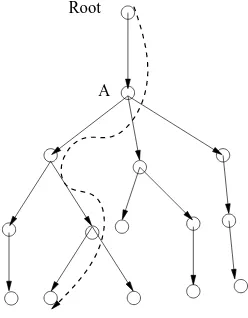
A Root
Fig. 1.Non-determinism Scenario
based testing though is an incomplete activity; the selected behaviours could be enriched to capture interesting aspects of the system and hence the success of their testing would give us confidence about the correctness of the system.
with the current status of our implementation. In Section 7, we make an analysis of our method, and finally, Section 8 concludes the paper.
2
Related Work
Atesting criterionis a set of requirements on test data which reflects a notion of adequacy on the testing of a system [19]. A test adequacy criterion determines whether sufficient testing has already been done, and in addition, it provides measurements to obtain the degree of adequacy obtained after testing stops [25]. Atest oracleis a mechanism to determine correctness of test executions. A test driveris a tool which activates a system, provides test inputs and report test results [18].Representation mappingis a mapping which maps the abstract name space of the model with the concrete name space of the SUT [7]. In this context, there are two kinds of mappings: control and data [19]. Control mappings are between control points in the implementation and locations in the specification; these are the points where the specification and the implementation states are to be matched. Data mappings are transformations between data structures in the implementation and those in the specification. A test sequence is calledpresetif the input sequence is fixed prior to the start of testing; it is calledadaptiveif at each step the choice of the next input symbol depends on the previous outputs [23]. The adaptive test cases are in the form of decision trees; the tester supplies an input and depending on the output, a branch is selected.
The work by Dick and Faivre [4] is a major contribution to the use of formal methods in software testing. A VDM [12] specification has state variables and an invariant (Inv) to restrict the variables. An operation, say OP, is specified by a pre-condition (OPpre) and a post-condition (OPpost). The expression OPpre∧
OPpost∧Inv is converted into its Disjunctive Normal Form (DNF); each disjunct,
unless a contradiction itself, represents an input sub-domain of OP. Next, as many operation instances are created as the number of valid disjuncts in the DNF. An attempt is then made to create a FSA (Finite State Automaton) in which each node represents a possible machine state and an edge represents an application of an operation instance. A set of test cases is then generated by traversing the FSA, each test case being a sequence of operation instances. The authors discuss only the mechanism of the partitioning algorithm.
a boundary state, a state satisfying a given boundary goal. And then relevant operation instances are applied at the boundary state by giving them boundary input values. The results of the query operations become the oracle information. BZ-TT assumes that the B operations are deterministic. The authors point out that automatic verdict assignment is difficult because of non-determinism, and representation mappings [14, 15].
Satpathy et al. [21] discuss the prototype of a tool called ProTest which per-forms testing of an implementation in relation to its B model. The tool perper-forms partition analysis using a technique similar to that of Dick and Faivre. A finite coverage graph is created from a symbolic execution of the B model by a model checking tool called ProB [16]. Some paths starting from the initial state are taken as test cases. The ProTest tool can run Java programs. So the B model and its Java implementation are run simultaneously by the tool, and in relation to a test case, similar states are matched to assign a verdict.
Finite state machines have been used to model systems like sequential cir-cuits, communication protocols and some types of programs such as lexical anal-ysis and pattern matching [13]. Though the implementation of such systems is usually deterministic, some of the state parameters may be unspecified during the specification stage. In such cases, non-deterministic finite state machines (NDFSMs) are used for modeling. Sometimes the code for the implementation (SUT) is not available and the problem then is to find if the SUT conforms to its finite state model; i.e. we need to show whether every i/o sequence that is possible in the SUT is also present in the specification. Solutions to this confor-mance testing problem when the specification is a NDFSM have been addressed by many authors including Hierons [10, 11], Zhang and Cheung [24] and Nach-manson et al [17]. However, the models which we discuss in this paper are in general infinite state machines.
3
The B-Method and Examples
The B-method is a theory and methodology for formal development of com-puter systems [1]. The basic unit of specification in B is called a B machine. Larger specifications can be obtained by composing B machines in a hierarchical manner. An individual B machine consists of a set of variables, an invariant to restrict the variables, and a set of operations to modify the state. An operation has a precondition, and an operation invocation is defined only if the precondi-tion holds. The initializaprecondi-tion acprecondi-tion and an operaprecondi-tion body are written as atomic actions coded in a language called thegeneralized substitution language[1]. The language allows specification of deterministic and non-deterministic assignments and operations. An operation invocation transforms a machine state to a new state. The behaviour of a B machine can be described in terms of a sequence of operation invocations in which the first operation call originates from the initial state of the machine.
Machine TAgency1
SETS USER = {u1, u2}; SESSION={s1}; ROOM={r1, r2}
VARIABLES sess, booking INVARIANT
sess∈SESSION +→USER /* +→means partial function */
∧booking ∈ROOM +→USER INITIALISATION
sess :=∅ ||booking :=∅
OPERATIONS
login(u) = PREu∈USER∧sess=∅THEN sess(s1) := u END;
alloc(s)= PREs∈SESSION∧sess6=∅ ∧dom(booking)6={r1, r2}THEN IFr1∈dom(booking) THEN
booking(r2) := sess(s) ELSE booking(r1) := sess(s) END END;
logout(s) = PREs∈SESSION∧sess6=∅THEN sess :=∅END END
Table 1.A Deterministic B machine
can only handle a single session s1. sessand booking are the two variables, and the INVARIANT tells that both are partial functions. Both variables are initialized to empty. There are three operations in all. The login() operation assigns the single session to a user. Then alloc(ss) allocates a room in relation to the sessionss, but preference is given tor1. The logout() operation terminates the session.
4
The Method I: Deterministic Models
We assume flat B machines without any hierarchy and Java is the language of implementation. We now outline our method in the following steps.
Creation of Probe Operations: For each operation in the machine, a set
of probe operations are manually created from the domain knowledge and the operation meaning. The probes will be used in matching similar specification and implementation states. For the operation alloc(s), some possible queries to become its probe operations are:
– Which user made the allocation request? (probe operation alloc P1()) – How many rooms got allocated so far? (probe operation alloc P2())
These two probe operations can be encoded in B as follows: uu←alloc P1(s) = PRE s∈SESSION THEN uu := sess(s) END count←alloc P2 = BEGIN count := card(booking) END
Signature Generation: The SUT in Java must have a similar signature as the
specification; i.e., the SUT will have the same operation names as those in the specification but their parameters would be similar in the following sense:
– If a model parameter type is either numeric or boolean it becomesintand booleanin the implementation respectively.
– For any other model parameter of type P P, we treat it as an object of a classP P in the implementation.
For instance, the login() will have the signature’void login(USER uu)’. We also create signatures of the probe operations; for instance, alloc P1() will be
of’USER alloc P1(SESSION s)’. The SUT also implements SESSION, USER
and ROOM as Java classes. It is expected that the developer while writing the SUT preserves the signatures of the B operations and their probes.
Generation of Operation Instances: We perform a DNF based analysis over
the operation preconditions in order to obtain operation instances. However, op-eration preconditions in B are relatively simpler; therefore, in order to obtain interesting partitions, we add tautologies through conjunction to the precondi-tion as per the following rules.
– If an operation has anIFlike’IF C THEN S1 ELSE S2’, then add the tautology (C∨ ¬C) to the precondition through conjunction. For’IF C THEN (IF C1 THEN S1 ELSE S2) ELSE S2’, we add(C ∧ (C1 ∨ ¬C1)) ∨ ¬C
– If the operation has a SELECT with branch conditionsC1, . . . , Ckthen add to the
precondition:C1∨C2∨. . . Ck∨(¬(C1∨C2∨. . . Ck))
– If setS occurs in the operation, then add to the precondition: S = ∅ ∨ S 6= ∅
Obtain the DNF of the modified precondition. The non-contradictory disjuncts are used for creating operation instances. Some instances of alloc() are shown below. From now onwards, by operations we will mean operation instances.
alloc1(s):s∈SESSION∧sess6=∅ ∧booking=∅
alloc2(s):s∈SESSION∧sess6=∅ ∧booking6=∅ ∧dom(booking)6= {r1, r2} ∧booking(r1) =sess(s)
alloc3(s):s∈SESSION∧sess6=∅ ∧booking6=∅ ∧dom(booking)6= {r1, r2} ∧booking(r1)6=sess(s)
It is easy to see that for each control paths in an operation, we have an operation instance. This means that if are able to generate test cases for each of the operation instances, then the branches within the original operations are also covered.
Creation of a Coverage graph: Our testing criterion is to test each operation
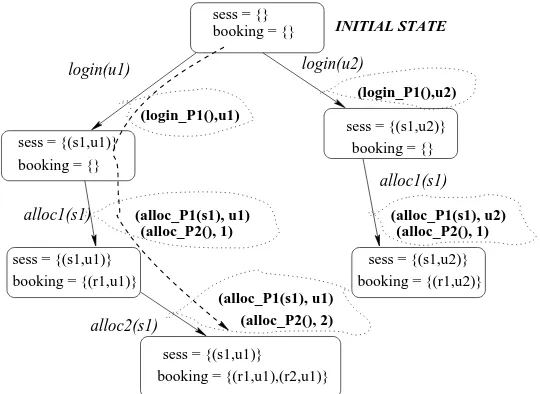
at least once; therefore, we try to generate a finite coverage graph so that each operation instance appears at least once. However, we may not be able to cover all operations because: (a) an operation may be infeasible, (b) a certain initialisation may prevent an operation from appearing or (c) an operation may not appear within the finite dimension of the graph. We now outline our construction process in the following steps. Figure 2 shows a coverage graph for TAgency1.mch. The probe calls and their results are shown within the dotted regions.
– Step 1: Create an initial node (the root) in which the variables of the B
machine get the assignments of the INITIALISATION clause.
– Step 2:Take any node in the graph calledsourcewhere all the state
vari-ables are already available as ground terms. If the precondition of a non-probe operation holds at source, apply this operation to obtain the target state. Create a new node for target state only if an identical state does not already exist. Label the edge (source,target) with the operation call.
– Step 3: For each probe operationpop()of OP(), make a call to it at the
target state to obtain the resultres. Attach to the edge just created the pair (pop(), res). If enough coverage has not been done then jump to Step 2.
Note that our method can be tuned to many other testing criteria; the graph creation process needs to be changed accordingly.
Generation of Test Sequences: We traverse the coverage graph to generate
booking = {}
booking = {} sess = {(s1,u1)}
sess = {(s1,u1)} booking = {(r1,u1)}
sess = {(s1,u1)} booking = {(r1,u1),(r2,u1)}
booking = {} sess = {(s1,u2)}
INITIAL STATE
(alloc_P1(s1), u1)
(alloc_P1(s1), u1) (login_P1(),u1)
(login_P1(),u2)
booking = {(r1,u2)} sess = {(s1,u2)}
(alloc_P1(s1), u2)
login(u1) login(u2)
sess = {}
alloc2(s1) alloc1(s1)
alloc1(s1)
(alloc_P2(), 1)
(alloc_P2(), 2)
[image:8.612.173.443.65.262.2](alloc_P2(), 1)
Fig. 2.A coverage graph for TAgency1.mch; dotted path shows one test case
Generation of a test driver: The test driver generator takes a set of test
cases and generate a code fragment in Java. This code when executed in a testing context will infer whether the SUT has passed the test cases. At present we consider code for a single test case; multiple test cases can be executed by assuming an initialize() operation to take control back to the initial state. When a new test case is executed after re-initialization, the operation parameters are freshly created; therefore, they are not in conflict with the parameters of the previous runs. By testing context, we mean the following:
– IfMM.mchis the B machine, then the SUT defines a class with nameMMand creates an object of the same class, saymmo. It is expected that class MM has all operations of the machine as methods with similar signatures.
– In any test case, if an operation has a parameterppas an element of setPP, then SUT must have the objectppof classPP.
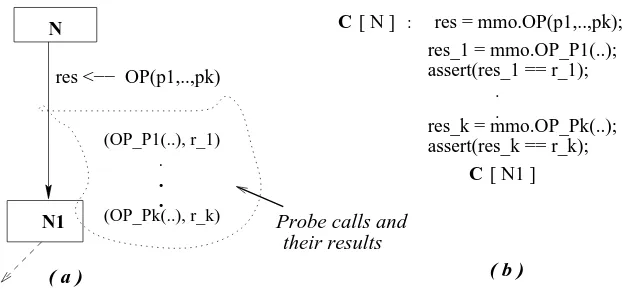
Refer to Figure 3(a). (N, N′) is an edge in the test sequence with ′res ←
OP(..)′ as the operation call. This edge has also kprobe calls along with their
results. The corresponding code in Java has been shown in Figure 3(b). C[N] stand for the code generated at nodeN. First a call to mmo.OP(...)is made. Then we obtain the results of the probe operations from the SUT which are compared with the results of the same operations stored in the test case; this comparison is performed by Java assertions. In (b), res 1,..., res k are the temporary variables to receive the probe results.
.
N1
N C [ N ] :
.
C [ N1 ]
assert(res_k == r_k); assert(res_1 == r_1);
res = mmo.OP(p1,..,pk); res_1 = mmo.OP_P1(..);
res_k = mmo.OP_Pk(..); res <−− OP(p1,..,pk)
(OP_P1(..), r_1) . . .
(OP_Pk(..), r_k) Probe calls and
their results
[image:9.612.151.462.63.213.2]( a ) ( b )
Fig. 3.Code generation from a test case
With these, the code in Table 2 if runs without any assertion violation it would mean that the SUT has passed the test case. Note that the generation of the code in Table 2 can easily be automated. It is to be further noted that the testing context must be provided by the implementor because it involves some design decisions like defining the constructors of various classes.
USER login t1, alloc t1; int alloc t2; TA1.login(u1); login t1= TA1.login P1();
assert(login t1==u1);
TA1.alloc(s1); alloc t1= TA1.alloc P1(s1); assert(alloc t1==u1);
alloc t2 = TA1.alloc P2(s1); assert(alloc t2== 1);
TA1.alloc(s1); alloc t1= TA1.alloc P1(s1); assert(alloc t1==u1);
alloc t2 = TA1.alloc P2(s1); assert(alloc t2== 2);
Table 2.Code for the test case in Figure 2
5
The Method II: Non-deterministic Models
OP(..)=. . . br←OP(..)=. . .
SELECT C1 THEN S1 SELECT C1 THEN S1 ||br := 1
. . . .
WHEN CkTHEN SkEND WHEN Ck THEN Sk||br := k END
Table 3.Making internal choices observable: SELECT statement
There are two primary categories of non-determinism in B [1]: unbounded choice through the ANY statement and bounded choice through the SELECT statement, both having the following syntax respectively.
ANYx1, . . . , xk WHERE SELECTC1 THENS1
P(x1, . . . , xk) . . .
THENSEND WHENCk THENSkEND
The ANY statement makes k non-deterministic choices satisfying the predi-cate P(x1, . . . , xk) which are used to perform the substitution S. For a
non-deterministic SELECT, the branching conditionsC1, . . . Ck do overlap; and then
one valid branch is selected in a non-deterministic way. In addition to SELECT and ANY, B supports non-deterministic assignments in initializations with the syntaxx :∈ Smeaning thatxis given any element ofS. However, this statement can always be converted to:ANY y WHERE y∈S THEN x:=y END.
5.1 Pre-processing of the B model
We make the internal choice – within an ANY statement or the branch selection in SELECT – visible by making the associated B operations more observable. This we do by introducing additional result parameters. Refer to the enterCard() in Appendix-A. We have added a result parameter to observe the internal choice made by the ANY statement. Similarly, we have also added a result parameter to login() to make its non-deterministic choice visible. We also make the branch choice that a non-deterministic SELECT makes observable by introducing an additional result parameter (refer to Table 3). We term the constraint under which a choice is made aschoice predicate. For ANY, it is the constraint within the WHERE clause. For SELECT, we define it to bebr∈ {1, .., k}, wherebr is the output variable introduced to capture which branch the SUT would select (refer to Table 3), andkis the number of branches.
5.2 Coverage graph for a non-deterministic model
Vect
AC
AssP
Vect’
AC’
AssP’
< P, y <−− OP(X) >
[image:11.612.200.406.62.224.2]Probe calls and their results
Fig. 4.Application of a non-deterministic operation
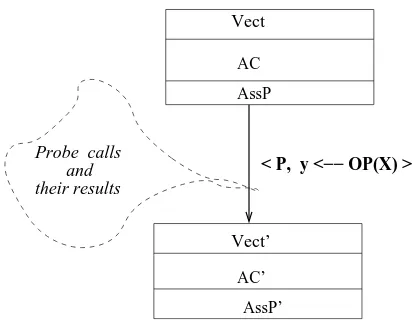
A node in the coverage graph is a tuple < V ect, AC, AssP >, where V ect is the state vector to store the bindings of expressions to state variables; these expressions may contain choice variables as sub-terms. AC is the set of accu-mulated constraints which essentially restricts the choice variables occurring in the expressions inV ect.AssP is an assertion which results from an application of a non-deterministic operation. For a nodeN, we refer to its fields by the dot notation such asN.V ect, N.AC etc.
Figure 4 shows an edge in the coverage graph, where< V ect, AC, AssP > constitute the source node. Let application of call OP(X)at the source would give us the target node < V ect′, AC′, AssP′ >. The edge between the source
and the target is labeled with < P, y←OP(X)>. The derivation process is as follows:
– Pis a predicate to check thatOP(X)is applicable at< V ect, AC, AssP >. If pre(OP(X)) is the precondition of OP(X) thenP is an expression over the choice variables occurring inV ectand is equivalent toAC∧pre(OP(X)) or its boolean simplification. We call it the Precondition Satisfaction Predicate (or PSP) which beingfalsewould mean thatOP(X)is not applicable.
– If OP() is a non-deterministic operation, y stands for the choice variable selected in place of the internal non-deterministic choice. Ifccis the internal choice in OP(), andcpredis the choice predicate, thenAssP′ is the reduced
form of the constraintcpred[y/cc]; i.e., the substitution ofy in place of the free occurrences ofccincpred.
– V ect′ is the reduced form ofV ect[body(OP(X))] wherebody(OP(X)) is the
substitution in relation toOP(X).
– AC′ is the accumulated constraint of the target node and is equivalent to the
reduced form of (AC∧P∧AssP′). Note thatAC′ always includesAssP′.
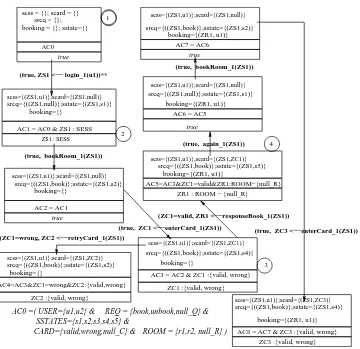
For the initial node,AC is initialized to the constraints made out of the set declarations and the constraints. Figure 5 shows a part of the coverage graph for the B machine TAgency2. The node marked ’1’ is the initial node. ItsACfield is initialized toAC0 as given in the figure. TheV ectfield here corresponds to the INITIALIZATION clause of the machine.AssP is given the trivial value oftrue. In node 2, ZS1 represents the non-deterministically selected session identifier. Now consider the call of responseBook1(ZS1) at node 3. Observe how the choice variableZS1 has been used as a parameter. Now consider the application of the following operation instance at node 3:
rstatus←responseBook1(sid) =
PREsid∈SESSION∧sid∈dom(session)∧
s req(sid) =book ∧ s state(sid) =s4∧
s card(sid) =valid∧dom(booking)⊂(ROOM−nullR)
THEN
ANYrrWHERErr∈(ROOM−null R)−dom(booking) THEN booking(rr) := sess(sid)||rstatus :=rrEND||. . . END
The predicate AC3 ∧ pre(responseBook1(ZS1)) reduces to ZC1 = valid to become thePSPof the current call. IfZR1 is the choice variable due to ANY, then (rr∈(ROOM−nullR)−dom(booking)) [ZR1/rr] reduces toZR1∈(ROOM− nullR) to becomes the AssPof the target node. Substitution of the operation
body over theVectorof the source node, gives us the newVector. Finally,AC3 augmented with thePSPand theAssPbecomes theAC of the target node.
5.3 Test cases from non-deterministic models
As in the case of deterministic models, the coverage graph could be traversed to generate a set of linear test cases. We will term those as basic test cases; they will be combined to form adaptive test cases. If we treat a basic test case as a test case proper, then consider the case when SUT control encounters an edge with a non-trivial PSP and it does not hold. For example, in Figure 5, if edge (ZC1 = valid, ZC1 ←responseBook(ZS1)) occurs in a basic test case, then ZC1 =validcould be false, and then there is no point in following this edge any further. In the worst case scenario, we may not be able to test any of the basic test cases into completion. Adaptive test cases are introduced precisely for this purpose. An adaptive test case in the coverage graph is a subgraph in the form of a tree with the following properties:
– Its root is same as the root of the coverage graph.
– The paths from the root to the leaves are mutually exclusive in that at any non-leaf node, thePSPs of its outgoing edges are mutually contradictory. In this way we would be able to test all the paths of the test case by a single threaded test driver.
booking = {}; sstate={}
(ZC1=valid, ZR1 <−−responseBook_1(ZS1))
ZR1 : ROOM − {null_R} 1 sess={(ZS1,u1)};scard={(ZS1,ZC1)} sreq={((ZS1,book)};sstate={(ZS1,s5)} booking={(ZR1, u1)} AC5=AC3&ZC1=valid&ZR1:ROOM−{null_R} 2 4
(true, ZC3 <−−enterCard_1(ZS1)) (true, again_1(ZS1))
true
AC6 = AC5 booking={(ZR1, u1)} sreq={((ZS1,null)};sstate={(ZS1,s1)}
sess={(ZS1,u1)};scard={(ZS1,null)} (true, bookRoom_1(ZS1))
true
AC7 = AC6 booking={(ZR1, u1)} sreq={((ZS1,book)};sstate={(ZS1,s2)}
sess={(ZS1,u1)};scard={(ZS1,null)}
sess = {}; scard = {} sreq = {};
AC0 true
(true, ZS1 <−− login_1(u1))**
sess={(ZS1,u1)};scard={(ZS1,null)}
sreq={((ZS1,null)};sstate={(ZS1,s1)} booking={}
AC1 = AC0 & ZS1 : SESS ZS1 : SESS
(true, bookRoom_1(ZS1))
sess={(ZS1,u1)};scard={(ZS1,null)}
sreq={((ZS1,book)};sstate={(ZS1,s2)} booking={}
AC2 = AC1
true
(ZC1=wrong, ZC2 <−−retryCard_1(ZS1))
sess={(ZS1,u1)};scard={(ZS1,ZC2)}
sreq={((ZS1,book)};sstate={(ZS1,s2)} booking={}
AC4=AC3&ZC1=wrong&ZC2:{valid,wrong}
ZC2 :{valid, wrong}
(true, ZC1 <−−enterCard_1(ZS1))
sess={(ZS1,u1)};scard={(ZS1,ZC1)}
sreq={((ZS1,book)};sstate={(ZS1,s4)} booking={}
AC3 = AC2 & ZC1 :{valid, wrong}
ZC1 :{valid, wrong}
3
sess={(ZS1,u1)};scard={(ZS1,ZC3)}
sreq={((ZS1,book)};sstate={(ZS1,s4)}
booking={(ZR1, u1)}
AC8 = AC7 & ZC3 :{valid, wrong} ZC3 :{valid, wrong}
REQ = {book,unbook,null_Q} & AC0 =( USER={u1,u2} &
SSTATES={s1,s2,s3,s4,s5} &
[image:13.612.138.498.59.408.2]CARD={valid,wrong,null_C} & ROOM = {r1,r2, null_R} )
Fig. 5.Part of the coverage graph for TAgency2.mch
algorithm is given in [20]. Refer to Figure 5. In this tree all paths from the root to leaves can be seen as basic test cases. Only the node marked 3 has outgoing edges with non-trivial PSPs. The PSPs of the two outgoing edges of this node areZC1 =validandZC1 =wrong, and hence mutually contradictory; so, the whole tree in the figure produces the single adaptive test case.
5.4 Test Driver Generation
term Reduced Terms condition NULL null null object reference dom(R){s1, . . . , sk} R={(s1, t1), . . . ,(sk, tk)}
ran(R) {t1, . . . , tk} R={(s1, t1), . . . ,(sk, tk)}
[image:14.612.159.458.65.137.2]R−1 {(t1, s1). . . ,(tk, sk)} R={(s1, t1), . . . ,(sk, tk)} F(si) ti F={(s1, t1), . . . ,(sk, tk)};F is a function
Table 4.Schema Rules for reducing some B terms
work with. When it allocates a session there is no need to check the model predicateZS1∈SESSION because it would be trivially satisfied by the type checking rule of Java. But if a null object reference is returned then from the view point of testing there is no need to check the subsequent operation calls. In summary, when an element of a deferred set is obtained it must be checked for non-nullness. To signify that in the coverage graph of Figure 5, we have marked the edge joining nodes 1 and 2 with ’**’.
B predicates to Java Assertions While generating a coverage graph, we
ob-tain predicates which involves choice variables. Let us call thesegraph predicates. They are different from model predicates, the predicates occurring in a B model. We require a Set Constraint Solver (SCS) to translate any graph predicate into Java assertions. The development of such a SCS in general is a challenging task. In this paper we consider a simple SCS and so we put restrictions on model predicates which in turn restrict the graph predicates. If xis an internal choice — likeccin enterCard() orrrin response book() — the syntactic constraint on model predicates is that, it can be of the form: x∈S∧ P, whereS is either a deferred set or an enumerated set or a basic set (Bool or Int), and P includes finite number of (state) variables and constants. For instance, in login(), the model predicatesid∈SESSION∧sid /∈dom(sess) is of this form.
SCS performs two main tasks: (a) to evaluate a graph predicate — involv-ing choice variables, sets, relation, function etc. — to obtain PSPs; this can be done by extending Constraint Logic Programming (CLP) to sets, relations and functions; and (b) to reduce the PSPs and the AssPs into Java assertions.
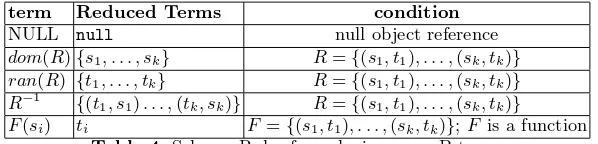
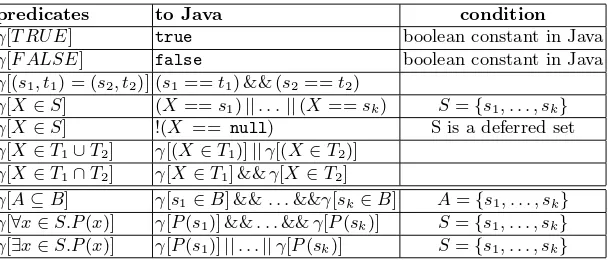
Table 4 shows the reduction rules for some terms in graph predicates. Table 5 shows the rules to reduce some graph predicates to Java assertions by a trans-lation functionγ. Note that eachsi or ti stands for a term occurring in graph
predicates. We assume that the reduction of terms can be performed by syn-tactic checking only. For instance, the reduction of{(ZS1, u1),(ZS2, u2)}(ZS2) can be done by syntax checking, whereas that of {(ZS1, u1),(ZS2, u2)}(ZS8) given thatZS8∈ {ZS1, ZS2}can not be performed by syntactic checking alone. Though the latter terms can be reduced to Java by defining more and more rules, we do not consider them here.
Test Driver Generation Algorithm The test driver generation algorithm
predicates to Java condition
γ[T RU E] true boolean constant in Java
γ[F ALSE] false boolean constant in Java
γ[(s1, t1) = (s2, t2)] (s1==t1) && (s2==t2)
γ[X ∈S] (X==s1)||. . .||(X==sk) S={s1, . . . , sk}
γ[X ∈S] !(X == null) S is a deferred set γ[X ∈T1∪T2] γ[(X ∈T1)]||γ[(X∈T2)]
γ[X ∈T1∩T2] γ[X∈T1] &&γ[X ∈T2]
γ[A⊆B] γ[s1∈B] &&. . .&&γ[sk∈B] A={s1, . . . , sk}
γ[∀x∈S.P(x)] γ[P(s1)] &&. . .&&γ[P(sk)] S={s1, . . . , sk}
[image:15.612.158.463.64.194.2]γ[∃x∈S.P(x)] γ[P(s1)]||. . .||γ[P(sk)] S={s1, . . . , sk}
Table 5.Schema rules for transforming some B predicates
A junction nodes gets transformed to an if-elseif-elsestatement, and the PSPs of the branches become theif (or elseif)conditions. In addition, there has to be anelseclause because the set of the PSPs may not be exhaustive. If during testing, SUT control enters thiselse branch, this would mean that we cannot carry out testing any further; appropriate message can be given to the tester in this case. A detailed discussion on this situation has been given in [20]. Leaving aside the PSPs, in relation to a branch in the test case, we encounter a sequence of operation applications which may have assertions (AssPs) and they become Java assertions in the code. We show this by generating code for the single adaptive test case of Figure 5; the code has been shown below. Observe how the branching in the code corresponds to the branching in the adaptive test case. We do not show the testing context here since it remains the same as earlier.
SESSION ZS1; ROOM ZR1; CARD ZC1,ZC2; USER temp u; int temp c;
ZS1 = TA2.login(u1);assert(ZS1 ! = null); TA2.bookRoom(ZS1); ZC1 = TA2.enterCard(ZS1); assert(ZC1 ==valid||ZC1 ==wrong);
if (ZC1 == wrong){// PSP of 1st branch holds ZC2=TA2.retryCard(ZS1);
assert(ZC5 ==valid||ZC5 ==wrong);
}else if (ZC1 == valid){// PSP of next branch holds ZR1=TA2.responseRoom(ZS1);
assert(ZR1 ==u1||ZR1 ==u2||ZR1 ==u3); temp u = TA2.whichUser(ZS1); assert(temp u==u1); temp c = TA2.numOfRoomsBooked(); assert(temp c== 1);
}else{
Sys.out.println("SUT control deviated; testing stops");
6
Implementation
ProB is a model checking and animation tool for B machines [16]. ProB includes a fully automatic animator written in SicStus Prolog. An extension of ProB will be our implementation platform. As of now, we have implemented testing of a SUT written in accordance with a deterministic B model. We have made the following steps automatic so far.
– Given a B operation with its precondition enriched with tautologies (refer to Section 4) we generate a set of operation instances.
– Given a B model, we generate a Java signature template for all B operations.
– After restricting the sets to be finite, the current tool automatically creates a coverage graph (now no deferred sets).
– We traverse the coverage graph to generate a set of preset test cases; this is because we consider deterministic models only.
– Given a set of test cases, we generate a test driver which when augmented with the testing context performs automatic testing of a Java implementa-tion.
Now the development of a SCS to handle a subset of B predicates is under progress. This will enable us in handling non-deterministic models.
7
Discussion
– Making the whole testing cycle automatic in presence of non-determinism is an important contribution of our work. It is often the case that non-determinism in B is gradually refined out in the B refinement process, but our strategy does not assume the implementation to be deterministic. Were the implementation non-deterministic, our method would work without any change. Existing testing tools likeBZ-TT[2] avoid the issues related to non-determinism.
– The tester (or the specifier) has to write a set of probe operations for each B operation. In this paper, we have kept this step outside of the scope of our testing cycle. However, we believe writing a set of probe operation from the domain knowledge and the intention of the operation is too ad-hoc an ap-proach. Probe operations should be made finer by generating them from the model in a systematic manner. One possibility is to define abstract functions mapping the concrete states of the Java program to the abstraction level in the B machine. This issue requires further research.
– Our method can create a coverage graph in presence of deferred sets.
– For the development of a SCS, we took a simple subset of the B predicates. However, this is a useful subset since we have examined a number of examples and seen that this subset is sufficient. The examples include B models for a larger version of the travel agency example, the router component of a Network-on-Chip system and a component of a TV teletext system. The problem of implementing a robust SCS will require further research.
8
Conclusion
We have discussed how a test driver in the form of a Java program can be mechanically generated from a B model, possibly non-deterministic, to perform automatic testing. The constraints arising out of non-deterministic choices and oracle information matching become Java assertions in the test driver which if runs without any assertion violation would mean that the implementation has passed the test cases. Our approach can generate the test driver much before the implementation; however, it assumed that the implementation should adhere to the Java signature template obtained from the model. We have made compar-isons of our research with existing work, the important contributions being the handling of non-determinism.
Acknowledgement: We would like to thank Linas Laibinis for going through
an earlier version of this work and offering many a useful suggestion. The com-ments of the anonymous reviewers also helped us in improving the quality of this paper.
References
1. Abrial J.-R. (1996). The B–Book: Assigning Programs to Meanings, Cambridge University Press.
2. Bernard E., Legeard B., Luck X., Peureux F. (2004). Generation of test sequences from formal specifications: GSM 11-11 standard case study,Software Practice and Experience, Volume 34 (10) , pp. 915 - 948.
3. Colin, S., Legeard, B., Peureux, F. (2004). Preamble computation in automated test case generation using constraint logic programming, Software Testing Verifi-cation and Reliability, John Wiley, Vol. 14: 213–235.
4. Dick, J.; Faivre, A. (1993). Automating the Generation and Sequencing of Test Cases from Model-based Specifications, Proc. of the FME’03, LNCS 670. pp. 268– 284.
5. Dalal, S.R., Jain A., Karunanithi, N., Leaton J.M., Lott C.M., Patton G.C., Horowitz B.M. (1999). Model Based Testing in Practice, Proc. of ICSE ’99. 6. El-Far, I.K., Whittaker, J.A. (2001). Model Based Software Testing,Encyclopedia
on Software Engineering (Ed. J.J. Marciniak), John Wiley.
7. Gannon, J.D., Hamlet R.G., Mills, H.D. (1987). Theory of modules, IEEE Trans-actions on Software Engineering, 13(7):820–829.
9. Gurevich, Y. (2000). Sequential Abstract-State Machines Capture Sequential Pro-grams, ACM Transaction on Computational Logic, Vol 1(1): 77–111.
10. Hierons R.M. (2004). Testing from a Non-deterministic Finite State Machine using Adaptive State Counting, IEEE Transactions on Computers, Vol 53(10), pp. 1330-1342.
11. Hierons R.M. (2006). Applying Adaptive Test Cases to Non-deterministic Imple-mentations,Information Processing Letters, 98(2006): 56–60.
12. Jones, C.B. (1990). Systematic Software Development using VDM (2nd Edn), Prentice Hall.
13. Lee, D.; Yannakakis, M. (1996). Principles and Methods of Testing Finite State Machines: A survey, Proc. of the IEEE, 80(8): 1090–1123.
14. Legeard, B., Peureux, F., Utting, M. (2002). Automatic Boundary Testing from Z and B, Formal Methods Europe ’02, LNCS Volume 2391, Springer, pp. 21–40. 15. Legeard, B., Peureux, F., Utting, M. (2004). Controlling test case explosion in test
generation from B formal models, Software Testing, Verification and Reliability, John Wiley, pp.81–103.
16. Leuschel, M., Butler M. (2005). ProB: A Model Checker for B, Proc. FME’03, LNCS Volume 2805, Springer, pp. 855–874.
17. Nachmanson L., Veanes M., Schulte W., Tillmann N. and Grieskamp W.(2004). Optimal Strategies for Testing Nondeterministic Systems, ACM ISSTA’04, Boston, July 2004.
18. Panzl, D.J. (1978). Automatic Software Test Drivers, IEEE Computer, 11(4). 19. Richardson D.J., Leif Aha A., O’Malley T.O. (1992). Specification-based Test
Or-acles for Reactive Systems, Proc. of the 14th ICSE, Melbourne, pp. 105–118. 20. Satpathy, M., Butler,M., Ramesh, S.,Leuschel, M. (2006). Automatic Testing of
Formal Specifications, Technical Report 792, Abo Akademi University, Turku, Fin-land. (available at:http://www.tucs.fi/publications)
21. Satpathy, M., Leuschel, M., Butler,M. (2005). ProTest: An Automatic Test Envi-ronment for B Specifications,Electronic Notes on TCS (ENTCS), 111, pp: 113–136. 22. Spivey, J.M. (1988).Understanding Z, Cambridge University Press.
23. Yannakakis M., Lee D.(1995). Testing Finite State Machines: Fault Detection,
Journal of Computer and System Sciences, Vol. 50, pp.209–277.
24. Zhang F. and Cheung T.(2003). Optimal Transfer Trees and Distinguishing Trees for Testing Observable Nondeterministic Finite State Machines, IEEE Transactions on Software Engineering, Vol 29(1): 1–14.
25. Zhu, H., Hall P.A.V., May J.H.R. (1997). Software Unit Test Coverage and Ade-quacy,ACM Computing Surveys, 29(4):366–427.
Appendix – A
MACHINETAgency2
SETS SESSION; /* A deferred set */
USER ={u1, u2}; REQ={book, unbook, null r}; SSTATES={s1, s2, s3, s4, s5};
CARD ={valid, wrong, null C}; ROOM ={r1, r2, null R}
VARIABLESsess, scard, sstate, sreq, booking/* all partial functions */
INVARIANTsess∈SESSION +→ U SER∧scard∈SESSION +→CARD∧
sstate∈SESSION +→ SST AT ES∧sreq∈SESSION +→REQ∧
OPERATIONS
id←− login(uu) = PREuu∈U SERTHEN
ANYsidWHEREsid∈SESSION∧sid /∈dom(sess) THEN sess(sid) :=uu||s card(sid) :=null C||
s state(sid) :=s1||s req(sid) :=null r
||id:=sid END END;
bookRoom(sid) = PREsid∈SESSION∧sid∈dom(sess)∧
s state(sid) =s1∧s req(sid) =nullr
THENs state(sid) :=s2||s req(sid) :=book END;
unbookRoom(sid) =. . .
cstatus←− enterCard(sid) = PREsid∈SESSION∧sid∈dom(sess)∧
s state(sid)∈ {s2, s3}
THENs state(sid) :=s4||
ANYccWHEREcc∈ {valid, wrong}
THENs card(sid) :=cc||cstatus:=cc END END;
cstatus←−retryCard(sid) = PREsid∈SESSION∧sid∈dom(sess)∧
s state(sid) =s4∧ s card(sid) =wrong THEN ANYccWHEREcc∈ {valid, wrong}
THENs card(sid) :=cc||cstatus:=cc END END;
rstatus←−response book(sid) =
PREsid∈SESSION∧sid∈dom(sess)∧s req(sid) =book∧
s state(sid) =s4∧ s card(sid) =valid THENs state(sid) :=s5||
IFdom(booking)⊂(ROOM− {null R}) THEN
ANYrrWHERErr∈(ROOM− {null R})−dom(booking) THENbooking(rr) :=sess(sid)||rstatus:=rrEND ELSErstatus:=null R
END END;
rstatus←−response unbook(sid) = . . . again(sid) = . . .