Article for Ecology and Farming, June 2004 special issue on Principles of Organic Agriculture First version, 20. April 2004
Basic principles for organic agriculture: Why? And what kind of principles?
Hugo Fjelsted Alrøe and Erik Steen Kristensen*Recently, discussions of basic principles for organic agriculture (and similar ideas) have emerged in several different settings (Benbrook & Kirschenmann 1997, DARCOF 2001, Lund & Röcklinsberg 2001, Verhoog & al. 2003, this issue of Ecology & Farming). In this article we discuss the purposes and functions of such principles and what the principles should look like in order to meet these purposes. We state that there is a need for identifying a few basic principles for organic agriculture, and that the principles must be normative, or ethical, principles on how to act in an organic way, if organic farming is to continue as a distinct alternative to mainstream agriculture. We argue that basic normative principles can help resist unwanted developments; support the development and extension of organic agriculture into new areas, the planning of proactive research, and the development of organic rules; and serve as a guide for practice and development that, to some degree, will lessen the need for ever more rules. Finally, we present examples of how such principles can be formulated.
Background
Agriculture and food production is in a period of change. In the more industrialised countries, agricultural production has been intensified and specialised through decades and food security is no longer a problematic issue. There is a widespread disapproval of this structural and technological development and society makes ever-increasing demands for a reduction in the use of traditional agricultural inputs such as pesticides, artificial fertilisers, and prophylactic medicines.
In the less industrialised countries food security is often a problem of key importance, and some advocate industrialised inputs as the solution to insufficient food production. Others are concerned about the consequences of globalisation for smallholder farmers in form of, for example, for-profit promotion of technological agriculture by multinational corporations and dumping of state
supported food from surplus productions in high-income countries.
In this context, there is an increasing interest in organic production methods. Organic farming represents an alternative and more holistic view of agriculture and food production, which directly addresses the problems faced in many areas of conventional agricultural practice. Concerns for environment and nature, livestock welfare, and food quality are thus essential elements of the philosophy behind organic farming.
Consequently, the demand for organic products has grown, and in recent years organic farming has gone through a quite dramatic growth and development in many high-income countries. This development has, in many ways, been quite similar to the development of conventional agriculture. Some characteristic features of modern organic agriculture are:
− large-scale production – in many countries, organic farms are on average as big as or bigger than the conventional
* Hugo Fjelsted Alrøe is Postdoctoral Scientist at the Danish Research Centre for Organic Farming (DARCOF) and
member of the IFOAM Task Force on Rewriting the Principles of Organic Agriculture. Erik Steen Kristensen is Chief Scientist at DARCOF. Contact address: DARCOF, P.O.Box 50, DK-8830 Tjele, Denmark.
Internet: http://www.darcof.dk, phone: +45 8999 1679, fax: +45 8999 1673, email: hugo.alroe AT agrsci.dk
− processing and marketing through large conventional food companies − sale through supermarkets, sometimes using supermarket brands − trade of feed, seed and other inputs through conventional companies − global trade with organic feed and food products
This development of modern organic agriculture has, on the other hand, led to concern that the organic practice is deviating from the original organic values and principles. There is therefore a new and renewed interest in values and principles of organic farming that can guide the future development.
Why do we need basic principles?
The main purpose of identifying and communicating the basic principles of organic agriculture is to determine what organic agriculture is and thereby guide its development. Today, organic agriculture is mostly characterised by its rules, and this is not good enough. Organic agriculture is a living thing in a living and still more globalised world.
Basic principles are, first of all, needed to counter the ongoing structural and technological developments, which are propelled by other values and general social mechanisms.
The need for principles is especially evident with respect to the multitude of new options and technologies that organic farming is faced with due to the running technological development and increasing globalisation. The surrounding world grows and changes, and organic agriculture changes with it, unless something tells it not to. Here the principles can be a guide as to where the ongoing development is to be controlled or stopped. Some of the new technologies and
developments are acceptable and useful to organic agriculture, while others go against the basic values and principles. The existing regulations, standards and principal aims of organic farming are not always, in themselves, adequate as a guide for development in this rapidly changing world. Basic principles can be a tool to evaluate the development, correct the course, and avoid unwanted consequences by way of timely care.
In a more constructive spirit, principles of organic agriculture are needed in all those areas where concrete rules have not yet been developed, where rules are hard to make, or where rules as such will tend to work against the organic spirit. Basic principles are needed to guide the development of "organics" in new production areas such as fishery, forestry, industry, etc., where new practices, standards and aims have to be developed on the basis of the organic ideas and values. Likewise, basic principles are needed to guide the development of organic agriculture in new geographical areas where the practices, standards and aims will be somewhat different due to differences in the cultural and natural conditions. Basic principles have also been advocated as a needed tool for researchers to initiate far-seeing, proactive research that can assist the development of organic agriculture, and the sustainable development of agriculture in general, in line with the characteristic ideas and values of organic farming (DARCOF 2000).
relieve the rules of some of their duties, so that the present trend towards more and more complex and complicated rules can be stopped and reversed (see e.g. Organic Revision 2004).
In connection with the above-mentioned trend, there is even a concern whether a more focused formulation of the organic values is needed to sustain the organic movement itself. There is much work today on organic marketing concepts done by large, not-exclusively-organic companies and a continued elaboration of organic rules carried out by states and supranational bodies, but neither of these can continue and reproduce the organic movement as a distinct form of agricultural
development. If a social movement is to continue to exist as a coherent, self-organising system, the core ideas, values, and visions need to be reproduced by the system itself in order to create and uphold the identity of the movement (Noe 2003). The principles may be the pivot that organic agriculture can organise itself around, by way of expressing the key goals and values, the essential meaning, of organic agriculture
What kind of principles is needed?
In summary, basic principles are needed to help steer the course of organic agriculture and focus the organic movements. The principles should serve directly as guidelines for practices and
developments and as a basis for developing more detailed principles, decision criteria, standards and rules. Given these purposes and functions, what form should the principles have? What kind of principles is needed?
In order for the principles to function as guidelines and organising principles, they need to be normative – that is, some kind of moral or ethical principles. Goals are not sufficient, because goals can be reached, but not used for setting new goals. Rules are not sufficient because concrete rules are to be developed in accordance with deeper goals or principles. Law-like or nature-given principles, like the principles of physics, are certainly insufficient, because they merely state how the world is and not how it should be. Values as such, or value-laden differences as commonly used in marketing concepts, are not sufficient, because they only refer to individual preferences and have no guiding force. We claim that the organic movements are concerned with more than preferences; they are concerned with the proper way to do agriculture and produce food – how it ought to be done. Therefore, the kind of principles that is needed, is normative or ethical principles for how to act "in an organic way". By being ethical (ethical principles, ethical values) they claim to hold for others as well as for one self. They state how responsible beings ought to behave, as opposed to simple values, aims, preferences, etc., which bear no such claim in themselves (see Alrøe & Kristensen 2003 for a detailed analysis of ethics from the perspective of organic agriculture).
If the principles are to function as guidelines and "identity creators", they must be easy to
communicate and support decision making. Therefore, they should be few in number, they must not contradict each other, and they should not have excessive overlaps. They should be sufficiently general and not directed at any specific area, yet concrete enough to serve as a guide for
development.
How to identify the principles?
There are different means of identifying normative principles of organic agriculture. We can, and should, look to the historic documents of organic farming to get ideas about the worldviews and values that characterise the organic movements. But we will not find a finished set of normative principles for organic agriculture there, because the organic movements have not previously
decided to formulate such a set of principles (there are some recent examples though, which we will present below).
The values and goals of organic agriculture are expressed in the principal aims, general principles and standards that have been formulated by the organic movements, and these are important means to identify the principles. Normative principles cannot, however, be directly read out of the
principal aims, and the demand for consistency must have priority over existing aims and principles. The values of organic farming are also expressed in the organic practice, so one might consider deducing the principles from the established practice. The problem in this is that, as mentioned above, there is a concern that the organic practice is actually deviating from the original values. Therefore, we might, on the contrary, wish to use the principles in an evaluation and critique of the use of new technology in organic farming1.
We cannot expect to find the organic principles among the mainstream normative principles of applied ethics, because organic farming is an alternative movement that represents a break with the mainstream. On the other hand, we might find appropriate principles in the other alternative
movements that organic farming is related to, such as the various environmental movements. Organic farming arose mainly from practice and reflections on practice, and there isn't (yet) a separate "normative theory of organic agriculture". The environmental movements, on the other hand, have spurred separate theories of environmental ethics. But these movements and theories do not necessarily share the view of nature found in the organic movement, and this is a decisive difference (see e.g. Tybirk et al. 2004, Alrøe & Kristensen 2003).
Therefore, it is important to first identify the characteristic "organic views" of nature and humans, which can then be used as necesssary means to identify the basic normative principles. These views probably differ somewhat within the organic movement, and they may not be particular to it. Still, as a preliminary suggestion, we pose the following characteristic views of the relation to nature, of scientific knowledge and of human experience and interaction: A) Humans are part of nature. Social systems can be distinguished from natural systems, but not separated from them. B) Scientific knowledge of complex systems will always be limited and contextual. Some technological
consequences are unforeseeable. C) Living and learning is both experiential (hands-on) and social (co-operative). Organic food systems are networks of actors. However, even if these views are deeply influential in the organic movements, they can only suggest normative principles, not justify
them (see figure 1).
Basic "organic views"
of human and nature Basic principles for acting"in an organic way"
Not particular to, but characteristic of the organic movement
Not justification,
[image:5.595.130.453.97.226.2]but suggestion To be discussed and confirmed by the organic movement
Figure 1
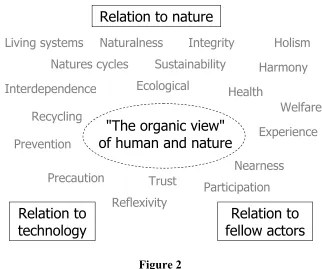
Given these means of identifying normative principles of organic farming, it seems that the formulation of such principles is best done on the basis of an intimate knowledge of the views, values and aims of the organic movement, connected to a knowledge of other normative principles and ethics in general. Within the field of suitable normative principles there will presumably be quite a few possibilities to choose from, and some will have to be chosen that can cover the field. Figure 2 shows a range of more or less value-laden concepts that may be developed into principles of organic agriculture. The concepts all relate to "the organic view" of human and nature, and they are placed in relation to different aspects of "acting in an organic way": The relation to nature, to technology, and to fellow actors in the organic food systems.
Naturalness
Recycling
"The organic view"
of human and nature
Prevention Experience
Participation Interdependence
Trust Reflexivity
Health
Harmony Integrity
Natures cycles
Ecological
Precaution Nearness
Welfare Sustainability
Relation to
technology
Relation to nature
Relation to
fellow actors
[image:5.595.135.457.388.657.2]Holism Living systems
Figure 2
On this empirical and theoretical basis, we may choose and formulate a coherent and consistent set of normative principles for organic agriculture. The suggested principles cannot, however, be fully justified on this basis. The decision that they are the proper normative principles of organic
Examples of normative principles of organic agriculture
In the above discussion it is tacitly presumed that it is possible to formulate a small set of normative principles for organic agriculture that works at a deeper level than the IFOAM principal aims. This presumption is substantiated by the fact that such principles have actually been formulated in recent years.
We know of two independently formulated sets of normative principles for organic agriculture; one motivated by new organic rules (Benbrook & Kirschenmann 1997) and one motivated by research needs (DARCOF 2000). There are also some recent closely related approaches that seek to
characterise the values of organic agriculture without specifically formulating a full set of normative principles. Lund and Röcklinsberg (2001) identified three "core values" of organic agriculture: 1) aim for holistic view, 2) aim for sustainability and 3) respect for nature, which they employed in an outline of a conception of animal welfare for organic farming systems. Verhoog et al. (2003) analysed the conception of the natural or naturalness in organic farming. They identified three main approaches in organic agriculture related to naturalness: 1) the no-chemicals approach, 2) the ecological approach and 3) the integrity approach. And they concluded that, if it refers to all these three approaches, the principle of naturalness can serve as a guide to future developments in the field of organic agriculture.
The first full set of principles arose in the process of formulating a new organic "rule" in the USA. The rule suggested by the United States Department of Agriculture (USDA) was met by serious criticism by the organic movement (Kirschenmann & Kirschenmann 1998, Lutz 2000). As an element in the discussion of the rule, Charles Benbrook and Fred Kirschenmann proposed a set of organic principles (and a set of administrative principles, which we will not address here) for evaluating the organic "rule" (Benbrook & Kirschenmann 1997). The three principles are: 1) the ecological principle, 2) the precautionary principle, and 3) the systems principle2.
The second full set of principles arose in the process of planning a new Danish research effort in organic farming. In this planning process the principles of organic farming and their role in the future development came up for discussion. The new research should be proactive and forward-looking, have a long-term perspective, and help to promote organic principles. These objectives could only be fully satisfied, however, if a degree of consensus was reached on the principles of organic farming. In order to support this discussion, the Danish Research Centre for Organic
Farming prepared a discussion document (DARCOF 2000) on the "Principles of Organic Farming".
2Ecological Principle. Organic production should fit into and benefit from nature's systems. Dual goals should guide
farm management decision-making: producing high quality, safe food in a manner that tends to preserve the integrity and stability of the biotic community, and builds, or at least sustains, the inherent productive capacity of the soil and biological resources used in the production process. Organic processing should, as much as possible, retain the integrity of the product so produced. Any deviation from this ideal, in production or processing, should only be allowed when there is clearly demonstrated need, and must not undermine the long-term goals of building soil productivity and producing nutritious, safe food that consumers can buy and enjoy with confidence.
Precautionary Principle. Any materials used in the production or processing of organic food must be proven safe. No materials will be allowed simply because they have not been proven unsafe or because benefits may appear to outweigh risks.and uncertainties. The burden of proof shall always be on the party wishing to use the material. and contending it is safe.
Three general principles for how to develop organic farming are set out in the document: 1) the cyclical principle (later also referred to as the ecological principle), 2) the precautionary principle and 3) the nearness principle.
In a formulation from Alrøe et al. (2002), the three principles are describes thus:
1. The cyclical principle is a principle for how to interact with nature. It says that organic food systems should emulate and benefit from nature's systems and cycles, fit into them, and help sustain them. This is the oldest and most established organic principle. Kindred concepts are the ecological principle and the idea of naturalness.
2. The precautionary principle is a principle for how to make decisions on changes in technology and practice. It says that action should be taken to prevent harm, even if there is no conclusive scientific evidence that this harm will occur. The principle also calls for the active promotion of cleaner, safer technologies and comprehensive research to detect and reduce risks.
3. The nearness principle is a principle for how to learn and communicate in food systems. It says that possibilities for personal experience and close contact between consumers, producers, researchers and other organic actors should be created and maintained. All relevant actors should be encouraged to take part in the development of organic agriculture. This participation should be facilitated by promoting transparency and cooperation in the production and
communication processes in the organic food systems.
Conclusion and perspectives
The principles of organic agriculture are concerned with how agriculture and food production ought
to be done. Therefore they have to be normative or ethical principles with sufficient generality and guiding force. But they will not be comprehensive principles for a better world or general principles on how to behave in life. They will only concern certain aspects of our lives and actions, focusing on our relation to natures systems and cycles in food production, and on closely linked aspects such as our abilities to act in relation to nature (technology) and our connections in the networks of actors in which food is produced and consumed. It seems, however, that there is nothing to prevent these principles from being applied more generally on other human interactions with nature. The precautionary principle arose in such a broader environmentalist setting. And the nearness principle is closely related to even broader democratic principles. As ethical principles they are of a general nature. This means that, from the perspective of organic agriculture, these principles ought to be followed outside the organic movements as well as inside them. But, of course, other groups or individuals may disagree with these normative principles.
References
Alrøe, Hugo Fjelsted and Erik Steen Kristensen (2003) Toward a Systemic Ethic: In search of an Ethical Basis for Sustainability and Precaution. Environmental Ethics 25(1): 59-78. [Available online at http://orgprints.org/00000552 ]
Alrøe, Hugo Fjelsted and Kristensen, Erik Steen and Hansen, Birgitte (2002) Identifying the basic normative principles for organic farming. Paper presented at 14th IFOAM Organic World Congress, Victoria, Canada, 21-24 August 2002; Published in Cultivating Communities, page 281. Canadian Organic Growers (COG). [Available online at http://orgprints.org/00000060 ]
DARCOF (2000) Principles of organic farming: Discussion document prepared for the DARCOF Users Committee. Danish Research Centre for Organic Farming. [Available online at
http://www.darcof.dk/discuss/Princip.pdf ]
IFOAM (2002) IFOAM Basic Standards for Organic Production and Processing. [Online at
http://www.ifoam.org/standard/norms/ibs.pdf ]
Kirschenmann, A. and F. Kirschenmann. (1998) Genetic Engineering and Organic Food: The proposed USDA rule on organic agriculture. Biotechnology and Development Monitor No. 34:18-21.
Lund, Vonne and Helena Röcklinsberg (2001) Outlining a Conception of Animal Welfare for Organic Farming Systems, Journal of Agricultural and Environmental Ethics 14(4): 391– 424.
Lutz, Karen (2000)Discussion on USDA's rule implementing the National Organic Farming Act of 1990. Webpage at http://www.pmac.net/nosrule.htm dated 16. March 2000. Accessed 19. April 2004.
Noe, Egon (2003) Does instrumentalization of “organic farming” lead to enhancement or dissolution? - A case study of the local dissemination processes of organic farming. Submitted.
[Preprint available online at http://orgprints.org/00002114 ]
Organic Revision (2004) Research to support the revision of the EU Regulation on organic agriculture. A Specific Targeted Research Project under EU's Sixth Framework Programme (FP6-502397). See the websites http://ecowiki.org/OrganicRevision and http://www.organic-revision.org. Tybirk, Knud, Hugo Fjelsted Alrøe and Pia Frederiksen (2004) Nature quality in organic farming: A conceptual analysis of considerations and criteria in a European context. Forthcoming in Journal of Agricultural and Environmental Ethics. [ Preprint available at http://orgprints.org/00001325 ] Verhoog, Henk, Mirjam Matze, Edith Lammerts van Bueren and Ton Baars (2003) The Role of the Concept of the Natural (Naturalness) in Organic Farming, Journal of Agricultural and