White Rose Research Online URL for this paper:
http://eprints.whiterose.ac.uk/145115/
Version: Accepted Version
Article:
Kui, W, McLernon, D orcid.org/0000-0002-5163-1975, Tu, Y et al. (2 more authors) (2019)
A spectrum matching method for accurate frequency estimation of real sinusoids. Review
of Scientific Instruments, 90 (4). 045112. ISSN 0034-6748
https://doi.org/10.1063/1.5091024
This article is protected by copyright. The following article has been accepted by Review of
Scientific Instruments. After it is published, it will be found at
https://aip.scitation.org/journal/rsi
[email protected] https://eprints.whiterose.ac.uk/
Reuse
Items deposited in White Rose Research Online are protected by copyright, with all rights reserved unless indicated otherwise. They may be downloaded and/or printed for private study, or other acts as permitted by national copyright laws. The publisher or other rights holders may allow further reproduction and re-use of the full text version. This is indicated by the licence information on the White Rose Research Online record for the item.
Takedown
If you consider content in White Rose Research Online to be in breach of UK law, please notify us by
A Spectrum Matching Method for Accurate Frequency
1Estimation of Real Sinusoids
2Kui Wang
1, Yaqing Tu
1,*, Des McLernon
2, Yanlin Shen
3and Peng Chen
1 31. Army Logistics University of PLA, Chongqing 401311, China. 4
2. The University of Leeds, LEEDS LS2 9JT, UK. 5
3. Logistics University of PAP, Tianjin 300309, China. 6
* Corresponding author. 7
Email: [email protected]; [email protected] 8
9 10
Abstract: It is well-known that incoherent sampling is detrimental for frequency estimation of a real 11
sinusoid, and the estimation errors get worse when the signal lengths are very short. In this paper, a spectrum 12
matching based frequency estimator is proposed as well as evaluated against other four two-step methods 13
developed to suppress the effect of incoherent sampling. The spectral interference introduced by incoherent 14
sampling is eliminated via a spectrum matching process including modulation and spectral analysis. A 15
further error correction based on Fourier transform is conducted to generate the fine frequency estimate. 16
Simulation results are carried out to show that the proposed method can closely approach the Cramér-Rao 17
lower bound without any error floor, and it can outperform the other four methods particularly for short 18
signal lengths. 19
Keywords: Frequency Estimation, Incoherent Sampling, Real Sinusoids, Spectrum Matching 20
21
I. INTRODUCTION 22
Frequency estimation of sinusoids has been a subject of investigation in many fields for decades, such as 23
radar, power systems, measurement and instrumentation. Numerous estimation approaches have been 24
developed so far. Given a straightforward operation of maximizing the periodogram [1], frequency domain 25
approaches based on the discrete Fourier transform (DFT) and implemented by the fast Fourier transform 26
(FFT) show high computational efficiency. A typical two-step scheme is widely concerned which usually 27
includes a coarse estimation via DFT to locate the spectral maximum, followed by a fractional interpolation 28
complex signals, and for real sinusoids, the inherent picket fence effect and spectral leakage of the DFT may 30
introduce significant errors if the signal is not coherently sampled [5, 6]. In addition, the DFT based methods 31
suffer from resolution loss when the signal lengths are very short. 32
In time domain, the two-step procedure is also introduced to promote the estimation performance. The 33
two-stage autocorrelation (TSA) approach [7] employs the linear property (LP) to reform the signal and 34
makes use of different lags of autocorrelations to produce frequency estimates. To avoid multiple 35
autocorrelations which are computationally burdensome, the Taylor expansion and the least squares (LS) 36
principle are involved to generate an error function in the extended autocorrelation (EA) method [8]. By 37
minimizing the error function, the performance of the EA method can approach the Cramér-Rao lower bound 38
(CRLB) when the signal lengths are sufficiently large. However, coping with incoherently sampled data in 39
short length, the EA method performs biased significantly because the signal autocorrelation has an error 40
term which is not negligible. Accordingly, the recently proposed phase match based (PM) method [9] and 41
phase correction autocorrelation (PCA) method [10] show different ways of reconstructing the 42
autocorrelation function to avoid the error term, and besides, the Cauchy inequality is also considered to 43
derive the error function in [9]. Generally, the PM and PCA methods are effective to deal with the 44
incoherently sampled signal, but their performance still shows slight degradation when the signal lengths are 45
very short. 46
In this paper, a new two-step frequency estimator based on spectrum matching is proposed, which shows 47
improvements in accuracy among the aforementioned two-step methods. The estimation bias caused by 48
incoherent sampling is effectively reduced by modulation, which has already been validated in our previous 49
work [11]. Then, spectral analysis is carried out to divide the original signal spectrum into two separated 50
complex versions, what we called spectrum matching. Finally, the fine estimate results from an error 51
correction via a classical approach based on Fourier transform [12]. The rest of the paper is organized as 52
follows: In Section II, the underlying principle to deal with the spectral interference caused by incoherent 53
sampling is interpreted. The whole algorithm is carried out in Section III. Performance comparison is 54
II. UNDERLYING PRINCIPLE 56
Consider a general, real sinusoid in noise as follows: 57
0
( ) cos( ) ( ), 1, 2,3,..., 1
x n A n w n n N (1) 58
where A and represent the signal amplitude and the initial phase respectively; 0(00) is the 59
angular frequency in radians; and w n( ) is the zero-mean additive white Gaussian noise (AWGN) with a 60
variance of 2.
61
From [9, 10], we know that if the signal is incoherently sampled, the signal autocorrelation has an error 62
term which is only negligible for sufficiently large N. In frequency domain, the spectrum of the incoherently 63
sampled signal suffers from interference from the negative frequency components, and it gets worse for small 64
value of N. In addition, although the number of samples is increasing, the chosen value of 0 can hardly
65
matches a frequency bin of the DFT, and so, it is inevitable to deal with the effect of incoherent sampling for
66
accurate frequency estimation. Now, with a priori knowledge of the signal frequency, which is provided by 67
the coarse estimation, the signal frequency can be directly modulated to approach coherent sampling. 68
Modulate the signal as ( ) ( ) jcn
m
x n x n e , and then 69
( 0 ) ( 0 )
( ) ( / 2) j cn ( / 2) j cn ( ) jcn
m
x n A e A e w n e (2) 70
where c (0c0) is the modulation frequency.
71
Calculate the DFT of x nm( ), denoted as X km( ), as
72
( ) ( ) ( ) ( )
m m m m
X k S k S k W k (3)
73
where W km( ) is the DFT of the modulated noise; Sm( )k and Sm( )k are the DFT of the positive and
74
negative frequency exponentials in (2) respectively, which can be written as 75
0 0 1( ) 0
2
0
1
( ) 0
2
0
sin ( ) / 2
( )
2 sin ( ) / 2
sin ( ) / 2
( )
2 sin ( ) / 2
c k
c k
N
j c k
j m
c k
N
j c k
j m
c k
N A
S k e e
N A
S k e e
(4) 76
where k2k N/ represents the k-th DFT frequency bin, and k0,1, 2,...,N1.
77
Note that in (4), we can force most values of Sm( )k or Sm( )k to be zero only by setting
0 c 2 m N/
or 0 c 2m N/ (m is an arbitrary integer). For example, in the absence of noise, if
79
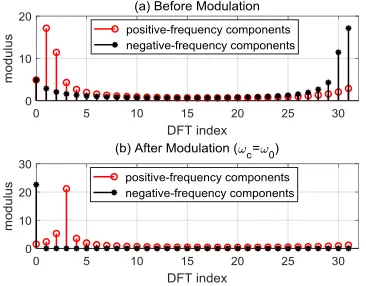
we set c 0, the modulus of Sm( )k and Sm( )k are shown in Fig. 1 (00.0876 ,N32 and
80
/ 7
). Serious interference of the negative frequency components occurs in Fig. 1(a), and the frequency 81
estimation which ignores the negative frequency contribution will exhibit a significant bias. But in Fig. 1(b), 82
the negative frequency component has Sm( )k 0 for all values of k excluding k= 0, which means the
83
interference only exists at k= 0. Thus, if we can figure outSm(0), it is possible to matchX km( ), which is the 84
spectrum of a real signal, to the spectrum of a complex sinusoid asSm( )k . The spectral interference of the
85
negative frequency components can be eliminated in this case. 86
[image:5.612.211.394.284.427.2]87
Fig. 1. Interaction of positive and negative frequency components (zero noise). 88
89
III. METHOD DEVELOPMENT 90
A. Coarse Estimation 91
In practice, 0 is unknown, and c can only be set according to a coarse frequency estimate ˆ0c. Assume 92
0 0 0
ˆc c
c
, where 0c is the estimation error. Then, from (4) for0,1, 2,..., 1
k N , we get 93
0
1
( )
0 2
0
sin( / 2)
( ) ( 1) .
2 sin(( ) / 2)
c k
N c
j
k j
m c
k
N A
S k e e
(5) 94
Obviously, Sm( )k is proportional to sin(N0c/ 2), and
( ) 0
m
S k when k0. Thus, we need 95
0
|Nc| to be sufficiently small (empirically
0
|Nc| 0.1 ) so that the interference occurred at
0 k can 96
estimate ˆ0c as 98 2 2 1 0 8 ˆ cos 4
c d d c
c
(6) 99
where
5 ( 2)[ ( ) ( 4)] K
k
d
r k r k r k , 14 ( 1)[ ( ) ( 2)]. K
k
c
r k r k r k The difference to [13] is that 100we set
1
( ) N K ( )[ ( ) ( )]
n K
r k
x n x n k x n k , k1, 2,3,...,K , and Kround(N/ 3), where round( )x101
means to round x up or down to the nearest integer. This is to enhance the SNR according to the LP, and the 102
value of K is determined through simulations. Unlike the widely used FFT, the adopted coarse estimator does 103
not suffer from resolution loss for short signal lengths. 104
B. Spectrum Matching 105
Since most of the values of Sm( )k are forced to approximate zero after modulation, then the key problem
106
is to deal with the interference for k0. From (4), we know that 107
0
1
( ) 0
2
0
sin ( ) / 2
(0) .
2 sin ( ) / 2
c N j c j m c N A
S e e
(7) 108
According to (3) and (4), for arbitrary value of integer q ( 0 q N 1), we can write 109
0
1
( ) 0
2
0
sin ( ) / 2
( ) ( ) ( ) ( ) .
2 sin ( ) / 2
c q
N
j c q
j
m m m m
c q
N A
S q X q S q W q e e
(8) 110
Then, substitute (8) for ( / 2)A ejin (7) and we obtain 111
1 0 2 0sin ( ) / 2
(0) ( 1) ( ) ( ) ( ) .
sin ( ) / 2
q
N
j c q
q
m m m m
c
S e X q S q W q
(9)
112
Thus, substituting ˆ0c for 0 and c in (9), we can define an estimator of Sm(0) as
113 1 0 2 0 ˆ
sin( / 2)
ˆ (0) ( 1) ( ).
ˆ sin( ) q c N j q q
m c m
S e X q
(10) 114
Assuming that |0c| is sufficiently small, it is easy to make the approximation to 115
0 0
0 0
ˆ
sin( / 2) sin(( ) / 2)
.
ˆ sin(( ) / 2)
sin( )
c
q c q
c c
(11) 116
ˆ (0) (0) ( ) ( )
m m
S S q q (12)
118
where ( )q and ( )q can be regarded as the terms of the estimation error caused by Sm( )q and the 119 modulated noise: 120
1 0 2 0sin ( ) / 2
( ) ( 1) ( )
sin ( ) / 2
q
N
j c q
q
m c
q e S q
(13)
121
1 0 2 0sin ( ) / 2
( ) ( 1) ( ).
sin ( ) / 2
q
N
j c q
q
m c
q e W q
(14)
122
Substitute (5) and
c
ˆ0c
0
0cinto (13), and as |0c| is assumed to be sufficiently small, so 123
0 1 0 2 0sin( / 2)
( ) cot( ) cot( / 2) .
2 c N c j j q A N
q e e
(15)
124
Note that q can be an arbitrary integer from 1 to N-1, and we can set q/ 20 to make ( )q 0. So 125
q can be approximated by setting qround(N ˆ0c/ ). Furthermore, as we assumed that
0 cN
is small in 126
(5), the value of ( )q can be sufficiently small to be ignored. 127
For ( )q , it is easy to prove thatE[ ( )] q 0, where E[ ] is the expectation operator. Then, from (12), we 128
can write 129
ˆ
E[Sm(0)]Sm(0)( ) E[ ( )]q q Sm(0) (16)
130
which means that Sˆm(0) can be recognized as an unbiased estimator of Sm(0). 131
Now, we can divide the spectrum of the modulated real signal as X km( ) into two spectrums of complex
132
exponentials, as Sˆm( )k and Sˆm( )k , written as
133
ˆ ( ) ( ) ( (0) ˆ (0)) ( )
, 0,1, 2,..., 1 ˆ ( ) ( (0) ˆ (0)) ( )
m m m m
m m m
S k X k X S k
k N
S k X S k
(17)
134
where ( )k is the discrete Dirac Delta function with (0)1 and ( )k 0 for k0. Xm(0) can be
135
calculated by summing the elements of x nm( ). After this spectrum matching process, the signal amplitude
136
and initial phase can be directly estimated from Sˆm( )k as Aˆ2Sˆm(0) N and
ˆ angle S(ˆm(0)), but 137here we focus on frequency estimation, which can be further derived from Sˆm( )k .
C. Error Correction 139
After modulation, the actual frequency of the positive frequency exponential in (2) has been shifted to 140
0 c
. Accordingly, we can use 2ˆ0c to approximately locate the spectral maximum of Sm( )k , which is
141
only 0c radians distant from the actual value. Then, we could estimate 0 c
to correct the estimation bias 142
of ˆ0c. According to the classical methodology of interpolation in frequency domain [12, 14], we can use two
143
spectral points as Sm(2 ˆ0c /N) andSm(2 ˆ0c /N) to realize accurate error correction. 144
From (4), we can calculate Sm(2 ˆ0c /N), Sm(2 ˆ0c /N), and after some simple algebra, we 145
obtain 146
0
1 1
0 0 2 2 0
0
ˆ
sin( ) cos( ) cos( ) sin( ) (2 ) cos( )
2 2 2 2 2 2
c
N N
c c c
j j
c N j
m
N A
S e e e
N N N
(18)
147
0
1 1
0 0 2 2 0
0
ˆ
sin( ) cos( ) cos( ) sin( ) (2 ) cos( ).
2 2 2 2 2 2
c
N N
c c c
j j
c N j
m
N A
S e e e
N N N
(19)
148
By subtracting the both sides of (18) and (19), making exp( (j N1) / N) 1 and tan( )x x for 149
sufficiently small x, after some simplification, we obtain 150
0 (2ˆ0 ) 0 (2ˆ0 )
c c c c
m m
S S
N N N N
(20)
151
Substitute ˆ (2ˆ0c / )
m
S N , ˆ (2ˆ0c / )
m
S N for (2ˆ0c / )
m
S N and (2ˆ0c / )
m
S N , and take the 152
real part to avoid complex value. We can estimate 0c as 153
0 0
0
0 0
ˆ (2ˆ / ) ˆ (2ˆ / )
ˆ Re
ˆ (2ˆ / ) ˆ (2ˆ / )
c c
c m m
c c
m m
S N S N
N S N S N
(21)
154
where ˆ (2ˆ0c / )
m
S N can be calculated from the inverse DFT of Sˆm( )k in (17) as
155
01
ˆ
(2 / )
0
0
ˆ (2ˆc / ) N ( ) (0) ˆ (0) j c N n.
m m m m
n
S N x n X S N e
(22)156
Finally, the fine frequency estimate (ˆ0f) of our method can be calculated by
0 0 0
ˆf ˆc ˆc
. The overall 157
signal processing algorithm for the proposed method is shown in Table I. 158
TABLEI 160
SIGNAL PROCESSING ALGORITHM
161
1 Calculate the coarse frequency estimate ˆ0 c via (6).
2 Modulate x n( ) with ˆ0 c c
to obtain x nm( ) as in (2).
3 Calculate round( ˆ0/ ) c
q N and 1
0
( ) N ( ) jqn
m n m
X q
x n e . 4 Calculate Sˆm(0) according to (10).5 Calculate ˆ (2ˆ0 / ) c m
S N and ˆ (2ˆ0 / ) c m
S N via (22)
6 Generate the frequency correction factor ˆ0 c
via (21).
7 Obtain the fine frequency estimate byˆ0 ˆ0 ˆ0
f c c
. 162
IV. SIMULATION RESULTS 163
To evaluate the performance of the aforementioned two-step methods, we use the TSA [7], EA [8], PM [9], 164
and PCA [10] methods as a comparison against our proposed method. Without loss of generality, we assume 165
1
A , and is uniformly distributed between and . Each simulation result is carried out with an 166
average of 2000 independent Monte Carlo runs. 167
Bounds As with the approximation made in [15], the CRLB of frequency estimation for a real sinusoid is 168
given as 169
0 2
12 ˆ
CRLB var[ ]
SNR ( 1)
f
N N
(26) 170
where the SNR is defined as 2 2
/ (2 ) A . 171
Variable Frequency: Because of the periodicity of the spectrum of a real sinusoid, we only evaluate the 172
performance for 000.5 . The root-mean-square error (RMSE) versus signal frequency 0 for 173
32
N for four different SNR values is presented in Fig. 2. The signal frequency varies from 0.01 to 174
0.49with a step size of 0.01 . The enlarged scale of 1.5 03.5 can show the advantages of the 175
proposed method more clearly. When the signal frequency is very low, the PCA and EA methods provide 176
more reliable accuracy at SNR=10dB in Fig.2 (a), while the PM method performs better for high SNRs in Fig. 177
2 (c) and (d). However, generally speaking, the proposed method shows higher accuracy than the other 178
evaluated methods in a very large range of signal frequency, and the superiority becomes more obvious with 179
181
[image:10.612.97.496.79.310.2]182
Fig. 2. RMSE versus 0 for N=32. (a) SNR=10dB; (b) SNR=30dB; (c) SNR=50dB; (d) SNR=70dB. 183
184
Variable SNR: The RMSE versus SNR for00.09and N32 is shown in Fig. 3. The SNR varies 185
from -10dB to 119dB with a step size of 3dB. The effect of RMSE saturation can be found for the EA and 186
PCA methods, which has proved their biasness in this case. By contrast, the TSA, PM and proposed methods 187
can follow the trend of the CRLB without error floors, but only the proposed method can asymptotically 188
approach the CRLB for sufficiently large SNRs. 189
190
Fig. 3. RMSE versus SNR for 00.09and N32. 191
192
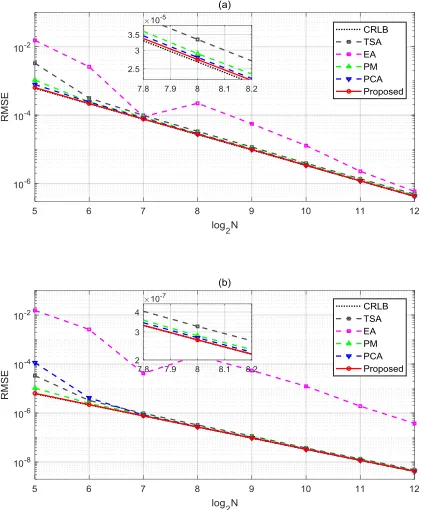
[image:10.612.213.393.491.634.2]in Fig. 4. The reformed signal length log2N continuously increases from 5 to 12 (32 to 4096 for N). For two
194
SNR values of 30dB and 70dB, evident advantages of the proposed method can be found for short signal 195
lengths (eg. N<128). With increasing the signal length, all the TSA, PM, PCA and the proposed methods can 196
closely follow the CRLB. However, from the enlarged subgraph, we can see the proposed method is even 197
slightly better than the other evaluated methods. 198
199
[image:11.612.197.408.196.451.2]200
Fig. 4. RMSE versus log2N for00.09. 201
(a) SNR=30dB; (b) SNR=70dB. 202
203
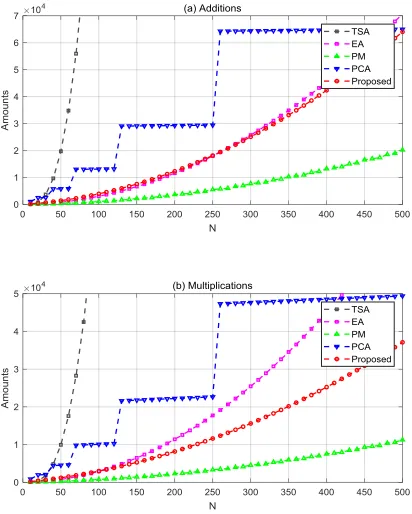
Computational Complexity: The result of the comparison of computational complexity is shown in Table 204
II. All the complex-valued (CV) operations are converted to real-valued (RV) additions and multiplications, 205
following the principle listed on the right-hand part of Table II. We neglect all the computations with O(1) 206
complexity. To make the comparison more clearly, the amount of required additions and multiplications for 207
the evaluated methods is shown in Fig. 5. The signal length N varies from 10 to 500 with a step size of 10. 208
Obviously, we can see the computational complexity of the proposed method is only higher than the PM 209
method, while the TSA, EA and PCA methods require more additions and multiplications within the 210
TABLE II 212
Comparison of Computational Complexity. 213
Method Addition Multiplication Converting Principle
Operation Addition Multiplication
TSA [7] 2NM02M028M03/ 3 32 N
2 2 3
0 0 4 0/ 3 26 0/ 3 16
NM M M M N CV CV 2 4
EA [8] 5N2/ 18 5 N/ 2 2
5N / 18 3 N/ 2 CV RV 0 2
PM [9] 2Np4p28p 2
2 9
Np p p CV+CV 2 0
PCA [10] 3 2M1 2M1 3
M N 2 2
2M 2M 41 / 3
M N CV+RV 1 0
Proposed 2
2N / 9 51 N/ 3 2
/ 9 56 / 3 N N
Note: M0(N1) / 2,p0.46N,M log 22 N, where x or x means to round x down or up to the nearest integer.
214
215
[image:12.612.203.409.231.488.2]216
Fig. 5. Amounts of additions and multiplications versus N. 217
(a) Additions; (b) Multiplications. 218
V. CONCLUSION 219
In this paper, a spectrum matching based method is proposed to realize frequency estimation of an 220
incoherently sampled real sinusoid. Compared with other four methods designed to solve this problem, the 221
proposed method shows better performance when the signal lengths are short. As long as the SNR reaches a 222
certain level, the proposed method can closely approach the CRLB without any error floor, which means, the 223
proposed method can be very useful in some high SNR applications such as measurement and 224
process can be also used for the estimation of signal amplitude and initial phase. 226
ACKNOWLEDGMENTS 227
The study is supported by National Natural Science Foundation of China (NNSFC) (61871402), 228
Postgraduate research innovation project of Chongqing (CYB14100), Natural Science Foundation of Tianjin 229
(18JCQNJC01400), Key Program of Natural Science Foundation of Chongqing (cstc2015 jcyjBX0017), PhD 230
startup foundation (WHB201707) and Special Project for 100 Academic and Discipline Talents of 231
Chongqing (2012-44). 232
233
REFERENCES 234
[1] D. C. Rife, R. R. Boorstyn, “Single tone parameter estimation from discrete-time observations”, IEEE
235
Trans. Inform. Theory. 20, 591-598 (1974).
236
[2] E. Jacobsen, P. Kootsookos, “Fast, accurate frequency estimators”, IEEE Signal Process. Mag. 24,
237
123-125, (2007).
238
[3] C. Candan, “A method for fine resolution frequency estimation from three DFT samples”, IEEE Signal
239
Process. Lett. 18, 351-354 (2011).
240
[4] C. Candan, “Fine resolution frequency estimation from three DFT samples: Case of windowed data”,
241
Signal Process. 114 245-250 (2015).
242
[5] Shanglin Ye, Jiadong Sun, and Elias Aboutanios, “On the Estimation of the Parameters of a Real
243
Sinusoid in Noise”, IEEE Signal Process. Lett. 24, 638-642 (2017).
244
[6] Slobodan Djukanović, “An Accurate Method for Frequency Estimation of a Real Sinusoid”, IEEE
245
Signal Process. Lett. 23, 915-918 (2016).
246
[7] Lui K W K, So H C, “Two-stage autocorrelation approach for accurate single sinusoidal frequency
247
estimation”, Signal Process. 8, 1852-1857 (2008).
248
[8] Y. Cao, G. Wei, and F.-J. Chen, “A closed-form expanded autocorrelation method for frequency
249
estimation of a sinusoid,” Signal Process. 92, 885–892 (2012).
250
[9] Yanlin Shen, Yaqing Tu, Linjun Chen and Tingao Shen, “A phase match based frequency estimation
251
method for sinusoidal signals”, Rev. Sci. Instrum. 86, 045101 (2015).
252
[10]Yaqing Tu, Yanlin Shen, “Phase correction autocorrelation-based frequency estimation method for
253
sinusoidal signal”, Signal Process. 130, 183-189 (2016).
[11]Kui Wang, Yaqing Tu, Yanlin Shen, Wei Xiao, “A modulation based phase difference estimator for real
255
sinusoids to compensate for incoherent sampling”, Rev. Sci. Instrum., 89, 085120 (2018).
256
[12]E. Aboutanios, B. Mulgrew, “Iterative frequency estimation by interpolation on Fourier coefficients”,
257
IEEE Trans. Signal Process. 53, 1237-1242 (2005).
258
[13]Kenneth Wing Kin Lui and Hing Cheung So, “Modified Pisarenko Harmonic Decomposition for
259
Single-Tone Frequency Estimation”, IEEE Trans. Signal Process.56, 3351-3356 (2008).
260
[14]Lei Fan, Guoqing Qi,“Frequency estimator of sinusoid based on interpolation of three DFT spectral
261
lines”, Signal Process. 144, 52-60 (2017).
262
[15]M. Kay Steven, “Fundamentals of Statistical Signal Processing, Volume I: Estimation theory”, Upper
263
Saddle River, NJ, USA: Prentice-Hall, (1993).