Faculty of Mechanical and Manufacturing Engineering
Technology
INTEGRATION OF TIME DRIVEN ACTIVITY BASED COSTING
(TDABC) AND SIMULATION FOR DECISION MAKING IN
ASSEMBLY PROCESS
Tan Fei Sian
Bachelor of Manufacturing Engineering Technology (Process and Technology) with Honours.
UNIVERSITI TEKNIKAL MALAYSIA MELAKA
BORANG PENGESAHAN STATUS LAPORAN PROJEK SARJANA MUDA
TAJUK:
INTEGRATION OF TIME DRIVEN ACTIVITY BASED COSTING (TDABC) AND SIMULATION FOR DECISION MAKING IN ASSEMBLY PROCESSSESI PENGAJIAN:
2018/19 Semester 1
Saya TAN FEI SIAN mengaku membenarkan Laporan PSM ini disimpan di
Perpustakaan Universiti Teknikal Malaysia Melaka (UTeM) dengan syarat-syarat
kegunaan seperti berikut:
1. Laporan PSM adalah hak milik Universiti Teknikal Malaysia Melaka dan penulis. 2. Perpustakaan Universiti Teknikal Malaysia Melaka dibenarkan membuat salinan
untuk tujuan pengajian sahaja dengan izin penulis.
3. Perpustakaan dibenarkan membuat salinan laporan PSM ini sebagai bahan pertukaran antara institusi pengajian tinggi.
4. **Sila tandakan ( )
SULIT
TERHAD
TIDAK TERHAD
(Mengandungi maklumat yang berdarjah keselamatan atau kepentingan Malaysia sebagaimana yang termaktub dalam AKTA RAHSIA RASMI 1972)
(Mengandungi maklumat TERHAD yang telah ditentukan oleh organisasi/badan di mana penyelidikan dijalankan)
Alamat Tetap:
No. 9 Jalan Serindit Kaw 17,
Taman Eng Ann, 41150 Klang,
Selangor.
Tarikh:
________________________
Disahkan oleh:
Cop Rasmi:
Tarikh:
_______________________
DECLARATION
I declare that this thesis entitled “Integration of Time Driven Activity Based Costing
(TDABC) and Simulation for Decision Making in Assembly Process” is the result of my
own research except as cited in the references. The thesis has not been accepted for any
degree and is not concurrently submitted in candidature of any other degree.
Signature : ……….
Author’s Name : ………
Date : ………
APPROVAL
I hereby declare that I have read this dissertation/report and in my opinion this
dissertation/report is sufficient in terms of scope and quality as a partial fulfillment of
Bachelor of Manufacturing Engineering Technology (Process and Technology) with
Honours.
Signature : ……….
Supervisor’s Name : ………
DEDICATION
i
ABSTRACT
ii
ABSTRAK
Industri pembuatan sedang bergerak ke paradigma perindustrian yang baru – Industri 4.0 yang ditujukan kepada proses pengeluaran yang lebih khusus. Hal ini membawa kepada peningkatan persaingan di kalangan syarikat pembuatan Malaysia. Oleh sebab itu, syarikat pembuatan haruslah menitikberatkan kitaran pengeluaran mereka supaya menjadi kos
efektif. Demi mendapat kos pengeluaran yang tepat, sistem kos yang memperuntukkan
iii
ACKNOWLEDGEMENTS
I would like to thank everyone who had contributed to the successful completion of this
project. Firstly, I would like to thank my supervisor, Dr Lau Kok Tee for his invaluable
advice. I would like to express my gratitude to Mr. Mohd Soufhwee Bin Abd Rahman for
his guidance and dedication throughout the development of the project. I owe my deepest
gratitude to my loving parent and friends who had helped and given me encouragement and
endless effort throughout my university life. I consider it an honour to work with the plant
manager of Peps-Jv (M) Sdn Bhd, Mr Fazriani Bin Amran and his supervision through the
company case study. I am indebted to all the lecturers that have thought me throughout my
iv
TABLE OF CONTENTS
PAGE DECLARATION
APPROVAL
DEDICATION
ABSTRACT i
ABSTRAK ii
ACKNOWLEDGEMENT iii
TABLE OF CONTENTS iv
LIST OF TABLES vii
LIST OF FIGURES ix
LIST OF APPENDICES xii
LIST ABBREVIATIONS, SYMBOLS AND NOMENCLATURES xiii
CHAPTER
1. INTRODUCTION
1.0 Introduction 1
1.1 Background 2
1.2 Problem Statement 3
1.3 Objectives 4
1.4 Scope 4
1.5 Expected Result 5
2. LITERATURE REVIEW
2.0 Introduction 6
2.1 Introduction to Industry 4.0 6 2.1.1 Cyber-Physical System (CPS) 8 2.1.2 The Nine Pillars of Technologies Advancement 9
2.1.2.1 Big Data 9
2.1.2.2 Autonomous Robots 10 2.1.2.3 Universal System Integration 10 2.1.2.4 Internet of Things (IoT) 11 2.1.2.5 Cyber Security 11 2.1.2.6 Cloud Computing 11 2.1.2.7 Additive Manufacturing 12 2.1.2.8 Augmented Reality (AR) 12
2.1.2.9 Simulation 12
v 2.2 Traditional Costing System 14 2.3 Activity Based Costing (ABC) 17 2.3.1 Implementation of Activity Based Costing 17 2.3.2 Downfall of Activity Based Costing 19 2.4 Time Driven Activity Based Costing (TDABC) 20
2.4.1 Calculation using Time Driven Activity Based Costing
Method 22
2.4.1.1 Time Equation 23 2.4.1.2 Activity Cost 25 2.4.2 Implementation of Time Driven Activity Based Costing
Model 26
2.5 Automotive Assembly Process 28
2.5.1 Manual Assembly 29
2.5.2 Automation Assembly 30
2.6 Simulation 33
2.6.1 Simulation Steps 34
2.6.2 Types of Simulation Model 36 2.6.3 Benefits of Using Simulation 37 2.6.4 Simulation in Decision Support System (DSS) 38
3. METHODOLOGY
3.0 Introduction 39
3.1 Project Planning 39
3.1.1 Overall Project Planning Flow Chart 40
3.2 Overview of Study 41
3.3 Research Methodology 44
3.3.1 Company Selection 44 3.3.2 Problem Formulation 45 3.3.3 Define Objectives 46
3.3.4 Scope of Project 46
3.3.5 Production Line Evaluation and Information Gathering 46 3.3.6 Model Visualisation 47
3.3.7 Data Collection 47
3.3.8 Stopwatch Time Study 48 3.3.9 Application of Time Study in TDABC 49 3.3.9.1 Estimating Time Consumptions 49 3.3.9.2 Time Equation 49 3.3.10 Comparison of TDABC and Existing Costing System 51
3.3.11 Arena Modelling 51
3.3.12 Verification 51
3.3.13 Validation 52
3.3.14 Simulation and Analysis 52 3.3.15 Decision Making by Using Decision Support System
vi
3.3.16 Documentation 53
3.3.17 Conclusion and Recommendation 53
4. RESULT AND DISCUSSION
4.0 Introduction 54
4.1 Company Background 54
4.2 Product Background 55
4.2.1 Bill of Material (BOM) 57
4.3 Process Layout 62
4.4 Formulation of Time Equation 64 4.4.1 Formulation of Time Equation for Autonomous Robot 65 4.4.2 Formulation of Time Equation for Resources 70
4.5 Capacity Cost Rate 84
4.5.1 Capacity Cost Rate for Autonomous Robot 84 4.5.2 Capacity Cost Rate for Resources 87 4.6 Comparison between TDABC and Existing Costing Method 91
4.6.1 Similarities between TDABC and Existing Costing
Method 94
4.6.2 Differences between TDABC and Existing Costing
Method 94
4.7 ARENA Simulation Result 96 4.7.1 Parameters of Simulation Model 98 4.7.2 Verification of Simulation Model 105 4.7.3 Validation of Simulation Model 106 4.8 TDABC Costing in ARENA Simulation 108
4.8.1 Comparison of TDABC in ARENA Simulation and
TDABC calculated manually 111 4.9 Cost Matrix Based on Utilization of Resource in ARENA
Simulation 112
4.10 Simulation as Decision Support System (DSS) 114
5. CONCLUSION AND RECOMMENDATION
5.0 Introduction 116
5.1 Project Summary 116
5.2 Findings 118
5.3 Further Recommendations 118
5.4 Conclusion 118
REFERENCES 120
vii
LIST OF TABLES
TABLE TITLE PAGE
2.1 Types of Costing Methods 16
2.2 Typical Time Driven ABC Implementation 26
4.1 BOM List for Wheel House Comp (L) 57
4.2 BOM List for Wheel House Comp (R) 58
4.3 BOM List for Cross Member (C/MR) 58
4.4 Sub-activities for Autonomous Robot 66
4.5 Parameters affecting time of sub-activity 70
4.6 Categorization of value of each activity carried out by operator 1 73
4.7 Categorization of value of each activity carried out by operator 2 75
4.8 Categorization of value of each activity carried out by operator 3 77
4.9 Categorization of value of each activity carried out by operator 4 79
4.10 Categorization of value of each activity carried out by inspector 1 81
4.11 Categorization of value of each activity carried out by inspector 2 82
4.12 Categorization of value of each activity carried out by inspector 3 82
4.13 Capacity cost rate of Autonomous Robot 85
4.14 Total cost of Autonomous Robot 86
4.15 Capacity cost rate of resources 88
4.16 Total cost of T9AX assembly production line using TDABC 91
viii 4.18 Differences between TDABC and existing costing method 95
4.19 Comparison between actual output and simulation output 107
4.20 Comparison of TDABC in simulation and TDABC calculated
manually
111
ix
LIST OF FIGURES
FIGURE TITLE PAGE
2.1 Revolution of Industry 4.0 7
2.2 Traditional Costing System Method 15
2.3 Activity Based Costing Framework 18
2.4 Time Driven Activity Based Costing Framework 21
2.5 Autonomous Spot Welding Robot in Assembly Line 30
2.6 Dial-type Automated Assembly 31
2.7 In-line Automated Assembly 32
2.8 Type of simulation models 36
2.9 Categories of Decision Making System (DSS) 38
3.1 Overall Project Planning Flow Chart 40
3.2 Process Flow Chart 43
3.3 Sequence of implementing TDABC model 50
4.1 Components of car body 55
4.2 Left Wheel House Comp (LH) 56
4.3 Right Wheel House Comp (RH) 56
4.4 Cross Member (C/MR) 56
4.5 BOM Chart for Left Wheel House Comp (LH) 59
4.6 BOM Chart for Right Wheel House Comp (RH) 60
x
4.8 Layout of Line T9AX 62
4.9 Spot welding assembly process 64
4.10 Three-step model 65
4.11 Time-driven Activity Based Costing (TDABC) for Resources 89
4.12 Cost Element in Existing Costing Method of the company 93
4.13 Arena Simulation Result 97
4.14 Create Module 98
4.15 Assign Module 99
4.16 Process Module for Spot Welding Operation 99
4.17 Route Module 100
4.18 Station Module 100
4.19 Match Module 101
4.20 Batch Module 101
4.21 Process Module for Inspection Operation 102
4.22 Decide Module 103
4.23 Dispose Module 103
4.24 Set-up Parameters 104
4.25 Result Number Out in Simulation 107
4.26 Parameters of Resources Busy Hour, Idle Hour and Per Use 108
4.27 Variable of Resource Using Expression Builder 109
4.28 Arrangement of variable costing in model 109
4.29 Result of total resource busy cost 110
4.30 Usage of each resource 112
xi
LIST OF APPENDICES
APPENDIX TITLE PAGE
I Project Gantt Chart for Final Year Project I 128
II Project Gantt Chart for Final Year Project II 129
A Line 1 (T9AX) Process Time Sheet – Autonomous Robot 130
B Line 1 (T9AX) Process Time Sheet – Operator 1 131
C Line 1 (T9AX) Process Time Sheet – Operator 2 132
D Line 1 (T9AX) Process Time Sheet – Operator 3 133
E Line 1 (T9AX) Process Time Sheet – Operator 4 134
F Line 1 (T9AX) Process Time Sheet – Inspector 1 135
G Line 1 (T9AX) Process Time Sheet – Inspector 2 136
H Line 1 (T9AX) Process Time Sheet – Inspector 3 137
xii
LIST OF ABBREVIATIONS, SYMBOLS AND NOMENCLATURE
TDABC - Time Driven Activity Based Costing
ABC - Activity Based Costing
CPS - Cyber Physical System
CPPS - Cyber Physical Production System
2D - 2 Dimensional
3D - 3 Dimensional
IoT - Internet of Things
IT - Information Technology
AR - Augmented Reality
HVAC - Heating, Ventilation and Air Conditioning
ASQ - American Society for Quality
RM - Ringgit Malaysia
FYP - Final Year Project
EPMB - EP Manufacturing Berhad
1
CHAPTER 1
INTRODUCTION
1.0 Introduction
The industry is now in the midst of a fourth wave of technology advancement, known
as Industry 4.0 which connects digital system production technologies and production
process through streaming of data. Under the concept of Industry 4.0, the pressure of
changing mass production to customized productions leads manufacturing industry to a new
challenge. Therefore it is crucial to manufacturing companies to be cost-effective during
their production cycle.
In this context, an accurate costing method is essential to estimate the cost of the
production line namely the assembly process. Many companies have established their own
costing methods which usually involves material, labor and overhead cost or based on past
experience of costing strategy. In addition, most costing method established by companies
uses only estimation and assumption to decide the cost of their product. There is no measure
to determine whether the cost is too high or too low for the manufacturing cost. Neither way
can cause problem such as overcharging or undercharging customers for their product.
Hence, Time Driven Activity Based Costing (TDABC) an alternative costing method is used
in this paper.
Since many manufacturing companies have enter the paradigm of Industrial 4.0
therefore utilising of the pillars of technology of Industrial 4.0 is an advantage and it brings
many more benefits for the company. Simulation is one of the tool to help the management
2 evaluated. Consequently, this paper combines TDABC and ARENA simulation to study
costing of production line and provide Decision Support System (DSS) to the company. This
paper presents the aid of ARENA simulation for decision making on a cost effective
perspective.
1.1 Background
Time Driven Activity Based Costing (TDABC) was first developed in 2004 by
Kaplan and Anderson as a cost allocation methodology to derive a more reliable information
to set pre-dominance for multi-products, price allocating and process improvement. TDABC
is an improvised version of ABC due to its complexity and neglect of the actual capacity of
resources are working (idle time).
As mentioned earlier in the introduction, the two key parameters of TDABC are cost
rate of capacity and resources estimated for related cost object. To obtain the first parameter,
the total cost of resource capacity supplied is divided by the actual capacity. The cost of all
the resources supplied to a particular department or any process which can be equipment,
technology or infrastructure sums up together as the total cost. Whilst, estimated resource
employed are derived from time equation to justify the time required to carry out each task
(Siguenza-Guzman, 2014).
Along with that, Wouters et al. (2015) found that the most innovative outlook of
TDABC is the use machine times based on real time data, in the context of a large number
and routinely alternating products which complies with Industry 4.0 concept. On top of that,
the digital industrial technology in Industry 4.0 leading production process to achieve great
efficiency, more autonomous and versatile. TDABC methodology is also used in the flexible
production not only for costing estimations but also capacity optimization in operations and
3
1.2 Problem Statement
Malaysia manufacturing companies today face the increasing competition on global
market. These companies should react rapidly and produce low cost product to be
competitive in this latest of environment. In this case study, the company chosen is Peps-JV
(M) Sdn Bhd also known as EP Manufacturing Bhd (EPMB) which is located in Alor Gajah,
Melaka. Peps-JV (M) Sdn Bhd Melaka mainly manufactures and supplies automotive
modular components to Honda Malaysia Sdn Bhd (HMSB).Their product range includes
body parts, suspensions, engine parts, modular assemblies and engineering plastic parts of
automobile.
The current practice costing model of PEP-JV consist of only estimation and
assumption of the labor cost and capital cost. Estimation of these elements are not precise
enough to help in decision making and certainly not accurate enough to charge the customers.
Thus, the company faced problems such as undercharging or overcharging their customers.
As an example, if the company undercharge their customer for their products, the company
may loss profit. In contrast to that, if the company overcharge their customers, they will
suffer from loss of customer as the price of product is high. Therefore, as effective control
measurements, there must be a cost system that accurately allocate all the product cost using
apportionments standard and comprising of allocation errors.
The management should have accurate and up to date costing information. The
reason behind a new costing system have to be introduced so that the true cost of a certain
product can be revealed and lead to right decision making. Therefore, Time Driven
Activity-Based Costing (TDABC) will be implemented to estimate the accurate costing of a product’s
production line. This costing method hopes to provide the management reliable cost of
product complies with Industry 4.0 using ARENA simulation as a Decision Support System
4
1.3 Objectives
Several objectives are established to achieve the goal of study indicated as below:
i. To calculate costing of the assembly line using Time Driven Activity-Based
Costing (TDABC) Method.
ii. To compare the accuracy of existing costing method and Time Driven
Activity-Based Costing Method.
iii. To predict the changes in cost structure of the assembly line by using ARENA
Software.
1.4 Scope
This project will be based on case study on a selected company which is PEPS-JV
Sdn Bhd. This project focus on selecting one entire assembly line of the family product. In
this case, line T9AX is selected which assemblies Left Wheel House Comp (LH), Right
Wheel House Comp (RH) and Cross Member (C/MR) for Honda City car model. These three
products are running in the same assembly production line. This study will be focusing on
the existing costing method implied by the company and analysis will be made. TDABC will
be carried out to evaluate the cost of assembly line of the product selected. The accuracy of
existing costing system and TDABC will be review thoroughly. However, costing model is
considered private and confidential documents of a company. Hence, the company will not
reveal the complete steps in obtaining the cost of production. In conjunction to that,
interview session is made with the plant manager to get rough information on their costing
5
1.5 Expected Result
The project aims to provide analytical evaluation on existing costing system in
assembly production line in contrast with Time Driven Activity-Based Costing (TDABC).
Together with other complementary results of the case study, TDABC will come out as a
more accurate costing method by using the practical capacity of the resources supplied to
drive cost rates. Simulation will act as a good Decision Support System (DSS) to support
and enable managers to make a decision on the entities, attributes and cost of the production
6
CHAPTER 2
LITERATURE REVIEW
2.0 Introduction
This chapter mainly discuss about the background study of the project. Literature
review is the solid backbone to ensure success of any study and it also helps to identify
current problem occurred in the field of study. Moreover, it also reviews various approach
to achieve project goal based on the study. This chapter focuses on the current trend –
Industry 4.0 in Manufacturing System and the technologies revolving the evolution. Costing
methods from Traditional Costing method to Time Driven Activity-Based Costing (TDABC)
method are also reviewed as the main objective is to calculate costing of the assembly line
using TDABC method. Besides, types of assembly process is discussed as part of the case
study. Study on Simulation Model is also included in this this chapter.
2.1 Introduction to Industry 4.0
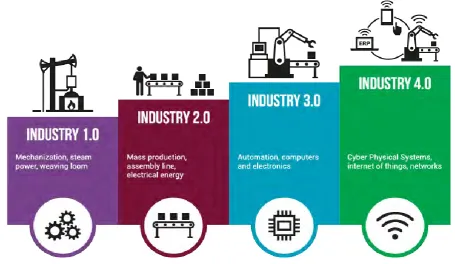
According to Lasi et al. (2014), the beginning of industrial evolutions has taken a
leap to a new paradigm in digital technology. The first industrial revolution was in the field
of mechanization where machine is introduced in Britain by the end of 18th century
(1760-1840) with the water as source of power to generate steam powered engines. The intensive
use of electrical energy is the symbol of the beginning of second industrial revolution
(1870-1914). The electrification of factories contributes to mass production in the industry.
7 up the beginning of wide spread digitalization in the industry which so-called the third
industrial revolution which uncover between 1950 and 1970. In another words, it was also
called information age where a direct result of massive development in computers,
[image:24.595.78.534.181.445.2]information and communication technology.
Figure 2.1: Revolution of Industry 4.0 (Simio LLC, 2017)
Today, the fourth industrial revolution emerges as an advanced digitalization within
factories, the combination of Internet technologies and future-oriented technologies in the
field of smart objects (machines and products) seems to result in a new fundamental
paradigm shift in industrial production. Zhou et al. (2014) stated that “Industrial 4.0”
concept is surfaced by the German government in November 2011. Over the past few years,
“Industrial 4.0” has been broadly deliberated for most global industries which will yield
remarkable influence on international industries. The concept of Industry 4.0 is depending
on a Cyber Physical System (CPS) based on the streaming of data and communication
technologies and industrial technology coming together to form a smart factory, leading