Int. J. Electrochem. Sci., 11 (2016) 6387 – 6402, doi: 10.20964/2016.07.07
International Journal of
ELECTROCHEMICAL
SCIENCE
www.electrochemsci.org
A Mediated BOD Microsensor Based on Poly(Neutral Red) and
Bacteria Modified Interdigited Ultramicroelectrode Array
Jingfang Hu1,*, Guowei Gao1,2, Shanhong Xia2
1
Information Acquisition and Detection Key Laboratory, Beijing Information Science and Technology University, Beijing, China
2
State Key Laboratory of Transducer Technology, Institute of Electronics, Chinese Academy of Science, Beijing China
*
E-mail: [email protected]
Received: 23 March 2016 / Accepted: 12 May 2016 / Published: 4 June 2016
A mediated microsensor for assessing biochemical oxygen demand (BOD) was proposed based on poly(neutral red) (PNR) and Pseudomonas aeruginosa (P. aeruginosa) bacteria modified interdigited ultramicroelectrode array (IUDA). IUDA was fabricated by micro-electro-mechanism system (MEMS) technique. NR was directly electropolymerized on IUDA to form poly(neutral red) (PNR) layer as immobilized mediator. The gram-negative bacteria P. aeruginosa was entrapped into polypyrrole (PPy)-alginate matrix by electropolymerization on PNR layer acted as biocatalyst film. The electropolymerization method provided possibility for immobilization of mediator and bacteria on IUDA for mediated BOD measurement. The mediated microsensor can determine BOD value within 20min and possesses an analytical linear range from 5 to 100 mg/L, with a limit detection of 3 mg/L. The as-prepared BOD microsensor exhibited good stability, repeatability and anti-interference ability to heavy metal ions of Cu2+, Zn2+, Mn2+ and Fe3+. The measurement results of the BOD microsensor method showed a good agreement with those obtained from conventional BOD5 method for real river
water samples.
Keywords: mediated BOD microsensor; poly(neutral red); polypyrrole-alginate; interdigited ultramicroelectrode array; Pseudomonas aeruginosa bacteria
1. INTRODUCTION
Biochemical oxygen demand (BOD) is a key parameter for water environment monitoring[1]. To date, large number of rapid BOD sensor have been developed because that the conventional BOD measuring method (5-days BOD, BOD5) is so time-consuming and laborious[2]. Recently, the kind of
one order of magnitude higher as compared with the current response in the oxygen-type BOD sensor, thereby making it possible to design microsensor[8]. The electrochemical mediated BOD sensor can be classified into two groups[9]. One is based on a bioreactor, in which the microbial biocatalyst film and electrode are separate. The other is based on microbial biocatalyst film modified electrode. The former approach is time-consuming (more than 1h) for BOD measurement, and uneasy integrated for microsensor development, so it is not suited to be applied on on-line real-time monitoring. The latter approach only needs less than 30 min for BOD detection and is more favorable in BOD fast monitoring and microsensor development.
Among the developing electrochemical mediated BOD sensors, two common mediators such as ferricyanide (FC)[10] and menadione[11] were used as an electron acceptor instead of oxygen for BOD measurement. These mediators were usually dissolved in water and their concentration always kept high level, which may cause troublesome problems in secondary environment pollution and a large waste of reagents. Chen et al.[12] reported an immobilized FC mediator in an ion-exchangeable polysiloxane for BOD sensing. Our previous study[13] also developed a new immobilized FC-mediated BOD sensor through electropolymerization of pyrrole. These immobilized mediators had great improvement in conventional dissolved mediators for BOD measurement, and convenient for on-line application. But these proposed immobilized FC mediators would have poor long-term stability, because the both FC immobilization methods were based on electrostatic attraction, and it can not avoid FC leakage from the polymer films during multiple measurements. However, the phenazine dye neutral red (NR), due to its excellent electrochemical reversibility, has been demonstrated to be an attractive mediator to harvest microbial metabolic electrons[14]. NR can be directly immobilized on electrode surface via electropolymerization to form poly (neutral red) (PNR). PNR has good stability and is often used as a redox mediator[15]. To date, few reports have been founded using PNR as the mediator for determination of BOD.
2. EXPERIMENTAL
2.1 Materials and reagents
The standard GGA solution at 198 mg/L of BOD(150 mg/L glucose and 150 mg/L glutamic acid) was prepared according to procedures described in the APHA standard methods[20]. Solution with other concentrations was prepared by appropriate dilution of the BOD198 standard solution with deionized water. Pyrrole, neutral red (NR), sodium alginate, disodium hydrogen phosphate (Na2HPO4),
dipotassium hydrogen phosphate (K2HPO4), sulphuric acid (H2SO4), potassium sulphate (K2SO4)and
Nutrient broth (NB) were obtained from Sinopharm Chemical Reagent Beijing Co. Ltd (Beijing, China). Nutrient broth (NB) was prepared containg 10 g/L peptone, 5 g/L yeast extract, 10 g/L NaCl and 15 g/L agar at pH 7.0, then it is stored for use after autoclaving at a temperature of 121C with 30 min. The live bacteria cell dye, fluorescein diacetate (FDA) fluorochrome, was purchased from Sigma&Aldrich. Dried bacterial cells of strain P. aeruginosa CGMCC 1.10712 were acquired from China General Microbiolgical Culture Collection Center. Unless otherwise stated, all chemical regents were of analytical grade and prepared with deionized water.
2.2 Cultivation of P. aeruginosa bacteria
TheP. aeruginosa was grown in NB solution at a temperature of 37°C for 12 h with shaking at 150 rpm. After cultivation, bacteria cells were harvested by centrifugation at 7000 rcf for 20min at room temperature, and washed twice with 0.1 M sodium-potassium phosphate buffer solution (PBS), pH 7.0. Washed cells was kept in micro test tubes at 4 °C. The bacteria concentrations were adjusted to the desired optical density measured at 600nm (OD600) using the spectrometer.
2.3 Fabrication of interdigited ultramicroelectrode array (IUDA)
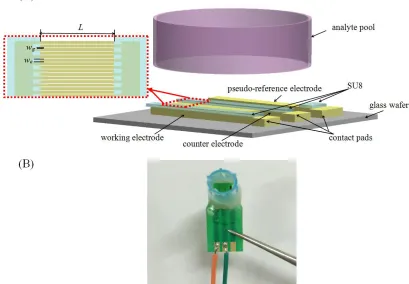
Figure 1. Schematic structure of IUDA chip (A) and photography of the packaged IUDA chip (B)
2.4 IUDA Modification
The IUDA was modified via two steps. Firstly, prior to modification, the IUDA was ultrasonically cleaned with acetone, ethanol, and deionized water for 5min, respectively. And the electrode was dried under a flow of nitrogen and pretreated by soft plasma etching for 30 s. Then the IUDA was electrochemically cleaned in 0.01 M H2SO4 by cycling the electrode potential from 0 to 1.5
V (vs. Ag/AgCl) until a reproducible voltammogram was obtained. Then PNR was modified on working electrode surface by potential cycling of NR between -1.2V and 1.5V for 5 cycles, and followed by 10 cycles between -0.8 V and 0.8 V. Secondly, P. aeruginosa bacteria, which was priorly cultivated as described in our previous report[13], was immobilized on PNR/IUDA by cyclic voltammetry (CV) scan from 0 to -0.9 V (vs. Ag/AgCl) for 10 cycles in N2 saturated 0.1M PBS
solution (pH=5.0) containing 0.01M pyrrole, 0.35% alginate (self-doping pyrrole-alginate monomer) and 2.0×10⁵
CFU/cm2 P. aeruginosa, obtained as (PPy-alginate/P. aeruginosa)/PNR/IUDA.
2.5 Electrochemical measurement
[image:4.596.92.501.83.367.2]
incubation of the modified electrode in test solution was required for stable and the incubation time was 10 min at a temperature of 37 °C. CV method was used for electrochemical characterization of IUDA and modified IUDA. Chronoamperometry method was used for electrochemical measurement of BOD, and the applied potential was -0.35 V for 300 s. The microsensor was dried at 4 °C for 6 h, and stored at 4°C when not in use.
2.6 Microscopic observations
The P. aeruginosa bacteria cells entrapped into PPy-alginate films were stained with fluorescence pigment, FDA, according to the manufacturer’s instructions. P. aeruginosa bacteria immobilized in the PPy-alginate films were observed by fluorescent microscope (BX51, Olympus; Japan).
3. RESULTS AND DISCUSSION
3.1 The sensing mechanism of the mediated BOD microsensor
NR mediator has a redox potential at around -0.33 V, which is compatible to the major metabolic electron carriers (e.g. -0.32 V of NADH/NAD+) for bacteria cells[14]. Electropolymerization of NR to form PNR as an immobilized mediator has been proved to ensure long-term stability and retain electrochemical properties of the NR redox-active sites[16]. P. aeruginosa bacteria is most frequently used as biocatalyst, because it is tolerant to negative environmental factors and can function as a recognition element of biosensor for a long time[22]. In the P. aeruginosa bacteria metabolic processes, oxygen is replaced by the artificial electron acceptor of PNR(ox.). The microbial reaction still involves oxidation of organic substrate to CO2 via glycolysis
and the tricarboxylic acid cycle (TCA cycle) (eq 1)[9]. The electrons derived from this process, however, are transferred down the electron transport system (ETS) to reduce PNR(ox.) to PNR(red.) (eq 2)[23] instead of being transferred to O2 to produce H2O. The overall PNR mediated reaction with
the P. aeruginosa bacteria can be described in eq 3. The mechanism of PNR as an electron transfer mediator promoting BOD sensing is illustrated in Fig.2.
(1)
(2)
Figure 2. Schematic mechanism of PNR as an electron transfer mediator for BOD sensing
3.2 Characterization of IUDA
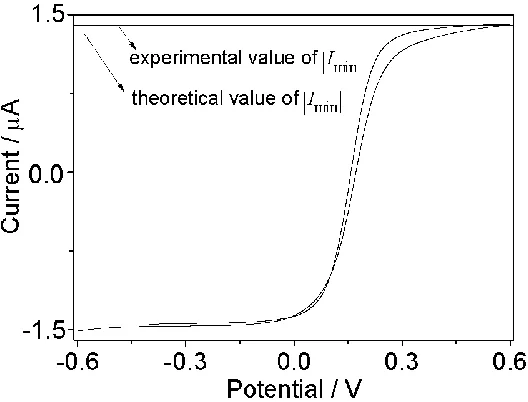
The characterization of the IUDA was performed by CV in 10 mM potassium ferricyanide (K3Fe(CN)6) solution. As shown in Fig. 3, a typical sigmoidal CV curve was obtained, meaning that
the diffusion profile of the IUDA is hemispherical diffusion and a steady-state limiting current can be obtained in short time[24]. The expression of steady-state limiting current (│Imin│) for IUDA is
defined as:
* 2
lim 0.637 ln 2.25(1 e / g) 0.19 /(1 e/ g)
I mnLFc D
where m is the number of microband electrode pairs, n is the number of electrons, L is the microband length, F is Faraday’s constant, c* and D is the concentration and diffusion coefficient of [Fe(CN)6]3-,we is the microband width and wg is the gap between the microbands. Using n=1, F=96485
C/mol, D=7.6×10⁻⁶ cm2/s, C*=10 mM, we=50 μm and wg=10 μm, the calculated │Imin│ for the IUDA
is 1.212 μA. The experimental value of │Imin│ was 1.354 μA (Fig. 3) which shows a good agreement
with the theoretical value of │Imin│.
Figure 3. CV curve of the IUDA in 10mM ferricyanide solution. The black line and the red dash line represent the experimental value and the theoretical value of │Imin│, respectively. Scan rate:
[image:6.596.161.444.72.178.2] [image:6.596.168.432.494.695.2]
3.3 Immobilization of bacteria cells on PNR/IUDA
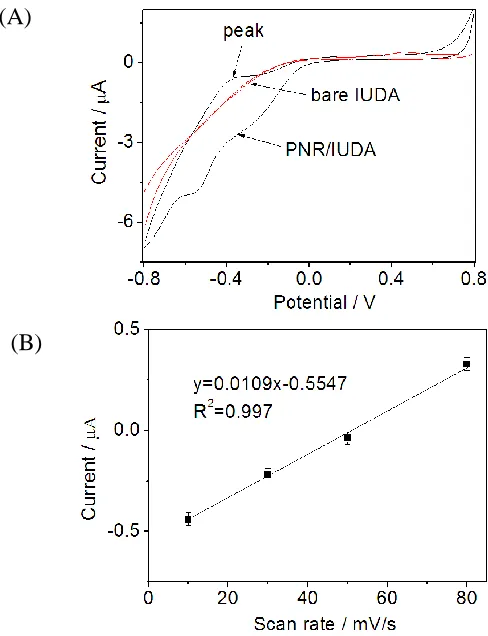
The CV curves of the bare IUDA and PNR modified IUDA were revealed in PBS solution. As illustrated in Fig. 4A, compared with the bare electrode, the CV curve of PNR/IUDA showed a typical redox couple of PNR with oxidation peak at -0.35 V and reduction peak at -0.58 V, suggesting that the NR mediator has been immobilized on IUDA successfully. The relationship between the peak current value and CV scan rate was investigated in Fig. 4B. It is obvious that the peak current value is linearly related with the CV scan rate from 10 to 80 mV/s, which suggests that the electrode process is controlled by the surface adsorption. This result further proved that NR had been immobilized on working electrode and maintained good electrochemical characteristic.
Figure 4. CV curves of PNR/IUDA (black line) and bare IUDA (red line) in 0.1 M PBS solution (pH=7.0) with scan rate of 50 mV/s (A); linear relationship between peak values at about -0.35 V and scan rates from 10 to 80 mV/s in 0.1 M PBS solution (pH=7.0). The error bars represent three separate measurements.
3.4 Immobilization of bacteria cells on PNR/IUDA
In this study, P. aeruginosa bacterial cells were immobilized on PNR/IUDA by electropolymerization of pyrrole-alginate doped with P. aeruginosa to form PPy-alginate/P. aeruginosa as a microbial biocatalyst film. The biological activity of the immobilized bacteria cells was important for the BOD sensor performance. As shown in Fig. 5, the immobilized P. aeruginosa
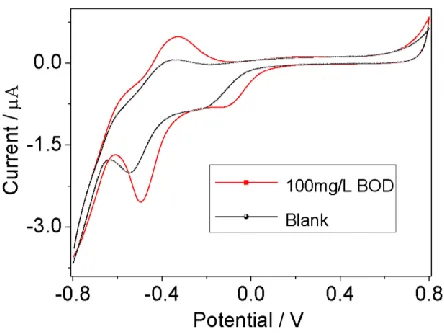
[image:7.596.154.398.251.569.2]respectively. As shown in Fig. 6, after incubation, the anodic peak current at -0.35 V increased as some of the PNRs were reduced by the bacteria cells. Consequently, the results indicated that immobilized P. aeruginosa bacteria had good respiratory metabolism ability in oxidizing organic substrate. So the prepared microbial biocatalyst film on IUDA had an effective performance for BOD sensing.
Figure 5. Fluorescence-microscope image of the immobilized P. aeruginosa after staining a PPy-alginate film with FDA fluorochrome reagent. The fluorochrome was excited under illumination of 460-490 nm wavelengths and observed through high-pass optical filters with cutoff wavelength of 520 nm.
[image:8.596.189.408.250.414.2] [image:8.596.184.406.512.679.2]
3.5 Optimization of NR concentration and bacterial cells loading
The immobilized quantity of PNR mediator and P. aeruginosa bacterial cells in sensing film on IUDA are key factors to obtain a sensitive signal. An optimal concentration of NR and P. aeruginosa bacterial cells loading during electropolymerization were investigated, respectively. Fig. 7 shows that the PNR oxidation peak value at PNR/IUDA increased with the increase of NR concentration from 1 to 3 M in polymerization solution, but decreased with 4 M NR. The thickness of PNR is proportional to the NR concentration. Just as a previous study showed that the electronic conductivity of PNR film would drop when the thickness of PNR film is large enough[26], the electrochemical activity of PNR as electron transfer mediator was inhibited when the thickness reached a certain level.
Figure 7. CV curves in 0.1 M PBS solution recorded at different PNR/IUDA modified electrodes obtained from electropolymerization of NR solutions with concentrations from 1 M to 4 M. Scan rate: 50 mV/s.
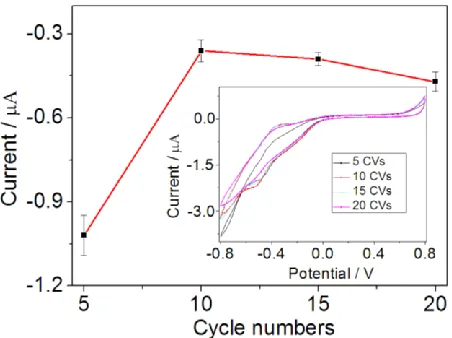
[image:9.596.195.399.264.418.2] [image:9.596.186.412.491.660.2](PPy-alginate/P. aeruginosa)/ PNR/IUDA modified electrode. As shown in Fig. 8, the peak value near -0.35 V increased with increasing the cycle number, and reached a maximum value when the cycle number was increased to 10, but decreased when continuing to increase the cycle number more than 10.
This result may be analyzed in two aspects. On one hand, the higher signal would be obtained with more immobilized bacteria cells due to the more PNR uptake during organic substrate degradation. On the other hand, the thick film with more bacteria cells loading would hinder PNR diffusion, and the decrease of PNR diffusion rate can be indicated by the decrease in the background current (CV scan in PBS solution). So in the following experiments, 10 cycles was selected to immobilize the PPy-alginate / P. aeruginosa microbial film with CV method.
3.6 Influence of measurement condition
[image:10.596.185.415.381.707.2]
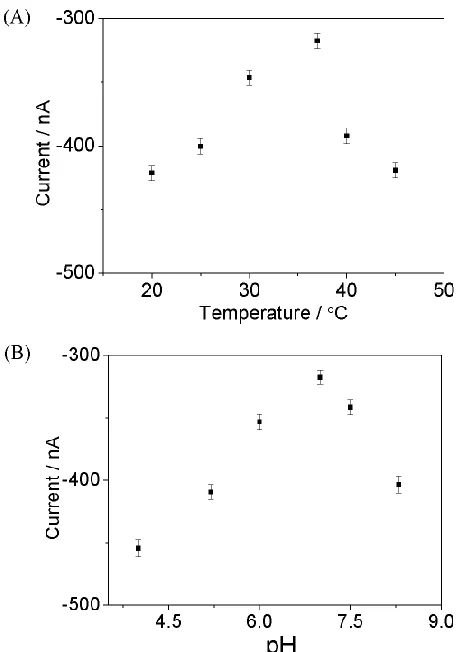
The effect of different measurement conditions on the proposed BOD microsensor such as time, temperature and pH were studied sequentially. For BOD determination, chronoamperometric experiments were performed and the measurement time was 300 s when the signal was up to be stable. The influence of measurement temperature on the response of the BOD microsensor was examined by using 100 mg/L BOD solution. Fig. 9A shows that the chronoamperometric analytical signal increased with the increase of temperature, and reached high in the range of 30-37°C. The signal decreased obviously when the temperature was less than 25 °C or more than 40 °C. This result is similar with other reports that BOD sensor is temperature-dependent due to the inherent temperature-sensitivity of microbial respiration[27], and hence 37 °C was chosen in the experiment. Then the chronoamperometric current responses of the BOD microsensor in different pH solutions from 4.0 to 8.2 were investigated at a constant BOD concentration of 100 mg/L at 37 °C. As shown in Fig. 9B, the current value increased with the increase of pH, reached a maximum value at pH 7.0 and then decreased slightly, which suggested that their respiratory activity of the immobilized microbial bacteria cells in PPy-alginate film were dependent on the solution pH, which has a similar phenomenon with other reports[11-13].
3.7 Electrochemical response to BOD standard solutions
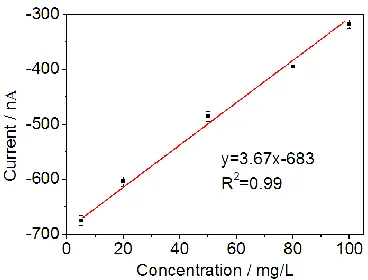
[image:11.596.44.570.572.770.2]The electrochemical response to different concentrations of BOD standard solutions were evaluated from 0 to 100 mg/L. Before measurement, 1 mL 0.1M PBS at pH 7.0 was injected into the micro analyte pool, and the modified IUDA was immersed in the solution for 10 min to obtain a stable current response. Then the corresponding current response of each concentration of BOD standard solution was recorded at the potential of -0.35 V for 300 s after the modified IUDA immersed in the BOD solution for incubation. As illustrated in Fig. 10, a linear relationship curve was obtained from 5 to 100 mg/L, with the sensitivity of 3.73 nA / mg/L, and the limit of detection was calculated as 3 mg/L (S/N≥3).
Table 1. Comparison of the reported mediated BOD sensor
Mediator Biocatalyst Electrode Response
time (min)
Working range
(mg/L) Reference Dissolved FC Immobilized
bacteria
Electroplated gold
electrode 20 min 15-200 [28]
Dissolved FC and menadione
Suspended bacteria
Screen-printed carbon
electrode 15 min 6.6-220 [11]
Immobilized FC
Immobilized
bacteria Glassy carbon electrode 30 min 1.2-40 [12] Dissolved FC Suspended
bacteria
Platinum array
microelectrode 1 h 5-400 [6]
Immobilized FC
Immobilized
bacteria Disk gold microelectrode 20 min 5-100 [13] Immobilized
PNR
Immobilized bacteria
Interdigited
ultramicroelectrode array 10 min 5-100
Figure 10. Linear relationship between current responses and BOD concentrations in the range of 5-100 mg/L. The error bars represent three separate measurements.
3.8 Anti-interference, repeatability and stability
Some heavy metal ions, such as Cu(II), Zn(II), Mn(II)and Fe(III) are common in the rive water or lake water samples and may disturb the metablic activity of bacteria cells[30]. Additionally, the highest concentration of these heavy metal ions in a polluted Chinese river should be below 0.5 mg/L[31]. Therefore the influence of these heavy metal ions on the microsensor response was investigated at 0.5 mg/L. The BOD concentration of 50 mg/L was used as control.
Figure 11. Interference of heavy metal ions on the microsensor current response to 50 mg/L BOD. Each data was the average of three separate measurement.
[image:12.596.206.390.165.305.2] [image:12.596.196.398.513.667.2]
6% compared with 50 mg/L BOD without interference ions. It revealed that Cu2+, Zn2+, Mn2+ and Fe3+ (0.5 mg/L, each) have no interference on the curent response of the BOD microsensor.
[image:13.596.117.478.193.267.2]The repeatability of three micosensors was investigated with different BOD concentrations. As shown in Table 1, the relative standard deviations of five successive tests were less than 15%.
Table 1. Repeatability of three microsensors.
C / mg/L 1# / nA 2# / nA 3# / nA RSD / %
5 -661.02 -675 -652.5 11.35
20 -590.4 -604 -582.3 10.97
50 -474 -485.7 -465.8 10
100 -308.1 -317.7 -303.8 7.12
*
Each data was the average of three separate measurement
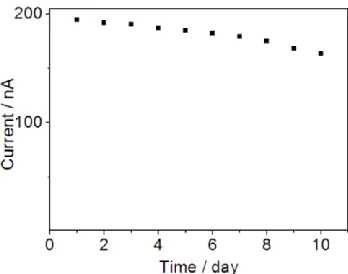
Figure 12. Stability of the BOD microsensor. Each data was the average of three separate measurement, and the backgroud signal was deducted.
The good repeatability may be due to the high consistency of MEMS fabrication technology and high controllability of electropolymerization method. Furthermore, stability of the microsensor was examined by measuring 50 mg/L BOD standard solution. In Fig. 12, in the following 1-10 day application, only 2.5% ampermetric current response decrease after 1 day, and 16% decrease until the 10 day. Compared with the reported BOD sensors based on immobilized FC mediator[12, 13], the prepared BOD microsensor showed a significantly longer time stability, which denotes that the electropolymerized PNR mediator has a good stabiliby for BOD measurement.
3.9 Analysis of real water samples
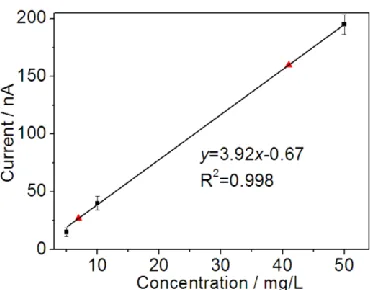
[image:13.596.212.386.313.450.2]Figure 13. Calibration curve for BOD standard solutions. The red point of intersection“▲” was BOD value of real water samples. Each data was subtracted by the background signal.
Table 2. Comparison of BOD analysis for real water samples between the microsensor and BOD5
real wate samples
measurement method relative deviation / %
BOD5 / mg/L microsensor / mg/L
1# 6.0 6.9 15%
2# 36.0 41.0 13.9%
3# 12.7 14 10.2%
4# 22.3 25.1 12.6%
5# 8.0 9.1 13.8%
Then two real water samples were tested and their BOD concentrations were calculated according to the calibration curve. The obtained calibration curve and measurement results were shown in Fig 13. A linear regression equation of y = 3.92x-0.67 (R²=0.998) was calculated, where y was the current response difference (∆I) on BOD standard solution and blank solution, and x was the BOD concentration value. The meaurement results of real water samples were compared with the standard method BOD5. As shown in Table 2, there is a good agreement of less than 15% relative
deviation between the microsensor method and the standard BOD5 method, which indicates that the
proposed microsensor would provide a feasible method for BOD fast determination in practice.
4. CONCLUSION
[image:14.596.76.522.378.505.2]
First, NR was electropolymerized on IUDA surface to form the immobilized mediator as PNR/IUDA. Then P. aeruginosa bacteria cells were doped into pyrrole-alginate and immobilized on PNR/IUDA by electropolymerization method to obtain a mediated BOD microsensor. The electropolymerization method is adaptable for immobilization of mediator and microorganism on the ultramicroelectrode array of IUDA due to its high controllability. Some influencing parameters, such as NR concentration, bacteria cells loading, and measurement time, temperature and pH were optimized for obtaining a sensitive signal. The as-prepared BOD microsensor provided comparable results with those of standard BOD5 method. More importantly, the immobilized PNR mediator and P. aeruginosa bacteria by
electropolymerization on IUDA was firstly validated to develop a mediated BOD microsensor. Future work will involve integration of the microsensor into a microfluidic system for rapid BOD monitoring in practical application.
ACKNOWLEDGEMENT
We acknowledge financial supports from the Beijing Natural Science Foundation (No. 4154070), Beijing Talents Fund (No. 2014000020124G104) and the open Fundation of State Key Laboratory of Transducer Technology (No. SKT1307).
References
1. M. Jordan, D. Welsh; R. John, K. Catterall and P. Teasdale, Water Res. 47 (2013) 841. 2. S. Jouanneau, L. Recoules, M. Durand, A. Boukabache, V. Picot, Y. Primault, A. Lakel, M.
Sengelin, B. Barilon and G. Thouand, Water Res. 49 (2014) 62.
3. N. Hideaki, K. Shun, H. Yu, K.Suzuki and Y. Mogi, Anal. Biochem. 369 (2007) 168.
4. A. Tizzard, J. Bergsma and G. Lloyd-Jones, A resazurin-based biosensor for organic pollutants. Biosens. Bioelectron. 22 (2006) 759.
5. H.Nakamura, Y. Abe, K. Rui, K.Suzuki and Y. Mogi, Anal. Chim. Acta, 602 (2007) 94. 6. L. Liu, S. Li, C. Liu, B. Zhang, and S. Dong, Talanta, 81 (2010) 170.
7. L. Liu, D. Liu, D. Yang and S. Dong, Talanta, 84 (2011) 895.
8. O. Ponomareva, V. Arlyapov, V. Alferov and A. Reshetilov, Appl. Biochem. Microbiol. 47 (2011) 1.
9. K. Morris, H. Zhao and R. John, Aust. J. Chem. 58 (2005) 237.
10. S. Oota, Y. Hatae, K. Amada, H. Koya and M. Kawakami, Biosens. Bioelectron. 26 (2010) 262. 11. N. Hideaki, S. Kyota, I. Hiroaki, K. Shintaro, and K. Rui, Talanta, 72 (2007) 210.
12. H. Chen, T. Ye, B. Qiu, G. Chen, and X. Chen, Anal. Chim. Acta, 612 (2008) 75. 13. J. Hu, G. Gao and S. Xia, Int. J. Electrochem. Sc. 10 (2015) 9695.
14. K. Wang, Y. Liu, and S. Chen, J. Power Sources 196 (2011) 164.
15. R. Carvalho, C. Gouveia-Caridade and C. Brett, Anal. Bioanal. Chem. 398 (2010) 1675. 16. J. Wang, B. Chao, J. Tong, J. Sun, W. Hong, and S. Xia, Electrochim. Acta, 145 (2014) 64. 17. M. Gutierrezcapitan, A. Baldi, C. Jimenezjorquera and C. Fernandez-Sanchez, IEEE 9th
Ibero-American Congress on sensors, 2014, 1.
18. H. Huang, P. Huang, W. Kuo, Y. Ju, and M. Wang, J. Sol-gel Sci. Techn. 67 (2013) 492. 19. P.Tomčík, Sensors. 13 (2013) 13659.
20. Standard Methods for the Examination of Water and Wastewater, 19th ed., American Public Health Association, Washington, D. C. 1997.
319.
26. H. Wu, X. He, X. Yang and J. Kang, Journal of Lanzhou Petrochemical College of Vocational Technology, 9 (2007).
27. M. Anjum, H. Shekhar, S. Hyun and S. Hong, Proceedings of IEEE on sensors, 3 (2004) 1202. 28. People's Republic of China, Environmental Quality Standard for Surface Water, GB-3838-2002. 29. N. Yoshida, J. Hoashi, T. Morita, S. J. McNiven, H. Nakamura, and I. Karube, J. Biotechnol. 88
(2001) 269.
30. E. Sevgi, G. Coral, A. Gizir, and M. Sangün, Turk. J. Biol. 34 (2010) 423.