Dalton
Transactions
Dynamic Article Links
Cite this:
Dalton Trans.
, 2011,
40
, 1061
www.rsc.org/dalton
PAPER
Mapping the potential energy surfaces for ring-closing metathesis reactions of
prototypical dienes by electronic structure calculations†
Ian H. Hillier,*
aShanthi Pandian,‡
aJonathan M. Percy*
band Mark A. Vincent
aReceived 30th September 2010, Accepted 24th November 2010
DOI: 10.1039/c0dt01314e
The potential energy surfaces for ring-closing metathesis reactions of a series of simplea,w-dienes which lead to 5–10 membered ring products, have been explored using density functional theory methods. We have investigated both the conformational aspects of the hydrocarbon chain during the course of the reactions, as well as the stationary structures on the corresponding potential energy surfaces. Extensive conformational searches reveal that the reaction proceedsviathe conformation that would be expected for the cycloalkene product, though most unexpectedly, cyclohexene formsvia complexes in boat-like conformations. The M06-L density functional has been used to map out the potential energy surfaces, and has identified metallocyclobutane fragmentation as being generally the highest barrier along the pathway. The structural variations along the pathway have been discussed for the reactant hydrocarbons of differing chain length to identify points at which cyclisation events may begin to affect reaction rates. Our study provides an excellent starting point from which to begin to learn about the way RCM reaction outcomes are controlled by diene structure.
Introduction
The importance of alkene metathesis reactions has grown spectac-ularly since well defined and air stable metal-alkylidene catalysts
1a–1c became commercially available.1 The closure of
highly-functionalised carbocycles and heterocycles of a wide range of sizes can be achieved under mild conditions, and many groups have executed elegant syntheses of complex natural products based on ring-closing metathesis (RCM) reactions,2 some of which use ingenious control or editing strategies.3 However, the excitement generated by the synthetic chemistry has stimulated remarkably few detailed quantitative studies of RCM chemistry.4 The Boehringer–Ingelheim5,6 group has rigorously explored a macrocyclisation by RCM as part of a process chemistry optimisa-tion, while Monfette and Fogg7recently reviewed the influence of thermodynamic control on RCM outcomes. In a series of elegant experiments, Metzger and co-workers have recently used ESI-MS to compare the stabilities of various ions on the RCM pathway of simple dienes catalysed by1ain the mass spectrometer,8while Piers
aSchool of Chemistry, University of Manchester, Oxford Road, Manchester,
UK M13 9PL. E-mail: [email protected]; Fax: +44 161 275 4734; Tel: +44 161 275 4687
bWestCHEM, Department of Pure and Applied Chemistry, Thomas Graham
Building, 295 Cathedral Street, Glasgow, G1 1XL. E-mail: jonathan.percy@ strath.ac.uk; Fax: +44 141 548 4822; Tel: +44 141 548 4398
† Electronic supplementary information (ESI) available: Cartesian coor-dinates and energies for the stationary structures on the RCM potential energy surfaces, for the lowest energy conformers and more. See DOI: 10.1039/c0dt01314e
‡ Universit¨at Heidelberg, Anorganisch-Chemisches Institut, INF 270, 69120 Heidelberg, Germany.
and van der Eide have identified a series of key intermediates using low temperature NMR.9,10There have been many computational studies; for example, the strength of ligand binding,11 and the mode of coordination (bottom or side bound) have been explored extensively.12–15Complex systems of special synthetic interest,16,17 are also described but studies of full systems18,19of general interest and importance are rare.20 Despite all this activity, systematic studies of the relationship between structure and reactivity remain few and far between. Our solution experimental work quantified the efficiency of formation of some substituted cyclooctenes by RCM,21where we measured the first effective molarities for RCM reactions. We also showed that the medium-ring products formed directly from acyclic diene precursors without the detectable intermediacy of oligomeric species, suggesting strongly that we were following a kinetically-controlled process (meaning that the product formed arose from the fastest reaction), and not a de-oligomerisation via backbiting22 in which the most stable product formed. During the course of our work, we became aware that there was relatively little underpinning computational work dealing with the RCM of prototypicala,w-dienes. We therefore now describe a computational study of the RCM reactions of simplea,w-dienes, the prototypical RCM substrates, using density functional theory (DFT) methods, from which we can begin to learn about the way reaction outcomes are controlled by diene structure.
Scheme 1 shows a catalytic cycle and the potential complexity of the RCM reaction. Here methylidene2maintains the cycle after the first turnover of pre-catalyst, and the ability of this species to react with starting diene3, cycloalkene product4and dimer5(the precursor to linear and cyclic oligomers) must be considered. In
Downloaded by University of Strathclyde on 13 December 2011
Scheme 1 Catalytic cycle showing RCM and dimerisation pathways and the important complexes.
principle, all of these pathways are reversible and the reaction can be subject to thermodynamic control. The possibility of thermodynamic control must be considered very carefully because of the ability of the extremely effective and widely-used second generation Ru pre-catalyst1bto react with disubstituted alkenes.23 If all the steps are reversible, product4or dimer5can re-enter the catalytic cycle and after equilibration, the product with the lowest free energy will dominate the reaction mixture.
The fastest reactions available to 2are likely to be with the terminal alkenyl groups presented by the acyclic diene and linear dimer (and higher oligomer).24The outcome of RCM carried out under kinetic control depends on the partitioning of alkylidene
A between the h2-complexes B and B¢, and therefore on the
relative rates and equilibrium constants for the pathways to
E and E¢. Kinetic control of this type of sequence is likely when the disubstituted alkene products re-enter the cycle slowly, either because of the pre-catalyst used, or because of features of the product structure. Understanding how structural changes and their effects on individual reaction steps affect overall rate or frequency of turnover represents a major challenge. In this manuscript, we focus on the events which define the cyclisation reaction, rather than the alkylidene transfer sequence from3to
A(Scheme 1) which should be common to all the systems in the current study.
Almost all of the systems studied by synthetic chemists are highly functionalised. Ring-opening metathesis polymerization (ROMP) reactions of simple cycloalkenes have been well studied by polymer chemists and catalyst developers,25 but the reaction concentrations used are usually high and the data cannot tell us directly about RCM efficiency. We therefore decided to explore the RCM reactions of the simplest acyclic dienes because the outcomes could be related closely to thermodynamic changes. Simple alicyclic systems are fairly well defined conformationally, so we can make predictions about the conformations of the intermediate organometallic complexes and test these predictions using electronic structure calculations employing appropriate density functionals. We could then begin to understand RCM reaction efficiency; RCM reactions differ significantly in their geometries at critical stages from those of the cyclic ether and lactone-forming reactions upon which the literature dealing with intramolecularity is based,26–28 so an accurate inventory of free energy changes throughout the RCM reaction as a function of ring size and molecular conformation could be extremely useful. This manuscript aims to lay a foundation for a better understanding of the thermodynamics of RCM, and the thermodynamic changes occurring inside the various compartments within the reaction. To achieve this end, we must consider the following issues; firstly, what is the conformation of the hydrocarbon chain on the potential energy surface (PES) of the reaction (Scheme 1)? In particular, is the conformation of the initial h2-complex (B)
maintained during the reaction? Secondly, what are the energetics of the various stationary structures (both minima and transition structures) on the PES, and how do the surfaces vary for different hydrocarbon chain lengths? The manuscript will not try to predict rate constants; this will be a goal of manuscripts in which we present reaction kinetic analysis.
Downloaded by University of Strathclyde on 13 December 2011
Table 1 Free energy changes (kcal mol-1, in dichloromethane) at the M06-L/B2 level, for the full reaction profiles based on the lowest energy conformers, and normalised to the sum of diene and methylidene (2) free energies
Ring Size Diene + 2a A B BC C CD D E(Cycloalkene + 2)a
5 0 -4.05 -15.53 -12.10 -14.13 -0.62 -7.48 -3.98
6b 0 -4.54 -11.13 -8.67 -14.75 -3.92 -9.27 -8.06
7 0 -4.38 -12.04 -6.55 -12.98 -3.48 -5.44 -3.55
8 0 -4.30 -9.45 -4.07 -8.96 -1.86 -5.07 -1.27
9 0 -4.45 -5.20 0.94 -5.30 4.36 -0.55 2.45
10 0 -3.98 -8.42 0.07 -4.14 1.68 -3.81 -0.27
aSee Scheme 1.bThis represents the pathway through the lowest energy conformers for the 6-ring with change in conformation before metallocyclobutane fragmentation.
We have adopted the following computational strategy to address these questions.
Computational strategy
Hydrocarbon conformation
We propose to explore the conformational space available to the complexes of simple hydrocarbon dienes and the tensions and constraints created by coordination to the metal centre. We also wish to develop a set of robust templates (by this we mean a set of reliable starting conformations upon which more complicated synthetic architectures can be built) which can be used to further our understanding of the behaviour of more complex systems and upon which we can model substituent effects.
Given the length of the hydrocarbon chains being considered, it was necessary to carry out conformational searches to identify the lowest energy, or at least one of the lower energy conformers for reaction. The conformational space occupied by the cycloalkenes was searched using the Monte Carlo conformer distribution algorithm (cycloalkenes) in Spartan (MMFF94 forcefield).29The conformational searches and preliminary location of energy minima were carried out using Spartan’0630 or Spartan’08.31 For these calculations, the LACVP basis sets, which combine the 6-31G family of basis sets with a LANL2DZ effective core potential on atoms heavier than Ar, were employed. Promising conformations were optimized using the widely employed B3LYP density functional and the LACVP* basis (B3LYP/LACVP*); this combination of functional and small basis is probably adequate to study different hydrocarbon conformations and is necessary to allow for the evaluation of a range of different structures and the avoidance of bias.
Prior to the conformational search of hydrocarbons bound to Ru, a pair of templates was generated fromh-bound ethylene and the four membered metallocyclobutane (formed from thish -complex).32The status and application of these templates will be discussed in more detail later. Startingh2-complexes were built
in-dividually on the template, the tether conformation being matched to a metallocyclobutane conformer in each case. For each complex, the geometry was optimised at the B3LYP/LACVP* level. In this way, we arrived at a conformation for each hydrocarbon that seemed to be energetically accessible throughout the entire reaction sequence and we were also aware of significant alternative conformations. All the dienes used in our study were optimised with the hydrocarbon chain fully staggered; this conformation
was confirmed as the lowest energy species using the equilibrium conformer algorithm implemented in the Spartan programmes.
Electronic structure calculations of the PES
We have previously33 used high level wavefunction calculations (CCSD(T)) on a model system34 to show that the ubiquitous B3LYP function is not sufficiently accurate for the calculation of the relative energies of the various structures on the PES (Scheme 1), whereas the newer M06 functionals (M06 and M06-L) have the required accuracy.35–39 Gaussian0340 was employed with a local implementation of the M06-L functional for the calculation of the stationary structures on the PES (Scheme 1). Two basis sets, B1 and B2, were employed, which were used previously.41 Basis B1 consisted of the effective core potential (ECP) and double zeta basis (LanL2DZ) on Ru (with an added f-function of exponent 0.5780), the 6-31G* basis on heavy atoms, and 6-31G on hydrogens. The larger basis, B2, consisted of the SDD ECP and corresponding basis set on Ru42 with the same f-function as B1, and with a 6-311G** basis on all other atoms. The stationary structures obtained with the small basis (B1) were characterized as minima or transition structures by calculation of the harmonic frequencies. Geometry optimization was further carried out using the larger basis (B2), starting with the B1 structures. There were normally only minor changes in the structures, and harmonic frequencies were therefore not computed. Thus, the electronic energies for the optimal B2 structures were corrected for thermodynamic effects (to give free energies) computed using the B1 structures and B1 basis. Finally, the effect of solvation was included by the use of the Conductor-like Polarizable Continuum Model (C-PCM) with a dielectric of 8.93 (dichloromethane). Unless otherwise stated, the energies for the species involved in the RCM reactions (Scheme 1) are free energies computed in this way. We now discuss the computational results of applying this strategy to the structures in Scheme 1.
Computational results
Table 1 summarizes the free energies (in dichloromethane) at the M06-L/B2 level, for the full reaction profiles based on the lowest energy conformers (vide infra for a discussion of the identification of these species), and normalised to the sum of diene and methylidene energies. The basis for the selection of these conformers will now be discussed. The structures of the species shown in Table 1 are in the Supplementary Information.†
Downloaded by University of Strathclyde on 13 December 2011
Conformation of the initialg2-complex (A)
The 14e propagating carbene complexes (A, Scheme 1) are formed by exergonic reactions between methylidene2, which carries the catalytic cycle, and the corresponding dienes. The free energy difference is typically 4.3 kcal mol-1 (Table 1: the full range is
3.98–4.54 kcal mol-1at 298 K) so the equilibrium constant (K) for
alkylidene transfer isca.1400 in favour of the more substituted alkylidene species. This reaction releases ethene, which is often referred to as the driving force for alkene metathesis. Thus, even without the passage of ethene from solution to gas phase, the increase in the level of substitution of the alkylidene provides a substantial driving force for alkylidene transfer.43
In the 14e alkylidene complexes (A) the orientation of the Ru CH bond causes the hydrocarbon chain to project into free space, which brings the alkylidene proton into close contact with the N–C(aryl) carbon in the propagating carbene complexes (Fig. 1) This H◊ ◊ ◊C contact lay between 2.39 and 2.42 A˚ (M06-L/B2) in all cases and thus might be expected to result in an attractive interaction, which would be correctly modelled by the M06 functional, but not by B3LYP.44
Fig. 1 The 14e alkylidene derived from 1,6-heptadiene (geome-try optimised at M06-L/B2 level of theory) highlighting the short N(Ar)C◊ ◊ ◊H–C Ru contact.
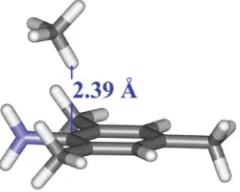
To investigate this H◊ ◊ ◊C(aryl) interaction further, the in-teraction energy of a complex between methane and 1-amino-2,4,6-trimethylbenzene (mesitylamine) (Fig. 2) having an H◊ ◊ ◊C distance of 2.39 A˚ was evaluated. The interaction was predicted to be attractive (by 1.74 kcal mol-1) using the M06-L functional,
but was repulsive (by 1.36 kcal mol-1) when B3LYP was used.
Fig. 2 Complex between methane and 1-amino-2,4,6-trimethylbenzene modelling the H◊ ◊ ◊C(aryl) interaction identified in Fig. 1.
Conformation of the reactiveg2-complex (B)
The next step is the formation of theh2-complex (B), in which the
double bonds, C C and Ru C, are brought into close proximity. The conformational aspects of this interaction were investigated using the h2-complex template 6 (Fig. 3). Straub explored 6b
and the related structures 6a, 6cand 6d and showed that the reactive alignment6b of alkene and alkylidene was favoured by the presence of the N-heterocyclic carbene (NHC) ligand used in this study, the minimum being only 0.05 kcal mol-1above the
metallocycle (B3LYP/LACV3P**+//B3LYP/LACVP*).
Fig. 3 The conformational possibilities for bottom-boundh2-complex6. The arrows refer to the C–Cs-bond directions and the open parallelograms to the alkene and alkylidenes-planes.
We optimised this template using B3LYP/LACVP* and B3LYP/B2. With the smaller basis (LACVP*), the structure was a minimum, but the metallocyclobutane was formed during optimisation with the higher basis. Further work showed that the stability of the h2-complex in the reactive conformation is
dependent on the basis sets used. Thus, removal of the f-functions from the B1 and B2 basis sets followed by optimisation revealed theh2-complex to be a stable minimum. Theh2-complex was also
a minimum when the M06-L functional was used (LACVP* or B2 basis), but the surrounding energy surface was very flat. On increasing the basis set from one to two f-functions on Ru and using a 6-311G(2d,2p) basis on the other atoms, theh2-complex
collapsed to the metallocyclobutane. It would thus seem that this
h2-complex is only stable in the aligned and reactive conformation
because of a basis set effect.
The addition of a hydrocarbon tether changes the way that the alkene and alkylidene bonds align and introduces conformational complexity. The four possible conformers (7a–7d, Fig. 4), cor-responding to (6a–6d, Fig. 3) were then examined explicitly. We built models in which theh2-coordinated alkene ligand and/or the
alkylidene Ru C bond were turned through 90◦to correspond to these alternative states, but they turned back to 7b during optimisation at the B3LYP/B1 level.
This outcome is consistent with the known tendency of cyclopentanoids to populate envelope conformations, involving some eclipsing of adjacent bonds.45The parallel aligned conformer represented by7btherefore anticipates an envelope conformation whereas the orthogonal conformers7cand7dwould seem difficult to populate within a ring of this size.
Downloaded by University of Strathclyde on 13 December 2011
[image:4.595.316.537.186.351.2] [image:4.595.58.273.307.466.2] [image:4.595.107.227.607.703.2]Fig. 4 The conformational possibilities for bottom-bound cyclic
h2-complex7. The arrows refer to the alkene C–Cs-bond directions and the open parallelograms to the alkene and alkylidenes-planes.
It is interesting to compare structure7b with8, obtained by Adlhart and Chen46during their investigation of the ring-opening of norbornene.
The turned alkylidene structure found in8(and like7a) is usually favourable for species more substituted than methylidene2, the C–C and Ru–Cl bonds becoming eclipsed when a hydrogen is replaced, and an allylic proton encroaches within van der Waals contact of the chlorine ligand in the frontal hemisphere. However, coordination of thew-alkene (in7b) brings the twop-bonds into alignment ready for metallocyclobutanation. The bicyclic nature of Adlhart and Chen’s structure8allows a pair of eclipsed and pseudo-axial bonds to converge spatially, reducing the effective length of the tether. The disposition of this system to adopt the turned structure is entirely consistent with the high reactivity of norbornene ring towards ring-opening, ROMP and tandem ring opening/cross-metathesis reactions being well known for this and related substrates.47
We found two distinct aligned starting cyclich2-complexes for 7b, so tethering allows the population of a productive confor-mation which can progress to the transition structure without conformational change, and imposes a significant (DG‡ = 3.4
kcal mol-1, Table 1) barrier to metallocyclobutanation (vide infra).
There is a significant degree of twisting of the Ru C alkylidene plane (H–C Ru–Cl dihedral angle=24◦) in the lower energy of the two conformers (Fig. 5a), the hydrocarbon chain being chair-like in this complex. One allylic proton points in towards a chlorine atom in the lower energy conformer and the interatomic distance is just less than the sum of the van der Waals radii at 2.63 A˚ . In the higher energy boat-like conformer (Fig. 5b), the non-allylic methylene is folded in, so that one of the protons approaches to within 2.55 A˚ of a chlorine ligand and the alkylidene plane is
Fig. 5 Conformers found for7bshowing twisting of the alkylidene plane; (a) lower energy chair and (b) higher energy boat.
twisted by 41◦which represents a large distortion away from the expected geometry.
The chair-like conformer series was selected for optimisation with the M06-L functional and B2 basis; Fig. 6 overlays B3LYP (blue) and M06-L (red) structures and illustrates the different ligand geometries predicted.
Fig. 6 Overlaid B3LYP/LACVP* (blue) and M06-L/B2 (red) structures calculated for7b(low energy conformer).
The main significant difference in the geometries lies in the angle between the planes of the arene rings in the NHC ligand, the M06-L functional making this angle more acute. The change in the position of the arene which sits over the alkylidene (Ru C) bond is minimal whereas the left-hand arene changes position, screening the Ru atom more effectively than in the B3LYP structure.
Cyclohexene exists in a half-chair form in solution, and confor-mational inversion occursviaa boat transition state with a barrier of 5.3 kcal mol-1.48,49In the initial search (B3LYP/LACVP*), the lower energy conformer in the initial cyclich2-complex was
boat-like and 1.3 kcal mol-1lower in (gas phase electronic) energy than
the best half-chair complex. The boat-like conformer became still more stable (by 2.0 kcal mol-1) than the half-chair when the free
energies were calculated (M06-L/B2, dichloromethane solution). We also found a second diastereoisomeric half-chair conformer, though this lay 3.6 kcal mol-1 above the boat-like structure
(M06-L/B2, dichloromethane solution) (see the Supplementary Information for illustrations).
Downloaded by University of Strathclyde on 13 December 2011
[image:5.595.61.268.51.234.2] [image:5.595.314.545.54.207.2] [image:5.595.311.547.331.484.2]The alkylidene group, in the lower energy boat-like conforma-tion, has the H tilted towards the mesitylene ring (12◦), whilst the half-chair conformation has this hydrogen atom pointing away from the mesitylene moiety (12◦). The CH2-CH2dihedral in the
boat-like tether is twisted by 35◦to minimise the eclipsing interac-tion between adjacent methylene groups with the closest approach between protons being 2.33 A˚ . These results are most unexpected because they show that the anticipated half-chair conformer is the less accessible species, with the boat-like conformer representing the lowest energy entry point to the cycle. Both complexes have essentially the same geometry of alkene coordination with both C C bond distances being 1.37 A˚ and the shortest C◊ ◊ ◊Ru bonds being 2.30 and 2.27 A˚ for boat and half chair conformers, respectively. The two complexes contain a similar number of short (<2.4 A˚ ) H◊ ◊ ◊H contacts. The half-chair also has the shortest C–H◊ ◊ ◊C(Ar) contact at 2.64 A˚ , leading to a favourable H◊ ◊ ◊ p
interaction.
We did not carry out extensive conformational searching for the initialh2-complexes for the seven to nine membered rings because
of the emergence of a pattern in which the metallocyclobutane was the lowest point on the energy surface, and its fragmentation the highest barrier, and in which the producth2-complex was a
reliable guide to low energy species on the surface (vide infra). However, the initialh2-complex and not the metallocyclobutane
is the lowest energy species (by more than 4 kcal mol-1) for
Z-cyclodecene (which populates a single conformer which is over 2 kcal mol-1more stable than any other conformer)50so the correct identification of the rate-determining step depends on finding a competitive initialh2-complex. A number of complexes were
examined, but the lowest energy cyclodecene conformer lies within
±0.5 kcal mol-1of the lowest energyh2-complex we could find. An
attempt was also made to find turned (type c) conformers on the cyclodecene pathway, but these optimised to the aligned reactive (type b) conformers.
Conformation of the metallocyclobutane (C)
The metallocyclobutanes have long been viewed as the pivotal species on the RCM energy surface.51To build metallocyclobutane templates to be used to construct a starting structure for each Cx ligand, the heterocyclic carbene and chloride ligands were
first frozen and Monte Carlo MM conformational searching was carried out; restricted searches were carried out because the parameterisation of ruthenium in MM is inadequate. We shall subsequently refer to this as the Monte Carlo/frozen atoms method. Distinct structures were then optimised (without constraints) at the B3LYP/LACVP* and M06-L/LACVP* levels. The sets of metallocyclobutane conformers were checked against the cycloalkene conformer sets (vide infra), and when there were important absences, the appropriate metallocyclobutane complexes were constructed manually on the template. Both diastereoisomeric complexes were constructed for cycloalkene conformers which lacked mirror plane symmetry. The use of different approaches here is intended to avoid bias and increase the chances of locating unexpected but important conformers.
Metallocyclobutanes were found to match all the 5- and 6-membered h2-complexes and the order of free energy
differ-ences between them was preserved. The lower stability of the cyclohexene-forming half-chair (+2.1 kcal mol-1) at the
metallocy-clobutane stage is surprising. The boat conformer is more twisted to minimise the number of eclipsed bonds, but retains the close H◊ ◊ ◊H contact between 1,4-hydrogen atoms (2.27 A˚ ) expected for the hydrocarbon itself (Fig. 7a). This means that the half-chair metallocyclobutane must be significantly destabilised, and there is a new eclipsing interaction, and an additional close H◊ ◊ ◊H contact (of 2.19 A˚ ) which may be responsible. The alternative half-chair is still higher in energy (by 4.4 kcal mol-1). These results suggest that
all the metallocyclobutane complexes en route to cyclohexene are significantly destabilised by non-bonded interactions.
Fig. 7 (a) Twisted-boat and (b) half chair metallocyclobutane conformers (M06-L/B2) showing inter-atomic close contacts.
Cycloheptene is reported to occupy chair (0.00), twist (+1.1 kcal mol-1) and boat (+3.8 kcal mol-1) conformers according
to computational (the MP2/6-31G* relative free energies are given in parentheses)52 and NMR53 studies. In our M06-L/6-31G*//MMFF94 calculations, we found chair, twist-chair and twist-boat conformers with relative free energies of +1.0 kcal mol-1
for the twist-chair and +2.7 kcal mol-1for the twist-boat, but the
symmetrical boat conformer was not a minimum at this level of theory.54
Monte Carlo conformational searching for the metallocy-clobutane using the frozen atom approach yielded symmetrical boat, symmetrical chair and one twist-chair metallocyclobutane
Downloaded by University of Strathclyde on 13 December 2011
[image:6.595.311.545.182.551.2]complex, but the twist boat conformer was not found. The other (diastereoisomeric) twist-chair metallocyclobutane complex was constructed manually and optimised (B3LYP/LACVP*). We found that the electronic energy of the chair conformer was 3.2 kcal mol-1 lower than the boat, with the twist conformers
decisively higher at +8.4 and +7.2 kcal mol-1. The energies of the
complex converged, but followed the same order when the M06-L functional was used (M06-LACVP* basis), the relative electronic energies being chair (0.00), boat (+1.6 kcal mol-1) and twist (+5.2
and +6.8 kcal mol-1). The identity of the lowest energy conformer
was confirmed with the larger basis (M06-L/B2) revealing an advantage of 2.0 kcal mol-1for the chair so the B3LYP functional
has identified the lowest energy conformer correctly, which is also the one expected. The relatively high energies of the twisted conformations may be due to short (<2.7 A˚ ) C–H◊ ◊ ◊Cl–Ru contacts. The larger ring systems afforded further opportunities to test the ability of the B3LYP functional to order conformers correctly. The conformations available to the cyclooctyl and cyclononyl series were explored carefully because these systems present challenges in synthetic chemistry and mark points at which step changes in efficiency occur. Whereas there are many examples of successful closures of cyclooctenes,55–58with even annulations proceeding smoothly when the systems are suitably “geared”,59–63 there are fewer reports of successful cyclononene closures64–66and we were anxious to represent any major differences between the systems accurately.67–69
Boat-chair type conformers are favoured for cis-cyclooctenes,70–72 and we have not found other documented conformers. Monte Carlo conformational searching for cis-cyclooctene identified the boat-chair as the lowest, and three other conformers. The next lowest (2.1 kcal mol-1) lies between
boat-boat and twist-boat conformers (we refer to the nomenclature used for cyclooctane conformers by Eliel).45 The third (3.6 kcal mol-1) resembles a twist-chair-chair conformation while the
fourth (6.2 kcal mol-1) is closest to a chair-chair conformation.
All four conformers are chiral so diastereoisomeric pairs of metallocyclobutane complexes must be explored, and thus eight product complexes were built using the template (they were not all found by the Monte Carlo search using the frozen atom approach) based on the optimised cyclooctene structures. These complexes were optimised (B3LYP/LACVP*) and, as expected, the boat-chair conformers were the lowest energy in the set, with all the other conformer energies following the same order as those of the uncomplexed cyclooctene.
After minimisation, the two highest energy cyclooctene con-formers were not represented amongst the metallocyclobutanes. This may be a consequence of the presence of two additional sp3
centres in the metallocyclobutane complexes, since their replace-ment of sp2centres will cause additional transannular or van der
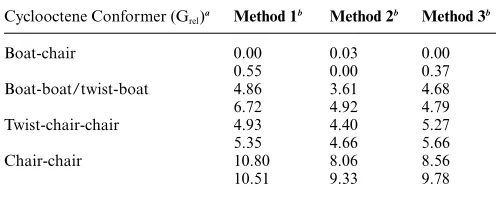
[image:7.595.304.552.91.190.2]Waals strain. Cyclooctenes constructed from the highest energy metallocyclobutane conformations (by ablation of the atoms dervied from the complex and installation of an alkene) minimised to the higher energy cyclooctenes consistent with this view. To check the effectiveness of the more economical B3LYP conformer screening method, we also optimised all eight metallocyclobutanes L/LACVP*) and calculated single point energies (M06-L/LACVP*) at the B3LYP geometries; Table 2 summarises the results obtained using the different methods. There are two diastereoisomeric complexes for each cyclooctene conformer.
Table 2 Relative electronic energies (kcal mol-1) for optimised geometries using the different methods. Each cyclooctene conformer has a pair of diastereoisomeric complexes
Cyclooctene Conformer (Grel)a Method 1b Method 2b Method 3b
Boat-chair 0.00 0.03 0.00
0.55 0.00 0.37
Boat-boat/twist-boat 4.86 3.61 4.68
6.72 4.92 4.79
Twist-chair-chair 4.93 4.40 5.27
5.35 4.66 5.66
Chair-chair 10.80 8.06 8.56
10.51 9.33 9.78
aM06-L/6-31G*//MMFF94. bMethod 1: Optimised geometry (B3LYP/LACVP*).Method 2:Single points (M06-L/LACVP*//B3LYP/ LACVP*).Method 3:Optimised geometry (M06-L/LACVP*).
The electronic energies of the M06-L optimized structures fol-low the same order as the cyclooctene free energies, and the M06-L/LACVP*//B3LYP/LACVP* and B3LYP/LACVP* electronic energies follow approximately the same order as the cyclooctene free energies. As in the cycloheptene case, the differences between the conformer energies increase at the metallocyclobutane stage. Overall, these results suggest strongly that the screening process that we have undertaken with the B3LYP functional allows the reliable identification of low energy conformers. We note that only the boat-chair species was optimised using the large B2 basis. We therefore pursued a unique single startingh2-complex based
on the boat-chair conformer, corresponding to the lowest energy metallocyclobutane. The strategy for the product h2-complexes
will be discussed later in this paper.
Cyclononene partitions between two conformers at low tem-perature according to Noe and co-workers, who used ab initio (HF/6-311G*) calculations and low temperature NMR methods to identify the main species.73 We generated a set of six cy-cloalkene conformers within 2 kcal mol-1of each other
(M06-L/6-31G*//MMFF94), and used these, and the Monte Carlo/frozen atoms method, to construct the complexes of interest on the metallocyclobutane template. The presence of conformers of very similar energy was likely to provide a sterner test of the B3LYP screening method. One of the conformers has mirror plane symmetry but the rest are chiral so eleven complexes were built and optimised. We found two groups of metallocyclobutanes; five conformers lay within 1 kcal mol-1, with the other six conformers
2.5 kcal mol-1 or more higher than the lowest energy species.
Though the lowest energy conformer from the B3LYP screen is no longer the most stable species at the M06-L/LACVP* level, it lies within 0.5 kcal mol-1of the most stable complex, and does match
the most stable cyclononene conformation. We can therefore safely use this conformer to explore the starting h2-complex because
there is no alternative species at significantly lower energy. The geometries of the product complexes will be discussed later in the manuscript.
There is very strong linkage between the most favourable metallocyclobutane and the most stable cycloalkene conformer, particularly for the seven to nine membered rings. This is an important observation which potentially can be used to guide investigations of much more complex systems. It suggests that the knowledge gained from a thorough investigation of product
Downloaded by University of Strathclyde on 13 December 2011
cycloalkene geometries can be transferred directly and informa-tively to the more computationally-demanding complexes.
Conformational searching was carried out for the 10-membered metallocyclobutane but none of the species found were lower in energy than the initialh2-complex; we therefore worked with the
conformation corresponding to the lowest energyZ-cyclodecene.
Conformation of the cycloalkene complex (D)
For the product cycloalkenes, theh2-complexes were built from
the cycloalkene conformer sets using either the B3LYP or M06-L templates. Both diastereoisomeric complexes were constructed for cycloalkene conformers which lacked mirror plane symmetry. The structures were optimised at the B3LYP/LACVP*, M06-L/LACVP* or M06-L/B2 levels. One general observation which emerged is that complexation of the cycloalkene to the ruthenium methylidene does not change the order of conformer energies, the lowest energy cycloalkene conformer being the same with or without complexation to ruthenium, at least for the electronic energies. Once again, the B3LYP functional appears to order complex energies correctly.
The potential energy surface
The metallocyclobutane is of similar, or of lower energy, than the initial h2-complex, for all the systems studied, except for
the one that leads to cyclodecene (Table 1). We have therefore focused on the metallocyclobutane and product h2-complexes
in the discussion that follows, and calculated only transition structures that lie between the lowest energy metallocyclobutane and producth2-complexes. The correspondence between orders
of cycloalkene, cycloalkeneh2-complex and metallocyclobutane
energies suggests very strongly that with one exception (the 6-membered ring), the product conformation may also be a reliable indicator of conformation for the initial h2-complex. We have
therefore confined our attention to single initial h2-complex
conformations that match the producth2-complex.
Structural features of the potential energy surface
We first comment on the transition structures we have identified for the various steps of the RCM reactions. Transition structures were difficult to find between the carbenes and the initialh2-complexes
because of the shallow energy surfaces, though we succeeded in three cases. Fig. 8a shows the transition structure found between the 14e andh2-complex for cyclopentene formation.
The alkene carbon◊ ◊ ◊Ru distances are close to 4 A˚ and the alkene C–C bond is skewed by 45◦ away from the h2-complex
alignment. There has been minimal motion of the Ru CH alkylidene bond at the barrier. Inspection of the imaginary fre-quency shows that the transition structure involves the formation of Ru–C bonds, rather than a flexing motion of the tether, and we note that this transition structures connects to a coiled conformation of A, rather than the extended chain structure. We were not able to find transition structures for cycloalkene release from the methylidene complexes. Transition structures for metallocyclobutane formation and fragmentation were easier to find. We looked for single structures that linked the conformers identified by searching as described in the previous sections; in this way, one productive complex can be tracked smoothly throughout
Fig. 8 (a) Transition structure found between the 14e andh2-complex for cyclopentene formation and (b) transition structure/h2-complex (blue) overlay showing the change in alkylidene geometry and progression of alkene intoh2-coordination.
the entire reaction sequence. The transition structures for metallo-cyclobutane fragmentation are consistently the highest points on the energy surface and are therefore of critical importance for an appreciation of the barriers to turnover (vide infra). Our searching on the cyclodecene surface gave us an opportunity to investigate a number of such transition structures but it was reassuring to find that the lowest energy barrier corresponded to the lowest energy Z-cyclodecene conformer.
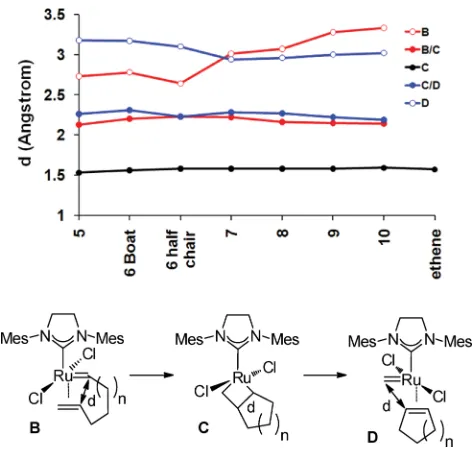
We now employ the key distance d, shown in Fig. 9 as a function of ring size at various points on the energy surface, to highlight the structural changes during the reaction. In the metallocyclobutanes, d was effectively constant varying only between 1.60 and 1.65 A˚ . The transition structures were also very similar, with modest variation in d between 2.13 and 2.23 A˚ for metallocyclobutane formation, and between 2.19 and 2.31 A˚ for metallocyclobutane fragmentation. The variation in d in theh2
-complexes was greater, particularly in the initial -complexes, where there appeared to be two distinct groups of ring systems, with the smaller rings allowing closer approach of the reaction carbon centres and a step change in d between 6 and 7 membered rings.
Fig. 9 Variation in distance d as ring size varies for the key complexes (B–D) and transition states (B/C,C/D) (M06-L/B2 optimised structures).
Downloaded by University of Strathclyde on 13 December 2011
[image:8.595.315.544.53.164.2] [image:8.595.311.548.479.704.2]Potentially, the large value of d inBis advantageous as it may reduce the development of transannular strain at this stage, though the penalty for this will be weaker complexation. The progression from the h2-complex to the metallocyclobutanation transition
state becomes increasingly expensive as the change in d becomes larger.
TheD-complexes occupy a much tighter range of geometries than the initialh2-complexes with d at its greatest for the 5 and
6-membered rings. The plane which includes the alkene and allylic carbons is tilted away from the alkylidene plane, presumably to ease steric crowding arising from the presence of allylic protons.
The metallocyclobutanes and the transition states for their fragmentation are structurally very similar. There is also a close relationship between the value of d in the product h2
-complexDand in the transition structure for metallocyclobutane fragmentation, the two lines in Fig. 9 mirroring each other.
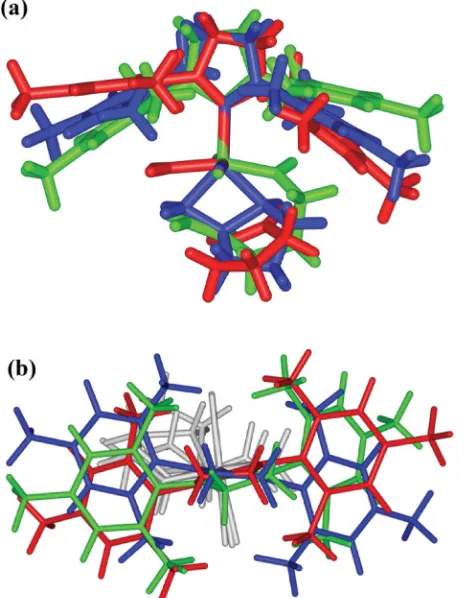
[image:9.595.313.543.180.353.2]It is of interest to examine the changes in the ligand geometry during the RCM reaction. Fig. 10 shows the three main reaction complexes (M06-L/B2) on the pathway for cyclopentene forma-tion in overlay to expose the moforma-tion of the ligand; the NHC ligand tilts and turns during the course of the reaction. The parallel relationship between alkylidene plane and aryl ring can be seen clearly in Fig. 10a (red and green structures); the ligand appears to rock across the top of the complex like a three-position switch, with the metallocyclobutane (blue) in the mid-position, with the NHC ligand disposed more symmetrically over the metallocyclobutane. The turning movement around the Ru–C bond to the carbene carbon of the NHC ligand can be seen in Fig. 10b.
Fig. 10 Overlay of the three main reaction complexes (M06-L optimised structures); startingh2-complex ingreen, metallocyclobutane in blue and producth2-complex in red (a) in profile and (b) from above.
The more acute angle between the planes of the arene rings in the NHC ligand in the M06-L optimised structures shortens certain C–H◊ ◊ ◊C(Ar) contacts by up to 0.5 A˚ relative to the B3LYP geometry, without changing the position or conformation of the hydrocarbon tether. The starting boath2-complexes en route to
[image:9.595.52.284.390.689.2]cyclohexene are overlaid in Fig. 11a (M06-L red, B3LYP blue); the change in the position of the arene which sits over the alkylidene (Ru C) bond is minimal whereas the left-hand arene which is in a very open sector of space changes position. The closest C– H◊ ◊ ◊C(Ar) contacts are very similar in the two complexes in (a).
Fig. 11 Overlays of DFT-optimised structures (B2 basis) for (a)
h2-complex (boat), (b) metallocyclobutane (boat) and (c) product
h2-complex (half-chair). M06-L structures are in red, B3LYP structures are in blue and distances are in A˚ .
Our model calculations, previously described (vide supra), show that these close contacts do result in attractive interactions when the M06-L functional is used. The rocking of the ligand also shortens the C–H◊ ◊ ◊C(Ar) contacts in Fig. 11b and Fig. 11c, relative to the B3LYP structures.
Energetic features of the potential energy surface
There are clearly expected to be differing entropy contributions to the various stages of the RCM reaction. These have been included within the gas phase rigid-rotor, harmonic oscillator model, with the effect of solvation being taken into account by a continuum model, which yields the solvation free energy. The solvent will clearly modify the entropic changes predicted by the gas phase model, but since the consideration of such effects is beyond the scope of the present paper, it is useful to present the potential energy surface without the gas phase entropy terms, but still retaining the solvation free energies.18 Table 3 contains the enthalpy plus solvation free energy changes during the reaction, to be compared to the corresponding total free energy changes given in Table 1.
The difference between the corresponding values gives the entropy contribution. We find that the initial cyclisation fromA
toB, bears, as expected, a significant entropy loss, which increases from 12 eu to 23 eu as the ring size increases from 5 to 10. This corresponds to an entropy loss of 2 eu for each additional C–C bond, which is somewhat smaller than the value of 4 eu suggested by Galli and Mandolini.28 For the other steps in the reaction
Downloaded by University of Strathclyde on 13 December 2011
Table 3 Energies (kcal mol-1) at the M06-L/B2 level for the full reaction profiles
Ring Size Diene +2 A B BC C CD D
5 0 -5.01 -19.94 -18.61 -20.27 -6.97 -10.28 6 0 -5.20 -15.66 -14.77 -19.83 -10.51 -14.03 7 0 -5.36 -17.43 -13.76 -20.26 -9.75 -10.92 8 0 -4.93 -16.05 -11.73 -16.78 -8.33 -10.20 9 0 -5.26 -11.23 -7.93 -12.85 -4.10 -6.89 10 0 -5.00 -16.20 -9.82 -13.82 -7.72 -11.54 Energies are based on H +DGsolv.
we find that there is no systematic variation in the size of the entropy change with hydrocarbon chain length, but the trends in its magnitude for the different reaction steps are as expected. Conformational reorganisation as theh2-complex (B) progresses
to the metallocyclobutanation transition state is minimal so the free energy change is expected to be dominated by the enthalpic component. For this step, the calculated entropy loss is in the range 3–9 eu. There is a slightly greater entropy gain (4–11 eu) for the formation of the cycloalkene complex (D) from the cyclobutane (C).
Turning to the energy changes during the reaction, the free energy differences between entry to and entry from the RCM cycles not only represent predictions of the thermodynamic changes which control RCM, but also enable the identification of the steps that control turnover. Fig. 12 summarises the data from Table 1 in graphical form.
Fig. 12 Free energy profiles for RCM reaction (in kcal mol-1, M06-L/B2, dichloromethane, 298 K).
The reactions fall into four groups. Cyclohexene formation is clearly exceptional, in terms of bothDH(Table 3) andDG(Table 1) with a very favourable equilibrium constant (K=8.15¥105M at
298 K based onDG= -8.06 kcal mol-1). Except for the largest
ring size (10), we see that the step that controls the throughput is metallocyclobutane fragmentation to producth2-complex. The
return of metallocyclobutane through the cycle is a faster reaction but the forward cycle is driven by conversion of diene to formA.
Decomplexation is an important event in turnover. The process was endergonic by 3.0–3.8 kcal mol-1for the 5 and 8–10 membered
rings, with smaller penalties for the 7 (1.9 kcal mol-1) and 6 (1.2 kcal
mol-1) ring species. There is no clear correlation betweenDGand
ring strain for this step; the very low degree of pyramidalisation as the alkene complex forms should be noted. Cede ˜no and
Sniatynsky74 have argued that strain relief is maximal when the alkene has pyramidal character before complexation, minimising the conformational reorganisation required. This does not apply to any of the alkenes in the present study. The small energy of complexation for cyclohexene may be due to steric destabilisation of the D complex. The free energies of the cyclopentene and cyclohexeneDcomplexes are closer than expected based on the strain energy difference (cyclopentene 5.0 kcal mol-1, cyclohexene
0.9 kcal mol-1)75 between the cycloalkenes, consistent with this view. All the cyclisations are less favourable when product decomplexation is included in the reaction thermodynamics.
The RCM reactions to form cyclopentene and cycloheptene are very similar according to these calculations, with cyclisation free energies which lie within the limits of accuracy of the calculations (± 0.5 kcal mol-1); taking 3.75 kcal mol-1 as an
average free energy of cyclisation for these systems affords a K of ca. 600 M at 298 K. Cyclooctene and cyclodecene fall in the next group; cyclisation free energies are much closer to zero (K close to unity). There is a major difference between these systems at the metallocyclobutane complex, with the eight-membered system significantly more stable. The eight-eight-membered ring system appears committed to cyclisation (K=8.5), but while there is no additional barrier on the pathway to cyclooctene, metallocyclobutane fragmentation is more expensive for the 10-membered ring system (K=1.58). The cyclononene system stands alone with a very unfavourable free energy of cyclisation (2.45 kcal mol-1, K=0.016) and still higher barrier to metallocyclobutane
fragmentation.
Access to the potential energy surface is controlled by the initiation event which converts the pre-catalyst to active catalyst; strongly bound phosphane dissociates in this step and a number of workers have proposed barriers for this reaction. Grubbs and co-workers used two different approaches to determine experimental values. UV spectrophotometry was used to follow the reaction between pre-catalyst 1b and ethyl vinyl ether, leading to the irreversible formation of a Fischer carbene complex.7631P NMR
experiments were also used to detect ligand exchange, with the two approaches delivering consistent values forDG‡(298 K) of the
order of 25 kcal mol-1. We have computed the free energy change
accompanying the loss of the phosphane from 1b, at the M06-L/B2 (C-PCM) level, giving a value of 20.8 kcal mol-1, which is
close to the experimental estimate. Thus, it would appear that our estimates of the barriers for even the most demanding steps on the cyclisation profiles are relatively low compared to the phosphane binding energy and we find that most of the intermediates on the surfaces lie below the starting alkylidene derived from the pre-catalyst.77 If each turnover required the dissociation of the phosphane from the pre-catalyst1b, this barrier would be the rate-determining step. However, once the active catalyst has formed, the rate of turnover is controlled by the propagation of2through the intervening complexes.78,79
Conclusions
In conclusion, we have determined low energy structures for all the intermediates on the RCM pathways and obtained the transition structures that link them. The conformational space around these intermediates has been explored thoroughly and the B3LYP functional has been shown to be effective at ordering
Downloaded by University of Strathclyde on 13 December 2011
[image:10.595.48.285.387.534.2]conformer energies, though the M06-L hybrid functional is used as a source of reliable energies. Metallocyclobutane fragmentation has been identified as the highest barrier within productive RCM sequences. In the case of cyclohexene, the reaction sequence most unexpectedly starts through an unfavourable conformer. The electronic structure calculations rank the cyclisations in the order of efficiency that would be expected from synthetic experimental work, with cyclohexene formation predicted to be orders of magnitude more favourable than any other RCM. Overall, we have provided a robust set of templates for use in analysing more complex systems, and a structural framework upon which a quantitative understanding of RCM can be constructed.
Acknowledgements
This work was supported by the EPSRC Initiative in Physical Organic Chemistry 2 (EP/G013160/1 and EP/G013020/1) and ORSAS (Studentship to SP).
Notes and references
1 G. C. Vougioukalakis and R. H. Grubbs,Chem. Rev., 2010,110, 1746. 2 K. C. Nicolaou, P. G. Bulger and D. Sarlah,Angew. Chem.-Int. Edit.,
2005,44, 4490.
3 A. H. Hoveyda and A. R. Zhugralin,Nature, 2007,450, 243. 4 M. Bieniek, A. Michrowska, D. L. Usanov and K. Grela,Chem.-Eur. J.,
2008,14, 806.
5 V. Farina, C. Shu, X. Zeng, X. Wei, Z. Han, N. K. Yee and C. H. Senanayake,Org. Process Res. Dev., 2009,13, 250.
6 C. Shu, X. Z. Zeng, M. H. Hao, X. D. Wei, N. K. Yee, C. A. Busacca, Z. X. Han, V. Farina and C. H. Senanayake,Org. Lett., 2008,10, 1303. 7 S. Monfette and D. E. Fogg,Chem. Rev., 2009,109, 3783.
8 H. Y. Wang, W. L. Yim, T. Kluner and J. O. Metzger,Chem.-Eur. J., 2009,15, 10948.
9 E. F. Van Der Eide, P. E. Romero and W. E. Piers,J. Am. Chem. Soc., 2008,130, 4485.
10 E. F. Van Der Eide and W. E. Piers,Nat. Chem., 2010,2, 571. 11 Y. Minenkov, G. Occhipinti and V. R. Jensen,J. Phys. Chem. A, 2009,
113, 11833.
12 A. Correa and L. Cavallo,J. Am. Chem. Soc., 2006,128, 13352. 13 D. Benitez, E. Tkatchouk and W. A. Goddard,Organometallics, 2009,
28, 2643.
14 C. E. Diesendruck, E. Tzur, A. Ben-Asuly, I. Goldberg, B. F. Straub and N. G. Lemcoff,Inorg. Chem., 2009,48, 10819.
15 E. Tzur, A. Szadkowska, A. Ben-Asuly, A. Makal, I. Goldberg, K. Wozniak, K. Grela and N. G. Lemcoff,Chem.-Eur. J., 2010,16, 8726. 16 S. E. Vyboishchikov, M. Buhl and W. Thiel,Chem.-Eur. J., 2002,8,
3962.
17 S. E. Vyboishchikov and W. Thiel,Chem.-Eur. J., 2005,11, 3921. 18 For a recent study of a single diene catalysed by 1c, see X.
Solans-Monfort, R. Pleixats and M. Sodupe,Chem.-Eur. J., 2010,16, 7331. 19 Straub has published a detailed PES for a single case of enyne RCM:
see J. J. Lippstreu and B. F. Straub,J. Am. Chem. Soc., 2005,127, 7444. 20 For a recent review of computational methods applied to
organometal-lic catalysis, see N. Fey,Dalton Transactions, 2010,39, 296.
21 L. Mitchell, J. A. Parkinson, J. M. Percy and K. Singh,J. Org. Chem., 2008,73, 2389.
22 J. C. Conrad, M. D. Eelman, J. A. D. Silva, S. Monfette, H. H. Parnas, J. L. Snelgrove and D. E. Fogg,J. Am. Chem. Soc., 2007,129, 1024. 23 For an example of cycloalkene diastereoisomer equilibration catalysed
by1b, see C. W. Lee and R. H. Grubbs,Org. Lett., 2000,2, 2145. 24 M. Ulman and R. H. Grubbs,Organometallics, 1998,17, 2484. 25 K. J. Ivin,Makromol. Chem.-Macromol. Symp., 1991,42-3, 1. 26 A. J. Kirby,Adv. Phys. Org. Chem., 1980,17, 183.
27 L. Mandolini,Adv. Phys. Org. Chem., 1986,22, 1. 28 C. Galli and L. Mandolini,Eur. J. Org. Chem., 2000, 3117. 29 T. A. Halgren,J. Comput. Chem., 1996,17, 490.
30 Spartan’06, Wavefunction, Irvine, CA, 2006. 31 Spartan’08, Wavefunction, Irvine, CA, 2008.
32 B. F. Straub,Angew. Chem.-Int. Edit., 2005,44, 5974.
33 S. Pandian, I. H. Hillier, M. A. Vincent, N. A. Burton, I. W. Ashworth, D. J. Nelson, J. M. Percy and G. Rinaudo,Chem. Phys. Lett., 2009, 476, 37.
34 M. Piacenza, I. Hyla-Kryspin and S. Grimme,J. Comput. Chem., 2007, 28, 2275.
35 S. Torker, D. Merki and P. Chen,J. Am. Chem. Soc., 2008,130, 4808. 36 P. Sliwa and J. Handzlik,Chem. Phys. Lett., 2010,493, 273.
37 I. C. Stewart, D. Benitez, D. J. O’Leary, E. Tkatchouk, M. W. Day, W. A. Goddard and R. H. Grubbs,J. Am. Chem. Soc., 2009,131, 1931. 38 Y. Zhao and D. G. Truhlar,J. Chem. Theor. Comput., 2009,5, 324. 39 For a recent review, see C. J. Cramer and D. G. Truhlar,Phys. Chem.
Chem. Phys., 2009,11, 10757.
40 M. J. Frisch, G. W. Trucks, H. B. Schlegel, G. E. Scuseria, M. A. Robb, J. R. Cheeseman, J. A. Montgomery, T. Vreven, K. N. Kudin, J. C. Burant, J. M. Millam, S. S. Iyengar, J. Tomasi, V. Barone, B. Mennucci, M. Cossi, G. Scalmani, N. Rega, G. A. Petersson, H. Nakatsuji, M. Hada, M. Ehara, K. Toyota, R. Fukuda, J. Hasegawa, M. Ishida, T. Nakajima, Y. Honda, O. Kitao, H. Nakai, M. Klene, X. Li, J. E. Knox, H. P. Hratchian, J. B. Cross, C. Adamo, J. Jaramillo, R. Gomperts, R. E. Stratmann, O. Yazyev, A. J. Austin, R. Cammi, C. Pomelli, J. W. Ochterski, P. Y. Ayala, K. Morokuma, G. A. Voth, P. Salvador, J. J. Dannenberg, V. G. Zakrzewski, S. Dapprich, A. D. Daniels, M. C. Strain, O. Farkas, D. K. Malick, A. D. Rabuck, K. Raghavachari, J. B. Foresman, J. V. Ortiz, Q. Cui, A. G. Baboul, S. Clifford, J. Cioslowski, B. B. Stefanov, G. Liu, A. Liashenko, P. Piskorz, I. Komaromi, R. L. Martin, D. J. Fox, T. Keith, M. A. Al-Laham, C. Y. Peng, A. Nanayakkara, M. Challacombe, P. M. W. Gill, B. Johnson, W. Chen, M. W. Wong, C. Gonzalez and J. A. Pople,Gaussian 03, Revision D.02, Gaussian Inc., Wallingford, CT, 2004.
41 I. W. Ashworth, D. Carboni, I. H. Hillier, D. J. Nelson, J. M. Percy, G. Rinaudo and M. A. Vincent,Chem. Commun., 2010,46, 7145. 42 D. Andrae, U. Haussermann, M. Dolg, H. Stoll and H. Preuss,Theor.
Chim. Acta, 1990,77, 123.
43 For a recent experimental evaluation of alkylidene transfer free energies with pre-catalyst 1a, see D. R. Lane, C. M. Beavers, M. M. Olmstead and N. E. Schore,Organometallics, 2009,28, 6789.
44 R. K. Raju, A. Ramraj, I. H. Hillier, M. A. Vincent and N. A. Burton, Phys. Chem. Chem. Phys., 2009,11, 3411.
45 E. L. Eliel, S. H. Wilen and L. N. Mander,Stereochemistry of Organic Compounds, Wiley-Interscience, New York, 1994.
46 C. Adlhart and P. Chen,J. Am. Chem. Soc., 2004,126, 3496. 47 For a recent example, see S. J. P’Pool and H. J. Schanz,J. Am. Chem.
Soc., 2007,129, 14200.
48 N. L. Allinger,J. Am. Chem. Soc., 1977,99, 8127.
49 F. A. L. Anet, D. I. Freedberg, J. W. Storer and K. N. Houk,J. Am. Chem. Soc., 1992,114, 10969.
50 D. M. Pawar and E. A. Noe,J. Am. Chem. Soc., 1998,120, 5312. 51 D. Castoldi, L. Caggiano, L. Panigada, O. Sharon, A. M. Costa and C.
Gennari,Chem.-Eur. J., 2005,12, 51.
52 M. K. Leong, V. S. Mastryukov and J. E. Boggs,J. Mol. Struct., 1998, 445, 149.
53 E. S. Glazer, C. Ganter, J. D. Roberts and R. Knorr,J. Am. Chem. Soc., 1972,94, 6026.
54 L. I. Ermolaeva, V. S. Mastryukov, N. L. Allinger and A. Almenningen, J. Mol. Struct., 1989,196, 151.
55 J. S. Clark,Chem. Commun., 2006, 3571.
56 A. Michaut and J. Rodriguez, Angew. Chem.-Int. Edit., 2006, 45, 5740.
57 J. A. L. Miles, L. Mitchell, J. M. Percy, K. Singh and E. Uneyama, J. Org. Chem., 2007,72, 12.
58 I. W. Ashworth, J. A. L. Miles, D. J. Nelson, J. M. Percy and K. Singh, Tetrahedron, 2009,65, 9637.
59 M. T. Crimmins, K. A. Emmitte and A. L. Choy,Tetrahedron, 2002, 58, 1817.
60 M. T. Crimmins and E. A. Tabet,J. Am. Chem. Soc., 2000,122, 5473. 61 K. Fujiwara, N. Kawamura, H. Kawai and T. Suzuki,Tetrahedron Lett,
2009,50, 1236.
62 K. Fujiwara, A. Goto, D. Sato, H. Kawal and T. Suzuki,Tetrahedron Lett, 2005,46, 3465.
63 S. Monfette and D. E. Fogg, inGreen Metathesis Chemistry: Great Challenges in Synthesis, Catalysis and Nanotechnology, ed. V. Dragutan, A. Demoncean, I. Dragutan and E. S. Finkelshtein, 2010, pp. 129. 64 M. T. Crimmins and A. L. Choy,J. Am. Chem. Soc., 1999,121, 5653. 65 S. V. Pansare and V. A. Adsool,Org. Lett., 2006,8, 5897.
Downloaded by University of Strathclyde on 13 December 2011
66 For an unsuccessful nine-membered ring closure, see L. A. Paquette, S. Dong and G. D. Parker,J. Org. Chem., 2007,72, 7135.
67 For recent ten-membered ring closures, see P. R. Krishna and T. J. Rao, Tetrahedron Lett, 2010,51, 4017.
68 P. R. Krishna and T. J. Rao, Org. Biomol. Chem., 2010, 8, 3130.
69 K. Tsuboi, T. Nakamura, T. Suzuki, A. Nakazaki and S. Kobayashi, Tetrahedron Lett, 2010,51, 1876.
70 K. L. Servis and E. A. Noe,J. Am. Chem. Soc., 1973,95, 171. 71 V. S. Mastryukov, K. H. Chen and N. L. Allinger,J. Phys. Chem. A,
2001,105, 8562.
72 G. A. Griffith, J. M. Percy, S. Pintat, C. A. Smith, N. Spencer and E. Uneyama,Org. Biomol. Chem., 2005,3, 2701.
73 D. M. Pawar, S. D. Miggins, S. V. Smith and E. A. Noe,J. Org. Chem., 1999,64, 2418.
74 D. L. Cedeno and R. Sniatynsky,Organometallics, 2005,24, 3882. 75 H. A. Skinner and G. Pilcher,Quart. Rev., 1963,17, 25.
76 M. S. Sanford, J. A. Love and R. H. Grubbs,J. Am. Chem. Soc., 2001, 123, 6543.
77 D. Benitez, E. Tkatchouk and W. A. Goddard,Chem. Commun., 2008, 6194.
78 For recent detailed studies of the initiation behaviour of 1c, see T. Vorfalt, K. J. Wannowius, V. Thiel and H. Plenio,Chem.-Eur. J., 2010, 16, 12312.
79 T. Vorfalt, K. J. Wannowius and H. Plenio,Angew. Chem.-Int. Edit., 2010,49, 5533.
Downloaded by University of Strathclyde on 13 December 2011