White Rose Research Online URL for this paper:
http://eprints.whiterose.ac.uk/83826/
Version: Published Version
Article:
Zappa, Emilio, Dykeman, Eric C and Twarock, Reidun orcid.org/0000-0002-1824-2003
(2014) On the subgroup structure of the hyperoctahedral group in six dimensions. Acta
crystallographica. Section A, Foundations and advances. pp. 417-428. ISSN 2053-2733
https://doi.org/10.1107/S2053273314007712
[email protected] https://eprints.whiterose.ac.uk/
Reuse
Items deposited in White Rose Research Online are protected by copyright, with all rights reserved unless indicated otherwise. They may be downloaded and/or printed for private study, or other acts as permitted by national copyright laws. The publisher or other rights holders may allow further reproduction and re-use of the full text version. This is indicated by the licence information on the White Rose Research Online record for the item.
Takedown
If you consider content in White Rose Research Online to be in breach of UK law, please notify us by
Acta Crystallographica Section A Foundations and Advances ISSN 2053-2733
Received 17 January 2014 Accepted 7 April 2014
On the subgroup structure of the hyperoctahedral
group in six dimensions
Emilio Zappa,a,c* Eric C. Dykemana,b,cand Reidun Twarocka,b,c
a
Department of Mathematics, University of York, York, UK,bDepartment of Biology, University of York, York, UK, andcYork Centre for Complex Systems Analysis, University of York, York, UK.
Correspondence e-mail: [email protected]
The subgroup structure of the hyperoctahedral group in six dimensions is investigated. In particular, the subgroups isomorphic to the icosahedral group are studied. The orthogonal crystallographic representations of the icosahedral group are classified and their intersections and subgroups analysed, using results from graph theory and their spectra.
1. Introduction
The discovery of quasicrystals in 1984 by Shechtmanet al.has spurred the mathematical and physical community to develop mathematical tools in order to study structures with non-crystallographic symmetry.
Quasicrystals are alloys with five-, eight-, ten- and 12-fold symmetry in their atomic positions (Steurer, 2004), and therefore they cannot be organized as (periodic) lattices. In crystallographic terms, their symmetry group G is noncrys-tallographic. However, the noncrystallographic symmetry leaves a lattice invariant in higher dimensions, providing an integral representation of G. If such a representation is reducible and contains a two- or three-dimensional invariant subspace, then it is referred to as a crystallographic repre-sentation, following terminology given by Levitov & Rhyner (1988). This is the starting point to construct quasicrystalsvia the cut-and-project method described by, among others, Senechal (1995), or as a model set (Moody, 2000).
In this paper we are interested in icosahedral symmetry. The icosahedral group I consists of all the rotations that leave a regular icosahedron invariant, it has size 60 and it is the largest of the finite subgroups ofSOð3Þ.Icontains elements of order five, therefore it is noncrystallographic in three dimensions; the (minimal) crystallographic representation of it is six-dimensional (Levitov & Rhyner, 1988). The full icosahedral group, denoted byIh, also contains the reflections and is equal toI C2, whereC2denotes the cyclic group of order two.Ih
is isomorphic to the Coxeter groupH3(Humphreys, 1990) and
is made up of 120 elements. In this work, we focus on the icosahedral group I because it plays a central role in appli-cations in virology (Indelicato et al., 2011). However, our considerations apply equally to the larger groupIh.
Levitov & Rhyner (1988) classified the Bravais lattices inR6
that are left invariant by I: there are, up to equivalence, exactly three lattices, usually referred to as icosahedral Bravais lattices, namely the simple cubic (SC), body-centred cubic (BCC) and face-centred cubic (FCC). The point group of these lattices is the six-dimensional hyperoctahedral group,
denoted by B6, which is a subgroup of Oð6Þ and can be
represented in the standard basis ofR6as the set of all 66
orthogonal and integral matrices. The subgroups ofB6which
are isomorphic to the icosahedral group constitute the integral representations of it; among them, the crystallographic ones are those which split, inGLð6;RÞ, into two three-dimensional
irreducible representations of I. Therefore, they carry two subspaces inR3which are invariant under the action ofI and can be used to model the quasiperiodic structures.
The embedding of the icosahedral group intoB6 has been
used extensively in the crystallographic literature. Katz (1989), Senechal (1995), Kramer & Zeidler (1989), Baake & Grimm (2013), among others, start from a six-dimensional crystal-lographic representation ofI to construct three-dimensional Penrose tilings and icosahedral quasicrystals. Kramer (1987) and Indelicato et al. (2011) also apply it to study structural transitions in quasicrystals. In particular, Kramer considers in B6a representation ofI and a representation of the
octahe-dral groupOwhich share a tetrahedral subgroup, and defines a continuous rotation (called Schur rotation) between cubic and icosahedral symmetry which preserves intermediate tetrahedral symmetry. Indelicato et al. define a transition between two icosahedral lattices as a continuous path connecting the two lattice bases keeping some symmetry preserved, described by a maximal subgroup of the icosahe-dral group. The rationale behind this approach is that the two corresponding lattice groups share a common subgroup. These two approaches are shown to be related (Indelicato et al., 2012), hence the idea is that it is possible to study the transi-tions between icosahedral quasicrystals by considering two distinct crystallographic representations of I in B6 which
share a common subgroup.
These papers motivate the idea of studying in some detail the subgroup structure ofB6. In particular, we focus on the
subgroups isomorphic to the icosahedral group and its subgroups. Since the group is quite large (it has 266!elements),
the elements of B6 inGAPas a subgroup of the symmetric
groupS12and then find the classes of subgroups isomorphic to
the icosahedral group. Among them we isolate, using results from character theory, the class of crystallographic repre-sentations of I. In order to study the subgroup structure of this class, we propose a method using graph theory and their spectra. In particular, we treat the class of crystallographic representations ofI as a graph: we fix a subgroupGofIand say that two elements in the class are adjacent if their inter-section is equal to a subgroup isomorphic to G. We call the resulting graph G-graph. These graphs are quite large and difficult to visualize; however, by analysing their spectra (Cvetkovic et al., 1995) we can study in some detail their topology, hence describing the intersection and the subgroups shared by different representations.
The paper is organized as follows. After recalling, inx2, the definitions of point group and lattice group, we define, in x3, the crystallographic representations of the icosahedral group and the icosahedral lattices in six dimensions. We provide, following Kramer & Haase (1989), a method for the construction of the projection into three dimensions using tools from the representation theory of finite groups. Inx4 we classify, with the help of GAP, the crystallographic repre-sentations of I. In x5 we study their subgroup structure, introducing the concept of G-graph, where G is a subgroup ofI.
2. Lattices and noncrystallographic groups
Letbi,i¼1;. . .;nbe a basis ofRn, and letB
2GLðn;RÞbe
the matrix whose columns are the components of bi with
respect to the canonical basisfei;i¼1;. . .;ngofRn. A lattice
inRn is aZ-free module of ranknwith basisB,i.e.
LðBÞ ¼
x¼P
n
i¼1
mibi: mi2Z
:
Any other lattice basis is given byBM, whereM2GLðn;ZÞ, the set of invertible matrices with integral entries (whose determinant is equal to1) (Artin, 1991).
The point group of a latticeLis given by all the orthogonal transformations that leave the lattice invariant (Pitteri & Zanzotto, 2002):
PðBÞ ¼ fQ2OðnÞ: 9M2GLðn;ZÞs:t:QB¼BMg:
We notice that, ifQ2 PðBÞ, thenB1QB¼M2GLðn;ZÞ.
In other words, the point group consists of all the orthogonal matrices which can be represented in the basisBas integral matrices. The set of all these matrices constitute the lattice group of the lattice:
ðBÞ ¼ fM2GLðn;ZÞ: 9Q2 PðBÞs:t:M¼B1
QBg:
The lattice group provides an integral representation of the point group and these are relatedviathe equation
ðBÞ ¼B1PðBÞB;
and moreover the following hold (Pitteri & Zanzotto, 2002):
PðBMÞ ¼ PðBÞ; ðBMÞ ¼M1ðBÞM; M2GLðn;ZÞ:
We notice that a change of basis in the lattice leaves the point group invariant, whereas the corresponding lattice groups are conjugated inGLðn;ZÞ. Two lattices are
inequi-valent if the corresponding lattice groups are not conjugated inGLðn;ZÞ(Pitteri & Zanzotto, 2002).
As a consequence of the crystallographic restriction [see, for example, Baake & Grimm (2013)] five- and n-fold symmetries, wherenis a natural number greater than six, are forbidden in dimensions two and three, and therefore any group G containing elements of such orders cannot be the point group of a two- or three-dimensional lattice. We there-fore call these groups noncrystallographic. In particular, three-dimensional icosahedral lattices cannot exist. However, a noncrystallographic group leaves some lattices invariant in higher dimensions and the smallest such dimension is called the minimal embedding dimension. Following Levitov & Rhyner (1988), we introduce:
Definition 2.1. Let G be a noncrystallographic group. A crystallographic representation of G is a D-dimensional representation ofGsuch that:
(1) the charactersofare integers;
(2)is reducible and contains a two- or three-dimensional representation ofG.
We observe that the first condition implies thatGmust be the subgroup of the point group of aD-dimensional lattice. The second condition tells us that contains either a two-or three-dimensional invariant subspace E of RD, usually
referred to as physical space (Levitov & Rhyner, 1988).
3. Six-dimensional icosahedral lattices
The icosahedral groupI is generated by two elements,g2and g3, such that g2
2¼g33¼ ðg2g3Þ 5
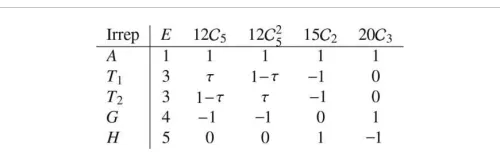
¼e, where e denotes the identity element. It has size 60 and it is isomorphic toA5, the alternating group of order five (Artin, 1991). Its character table is given in Table 1.
From the character table we see that the (minimal) crys-tallographic representation ofIis six-dimensional and is given by T1T2. Therefore, I leaves a lattice in R
6
[image:3.610.315.565.105.189.2]invariant. Levitov & Rhyner (1988) proved that the three inequivalent Bravais lattices of this type, mentioned in theIntroductionand
Table 1
Character table of the icosahedral group.
referred to as icosahedral (Bravais) lattices, are given by, respectively:
LSC¼ fx¼ ðx1;. . .;x6Þ:xi2Zg;
LBCC¼ x
¼1
2ðx1;. . .;x6Þ:xi2Z;xi¼xjmod2;8i;j¼1;. . .;6
;
LFCC ¼ x
¼1
2ðx1;. . .;x6Þ:xi2Z;
P6
i¼1xi¼0 mod2
:
We note that a basis of the SC lattice is the canonical basis ofR6. Its point group is given by
PSC¼ fQ2Oð6Þ:Q¼M2GLð6;ZÞg ¼Oð6Þ \GLð6;ZÞ ’Oð6;ZÞ;
ð1Þ
which is the hyperoctahedral group in dimension six. In the following, we will denote this group by B6, following
Humphreys (1996). We point out that this notation comes from Lie theory: indeed,B6represents the root system of the
Lie algebra soð13Þ (Fulton & Harris, 1991). However, the
corresponding reflection group WðB6Þ is isomorphic to the hyperoctahedral group in six dimensions (Humphreys, 1990). All three lattices have point groupB6, whereas their lattice groups are different and, indeed, they are not conjugate in GLð6;ZÞ(Levitov & Rhyner, 1988).
LetHbe a subgroup ofB6 isomorphic toI. Hprovides a
(faithful) integral and orthogonal representation ofI. More-over, if H ’T1T2 in GLð6;RÞ, then H is also
crystal-lographic (in the sense of Definition 2.1). All of the other crystallographic representations are given by B1HB, where B2GLð6;RÞ is a basis of an icosahedral lattice in R6.
Therefore we can focus our attention, without loss of gener-ality, on the orthogonal crystallographic representations.
3.1. Projection operators
LetHbe a crystallographic representation of the icosahe-dral group. H splits into two three-dimensional irreducible representations (IRs),T1andT2, inGLð6;RÞ. This means that
there exists a matrixR2GLð6;RÞsuch that
H0:¼R1HR¼ T1 0
0 T2 !
: ð2Þ
The two IRs T1 and T2 leave two three-dimensional
subspaces invariant, which are usually referred to as the physical (or parallel) space Ek and the orthogonal spaceE?
(Katz, 1989). In order to find the matrixR(which is not unique in general), we follow (Kramer & Haase, 1989) and use results from the representation theory of finite groups (for proofs and further results see, for example, Fulton & Harris, 1991). In particular, let :G!GLðn;FÞbe ann-dimensional repre-sentation of a finite group G over a field F (F = R, C).
By Maschke’s theorem, splits, in GLðn;FÞ, as m1 1. . .mr r, where i:G!GLðni;FÞ is an ni
-dimensional IR of G. Then the projection operator Pi:Fn
!Fni is given by
Pi:¼ ni
jGj X
g2I
iðgÞ ðgÞ; ð3Þ
where
i denotes the complex conjugate of the character of the representation i. This operator is such that its image
ImðPiÞis equal to anni-dimensional subspaceViofFn
invar-iant under i. In our case, we have two projection operators,
Pi:R6!R3, i= 1, 2, corresponding to the IRsT1 andT2, respectively. We assume the image ofP1, ImðP1Þ, to be equal to Ek, and ImðP
2Þ ¼E?. Iffej;j¼1;. . .;6gis the canonical basis
of R6, then a basis of Ek (respectively E?) can be found
considering the set fee^
j:¼Piej;j¼1;. . .;6g for i¼1
(respectively i¼2) and then extracting a basis Bi from it. Since dimEk= dimE?¼3, we obtainB
i¼ fee^i;1;ee^i;2;ee^i;3g, fori
= 1, 2. The matrixRcan be thus written as
R¼
^
e
e1;1;ee^1;2;ee^1;3 |fflfflfflfflfflfflfflffl{zfflfflfflfflfflfflfflffl}
basis ofEk
;ee^2;1;ee^2;2;ee^2;3 |fflfflfflfflfflfflfflffl{zfflfflfflfflfflfflfflffl}
basis ofE?
: ð4Þ
Denoting bykand?the 36 matrices which represent
P1 andP2 in the bases B1 andB2, respectively, we have, by linear algebra
R1¼ k
?
!
: ð5Þ
SinceR1
H ¼ H0R1[cf.equation (2)], we obtain
kðHðgÞvÞ ¼T1ðkðvÞÞ; ?ðHðgÞvÞ ¼T2ð?ðvÞÞ; ð6Þ
for allg2 Iandv2R6. In particular, the following diagram commutes
The setðH; kÞis the starting point for the construction of
quasicrystalsviathe cut-and-project method (Senechal, 1995; Indelicatoet al., 2012).
4. Crystallographic representations ofI
From the previous section it follows that the six-dimensional hyperoctahedral groupB6 contains all the (minimal)
ortho-gonal crystallographic representations of the icosahedral group. In this section we classify them, with the help of the computer software programmeGAP(The GAP Group, 2013).
4.1. Representations of the hyperoctahedral groupB6 Permutation representations of the n-dimensional hyper-octahedral groupBnin terms of elements ofS2n, the symmetric
group of order 2n, have been described by Baake (1984). In this subsection, we review these results because they allow us to generateB6inGAPand further study its subgroup struc-ture.
It follows from equation (1) that B6 consists of all the
orthogonal integral matrices. A matrixA¼ ðaijÞof this kind must satisfy AAT ¼I
6, the identity matrix of order six, and
permutation matrices. It is straightforward to see that anyA2B6can be written in the form
NQ, where Qis a 66 permutation matrix andNis a diagonal matrix with each diagonal entry being either 1 or 1. We can thus associate with each matrix in B6a pairða; Þ,
wherea2Z62is a vector given by the diagonal elements ofN, and2S6is the permutation
associated with Q. The set of all these pairs constitutes a group (called the wreath product of Z2 and S6, and denoted by Z2oS6;
Humphreys, 1996) with the multiplication rule given by
ða; Þðb; Þ:¼ ða
þ2b; Þ;
whereþ2denotes addition modulo 2 and
ðaÞ
k:¼aðkÞ; a¼ ða1;. . .;a6Þ:
Z2oS6andB6are isomorphic, an isomorphism
Tbeing the following:
½Tða; Þ
ij:¼ ð1Þ ai
ðiÞ;j: ð8Þ
It immediately follows that |B6| = 266! = 46 080. A set of
generators is given by
:¼ ð0;ð1;2ÞÞ; :¼ ð0;ð1;2;3;4;5;6ÞÞ; :¼ ðð0;0;0;0;0;1Þ;id
S6Þ; ð9Þ
which satisfy the relations
2¼2¼ 6¼ ð0;id S6Þ:
Finally, the function’:Z2oS6!S12defined by
’ða; ÞðkÞ:¼ (
ðkÞ þ6ak if 1 k 6 ðk6Þ þ6ð1ak6Þ if 7 k 12
ð10Þ is injective and maps any element ofZ2oS6into a permutation of S12, and provides a faithful permutation representation of B6 as a subgroup of S12. Combining equation (8) with the inverse of equation (10) we get the function
:¼T1:S
12 !B6; ð11Þ
which can be used to map a permutation into an element ofB6.
4.2. Classification
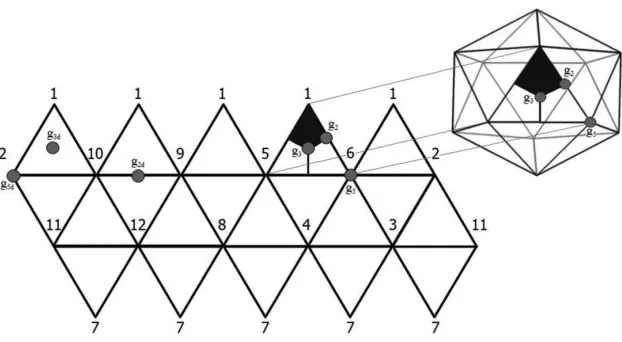
In this subsection we classify the orthogonal crystal-lographic representations of the icosahedral group. We start by recalling a standard way to construct such a representation, following Zappaet al.(2013). We consider a regular icosahe-dron and we label each vertex by a number from one to 12, so that the vertex opposite to vertexi is labelled byiþ6 (see Fig. 1). This labelling induces a permutation representation
:I !S12 given by
ðg2Þ ¼ ð1;6Þð2;5Þð3;9Þð4;10Þð7;12Þð8;11Þ; ðg3Þ ¼ ð1;5;6Þð2;9;4Þð7;11;12Þð3;10;8Þ:
Using equation (11) we obtain a representation II^ :I !B 6
given by
^
IIðg2Þ ¼
0 0 0 0 0 1 0 0 0 0 1 0 0 01 0 0 0 0 0 0 1 0 0 0 1 0 0 0 0 1 0 0 0 0 0
0
B B B B B B @
1
C C C C C C A
; IIð^ g3Þ ¼
0 0 0 0 0 1 0 0 0 1 0 0 01 0 0 0 0 0 01 0 0 0 1 0 0 0 0 0 0 0 0 0 1 0
0
B B B B B B @
1
C C C C C C A :
ð12Þ
We see thatII^ðg2Þ ¼ 2 andII^ðg3Þ ¼0, so that, by looking
at the character table ofI, we have
^
II ¼T1 þT2;
which implies, using Maschke’s theorem (Fulton & Harris, 1991), thatII ’^ T1T2inGLð6;RÞ. Therefore, the subgroup
^
II ofB6is a crystallographic representation ofI.
Before we continue, we recall the following (Humphreys, 1996):
Definition 4.1. Let H be a subgroup of a group G. The conjugacy class ofHinGis the set
CGðHÞ:¼ fgHg 1:g
2Gg:
In order to find all the other crystallographic representa-tions, we use the following scheme:
(a) we generateB6as a subgroup ofS12using equations (9)
and (10);
(b) we list all the conjugacy classes of the subgroups ofB6 and find a representative for each class;
(c) we isolate the classes whose representatives have order 60;
(d) we check if these representatives are isomorphic toI; (e) we map these subgroups of S12 intoB6using equation
(11) and isolate the crystallographic ones by checking the characters; denoting bySthe representative, we decomposeS
[image:5.610.253.564.68.239.2]as
Figure 1
S¼m1Aþm2T1þm3T2þm4Gþm5H;
mi2N; i¼1;. . .;5:
Note thatSis crystallographic if and only ifm2¼m3¼1
andm1¼m4¼m5¼0.
We implemented steps (1)–(4) inGAP(see Appendix C). There are three conjugacy classes of subgroups isomorphic to I inB6. Denoting bySi¼ hg2;i;g3;iithe representatives of the classes returned byGAP, we have, using equation (11),
S1ðg2;1Þ ¼2; S1ðg3;1Þ ¼3)S1 ¼2AþG)S1’2AG; S2ðg2;2Þ ¼ 2; S2ðg3;2Þ ¼0)S2 ¼T1þT2)S2’T1T2; S
3ðg2;3Þ ¼2; S3ðg3;3Þ ¼0)S3 ¼AþH)S3’AH:
Since 2A is decomposable into two one-dimensional representations, it is not strictly speaking two dimensional in the sense of Definition 2.1, and as a consequence, only the second class contains the crystallographic representations of I. A computation inGAPshows that its size is 192. We thus have the following:
Proposition 4.1. The crystallographic representations ofIin B6form a unique conjugacy class in the set of all the classes of
subgroups ofB6, and its size is equal to 192.
We briefly point out that the other two classes of subgroups isomorphic to I inB6 have an interesting algebraic
intepre-tation. First of all, we observe that B6is an extension of S6,
since according to Humphreys (1996):
B6=Z 6
2’ ðZ2oS6Þ=Z 6 2’S6:
Following Janusz & Rotman (1982), it is possible to embed the symmetric group S5 into S6 in two different ways. The
canonical embedding is achieved by fixing a point inf1;. . .;6g and permuting the other five, whereas the other embedding is by means of the so-called ‘exotic map’’:S5!S6, which acts on the six 5-Sylow subgroups ofS5by conjugation. Recalling
that the icosahedral group is isomorphic to the alternating groupA5, which is a normal subgroup ofS5, then the canonical embedding corresponds to the representation 2AGinB6,
while the exotic one corresponds to the representationAH. In what follows, we will consider the subgroupII^ previously defined as a representative of the class of the crystallographic representations ofI, and denote this class byCB6ðIIÞ^ .
Recalling that two representationsDð1Þ andDð2Þof a group Gare said to be equivalent if there are relatedviaa similarity transformation,i.e.there exists an invertible matrixSsuch that
Dð1Þ¼SDð2ÞS1;
then an immediate consequence of Proposition 4.1 is the following:
Corollary 4.1. Let H1 andH2 be two orthogonal
crystal-lographic representations ofI. ThenH1andH2are
equiva-lent inB6.
We observe that the determinant of the generators ofII^ in equation (12) is equal to one, so that II 2^ Bþ6 :¼
fA2B6:detA¼1g. Proposition 4.1 implies that all the
crystallographic representations belong to Bþ6. The
remark-able fact is that they split into two different classes inBþ6. To
see this, we first need to generateBþ6. In particular, withGAP
we isolate the subgroups of index two inB6, which are normal inB6, and then, using equation (11), we find the one whose generators have determinant equal to one. In particular, we have
Bþ6 ¼ hð1;2;6;4;3Þð7;8;12;10;9Þ;ð5;11Þð6;12Þ;
ð1;2;6;5;3Þð7;8;12;11;9Þ;ð5;12;11;6Þi:
We can then apply the same procedure to find the crystal-lographic representations ofI, and see that they split into two classes, each one of size 96. Again we can choose II^ as a representative for one of these classes; a representativeKK^ for the other one is given by
^ K K ¼
*
0 1 0 0 0 0 1 0 0 0 0 0 0 0 1 0 0 0 0 0 0 0 0 1 0 0 0 0 1 0 0 0 0 1 0 0 0
B B B B B B @
1
C C C C C C A
;
0 0 0 1 0 0 1 0 0 0 0 0 0 0 0 0 0 1 0 1 0 0 0 0 0 0 1 0 0 0 0 0 0 0 1 0 0
B B B B B B @
1
C C C C C C A +
:
ð13Þ We note that in the more general case of Ih, we can construct the crystallographic representations of Ih starting from the crystallographic representations ofI. First of all, we recall thatIh¼IC2, whereC2is the cyclic group of order
two. LetHbe a crystallographic representation ofIinB6, and
let ¼ f1;1g be a one-dimensional representation of C2.
Then the representationHH^ given by
^ H
H:¼ H ;
where denotes the tensor product of matrices, is a repre-sentation ofIhinB6and it is crystallographic in the sense of Definition 2.1 (Fulton & Harris, 1991).
4.3. Projection into the three-dimensional space
We study in detail the projection into the physical spaceEk using the methods described inx3.1.
LetII^ be the crystallographic representation ofI given in equation (12). Using equation (3) with ni¼3 and jGj ¼ jIj ¼60 we obtain the following projection operators
P1¼ 1 2pffiffiffi5
ffiffiffi 5 p
1 1 1 1 1
1 pffiffiffi5 1 1 1 1
1 1 pffiffiffi5 1 1 1
1 1 1 pffiffiffi5 1 1
1 1 1 1 pffiffiffi5 1 1 1 1 1 1 pffiffiffi5 0
B B B B B B @
1
C C C C C C A
;
P2¼ 1 2pffiffiffi5
ffiffiffi 5 p
1 1 1 1 1
1 pffiffiffi5 1 1 1 1
1 1 pffiffiffi5 1 1 1 1 1 1 pffiffiffi5 1 1
1 1 1 1 pffiffiffi5 1
1 1 1 1 1 pffiffiffi5
0
B B B B B B @
1
C C C C C C A
The rank of these operators is equal to three. We choose as a basis of Ek and E? the following linear combination of the columns ci;j of the projection operators Pi, for i = 1, 2 and
j¼1;. . .;6:
c1 ;1þc1;5
2 ; c1
;2c1;4 2 ;
c1 ;3þc1;6
[image:7.610.46.300.91.235.2] [image:7.610.367.516.206.290.2] [image:7.610.45.296.299.396.2] [image:7.610.48.296.478.513.2]2
|fflfflfflfflfflfflfflfflfflfflfflfflfflfflfflfflfflfflfflfflfflfflfflfflfflfflffl{zfflfflfflfflfflfflfflfflfflfflfflfflfflfflfflfflfflfflfflfflfflfflfflfflfflfflffl} basis ofEk
; c2;1c2;5
2 ; c2
;2þc2;4 2 ;
c2 ;3c2;6
2
|fflfflfflfflfflfflfflfflfflfflfflfflfflfflfflfflfflfflfflfflfflfflfflfflfflfflffl{zfflfflfflfflfflfflfflfflfflfflfflfflfflfflfflfflfflfflfflfflfflfflfflfflfflfflffl} basis ofE?
!
:
With a suitable rescaling, we obtain the matrixRgiven by
R¼ ffiffiffiffiffiffiffiffiffiffiffiffiffiffiffiffi1 2ð2þÞ
p
1 0 0 1
0 11 0
1 0 0 1
0 1 1 0
1 0 0 1 1 0 0 1
0
B B B B B B @
1
C C C C C C A
:
The matrixRis orthogonal and reducesII^as in equation (2). In Table 2 we give the explicit forms of the reduced repre-sentation. The matrix representation inEk of P
1 is given by
[see equation (5)]
k¼ ffiffiffiffiffiffiffiffiffiffiffiffiffiffiffiffi1 2ð2þÞ
p
01 0 1 1 0 1 0
0 1 1 0
0
@
1
A:
The orbitfT1ðkðejÞÞg, wherefej;j¼1;. . .;6g is the
cano-nical basis of R6, represents a regular icosahedron in three
dimensions centred at the origin (Senechal, 1995; Katz, 1989; Indelicatoet al., 2011).
LetKbe another crystallographic representation ofIinB6.
By Proposition 4.1,K andII^ are conjugated inB6. Consider
M2B6such thatMII^M1¼ Kand letS¼MR. We have
S1KS¼ ðMRÞ1KðMRÞ ¼R1M1KMR¼R1II^R¼T1T2:
Therefore it is possible, with a suitable choice of the reducing matrices, to project all the crystallographic representations of I inB6in the same physical space.
5. Subgroup structure
The nontrivial subgroups ofI are listed in Table 3, together with their generators (Hoyle, 2004). Note thatT,D10 andD6
are maximal subgroups of I, and that D4, C5 and C3 are
normal subgroups ofT,D10andD6, respectively (Humphreys,
1996; Artin, 1991). The permutation representations of the generators inS12are given in Table 4 (see also Fig. 1).
SinceIis a small group, its subgroup structure can be easily obtained in GAP by computing explicitly all its conjugacy classes of subgroups. In particular, there are seven classes of nontrivial subgroups in I: any subgroup H of I has the property that, ifKis another subgroup ofI isomorphic toH, thenHandKare conjugate inI(this property is referred to as the ‘friendliness’ of the subgroupH; Soicher, 2006). In other words, denoting by nG the number of subgroups of I isomorphic toG,i.e.
nG:¼ jfH<I :H’ Ggj; ð14Þ
we have (cf.Definition 4.1)
nG¼ jCIðGÞj:
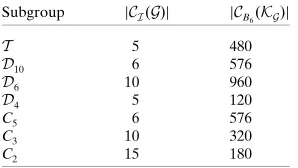
In Table 5 we list the size of each class of subgroups inI. Geometrically, different copies ofC2,C3andC5correspond to
the different two-, three- and fivefold axes of the icosahedron, respectively. In particular, different copies ofD10stabilize one
Table 2
Explicit forms of the IRsT1andT2withII ’^ T1T2.
Generator IrrepT1 IrrepT2
g2 1
2
1 1
1 1
1 1
0
@
1
A 1
2
1 1
1 1
1 1 0
@
1
A
g3 1
2
1 1
1 1
1 1
0
@
1
A 1
2
1 1
1 1
1 1
0
@
1
A
Table 3
Nontrivial subgroups of the icosahedral group.
T stands for the tetrahedral group,D2nfor the dihedral group of size 2n, and
Cnfor the cyclic group of sizen.
Subgroup Generators Relations Size
T g2;g3d g2
2¼g33d¼ ðg2g3dÞ
3¼e 12
D10 g2d;g5d g22d¼g55d¼ ðg5dg2dÞ
2
¼e 10
D6 g2d;g3 g22d¼g33¼ ðg3g2dÞ2¼e 6
C5 g5d g5
5d¼e 5
D4 g2d;g2 g22d¼g22¼ ðg2g2dÞ
2
¼e 4
C3 g3 g3
3¼e 3
C2 g2 g2
2¼e 2
Table 4
Permutation representations of the generators of the subgroups of the icosahedral group.
ðg2Þ ¼ ð1;6Þð2;5Þð3;9Þð4;10Þð7;12Þð8;11Þ ðg2dÞ ¼ ð1;12Þð2;8Þð3;4Þð5;11Þð6;7Þð9;10Þ ðg3Þ ¼ ð1;5;6Þð2;9;4Þð7;11;12Þð3;10;8Þ
ðg3dÞ ¼ ð1;10;2Þð3;5;12Þð4;8;7Þð6;9;11Þ ðg5Þ ¼ ð1;2;3;4;5Þð7;8;9;10;11Þ ðg5dÞ ¼ ð1;10;11;3;6Þð4;5;9;12;7Þ
Table 5
Sizes of the classes of subgroups of the icosahedral group inIandB6.
Subgroup jCIðGÞj jCB6ðKGÞj
T 5 480
D10 6 576
D6 10 960
D4 5 120
C5 6 576
C3 10 320
of the six fivefold axes of the icosahedron, and each copy ofD6
stabilizes one of the ten threefold axes. Moreover, it is possible to inscribe five tetrahedra into a dodecahedron, and each different copy of the tetrahedral group in I stabilizes one of these tetrahedra.
5.1. Subgroups of the crystallographic representations ofI Let G be a subgroup of I. The function (11) provides a representation ofGinB6, denoted byKG, which is a subgroup
ofII^. Let us denote byCB6ðKGÞthe conjugacy class ofKGinB6.
The next lemma shows that this class contains all the subgroups of the crystallographic representations ofI inB6.
Lemma 5.1. Let Hi2 CB6ð
^
IIÞ be a crystallographic repre-sentation of I in B6 and let Ki Hi be a subgroup of Hi isomorphic toG. ThenKi2 CB
6ðKGÞ.
Proof. Since Hi2CB6ð
^
IIÞ, there exists g2B6 such that
gHig1¼II^, and therefore gKig1¼ K0 is a subgroup of II^
isomorphic to G. Since all these subgroups are conjugate in ^
II [they are ‘friendly’ in the sense intended by Soicher (2006)], there exists h2II^ such that hK0h1
¼ KG. Thus
ðhgÞKiðhgÞ1¼ KG, implying thatKi2 CB
6ðKGÞ. &
We next show that every element ofCB
6ðKGÞis a subgroup
of a crystallographic representation ofI.
Lemma 5.2. Let Ki2 CB6ðKGÞ. There exists Hi2 CB6ð
^ IIÞ such thatKiis a subgroup ofHi.
Proof. Since Ki2 CB6ðKGÞ, there exists g2B6 such that
gKig1¼ KG. We defineHi:¼g1II^g. It can be seen
imme-diately thatKiis a subgroup ofHi. &
As a consequence of these lemmata, CB6ðKGÞ contains all the subgroups of B6 which are isomorphic to G and are
subgroups of a crystallographic representation of I. The explicit forms of KG are given in Appendix B. We point out that it is possible to find subgroups of B6 isomorphic to a subgroup G of I which are not subgroups of any crystal-lographic representation of I. For example, the following subgroup
^ TT ¼
*
1 0 0 0 0 0 01 0 0 0 0 0 0 1 0 0 0 0 0 0 1 0 0 0 0 0 0 1 0 0 0 0 0 0 1 0
B B B B B B @
1
C C C C C C A
;
0 0 1 0 0 0 1 0 0 0 0 0 01 0 0 0 0 0 0 0 0 0 1 0 0 0 1 0 0 0 0 0 0 1 0 0
B B B B B B @
1
C C C C C C A +
is isomorphic to the tetrahedral group T; a computation in GAPshows that it is not a subgroup of any elements inCB6ðIIÞ^ . Indeed, the two classes of subgroups,CB6ðKTÞandCB6ðTT Þ^ , are disjoint.
UsingGAP, we compute the size of eachCB6ðKGÞ(see Table 5). We observe thatjCB6ðKGÞj<jCB6ðIIÞj ^ nG. This implies that
crystallographic representations ofImay share subgroups. In order to describe more precisely the subgroup structure of CB6ð
^
IIÞwe will use some basic results from graph theory and their spectra, which we are going to recall in the next section.
5.2. Some basic results of graph theory and their spectra In this section we recall, without proofs, some concepts and results from graph theory and spectral graph theory. Proofs and further results can be found, for example, in Foulds (1992) and Cvetkovicet al.(1995).
Let G be a graph with vertex set V¼ fv1;. . .;v ng. The
number of edges incident with a vertexvis called the degree of v. If all vertices have the same degreed, then the graph is called regular of degreed. A walk of lengthlis a sequence ofl consecutive edges and it is called a path if they are all distinct. A circuit is a path starting and ending at the same vertex and the girth of the graph is the length of the shortest circuit. Two verticespandqare connected if there exists a path containing pandq. The connected component of a vertexvis the set of all vertices connected tov.
The adjacency matrixAofGis thennmatrixA¼ ðaijÞ whose entriesaijare equal to one if the vertexviis adjacent to the vertexvj, and zero otherwise. It can be seen immediately
from its definition thatAis symmetric andaii¼0 for alli, so
that TrðAÞ ¼0. It follows thatAis diagonalisable and all its eigenvalues are real. The spectrum of the graph is the set of all the eigenvalues of its adjacency matrixA, usually denoted by
ðAÞ.
Theorem 5.1. LetAbe the adjacency matrix of a graphG with vertex set V¼ fv1;. . .;v
ng. Let Nkði;jÞ denote the
number of walks of lengthkstarting at vertexviand finishing at vertexvj. We have
Nkði;jÞ ¼Akij:
We recall that the spectral radius of a matrixAis defined by
ðAÞ:¼maxfjj:2ðAÞg. IfAis a non-negative matrix,i.e. if all its entries are non-negative, thenðAÞ 2ðAÞ(Horn & Johnson, 1985). Since the adjacency matrix of a graph is non-negative,jj ðAÞ:¼r, where2ðAÞandris the largest eigenvalue.ris called the index of the graphG.
Theorem 5.2. Let1;. . .; nbe the spectrum of a graphG,
and letrdenote its index. ThenGis regular of degreerif and only if
1 n
Xn
i¼1 2i ¼r:
Moreover, ifGis regular the multiplicity of its index is equal to the number of its connected components.
5.3. Applications to the subgroup structure
LetGbe a subgroup ofI. In the following we represent the subgroup structure of the class of crystallographic repre-sentations of I in B6, CB6ð
^
H1;H22 CB6ð
^
IIÞare adjacent to each other (i.e.connected by an edge) in the graph if there exists P2 CB6ðKGÞ such that
P¼ H1\ H2. We can therefore consider the graph G¼ ðCB
6ð
^
IIÞ;EÞ, where an edgee2Eis of the formðH1;H2Þ. We call this graphG-graph.
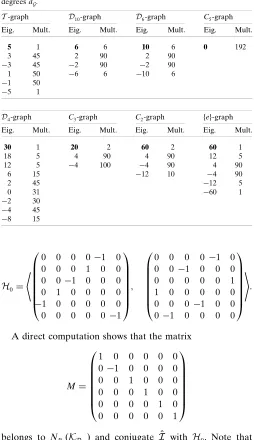
Using GAP, we compute the adjacency matrices of the G-graphs. The algorithms used are shown in Appendix C. The spectra of the G-graphs are given in Table 6. We first of all notice that the adjacency matrix of the C5-graph is the null
matrix, implying that there are no two representations sharing precisely a subgroup isomorphic to C5, i.e. not a subgroup
containingC5. We point out that, since the adjacency matrix of
the D10-graph is not the null one, then there exist
crystal-lographic representations, sayHi andHj, sharing a maximal subgroup isomorphic toD10. SinceC5is a (normal) subgroup
ofD10, thenHiandHjdo share aC5subgroup, but also aC2
subgroup. In other words, if two representations share a fivefold axis, then necessarily they also share a twofold axis.
A straightforward calculation based on Theorem 5.2 leads to the following
Proposition 5.1. Let G be a subgroup of I. Then the correspondingG-graph is regular.
In particular, the degreedGof eachG-graph is equal to the largest eigenvalue of the corresponding spectrum. As a consequence we have the following:
Proposition 5.2. LetHbe a crystallographic representation of I in B6. Then there are exactly dG representations
Kj2 CB6ð
^
IIÞsuch that
H \ Kj¼Pj;9Pj2 CðKGÞ;j¼1;. . .;dG:
In particular, we havedG = 5, 6, 10, 0, 30, 20, 60 and 60 for G ¼ T;D10;D6,C5;D4;C3;C2andfeg, respectively.
In particular, this means that for any crystallographic representation ofI there are precisely dG other such repre-sentations which share a subgroup isomorphic toG. In other words, we can associate to the class CB6ð
^
IIÞ the ‘subgroup matrix’Swhose entries are defined by
Sij¼ jHi\ Hjj; i;j¼1;. . .;192:
The matrixSis symmetric andSii¼60, for all i, since the order ofI is 60. It follows from Proposition 5.2 that each row of ScontainsdGentries equal tojGj. Moreover, a rearrange-ment of the columns ofSshows that the 192 crystallographic representations of I can be grouped into 12 sets of 16 such that any two of these representations in such a set of 16 share a D4-subgroup. This implies that the corresponding subgraph of
the D4-graph is a complete graph, i.e. every two distinct vertices are connected by an edge. From a geometric point of view, these 16 representations correspond to ‘six-dimensional icosahedra’. This ensemble of 16 such icosahedra embedded into a dimensional hypercube can be viewed as a six-dimensional analogue of the three-six-dimensional ensemble of five tetrahedra inscribed into a dodecahedron, sharing pair-wise aC3-subgroup.
We notice that, using Theorem 5.2, not all the graphs are connected. In particular, theD10- and theD6-graphs are made
up of six connected components, whereas theC3- and theC2 -graphs consist of two connected components. WithGAP, we implemented a breadth-first search algorithm (Foulds, 1992), which starts from a vertexiand then ‘scans’ for all the vertices connected to it, which allows us to find the connected components of a given G-graph (see Appendix C). We find that each connected component of theD10- andD6-graphs is
made up of 32 vertices, while for theC3- andC2-graphs each
component consists of 96 vertices. For all other subgroups, the corresponding G-graph is connected and the connected component contains trivially 192 vertices.
We now consider in more detail the case when G is a maximal subgroup ofI. LetH 2 CB6ð
^
IIÞand let us consider its vertex star in the correspondingG-graph,i.e.
VðHÞ:¼ fK 2 C B6ð
^
IIÞ:Kis adjacent toHg: ð15Þ
A comparison of Tables 5 and 6 shows thatdG¼nG[i.e.the number of subgroups isomorphic toGinI,cf.equation (14)] and therefore, since the graph is regular,jVðHÞj ¼dG¼nG. This suggests that there is a one-to-one correspondence between elements of the vertex star ofHand subgroups ofH isomorphic toG; in other words, if we fix any subgroupPofH isomorphic to G, then P ‘connects’ H with exactly another representationK. We thus have the following:
Proposition 5.3. LetGbe a maximal subgroup ofI. Then for every P2 CB6ðKGÞ there exist exactly two crystallographic representations ofI,H1;H22 CB6ð
^
IIÞ, such thatP¼ H1\ H2.
In order to prove it, we first need the following lemma:
Lemma 5.3. LetGbe a maximal subgroup ofI. Then the correspondingG-graph is triangle-free,i.e.it has no circuits of length three.
Proof. LetAG be the adjacency matrix of theG-graph. By Theorem 5.1, its third power A3G determines the number of walks of length three, and in particular its diagonal entries, ðA3
GÞii, fori¼1;. . .;192, correspond to the number of
trian-gular circuits starting and ending in vertex i. A direct computation shows thatðA3
GÞii¼0, for alli, thus implying the
non-existence of triangular circuits in the graph. &
Proof of Proposition 5.3. IfP2 CB
6ðKGÞ, then, using Lemma
5.2, there existsH12 CB
6ð
^
IIÞsuch thatPis a subgroup ofH1. Let us consider the vertex starVðH1Þ. We havejVðH1Þj ¼dG; we call its elementsH2;. . .;HdGþ1. Let us suppose thatP is
not a subgroup of anyHj, forj¼2;. . .;d
Gþ1. This implies
thatP does not connect H1 with any of theseHj. However,
sinceH1has exactlynG different subgroups isomorphic toG,
then at least two vertices in the vertex star, sayH2andH3, are
Q¼ H1\ H2;Q¼ H1\ H3)Q¼ H2\ H3:
This implies thatH1,H2andH3form a triangular circuit in the
graph, which is a contradiction due to Lemma 5.3, hence the
result is proved. &
It is noteworthy that the situation inBþ6 is different. If we denote by X1 and X2 the two disjoint classes of
crystal-lographic representations of I inBþ6 [cf. equation (13)], we
can build, in the same way as described before, theG-graphs forX1andX2, forG ¼ T;D10 andD6. The result is that the
adjacency matrices of all these six graphs are the null matrix of dimension 96. This implies that these graphs have no edges, and so the representations in each class do not share any maximal subgroup of I. As a consequence, we have the following:
Proposition 5.4. LetH;K 2 CB6ð
^
IIÞbe two crystallographic representations ofI, andP¼ H \ K,P2 CB6ðKGÞ, whereGis
a maximal subgroup ofI. ThenHandKare not conjugated in Bþ6. In other words, the elements ofB6which conjugateHwith Kare matrices with determinant equal to1.
We conclude by showing a computational method which combines the result of Propositions 4.1 and 5.2. We first recall the following:
Definition 5.1. Let H be a subgroup of a group G. The normaliser ofHinGis given by
NGðHÞ:¼ fg2G:gHg1
¼Hg:
Corollary 5.1. LetHandKbe two crystallographic repre-sentations ofIinB6andP2 CðKGÞsuch thatP¼ H \ K. Let
AH;K¼ fM2B6:MHM 1
¼ Kg
be the set of all the elements ofB6which conjugateHwithK
and letNB6ðPÞbe the normaliser ofPinB6. We have
AH;K\NB6ðHÞ 6¼ ;:
In other words, it is possible to find a nontrivial element M2B6in the normaliser ofPinB6which conjugatesHwith
K.
Proof. Let us suppose AH;K\NB
6ðHÞ ¼ ;. Then
MPM16¼P, for all M2A
H;K. This implies, since
MHM1¼ K, that P is not a subgroup of K, which is a
contradiction. &
We give now an explicit example. We consider the repre-sentation II^ as in equation (12), and its subgroup KD10 (the explicit form is given in Appendix B). WithGAP, we find the other representation H02 CðIIÞ^ such thatKD10 ¼
^
II \ H0. Its
explicit form is given by
H0¼ *
0 0 0 01 0 0 0 0 1 0 0 0 01 0 0 0 0 1 0 0 0 0
1 0 0 0 0 0
0 0 0 0 0 1 0
B B B B B B @
1
C C C C C C A
;
0 0 0 0 1 0 0 01 0 0 0 0 0 0 0 0 1 1 0 0 0 0 0 0 0 0 1 0 0 01 0 0 0 0 0
B B B B B B @
1
C C C C C C A +
:
A direct computation shows that the matrix
M¼
1 0 0 0 0 0 0 1 0 0 0 0 0 0 1 0 0 0 0 0 0 1 0 0 0 0 0 0 1 0 0 0 0 0 0 1 0
B B B B B B @
1
C C C C C C A
belongs to NB6ðKD10Þ and conjugate II^ with H0. Note that
detM¼ 1.
6. Conclusions
In this work we explored the subgroup structure of the hyperoctahedral group in six dimensions. In particular we found the class of the crystallographic representations of the icosahedral group, whose size is 192. Any such representation, together with its corresponding projection operatork, can be
chosen to construct icosahedral quasicrystalsviathe cut-and-project method. We then studied in detail the subgroup structure of this class. For this, we proposed a method based on spectral graph theory and introduced the concept ofG-graph, for a subgroupGof the icosahedral group. This allowed us to study the intersection and the subgroups shared by different representations. We have shown that, if we fix any
repre-Table 6
Spectra of theG-graphs forGa nontrivial subgroup ofIandG ¼ feg, the trivial subgroup consisting of only the identity elemente.
The numbers highlighted are the indices of the graphs, and correspond to their degreesdG.
T-graph D10-graph D6-graph C5-graph
Eig. Mult. Eig. Mult. Eig. Mult. Eig. Mult.
5 1 6 6 10 6 0 192
3 45 2 90 2 90
3 45 2 90 2 90
1 50 6 6 10 6
1 50
5 1
D4-graph C3-graph C2-graph feg-graph
Eig. Mult. Eig. Mult. Eig. Mult. Eig. Mult.
30 1 20 2 60 2 60 1
18 5 4 90 4 90 12 5
12 5 4 100 4 90 4 90
6 15 12 10 4 90
2 45 12 5
0 31 60 1
2 30
4 45
[image:10.610.313.567.117.557.2]sentationHin the class and a maximal subgroupPofH, then there exists exactly one other representation K in the class such that P¼ H \ K. As explained in theIntroduction, this can be used to describe transitions which keep intermediate symmetry encoded byP. In particular, this result implies in this context that a transition from a structure arising fromHvia projection will result in a structure obtainable for K via projection if the transition has intermediate symmetry described byP. Therefore, this setting is the starting point to analyse structural transitions between icosahedral quasicrys-tals, following the methods proposed in Kramer (1987), Katz (1989) and Indelicatoet al.(2012), which we are planning to address in a forthcoming publication.
These mathematical tools also have many applications in other areas. A prominent example is virology. Viruses package their genomic material into protein containers with regular structures that can be modelledvialattices and group theory. Structural transitions of these containers, which involve rear-rangements of the protein lattices, are important in rendering certain classes of viruses infective. As shown in Indelicatoet al. (2011), such structural transitions can be modelled using projections of six-dimensional icosahedral lattices and their symmetry properties. The results derived here therefore have a direct application to this scenario, and the information on the subgroup structure of the class of crystallographic repre-sentations of the icosahedral group and their intersections provides information on the symmetries of the capsid during the transition.
APPENDIXA
In order to render this paper self-contained, we provide the character tables of the subgroups of the icosahedral group, following Artin (1991), Fulton & Harris (1991) and Jones (1990).
Tetrahedral groupT [!¼expð2i=3Þ]:
Dihedral groupD10:
Dihedral groupD6(isomorphic to the symmetric groupS3):
Cyclic groupC5[¼expð2i=5Þ]:
Dihedral groupD4(the Klein Four Group):
Cyclic groupC3[!¼expð2i=3Þ]:
Cyclic groupC2:
APPENDIXB
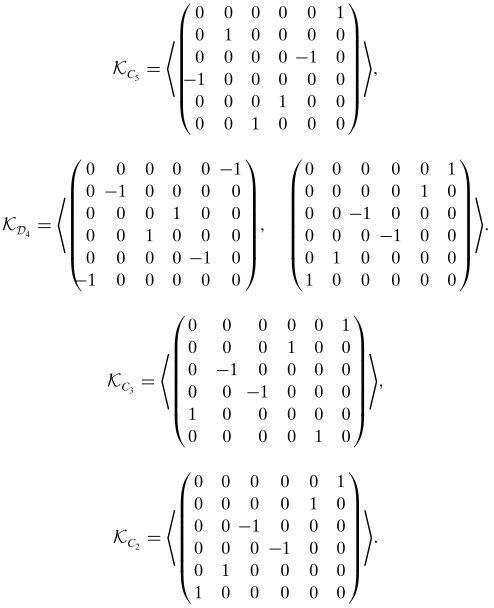
Here we show the explicit forms ofKG, the representations inB6 of the subgroups ofI, together with their
decomposi-tions inGLð6;RÞ.
KT ¼
*
0 0 0 0 0 1 0 0 0 0 1 0 0 01 0 0 0 0 0 0 1 0 0 0 1 0 0 0 0 1 0 0 0 0 0
0
B B B B B B @
1
C C C C C C A ;
0 1 0 0 0 0 0 0 01 0 0 0 0 0 0 0 1
1 0 0 0 0 0 0 0 1 0 0 0 0 0 0 01 0
0
B B B B B B @
1
C C C C C C A +
;
KD10¼
*
0 0 0 0 0 1 0 1 0 0 0 0 0 0 0 1 0 0 0 0 1 0 0 0 0 0 0 01 0
1 0 0 0 0 0
0
B B B B B B @
1
C C C C C C A ;
0 0 0 0 0 1 0 1 0 0 0 0 0 0 0 01 0
1 0 0 0 0 0 0 0 0 1 0 0 0 0 1 0 0 0
0
B B B B B B @
1
C C C C C C A +
;
KD6¼
*
0 0 0 0 0 1 0 1 0 0 0 0 0 0 0 1 0 0 0 0 1 0 0 0 0 0 0 01 0
1 0 0 0 0 0
0
B B B B B B @
1
C C C C C C A ;
0 0 0 0 0 1 0 0 0 1 0 0 01 0 0 0 0 0 0 1 0 0 0 1 0 0 0 0 0 0 0 0 0 1 0
0
B B B B B B @
1
C C C C C C A +
KC5 ¼
*
0 0 0 0 0 1 0 1 0 0 0 0 0 0 0 01 0
1 0 0 0 0 0 0 0 0 1 0 0 0 0 1 0 0 0
0
B B B B B B @
1
C C C C C C A +
;
KD4 ¼
*
0 0 0 0 0 1 0 1 0 0 0 0 0 0 0 1 0 0 0 0 1 0 0 0 0 0 0 01 0
1 0 0 0 0 0
0
B B B B B B @
1
C C C C C C A ;
0 0 0 0 0 1 0 0 0 0 1 0 0 01 0 0 0 0 0 0 1 0 0 0 1 0 0 0 0 1 0 0 0 0 0
0
B B B B B B @
1
C C C C C C A +
:
KC3 ¼
*
0 0 0 0 0 1 0 0 0 1 0 0 0 1 0 0 0 0 0 0 1 0 0 0 1 0 0 0 0 0 0 0 0 0 1 0
0
B B B B B B @
1
C C C C C C A +
;
KC2¼
*
0 0 0 0 0 1 0 0 0 0 1 0 0 01 0 0 0 0 0 0 1 0 0 0 1 0 0 0 0 1 0 0 0 0 0
0
B B B B B B @
1
C C C C C C A +
:
KT ’2T;KD10’2A2E1E2; KD6’2A22E;KC5’2AE1E2;
KD4’2B12B22B3;KC3’2A2E;KC2’2A4B:
APPENDIXC
In this Appendix we show our algorithms, which have been implemented in GAP and used in various sections of the paper. We list them with a number from 1 to 5.
Algorithm 1 (Fig. 2): Classification of the crystallographic representations ofI (seex4). The algorithm carries out steps 1–4 used to prove Proposition 4.1. In theGAPcomputation, the classCB6ðIIÞ^ is indicated as CB6s60. Its size is 192.
Algorithm 2 (Fig. 3): Computation of the vertex star of a given vertexiin theG-graphs. In the following,Hstands for the classCB6ðIIÞ^ of the crystallographic representations ofI, i2 f1;. . .;192gdenotes a vertex in theG-graph corresponding to the representationH½iandnstands for the size ofG: we can use the size instead of the explicit form of the subgroup since, in the case of the icosahedral group, all the non isomorphic subgroups have different sizes.
Algorithm 3 (Fig. 4): Computation of the adjacency matrix of theG-graph.
Algorithm 4 (Fig. 5): This algorithm carries out a breadth-first search strategy for the computation of the connected component of a given vertexiof theG-graph.
Algorithm 5 (Fig. 6): Computation of all connected components of aG-graph.
Figure 2
Algorithm 1.
Figure 3
Algorithm 2.
Figure 4
[image:12.610.48.295.69.373.2]We would like to thank Silvia Steila, Pierre-Philippe Dechant, Paolo Cermelli and Giuliana Indelicato for useful discussions, and Paolo Barbero and Alessandro Marchino for technical help. ECD thanks the Leverhulme Trust for an Early Career Fellowship (ECF-2013-019) and the EPSRC for funding (EP/K02828671).
References
Artin, M. (1991).Algebra.New York: Prentice Hall. Baake, M. (1984).J. Math. Phys.25, 3171–3182.
Baake, M. & Grimm, U. (2013).Aperiodic Order, Vol. 1. Cambridge University Press.
Cvetkovic, D., Doob, M. & Sachs, H. (1995). Spectra of Graphs. Heidelberg, Leipzig: Johann Ambrosius Barth.
Foulds, L. (1992).Graph Theory Applications.New York: Springer-Verlag.
Fulton, W. & Harris, J. (1991).Representation Theory: A First Course. Springer-Verlag.
Horn, R. & Johnson, C. (1985). Matrix Analysis. Cambridge University Press.
Hoyle, R. (2004).Physica D,191, 261–281.
Humphreys, J. (1990). Reflection Groups and Coxeter Groups. Cambridge University Press.
Humphreys, J. (1996).A Course in Group Theory.Oxford University Press.
Indelicato, G., Cermelli, P., Salthouse, D., Racca, S., Zanzotto, G. & Twarock, R. (2011).J. Math. Biol.64, 745–773.
Indelicato, G., Keef, T., Cermelli, P., Salthouse, D., Twarock, R. & Zanzotto, G. (2012).Proc. R. Soc. A,468, 1452–1471.
Janusz, G. & Rotman, J. (1982).Am. Math. Mon.89, 407–410. Jones, H. (1990).Groups, Representations and Physics. Institute of
Physics Publishing.
Katz, A. (1989). InIntroduction to the Mathematics of Quasicrystals, edited by M. Jaric´. New York: Academic Press.
Kramer, P. (1987).Acta Cryst.A43, 486–489.
Kramer, P. & Haase, R. (1989). InIntroduction to the Mathematics of Quasicrystals, edited by M. Jaric´. New York: Academic Press. Kramer, P. & Zeidler, D. (1989).Acta Cryst.A45, 524–533. Levitov, L. & Rhyner, J. (1988).J. Phys. France,49, 1835–1849. Moody, R. (2000). InFrom Quasicrystals to More Complex Systems,
edited by F. Axel, F. De´noyer & J. P. Gazeau. Springer-Verlag. Pitteri, M. & Zanzotto, G. (2002). Continuum Models for Phase
Transitions and Twinning in Crystals.London: CRC/Chapman and Hall.
Senechal, M. (1995). Quasicrystals and Geometry. Cambridge University Press.
Soicher, L. (2006).Oberwolfach Rep.3, 1809–1811. Report 30/2006. Steurer, W. (2004).Z. Kristallogr.219, 391–446.
The GAP Group (2013).GAP – Groups, Algorithms, and Program-ming, Version 4.7.2. http://www.gap-system.org.
Zappa, E., Indelicato, G., Albano, A. & Cermelli, P. (2013).Int. J. Non-Linear Mech.56, 71–78.
Figure 5
Algorithm 4.
Figure 6