0379-1386
Β
£
eurostat
DE EUROPÆISKE FÆLLESSKABERS STATISTISKE KONTOR
STATISTICAL OFFICE OF THE EUROPEAN COMMUNITIES
ISTITUTO STATISTICO DELLE COMUNITÀ EUROPEE
Luxembourg-Kirchberg, Boîte postale 1907 — Tél. 4 3 0 1 1 Télex : Comeur Lu 3 4 2 3
1049 Bruxelles, Bâtiment Berlaymont, Rue de la Loi 2 0 0 (Bureau de liaison) — Tél. 735 80 4 0
Denne publikation kan fås gennem de salgssteder, som er nævnt på omslagets tredje side i dette hæfte
This publication is obtainable from the sales agents mentioned on the inside backcover
Per ottenere questa pubblicazione, si prega di rivolgersi agli uffici di vendita i cui indirizzi sono indicati
nella 3
apagina di copertina
Indholdsgengivelse kun tilladt med angivelse af kilde
Reproduction of the contents of this publication is subject to acknowledgment of the source
E U R O S T A T I S T I K
DATA TIL KONJUNKTURANALYSE
E U R O S T A T I S T I C S ™
DATA FOR SHORT-TERM ECONOMIC ANALYSIS
EUROSTATISTICHE
DATI PER L'ANALISI DELLA CONGIUNTURA
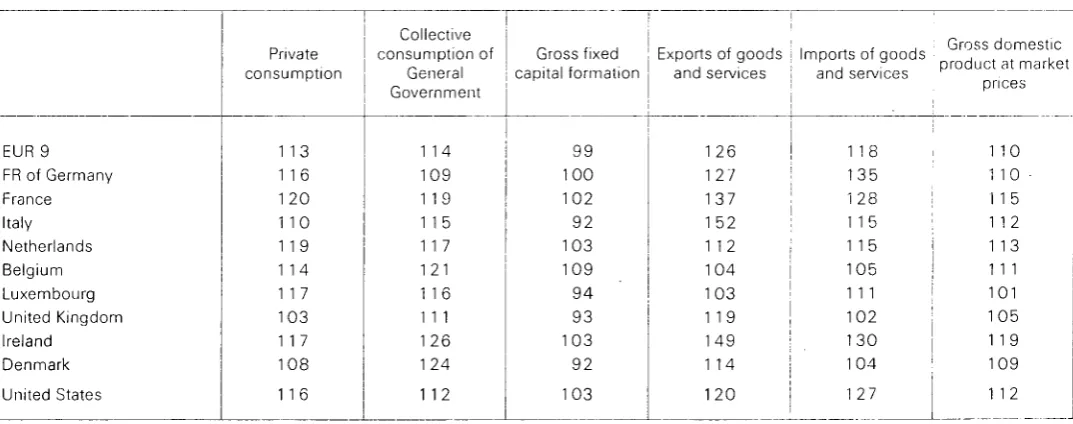
Growth in real terms of the main
economic aggregates between 1973
and 1978
ARTIKLER - ARTICLES - ARTICOLI 83
Manuskript afsluttet den 25 juni 1 979
Manuscript completed 25 June 1 979
AKTUELLE FAKTA
Arbejdsløshed
Den nedgang i arbejdsløsheden, der startede i februar 1979 både i Fællesskabet under ét og i de enkelte medlemslande, fortsattte i maj.
Efter en ny nedgang på ca. 250 0 0 0 personer var antallet af registrerede arbejdsløse i Fællesskabet ved udgangen af maj 5,6 mio., mens de
registrerede arbejdsløses andel af den erhvervsaktive befolkning udgjorde 5,3% mod 5,5% den foregående måned.
Dette svarer i bruttotal til en nedgang på 4 , 2 % af antallet af registrerede arbejdsløse i sidste måned. I sæsonkorrigerede tal er nedgangen
også temmelig betydelig ( — 0,9%). Den nedadgående tendens er generel, og kun for Frankrig, Nederlandene og Belgien viste de
sæsonkorrigerede tal en stigende arbejdsløshed (henholdsvis + 0 , 9 % + 1,7% og + 0 , 2 3 % ) .
Industriproduktionen : fornyet stigning i indekset for EUR-9 i februar og marts, men hovedtendensen i stigningstakten er stadig
ugunstig.
De sæsonkorrigerede indekstal for Fællesskabets industriproduktion nåede i marts 1979 op på 1 16,5 ( 1 9 7 5 = 1 0 0 ) i forhold til 1 12,3 og
1 14,9 for januar og februar. På trods af den nylige stigning i industriproduktionen er hovedtendensen i Fællesskabets stigningstakt ugunstig
(1. kvartal 1 979 udviste en stigning på 0 , 5 % i forhold til 4. kvartal 1 978). Dette bekræftes af de første skøn for april, som viser en stigning
på 0 , 3 % for Fællesskabets produktion. Stigningstakten for produktionsindekset for hele industrien er blevet gradvist forringet siden november
1 978, hvilket afspejler den ugunstige situation i de tre vigtigste produktionssektorer. I 1. kvartal 1 979 var denne tendens særlig markant for
produktionen af investeringsgoder ( — 2 , 6 % i forhold til 4. kvartal 1978), men dæmpningen i produktionen af forbrugsgoder ( + 0,2%) og
mellemproduktindustrien ( + 1 , 1 % ) er ligeledes foruroligende.
I de enkelte medlemslande er denne dæmpning meget betydelig, således i Forbundsrepublikken Tyskland, Italien og Danmark, mens den er
mindre i Luxembourg og nu også synes at gøre sig gældende i Nederlandene. I Frankrig er situationen gunstigere. I Det forenede Kongerige,
hvor der har været nedgang siden august 1 9 7 8 , synes tendensen nu at være stigende.
Energi : stærk stigning i forbruget i 1 9 7 8
1 978 adskiller sig fra de foregående år ved en ret betydelig stigning i energiforbruget i hele Fællesskabet. Energiforbruget har for første gang
siden oliekrisen i slutningen af 1973 passeret 1 973-niveauet, som var på 933 millioner tons olieækvivalent. Stigningen på 2 , 9 % er
temmelig stor, ¡sær hvis man sammenligner med stigningstakten for bruttonationalproduktet (2,9%) og industriproduktionen (af
størrelsesor-denen 2,2%). Energiforbruget på 942,3 millioner tons dækkes hovedsagelig af olie (54%), kul (19%) og naturgas (17%), mens den
elektriske primærenergi (3,6%) faldt med 0 , 5 % i forhold til det foregående år som følge af nedsat vandføring. På trods af en
produktionsstigning på 8 % i forhold til 197 7 dækker atomkraft endnu kun 3 % af det samlede forbrug.
Samhandelen inden for Fællesskabet : økonomisk opgang fører til markant forøgelse af den økonomiske aktivitet.
Den mærkbare bedring i den økonomiske situation i medlemsstaterne kom til udtryk gennem en betydelig stigning i samhandelen inden for
Fællesskabet (udregnet på basis af importtallene). I de tolv måneder, som gik forud for marts 1979, voksede samhandelen med 2 4 , 4 % ,
mens samhandelen i det første kvartal — 51,4 mrd ERE — udviste en stigning på 1 7,9% i forhold til samme periode i 1 9 7 8 .
Den ekstraordinære stigning i Italiens ( + 3 5 , 2 % i første kvartal af 1979 sammenlignet med første kvartal af 1978), Irlands ( + 27.7%) og
Det forenede Kongeriges import ( + 21,1%) var hovedårsagerne til denne bedring i den økonomiske situation. Italien udlignede denne
stigning med en lige så stor vækst i eksporten til andre EF-lande og opnåede således et overskud på 239 mio. ERE i samhandelen med
fællesskabslandene. Til trods for en hurtig stigning i eksporten af olie til de andre EF-lande nåede væksten i Det forenede Kongeriges eksport
kun op på 1 2 % , hvilket førte til en fordobling af underskuddet fra første kvartal af 1 9 7 9 , som nu beløber sig til — 1 343 mio. ERE, i forhold
til - 7 3 5 mio. ERE for første kvartal af 1978.
Fællesskabets samhandel med tredjelande : olieimporten belaster handelsbalancen.
I første kvartal af 1979 voksede EF's samhandel med tredjelande ikke nær så kraftigt som samhandelen inden for Fællesskabet : importen
steg med 1 0 , 2 % (i forhold til samme periode forrige år) til 47,3 mrd ERE, hvilket navnlig skyldes den øgede efterspørgsel efter olie og de
højere oliepriser, mens eksporten kun steg med 8 % til 43,5 mrd ERE, hvilket ikke mindst skyldes den ringe økonomiske opgang i USA.
Derfor var importdækningen kun 9 2 % og underskuddet på handelsbalancen forøgedes til - 3 . 8 mrd ERE (første kvartal 1 978 : - 2 , 6 mrd).
Den opadgående økonomiske tendens i Italien indvirkede også på dette lands import fra tredjelande ( + 2 6 , 9 % for de første tre måneder),
mens stigningen i olieimporten belastede handelsbalancen. Trods lirens styrkede position steg også eksporten betydeligt, og dette gjorde
forringelsen af handelsbalancen mindre udtalt, hvor underskuddet reduceredes med 302 mio. ERE til - 8 6 9 mio. ERE. Det forenede
Kongerige kunne ikke i fuldt omfang udnytte fordelene ved landets egen olieproduktion : importen faldt med 3,9%, men samtidig faldt
eksporten med 8,2%. Resultatet blev et forøget underskud på — 1 3 0 4 mio. ERE for perioden fra januar til marts 1 9 7 9 , sammenlignet med
— 979 mio ERE for samme periode i 1978. I Nederlandene noteredes der også et anseligt underskud ( - 1 8 1 4 mio. ERE). Nederlandene
havde med 6 1 % den laveste importdækningsgrad, fulgt af Irland med 6 3 % . Den største absolutte forringelse af handelsbalancen noteredes
for Tyskland, hvis overskud blev reduceret med 394 mio. til + 2 2 1 0 mio. ERE.
Forbrugerpriser : moderat stigning i maj.
I maj 1979 steg forbrugerprisindekset)*) for Fællesskabet med 0 . 8 % i forhold til april. Dette betyder en moderat stigning i forhold til de
foregående måneder af 1 9 7 9 .
Der er tale om meget forskellige stigninger fra land til land : i Forbundsrepublikken Tyskland og Benelux-landene ligger stigningstakten
mellem 0 (Nederlandene) og 0,6 (Luxembourg). Stigningerne er kraftigere i Frankrig (1,0%), Irland (1,1%), Italien (1,3%) og især i Danmark
(1,6%). I Danmark er stigningen påvirket af den halvårlige indregning af husleje samt af ferieudgifterne. Stigningen i Det forenede Kongerige
ligger på samme niveau som i Fællesskabet (0,8%).
For øjeblikket er stigningen i fællesskabsindekset 8 , 9 % på årsbasis, hvilket viser, at der siden begyndelsen af 1979 er sket en mindre
forøgelse af stigningstakten.
Penge og Finanser : ECU'en som betalingsmiddel mellem Fællesskabets centralbanker
Den belgiske franc nåede ved udgangen af maj den nederste interventionsgrænse over for DM; den belgiske centralbank modtog DM som
modydelse for sine ECU-fordringer i EFMS. Hermed introduceredes ECU'en som betalingsmiddel mellem centralbankerne i de lande, som
deltager i EMS.
Desuden hævede den belgiske centralbank — for at begrænse kapitaludstrømningen — diskontoen fra 7 % til 8%, og denne beslutning blev
øjeblikkeligt fulgt af Nederlandsche Bank. som hævede diskontoen fra 6 . 5 % til 7%. Den seneste styrkelse af DM'en skyldes delvis Deutsche
Bundesbank's salg af US-dollars på det internationale valutamarked. Dette har begrænset både dollarens stigning og de stigende olieprisers
inflatoriske virkning.
MAIN DEVELOPMENTS
Unemployment
The downward trend in unemployment, which began in February 1979 in both the Community as a whole and the Member States, continued
in May. After a further drop of around 250 0 0 0 , the number of registered unemployed in the Community stood at 5.6 million at the end of
May, representing 5.3% of the civilian working population — compared with 5.5% in the previous month.
This represents a drop of 4 . 2 % in the gross figures for registered unemployed persons during the past month. The drop in the seasonally
adjusted figures is also quite substantial ( — 0.9%). This downward trend is fairly widespread, with only France, the Netherlands and Belgium
recording an increase in their seasonally adjusted unemployment figures ( + 0.9, 1.7 and 0 . 2 3 % respectively).
Industrial production: rise in the EUR-9 index in February and March, but the underlying trend in the growth rate still unfavourable.
After adjustement for seasonal variations, the index of industrial production in the Community reached 116.5 in March 1979
(1975 = 100), compared with the figures of 1 12.3 and 1 14.9 recorded in January and February. Despite the recent upturn in industrial
production, the underlying growth trend in the Community is unfavourable (first quarter of 1979 0 . 5 % up on the fourth quarter of 1978).
This is confirmed by the initial estimates for April which indicate a growth of 0 . 3 % in Community production. The growth rate for the
all-industry index of production has progressively declined since November 1 978, as is shown by the unfavourable situation in the three main
sectors into which production is aggregated. In the first quarter of 1979, this trend was particularly pronounced in the capital goods
industries ( 2 . 6 % down on the fourth quarter of 1978), but the slowing down of production in the consumer and intermediate goods
industries ( + 0.2 and + 1 . 1 % respectively) is just as disturbing.
At national level, this slowing down is very marked in Germany, Italy and Denmark, not so pronounced in Luxembourg and seems to be
increasing in the Netherlands. The situation is more favourable in France. In the United Kingdom, after a decline since August 1978,
production seems to have been picking up again over the past few months.
Energy: sharp increase in consumption in 1 9 7 8
1 978 stands out from previous years by virtue of a fairly substantial increase in energy consumption in the Community as a whole. Thus, for
the first time since the oil crisis at the end of 1973, energy consumption exceeded the 1973 level of 933 million tonnes petroleum
equivalent. The increase of 2 . 9 % is a fairly substantial one, especially in comparison with the growth rates for GDP (2.9%) and industrial
production (around 2.2%). Total consumption of 942.3 million tonnes was accounted for mainly by oil (54%). coal (19%), natural gas
(17%) and primary electrical energy (3.6%), the latter being 0 . 5 % down on the previous year owing to less satisfactory flow conditions.
Despite an increase of 8 % over 1 977. nuclear energy still accounts for only 3 % of total consumption.
Intra-Community trade: economic recovery leads to marked acceleration
The notable economic recovery in the Member States manifested itself in considerably increased trade within the Community (as measured by
imports). In the twelve months to March 1979. trade increased by 2 4 . 4 % , while, in the first quarter, trade amounted to 51.4 Mrd. EUA, a
rise of 1 7.9% compared with the same period of 1978.
The extraordinary expansion of purchases by Italy ( + 3 5 . 2 % for the 1st quarter 1979 compared with the first quarter 1978), Ireland
( + 27.7%) and the United Kingdom (21.1%) were the prime movers of this boom. Italy balanced this increase by an equally large growth in
its sales to other EC countries, to realise a surplus of 239 Mio EUA in its intra trade. Despite a rapid increase in the United Kingdom's oil
exports to its EC partners, the average growth of its exports was limited to only 1 2%, leading to a doubling of its 1 st quarter deficit to
- 1 343 Mio EUA in 1979 against - 735 Mio EUA in 1 978.
Community external trade: Oil imports burden the trade balance
In the first quarter of 1979 the EC's external trade grew much more feebly than internal trade: imports went up by 1 0 . 2 % (as against the
same period of the previous year) to 47.3 Mrd EUA particularly as a result of strengthened oil demand and higher oil prices, while exports
increased by only 8 % to 43.5 Mrd EUA, not least because of the weak economic recovery in the USA. Therefore import coverage was only
9 2 % and the deficit on the trade balance widened to - 3 . 8 Mrd EUA (1st quarter 1 9 7 8 : - 2 . 6 Mrd.)
The upward economic trend in Italy also had an impact on its imports from non-EC countries ( + 2 6 . 9 % for the first three months) with the
expansion in oil imports putting a strain on the trade balance. However, even with the stronger position of the lira, exports also increased
considerably thus moderating the worsening of the trade balance, which widened by 302 Mio to —869 Mio EUA. The United Kingdom did
not profit fully from the advantages of its own oil production: imports decreased by 3.9%, but at the same time exports shrunk by 8.2%. The
result was an enlarged deficit of - 1 3 0 4 Mio EUA in January to March 1979 as against - 9 7 9 Mio in the same period of 1978. The
Netherlands also reported a higher deficit (—1814 Mio EUA). This member had the lowest import coverage rate of 61 % followed by Ireland
with 6 3 % . The largest absolute deterioration of a trade balance was that for Germany, whose surplus was reduced by 3 9 4 Mio to + 2 2 1 0
Mio EUA.
Prices: more moderate rise in May
The consumer price index (*) for the Community as a whole went up by 0 . 8 % between April and May 1 979, representing a moderate rise in
comparison with the corresponding increases in the first five months of the year.
This rise still varies considerably from country to country: in the FR of Germany and the Benelux countries the rate of increase ranged from 0
(the Netherlands) to 0 . 6 % (Luxembourg). The rises were high in France (1.0%). Ireland (1.1%), Italy (1.3%) and above all Denmark (1.6%),
where the rise was influenced by inclusion in the index of half-yearly rent increases and holiday expenses. The rise in the United Kingdom
was the same as that in the Community (0.8%).
The rate of increase in the Community index over 1 2 months currently stands at 8.9%, thus confirming the slight acceleration in prices since
the beginning of 1979.
Finance: the ECU as a means of payment between central banks in the Community
At the end of May the Belgian franc reached its lowest intervention level vis-à-vis the Deutsche Mark; the Belgian Central Bank obtained DM
in exchange for its assets in ECU held with the European Monetary Co-operation Fund (FECOM). This marks the beginning of the ECU'S role
as a means of payment between the central banks of the countries in the EMS.
In addition, in order to limit the outflow of capital, the Belgian authorities increased the official discount rate from 7 to 8 % — a decision
which was immediately followed by the Nederlandsche Bank, which increased its rate from 6.5 to 7%. The recent strengthening of the DM is
due partly to the Bundesbank's sales of US dollars on the international exchange market — an action which curbed both the rise of the US
dollar and the inflationary pressure linked to the increase in the price of oil.
FATTI IMPORTANTI
Disoccupazione
E' proseguito in maggio il movimento di riduzione della disoccupazione, avviatosi nel febbraio 1 9 7 9 , sia per l'insieme della Comunità che per
i singoli Stati membri. Dopo una nuova flessione di circa 2 5 0 . 0 0 0 unità, a fine maggio i disoccupati iscritti presso gli uffici di collocamento
della Comunità erano 5,6 milioni e la loro quota sul totale della popolazione attiva civile era scesa al 5,3%, contro il 5,5% del mese
precedente.
In termini relativi e sulla scorta dei dati non corretti delle variazioni stagionali, i disoccupati ¡scritti presso gli uffici di collocamento risultano
diminuiti, nell'ultimo mese, del 4 , 2 % ; la diminuzione resta abbastanza sensibile ( — 0,9%) anche quando è calcolata sulla scorta dei dati
corretti delle variazioni stagionali. La tendenza discendente della disoccupazione è generale; soltanto la Francia, i Paesi Bassi ed il Belgio
accusano un aumento della disoccupazione sulla scorta dei dati destagionalizzati (rispettivamente : + 0 , 9 % , + 1 , 7 % , + 0 , 2 3 % ) .
Produzione industriale : ripresa dell'indice EUR-9 in febbraio e in marzo, ma persistere della tendenza di base sfavorevole del tasso
di crescita.
In base ai dati destagionalizzati, l'indice della produzione industriale della Comunità ha raggiunto nel marzo 1979 il livello di 116,5
( 1 9 7 5 = 100) rispetto alle cifre di 112,3 e 114,9 registrate in gennaio e in febbraio. Tuttavia, nonostante la recente ripresa della
produzione industriale, la tendenza di base dello sviluppo nella Comunità resta sfavorevole (per il 1° trimestre 1979, aumento dello 0 , 5 %
rispetto al 4° trimestre 1978). Questo fatto è confermato dalle prime stime per il mese di aprile, che indicano un incremento dello 0 , 3 %
della produzione comunitaria. Il tasso d'incremento dell'indice della produzione del complesso delle industrie è progressivamente peggiorato
dal novembre 1978, accusando la situazione sfavorevole dei tre principali settori in cui viene raggruppata la produzione. Per il 1° trimestre
del 1 979, la tendenza negativa è particolarmente accentuata nelle industrie dei beni d'investimento ( — 2 , 6 % rispetto al 4° trimestre 1 978),
ma i rallentamenti osservati nelle industrie dei beni di consumo ( + 0,2%) e in quelle dei beni intermedi ( + 1 , 1 % ) non sono meno
preoccupanti.
Se si esamina la situazione dei singoli Stati membri, il rallentamento appare molto accentuato in Germania, in Italia e in Danimarca e più
moderato nel Lussemburgo, mentre sembra manifestarsi nei Paesi Bassi.
In Francia la situazione è più favorevole. Nel Regno Unito, dopo un regresso dall'agosto 1978, la tendenza degli ultimi mesi sembra indicare
una ripresa.
Energia : forte espansione del consumo nel 1 9 7 8
Il 1 978 si distingue dagli anni precedenti per un aumento alquanto sensibile del consumo di energia per l'intera Comunità : per la prima volta
dalla crisi petrolifera della fine del 1973, il consumo di energia ha superato il livello del 1973, che era stato di 933 milioni di tonnellate di
equivalente petrolio. L'aumento del 2 , 9 % è piuttosto rilevante, soprattutto se confrontato con i tassi d'incremento del PIL (2,9%) e della
produzione industriale (dell'ordine del 2,2%). Il consumo di energia, pari a 942,3 milioni di tonnellate, è stato coperto essenzialmente con il
petrolio (54%), il carbone (19%), il gas naturale (17%) e l'energia elettrica primaria (3,7%), diminuita tuttavia dello 0 , 5 % rispetto all'anno
precedente per le meno favorevoli disponibilità idriche. L'energia nucleare, pur avendo registrato un'espansione dell' 8 % rispetto al 1977,
non rappresenta ancora che una quota del 3 % del consumo globale di energia.
Commercio intracomunitário : mercato più vivace per la ripresa economica
La sensibile ripresa economica negli Stati membri si è tradotta in un deciso incremento del volume del commercio tra i paesi della Comunità
(rilevato sulla base delle importazioni). In dodici mesi, fino a tutto marzo 1 979, gli scambi intracomunitari sono aumentati del 2 4 , 4 % , mentre
nel solo primo trimestre tale interscambio è stato di 51.4 miliardi di UCE. con un aumento del 1 7,9% rispetto allo stesso periodo del 1 978.
Questo boom è stato avviato da una straordinaria espansione delle importazioni da parte dell'Italia ( + 3 5 , 2 % per il 1° trimestre 1979,
rispetto al 1° trimestre del 1978), dell'Irlanda ( + 27,7%) e del Regno Unito ( + 21,1%). Per l'Italia l'incremento delle importazioni è stato
accompagnato da uno sviluppo altrettanto forte delle vendite agli altri paesi della CE, cosicché la bilancia commerciale italiana con gli altri
paesi della Comunità si chiude con un attivo di 239 milioni di UCE. Per il Regno Unito, nonostante un rapido incremento delle forniture di
petrolio agli altri paesi della CE, l'espansione media delle esportazioni è stata limitata al 1 2 % : il disavanzo per il 1° trimestre si è cosi'
raddoppiato, passando a — 1.343 milioni di UCE nel 1 979, contro —735 milioni di UCE nel 1 978.
Commercio estero della comunità : le importazioni di petrolio gravano sulla bilancia commerciale
Nel 1° trimestre del 1979 il commercio estero della CE è aumentato molto più debolmente del commercio intracomunitário : rispetto al
periodo corrispondente dello scorso anno, le importazioni sono aumentate del 10,2%, salendo a 47.3 miliardi di UCE, soprattutto per la più
sostenuta domanda di petrolio e per i prezzi più elevati di questa materia prima, mentre le esportazioni sono salite solo dell'8%,
raggiungendo un livello di 43,5 miliardi di UCE, anche a causa della debolezza della ripresa economica negli Stati Uniti. Di conseguenza le
esportazioni hanno coperto solo il 9 2 % delle importazioni ed il disavanzo della bilancia commerciale è salito a —3,8 miliardi di UCE
(disavanzo del 1° trimestre 1978 : —2,6 miliardi).
La tendenza economica ascendente registrata dall'Italia ha avuto incidenza anche sulle sue importazioni dai paesi terzi ( + 2 6 , 9 % per i primi
tre mesi) : in particolare, l'espansione delle importazioni di petrolio si è duramente ripercossa sulla bilancia commerciale. Comunque,
malgrado il rafforzamento della lira, anche le esportazioni sono aumentate notevolmente, moderando cosi' il peggioramento della bilancia
commerciale, che è passata da un attivo di 302 milioni a un disavanzo di 869 milioni di UCE. Il Regno Unito non ha approfittato pienamente
dei vantaggi della produzione interna di petrolio : infatti, se le importazioni sono diminuite del 3,9%, le esportazioni si sono ridotte nel
contempo dell'8,2%. La conseguenza è stato un maggiore disavanzo, pari a 1304 milioni di UCE da gennaio a marzo 1979, contro
979 milioni di UCE nello stesso periodo del 1978. Anche i Paesi Bassi hanno registrato, un più grave disavanzo (—1.814 milioni di UCE) e
risultano il paese membro che registra il tasso più basso di copertura delle importazioni con esportazioni (61%), seguiti dall'Irlanda con il
6 3 % . Il maggior peggioramento della bilancia commerciale in termini assoluti è stato quello della Germania, il cui attivo si è ridotto di
3 9 4 milioni, scendendo a + 2 . 2 1 0 milioni di UCE.
Prezzi : aumento più moderato in maggio
Nel maggio 1979 l'indice dei prezzi al consumo* per la Comunità è salito dello 0 . 8 % rispetto al mese precedente : si tratta di un aumento
moderato, a fronte dei tassi conosciuti nei primi quattro mesi del 1 9 7 9 .
Se si considerano singolarmente i vari paesi membri, l'aumento dei prezzi presenta come sempre disparità notevoli : per la Repubblica
federale di Germania e i paesi del Benelux il tasso è compreso tra lo 0 (Paesi Bassi) e lo 0 . 6 % (Lussemburgo); tassi elevati si osservano
invece in Francia (1.0%), in Irlanda (1,1%), in Italia (1,3%) e soprattutto in Danimarca (1,6%) : in quest'ultimo paese le cifre sono
influenzate dall'inclusione semestrale, nell'indice, degli aumenti degli affitti e delle spese per le vacanze. Nel Regno Unito l'evoluzione dei
prezzi si colloca allo stesso livello della media comunitaria (0,8%).
Attualmente il tasso d'incremento dell'indice comunitario su 12 mesi risulta dell'8,9%, il che conferma la lieve accelerazione dall'inizio del
1979.
Finanze : L'ECU come mezzo di pagamento tra le banche centrali della Comunità
Il franco belga ha raggiunto a fine maggio il livello minimo d'intervento nei confronti del marco tedesco e la Banca Centrale del Belgio ha
ottenuto dei DM come contropartita dei suoi attivi in ECU presso il FECOM. Cio'segna l'inizio del ruolo dell'ECU come mezzo di pagamento
tra banche centrali dei paesi partecipanti allo SM E.
Inoltre, per frenare le uscite di capitali, le autorità belghe hanno aumentato il tasso ufficiale di sconto dal 7% all'8%; tale decisione è stata
seguita immediatamente dalla Nederlandsche Bank, che ha portato a sua volta il tasso di sconto dal 6 , 5 % al 7%. Il recente rafforzamento del
DM è dovuto in parte alle vendite di dollari US sul mercato internazionale dei cambi, operate dalla Bundesbank; tali vendite hanno limitato sia
la risalita del dollaro US, sia la pressione inflazionista connessa con l'aumento del prezzo del petrolio.
FORORD
Denne publikation omfatter to dele: den ene indeholder
»fælles-skabstabeller« og den anden »tabeller efter lande«.
I »fællesskabstabellerne« er samlet de vigtigste indikatorer for
Fælles-skabets og for hver medlemsstats økonomiske udvikling på kort sigt.
uddybet med nogle strukturelle oplysninger for året 1975. Denne
del, som skal muliggøre sammenligninger mellem landene,
indehol-der indehol-der for kun af EUROSTAT harmoniserede tal, på grundlag af
fælles kriterier, hvilket forklarer visse uoverensstemmelser med de
nationale tal.
Rækkerne er korrigerede for sæsonvariationer ved hjælp af
EURO-STATS »Dainties«-metode.
De mest aktuelle tal er foreløbige og i
visse tilfælde direkte skønnede af EUROSTAT.
Som indikator for verdenskonjunkturudviklingen indeholder
»fælles-skabstabellerne« en søjle for USA.
I »tabellerne efter lande« er for hvert land udvalgt de for det
pågældende land mest anvendte konjunkturelle indikatorer; det drejer
sig om nationale rækker, i overensstemmelse med nationale kriterier
og sæsonkorrigerede efter nationale metoder. I denne del er der ud
over Fællesskabets ni medlemslande medtaget kandidatlandene
Spa-nien, Grækenland og Portugal, såvel som USA og Japan.
For alle rækkerne findes de historiske tal (årlige, kvartals- og
måneds-tal) i EUROSTATS databank CRONOS. Almindeligvis går tallene
tilbage til 1 960, og kan oplyses på anmodning.
Denne publikation indeholder kun et yderst minimalt antal
metodolo-giske bemærkninger. Oplysninger om definitioner, metoder,
fælles-skabstilpasninger og kilder for hver enkelt række vil blive givet i en
specialudgave af »EUROSTATISTIK«, hvori de statistiske angivelsers
definitioner, metoder, tilpasninger og kilder vil blive beskrevet.
Der udkommer to udgaver af »EUROSTATISTIK« hver måned. Den
ene affattet på dansk, engelsk og italiensk leveres til trykning den
fjerde tirsdag hver måned, og vil kunne fås i hovedstæderne den
følgende mandag. Den anden affattet på tysk. fransk og nederlandsk
leveres til trykning den anden tirsdag hver måned, og vil kunne fås i
hovedstæderne den følgende mandag. Hver udgave indeholder de
mest aktuelle tal til disposition den dag leveringen til trykning finder
sted.
PREFACE
This bulletin is in two parts : 'Community Tables' and 'Country
Tables'.
The Community Tables contain the main indicators useful for
follow-ing short-term economic developments in the Community as a whole
and in the Member States, supplemented by a certain amount of
structural data relating to 1 975. This part of the bulletin is intended
to make possible real comparisons between countries and therefore
only contains data which has been harmonized by EUROSTAT on the
basis of common criteria, this explains many of the differences from
national series.
Seasonal adjustement of the series has been done with EUROSTAT's
own method. 'Dainties'.
The most recent data are provisional and
in some cases estimated by EUROSTAT.
Finally the Community Tables include a column for the USA as an
indicator of changes in the world economy.
The Country Tables contain a selection of the economic indicators
most often used in each country. They are national series based on
the definitions of the country concerned and seasonally adjusted by
the country. In addition to the nine Community countries this section
includes the three candidate countries (Spain, Greece and Portugal)
the USA and Japan.
For all series, historical data (annual, quarterly or monthly) is
availa-ble in EUROSTAT's CRONOS data bank, going back in most cases to
1 960. This can be supplied on request.
This publication contains the absolute minimum of methodological
notes. Details of definitions, methods, Community adjustments and
sources of each series will be given in a special edition of
'Eurosta-tistics'.
Two versions of 'EUROSTATISTICS' come out every month. The first
in Danish, English and Italian goes to the printers the fourth Tuesday
of the month and will be distributed in the national capitals the
following Monday. The second in German, French and Dutch goes to
the printers the second Tuesday of the month and will be distributed
in the national capitals the following Monday. Each version will
contain the latest figures available when it went to press.
AVVERTENZA
Il presente bollettino consta di 2 parti : luna ha per oggetto alcune
« tavole comunitarie », l'altra riguarda alcune « tavole per paese ».
Nelle tavole « comunitarie » si trovano riuniti i principali indicatori che
consentono di seguire l'evoluzione di breve periodo dell'economia
comunitaria nel suo complesso e in ogni singolo Stato membro,
completati da alcuni dati strutturali relativi al 1975. Questa parte,
che si prefigge di consentire di stabilire confronti reali fra paesi,
contiene soltanto dati armonizzati dall'EUROSTAT in base a criteri
comuni, il che spiega l'esistenza di certe differenze rispetto ai dati
nazionali.
Le variazioni stagionali delle serie sono eliminate con il metodo
« Dainties » dell'EUROSTAT.
I dati più recenti sono provvisori e, a
volte direttamente stimati da EUROSTAT.
Nelle tavole comunitarie figura una colonna relativa agli Stati Uniti
d'America a titolo di indicatore dell'evoluzione della congiuntura
mondiale.
Nelle « tavole per paesi » si riporta una selezione degli indicatori
congiunturali più correntemente adoperati in ogni paese; si tratta di
serie nazionali, corrispondenti ai criteri nazionali e «
destagionaliz-zate » per mezzo dei metodi nazionali. In questa parte sono presi in
considerazione oltre ai 9 paesi membri della Comunità, i paesi
candidati all'adesione: Grecia. Portogallo. Spagna, nonché gli Stati
Uniti d'America e il Giappone.
Per tutte le serie, presso il sistema CRONOS dell'EUROSTAT sono
disponibili dati storici (annui, trimestrali o mensili) risalenti in
generale al 1 960. i quali possono essere forniti su richiesta.
La presente pubblicazione contiene soltanto annotazioni
metodolo-giche ridotte allo stretto minimo. Le informazioni relative alle
defini-zioni, ai metodi, agli aggiornamenti comunitari e alle fonti di ogni
serie saranno riportate in un fascicolo speciale (ad hoc) di
EUROSTATISTICHE avente per oggetto le definizioni, i metodi, gli
aggiornamenti e le fonti dei dati statistici.
.
INDHOLD
aa
Forord
Tegn og forkortelser
I. FÆLLESSKABSTABELLER
1.
Nationalregnskaber ens
Mængdeudvikling
Prisudvikling
2.
Beskæftigelse
Befolkning
Beskæftigelse
3.
Arbejdsløshed
* 4.
Indeks for industriproduktion (1)
Industri, bygge og anlægsvirksomhed
Produktion efter kategori
Produktion efter branche
Produktion for brancher i vanskeligheder
5.
Industriens forventninger (2)
6.
Produktion
Industriprodukter
Landbrugsprodukter
7.
Udenrigshandel (3)
Vigtigste indikatorer
Handel med tredjelande
Handel med EFlande
Handel efter lande
8
Priser
Forbrugerprisindeks
Producentprisindeks
Lønninger
9.
Penge og finansstatistik
Valutakurser
Vigtigste penge og finansstatistikker
10
Betalingsbalance
Vigtigste saldi
II.
TABELLER EFTER LANDE
EUR 9
—
BR Deutschland
—
France
—
Italia
—
Nederland
—
Belgique — België
—
Luxembourg
—
United Kingdom
—
Ireland
—
Danmark
—
USA
ARTIKEL
LIGE UDKOMMET
(1)
Mere detaljerede oplysninger efter brancher findes i publikationen
»Industriens Konjunkturindikatorer«.
(2) Oplysningerne ι dette afsnit af publikationen svarer til resultaterne
af konjunkturundersøgelsen hos virksomhedsledere i
Fællesskabet. Mere detaljerede oplysninger findes i »Europæisk
ekonomi«.
(3) Tallene vedrørende udenrigshandelen findes mere detaljerede og
udtrykt i ERE i »Månedlig Bulletin over Udenrigshandelen«.
Side
Page
83
89-90
CONTENTS
Preface
Symbols and abbreviations
COMMUNITY TABLES
1 1
1 1
12
13
13
13
16
19
19
20
21
23
25
29
29
33
34
34
37
43
49
53
53
56
57
58
58
59
62
62
67
73
74
75
76
77
78
79
8 0
81
82
1.
2.
3.
4.
5.
6.
7.
8.
9.
10.
National accounts esa
Volume
Price
Employment
Population
Employment
Unemployment
Index of industrial production (1)
Industry, construction
Production by category
Production by branch
Branches in difficulty
Opinions in industry (2)
Output
Industrial products
Agricultural products
External trade (3)
Main indicators
ExtraCommunity trade
IntraCommunity trade
Trade by country
Prices
Consumer prices
Producer prices
Wages and salaries ¡n industry
Financial statistics
Exchange rates
Main financial statistics
Balance of payments
ι
Main balances
II.
TABLES BY COUNTRY
—
—
—
EUR 9
BR Deutschland
France
Italia
Nederland
Belgique — België
Luxembourg
United Kingdom
Ireland
Danmark
USA
ARTICLE
Growth in real terms of the main economic
aggregates between 1 9 7 3 and 1 9 7 8
JUST
PUBLISHED
(1) More detailed data by branch appears in 'Industrial Shortterm
Trends'.
(2) The data included in this section of the bulletin are results from a
shortterm trends enquiry conducted among heads of enterprises
in the Community. More detailed data appear in 'European
Economy'.
INDICE
Avvertenza
Segni e abbreviazioni utilizzati
I. TAVOLE COMUNITARIE
1. Conti nazionali sec
Evoluzione in volume
Evoluzione dei prezzi
2
Occupazione
Popolazione
Occupazione
3.
Disoccupazione
4.
Indici della produzione
industriale (1)
Industria, costruzione
Produzione per categoria
Produzione per branca
Produzione dei settori in difficoltà
5.
Opinioni nell'industria (2)
6. Produzione
Prodotti industriali
Prodotti agricoli
7.
Commercio estero (3)
Principali indicatori
Commercio extra-comunitario
Commercio intra-comunìtario
Commercio per paese
8
Prezzi
Prezzi al consumo
Prezzi alla produzione
Salari nell'industria
9.
Statistiche finanziarie
Tassi di cambio
Principali statistiche finanziarie
1 0.
Bilancia dei pagamenti
II. TAVOLE PER PAESE
— EUR 9
— BR Deutschland
— France
— Italia
— Nederland
— Belgique/België
— Luxembourg
— United Kingdom
— Ireland
— Danmark
USA
ARTICOLO
DI RECENTE
PUBBLICAZIONE
(1) Alcuni dati più dettagliati per branca sono riportati nel bollettino
« Indicatori congiunturali dell'industria »
(2) I dati contenuti in questa parte del bollettino rappresentano i
risultati dell'indagine sulla congiuntura presso i capi di impresa
delle Comunità. Alcuni dati più particolari figurano in « Economia
europea ».
(3) Alcuni dati del commercio estero più dettagliati ed espressi in
UCE sono riportati nel « Bollettino mensile del commercio
estero ».
Pagina
5
8
1 1
1 1
12
13
13
13
16
19
19
20
21
23
25
29
29
33
34
34
37
43
49
53
53
56
57
58
58
59
62
67
73
74
75
76
77
78
79
80
81
82
83
91
Die deutsche Fassung dieses Bulletins wird am
zweiten Dienstag jeden Monats in Druck gegeben.
La version française de ce bulletin est mise sous
presse le second mardi de chaque mois.
TEGN OG FORKORTELSER
SYMBOLS AND ABBREVIATIONS
SEGNI E ABBREVIAZIONI CONVENZIONALI
- Nul
0
Mindre end det halve af den
anvendte enhed
: Oplysning foreligger ikke
1-4
1 til 4
6 + 8 6 og 8
% Procent
%,
T4/T0
Procentvis stigning for ét kvartal i
forhold til samme kvartal året før
%,
T12/T0
Procentvis stigning foren måned i
forhold til samme måned året før
%,
Saldo
Saldo for positive svar (stigning,
forbedring af situationen) og
negative svar (fald, forværring af
situationen) fra '
konjunkturundersøgelsen hos
virksomhedsledere i Fællesskabet
* Sæsonkorrigeret (tabeller efter
lande)
1975
=
100
Basisår
EUR
9 =
100
Procentvise tal ¡forhold til
Fællesskabet ( = 1 0 0 )
Mio
Million
Mrd
Milliard
t Metrisk ton
TOE
Ton råolieækvivalent
GWh
Gigawattime= 1 O
6kWh
M3 Kubikmeter
DM
Tyske mark
FF
Franske francs
LIT
Italienske lire
HFL
Gylden
BFR
Belgiske francs
LFR
Luxembourgske francs
UKL
Pund sterling
IRL
Irske pund
DKR
Danske kroner
USD
US-dollars
ERE
Europæisk regningsenhed
SDR
Særlige trækningsrettigheder
EF
Det europæiske Fællesskab
EUROSTAT
De europæiske Fællesskabers
statistiske Kontor
EUR
9 EF-medlemsstaterne i alt
*
1975 = 100 EUR9 = 100
Mio
Mrd
t
TOE
GWh
M3
DM
FF
UT
HFL
BFR
LFR
UKL
IRL
DKR
USD
EUA
SDR
EC
EUROSTAT
EUR 9
ACP
Lande i Afrika, Karibien og
Stillehavet i henhold til
Lomé-konventionen
ENS
Europæisk
nationalregnskabssystem
NACE
Systematisk fortegnelse over
økonomiske aktiviteter i De
europæiske Fællesskaber
SfTC
Standard International Trade
Classification
- Nil
0 Data less than half the unit used
: No data available
1-4
from 1 to 4
6 + 8 6 and 8
% Percent
%
T4/T0
Percentage increase on the
corresponding quarter of the
previous year
%,
T12/T0
Percentage increase on the
corresponding month of the
previous year
%,
Balance
Balance between positive replies
(increase, improvement in the
situation) and negative replies
(reduction, worsening of the
situation) in the short-term trends
enquiry conducted among heads of
enterprises in the Community.
Seasonally adjusted (Tables by
country)
Reference year
Data for countries expressed as a
percentage of the Community total
Million
Thousand million
metric tonne
Tonnes of oil equivalent
Gigawatt hour ( = 1 0
6kWh)
Cubic metre
Deutsche Mark
French franc
Italian lire
Guilder
Belgian franc
Luxembourg franc
Pound sterling
Irish pound
Danish crown
US dollar
European unit of account
Special Drawing Rights
European Communities
Statistical Office of the European
Communities
Total of the member countries of the
EC
ACP
African, Caribbean and Pacific
countries of the Lomé Convention
ESA
European System of Integrated
Economic Accounts
NACE
General Industrial Classification of
Economic Activities within the
European Communities
SITC
Standard International Trade
Classification
— Il fenomeno non esiste
0 Dato inferiore alla metà dell'unità
indicata
: Dato non disponibile
1-4
Da 1 a 4
6 + 8 6 e 8
% Percentuale
%,
T4/T0
Incremento ¡n percentuale di un
trimestre rispetto a quello
corrispondente dell'anno
precedente
%,
T12/T0
Incremento in percentuale di un
mese rispetto al mese
corrispondente dell'anno
precedente
%,
Saldo
Saldo fra le risposte positive
(incremento, miglioramento della
situazione) e le risposte negative
(diminuzione, deterioramento della
situazione) registrate nell'indagine
congiunturale eseguita presso gli
imprenditori della Comunità
* Destagionalizzato (tavole per paese)
1975
=
100
Annodi base
EUR
9 =
100
Dati dei paesi espressi in
percentuale della Comunità ( = 1 00)
Mio
Milione
Mrd
Miliardo
t Tonnellata metrica
TEP
Tonnellata equivalente petrolio
GWh
Gigawattora = 1 0
BkWh
M3 Metro cubo
DM
Marco tedesco
FF
Franco francese
LIT
Lira italiana
HFL
Fiorino
BFR
Franco belga
LFR
Franco lussemburghese
UKL
Lira sterlina
IRL
Sterlina irlandese
DKR
Corona danese
USD
Dollaro USA
(UCE)
Unità di conto europea
(DSP)
Diritti speciali di prelievo
CE
Comunità europee
EUROSTAT
Istituto statistico delle Comunità
europee
EUR
9 Totale dei paesi membri della CE
ACP
Stati d'Africa, dei Caraibi e del
Pacifico — Convenzione di Lomé
SEC
Sistema europeo di conti economici
integrati
NACE
Nomenclatura generale delle attività
economiche nelle Comunità
europee
CTCI
Classificazione tipo per il
Cf
LS
r
Fællesskabstabelle.
Arbejdsloeshed
Unemployment
Disoccupazione
(1000)
Industriproduktion
Industrial production
Produzione industriale
Trend
Trend
Tendenza
(1975 - 100)
Produkt ionsfoventninger*
Production expectations*
Prospettive di produzione*
Faerdigvarelagre
Stocks of finished products
Giacenze di prodotti f i n i t i
Ordrebeholdning
Order books
Ordinativi industriali
Saldo)
Balance)
Saldo)
Import fra tredjelande
Imports extra-EC
Importazioni extra-CE
Eksport t i l tredjelande
Exports extra-EC
Esportazaioni extra-CE
(Mio ERE)
(Mio EUA)
(Mio UCE)
Forbrugerprisindeks
Consumer prices
Prezzi al consumo
Stigning
%
T12/T0
Increase
%
T12/T0
Incremento
%
T12/T0
70 + + + + + + + J-+-Í- + + + + + + + + + + +'+ + + + + + + + + + + + + + + + + + + +"V+ + +V+ + -r + + +
J F M A M J J A S O N D I F M A M J J A S O N D J F M A M J J A S O N D J F M A M J J A S O N DJ F M A
8.0
1.6
1.2
6.8
6.4
6.0
5.6
5.2
4.8
4.4
4.0
3.6
3.2
2.8
2.4
2.0
1.6
1.2
0.8
0.4
0.
REGISTRERET LEDIGHED
_ _ _ I ALT
_ _ I ALT/SAESONKOffllGEBET
~ _ nAfcM5/SA£S0HK0RHietH£T
T_ T_ KUIHDER/SAESOteiDfflieERET
REGISTERED UNErlPLOTHENT
EUR9 ΠΙΟ
_ _ _ _ TOTAL
_ ' T0TAL/SEAS0HAUÏ ADJUSTED
~ _ nEH/SEASONAUT ADJUSTED
_ _ Τ UOItEN/SEASQUAUT ADJUSTED
DISOCCUPATI ISCRITTI
TOTALE
T0TALE/DESTAGI0HALIZ2AT0 UOniHI/DESTAGIOHALIZZATO OOIWE/DESTAGIONALIZZATO
I I I I I I I ι ι ι ι ι I 1 I I I t ι 1 t 1 t 1 1 I I I I 1 1 I 1 I 1 [ I I 1 1 1 I I 1 1 1 1
e.o
1.6
3.2
6.8
6.4
6.0
5.6
5.2
¿„8
4.4
4.0
3.6
3.2
2.8
2.4
2.0
1.6
1.2
0.8
0.4
J F r i A r i J J A S O N D J F r l A r i J J A S O N D J F I l A r l J J A S O N D J F r l A n J J A S O N u J F n A n j J A S O N D
1915
1916
1911
1918
1919
20
19
18
Π
16
15
14
13
12
11
10
9
8
1
6
5
4
3
2
1
ARBEJDSLOESHED
_ DE
UNEriPLomENT
100=ooo
F R IT
DISOCCUPAZIONE
l' t
/
. ' * . .
■ . « * * > " " * " ' * "
>·«
UK
■ ι I I I ' ι ι ι ι ι ι ι ι ι ι ι ι I I I 1 I I I I I ■ ι ■ ι ι ί I I I I I I I I I I 1 I I I I I I I 1 I I I I I
20
IS
18
11
16
15
14
13
12
11
10
9
B
1
6
5
i 3
J F H A r l J J A S O N D J F n A l l J J A S O N D J F n A n J J A S O N D J F I I A n j J A S O N D J F n A n J J A S O N D
40
38
36
34 L
32
30 .
28 '.
26 t
24
22
20
18
16
14
12
10
8
6
4
2
0
ARBEJDSLOESHED
NL
UNEriPLOÏMENT 1 0 π 0 0 0
DISOCCUPAZIONE
_ B G
..
. » > ■IR
>'*S
DK
+ * - ■ ^ M M M
► » » /
r--"
- - - '
¿^---^^^
^ " s .
-^ Ν
I I I I I I 1 I t I I I 1 I I I I 1 I I I I I l _ J I 1 1 I I I 1 I I I I 1 _ 1 1 I I I I I I I I I I I I
40
3B
36
34
32
30
2B
26
24
22
20
16
16
14
12
10
8
6
4
J F n A r i J J A S O N D J F n A n j J A S O N D J F r ì A I l J J A S O N D J F r ì A r i J J A S O N D J F r ì A n j J A S O N u
1915
1916
1911
1918
1919
120
119
118
111
116 115
114
113
112
111
110
109
108
101
106 105
104
103
102
101
100
99
98
91
96
95
INDUSTRIPRODUKTION
TREND EUR-9
^ ^ ^ ^ INDUSTRI-NACE 1-4
_ _ nELLEHPRODUKTER
_ _ INllESTERINCSCODER
F0RBRU68CODER
INDUSTRIAL PRODUCTION
TREND EUR-9
1915 = 100
_ ^ IN0U8TRT-NACE 1-4 _ INTERMEDIATE SOODS _ INUESTIJENT BOODS
CONSUMPTION GOODS
PRODUZIONE INDUSTRIALE
TENDENZA EUR-9
^ ^ INDUSTRIE NACE 1-4
_ BENI INTERMEDI
fc— , BENI FINALI ΙΝΙ/Ε3ΤΙΠΕΝΤ0
BENI FUIALI D I CONSUMO
X
J F I l A n J J A S O N D J F I l A n j J A S O I I O J F I l A n J J A S O I I D J F I l A n j J A S O N O J F B A O J J i S O N D
FORBRUGERPRISINDEKS
SATILET INDEKS
CONSUF1ER PRICES
GENERAL INDEX 1915 = 100
PREZZI AL CONSUNO
INDICE GENERALE
130
125
120
115
110
105
100
95
30
—ι ■ ■ D E — — N L BG
>· ' > ^ W ^ _ i ^ " ^
>
**
,-'Λ
'
r
/ / '
■"
:
¿7»
t
I I I I I I I I I I I I I I I I I t I I I I I 1 I 1 I I 1 I 1 I 1 1 I 1 I I I I I I I 1 ι ι ι ι ι ι ι ι ι ι
LG
ι ι ι
130
125
120
115
110
105
100
95
90 J F n A f l J J A S O N D J F n A n j J A S O N D J F I I A n J J A S O N D J F n A n J J A S O N D J F n A n j J A S O N D
1915
1916
1911
1918
1919
FORBRUGERPRISINDEKS
SATILET INDEKS
CONSUMER PRICES
GENERAL INDEX
1915 = 100
PREZZI AL CONSUMO
INDICE GENERALE
185
180
115 110 165 160
155
150
145
140
135
130
125
120
115
110 105 100 95 90 SS
Ρ — — FR B B I T « . « , . . UK I R
2,5 ι FOREGAAENDE ÜAALESTOK SCALE OF PREUIOUS GRAPH I 2.5 SCALA Da PRECEDENTE ι 2,5
•
•
•
*»
•
'
t
. * *
/
S
„^'
» " * +<**"■'
'*
? — '
*
+£-.***
**
+*.*?·'
.■<*
f
—
+
!
~;~'
* * * * *
: /
^
?
I 1 1 t I I I I I I I I I I I I I I I I I I I I 1 1 1 1 1 I I I I 1 1 I I I I I I I I 1 1 1 I I I 1 1 1 1 I 1
. DK
I I I 185 180
115 110 165
160
155
150
145 140 135 130 125 120 115 110 105
100
95 90
j F η Α η J J A s o M o J F η Α Π J J A S Ο Ν O J F Π Α η J J A S Ο Ν D J . F: Γ Ι A η J J A S Ο Ν D J F η Α η J J Α S Ο Ν D
VALUTAKURSER
EXCHANGE RATE
CORSO D E I CAHBI1.40 1.38 1.36 1.34 1.32 1.30 1.28 1.26 1.24 1.22 1.20 1.18 1.16 1.14 1.12 1.10 1.08 1.06 1.04 1.02 1.00 0.98 0.96 0.94 0.92 0.90
1 ERE = . . . S D R 1 ERE = . . . S
1 EUA = ...SDR . _ 1 EUA = . . . S
' \
-I \f
1 UCE = . . . D S P 1 UCE = . . . I
ι
.'
\/
v-\
J I I I I I I I I I I I I I I I I I I I i_ I I I I I I I I _l I I I I I I I L_l l_ - I l I I I I L_l I I L
1.400
1=380
1.360
1.340
1.320
1.300
1.280
1.2G0
1.240
1.220
1.200
1.180
1.180
1.140
1.120
1.100
1.080
1.080
1.040
1.020
1.000
0.980
0.980
0.!
J F n A n j J A S O N D J F U A n j J A S O N D J F n A n j J A S O N D J F r i A n j J A S O N D J F n A n j J A S O N D
NATIONALREGNSKABER ENS
NATIONAL ACCOUNTS ESA
CONTI NAZIONALI SEC
EUR9 B.R.
DEUTSCHLAND F R A N C E I T A L I A N E D E R L A N D
B E L G I Q U E
BELGIË LUXEMBOURG
U N I T E D
KINGDOM IRELAND DANMARK U.S.A.
D01 ■ BRUTTONATIONALPRODUKT MAENGDEUDVIKLING
1 9 7 5
loo.o
1 9 7 5 1 9 7 6 1 9 7 7 1 9 7 8
1 9 7 5 IV 1 9 7 6 1 II III IV 1 9 7 7 1 II III IV 1 9 7 8 I II III IV 1 9 7 9 1
0 0 2 ■ PRIVAT MAENGDEUDV
1 0 0 . 0 1 0 4 . 8 107.2 1 10.3
+ 1.2 + 4.2 + 4.8 + 5.3 + 5.1 + 3.5 + 2.0 + 2.2 + 1.6 + 1.7 + 3.6 + 3.2 + 3.6
KONSUM KLING
1 9 7 5
1 9 7 5 1 9 7 6 1 9 7 7 1 9 7 8
1975 IV 1 9 7 6 I II III IV 1 9 7 7 I II III IV 1 9 7 8 I II III IV 1 9 7 9 I
loo.o
100.0 103.6 105.7 109.5
+ 2.8 + 3.6 + 3.1 + 3.4 + 3.1 + 1.5 + 1.9 + 2.8 + 2.1 + 3.9 + 4.3 + 3.7 + 4.1
27.8
1 0 0 . 0 1 0 5 . 0 107,9 1 1 1.2
+ 1.6 + 5.0 + 5,4 + 4,7 + 4.9 + 3,7 + 2,1 + 3,0 + 2,3 + 1,5 + 3.8 + 3.4 + 3,5 + 3.7
27,1
100.0 103.6 106.3 1 10,2
+ 3.9 + 5.0 + 3.0 + 2.7 + 3.4 + 2,2 + 3.0 + 4.4 + 2.8 + 3.9 + 4.2 + 3.3 + 3.1 + 3.2
D03 FASTE BRUTTOINVESTERINGER MAENGDEUDVIKLING
1975
1975 1976 1977 1978
1 9 7 5 IV 1 9 7 6 I II III IV 1 9 7 7 I II IV 1 9 7 8 I II III IV 1 9 7 9 I
loo.o
100.0 103.0 104.3 107.2
1 . 4 + 0.8 + 3.6 + 2.1 + 2.5 + 4.0 + 1,1 + 2,0 + 0,6 0 . 6 + 2.6 + 3,2 + 3,9
28.9
100.0 104.7 108.9 1 15.7
+ 1.8 + 7,5 + 3,6 + 5.4 + 7,7 + 2.1 + 4,6 + 2.4 + 0.4 + 7.4 + 8.0 + 8.1 + 2.9
2 3 . 0
100,0 104,6 107,8 11 1,0
+ 3,1 + 5,0 + 5,1 + 5,3 + 4,2 + 4.3 + 2.9 + 2.7 + 2.0 + 1.8 + 3.9 + 3,1 + 4.4
22.5
100.0 105.3 108.3 1 1 1.7
+ 6.5 + 6.3 + 6.0 + 5.1 + 4,2 + 3,8 + 2.4 + 3.1 + 2.3 + 3.3 + 5,3 + 3.3 + 4.1
100.0 103.7 103.7 104,0
+ 1.9 + 5,3 + 4,8 + 4.1 + 0,7 + 1.9 1 , 4 + 1.1 0 . 7 3 , 5 + 0,5 0 , 3 + 1,4
15,7
GROSS DOMESTIC PRODUCT CHANGE IN VOLUME
EUR9 100
5,7 4.1
1975 = 100
100.0 105.9 108.0 110.8
+ 0,6 + 3,7 + 6.6 + 6.2 + 7.0 + 5.7 + 2.0 + 1.4 1 . 0 0 . 1 + 2,0 + 2,8 + 5,6 + 4.9
100.0 104.7 107.0 109.6
% . T 4 / T 0
100.0 105,6 106,9 108,8
1 , 4 + 0.3 + 5.8 + 7.3 + 6.6 + 4.9 + 1.8 + 0.6 + 0.7 + 2.5 + 1,4 + 2,1
CONSUMPTION BY HOUSEHOLDS
16.1
1 0 0 . 0 103.6 105.9 108.9
+ 3,1 + 4,3 + 3,4 + 3,9 + 2,0 1 , 3 + 2,9 + 3,1 + 3,7 + 4,0 + 2,0 + 2,2 + 2,3
GROSS
15,8
100,0 102,3 102,4 101,9
1 1,4 2 , 7 + 2,5 + 3,4 + 6,4 + 5,7 + 1,0 1 , 5 4 . 8 5 , 3 2 . 8 + 1.0 + 5.8 + 4.6
CHANGE IN VOLUME
EUR9 = 5.6
1 9 7 5 = 100,0 103,2 107,2 1 1 1,0
100
l o o
°/b, T 4 / T 0 + 4.8 + 4.4 + 5.1 + 4,0 + 1.7 + 4.0 + 4.8 + 5.8 + 4.6 + 5.5 + 2.8 + 2.8 + 2.6
4.1
100,0 106.0 108,2 1 10.4
+ 1,4 + 1,7 + 4,3 + 4.7 + 2.5 + 4.8 + 3.6 + 1.0 + 1.9 + 3.4 + 2.1 + 3,0
FIXED CAPITAL FORMATION CHANGE IN VOLUME
EUR9 5.6
1 9 7 5 =
loo.o
98.2 109.1 1 12.7
100
100
o/o, T 4 / T 0 + 2.9 6 . 4 2 . 0 + 0.4 + 0.8 + 16,4 + 11.1 + 10.6 + 5.9 + 1,9 + 5.6 + 4.3 + 1.5
4,4
100,0 102,5 101.6 103.1
3 . 6 5 . 6 0 . 8 2 . 5 + 1.5 + 8.5 + 7.9 + 8,5 + 2.5 1 . 4 1 . 9
0.2
100.0 102.2 103,6 106.9
0.2
100.0 103.1 104.6 106.5
0.2
loo.o
102.7 l o o . o 102.5
100.0 103.6 104,8 108.3
0 . 6 + 3.5 + 2.2 + 5.1 + 4,6 + 0,5 + 1,0 + 1,7 + 2,3 + 3.4 + 4.7 + 3.7 + 1.5 + 1.3
2 1 . 4
100.0 100.8 100.3 105.8
3 . 1 1 . 6 0 , 7 + 1,8 + 2.8 0 . 9 1 . 8 0 . 4 0 . 6 + 4.3 + 6.0 + 6.2 + 5.4 + 4.0
15.7
0 0 0 98 8 95 0 97.9
4 , 0 0 . 9 1 . 2 3 . 3 2 . 7 6 5 1 9 2 . 3 + 2,4 + 6,8 + 3.0 + 1.8 0 . 4
0,7
100,0 102.9 108.6 1 15.1
PRODOTTO INTERNO LORDO EVOLUZIONE DEL VOLUME
2 . 2 |
ìoo.o
106.3 108.3 1 0 9 . 4
■ I
CONSUMI
100.0 105.6 110.6
+ 2.7 + 7.2 + 6.9 + 5.0 + 4.6 + 4.0 + 4.2 + 4.7 + 5.2 + 3,6 + 4.3 + 3.6 + 4.4 + 4.7
PRIVATI EVOLUZIONE DEL VOLUME
2.1 |
ìoo.o
102,7 108,8 1 17.4
ìoo.o
105.2 106,0 105,5
■
1 0 0 , 0 105.8 1 10.6
+ 5.3 + 6.6 + 5.9 + 5,4 + 5.9 + 4.9 + 4.2 + 4,3 + 4,4 + 3,2 + 4.3 + 4.3 + 4.0 + 4.8
INVESTIMENTI FISSI LORDI EVOLUZIONE DEL VOLUME
0,7
ìoo.o
106.3 1 14.4 126.4
2,3
0 0 C 16 e 14 f 15.:
1 0 0 . 0 106.2 1 16.4