
This is a repository copy of
Carried object detection and tracking using geometric shape
models and spatio-temporal consistency
.
White Rose Research Online URL for this paper:
http://eprints.whiterose.ac.uk/81159/
Proceedings Paper:
Tavanai, A, Sridhar, M, Gu, F et al. (2 more authors) (2013) Carried object detection and
tracking using geometric shape models and spatio-temporal consistency. In: Chen, M,
Leibe, B and Neumann, B, (eds.) Computer vision systems. Lecture notes in computer
science. 9th International Conference, ICVS 2013, 16-18 July 2013, St Petersburg,
Russia. Springer-Verlag , 223 - 233. ISBN 978-3-642-39401-0
https://doi.org/10.1007/978-3-642-39402-7_23
[email protected] https://eprints.whiterose.ac.uk/
Reuse
Unless indicated otherwise, fulltext items are protected by copyright with all rights reserved. The copyright exception in section 29 of the Copyright, Designs and Patents Act 1988 allows the making of a single copy solely for the purpose of non-commercial research or private study within the limits of fair dealing. The publisher or other rights-holder may allow further reproduction and re-use of this version - refer to the White Rose Research Online record for this item. Where records identify the publisher as the copyright holder, users can verify any specific terms of use on the publisher’s website.
Takedown
If you consider content in White Rose Research Online to be in breach of UK law, please notify us by
Carried Object Detection and Tracking using
Geometric Shape Models and Spatio-Temporal
Consistency
Aryana Tavanai, Muralikrishna Sridhar, Feng Gu, Anthony G. Cohn, and David C. Hogg
School of Computing, University of Leeds Leeds, LS2 9JT, United Kingdom
{fy06at,scms,f.gu,a.g.cohn,d.c.hogg}@leeds.ac.uk
Abstract. Detection and tracking of carried objects has been of great interest, especially with respect to activity analysis and surveillance. This paper proposes a novel approach for carried object detection and track-ing by characteristrack-ing carried objects given that only the carry event occurs i.e. that these objects follow a person’s trajectory with a tem-porally continuous and characteristically consistent spatial relationship with respect to the person. In addition, we incorporate the use of ge-ometric shape properties such as convexity to detect a generic class of carried objects together with other properties such as track continuity and overlap with protrusions on a person silhouette. We formulate the carried object detection and tracking task as finding the most likely set of tracks associated with a person that has these properties. The pro-posed approach significantly outperforms a state-of-the-art approach on two challenging datasets PETS2006 and MINDSEYE2012.
1
Introduction
Detection and tracking of carried objects is an important component of vision systems whether these are surveillance systems that aim to detect events such as leaving, picking up or handing over a luggage, or robots that learn to perform better in indoor environments by analysing events where humans manipulate carried objects. Despite significant progress in object detection and tracking, the task of detecting and tracking carried objects well enough to be able to use them for activity analysis is still a challenging problem. This task is elusive due to the wide range of objects that can be carried by a person and the different ways in which carried objects relate to the person(s) carrying it e.g. carrying, dropping, swinging, picking it up, occluding etc.
then attempt to explain the remaining regions in terms of carried objects. The first of these approaches looked for carried objects in protrusions which are re-garded as the part of foreground that is different from the person region. This approach evolved starting from an early work - Backpack [6] - that proposed temporal templates as a way of characterising the person region. Subsequent researchers have extended this approach by introducing refinements - such as modelling variances from the temporal templates [1] and 3-D exemplar tempo-ral templates corresponding to different viewpoints of a walking person together with spatial priors in a very recent work [4]. Other indirect approaches have built a pre-trained appearance model ofpersons without carried objectsand they detectperson carrying objects as anomalies [9] and used gait analysis to differ-entiate persons carrying objects from other persons [12].
We propose a novel approach for carried object detection with the following contributions. Firstly, we perform object detection by using geometric shape models to characterise carried objects. In this way, we avoid using specific pre-trained object class models as in [2]. Secondly, our approach integrates detection and tracking by incorporating normal motion properties that apply generically to most carried objects such as spatio-temporal smoothness that have been widely used in the object tracking literature, but have not been exploited for the carried object task.
Thirdly, and most importantly, this paper proposes a novel approach for car-ried object detection and tracking by characterising carcar-ried objects given that only the carry event occurs i.e. that these objects follow a person’s trajectory with a temporally continuous and characteristically consistent spatial relation-ship with respect to the person. Accordingly, we introduce an optimisation strat-egy that starts with a small set of detections with possibly several false positives and increasingly incorporates a learned person-object spatial relationship that characterises the carry event. This procedure starts building longer tracks that tend to approximate the true carried object trajectory, while also rejecting the false positivies. The learned spatial relationship leads to significant improvement compared to using a static spatial prior as in [4]. Section 5 shows that the pro-posed approach significantly improves the performance over a state-of-the-art carried object detector [4] on the PETS2006 and MINDSEYE2012 datasets1.
2
Proposed Formulation
We consider a video I which is a time series of images {I1, ..., It, ..., IN}. For
this video, we obtain a corresponding sequence of foreground regions F =
{f1, ..., ft, ...fN} and a set of person tracks P = {p
1, ..., pM}. Here a person
track pi ∈ P is a time series of segmented person regions {..., pti, ...}. In
addi-tion, we defineRas a set of candidate object regions, from which a setOof all possible candidate object tracks may be sampled. We describe the procedure for obtaining the foreground and person tracks in section 5 and candidate object regions in section 2.1.
In this work, we make the simplifying assumption that carry is the only event that governs the relationship between a personpiand an associated set of
carried object tracksO⊆ O i.e. the carried objects are not picked up, dropped
1 Mind’s Eye videos are hosted at www.visint.org. The Year 2 videos used in this
or given to another person. That is, if a carried object trackoj∈Ois associated
with a person track pi, then there exists a bijective relationship between the
corresponding regions ot
j ∈ oj and pti ∈ pi. We also assume that the carried
object tracks are independent of each other.
Under these assumptions, our task is to find a set of carried object tracks
O associated with each person track pi. Accordingly, for each person trackpi
we formulate our task as finding an optimal set of carried object tracks ˆO that maximises the following objective.
ˆ
O= arg max
O⊆O
Y
oj∈O
P(oj|ΘO)P(oj|pi, F, ΘC)P(oj|ΘS) (1)
In the above equation, the probability distributionP(oj|ΘO) prefers tracks
that consists of regions which correspond to certain geometric shapes, as de-tailed in section 2.1. The second probability distributionP(oj|pi, F, ΘC) models
the person-object relationship that is characteristic of the carry event as de-scribed in section 2.2. The third probability distributionP(oj|ΘS) parametrised
by the smoothness modelΘSin the above equation regards a trackojbeing more
likely, if the sequence of carried object regions constituting this track are first of all smooth with respect to motion and apperance and secondly if it has other desirable properties such as minimum overlap with other tracks, minimum gap and maximum possible length. We compute each of these measures similarly to [15].
2.1 Geometric Object Shape Models P(oj|ΘO)
We regard a candidate object trackoj∈O as more likely to be a carried object
if the shape of the region is likely to be any of the pre-defined generic geometric shapes. The distributionP(oj|ΘO) in equation 1 measures this likelihood with
respect to a set of geometric shape modelsΘO. Assuming independence between
an object regionot
jand the rest of the object regions in an object trackoj, we
fac-torise the likelihoodP(oj|ΘO) asP(oj|ΘO) =Qot j∈ojP(o
t
j|ΘO). We marginalise
across each of the object shape modelsθ∈ΘOand assume a uniform prior
distri-butionP(θ) across these models to obtainP(ot
j|ΘO) = 1/|ΘO|
P
θ∈ΘOP(o
t j|θ)
. In this work, we consider a convex shape model with parameter θc ∈ ΘO
and an elongated shape model with parameter θe ∈ ΘO since many carried
objects have a shape that is approximately convex (e.g. briefcases, suitcases, petrol cans) or elongated (e.g. objects with an elongated part - shovels, guns, brooms). We evaluate the probabilities P(ot
j|θc) and P(otj|θe) for the convex
and elongated model as an exponential distribution 1/z0exp(θcC(E(otj))) and
1/z1exp(θeE(E(otj))) over a convexity measureC(E(otj)) and a parallel measure
E(E(ot
j)) respectively. Here,E(otj) refers to the set of edges that form the
bound-ary of the object regionot
j. In section 4, we describe our novel level-wise mining
approach for extracting the set Rof candidate object regions, where each such region is formed by a set of edges. We compute the degree of convexityC(E(ot
j))
for a region ot
j, using the method in [16]. In order to compute the degree of
parallelism,E(E(ot
j)), we only consider those candidate sets of contour segments E(ot
j) which can be partitioned into two non-overlapping proximal groups of
combine a measure of co-linearity [13] within each group with the degree of parallelism across the two groups.
2.2 Person-Carried Object Relationship P(oj|pi, F, ΘC)
We regard a candidate object track oj ∈ O as more likely to be a carried
object associated with a person pi if: (i) the track oj follows pi’s trajectory
with spatio-temporal consistency characterised by thecarry event; (ii) the ob-ject regions ot
j ∈ oj overlaps with protrusions corresponding to the person
re-gion pt
i ∈ pi. Both these person-carried-object relationships are modelled by
the probability distribution P(oj|pi, F, ΘC) with carriedness parameter setΘC.
Given model parameters θr for protrusions, θs for spatio-temporal consistency
and the foreground regionsF, we factorise this distribution asP(oj|pi, F, ΘC) =
Q
ot j∈ojP(o
t
j|pti, θs)P(otj|pti, ft, θr), whose two terms that capture person-object
spatial relation and protrusions respectively, and are explained below.
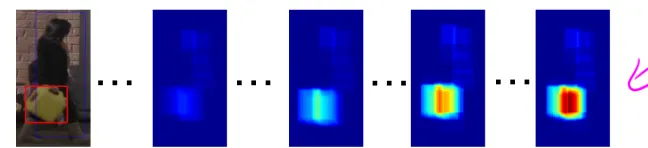
Person-Object Spatial Relation.Another more significant way of character-ising carried objects given that only thecarry event occurs is that they follow a person’s trajectory with a temporally continuous and characteristically con-sistent spatial relationship with respect to the person. In order to quantify this, we propose a voting measure that counts the number of times the relative po-sition of a pixel with respect to the centroid of a person’s region falls within a detection.
Let dxpt
i, dypti be the offset of a pixel relative to the centroid (xpti, ypti) of the i’th person’s bounding box pt
i at time t i.e. (xpt
i+dxpti, ypti +dypti) is the absolute position of the pixel relative to the image frameIt. We define a function δ(dxpt
i, dypti, o
t
j) as follows.
δ(dxpt i, dypti, o
t j, i) =
(
1, if (xpt
i+dxpti, ypit+dypti)∈o
t j
0, if (xpt
i+dxpti, ypit+dypti)6∈o
t j
Using the above definition we define the heatmap H of a relative offset (dxpt
i, dypti) position asH(dxpti, dypti) = P
oj∈O P
ot
j∈ojδ(xpti+dxpti, ypti+dypti, o
t j, i).
Given a set of tracksOassociated with a personpi, the intensity values in the
heatmap measure the number of votes for each relative offset pixel (dxpt i, dypti) given by the tracks in O. Since we expect carried objects to have a consistent relative location with respect to the person and noise to be more randomly distributed, the heatmap captures the locations relative to the person where carried objects is most likely to exist. This is as a result of these locations receiving higher votes in the heatmap due to the repeated presence of potential carried objects even though they may be sparsely detected in the video.
We regard a detection ot
j as more likely to be a carried object if it covers
pixels with high intensity values in the heatmap. We model therelative positional probability P(ot
j|pti, θs) as follows.
P(ot
j|p t i, θs) =
1
z3
expθs
X
(x,y)∈ot j
H(x−xpt
i, y−ypti)
(2)
...
...
...
...
Fig. 1: An illustration of the learned spatial distribution of the object relative to the person approximates the true relative position in the leftmost figure.
Protrusions.Areas corresponding to protrusions have been shown to be likely carried object regions with respect to the region of the person carrying it. For each person region pt
i, we obtain a protrusion regionα t
i by subtracting the
per-son region pt
i from the foreground region f
t in frame It and considering only
a subregion of αt
i in the vicinity of the person (defined by the detected person
bounding box). We regard a region ot
j as more likely to be a carried object if
it overlaps significantly with αt
i. Accordingly we compute the degree of
over-lap V(αt
i, otj) = (αti ∩otj)/(αti∪otj) and then evaluate P(otj|pti, ft, θr) using an
exponential model 1/z2exp(θr(V(αti, o t j)).
3
Event Driven Optimisation.
We now describe the main novelty of the paper which is an event driven optimi-sation. According to this scheme, the optimal solution of the objective function in equation 1 emerges as a result of iterations which involve cyclic interactions between the two components of the objective function. We define the first com-ponent, P(oj|ΘO)P(oj|ΘS), as a product of the probability distributions
corre-sponding to the detection strengths and spatio-temporal continuity respectively. The second novel component P(oj|pi, F, ΘC) is the relative positional
proba-bility distribution that models the person-object spatial relationship which is characteristic of thecarry event.
We first describe the basic search procedure in the optimisation process be-fore discussing the role of these two components. For each person trackpi, the
optimisation involves starting with an initial set of trackletsO0and then
apply-ing a sequence of moves to iteratively obtain a sequence of hypothesised tracklets (O1, ..., Ok, ...). The objective function given in equation 1 is used at each stepk
in the iteration to decided whether to accept the new hypothesisOkor to persist
the previous hypothesis Ok−1. We adopt two simple moves, the first of which
Basic Tracking System. When this procedure is used only with the first component, it tends to result in carried object tracks have higher detection probabilitiesP(oj|ΘO) and are smooth with respect to the properties captured
in P(oj|ΘS). We call such a system as the basic tracking system, that we refer
to in our experimental section.
Heatmap Driven System.The introduction of the second component i.e. the relative positional probability distribution P(oj|pi, F, ΘC) tends to favour the
formation of object tracks whose objects firstly overlap with protrusions, and secondly (more importantly) those tracks that overlap with the heatmap given in 2. That is these tracks tend to accumulate higher values of the positional probability distribution and therefore have the characteristics of a carried object, as described in section 2.2.
Attention Driven System.To further capitalise on the potential of this rel-ative positional probability distribution, we introduce an attention-like mecha-nism into the optimisation process, where we start by considering only those object detections that have high detection likelihoods and we call these initial tracklets of length one as initial seed tracklets. At each iteration, the link move forms larger seed tracklets by focussing on connecting only seed tracklets to other seed tracklets or non-seed detections (tracklet of length one). Similarly the split move operates only on the seed tracklets.
At each iteration, only the seed tracklets contribute to the computation of the heatmap. As the heatmap becomes more well defined with further iterations, some of those non-seed tracklets with higher positional probability distributions (although they may have relatively lower detection likelihoods) tend to be in-cluded as seed tracklets. These updated seed tracklets are used for applying moves in the next iteration. In this manner, an attention-like mechanism begins to evolve with a tendency toselect object tracklets that correspond to the true carried objects,against other false positive candidate tracks.
Due to the cyclic interactions between the two components of the objective function, the optimisation procedure often starts with a sparse set of detections with possibly several false positives and starts building longer tracks that tend to approximate the true carried object trajectory, while also rejecting the false positivies.
4
Object Detection
In order to obtain a set of detectionsRas an input to the optimisation, we start by computing a sequence of foreground regions for a video using an off the shelf foreground extraction technique [11]. We then obtain person tracks by detecting a set of person regions in each frame and then we track all these detections using a dynamic programming based tracker [10]. The person regions in each frame are obtained in three steps. First we detect bounding boxes corresponding to the person detections obtained using a standard object detector with a trained per-son model [5]. Second, we obtain bounding boxes that are body part estimates inside each of the person bounding boxes using articulated pose estimation code [14]. Finally we take the union of the regions circumscribed by each of the parts to be a segmentation of the person inside that bounding box.
(a) (b) (c) (d) (e) (f) (g)
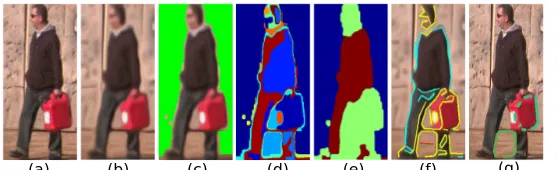
Fig. 2: The process of obtaining candidate carried object detection. (a) We first obtain the image corresponding to the person detection; (b) We then apply the method in [8] to enhance edges corresponding to natural boundaries; (c) We apply foreground extraction onb with background shown in green; (d) We obtain regions after applying colour based segmentation toc; (e) We identify the two largest segments (given in red) ind, which tend to correspond to regions on the person. The carried object is more likely to be present in the green region; (f) Using the regions identified in e, many of the line segments belonging to the person are removed, as coloured with cyan; (g) The result of applying level-wise mining to the remaining edges (coloured yellow in f) to obtain candidate carried object regions, as an input to the event driven optimisation procedure.
reduces the set of line segments enabling us to generate a smaller set of candidate object regions from the remaining set of line segments. We then search this set for candidate object detectionsot
j, where each detection is just a subset of line
segments forming a fully or partially connected chain (Figure 2.g), that are likely to belong to any of the geometric shapes under consideration. In order to search efficiently, we use a level-wise mining procedure, where two candidate k−1 subsets are merged if they sharek−2 segments and accepted as ak candidate set ot
j, if the likelihood score P(otj|θ) ofotj, with respect to a geometric shape
model θ∈ΘO is above a minimum conservative threshold.
5
Experimental Setup
The experimentation consists of two aspects, first of which is a comparison be-tween the proposed approach and the state-of-art Damen and Hogg’s carried object detector (protrusion based) [4], which has been shown to outperform previous systems based on periodicity analysis [3, 7]. Secondly, we would like to further explore the true potential of our approach, by alternating certain key components and identifying their effects in terms of detection performance. As a result, a benchmark dataset, namely the PETS2006 dataset is used for the first aspect of baseline comparison. On the other hand, a much more com-plex dataset, the MINDSEYE2012 dataset, is used in a set of more extensive experiments, which are aimed at the exploration of key components of the pro-posed approach. The corresponding evaluation is concentrated on the detection performance of the compared approaches and thus it is done with respect to spatio-temporal localisation of each carried object per frame by computing the standard overlap ratio also used in [4], except that we also vary the overlap threshold and report results for each value.
0.0 0.2 0.4 0.6 0.8 1.0 0.0 0.1 0.2 0.3 0.4 0.5 0.6 0.7
F1 Score Comparison on PETS2006
Overlap Threshold F1 Score ● ● ● ● ● ● ● ● ● ● ● ● BTS Raw Detections Damen and Hogg
(a) PETS2006
0.0 0.2 0.4 0.6 0.8 1.0
0.0 0.1 0.2 0.3 0.4 0.5 0.6 0.7
F1 Score Comparison on MINDSEYE2012
Overlap Threshold F1 Score ● ● ● ● ● ● ● ● ● ● ● ● ● ● ● ● ● ● ● ● ● ● ●
ADS (auc = 0.43) HDS (auc = 0.34) BTS (auc = 0.18) Raw Detections (auc = 0.14) Damen and Hogg (auc = 0.12)
[image:9.612.152.580.118.296.2](b) MINDSEYE2012
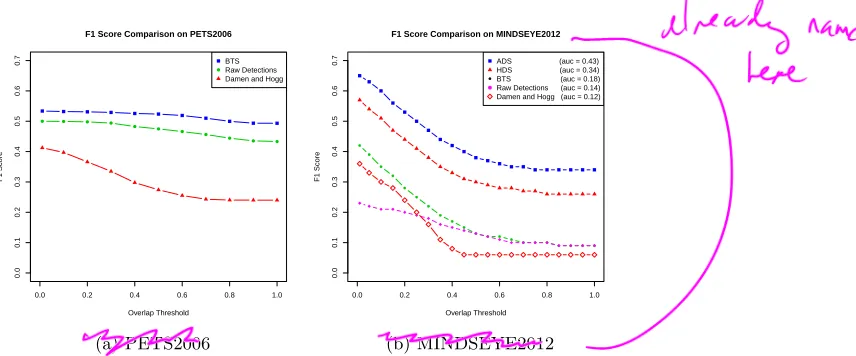
Fig. 3: Result plots of compared methods in terms of F1 scores as the threshold of overlap increases on both PETS2006 and MINDSEYE2012.
environmental factors, e.g. changes in light conditions (e.g. brightness due to weather), moving trees and grasses in the background, as well as a greater variety of carried object types. The ground-plane homography estimation of PETS2006 was provided as part of the sample set, while that of MINDSEYE2012 is done for each camera setting. Human tracks of both datasets are generated through first applying basic background subtraction to obtain foreground segmentation and then using an off-the-shelf tracker [10].
Parameter Settings.In our experiments, we tune the parameter setΘO
(cor-responding to the geometric shape models),ΘS(modelling smooth trajectories),
andθr∈ΘC(concerning the overlap between the protrusion and the object mask
respectively), on a separate subset of the Mindseye project. Values of these pa-rameters are independent from any particular selection of subset, containing a reasonable number of videos. This is because general geometric properties ΘO
(e.g. convexity) are invariant across samples from any dataset. As focus of this work is to prove a concept, only the convex shape model is investigated. Simi-larlyΘS are generic due to similar motion patterns in the datasets (e.g. people
walking). Finally, forθr∈ΘC, irrespective of the dataset and the perspective, it
is reasonable to assume that the protrusion mask corresponds to a part or whole of the object. This is due to the assumption that the person and the carried ob-ject together constitute the foreground mask. In addition, we set the parameter
θs∈ΘCequal to one over the length of the person track in consideration, acting
as a normalisation factor. Default parameter settings of the detector [4] are used for both datasets, as it is often considered most suitable for general uses.
6
Results and Analysis
Results. In both Fig 3a and Fig. 3b, three F1 score curves correspond to the
(a) (b) (c) (d) (e) (f) (g) (h) (i)
[image:10.612.156.451.112.268.2](j) (k) (l) (m) (n) (o) (p) (q)
Fig. 4: Illustration of the successes and the failures of our approach and also a com-parison with [4]. For images (a)-(m), boxes coloured in green correspond to ground truth, red to [4] and blue to those obtained using the proposed approach. Note that the ground truth is sometimes imperfect eg. (l). Images (n)-(q) illustrate the obtained contour of the detected object using the proposed method.
to the performance improvement of the following systems. The reason for the high starting point of the Damen and Hogg’s detector on MINDSEYE2012 is due to the fact that the detector tends to produce large bounding boxes of the de-tections, which could be regards as true positives when the threshold of overlap is low. However, such detections should be in fact considered as false positives, which becomes obvious as the overlap condition becomes more strict. It is also obvious the BTS significantly out-perform the Damen and Hogg’s detector on both datasets. Moreover, in Fig. 3b, two additional curves are presented, cor-responding to two variants of our approach where the optimisation process is altered accordingly. These two variants are heatmap driven system (HDS) and attention driven system (ADS). It is clear the use of heatmap and attention like mechanism, in addition to BTS, further significantly improves the detection performance.
Qualitative Analysis. In this section we also present a qualitative analysis
7
Summary and Future Work
We have introduced a vision system that performs carried object detection and tracking. Our approach characterises carried objects in terms of generic shape properties such as convexity, whilst taking account of the fact that they are often, but not always, protrusions on a person silhouette, and exploiting the property that they have continuous and spatially consistent trajectories relative to the person carrying them. In addition, an iterative event driven optimisation process, which could use heatmap and attention like mechanism, is introduced to obtain an optimal set of object detections. Experimental results show that our approach significantly outperforms a state-of-the-art technique [4], especially the system where both heatmap and attention like mechanism are employed, on two challenging datasets. A future extension of this work would be to include other geometric shapes. Another future direction is to build on the existing framework by incorporating more carried object events such as drop, pick-up, give, take etc.
References
1. C. Benabdelkader and L. S Davis. Detection of people carrying objects: A motion-based recognition approach. Proc. Intl Conf. Automatic Face and Gesture Recog-nition, pages 378–384, 2002.
2. A. Branca, M. Leo, G. Attolico, and A. Distante. Detection of objects carried by people. Proc. Intl Conf. Image Processing, 3:317–320, 2002.
3. R. Cutler and L. Davis. Robust real-time periodic motion detection, analysis, and applications. PAMI, 22(8), 2000.
4. D. Damen and D. Hogg. Detecting carried objects from sequences of walking pedestrians. PAMI, 34(6):1056–1067, 2012.
5. P. F. Felzenszwalb, R. B. Girshick, D. A. McAllester, and D. Ramanan. Object detection with discriminatively trained part-based models. PAMI, 32(9):1627– 1645, 2010.
6. I. Haritaoglu, R. Cutler, D. Harwood, and L. S. Davis. Backpack: Detection of people carrying objects using silhouettes. CVPR, 1:102–107, 1999.
7. D. Harwood I. Haritaoglu and L.S. Davis. W4: Real-time surveillance of people and their activities. PAMI, 22(8), 2000.
8. D. Kroon and C. H. Slump. Coherence filtering to enhance the mandibular canal in cone-beam ct data. InProceedings of the 4th Annual Symposium of the IEEE-EMBS Benelux Chapter, pages 41–44, 2009.
9. H. Nanda, C. Benabdelkedar, and L. S. Davis. Modelling pedestrian shapes for outlier detection: A neural net based approach. Proc. Intelligent Vehicles Symp, pages 428–433, 2003.
10. H. Pirsiavash, D.Ramanan, and C. C. Fowlkes. Globally-optimal greedy algorithms for tracking a variable number of objects. InCVPR, pages 1201–1208, 2011. 11. C. Stauffer and W. E. L. Grimson. Learning patterns of activity using real-time
tracking. PAMI, 22:747–757, 2000.
12. D. Tao, X. Li, S. J. Maybank, and W. Xindong. Human carrying status in visual surveillance. CVPR, 2006.
13. K. Tsuda, M. Minoh, and K. Ikeda. Extracting straight lines by sequential fuzzy clustering. Pattern Recognition Letters, 17(6):643–649, 1996.
14. Y. Yang and D. Ramanan. Articulated pose estimation using flexible mixtures of parts. CVPR, 2011.
15. Qian Yu and Gerard Medioni. Multiple-target tracking by spatiotemporal monte carlo markov chain data association. PAMI, 31, 2009.
![Fig. 4: Illustration of the successes and the failures of our approach and also a com-parison with [4]](https://thumb-us.123doks.com/thumbv2/123dok_us/7985194.203768/10.612.156.451.112.268/fig-illustration-successes-failures-approach-com-parison.webp)
