0022-538X/93/052575-08$02.00/0
Copyright © 1993,American SocietyforMicrobiology
Open Reading
Frames
UL44,
IRS1/TRS1, and
UL36-38 Are
Required for Transient
Complementation of
Human
Cytomegalovirus oriLyt-Dependent
DNA
Synthesis
GREGORY S. PARI,1 MARILYNA. KACICA,2ANDDAVID G. ANDERS*
Laboratoryof Virology, The Wadsworth Centerfor Laboratories andResearch, New York State Department of Health, and Department of Biomedical Sciences, SUNY School of Public Health, Albany, NewYork12201-0509,1and
Department of Pediatrics, AlbanyMedical College, Albany, New York 122012
Received 18 November 1992/Accepted 19 January 1993
Previous results showed that plasmids containing human cytomegalovirus (HCMV) oniLytare replicated after transfection intopermissive cells if essential trans-acting factorsaresupplied by HCMV infection (D. G. Anders, M. A. Kacica, G. S. Pari,and S. M. Punturieri, J. Virol. 66:3373-3384, 1992). We havenowused oriLytas areporterofHCMV DNAreplication ina transientcomplementation assayinwhichcotransfected cosmid clones, instead of HCMVinfection, providedessentialtrans-actingfactors. Complemented replication
was oniLyt dependent and phosphonoformic acid sensitive and produced tandem arrays typical ofHCMV lytic-phase DNAsynthesis.Thus, this assayprovides avalid genetictest tofind previously unidentifiedgenes thatareessential for DNAsynthesis and tocorroborate functional predictions made bynucleotide sequence
comparisonsandbiochemicalanalyses. Five cosmidswerenecessaryand sufficienttoproduceorigin-dependent DNAsynthesis;all butoneoftheserequiredcosmids containatleastonecandidate homolog of herpes simplex virus type 1 replication genes. Wefurtherused the assay todefine essential regions in twoof the required cosmids, pCM1017and pCM1052.Results presented show that UL44, proposedon the basis ofbiochemical evidencetobe the HCMV DNApolymeraseaccessoryprotein,wasrequiredforcomplementation. In addition, three genomic regions encoding regulatory proteins also were needed to produce origin-dependent DNA synthesis inthisassay: (i) IRS1/TRS1,which cooperateswith themajorimmediate-early proteinstoactivate UIA4expression;(ii) UL36-38; and (iii) themajorimmediate-early regioncomprisingIEland IE2.Combined, these resultsunequivocallyestablish theutilityof thisapproachformappingHCMVreplicationgenes.Thus, it willnowbe possibletodefine thesetofHCMVgenesnecessaryand sufficient for initiating andperforming lytic-phase DNA synthesis as well as to identify those virus genes needed for their expression in human fibroblasts.
The set of human cytomegalovirus (HCMV) genes that
carry out lytic-phase DNA replication has not been
estab-lished, largely because of difficulties in performing genetic studies in thissystem.Therefore, much ofourunderstanding ofHCMV DNAreplicationhasbeengleaned by comparison with theprototypeherpesvirus, herpes simplexvirustype 1 (HSV-1). Challberg and colleagues defined seven HSV-1
genesasnecessaryand sufficient fororigin-dependent DNA
replication byusing atransient cotransfection assay to test theability of cloned fragments of HSV DNAto supportthe replicationofanorigin-containingplasmid (9-11, 63). These
genesencode aDNApolymerase(UL30) andanassociated
polymerase accessory protein (UL42), a single-stranded-DNA-binding protein (UL29), a heterotrimeric helicase-primase complex (UL5, UL8, and UL52), and an origin-binding protein (UL9) (reviewed in references 10 and 11). Their resultsprovedtobeanexusforextensivegeneticand biochemical studies (e.g., references 8, 24, 42, 44, 50, 51, and 61; reviewed in reference 60). Candidate HCMV ho-mologs of four of these HSV-1 replicationgenes,includinga DNA polymerase (UL54), a single-stranded-DNA-binding protein (UL57), and two subunits of the helicase-primase complex (UL105 and UL70), were identified by sequence
similarity(12).Inaddition, HCMV UL44wasidentifiedas a candidate polymerase accessory protein on the basis of
* Correspondingauthor.
biochemical studies of the expressed protein (18, 19). HCMVopenreading frames(ORFs) positionallyequivalent
to HSV-1 UL8 and UL9 are not detectably similar in
sequence (12). Proteinproducts of ORFs UL57,UL54, and
UL44 have been purified and characterized to various
de-grees (1, 3, 18, 19, 31, 34, 35), but except for the DNA polymerase, there has been little direct evidence that these candidatehomologsarerequired for viral DNA synthesis in
vivo.
It is important to better define all of the componentsof HCMVreplication,becausethey confer the uniquerangeof sensitivities exhibited for several antiviral agents. In addi-tion, these components may provide useful targets for the rationaldesign ofnewanti-HCMVchemotherapeuticagents. There may be significant differences between the compo-nentsofHCMV DNAreplication and those of other herpes-viruses, despite the identification of candidate HCMV ho-mologs of several of the HSV-1 replication genes and observed similarities in the DNA replication process. For example, one conspicuous gap is the failure to identify by
sequencesimilarityanHCMVhomolog oftheHSV-1
origin-bindingprotein(12). This absence is particularly intriguingin the light of the distinctive structure ofan HCMVorigin of lytic-phase DNA replication, oriLyt (2, 4, 29, 43). In this regard, itwasrecently suggestedthatthegammaherpesvirus Epstein-Barr virus(EBV)lacksanequivalentof HSV-1 UL9 (20). Finally, some essential HCMVreplication genes may 2575
on November 9, 2019 by guest
http://jvi.asm.org/
2576 PARI ET AL.
be unique in that other herpesviruses do not encode ho-mologs.
Our laboratory(2, 4) and others (29, 43) recentlydescribed HCMV oniLyt. HCMV onLyt replicates autonomously when transfected into permissive cells if essential
trans-acting factors are supplied by HCMV infection, which has
facilitated its characterization (2, 4, 43). This finding
sug-gested to us that the cotransfection strategy described by Challberg (9) could be used to locate essential HCMV replication genes. In this report, we describe a transient
complementation assayinwhichtrans-actingfactors neces-saryforHCMVlytic-phase DNA replicationareprovided by asetofoverlapping cosmids.We further describe theuseof thisassayto show thatHCMV UL44, aproposed homolog ofthe HSV-1 polymerase accessoryprotein (18), isrequired forcomplementation oforigin-dependent DNAreplication. Moreover, IRS1/TRS1, a recently described transcription activator that acts cooperatively with HCMV immediate-early (IE) proteins to upregulate the UL44 promoter (55), alsowasindispensable, as weretwoother regions encoding previously described HCMVtranscriptional activators, the majorIE (MIE) regions1 and2, andORFs UL36-38.
MATERIALSAND METHODS
Cells and virus. Human foreskin fibroblast (HFF) cells
wereused for allexperiments andwerecultured in Dulbec-co'smodified Eagle's medium (DMEM)supplemented with 10%(vol/vol) fetal calfserum. HCMV strain AD169 (Amer-ican Type Culture Collection) was maintained as frozen stocks. Infectionwasdoneatanapproximate multiplicity of infectionof 10. Phosphonoformic acid (PFA; Sigma Chemi-calCo., St. Louis, Mo.)wasusedatafinalconcentration of 200
jig/ml
and added eitherat24hposttransfectionoratthe time ofinfection, as indicated.Plasmid constructs. Construction of the replication
re-porter pSP50 was described previously (2); it contains HCMV oriLyt as a 5.6-kbp PvuII-to-KpnI subfragment of
HindIII-D. HCMVcosmid clones (21)werekindlysupplied
byA.Colberg-Poleywiththepermission ofB.Fleckenstein. Subclones of these cosmids all were constructed in
pGEM7ZF(-) (Promega, Madison, Wis.) by usingstandard procedures (52). pSVH contains HCMV IEl and IE2 (56) and was a gift of R. Stenberg. A clone containing strain AD169 TRS1(pXEXX-6.1)wasobtained from T. Jones (36), andplasmids containing strainTowneTRS1(pON2334) and TRS1witha frameshift mutation (pON2336)were supplied
by E. Mocarski (55). Additional plasmid constructs were made asdetailed below.
(i)Subclones of cosmidpCM1052. Plasmid pZP1wasmade by excisingfromalow-melting-point (LMP)agarosegel the
20-kbp HindIII G fragment derived from pCM1052 and ligating it into pGEM7Zf(-). Plasmid pZP2 was made by excising the 12.6-kbp EcoRI F fragment from an LMP gel andligatingitintopGEM7Zf(-). Plasmid pZP3wasmade by
ligating the 3.6-kbp SmaI fragment extending from nucle-otides (nt) 189500to 193108 intopGEM7Zf(-).
(ii) Subclones of pCM1017. Plasmid pZP4 was made by
ligating intopGEM7Zf(-) the 10.3-kb HindIII M fragment. pZP5 was made by excising the 7.0-kb Sacl fragment
ex-tendingfromnt52260to59219 fromanLMPgelandligating it intopGEM7Zf(-). pZP6wasmade by excisingthe 8.0-kbp
BglII fragment extending from nt 47366 to 56170 from an
LMPgeland ligating it into pGEM7Zf(-). pZP7was made
by ligating the 2.6-kbp KpnI fragment extending from nt
54118 to 56701 into pGEM7Zf(-). pAZP7 is pZP7 with a
582-bpHinclI deletionextending fromnt54231to54813 that removes429ntofUL42 and 432ntof UL43.pZP8wasmade by ligating the 11-kbp
KpnI
fragment extending from nt 42045 to53104 into pGEM7Zf(-).Transfection and replication assay. HFFcellswereplated onto6-cm-diameter dishesatacelldensityof105perplate24 hbefore transfection.Approximately 4 h priorto transfec-tion, the media were replaced with 3 ml of fresh DMEM. DNAwas transfected by using theprocedure described by Chen andOkayama(14).Briefly,4
Rg
ofpSP50,1 ,ugeach of cosmids pCM1017, pCM1029, pCM1039, pCM1035, pCM1052,pCM1058,andpCM1015,and1 ,ugofpSVHwere addedtoa5-ml sterile testtube. Tothis DNA mixturewas added 0.5 ml of 0.25MCaCl2followedby 0.5 ml of 2x BBS [50 mMN,N-bis(2-hydroxyethyl)-2-aminoethanesulfonic
acid (BES), 280 mM NaCl, 1.5 mM Na2HPO4, (pH 6.95)]. The solution was vortexed briefly and allowed to stand at room temperature for 20 min; 0.5 ml of this cocktail was addeddropwisetoeachplate, and the disheswereincubated
at 37°C in a 3% Co2 incubator for approximately 20 h. Dishes thenwerewashed twice withDMEM, 3 ml of fresh DMEMcontaining10%fetal calfserum wasadded,and cells werefurtherincubatedat37°C ina5%CO2incubator for up to 120 h.Alltransfectionswere done induplicate.Atypical positivecontrol for theseexperiments, notusuallydepicted intheresultspresented,was aparalleltransfectionwith the completesetofcosmids plus pSP50, followedbyinfection 24 haftertransfection.
Total cell DNA was collected by removing the media, washing cells once with phosphate-buffered saline, and lysingcellsdirectlyonthe dish with 400
[lI
of celllysisbuffer(2%
sodium dodecyl sulfate, 10 mM Tris-HCl [pH8.0],
10 mM EDTA). Cell lysates were transferred to a 1.5-ml microcentrifuge tube, proteinase K was added to a final concentration of 200 ,ug/ml,andthe lysates wereincubated at50°C for 3 h.Sodiumacetate(pH 5.4)wasaddedto afinal concentrationof 0.3 M; the celllysateswerethenextracted oncewith phenol-chloroform-isoamyl alcohol (25:24:1) and once with chloroform-isoamyl alcohol (24:1) and ethanol precipitated.DNA wasresuspendedin 100,Iof Tris-EDTA (pH8.0), andone-quarter of thetotalwastreated with 25 U ofEcoRI and 10 U ofDpnI
inavolume of 50RI
at37°Cfor 4to16h.CleavedDNAwaselectrophoresed througha0.8% agarose gel, transferred to a Zeta-probe (Bio-Rad, Rich-mond, Calif.) nylon membrane, and probed with random-primer32P-labeled
pGEM. Hybridizations were performed according to manufacturers' instructions. Southern blots were then exposed to X-Omat AR X-ray film (Kodak) at-80°Cfor 24 h.
RESULTS
HCMV cosmid clones can direct lytic-phase DNA replica-tion when cotransfected with a plasmidwhich expresses IEI and IE2. In developing a transient complementation assay for HCMV DNA replication, our strategywas to introduce large overlapping cloned segments of the HCMV genome intopermissiveHFFcellstogether withaplasmid containing HCMV
oniLyt.
Available cosmid libraries (21) provided convenient sets ofoverlapping genomicfragments, and theoniLyt-containing
plasmid SP50 (4) served as an assayable reporter oforiLyt-mediated
DNA synthesis; replication of pSP50was detected by treatment oftransfected-cell DNA withDpnI,
which cleavesonlyunreplicateddam-methylated inputDNA.Initialexperimentstested variouscombinations of available cosmids, plus or minus added pSVH, which J.VIROL.on November 9, 2019 by guest
http://jvi.asm.org/
pCM1052
pCM1035 pCM1017 pCM1075 pCM1 058
pCM1015 pCM1029 pCM1039 pCM1035
v v zX IiFIvI= D. .,
- A.VA-a X,/'OR1IX
B 1 2
>. *-Dpnl-resistant
F-DpnI-cleaved
- + pSVH
FIG. 1. Ability of cotransfected cosmidstocomplementreplication of cloned HCMV oriLyt.(A) Physicalmapsofthe HCMVgenomeand
locations of the cosmids used for the described experiments.(B) Evidence that cosmidcomplementation requires pSVH.Cotransfectionwas
doneasdescribed in Materials and Methods. Cotransfectionmixtures contained 4 pgofpSP50and 1,ugeachof cosmidspCM1015, pCM1017,
pCM1029,pCM1039, pCM1058, pCM1052, and pCM1035(lane 1)orthesamesetof recombinants plus 1,ugof pSVH (lane 2). Shown isan
autoradiogram of the resulting Southern transfer. The arrowhead indicates the position of the pGEM7Zf(-)-containingEcoRIfragmentof the
reporterplasmid pSP50.
contains the MIEregions1and2(56), and compared several transfection methods, including standard CaPO4, DEAE-dextran andlipofection protocols. Although all of the
trans-fection protocols were efficient enough for standard
trans-fection experiments in which only onLyt was transfected and necessary trans-acting factorswere supplied by
infec-tion,we found thatonly theBES-buffered, modifiedCaPO4
procedure described by Chen and Okayama (14) yielded complementation (47). Positive results, measured by conver-sion ofonLyttoDpnI resistance, firstwere obtained when the seven cosmids pCM1015, pCM1017, pCM1029,
pCM1035,pCM1039, pCM1058,andpCM1052were cotrans-fected witharoughly20-fold molarexcessofpSVH(Fig. 1B,
lane 2). Thus, these seven partially overlapping cosmids
expressed all of the proteins needed to direct detectable oniLyt replication.Together they comprisealmost the entire HCMV genome (Fig. 1A), including all of the described
homologs of HSV-1 replication genes. Without added
pSVH, the same set of cosmids reproducibly failed to
complement DNA replication (e.g., Fig. 1B, lane 1), even
though pCM1058 containsafunctioningMIEregion (47). In thisand otherexperiments, only oriLyt-containing plasmids
werereplicated. While it is difficulttointerpret these results quantitatively,wenotethat intypical experiments, comple-mentedreplicationproducedaDpnI-resistant signal roughly 50-to 100-fold lower than that found for theparallelinfected control(e.g., comparelanes0 and 1 inFig. 4C).
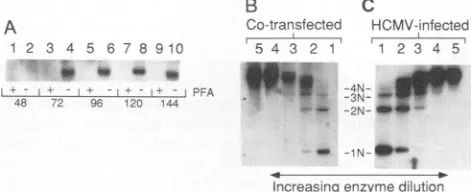
Two additional control experiments were done to test whether the detectedDpnI-resistant productsresulted from HCMV lytic-phase DNA synthesis. PFA treatment, which selectivelyinhibits thevirus-encoded DNApolymerase,was used to determine whether theoniLyt replication resulting from cosmid cotransfection required HCMV DNA
poly-merase activity. HFF cells were cotransfected with the indicated set of clones and then incubated with orwithout PFA for up to 144 h (Fig. 2A). Replication of oniLyt was detected from 72 h after transfection in untreated cells(lanes 4, 6, 8, and 10). However, in PFA-treated cells, no DpnI-resistantproductwasdetectedat anytimepoint (lanes 1, 3,
5, 7, and 9). This finding is consistent with results from earlier experiments showing the PFAsensitivity of onLyt-mediated DNAreplication (4). We also examined the struc-turesofreplication products resultingfrom cosmid
cotrans-fection. Replication productsofoniLyt-containing plasmids in the transienttransfection-plus-infectionassayaretandem
arrays (4). Thus, partial digestion with an enzyme that
cleaves the vector at a unique site produces a ladder of
fragments representing 1N, 2N, 3N, etc., copies of the reporter plasmid. Similar patterns were seen when onLyt
replication products from HCMV-infected (Fig. 2C) and cosmid-cotransfected(Fig. 2B)HFF cellswerecompared by
partial digestion. Together, these results argue that oriLyt replication directed by cotransfected cosmids is equivalent
tothatof thetransienttransfection-plus-infection assayand accurately reproduces events of HCMV lytic-phase DNA replication.
Five cosmids are needed for complementation of HCMV
origin-dependent DNA replication. Once it was established that thecotransfected cosmids directedauthenticlytic-phase replicationofoniLyt,wenextidentified whichof the cosmids containedgenes essential for transientcomplementation by eliminatingonecosmidatatime from transfection mixtures. When cosmids pCM1015 and pCM1035 were omitted from cotransfection cocktails(Fig. 3,lanes 2and5, respectively), onLyt replication was unaffected. HindlIl fragments I, H,
A
1 2 3 4 5 6 7 8 910
- - - -. 1- - PFA
48 72 96 20 144
B C
Co-transfected HCMV-infected
Ii
5 4 32 1 1 23 4 5
ww_w
- -4N- __,wiF
-3N-O.' -2N-4"
-1 N--
-I
Increasingenzymedilution
FIG. 2. EvidencethatreplicationoforiLyt following cotransfec-tion is authentic HCMVlytic-phase DNA synthesis. (A) Comple-mentationis PFA sensitive. HFF cellswere cotransfected with a
mixture containing cosmids pCM1017, pCM1029, pCM1039, pCM1058,and pCM1052plus plasmids pSVHandpSP50and then incubated for the indicated time with (lanes 1, 3, 5, 7, and 9) or
without(lanes 2, 4, 6, 8,and10)200,ugof PFApermlof medium. DNA was extracted and digested as described in Materials and Methods. Only that portion of the resulting Southern transfer containingtheDpnI-resistant products is shown. (B and C) Com-plementedDNAsynthesis produces tandemarraysofpSP50. Par-allelsetsof disheswerecotransfectedwithareplication-competent
setof cosmidspluspSP50.Onesetof disheswasinfected(C), and the othersetwasleft uninfected(B); the disheswereincubated for 96h, and total DNAwas preparedas described in Materials and Methods.DpnI-resistantDNAwascleavedpartiallywithHindIII by the serial dilution method.
A
on November 9, 2019 by guest
http://jvi.asm.org/
[image:3.612.90.514.78.175.2] [image:3.612.317.553.471.567.2]2578 PARI ET AL.
2~1In r-- m m oi a 7
O--° Lo LO
c) E jE j j jj -Omitted cosmids
'0
)0-<: CL Cf a 9- a_ 9 La
-w C)-Dpnl-resistant
F-Dpnl-cleaved
1 2 3 4 5 6 7 8
FIG. 3. Evidence that five cosmidsareneeded for
complemen-tation of HCMVorigin-dependent DNA replication.Transient
com-plementation assays wereperformedasdescribed in Materials and
Methods. Alltransfections containedpSP50 and pSVH plus either the complete set of seven cosmid clones (pCM1015, pCM1017,
pCM1029,pCM1035, pCM1039,pCM1052,andpCM1058;lane1)or
thecompletesetofcosmid clones minus the indicated cosmid (lanes 2to 8). Shown is the resulting Southern transfer. The position of DpnI-resistantreplication products is indicated.
and0areuniquetothesecosmids(Fig.1A);therefore these fragments do not express genes essential for origin-depen-dent HCMV DNA replication. However, no replication products were detected when any of the four cosmids
containingpreviouslyidentified candidatereplication genes,
pCM1017, pCM1029, pCM1039, and pCM1058, were omit-ted from thetransfection cocktails(Fig. 3,lanes3, 4, 6, and 8).Inaddition, cosmidpCM1052,which doesnotcontainan
identified homolog ofanHSV-1 replication gene, alsowas
required (Fig. 3, lane 7). Thus, five cosmids (pCM1017, pCM1029, pCM1039, pCM1052, and pCM1058) plus pSVH
were needed to complement DNA replication in our
tran-sientassay.
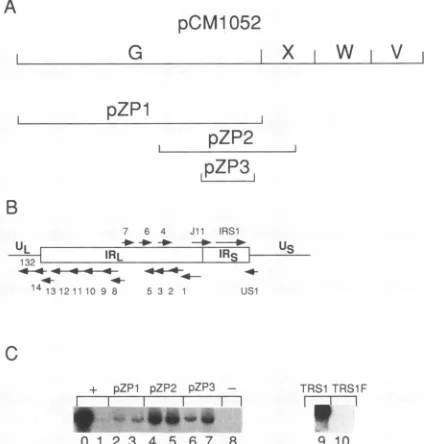
IRS1/TRS1isessentialfortransient complementation. Once the minimum set of cosmid clones sufficient to direct the replication ofonLytwas established,we soughtto identify essential regions within each required cosmid. Because pCM1052 does not contain a candidate homolog of any HSV-1 replication gene, we studied it first. To determine which gene(s) withinpCM1052wasrequiredinour assay, we madeaseries ofsubclones, usingpreviouslyidentified ORFs
(13, 62)as aguide, and tested whether theycould substitute individuallyforpCM1052in thecotransfectionassay.Three of the constructs, pZP1, pZP2, and pZP3, efficiently
re-placedpCM1052 (Fig. 4C, lanes2to7)in the transientassay. Transfections omitting pCM1052 without substitution pro-duced nodetected signal (Fig. 4C,lane 8),asshown above
(Fig. 3, lane7). Noneoftheothertested fragments derived from pCM1052, including HindIII-W and -V, could
substi-tute for pCM1052 (47). pZP3 contains a 3.6-kb SmaI
frag-mentthatspansonly the ORFs IRS1 and US1 (Fig.4Aand
B).BecauseUS1 has been showntobedispensable for virus growth in culture (36), we suspected that IRS1 was the
essential ORF. TRS1, the terminal repeat counterpart of IRS1, shares extensivesequenceidentity withIRS1(12), and
both can cooperate with IEl and IE2 to transactivate de-layed-earlygene expression(55). Inlight of the finding that the IRS1 regionofpCM1052wassufficient for
complemen-tation, itwassurprising to usthat cosmid pCM1035,which containsTRS1, failedtosubstituteforpCM1052(Fig. 3, lane 7). However, we subsequently found that a plasmid
con-A
G
pCM1 052
X W L V
pZP1
pZP2
LPZP
B
7 6 4 Jil IRS1 UL --A-~ - ~ US
132 RL IRS
14313211O98 53 2 1 USi
C
+ pZP1 pZP2 pZP3 - TRS1 TRS1F
* ~S***
01 2 3 4 5 6 7 8 9 10
FIG. 4. Evidence that IRS1/TRS1 is essentialfor origin-depen-dent DNA replication. (A) Physical map depicting HindIll frag-ments within pCM1052 and fragments that were subcloned as
described in Materials andMethods and then testedin cotransfec-tion experiments. pZP1 extends from nt 176883 to 195837. pZP2 extendsfromnt185495to195231.pZP3extends fromnt189500to 193108.(B)ORFspredicted by Cheeetal.(12) situatedwithin the IR regionbetween the UL and the UsofHCMV. (C) Cotransfection experimentsshowingthatIRS1/TRS1is essential for complementa-tionofDNA synthesis. Cotransfections contained pSP50, pSVH, and cosmids pCM1017, pCM1029, pCM1039, pCM1058, and pCM1052 (lanes 0 and 1), the same cocktail with the indicated substitution for pCM1052 (lanes 2to 7, 9, and 10), orthe same
transfectionmixture minuspCM1052 without substitution(lane 8). The dishtransfected for thesample run in lane 0wasinfected as described in Materials and Methods 24 h aftertransfection.Inlanes 9 and lane 10, pON2334 (TRS1) and pON2336 (TRS1F), respec-tively,weresubstituted forpCM1052(55)asexplainedinResults.
struct spanning HCMV strain AD169 TRS1 (pXEXX-6.1; providedby T.Jones) could substitute for cosmid pCM1052 followingcotransfection(47); thus,theTRS1 copy presentin
pCM1035 is probably defective. Further supporting this contention was the finding that a plasmid containing only TRS1 (from HCMV strain Towne; pON2334; kindly pro-vided by E. Mocarski) efficiently substituted for pCM1052 (Fig. 4C, lane 9) upon cotransfection, whereas a frame-shifted mutant of TRS1 (pON2336) lacked the essential activity (Fig. 4C, lane 10). We concluded that IRS1 is the only ORF within cosmid pCM1052 needed for transient complementation and that TRS1 can substitute for IRS1. Thus, except forIRS1/TRS1,thegenomic segments contain-ing
Us,
IRL, andIRS
weredispensableforlytic-phaseDNAsynthesis. Replication signals in these substituted transfec-tionswerehigherthanwithpCM1052(Fig.4C; compare lane 1 with lanes 3 to 7), presumably because of the higher effective concentration of an essential gene that resulted from replacing pCM1052 with an equal mass of smaller plasmids. A related observation is that extramolar IRS1 relieved the observed requirement forpSVH, although the MIEregion, supplied by pCM1058,wasstill essential (47).
CosmidpCM1017contains tworegions essentialfor oriLyt-dependentDNAreplication. IRS1/TRS1 recently was shown J. VIROL.
on November 9, 2019 by guest
http://jvi.asm.org/
[image:4.612.332.546.80.302.2] [image:4.612.116.258.80.215.2]pCM1017
pZP8
pAZP7
-J
pZP5
pZP6
C 39
34 35 A
*.--- 36 -37 38 4041
42
44 4543
1 2 3 4 5 6 7 8 9 10 11 12 13 14 15 16 1718
N. NN Nls X pZP8
1\1\W
K
IN\I
;I \J
pZP6
pCMlOl!-\ pZP8
. .. < pZP6
. \s ZP
.;, 4 pZP5 :pIp
pZP4
'% '\ pCM1017
FIG. 5. Presence in cosmid pCM1017 oftworegions thatarerequiredfororigin-dependentDNAreplication. (A)Physicalmapdepicting
HindIll fragments within cosmid pCM1017. (B) Fragments that were subcloned from cosmid pCM1017 and used in the described
cotransfection experiments. Subclone pZP8 containsafragment that extends fromnt42045to53104.pZP6containsafragmentthatextends
fromnt47366to56170. pZP5 containsafragment that extends fromnt52260to59219.pAZP7containsafragment thatextendsfromnt54118 to56701withaHincII deletion fromnt54231to54813. (C)Predicted ORFs (12) within the essential region of pCM1017. (D) Cotransfection experimentsdefining essential regions within cosmid pCM1017. All transfections contained pSP50, pSVH, pZP3, pCM1029, pCM1039, and pCM1058, plus pCM1017 (lanes 11to14)orthe substitutionfor pCM1017 indicated below each lane withacheckmark (lanes 1to10 and 15
to18).
to trans activate HCMV UL44 expression in cooperation withthe MIE region (55).Elsewhere, UL44wasproposedto
encode a polymerase accessory protein on the basis of
biochemicalstudiesof the expressedprotein(18), suggesting that it is a component of the DNA synthesis apparatus. Those findings predicted that UL44 should be essential for transientcomplementationof DNAsynthesis. Therefore, to
determinewhetherULA4wasrequired,wetestedasubclone that leftintactonlythepredictedtranscription unit for UL44 (pAZP7) and foundthat itfailed toreplace pCM1017 in the replication assay (Fig. 5, lane 18). Therefore, additional pCM1017subclonesweremade and tested bothindividually andtogetherwithUL44-containing constructs (Fig. 5) (47). None of the individual constructs that were tested could replacepCM1017 (e.g., Fig. SD, lanes 7to10).However, the combination ofpAZP7 (or pZP5)witheither pZP6orpZP8
(Fig. SD, lanes 1to4, 16,and17) substituted forpCM1017. The 582-nt HincII deletion in pAZP7 removed all but the amino-terminal41ntof the420-ntUL42ORFaswellasthe
carboxyl-terminal 209 nt of the 561-nt UL43 ORF, leaving only ULA4 intact. Furthermore, a frameshifted mutant of UL44 in which theBglII site (nt 56170) was filled in with Klenow enzymefailed tocomplement replication (47),
pro-viding additionalevidence that UL44 is theessentialORF in pAZP7. Thefindingthat eitherpZP6orpZP8could
cooper-atewithpAZP7toreplacepCM1017defineda5.7-kbp region
extendingfromtheBglIIsiteat nt47366to theKpnI site at nt 53104 and spanning only ORFs UL36-38. Moreover, a
construct containingthis 5.7-kbp fragment also substituted
for pCM1017 (47). Therefore, from this series of experi-ments, we concluded that bothULA4 and the region
span-ning ORFs UL36-38wereneededtoreplacepCM1017 in the replicationassay (Fig. SD, lane 17).
DISCUSSION
We havedevelopedatransientcomplementationassayof HCMV lytic-phase DNA replication that is based on the strategydevised by Challberg (9) andusesavailablecosmid
libraries. Five cosmids, pCM1017, pCM1029, pCM1039, pCM1052, andpCM1058, plus pSVH, which comprisesthe MIE region, were required for complementation ofDNA
replication in permissive HFF cells. In this report, we demonstrate the validity of this assay and show results locating thegenes essential for complementation in two of therequired cosmids, pCM1017andpCM1052.
Several lines ofexperimentalevidenceindicate thatDNA synthesis resulting from transient complementation
accu-rately reproduceseventsofHCMVlytic-phase DNA repli-cation and thus is a valid approach to identifying HCMV replicationgenes. First, complemented replicationwas
on-Lyt dependent. For example,neitherpSVH noranyofthe cosmids not containing oriLyt were replicated, although
replicationofpCM1029,which includesoriLyt, wasreadily seen. Second, replication was PFA sensitive, as is viral DNA replication (4), arguing that the HCMV-contributed DNApolymerase is essential forcomplementationof lytic-phase DNA synthesis, as would be predicted. Consistent
A
N
J
B
Z
M
D
"so
WV
on November 9, 2019 by guest
http://jvi.asm.org/
[image:5.612.125.488.74.331.2]2580 PARI ET AL.
with this viewarepreliminaryresultsindicatingthatHCMV
UL54,
which encodes the DNApolymerase,
is essential forcomplementation (47). Third, complemented replication
was autonomous because recombination with cosmid DNAwas notdetected, andreplicated productsweretandem arrays ofinput
plasmidDNA.Finally,
asdetailedbelow,
complemen-tation
depends
ontheexpression
ofalimited subset of virus genes,including
one of theproposed homologs
of HSV-1 replication genes.Only
onepCM1052 ORF, IRS1,
wasessential for transientcomplementation.
The promoter and theamino-terminal 684 residues of IRS1areencoded within theinternal copy of theIRS
region and thus are duplicated in the terminal inverted repeat as TRS1; the unique carboxyl-terminal portion of IRS1isencoded in theUs
segment(12).The smallest testedfragment
thatprovidedIRS1 function also includedUS1,but two lines ofexperimental evidence demonstrate that IRS1 encodes the essentialtrans-actingfunction. First,Jones and Muzithras(36)
showed that theunique
ORFUS1 isdispens-able for viral
replication
inpermissive
fibroblasts bycon-structing
viable virus deletions of thisregion. They
also demonstrated thatIRS1wasdispensable. Second,
wefound thataclonecontaining only
theterminal repeat counterpart ofIRS1, TRS1, complemented
DNAreplication
aseffi-ciently
asdid theIRS1-containing
clone.Moreover,a frame-shift mutation in thecommonsegmentofTRS1abrogated
itsability
toreplace
IRS1(Fig.
4C,lanes 9 and10).
Thus,either IRS1 or TRS1 was essential to complement DNAreplica-tion,
but therestof theUs
andinverted repeatregionsweredispensable.
Our results are therefore consistent with thefindings
of Jones and Muzithras(36)
and further suggest that it may not bepossible
to deletesimultaneously
both IRS1 and TRS1 because at least one copy may be essential forgrowth
in fibroblasts. IRS1 and TRS1 have amino-terminal sequencesimilarity
toseveralotherpredicted
HCMVORFs, whicharegroupedastheUS22family(12, 62), andwe note thatnoneof thegenomic
clonescontaining
other members of thisfamily
thatweretested, including
thosespanningUL36-38,
could substituteforIRS1/TRS1
in our assay.Two distinct
regions
within pCM1017 were needed tocomplement
HCMV DNAreplication.
The two defined segments span ORFs UL44 and UL36-38, respectively. No other ORFs remainedintact in thefragment
usedtoprovide
UL44
(p/ZP7), suggesting
that UL44 encodes the requiredprotein. Moreover,
areading
frame mutationnearthe amino terminus ofUL44 abolished theability
of this fragment tocomplement replication, supporting
this contention (47). UL44 encodes anabundant, phosphorylated DNA-binding
protein
ofabout 53 kDa(23, 45)
thatisexpressedbeginning in theearly phase
of infection and accumulatesthroughthe latephase (23).
Ertl and PowellexpressedbothHCMVDNApolymerase
and UL44 in insect cellsby
using
recombinant baculoviruses and showed that theprotein productofUL44complexes
with coexpressed polymerase (18). Moreover, UL44selectively
stimulated HCMVDNApolymeraseactiv-ity
in a template-dependent manner. On the basis of theseresults,
they suggestedthatUL44functionsas apolymerase accessory protein, equivalent to HSV-1 UL42 (25, 33),although
sequence similarityto HSV-1 UL42 isnotreadily apparent. Thus, ourresults, consideredtogether with avail-able biochemicalevidence,
are consistent with a model in which HCMV UL44participates directlyin DNA synthesis viaphysical interaction with other components of the repli-cationmachinery.
Usingasimilartransient assay, Fixmanet al.(20)
recently demonstrated that EBV BMRF1, which associates with the EBV-coded polymerase (37, 38), isessential for EBV DNA replication. Like HCMV UL44, BMRF1shows minimal sequence similarity to HSV-1UL42; however, it has a genomic location similar to that of the HSV-1 UL42 gene (5). In contrast, sequence similaritywas observed between HCMV UL44 and a human herpesvirus 6 phosphoprotein, p41 (18).
The second essential region within pCM1017 defined by these studies spans ORFs UL36-38 (12, 17, 57, 58). These ORFs areexpressed by a family of at least four overlapping and spliced transcripts, utilizing three different start sites. Three of thetranscripts are expressed under IE conditions, and the fourth is expressed initially at early times (17, 57, 58). These transcripts can encode at least four distinct proteins (17, 57, 58). Thus, like the MIE region, genomic constructs spanning UL36-38 have the potentialto express differentially a variety of protein species. Prbteins encoded within this region regulate the expression of target genes in a promoter- andcell-specific manner, in somecases cooperat-ing with IE1orIE2(17). We havenotyetdetermined which among these transcriptsareneeded forcomplementation of DNAreplication.
Incontrast totheHSV-1 system, in which virus-encoded transactivatorsare not essential for transient complementa-tion ofDNAreplication,wefound thatatleastthreedistinct genomic regions encodingIEtranscriptional regulators, the MIE region, IRS1/TRS1, and UL36-38, were needed for complementation of onLyt-mediated DNA synthesis. The essential rolesplayed by each of these three transactivators in transient complementation of DNA synthesis have not beenestablished, but there are several nonexclusive possi-bilities. First, it is likely that these transactivators are needed to promote theexpression of early genes required for HCMV DNA replication, because it has been shown that IRS1/TRS1and the MIEregions encoding IE1 and IE2 can cooperate to activateexpression of essential early genes in transient transfection assays (55). The MIE proteins have been studied extensively with respect to their role in regu-lating HCMV and heterologous promoters (6, 15, 22, 27, 32, 41,49, 55, 56, 59). They upregulate expression from several delayed-early promoters, including those of the DNA poly-meraseand UL44(54, 55, 56). Like the MIE region, TRS1 is expressed atIE times after infection and in the presence of cycloheximide (55). We found that IRS1/TRS1wasessential for transient complementation of DNA synthesis, whereas Stasiak and Mocarski (55) observed only a severalfold su-perinduction of UL44 by TRS1 plus theMIEregionoverthe MIE region-activated UL44 promoter. However, we note that this effect would be multiplied if IRS1/TRS1 similarly inducesexpression of other genes essential for DNA synthe-sis, which could readily account for its key role in-comple-mentation. UL36-38 gene products also activate transcrip-tion of selected cellular genesaswell asHCMV early genes in a cell-type-specific manner in cooperation withTEl and IE2 (17). However, replication genes have not yet been shown tobe targets fortranscriptional activation by UL36-38. A second possibility is that these IE regions induce cellular factors thatinfluence HCMV viral DNA replication. Thecorresponding MIE proteins of mouse cytomegalovirus andHCMV havebeenimplicatedintheinduction of cellular DNAreplication and transcription (27, 48, 53) and thus could play another crucial role by increasing the availability of needed host factors such as topoisomerase(7). Finally, it is alsopossible that one or more of the transactivators directly affects orregulates initiation of replication, as has recently been suggested for simian virus 40 and for the papillomavi-ruses (16, 26, 46). In this regard, onLyt-dependent EBV J. VIROL.
on November 9, 2019 by guest
http://jvi.asm.org/
replication also requires three IE proteins, Zta, Rta, and Mta, althoughtherequirement for Mta is not absolute (20). Zta bindsdirectly to elements in two distinctdomainsof the DSL promoterand enhancer regions and activates divergent transcription(30, 39, 40). This region lies within EBVoriLyt (28), and Zta may play a role in promoting EBV DNA replication.
Experiments are under way to identify specific genes within the remainingcosmids that contribute genes essential for DNA replication.Results obtained thus far are consistent with arequirementfor candidate HCMV homologs of HSV-1 replication genes (47). Once all of the genes needed for complementationareidentified, it willbepossibleto address experimentally the role of viral transactivators.
ACKNOWLEDGMENTS
We thank Rich Stenberg, Tom Jones, Ed Mocarski, and Annie Colberg-Poleyforgenerousgiftsofrecombinant plasmids; J. Nelson for providingantibodies;andMaryBeth Coy for dedicated technical assistance.
This work was aided by Public Health Service NIH grants AI31249 andA133416. G.S.P. isaWadsworth postdoctoral fellow.
REFERENCES
1. Anders, D. G., A.Irmiere, andW.Gibson. 1986. Identification and characterization ofa major early cytomegalovirus DNA-binding protein. J. Virol. 58:253-262.
2. Anders, D. G., M. A. Kacica, G. S.Pari, and S. M. Punturieri. 1992.Boundariesand structure ofhumancytomegalovirus ori-Lyt, acomplex origin forlytic-phase DNAreplication. J. Virol. 66:3373-3384.
3. Anders, D. G., J. R. Kidd, and W.Gibson. 1987. Immunological characterization of an early cytomegalovirus single-strand DNA-bindingprotein withsimilarities to the HSV major DNA-binding protein. Virology161:579-588.
4. Anders, D. G., and S. M. Punturieri. 1991. Multicomponent origin ofcytomegaloviruslytic-phase DNA replication. J. Virol. 65:931-937.
5. Baer, R., A. T. Bankier, M. D. Biggin, P. L. Deininger, P. J. Farrell, T. J. Gibson, and G. Hatfull. 1984.DNA sequence and expression of the B95-8 Epstein-Barr virus genome. Nature (London) 310:207-211.
6. Baracchini, E., E. Glezer, K.Fish, R. M. Stenberg, J. A. Nelson, and J. A.Ghazal. 1992. An isoformvariant of the cytomegalo-virus immediate-early auto repressor functions as a transcrip-tional activator. Virology 188:518-530.
7. Benson, J. D., and E. S. Huang. 1988. Two specific topoi-someraseinhibitors prevent replication ofhuman cytomegalo-virusDNA: animplied rolein replication of the viral genome. J. Virol. 62:4797-4800.
8. Carmichael, E. P., M. J. Kosovsky, and S. K. Weller. 1988. Isolationandcharacterizationofherpessimplex mutants defec-tive inviral DNAsynthesis.J.Virol. 62:91-99.
9. Challberg, M. D. 1986. A method foridentifyingtheviral genes required for herpes DNA replication. Proc. Natl. Acad. Sci. USA 83:9094-9098.
10. Challberg,M. D. 1991.Herpes simplexvirus DNA replication. Semin. Virol. 2:247-256.
11. Challberg, M. D., and T. J. Kelly. 1989. Animal virus DNA replication. Annu. Rev.Biochem. 58:671-717.
12. Chee, M. S., A. T.Bankier, S. Beck, R. Bohni,C. M. Brown, R. Cerny, and T.Horsnell. 1990.Analysis of the coding content of the sequenceof human cytomegalovirus strain AD169. Curr. Top. Microbiol. Immunol.154:125-169.
13. Chee, M. S., S. C.Satchwell, E. Preddie, K. M. Weston, and B.G. Barrell. 1990. Human cytomegalovirus encodes three G protein-coupled receptor homologues. Nature (London) 344: 774-777.
14. Chen, C., and H.Okayama. 1987. High-efficiency transforma-tion of mammalian cells by plasmid DNA. Mol. Cell. Biol. 7:2745-2752.
15. Cherrington, J. M., E. L. Khoury, and E. S. Mocarski. 1991. Humancytomegalovirus ie2 negatively regulates a gene expres-sionvia ashorttarget sequence near the transcription start site. J.Virol. 65:887-896.
16. Chiang, C. M., G. Dong, T. R. Broker, and L. T. Chow. 1992. Controlofhuman papillomavirus type 11 origin of replication by the E2 family of transcription regulatory proteins. J. Virol. 66:5224-5231.
17. Colberg-Poley, A. M., L. D. Santomenna, P. P. Harlow, P. A. Benfield,and D. J. Tenney. 1992. Human cytomegalovirus US3 and UL36-38 immediate-early proteins regulate gene expres-sion. J. Virol. 66:95-105.
18. Ertl, P. F., and K. L. Powell. 1992. Physical and functional interactionofhuman cytomegalovirus DNA polymerase and its accessory protein (ICP36) expressed in insect cells. J. Virol. 66:4126-4133.
19. Ertl, P.F., M. F. Thomas, and K. L. Powell. 1991. High level expression ofDNA polymerases from herpesviruses. J. Gen. Virol. 72:1729-1734.
20. Fixman, E. D., G. S. Hayward, and S. D. Hayward. 1992. trans-acting requirements for replication of Epstein-Barr virus ori-Lyt. J. Virol. 66:5030-5039.
21. Fleckenstein, B.,I. Muller, and J. Collins. 1982. Cloning of the complete human cytomegalovirus genome in cosmids. Gene 18:39-46.
22. Ghazal, P., J. Young, E. Giulietti, C. DeMattei, J. Garcia, R. Gaynor, andR. M. Stenberg. 1991. A discrete cis element in the human immunodeficiency virus long terminal repeat mediates synergistic trans activation by cytomegalovirus immediate-early proteins. J. Virol. 65:6735-6742.
23. Gibson,W. 1984. Synthesis, structure and function of cytomeg-alovirus majornonvirion nuclear protein, p. 423-440. In F. Rapp (ed.),Herpesvirus. Alan R. Liss, New York.
24. Goldstein, D.J.,and S. K. Weller. 1988. An ICP6::lacZ inser-tional mutagen is used to demonstrate that the UL52 gene of herpes simplex virus type 1 is required for virus growth and DNAsynthesis. J. Virol. 62:2970-2977.
25. Gottleib, J., A.I. Marcy, D. M. Coen, and M. D. Challberg. 1990. The herpes simplex virus type 1 UL42 gene product: a subunitofDNApolymerase that functions to increase proces-sivity. J. Virol. 64:5976-5987.
26. Guo,Z.-S., and M. L. DePamphilis. 1992. Specific transcription factors stimulate simian virus 40 and polyomavirus origins of DNAreplication. Mol.Cell. Biol. 12:2514-2524.
27. Hagemeier, C., S. M. Walker, P. J. G. Sissons, and J. H. Sinclair. 1992. The 72K IE1 and 80K IE2 proteins of human cytomegalovirus independently trans-activate the c-fos, c-myc and hsp70 promoters via basal promoter elements. J. Gen. Virol. 73:2385-2393.
28. Hammerschmidt,W., and B. Sugden. 1988. Identification and characterizationoforiLyt, a lytic origin of DNA replication of Epstein-Barrvirus.Cell 55:427-433.
29. Hamzeh, F. M., P.S.Lietman, W. Gibson, and G. S. Hayward. 1990. Identification of the lytic origin of DNA replication in humancytomegalovirusbya novel approach utilizing ganciclo-vir-induced chaintermination. J. Virol. 64:6184-6195.
30. Hardwick,J. M., P. M. Lieberman, and S. D. Hayward. 1988. A newEpstein-Barrvirustransactivator, R,induces expression of acytoplasmic early antigen. J. Virol. 62:2274-2284.
31. Heilbronn, R., G. Jahn, A. Burkle, U.-K. Freese, B. Flecken-stein, and H. zurHausen. 1987. Genomic localization, sequence analysis, andtranscription of the putative human cytomegalo-virus DNApolymerase gene.J. Virol. 61:119-124.
32. Hermiston, T. W., C. L. Malone, and M. F. Stinski. 1990. Human cytomegalovirus immediate-early two protein region involved in negative regulation of the major immediate-early promoter.J. Virol.64:3532-3536.
33. Hernandez,T. R.,and I. R. Lehman. 1990. Functional interac-tionbetween the herpessimplex-1 DNA polymerase and UL42 protein.J. Biol.Chem.265:11227-11232.
34. Huang, E. 1975. Human cytomegalovirus. IV. Specific inhibi-tion ofvirus-induced DNApolymerase activity and viral DNA replicationbyphosphonoaceticacid. J. Virol. 16:1560-1565.
on November 9, 2019 by guest
http://jvi.asm.org/
2582 PARI ET AL.
35. Huang, E.-S. 1975. Human cytomegalovirus.III.Virus-induced DNApolymerase. J. Virol. 16:298-310.
36. Jones, T. R., and V. P.Muzithras.1992. Aclusterofdispensable geneswithin the human cytomegalovirus genome short compo-nent: IRS1, US1 through US5, and the US6 family. J. Virol. 66:2541-2546.
37. Kiehl, A., and D. I. Dorsky. 1991. Cooperation of EBV DNA polymerase andEA-D(BMRF1) invitro andcolocalization in nuclei ofinfected cells. Virology 184:330-340.
38. Li, J., B.-S. Zhou, G. E. Dutschman, S. P.Grill, R.-S. Tan, and Y.-C. Cheng. 1987. Association of Epstein-Barr virus early antigen diffusecomponentandvirus-specifiedDNApolymerase activity.J. Virol. 61:2947-2949.
39. Lieberman, P. M., J. M. Hardwick, J. Sample, G. S. Hayward, and S. D. Hayward. 1990. The Zta transactivator involved in induction of lytic cycle gene expression inEpstein-Barr virus-infectedlymphocytesbinds to both AP-1 and ZRE sites in target promoter and enhancerregions. J. Virol. 64:1143-1155. 40. Lieberman, P. M., M. Hardwick, and S. D. Hayward. 1989.
ResponsivenessofEpstein-Barrvirus NotI repeat promoter to theZ transactivator is mediated in acell-type-specific manner byindependent signalregions. J. Virol. 63:3040-3050. 41. Malone, C. L., D. H. Vesole, and M. F. Stinski. 1990.
Transac-tivation ofa human cytomegalovirus early promoter by gene products from the immediate-early gene IE2 and augmentation by IEl: mutational analysis of the viral proteins. J. Virol. 64:1498-1506.
42. Marchetti, M. E., C. A. Smith, and P. A. Schaffer. 1988. A temperature-sensitive mutation in aherpessimplex virus type 1 gene required for viral DNA synthesis maps to coordinates 0.609through 0.614 inUL. J.Virol. 62:715-721.
43. Masse, M. J. O., S. Karlin, G. A. Schachtel, and E. S. Mocarski. 1992. Human cytomegalovirus originof DNAreplication (ori-Lyt) resides within a highly complex repetitiveregion. Proc. Natl. Acad. Sci. USA 89:5246-5250.
44. Matz,B., J. H.Subak-Sharpe, and V. G. Preston. 1983.Physical mappingoftemperature-sensitive mutations of herpes simplex virus type 1using cloned restrictionendonucleasefragments. J. Gen. Virol. 64:2261-2270.
45. Mocarski, E. S., L. Pereira, and N. Michael. 1985. Precise localization of genes on large animal virus genomes: use ofXgtll and monoclonalantibodies to map the gene fora cytomegalo-virus proteinfamily. Proc. Natl. Acad. Sci. USA 82:1266-1270. 46. Mohr,I. J., R. Clark, S. Sun, E. J. Androphy, P. MacPherson, and M. R.Botchan. 1990.TargetingtheElreplication proteinto the papillomavirus origin ofreplication by complex formation with the E2 transactivator. Science 250:1694-1699.
47. Pari, G. S., and D. G. Anders. 1992.Unpublishedresults. 48. Pari,G. S., and S. C. St. Jeor. 1990. Humancytomegalovirus
major immediate early gene product can induce SV40 DNA replication in human embryonic lungcells. Virology 179:785-794.
49. Pizzorno, M. C., M. A. Mullen, Y. N. Chang, and G. S. Hayward. 1991. The functionally active IE2 immediate-early regulatory proteinof human cytomegalovirus is an 80-kilodalton
polypeptidethat containstwodistinct activator domains and a
duplicatednuclear localizationsignal. J.Virol. 65:3839-3852. 50. Purifoy, D. J. M., R. B. Lewis, and K. L. Powell. 1977.
Identification of the herpes simplex virus DNA polymerase gene.Nature(London) 269:621-623.
51. Purifoy, D. J. M., and K. L. Powell. 1981. Temperature-sensitive mutants in two distinct complementation groups of herpes simplex virus type 1 specify thermolabile DNA
poly-merase.J. Gen.Virol. 54:219-222.
52. Sambrook, J., E. F. Fritsch, and T. Maniatis. 1989. Molecular cloning: a laboratory manual, 2nd ed., vol. 3. Cold Spring Harbor Laboratory, Cold Spring Harbor, N.Y.
53. Schickendanz, J., L. Philipson, W. Ansorge, R. Pepperkok, R. Klein, and U. H. Koszinowski. 1988. The 89,000-Mr murine cytomegalovirus immediate-early protein stimulates c-fos ex-pression and cellular DNA synthesis. J. Virol. 62:3341-3347. 54. Staprans, S. I., D. K. Rabert, and D. H. Spector. 1988.
Identi-fication of sequence requirements and trans-acting functions necessaryforregulated expression of a humancytomegalovirus earlygene.J.Virol. 62:3463-3473.
55. Stasiak,P.C., and E. S. Mocarski. 1992. Transactivation of the cytomegalovirus ICP36 gene promoter requires the ax gene product TRS1 in addition to IEl and IE2. J. Virol. 66:1050-1058.
56. Stenberg, R. M., J.Fortney, S. W. Barlow, B. P.Magrane, J. A. Nelson, and P. Ghazal. 1990.Promoter-specific trans activation andrepression by humancytomegalovirusimmediate-early pro-teins involves common and unique protein domains. J. Virol. 64:1556-1565.
57. Tenney, D. J., and A. M.Colberg-Poley. 1991. Expression of the human cytomegalovirusUL36-38immediate earlyregionduring permissiveinfection.Virology182:199-210.
58. Tenney, D. J., and A. M.Colberg-Poley. 1991. Human cytomeg-alovirus UL36-38 and US3 immediate-early genes: temporally regulated expression of nuclear, cytoplasmic, and polysome-associatedtranscriptsduring infection.J. Virol. 65:6724-6734. 59. Wade, M., T. F. Kowalik, M. Mudryj, E. Huang, and J. C.
Azizkhan. 1992. E2F mediates dihydrofolate reductase pro-moteractivationandmultiproteincomplex formation inhuman cytomegalovirus infection. Mol. Cell. Biol. 12:4364-4374. 60. Weller, S. K. 1990. Genetic analysis of HSV genesrequired for
genomereplication, p. 105-135. In E. Wagner (ed.), Herpesvi-rus transcription and its regulation. CRC Press, Boca Raton, Fla.
61. Weller, S. K., K. J. Lee, D. J. Sabourin, and P.A. Schaffer. 1983.Genetic analysisoftemperature-sensitivemutantswhich define the gene for the major herpes simplex virus type 1 DNA-binding protein.J. Virol. 45:354-366.
62. Weston, K., and B. G. Barrell. 1986. Sequence of the short unique region, short repeats, and partof the long repeats of humancytomegalovirus.J.Mol. Biol. 192:177-208.
63. Wu, C.A., N. J. Nelson, D. J.McGeoch,and M. D.Challberg. 1988. Identification of herpes simplex virus type 1 genes re-quired fororigin-dependent synthesis. J. Virol. 62:435-443.
J.VIROL.