City, University of London Institutional Repository
Citation: Lang, T., Wu, M. and Caraher, M. (2017). Meat and Policy: Charting a Course
through the Complexity. In: d’Silva, J. and Webster, J. (Eds.), The Meat Crisis: developing more sustainable and ethical production and consumption. (pp. 317-334). Adingdon, UK: Routledge. ISBN 9781138673298This is the accepted version of the paper.
This version of the publication may differ from the final published
version.
Permanent repository link: http://openaccess.city.ac.uk/18657/
Link to published version:
Copyright and reuse: City Research Online aims to make research
outputs of City, University of London available to a wider audience.
Copyright and Moral Rights remain with the author(s) and/or copyright
holders. URLs from City Research Online may be freely distributed and
linked to.
City Research Online: http://openaccess.city.ac.uk/ [email protected]
CHAPTER 16
Meat and Policy: Charting a Course through the Complexity1
Tim Lang
for Joyce d’Silva and John Webster, eds. (2017). The Meat Crisis. Abingdon: Routledge Earthscan 2nd edition
Meat is a ‘hot’ policy issue for the food industry, governments and consumers. Half a century ago, to question unrestricted meat consumption would have been to stand in the way of what was deemed to be culinary progress and the expansion of personal choice. The Western world judged vegetarians rather weird or eccentric or worse, certainly not
progress. Progress was not what ancient culinary cultures such as vegetarian India or carnivorous China had developed, namely low or no meat plant-based diets, but was firmly in the ‘meat at the centre of the plate’ school of thought, and the more meat the better! Policy-makers worldwide in post World War 2 reconstruction were generally committed to increasing meat production and servicing rising demand, and an intensification of modes of production was unleashed.(Brandt, 1945) (Nierenberg, 2005) Even in India, the cattle population was expanded for milk, if not meat. That policy support for meat (and dairy, the flipside of the policy coin) delivered the astonishing growth in meat production and
consumption, evidenced in this book and elsewhere.(Steinfeld et al., 2006) This chapter addresses the challenge to policy-makers now that meat’s policy status is so in doubt, indeed in some quarters is almost inverted. Far from being a good thing, data suggest the need to curtail and almost certainly either reverse or radically transform its production and consumption. Whichever route is followed, past policy is certainly looking increasingly ragged. The chapter concludes with an overview of the policy options. Although the battles over meat’s role in public health and environment are ever more clear, I argue that the cultural battle over the place of meat in culinary and consumer culture is going to be critical. This is a battle for hearts and minds, not just mouths. This is about reconfiguring food progress.
Policy arguments for and against meat
In the last two decades, there has been a veritable explosion of analyses and data about meat production, which has emerged as central to a number of key public and planetary health challenges. These range from climate change to water use;(Gerber et al., 2013) (Hoekstra, 2010; Bailey et al., 2014) from land use to culinary culture;(Holm and Mhl, 2004; Elferink and Nonhebel, 2007) from economic development to social
inequalities;(Larsen, 2012; Bailey et al., 2014) from heart disease to cancers;(IARC, 2015;
1
Bouvard et al., 2015; Sinha et al., 2009; Aune et al., 2013; Chan et al., 2011) and to sources of communicable disease such as salmonella, campylobacter and e coli. Because the biodiversity on which humanity depends looks to be now part threatened by meat consumption, we now find conservation bodies increasingly worried about the seemingly inexorable rise in meat production (the policy ‘success’ legacy) and now developing action plans for meat reduction.(Machovina et al., 2015; WWF, 2015) As a result, over recent decades, the gap between evidence, policy and practice has grown ever wider and more fraught. It would be possible, if not wholly true, to argue that the meat industry is now intellectually beleaguered, forced to rely on strong political lobbying and financial influence to retain its favoured policy status.
Such a conspiracy interpretation would be wrong. A sound policy analysis – whatever our personal preferences - has to consider the policy arguments for meat, too. Even in a book, largely and rightly critical of the 20th century legacy of meat industrialization, we must note that meat might have a place in ecosystems and culinary culture. It is better for critics of meat (and dairy) to know their opposition truly than to paint a false picture. Indeed, one of the reasons the animal welfare movement has made such remarkable policy inroads into animal management in recent years is because it did its homework properly and came to understand the motivations of farmers and industry. To change policies and policy actors (ie people), it helps if you really know them, their differences, and can engage across all the nuances of positions and possibilities. Pragmatically, it is important for meat critics to recognize the fairly consistent message that meat can have a positive nutritional role. The good news is that even mainstream, usually cautious national advice is beginning to
recognise the problem of overconsumption. In my own country, the UK, the official nutrition advice since 2016 now includes “Eat less red and processed meat” at the edge of the advice plate.(Public Health England, 2016) This would have been unthinkable a decade ago.
Health is not the only policy concern. Meat is a test case for how and whether policy-makers will align the food system with sustainability goals.(Garnett, 2009; Tilman et al., 2001) There is strong evidence for behaviour change, for a reorientation of production and for a
refinement of supply chain management, land use, and food culture. Meat and dairy consumption is already far too high in high-income countries; is growing too fast in middle-income countries; and is economically aspirational in low-middle-income countries. The evidence, however, suggests that countries at all income levels ought to reset their meat and dairy consumption goals.
living rise. This nutrition transition is manifest worldwide, bringing a costly health toll in its wake.(Monteiro et al., 2013; Popkin, 2003; Popkin and Gordon-Larsen, 2004) Rising meat consumption, particularly red and processed meats, are associated with some
cancers.(WCRF, 2013; WCRF / AICR, 2009)
As battles over evidence on health or environment rage, official policy-makers come under pressure. Both producers on and health or environmental interests now vie to represent the consumer. The former invoke choice, preference, and individual rights. The challenge, according to this position, is how to unleash ever more production and how to service demand ad infinitum. Health and environmental interests, on the other hand, cite public responsibilities, planetary and health limits. They now ask: what would it take to shift population behaviour to a level where meat-free or low meat diet is the new normal?
Meat thus unleashes huge philosophical issues. If policy-makers favour meat reduction, they are siding with constraint on choice and the whole 20th century neo-liberal consumerist vision. But if they do favour unfettered production and consumption, the critics counter, they consign public and planetary health to ever greater strain. What starts as a scientific matter, supposedly shaped by evidence, rapidly becomes a matter of values and
perspective. This is a battle over what we mean by Progress. Why is the ubiquity and plentifulness of meat deemed to be a food advance? Why is little attention being taken of epidemiological evidence of the advantages of plant-based diets at the population level, and of the case for rich countries to lower their meat intake, particularly red and processed meat?(McMichael et al., 2007) These are huge and complex questions. No wonder policy-makers are somewhat shy of addressing them. But address them, they must. If not now, soon.
This chapter began with a short summary of the evidence against meat or certainly its radical curtailment and policy reorientation. Supporters of meat production and consumption view the situation very differently. Their view is that production and
consumption must be encouraged to rise. And 20th century history suggests that population behaviour has been on their side. Partly, this has been facilitated by the astonishing
‘efficiencies’ of industrial output. This has not just been due to animal breeding
improvements or the industrialization of farms by CAFOs and other methods, but of the inputs – grain, energy, land, water, minerals, buildings, pharmaceuticals. An army of
scientific, technical and engineering advice has underpinned this. The result has been meat price reduction, which has made everyday meat affordable in those economies where consumers’ disposable incomes have risen. The moment their incomes rise, they consume more. Here lies the policy lock-in to the status quo. There may be a mismatch of evidence, policy and practice, and a terrain crisscrossed by competing demands – consumer choice, culinary history, industry economic might, moral dilemmas, public health and environmental protection – but the hard reality is that few if any politicians dare to enter this policy terrain.
vital income earners for huge populations, particularly in the developing world where a cow or some goats can be a passport to better incomes, family health and well-being.
The ace in meat proponents’ policy pack is that a large majority of consumers like meat (and dairy).(Fairlie, 2010) The drop in meat prices has thus been a boon. Meat has moved from ‘feast day’ food to ‘everyday’ food. Social status plays a part in this. Meat (more than dairy) has been historically high status, something reserved for festivals, something which
symbolized the exceptional access and choice available to rich people everywhere.(Rogers, 2004) Modern marketing and advertising fuels the status appeal of meat.
Supermarketisation sells itself as offering cheaper meat but always ‘fine’ or ‘choice’ cuts. They have to be careful not to say the meat is suspiciously cheap, because most consumer cultures have experience of food industries’ capacity to adulterate food and sell
frauds.(Wilson, 2008)
How has this messy policy situation come about? Where now?
Unless one believes that consumers are deluded and don’t know what they are doing or have become the pawns of the marketing and advertising industries, one has to accept that consumers buying meat all the time are doing so out of some element of volition. This is why meat reduction becomes so tricky for policy-makers. Politicians don’t like to attack their voters. And their voters are consumers, the very same meat eaters.
People, organizations and scientists who want to reduce meat’s central role in food culture thus have a hard task. Raising meat and dairy consumption has been an indicator of
progress. In the mid 20th century, a consensus had emerged between agricultural policy-makers, who saw the economic advantages for farmers of cattle rearing, and the
increasingly influential science of nutrition, whose advice was to use milk in particular as a social fix for poor nutrition. John Boyd Orr, who became first Director General of the new UN Food and Agriculture Organisation post World War 2, was no exception. He was one of the most influential food scientists of the day, later recipient of the Nobel Peace Prize for his food work, and the researcher who had shamed the British government with his data on the shocking state of UK food poverty in the 1930s.(Boyd Orr, 1936) He was a key government policy advisor in World War 2 but in 1943 was a wonderfully clear if trenchant ‘angry Professor’ when he wrote Food and the People. This was a visionary and powerful policy appeal to tackle child ill-health by instituting school meals (including meat) and providing daily cow’s milk for growing children.(Boyd Orr, 1943) These were to be the new food welfare, and to reduce malnutrition and stunting. It is possible, he and others argued, to raise food production and get good, quick fix foods available to all the people.
This kind of intellectual support for animal and dairy production helped frame the
almost everywhere used to have three basic elements: a core food item such as rice (C), a fringe item such as a sauce (F) and a legume (L).(Mintz, 1996) This CFL pattern was even recently common in developing economies but has changed to a different recipe: meat (M) plus a staple (S) such as potatoes and two vegetables (V): M+S+2V. Meat has triumphed, central to the meal rather than providing flavouring or being the exceptional. It has moved from feast-day to everyday.
But today, meat is a powerful drag on progress. It is undermining food system success. So what would the goal of a food system framed for sustainable development look like? The scientific consensus is to reduce meat from the Western high, and to cap the aspirations of the low income country consumers – what is called a ‘contract and converge’ policy.(Royal Society, 2012) This would be a seismic policy shift.
Consider the figures. In 2014 US consumers ate on average 90 kilos (kg) of meat per year, nearly three times the world average of 34 kg. But average figures disguise remarkable variation in what kind of meat and how much different countries eat. Israel, for example, leads the world in chicken consumption at 57.7 kg per capita per annum (kg/pc/pa) compared to India’s 1.7 kg/pc/pa.(OECD Data, 2017) The European Union’s consumers eat 33 kg/pc/pa of pork meat a year, marginally more than China’s 31.6 kg, compared to Mozambique’s 3.9 kg or Mexico’s 11.5 kg. The broad policy support for meat, therefore, is taking different forms across the world. In 1992, Jeremy Rifkin could argue in Beef Culture, that the food system is now geared to serve cattle.(Rifkin, 1992) Today, a mere quarter of a century later, meat production is hydra-headed: pushing pig production in some, chicken in others and beef in yet others.
There is a particularly important cultural element here. By ‘culture’ I mean the mix of aspirations, norms, meanings and values which people bring to the table, i.e. the set of assumptions and everyday ‘rules for living’ which we all apply to our food choices. These rules are learned, and shaped overwhelmingly by family, religion, location, income. So if we want to recalibrate meat culture – and ask policy-makers to help that – we enter the moral not just scientific world. And on meat, possibly like no other in the world of food, moral philosophers have been particularly effective and noisy over the last half century. Partly in horror at the intensification of meat production, and partly reconnecting with older analysis of the case for respecting animals (most famously Aristotle),(Spencer, 1993) moral
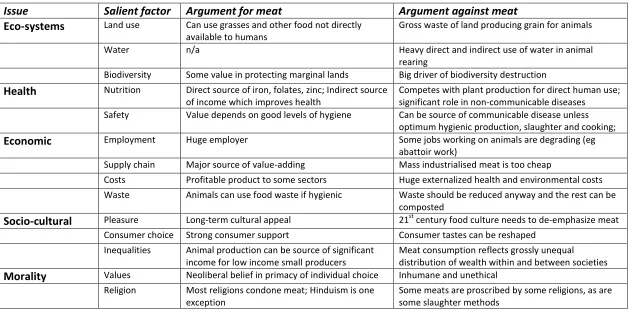
This brief summary of the arguments pushing at policy-makers’ doors suggests a complex picture of arguments about meat, mostly for a new constraint or contract-and-converge, but also reminding us of the case for meat. Table 1 provides a brief summary. No wonder
politicians are wary of taking a lead on meat policy. Leave well alone! Stay in the post war comfort zone, championing market forces or consumer rights and the ‘freedom to choose’! Can we blame policy-makers for seeing meat as something to leave in the ‘too hard to deal with’ box or for ministers to ‘leave for my successor to deal with’? This, however, is to bury heads in the sand.
TABLE 1: Summary of significant policy arguments for and against meat
Issue Salient factor Argument for meat Argument against meat
Eco-systems Land use Can use grasses and other food not directly available to humans
Gross waste of land producing grain for animals
Water n/a Heavy direct and indirect use of water in animal
rearing
Biodiversity Some value in protecting marginal lands Big driver of biodiversity destruction
Health Nutrition Direct source of iron, folates, zinc; Indirect source of income which improves health
Competes with plant production for direct human use; significant role in non-communicable diseases
Safety Value depends on good levels of hygiene Can be source of communicable disease unless
optimum hygienic production, slaughter and cooking;
Economic Employment Huge employer Some jobs working on animals are degrading (eg abattoir work)
Supply chain Major source of value-adding Mass industrialised meat is too cheap
Costs Profitable product to some sectors Huge externalized health and environmental costs
Waste Animals can use food waste if hygienic Waste should be reduced anyway and the rest can be
composted
Socio-cultural Pleasure Long-term cultural appeal 21st century food culture needs to de-emphasize meat
Consumer choice Strong consumer support Consumer tastes can be reshaped
Inequalities Animal production can be source of significant income for low income small producers
Meat consumption reflects grossly unequal
distribution of wealth within and between societies
Morality Values Neoliberal belief in primacy of individual choice Inhumane and unethical Religion Most religions condone meat; Hinduism is one
exception
Multi-level, multi-actor, multi-sector policy responses
How could policy-makers engage with this complexity? Since the 1970s, a policy framework has emerged for almost all issues - not just food, let alone meat - which policy academics describe as multi-level, multi-actor and multi-sector. Gone are the days when ‘policy’ was only what governments did or thought. In this section, I sketch how this complex modern policy world emerges and shapes what can or might be done about meat policy.
In 2006 the FAO published Livestock’s long shadow, an ambitious audit of the role and impact of livestock.(Steinfeld et al., 2006) This sent an official UN signal into the meat policy terrain that there is a significant problem. Meat critics saw this as validating the
unsustainability of meat, but the report also recommended a policy push to reduce the CO2
emissions from meat production without necessarily confronting high or rising meat consumption. The report also sidestepped the role of ruminants in sequestering carbon through grass (see other chapters in this volume). The meat industry, equally, demanded a ‘recount’ and seven years later, the sequel report appeared. This showed that the most efficient farm systems could reduce greenhouse gas emissions by up to 30%.(Gerber et al., 2013) But, it also noted that if world consumption continued to rise, those efficiency gains would be cancelled out.
Food products vary widely in where their main greenhouse gas emissions are
concentrated.(Munasinghe et al., 2009) For cooked vegetables, it is the consumer cooking them at home that contributes most. For meat and dairy, the largest source of emissions is before the farm gate. This is why the big retailers with such a grip on milk supply chains are exploring the impact of changed feeding regimes, more efficient use of grazing (also to keep carbon in the soil) and improving agricultural practices. There is parallel thinking about how to reduce greenhouse gases in meat production. The motive is partly self-interest – fear of being blamed later – and partly because the corporate sector recognizes that while
governments and policy-makers come and go, and are shaped by electoral cycles, they and their shareholders have an eye on long-term market growth and share. Their technical managers see the logic and want to do the right thing. As a result, they have increasingly adopted a ‘choice-editing’ approach.(Gunn and Mont, 2014; National Consumer Council and Sustainable Development Commission, 2006) In choice-editing, the retailer or manufacturer shapes change before the consumer sees the food product. The product is reformulated; or its size altered; or its supply chain is re-engineered; or all of these. The net effect is to change the product before consumers can exert their ‘right to choose’.
Strategies such as choice-editing expose the role of governmental policy-makers. Here are the big companies taking meat’s negative role seriously, so what are you governments doing? Choice-editing can actually let governments off the hook, leaving matters to their beloved market forces. Some theoreticians argue this hands-off role for government is right; government has no place in shaping consumer policy. Others, not least companies, know this is not wholly true. Markets work well only if there is some common terms of reference, standards, legal duties, fairness.
national, sub-national (local) and domestic. In each, different actors vie for influence. This patchwork policy world is complex and is why NGOs may lobby at the EU or national or global level for law changes or governmental commitments, while companies lobby for something different, and all eye how mass consumer behaviour works. To make things even more complex, there can be little congruence between policy actors even within nominally the same family of agencies. Within the UN, for instance, UNEP has been more openly critical of the environmentally consequences of meat, and the WHO has come ever clearer in its recommendations to keep consumption of red and processed meats low, while the FAO has tended to support meat production, even while producing evidence which
undermines that. At the UN level, i.e. at the New York based UN itself, rather than at FAO in Rome or UNEP in Nairobi or WHO in Geneva, there has emerged an important set of
overarching goals which ought to shape new meat policies.
The 2015 Paris Climate Change Accord committed governments to strong reduction
actions,(UNFCCC, 2015) and the 2015 Sustainable Development Goals agreed the same year also had a thread of food throughout their 17 goals and following 163 targets.(United Nations, 2015) Without specifying meat, these policies point to meat reduction, or certainly a dramatic alteration in meat production. These positive policy pointers came after
disappointment with the long-arranged 2014 International Conference on Nutrition (ICN2), the first UN reconvening on nutrition since the first ICN in 1992.(FAO and WHO, 1992) In the run-up to 2014, there had been much pressure from scientists and NGOs for ICN2 to set clearer linkages between environment, health and production but it did so only in broad terms.(Brinsden and Lang, 2015) It did however promise a Decade of Nutrition Action,(FAO and WHO, 2014) through which more might follow.
Why ICN2 mattered so much is because for decades nation states have been encouraged by the UN to set dietary guidelines as frameworks for public and commercial policy. In Sweden, Australia, the Netherlands, UK, Germany, and elsewhere, scientific advisors began to try to create a new generation of sustainable dietary guidelines, expanding the nutrition
advice.(Lang, 2014) Most attempts were rebuffed, unless left at fairly soft advice, without hard targets or KPIs. As the ICN2 process met, the USA was becoming the policy frontline in this long tussle. Since the 1980s, by law the US has to revise its official Dietary Guidelines for Americans (DGA) every five years. The 2012-15 US revision received clear advice from its scientific advisors – in a huge, comprehensive literature review (since updated)(Nelson et al., 2016; US Dietary Guidelines Advisory Committee, 2015) – that the DGA should inject environmental considerations into dietary advice. This was furiously lobbied against by the US meat industry which persuaded the Secretary of State for Agriculture to its side, despite loud consumer and health lobbying (over 30,000 submissions from the public supporting the change). Productionism triumphed over commitments to tackle meat-related
non-communicable diseases.
report went far wider than meat, of course, but meat is a thread running throughout the analysis. (The precise connection warrants amplification.) The policy response here does not automatically point to meat reduction but could be pharmaceuticals and better farm
practices, which are indeed the default policy response.
Food safety directly threatens not just consumers but also commercial reputation and trust. It underpins food culture. Food quality scandals can and do destabilize governments.(Smith et al., 2005) For over two decades, for example, UK politics was peppered with animal health-related incidents: salmonella in eggs exposed hidden food poisoning
rates;(Agriculture Committee, 1989) BSE (mad cow disease) exposed unsavoury feeding practices;(van Zwanenberg and Millstone, 2005) foot and mouth disease exposed poor farm practice (and some hints of illicit trade);(National Audit Office, 2002) and deaths induced by
e coli showed poor butcher hygiene standards.(Pennington, 1996; Pennington, 2009) In the USA, the Centers for Disease Control and Prevention 2016 estimate is that one in six people got sick from food-borne illness.(CDC, 2016)
Within the food industry, there is clear recognition of the dangers posed by meat. Reputations can be damaged, sales hit. The policy framework within which most work is Hazards Analysis Critical Control Point (HACCP), first developed from the 1950s to prevent food poisoning in food for US astronauts (who can hardly get to a local hospital).(US FDA, 2015) HACCP encourages management and workers to identify where the most likely source of risk lies, and to focus on prevention there. It is a tool for cleaning up rather than stopping supply chains. Some food companies have seen the market opportunities in meat reduction not just its clean-up. Since the 1990s there has been a rise and now explosion of plant-based processed food products, with a rush of technical innovation today. Some giant food
companies now recognize the ecological impact of their supply chains.
This mix of motives is why there has been a slow but steady acceptance of the policy approach known as Sustainable Consumption and Production (SCP). SCP emerged from the 1992 Rio UN Conference on Environment and Development (UNCED), where the EU offered to take the global lead in fleshing this policy thinking out, with Sweden offering to be lead. It culminated in the EU’s 2008 Communiqué.(European Commission, 2008) Many food
companies saw the value of this as creating a new level playing field, and a rationale for choice-editing. For a while it looked as though this could create a new level playing field in Europe, with the food industry doing important assessments of the carbon footprint of their products. Inevitably, meat and dairy emerged as key, if not the key, foods in not just climate change but water and nutrition in these audits.(IGD, 2013; IGD ShopperVista et al., 2013)
The picture I am painting is of slow development – useful preconditions, perhaps for wider change. But the elephant in the room has been consumers. Few want to confront them, certainly not on the mass scale the scientists have long been suggesting.(McMichael et al., 2007) Arguably it is civil society which has taken the clearest lead in confronting meat habits. As often happens in food policy, NGOs are the policy scouts, mapping future
organization in the world has recognised that it will not protect biodiversity unless it encourages consumers to cut back on meat.(Gladek et al., 2016) This spawned many
internal arguments but continues to be rolled out. Across the world, many NGOs have made this policy leap. Some new campaigns and collaborations have emerged, such as the Square Meal Coalition,(RSPB, 2014) and WWF’s annual report with the Zoological Society of
London,(WWF and Zoological Society of London, 2015) or the Eating Better coalition in the UK.(Eating Better, 2016) Meatless Monday, now a global campaign, has encouraged school cooks to reduce meat offerings since it began in the USA in 2003.(Meatless Monday Global, 2016) Such coalitions can open up policy space, encouraging evidence-gatherers to speak out, creating room for progressive policy makers to act. Without such outside pressure, it is unlikely official bodies could take the step such as Public Health England’s revised Eatwell advice in 2016 to “[e]at less red and processed meat”, cited earlier.(Public Health England, 2016)
In summary, a complex range of strategic options now exists, and is being populated by diverse actors. Gone is the policy era where governments governed from on-high. In its place is this messier policy world where companies may be more powerful than
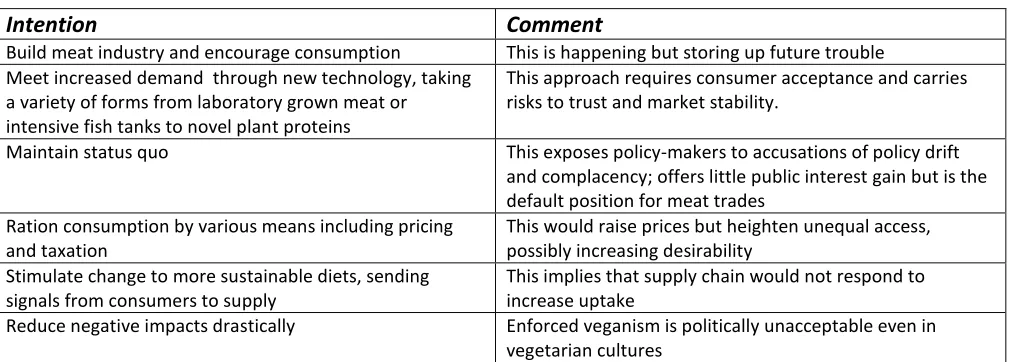
governments, and where policy is overtly not just covertly ideological, and where there are multiple actors, ranging across a spectrum of possibilities. This range of options for meat futures is summarized in Table 16.2. These go from supporting more production and consumption (undesirable today but the default) to their restriction and reorientation (desirable). On a positive note, the health and environmental evidence has begun to affect the discourse. And official guidelines ought to be one means to set targets to meet SCP, and to switch from policy being at the upper end of Table 16.2 to being further down. Academic modeling has also begun to suggest global targets of around 90g of meat per capita per day,(Weis, 2013; Smil, 2013; McMichael et al., 2007) but most analysts recognize such figures need to be nuanced according to the meat type and its mode of production – grass-fed versus grain-grass-fed, etc – and to be created to suit local and national conditions. There is simply not enough or effective pressure yet to get these goals agreed let alone
implemented. This is now the urgent task on meat.
INSERT TABLE 16.2 about here
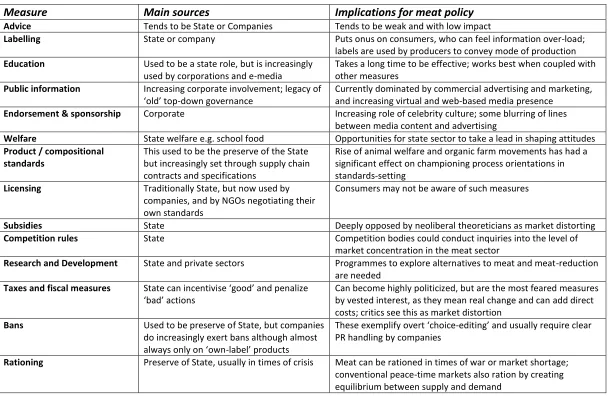
To meet sustainable development and health goals, we need to put pressure on policy-makers to start climbing a progressive ‘ladder’ of achievement, which must include the commitment to: (1) produce a solid evidence base that meat and dairy are problematic; (2) develop global/national/local/domestic ‘meat reduction / change’ strategies; (3) identify alternative land use and livelihoods for current producers; (4) develop population change strategies; (5) identify industry winners and losers, supporters and opponents; and (6) reposition meat and dairy consumption as seasonal or exceptional, i.e. to become ‘feast-day’ not ‘every‘feast-day’. Table 16.3 outlines policy measures which could be invoked to reshape meat production and consumption. The table outlines which actor tends to use each measure, and what its implications or potential for meat might be. ‘Soft’ measures are at the top of the table, and ‘hard’ ones towards the bottom. In practice, meat policy and actions tend to be accompanied by soft measures, because the default position has been won by the productionist agenda – more and cheaper meat for all. This is the challenge.
Table 16.2 The range of strategic options for meat futures
Option Intention Comment
Increase production Build meat industry and encourage consumption This is happening but storing up future trouble
Technical development
Meet increased demand through new technology, taking a variety of forms from laboratory grown meat or intensive fish tanks to novel plant proteins
This approach requires consumer acceptance and carries risks to trust and market stability.
‘Freeze’ at current levels
Maintain status quo This exposes policy-makers to accusations of policy drift
and complacency; offers little public interest gain but is the default position for meat trades
Reduce production Ration consumption by various means including pricing
and taxation
This would raise prices but heighten unequal access, possibly increasing desirability
Reduce consumption
Stimulate change to more sustainable diets, sending signals from consumers to supply
This implies that supply chain would not respond to increase uptake
Ban or rationing Reduce negative impacts drastically Enforced veganism is politically unacceptable even in
Table 16.3 The range of public policy measures available to shape meat supply and consumption
Measure Main sources Implications for meat policy
Advice Tends to be State or Companies Tends to be weak and with low impact
Labelling State or company Puts onus on consumers, who can feel information over-load;
labels are used by producers to convey mode of production
Education Used to be a state role, but is increasingly
used by corporations and e-media
Takes a long time to be effective; works best when coupled with other measures
Public information Increasing corporate involvement; legacy of
‘old’ top-down governance
Currently dominated by commercial advertising and marketing, and increasing virtual and web-based media presence
Endorsement & sponsorship Corporate Increasing role of celebrity culture; some blurring of lines
between media content and advertising
Welfare State welfare e.g. school food Opportunities for state sector to take a lead in shaping attitudes
Product / compositional standards
This used to be the preserve of the State but increasingly set through supply chain contracts and specifications
Rise of animal welfare and organic farm movements has had a significant effect on championing process orientations in standards-setting
Licensing Traditionally State, but now used by
companies, and by NGOs negotiating their own standards
Consumers may not be aware of such measures
Subsidies State Deeply opposed by neoliberal theoreticians as market distorting
Competition rules State Competition bodies could conduct inquiries into the level of
market concentration in the meat sector
Research and Development State and private sectors Programmes to explore alternatives to meat and meat-reduction
are needed
Taxes and fiscal measures State can incentivise ‘good’ and penalize
‘bad’ actions
Can become highly politicized, but are the most feared measures by vested interest, as they mean real change and can add direct costs; critics see this as market distortion
Bans Used to be preserve of State, but companies
do increasingly exert bans although almost always only on ‘own-label’ products
These exemplify overt ‘choice-editing’ and usually require clear PR handling by companies
Rationing Preserve of State, usually in times of crisis Meat can be rationed in times of war or market shortage;
Conclusion
This chapter has outlined the new complex policy world in which meat policy is a sub-section. This is a multi-level, multi-actor, multi-sector world. The evidence for tackling runaway meat production and consumption is strong. There is a gap between evidence, policy and practice, a gap which sadly is not unusual in policy. It took half a century for the evidence (and much campaigning by doctors and NGOs) on tobacco, for instance, to create intergovernmental support for the WHO’s global 2003 Framework Convention for Tobacco Control.(WHO, 2003) Still today, however, tobacco is legal and public behaviour remains in thrall to the ideology of consumer choice, albeit now happily constrained in part. The good news is that sudden policy changes can and do happen. Smoking was banned on the London underground after a fire in 1987;(Fennell, 1988) and people obeyed the ban. In the 2000s, a ban on smoking in public or work buildings indoors spread worldwide. Suddenly
governments were prepared to act, and people prepared to obey. Commerce and the giant tobacco corporations were put on the back foot; enough businesses supported controls for there not to be a commercial backlash. Culture changed.
References
Agriculture Committee (House of Commons). (1989) Salmonella in Eggs. A progress report. London: Her Majesty's Stationery Office.
Aune D, Chan DS, Vieira AR, et al. (2013) Red and processed meat intake and risk of colorectal adenomas: a systematic review and meta-analysis of epidemiological studies. Cancer Causes Control 24: 611-627. Bailey R, Froggatt A and Wellesley L. (2014) Livestock - Climate Change’s Forgotten Sector: Global Public
Opinion on Meat and Dairy Consumption. London: Royal Institution of International Affairs Bouvard V, Loomis D, Guyton KZ, et al. (2015) Carcinogenicity of consumption of red and processed meat.
The Lancet Oncology: http://dx.doi.org/10.1016/S1470-2045(1015)00444-00441.
Boyd Orr J. (1936) Food, Health and Income: Report on Adequacy of Diet in Relation to Income, London: Macmillan and Co.
Boyd Orr SJ. (1943) Food and the People, London: Pilot Press.
Brandt K. (1945) The Reconstruction of World Agriculture, London: George Allen & Unwin.
Brinsden H and Lang T. (2015) Reflecting on ICN2: was it a game changer? Archives of Public Health 73. CDC. (2016) Attribution of foodborne illness: findings Atlanta: Centers for Disease Control and Prevention. Chan DS, Lau R, Aune D, et al. (2011) Red and processed meat and colorectal cancer incidence: meta-analysis
of prospective studies. PLoS ONE 6: e20456.
Eating Better. (2016) statement welcoming the new Public Health England Eatwell Plate. March 17 2016. Brighton: Eating Better Coalition.
Elferink EV and Nonhebel S. (2007) Variations in land requirements for meat production. Journal of Cleaner Production 15: 1778-1786.
European Commission. (2008) Communication from the Commission to the European Parliament, the Council, the European Economic and Social Committee and the Committee of the Regions on the Sustainable Consumption and Production and Sustainable Industrial Policy Action Plan COM/2008/0397 final. Brussels: Commission of the European Communities.
Fairlie S. (2010) Meat: a benign extravagance, East Meon, Hampshire: Permanent Publications.
Fairweather-Tait SJ. (2007) Iron nutrition in the UK: getting the balance right. Proceedings of the Nutrition Society 63: 519–528.
FAO and WHO. (1992) International Conference on Nutrition. Final report of the conference. Rome: Food and Agriculture Organisation, and World Health Organisation.
FAO and WHO. (2014) ICN2 International Conferenc on Nutrition: better nutrition, better lives. 19-21 November 2014, Rome. Rome: Food and Agriculture Organisation.
Fennell D. (1988) Investigation into the King's Cross Underground Fire. Report to the Department of Transport. London: Her Majesty's Stationery Office.
Garnett T. (2009) Livestock-related greenhouse gas emissions: impacts and options for policy makers.
Environmental Science & Policy 12: 491-503.
Gerber P, Steinfeld H, Henderson B, et al. (2013) Tackling climate change through livestock: a global assessment of emissions and mitigation opportunities. http://www.fao.org/3/i3437e.pdf [accessed March 3 2014]. Rome: Food and Agricultural Organisation.
Gladek E, Fraser M, Roemers G, et al. (2016) The Global Food System: An Analysis - report to WWF. Amsterdam: WWF Netherlands, 188.
Gunn M and Mont O. (2014) Choice editing as a retailers’ tool for sustainable consumption. International Journal of Retail & Distribution Management 42: 464-481.
Hoekstra AY. (2010) The water footprint of animal products. In: D'Silva, J. and Webster, J. (eds). The meat crisis: Developing more sustainable production and consumption. London, UK: Earthscan, pp 22-33. Holm L and Mhl M. (2004) The role of meat in everyday food culture: An analysis of an interview study in
Copenhagen. Appetite 34.
IARC. (2015) The carcinogenicity of the consumption of red meat and processed meat. IARC Monographs volume 114 IARC Monographs. Lyons: The International Agency for Research on Cancer of the World Health Organization.
IGD. (2013) Sustainable Diets Working Group (chair: Cathryn Higgs): Letchmore Health (Herts): IGD. IGD ShopperVista, Arnold H and Pickard T. (2013) Sustainable Diets: helping shoppers. Letchmore Heath:
IGD.
Lang T. (2014) Sustainable Diets: Hairshirts or a better food future? Development 57: 240-256.
Lang T and Heasman M. (2015) Food Wars: the global battle for mouths, minds and markets. 2nd edition,
Larsen J. (2012) Plan B: Meat Consumption in China Now Double That in the United States. Earth Policy Institute. http://www.earth-policy.org/plan_b_updates/2012/update102 [accessed January 21 2017] Machovina B, Feeley KJ and Ripple WJ. (2015) Biodiversity conservation: The key is reducing meat
consumption. Science of the Total Environment 536: 419-431.
McMichael AJ, Powles JW, Butler CD, et al. (2007) Food, livestock production, energy, climate change, and health. The Lancet 370: 1253-1263.
Meatless Monday Global. (2016) Meatless Monday Global: http://www.meatlessmonday.com/the-global-movement/ [accessed January 21 2017].
Milman O and Leavenworth S. (2016) China's plan to cut meat consumption by 50% cheered by climate campaigners. The Guardian. Beijing / London, 20 June
Mintz S. (1996) Tasting food, tasting freedom: excursions into eating, culture and the past, Boston: Beacon Press.
Monteiro CA, Moubarac J, Cannon G, et al. (2013) Ultra-processed products are becoming dominant in the global food system. Obesity Reviews 14: 21-28.
Munasinghe M, Dasgupta P, Southerton D, et al. (2009) Consumers, Business and Climate Change: Report by SCI with the CEO forum of companies. Manchester: Sustainable Consumption Institute, University of Manchester, 59.
National Audit Office. (2002) The 2001 Outbreak of Foot and Mouth Disease. Report by the Comptroller and Auditor General. HC 939 Session 2001-2002: 21 June 2002. London: The Stationery Office. National Consumer Council and Sustainable Development Commission. (2006) Looking Back Looking
Forward: lessons in Choice Editing for Sustainability: 19 case studies into drivers and barriers to mainstreaming more sustainable products. London: Sustainable Development Commission. Nelson ME, Hamm MW, Hu FB, et al. (2016) Alignment of Healthy Dietary Patterns and Environmental
Sustainability: A Systematic Review. Advances in Nutrition 7: 1005-1025.
Nierenberg D. (2005) Happier Meals – Rethinking the Global Meat Industry. Worldwatch paper 171. Washington DC: Worldwatch Institute.
OECD Data. (2017) Meat consumption (indicator). doi: 10.1787/fa290fd0-en. Paris: Organisation for Economic Co-operation and Development, https://data.oecd.org/agroutput/meat-consumption.htm.[Accessed 15 January 2017]
Pennington HC. (1996) Report on the circumstances leading to the 1996 outbreak of infection with E.coli O157 in Central Scotland, the implications for food safety and the lessons to be learned. Edinburgh: The Scottish Office.
Pennington Hc. (2009) The public inquiry into the September 2005 outbreak of e-coli 0157 in South Wales. Cardiff: Wales Assembly Government, 355.
Pollan M. (2008) In Defence of Food: The Myth of Nutrition and the Pleasures of Eating London: Allen Lane. Popkin BM. (2003) The nutrition transition in the developing world. Development Policy Review 21: 581-597. Popkin BM and Gordon-Larsen P. (2004) The nutrition transition: worldwide obesity dynamics and their
determinants. International Journal of Obesity and Related Metabolic Disorders 28: S2-9.
Public Health England. (2016) The Eatwell Guide: Helping you eat a healthy, balanced diet. London: Public Health England.
Punjabi M. (2009) India: Increasing demand challenges the dairy sector. New Delhi: Food and Agriculture Organisation, http://www.fao.org/docrep/011/i0588e/I0588E0505.htm. [accessed January 20 2017] Ricard M. (2016) A Plea for the Animals, Boulder (Colorado): Shambala Publications.
Rifkin J. (1992) Beyond beef : the rise and fall of the cattle culture, New York: Dutton.
Rogers B. (2004) Beef and Liberty: Roast Beef, John Bull and the English Nation., London: Vintage books. Royal Society. (2012) People and the Planet. London: Royal Society
RSPB WT, Friends of the Earth, Sustain, National Trust, Eating Better, Compassion in World Farming, Food Research Collaboration, Food Ethics Council, Soil Association,. (2014) Square Meal: why we need a better recipe for the future. London: Food Research Collaboration.
Singer P. (1975) Animal Liberation: A New Ethics for our Treatment of Animals, New York: Random House. Singer P and Mason J. (2006) Eating, London: Arrow.
Sinha R, Cross A J, Graubard B I, et al. (2009) Meat Intake and Mortality. Arch Intern Med 169: 562-571. Smil V. (2013) Should We Eat Meat? Evolution and Consequences of Modern Carnivory: Wiley-Blackwell. Smith DF, Diack HL, with, et al. (2005) Food Poisoning, Policy and Politics: Typhoid And Corned Beef In The
1960s, London: Boydell Press.
Spencer C. (1993) The heretic's feast: a history of vegetarianism, London: Fourth Estate.
Steinfeld H, Gerber P, Wassenaar T, et al. (2006) Livestock's long shadow: environmental issues and options. . Rome: Food and Agricultural Organisation.
Stuart T. (2009) Waste: Uncovering the Global Food Scandal, London: Penguin.
Tilman D, Fargione J, Wolff B, et al. (2001) Forecasting Agriculturally Driven Global Environmental Change.
Science 292: 281-284.
UNFCCC. (2015) UN Framework Convention on Climate Change (COP21). Paris. 30 November - 11 December 2015. http://unfccc.int/secretariat/contact/items/2782.php. Bonn (Germany): United Nations
Framework Convention on Climate Change.
United Nations. (2015) Sustainable Development Goals, agreed at the UN Summit, September 27-29 2015:
https://sustainabledevelopment.un.org/post2015/summit [New York: United Nations Department of Economic and Social Affairs, Division for Sustainable Development.
US Dietary Guidelines Advisory Committee. (2015) Scientific Report of the 2015 Dietary Guidelines Advisory Committee to the Secretaries of the U.S. Department of Health and Human Services and the U.S. Department of Agriculture. Washington DC: U.S. Department of Health & Human Services. US FDA. (2015) Hazards Analysis Critical Control Point (HACCP).
http://www.fda.gov/Food/GuidanceRegulation/HACCP/ [accessed August 2, 2016]. Silver Spring MD: United States Food and Drug Administration.
USDA. (2017) Cattle and Beef: background https://www.ers.usda.gov/topics/animal-products/cattle-beef/background.aspx [accessed January 15, 2017]. Washington DC: United States Department of Agriculture.
van Zwanenberg P and Millstone E. (2005) BSE: risk, science, and governance, Oxford ; New York: Oxford University Press.
WCRF. (2013) Red and processed meat and cancers. London: World Cancer Research Fund.
WCRF / AICR. (2009) Policy and Action for Cancer Prevention - Food, Nutrition, and Physical Activity: a Global Perspective. London / Washington DC: World Cancer Research Fund / American Institute for Cancer Research.
Weis T. (2013) The meat of the global food crisis,. The Journal of Peasant Studies 40: 65-85.
WHO. (2003) WHO Framework Convention on Tobacco Control. Geneva: World Health Organisation. WHO. (2015) WHO estimates of the global burden of foodborne diseases: Foodborne diseases burden
epidemiology reference group 2007-2015. Geneva: World Health Organisation, 225.
Wilson B. (2008) Swindled: From Poison Sweets to Counterfeit Coffee - The Dark History of the Food Cheats
London: John Murray.
World Wildlife Fund. (2015) Livewell: a balance of sustainable and healthy food choices. Available:
http://assets.wwf.org.uk/downloads/livewell_report_jan11.pdf. Accessed 20 May 2015.
WWF. (2015) On our plate today. Healthy, sustainable food choices - LiveWell Final recommendations. Gland: WWF-UK.