City, University of London Institutional Repository
Citation
:
Lang, T., Caraher, M. and Wu, M. (2010). Meat and Policy: Charting a Course Through the Complexity. In: D'Silva, J. and Webster, J. (Eds.), The Meat Crisis: Developing More Sustainable Production and Consumption. (pp. 254-274). Routledge. ISBN9781844079032
This is the accepted version of the paper.
This version of the publication may differ from the final published
version.
Permanent repository link: http://openaccess.city.ac.uk/id/eprint/7869/
Link to published version
:
Copyright and reuse:
City Research Online aims to make research
outputs of City, University of London available to a wider audience.
Copyright and Moral Rights remain with the author(s) and/or copyright
holders. URLs from City Research Online may be freely distributed and
linked to.
City Research Online: http://openaccess.city.ac.uk/ [email protected]
Sustainable meat and public policy: charting a way through the
contradictionsparadoxes
Tim Lang, Michelle Wu, Tim Lang, Martin Caraher
Centre for Food Policy, City University, London.
chapter for: John Webster & Joyce d’Silva, eds,
The Crisis in Meat and
Dairy Consumption: Developing a Sustainable and Greener Future
Introduction ... 111
Meat as a policy problem: mapping the terrain ... 444
Environment ... 554
Public Health ... 665
Economics ... 776
Culture ... 887
National identity ... 998
Ideology and Philosophy ... 10109
The role of science, technology and research ... 111110
Consumer choice ... 121211
What can policy do about these problems? ... 131312
References ... 161615
Wordcount (new): 7k
Introduction
Meat is now becoming a ‘hot’ issue for the food industry, governments and
consumers. Not without reason was an earlier era of US politics known as the triumph of ‘pork-barrel politics’. Not only is there much money in the meat trades but meat has considerable symbolic power.1 To re-shape meat production and consumption and to bring them in line with the earth’s capacities is a microcosm of wider challenges for the food system. Because of its footprint, meat is a test case for whether policy makers will actually help align the food system with sustainability in the 21st century. The evidence for behaviour change by consumers,and for a reorientation of production and for a refinement of supply chain management is very strong. Certainly rich societies need to eat less meat, also less dairy; the two sectors are actually one. Developing countries which are witnessing a rise in both also need to restrain that trend. As Popkin points out there are multiple health benefits to reducing meat consimption has multiple benefits for the Worlds’ health. [Pokin B (2009) Editorial: Reducing Meat Consumption has multiple benefits for the World’s Health. ARCH INTERN MED/VOL 169 (NO. 6), MAR 23, 2009, 543-545]
fFeed consumption in the EU-15 increased by 50% from 2000 with the rate
accelerating sharply between 2005-2007.2 This upwards direction of consumption has to be reversed for environmental and health reasons but this such restrictions are is currently deemed politically explosive. This is partially related to the cultural and economic significance of meat in the diet and the fact that the meat industry has used these associations to harness consumer objections to proposals to restrict the diet. This chapter explores why this is such tricky political space and how or indeed whether policy must remain at odd with evidence.
Even if privately policy makers accept that meat and dairy consumption (and therefore production) need to come down worldwide, few will espouse the cause publicly. In addition the complex webs of the meat industry often mean that the evidence used to justify meat consumption often comes from or is funded by the meat industry. Stanton in Australia has criticised the meat component of the CSIRO Total Wellbeing Diet on the basis of flawed research and research that was partially funded by Meat and Livestock Australia and they say that the endorsemwnt by CSRIO of “high-meat diet is an indication of the extent to which its scientists have taken on the role of consultants to industry in their bid to raise funding, and their willingness to deliver research findings that industry finds agreeable.” [Stanton R and Scrinis G (2005 )Total Wellbeing or Too Much Meat? Australian Science. October , 2005, p 37-38] Why? That’s the nub of the issue now needing airing. Policy makers in the main still believe they inhabit the familiar policy terrain where consumer choice rules, industry lobbying is powerful and based on economic and jobs where change can be guided by voluntarism and where progress is defined by humanity’s capacity to deliver and consume ever more.
Alas, meat is not alone in illustrating the above mismatch. It is also true for total diets, where the environmental impact of current Western diets is well charted albeit not adequately responded to. Nutritionists still advise populations to consume fish, for example, without reference to serious evidence about fish stocks being at best under stress or at worst in terminal decline. And they advise us all to eat fruit and vegetables with insufficient regard to the carbon footprint of their transportation or the possible advantages of seasonality or the coming threat of water security. With regard to meat, policy makers are not lacking in advice that to eat less meat would be a good thing. Even economists now are prepared to trumpet the cause. Lord Stern, former World Bank chief economist, whose report on the economics of climate change has been significant in adding urgency to policy makers’ attention,3
has championed lower meat and dairy consumption.4 Were they to adopt this course – which they show little sign of doing – the rich economies might become better role models for the 21st century.56 Yet, rising meat consumption (or hidden rise through increased dairy if not actual flesh consumption) is a key element in the nutrition transition, the process whereby, as poor societies see their incomes rise, they change what they eat.7
Affluence enables formerly poor populations to range more widely across the planetary larder. In this respect, the nutrition transition is actually also partially a cultural transition, the adoption of lifestyles which have meaning and reflect aspirations of a developing economy, these are usually expressed as consumer demands and aide and abetted by a huge marketing and the availibilty of goods previously not attainable. In this respect many industries target the developing world and countries in transition as the major growth areas, dumping and making available
Formatted
products at low prices and building a cultural imperative around them, so meat is good and healthy and now cheap! Unless strong cultural values – such as religion or other ‘rules of everyday life’ such as veganism – prevent or constrain such behaviour change, eating more meat or dairy (which requires a hidden meat industry) becomes a symbol of rising wealth. What Fod that was previously exceptional feast-day,
occasional and a minor part of the diet food can becomes an every-day event.8 Meat consumption acts as an indicator proxy for economic, social and cultural progress. This fact is recognised by politicians as partly explains their visceral reluctance to champion meat reduction. They know their voters’ aspirations and the power of the meat lobby.
This combination of the mismatch of evidence and reality alongside complexity of a changing and developing culture is the normality which public policy must now address. Like energy profligate housing or water wasteful lifestyles, the inexorable rise in meat consumption and production is now a major theme for 21st century change. This chapter tries to consider where public policy sits in that process. That policy makers need to be encouraged to address this issue is abundantly true. Less attention has been given to how politicians’ needs – such as are expressed by voters– may be addressed. In formal terms, scientists are more comfortable reiterating the case for ‘evidence-based policy and practice’ than in listening to the evidence needs of policy makers. No wonder politicians retreat to their comfort zone, championing oft-cited market forces or consumer rights and the ‘freedom to choose’, as though the law of unintended consequences might not apply to those values in the real world, too.
So is this issue of meat and policy doomed to reside in the ‘too hard to deal with’ box and to suffer the indignity of ‘leave for my successor to deal with’? Could we conceive of policy frameworks and food systems in which progress is defined as consuming less meat (and dairy)? Might a world be created where people and animals live decent lives in some kind of ecological and economic viability? How might these utopian situations be realised?
Both words - ‘sustainable’ and ‘development’ - can mean diverse things, but yoked together they denote what the 1987 Our Common Future report chaired by Dr Gro Harlan Brundtland (former Norwegian prime minister and Director General of the World Health Organisation) famously defined as "meeting the needs of the present without compromising the ability of future generations to meet their own needs." 12 For over 20 years, the sustainable development framework has gradually emerged as a reasoned way to cross-fertilise otherwise discrete policy work. The core message is that environmental, economic and societal needs can rarely be answered in isolation; they have a tendency to knock-on to other imperatives. Single focus policies
generally, the argument goes, store up trouble for later. We note this already with regard to meat; politicians are ducking the issue, ceding leadership to scientists or NGOs. Thus we find academics providing de facto consumer advice, and NGOs more used to saving the planet, taking on the mantle of health advisors to nations. All is this because policy makers seem are keen to duck the issue as . Or is it because they are not shown a way to address it?
Some policy makers argue that sustainable development (SD) has little resonance with the public. It is true that sustainable development takes policy into complex territory. Let us consider momentarily the societal cultural aspects of meat consumption rather than its environmental or economic. The manly association of meat eating are in many cultures; butchers are male yet the domestic task of meat preparation is more
frequently female, and women eat meat though tend to favour their children and men over their own intake. Despite this central domestic role, women as potential change agents at mass population level have barely been considered, building on the role of women as cooks and carers. The global shift towards higher fat and meat, reduced carbohydrate and fibre in the diet are in the first instance a feature of urbanisation among the middle classes. They represent in cultural terms a shift from having to eat to eating for pleasure (the pleasure versus necessity nexus), the move from the old to the new and modern, and the association of meat –at least for some- with affluence. The costs are health related with higher rates of obesity and heart disease. Aspirations for a lifestyle are translated into dietary form and consumerism; they may be driven by the affluent but are also copied by the less well off. This pattern includes, for example, an emphasis on meat eating as an indicator of progress, and a disregard for more local foods. ‘Peasant’ becomes a term of abuse, synonymous with the past. In developing economies the standard meal plate of CFL (or a tail) which is a Core food item (such as rice), a Fringe item (such as a sauce) and a Legume. With
industrialisation this has changed to M+S+2V, Meat plus a Staple (e.g. potatoes) and Two Vegetables.
If the goal of a food system framed for sustainable development is to reduce meat, these social and cultural meanings and roles ought to be central not afterthoughts.
Meat as a policy problem: mapping the terrain
How do policy makers engage with the meat question? Their current understandings are under-researched but their support- as in the productionist paradigm- for policies to increase rather than decrease meat consumption is long-standing. Yet, some policy makers are beginning to support the growing policy debate about whether as well as how the world’s seemingly insatiable appetite for meat could be fed. The FAO published an ambitious audit in its report Livestock’s Long Shadow.13
That has been
Comment [mc1]: Not sure what we mean here, do we mean we do not understand their understanding and do not have research to back this up?
interpreted by meat criticssome??? as providing evidence of meat’s unsustainability. There was also a strand of thinking that the current unsustainability of meat
production could and should be tackled, which has encouraged large European retailers, for example, to champion urgent reduction in CO2 emissions without
reducing meat consumption. Life cycle analysis of key consumer products – not just food – has shown how products vary widely in where their main greenhouse gas emissions happen.14 For chilled drinks the hotspot lies in distribution – all those refrigerated wagons trucking up and down motorways carrying water-based products. If a soft drinks is not chilled, the main burden lies at recycling – all those PET bottles. For cooked vegetables, it’s the consumer cooking them at home which emits most. For meat and dairy, the biggest source of emissions comes before leaving the farmgate.
This is why the retailers with such a grip on milk supply chains are exploring how emissions can be reduced by changed feeding régimes, more efficient use of grazing (also to keep carbon in the soil rather than let it leach), and improving the worst agricultural practices up to the best. The motive for this effort is partly self-interest to obviate blame coming to retailers in the future (why didn’t you tell us and act?) and partly because the corporate sector has begun to recognise that while governments and policy makers come and go, and are shaped by electoral cycles, they and their
shareholders want the companies to grow and survive long-term.
That model of change contains a significant shift of policy horizon; it relies on editing, the retailer driving change before the consumer sees the food product, choice-editing rather than choice. As powerbroker in the supply chain, the retailer is actually restricting end choice – in the name of a good reason. The consumer’s ‘right to choose’ between climate change reducing or inducing products is being framed by a general trend to reduce all meat and dairy products’ impact. This approach is at an early stage and it remains to be seen how effective it ultimately is. It’s highly unlikely dramatically to reduce the much cited figures from the FAO Livestock’s Long Shadow or the Stern Economics of Climate Change reports. But it may reduce them.
What, then, is the full terrain on which policy might or does engage with meat? Policy mapping is needed. We see a number of core clusters of interest: environment, health, economic, culture, national identity, ideology and philosophy, the role of science, technology and research, and finally, the role consumers.
Environment
Policy makers know that meat production raises serious environmental problems. For over two decades, UK politics was peppered with animal incidents: salmonella in eggs exposed hidden food poisoning rates,15 BSE (mad cow disease) exposed unsavoury feeding practices,16 foot and mouth disease exposed poor farm practice 17 (and some hints of illicit trade), e-coli induced deaths showed poor butcher hygiene standards.18
19
These were initially downplayed as regrettable but inevitable, but eventually recognised as more systemic. Policy reacted rather than prevented.
tends to centre on efficiency, but even efficient feed converters such as poultry or pigs have considerable ecological footprints. Stronger policy responses have been directed at problems such as animal effluents, not least because they can spread disease. The most likely source of control over meat’s wider environmental impact is climate change but it has not featured in the world negotiations for the post Kyoto Treaty on climate change. CHECK This might change; the UK, for instance, passed legally binding reduction targets on emissions in the Climate Change Act 2008, and EU studies have showed how significant meat and dairy are in food’s already high environmental footprint.20 Meat’s environmental role is probably poised to be policy ‘live’. Some NGOs, such as Friends of the Earth, CIWF, and WWF have launched important public outreach and campaign work but this probably needs to link more to…?. There is already a strong reaction and invocation of arguments about ‘nannies dictating what people can eat’.
Public Health
Meat’s second problem for policy is its perceived role in public health. Although not essential, there can be nutritional benefits from the inclusion of some meat in the human diet.21 GIVE TL THESE TWO REFS BELOW PLEASE12 Red meat is one of the richest sources of iron, along with minerals and vitamins such as zinc and vitamin B12. This may be especially relevant for the millions of people who lack adequate food, for whom animal sources provide the most usable (or bio-available) form of many nutrients. The ecological argument about meat production now warping land use suggests this might raise a familiar conundrum for policy: how to weigh short-term advantages against long-term pain. On the counter side, there is now strong evidence of the adverse impact of high meat consumption, including higher risk of obesity, and increased mortality rates due to cancers and cardiovascular disease.5 GIVE TL THIS Sinha et al REF PLEASE This has led to firm international guidance to cut consumption.22 There is now a growing body of evidence about how to
facilitate behaviour change, should policy require it. As one study put it, change is “only likely if three components are addressed simultaneously” which are motivation, ability, and opportunity.23 GIVE TL FULL DETAILS OF REF FOR Sto et al PLEASE
Meat and dairy have historically been approved by mainstream health policy makers. 1930s nutrition thinking, for instance, positively encouraged an increase in production and consumption, notably the availability of milk for children.2425 If the ubiquity of meat and dairy today is to be tackled for health reasons, this would be a policy volte-face, one which the public health professions have not really acknowledged. As the evidence of the negative effect of dairy fats emerged in the 1980s, the meat trade unleashed a furious rearguard action. Marion Nestle has documented how attempts to upgrade US nutrition guidelines on meat and dairy were subject to intense political lobbying and mainstream policy scrutiny.26 Many countries have adopted rather bland consumer advice to ‘eat leaner meat and a bit less cheese’, as a UK campaign on saturated fats put it. PLEASE GIVE TL FULL REF – WHERE WAS THIS?
1
Murphy et al (2003)
2
In fact, the meat trades in affluent countries began to try for ‘lean’ meats in the 1980s in response to the criticism about saturated fats, but two decades on consumption remains high, and the evidence of its connection to non-communicable diseases (NCDs) remains strong.5 This NCD picture has entered Western policy debates about meat, but it has not dented production. Although meat’s role in communicable diseases captured Western policy imagination – particularly BSE – its impact is greater in the developing world.27 28 Meat is also associated with communicable diseases such as salmonella, campylobacter and e coli. In the 2000s, swine ‘flu emerged as a public health concern, unleashing a huge global collaboration, and renewed need to track zoonotic diseases.29 Bio-security now stands alongside risk assessment and management in the policy lexicon. This is welcome but perhaps too much policy attention is at the level of creating better monitoring and research. They are needed, of course, but the notion of prevention deserves higher priority.
Economics
The third issue is economic. Policy makers can claim that increased meat production and its reduced cost price has been one of its greatest successes post World War 2. But this has come at some cost to taxpayers in the form of state subsidies. A recent WHO study quantified the impact CAP subsidies for dairy and meat on cardiovascular disease. Conservative estimates of mortality attributable to CAP was approximately 9,800 additional CVD deaths and 3,000 additional stroke deaths within the EU, half of them premature. ADD REF Similarly, a US study attributed 40% of the recent rise in weight to lower food prices brought about by agricultural innovation.1 Popkin has shown that in countries in transition a small reduction in the price of fat has huge implications across the population. This is aided by increased urbanisation which makes supply easier and introduces economies of scale. [POPKIN, B. (1998) The nutrition transition and its health implications in lower-income countries. Public Health Nutrition, 1(1), 5–21.
POPKIN BM AND GORDON-LARSEN P (2004) The nutrition transition:
worldwide obesity dynamics and their determinants. International Journal of Obesity, 28, S2–S9] Such transitions are occurring within shorter and shorter time periods. Even here there are inequalities over one billion of the world’s population can be classed as poor, relying on grain for food and local biomass for cooking, meat introduces an additional burden in storing, cooking and preparation for such groups.
The productionist policy framework which unleashed the agri-food revolution of the second half of the 20th century hinged on generating mass production (scale) and lowering prices to consumers.30 The model assumed that high cost and poor affordability and output were barriers to health, ergo the pursuit of economic
efficiency and productivity would deliver both health and public good. Half a century on, we now know that lowered costs to consumers has come with unaccounted costs; no-one has paid actual money (yet) for climate change, but the bills are now being calculated. One study cited by the Pew Commission on Industrial Farm Animal Production calculated that US industrial farm animal production facilities cost US taxpayers over $38 billion in externalized costs, c. $159 for each US inhabitant.31 Reactions to the Pew Commission when it published in 2008 showed the formidable economic leverage of the meat trades. This goes wider than meat farmers per se. A constellation of economic agents works around farmers: animal breeders, breed
societies, compound and feedstuffs makers, traders, equipment manufacturers, processors, logistics companies (road, rail, ship, and occasionally air freight), retailers and caterers. This combined power argued against the Pew Commission’s proposal for more controls on meat production.
Such corporate meat trade power has perhaps never been more starkly exposed than by Upton Sinclair in his still shocking but now dated and US-centric 1906 exposé of the Chicago stockyards and processors.32 Ostensibly, The Jungle was a novel but it was based on considerable site research. Sinclair alleged the industry was
characterised by low morals and ruthless processes, even claiming that a processing factory failed to halt production when a worker fell into machinery. The book was notionally fiction, of course, but a scandal erupted on publication and President Theodor Roosevelt, suspicious of Sinclair’s radical agenda, ordered a secret inquiry which not only confirmed Sinclair’s account but indicated that he had perhaps understated his case. Roosevelt’s response was to accelerate the passage of the US Food and Drug Act onto the statute books, and led to the creation of new state institutions to deliver change. It took a ‘novel’ to narrow the gap between evidence, policy and institutional engagement.
The BSE crisis in the UK and Europe is perhaps a modern parallel.16 33 When the enormity of mad cow disease dawned on the UK public, its impact helped
transformed policy. New laws and regulations followed (the Food Safety Act), new institutions were created (the Food Standards Agency plus committees) and a new approach was adopted to transform supply chains, with the adoption of Hazards Analysis Critical Control Point (HACCP). It is possible that the adoption of lifecycle analysis (LCA) techniques might do this for meat. But, unlike HACCP, which requires a wide range of workers in the food chain to be involved, LCA requires top-down scientist expertise. The pioneering attempt to harmonise methodology by a multilateral group hosted by the British Standards Institute illustrated the complexity of doing calculations even for a ‘simple’ food product (involving butter) such as a croissant.34 A different policy avenue has been highlighted by Goodland and Anhang, World Bank environment specialists.35 They argue that advising consumers is a failed policy strategy but that more attention needs to go to highlighting how financial investment in meat is now risky and that companies seeking long-term growth ought to invest in alternatives. This is more likely to yield change quicker.
Culture and National identity
Meat consumption is a deep cultural indicator. In Judaeo-Christian culture, the phrase ‘killing the fatted calf’ is associated with the return of the prodigal son; globally, meat used to be for the unusual or the feast-day. As many writers on meat have noted, meat consumption is now often meaningless. As a result, life itself is cheapened.
Policy makers are highly sensitised to this cultural dimension for meat. One entry point is an old one: school and public foodservice. Attempts to change both the quality and amount of meatof food served in schools food in the UK, for instance, despite early support from a popular celebrity chef (Jamie Oliver), met passive resistance. Uptake of school meals dropped and the move’s perception as interference and unwarranted choice-editing reduced its impact. . But even here the new guidelines specified that meat should be served at least twice a week. That impact may change. Food culture shifts can be slow, unless framed by emergencies such as war, privation or other shocks.
One particular tension point concerns marketing and whether public policy ought to be tougher on the undoubted capacity of advertising to shape tastes. This is
particularly sensitive with regard to children and young people. The Hastings review proved that culture can be and is shaped by commercial interests,36 yet controls on that power have remained elusive.
National identity
CHANGE REFS TO ENDNOTE
Meat does not just have cultural associations with well-being and gender (especially masculinity) but also national identity. Consider the British association with ‘John Bull’ and beef,1
or the French with camembert.37 The crisis over BSE in the UK was, according to some, as much to do with national identity and the threat inherent to this, as it was to do with the safety of food.38 Rogers has offered an historical account of the fondness of the British for beef, using France as a counterpoint. Similarly, Steven Mennell’s magisterial exploration of food habits comes down to a comparison of British and French ways of cooking and eating which are metonyms for the respective cultures.39 Other accounts have been given of how beef became ‘food of the gods’, spawning its place in myth and legend, and of its role in the US pioneering spirit as settlers headed westwards with wagon trains and herds of cattle.40 These accounts of meat and muscle are rampant in the way in which the benefits of meat consumption are portrayed. This is a view shared by Albritton in his exposure of the food industry and the ‘meatification’ of the food system both at the production of meat but also culturally in how it refines the products of the meat industry as in processed meats.41 Albritton documents the way in which Oprah Winfrey was pursued in the courts by Texas cattle ranchers over remarks made about mad cow disease. We have already referred to the work by Nestle and Stanton above and their analyses of how nutrition guidelines have been influenced by the meat lobby.
This national identification with meat extends to its place in the everyday diet or meal. Not being able to afford meat in a culture where this is the norm is seen as an
indicator of relative poverty, for example the National Anti-Poverty Strategy in Ireland along with an income standard uses the following indictors along with an income standard normative expectations of foods and meals (rather than nutrients) as part of its measure of 'consistent' poverty, combining a relative income measure with a
composite deprivation index of eight items, three of which relate to food: having a meal with meat, fish or chicken every second day; having a roast or its equivalent once a week; not having gone without a substantial meal in last 2 weeks.42
COMPLETE FULL REF [Government of Ireland. Building an inclusive society. Review of the national Anti-Poverty strategy under the Programme for Prosperity and Fairness. Dublin: Department of Social and Family Affairs,
2002.] Not being able to access or afford fruit is not seen as an indicator of deprivation,
an affront to national identity and sense of worth.
Australia, North America and to some extent South America are examples of imported agricultural systems but meat’s role has been central in creating a self-image. The existing Australian food system is a transplanted one, largely shaped by the British, who would not learn or develop the aboriginal food system based on millennia of engagement with that fragile landscape. In Australia the imposition of cattle to the continent was an attempt to recreate an English/Irish/ Scottish idyll. In his classic work on the gastronomic history of the Australia, Symons proposed that Australia shifted from a hunter-gatherer to an industrial food society skipping the agrarian model in which families plant crops around a homestead.43
Some of this ‘agrarian model’ was imported into back gardens of migrants from the South of Europe to Australia.44 The focus on meat, and the ubiquitous barbecue reflects its lack of indigenous peasant culture, its demolition of the aboriginal identity. The European settlers lived on imported/transported rations which consisted of ‘ten, ten, two and a quarter’ of flour meat, sugar, tea and salt respectively. Ten pounds of meat (4.5 kilos) seems a lot but set the basis for Australian food culture and ‘barbies’. In the recent Baz Lurman film ‘Australia’ the message is given that cattle and beef were necessities for the war effort. Symons in his work on cooking in Australia proposes that there have been three periods of tremendous change in the food industry: the industrialisation of the garden, then the pantry and finally the kitchen.45 The latest is the climate crises facing large tracts of Australia.
Ideology and Philosophy
the entire oeuvre of agri-food science which built a response by unleashing industrial agriculture, incorporating Mendelian genetics and von Liebig’s chemistry onto farming.
That combination of social pressure – revolution and democracy, genetics and
industrial productivity – have enabled Malthus to be proven wrong so far. Food output has kept up with global population growth.48 There is ample food, as measured calorifically, to feed the world at present, if it was equitably distributed and if waste was reduced. Those are big ‘ifs’. Malthus’ challenge was interpreted by some as questioning whether even to try to produce more, whether to conceive that the social and natural order could be pushed back, whether in fact to accept his ‘principle’ as reality. This is not just a technical matter but a political and philosophical one. Should societies try to improve the human condition or is it fixed? Not so far below the surface of some environmental thinking is an acceptance and conservatism. But to champion ‘living within environmental limits’ (the wording of the UK Government’s commitment to sustainable development in its Securing the Future White Paper49) be translated into practical policy?
No mainstream political party has yet championed radical meat reduction other perhaps than the Greens in Europe, but even they allow for choice, and they tend to espouse modes of production deemed to be ‘softer’ or more ethical such as organics. ‘Less but better quality’ might be the summary of that policy position. OR PUT SINGER HERE. Within the marketplace, this becomes translated into just ‘better quality’, as retailers champion high quality / high price market niches. Governments in Europe at least have not just accepted but validated this approach, with standards being set and harmonised by the EU. The individualisation of market relations, however, does not quite bridge the ideological gap between broad ethical values and the continued economic reality of land use wedded to meat production.
The role of science, technology and research this is already covered, it is a bit rambling.
As we have highlighted throughout this chapter Ppolicy makers and the meat industry are once more looking to science, technology and research to ‘resolve’ the problems associated with of meat production and consumption. They are enticed by claims that more efficient, less methane emitting animals are possible with new feeding
regimes.50 As we noted above, ever since Malthus, a determined army of investigators and entrepreneurs have endeavoured to prove him wrong [Ó Gráda, C. (2009)
Famine: A short history. Princeton University Press: New Jersey.]. A persistent body of ‘deep green’ critics questioned this confidence in the late 20th
The spectre of wars, famines and water pressures perhaps opened the chance that meat’s ecological footprint might rise up the agenda of contemporary policy. If so in theory, it did was not reflected at, for example, the FAO’s high level conference on the crisis in 2008.54 Previous disproof of Malthus has been technology-derived, also the philosophical underpinning of Malthus is rarely questioned as in his assertions that the poor had not right to subsistence and that famine was a natural leveler. In the 18th century – even as Malthus wrote – animal husbandry, drainage and cultivation regimes were being revolutionised to increase output. And barely half a century after his Essay, the German monk Gregor Mendel realised the existence of genes, the precise description of which had to wait till the discovery of the double helix in 1953.55 56 In the mid 19th century, the new science of chemistry was pioneered for agriculture by people such as von Liebig in Germany and Lawes in England, unleashing the power of fertilisers and later pesticides, linked with plant breeding in the 1960s by Borlaug and colleagues creating the Green Revolution.9
Today, strong voices again call for technology to resolve meat’s paradox in food culture. Biotechnology, genetic modification and the full range of the ‘nomics’ should enable, these proponents suggest, the continuation of unfettered meat culture. Others are more cautious. Time will tell. Pressure is already building up on policy makers, with influential voices such as the Royal Society arguing for a new bout of hi-tech investment to push the spectre of Malthus back out of the policy door.50 Others argue that more policy attention should go onto the social side of food (and meat). The International Assessment of Agricultural Science Technology Development, set up by the World Bank but an inter-agency collaboration, concluded its review of the evidence that supporting small and poor farmers would yield more than expensive technology. The food (and meat) problem is more a social than a technical challenge. Or vice versa, the best way to harness technology is to build it around people’s real livelihoods not to restrict it to big company owned approaches.57
Consumer choice this could be left out completely it has all been said above?
The tension between these two positions – technology-led or people-led - raises the final policy challenge: the role of consumers and their choices. Progress has been defined as increasing choice, but now – if the evidence is correct – progress is threatened by choice generating unsustainable consumption.58 Some perspective is needed. When the income of poor communities rises above $1 or $2 per person per day, their food choices grow and their health improves; they purchasing power enables them to eat more and to have insurance against the vagaries of climate, seasons, crises.59 This brings better quality and length of life. The range of food widens; diet is not trapped by locality; more meat and dairy products can be eaten; energy levels rise.
decline of previous civilisations, citing Jared Diamond’s Collapse,60
or James Lovelock’s Revenge of Gaia.61 62
Apocalyptic futures aside, meat illustrates the questioning of neo-liberal public policy’s celebration of choice as the motor force for progress. In that vision, articulated by the Chicago school of economists, the role of government needs to be resisted, and the central dynamic should be between supply chains and consumers.63 Barriers to choice are infringements of liberty.
The emergence of hard evidence about planetary stress and the role of food and meat in that stress has undermined the neo-liberal dogma. Its grip on policy remains at the ideological level but is weakening as reality is reasserted. Choice was never a homogeneous factor; it is in fact a dimension, ranging from unrestricted choice open only to the mega rich to constraint and marginal options which is the lot of the poor. For policy to rely on choice as the motor for meat reduction, for example, would require socially differentiated strategies; what might work for the rich would not for the poor. In Western life, consumers have options undreamed of by their
grandparents (unless very wealthy). Policy makers have liked to see cheaper meat as a route to what J K Galbraith referred to as the culture of contentment. ADD REF GALBRAITH
In the USA, the Pew Commission on Industrial Farm Animal Production in America argued that policy makers will almost inevitably have to curtail US consumer choice by re-internalising externalised costs, for instance restricting use of antibiotics which facilitate intensive feedlot systems.31 In the UK, the Food Ethics Council argued a different position, suggesting that government must lead ways of helping consumers change starting from their beliefs,64 a position shared with the Tesco-funded Sustainable Consumption Institute.14 move this up?
What can policy do about these problems?
Policy responses to the challenge posed by meat have tended to be low key, policy maintenance rather than redirection. They tend to be consumer-oriented and invoking advice and information rather than ‘upstream’ harnessing fiscal measures or use of public procurement to reshape demand. In the UK, for instance, the School Food Trust - set up in the wake of celebrity chef Jamie Oliver’s Upton Sinclair-like exposé of the lamentable state of school food in 2006 – has shied away from reducing meat, and on the contrary enshrined its routine use.65 It has been left to NGO initiatives to take the lead, such as the organic movement’s Food4Life project which suggests offsetting higher costs of more sustainably produced meat by eating less. ADD REF CAN WE CHECK THIS THIS IS NOT AN ORGANIC MOVEMENT AND IS SCHOOL BASED. ARE WE THINK ING OF SOMETHING ELSE, SEE
www.
food4life
.org.uk/
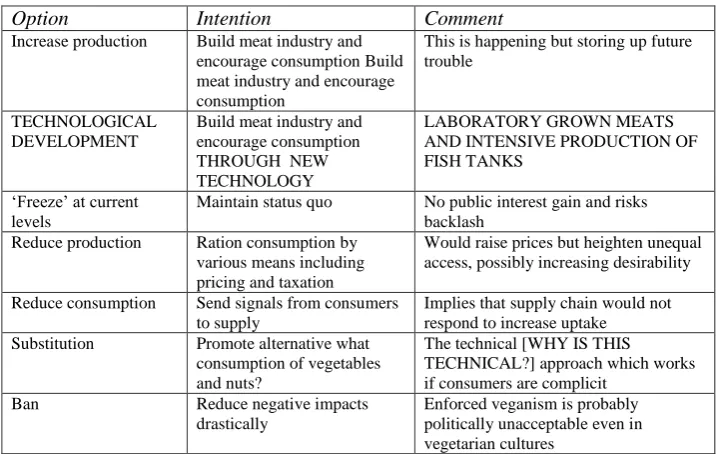
In theory, there are some clear strategic options (see Table 1). They range from increasing to decreasing both production and consumption.
Table 1. Overall strategic options
Option Intention Comment
Increase production Build meat industry and encourage consumption Build meat industry and encourage consumption
This is happening but storing up future trouble
TECHNOLOGICAL DEVELOPMENT
Build meat industry and encourage consumption THROUGH NEW TECHNOLOGY
LABORATORY GROWN MEATS AND INTENSIVE PRODUCTION OF FISH TANKS
‘Freeze’ at current levels
Maintain status quo No public interest gain and risks backlash
Reduce production Ration consumption by various means including pricing and taxation
Would raise prices but heighten unequal access, possibly increasing desirability Reduce consumption Send signals from consumers
to supply
Implies that supply chain would not respond to increase uptake Substitution Promote alternative what
consumption of vegetables and nuts?
The technical [WHY IS THIS TECHNICAL?] approach which works if consumers are complicit
Ban Reduce negative impacts drastically
Enforced veganism is probably politically unacceptable even in vegetarian cultures
Such moves will only develop and consolidate through the democratic process, within and outside formal governance structures. Such processes are emerging. From civil society, there is being an important quasi-formal set of foundation-funded inquiries, articulating NGOs and academic concerns. They suggest a growing coalition determined to push meat up the policy agenda. The issue of tactics – how to argue as well as what - has emerged in private already. The Pew Commission focussed on the environmental, economic and health implications of industrial modes of animal production, reflecting a widely held view that industrial farming is the Achilles heel of US meat culture. But do those arguments fit Europe or developing regions? Possibly not. Another debate for tactics is whether to promote step change versus incrementalism. To wean consumers off ubiquitous meat, is it best to suggest a ‘meat free Monday’ - a secular resuscitation of Christianity’s former meat-free Fridays – or to encourage hidden change through processed foods and public service food going meat-free with little public announcement?
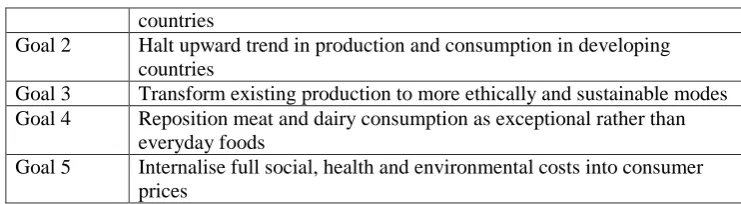
[image:15.595.72.431.117.344.2]These questions need careful thought, experimentation, research and evaluation. Like most analysts, we favour a re-orientation of policy to reduce both production and consumption. Environmentalist Jeremy Rifkin,52 ethicist Peter Singer66 67 and consumer health campaigner Michael Jacobson6 have each made powerful cases for what we might term a paradigm shift. This can be coalesced in one set of overarching goals (Table 2). I AM NOT CONVINCED THAT SINGER REPRESENTS A PARADIGM SHIFT AS defined by Kuhn. Singer is proposing a shift in behaviour based on ethics and at the level of the individual as opposed to a cultural shift.
Table 2 Possible main goals for a meat reduction policy
countries
Goal 2 Halt upward trend in production and consumption in developing countries
Goal 3 Transform existing production to more ethically and sustainable modes Goal 4 Reposition meat and dairy consumption as exceptional rather than
everyday foods
Goal 5 Internalise full social, health and environmental costs into consumer prices
[image:16.595.70.441.116.218.2]In theory, policy makers have a wide range of measures and instruments available to help them deliver policy. Their choice and use is usually shaped by circumstance and the balance of forces, and what politicians will dare to do. The trans fat bans in Denmark and New York City have shown how evidence-based policies can be implemented to protect the consumer, and not just the average consumer but sub-groups within the population who may consume higher levels of saturated fat. ADD REFS Where will the first local authority leader dare to impose extra charges on meat – akin to London’s traffic congestion charge which cut car use by imposing a daily rate? Where will a hospital or company take the lead in cutting meat from its canteen? We need some options to be tried, if we are to evaluate real policy effectiveness. Circumstances, of course, often provide natural experiments. Wars or dislocations due to health crises offer such occasions. In times of crisis, a broader range of measures tends to be politically more acceptable than in times of peace. And indicative list can be drawn, ranging from ‘soft’ at the top of the table to ‘hard’ measures towards the bottom (Table 3). They also range in orientation from individual to population effect.
Table 3 The range of public policy measures to shape meat supply and consumption
Measure Main sources Implications
Advice Tends to be State or Companies Tends to be weak and with low impact.
Labelling State or company Puts onus on consumers. Can suffer from information over-load.
Education Used to be state, but increasing presence of corporate materials
Long time to be effective; works best when coupled with other measures.
Public information
Corporate. Sometimes funded by states or levies on trade
Ranges from advertising and marketing to virtual and web-based media
Endorsement & sponsorship
Corporate Increasing use of celebrity. Some blurring of lines between media content and advertising.
Welfare support
State have tendency to use this to subsidies for surplus disposal.
Product / compositional standards
Was preserve of State. Now used by states, supply chains (through contracts) and civil society.
Rise of animal welfare and organic farm movements has had big effect on championing process orientations in standards-setting.
Licensing Traditionally State, but now used by companies, and by NGOs negotiating their own standards.
Brands are licenses.
Subsidies State Deeply opposed by theoreticians (eg OECD) as market distorting.
rules which conduct inquiries and have leverage eg through fines
Taxes & fiscal measures
State The most feared measure by corporates, as they add direct costs. Critics see them as distortions.
Bans Used to be preserve of State, but increasingly championed by Corporate. Civil society organisations frequently call for them.
rise of overt corporate standards has seen ‘choice-editing’ being champion
Rationing Preserve of State Tends to be used in times of war in free societies. Markets of course ‘ration’ by creating equilibrium between supply and demand.
When he argued that future food culture should centre of the simple ‘rule’ of ‘Eat food. Not too much. Mostly plants’, journalist Michael Pollan articulated a simple, perhaps overly simple recommendation for a sustainable diet.68 We too see the meat question as part of the search for sustainable diets and sustainable food systems. Perhaps it is in this terrain that consensus might be built.
Some northern European countries have begun to produce relevant policy documents. In 2009 the Swedish National Food Administration and Environmental Protection Agency collaborated to produce advice on environmentally friendly but healthy diets.69 This stated “In 2008, the Dutch Ministry of Agriculture, Nature and Food Quality produced a policy commitment to develop a sustainable food system including reshaping consumer behaviour.70 The message was that sustainability is about efficiency. It hinted at the case for less meat but backed off, citing the value of animal production in many developing countries. In Germany, the Council for Sustainable Development has long produced a guide The Sustainable Shopping Basket. 71 This states clearly and simply “your shopping basket should contain…less meat and fish” (pg 11). In the UK, like the Netherlands a big meat producer, Defra has been reluctant to specify meat reduction, but has acknowledged the need to reduce meat’s emissions. ADD REF Such policy documents suggest that the notion of sustainable diet might be the terrain on which a new policy framework for meat is based. This might bring together the various initiatives by companies, governments and civil society bodies which agree that meat production and consumption needs to reduce. Meanwhile, it has to be concluded that policy generally lags behind the evidence, and policy makers lack evidence which could help them frame policy shifts.
References
1. Rogers B. Beef and Liberty: Roast Beef, John Bull and the English Nation. London: Vintage books, 2004.
2. Eurostat. Food: from farm to fork statistics. Brussels: Eurostat, 2008.
3. Stern N. The Stern Review of the economics of climate change. Final Report. London: H M Treasury, 2006.
4. Stern N. Climate chief Lord Stern: give up meat to save the planet The Times
5. WCRF / AICR. Food, Nutrition, Physical Activity and the Prevention of Cancer: a Global Perspective. Washington DC / London: World Cancer Research Fund / American Institute for Cancer Research, 2007.
6. Jacobson MF. Six Arguments for a Greener Diet: How a More Plant-Based Diet Could Save Your Health and the Environment Washington DC: Center for Science in the Public Interest, 2006.
7. Popkin BM, Nielsen SJ. The Sweetening of the World's Diet. Obesity Research 2003;11(11):1-8.
8. Delgado CL. Rising consumption of meat and milk in developing countries has created a new food revolution. Journal of Nutrition 2003;133(11 (SUP2 :191)):3907S-3910S.
9. Lang T, Barling D, Caraher M. Food Policy: integrating health, environment and society. Oxford: Oxford University Press, 2009.
10. OECD. Sustainable Development: Linking economy, society, environment. Paris: Organisation for Economic Co-operation and Development, 2008.
11. Porritt J. Capitalism as if the world matters. London: Earthscan, 2005. 12. Brundtland GH. Our Common Future: report of the World Commission on
Environment and Development (WCED) chaired by Gro Harlem Brundtland. Oxford: Oxford University Press, 1987.
13. FAO. Livestock’s Long Shadow – environmental issues and options. Rome: Food and Agriculture Organisation., 2006.
14. Munasinghe M, Dasgupta P, Southerton D, Bows A, McMeekin A, Walker G. Consumers, Business and Climate Change: Report by SCI with the CEO forum of companies. Manchester: Sustainable Consumption Institute, University of Manchester, 2009:59.
15. Smith MJ. From policy community to issue network: salmonella in eggs and the new politics of food. Public Administration 1991;69(2):235-255.
16. van Zwanenberg P, Millstone E. BSE: risk, science, and governance. Oxford: Oxford University Press, 2005.
17. Royal Society. Royal Society Infectious Disease in Livestock Inquiry Follow-Up Review. London, 2004.
18. Penningon TH. When Food Kills. Oxford: Oxford University Press, 2003. 19. Pennington Hc. The public inquiry into the September 2005 outbreak of e-coli
0157 in South Wales.
http://wales.gov.uk/ecolidocs/3008707/reporten.pdf?skip=1&lang=en Cardiff:
Wales Assembly Government, 2009:355.
20. Tukker A, Huppes G, Guinée J, Heijungs R, de Koning A, van Oers L, et al. Environmental Impact of Products (EIPRO): Analysis of the life cycle environmental impacts related to the final consumption of the EU-25. EUR 22284 EN. Brussels: European Commission Joint Research Centre., 2006. 21. Monsen ER. Iron nutrition and absorption: dietary factors which impact iron
bioavailability. Journal of the American Dietetic Association 1988;88(7):786-90.
22. WCRF / AICR. Policy and Action for Cancer Prevention - Food, Nutrition, and Physical Activity: a Global Perspective. London / Washington DC: World Cancer Research Fund / American Institute for Cancer Research, 2009. 23. Sto, et al. ????? In: Tukker A, Bausch-Goldbohm S, Verheijden M, de Koning A,
editors. Environmental impact of diet changes in the EU: European
24. Boyd Orr SJ. Food and the People. Target for Tomorrow No 3. London: Pilot Press, 1943.
25. British Medical Association. Nutrition and the Public Health: Proceedings of a national conference on the wider aspects of nutrition, April 27-28-29, 1939. London: British Medical Association, 1939.
26. Nestle M. Food Politics. Berkeley CA: University of California Press, 2002. 27. McMichael AJ, Powles JW, Butler CD, Uauy R. Food, livestock production,
energy, climate change, and health. The Lancet 2007;370:1253-1263.
28. Nierenberg D. Happier Meals – Rethinking the Global Meat Industry. Worldwatch paper 171. Washington DC: Worldwatch Institute, 2005.
29. European Academies Science Advisory Council. Combating the threat of zoonotic infections London: EASAC / Royal Society, 2008.
30. Lang T, Heasman M. Food Wars: the global battle for mouths, minds and markets. London: Earthscan, 2004.
31. Pew Commission on Industrial Farm Animal Production. Putting Meat on the Table: Industrial Farm Animal Production in America. Washington DC: Pew Charitable Trusts and Johns Hopkins Bloomberg School of Public Health, 2008.
32. Sinclair U. The jungle. Harmondsworth: Penguin, 1906/1985.
33. Phillips LPoWM, Bridgeman J, Ferguson-Smith M. The BSE Inquiry: Report: evidence and supporting papers of the Inquiry into the emergence and identification of Bovine Spongiform Encephalopathy (BSE) and variant Creutzfeldt-Jakob Disease (vCJD) and the action taken in response to it up to 20 March 1996. London: The Stationery Office, 2000:16 volumes.
34. British Standards Institute. PAS 2050 - Assessing the life cycle greenhouse gas emissions of goods and services. London: British Standards Institute, 2008. 35. Goodland R, Anhang J. Livestock and Climate Change. World Watch 2009:10-19. 36. Hastings G, Stead M, Macdermott L, Forsyth A, Mackintosh AM, Rayner M, et
al. Review of Research on the Effects of Food Promotion to Children. Final Report to the Food Standards Agency by the Centre for Social Marketing, University of Strathclyde. London: Food Standards Agency, 2004.
37. Boisard P. Camembert: A National Myth. Berkley CA: University of California Pres, 2003.
38. Ravallion M. Competing Concepts of Inequality in the Globalization Debate. World Bank Policy Research Working Paper Series. Washington, DC, 2004. 39. Mennell S. All Manners of Food: Eating and Taste inn England and France from
the Middle ages to the Present. 2nd ed. Chicago: University of Illinois Pres, 1996.
40. Rimas A, Fraser EDG. Beef: How Milk, Meat and Muscle Shaped the World. Edinburgh: Mainstream Publishin, 2009).
41. Albritton R. Let Them Eat Junk: How capitalism creates hunger and obesity. London: Pluto Press, 2009.
42. IRISH GOVERNMENT ???? National Anti-Poverty Strategy
http://www.socialinclusion.ie/poverty.html. Dublin: ????, ???
43. Symons M. One continuous picnic: A history of eating in Australia. Adelaide: Penguin, 1998.
44. Gaynor A. Harvest of the Suburbs: an environmental history of growing food in Australian Cities. Crawley: University of Western Australia Press, 2006. 45. Symons M. The pudding that took a thousand cooks: The story of cooking in
46. Korthals M. Before Dinner: Philosophy and Ethics of Food. Dordrecht NL: Springer, 2004.
47. Malthus TR. An essay on the principle of population, as it affects the future improvement of society with remarks on the speculations of Mr. Godwin, M. Condorcet and other writers. London: Printed for J. Johnson, 1798.
48. Defra. Food Security Assessment.
http://www.defra.gov.uk/foodfarm/food/security/assessment.htm [accessed
October 27 2009]. London: Department for Environment, Food and Rural Afffairs, 2009.
49. H. M. Government. Securing the Future: delivering UK sustainable development strategy, Cm 6467. London: H.M.Government, 2005.
50. Royal Society. Reaping the Benefits: Science and the sustainable intensification of global agriculture. London: Royal Society, 2009.
51. Brown LR. Who will feed China? Wake up call for a small planet. New York: WW Norton, 1995.
52. Rifkin J. Beyond beef: the rise and fall of the cattle culture. New York: Dutton, 1992.
53. FAO. State of Food and Agriculture 2008 - Biofuels: prospects, risks and opportunities. Rome: Food and Agriculture Organisation, 2008.
54. FAO. High-Level Conference on World Food Security: the Challenges of Climate Change and Bioenergy. Rome. June 2008.
http://www.fao.org/foodclimate/hlc-home/en/, 2008.
55. Watson JD, Crick FHC. A Structure for Deoxyribose Nucleic Acid. Nature 1953;171:737-738.
56. Watson JD, Crick FHC. Genetical Implications of the structure of Deoxyribonucleic Acid Nature 1953;171:964-967.
57. IAASTD. Global Report and Synthesis Report. London: International Assessment of Agricultural Science and Technology Development Knowledge, 2008. 58. Schwartz B. The paradox of choice : why more is less. 1st ed. New York: Ecco,
2004.
59. Heilig GK. Food, Lifestyles, and Energy. In: van der Heij DG, editor. Food and Nutrition Policy. Proceedings of the Second European Conference on Food and Nutrition Policy. The Hague, Netherlands, 21-24 April 1992.
Wageningen: Pydoc, 1993:60-86
60. Diamond J. Collapse: How Societies Choose to Fail or Survive. London: Allen Lane, 2005.
61. Lovelock J. Gaia: a new look at life on Earth. Oxford; New York: Oxford University Press, 1979.
62. Lovelock J, Tickell C. The revenge of Gaia: why the earth is fighting back - and how we can still save humanity. London: Penguin, 2007.
63. Friedman M, Friedman RD. Free to choose: a personal statement. 1st ed. New York: Harcourt Brace Jovanovich, 1980.
64. MacMillan T, Durrant R. Livestock consumption and climate change: A framewok for dialogue. Brighton: Food Ethics Council, 2009. 65. School Food Trust.
http://www.schoolfoodtrust.org.uk/stacker_detail.asp?ContentId=435
[accessed 15th June, 2009]. London: School Food Trust, 2009.
66. Singer P. Animal Liberation: A New Ethics for our Treatment of Animals. New York: Random House, 1975.
68. Pollan M. In Defence of Food: The Myth of Nutrition and the Pleasures of Eating London: Allen Lane, 2008.
69. National Food Administration. Environmental-friendly food choices: proposals notified to the EU. Stockholm: National Food Administration, 2009.
70. Ministry of Agriculture NaFQN. Policy Document on Sustainable Food: Towards sustainable production and consumption of food
http://www.minlnv.nl/portal/page?_pageid=116,1640321&_dad=portal&_sche
ma=PORTAL&p_file_id=39545. Den Hag: Ministry of Agriculture, Nature
and Food Quality, 2008.
71. German Council for Sustainable Development. The Sustainable Shopping Basked: a guide to better shopping. 3rd edition. 3rd ed. Berlin: German Council for Sustainable Development, 2008.
1