R E S E A R C H A R T I C L E
Open Access
Structural factors and best practices in
implementing a linkage to HIV care program
using the ARTAS model
Jason Craw
1,2*, Lytt Gardner
2*, Amber Rossman
3, DeAnn Gruber
4, O
’
Donnell Noreen
5, Diana Jordan
6,
Richard Rapp
7, Cathy Simpson
8, Karen Phillips
9Abstract
Background:Implementation of linkage to HIV care programs in the U.S. is poorly described in the literature despite the central role of these programs in delivering clients from HIV testing facilities to clinical care sites. Models demonstrating success in linking clients to HIV care from testing locations that do not have co-located medical care are especially needed.
Methods:Data from the Antiretroviral Treatment Access Studies-II project (’ARTAS-II’) as well as site visit and project director reports were used to describe structural factors and best practices found in successful linkage to care programs. Successful programs were able to identify recently diagnosed HIV-positive persons and ensure that a high percentage of persons attended an initial HIV primary care provider visit within six months of enrolling in the linkage program.
Results:Eight categories of best practices are described, supplemented by examples from 5 of 10 ARTAS-II sites. These five sites highlighted in the best practices enrolled a total of 352 HIV+ clients and averaged 85% linked to care after six months. The other five grantees enrolled 274 clients and averaged 72% linked to care after six months. Sites with co-located HIV primary medical care services had higher linkage to care rates than non-co-located sites (87% vs. 73%). Five grantees continued linkage to care activities in some capacity after project funding ended.
Conclusions:With the push to expand HIV testing in all U.S. communities, implementation and evaluation of linkage to care programs is needed to maximize the benefits of expanded HIV testing efforts
Background
Testing, linkage to care, and HIV treatment have been recognized as the three arms of an approach to HIV prevention receiving recognition and funding recently in the U.S. [1]. However, of the three, linkage to care is by far the least well described in the HIV literature. The emergence of several recent publications on the conse-quences of failure to remain in care [2] and failure to engage in spite of pre-arranged clinic appointments [3,4] has raised the awareness of the problem of sub-optimal
rates of early entry into HIV care previously documen-ted [5,6].
Programs that actively facilitate connecting a recently diagnosed HIV-positive person to HIV medical care are known as linkage to care programs or models. Linkage to care models have been mostly homegrown, small sin-gle-site efforts at large medical centers closely co-located with HIV testing facilities. Some of these models from large medical centers with emergency room testing and a nearby HIV clinic have shown impressive rates of link-age to care within a few months, often exceeding 85% [7-11]. However, there is still an urgent need to evaluate linkage models that connect clients to HIV care from testing locations outside of HIV medical care settings. * Correspondence: [email protected]; [email protected]
1Northrop Grumman Corporation, Atlanta, GA, USA 2
Centers for Disease Control and Prevention, Division of HIV/AIDS Prevention, Atlanta, GA, USA
Full list of author information is available at the end of the article
CDC funded a linkage model incorporating multiple sources of clients and testing locations (the Antiretroviral Treatment Access Study [ARTAS-I]); the study used a two-arm randomized controlled trial that compared a brief strengths-based case management intervention with standard-of-care referral in linking recently diagnosed HIV-infected persons to a primary medical care provider [12]. Participants in the intervention group received up to five sessions with a case manager over 90 days. Partici-pants in the standard-of-care (control) group received information about HIV and local care resources, as well as a passive referral to a local HIV medical care provider. Successful initial linkage to care was defined as attending at least one HIV medical care visit within six months after enrollment. The ARTAS-I trial found that 78% in the case management arm versus 60% in the standard-of-care control arm attended at least one HIV primary standard-of-care visit within six months [12].
Based on positive outcomes from the ARTAS-I trial, CDC funded a demonstration project (ARTAS-II) to evaluate the feasibility of implementing that same link-age to care model in local and state health departments and non-profit community-based organizations (CBOs). Ten health departments or CBOs were funded to imple-ment the linkage to care program. Results from
ARTAS-II showed that 79% of all participants enrolled in the program visited an HIV clinician at least once within the first six months [13].
These findings indicated that a brief linkage case man-agement intervention can be implemented effectively by service-oriented organizations in typical HIV programs in rural, mid-sized, and urban settings in the U.S. The objective of the current report was to describe best practices and structural characteristics of organizations from the ARTAS-II demonstration project, specifically those factors which facilitated successful implementation of a program to link recently diagnosed HIV-infected persons to HIV care providers.
Methods
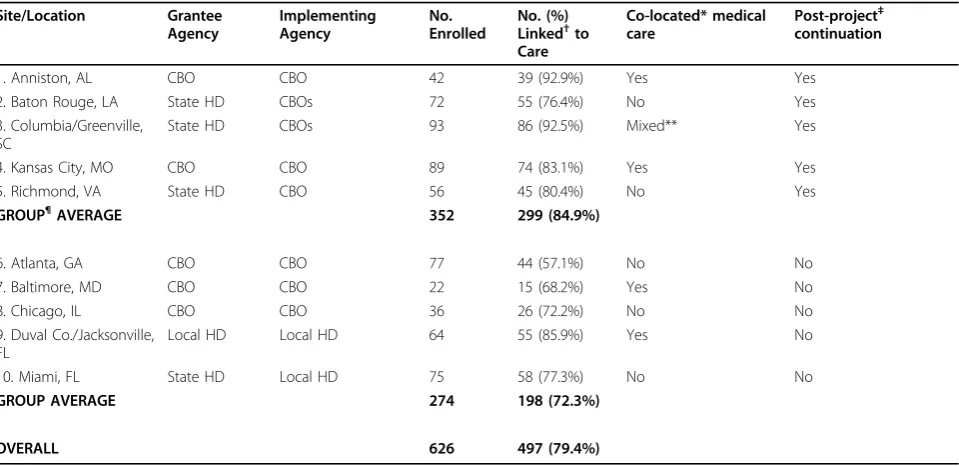
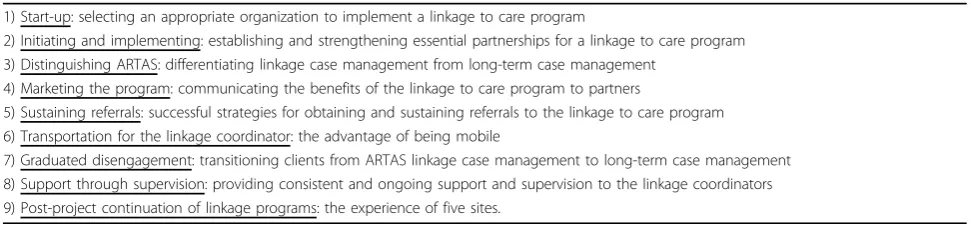
[image:2.595.59.539.420.653.2]The best practices, characteristics, and structural factors in this report incorporate information obtained from the 10 ARTAS-II study sites from October 2004 to June 2007 (Table 1). This information was collected from CDC’s main data collection activities (as previously reported [13]), from CDC site visit reports, final grantee site reports, and discussions held during the investigator meeting in December 2006. The research team synthe-sized the information obtained from these sources and created eight categories of best practices in addressing
Table 1 Characteristics of ARTAS-II Linkage to Care Study Sites, October 2004 - June 2007
Site/Location Grantee Agency
Implementing Agency
No. Enrolled
No. (%) Linked†to Care
Co-located* medical care
Post-project‡ continuation
1. Anniston, AL CBO CBO 42 39 (92.9%) Yes Yes
2. Baton Rouge, LA State HD CBOs 72 55 (76.4%) No Yes
3. Columbia/Greenville, SC
State HD CBOs 93 86 (92.5%) Mixed** Yes
4. Kansas City, MO CBO CBO 89 74 (83.1%) Yes Yes
5. Richmond, VA State HD CBO 56 45 (80.4%) No Yes
GROUP¶AVERAGE 352 299 (84.9%)
6. Atlanta, GA CBO CBO 77 44 (57.1%) No No
7. Baltimore, MD CBO CBO 22 15 (68.2%) Yes No
8. Chicago, IL CBO CBO 36 26 (72.2%) No No
9. Duval Co./Jacksonville, FL
Local HD Local HD 64 55 (85.9%) Yes No
10. Miami, FL State HD Local HD 75 58 (77.3%) No No
GROUP AVERAGE 274 198 (72.3%)
OVERALL 626 497 (79.4%)
ARTAS = Antiretroviral Treatment Access Studies CBO = community-based (non-profit) organization HD = health department
†Attended at least 1 HIV primary care visit within 6 months of enrolling in program
*HIV primary medical care located on the same campus as the linkage to care program
‡Site was able to continue the linkage to care program in some capacity after CDC funding ended
**One of the two implementing sites in Columbia did not have co-located medical care; the CBO in Greenville had co-located medical care.
¶
implementation challenges. These practices are elements of program implementation that multiple study person-nel considered critical to the overall success of the linkage to care program (Table 2). A ninth category -post-project continuation - describes linkage program continuation efforts. Specific examples illustrating how sites overcame implementation challenges come from project directors at five sites which sustained linkage activities in some capacity for at least several months since project funding ended. These grantees and their corresponding implementing site locations (in parenth-eses) were: Health Services Center (Anniston, AL); Kan-sas City Free Health Clinic (KanKan-sas City, MO); Louisiana Office of Public Health, HIV/AIDS Program (Baton Rouge, LA); South Carolina Department of Health and Environmental Control (Columbia & Greenville, SC); and Virginia Department of Health (Richmond, VA).
The study sites implementing ARTAS-II enrolled recently diagnosed HIV-positive participants who were not yet in medical care, with a goal of linking a mini-mum of 75% of enrolled participants to medical care. The recruitment period for the project was extended from 6 months to 12 months to achieve an overall enrollment of 600 participants.
The ARTAS Case Management Model
The ARTAS linkage case management model is rooted in strengths-based case management principles. A cen-tral strengths-based principle is that clients identify their own strengths, abilities, and assets to overcome barriers and accomplish specific goals. The process of identifying and reinforcing personal strengths enables clients to appreciate their own past self-efficacy, enhances motiva-tion, and prepares them for identifying and achieving goals. Strengths-based case management is designed to help clients identify needed resources to resolve the var-ious individual and structural barriers to HIV medical care [14-16]. The ARTAS case management model also emphasizes smaller client caseloads than traditional case management because of the intensive, short-term nature
(up to 5 sessions within 90 days) of the linkage interven-tion. A summary of the principles of strengths-based case management is listed below.
Principles of Strengths-Based Case Management
1. Encourage clients to identify and use their strengths, abilities, and assets to accomplish goals
2. Recognize and support client control over goal-set-ting and the search for needed resources
3. Establish an effective working relationship with the client
4. View the community as a resource and identify informal sources of support (family members, friends, neighbors, support groups, etc.)
5. Conduct case management as an active, commu-nity-based activity (meet with clients in the community, outside of the office setting)
Results
Characteristics, Linkage to Care Rates, & Structural Factors of Implementation Sites
Grantee and implementing site characteristics, enroll-ment totals, and rates of linkage to HIV care are pre-sented in Table 1. Sites numbered 1 through 5 are those which contributed examples of best practices employed to overcome challenges in recruiting and linking partici-pants to medical care. These five sites collectively enrolled 352 participants (56% of the total enrolled) and linked 85% to HIV medical care. The remaining five sites (numbered 6 through 10) enrolled 274 participants (44% of the total enrolled) and linked 72% to HIV medi-cal care. Sites that had co-located HIV medimedi-cal care on the same campus achieved an 87% linkage to care rate compared with 73% for non-co-located sites.
[image:3.595.55.541.610.723.2]Best Practices in Addressing Implementation Challenges (Table 2)
1) Start-up: selecting an appropriate organization to implement a linkage to care program
In the application process, grantees were competitively selected from health departments in the southeastern
Table 2 Best Practices in Progam Implementation Identified from the ARTAS-II Linkage to Care Demonstration Project, October 2004 - June 2007
1) Start-up: selecting an appropriate organization to implement a linkage to care program
2) Initiating and implementing: establishing and strengthening essential partnerships for a linkage to care program 3) Distinguishing ARTAS: differentiating linkage case management from long-term case management
4) Marketing the program: communicating the benefits of the linkage to care program to partners
5) Sustaining referrals: successful strategies for obtaining and sustaining referrals to the linkage to care program 6) Transportation for the linkage coordinator: the advantage of being mobile
7) Graduated disengagement: transitioning clients from ARTAS linkage case management to long-term case management 8) Support through supervision: providing consistent and ongoing support and supervision to the linkage coordinators 9) Post-project continuation of linkage programs: the experience of five sites.
United States and non-profit CBOs throughout the U.S. Of the 10 funded grantees, there were 4 state health departments, 1 county health department, and 5 CBOs.
Following the funding award, grantees selected an appropriate agency to implement the linkage program. Based on the grantees’ final reports, the agencies best suited to implement such a program were health depart-ments (state, county, or city) or CBOs with strong, established working relationships with high-volume HIV testing sites.
Linkage to care programs - state health department granteesFor the four state health department grantees, a staff person located in the office of the state AIDS director typically served as the project director. This staffing decision ensured that the project director was familiar with the statewide Ryan White HIV/AIDS Treatment Modernization Act programs and was in a position to select the best agency to implement the link-age program. None of the state health department gran-tees directly implemented the linkage program; instead, state health departments selected CBOs or local health departments to serve as the implementing organizations. Project directors selected implementing organizations through a non-competitive process, which resulted in the selection of capable and experienced service agencies to implement the linkage program. Collectively, the four state health department grantees enrolled an average of 74 participants compared with non-state health depart-ment grantees that enrolled an average of 55 partici-pants (from data in Table 1). A key reason for the enrollment success of the state health department gran-tees was their level of control in selecting the appropri-ate organization(s) to implement the linkage program.
Health department project directors considered many factors when selecting community partners to imple-ment the linkage to care program. One important con-sideration was selecting service organizations with a longstanding history of successful collaboration with the state HIV/AIDS program or organizations that had an existing contractual relationship with the state HIV/ AIDS program. Selecting such an agency ensured that staff were familiar working with the state and had a pre-established level of trust and partnership. An equally important factor was selecting an organization that pos-sessed the capacity to deliver or link HIV-infected per-sons with comprehensive HIV/AIDS services (including HIV counseling and testing, HIV case management, HIV primary medical care, mental health services, sub-stance abuse treatment, housing, and outreach services). Other factors considered when selecting an implement-ing organization were the organization’s level of interest and commitment to offering linkage to care services to HIV-infected clients and their capacity to collect and manage data that would be used to evaluate the linkage
program. Lastly, the project directors at state health departments considered selecting organizations in regions of the state that had the highest or increasing rates of new HIV infections. In Louisiana, for example, HIV/AIDS program staff reviewed counseling and test-ing data to select a region of the state in which to implement the linkage to care program. Once the Baton Rouge region was selected, these data were used to identify potential referring sites (e.g. parish/county health units, STD clinics, and CBOs) that tested a high volume of clients and had high positivity rates.
Other sites considered the ease with which the linkage to care program could be integrated into existing HIV care delivery systems. In South Carolina, for example, the Department of Health chose to implement the link-age program in two regions of the state where there was only one Ryan White Part B provider, which streamlined integration of the linkage program with HIV prevention and care services in those regions.
Linkage to care programs - CBO grantees Five gran-tees were non-profit CBOs, and in all cases that same CBO served as the implementing agency. Two directly-funded CBO grantees that we highlight in this report are the Kansas City Free Health Clinic and Health Ser-vices Center (Alabama). Both these CBOs offered co-located comprehensive HIV/AIDS services, as outlined above. In addition, these two CBOs had pre-existing, strong working relationships with the local health departments serving their community, which facilitated the process of securing cooperation from health depart-ment disease intervention specialists (DIS) and counsel-ing and testcounsel-ing staff to supply referrals of recently diagnosed HIV-positive persons. One common tactic used by CBO staff to market the linkage to care pro-gram to health departments was to emphasize the reduced burden on health department staff for linkage to care, thus freeing up staff to perform other core job duties, such as partner services.
2) Initiating and implementing: establishing and
strengthening essential partnerships for a linkage to care program
One key step in initiating a linkage to care program was for the implementing agency to identify appropriate agencies and organizations in the community with which to partner. These collaborations involved partner-ing with 1) agencies conductpartner-ing HIV testpartner-ing, 2) HIV pri-mary care providers to whom clients could be linked to medical care, and 3) case management agencies to which clients could be referred for long-term case man-agement services after completing the brief linkage to care intervention. One structural attribute that facili-tated successful implementation was having as many HIV services as possible (e.g. HIV testing, primary medi-cal care, and long-term case management) co-located within the same building or campus where the linkage case management intervention was being delivered. Sites that had co-located services averaged 87% of partici-pants linked to care, whereas sites without co-located services averaged 73% of participants linked to care (from data in Table 1). Where services were not co-located, active and ongoing efforts to establish and maintain partnerships with HIV testing and care provi-ders were critical.
Sources of referrals of HIV-infected persons to the linkage to care programMany project directors quickly recognized the importance of collaborating closely with DIS staff and counseling and testing staff that had direct access to clients testing HIV-positive. During the first 4 months of recruitment, the CBO in Richmond (VA) enrolled 1 to 2 persons per month into the linkage pro-gram. To counteract this period of slow enrollment, the Virginia Department of Health chose to mandate that all DIS staff in the central Virginia region refer all per-sons testing HIV-positive to the linkage to care pro-gram. After the DIS referral mandate was implemented, the CBO averaged over 6 enrollments per month during the next 4 months. The state health department actively monitored DIS referrals to the linkage program and cre-ated a mechanism for receiving feedback from the link-age program (a letter mailed back to the DIS) to indicate whether or not the client had been successfully linked to HIV primary care.
In South Carolina, the implementing agency in Green-ville had an HIV prevention services employee who essentially functioned as part of the DIS team and had office space in the local health department, so the refer-ral process was relatively seamless. However, due to the large size and complex structure of the health depart-ment in Columbia, planning and coordination was required to ensure that DIS and counseling and testing staff were actively referring persons testing HIV-positive to the linkage program. For the first several months of
the project, the linkage coordinators and their supervi-sors met frequently with health department staff to remind them of the new protocol for contacting the linkage coordinators when HIV-positive test results were to be delivered. Once the linkage coordinators established a presence at the clinic, health department staff began consistently referring patients to them.
In Louisiana and Kansas City, linkage program staff initiated contact with all of the counseling and testing sites in the area, met with key staff, presented program information at staff meetings, and distributed brochures, referral forms, referral flow charts, and other relevant information regarding the linkage program. Many of the counseling and testing sites in Baton Rouge were already familiar with the two CBOs implementing the linkage to care program because these CBOs provided long-term HIV/AIDS case management services. The trust and familiarity with these two CBOs increased cooperation between local counseling and testing sites and linkage program staff in Baton Rouge.
In Alabama, Kansas City, and Virginia, there was some initial resistance among DIS staff at the health depart-ments about relinquishing control of the referral to care process. To alleviate DIS concerns about overlapping job duties, the linkage coordinators emphasized that their role was focused on linking clients to HIV medical care, which would relieve DIS of this additional task and allow them to focus on core job duties such as partner elicitation. DIS staff were generally cooperative if they viewed the linkage coordinator’s role as complementary and supportive rather than duplicative of their role. Over time, as the linkage coordinators demonstrated their commitment and competency in providing linkage to care services, DIS staff began trusting them with all referrals of recently diagnosed HIV-positive persons.
at any time of day, so the Kansas City linkage program provided staff with a 24/7 referral line/pager to directly refer clients to the linkage program. Emergency depart-ment HIV testing has become a steady source of refer-rals to the linkage program in Kansas City since the end of the demonstration project.
Partnerships with HIV primary medical care provi-ders Compared with siteswithout co-located HIV pri-mary medical care and ARTAS case management, persons enrolled at sites with co-located services had significantly higher rates of linkage to care at six months in a multivariate analysis [13]. More importantly, how-ever, several implementing sites that lacked co-located HIV medical care (Baton Rouge, Richmond, and one CBO in Columbia, SC) still linked 80% to medical care. Several additional efforts were made by these sites to compensate for not having HIV primary medical care onsite. First, it was essential that linkage coordinators were familiar with local HIV primary care providers in the community to provide accurate information to cli-ents about HIV primary care options. In some instances, these relationships with primary care providers were already firmly established; in others, the linkage coordi-nators had to establish a relationship with these medical providers and familiarize them with the purpose of the linkage program. Another important factor in success-fully linking clients to care was arranging transportation and, in certain instances, accompanying clients to their first medical visit to alleviate potential anxiety or fear about the visit. The flexibility to accompany clients to medical appointments facilitated successful linkage in the absence of co-located HIV primary care.
Partnerships with case management agencies Estab-lishing working relationships and partnerships with local case management agencies enhanced the overall delivery and continuity of client services. At the majority of sites, the agency implementing the linkage program also pro-vided Ryan White-funded case management services. Establishing the linkage program within an agency that provided Ryan White services allowed for a seamless transition for those clients who needed long-term case management upon discharge from short-term ARTAS case management. Regardless of whether or not the long-term case managers were located in-house, it was common for linkage staff to demonstrate how the pro-gram benefited case managers, especially emphasizing the preparatory work done by linkage staff (e.g., com-pleting eligibility assessments, intake paperwork) prior to the client’s first meeting with the case manager.
3) Distinguishing ARTAS: differentiating linkage case management from long-term case management
From an early stage of implementation, several project directors recognized that a change in job title was needed to reduce confusion and differentiate the roles
and responsibilities of the short-term ARTAS linkage case manager from long-term or Ryan White case man-agers. Nearly all sites dropped the term“case manager” in favor of the term“linkage coordinator”or“linkage to care coordinator” to clarify that this position was transi-tional, short-term, and specific to facilitating linkage to medical care. Both clients and long-term case managers benefited from this distinction in terminology. In addi-tion to making the linkage coordinator’s role more transparent, another benefit of changing the job title was that it helped alleviate fears that the linkage pro-gram was competing for or “stealing” potential clients from long-term case managers. Dropping the term“case manager”from the job title helped mitigate territoriality or turf issues that arose when linkage coordinators were perceived as duplicating existing services rather than coordinating clients’ entry into HIV medical care. Despite the clarification in job title, however, some Ryan White case managers expressed resentment over the dis-crepancy in caseload size (at agencies that housed both Ryan White case managers and linkage coordinators). To alleviate these concerns, supervisory staff scheduled periodic educational sessions with the case managers to ensure they had a thorough understanding of the link-age program and explain that smaller caseloads were needed due to the short-term, intensive nature of the intervention.
Many ARTAS-II sites used similar methods to educate partners about the purpose and objectives of the linkage program and to delineate the roles and responsibilities of the linkage coordinator. Several sites held“lunch and learn”meetings to present information about the linkage to care program. Project directors at those sites noted that providing free lunch at these in-service sessions helped encourage attendance. Another common delivery method involved making special presentations to com-munity partners, HIV consortia, and regional case man-agement forums to educate stakeholders about the linkage to care program. Most sites created brochures and other informational materials about the linkage pro-gram to disseminate through meetings, in-services, and follow-up mailings. In Virginia, project staff recognized that their initial marketing materials were not effective because they were lengthy and convoluted, so they were replaced with simple, concise pocket cards or flyers that clearly outlined the benefits of the linkage program, which clients to refer, and who to contact. Virginia also created and presented case-based examples of the bene-fits of using a strengths-based approach to link clients to HIV medical care.
4) Marketing the program: communicating the benefits of the linkage to care program
potential referring partners and long-term case man-agers. As was mentioned earlier, linkage coordinators frequently completed intake assessments or eligibility paperwork, which reduced the overall workload for long-term case managers when clients were transitioned to them. Long-term case managers liked receiving cli-ents who had eligibility and intake documentation com-pleted because it freed them to do other work with clients. Another benefit of the program was that ARTAS clients were often better prepared than non-ARTAS cli-ents when transitioned to long-term case management. Several project directors mentioned that the linkage coordinators took time to orient ARTAS clients to the case management system and the services that their case manager could provide. Lastly, the South Carolina sites marketed the linkage program by emphasizing the bene-fit to the patient’s health and the overall public health in that patients who are in regular HIV medical care gen-erally have better health (e.g. lower viral loads) and are less likely to transmit HIV infection than those who are not in HIV care [18,19].
5) Sustaining referrals: successful strategies for obtaining and sustaining referrals to the linkage to care program
Across sites there was fairly uniform agreement about strategies that were most successful in generating and sus-taining referrals to the linkage program. Mainsus-taining ongoing communication and frequent contact (e.g. weekly) with supervisory and front-line staff at partner agencies was extremely important in ensuring the success of the referral process. In Virginia, program staff documented and monitored the number and types of contacts initiated by the linkage coordinators to establish new referral sources and partnerships. Documenting and tracking the number, frequency, and outcome of these contacts con-tributed to an increase in referrals throughout the project period. The Baton Rouge CBOs that implemented the linkage program hosted a quarterly networking lunch with their referring partners to provide updates on the progress of the linkage program and discuss successes and chal-lenges with the referral process. This meeting also pro-vided a forum in which community agencies could connect with each other and learn about the resources and services offered by each agency. Frequent communica-tion with referral partners was crucial not only from a relationship-building perspective but also from a quality improvement perspective. Part of establishing and sustain-ing consistent referrals to the linkage program involved detecting problems or barriers with the existing referral process in order to make adjustments and improvements to the process. One of the most common issues that caused declines or total stoppage of referrals to the linkage program was staff turnover at referring agencies. When staff turnover occurred, the linkage coordinator had to work with the referral partner to identify a new person
who would be responsible for making referrals to the link-age program and re-educate staff on the referral process.
Another key strategy for sustaining referrals was pro-viding referral partners with timely feedback on whether or not the clients they had referred had been linked to care. Providing referral partners with regular feedback was important in establishing trust and confidence in the linkage program and sustaining productive working rela-tionships. In Virginia, DIS staff required formal docu-mentation, such as a letter to place in their files, to confirm whether or not the client had been referred and linked to care. Less formal feedback mechanisms (e.g., phone calls, e-mails, faxes) were also used with referral partners to inform them about the client’s linkage status. In Kansas City, linkage staff prepared and disseminated a quarterly newsletter that shared linkage“success stories”, praised partners for successful referrals, and provided tips on making referrals to the linkage program. Referral partners were viewed as secondary clients, and providing feedback on referred clients was seen as good customer service. The feedback helped ensure that persons who made referrals received credit for their important role in connecting clients with HIV care.
decreased the likelihood of client referrals falling through the cracks.
6) Transportation for the linkage coordinator: the advantage of being mobile
One of the guiding strengths-based principles is making case management an active, community-based activity. Accordingly, many study sites allowed their linkage coordinators to be mobile and meet with referral part-ners and clients outside of the office setting (e.g., client’s home, coffee shop, library). However, agency-specific policies prohibited some study sites from allowing their linkage coordinators to meet with clients outside of the office or transport clients in a personal or agency-owned vehicle. Nonetheless, the agencies that were allowed to do so found that the flexibility to meet with clients out-side of the office setting was critical to the success of the linkage program. Meeting face-to-face with clients immediately after post-test counseling was extremely valuable to the linkage coordinator in building trust and establishing rapport with the client. At some sites, the linkage coordinator was able to use an agency-owned vehicle to meet with clients or referral partners outside of the office. At other sites, the linkage coordinator used a personal vehicle and was reimbursed for mileage. The linkage coordinators were usually covered under the agency’s liability insurance for work conducted with cli-ents outside of the office.
A few sites even allowed their linkage coordinators to ride the bus or subway with clients to help them navigate the transportation system. Transportation is a common barrier to engaging in ongoing HIV medical care, and link-age coordinators used the strengths-based approach to help clients learn how to secure transportation and navi-gate their way to the clinic so they could become self-suffi-cient in arranging transportation in the future. The majority of sites also encouraged the linkage coordinator to meet clients at the HIV clinic and accompany them during their first HIV medical care visit. Allowing the link-age coordinators to be mobile and meet with clients out-side of the office was vital to the success of the linkage program, especially among sites serving large, rural geo-graphic areas where clients frequently had limited access to personal or public transportation.
7) Transitioning clients from ARTAS linkage case management to long-term case management
The short-term nature of the ARTAS linkage intervention requires a seamless process by which clients can transition from ARTAS case management to long-term case man-agement, if needed–a process referred to as disengage-ment. Several techniques for handling the disengagement process were presented during the intervention training. The linkage coordinators were taught that disengagement is a graduated process that begins during the very first contact with the client and one that is reinforced during
subsequent contacts. The client should be informed up front about the short-term, transitional nature and goals of ARTAS linkage case management. The linkage coordi-nator must ensure that clients fully understand that once they have completed five sessions together or have entered HIV primary care (whichever occurs first), they will be transferred to long-term case management services, if needed.
The “active hand-off”model for facilitating the tran-sition to long-term case management The “active hand-off”is one model for facilitating the client’s transi-tion to long-term case management services provided through an HIV medical clinic or community agency. The active hand-off often involved introducing the client to his/her new case manager prior to disengagement and describing the types of case management services offered. Oftentimes, the linkage coordinator attended part of the client’s first session with the new case manager. In Kansas City, the linkage coordinators used a statewide case man-agement data capture system, so the comprehensive pro-gress notes and any completed eligibility assessments were readily available to long-term case managers. Some linkage coordinators allowed clients to make a brief phone call after disengagement just to check in and let them know how things were going with their new case manager. The active hand-off model was especially useful when the link-age coordinator and long-term case manlink-agers were located at the same agency. Most importantly, clients had the opportunity to meet their long-term case manager prior to disengaging from the linkage coordinator. In addi-tion, because of the intervention sessions with the linkage coordinator, most clients were already familiar with agency staff, agency culture and policies, and how to arrange transportation to the agency.
8) Support through supervision: providing consistent and ongoing support and supervision to the linkage
coordinators
model of supervision was holding weekly case confer-ence meetings during which client cases were discussed.
Another level of supervision is needed when the state health department is overseeing implementation of the linkage program by community agencies. At this level, a staff person from the state HIV/AIDS program office needs to monitor implementation of the linkage program locally to ensure that the contracted agencies follow proto-cols and deliver linkage to care services as intended. For example, the linkage program directors at the state health departments in Louisiana, Virginia, and South Carolina monitored the number of referrals to the linkage program from various sources, gave quality assurance oversight, and provided programmatic or administrative support.
9) Post-project continuation of linkage programs
As expected, when CDC funding ceased, 5 of the 10 study sites were unable to continue linkage to care activities. The five sites highlighted in this report fared better, with all five extending linkage activities in some capacity for at least several months beyond the end of project funding. However, these extensions were themselves dependent on small amounts of local funding which, in most cases, could not be sustained in the long run. South Carolina ceased all linkage activities when project funding ended, but re-started them several months later by incorporating linkage to care services in their CDC-funded Expanded HIV Testing Initiative project in emergency departments and in a Ryan White clinic using Minority AIDS Initiative funding. The effort to continue providing linkage services in South Carolina was successful because it used multiple funding streams (CDC, Ryan White Part B, and Minority AIDS Initiative) and employed one of the linkage coordi-nators from the ARTAS demonstration project. The Ala-bama CBO also used multiple funding sources to continue providing linkage services using one of the original linkage coordinators as a dual linkage/standard case manager. Louisiana was able to maintain one of the two linkage coordinators on a part-time basis for several months after the end of the project. The state HIV/AIDS programs in Missouri and Virginia were able to use Ryan White fund-ing to continue supportfund-ing linkage program activities. Mis-souri also sponsored training opportunities in strengths-based methodology for case managers throughout the state.
One key to setting the stage for future funding in Mis-souri was that the linkage program coordinator from Kan-sas City served on Missouri state committees for case management standards and quality improvement. She took advantage of any opportunity to report linkage to care program data, milestones, case studies, and anecdotal successes to the committee and to the state AIDS Direc-tor. In mid-2008, funding was expanded to quadruple the number of clients served by the linkage program in three areas of Missouri (Kansas City, St. Louis, and Springfield/
Joplin), which represent very different client populations across urban, suburban, and rural communities. The Kan-sas City, MO area has expanded the number of linkage coordinators, and has also done consulting work to expand the linkage program to the state of Kansas.
Discussion
Linkage to care is the important bridge between HIV counseling and testing and HIV medical care. Successful implementation of a linkage to care program requires attention to all the program practices described. As a group, sites that followed these best practices enrolled more participants, linked a higher percentage to medical care, and were able to continue linkage program activ-ities for some period of time after CDC funding ended. It is noteworthy that the five grantees that continued the linkage program came from smaller metropolitan areas (average 990,000 persons in 2000) compared to the five grantees that did not continue (average 4.1 mil-lion persons in 2000).
Attention to these eight practices takes on additional urgency when HIV testing is not co-located with an onsite HIV clinic because inter-agency partnerships must be maintained. Strong inter-agency partnerships were a defining characteristic of sites that continued the linkage program after CDC funding ended. When multi-ple sources of newly diagnosed clients (across agencies) are involved, the organizational complexity to maintain these sources can be daunting. Nevertheless, implement-ing these best practices is not beyond the ability of even a small CBO. The five CBOs that were able to continue the linkage program after project funding ended had long-standing, cooperative relationships with local health departments, resulting in a steady influx of recently diagnosed HIV-positive persons. These CBOs recruited 56% of the 626 participants and recruited an average of 70 participants per grantee. In contrast, the three CBOs that did not continue the linkage program all experi-enced major challenges establishing and maintaining reliable relationships with local health departments. These CBOs recruited an average of 45 participants per grantee and averaged less than 70% linked to care.
Our report is not without limitations. We did not pre-sent statistical testing of the differences in linkage to care rates for site-level characteristics and best practices. Site-level best practices tend to be clustered, making separation of these characteristics on a small sample dif-ficult. Modeling of these data that accounts for colli-nearity of site level factors and includes individual level factors was beyond the scope of this report.
Conclusions
With the continuing push to expand offering of HIV testing in the United States, there is an urgent need to adapt linkage to care programs so that public health departments, community-based organizations, hospitals, emergency rooms, private doctors’ offices, and HIV clinics are affiliated with a linkage to care program. To fully maximize the benefits of expanded HIV testing will require careful implementation, adaptation, and evalua-tion of linkage to care programs.
Author details
1Northrop Grumman Corporation, Atlanta, GA, USA.2Centers for Disease Control and Prevention, Division of HIV/AIDS Prevention, Atlanta, GA, USA. 3Kansas City Free Health Clinic, Community Services Department, Kansas City, MO, USA.4Louisiana Office of Public Health, HIV/AIDS Program, New Orleans, LA, USA.5South Carolina Department of Health and Environmental Control, Columbia, SC, USA.6Virginia Department of Health, Division of Disease Prevention, HIV Care Services, Richmond, VA, USA.7Center for Interventions, Treatment and Addictions Research, Wright State University Boonshoft School of Medicine, Dayton, OH, USA.8University of Alabama at Birmingham, School of Public Health, Department of Health Behavior, Birmingham, AL, USA.9Health Services Center, Inc., Anniston, AL, USA.
Authors’contributions
JC was the study coordinator and participated in drafting the manuscript. LG conceived the study and participated in drafting the manuscript. AR managed the Kansas City site of the project and participated in editing the manuscript. DG managed the Baton Rouge site of the project and participated in editing the manuscript. NO managed the South Carolina site of the project and participated in editing the manuscript. DJ managed the Virginia site of the project and participated in editing the manuscript. RR provided the training for the linkage coordinators and participated in editing the manuscript. CS provided guidance to the design and implementation for the Alabama site of the project. KP managed the Alabama site of the project and participated in editing the manuscript.
All authors read and approved the final manuscript.
Competing interests
The authors declare that they have no competing interests.
Received: 26 March 2010 Accepted: 20 August 2010 Published: 20 August 2010
References
1. Report on the status of the NIH-funded three-year project to implement a test and treat strategy.[http://www.iavireport.org/archives/2009/Pages/ IAVI-Report-13(5)-Vaccine-Briefs.aspx].
2. Giordano T, Gifford A, White A, Suarez-Almazor M, Rabeneck L, Hartman C, Backus L, Mole L, Morgan R:Retention in care: a challenge to survival with HIV infection.Clinical Infectious Diseases2007,44:1493-1499. 3. Mugavero M, Lin H, Allison J, Willig J, Chang P, Marler M, Raper L,
Schumacher J, Pisu M, Saag M:Failure to establish HIV care: characterizing the“no show”phenomenon.Clinical Infectious Diseases
2007,45:127-130.
4. Ulett K, Willig J, Lin H, Routman J, Abroms S, Allison J, Chatham A, Raper J, Saag M, Mugavero M:The therapeutic implications of timely linkage and early retention in HIV care.AIDS Patient Care STDS2009,23:41-49. 5. Centers for Disease Control and Prevention:Missed opportunities for
earlier diagnosis of HIV infection–South Carolina, 1997-2005.MMWR Morb Mortal Wkly Rep2006,55(47):1269-72.
6. Centers for Disease Control and Prevention:HIV/AIDS Supplemental Surveillance Report: Reported CD4+ T-lymphocyte Results for Adolescents and Adults with HIV/AIDS, 33 States[http://www.cdc.gov/hiv/topics/surveillance/ resources/reports/2005supp_vol11no2/pdf/HASRSuppVol11No2.pdf]. 7. Brown J, Shesser R, Simon G, Bahn M, Czarnogorski M, Kuo I, Magnus M,
Sikka N:Routine HIV screening in the emergency department using the new US Centers for Disease Control and Prevention Guidelines: results from a high-prevalence area.J Acquir Immune Defic Syndr2007, 46:395-401.
8. Calderon Y, Leider J, Halperin S, Chin R, Ghosh R, Fettig J, Gennis P, Bijur P, Bauman L:High volume rapid HIV testing in an urban emergency department.AIDS Patient Care and STDs2009,23:749-757.
9. Haukoos J, Hopkins E, Eliopoulos V, Byyny R, Laperriere K, Mendoza M, Thrun M:Development and implementation of a model to improve identification of patients infected with HIV using diagnostic rapid testing in the emergency department.Acad Emerg Med2007, 14:1149-1157.
10. Lyss S, Branson B, Kroc K, Couture E, Newman D, Weinstein R:Detecting unsuspected HIV infection with a rapid whole-blood HIV test in an urban emergency department.J Acquir Immune Defic Syndr2007, 44:435-442.
11. White D, Scribner A, Schulden J, Branson B, Heffelfinger J:Results of a rapid HIV screening and diagnostic testing program in an urban emergency department.Annals of Emergency Medicine2009,54:56-64. 12. Gardner L, Metsch L, Anderson-Mahoney P, Loughlin A, del Rio C,
Strathdee S, Sansom S, Siegal H, Greenberg A, Holmberg S:Efficacy of a brief case management intervention to link recently diagnosed HIV-infected persons to care.AIDS2005,19:423-31.
13. Craw JA, Gardner LI, Marks G, Rapp R, Bosshart J, Duffus W, Rossman A, Coughlin S, Gruber D, Safford L, Overton J, Schmitt K:Brief strengths-based case management promotes entry into HIV medical care: results of the Antiretroviral Treatment Access Study-II (ARTAS-II).J Acquir Immune Defic Syndr2008,47:597-606.
14. Rapp RC:Strengths-based case management: enhancing treatment for persons with substance abuse problems.InThe strengths perspective in social work practice.Edited by: Saleebey D. Boston: Allyn and Bacon; , 4 2006:.
15. Saleebey D:The strengths perspective in social work practice: extensions and cautions.Social Work1996,4:296-305.
16. Rapp CA, Wintersteen R:The strengths model of case management: results from twelve demonstrations.Psychosoc Rehabil Journal1989, 13:23-32.
17. Centers for Disease Control and Prevention:Revised recommendations for HIV testing of adults, adolescents, and pregnant women in health-care settings.MMWR Morb Mortal Wkly Rep2006,55(RR-14):1-17.
18. Quinn T, Wawer M, Sewankambo N, Serwadda D, Chuanjun L, Wabwire-Mangen F, Meehan M, Lutalo T, Gray R:Viral load and heterosexual transmission of human immunodeficiency virus type 1.New Engl J Med
2000,342:921-9.
19. Tovanabutra S, Robison V, Wongtrakul J, Sennum S, Suriyanon V, Kingkeow D, Kawichai S, Tanan P, Duerr A, Nelson K:Male viral load and heterosexual transmission of HIV-1 subtype E in northern Thailand.J Acquir Immune Defic Syndr2002,29:275-83.
Pre-publication history
The pre-publication history for this paper can be accessed here: http://www.biomedcentral.com/1472-6963/10/246/prepub
doi:10.1186/1472-6963-10-246
Cite this article as:Crawet al.:Structural factors and best practices in implementing a linkage to HIV care program using the ARTAS model.