EXIT Chart Analysis of Low-Complexity Bayesian Turbo
Multiuser Detection for Rank-Deficient Multiple Antenna
Aided OFDM
Lei Xu, Sheng Chen and Lajos Hanzo School of ECS., Univ. of Southampton, SO17 1BJ, UK.Tel: +44-23-80-593 125, Fax: +44-23-80-593 045
Email:{lx04r,sqc,lh}@ecs.soton.ac.uk, http://www-mobile.ecs.soton.ac.uk
Abstract— This paper studies the mutual information transfer charac-teristics of a novel low-complexity Bayesian Multiuser Detector (MUD) proposed for employment in Space Division Multiple Access (SDMA) aided Orthogonal Frequency Division Multiplexing (OFDM) systems. The design of the Bayesian MUD advocated is based on extending the optimum single-user Bayesian design to multiuser OFDM signals modeled by a Gaussian mixture, rather than by a single Gaussian distribution, when characterizing the conditional PDF of the received signal. In order to reduce the complexity of the Bayesian MUD, we introduce ana prioriinformation threshold and then discard the low-probability terms during the calculation of the extrinisic information generated . The achievable complexity reduction as a function of different threhold values is analyzed and the best tradeoff values are derived with the aid of simulation. Both non-systematic and recursive systematic convolutional codes are used for exchanging extrinsic information with the MUD for the sake of achieving a turbo-detection aided iteration gain. The convergence behavior of the proposed low-complexity Bayesian turbo MUD is investigated using EXtrinsic Information Transfer (EXIT) chart analysis and compared to that of Soft Interference Cancellation aided Minimum Mean Square Error (SIC-MMSE) MUD schemes. As expected, the simulation results show that the proposed low-complexity Bayesian Turbo MUD outperforms the SIC-MMSE MUDs. A substantial benefit of the proposed MUD is that it is potentially capable of supporting up to three times higher number of users than the number of receiver antennas. In this challenging multiuser scenario, the resultant channel-matrix becomes rank-deficient, resulting in a linearly non-separable detector output phasor constellation, when classic linear receivers tend to exhibit a poor performance.
I. INTRODUCTION
During the past a few years, Space Division Multiple Access (SDMA) has attracted substantial research efforts expended for the sake of increasing the number of users supported. This is achieved by allowing the users to communicate within the same time-slot and frequency band, differentiating them with the aid of their unique user-specific Channel Impulse Response (CIR) [1], [2]. In recent years, Orthogonal Frequency Division Multiplexing (OFDM) has found its way into a range of Wireless Local Area Network (WLAN) and Broadcast standards. Combining the benefits of SDMA and OFDM has the promise of achieving reliable wireless communications at high data rates with the aid of efficient Multi-User Detector (MUD) algorithms [2].
Following Berrou’s landmark paper on the turbo principle [3], iterative detection has found applications in channel coding [4], channel estimation, equalization [4] and multiuser detection [4]. The conventional Minimum Mean Square Error (MMSE) algorithms can be conveniently combined with the so-called interference Cancel-lation (IC) [2], [4] technique to create attractive MUDs. However, when supporting a higher number of users than the number of receiver antennas, the channel matrix becomes rank-deficient and hence the MMSE SDMA MUD falters. In this rank-deficient scenario the phasors become linearly non-separable at the channel’s output and only non-linear SDMA MUDs have the ability to perform adequately. Hence in this contribution we propose a non-linear Bayesian turbo MUD, which is capable of achieving an attractive tradeoff between the attainable complexity reduction and the performance degradation
The financial support of the European Union and that of EPSRC, UK is gratefully acknowledged.
imposed. Our advocated solution outperforms the linear turbo MMSE MUD benchmarkers at the cost of a moderate complexity increase [5].
The achievable performance of these MUDs will be investigated using EXIT charts [6], which provide a convenient way of visualizing the mutual information exchange between the inputs and outputs of concatenated receiver components and hence allow us to predict their achievable performance and to examine their convergence properties. Although at a low number of interferes the extrinsic information at the output of the proposed turbo Bayesian MUD may be non-Gaussian distributed, nonetheless, the EXIT-chat technique succeeded in predicting the achievable turbo performance of the system in the context of SDMA OFDM using convolutional codes and BPSK modulation.
Perfect Channel State Information (CSI) is assumed to be available at the receiver, which will be substituted by a more realistic channel estimator outlined for example in Chapter 16 of [2] in our future work. Alternatively, a number of adaptive techniques may be used for circumventing this problem [7]. Our results will demonstrate that the proposed detector is capable of significantly outperforming the MMSE MUD, especially in the so-called rank-deficient scenarios, namely when the number of SDMA uplink users supported is higher than the number of receiver antennas at the base station.
The remainder of this contribution is organized as follows. In Sec-tion II, a system model is introduced, which will be used in SecSec-tion III for studying a range of different turbo MUD strategies. Our system performance results and EXIT chart analysis are presented in Section IV, followed by our conclusions in Section V.
II. SYSTEMMODEL
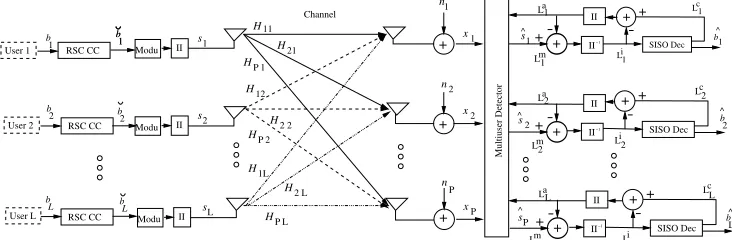
The SDMA uplink (UL) transmission structure is portayed in
Fig.1. More specifically, each of theLsimultaneous MSs employs a
convolutional encoder and a single UL transmission antenna, while
the BS’s UL receiver has a P-element antenna array. As seen in
Fig. 1, the set of complex-valued UL signals,xp[n, k], p∈1, . . . , P
received from the P-element antenna array in the k-th subcarrier
of then-th OFDM symbol is constituted by the superposition of the
independently faded signals corresponding to theLUL users sharing
the same frequency band, which are also corrupted by the Additive White Gaussian Noise (AWGN) encountered at the array elements
[2]. The indices[n, k]have been omitted for notational convenience
during our forthcoming discourse, yielding [2]:
x = Hs+n = ¯x+n, (1)
wherexis the(P×1)-dimensional vector of the UL received signals,
s is the transmitted (L×1)-dimensional signal vector generated
from the convolutional encoded bits,nis the(P×1)-dimensional
noise vector and¯x represents the noiseless component ofx. Both
the complex-valued UL transmitted signal,slof thel-th user, where
l ∈ 1, . . . , L and the AWGN process, np, at p-th antenna array
element, wherep∈ 1, . . . , P are assumed to exhibit a zero mean
and variances ofσ2l and2σ2n, respectively.
Furthermore,His the Frequency Domain Channel Transfer
Func-tion (FDCHTF) matrix having a dimension of(P×L), constituted
+
n
xP
P 1
b
User 2 2 b
RSC CC b
L User L
1
n
^s 2 2
b 1 b
b L 1 b
Modu II
Modu II
Modu II
1
SISO Dec
SISO Dec
SISO Dec
II−1
II−1
II−1
Channel
Multiuser Detector
s
1
H
H2 HP
H2 HP
H2
H
1
2
L
s
s 1
1
1
2
2 1
H
2
H1L
L
L P User 1 RSC CC
RSC CC
+ x1
+
x n2
2
+ +
+ +
^ 1
s
+ +
2
2 1
^
sP
L L
+ +
2 b ^
2
2
+ +
^ b L L
L
+ +
1
^ b
1
1
II
II
II La
Lm Lm La
Lc
Lc
Lc
Li
La
m L
Li
Li
Fig. 1. Schematic of the turbo SDMA OFDM uplink scenario, where each of theLusers is equipped with a convolutional channel code and a single transmit antenna, while the BS’s receiver is assisted by aP-element antenna array followed by iterative processing.
by the set of channel transfer factorsHp,l, which describes the inde-pendent, stationary and complex-Gaussian distributed fading process
between the reception array element p ∈ 1, . . . , P and the single
transmitter antenna associated with a particular userl, characterized by a zero-mean and unit variance.
Thea posterioriinformationLm,p(sl)output by the turbo MUD is derived by exploiting both the received signal vectorxand thea priori informationLm,a(sl)of all theLUL users, which is the interleaved
extrinsic information Lc,e(sl) generated by the channel decoders
for the bits received. Upon subtracting the a priori information
Lm,a(sl)from thea posterioriinformationLm,p(sl), the extrinsic
information Lm,e(sl) output by the MUD is attained. After
de-interleaving Lm,e(sl) is forwarded to a bank of Input
Soft-Output (SISO) channel decoders as thea prioriinformationLc,a(sl),
in order to generate thea posterioriinformationLc,p(sl)for carrying out the decisions concerning the original source bits. The extrinsic
information Lc,e(sl) output by the l-th channel decoders, where
l ∈ 1, . . . , L, is generated by deducting thea priori information Lc,a(sl)from thea posteriorioutputLc,p(sl)and then interleaved,
before it is fed back to the MUD as thea prioriinformationLm,a(sl),
in order to complete a full iteration. The subscript l of the soft
information L in Fig.1 indicates that it belongs to sl. The usual
interleavers and de-interleavers separating the MUD and the channel decoders render the distribution of information fed into the MUD and channel decoders independent of each other, which improves the benefits of the extrinsic information generated in terms of the achievable iteration gain.
When employing BPSK modulation, thea posterioriinformation
of thel-th user’s transmitted bitsl generated by the SISO MUD is
expressed in terms of Log Likelihood Ratios (LLR) as:
Lm,p(sl) = lnP(sl= +1|slˆ)
P(sl=−1|slˆ)
= lnP( ˆsl|sl= +1)
P( ˆsl|sl=−1)+ln
P(sl= +1)
P(sl=−1)
= Lm,e(
sl) +Lm,a(sl), (2)
where thea posterioriinformation seen in Fig. 1 is given by the sum
of the extrinsic information anda prioriinformation. More explicitly, Lm,e(sl)in Eq.(2) is the extrinsic information which is fed into the
channel decoder of Fig. 1 after de-interleaving, while the second term denoted byLm,a(sl)represents thea prioriinformation related to the interleaved encoded bitssl. Since noa prioriinformation is available for the MUD during the first iteration, we haveLm,a(sl) = 0. During
the following iterations, the a priori information of the MUD is
generated by interleaving the extrinsic information of the channel decoder, gained by subtracting itsa prioriinformationLc,a(sl)from itsa posterioriinformationLc,p(sl), as depicted in Fig.1.
III. TURBOMUDS
In this section, several turbo MUDs will be introduced. The conventional MMSE MUD minimizing the complex-valued MSE
between the estimated and ideal noiseless received signal will be presented first, which employs soft interference cancellation. This is referred as the Complex-valued MMSE (CMMSE) [5] MUD. For BPSK scenarios, the so-called real-valued MMSE (RMMSE) [8] may also be applied for enhancing the achievable performance of the system, which will be outlined below. Finally, we will investigate the novel low-complexity Bayesian MUD and demonstrate that it outperforms the linear benchmark employed.
For the linear turbo MUDs employing soft interference cancel-lation, such as the CMMSE and RMMSE schemes, the symbol ¯ˆ
s(li(MMSE) )of thel-th user estimated during thei-th decoding iteration can be written as follows [5]:
ˆ
sl[i]= ¯s[li]+vl[i]wl[i]H·(x−H¯s[i]), (3) where the superscript[i]denotesi-th decoding iteration.vl[i]is thea priorivariance ofˆs[li]given by [5]:
vl[i] = 1− |s¯[li]|2, (4)
¯
s[li]is thel-th user’sa priorimean value and all the valuess¯[li], l= 1. . . Lof theLusers constitute the mean vector¯s[i]ofi-th decoding iteration. Furthermore,w[li]H is the Hermitian of thel-th column of
the array weight matrixW[i]employing the CMMSE or the RMMSE
criterion. For notational simplicity, we have omitted the superscript [i]fromsl¯,vl,wlandWduring our forthcoming discourse.
A. Turbo CMMSE Multiuser Detection
The CMMSE MUD is one of the most popular linear MUD algorithms, which minimizes the Complex-valued MSE (CMSE) metric for thel-th user expressed as:
JCMSE(wl) =E[|ˆsl[i]−sl|2], (5)
wheresˆ[li]andslare generally complex-valued.
The closed-form CMMSE array weight vector is expressed as [5]:
wl,CMMSE= (HVHH+ 2σn2IP)−1hl (6) assuming thatσl2= 1, whereV=diag[v1. . . vL],IP is a(P×P
)-dimensional identity matrix, andhlis thel-th column of the FDCHTF
matrixH.
B. Turbo RMMSE Multiuser Detection
For BPSK transmission, only the real part of the estimated signal is required, therefore directly minimizing the real-valued MSE (RMSE) between the estimated signal and desired signal will remove the unnecessary constraint imposed on the array weight matrix of the CMMSE MUD characterized in Eq.6 and hence will provide signif-icant performance improvements. The cost function of the RMMSE algorithms is formulated as [8]:
JRMSE(wl) =E[|sˆl,R[i] −sl|2], (7)
[image:2.612.122.488.58.178.2]Applying the real-valued vertical concatenation matrix method of [8], we attain the vertically concatenated RMMSE weight vector in
the form of: assuming thatσl2= 1, wherehl is thel-th column of
the FDCHTF matrixHand the subscriptcof the matrices indicates
the vertical concatenation, defined as:
U
¯c=
[U ¯]
[U ¯]
, (8)
with U
¯ indicating an arbitrary matrix. While[U¯]and[U¯]denote real and imaginary parts, respectively. Once the vertically
concate-nated RMMSE weight vector wl,RMMSE,c has been derived, the
RMMSE weight vector wl,RMMSE can be derived by finding the
inverse of the operator in Eq.(8).
C. low-complexity Bayesian turbo Multiuser Detection
When thea prioriinformation concerning the likelihood of all the
legitimateNb= 2Lnumber of BPSK modulatedL-user bit sequences
becomes available, the joint PDF of the antenna array’s outputxand
the transmitted BPSK modulated bits˘b(lj)∈ {±1},j∈ 1, . . . , Nbof
userlat the output of the convolutional encoder can be expressed as
the superposition of all the conditional Gaussian PDFs positioned at
the legitimate noiseless outputs corresponding tosl= +1andsl=
−1, multiplied by the j-th legitimate signal vector’s probabilities,
respectively, which can be expressed as :
P(x, sl= +1) =
∀j:s(lj)=+1
P(s(j))e
−(x−¯2σx2j)2
n
, (9)
P(x, sl=−1) =
∀j:s(lj)=−1
P(s(j))e
−(x−¯xj)2 2σ2n
. (10)
The entire set ofNb= 2Lnumber of legitimate vectors of theL
users is partitioned into two subset corresponding to sl= +1 and
sl=−1according to these two equations. In Eq.9 and Eq.10,2σn2
is the variance of the noise, while¯xj, j∈1, . . . , Nbconstitutes the noiseless received signal vectors, where the Gaussian PDFs seen in Eq.9 and Eq.10 are centered. The Euclidian distance measured from their noiseless center to the received signal vector is used as the metric of quantifying their corresponding probability. Furthermore,P(s(j)) is the a-priori information to be defined more explicitly below. All the other notations are defined as before.
Provided that the convolutional encoded bits of all theLusers are
independent, the probabilityP(s(j))can be expressed as :
P(s(j)) =
L
l=1
P(s(lj)), j∈1, . . . , Nb, (11)
whereP(s(lj))represents the probabilities of eitherP(s(lj)= 1)or
P(s(lj)= 0), depending on thel-th user’s bit at thej-th bit position,
j ∈ 1, . . . , Nb= 2L within theL-user transmitted symbol vector,
which is the a-priori information provided by thel-th user’s SISO
channel decoder.
Based on our above discourse concerning the joint PDF of the received signal vector and thelth user’s transmitted bit, we will ouline here the philosophy of the Bayesian turbo MUD advocated. Let us use the conditional likelihood of the received signal vector as that of the estimated bit decision concerning thelth user’s transmitted bit according to Eq.2. Then we have:
Lm,p(sl) = lnP(sl= +1|x)
P(sl=−1|x)
= lnP(x, sl= +1)
P(x, sl=−1)
= ln
∀j:s(lj)=+1P(s
(j))e
−(x−¯2σx2j)2
n
∀j:s(lj)=−1P(s(j))e
−(x−¯2σx2j)2
n
[image:3.612.319.517.73.219.2]. (12)
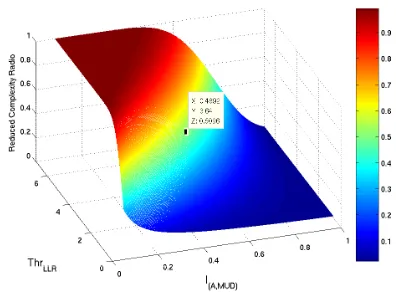
Fig. 2. Complexity reduction radio of the low-complexity Bayesian MUD when supportingL= 6users
where all the notations have been define before. Eq.12 will lead to the maximum-likelihood solution.
In order to further reduce the complexity of the Bayesian turbo
MUD, we introduce thea prioriLLR threshold valueT hrLLR.
Be-fore invoking thea prioriprobability vector for calculatingLm,p(sl), preprocessing of thea prioriinformation is carried, as follows:
P(sl= +1) =
1 ifLm,a(sl)> T hrLLR; 0 ifLm,a(sl)<−T hrLLR;
1 2(tanh(L
m,a(s l)
2 ) + 1) else,
(13)
wherel∈1, . . . , L.
Let us now observe Eq.12 again. Once thea priori information
Lm,a(sl) associated with a specific user l has an absolute value
higher than T hrLLR, half the number of the 2(L−1) PDF terms
in both the numerator and denominator will become zero, when calucatingLm,a(sl), l=l. Hence the total number of calculations
required by all theLusers is nearly halved. If the absolute value of
thea prioriinformation associated with another user is higher than
T hrLLR as well, the complexity imposed will be further halved. Hence the complexity associated with using this threshold can be expressed as:
CLC≈COriginal·(1−12P(|Lm,a(sl)|> T hrLLR))L, (14)
whereCOriginalis the original complexity of the Bayesian MUD,
which can be seperated into two parts, namely the calculation of the legitimate channel output states and the addition of the Gaussian PDFs . The computation of the legitimate channel output states
requires 2∗2LP(2L−1) operations, while the addition of the
Gaussian PFDs requires2L(6P+1)operations, plus2Lexp function
evaluations, when considering a single transmitted bit. When the Gaussian distribution assumption is applied to the PDF of the LLRs,
Lm,a(sl)can be considered to be normally distributed with a mean
ofµ=sl·σ2LLR/2and a variance ofσ2LLR[6]. Then following a
number of steps we can derive:
P(|Lm,a(sl)|> T hrLLR) =Q
T hrLLR−1 2σLLR2 σLLR
(15)
+Q
T hrLLR+1 2σ2LLR σLLR
.
Furthermore, thea priorimutual information ofI(A,MUD)
avail-able for the MUD and calculated between thea prioriinformation
System Parameters SDMA
Number of users 2, 4, 5, 6 ,8
Number of receiver
antennas 2
Channel impulse 3-path SWATM
response symbol-invariant [2 p.78] OFDM
Number of subcarriers 128
Length of cyclic prefix 32
Modulation BPSK
Channel Coding
Type NSC, RSC
Code rate 1/2
Constraint Length 4
Turbo interleaver
block length 20480
[image:4.612.101.273.66.230.2]Decoder type Approximate Log MAP [4] TABLE I
PARAMETERS FOR THE SIMULATIONS.
I(σLLR) = 1−
∞
−∞ e
−(x−σ2LLR/2)2 2σ2
LLR
√
2πσLLR ·log2(1 +e
−x)dx. (16)
Since the function I(σLLR) is monotonically increasing, it is
invertible. Therefore, the complexity reduction ratio COriginalCLC will
be a function of the LLR threshold T hrLLR and that of the a
priori mutual information I(A,MUD) of the MUD. Fig.2 portrays
the 3-D complexity reduction ratio, when supportingL= 6users.
As expected, this ratio is a monotonically increasing function of
the thresholdT hrLLR, while a monotonically decreasing function
of the a priori mutual information I(A,MUD) of the MUD. This
implies that we have to set the value ofT hrLLRas low as possible
without inflicting any significant performance degradation in order to obtain the best possible complexity reduction. The simulated results of Section IV will provide us with further insight on the best
tradeoff value ofT hrLLRbetween maintaining a low complexity and
imposing a performance degradation.
IV. SIMULATION RESULTS
In this section, the attainable performance of the proposed low-complexity Bayesian turbo MUD is investigated in comparison to the other two linear turbo MMSE MUDs outlined in Section III. The EXIT chart technique is employed as our semi-analytical convergence testing tool. Our system parameters are summarized in Table I. Each user has a different random interleaver. We will demonstrate that the low-complexity Bayesian turbo detector outperforms the two linear turbo MMSE MUDs employed as benchmarkers.
In Fig.3, we plot both the associated EXIT charts along with the associated simulated detection trajectories of the low-complexity Bayesian turbo receiver associated with different threshold values,
when supportingL= 6users, and employing a half-rate,
constraint-length-4 Non-Systematic Convolutional (NSC) encoder for each UL user. The lines characterize the EXIT curves of the proposed low-complexity Bayesian turbo detector in conjunction with different threshold values, indicating that the system’s performance is nearly remain virtually unimpaired, when the threshold values are higher thanT hrLLR= 4. The simulated detection trajectories in conjunc-tion with different threshold values are also shown in Fig.3 using lines marked with arrows. This also indicates that the best tradeoff value
of the LLR threshold is aroundT hrLLR= 4. The iterative detection
process commences from the origin of Fig.3, which represents the absence of a-priori information for the MUD. Then the decoding trajectory traverses to the MUD’s EXIT curve in Fig.3, indicating that valuable LLR information was generated by the MUD. The resultant extrinsic information is forwarded to the channel decoders
0 0.2 0.4 0.6 0.8 1
0 0.2 0.4 0.6 0.8 1
I(E,MUD)
,I(A,CC)
I(A,MUD),I(E,CC) Eb/N0=5dB
Eb/N0=7dB
NSC 0
0.2 0.4 0.6 0.8 1
0 0.2 0.4 0.6 0.8 1
I(E,MUD)
,I(A,CC)
I(A,MUD),I(E,CC) Eb/N0=5dB
Eb/N0=7dB
Bayesian thr=2
0 0.2 0.4 0.6 0.8 1
0 0.2 0.4 0.6 0.8 1
I(E,MUD)
,I(A,CC)
I(A,MUD),I(E,CC)
Eb/N0=5dB
Eb/N0=7dB
Bayesian thr=4
0 0.2 0.4 0.6 0.8 1
0 0.2 0.4 0.6 0.8 1
I(E,MUD)
,I(A,CC)
I(A,MUD),I(E,CC) Eb/N0=5dB
Eb/N0=7dB
Bayesian thr=10
0 0.2 0.4 0.6 0.8 1
0 0.2 0.4 0.6 0.8 1
I(E,MUD)
,I(A,CC)
I(A,MUD),I(E,CC)
Eb/N0=5dB
Eb/N0=7dB
Bayesian Trajectory thr=2
0 0.2 0.4 0.6 0.8 1
0 0.2 0.4 0.6 0.8 1
I(E,MUD)
,I(A,CC)
I(A,MUD),I(E,CC)
Eb/N0=5dB
Eb/N0=7dB
[image:4.612.313.460.72.217.2]Bayesian Trajectory thr=4
Fig. 3. EXIT charts and simulated trajectories of the low-complexity Bayesian MUD with different threshold values forP= 2receiver antennas andL= 6users
of Fig.1 and hence the detection trajectory reaches the EXIT curve of the channel decoder, which demonstrates that further extrinsic information is obtained from the SISO channel decoder assisted by the a-priori information gleaned from the MUD. During its further evolution, the trajectory traces up to the MUD’s EXIT curve again, as a result of exploiting the extrinsic information extracted from the channel decoder, which is fed back to the MUD and so forth. In other words, the trajectory evolves in this manner within the open detection tunnel between the EXIT curves of the MUD and the channel decoder, until it reaches the intersection of the curves if the threshold is large enough. The simulated detection trajectories when the threshold equal to 4or larger closely follow the behaviour predicted by the EXIT curves.
0 0.2 0.4 0.6 0.8 1
0 0.2 0.4 0.6 0.8 1
I(E,MUD)
,I(A,CC)
I(A,MUD),I(E,CC)
Eb/N0=2dB
Eb/N0=6dB
BAYESIAN thr=4 0
0.2 0.4 0.6 0.8 1
0 0.2 0.4 0.6 0.8 1
I(E,MUD)
,I(A,CC)
I(A,MUD),I(E,CC)
Eb/N0=2dB
Eb/N0=6dB
RMMSE
0 0.2 0.4 0.6 0.8 1
0 0.2 0.4 0.6 0.8 1
I(E,MUD)
,I(A,CC)
I(A,MUD),I(E,CC)
Eb/N0=2dB Eb/N0=6dB
CMMSE
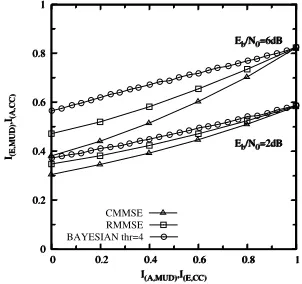
Fig. 4. EXIT charts of different turbo MUDs forP= 2receiver antennas andL= 6users
In order to plot the EXIT curves for the iterative multi-user com-munication system in a 2-D plane, the average of all the users’ mutual information was used. If the average Channel Impulse Response (CIR) and SNR of each user is similar, then this may be judiciously exploited for the sake of employing EXIT analysis.
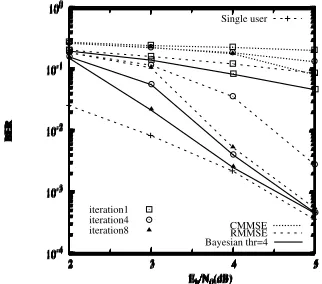
[image:4.612.319.470.401.543.2]at the abscissa of zero, followed by the RMMSE and then the CMMSE scheme, providing the widest EXIT tunnel. Hence the Bayesian detector has the lowest SNR convergence threshold and fastest convergence rate, again, followed by the RMMSE and the CMMSE detector. Fig.5 portrays the BER performance of these three
10-4 10-3 10-2 10-1 100
2 3 4 5
BER
Eb/N0(dB)
iteration1 iteration4 iteration8
10-4 10-3 10-2 10-1 100
2 3 4 5
BER
Eb/N0(dB) Bayesian thr=4 10-4
10-3 10-2 10-1 100
2 3 4 5
BER
Eb/N0(dB)
10-4 10-3 10-2 10-1 100
2 3 4 5
BER
Eb/N0(dB)
10-4 10-3 10-2 10-1 100
2 3 4 5
BER
Eb/N0(dB) RMMSE
10-4
10-3
10-2
10-1
100
2 3 4 5
BER
Eb/N0(dB) 10-4
10-3 10-2 10-1 100
2 3 4 5
BER
Eb/N0(dB)
CMMSE
10-4 10-3 10-2 10-1 100
2 3 4 5
BER
Eb/N0(dB)
[image:5.612.86.247.126.268.2]Single user
Fig. 5. BER performance of the different MUDs forP= 2receiver antennas andL= 6users
MUD algorithms parameterized by the SNR, which confirms the predictions of our EXIT chart analysis. It is clearly seen in Fig.4 that when the SNR is higher than a certain threshold and the number of iterations is sufficiently high, the achievable BER of each of the three MUDs approaches the single-user-bound.
0 0.2 0.4 0.6 0.8 1
0 0.2 0.4 0.6 0.8 1
I(E,MUD)
,I(A,CC)
I(A,MUD),I(E,CC) RSC
0 0.2 0.4 0.6 0.8 1
0 0.2 0.4 0.6 0.8 1
I(E,MUD)
,I(A,CC)
I(A,MUD),I(E,CC) NSC
0 0.2 0.4 0.6 0.8 1
0 0.2 0.4 0.6 0.8 1
I(E,MUD)
,I(A,CC)
I(A,MUD),I(E,CC)
Eb/N0=4dB
Single user 0
0.2 0.4 0.6 0.8 1
0 0.2 0.4 0.6 0.8 1
I(E,MUD)
,I(A,CC)
I(A,MUD),I(E,CC)
Eb/N0=4dB
3users
0 0.2 0.4 0.6 0.8 1
0 0.2 0.4 0.6 0.8 1
I(E,MUD)
,I(A,CC)
I(A,MUD),I(E,CC) Eb/N0=4dB
4users
0 0.2 0.4 0.6 0.8 1
0 0.2 0.4 0.6 0.8 1
I(E,MUD)
,I(A,CC)
I(A,MUD),I(E,CC) Eb/N0=4dB
5users
0 0.2 0.4 0.6 0.8 1
0 0.2 0.4 0.6 0.8 1
I(E,MUD)
,I(A,CC)
I(A,MUD),I(E,CC)
Eb/N0=4dB
6users
0 0.2 0.4 0.6 0.8 1
0 0.2 0.4 0.6 0.8 1
I(E,MUD)
,I(A,CC)
I(A,MUD),I(E,CC)
Eb/N0=4dB
7users
0 0.2 0.4 0.6 0.8 1
0 0.2 0.4 0.6 0.8 1
I(E,MUD)
,I(A,CC)
I(A,MUD),I(E,CC)
Eb/N0=4dB
8users
0 0.2 0.4 0.6 0.8 1
0 0.2 0.4 0.6 0.8 1
I(E,MUD)
,I(A,CC)
I(A,MUD),I(E,CC) Eb/N0=4dB
9users
0 0.2 0.4 0.6 0.8 1
0 0.2 0.4 0.6 0.8 1
I(E,MUD)
,I(A,CC)
I(A,MUD),I(E,CC) Eb/N0=4dB
10users
Fig. 6. EXIT characteristics of the NSC and RSC channel decoders and that of the low-complexity Bayesian MUD withthr= 4for supporting different number of users atEb/N0= 4dB, when employingP= 2receiver antennas
Fig.6 allows us to compare the EXIT curves of different con-volutional channel codes, namely that of the previously used NSC code as well as that of the half-rate, constraint-length-4 Recursive Systematic Convolutional (RSC) code to the corresponding EXIT curve of the Bayesian MUD, when supporting different number of users atEb/N0 = 4dB. We can see in Fig.6 that all the curves corresponding to the different numbers of users converge to the same point, again, attaining a near-single-user performance. This indicates that regardless of the number of users, all the multiple access interference can be removed when perfect a-priori information is available, namely, at the abscissa value of unity. The differences of these curves supporting different numbers of users may be observed both in terms of their different ordinate values at abscissa value of zero and the sloping rates. The higher the number of users supported, the lower ordinate starting points in Fig.6 and the steeper their slopes. This is because supporting a higher number of users imposes more interference at the MUD’s output, resulting in a lower extrinsic mutual information improvement, when the same amount of a-priori information is provided. More explicitly, Fig.6 suggests
that atEb/N0= 4dB, at leastL= 8users can be supported, since there is an open EXIT-tunnel between the MUD’s and the channel decoder’s EXIT curves. Let us briefly compare the different channel codes adopted, namely the NSC and RSC code having the generator polynomials of (15,17) and (13,6) expressed in terms of their octal representation, respectively. We may conclude from Fig.6 that the shapes of the EXIT curves associated with the NSC and RSC are similar, although the NSC code has the potential of offering the benefits of a slightly wider EXIT tunnel initially, at the cost of having a lower ordinate value at the abscissa of zero. This implies having a higher residual BER for the NSC code.
The best matching channel decoder for the MUD considered can be found for example by using the Irregular Convolutional Codes (IRCC) derived in [9].More explicitly, this procedure allows us to shape the IRCC scheme’s EXIT characteristic so that it matches that of the MUD and hence provides an open EXIT-tunnel at low SNRs, thereafter it is capable of potentially supporting near-capacity operation.
V. CONCLUSION
In conclusion, a novel low-complexity Bayesian turbo MUD was proposed, which is capable of outperforming both the CMMSE and the RMMSE turbo MUDs. We also demonstrated the accuracy of EXIT charts, despite the non-Gaussian LLR-distribution recorded at the output of the Bayesian MUD. The focus of our future work is on the design of similar turbo receivers for high-throughput QAM schemes using a variety of sophisticated channel decoders [4].
REFERENCES
[1] P. Vandenameele, L. van Der Perre, and M. Engels, Space Division Multiple Access for Wireless Local Area Networks. Boston: Kluwer Academic Publishers, 2001.
[2] L. Hanzo, M. M¨unster, B. J. Choi and T. Keller,OFDM and MC-CDMA. West Sussex, England: John Wiley and IEEE Press, 2003.
[3] C. Berrou, A. Glavieux, and P. Thitimajshima, “Near-optimum error-correcting coding and decoding: Turbo codes,”IEEE Transactions on Communications, vol. 44, pp. 1261–1271, Oct. 1996.
[4] L. Hanzo, T. H. Liew and B. L. Yeap,Turbo Coding, Turbo Equalisation and Space Time Coding for Transmission over Wireless Channels. West Sussex, England: John Willy and IEEE Press, 2002.
[5] M. Tuchler, A. C. Singer, and R. Koetter, “Minimum mean squared error equalization using a priori information,”IEEE Transactions on Signal Processing, vol. 50, pp. 673–683, March 2002.
[6] S. ten Brink, “Convergence of iterative decoding,”IEE Electronic Letters, vol. 35, no. 13, pp. 1117–1118, June 1999.
[7] S. Chen, A. K. Samingan, B. Mulgrew, and L. Hanzo, “Adaptive minimum-BER linear multiuser detection for DS-CDMA signals in mul-tipath channels,”IEEE Transactions on Signal Processing, vol. 49, no. 6, pp. 1240–1247, June 2001.
[8] W. R. Schober and L. Lampe, “On suboptimum receivers for DS-CDMA with BPSK modulation,”Signal Processing, vol. 85, no. 6, pp. 1149–1163, June 2005.
[image:5.612.86.237.353.496.2]