Computer Geek Versus Computer Chic: IT Education and IT
Careers
Reena Pau,
University of Southampton.
David Argles,
University of Southampton
Su White,
University of Southampton
Gillian Lovegrove
British Computer Society
Abstract
The number of women in the UK IT Industry is now down to 20% (SSDA 2004): a worrying fact since the IT Industry is currently facing a skills shortage . A contributing factor to this is the declining number of women in the IT Sector(e-skills 2004).
This paper explores whether there is a relationship between the method by which IT is taught in UK schools to the pupils’ perception of what a career in IT is really like. There was a particular focus upon pupils in Key Stage Two (preteen) and Key Stage Three (mid-teens) of the national curriculum because studies have shown that it is between the ages of 10-13 (SSDA 2004) that females lose interest in IT. Pupils are far more exposed to IT at home and at school than ever before (Selwyn & Bullon, 2000), which is why it was an appropriate time to understand the influences of education over the use of technologies.
From conducting questionnaires, focus groups and observations in schools and organisations this paper focuses upon three main questions: do pupils perceive the IT Industry in the way that professionals do? Have feelings changed towards IT from preteen to teenagers? And how has the increase in IT within schools made an impact on pupils?
1. Introduction
The IT Industry is a fast paced, dynamic, ever changing sector with lots of opportunities for both men and women (BCS 2004) but why is it that men decide to take up these opportunities and women decide to take alternative career paths?
According to the Sector Skills Development Agency (SSDA 2004) girls typically lose interest in IT between the ages of 10-13. The reasons for this may be varied and complex. Peer pressure and the geeky image of IT is something that girls at schools in this age group have become a lot more aware of (Margolis 2003; Milner 2004). Stereotyping of careers is something that increases skills shortages (Working Group 2004 pg 84). The result of this is that girls are using ‘exciting’ technologies at home but do not make the link between the technologies they use at home and ‘exciting’ IT careers. Projects like ‘Computer Clubs for girls’ are aimed at girls in this age group to sustain interest in IT (e-skills 2004). Organisations are also trying to get more pupils into IT subjects, for example arranging trips to offices to show that IT is ‘fun’.
Pupils are unclear of what a career in IT actually means and are therefore confused about the work involved, so pupils are only able to relate it to classroom activities i.e. MS Office (Martin 2004).
Technology in schools does not have the excitement it once did (Twist 2003) because pupils are more exposed to IT at home than ever before (Martin 2004). The excitement of the technologies used at home does not compare to those used at school.
2. Objectives of Research
The following three objectives identify the aims of this paper.
2.1 i) Do preteen and teenagers perceive the IT Industry in the same way it is perceived by the IT Professionals?
2.2 ii) Have feelings towards IT changed from preteens to teenagers? 2.3 iii) How has the increase in IT within schools made an impact on pupils?
3. Background
This research paper was carried out during a six-month undergraduate project as part of the Information Technology and Organisations BSc degree programme at the University of Southampton in the School of Electronics and Computer Science.
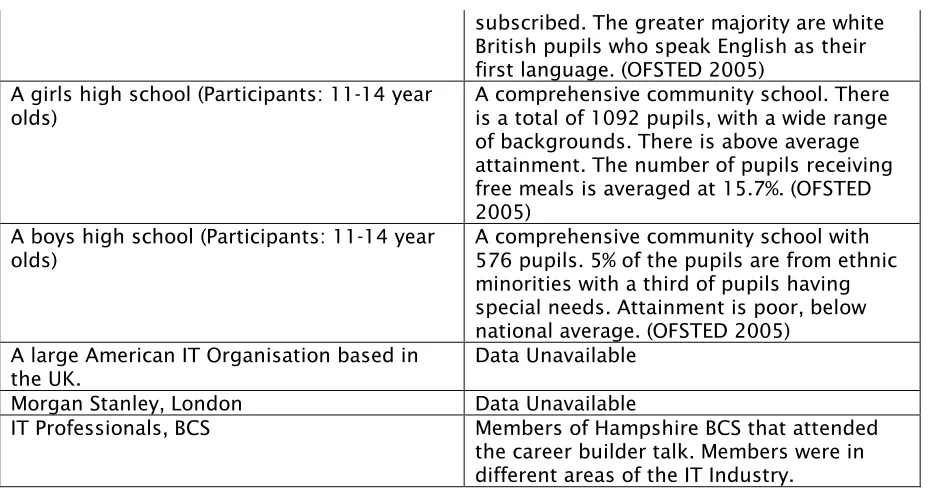
Primary research was conducted at schools1 and organisations. There were three schools in Southampton that took part: a girls’ school, a boys’ school and a mixed primary school. There were three organisations that took part: A large American IT organisation based in the UK2, Morgan Stanley and members of BCS in Hampshire. A
detailed background of the schools and organisations are in Table 1.
Representatives of schools and organisations were approached and acted as links into the schools and organisations. The role of the representatives was to distribute/collect questionnaires; arrange times for observations and focus groups.
Views of both males and females were considered to identify what attracted boys and what deterred girls from choosing an IT Career.
School/Organisation
Details
Mixed Primary School (Participants: 8-11 year olds)
This school is a mixed community school that is popular with parents and is over
subscribed. The greater majority are white British pupils who speak English as their first language. (OFSTED 2005)
A girls high school (Participants: 11-14 year olds)
A comprehensive community school. There is a total of 1092 pupils, with a wide range of backgrounds. There is above average attainment. The number of pupils receiving free meals is averaged at 15.7%. (OFSTED 2005)
A boys high school (Participants: 11-14 year olds)
A comprehensive community school with 576 pupils. 5% of the pupils are from ethnic minorities with a third of pupils having special needs. Attainment is poor, below national average. (OFSTED 2005)
A large American IT Organisation based in the UK.
Data Unavailable
Morgan Stanley, London Data Unavailable
[image:3.612.90.555.67.312.2]IT Professionals, BCS Members of Hampshire BCS that attended the career builder talk. Members were in different areas of the IT Industry. Table 1: Background of Schools and Organisations
4. Methodology
Primary Research was conducted in three stages: questionnaires, observation, focus groups. Quantitative and qualitative methodologies were adopted to obtain data. Qualitative data was needed to build upon the views of participants to get a deeper understanding of the thoughts of pupils and IT Professionals (Bryman 2004).
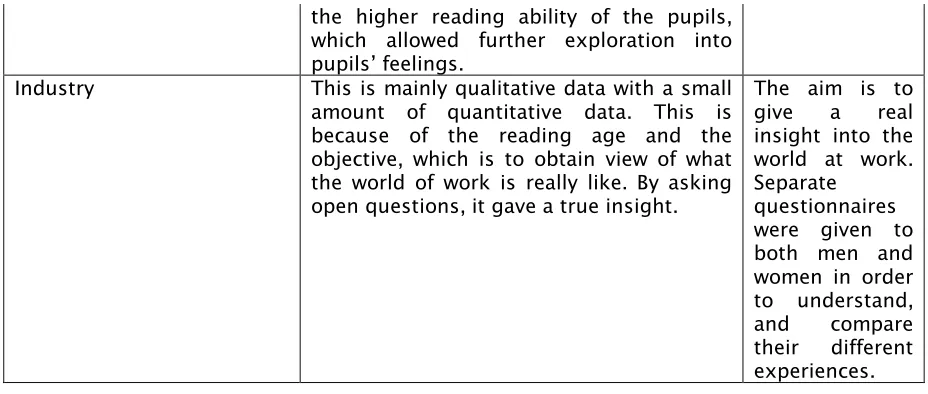
Self-Completion Questionnaires were sent to organisations and pupils in Key Stage Two (age 8-11 – Primary School) and Key Stage Three (age 11-14 – Secondary School) of the national curriculum. Three sets of questionnaires (primary schools, high schools and people in industry) were sent to schools and organisations by post and administered by the representative. To lessen the burden on the representative TDM (Total Design Method) was used for the questionnaires3 (Bryman 2004). There were sets of open and closed questions. A closed question started off an ‘issue’, open questions followed to gain a deeper understanding of the views of the respondents. The questionnaires were no more than a page so respondents’ time wasn’t taken up (Bryman 2004). Table 2 states the questionnaire objectives.
Questionnaire Target Audience
Questionnaire design details. Objective
Primary (Key Stage Two) Closed structured questions, i.e. Yes or No questions. Due to the age group, it is in inappropriate to make the questionnaire into a reading and writing exercise.
Understand views on IT and Computers.
Secondary (Key Stage Three) This collected both quantitative and qualitative data, in that it asked both open and closed questions. It had a lot more questions and has open questions because
Understand views on IT and Computers.
3
the higher reading ability of the pupils, which allowed further exploration into pupils’ feelings.
Industry This is mainly qualitative data with a small amount of quantitative data. This is because of the reading age and the objective, which is to obtain view of what the world of work is really like. By asking open questions, it gave a true insight.
The aim is to give a real insight into the world at work. Separate
[image:4.612.88.552.70.267.2]questionnaires were given to both men and women in order to understand, and compare their different experiences. Table 2: Aims of questionnaires
Observations were used to understand classroom culture and how pupils reacted in lessons with IT Technologies. There was a danger of bias when observing because other factors could influence pupils behaviour in the classroom (Becta 2004). For example, was a pupil feeling positive in a lesson due to enjoyment in the lesson or enjoyment of school life in general? Asking pupils in focus groups how they felt about school and about IT lessons lessened the effects of bias. Therefore it was inappropriate to categorise what happens in observations into enthusiasm, participation and attitude. All categories can merge into one another. Observations were recorded when something happened, i.e. Incidents4.
Each year group was observed in IT lessons for three hours in total. Sessions provided an idea of the scheme of work and the technologies that the school had available.
Focus groups lasted from ten to twenty minutes (depending on the year group). The aim of the focus group was to understand attitudes to IT lessons and to probe what motivated or deterred pupils to aspire to a career in IT. Pupils were taken out of IT lessons separately in mixed ability groups of five and recorded on a Dictaphone.
5. Questionnaire Responses
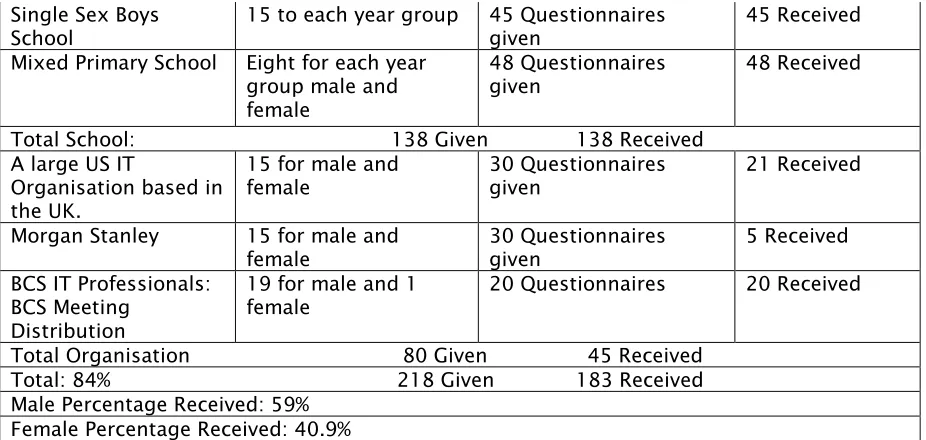
The sample sizes were dependent upon the number of participants the representatives were able to provide. Table 2 shows the number of questionnaires received.
The samples of primary school results were small: there was a total of eight pupils of each gender and secondary school (year 7, 8 and 9) results were small as there were a total of 15 questionnaires from each year group. The representative distributed questionnaires to mixed ability pupils to get a varied response, and this prevented generalisations. These results revealed a lot about the thoughts of pupils and IT Professionals.
Type of
Organisation
Sample
Detail
Sample Total
Total
Received
Single Sex GirlsSchool
15 to each year group 45 Questionnaires given
45 Received
Single Sex Boys School
15 to each year group 45 Questionnaires given
45 Received Mixed Primary School Eight for each year
group male and female
48 Questionnaires given
48 Received
Total School: 138 Given 138 Received A large US IT
Organisation based in the UK.
15 for male and female
30 Questionnaires given
21 Received
Morgan Stanley 15 for male and female
30 Questionnaires given
5 Received BCS IT Professionals:
BCS Meeting Distribution
19 for male and 1 female
20 Questionnaires 20 Received
Total Organisation 80 Given 45 Received Total: 84% 218 Given 183 Received Male Percentage Received: 59%
[image:5.612.90.553.71.291.2]Female Percentage Received: 40.9%
Table 3: Number of questionnaires received
6. Results
6.1 Do pupils (both pre-teen and teenagers) perceive the IT Industry
in the way it is experienced by IT Professionals?
The issues discussed in this section are:
• Boredom versus Excitement
• Lesson Enjoyment versus Career Aspirations • Creative careers
• Career Choice • Discrimination • Role Models • Technical Aspects
6.1.1 Boredom versus Excitement
Pupils do not perceive the IT Industry in the way that IT Professionals do because both have totally different experiences of the Industry (Nielsons, et al 2001). From questionnaire results, IT Professionals (both genders) are extremely positive about their career and enjoy being part of a dynamic, fast moving industry. A common comment was: ‘I cannot see myself doing anything else’.
In contrast, pupils surveyed view the Industry as ‘boring’ and were unclear of the opportunities surrounding IT. In questionnaires pupils were asked to name four words they associated with a career in IT, the most common were: ‘Money’, ‘Boring’, ‘Not Active’, ‘Hard work’ and ‘complicated’. Girls said words like ‘boring’, ‘offices’ and
‘receptionist’. Pupils didn’t write the word geek or the attributes of a geek (which was expected!). Instead pupils have written about the type of work involved, for instance ‘hard’, ‘complex’ and ‘Viruses’.
6.1.2 Lesson Enjoyment versus Career Aspiration
According to questionnaire results (see graph one and two) each gender viewed enjoyment of IT lessons and IT career aspirations differently. This could be a factor in why girls lose interest in the subject much quicker than boys.
For girls the level of enjoyment in lessons is a factor in deciding if they see IT as a possible career option, so in other words they link IT lessons and IT careers together, whereas boys view IT lessons separately to IT careers.
However In year 9 both genders’ exhibited the same level of career aspiration at 20%. A possible reason for this is that in year 9 pupils are choosing GCSE options. See graphs 1 and 2 below.
Boys: Enjoyment Vs ICT Career Aspirations
0% 20% 40% 60% 80% 100% 120%
Year 4 Year 5 Year 6 Year 7 Year 8 Year 9
Year Group
P
e
rc
e
n
ta
g
e
Enjoyment Career
Girls: Enjoyment vs Career Aspirations
0% 20% 40% 60% 80% 100% 120%
Year 4 Year 5 Year 6 Year 7 Year 8 Year 9
Year Group
P
e
rc
e
n
ta
g
e
Enjoyment Career
Graph 2: Graph to show girls’ enjoyment in IT Lessons and IT Career Aspirations
6.1.3 Creative Careers
Due to the repetitive use of the word: ‘boring’, pupils were asked what they enjoyed about IT: ‘Page Plus designing front covers’ and ‘PowerPoint presentations are fun, cos you can create what you want’. Creative tasks were popular with pupils however from the questionnaire results it seems that pupils have ‘creative tasks’ as a treat in free lessons. This implies that creativity is not work because it’s seen as easy and cannot be easily assessed. IT professionals love creative roles; questionnaire results from female web designers and computer games designer showed a passion for the role that they are in: ‘Its great, I get to use logic as well as creativity, it’s a really fun job…now how many people can say that?!’
6.1.4 Career Choice
A career in IT isn’t something that males or females in organisations aspired to when they were the age of the participants. However male participants interest in technology started before females became interested in it. The male participants were interested in IT because they enjoyed technology, however they didn’t relate enjoyment to a future career until later on. For example a male participant from an organisation demonstrates a typical male response: ‘I’d fooled around with computers from the age of 11, then when I got careers advice at 16 I didn’t know what I wanted to do, so I asked what paid well – it was either Computing or Medicine (I hate Biology).’
Figure 1: Stuff Magazine
6.1.5 Discrimination
All women questioned in organisations claimed that they did not feel ignored or discriminated against and that they are respected. However they do feel that they are under pressure to prove that they are just as good as their male counterparts; for example participant three (Morgan Stanley) claims: ‘I don’t feel ignored, In someway it's an advantage being a woman in a very male dominated profession. However it’s harder to be accepted as technically excellent. Also, as you get older, there seem to be fewer women and the culture of the department is very masculine and it can be very difficult for a woman to be assertive without being perceived as aggressive.’ Over 65% of pupils questioned said that IT is a career for both genders, a year 7 girl said: ‘because girls are multi-tasked and boys love mechanical items’. Pupils (both genders), are not expecting to be discriminated against and are not expecting to discriminate. Girls questioned did not mention the possibility of discrimination against them as a factor for not wanting a job in IT (Adam et al 2004).
However from initial observations at boys’ school there were magazines called ‘Stuff’ in the IT room. These have informative content however the cover had a woman with very
little clothing! The teacher used these as props in the classroom to demonstrate new technologies and thus the subliminal message between gender and technology is reiterated. See Figure 1 for a ’Stuff’5 front cover.
In a year 9 boys database class, the teacher used the tactic of getting the students to type in their top ten most favourite footballers to populate the database, however this didn’t work, so the teacher used the tactic of using their top ten ‘fittest’ women. The pupils seemed enthusiastic and the databases got populated very quickly.
By displaying women’s relationship with technology in a sexual way, women are displaced in the IT sector as submissive to men: these connotations clearly reinforce the message that the IT sector is a plaything ‘for the boys’ – a sector where women have no clear place.
6.1.6 Role Models
Role models (Lightbody & Durndell 1998, p.37-58) were a factor for both genders in primary schools as justification for not wanting a career in IT. Parents who use the computer at work are what pupils have as ‘IT Role models’. Parents provide views of working in the IT Industry. Below is a typical answer from primary school pupils (in this case a year 5 female):
Participant: ‘because it might hurt your head and your eyes’ Interviewer: ‘Why do you think that it might hurt your eyes?’
Participant: ‘My mum works at the Southampton Institute and spends all day on the computer, when she comes home she always says that she’s got a headache and tells me to be quiet’.
IT Professionals revealed that role models as well as family support influenced decisions by convincing them to join the profession or to take on Computer Science at higher education. For example, ‘An agreement with my Dad, that if I got a good O Level
in Maths that I would do an A Level in Computer Science, - I didn’t think that I would so [it was] a good bet - I therefore did CS [computer science] A-level and then for a degree as I was good at it.’
6.1.7 Technical Aspect
Both girls and boys in primary school felt negative about having a job in IT because they felt IT jobs were about ‘fixing things’. For example a year five female pupil said: ‘ if I’m on my own in the office…I might have a cup of coffee and go … Oops [action of spilling]’.
Boys in year six had the same sorts of comments,: ‘I don’t like IT because I wouldn’t know what to do if something went wrong’ and ‘because it is complicated’. Pupils feel that IT is difficult and challenging. There was an obsession with fixing equipment as pupils thought IT was all about the actual machine, pupils didn’t talk about having to work in a team or deadlines etc.
In focus groups, pupils (year 9 boys in particular) that didn’t want a career in IT gave different reasons: ‘because I want to fix things’ this pupil revealed that he wanted to be mechanic when he was older. Another reason was ‘because I want to be a builder’. This pupil later revealed that he wanted to ‘create things’ and ‘make things’; these are all skills that IT Industry would benefit from. However pupils feel that they are not good enough to fulfil these roles.
6.2 How have feelings towards IT Changed during pre-teen to
teenager?
The issues discussed in this section are: • Lesson Enjoyment
• Creativity and Fun • Repeating Work • GCSE Choices
6.2.1 Lesson Enjoyment
Girls and Boys enjoyment rates
0% 20% 40% 60% 80% 100% 120%
Year Four Year Five Year six Year seven Year eight Year nine
Year groups
P
e
rc
e
n
ta
g
e
o
f
p
u
p
il
s
Girls Boys
H
ig
h
S
c
h
o
o
l
M
o
v
e
Graph 3: Comparison of gender IT enjoyment rates
6.2.2 Creativity and Fun
Creativity and fun are fundamental in IT. The first introductions that pupils have to computers in an educational setting are games and creative programs such as paint.
Once pupils are able to grasp the basic concepts of using a computer, they are able to use one at home and together with parents or a sibling, pupils are able to explore the different programs available. The element of fun in IT lessons is kept throughout the primary school stage because pupils are constantly being introduced to new concepts and programs(Coupapel 1999).
When pupils get to secondary school a fundamental part of computing is missing and that is ‘fun’. According to questionnaire results and focus groups 77% of all girls enjoy playing games for example comments were: ‘if we could have 10 mins at the end of each lesson to play games’.
6.2.3 Repeating Work
In primary school pupils are taught about Access, Excel and Word. They are able to practice these newfound skills at home.
In secondary school, pupils also have to learn about Access, Excel and Word. Pupils have to use the same programs that they have at home. In the girls’ high school, at least 4 students in each year group said that they wanted to learn something new every lesson: ‘we do the same thing every time and it’s boring’.
A good example of this is during the observation of year 5. The pupils were learning about databases: trends in data, anomalies and CRUD6
. Students in year 9 were having the same lesson except the database was about hotels rather than footballers.
Boys have had a consistent interest in computing out of school resulting from playing computer games so interest is sustained. However girls lose interest soon after they enter high school at year eight because they see lessons as repetitive and they only play computers at home if there is nothing else to do. Moreover, this again affects career choice, as girls view IT lessons as a reflection of an IT Career.
6.2.4 GCSE Choices
The biggest contrast between year 7 and year 9 was that year 7 was keen to get the work done, found it a challenge and generally enjoyed the lessons. In year nine, there was a split between those who wanted to work hard at IT and those who didn’t. There could be various reasons for this, one is that year nine is when pupils choose their GCSE options. The behaviour and attitudes could be affected by this because when questioned those who were carrying on the subject were engaged in the work in comparison to those who decided not to carry IT on for GCSE.
Out of all the questionnaires (138 received) that were returned only one participant wrote the word ‘geek’ and when asked in focus groups and questionnaires, over 65% of all pupils said that IT was for both boys and girls, it doesn’t seem to be the image of IT that’s stopping pupils from wanting a career in it, it is the variation of work and the pupils experience at school that is a determining factor. If the only experience pupils obtain from IT is doing the same work repeatedly then it seems doubtful that we are going to get people into the industry. The biggest difference in boys and girls is that boys are able to sustain an interest in IT outside of school, where as girl develop new interests.
6.3 How has an increase in IT within schools made an impact on
pupils?
The issues discussed in this section are: • Development
• High Expectations • Impact on teacher • Equal Participation
6.3.1 Development
Computers began to be brought into schools in the mid 1980s. They were seen as new and were locked away. Pupils were often only allowed access if they were part of a special computer club. However as computers increased in importance the number of computers in schools became a lot higher. In 1990 when the National Curriculum was
introduced, Information Technology was made a core subject (Carter & Jenkins 2001; Downes 2002).
Today, Information technology plays a huge part of education in both primary and secondary schools. IT has been integrated into everyday teaching with the use of whiteboards and computer use of IT into various subjects, for example Modern Foreign Languages (teem 2005). Due to Government initiatives pupils are able to have regular access to a computer at school. (Coupapel 1999; Selwyn & Bullon, 2000).
Computers are so a part of pupils’ lives that when observing pupils in secondary schools it was seen that year 9 boys especially didn’t treat the computer equipment with appreciation, for instance, taking the keys off the keyboard and either swapping or hiding them. It seems that pupils are so accustomed to technology that they don’t respect it.
6.3.2 High Expectations
Once pupils move to secondary school, they expect a lot from IT lessons and a lot from the facilities for instance ‘touch screen computers’. However pupils in secondary school commented ‘the computers are crap, they are so slow’. Pupils knew the school had some better facilities but pupils weren’t allowed to use them and they were only brought out on prospective students’ evenings.
6.3.3 Equal Participation
Pupils are aware that IT is for both genders because in primary school all have equal chances to use the computer. A good example of this is when Year 7 (age 11-12) was asked in focus groups if they thought that IT careers were for girls or boys. They all instantly replied IT careers are for both genders.
However stereotypes are still obvious for instance when asked if IT was for boys or girls, a year 8 girl replied: ‘Most office workers are male and boys are into electronics and are more interested’. When questioning her further on this, another participant (the most dominant group member) jumped in saying: ‘what do you mean? We [girls] know all about computers and boys might get bored [of computers]!’ at which point all participants agreed with the dominant group member that computers were for girls.
Year 7 (age 12-13) was asked if they thought that IT careers were for boys or girls. The girls answered individually, giving opinions: ‘I think it’s for boys because whenever you have a computer problem you have to call a man to sort it out’. Another participant agreed saying ‘because girls should be doing more active things and boys like technical business jobs. ’ The next participant disagreed saying ‘girls have more patience and most office people are girls’. The other participants disagreed arguing that IT was a career for both males and females; saying that ’we all have to learn about IT’, ‘my mum says as long as your happy it doesn’t matter what type of job you do as long as you do the job well’ at this point the girls agreed. When I asked if they would like a job in IT the overwhelming response was no and shaking of heads, when asked why they responded:
‘cos there is no way I am going to be stuck in an office all day, it depends what you like’.
Pupils are adamant that IT is for both genders, however it is ‘not for them’; one year 9 girl commented: ‘computers aren’t sexist’.
7. Recommendations
Pupils need to understand that IT is evolving and constantly moving, the IT Curriculum needs to be updated to reflect the changes in the IT World. The following recommendations are in response to pupils’ comments:
1. Both boys and girls have suggested and liked the idea of having play station clubs at lunch and break times. To avoid the risk of boys dominating strategies would need to be adopted to prevent this.
3. Give pupils the chance to get involved with research so that they are aware of what is going on, to give the sense of being part of the future. Pupils need to feel like they can make a difference to the wider world, an example of this would be to tell pupils about biomedical technology and the difference that has made to lives.
4. Creative tasks on the computer should be seen as ‘work’, rather than ‘doss lessons’7. This would give pupils the chance feel like creators rather than just users of technology.
5. More links with Industry, one-off trips to organisations are not enough; allow them to develop a relationship with workers to develop role models in the industry. Organisations are trying to get more pupils into IT subjects, for example arranging trips to offices to show that IT is ‘fun’. However pupils do IT lessons at least once a week, so the work they do in school is a bigger influence than a single trip to an organisation.
IT Professionals were very passionate about their jobs; pupils have to feel the same. Girls and boys have both had the same start with the technology; in order to sustain girls’ interest, they need to enjoy the lesson and feel that they are creating something.
8. Conclusion
Throughout this research process, not one pupil believed that IT is a vibrant, exciting industry. It is apparent that both girls and boys are losing interest in IT and prospects of their continuation in IT are low.
The behaviour of boys and girls in the classroom were very similar, in terms of how they interacted with technology and their somewhat similar views about the industry. Both boys and girls have lost the element of fun and creativity in secondary school IT lessons which means that they find lessons ‘boring’. Another factor for boredom is that there is not much differentiation between what is taught at secondary and junior school.
Pupils are unaware of what a career in IT is; they are confused because of the work they do in school and from the views of role models that are working in IT. Pupils are confused between those that use computers as a tool and those that are creating the next computer.
This paper is entitled ‘computer geek versus computer chic’. However it seems that pupils want a lot more excitement in IT lessons and giving pupils a snippet of the work that ‘geeks’ do could be the key to engaging them and giving a better understanding of the IT Profession, we need prove to pupils that geek can be chic.
9. Acknowledgements
The authors would like to thank the pupils and the IT Professionals from schools and organisations that took part in questionnaires, focus groups and observation sessions.
References
Adam A, Howcroft D, Richardson H, 2004, A decade of Neglect: reflecting on gender and IS, New Technology, Work and Employment, Blackwell Publishing, 19[3], 222-240.
Becta, 2004, Secondary School and IT Standards, An analysis of data from Ofsted and QCA by Becta. Becta Publications.
Becta, 2003, The impact of Information Technology and Communications on Pupil Learning and Attainment [online], Becta Publications. Available from: http://www.becta.org.uk/page_documents/research/report01.pdf [Accessed on: March 27th 2005]
British Computer Society, 2004, Inside Careers: Information Technology, London, Cambridge market Intelligence Ltd & British Computer Society
Bryman, A, 2004, Social Research Methods. 2nd Edition, United States: Oxford University Press.
Carter, J, Jenkins, T, 2001, Where have all the girls gone? What entices female students to apply for computer science degrees, 2nd Annual LTSN-ICS Conference,
London.
Couapel, B, 1999, The influence of Information Technology in the Curriculum (and its implementation), Thesis (PhD), Oxford, UK.
Downes, S, 2002, Into the new millennium: why do students decide to study IT?,
Informing Science
E-Skills/Gartner, 2004, IT Insights: Trends and UK Skills Implications Report,
Available from: www.e-skills.com/register [Accessed: February 2005]
E-Skills, 2004, Computer Clubs for Girls, [online], Available from: http://www.e-skills.com/cgi-bin/wms.pl/33 [Accessed: February 2005]
Gentile A.D, Anderson C.A, 2003, Violent Video Games: The newest media hazard. Ed Gentile A.D, Media Violence and Children: A complete guide for parents and professionals, Praeger: London, p. 132-152.
Lightbody, L, Durndell, A, 1998, Using Stereotypes to dispel negative perceptions of careers in science and technology. Ed. Radford, J, Gender and Choice in Education and Occupation, Routledge: London, p.37-58.
Margolis, J, Fisher A, 2003, Unlocking the Clubhouse: Women in Computing, The MIT Press, US, and 1st Edition.
Milner, M.J, 2004, Freaks, Geeks and Cool Kids: American teenagers, schools and culture of consumption, Routledge, UK.
Martin, U, 2004, 2004, Women, Computing and Chocolate Cake. [online], Available from: www.web.comlab.ox.ac.uk/oucl/seminars-ht05/wccc.pdf [Accessed: March 27th 2004]
Nielsons, S,. Von Hellens, L., Wong, S., The Male IT Domain: You’ve Got To Be In It To winIT!,12th Australiasians Conference on Information Systems, 5-7th December 2001, Coffs Harbour, NSW,.
Ofsted, 2005, Inspection Reports, Office for standards and education [online],
Available from: http://www.ofsted.gov.uk/reports/index.cfm?fuseaction=lea&id=852 [Accessed: March 2005]
Prospects Career Service, 2004, Working futures: forecast of employment prospects for 2012 (spring 04) [online], Available from:
Selby L, Ryber K & Young A, 1998, Women in Computing: What does the data show?, ACM SIGCSE Bulletin, 30 [4], 62-67.
Selwyn N, Bullon K, 2000, Primary School Children’s use of IT, British Journal of Educational Technology, 31 [4], 321-332.
SSDA, 2004, Computer Agency for Girls sparks enthusiasm and interest in IT
[online], Skills for Business, Available from:
http://www.ssda.org.uk/ssda/Default.aspx?page=242 [Accessed: 20th
November 2004]
Teem, 2005, Teachers evaluating educational multimedia [online], Available from: http://www.teem.org.uk/ [Accessed 27 March 2005]
Teem, 2004, Teachers evaluating educational multimedia, Report on the use of educational games [online], Available from:
http://www.teem.org.uk/publications/teem_gamesined_full.pdf [Accessed 27 March 2005]
Twist, J, 2003, Technology that makes you go wow, BBC, Available from: http://news.bbc.co.uk/1/hi/technology/3175506.stm [Accessed Jan 2005]