
ARTICLE
Cite this: DOI: 10.1039/x0xx00000x
Received 00th January 2012, Accepted 00th January 2012
DOI: 10.1039/x0xx00000x
www.rsc.org/
2-Arylacetic Anhydrides As Ammonium Enolate
Precursors
Louis C. Morrill, Lyndsay A. Ledingham, Jean-Philippe Couturier, Jasmine Bickel, Andrew D. Harper, Charlene Fallan and Andrew D. Smith*
Readily prepared 2-arylacetic anhydrides act as convenient ammonium enolate precursors in isothiourea (HBTM-2.1)-mediated catalytic asymmetric intermolecular Michael addition-lactonisation processes, giving diverse synthetic building blocks in good yield with high diastereo - and enantiocontrol (up to 95:5 dr and >99% ee).
Introduction
Within the arena of Lewis base catalysis,1 the generation and application of ammonium enolates2 toward generating stereodefined molecules with high levels of stereocontrol is of widespread interest in asymmetric catalysis.3 Most commonly formed from the interaction of a nucleophilic tertiary amine with either a preformed or in situ generated ketene,4 C1-ammonium enolates present an attractive alternative to existing organocatalytic strategies for the generation of enolates or their equivalents such as the use of enamines,5 N-heterocyclic carbenes (NHCs),6 and cinchona alkaloid derivatives.7
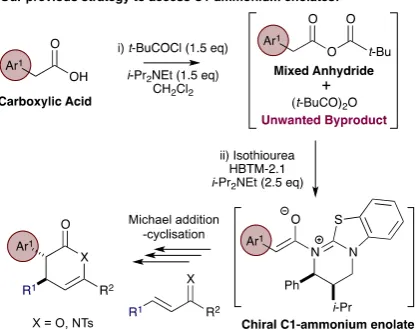
Building upon the pioneering intramolecular nucleophile catalysed aldol-lactonisation (NCAL) strategy developed by Romo,8 we have recently shown that isothioureas,9 initially employed by Birman and Okamoto as efficient O-acyl transfer reagents,10 can generate ammonium enolates from carboxylic acids through in situ formation of a mixed anhydride and subsequently undergo a range of intra- and intermolecular Michael addition-cyclisation processes.11 While this powerful synthetic strategy allows access to a range of stereodefined products in high enantioselectivity, noteworthy drawbacks include the use of excess sacrificial base (up to 4 equivalents of i-Pr2NEt) and the production of unwanted by-products derived
from the acid “activating agent” (such as pivalic anhydride derived from pivaloyl chloride) that can be difficult to separate from the desired products (Figure 1).
As part of our on-going interest in Lewis base catalysis12 we wished to investigate alternative bench stable precursors to ammonium enolates at the carboxylic acid oxidation level. Following our recent report on the generation of , -unsaturated acyl ammonium species from homoanhydrides,13 and inspired by Connon’s functionalisation of enolisable anhydrides using bifunctional squaramides,14 in addition to Chi’s use of p-nitrophenyl esters as azolium enolate precursors,15 we envisaged readily available 2-arylacetic anhydrides as C1-ammonium enolate precursors (Figure 2).
Figure 1. Previous access to isothiourea-derived C1-ammonium enolates from carboxylic acids
[image:1.595.325.534.327.492.2]This work: preformed arylacetic anhydrides as precursors
Ar1 O O
HBTM-2.1 Base (1 eq)
Ar1 N O
N S
Ph
i-Pr
Ar2 X Y R
O Michael Addition
Cat O
X Y
O Ar2 Ar1
Lactonisation X
Y O O
Ar2 Ar1
LB*
R R Organocatalytic
Functionalisation O
Ar1 O
O
O O
R
1. Squaramide A
(5 mol%) MTBE (0.1 M),
-15 ˚C
2. TMSCHN2 (1.2 eq), MeOH
O O
R
CO2Me
O O
N H NH
N
OMe F3C
F3C N
Squaramide A Connon's work:
Chi's work:
Ar1 O
OPNP PNP = 4-NO2C6H4
+
Ar2 Ar3
NTs
NTs O
Ar3 Ar1
Ar2 azolium salt B
(30 mol%) Me4NCl (1 eq) i-Pr2NEt (5 eq) CH2Cl2, rt 24 h
N N
N
Ph
Ph
BF4
azolium salt B
up to 20:1 dr and 99% ee up to 97:3 dr and 99% ee +
Figure 2. Proposed direct access to C1-ammonium enolates from arylacetic anhydrides.
Results and discussion
Optimisation Studies:
Initial proof of concept studies used 2-phenylacetic anhydride 1
as an ammonium enolate precursor and trifluoromethylenone 2
as a Michael acceptor, with laboratory grade solvents employed as standard. 2-Phenylacetic anhydride (and all 2-arylacetic anhydrides used throughout this manuscript) is simply prepared by reaction of the parent arylacetic acid with DCC and is bench stable for approximately one week.17 Using achiral DHPB (10 mol%) as a catalyst only ~80% conversion of trifluoromethyl ketone 2 was observed when 1 equivalent of both 2-phenylacetic anhydride and i-Pr2NEt were used. Using a slight
excess of anhydride 1 (1.25 eq) and i-Pr2NEt (1.25 eq) was
necessary for complete consumption of 2, presumably due to Claisen-type self condensation of the anhydride,giving 4 after in situ ring opening with MeOH in 71% yield and 90:10 dr at rt. Screening of a small number of chiral isothioureas in this process showed that HBTM-2.1 3 offered higher enantioselectivity then either tetramisole or benzotetramisole at rt (entries 2-4, Scheme 1). Lowering the reaction temperature to -78 °C gave optimal diastereo- and enantiocontrol using HBTM-2.1 3 (entry 5), giving trifluoromethyl ketone 4 directly from anhydride 1 in 78% yield, 90:10 dr and 99% ee. Alternatively, Michael addition-lactonisation gave lactone 5
that was isolated in 81% yield and with excellent diastereo- and enantioselectivity (94:6 dr, 98% ee). In all cases, highly pure material could be obtained after a simple acid/base work-up, with chromatographic purification used to obtain analytical samples.
Entry Isothiourea Prod T/˚C dra Yield Eed
1 DHPB 4 rt 90:10 71b
2 tetramisole 4 rt 87:13 52b 83
3 benzotetramisole 4 rt 84:16 58b 71
4 HBTM-2.1 3 4 rt 80:20 67b 88
5 HBTM-2.1 3 4 -78 90:10 78b 99
[image:2.595.47.296.54.338.2]6 HBTM-2.1 3 5 -78 94:6 81c 98
Table 1. Optimisation studies: [a] Determined by 1H NMR spectroscopic analysis of the crude reaction mixture; [b] Isolated yield of 4 (≥95:5 dr); [c] Isolated yield of 5 (90:10 dr); [d] Determined by chiral HPLC analysis.
Generality: Anhydrides as ammonium enolate precursors for asymmetric Michael addition-lactonisation with trifluoromethylenones
With an optimised process developed, the generality of this asymmetric Michael addition-lactonisation process using 2-arylacetic anhydrides was investigated. Sequential variation of the anhydride component was first investigated using trifluoromethylenone 2 (Table 2), with all product racemates prepared using DHPB. Using 5 mol% of 3 as standard, under optimised conditions this process readily tolerates 3- or 4-aryl substitution within the anhydride, including electron-withdrawing and -donating substituents (products 6-11) as well as extended aromatic systems (product 12).Interestingly, 2-aryl substitution within the anhyride is not tolerated in this system. For example the use of methylphenyl)acetyl 2-(2-methylphenyl)acetate gave <5% conversion to the desired product. Furthermore the use of 2-(thiophen-3-yl)acetic anhydride leads to reduced product diastereoselectivity (product
[image:2.595.49.547.56.334.2]Table 2. Variation of arylacetic anhydride component; [a] Determined by 1H NMR spectroscopic analysis of the crude reaction mixture; [b] Isolated yield (≥95:5 dr); [c] Determined by chiral HPLC analysis; [d] Isolated yield at stated dr.
Subsequent studies showed the versatility of this process by focusing upon functionalisation of 2-phenylacetic anhydride with a range of trifluoromethylenones as well as variation of the nucleophilic ring-opening reaction component (Table 3). For example, in addition to in situ ring opening with methanol, alternative nucleophiles such as ethanol and allyl alcohol can also be used (products 14 and 15). Within the Michael acceptor, both electron-withdrawing Cl) and electron-donating (4-OMe) substituents in the aryl unit are readily incorporated, providing the corresponding products in high ee. Heteroaryl substituents (2-furyl), as well as extended aromatic substituents (2-Np) can also be incorporated with good dr (up to 88:12) and ee (up to 99% ee).
Table 3. Variation of trifluoromethylenone and nucleophilic component; [a] Determined by 1H NMR spectroscopic analysis of the crude reaction mixture; [b] Isolated yield at stated dr. [c] Determined by chiral HPLC analysis; [d] Isolated yield (≥95:5 dr).
Anhydrides as ammonium enolate precursors for Michael addition-lactonisations with -keto-,-unsaturated esters and N-aryl-N-aroyldiazenes
Having developed an efficient protocol for the isothiourea catalysed Michael addition-lactonisation of anhydrides and 4-aryl-trifluoromethylenones, this process was extended to other classes of suitably electron deficient Michael acceptors such as
[image:3.595.317.547.56.398.2] [image:3.595.46.274.57.391.2]Table 4. Michael addition-lactonization using -keto-,-unsaturated esters; [a] Determined by 1H NMR spectroscopic analysis of the crude reaction mixture; [b] Isolated yield (≥98:2 dr); [c] Determined by chiral HPLC analysis; [d] Isolated yield (93:7 dr).
As a final demonstration of the utility of this methodology, functionalisation of 2-arylacetic anhydrides with N-aryl-N-aroyldiazenes using a tandem Michael addition-lactonisation ring-opening protocol with MeOH was achieved (Table 5). Using simple reaction conditions, a range of anhydrides bearing electron-donating and electron-withdrawing aryl substituents, as well as heteroaryl substitution were tolerated, alongside variation of the acyl unit within the N-aryl-N-aroyldiazenes. In all cases, a variety of stereodefined hydrazides were isolated in high yields (61-85%) and excellent enantioselectivity (up to >99% ee) following in situ methanolysis.
Table 5. Michael addition-lactonization using N-aryl-N-aroyldiazenes; [a] Isolated yield; [b] Determined by chiral HPLC analysis.
[image:4.595.314.544.50.380.2] [image:4.595.46.291.54.258.2]Figure 3. Proposed mechanism of asymmetric heterocycle formation.
Conclusions
In conclusion, 2-arylacetic anhydrides are convenient and readily prepared precursors for the formation of ammonium
enolates in isothiourea-mediated Michael
addition-lactonisation processes. N-aryl-N-aroyldiazenes, 4-aryl-trifluoromethylenones and -keto-,-unsaturated esters are reactive Michael accceptors in this process, with HBTM-2.1 (5 mol%) readily promoting heterocycle formation with high diastereo- and enantiocontrol (up to 95:5 dr, up to >99% ee). This protocol offers a useful and practical alternative to the in situ carboxylic acid activation method, in which by-product formation and the amount of sacrificial base used is minimised. Current research from this laboratory is directed toward developing alternative applications of isothioureas in asymmetric catalysis and expanding the synthetic utility of anhydrides as ammonium enolate precursors.
Experimental
General Information
Reactions involving moisture sensitive reagents were carried out under an argon atmosphere using standard vacuum line techniques in addition to freshly distilled solvents. All glassware used was flame dried and cooled under vacuum. Solvents (THF, CH2Cl2, toluene, hexane and Et2O) were obtained anhydrous and purified by an alumina column (Mbraun SPS-800). Petrol is defined as petroleum ether 40-60 °C. All other solvents and commercial reagents were used as supplied without further purification unless stated otherwise. Room temperature (rt) refers to 20-25 °C. Temperatures of 0 °C and -78 °C were obtained using ice/water and CO2(s)/acetone baths respectively. Temperatures of 0 °C to -50 °C for overnight reactions were obtained using an immersion cooler (HAAKE EK 90). Reflux conditions were obtained using an oil bath equipped with a contact
thermometer. In vacuo refers to the use of a Büchi Rotavapor R-2000 rotary evaporator with a Vacubrand CVC2 vacuum controller or a Heidolph Laborota 4001 rotary evaporator with a vacuum controller.
Analytical thin layer chromatography was performed on pre-coated aluminium plates (Kieselgel 60 F254 silica). TLC visualisation was carried out with ultraviolet light (254 nm), followed by staining with a 1% aqueous KMnO4 solution. Flash column chromatography was performed on Kieselgel 60 silica in the solvent system stated.
1H and 13C nuclear magnetic resonance (NMR) spectra were
acquired on either a Bruker Avance 300 (300 MHz, 1H, 75 MHz 13C), Bruker Avance II 400 (400 MHz, 1H, 100 MHz 13C) or a Bruker Avance II 400 (500 MHz, 1H, 125 MHz 13C)
spectrometer at ambient temperature in the deuterated solvent stated. All chemical shifts are quoted in parts per million (ppm) relative to the residual solvent as the internal standard. All coupling constants, J, are quoted in Hz. Multiplicities are indicated by: s (singlet), d (doublet), t (triplet), q (quartet), ABq (AB quartet), sept (septet), oct (octet), m (multiplet), dd (doublet of doublets), ddd (doublet of doublet of doublets, dt (doublet of triplets) and td (triplet of doublets). The abbreviation Ar is used to denote aromatic, br to denote broad and app. to denote apparent.
Infrared spectra (max) were recorded on a Perkin-Elmer Spectrum GX FT-IR spectrometer using either thin films on NaCl plates or KBr discs. Only the characteristic peaks are quoted. Melting points were recorded on an Electrothermal apparatus and are uncorrected.
HPLC analyses were obtained on two separate machines; a Gilson HPLC consisting of a Gilson 305 pump, Gilson 306 pump, Gilson 811C dynamic mixer, Gilson 805 manometric module, Gilson 401C dilutor, Gilson 213XL sample injector and sample detection was performed with a Gilson 118 UV/vis detector while the temperature was assumed to be 20 °C; a Shimadzu HPLC consisting of a DGU-20A5 degasser, LC-20AT liquid chromatograph, SIL-20AHT autosampler, CMB-20A communications bus module, SPD-M20A diode array detector and a CTO-20A column oven which allowed the temperature to be set from 25-40 °C. Separation was achieved using Chiralcel OD-H and OJ-H columns or Chiralpak AD-H, AS-H, IA, IB, IC and ID columns.
Mass spectrometry (m/z) data were acquired by electrospray ionisation (ES), electron impact (EI) or nanospray ionisation (NSI) either at the University of St Andrews or the EPSRC National Mass Spectrometry Service Centre, Swansea. At the University of St Andrews, low and high resolution ESI MS were carried out on a Micromass LCT spectrometer. At the EPSRC National Mass Spectrometry Service Centre, low resolution NSI MS was carried out on a Micromass Quattro II spectrometer and high resolution NSI MS on a Thermofisher LTQ Orbitrap XL spectrometer.
General procedure A: Formation of anhydrides.
To a solution of carboxylic acid (1 equiv.) in toluene was added DCC (0.50-0.55 eq) and the solution was allowed to stir at rt for 15 minutes. The reaction mixture was filtered and the filtrate was concentrated in vacuo to give the crude reaction mixture.
General procedure B: Michael-lactonisations.
To a solution of anhydride (1.25 equiv.) in CH2Cl2 (~2 mL per 0.2 mmol of anhydride) was added either (±)-HBTM-2.1 or (2S,3R)-HBTM-2.1 (5 mol%) followed by Michael acceptor (1 equiv.) and DIPEA (1.25 equiv.) at -78 °C. The reaction mixture was stirred at -78 °C until complete by TLC and was subsequently quenched by addition of 1M HCl. Once warmed to rt, the reaction mixture was poured into water and extracted twice with CH2Cl2. The combined organics were washed with sat. aq. NaHCO3, dried (MgSO4), filtered and concentrated in vacuo to give the crude reaction mixture.
General Procedure C: Tandem Michael-lactonisation ring-opening (HBTM-2.1)
To a solution of anhydride (1.25 equiv.) in CH2Cl2 (~2 mL
per 0.2 mmol of anhydride) was added either (±)-HBTM-2.1
or (2S,3R)-HBTM-2.1 (5 mol%) followed by Michael acceptor (1 equiv.) and DIPEA (1.25 equiv.) at -78 °C. The reaction mixture was stirred at the required temperature until complete by TLC then excess alcohol was added. This was stirred overnight at rt. The reaction mixture was quenched by addition of 1M HCl. Once warmed to rt, the reaction mixture was poured into water and extracted twice with CH2Cl2. The
combined organics were washed with sat. aq. NaHCO3, dried
(MgSO4), filtered and concentrated in vacuo to give the crude reaction mixture.
Starting Materials Used Isothiourea Catalysts
3,4-dihydro-2H-pyrimido[2,1-b]benzothiazole (DHPB) 35, HBTM-2.1 (±) 3 and HBTM-2.1 (2S,3R) 3 were made
according to literature procedures.11e
Trifluoromethyl Enones
(E)-1,1,1-trifluoro-4-phenylbut-3-en-2-one 2, (E )-4-(4-chlorophenyl)-1,1,1-trifluorobut-3-en-2-one 36, (E )-1,1,1-trifluoro-4-(naphthalen-2-yl)but-3-en-2-one 37, (E )-4-(4-methylphenyl)-1,1,1-trifluorobut-3-en-2-one 38, (E )-4-(4-bromophenyl)-1,1,1-trifluorobut-3-en-2-one 39, (E )-4-(4-methoxyphenyl)-1,1,1-trifluorobut-3-en-2-one 40 and (E )-1,1,1-trifluoro-4-(furan-2-yl)but-3-en-2-one 41 were made according to literature procedures.11e
-keto--unsaturated esters used
methyl (3E)-2-oxo-4-phenylbut-3-enoate 42, methyl
(3E)-4-(4-nitrophenyl)-2-oxobut-3-enoate 43, methyl
(3E)-4-(4-methoxyphenyl)-2-oxobut-3-enoate 44 and methyl
(3E)-4-(furan-2-yl)-2-oxobut-3-enoate 45 were made according to literature procedures.11a
N-aryl-N-aroyldiazenes used
(E)-N-(phenylimino)benzamide 46, (E
)-4-chloro-N-(phenylimino)benzamide 47, (E
)-4-nitro-N-(phenylimino)benzamide 48, (E
)-4-methyl-N-(phenylimino)benzamide 49 and (E
)-4-methoxy-N-(phenylimino)benzamide 50 were made according to
literature procedures.11c
Preparation of anhydrides
2-phenylacetic anhydride1. Following general procedure A,
phenylacetic acid (1.00 g, 7.34 mmol), DCC (0.83 g, 4.04 mmol) and toluene (20 mL) gave anhydride 1 as a white solid (1.68 g, 90%); mp 68-70 °C; {lit.18 mp 72-72.5 °C}; δH (400 MHz, CDCl3) 3.76 (4H, s, 2 CH2), 7.23-7.25 (4H, m, ArH), 7.32-7.38 (6H, m, ArH). Spectroscopic data are in accordance with the literature.19
2-(p-tolyl)acetic anhydride 51. Following general procedure A, p-tolylacetic acid (1.00 g, 6.66 mmol), DCC (0.70 g, 3.40 mmol) and toluene (20 mL) gave anhydride 51 as a white solid (1.00 g, 53%); mp 47-49 °C; {lit.19 mp 56-57 °C}; δH (300 MHz, CDCl3) 2.39 (6H, s, CH3), 3.72 (4H, s, CH2), 7.12-7.19 (8H, m, ArH). Spectroscopic data are in accordance with the literature.20
2-(4-fluorophenyl)acetic anhydride 52. Following general procedure A, 4-fluorophenylacetic acid (1.00 g, 6.49 mmol),
DCC (0.74 g, 3.57 mmol) and toluene (20 mL) gave
anhydride 52 as a white solid (1.48 g, 79%); mp 36-38 °C;
max (KBr) 3073, 2919 (C-H), 1821, 1750 (C=O), 1612, 1511;
δH (400 MHz, CDCl3) 3.70 (4H, s, 2CH2), 6.99-7.04 (4H, m, 2Ar(3,5)H), 7.16-7.19 (4H, m, 2Ar(2,6)H); δC (100 MHz, CDCl3) 41.3 (2CH2), 115.8 (d, J 21.4, 2ArC(3,5)), 127.7 (d, J 3.1, 2ArC(1)), 131.1 (d, J 8.1, 2ArC(2,6)), 162.4 (d, J 245, 2ArC(4)), 166.8 (2C=O); F (376 MHz, CDCl3) -115.1 (ArF);
m/z (ES+) 313 ([M+Na]+, 100%); HRMS (ES+)
C16H12F2NaO3+ ([M+Na]+) requires 313.0652; found 313.0655 (+1.0 ppm).
2-(m-tolyl)acetic anhydride 53. Following general procedure A, m-tolylacetic acid (1.00 g, 6.62 mmol), DCC (0.72 g, 3.50 mmol) and toluene (20 mL) gave anhydride 53 as a yellow oil (0.75 g, 80%); δH (300 MHz, CDCl3) 2.27 (6H, s, CH3), 3.54 (4H, s, 2CH2), 6.99-7.02 (3H, m, ArH), 7.12-7.18 (5H, m, ArH). Spectroscopic data are in accordance with the literature.20
2-(4-bromophenyl)acetic anhydride 54. Following general
procedure A, 4-bromophenylacetic acid (1.00 g, 4.65 mmol),
DCC (0.51 g, 2.46 mmol) and toluene (20 mL) gave
2-(4-chlorophenyl)acetic anhydride 55. Following general
procedure A, 4-chlorophenylacetic acid (1.00 g, 5.90 mmol),
DCC (0.60 g, 2.90 mmol) and toluene (50 mL) gave
anhydride 55 as a light yellow solid (0.96 g, quant.); mp 62-64 °C; max (KBr) 3482, 3038, 2908 (C-H), 1801 (C=O), 1753 (C=O), 1598, 1491, 1402, 1338, 1213, 752 (C-Cl); δH (500 MHz, CDCl3) 3.70 (4H, s, 2CH2), 7.13 (4H, d, J 8.5, 2Ar(3,5)H), 7.28-7.31 (4H, m, 2Ar(2,6)H); δC (100 MHz, CDCl3) 41.5 (2CH2), 129.1 (2ArC), 130.4 (2ArC(1)), 130.8 (2ArC), 133.9 (2ArC(4)), 166.5 (2C=O); m/z (ES+) 345 ([M+Na]+,100%); HRMS (ES+) C
16H12Cl2NaO3 ([M+Na]+) requires 345.0061; found 345.0055 (-1.8 ppm).
2-(4-methoxyphenyl)acetic anhydride 56. Following
general procedure A, 4-methoxyphenylacetic acid (1.00 g, 6.00 mmol), DCC (0.62 g, 3.00 mmol) and toluene (25 mL) gave anhydride 56 as a white solid (0.95 g, quant.); mp 60-62
°C; max (KBr) 2837 (C-H), 1798 (C=O), 1736 (C=O), 1611,
1510, 1300, 1242 (C-O); δH (300 MHz, CDCl3) 3.66 (4H, s, 2CH2), 3.80 (6H, s, 2CH3), 6.83-6.86 (4H, m, 2Ar(3,5)H), 7.10-7.13 (4H, m, 2Ar(2,6)H); δC (75 MHz, CDCl3) 41.4 (2CH2), 55.4 (2CH3), 114.3 (2ArC(3,5)), 124.1 (2ArC(1)), 130.6 (2ArC(2,6)), 159.2 (2ArC(4)), 167.5 (2C=O); m/z (ES+)
337 ([M+Na]+,100%); HRMS (ES+) C
18H18NaO5 ([M+Na]+) requires 337.1061; found 337.1052 (+2.8 ppm).
2-(naphthalen-2-yl)acetic anhydride 57. Following general procedure A, 2-naphthylacetic acid (1.00 g, 5.40 mmol), DCC
(0.56 g, 2.70 mmol) and toluene (25 mL) gave anhydride 57
as a white solid (0.59 g, 61%); mp 104-108 °C; max (KBr) 3055, 2928 (C-H), 2116, 1809 (C=O), 1748 (C=O), 1601, 1508, 1325; δH (300 MHz, CDCl3) 3.88 (4H, s, 2CH2), 7.27 (2H, d, J 7.4, ArH), 7.47-7.51 (4H, m, ArH), 7.63 (2H, s, 2Ar(1)H), 7.70-7.73 (4H, m, ArH), 7.80-7.83 (2H, m, ArH); δC (75 MHz, CDCl3) 42.4 (2CH2), 126.2 (2ArC), 126.5 (2ArC), 127.1 (2ArC), 127.8 (2ArC), 127.8 (2ArC), 128.5 (2ArC), 128.6 (2ArC), 129.5 (4ry 2ArC), 132.7 (4ry 2ArC), 133.4 (4ry 2ArC), 167.0 (2C=O); m/z (CI+) 372 ([M+NH4]+,
100%); HRMS (CI+) C
24H22NO3+ ([M+NH4]+) requires 372.1594; found 372.1599 (+1.3 ppm).
2-(thiophen-3-yl)acetic anhydride 58. Following general
procedure A, 3-thiophene acetic acid (1.00 g, 7.00 mmol),
DCC (0.73 g, 3.50 mmol) and toluene (25 mL) gave
anhydride 58 as a yellow solid (0.96 g, quant.); mp 40-42 °C;
max (KBr) 3098, 2930 (C-H), 1811 (C=O), 1740 (C=O), 1539, 1412, 1330; δH (400 MHz, CDCl3) 3.79 (4H, s, 2CH2), 6.99 (2H, dd, J 5.0, 1.2, 2Ar(4)H), 7.15 (2H, dd, J 2.0, 1.0, 2Ar(2)H), 7.31 (2H, dd, J 5.0, 3.0, 2Ar(5)H); δC (75 MHz, CDCl3) 36.7 (2CH2), 123.9 (2ArC), 126.4 (2ArC), 128.4 (2ArC), 131.5 (2ArC(3)), 166.6 (2C=O); m/z (ES+) 289
([M+Na]+, 50%); HRMS (ES+) C
12H10NaO3S2 ([M+Na]+) requires 288.9969; found 288.9976 (+2.5 ppm).
Preparation of products (Table 2)
(3R,4R )-3,4-diphenyl-6-(trifluoromethyl)-3,4-dihydro-2H-pyran-2-one 5. Following general procedure B, anhydride 1 (63.5 mg, 0.25 mmol) in CH2Cl2 (2 mL), HBTM-2.1 (2S,3R
)-3 (3.09 mg, 0.01 mmol, 5 mol%), enone 2 (40.0 mg, 0.20
mmol) and DIPEA (43.5 L, 0.25 mmol) for 16 h at -78 °C
gave crude lactone (3R,4R)-5 (94:6 dr). Chromatographic purification (eluent Et2O:petrol 3.5:96.5) gave lactone (3R,4R)-5 (>99:1 dr) as a white solid (51.8 mg, 81%) with identical spectroscopic data as previously reported;11e [α]D20 -219.2 (c 0.2, CH2Cl2); {lit.11e [α]D20 -227.2 (c 0.25, CH2Cl2)
for 99% ee}; Chiral HPLC Chiralpak AD-H (5% IPA:hexane,
flow rate 1 mL min-1, 211 nm, 20 °C) t
R(3R,4R): 10.9 min, tR(3S,4S): 12.2 min, 98% ee.
(3R,4R)-4-phenyl-3-(p
-tolyl)-6-(trifluoromethyl)-3,4-dihydro-2H-pyran-2-one 6. Following general procedure B,
anhydride 51 (70.5 mg, 0.25 mmol) in CH2Cl2 (2 mL), HBTM-2.1 (2S,3R)-3 (3.09 mg, 0.01 mmol, 5 mol%), enone 2
(40.0 mg, 0.20 mmol) and DIPEA (43.5 L, 0.25 mmol) for
16 h at -78 °C gave crude lactone (3R,4R)-6 (95:5 dr). Chromatographic purification (eluent Et2O:petrol 3:97) gave lactone (3R,4R)-6 (>99:1 dr) as a white solid (51.8 mg, 81%) with identical spectroscopic data as previously reported;11e Chiral HPLC Chiralpak AD-H (2% IPA:hexane, flow rate 1 mL min-1, 211 nm, 20 °C) t
R(3S,4S): 14.0 min, tR(3R,4R): 16.4 min, 99% ee.
(3R,4R
)-3-(4-fluorophenyl)-4-phenyl-6-(trifluoromethyl)-3,4-dihydro-2H-pyran-2-one 7. Following general procedure
B, anhydride 52 (72.5 mg, 0.25 mmol) in CH2Cl2 (2 mL), HBTM-2.1 (2S,3R)-3 (3.09 mg, 0.01 mmol, 5 mol%), enone 2
(40.0 mg, 0.20 mmol) and DIPEA (43.5 L, 0.25 mmol) for
16 h at -78 °C gave crude lactone (3R,4R)-7 (87:13 dr). Chromatographic purification (eluent Et2O:petrol 5:95) gave lactone (3R,4R)-7 (>99:1 dr) as a white solid (54.0 mg, 80%) with identical spectroscopic data as previously reported;11e Chiral HPLC Chiralcel OD-H (10% IPA:hexane, flow rate 1 mL min-1, 211 nm, 20 °C) t
R(3R,4R): 19.2 min, tR(3S,4S): 39.4 min, >99% ee.
(2R,3R)-methyl
2-(4-chlorophenyl)-6,6,6-trifluoro-5-oxo-3-phenylhexanoate 8. Following general procedure C,
anhydride 55 (80.8 mg, 0.25 mmol), enone 2 (40.0 mg, 0.20 mmol), HBTM-2.1 (2S,3R)-3 (3.08 mg, 0.01 mmol, 5 mol%), DIPEA (43.5 µL, 0.25 mmol) in CH2Cl2 (2 mL) for 16 h at -78 °C followed by methanol (2 mL) gave (2R,3R)-8 (90:10 dr). Chromatographic purification (5% Et2O:petrol eluent) gave pure product (2R,3R)-8 (90:10 dr) as a white solid (50.7 mg, 66%); mp 68-70 °C; [α]D20 -102.2 (c 0.5, CH2Cl2); Chiral
HPLC Chiralpak IA (10% IPA:Hexane, flow rate 0.5 mL min
-1, 211nm, 30 °C) t
R(2S,3S): 8.8 min, tR(2R,3R): 9.5 min, 95%
ee; νmax (KBr) 2955 (C-H), 1761 (C=O), 1730 (C=O), 1493,
1155, 1140 (C-F); Data for major diastereoisomer: δH
(300MHz, CDCl3) 3.13 (1H, dd, J 18.2, 3.7, C(4)HH), 3.32 (1H, dd, J 18.3, 9.1, C(4)HH), 3.69 (3H, s, CH3) 3.85 (1H, d,
(9H, m, ArH); δC (100MHz, CDCl3) 41.1 (C(4)), 43.4 (C(3)), 52.6 (CH3) 56.5 (C(2)), 115.4 (q, J 290, CF3) 127.4 (ArC), 128.1 (ArC), 128.7 (ArC), 128.7 (ArC), 129.9 (ArC), 133.6 (4ry ArC), 134.8 (4ry ArC), 139.2 (C(3)ArC(1)), 172.9 (C(1)=O), 189.1 (q, J 35.5, C(5)=O);F (470 MHz, CDCl3) -79.5 (CF3); Selected data for minor diastereoisomer: δH (300MHz, CDCl3) 2.70 (1H, dd, J 18.2, 3.4, C(4)HH), 2.92-3.02 (1H, m, C(4)HH); δC (100MHz, CDCl3) 40.3 (C(4)), 43.3 (C(3)), 52.2 (CH3), 56.9 (C(2)), 127.8 (ArC), 128.0 (ArC), 128.9 (ArC), 129.5 (ArC), 130.0 (ArC), 133.4 (4ry
ArC), 134.5 (4ry ArC), 139.9 (C(3)ArC(1)), 172.0 (C(1)=O);
F (470 MHz, CDCl3) -79.7 (CF3); m/z (NSI+) 385 ([M+H]+,
82%); HRMS (NSI+) C
19H17ClF3O3+ ([M+H]+) requires 385.0813; found 385.0818 (+1.3 ppm).
(2R,3R)-methyl 2-(4-bromophenyl)-6,6,6-trifluoro-5-oxo-3-phenylhexanoate 9. Following general procedure C, anhydride 54 (103 mg, 0.25 mmol), enone 2 (40.0 mg, 0.20 mmol), HBTM-2.1 (2S,3R)-3 (3.08 mg, 0.01 mmol, 5 mol%), DIPEA (43.5 µL, 0.25 mmol) in CH2Cl2 (2 mL) for 16 h at -78 °C followed by methanol (2 mL) gave (2R,3R)-9 (90:10 dr). Chromatographic purification (10% EtOAc:petrol eluent) gave pure product (2R,3R)-9 (90:10 dr) as a white solid (52 mg, 71%); mp 62-64 °C; [α]D20 -118.5 (c 0.15, CH2Cl2); Chiral HPLC chiralpak AD-H (5% IPA:hexane, flow rate 1 ml min-1, 211 nm) tR(2S,3S) 5.6 min, tR(2R,3R) 6.8 min, 96%
ee; νmax(KBr) 3065, 3030, 2956 (C-H), 1762 (C=O), 1734 (C=O), 1639, 1618 (C=C); Data for major diastereoisomer: δH (300 MHz, CDCl3) 3.09-3.16 (1H, m, C(4)HH), 3.31 (1H, ddd, J 18.3, 9.2, 0.5, C(4)HH), 3.69 (3H, s, CH3), 3.83 (1H, d,
J 10.8, C(2)H), 3.92 (1H, td, J 10.4, 3.9, C(3)H), 6.96-7.00 (4H, m, ArH), 7.07-7.18 (3H, m, ArH), 7.26-7.29 (2H, m, ArH); δC (100 MHz, CDCl3) 41.1 (C(4)), 43.4 (C(3)), 52.6 (CH3), 56.5 (C(2)), 115.4 (q, J 290, CF3), 121.7 (C(2)ArC(4)), 127.4 (C(3)ArC(4)), 128.0 (ArC), 128.7 (ArC), 130.2 (ArC), 131.7 (ArC), 135.3 (C(2)ArC(1)), 139.2 (C(3)ArC(1)), 172.8 (C(1)=O), 189.0 (q, J 35.5, C(5)=O); F (282 MHz, CDCl3) -80.0 (CF3); Selected data for minor diastereoisomer: δH (300 MHz, CDCl3) 2.66-2.73 (1H, m, C(4)HH), 2.97 (1H, ddd, J 18.2, 10.0, 0.5, C(4)HH); δC (100 MHz, CDCl3) 40.6 (C(4)), 43.2 (C(3)), 52.3 (CH3), 56.9 (C(2)), 121.3 (C(2)ArC(4)), 128.8 (ArC), 130.4 (ArC), 131.1 (ArC), 131.8 (ArC), 132.4 (ArC), 135.0 (C(2)ArC(1)), 139.9 (C(2)ArC(1)), 172.0 (C(1)=O); F (282 MHz, CDCl3) -80.2 (CF3); m/z (NSI+) 429 ([M+H]+, 20%); HRMS (NSI+) C19H1779BrF3O3+ ([M+H]+) requires 429.0308; found 429.0311 (+0.8 ppm).
(2R,3R)-methyl
6,6,6-trifluoro-2-(4-methoxyphenyl)-5-oxo-3-phenylhexanoate 10. Following general procedure C, anhydride 56 (78.5 mg, 0.25 mmol), enone 2 (40.0 mg, 0.20 mmol), HBTM-2.1 (2S,3R)-3 (3.08 mg, 0.01 mmol, 5 mol%), DIPEA (43.5 µL, 0.25 mmol) in CH2Cl2 (2 mL) for 16 h at -78 °C followed by methanol (2 mL) gave (2R,3R)-10 (97:3 dr). Chromatographic purification (5% Et2O:petrol eluent) gave pure product (2R,3R)-10 (97:3 dr) as a white solid (44.5 mg, 59%); mp 86-90 °C; [α]D20 -125.2 (c 0.5, CH2Cl2); Chiral
HPLC Chiralpak IA (5% IPA:Hexane, flow rate 1 mL min-1,
211nm, 30 °C) tR(2S,3S): 5.7 min, tR(2R,3R): 6.5 min, 99%
ee; νmax (KBr) 2949 (C-H), 1761 (C=O), 1730 (C=O), 1514, 1433, 1254, 1161, 1136 (C-F); Data for major diastereoisomer: δH (300 MHz, CDCl3) 3.13 (1H, dd, J 18.2, 3.8, C(4)HH), 3.33 (1H, dd, J 18.2, 9.4, C(4)HH), 3.68 (3H, s, CH3), 3.71 (3H, s, CH3) 3.80-3.95 (2H, m, C(2)H and C(3)H),
6.67-6.70 (2H, m, C(2)Ar(3,5)H), 6.99-7.04 (4H, m, ArH), 7.08-7.17 (3H, m, ArH); δC (75 MHz, CDCl3) 40.9 (C(4)), 43.6 (C(3)), 52.4 (CH3) 55.4 (CH3), 56.3 (C(2)), 114.0 (C(2)ArC(3,5)), 127.2 (C(3)ArC(4)), 128.1 (ArC), 128.3 (C(2)ArC(1)), 128.5 (ArC), 129.6 (ArC), 139.7 (C(3)ArC(1)), 159.0 (C(2)ArC(4)), 173.5 (C(1)=O), 189.3 (q, J 35.5,
C(5)=O); F (470 MHz, CDCl3) -79.5 (CF3); Selected data for minor diastereoisomer: δH (300 MHz, CDCl3) 2.72 (1H, dd, J 18.2, 3.5, C(4)HH), 2.95 (1H, dd, J 18.1, 10.1, C(4)HH); δC (75MHz, CDCl3) 40.6 (C(4)), 43.3 (C(3)), 52.0 (CH3), 55.5 (CH3), 56.8 (C(2)), 114.7 (C(2)ArC(3,5)), 128.1 (ArC), 128.8 (ArC), 129.7 (ArC); F (470 MHz, CDCl3) -79.7 (CF3); m/z
(NSI+) 381 ([M+H]+, 75%); HRMS (NSI+) C
20H20F3O4+
([M+H]+) requires 381.1308; found 381.1312 (+1.0 ppm).
(2R,3R)-methyl 6,6,6-trifluoro-5-oxo-3-phenyl-2-(m -tolyl)hexanoate 11. Following general procedure C, anhydride 53 (71.0 mg, 0.25 mmol), enone 2 (40.0 mg, 0.20 mmol), HBTM-2.1 (2S,3R)-3 (3.80 mg, 0.01 mmol, 5 mol%), DIPEA (43.5 µL, 0.25 mmol) in CH2Cl2 (2 mL) for 16 h at -78 °C followed by methanol (2 mL) gave (2R,3R)-11 (93:7 dr). Chromatographic purification (5% Et2O:petrol eluent) gave pure product (2R,3R)-11 (93:7 dr) as a white solid (51.7 mg, 71%) with identical spectroscopic data as previously reported;11e Chiral HPLC chiralpak AD-H (5% IPA:hexane, flow rate 1 ml min-1, 211 nm) t
R(2S,3S) 4.4 min, tR(2R,3R) 5.1 min, 98% ee.
(2R,3R)-methyl
6,6,6-trifluoro-2-(naphthalen-2-yl)-5-oxo-3-phenylhexanoate 12. Following general procedure C,
anhydride 57 (88.5 mg, 0.25 mmol), enone 2 (40.0 mg, 0.20 mmol), HBTM-2.1 (2S,3R)-3 (3.08 mg, 0.01 mmol, 5 mol%), DIPEA (43.5 µL, 0.25 mmol) in CH2Cl2 (2 mL) for 16 h at -78 °C followed by methanol (2 mL) gave crude product (2R,3R)-12 (94:6 dr). Chromatographic purification (5% Et2O:petrol eluent) gave (2R,3R)-12 (94:6 dr) as a white solid (57.1 mg, 71%); mp 112-114 °C; [α]D20 -183.7 (c 0.3, CH2Cl2); Chiral HPLC Chiralpak AS-H (1% IPA:Hexane, flow rate 1 mL min-1, 220nm, 30 °C) t
R(2S,3S): 7.3 min, tR(2R,3R): 9.2 min, >99% ee; νmax(KBr) 2953, 1759 (C=O), 1730 (C=O), 1433, 1283, 1151, 1136 (C-F); Data for major diastereoisomer: δH (300MHz, CDCl3) 3.17-3.24 (1H, m, C(4)HH), 3.36-3.45 (1H, m, C(4)HH), 3.69 (3H, s, CH3),
128.1 (ArC), 128.3 (ArC), 128.6 (ArC), 132.7 (4ry ArC), 133.3 (4ry ArC), 133.7 (4ry ArC), 139.4 (C(3)ArC(1)), 173.2 (C(1)=O), 189.3 (q, J 35.4, C(5)=O); F (282 MHz, CDCl3) -80.0 (CF3); Selected data for minor diastereoisomer: δH (300MHz, CDCl3) 2.68-2.75 (1H, m, C(4)HH). 2.97-3.06 (1H, m, C(4)HH); δC (100MHz, CDCl3) 40.6 (C(4)), 43.2 (C(3)), 52.4 (CH3), 57.7 (C(2)), 172.3 (C(1)=O); F (282 MHz, CDCl3) -80.2 (CF3); m/z (NSI+) 418 ([M+NH4]+,65%);
HRMS (NSI+) C
23H23F3NO3+ ([M+NH4]+) requires 418.1625; found 418.1626 (+0.3 ppm).
(2R,3R)-methyl 6,6,6-trifluoro-5-oxo-3-phenyl-2-(thiophen-3-yl)-hexanoate 13. Following general procedure C, anhydride
58 (66.5 mg, 0.25 mmol), enone 2 (40.0 mg, 0.20 mmol), HBTM-2.1 (2S,3R)-3 (3.08 mg, 0.01 mmol, 5 mol%), DIPEA (43.5 µL, 0.25 mmol) in CH2Cl2 (2 mL) for 16 h at -78 °C
followed by methanol (2 mL) gave crude product (2R,3R)-13
(78:22 dr). Chromatographic purification (5% Et2O:petrol
eluent) gave (2R,3R)-13 (78:22 dr) as a white solid (57.5 mg, 81%); mp 82-85 °C; [α]D
20
-54.0 (c 0.3, CH2Cl2); Chiral HPLC
Chiralpak AD-H (5% IPA:Hexane, flow rate 1 mL min-1, 211nm) tR(2S,3S): 5.2 min, tR(2R,3R): 5.9 min, >99% ee;
νmax(KBr) 1761 (C=O), 1730 (C=O), 1595, 1433, 1287, 1246,
1194 (C-F); Data for major diastereoisomer: δH (400MHz,
CDCl3) 3.13 (1H, dd, J 18.4, 4.2, C(4)HH), 3.35 (1H, dd, J
18.4, 9.5, C(4)HH), 3.70 (3H, s, CH3), 3.89 (1H, td, J 9.6, 4.2,
C(3)H), 4.02-4.05 (1H, m, C(2)H), 6.86 (1H, dd, J 5.0, 1.2, ArH), 6.94 (1H, dd, J 2.9, 1.1, ArH), 7.03-7.05 (2H, m, ArH), 7.13-7.21 (4H, m, ArH); δC (75MHz, CDCl3) 40.3 (C(4)), 43.6
(C(3)), 52.4 (CH3), 52.6, (C(2)), 115.4 (q, J 290, CF3), 123.3
(ArC), 125.8 (ArC), 127.4 (ArC), 127.4 (ArC), 127.9 (ArC), 128.6 (ArC), 136.2 (C(2)ArC(1)), 139.7 (C(3)ArC(1)), 172.9 (C(1)=O), 189.3 (q, J 35.3, C(5)=O); F (470 MHz, CDCl3)
-79.5 (CF3); Selected data for minor diastereoisomer: δH
(400MHz, CDCl3) 2.83 (1H, dd, J 18.3, 3.8, C(4)HH), 2.99
(1H, dd, J 18.4, 9.5, C(4)HH); δC (75MHz, CDCl3) 40.5 (C(4)),
43.6 (C(3)), 52.1 (CH3), 53.0 (C(2)), 124.0 (ArC), 127.0 (ArC),
127.2 (ArC), 127.7 (ArC), 128.0 (ArC), 128.8 (ArC), 136.4 (C(2)ArC(1)), 140.2 (C(3)ArC(1)), 172.1 (C(1)=O); F (470 MHz, CDCl3) -79.6 (CF3); m/z (APCI+) 374 ([M+NH4]+,73%);
HRMS (APCI+) C17H19F3NO3S +
([M+NH4] +
) requires 374.1032; found 374.1036 (+1.0 ppm).
Preparation of products (Table 3)
(2R,3R)-methyl 6,6,6-trifluoro-5-oxo-2,3-diphenylhexanoate 4. Following general procedure C, anhydride 1 (63.5 mg, 0.25 mmol), enone 2 (40.0 mg, 0.20 mmol), HBTM-2.1 (2S,3R)-3
(3.09 mg, 0.01 mmol, 5 mol%) and DIPEA (43.5 µL, 0.25 mmol) in CH2Cl2 (2 mL) for 16 h at -78 °C followed by
methanol (2 mL) gave crude product (2R,3R)-5 (90:10 dr). Chromatographic purification (5% Et2O:petrol eluent) gave
(2R,3R)-5 (90:10 dr) as a white solid (54.0 mg, 78%); mp 62-64 °C; [α]D20 -90.4 (c 0.45, CH2Cl2); Chiral HPLC Chiralpak
AD-H (5% IPA:hexane, flow rate 1 ml min-1, 211 nm, 20 °C) tR(2S,3S) 4.7 min, tR(2R,3R) 5.4 min, 99% ee; νmax (KBr) 3030,
2956 (C-H), 1762 (C=O), 1734 (C=O), 1601 (C=C); Data for major diastereoisomer: δH (300 MHz, CDCl3), 3.16 (1H, ddd, J
18.3, 3.8, 0.4, C(4)HH), 3.36 (1H, ddd, J 18.3, 9.4, 0.5, C(4)HH), 3.69 (3H, s, CH3), 3.87 (1H, d, J 10.5, C(2)H), 3.96
(1H, td, J 10.1, 4.0, C(3)H), 6.99-7.03 (2H, m, ArH), 7.07-7.17 (8H, m, ArH); δC (100 MHz, CDCl3) 40.9 (C(4)), 43.6 (C(3)),
52.4 (CH3), 57.1 (C(2)), 115.4 (q, J 290, CF3), 127.2 (ArC),
127.6 (ArC), 128.1 (ArC), 128.5 (ArC), 128.5 (ArC), 128.6 (ArC), 136.2 (C(2)ArC(1)), 139.6 (C(3)ArC(1)), 173.2 (C(1)=O), 189.3 (q, J 35.5 C(5)=O);F (470 MHz, CDCl3)
-79.5 (CF3); Selected data for minor diastereoisomer: δH (300
MHz, CDCl3), 2.07 (1H, ddd, J 18.4, 3.6, 0.3, C(4)HH),
2.91-3.01 (1H, m, C(4)HH); δC (100 MHz, CDCl3) 40.6 (C(4)), 43.6
(C(3)), 52.1 (CH3), 57.6 (C(2)), 128.7 (ArC), 128.8 (ArC),
129.3 (ArC), 136.1 (C(2)ArC(1)), 140.4 (C(3)ArC(1)), 172.4 (C(1)=O);F (470 MHz, CDCl3) -79.7 (CF3); m/z (NSI+) 350
([M+H]+, 100%); HRMS (NSI+) C
19H18O3F3+ ([M+H]+)
requires 351.1203; found 351.1206 (+1.0 ppm).
(2R,3R)-ethyl 6,6,6-trifluoro-5-oxo-2,3-diphenylhexanoate 14. Following general procedure C, anhydride 1 (63.5 mg, 0.25 mmol), enone 2 (40.0 mg, 0.20 mmol), HBTM-2.1 (2S,3R)-3
(3.08 mg, 0.01 mmol, 5 mol%) and DIPEA (43.5 µL, 0.25 mmol) in CH2Cl2 (2 mL) for 16 h at -78 °C followed by ethanol
(2 mL) gave crude product (2R,3R)-14 (85:15 dr). Chromatographic purification (5% Et2O:petrol eluent) gave
(2R,3R)-14 (85:15 dr) as a white solid (60.9 mg, 84%); mp 60-62°C; [α]D
20
-77.2 (c 0.5, CH2Cl2); Chiral HPLC Chiralpak
OJ-H (1% IPA:OJ-Hexane, flow rate 1 mL min-1, 211nm) tR(2R,3R):
6.9 min, tR(2S,3S): 10.2 min, 99% ee; νmax (KBr) 2943 (C-H),
1761 (C=O), 1724 (C=O), 1454, 1136 (C-F); Data for major diastereoisomer: δH (400 MHz, CDCl3) 1.21 (3H, t, J 7.1, CH3),
3.17 (1H, dd, J 18.3, 3.7, C(4)HH), 3.38 (1H, dd, J 18.1, 9.8, C(4)HH), 3.86 (1H, d, J 10.5, C(2)H), 3.96 (1H, td, J 10.2, 3.7, C(3)H), 4.08-4.23 (2H, m, CH2CH3), 7.02-7.04 (2H, m, ArH),
7.06-7.18 (8H, m, ArH); δC (100 MHz, CDCl3) 14.1 (CH3),
40.8 (C(4)), 43.6 (C(3)), 57.8 (C(2)), 61.4 (CH2CH3), 115.4 (q,
J 290, CF3), 127.2 (ArC), 127.6 (ArC), 128.1 (ArC), 128.5
(ArC), 128.5 (ArC), 128.5 (ArC), 136.4 (C(2)ArC(1)), 139.7 (C(3)ArC(1)), 172.7 (C(1)=O), 189.3 (q, J 35.4, C(5)=O); F
(470 MHz, CDCl3) -79.5 (CF3); Selected data for minor
diastereoisomer: δH (400 MHz, CDCl3) 0.91 (3H, t, J 7.1, CH3),
2.70 (1H, dd, J 18.3, 3.5, C(4)HH), 2.97 (1H, dd, J 18.2, 10.2, C(4)HH); δC (100 MHz, CDCl3) 13.9 (CH3), 40.7 (C(4)), 43.4
(C(3)), 57.8 (C(2)), 60.9 (CH2CH3), 127.6 (ArC), 128.2 (ArC),
128.7 (ArC), 128.7 (ArC), 129.2 (ArC), 136.2 (C(2)ArC(1)), 140.4 (C(3)ArC(1)), 171.8 (C(1)=O); F (470 MHz, CDCl3)
-79.7 (CF3); m/z (NSI+) 365 ([M+H]+, 95%); HRMS (NSI+)
C20H20F3O3 +
([M+H]+) requires 365.1359; found 365.1364 (+1.4 ppm).
(2R,3R)-allyl 6,6,6-trifluoro-5-oxo-2,3-diphenylhexanoate 15. Following general procedure C, anhydride 1 (63.5 mg, 0.25 mmol), enone 2 (40.0 mg, 0.20 mmol), HBTM-2.1 (2S,3R)-3
(3.08 mg, 0.01 mmol, 5 mol%) and DIPEA (43.5 µL, 0.25 mmol) in CH2Cl2 (2 mL) for 16 h at -78 °C followed by allyl
alcohol (2 mL) gave crude product (2R,3R)-15 (88:12 dr). Chromatographic purification (5% Et2O:petrol eluent) gave
(2R,3R)-15 (88:12 dr) as a white solid (30.8 mg, 42%); mp 44-46 °C; [α]D
20
-85.6 (c 0.5, CH2Cl2); Chiral HPLC Chiralpak
AD-H (5% IPA:Hexane, flow rate 0.5 mL min-1, 211nm) tR(2S,3S): 10.1 min, tR(2R,3R): 11.0 min, 97% ee; νmax (KBr)
3444, 3032, 2943 (C-H), 1767 (C=O), 1733 (C=O), 1456, 1152 (C-F); Data for major diastereoisomer: δH (400MHz, CDCl3)
3.16 (1H, dd, J 18.3, 3.5, C(4)HH), 3.33-3.40 (1H, m, C(4)HH), 3.89 (1H, d, J 10.5, C(2)H), 3.93-3.97 (1H, m, C(3)H), 4.54-4.65 (2H, m, allyl CHH and allyl CHH), 5.17-5.23 (2H, m, CH=CHHand CH=CHH), 5.79-5.88 (1H, m, CH=CH2),
7.01-7.03 (2H, m, ArH), 7.06-7.18 (8H, m, ArH); δC (75MHz,
CDCl3) 40.8 (C(4)), 43.6 (C(3)), 57.2 (C(2)), 65.9 (allyl CH2),
(ArC), 128.6 (ArC), 128.6 (ArC), 131.7 (CH=CH2), 136.2
(C(2)ArC(1)), 139.6 (C(3)ArC(1)), 172.4 (C(1)=O), 189.2 (q, J 35.3, C(5)=O); F (282 MHz, CDCl3) -80.0 (CF3); Selected data
for minor diastereoisomer: δH (400MHz, CDCl3) 2.70 (1H, dd,
J 18.2, 3.4, C(4)HH), 2.93-3.00 (1H, m, C(4)HH), 4.22-4.36 (2H, m, allyl CHH and allyl CHH), 4.90-5.02 (2H, m, CH=CHH and CH=CHH), 5.52 (1H, ddt, J 17.2, 10.5, 5.6, CH=CH2); δC (75MHz, CDCl3) 40.6 (C(4)), 43.4 (C(3)), 57.8
(C(2)), 65.5 (Allyl CH2), 118.1 (CH=CH2), 128.2 (ArC), 128.7
(ArC), 128.8 (ArC), 129.3 (ArC), 140.3 (C(3)ArC(1)), 171.6 (C(1)=O); F (282 MHz, CDCl3) -80.2 (CF3); m/z (NSI+) 377
([M+H]+,75%); HRMS (NSI+) C
21H20F3O3+ ([M+H]+) requires
377.1359; found 377.1363 (+1.0 ppm).
(3R,4R )-4-(4-chlorophenyl)-3-phenyl-6-(trifluoromethyl)-3,4-dihydro-2H-pyran-2-one 16. Following general procedure B, anhydride 1 (63.5 mg, 0.25 mmol) in CH2Cl2 (2 mL),
HBTM-2.1 (2S,3R)-3 (3.09 mg, 0.01 mmol, 5 mol%), enone 36
(46.9 mg, 0.20 mmol) and DIPEA (43.5 L, 0.25 mmol) for 16 h at -78 °C gave crude lactone (3R,4R)-16 (85:15 dr). Chromatographic purification (eluent Et2O:petrol 5:95) gave
lactone (3R,4R)-16 (>99:1 dr) as a white solid (59.8 mg, 85%) with identical spectroscopic data as previously reported;11e
Chiral HPLC Chiralpak AD-H (2% IPA:hexane, flow rate 2 mL min-1, 211 nm, 20 °C) tR(3R,4R): 10.2 min, tR(3S,4S): 30.3 min,
>99% ee.
(2R,3R)-methyl 6,6,6-trifluoro-3-(4-methoxyphenyl)-5-oxo-2-phenylhexanoate 17. Following general procedure C, anhydride 1 (63.5 mg, 0.25 mmol), enone 40 (46.0 mg, 0.20 mmol), HBTM-2.1 (2S,3R)-3 (3.08 mg, 0.01 mmol, 5 mol%) and DIPEA (43.5 µL, 0.25 mmol) for 16 h at -78 °C in CH2Cl2
(2 mL), followed by methanol (2 mL) gave crude product (2R,3R)-17 (95:5 dr). Chromatographic purification (5% Et2O:petrol eluent) gave (2R,3R)-17 (95:5 dr) as a colourless oil
(70.5 mg, 93%); [α]D 20
-38.7 (c 0.6, CH2Cl2); Chiral HPLC
Chiralpak AD-H (1% IPA:Hexane, flow rate 1 mL min-1, 211nm) tR(2S,3S): 12.0 min, tR(2R,3R): 16.4 min, 98% ee; νmax
(KBr) 2955 H), 1765 (C=O), 1730 (C=O), 1514, 1144 (C-F), 829; Data for major diastereoisomer: δH (500MHz, CDCl3)
3.12 (1H, dd, J 18.2, 3.7, C(4)HH), 3.32 (1H, dd, J 18.2, 9.8, C(4)HH), 3.68 (3H, s CH3), 3.69 (3H, s CH3), 3.84 (1H, d, J
10.4, C(2)H), 3.92 (1H, td, J 10.1, 3.7, C(3)H), 6.65-6.67 (2H, m, C(3)Ar(3,5)H), 6.92-6.94 (2H, m, C(3)Ar(2,6)H), 7.11-7.19 (5H, m, ArH); δC (125MHz, CDCl3) 41.0 (C(4)), 42.8 (C(3)),
52.4 (CH3), 55.2 (CH3), 57.2 (C(2)), 113.8 (C(3)ArC(3,5)),
115.4 (q, J 291, CF3), 127.6 (C(2)ArC(4)), 128.5 (ArC), 128.6
(ArC), 129.1 (ArC), 131.5 (C(3)ArC(1)), 136.3 (C(2)ArC(1)), 158.5 (C(3)ArC(4)), 173.3 (C(1)=O), 189.3 (q, J 35.1, C(5)=O);
F (470 MHz, CDCl3) -79.5 (CF3); Selected data for minor
diastereoisomer: δH (500MHz, CDCl3) 2.65-2.69 (1H, m,
C(4)HH), 2.89-2.95 (1H, m, C(4)HH), 6.85 (2H, d, J 8.7, C(3)Ar(3,5)H); δC (125MHz, CDCl3) 40.7 (C(4)), 42.5 (C(3)),
52.1 (CH3), 55.2 (CH3), 57.8 (C(2)), 128.6 (ArC), 129.3 (ArC),
129.5 (ArC); F (470 MHz, CDCl3) -79.7 (CF3); m/z (NSI+) 381
([M+H]+,25%); HRMS (NSI+) C20H20F3O4+ ([M+H]+) requires
381.1308; found 381.1314 (+1.5 ppm).
(2R,3R)-methyl 6,6,6-trifluoro-5-oxo-2-phenyl-3-(p -tolyl)hexanoate 18. Following general procedure C, anhydride
1 (63.5 mg, 0.25 mmol), enone 38 (43.0 mg, 0.20 mmol), HBTM-2.1 (2S,3R)-3 (3.80 mg, 0.01 mmol, 5 mol%), DIPEA (43.5 µL, 0.25 mmol) in CH2Cl2 (2 mL) for 16 h at -78 °C
followed by methanol (2 mL) gave crude product (2R,3R)-18
(93:7 dr). Chromatographic purification (10% EtOAc:petrol eluent) gave (2R,3R)-18 (93:7 dr) as a colourless oil (41.0 mg, 56%); [α]D20 -105.6 (c 0.10, CH2Cl2); Chiral HPLC chiralpak
AD-H (5% IPA:hexane, flow rate 1 ml min-1, 211 nm) tR(2S,3S)
4.9 min, tR(2R,3R) 5.3 min, 98% ee; νmax (KBr) 3030, 2952
(C-H), 1760 (C=O), 1723 (C=O), 1616 (C=C); Data for major diastereoisomer: δH (300 MHz, CDCl3) 2.21 (3H, s, ArCH3),
3.14 (1H, dd, J 18.3, 3.4, C(4)HH), 3.35 (1H, dd, J 18.2, 9.2, C(4)HH), 3.68 (3H, s, OCH3), 3.88 (1H, d, J 10.3, C(2)H), 3.94
(1H, td, J 9.8, 3.8, C(3)H), 6.89-6.96 (4H, m, ArH), 7.11-7.20 (5H, m, ArH); δC (100 MHz, CDCl3) 21.1 (ArCH3), 40.9
(C(4)), 43.0 (C(3)), 52.4 (OCH3), 57.1 (C(2)), 115.4 (q, J 290,
CF3), 127.6 (ArC), 127.9 (ArC), 128.5 (ArC), 128.6 (ArC),
129.2 (ArC), 136.4 (4ry ArC), 136.5 (4ry ArC), 136.7 (4ry ArC), 173.3 (C(1)=O), 189.3 (q, J 35.2, C(5)=O); F (470 MHz, CDCl3) -79.5 (CF3); Selected data for minor diastereoisomer:
δH (300 MHz, CDCl3) 2.32 (3H, s, ArCH3), 2.69 (1H, dd, J
18.1, 3.5, C(4)HH), 2.90-2.99 (1H, m, C(4)HH); δC (100 MHz,
CDCl3) 21.2 (ArCH3), 40.6 (C(4)), 42.8 (C(3)), 52.2 (OCH3),
57.7 (C(2)), 128.6 (ArC), 129.3 (ArC), 129.4 (ArC), 129.5 (ArC); F (470 MHz, CDCl3) -79.7 (CF3); m/z (NSI
+
) 365 ([M+H]+,30%); HRMS (NSI+) C20H20F3O3+ ([M+H]+) requires
365.1359; found 365.1367 (+2.2 ppm).
(3R,4R )-4-(naphthalen-2-yl)-3-phenyl-6-(trifluoromethyl)-3,4-dihydro-2H-pyran-2-one 19. Following general procedure B, anhydride 1 (63.5 mg, 0.25 mmol) in CH2Cl2 (2 mL),
HBTM-2.1 (2S,3R)-3 (3.09 mg, 0.01 mmol, 5 mol%), enone 37
(50.0 mg, 0.20 mmol) and DIPEA (43.5 L, 0.25 mmol) for 16 h at -78 °C gave crude lactone (3R,4R)-19 (89:11 dr). Chromatographic purification (eluent Et2O:petrol 5:95) gave
lactone (3R,4R)-19 (>99:1 dr) as a white solid (63.0 mg, 86%) with identical spectroscopic data as previously reported;11e Chiral HPLC Chiralpak AD-H (2% IPA:hexane, flow rate 2 mL min-1, 211 nm, 20 °C) tR(3R,4R): 11.1 min, tR(3S,4S): 26.8 min,
99% ee.
(2R,3R)-methyl 6,6,6-trifluoro-3-(furan-2-yl)-5-oxo-2-phenylhexanoate 20. Following general procedure C, anhydride 1 (63.5 mg, 0.25 mmol), enone 41 (38.0 mg, 0.20 mmol), HBTM-2.1 (2S,3R)-3 (3.08 mg, 0.01 mmol, 5 mol%) and DIPEA (43.5 µL, 0.25 mmol) in CH2Cl2 (2 mL) for 16 h at
-78 °C followed by methanol (2 mL) gave crude product (2R,3R)-20 (88:12 dr). Chromatographic purification (5% Et2O:petrol eluent) gave (2R,3R)-20 (88:12 dr) as a white solid
(55.8 mg, 81%); mp 48-50°C; [α]D20 -89.8 (c 0.57, CH2Cl2);
Chiral HPLC Chiralpak OJ-H (1% IPA:Hexane, flow rate 1 mL min-1, 211nm) tR(2R,3R): 7.6 min, tR(2S,3S): 9.8 min, >99% ee;
νmax (KBr) 2957 (C-H), 1761 (C=O), 1728 (C=O), 1140 (C-F),
1011; Data for major diastereoisomer: δH (300MHz, CDCl3)
2.99-3.06 (1H, m, C(4)HH), 3.32-3.41 (1H, m, C(4)HH), 3.69 (3H, s, CH3), 3.98-4.11 (2H, m, C(2)H and C(3)H), 5.79 (1H,
dd, J 3.2, 0.3, ArH), 6.08 (1H, dd, J 3.2, 1.9, ArH), 7.11-7.14 (2H, m, ArH), 7.20-7.24 (4H, m, ArH); δC (125 MHz, CDCl3)
37.4 (C(3)), 38.5 (C(4)), 52.5 (CH3), 54.7 (C(2)), 108.1 (ArC),
110.3 (ArC), 115.5 (q, J 290, CF3), 127.9 (ArC), 128.3 (ArC),
128.7 (ArC), 136.1 (C(2)ArC(1)), 141.7 (C(3)ArC(5)), 152.1 (C(3)ArC(2)), 172.8 (C(1)=O), 189.2 (q, J 35.4, C(5)=O); m/z (NSI+) 341 ([M+H]+, 100%); F (470 MHz, CDCl3) -79.4
(CF3); HRMS (NSI+) C17H16F3O4+ ([M+H]+) requires
341.0995; found 341.1000 (+1.4 ppm).
(3R,4R)-methyl 2-oxo-3,4-diphenyl-3,4-dihydro-2H-pyran-6-carboxylate 21. Following general procedure B, anhydride 1
(63.5 mg, 0.25 mmol) in CH2Cl2 (2 mL), HBTM-2.1 (2S,3R)-3
(3.09 mg, 0.01 mmol, 5 mol%), keto ester 42 (38.0 mg, 0.20 mmol) and DIPEA (43.5 L, 0.25 mmol) for 16 h at -78 °C gave crude lactone (3R,4R)-21 (98:2 dr). Chromatographic purification (eluent Et2O:petrol 30:70) gave lactone (3R,4R)-21
(>99:1 dr) as a white solid (47.8 mg, 78%) with identical spectroscopic data as previously reported;11a [α]D20 -195.0 (c
0.2, CH2Cl2); {lit.11a [α]D20 -179.0 (c 0.5, CH2Cl2) for 91% ee};
Chiral HPLC Chiralpak AD-H (40% IPA:hexane, flow rate 1 mL min-1, 211 nm, 30 °C) tR(3R,4R): 11.1 min, tR(3S,4S): 17.8
min, >99% ee.
(3R,4R)-methyl 3-(4-chlorophenyl)-2-oxo-4-phenyl-3,4-dihydro-2H-pyran-6-carboxylate 22. Following general procedure B, anhydride 55 (80.8 mg, 0.25 mmol) in CH2Cl2 (2
mL), HBTM-2.1 (2S,3R)-3 (3.09 mg, 0.01 mmol, 5 mol%), keto ester 42 (38.0 mg, 0.20 mmol) and DIPEA (43.5 L, 0.25 mmol) for 16 h at -78 °C gave crude lactone (3R,4R)-22 (90:10 dr). Chromatographic purification (eluent Et2O:petrol 30:70)
gave lactone (3R,4R)-22 (>99:1 dr) as a white solid (53.3 mg, 79%); mp 138-140 °C; [α]D
20
-193.0 (c 0.1, CH2Cl2); Chiral
HPLC Chiralpak AD-H (40% IPA:hexane, flow rate 1 mL min-1, 211 nm, 30 °C) t
R(3R,4R): 13.2 min, tR(3S,4S): 19.1 min,
>99% ee; max (ATR) 3059, 3030, 2957 (C-H), 1778 (C=O),
1746 (C=O), 1663; Data for major diastereoisomer: δH(300
MHz, CDCl3) 3.78-3.82 (4H, m, C(3)H and CH3), 3.94 (1H, dd,
J 10.1, 3.4, C(4)H), 6.60 (1H, d, J 3.5, C(5)H), 6.91-6.95 (4H, m, ArH), 7.15-7.21 (5H, m, ArH); δC(75 MHz, CDCl3) 45.4
(C(4)), 52.0 (C(3)), 52.9 (CH3), 118.2 (C(5)), 127.6 (ArC),
128.1 (ArC), 129.0 (ArC), 129.2 (ArC), 129.9 (ArC), 133.7 (4ry ArC), 133.9 (4ry ArC), 138.8 (4ry ArC), 142.0 (C(6)), 160.6 (CO2CH3), 166.6 (C(2)); m/z (NSI+) 365 ([M+Na]+, 70%);
HRMS (NSI+) C19H1535ClO4+ ([M+Na]+) requires 365.0551;
found 365.0547 (-1.1 ppm).
(3R,4R)-methyl 2-oxo-4-phenyl-3-(thiophen-3-yl)-3,4-dihydro-2H-pyran-6-carboxylate 23. Following general procedure B, anhydride 58 (66.6 mg, 0.25 mmol) in CH2Cl2 (2
mL), HBTM-2.1 (2S,3R)-3 (3.09 mg, 0.01 mmol, 5 mol%), keto ester 42 (38.0 mg, 0.20 mmol) and DIPEA (43.5 L, 0.25 mmol) for 16 h at -78 °C gave crude lactone (3R,4R)-23 (93:7 dr). Chromatographic purification (eluent Et2O:petrol 30:70)
gave lactone (3R,4R)-23 (>99:1 dr) as a white solid (52.3 mg, 83%); mp 128-130 °C; [α]D20 -209.5 (c 0.2, CH2Cl2); Chiral
HPLC Chiralpak AD-H (40% IPA:hexane, flow rate 1 mL min-1, 211 nm, 30 °C) t
R(3R,4R): 11.1 min, tR(3S,4S): 19.4 min,
>99% ee; max (ATR) 3105, 2951, 2924 (C-H), 1767 (C=O), 1736 (C=O), 1661; Data for major diastereoisomer: δH(500
MHz, CDCl3) 3.81 (3H, s, CH3), 3.97 (1H, dd, J 7.1, 4.5,
C(4)H), 4.01 (1H, d, J 7.1, C(3)H), 6.62 (1H, d, J 4.4, C(5)H), 6.90-6.91 (2H, m, ArH), 7.01 (2H, d, J 6.8, ArH), 7.19-7.25 (4H, m, ArH); δC(75 MHz, CDCl3) 44.9 (C(4)), 48.0 (C(3)),
52.9 (CH3), 117.2 (C(5)), 123.4 (ArC), 126.6 (ArC), 126.8
(ArC), 127.4 (ArC), 128.1 (ArC), 129.2 (ArC), 135.1 (4ry ArC), 139.0 (4ry ArC), 142.1 (C(6)), 160.7 (CO2CH3), 166.2 (C(2));
m/z (NSI+) 332 ([M+NH4]+, 61%); HRMS (NSI+) C17H18NO4S+
([M+NH4]+) requires 332.0951; found 332.0955 (+1.2 ppm). (3R,4R)-methyl 4-(4-nitrophenyl)-2-oxo-3-phenyl-3,4-dihydro-2H-pyran-6-carboxylate 24. Following general procedure B, anhydride 1 (63.5 mg, 0.25 mmol) in CH2Cl2 (2
mL), HBTM-2.1 (2S,3R)-3 (3.09 mg, 0.01 mmol, 5 mol%),
keto ester 43 (47.0 mg, 0.20 mmol) and DIPEA (43.5 L, 0.25 mmol) for 16 h at -78 °C gave crude lactone (3R,4R)-24 (91:9 dr). Chromatographic purification (eluent Et2O:petrol 40:60)
gave lactone (3R,4R)-24 (93:7 dr) as an off-white solid (60.6 mg, 86%) with identical spectroscopic data as previously reported;11a Chiral HPLC Chiralcel OD-H (50% IPA:hexane, flow rate 1 mL min-1, 254 nm, 30 °C) tR(3S,4S): 18.5 min,
tR(3R,4R): 23.2 min, >99% ee.
(3R,4R)-methyl 4-(4-methoxyphenyl)-2-oxo-3-phenyl-3,4-dihydro-2H-pyran-6-carboxylate 25. Following general procedure B, anhydride 1 (63.5 mg, 0.25 mmol) in CH2Cl2 (2
mL), HBTM-2.1 (2S,3R)-3 (3.09 mg, 0.01 mmol, 5 mol%), keto ester 44 (44.0 mg, 0.20 mmol) and DIPEA (43.5 L, 0.25 mmol) for 16 h at -78 °C gave crude lactone (3R,4R)-25 (93:7 dr). Chromatographic purification (eluent Et2O:petrol 30:70)
gave lactone (3R,4R)-25 (>99:1 dr) as a white solid (57.9 mg, 86%) with identical spectroscopic data as previously reported;11a Chiral HPLC Chiralpak AD-H (40% IPA:hexane, flow rate 1 mL min-1, 211 nm, 30 °C) tR(3R,4R): 14.9 min,
tR(3S,4S): 35.5 min, >99% ee.
(3R,4R)-methyl 4-(furan-2-yl)-2-oxo-3-phenyl-3,4-dihydro-2H-pyran-6-carboxylate 26. Following general procedure B, anhydride 1 (63.5 mg, 0.25 mmol) in CH2Cl2 (2 mL),
HBTM-2.1 (2S,3R)-3 (3.09 mg, 0.01 mmol, 5 mol%), keto ester 45
(36.0 mg, 0.20 mmol) and DIPEA (43.5 L, 0.25 mmol) for 16 h at -78 °C gave crude lactone (3R,4R)-26 (95:5 dr). Chromatographic purification (eluent Et2O:petrol 30:70) gave
lactone (3R,4R)-26 (>99:1 dr) as a white solid (47.6 mg, 80%) with identical spectroscopic data as previously reported;11a Chiral HPLC Chiralcel OJ-H (20% IPA:hexane, flow rate 1 mL min-1, 211 nm, 30 °C) tR(3R,4R): 25.9 min, tR(3S,4S): 29.1 min,
>99% ee.
Preparation of products (Table 5)
(R)-methyl 2-(2-benzoyl-1-phenylhydrazinyl)-2-phenylacetate 27. Following general procedure C, anhydride 1
(63.5 mg, 0.25 mmol) in CH2Cl2 (2 mL), HBTM-2.1 (2S,3R)-3
(3.09 mg, 0.01 mmol, 5 mol%), diazene 46 (42.0 mg, 0.20 mmol) and DIPEA (43.5 L, 0.25 mmol) for 30 mins at -78 °C, followed by addition of MeOH (2 mL) and stirring for 1 h at rt gave, after chromatographic purification (eluent Et2O:petrol
50:50) a rotameric mixture (ratio 90:10) of hydrazide (2R)-27
as a pale yellow solid (43.9 mg, 61%) with identical spectroscopic data as previously reported;11c [α]D
20
-37.2 (c 0.5, CH2Cl2); {lit.11c [α]D20 -37.6 (c 0.5, CH2Cl2) for 99% ee};
Chiral HPLC Chiralpak IB (10% IPA:hexane, flow rate 1 mL min-1, 220 nm, 30 °C) tR(2S): 10.5 min, tR(2R): 12.2 min, 98%
ee.
(R)-methyl 2-(2-benzoyl-1-phenylhydrazinyl)-2-(4-methoxyphenyl)acetate 28. Following general procedure C, anhydride 56 (78.5 mg, 0.25 mmol) in CH2Cl2 (2 mL),
HBTM-2.1 (2S,3R)-3 (3.09 mg, 0.01 mmol, 5 mol%), diazene 46 (42.0 mg, 0.20 mmol) and DIPEA (43.5 L, 0.25 mmol) for 30 mins at -78 °C, followed by addition of MeOH (2 mL) and stirring for 1 h at rt gave, after chromatographic purification (eluent Et2O:petrol 40:60) a rotameric mixture (ratio 89:11) of
hydrazide (2R)-28 as an off-white solid (65.4 mg, 84%) with identical spectroscopic data as previously reported;11c Chiral
(R)-methyl 2-(2-benzoyl-1-phenylhydrazinyl)-2-(4-chlorophenyl)acetate 29. Following general procedure C, anhydride 55 (80.8 mg, 0.25 mmol) in CH2Cl2 (2 mL),
HBTM-2.1 (2S,3R)-3 (3.09 mg, 0.01 mmol, 5 mol%), diazene 46 (42.0 mg, 0.20 mmol) and DIPEA (43.5 L, 0.25 mmol) for 30 mins at -78 °C, followed by addition of MeOH (2 mL) and stirring for 1 h at rt gave, after chromatographic purification (eluent Et2O:petrol 40:60) a rotameric mixture (ratio 91:9) of hydrazide
(2R)-29 as a yellow solid (59.0 mg, 75%); mp 135-137 °C; [α]D20 -12.4 (c 0.5, CH2Cl2); Chiral HPLC Chiralpak IB (10%
IPA:hexane, flow rate 1 mL min-1, 220 nm, 30 °C) tR(2S): 10.5
min, tR(2R): 14.7 min, 97% ee; max (ATR) 3341 (N-H), 3065,
3028 (C-H), 2949 (C-H), 1726 (C=O), 1686 (C=O); Data for major rotamer: δH (300 MHz, CDCl3) 3.72 (3H, s, CH3), 5.75
(1H, s, C(2)H), 6.87-6.93 (3H, m, ArH), 7.17-7.25 (5H, m, ArH), 7.28-7.35 (4H, m, ArH), 7.48-7.51 (2H, m, ArH), 8.50 (1H, s, NH); δC (75 MHz, CDCl3) 52.7 (OCH3), 66.1 (C(2)),
114.9 (NArC(2,6)), 121.9 (NArC(4)), 127.0 (ArC), 128.7 (ArC), 128.9 (ArC), 129.5 (ArC), 130.5 (ArC), 131.9 (4ry ArC), 132.0 (ArC), 132.7 (4ry ArC), 134.9 (4ry ArC), 148.2 (4ry ArC), 166.6 (NHC=O), 172.7 (MeOC=O); Selected data for minor rotamer: δH (300 MHz, CDCl3) 3.62 (3H, s, CH3), 5.46 (1H, s,
C(2)H), 6.79 (2H, d, J 8.4, ArH), 7.88 (1H, s, NH); δC (75
MHz, CDCl3) 52.2 (OCH3), 67.2 (C(2)), 115.3 (NArC(2,6)),
122.5 (NArC(4)), 127.9 (ArC), 130.0 (ArC), 131.4 (ArC); m/z (NSI+) 395 ([M+H]+, 100%); HRMS (NSI+) C22H2035ClN2O3+
([M+H]+) requires 395.1157; found 395.1160 (+0.8 ppm). (R)-methyl 2-(2-benzoyl-1-phenylhydrazinyl)-2-(thiophen-3-yl)acetate 30. Following general procedure C, anhydride 58
(66.5 mg, 0.25 mmol) in CH2Cl2 (2 mL), HBTM-2.1 (2S,3R)-3
(3.09 mg, 0.01 mmol, 5 mol%), diazene 46 (42.0 mg, 0.20 mmol) and DIPEA (43.5 L, 0.25 mmol) for 30 mins at -78 °C, followed by addition of MeOH (2 mL) and stirring for 1 h at rt gave, after chromatographic purification (eluent Et2O:petrol
40:60) a rotameric mixture (ratio 93:7) of hydrazide (2R)-30 as a yellow solid (54.8 mg, 75%) with identical spectroscopic data as previously reported;11c Chiral HPLC Chiralpak IA (40% IPA:hexane, flow rate 1 mL min-1, 220 nm, 30 °C) tR(2S): 8.0
min, tR(2R): 22.2 min, 95% ee.
(R)-methyl 2-(2-(4-nitrobenzoyl)-1-phenylhydrazinyl)-2-phenylacetate 31. Following general procedure C, anhydride 1
(63.5 mg, 0.25 mmol) in CH2Cl2 (2 mL), HBTM-2.1 (2S,3R)-3
(3.09 mg, 0.01 mmol, 5 mol%), diazene 48 (51.0 mg, 0.20 mmol) and DIPEA (43.5 L, 0.25 mmol) for 30 mins at -78 °C, followed by addition of MeOH (2 mL) and stirring for 1 h at rt gave, after chromatographic purification (eluent Et2O:petrol
50:50) a rotameric mixture (ratio 72:28) of hydrazide (2R)-31
as a pale yellow solid (63.5 mg, 78%) with identical spectroscopic data as previously reported;11c Chiral HPLC Chiralcel OJ-H (30% IPA:hexane, flow rate 1 mL min-1, 211 nm, 40 °C) tR(2S): 18.5 min, tR(2R): 14.0 min, 99% ee.
(R)-methyl 2-(2-(4-methoxybenzoyl)-1-phenylhydrazinyl)-2-phenylacetate 32. Following general procedure C, anhydride 1
(63.5 mg, 0.25 mmol) in CH2Cl2 (2 mL), HBTM-2.1 (2S,3R)-3
(3.09 mg, 0.01 mmol, 5 mol%), diazene 50 (48.0 mg, 0.20 mmol) and DIPEA (43.5 L, 0.25 mmol) for 30 mins at -78 °C, followed by addition of MeOH (2 mL) and stirring for 1 h at rt gave, after chromatographic purification (eluent Et2O:petrol
80:20) a rotameric mixture (ratio 91:9) of hydrazide (2R)-32 as a white solid (60.7 mg, 78%); mp 149-151 °C;[α]D20 -21.6 (c
0.5, CH2Cl2); Chiral HPLC Chiralpak IB (10% IPA:hexane,
flow rate 1 mL min-1, 211 nm, 30 °C) tR(2S): 17.2 min, tR(2R):
20.6 min, 99% ee; max (ATR) 3281 (N-H), 2951, 2932 (C-H),
1732 (C=O), 1655 (C=O), 1605 (C-O); Data for major rotamer: δH (300 MHz, CDCl3) 3.74 (6H, s, 2 CH3), 5.81 (1H, s, C(2)H),
6.76-6.79 (2H, m, C(O)Ar(3,5)H), 6.91-6.95 (3H, m, ArH), 7.18-7.25 (5H, m, ArH), 7.37-7.40 (2H, m, ArH), 7.44-7.47 (2H, m, C(O)Ar(2,6)H), 8.37 (1H, s, NH);δC (75 MHz, CDCl3)
52.5 (OCH3), 55.4 (OCH3), 66.7 (C(2)), 113.8 (NArC(3,5)),
114.8 (ArC), 121.6 (NArC(4)), 125.0 (4ry ArC), 128.6 (ArC), 128.9 (ArC), 128.9 (ArC), 129.1 (ArC), 129.5 (ArC), 133.3 (4ry ArC), 148.5 (4ry ArC), 162.4 (4ry ArC), 166.1 (NHC=O), 173.1 (MeOC=O); Selected data for minor rotamer: δH (300 MHz,
CDCl3) 3.63 (3H, s, CH3), 3.67 (3H, s, CH3), 5.54 (1H, s,
C(2)H), 6.48 (2H, d, J 8.9, ArH), 7.79 (1H, s, NH); δC (75
MHz, CDCl3) 55.3 (OCH3), 115.3 (NArC); m/z (NSI+) 391
([M+H]+, 100%); HRMS (NSI+) C23H23N2O4+ ([M+H]+)
requires 391.1652; found 391.1656 (+0.9 ppm).
(R)-methyl 2-(2-(4-chlorobenzoyl)-1-phenylhydrazinyl)-2-phenylacetate 33. Following general procedure C, anhydride 1
(63.5 mg, 0.25 mmol) in CH2Cl2 (2 mL), HBTM-2.1 (2S,3R)-3
(3.09 mg, 0.01 mmol, 5 mol%), diazene 47 (48.9 mg, 0.20 mmol) and DIPEA (43.5 L, 0.25 mmol) for 30 mins at -78 °C, followed by addition of MeOH (2 mL) and stirring for 1 h at rt gave, after chromatographic purification (eluent Et2O:petrol
40:60) a rotameric mixture (ratio 83:17) of hydrazide (2R)-33
as a white solid (58.1 mg, 74%); mp 63-66 °C;[α]D20 -30.8 (c
0.5, CH2Cl2); Chiral HPLC Chiralpak IB (10% IPA:hexane,
flow rate 1 mL min-1, 220 nm, 30 °C) t
R(2S): 10.9 min, tR(2R):
12.2 min, 98% ee; max (ATR) 3280 (N-H), 3032, 2951 (C-H), 1732 (C=O), 1663 (C=O), 1597 (C-O); Data for major rotamer: δH (500 MHz, CDCl3) 3.84 (3H, s, CH3), 5.91 (1H, s, C(2)H),
7.01-7.05 (3H, m, ArH), 7.32- 7.37 (7H, m, ArH), 7.46-7.50 (4H, m, ArH), 8.56 (1H, br s, NH);δC (75 MHz, CDCl3) 52.6
(OCH3), 66.7 (C(2)), 114.8 (NArC(2,6)), 121.9 (NArC(4)),
128.5 (ArC), 128.7 (ArC), 128.9 (ArC), 129.0 (ArC), 129.1 (ArC), 129.5 (ArC), 131.2 (4ry ArC), 133.2 (4ry ArC), 138.1 (4ry ArC), 148.3 (4ry ArC), 165.6 (NHC=O), 173.1 (MeOC=O); Selected data for minor rotamer: δH (500 MHz,
CDCl3) 3.72 (3H, s, CH3), 5.61 (1H, s, C(2)H), 6.90 (2H, d, J
8.5, ArH), 7.13 (1H, t, J 7.3, ArH), 7.21 (2H, t, J 7.7, ArH), 7.26 (2H, d, J 8.1, ArH), 8.05 (1H, br s, NH); δC (75 MHz,
CDCl3) 52.5 (OCH3), 68.1 (C(2)), 115.5 (NArC(2,6)), 122.6
(NArC(4)), 127.4 (ArC), 129.3 (ArC), 130.0 (ArC), 130.2 (ArC); m/z (NSI+) 395 ([M+H]+, 100%); HRMS (NSI+) C22H2035ClN2O3+ ([M+H]+) requires 395.1157; found 395.1159
(+0.5 ppm).
(R)-methyl 2-(2-(4-methylbenzoyl)-1-phenylhydrazinyl)-2-phenylacetate 34. Following general procedure C, anhydride 1
(63.5 mg, 0.25 mmol) in CH2Cl2 (2 mL), HBTM-2.1 (2S,3R)-3
(3.09 mg, 0.01 mmol, 5 mol%), diazene 49 (44.8 mg, 0.20 mmol) and DIPEA (43.5 L, 0.25 mmol) for 30 mins at -78 °C, followed by addition of MeOH (2 mL) and stirring for 1 h at rt gave, after chromatographic purification (eluent Et2O:petrol
50:50) a rotameric mixture (ratio 92:8) of hydrazide (2R)-34 as a white solid (63.2 mg, 85%) with identical spectroscopic data as previously reported;11c Chiral HPLC Chiralpak IB (10% IPA:hexane, flow rate 1 mL min-1, 220 nm, 30 °C) tR(2S): 11.7
min, tR(2R): 13.5 min, 99% ee.
![Table 1. Optimisation studies: [a] Determined by 1H NMR spectroscopic analysis of the crude reaction mixture; [b] Isolated yield of 4 (≥95:5 dr); [c] Isolated yield of 5 (90:10 dr); [d] Determined by chiral HPLC analysis](https://thumb-us.123doks.com/thumbv2/123dok_us/8548992.362160/2.595.49.547.56.334/optimisation-determined-spectroscopic-reaction-isolated-isolated-determined-analysis.webp)
![Table 2. Variation of arylacetic anhydride component; [a] Determined by 1H NMR spectroscopic analysis of the crude reaction mixture; [b] Isolated yield (≥95:5 dr); [c] Determined by chiral HPLC analysis; [d] Isolated yield at stated dr](https://thumb-us.123doks.com/thumbv2/123dok_us/8548992.362160/3.595.46.274.57.391/variation-arylacetic-anhydride-component-determined-spectroscopic-determined-isolated.webp)
![Table 4. Michael addition-lactonization using -keto-,-unsaturated esters; [a] Determined by 1H NMR spectroscopic analysis of the crude reaction mixture; [b] Isolated yield (≥98:2 dr); [c] Determined by chiral HPLC analysis; [d] Isolated yield (93:7 dr)](https://thumb-us.123doks.com/thumbv2/123dok_us/8548992.362160/4.595.46.291.54.258/lactonization-unsaturated-determined-spectroscopic-reaction-isolated-determined-isolated.webp)

