This is a repository copy of
Compiling Graph Programs to C
.
White Rose Research Online URL for this paper:
http://eprints.whiterose.ac.uk/126396/
Version: Accepted Version
Proceedings Paper:
Bak, Christopher Peter and Plump, Detlef orcid.org/0000-0002-1148-822X (2016)
Compiling Graph Programs to C. In: Echahed, Rachid and Minas, Mark, (eds.)
Proceedings 9th International Conference on Graph Transformation (ICGT 2016). 9th
International Conference on Graph Transformation (ICGT 2016), 05-06 Jul 2016 Lecture
Notes in Computer Science . Springer , pp. 102-117.
https://doi.org/10.1007/978-3-319-40530-8_7
[email protected] Reuse
Items deposited in White Rose Research Online are protected by copyright, with all rights reserved unless indicated otherwise. They may be downloaded and/or printed for private study, or other acts as permitted by national copyright laws. The publisher or other rights holders may allow further reproduction and re-use of the full text version. This is indicated by the licence information on the White Rose Research Online record for the item.
Takedown
If you consider content in White Rose Research Online to be in breach of UK law, please notify us by
Compiling Graph Programs to C
Christopher Bak⋆
and Detlef Plump
The University of York, United Kingdom
(cb574|detlef.plump)@york.ac.uk
Abstract. We show how to generate efficient C code for a high-level
domain-specific language for graphs. The experimental language GP 2 is based on graph transformation rules and aims to facilitate formal reason-ing on programs. Implementreason-ing graph programs is challengreason-ing because rule matching is expensive in general. GP 2 addresses this problem by
providingrooted rules which under mild conditions can be matched in
constant time. Using a search plan, our compiler generates C code for matching rooted graph transformation rules. We present run-time ex-periments with our implementation in a case study on checking graphs for two-colourability: on grid graphs of up to 100,000 nodes, the com-piled GP 2 program is as fast as the tailor-made C program given by Sedgewick.
1
Introduction
GP 2 is an experimental domain-specific language for graphs whose basic com-mand is the application of graph transformation rules. The language has a simple syntax and semantics to support formal reasoning on programs (see [14] for a Hoare-logic approach to verifying graph programs). GP 2’s initial implementa-tion is an interpreter running in one of two modes, either fully exploring the non-determinism inherent to transformation rules or attempting to produce a single result [3]. In this paper, we report on a compiler for GP 2 which trans-lates programs directly into efficient C code.
The bottleneck for generating fast code for graph transformation rules is the cost of graph matching. In general, to match the left-hand graph L of a rule within a host graph G requires time size(G)size(L) (which is polynomial since L is fixed). As a consequence, linear-time imperative programs operating on graphs may be slowed down to polynomial time when they are recast as rule-based graph programs. To speed up graph matching, GP 2 allows to distinguish some nodes in rules and host graphs as so-called roots, and to match roots in rules with roots in host graphs. This concept goes back to D¨orr [7] and was also studied by Dodds and Plump [6].
Our compiler, described in Section 3, translates GP 2 source code directly into C code, bridging the large gap between graph transformation rules and C. We use a search plan to generate code for graph matching, deconstructing each matching step into a sequence of primitive matching operations from which structured code is generated. The code generated to evaluate rule conditions
is interleaved in the matching code such that conditions are evaluated as soon as their parameters are assigned values, to rule out invalid matches at the first opportunity. Another non-standard aspect of the compiler is that programs are analysed to establish when the state (host graph) needs to be recorded for poten-tial backtracking at runtime. Backtracking is required by GP 2’s transaction-like branching constructsif-then-elseandtry-then-elsewhich may contain ar-bitrary subprograms as guards.
In [4] we identifiedfast rules, a large class of conditional rooted rules, and proved that they can be applied in constant time if host graphs have a bounded node degree (an assumption often satisfied in practice). In Section 4, we demon-strate the practicality of rooted graph programs with fast rules in a case study on graph colouring: we give a GP 2 program that 2-colours host graphs in linear time. We show that on grid graphs of up to 100,000 nodes, the compiled GP 2 program matches the speed of Sedgewick’s tailor-made implementation in C [17]. In this way, users get the best of both worlds: they can write visual, high-level graph programs with the performance of a relatively low-level language.
2
The Graph Programming Language GP 2
GP 2 is the successor to the graph programming language GP [12]. This section gives a brief introduction to GP 2. The original language definition is [13], an up-to-date version is given in the PhD thesis of the first author [2].
2.1 Conditional Rule Schemata
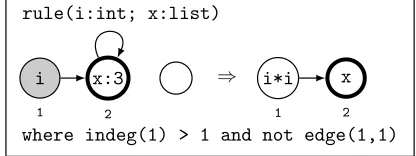
GP 2’s principal programming constructs are conditional rule schemata (abbrevi-ated torule schemataor, when the context is clear,rules). Rule schemata extend standard graph transformation rules1with expressions in labels and with appli-cation conditions. Figure 1 shows the declaration of a conditional rule schema
rule. The numbered nodes are theinterface nodes. Nodes that are in the left-hand side but not in the interface are deleted by the rule. Similarly, nodes that are in the right-hand side but not in the interface are added.
rule(i:int; x:list)
i
1
x:3
2
⇒ i*i
1
x
2
[image:3.612.201.409.544.622.2]where indeg(1) > 1 and not edge(1,1)
Fig. 1: Declaration of a conditional rule schema
The top line of the declaration states the name of the rule schema and lists the variables that are used in the labels and in the condition. All variables occurring in the right-hand side and in the condition must also occur in the left-hand side because their values a runtime are determined by matching the left-hand side with a subgraph of the host graph.
Each variable is declared with a type which is eitherint,char,string,atom
orlist. Types form a subtype hierarchy in which integers and character strings are basic types, both of which are atoms. Atoms in turn are considered as lists of length one. Labels in host graphs are variable-free expressions containing only constructor operations such as list or string concatenation. Lists are constructed by the colon operator which denotes list concatenation.2 String concatenation is represented by a dot.
To avoid ambiguity in variable assignments when constructing a mapping between the left-hand graph of a rule schema and a host graph, we require that expressions in the left graph aresimple: they (1) contain no arithmetic operators, (2) contain at most one occurrence of a list variable, and (3) do not contain string expressions with more than one occurrence of a string variable. Labels in the right-hand side of a rule schema may contain arithmetic expressions.
The labels of nodes and edges can bemarkedwith colours from a fixed set, in addition to a dashed mark for edges only. Marked items match only host graph items with the same mark. There is a special mark anythat matches arbitrary host graph marks. Nodes with thick borders areroot nodes. Their purpose is to speed up graph matching, discussed in more detail in the next section.
The programmer can specify a textual condition to add further control to where the rule is applicable, declared by the keywordwherefollowed by a boolean expression. GP 2 offers a number of predicates for querying the host graph. For example, the predicate indeg(1) > 1 in Figure 1 ensures that node 1 is only matched to suitable host graph nodes with more than one incoming edge.
2.2 Fast Rule Schemata
The idea ofrooted graph transformation [4] is to equip both rule and host graphs with root nodes which support efficient graph matching. Root nodes in rules must match compatible root nodes in the host graph. In this way, the search for a match is localised to the neighbourhood of the host graph’s root nodes. It is possible to identify a class of rooted rule schemata that are applicable in constant time if the host graph satisfies certain restrictions.
A conditional rule schemahL⇒R, ciisfast if (1) each node in Lis reach-able from some root (disregarding edge directions), (2) neitherLnorRcontain repeated list, string or atom variables, and (3) the condition ccontains neither an edge predicate nor a test e1=e2 or e1! =e2 where both e1 and e2 contain a list, string or atom variable.
2 Not to be confused with Haskell’s colon operator which adds an element to the
The first condition ensures that matches can only occur in the neighbourhood of roots. The other conditions rule out linear-time operations, such as copying lists or strings in host graph labels of unbounded length. In [4] it is shown that fast rule schemata can be matched in constant time if there are upper bounds on the maximal node degree and the number of roots in host graphs. The remaining steps of rule application, namely checking the dangling condition and the application condition, removing items from L−K, adding items from R−K, and relabelling nodes, are achievable in constant time.
2.3 Programs
GP 2 programs consist of a finite number of rule schema declarations and a main command sequence which controls their application order. Execution starts at the top-level procedure Main. The user may declare other named procedures, which consist of a mandatory command sequence and optional local rule and procedure declarations. Recursive procedures are not allowed.
The control constructs are: application of a set of conditional rule schemata
{r1, . . . , rn}, where one of the applicable schemata in the set is non-deterministi-cally chosen; sequential composition P;Q of programs P and Q; as-long-as-possible iteration P! of a program P; and conditional branching statements
if C then P else Q and try C then P else Q, where C, P and Q are arbitrary command sequences. The meaning of these constructs is formalised with a small-step operational semantics [2].
We just discuss the branching statements. To executeifC then P elseQ on a graphG, firstCis executed onG. If this produces a graph, then this result is thrown away and P is executed onG. Alternatively, if C fails onG, thenQ is executed on G. In this way, graph programs can be used to test a possibly complex condition on a graph without destroying the graph. If one wants to continue with the graph resulting fromC, the commandtryC thenP elseQ can be used. It first executesConGand, if this fails, executesQonG. However, ifC produces a graphH, thenP is executed onH rather than onG.
3
The GP 2 Compiler
The language is implemented with a compiler, written in C, that translates GP 2 source code to C code. The generated code is executed with the support of a runtime library containing the data structures and operations for graphs and morphisms. We describe how we convert high-level, non-deterministic and rule-based programs into deterministic, imperative programs in C.
3.1 Rule Application
b o o l m a t c h r u l e ( morphism ∗m) {
return match n0 ;
}
b o o l match n0 ( morphism ∗m) {
f o r( r o o t nodes N o f t h e h o s t graph ) {
i f(N i s not a v a l i d match f o r n0 ) continue;
e l s e {
f l a g N a s matched ; update morphism ;
i f( match e0 ) return t r u e ;
} }
return f a l s e ;
}
b o o l match e0 ( morphism ∗m) {
f o r( o u t e d g e s E o f match ( n0 ) ) {
i f(E i s not a v a l i d match f o r e0 ) continue;
e l s e {
f l a g E a s matched ; update morphism ;
return t r u e ;
} }
return f a l s e ;
[image:6.612.131.397.116.421.2]}
Fig. 2: Skeleton of the rule matching code.
search plan, a decomposition of the matching problem into a sequence of prim-itive matching operations [7]. The compiler supports operations to match an isolated node, to match an edge incident to an already-matched node, and to match a node incident to an already-matched edge. A search plan is constructed by an undirected depth-first traversal of the left-hand side of a rule. When a node or edge is first visited, an operation to match that item is appended to the current search plan. Every iteration of the depth-first search starts at a root node, if one exists, to ensure that the initial “find node” operation is as cheap as possible. If all root nodes have been visited, it starts at an arbitrary unexplored node.
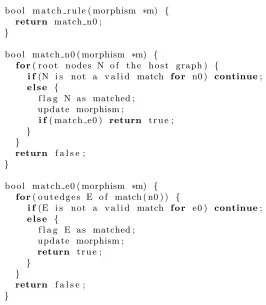
The generated code is a nested chain of matching functions corresponding to the search plan operations. The top-level function is namedmatch Rfor ruleR. The pseudocode in Figure 2 illustrates this structure for a rule that matches a root node with a looping edge.
1. his flagged as matched (note that we use injective matching).
2. The rule item is not markedanyandh’s mark is not equal to the rule item’s mark.
3. h is not structurally compatible with respect to the rule and the current partial morphism.
4. h’s label cannot match the expression of the rule item’s label.
The third check differs for nodes and edges. Host graph nodes are ruled out if their degrees are too small. For example, a rule node with two outgoing edges cannot match a host graph node with only one outgoing edge. Host graph edges are checked for source and target consistency. For example, if the target of a rule edge is already matched, the host edge’s target must correspond with that node. To evaluate rule conditions, the compiler writes a function for each predicate and a function to evaluate the whole condition. The predicate functions modify the values of global boolean variables that are queried by the condition evalu-ator. The condition is checked directly after each call to a predicate function. If the condition is true or all variables in the condition have not been assigned values, matching continues. Otherwise, the match fails and the current matcher returns false, triggering a backtrack. At runtime, the predicate functions are called as soon as they are needed. For example, the function to check the pred-icateindeg(1) = indeg(2)is called immediately after rule node 1 is matched and immediately after rule node 2 is matched. This is done in order to detect an invalid match as soon as possible. To make this possible, a complex data structure is used at compile time to represent conditional rule schemata. The data structure links nodes and variables in the rule to each condition predicate querying that node or variable.
A rule schema contains complete information on the behaviour of the rule, including which items are added, which items are deleted, which items are rela-belled, and which variables are required in updated labels. The rule is analysed at compile time to generate code to apply the rule given a morphism. Host graph modifications are performed in the following order to prevent conflicts and dan-gling edges: delete edges, relabel edges, delete nodes, relabel nodes, add nodes, add edges. The appropriate host nodes, host edges and values of variables are pulled from morphism data structures populated during the matching step.
3.2 Program Analysis for Graph Backtracking
recording of the host graph state. This analysis is quite subtle. For instance, a condition that requires graph backtracking in anif-then-elsestatement may not require graph backtracking in atry-then-elsestatement. We omit the de-tails for lack of space. The first author’s PhD thesis [2] describes the program analysis in detail, including the algorithm used by the compiler.
3.3 Program Translation
The main function of the generated C program is responsible for calling the matching and application functions as designated by the command sequence of the GP 2 program. Executing the program amounts to applying a sequence of rules. The code generator writes a short code fragment for each rule call and translates each control construct into an equivalent C control construct. The runtime code is supported by a number of global variables, including the host graphs and morphisms. A global boolean variable success, initialised to true, stores the outcome of a computation to support the control flow of the program. A standard rule call generates code trying to match the rule. If a match is found, the code calls the rule application function and sets the success flag to true. If not, control passes to failure code. Certain classes of rules allow simpler code to be generated. For example, a rule with an empty left-hand side does not generate code to call a matching function. The failure code is context-sensitive. If there is a failure at the top level, the program is terminated after reporting to the user and freeing memory. Failure in a condition guard sets the global success flag to false so that control goes to the else branch of the conditional statement. Failure in a loop sets the success flag to false and calls the functionundoChanges
(described below) to restore the host graph to the state at the start of the most recent loop iteration.
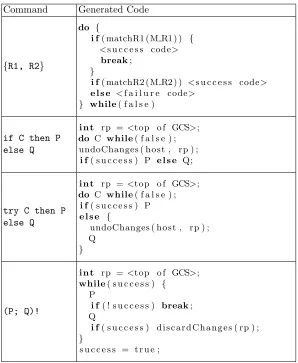
Figure 3 summarises the translation of some GP 2 control constructs to C. The rule set call{R1, R2}is tackled by applying the rules in textual order until either one rule matches or they all fail. The do-while loop is used to exit the rule set if a rule matches before the last rule has been reached. The condition of a branching statement is executed in a do-while loop: if failure occurs before the last command of the condition, the break statement is used to exit the condition, and control is assumed by the then/else branch. GP 2’s loop translates directly to a C while loop. One subtlety is the looped command sequence, where the line if(!success) break; is printed after the code for all commands except the last. A second subtlety is that success is set to true after exiting a loop because GP 2’s semantic rules state that a loop cannot fail. Command sequences are handled by generating the code for each command in the designated order. When a procedure call is encountered in the program text, the code generator inlines the command sequence of the procedure at the point of the call.
Command Generated Code
{R1, R2}
do {
i f( matchR1 (M R1 ) ) {
<s u c c e s s code>
break;
}
i f( matchR2 (M R2 ) ) <s u c c e s s code>
e l s e <f a i l u r e code>
} while( f a l s e )
if C then P else Q
i n t rp = <top o f GCS>;
do C while( f a l s e ) ;
undoChanges ( host , rp ) ;
i f( s u c c e s s ) P e l s e Q;
try C then P else Q
i n t rp = <top o f GCS>;
do C while( f a l s e ) ;
i f( s u c c e s s ) P
e l s e {
undoChanges ( host , rp ) ; Q
}
(P; Q)!
i n t rp = <top o f GCS>;
while( s u c c e s s ) {
P
i f( ! s u c c e s s ) break;
Q
i f( s u c c e s s ) d i s c a r d C h a n g e s ( rp ) ; }
[image:9.612.159.457.112.475.2]s u c c e s s = t r u e ;
Fig. 3: C code for GP 2 control constructs
the end of a successful loop iteration to prevent a failure in a future loop itera-tion from causing the host graph to roll back beyond the start of its preceding iteration. Each restore point has a unique identifier to facilitate multiple graph backtracking points.
3.4 Runtime Library
The runtime library is a collection of data structures and operations used by the generated code during rule matching, rule application and host graph back-tracking. As aforementioned, graph backtracking is performed by a graph change stack. We describe the other core data structures of the runtime library.
The host graph structure stores node and edge structures in dynamic arrays. Free lists are used to prevent fragmentation. Nodes and edges are uniquely iden-tified by their indices in these arrays. The graph structure also stores the node count, the edge count, and a linked list of root node identifiers for fast access to the root nodes in the host graph. A node structure contains the node’s identi-fier, its label, its degrees, references to its inedges and outedges, a root flag, and a matched flag. An edge structure contains the edge’s identifier, its label, the identifiers of its source and target, and a matched flag.
A label is represented as a structure containing the mark (an enumerated type), a pointer to the list and the length of the list. GP 2 lists are represented internally as doubly-linked lists. Each element of the list stores a type marker and a union of integers and strings, equivalent to GP 2’s atom type. Lists are stored centrally in a hash table to prevent unnecessary and space-consuming duplication of lists for large host graphs with repeated labels.
The morphism data structure needs to capture the node-to-node and edge-to-edge mappings, and the assignment mapping variables to their values. Thus the data structure used to represent morphisms contains the following four substruc-tures: (1) an array of host node identifiers, (2) an array of host edge identifiers, (3) an array of assignments, and (4) a stack of variable identifiers. At compile time each node, edge and variable in a rule is identified with an index of its array in the morphism, allowing quick access to the appropriate elements. The stack is used to record assignment indices in the order in which the variables are assigned values. This is needed because the variables encountered at runtime are not guaranteed to agree with the compile-time order.
4
Case Study: 2-Colouring
Vertex colouring has many applications [18] and is among the most frequently considered graph problems. We focus on 2-colourability: a graph is2-colourable, or bipartite, if one of two colours can be assigned to each node such that the source and target of each non-loop edge have different colours.
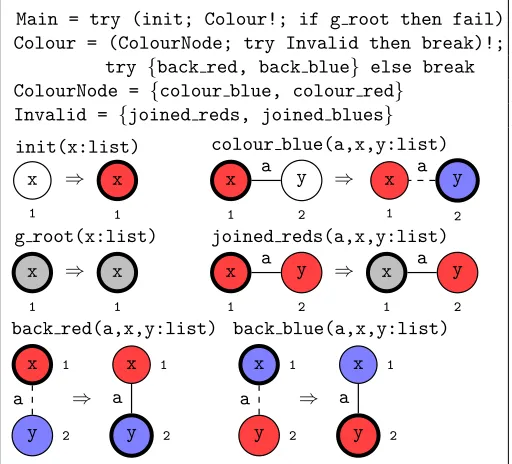
“inverted” versions of the rules colour blueand joined redswith respect to the node marks. In particular, the right-hand side of joined bluesalso has a grey root node.
Main = try (init; Colour!; if g root then fail) Colour = (ColourNode; try Invalid then break)!;
try {back red, back blue} else break ColourNode = {colour blue, colour red}
Invalid = {joined reds, joined blues}
[image:11.612.179.435.174.406.2]x 1 ⇒ init(x:list) x 1 x 1 ⇒ g root(x:list) x 1 x 1 y 2 a ⇒ colour blue(a,x,y:list) x 1 y 2 a x 1 y 2 a ⇒ joined reds(a,x,y:list) x 1 y 2 a x 1 y 2 a ⇒ back red(a,x,y:list) x 1 y 2 a x 1 y 2 a ⇒ back blue(a,x,y:list) x 1 y 2 a
Fig. 4: The program2colouring
At its core,2colouring is an undirected depth-first traversal in which the source node is chosen non-deterministically. The root node represents the current position in the traversal. The rule init prepares the search by matching an arbitrary host graph node, making it the root node, and colouring it red. Each iteration of the Colour!loop does the following:
1. ColourNode: move the root node to an adjacent uncoloured node and colour it with the opposite colour. Dash the edge connecting the current root node to the previous one.
2. try Invalid else break: check if the current root node is adjacent to any nodes with the same colour. If so, mark the root node grey and break the inner loop.
3. Repeat steps (1) and (2) until no more rules are applicable.
4. try {back red, back blue} else break: move the root along a dashed edge and undash the edge. If this is not possible, break the outer loop.
Once theColour!exits, the remainder of the program (if g root then fail) checks if the root node is grey. If the root node is grey, then thefailcommand causes thetry-then-elseto take theelsebranch, and the host graph assumes its state before entering the branch, which returns the input graph. Otherwise, thethenbranch is taken, which returns the current 2-coloured graph.
Termination is guaranteed because each rule either decreases the number of unmarked nodes or decreases the number of dashed edges while preserving the number of unmarked nodes. Therefore, at some point, a back rule will fail because there exist no dashed edges, or a colouring rule will fail because there exist no unmarked nodes.
1 2
3 4
∗
⇒
1 2
3 4
∗
⇒
1 2
3 4
∗
⇒
1 2
3 4
∗
⇐
1 2
3 4
∗
⇐
1 2
[image:12.612.189.424.257.402.2]3 4
Fig. 5: Example run of 2colouring
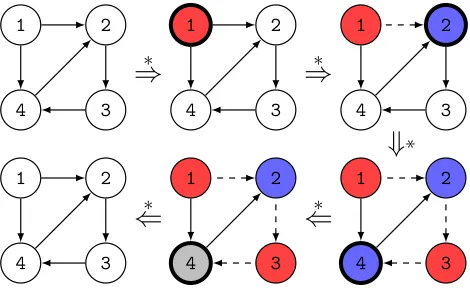
Figure 5 shows the execution of2colouringon the host graph in the upper-left of the diagram. This graph is clearly not 2-colourable. The ruleinitcolours node 1 red. The rule colour blue nondeterministically matches the edge 1→
2. It roots node 2, colours it blue and dashes the edge. The colouring rules are applied twice more to give the lower-right graph. At this point the rule
joined blues matches the edge 4 → 2. This colours the root node grey. The inner loop breaks, and control passes toBacktrack. Both back rules fail because neither match a grey root node. This causes the outer loop to break. Finally,
g rootsucceeds, causing thetrystatement to fail and return the original graph. The following result, proved in [2], assumes that input graphs are unmarked and connected.
Proposition 1 (Time complexity of 2colouring). On graphs with bounded node degree, the running time of 2colouringis linear in the size of graphs. On unrestricted graphs, the running time is quadratic in the size of graphs.
5
Performance
To experimentally validate the time complexity of 2colouring, and to test the performance of the language implementation, we ran the generated C code for
2colouring against an adaptation of Sedgewick’s hand-crafted C program for 2-colouring [17].
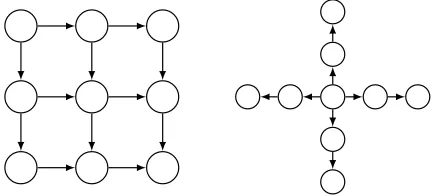
[image:13.612.199.416.330.428.2]We chose two classes of input graphs. The first class is square grids (ab-breviated grids), which are suitable because: (1) grids are 2-colourable. This guarantees that both programs perform the same computation, namely match-ing and colourmatch-ing every node in the graph; (2) grids have bounded node degree, which tests the linear complexity of 2colouring; (3) it is relatively simple to generate large grids. The second class is star graphs, used to test the perfor-mance on graphs of unbounded degree. A star graph consists of a central node with k outgoing edges. The targets of these outgoing edges themselves have a single outgoing edge. Star graphs share properties (1) and (3) of grid graphs. Examples can be seen in Figure 6.
Fig. 6: Examples of a square grid graph and a star graph
5.1 2-colouring in C
This section describes a C implementation of 2-colouring based on the code in Sedgewick’s textbook Algorithms in C [17] which uses an adjacency list data structure for host graphs. For a graph withnnodes, an adjacency list is a node-indexed array containing n linked lists. An edge i → j is represented by the presence of j in the ith linked list, and vice versa if the graph is undirected. For our purposes there is no requirement to implement a graph data structure that supports the complete GP 2 feature set. Instead, we exploit some of the properties of the algorithms and host graphs we wish to execute in order to develop a minimal graph data structure.
1 b o o l d f s C o l o u r (i n t node , i n t c o l o u r ) {
2 Link ∗l = NULL;
3 i n t n e w c o l o u r = c o l o u r == 1 ? 2 : 1 ;
4 host−>l a b e l [ node ] = n e w c o l o u r ;
5 f o r( l = host−>a d j [ node ] ; l != NULL;
6 l = l−>nex t )
7 i f( host−>l a b e l [ l−>i d ] == 0 ) {
8 i f( ! d f s C o l o u r ( l−>id , n e w c o l o u r ) )
9 return f a l s e ;
10 }
11 e l s e i f( host−>l a b e l [ l−>i d ] != c o l o u r )
12 return f a l s e ;
13 return t r u e ;
14 }
15
16 i n t main (i n t argc , char ∗∗argv ) {
17 h o s t = buildHostGraph ( argv [ 1 ] ) ;
18 b o o l c o l o u r a b l e = t r u e ;
19 i n t v ;
20 f o r( v = 0 ; v < host−>nodes ; v++)
21 i f( host−>l a b e l [ v ] == 0 )
22 i f( ! d f s C o l o u r ( v , 1 ) ) {
23 c o l o u r a b l e = f a l s e ; break;
24 }
25 i f( ! c o l o u r a b l e )
26 // Unmark a l l nodes .
27 f o r( v = 0 ; v < host−>nodes ; v++)
28 host−>l a b e l [ v ] = 0 ;
29 return 0 ;
[image:14.612.120.368.116.467.2]30 }
Fig. 7: DFS 2-colouring in C
where each list element stores the node identifier of a target of one of its outgoing edges.
At runtime, the GP 2 compiler’s host graph parser is used to read the host graph text file and construct the graph data structure. This minimises the gap between the handwritten C code and the code generated from the GP 2 compiler, so that the comparison between the performance of the actual computations on the host graph is as fair as possible.
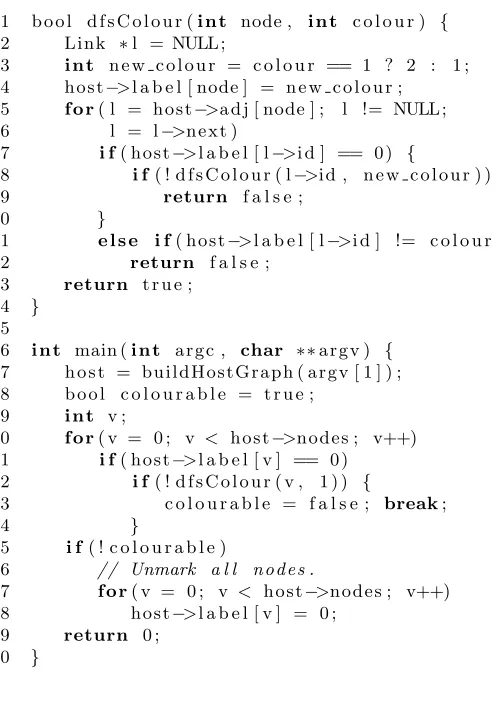
Nodes are labelled 0, 1 or 2. Node labels are initialised to 0, representing an uncoloured and unvisited node. 1 and 2 represent the two colours of the algorithm. The functiondfsColouris called recursively on all uncoloured nodes of the host graph. It is passed a nodevand a colourcas its argument. It coloursv with the contrasting colourc′, and goes throughv’s adjacency list. If an adjacent
node is uncoloured,dfsColouris called on that node. If an adjacent node is also colouredc′, the function returns false, which will propagate through its parent
calls and to the main function. If main detects a failure (line 25), it sets the label of all nodes to 0 and exits. Otherwise, the coloured graph is returned.
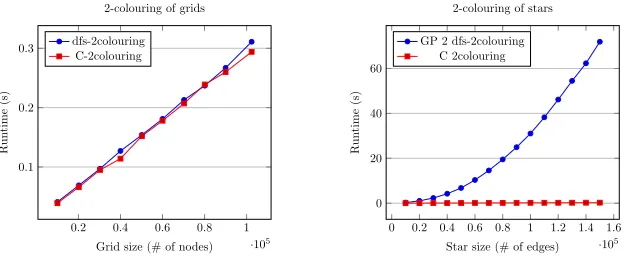
Figure 8 show the comparison of runtimes of both programs. There is almost no difference between the time it takes for either program to 2-colour grids, a remarkable result considering the compiled GP 2 code explicitly performs (rooted) subgraph matching at each step, while the tailored C program navigates a simple pointer structure. However, the star graph plot makes it clear that tailored C code is not limited by bounds on node degree. The compiled GP 2 code displays quadratic time complexity because it searches the outgoing edge list of the central node in the same order for every rule match.
0.2 0.4 0.6 0.8 1
·105
0.1 0.2 0.3
Grid size (# of nodes)
R
u
n
ti
m
e
(s
)
2-colouring of grids
dfs-2colouring C-2colouring
0 0.2 0.4 0.6 0.8 1 1.2 1.4 1.6
·105
0 20 40 60
Star size (# of edges)
R
u
n
ti
m
e
(s
)
2-colouring of stars
[image:15.612.139.451.341.471.2]GP 2 dfs-2colouring C 2colouring
Fig. 8: Plots of the runtimes of the 2-colouring programs in GP 2 and C
6
Related Work
matching code that searches the host graph with user-declared root points to prune the search space. However, there are some differences because of the dif-ferent feature sets of the languages. For example, GReAT’s code generator must handle passing matched objects from one rule to another, while GP 2’s code generator must handle application conditions during graph matching.
The concept of rooted rules has been used in various forms in implementations of graph transformation. To mention a couple of examples, rules in GrGEN.NET and GReAT can return graph elements to restrict the location of subsequent rule applications [10, 1], and the strategy language of PORGY restricts matches of rules to a subgraph of the host graph called the position which can be trans-formed by the program [8].
7
Conclusion and Future Work
We have reviewed the visual programming language GP 2 based on graph trans-formation rules and described a compiler that translates high-level GP 2 pro-grams to C code. A novel aspect of our implementation is generating search plans at compile time and using them to systematically generate structured and readable C code. Another distinctive feature is the static analysis of programs to determine if code needs to be generated to facilitate the recording of the host graph state. Using the compiler, we show that the generated C code for a depth-first 2-colouring program performs as quickly as a handcrafted C program also based on depth-first search on a class of host graphs with bounded node degree. These initial results are good, but more case studies ought to be investigated to further demonstrate the efficiency of the generated code, in particular pro-grams that transform the host graph structurally, such as a reduction program to identify membership in a specific graph class.
A limitation of the GP 2 implementation is that it makes little effort to optimise rule matching for rules without root nodes. One method of speeding up matching is to compute optimal search plans at runtime based on an analysis of the host graph. This has been implemented in GrGEN.NET [5]. Another approach is to optimise rule matching at compile time. An example of such an optimisation is transforming a looped rule call to code that finds all matches in the host graph and performs the modifications in one step, which in general is more efficient than finding one match and starting a new search for the next match. This requires some care because pairs of matches could be in conflict.
References
1. A. Agrawal, G. Karsai, S. Neema, F. Shi, and A. Vizhanyo. The design of a language for model transformations. Software and System Modeling, 5(3):261–288, 2006.
2. C. Bak. GP 2: Efficient Implementation of a Graph Programming Language. PhD
3. C. Bak, G. Faulkner, D. Plump, and C. Runciman. A reference interpreter for
the graph programming language GP 2. InProc. Graphs as Models (GaM 2015),
volume 181 ofElectronic Proceedings in Theoretical Computer Science, pages 48– 64, 2015.
4. C. Bak and D. Plump. Rooted graph programs. InProc. International Workshop
on Graph-Based Tools (GraBaTs 2012), volume 54 ofElectronic Communications of the EASST, 2012.
5. G. V. Batz, M. Kroll, and R. Geiß. A first experimental evaluation of search plan
driven graph pattern matching. In Applications of Graph Transformations with
Industrial Relevance, Revised Selected and Invited Papers, volume 5088 ofLecture Notes in Computer Science, pages 471–486. Springer, 2007.
6. M. Dodds and D. Plump. Graph transformation in constant time. In Proc.
In-ternational Conference on Graph Transformation (ICGT 2006), volume 4178 of
Lecture Notes in Computer Science, pages 367–382. Springer, 2006.
7. H. D¨orr.Efficient Graph Rewriting and its Implementation, volume 922 ofLecture Notes in Computer Science. Springer, 1995.
8. M. Fern´andez, H. Kirchner, I. Mackie, and B. Pinaud. Visual modelling of complex
systems: Towards an abstract machine for PORGY. In Proc. Computability in
Europe (CiE 2014), volume 8493 of Lecture Notes in Computer Science, pages 183–193. Springer, 2014.
9. A. H. Ghamarian, M. de Mol, A. Rensink, E. Zambon, and M. Zimakova.
Mod-elling and analysis using GROOVE. International Journal on Software Tools for
Technology Transfer, 14(1):15–40, 2012.
10. E. Jakumeit, S. Buchwald, and M. Kroll. GrGen.NET - the expressive, convenient
and fast graph rewrite system. Software Tools for Technology Transfer, 12(3–
4):263–271, 2010.
11. G. Manning and D. Plump. The GP programming system. InProc. Graph
Trans-formation and Visual Modelling Techniques (GT-VMT 2008), volume 10 of Elec-tronic Communications of the EASST, 2008.
12. D. Plump. The graph programming language GP. InProc. Algebraic Informatics
(CAI 2009), volume 5725 ofLecture Notes in Computer Science, pages 99–122. Springer, 2009.
13. D. Plump. The design of GP 2. InProc. International Workshop on Reduction
Strategies in Rewriting and Programming (WRS 2011), volume 82 of Electronic Proceedings in Theoretical Computer Science, pages 1–16, 2012.
14. C. M. Poskitt and D. Plump. Hoare-style verification of graph programs.
Funda-menta Informaticae, 118(1-2):135–175, 2012.
15. O. Runge, C. Ermel, and G. Taentzer. AGG 2.0 – new features for specifying
and analyzing algebraic graph transformations. In Proc. Applications of Graph
Transformations with Industrial Relevance (AGTIVE 2011), volume 7233 of Lec-ture Notes in Computer Science, pages 81–88. Springer, 2011.
16. A. Sch¨urr, A. Winter, and A. Z¨undorf. The PROGRES approach: Language and
environment. In H. Ehrig, G. Engels, H.-J. Kreowski, and G. Rozenberg, editors,
Handbook of Graph Grammars and Computing by Graph Transformation, volume 2, chapter 13, pages 487–550. World Scientific, 1999.
17. R. Sedgewick. Algorithms in C: Part 5: Graph Algorithms. Addison-Wesley, 2002.
18. S. S. Skiena. The Algorithm Design Manual. Springer, second edition, 2008. 19. A. Vizhanyo, A. Agrawal, and F. Shi. Towards generation of efficient
transfor-mations. In Proc. Generative Programming and Component Engineering (GPCE