i
DOP:
Iterated Data-Oriented Parsing
as a Model for Diachronic Syntax
MSc Thesis
(
Afstudeerscriptie
)
written by
Maarten Versteegh
(born November 15th, 1977 in Amstelveen, the Netherlands)
under the supervision of Dr. Willem Zuidema, and submitted to the Board of Examiners in partial fulfillment of the requirements for the degree of
MSc in Logic
at theUniversiteit van Amsterdam.
Date of the public defense: Members of the Thesis Committee:
Contents
1 Introduction 7
2 Models of language transmission 9
2.1 Models of language change . . . 9
2.1.1 The generative approach . . . 9
2.1.2 Grammaticalization . . . 14
2.2 The final model of language transmission . . . 19
3 Technical aspects of the language model 21 3.1 Data oriented parsing . . . 22
3.1.1 Introduction . . . 22
3.1.2 The probability model . . . 22
3.1.3 DOP and analogy . . . 25
3.1.4 Other estimators for data oriented parsing . . . 26
3.1.5 PCFG reduction of DOP grammars . . . 28
3.2 k-best Parsing . . . 34
3.2.1 Hypergraph parsing . . . 34
3.2.2 Flip-reverse parsing . . . 37
3.3 Representations of syntactic and semantic structures . . . 38
4 Simulations and Results 45 4.1 Reanalysis and analogical levelling . . . 45
4.1.1 The basic model . . . 46
4.1.2 Measuring reanalysis . . . 48
4.1.3 Simulation 1: reanalysis as rebracketing . . . 49
4.1.4 Simulation 2: the spread of relabelling . . . 55
4.2 Adding functional pressure . . . 61
4 CONTENTS
4.2.1 Linguistic motivation . . . 61
4.2.2 The simulation . . . 62
4.2.3 Obtaining and adjusting the grammar . . . 64
4.2.4 Results . . . 65
4.3 Adding a heterogeneous language community and communal feed-back . . . 69
4.3.1 Linguistic motivation . . . 70
4.3.2 The simulation . . . 71
4.3.3 Results . . . 73
5 Conclusion 77
List of Figures
2.1 Basic model of language transmission . . . 10
2.2 Revised model of transmission . . . 12
2.3 Second revised model of transmission . . . 13
2.4 Third revised model of transmission . . . 18
2.5 Final model of transmission . . . 19
3.1 Example training corpus . . . 23
3.2 Example DOP derivation . . . 23
3.3 Example DOP1-grammar . . . 24
3.4 Relabelling a phrase structure tree . . . 29
3.5 PTSG and PCFG subderivations . . . 33
3.6 Hypergraph representation of packed parse forest . . . 36
3.7 Flip-Reverse Operation . . . 38
3.8 Generated phrase structure trees . . . 43
4.1 Model for simulation of reanalysis and levelling . . . 46
4.2 SVO and OVS parse trees for rebracketing simulation . . . 51
4.3 Two shortest derivations . . . 51
4.4 Rebracketing: graph 1 . . . 52
4.5 Rebracketing: graph 2 . . . 53
4.6 Rebracketing: graph 3 . . . 54
4.7 Example trees for relabelling . . . 56
4.8 Relabelling: graph 3 . . . 58
4.9 Relabelling: graph 4 . . . 58
4.10 Relabelling: graph 1 . . . 59
4.11 Relabelling: graph 2 . . . 60
4.12 Generator/Interpreter submodule . . . 63
6 LIST OF FIGURES
4.13 Word order freezing: simulation overview . . . 63
4.14 Word order freezing: graph 1 . . . 66
4.15 Word order freezing: graph 2 . . . 67
4.16 Word order freezing: graph 3 . . . 67
4.17 Word order freezing: graph 4 . . . 68
4.18 Word order freezing: graph 5 . . . 69
4.19 Final model of transmission: revisited . . . 69
4.20 Word order change: graph 1 . . . 74
4.21 Word order change: graph 2 . . . 75
4.22 Word order change: graph 3 . . . 76
Chapter 1
Introduction
Language change is a complex process, involving many factors, such as acquisi-tion, language contact and innovations made by language users. These factors span the entire range of aspects of human language, from pragmatics to pho-netics. Because of this complexity, historical linguistics is often practiced as an informal science, relying on qualitative descriptions of processes and theories. This thesis reports on the formulation of a general quantitative model for the study of syntactic change. The overarching goal of this thesis is to contribute to the development of formal models and computational tools for the study of language change.
There are two main motivations for developing computational models of lan-guage change. The first is that such models may inform our theories on lanlan-guage change. Simulating change on a computer allows us to take a closer look at the mechanisms at work in language change. The results may then be used to sup-port and develop theories of diachronic linguistics. The second motivation is to use these models to test the validity of formal models of language and language acquisition. If a language formalism is to be regarded as an accurate model of human language, we should be able to use it in models of language change. Simulations can be used to study the behaviour of language formalisms under the conditions of repeated learning and use in a language community. This be-haviour may inform our evaluation of the validity of a language formalism as a viable model of human language. In this thesis, we will mostly be concerned with the first of the mentioned motivations for the computational study of lan-guage change; to inform our understanding of linguistic theories of syntactic change.
8 CHAPTER 1. INTRODUCTION
There are relatively few computational studies of language. Notable studies are the agent-based computational models of the evolution of language through iterated learning [10, 33], of the social factors involved in change [43], and of the formation of the relation between language learning and language contact [49]. None of these studies employ a fully specified language model together with a linguistically motivated model of language transmission to study language change.
This thesis presents a quantitative model of language change that integrates a formal model of language, Data-Oriented Parsing, in an agent-based iterated learning simulation. A central role in the model is reserved for language ac-quisition, taken in the broadest sense. Both the transmission of language from one generation to the next as well as between agents in a single generation are accounted for. Analogy as a mechanism of syntactic change will be central to the transmission.
Our research has two goals. First, to develop and implement a general quantative model of syntactic change that can be applied to a wide variety of phenomena. The model has to be specific enough so that we can study the language output of each generation in detail. The second goal is to test the assumptions of the model by examining case studies from historical linguistics. We strive to build a model such that the case studies can yield linguistically plausible results for language change. The simulations will allow us to examine the mechanisms at work in the phenomena in these case studies in more de-tail than an informal discussion may accomplish. This aspect is an important motivation for the development and implementation of quantitative models for language change.
Chapter 2
Models of language
transmission
This chapter discusses the linguistic background of the research in this thesis. The study of diachronic syntax and syntactic change is an active area in lin-guistics. Much like other areas in linguistics, there is no generally agreed on treatment of it. Instead several approaches exist. The approaches differ essen-tially in their treatment of language transmission. We first discuss two of the major approaches to syntactic change and the mechanisms these approaches identify as central to change. We focus our discussion on the different aspects of language transmission that the approaches highlight. Then we introduce the model of transmission used in this thesis, building on insights from both traditions.
2.1
Models of language change
2.1.1
The generative approach
Since the emergence of Generative Grammar in the 1950s, the generative ap-proach to historical syntax has been actively researched. A central tenet of Gen-erative Grammar has been the study of language acquisition and its implications for a wider theory of syntax. The research has focused on what Chomsky dubbed ‘logical problem of language acquisition’ [16]. Given that an adult speaker can give grammaticality judgements on an unbounded number of sentences of her
10 CHAPTER 2. MODELS OF LANGUAGE TRANSMISSION
native language, the central problem is how language acquisition is possible in principle, given the fact that the primary linguistic data offered to a language learning child, cruciallyunderdetermines its adult linguistic competence, being the understanding and knowledge of the language. The generative traditition assumes an innate, initial state of the language faculty, shared by the entire human species. From this initial state, the Universal Grammar, every human develops his or her native tongue.
This view on the cognitive abilities of humans has strongly influenced the generative approach to language change. This approach associates syntactic change with child language acquisition. It points to the discontinuity of gram-mars between generations as essential for change to occur. Syntactic change is an emergent feature, a result of what happens in the transmission of a gram-mmar from one generation to the next. Put simply, the generative approach states that if the grammar of a generation has its parameters set differently from the previous generation, then a syntactic change has taken place. This idea is exemplified in the diagram in figure 2.1.1, based on [1].
Grammar 1 Grammar 2
Output 1 Output 2
ge
n
er
a
te
s
input
for gen
er
a
te
[image:10.595.252.412.371.450.2]s
Figure 2.1: Diagram outlining the discontinuity of grammars in the basic model of language transmission from [1].
The diagram, which is the basis of many works in the generative study of syntactic change, amongst others the influential work of David Lightfoot, embodies a number of essential features to this approach to language change which we will discuss here in detail.
Firstly, the diagram points to the crucial interplay between child language acquisition and linguistic output. The grammar which a child acquires is not based directly on the grammar of its caretaker, but on the caretaker’s linguistic output, acting as an intermediary.
In essence, there are two ways in whichGrammar 2 may come to differ from
2.1. MODELS OF LANGUAGE CHANGE 11
that Output 1 is representative ofGrammar 1, the child’s learning mechanism interprets it the ‘wrong way’. Since the child bases its grammar solely on the output, the parameters of the child’s Universal Grammar may be set differently and so a language change will take place.
The second point of interest with this picture is that change is generally seen as abrupt. This view of abruptness is especially present in the works of David Lightfoot [39, 41]. The idea there is that over generations grammatical complexity builds up gradually through minor, relatively unimportant changes until a threshold is reached which triggers a major and far-reaching restructuring of the grammar. This restructuring is supposed to eliminate the complexity that made the language difficult for children to learn. Crucially, Lightfoot argued that syntactic change is autonomous, just as syntax in general is ascribed a high degree of autonomy in generative theory [39].
These views have received a fair amount of criticism (for an up to date overview see [19]). The first point of criticism we discuss is that the abrupt changes are actually quite rare and do not represent the majority of syntactic changes. The emphasis on the ‘catastrophic’ changes in historical data may even be said to mask a confusion about the locus of change and the origin of the data. While the discontinuity of grammars means that a change is indeed instantaneous from the perspective of an individual’s competence, the picture as it stands fails to incorporate two important factors. First, the data in historical linguistics do typically not originate from single individuals. Historical texts do not, in general, allow us to closely inspect the development of single users of a language. Second, the data are performance data, that may or may not accu-rately reflect the individual competences of a group of language users. As such, changes that may be instantaneous from the point of view of individual users, may take hundreds of years from the point of view of a language community and may seem very gradual indeed. A focus on individual competence to the exclusion of communal performance, obscures this important fact in the study of historical syntax.
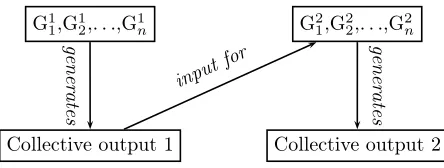
To counter this concern we may adapt the diagram from figure 2.1.1 to reflect the transmission of language in a community of speakers and learners, see figure 2.1.1. This diagram is not supposed to imply that children necessarily learn language from everyone in their community. Some subsets ofCollective output 1 may be vastly more important in the acquisition process than others.
12 CHAPTER 2. MODELS OF LANGUAGE TRANSMISSION
G11,G12,. . .,G1n G21,G22,. . .,G2n
Collective output 1 Collective output 2
ge
n
er
a
te
s
input
for gen
er
a
te
[image:12.595.219.441.121.205.2]s
Figure 2.2: Revised model of transmission, showing collective outputs and sets of grammars.
which does not rely on parameter setting and is able to incorporate the frequen-cies of form occurences may produce a much more gradual picture of language change. This feature then crucially depends on the specific details of the learn-ing algorithm. If one is willlearn-ing to let go of the generative model of acquisition, one may obtain a more fine-grained model. However, this does mean that the generative definition of syntactic change, i.e. a difference in parameter settings from one generation to the next, becomes void. A new definition of change is then needed.
A second general shortcoming of the model so far is that it only explic-itly incorporates internal factors in the change. Internal factors in language change are defined as factors promoting change within the linguistic system of a relatively homogeneous community, experiencing little outside influence. In contrast, external factors involve language contact, active language policy etc.
External factors, especially language contact, are important in diachronic syntax (as attested by the literature, see for example the collection in [24]), so we wish to account for them. We can adapt the model so that external factors (of any kind) can have influence on the linguistic output of the community, see figure 2.1.1.
External influence on the performance level may result in the output not being representative of the speakers’ grammars. For example, suppose that
Grammars 1 are fully case marked. This is the grammar the adults acquired as child. Due to some influence external to the grammar, the case markings in the output start to disappear. Note that in the generative view Grammars 1 are still fully case marked on the competence level. It is only on the performance
2.1. MODELS OF LANGUAGE CHANGE 13
External factors G1
1,G12,. . .,G1n G21,G22,. . .,G2n
Collective output 1 Collective output 2
ge
n
er
a
te
s
input
for gen
er
a
te
s
influ ences
Figure 2.3: Second revision to the model: external influence on the speakers’ output.
output from this speaker cannot but infer that the language it is learning does
not support case marking. It sets its parameters accordingly and thusGrammar 2 differs drastically fromGrammar 1 and a change has taken place.
We will come back to bith this model and the internal/external distinction later when we discuss other models of grammar.
Lastly, the model assumes, as does generative theory in general, a level of au-tonomy of (morpho-)syntax that has been questioned by researchers from other traditions (e.g. [25]). The mechanism of language acquisition is presumed to revolve around syntax. Therefore, phonological, semantic and especially prag-matic factors are difficult to incorporate into this model. The second important approach to language change, grammaticalization, discussed below, in part at-tempts to remedy this problem.
14 CHAPTER 2. MODELS OF LANGUAGE TRANSMISSION
2.1.2
Grammaticalization
The second approach to language change that will be relevant to our model, grammaticalization, is part of a long tradition, going back to the linguists of the nineteenth century, such as Wilhelm von Humboldt [42]. A widely used definition of grammaticalization comes from Jerzy Kuryłowicz:
Grammaticalization consists in the increase of the range of a mor-pheme advancing from a lexical to a grammatical or from a less grammatical to a more grammatical status. [44]
Grammaticalization studies typically involve themselves with two types of phenomena. The first are the changes of lexical items to morphemes and the second are the changes of discourse elements to morphosyntactical markers. These changes involve two mechanisms that are extensively studied.
The first is semantic bleaching. This involves the loss of meaning of lexical items. An example is the loss of meaning of the emphatic negation in Jespersen’ cycle [30]. Consider the development of negation in French, that can be sketched as follows:1
1. Je ne sais (NEG + VERB)
2. Je ne sais (pas) (NEG + VERB (+ EMPHATIC NEG)) 3. Je ne sais pas (NEG + VERB + OBLIGATORY NEG) 4. Je (ne) sais pas ((NEG) + VERB + NEG)
5. Je sais pas (VERB + NEG)
In the second stage, the itempas is optional, indicating emphatic negation and still retaining some of its original meaning. In the third stage, this meaning is lost and the item has become an obligatory part of the negation.
The second mechanism involved in grammaticalization isphonological reduc-tion. In this thesis we are only interested in the form that is calledsyntagmatic
reduction: ‘forms become shorter as the phonemes that comprise them erode’ [28, p.154]. It entails the dropping of vowels and consonants, loss of stress and/or assimilation of adjacent phonological segments. This process is important in the development of clitics into affixes.
1
2.1. MODELS OF LANGUAGE CHANGE 15
When evaluating grammaticalization phenomena it is important to again clearly distinguish the point of view of the language and the point of view of the language user. The object of the study is the process of language as a dynamic interchange of meaningful communication. Taken this way, grammaticalization takes a functional approach to the study of language change, incorporating the
useof language between users into their model. Some grammaticalizationists are inclined to ascribe to the phenomena they study an existence per se, and look at grammaticalization as anagent of change (cf. the discussion in [19], pages 115– 124). We do not wish to go this far, but feel it is important to note this contrast to the generative approach, which completely focuses on the individual speaker’s competence, leaving out the role of language as a communication device used by actual human beings.
Frequency
The focus on the performance level, where ‘the variation and fuzziness is to be found which forms the beginning of change’ [19], brings another aspect of language in sight of grammaticalization researchers: frequency. As Hopper and Traugott put it: frequency has ‘assumed an important place in the empirical study of how lexical forms move into grammatical roles’, i.e. in grammatical-ization studies. [28].
Joan Bybee [11], working from a usage-based background, points out two important effects of the frequency of constructions. Firstly, high frequency con-structions are more likely to undergo grammaticalization processes and secondly, high-frequency constructions retain their form longer under pressure from new formations. These two effects are strongly related to what Bybee and Thompson [12] term theReduction Effect and theConservation Effect.
The Reduction Effect states that high-frequency forms undergo erosion (both semantic and phonological) at a faster rate than less-frequent forms. This effect is attested by for example the phonetic shortening that English contractions such asyou’re,I’llundergo. The Conservation Effect states that highly frequent items are more likely to retain irregular forms and are less likely to be levelled by the pressure of regular forms. For clear evidence of this effect, Lieberman et al. studied the regularization of English verbs over the past 1200 years and showed that the rate of regularization of a verb depends on the frequency of its usage [38].
16 CHAPTER 2. MODELS OF LANGUAGE TRANSMISSION
the increased frequency of a construction over time is ‘prima facie evidence’ of grammaticalization [28, p.129]. This may not be a formally accurate definition, after all the word ‘computer’ probably increased significantly if frequency of use between, say, the 18th century and the present for reasons other than gram-maticalization. Nonetheless, we take frequency to be an important factor in our model of change and will partly base our definition of change on it (see chapter 4).
Analogy & reanalysis
Two mechanisms that are inextricably connected to grammaticalization are anal-ogy and reanalysis. Reanalysis has been called ‘the most important mechanism for grammaticalization [28, p. 39], and one of the three only mechanisms for syntactic change [13, p. 283]. Analogy has been referred to as the mechanism which actually implements a change and spreads it across a language.
Reanalysis is best defined by a well-known quote from Harris and Campbell.
Reanalysis . . . is a mechanism which changes the underlying struc-ture of a syntactic pattern and which does not involve any immediate or intrinsic modification of its surface manifestations. [27, p. 61]
A simple example of reanalysis is the modern use of the word Hamburger. Originally, it was constructed as [Hamburg] + [er], meaning a foodstuff origi-nating from Hamburg. Over time, the original meaning was lost and the word was reanalysed as [Ham] + [burger]. In itself, this reanalysis does not change the surface appearance of the word. But combined with analogy it opens up the possibility for innovations, such asCheeseburger. Without the initial reanalysis, analogy would not be able to implement the innovation.
2.1. MODELS OF LANGUAGE CHANGE 17
able to identify a levelling having taken place if one or more allomorphs have completely vanished. In chapter 4 we will give a new definition of levelling in a probabilistic framework, that will alow us to look at levelling as a process.
Analogical extension refers to the application of rules to new forms, by anal-ogy to existing forms. Examples are the regular declension implemented on new verbal forms such as e-mail or twitter or the formation of the plural for new nouns. This form of analogy is often considered relatively rare (cf. e.g. [13, p.284], as it is restricted to new forms. In the next chapter, however, we discuss a parsing model that works in part by the analogical extension of previously ex-perienced syntactic structures to new sentences. If this model has psychological relevance, then extension is in fact the predominant form of analogy.
Consequences for the transmission model
The mechanisms identified by grammaticalization research as described above, have several consequences for our model of language transmission.
The first is the following. If we take analogy serious as a mechanism for change then we have to rethink the role of adult language users in our model. In the above discussion of the generative model we saw that there only the acquisition of language by children plays an important role in language change. However, language researchers, and sociolinguists in particular, are increasingly pointing out studies that show that adults continue to develop their language. This includes adapting their own language output to that of their community, but also innovating new forms (cf. e.g. [28, 36, 37]). This has consequences for the view that children are the most important ‘learners’ of a language.
While child language acquisition is undoubtedly special in that it differs qualitatively from adult language acquisition, the insights from sociolinguistics suggest it is wrong to dismiss the results on adult innovation and language development in a model of language transmission. The fact that adults can invent and spread forms through a language means that the basic model of transmission needs to be revised again. See figure 2.4 for a revised diagram of the model. This revision is represented by letting the linguistic output feed back into the speakers’ model of their language, keeping in mind that we now also need to rethink the way the language model works in order to account for innovations on the part of adults. This means that there is yet another way that the output may not be representative of the grammar.
18 CHAPTER 2. MODELS OF LANGUAGE TRANSMISSION
G11,G12,. . .,G1n G21,G22,. . .,G2n
Collective output 1 Collective output 2
ge
n
er
a
te
s
input
for gen
er
a
te
s
in
fl
u
en
ce
s
Figure 2.4: Third revision: adult speakers’ grammar is influenced by the output of their community.
This is for the following reason. In our model we will only study one form of external influence, namely language contact. We will model contact between language users with different internal grammars by relaxing the condition that the language community (G1, . . . Gn)be homogeneous. By identifying certain
grammars to be radically different from others, we can in effect model a situation of contact between languages. From here on, consider(G1, . . . Gn)to represent
a potentially heterogeneous language community.
A second consequence for the model is more difficult to represent in the picture of language transmission we have built so far. It concerns the question of
how learning takes place. This question relates to both child and adult language learning and it revolves around the question of how to adequately account for both frequency effects as well as analogy in syntax.
Analogy in syntax is often interpreted as consisting of the extension or level-ling of syntactic rules across different domains, e.g. verbal or nominal paradigms. Taking the aforementioned definition to heart, syntactic analogy can also be in-terpreted more strictly in terms of similarity relations that exist between syntac-tic structures. This view of analogy, of similarity relations between structures (possibly in different domains), has been cited as having cognitive relevance [14] and has produced interesting results in the domain of language [21]. A rule-based grammar formalism is unable to adequately capture these relations however.
pro-2.2. THE FINAL MODEL OF LANGUAGE TRANSMISSION 19
viding a framework in which we can deal with analogy, both in the sense of extension and levelling of rules and in the sense of structural similarity.
2.2
The final model of language transmission
The model we use in the simulations we will discuss in chapter 4 is basically the model of figure 2.4. Keeping in mind the caveats about the learning mechanisms involved, we extend it to span over more than just two generations, see figure 2.5. The output of the second generation feeds back to form the input of a new grammar. This iterative model forms the basis of our experiments.
G1
1,G12,. . .,G1n G21,G22,. . .,G2n
Collective output 1 Collective output 2
ge n er a te s input
for gen
er a te s in fl u en ce s in fl u en ce s in p u t fo r
Figure 2.5: Final model of transmission
This diagram leaves open the question of the language model. For an effec-tive implementation, we need a formally precise model of language. From the considerations of the previous sections, we can state a number of desiderate for such a model.
First, it has to be able to account for the frequency effect that were found to be important in language change. Second, the language model has to be able to incorporate the mechanisms of analogy and reanalysis, either as primitive concepts or as emergent features of the model.
A standard generative grammar is unable to meet either of these demands as it is crucially non-probabilistic and most generative theories outright reject the relevance of analogy in linguistics (cf. the remarks by Chomsky [15, p.32].
A third desideratum is that the language model needs to allow a formal mechanism for the acquisition of language, considering both child and adult language learning.
20 CHAPTER 2. MODELS OF LANGUAGE TRANSMISSION
Chapter 3
Technical aspects of the
language model
The previous chapter outlined a basic model of language transmission. It de-scribed a list of desiderata for a language model. A language model that can be used in our model has to incorporate frequency and has to be able to account for analogical factors. Reanalysis especially was found to be important.
From a computational perspective, we can add three more desiderata. The implementation of the language model has to be efficient (since we will use it in an iterated simulation of transmission) and it has to be precise (since imprecisions are likely to add up over repeated application). It also has to be fully formalized.
This chapter first gives a description of data-oriented parsing, which will be used as a language model. We will explain its basic properties and some variants. We also explain why it meets the demands. After that we describe to describe the parsing mechanism we use, which is efficient and precise. Lastly we discuss the issue of syntactic and semantic representation and their relation in the simulations.
22 CHAPTER 3. TECHNICAL ASPECTS OF THE LANGUAGE MODEL
3.1
Data oriented parsing
3.1.1
Introduction
This section gives a short introduction to data-oriented parsing, the formal model that underlies this thesis. Data-oriented parsing [46] is a particularly apt framework for modelling analogy in natural language. It is based on exemplars and attempts to capture the structural analogies between sentences and corpora. Data-oriented parsing builds on the idea that there is a continuum between grammatical rules on the one hand and grammatical structures orconstructions, represented as parse trees on the other. It considers neither to be primary but attempts to build a framework which subsumes both notions. The primitive units of the grammar areall possible subtrees, encompassing both grammatical rules (represented simply as subtrees of depth 1) and wider reaching construc-tions (represented as subtrees of greater depth). These units can be combined to form full parse trees by a substitution operation.
This approach has found some remarkable success in the field of natural lan-guage processing (for an overview, see [8]). It meets the demands for a lanlan-guage model stated in the previous chapters on two grounds. Firstly, the most widely used DOP models are probabilistic, thus incorporating frequency of occurence of linguistic forms (see section 3.1.2). Secondly, data-oriented parsing has been described as an attempt to construct the maximal ahalogy between an input sen-tence and a collection of exemplar structures [46]. Taken together, this means the language model is able to model analogy both in the extension/levelling sense and in the structural similarity sense.
The next section introduces the formalities of the DOP model. After gaining familiarity with its basic properties, we return to the question of how DOP can meet the demands we listed for a viable language model.
3.1.2
The probability model
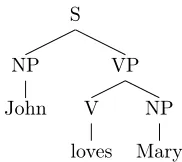
A DOP grammar is constructued by extracting all possible subtrees from a training corpus of syntactically annotated sentences. As an example, we show how to extract a DOP-model from the simple training corpus depicted in figure 3.1.2 consisting of a single sentence and its tree structure.
For every treetin this corpus, we extractevery subtree and assign a weight to it [6].
3.1. DATA ORIENTED PARSING 23
S
NP
John
VP
V
loves NP
[image:23.595.232.323.122.203.2]Mary
Figure 3.1: A simple example training corpus
Let X be a countable set of types, in this case tree fragments. Then a corpus is a function f : X → N and for each x∈ X, f(x) is a type frequency. The type frequency indicates the number of times a particular subtree occurs in the corpus. Let r(t)denote the root node of tree fragmentt, then the probability assigned to tis defined by equation 3.1.
p(t) =P f(t)
t′:r(t′)=r(t)f(t′)
[image:23.595.213.346.514.592.2](3.1)
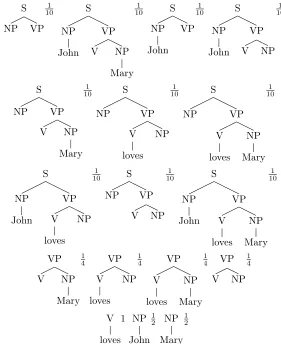
Figure 3.2 shows the set of extracted subtrees along with their probabilities. This collection of subtrees along with their weights is used to form a Prob-abilistic Tree Substitution Grammar (PTSG). To parse a sentence, the tree fragments can be recombined by means of the labelled substitution operation, denoted by ◦. As an example, figure 3.1.2 show how the tree fragments can be combined to form a derivation for the sentenceMary loves John, which was not in the training corpus.
S
NP VP
V
loves NP
◦ NP
Mary ◦ NP
John
Figure 3.2: Example of labelled substitution; the derivation of the parse tree forMary loves John
The probability of a derivation consisting of tree fragmentst1, . . . , tnis given
24 CHAPTER 3. TECHNICAL ASPECTS OF THE LANGUAGE MODEL S NP VP 1 10 S NP John VP V NP Mary 1 10 S NP John VP 1 10 S NP John VP V NP 1 10 S NP VP V NP Mary 1 10 S NP VP V loves NP 1 10 S NP VP V loves NP Mary 1 10 S NP John VP V loves NP 1 10 S NP VP V NP 1 10 S NP John VP V loves NP Mary 1 10 VP V NP Mary 1 4 VP V loves NP 1 4 VP V loves NP Mary 1 4 VP V NP 1 4 V loves 1 NP John 1 2 NP Mary 1 2
Figure 3.3: DOP1-grammar extracted from the corpus in figure 3.1.2, showing all extracted subtrees and their associated weights.
p(t1◦. . .◦tn) = n
Y
i=1
p(ti) (3.2)
A parse tree can be formed by many derivations. The probability of a parse treeT is given by the sum of the probabilities of the derivationsD producing that parse tree, equation 3.3.
p(T) = X
D derives T
3.1. DATA ORIENTED PARSING 25
3.1.3
DOP and analogy
The data-oriented parsing framework was chosen as the language model in this thesis because of two reasons. Firstly, it incorporates the frequency of occurence of structures, found to be important in the previous chapter. Us-ing DOP, the speakers in our simulation will exhibit a preference to use parts of highly-frequent structures above lesser-frequent ones. Over generations, the probabilities attached to structures may change and new structures may be pre-ferred. In a probabilistic setting, this is what constitutes language change. Note that this is essentially different from the generative view on language change. There, a difference in parameter settings means thatnew rules come into play. Syntactic change is essentially rule change. In our model, new structures may come into existence, but the essence of syntactic change is a change in the fre-quency of structures in such a way that a different structure comes to be the preferred one.
But there is another factor to the use of probabilistic models. Reanalysis cru-cially relies on the possibility of more than one analysis of a given construction being available (cf. [13, p.284]), that is, it relies on the ambiguity of analysis. Most sentences in natural language are syntactically ambiguous. In general, the longer the sentence, the more possible parses exist. Yet we usually perceive only one of the parses as being relevant. This poses a problem for natural language processing systems. Probabilistic grammars have sought to account for this problem by attaching weights to parses and taking the highest-ranking parse to be the ‘correct’ one. This relates directly to the issue of reanalysis.
When multiple analyses of a given form are available (and they often are), the real question about reanalysis is why a certain analysis comes into favour at the expense of another. For this we need the fine-grained system that a probabilistic grammar can give us. Reanalysis is the essential mechanism of change in the model we use in this thesis. As subtree probabilities change, the preferred analysis may change. Analogy may then spread this analyis across paradigms and so an overt change in form may take place.
26 CHAPTER 3. TECHNICAL ASPECTS OF THE LANGUAGE MODEL
share the following subtree in their parse:
S
NP VP
V NP
These sentences have something important in common, that is not easily ex-pressed in other systems. While this is a trivial example, it does show that using DOP means that the speakers in our simulation will have access to a large array of exemplars in the form of syntactic structures, with which they can form analogies to extend to new sentences. In fact, parsing under this framework is explicitly seen as maximizing the structural analogy between an input sentence and a corpus of previously observed structures [46]. Combined with the proba-bilistic nature and the importance of ambiguity this means that both analogical levelling and extension can be modelled by using DOP in an iterated setting.
A note about language learning. Above we discussed how a DOP-grammar can be extracted from a treebank. Naturally, this is not how children learn a language, since the primary linguistic data does not in general provide evidence of the syntactic analyses of its sentences. The best way to model language acquisition in this model would be to have anunsupervised mechanism of learn-ing tree-structures (such as proposed in [6, 7]). However, these systems are prohibitively slow for our purposes. So we take a shortcut and assume that child language acquisition does in fact proceed by extracting a grammar from a syntactically annotated bank of sentences. It may be objected that this is an unwarranted oversimplification. Experiments with unsupervised DOP show, however, that good results on learning the correct bracketing can be achieved. We presume therefore that taken together with a system of category induction
in principle methods can be designed that produce results that rival those of supervised DOP. This assumption provides a significant gain in computational speed.
3.1.4
Other estimators for data oriented parsing
3.1. DATA ORIENTED PARSING 27
The DOP1 estimator is able to assign non-zero probability to trees that do not occur in the training corpus. As we saw above, new parse trees can be derived by applying the substitution operation on subtrees that occur in the treebank. This means that it isbiased with respect to the relative frequency estimate.
This is not necessarily a bad thing. If an estimator is not biased, it can only assign non-zero probability to trees that occur in its training corpus, thus eliminating the use of it for parsing novel sentences. However, the DOP1 esti-mator assigns unproportionally more probability mass to subtrees that are part of large parse trees, since the number of subtrees grows exponentially with the size of the parse tree.
Several efforts have been made to remedy these problems. This thesis inves-tigates three other estimation methods by studying how they behave under the iterated transmission model.
The first variant estimator was proposed by Bonnema and Scha [9] (hence-forth: the Bonnema estimator). They propose equation 3.4 to estimate the probability of a subtree, whereN(t)is the number of non-root non-terminals in
t and F(t)represents the number of times the root of t occurs in the training data. This estimator remedies the bias problem by
p(t) =2
−N(t)f(t)
F(t) (3.4)
Another way to remedy the bias to deep trees comes from [26]. Assigning equal weight to each node in the training data and equal weight to each subtree produces equation 3.5, whereF(t)is the number of times the root non-terminal of t occurs in the training data and n(t)is the number of subtrees headed by the root non-terminal oft.
p(t) = f(t)
F(t)n(t) (3.5)
The estimator by Bonnema and Scha and the Equal Weight estimator from [26] share some desirable properties. Compared to the DOP1-estimator, less probability mass is reserved for the larger trees in the training data. The result is a more even distribution of mass amongst the subtree fragments.
28 CHAPTER 3. TECHNICAL ASPECTS OF THE LANGUAGE MODEL
maximizing syntactic context. Since the shortest derivation is not necessarily unique, Bod proposes to back-off to probabilistic DOP as a tie-breaker. For the purposes of this thesis, tie-breakers will not be necessary, as we will never only use the 1st best parse. We therefore consider only a ‘naive’ version of the shortest derivation estimator, calculating only the smallest number of subtrees used.
The non-probabilistic shortest derivation version of DOP can be cast into the probabilistic framework by assigning the same probability to every subtree such that p ∈ [0. . .1]. This has the effect of making the shortest derivation the most probable one. A derivation usingnsubtrees will have probabilitypn.
The derivation using the smallest amount of subtrees will then have the largest probability.1
Other DOP models than the ones described above exist (e.g. [57] which has been proven to be consistent). The described DOP-models were chosen for the following reasons. The DOP1 model is generally used as a reference point, being the first and most straightforward probability model. The estimator by Bonnema and Scha and the Equal Weights estimator were used as counterpoints to the DOP1-model, in an attempt to relieve the bias problems the latter has. As [7] points out, the shortest derivation model provides a natural way of modelling the maximization of structural analogy. It gives a metric of the simplicity of syntactic structure, ‘thereby maximizing the structural commonality between a sentence and previous sentence-structures’ [7]. Since we are interested in exactly the structural analogy between sentences and previously observed utterances, this estimator is a natural choice.
3.1.5
PCFG reduction of DOP grammars
This section can be safely skipped by the reader that is mainly interested in the linguistic aspects of this thesis. It concerns a technical aspect of the implemen-tation that is irrelevant for our linguistic argument.
The number of subtrees that can be extracted from a training corpus grows exponentially as the corpus grows [47]. To keep an implementation computa-tionally tractable, two approaches can be taken.
1. Reduce the number of fragments, for example by only including subtrees
1
3.1. DATA ORIENTED PARSING 29
up to a certain depth.
2. Reduce the PTSG to a Probabilistic Context-Free Grammar (PCFG) [26]
This thesis takes the latter approach.
Goodman [26] defines a simple scheme for reducing DOP PTSG grammars to an equivalent PCFG, that contains at most eight rewrite rules for each node in the training data. This means that the PCFG is linear in size to the training data, instead of exponential. This allows for much faster parsing using the full DOP grammar.
The conversion relies on relabelling the non-terminal nodes in the training corpus. Each node is assigned a unique address. For example, A@k denotes the node at address k with non-terminal labelA. For each non-terminal node in the training data, a new non-terminal is created, in the example this node is called Ak. Non-terminals of this form are called ‘interior’ non-terminals, while
the original non-terminals are called ‘exterior’. Figure 3.1.5 shows the relabelled tree from figure 3.1.2
S@1
NP@2
John
VP@3
V@4
loves
NP@5
Mary
Figure 3.4: The relabelled tree from 3.1.2
Letajrepresent the number of subtrees headed by nodeA@j. Letarepresent
the number of subtrees headed by nodes with non-terminalA, i.e. a=P
jaj.
Goodman next shows how to construct a PCFG that generates for every subtree in the training corpus headed byAa homomorphic subderivation with probability1/a. A PCFG subderivation is called homomorphic to an PTSG el-ementary tree if the subderivation begins and ends with external non-terminals, and uses internal non-terminals for intermediate steps. A PCFG derivation is homomorphic to an PTSG derivation if for every contributing subtree in the latter there is a corresponding subderivation in the PCFG. A PCFG tree is ho-momorphic to an PTSG tree if they are identical modulo the address labels at the nodes.
30 CHAPTER 3. TECHNICAL ASPECTS OF THE LANGUAGE MODEL
A@j
B@k C@l
eight PCFG rules will be generated as follows:
Aj→BC (1/aj) A→BC (1/a)
Aj→BkC (bk/aj) A→BkC (bk/a)
Aj→BCl (cl/aj) A→BCl (cl/a)
Aj→BkCl (bkcl/aj) A→BkCl (bkcl/aj)
(3.6)
Goodman goes on to show that subderivations headed by A with external non-terminals at the roots and leaves and internal non-terminals elsewhere have probability1/a, while subderivations headed byAj with external non-terminals
only at the leaves have probability 1/aj. Furthermore, the construction
de-scribed above produces PCFG trees homomorphic to the PTSG trees with equal probability.
The PCFG described above corresponds to a DOP1 PTSG, but the other estimators introduced in section 3.1.4 can be treated in the same way.
The probability model from Bonnema and Scha [9] described by equation 3.4 is equivalent to the PCFG schema in equation 3.7, wherea is the number of times non-terminals of typeA occur in the training data.
Aj→BC (1/4) A→BC (1/4a)
Aj→BkC (1/4) A→BkC (1/4a)
Aj→BCl (1/4) A→BCl (1/4a)
Aj→BkCl (1/4) A→BkCl (1/4a)
(3.7)
The shortest derivation model from [5] corresponds to the equivalent PCFG in equation 3.8.
Aj →BC (1) A→BC (1/2)
Aj →BkC (1) A→BkC (1/2)
Aj →BCl (1) A→BCl (1/2)
Aj →BkCl (1) A→BkCl (1/2)
(3.8)
3.1. DATA ORIENTED PARSING 31
Aj →BC (1/aj) A→BC (1/aja)
Aj →BkC (bk/aj) A→BkC (bk/aja)
Aj →BCl (cl/aj) A→BCl (cl/aja)
Aj →BkCl (bkcl/aj) A→BkCl (bkcl/aja)
(3.9)
The last reduction from the equivalence in equation 3.5 is not proven explic-itly in [26], so we take the opportunity here to show the reasoning behind the soundness of the reductions.
Theorem 1(Subderivation probability for Equal Weight DOP). Subderivations under the PCFG of equation 3.9 headed by Awith external non-terminals at the roots and internal non-terminals elsewhere have probability 1/aja. Subderiva-tions headed by Aj with external non-terminals only at the leaves and internal non-terminals elsewhere have probability 1/aj
Proof. Proof by induction on the depth of the trees. Base case: depth= 1. There are two cases:
A
B C
A@j
B C
For these cases the theorem holds trivially.
Inductive step: assume that the theorem holds for trees of depth6n. We have to show that it holds for trees of depth n+ 1. Naturally, there are eight cases, one for each of the PCFG rules corresponding to the node. We show four of them. The others follow by comparable reasoning.
1. Aj→BkCl (bkcl/aj)
Let
B@k
. . .
32 CHAPTER 3. TECHNICAL ASPECTS OF THE LANGUAGE MODEL
A@j
B@k
. . .
C@l
. . .
the probability is b1 k
1
cl
bkcl
aj =
1
aj.
2. A→BkCl (bkcl/aja)
For trees like
A
B@k
. . .
C@l
. . .
the probability is 1
bk
1
cl
bkcl
aja =
1
aja.
3. A→BC (1/aja)
For trees like
A
B C
the probability is a1 ja.
4. A→BkC (bk/aja)
3.1. DATA ORIENTED PARSING 33
A
B
D E
C
A
B@k
D E
[image:33.595.224.333.123.177.2]C
Figure 3.5: A PTSG subderivation (left) and a homomorphic PCFG subderiva-tion (right). The PCFG subderivasubderiva-tion has probability bk
aja
1
bk, while the PTSG tree will have probability F(t)n(t)f(t) .
A
B@k
. . . C
the probability is 1
bk
bkcl
aja =
1
aja.
The other four cases follow trivially.
The proofs for the other estimators follow by similar reasoning, as outlined in [26].
Theorem 2 (PCFG to PTSG equivalence). The construction produces PCFG trees homomorphic to PTSG trees with equal probability.
Proof. Assume every subtree in the PTSG occurs only once in the training data. The proof under this assumption is easy. Consider an arbitrary PTSG subderivation and a homomorphic PCFG subderivation. For example the ones shown in figure 3.5. The PTSG subderivation has a probability of F(t)n(t)f(t) as defined by equation 3.5. The homomorphic PCFG subderivation will have a probability of a1ja as was proven above. If f(t) = 1, as we assumed, the two subderivations will have equal probability.
34 CHAPTER 3. TECHNICAL ASPECTS OF THE LANGUAGE MODEL
change since they are obtained by summing over all derivations, automatically taking into account the multiple occurrences of subtrees and unmerged counts. So, summing over all PTSG derivations yields the same probability as summing over all homomorphic PCFG derivations.
3.2
k
-best Parsing
Like the previous section, this section can be safely skipped by the reader who is mainly interested in the linguistic argument of this thesis.
The simulations we will introduce in the next chapter rely heavily onk-best Viterbi lists as output from the parser. As we explain there, we will usek-best lists as approximations of the occurrence frequency of alternative analyses of syntactic structures in the iterated model.
As in [5] we approximate the most probable parse by summing overk-best lists. Finding the most probable parse for DOP is NP-hard [48], so an approx-imation which allows us to efficiently parse sentences is very welcome indeed. Other solutions exist, for example Monte Carlo sampling of the parse forest [4], or aggressively pruning the search space. The former has the disadvantage that progressively larger numbers of trees need to be sampled as the sentence length grows, eventually becoming inhibitively large, while the latter method produces relatively low qualityk-best lists.
So, for our implementation of the model to be efficient enough to be fea-sible, we need fast k-best parsing. In [29], Huang & Chiang elaborate on the proposal of Klein & Manning [35] to use weighted directed hypergraphs in prob-abilistic chart parsers. Huang & Chiang generalize this proposal to introduce a framework which uses hypergraphs to represent the search space of weighted deductive systems.
So for this thesis we used their hypergraph parser, implemented bottom-up as a variant of the CKY-algorithm [32, 56], outputtingk-best Viterbi lists.
3.2.1
Hypergraph parsing
3.2. K-BEST PARSING 35
set of tail nodes to a set of head nodes. The definition of a weighted hypergraph is slightly to suit the purposes of a probabilistic parser.
Definition 1 (Weighted hypergraph). A hypergraph H is a tuplehV, E, t, Ri, where V is a finite set of vertices, E is a finite set of hyperarcs and R is a set of weights. Each hyperarc e ∈ E is a triple e = hT(e), h(e), f(e)i, where
h(e)∈V is the headandT(e)∈V∗ is a vector of tailnodes. f(e)is a weight
function, f(e) : R|T(e)| →R. t ∈V is a distinguished vertex called the target
vertex. If|T(e)|= 0, thenf(e)is a constant andh(e)is a source vertex.
The parser traverses the hypergraph in the order defined by the topological ordering of the hypergraph’s graph projection, while updating the result of the weight functions f along the hyperarcs. The update process is simply the application of the normal Viterbi update, i.e. combining the results of subspans with the probability of a grammar rule to find the result for the superspan. If successful, i.e. the prespecified target vertex t is reachable from the source vertices, this results in a packed forest represented by the hypergraph (see the example in figure 3.6).
The goal is to find the k best derivations from the resulting packed parse forest.
Definition 2 (Derivation). Let inc(v) be the set of incoming hyperarcs to a vertex, i.e. inc(v) ={e∈E|h(e) =v}. AderivationD and its weightw(D)are defined as:
• if e∈inc(v)with |T(e)|= 0, then D =he, ǫiis a derivation of v and its
weightw(D) =f(e)().
• if e∈inc(v) with |T(e)|>0 and Di is a derivation of Ti(e)for 16i6
|T(e)|, then D =
e, D1, . . . , D|T(e)|
is a derivation of v, and its weight
w(D) =f(e)(w(D1), . . . , w(D|T(e)|))
Derivations are ordered by their weights, so we can define Di(v)to be the
ith
best derivation of v. The goal of the parser can then be restated as: find
36 CHAPTER 3. TECHNICAL ASPECTS OF THE LANGUAGE MODEL S NP I I VP VP He O O VP F F NP R R V L L J J PP V V Q Q saw O O NP R
R LL
the girl O O P L L NP S S with O O a telescope O O U U
Figure 3.6: Hypergraph representation of the packed parse forest for the sentence
He saw the girl with a telescope. Items in rounded boxes represent the vertices
of the hypergraph, joining arrows represent thehyperarcs.
finding thek-best derivations for each vertex, the computation is delayed until the target vertex is reached. The algorithm then consists of two phases:
1. A forward phase, which produces the 1st best derivation, but also stores all alternative derivations.
2. A backward phase, which recursively searches for the second best deriva-tion, untilk is reached.
The complete algorithm then has overall complexity ofO(|E|+nklogk), where
3.2. K-BEST PARSING 37
a k-bounded priority queue2
for storing the candidates for each vertex. The overall space complexity becomes(|E|+kn)
In summary, the Huang & Chiang algorithm allows us to do precisek-best parsing in a reasonable time.
3.2.2
Flip-reverse parsing
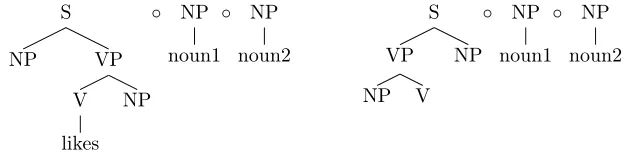
The models we introduce in the next chapter frequently require us to deal with input that is unparsable due to word order differences. As an example, consider the grammar in figure 3.2. Equipped with this grammar, the parser will not be able to derive the target vertex "S" for the sentenceJohn Mary loves, meaning
loves(John,Mary). However, for our purposes, we presume that speakerswill
be able to make a guess about the meaning of the sentence and therefore will need to be equipped with a parsing mechanism that will always output some
result in case parsing fails, however suboptimal that result may be from the point of view of the grammar.
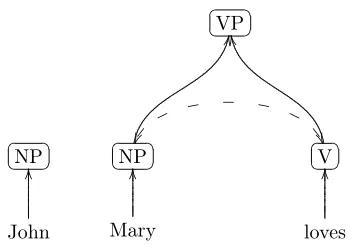
We propose the following, simple method for dealing with this kind of un-parsable input. If, after the first pass through the chart of the projected hyper-graph (as described in the previous section), the top cell does not contain the TOP label of the grammar ("S" in this case), a second pass through the chart is made. This pass, still in topological order, is allowed to modify the chart in the following way. For any two nodes with non-overlapping spans it passes over in the chart, the parser checks whether the grammar contains a rule that contains the node labels in reverse order as the right hand side. If this is the case, the parser adds a new hyperarc to the chart. This hyperarc has the rule’s left hand side as head node in the usual way and the rule’s right hand side as the tail vector, effectively ‘flipping’ the construction around. Figure 3.2.2 gives a simplified example of a flip in the parsing ofJohn Mary loves.
The transitional probability associated with the hyperarc is adjusted from the rule’s probability by a factor a, to give preference to lesser numbers of flips over greater. Once this second pass is completed, the parser checks whether the target vertex has been reached. If it has the parser is done, if it hasn’t, the process is repeated until either the target vertex has been reached or the last pass did not add new hyperarcs to the chart. In the latter case, the sentence is declared unparsable by the parser. This method provides a simple way to construct trees for constructions that are not allowed by the grammar, while
2
38 CHAPTER 3. TECHNICAL ASPECTS OF THE LANGUAGE MODEL
VP
NP
NP
L
L
o e _ Y O 8
V
R
R
John
O
O
Mary
O
O
loves
O
[image:38.595.160.338.119.244.2]O
Figure 3.7: Operation in second traversal of the hypergraph. The nodes NP
and V are being flipped to form aVP that was previously not derivable from the grammar.
still giving preference to the ones that are.
Note that a similar way to do this, would be to enrich the grammar with copies of all the rules with their right hand side flipped around. The advantage to this approach would be that the probabilities of the rules with the same left hand side form a proper probability distribution. This distribution is made improper by the approach we take here. There are, however, two reasons for not doing so. The first is that doing so will naturally double the size of the grammar, which will in practice already be quite large. Our approach allows us to generate the ‘flipped’ rules only when needed, thus retaining the original size of the grammar. A second reason for not doing so requires us to look ahead to the next chapter. There we will discuss that the grammar, aside from parsing, will also be used to calculate the probability of existing parse trees in order to rank them. For this application we do not want to include flipped rules in our calculations. We would therefore need to store two separate grammars for each of the agents in our simulation. This is unwanted as we wish to keep our memory usage to a minimum.
3.3
Representations of syntactic and semantic
struc-tures
3.3. REPRESENTATIONS OF SYNTACTIC AND SEMANTIC STRUCTURES39
between the two. We chose to use dependency trees to represent semantic structures as this allows for simple and fast conversion to and from phrase structures.
The semantic representations are used as a generative system for DOP, by first generating all possible trees corresponding to a semantic structure and then letting the grammar decide which tree structure is the most probable. In practice we predefine the semantic structures for a given simulation, depending on the type of phenomena we are interested in.
Dependency structures form a very limited means of semantic representa-tion. For our purposes, however, we are only interested in representing simple semantic structures, such as
loves(john, mary)
or slightly more complicated, a definite description à la Russell, with an embed-ded predicate:
(thinks(ιx(man(x)),loves(john,mary)))
These two formulas are represented (roughly) as follows:
loves
john mary
thinks
man
the
that
loves
john mary
We define a symmetric equality relation on the nodes in these structures:
Definition 3 (Equality of nodes in a semantic structure). Two nodes, n1 and
n2, in a dependency tree are equal iff:
1. The label ofn1 is the same as the label ofn2
2. The semantic annotation ofn1 is the same as the semantic annotation of
n2
3. For each node dependent on n1 there is a node dependent on n2 that is equal to it and vice versa
40 CHAPTER 3. TECHNICAL ASPECTS OF THE LANGUAGE MODEL
Definition 4(Equality of semantic structures). Two dependency trees are equal iff their top nodes are equal
For our syntactic representation the following conventions are used, which bear some resemblance to the standard x-bar conventions
1. Categories always project maximally, e.g. N projects up toNP. 2. Arguments attach to an intermediate projection of the head.
3. Specifiers attach to the maximal projection of the head.
4. Categories only project if necessary (save for rule 1), so if a category has no arguments, it has no intermediate projections.
5. The root node of a complete phrase structure tree is attached to aTOP -node, for parser purposes.
As examples, the phrase structure tree corresponding to John loves Mary
looks like this:
TOP
VP
NP
N
John
V’
V
loves NP
N
Mary
3.3. REPRESENTATIONS OF SYNTACTIC AND SEMANTIC STRUCTURES41
TOP
VP
NP
DP
DET
the N
man
V’
V
thinks
CP
C’
C
that
VP
NP
N
John
V’
V
loves NP
N
Mary
The conversion from phrase structure tree to dependency tree (i.e. semantic structure) is straightforward and follows the algorithm outlined in [55], with the caveat that the phrase structure conventions used in that article are slightly different from the ones used here. Let the lexical head of a projection node XP
be the daughter of the preterminal category node that produced the projection and thehead child be the daughter node of theXP node that is the ancestor of the lexical head. The conversion algorithm then takes the following steps:
1. Mark the lexical head of each node in the phrase structure tree.
2. Construct the dependency structure by making each lexical head of each non-head-child depend on the lexical head of the head-child.
42 CHAPTER 3. TECHNICAL ASPECTS OF THE LANGUAGE MODEL
The elements of this set may therefore violate rules 2 and 3 of the conventions for phrase structure trees we outlined above. The set is defined recursively.
Definition 5 (Unrestricted set of phrase structure trees corresponding to de-pendency nodeV). Base case: V has no daughters. ThenSis the singleton set consisting of the maximal projection of the category of the node’s label.
Recursive case: V has daughters d1, . . . , dn. Let D1, . . . , Dn be the sets of phrase structure trees corresponding to these daughters. For each permutation of hD1, . . . , Dni generate all combinations of elements of D1, . . . , Dn with V by attaching elements from D1, . . . , Dn−1 to intermediate projections ofV’s la-bel’s category and attaching elements of Dn to V’s label’s category’s maximal projection.
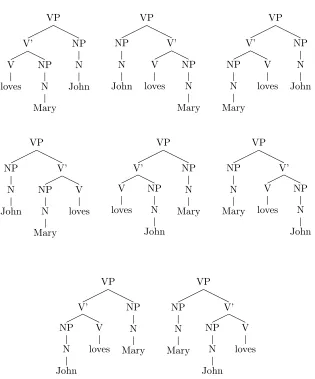
As an example, figure 3.8 shows the set of phrase structure trees corre-sponding with loves(john, mary). Note thatS quickly grows very large as |S|=n!· |D1| ·. . .· |Dn|.
3.3. REPRESENTATIONS OF SYNTACTIC AND SEMANTIC STRUCTURES43 VP V’ V loves NP N Mary NP N John VP NP N John V’ V loves NP N Mary VP V’ NP N Mary V loves NP N John VP NP N John V’ NP N Mary V loves VP V’ V loves NP N John NP N Mary VP NP N Mary V’ V loves NP N John VP V’ NP N John V loves NP N Mary VP NP N Mary V’ NP N John V loves
Chapter 4
Simulations and Results
The two previous chapters explored the features that an implementation of a model of language change should have. We looked at models of language trans-mission and discussed the properties of a suitable language model. This chapter describes several experiments based on these models. The first section describes a simulation that models reanalysis and analogical levelling. The next section adds semantic and phonological features and simulates the relation between word order freezing and loss of inflection. The final section models a situation of language contact and adds a heterogeneous language community. This last simulation closely adheres to the final model of transmission set out in chapter 2. All simulations are used to provide examples of how known phenomena in historical linguistics can be studied using computational methods.
4.1
Reanalysis and analogical levelling
This section describes a simulation focusing on reanalysis and analogical lev-elling. The model used is fairly simple, but we will show that even so, some interesting results can be obtained. We will first describe the basic implemen-tation. After that we will discuss two examples from historical linguistics that will serve as the starting point for our simulation. Lastly, we will discuss the results from these simulations.
46 CHAPTER 4. SIMULATIONS AND RESULTS
Seed treebank DOP Grammar
Sentence Generator
Sentences:
s1, . . . , sn
Weighted Treebank:
t1 1, w(t11)
, . . . ,
t1
k, w(t1k)
. . .
htn
1, w(tn1)i, . . . ,htnm, w(t n
m)i
defines
informs parses
generates forms
[image:46.595.160.518.130.273.2]defines (iteration step)
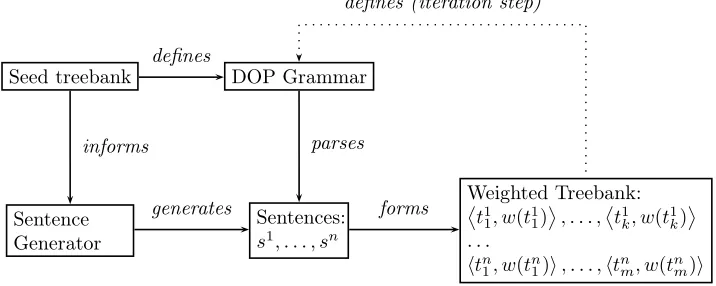
Figure 4.1: Diagram showing the basic model for the simulation of reanalysis and analogical levelling.
4.1.1
The basic model
The diagram in figure 4.1 shows the basic model used in this simulation. The idea is to model the repeated generation and parsing of sets of sentences. The parses of one set of sentences is used to extract the grammar for the next iter-ation. For this we need two components. (1) A grammar. (2) A module that generates sentences for the grammar to parse.
The initial grammar is extracted from a pre-defined treebank. From this treebank is also extracted a lexicon, consisting of words with associated part-of-speech tags. These are stored in the Sentence Generator module together with all the POS-tag sequences of the sentences in the seed treebank. The POS-tag sequences are used to generate sets of sentencesS=
s1, . . . , sn , by replacing
each POS-tag in a sequence with a randomly chosen word of that category. This procedure is used as a kind of faux semantic module, making sure that at every iteration, the grammar has a new set of sentences to parse. Each sentencesi∈S
is subsequently parsed using the extracted grammar, keeping the full range of non-optimal parses output by thek-best parser. The resultantk-best list forms the input for the extraction process of the grammar of the next iteration.
4.1. REANALYSIS AND ANALOGICAL LEVELLING 47
all allomorphs to a next generation. We therefore interpret the probability of an analysis as an indication of the relative frequency of its occurrence in the grammar’s output. As an example, consider the formxx, that can be parsed in two ways under a certain grammar, with the following probabilities.
S
A
x B
x
0.6 S
C
x D
x 0.3
In the simplest form, we then consider the left analysis to occur twice as often as the right one, since its probability is twice as high. In this simulation, the next generation will therefore be presented with a treebank in which the analyses occur in a 2 : 1ratio. We may, however, wish to allow for the parse with the highest probability, the most salient analysis, to be significantly different from the other parses. This can be implemented by optionally reserving an amount of probability mass for the 1st-best parse. This mass will ‘boost’ its probability and is therefore designated by b, for boost mass. The weighted treebank then defines the grammar for the next generation. All subtree-frequencies are simply scaled by their weight in the weighted treebank.
The formal definition of a weighted treebank is as follows. A Weighted Treebank W holds a number of sequences, each corresponding to a k-best list (each of which corresponds to a sentences∈S). Each sequence inW consists of a number of pairs, consisting of a parse tree tand an associated weightw(t). The weights are calculated as follows.
LetK =ht1, . . . , tki be the ordered sequence of parse trees output by the
parser for a particular sentence and for eachti, letp(ti)be its probability. Let
b be the amount of boost mass we wish to assign. Equation 4.1 shows how the weightw(t)is calculated for each treeton thek-list.
w(ti) =
p(ti)·(1−b)
Pk
j=1p(tj)+b ifi= 1
p(ti)·(1−b)
Pk
j=1p(tj) else
(4.1)
48 CHAPTER 4. SIMULATIONS AND RESULTS
k-list actually form a proper probability distribution, since∀i(w(ti)∈[0,1])and
Pk
i=1w(ti) = 1.
As a sidenote, this is reminiscent of the works of Simon Kirby et al. [34] on iterated Bayesian learning. Stated in the terms of that framework, the weighted treebank forms a posterior distribution over parse trees conditioned on the set of sentences. The next iteration’s grammar is learned from the entire distribution. If this distribution is unboosted, i.e. b= 0.0, then the effect is the same as if the grammar is obtained by sampling trees from an infinitely large treebank, with the relative frequencies of the trees equal to their weights. Another possibility for obtaining the input for the next iteration is by taking the maximum a posteriori probability (MAP), instead of a sample. Increasing the boost mass has the effect of moving from the sampling to the maximizing strategy.
4.1.2
Measuring reanalysis
Chapter 2 discusses a definition of reanalysis by Harris and Campbell that will serve as the starting point for the measurements in our simulation.
Reanalysis . . . is a mechanism which changes the underlying struc-ture of a syntactic pattern and which does not involve any immediate or intrinsic modification of its surface manifestations. [27, p. 61]
Since the overt form of the syntactic pattern is not modified by reanalysis until analogical levelling sets in, it is essentially unobservable in historical lan-guage data. However, the simulation setup described above has the advantage that for each generation we have access to both the surface manifestations of patterns and their analyses.
This means we can study reanalysis as a process. In any linguistic frame-work, alternative analyses of a form are commonly licensed by a grammar. In a probabilistic framework, however, we can quantify their position relative to the salient analysis. We first redefine reanalysis to fit our simulations.
Definition 6 (Reanalysis). A syntactic pattern is reanalyzed if the 1st-best structural analysis of the pattern (i.e. its parse tree) differs from the 1st-best analysis of the previous iteration in the simulation.
![Figure 2.1: Diagram outlining the discontinuity of grammars in the basic modelof language transmission from [1].](https://thumb-us.123doks.com/thumbv2/123dok_us/8386021.321938/10.595.252.412.371.450/figure-diagram-outlining-discontinuity-grammars-modelof-language-transmission.webp)