INTRODUCTION
With this booklet I attempt to make my master thesis usable in practice. It translates my theoretical study on social learning in farmer groups into practical hands-on advices. I hope my advices will help create fruitful learning environments for existing farmer groups, for those who assist farmer groups in development, and as inspiration for new farmer groups.
This booklet is a continuation of my master thesis, written in 2012: Social Learning in Farmer Groups – Field Study in the Rwenzori Region, Western Uganda. The thesis is based on four months of fieldwork, working with three Farmer Family Learning Groups (FFLG). I was assisted by Sustai-nable Agricultural Trainers Network (SATNET) and Organic Denmark (OD). It is dedicated to those who work on FFLG’s, but may be relevant for others as well. For a detailed description of the FFLG approach, see the manual Farmer Family Learning Groups for Community Development (Vaarst et al, 2011). For a collection of experiences from FFLG groups see the Rwenzori Experience (Vaarst et al., 2012).
Part 3 is written for groups and facilitators. Part 4 is written for project partners. The booklet is in five parts:
Part 1: Background………...…3
Part 2: Study………..4
Part 3: For groups/facilitators………...8
Part 4: For project partners……….13
PART I: BACKGROUND
INTERACTION TOWARDS DEVELOPMENT
The challenges of small-scale farmers today in terms of generating income and accessing markets are above the level of individual households. Therefore, farmers chal-lenges need to be addressed on a higher level of co-operation and coordinated action (Leeuwis, 2004). In the annual report by The World Bank it is pointed out that com-munity driven development can make use of the potential of rural communities in terms of local knowledge, creativity, and social capital (World Bank, 2008). As the Ugandan professor, John Munene from Makerere Univer-sity, says: Moving out of poverty is not action – it is interaction. The lesson from history is that farmers can be experts.
FARMERS
CAN
BE EXPERTS
During the green revolution in Asia, technological inputs are reported to have saved millions from starvation. But few parties are without hangovers. Problems emerged, espe-cially with environmental degradation and severe pest infections. Yields at the official research stations were even declining. Policy makers were mature for changes, when researchers found that research stations were outperformed in average yield by a significant number of farmers (Pingali et al., 1991). Their explanation was that farmers continued to innovate and improve. The conclusion was that farmers can be experts. Finally, the action taken was to develop and expand the Farmer Field Schools (FFS) throughout Asia. This was a major step towards investment
in farmer’s learning – getting beyond the old-fashioned transfer of technology from researcher to farmer.
FARMER FIELD SCHOOLS
In FFS, the field is used as classroom with practical experiences and field experiments instead of lectures and the trainers practice a learning approach of participatory discovery learning (John et al., 2002). Research on FFS indicates a substantial impact in terms of productivity, reduction of pesticide use and increase in farmer know-ledge, combined with developmental benefits as poverty reduction, greater empowerment and collective action (Duveskog et al. 2011).
FARMER FAMILY LEARNING GROUPS
PART II: STUDY
OBJECTIVES
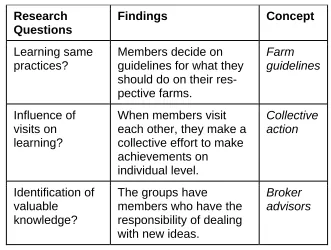
My research objectives took departure in the differences between FFS and FFLG. These differences are outlined below in Table 1. The FFS use a teaching plan, where FFLG’s decide along the way. Therefore I ask whether group members learn the same practices? The FFS use a demonstration plot while the FFLG learn at member’s farms. Therefore I ask what influence visits have on member’s learning? In the FFS, trainers are responsible for identifying what to learn, while in FFLG it is a joint respon-sibility. Therefore I ask how members identify valuable knowledge?
FIELD WORK AND ANALYSIS
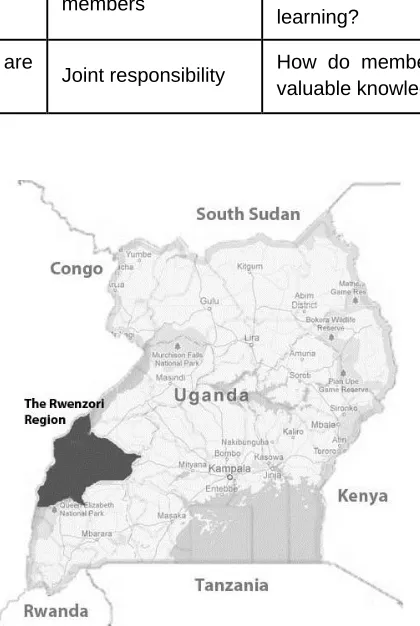
From March to July 2012 I did 28 in-depth interviews among members of three FFLG’s, assisted by SATNET. Figure 1 shows the Rwenzori region, the study area. The interviews were about individual member’s learning interactions. For example knowledge they had learnt, questions they had asked or knowledge they had shared. These interviews were recorded and transcribed to text from three local languages: rutooro, rukiga and lukonzo. In the analysis, information about learning interactions was categorized. The groups and members were very different. But this study is about what the groups had in common.
[image:4.842.423.769.81.527.2]
Table 1
Farmer Field Schools
Farmer Family
Learning Groups Research Questions
Teaching plan Decide along the way
Do members learn the same practices?
Demonstration plot
Learning at members
What influence do visits have on members’ learning?
Trainers are
responsible Joint responsibility
[image:4.842.498.708.206.519.2]How do members identify valuable knowledge?
FINDINGS
I came up with three concepts which describe how farmers learn in these three groups; farm guidelines, collective action and broker advisors. See Table 2 for a short descrip-tion.
Farm guidelines
By visiting each other and getting knowledge from outside, members develop farm guidelines. These guide the group members in what to learn in order to pursue their aims of developing themselves. It could be kitchen gardens, digging
trenches, pruning bananas, using green manure, improved cooking stoves and many more. The following quotes refer to the farm guidelines:
“At least they should find you with some vegetables as a woman in a home.” (This means that having vegetables is part of the farm guidelines)
“Better farming practices could be in several ways. How to make soil and water conservation channels, also how to cultivate faster, adding manure to the soil, mulching.” (This means that these practices are part of the farm guidelines)
“(…) when they come up with an idea they ask for suggestions from people and thereafter evaluate which idea could be useful. Then we concentrate on that one as a group.” (This means that practices in the farm guidelines is something that the group acts upon collectively)
Collective action
When farmers visit each other, they participate in collective action. Collective action is about acting together on the aims that the group has decided. They do that in three ways: establishment, evaluation and inspiration.
Establishment
[image:5.842.72.403.182.432.2]Members establish practices at the host farm, decided by the host. This could be digging a trench or making a kitchen garden. Doing it together makes it easier for the host to
Table 2
Research Questions
Findings Concept
Learning same practices?
Members decide on guidelines for what they should do on their res-pective farms. Farm guidelines Influence of visits on learning?
When members visit each other, they make a collective effort to make achievements on individual level. Collective action Identification of valuable knowledge?
The groups have
members who have the responsibility of dealing with new ideas.
take the first step. The following quote refers to establish-ment:
“Whatever is missing we have to look for them and put them there. And that is how we move forward.” (This means that the group develops through establishment)
Evaluation
Members evaluate each other’s participation. They identify missing things, for example if there is no dodo (amaranth) in the kitchen garden. They monitor the hosts’ progress, for example if soil is removed from the trench. They praise the host for good efforts, for example if the vegetables look good. The following quote refers to evaluation:
“What we decided was that after digging we tour around the garden. Then we see where the pit of rubbish should be put and if the kitchen is well maintained.” (This means that the member’s participation in the group’s farm guidelines is evaluated by other members)
Inspiration
Members get inspired at each others’ farms. They see what others do and try out themselves as they help the host. For example if they dig banana holes. They tour around the host’s home, where the host may show them new efforts around the house and garden. The following quote refers to inspiration:
“(…) if you visit me and you find me with a coffee plantation, you think about it as well. So if so and so
have this, why can’t I also have it? So this is the logic behind such visits.”
Broker advisors
Members in the farmer groups have broker advisor roles. If a member takes the role as a broker advisor, that member is to guide the other members in the development of their common farm guidelines, for example suggest that they should all build improved cooking stoves. They also show the way practically on their farm – they practice what they preach. The broker advisor brings ideas from outside, for example attend a workshop on coffee cultivation. Typically it is broker advisors who conduct trainings, manage English and can speak up in a crowd. The following quotes refer to broker advisors:
“(…) we chose member X to be the one to always visit other groups and other places and train us after. It is for member X to go because she is still young and knows English.” (This means that e.g. language skills is important in the broker advisor role)
“Doing farm rotational digging it is when we meet at the host farmer, but if we say we have a training we go to member Y’s home” (This means that broker advisor Y’s farm is used as model farm)
HOW IS IT PRACTICALLY?
In the FFLG project, groups have internal and external facilitators. Broker advisors are those who manage English and are used to speak up in a crowd. Therefore they will often be chairpersons, internal or even external facilitators. In a FFLG, farm guidelines have other names such as better farming practices or improved methods of farming. When groups meet, the collective action is not always visible. Sometimes they meet just for digging. Some visits may deal specifically with establishment of practices or evaluating participation.
During the interviews it came up that acting collectively on matters is much more than a feeling of togetherness. It is also about:
- Food security: If only one person grow vegetables, that person often share with the others. People grow by helping others, but this person will have fewer vegetables for his or her own family. Therefore people can get more motivated if they are many who grow vegetables.
- Selling: It can be a social barrier to start vegetables on the street – but when a group jointly decided to start selling dodo leaves (amaranth), it was possible. - Erosion: If only one person dig trenches it is very
difficult to control erosion on a hillside. When more persons dig trenches, it is much easier to control erosion.
- Disease control: If only one person controls a pest or disease like banana bacteria wilt, it is an almost
“fruitless” effort if the neighbors do not control it as well.
PART 3: FOR GROUPS/FACILITATORS
The suggestions below are meant as inspiration for groups and those who monitor FFLG’s (part A & B). It deals with some of the challenges found among members in the groups. In part C I present good stories from the groups.A) TRAVELLING
Finding: There is a belief that only those who move outside the community have knowledge to share
Travelling is seen by group members as something that enable them to ask questions and share knowledge. If few members travel, there is a risk that sharing of knowledge becomes one-way, and some members turn passive. For example in the quote below:
“Why would I ask, do I visit? I don’t visit, visiting to know what is happening in the world. It would help to know such but I don’t know. I also wait for what is brought to me.”
However, most people move for the market to sell produce, visit relatives, or are visited by relatives. Most will therefore have knowledge that is valuable to the group. A facilitator expressed it in this way:
“So these farmers, they are not stationed in one place. They do move. And when they get another idea from someone who has done a good work, they can stand and ask them. So that is how they also get knowledge.”
Learning how to use this potential is an ongoing effort. The state of this effort varies with groups and with individuals. Below are suggestions for how to improve on group level.
Suggestion 1: Send different people outside
When there are chances of attending a training outside, try to send someone new. Sometimes trainings are translated from English to local languages. Other times they are in local language. Then it can be possible for non-English speakers to go. One internal facilitator said:
“It would be nice for members to have exchange groups such that each member can get what to share with fellow members.”
Suggestion 2: Ask the whole group first
Sometimes one person knows a lot about a topic. But it is often best to ask the whole group first. For example if we say some members have pest problems in their coffee - they want to know what to do. Then you can first ask in the group: what have us members done to avoid insect pests in coffee? Then members interact and opportunities come up. Lyda: I use this and this organic pesticide…
George: I heard about one which is cheaper. But this and this village where they know the recipe is….
Miracle: I have relatives there and can get it!!
B) LEARNING METHODS
Finding: There were many different social barriers for learning
First it is important to say: there was a lot of knowledge shared in the groups! But there were also many who mentioned reasons for not interacting. That is something we can learn from.
Some would not share knowledge because they were afraid of bragging. Some would not share knowledge because they thought it was other’s responsibility. Some because they were not travelling. Others did not share or ask ques-tions because they saw themselves as old and illiterate.
Suggestion: Do problem solution
To make it easy for all to participate you can follow a procedure like you do in savings and credits. There each member knows what comes after what, for example that you collect money for preparedness in the green bowl before you start saving. It is easy to participate because everyone knows the procedure. This is can also be done in the Farmer Family Learning Groups. You can use it when hosts face problems which they would like the group to advice them in.
The procedure is described here:
1) During the week before the visit, the host prepares to tell about a positive experience and a problem at his or her farm.
2) The hosts discuss suggestions to the facilitator or chairperson. The facilitator should ensure that the problem is specific enough to give advices on. "I have no money" is not specific. But "I am looking for an income source which I can manage even though I am weak" is a specific problem that fellow members can advise on.
3) When the day comes, he or she presents the positive experience and then the problem to the group.
4) After this presentation, the members can ask questions to the host, in order to know more. Or they can go and take a look at the problem.
5) After asking the host, members are free to give advices to the host. The host then remains passive and listens. The facilitator also remains passive and listens.
6) After 3-5 members have given advices, the host comments on these advices, saying: “this I will try, this is too expensive so I will not do it, this I tried and it did not work.” Then the next 3-5 persons give advices, the host responds. It continues until the group has found a good solution.
7) The host thanks for all the advices.
The following is an example of how problem solution could be like:
1) The internal/external facilitator asks the host to come up with a positive experience and a problem. The host thinks about it and returns to the facilitator.
well. The facilitator accepts the positive experience, but the problem is not specific enough. It turns out that the problem with the goat is that it produces very little milk.
3) When the day comes, the host presents the positive experience and then the problem.
4) The members ask the host: what do you give your goat for eating, how many times a day do you milk it? And so on. 5) Members advice the host to milk twice a day instead of one in order to get more milk. But also to feed it more with grass and less with banana leaves. They suggest she should plant grasses around the borders of her land, to collect for the goat.
6) The host says that she herself has shaking hands and cannot milk. It is her grandchild who milks early in the morning before going to school. But she will start planting grasses along the borders of her land. The host thanks for the advices.
C) GOOD STORIES
From the interviews came a lot of good stories from members. In the following, I have put them together so they create the history of a farmer group.
Group formation
“We just had in mind that we would get something, that we would go together and generate income and chase poverty. When you are in a group there is a tendency to generate more ideas to be able to grow.”
“From the start, the main objective was to improve livelihoods or development in our homes where hygiene and sanitation was also part of the objectives. Then later we realised that we could not get development if we did not have some of the basic things like a latrine. But ideas kept coming in. Every sitting we would get a new idea to implement. “
Ideas become implemented
“We were discussing and basically for us after discussing we then see which system we will follow and do the practical lesson. We can decide that the practical we will do it at farmer-x and learn all of us. That’s why every group member have energy saving stoves.”
Members use facilitators for learning
“After digging we went to class for lesson for 1 hr or 2 hr. “What do you want to learn about?” Then they say: "We want to learn about this problem, maybe we are still backward in this idea". So I got information and then next thursday after digging we learn. Just like that.”
Members learn on own farms
my home we shall work on terraces. "So when we reach there we construct an A-frame. We measure the terrace, and we start it. Where we leave, he continues with the terrace.”
“When they come I do tour them around my gardens and see where I can put kitchen gardens. Also we teach each other in terms of reminding each other when they have come. And also I tell them where I have difficulties and they help me. For example making kitchen gardens or removing soil from trenches or pruning and weeding bananas.”
Members benefit from interaction
“As members interact, they talk about such issues (how to sell produce). Someone can say: "I have my ripe type bananas. Where can I sell it from?" Someone can say: "There is someone who buys at a higher price" Then that one can say: "Can you connect him or her to me?"”
Members remind each other
“When it comes to time for discussion, I tell them for example if dodo is scarce at home. Then I see that hunger is about to hit the house hold. So I advise them to improve on the kitchen gardens to avoid hunger.”
“We had learnt them (the making of organic pesticides) but other members had forgotten and their coffee had been affected. So I had to remind them on the medicine. Now their coffee looks good.”
Each develop on own level
“It does not have to be the same level. For example me I have cattle, and you have goats; you will not work to buy a cow but you will work to be able to buy some of the things that you can afford and those that will support your household. Such that you are also happy in your home but it is not a competition amongst us that if someone buys this that you will also buy it. But if you don’t have saucepans, you should first buy sauce pans, plates. So if I get money tomorrow I will buy a cow but you may decide to buy saucepans because it is what you are lacking. So everyone has their own ideas and needs.”
Members develop
“When I shifted here, the area had poor soils and none would imagine of living here. The coffee was also looking bad and weak, there was no grass cover, it had been eroded earlier on, it was only gullies. But because I have been cultivating burying grass and not burning it, the coffee is now very green and looks nice too.”
“I am old and used to beg neighbors for salt. But when my crops yield I carry a small sauce pan of the produce and sell it in the market and buy soap and salt. So I tell them to do the same and they appreciate what I share with them. That's the knowledge I give to the young people.”
“It is the farmer group that has removed it from me hahaha (laziness). The group has encouraged me a lot.”
Members overcome shyness
PART 4: FOR PROJECT PARTNERS
Etinne Wenger writes in his book on communities of practice that learning cannot be designed - it belongs to the realm of experience and practice (Wenger, 1998). But it can be designed for. One can facilitate tools and procedures and make sure the right people are together in the right kind of relation to make something happen. I hope that the following points can help to create good learning environ-ments.
Access to knowledge
Insights from study: Members who travel the most were those who mostly shared knowledge in the groups.
Field situation: Few speak English or have courage to speak up in a crowd. Therefore the same persons are sent for trainings or similar. This is a lot to put on one person’s shoulders, and make the groups person dependent.
Action: To make the groups stronger, knowledge should be accessible to all members through local language, visual information and informal interactions. When more people learn to speak in a crowd, interact with new people and share new knowledge with the group, it strengthens discussions in the groups and makes them less person dependent. Exchange visits between groups is a good way for members to learn and develop.
Balance between group cohesion and marketing
Insights from study: Farm guidelines were including mea-ning that most members were able to participate in these.
For example kitchen gardens and trenches. Such practices do not demand a lot of land or money.
Field situation: Clearly, collective action has potential in marketing, for example ensuring quality standards for selling. But if farmers start value adding, for example coffee, maize or ground nuts, not everyone can participate equally. They might be scarce in land, money or health. This can be a challenge to the group cohesion.
Action: It is best, if the groups sort out the matters them-selves with their facilitators. But they might need help. Some solutions could be:
- That member’s investment correspond to their land size
- That those with less land can take a loan in the savings and credits to buy the raw materials for value addition
- That the group has joint ownership to land, where they produce products for marketing.
Monitoring goals
Insights from study: The goals of a group are directly connected to their activities, the practices they choose to engage in, their efforts, the group’s identity and how they view their future. Maintaining a focus on goals can help the groups.
reluctant to change them. Also, the goals might not be operational, for example “to improve our lives”. In both cases the goals are likely to be passive.
Action: As part of the monitoring, ask groups about their goals. The purpose should be to raise attention, so the group might deal with their goals. The following questions might guide:
- What are you aspiring to achieve? - What do you do to reach this goal? - When have you met this goal?
- How do you see the group in 2 years?
Evaluating learning
Member’s learning is best evaluated on individual level. While walking or during informal talk, pick 2-3 different persons, preferably a mix of old, young and gender. The following three questions can give a good idea of what members learn in the group.
1) Have you learnt something new about farming in the group this year? What is that?
2) What was new about it for you?
3) Are you using it? If so, what is the result?
Keep in mind: As groups may be over 10 years old, it is important to ask about recent learning as in question 1. Persons might answer on behalf of the group instead of themselves, why it is important to focus on what is new for that person as in question 2. Not all theoretical learning has become practical, therefore it is important to ask if it is used as in question 3. Start by saying that there are no right and wrong answers, and that it is ok if they don’t remember.
Introduction of learning tools
Insights from field work: Learning tools can create a social space for learning. Following a fixed procedure for learning can help people break out of roles, for example being the shy one, the young and ignorant or the old and forgetful.
Field situation: Those who are not comfortable speaking in a crowd tend to remain silent and let others speak. On the other hand, some might forget to let others speak. This can be improved with procedures that promote broad participation.
Action: Introduce a procedure for knowledge sharing. When there is a time for asking and a time for sharing, social barriers become less influential. Showing the other members around the farm is a good way for members to overcome shyness. A procedure for sharing knowledge is described under ‘problem solution’ in the above chapter.
Sustainable knowledge channels
PART 5: FINAL REMARKS
FURTHER READING
For a detailed description of the FFLG approach, see the manual Farmer Family Learning Groups for Community Development (Vaarst et al, 2011). For a collection of experiences from FFLG groups see the Rwenzori Experience (Vaarst et al., 2012). An article which is based on this study is to come in 2014.
FINAL REMARK
In this booklet I have given my best suggestions for how to work with challenges in the FFLG groups. I hope they will serve as an inspiration and a help. Finally, I hope that more groups will experience positive developments.
ACKNOWLEDGEMENTS
First of all thanks to the groups from Rwenzori. I will never forget you and I still remember your names! Thank you for dancing, for your welcoming spirit and for teaching me how to prune bananas and dig properly. Thanks to the staff in SATNET for your friendliness and help: Mrs. Amanya Penninah, Mrs. Yasmin Kanyunyuzi, Mr. Samuel Mugisha, Mr. Kitooke Michael, Mrs. Hazel Rogers and Mr. Thaddeo Tibasima. Thanks to Mette Vaarst, Aage Dissing and Inge Lis Dissing from Organic Denmark for your help. Thanks to Mr. Bwambale George and Mrs. Phionah Ninsiima for the close and good spirited collaboration, numerous interviews and long days of transcription thereafter. Thanks to
Godliver Basima and Busingye Emmanuel for their assis-tance with typing and cross checking interviews. Also thanks to my supervisors Carsten Nico Hjortsø and Thi Minh Thai for dynamic meetings, especially for listening and opening my eyes to unconsidered possibilities.
Author
Lasse Englyst Olsen
REFERENCES
Duveskog, D., Friis-hansen, E., & Taylor, W. (2011). Farmer Field Schools in Rural Kenya : A
Transformative Learning Experience. Journal of Development Studies, 47(10), 1529–1544.
John, P., Russell, D., & Andrew, B. (Eds.). (2002). From farmer field school to community IPM: ten years of IPM training in Asia. Bangkok, Thailand: Food and
Agriculture Organization of the United Nations (FAO).
Leeuwis, C. (2004). Communication for Rural Innovation: Rethinking Agricultural Extension, 3rd Edition. Oxford: Wiley-Blackwell.
Pingali, P. L., & Rosegrant, M. W. (1991). Sustaining Rice Productivity Growth in Asia: A Policy Perspective. Social Sciences Division Paper, 91(01).
Vaarst, M. (2007). Participatory Common Learning in Groups of Dairy Farmers in Uganda ( FFS approach ) and Danish Stable Schools. DJF Animal Science, 78.
Vaarst, M., Nalunga, J., Tibasiima, T., Dissing, A., & Dissing, I. L. (2012). The Rwenzori Experience: The Farmer Family Learning Group Approach to Human and Social Capital Building, Environmental Care and Food Sovereignty. Environment & Development Series (Environmen., Vol. 15). Third World Network.
Vaarst, M., Tabisima, T., Nalunga, J., Dissing, A., & Dissing, I. L. (2011). Farmer Family Learning Groups For Community Development.
Wenger, E. (1998). Communities of Practice: Learning, Meaning, and Identity. Cambridge: Cambridge University Press.