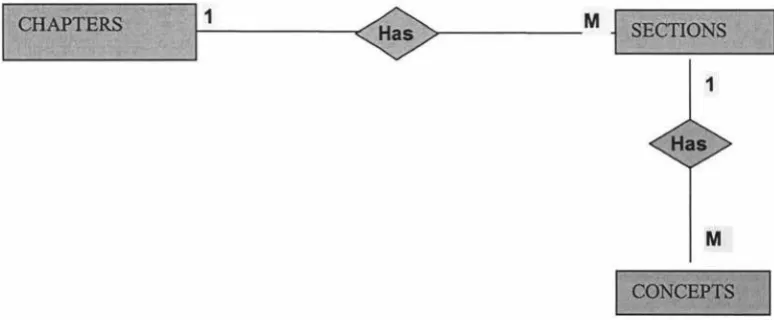
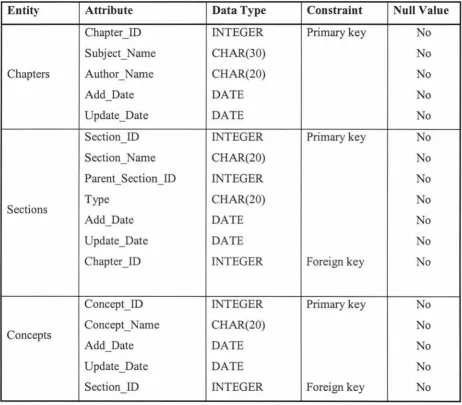
GRANULAR APPROACH TO ADAPTIVITY IN
PROBLEM-BASED LEARNING
Abstract
Constructivist approach to learning has been around for quite some time. The constructivist theory has resulted in the development of a wide variety of learning environments, however the problem-based learning (PBL) environment is one of the most ideal and most popular area that implements the constructivism theory. PBL is an attractive approach to foster learner's critical problem solving and self-directed learning skills. However, it is difficult to implement effective PBL environments. A majority of existing PBL environments suffers from the fact that the students easily get inundated by the fine granularity of the problems and loose focus of overall aims of the learning process.
This project has introduced student adaptivity technology into PBL environments to improve the effectiveness and efficiency of the learning process. To demonstrate the idea of PBL with student adaptivity, a web-based prototype is implemented in Process Costing, within the field of Accounting. Based on the architecture of the web-based intelligent educational systems, the problem base module is introduced.
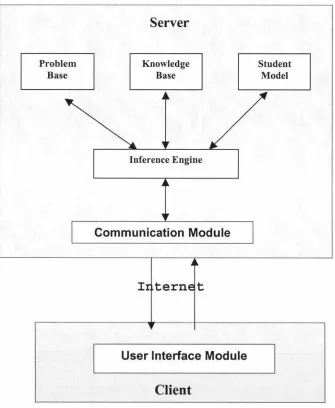
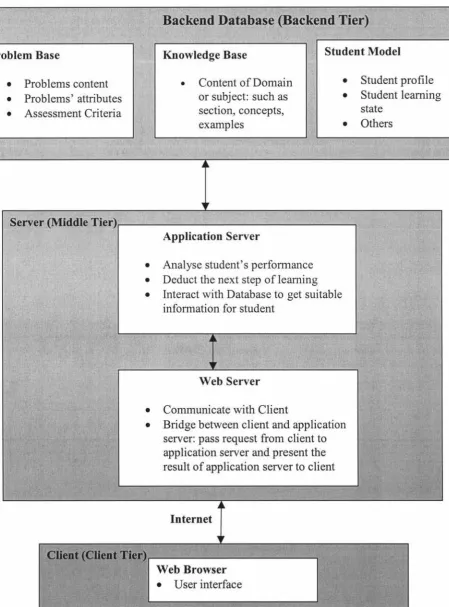
The basic architecture of the system is a typical three-tier, client-server structure. The client tier has the presentation interfaces that are implemented as HTML frames and run in a web browser. The application programs for performing adaptation, which were developed using PHP, reside in the middle layer, and communicate directly with the backend database: problem base, knowledge base that is the third tier. The web server as the communication channel also resides in the middle tier.
With the system, students work on the real world costing calculation problems, and the system evaluates students' performance results on the problems to provide adaptation to the students.
Acknowledgements
I would like to thank my supervisor, Dr. Kinshuk for all the help and guidance given to me during this project. I am especially thankful to Dr. Kinshuk for his patience and
thorough feedback throughout the whole research and the report writing.
Thanks my husband and mother for supporting me as much as they could.
-TABLE OF CONTENTS
CHAPTER 1
INTRODUCTION
1
1.1 Introduction 1
1.2 Constructivism Theory and Problem-based Learning 1
1.3 Student Adaptivity in Computer-based Intelligent Learning
Systems 3
1.4 Objectives of the Research 4
1.5 The Steps in This Research 4
1.6 Organization of the Thesis 6
CHAPTER 2
LITERATURE REVIEW:
OVERVIEW OF
CONSTRUCTIVISM
2.1 Introduction
2.2 Historical Foundations
2.3 Importance of Learning Theory
7
7
7
9
2.4 Definition of Constructivism 11
2.4.1 What is Learning? 11
2.4.2 Features of Constructivism 12
2.4.2.1 Learning Occurrence in Constructivism 12 2.4.2.2 The Factors of Influencing Learning in Constructivism 13 2.4.2.3 The Role of Memory in Constructivism 13
2.4.2.4 Transfer of Knowledge 14
2.4.2.5 The Best Types of Learning Based on Constructivism 15
CHAPTER 3
LITERATURE REVIEW: OVERVIEW OF
PROBLEM-BASED LEARNING
17
3.1 Introduction 17
3.2 History 17
3.3 Definition of PBL 19
3.4 Features of PBL 20
3.4. l Basing on Real World Problems 20
3.4.2 The Curriculum Based on Problems 20
3.4.3 Learner Self-directed Learning Process 20
3.4.4 The PBL Teachers Work as Tutors 21
3.4.5 Emphasizing on Collaborative Learning Group 21
3.5 Advantages and Disadvantages of PBL 21
3.5.1 Effective and Efficient Information Resources 21
3.5.2 Disadvantages of PBL 22
3.6 Implementation of PBL in Computer Assisted Learning Environment 23
3.6.1 Advantages of PBL 23
3.6.2 Simulation of Real World Problems 25
3.6.3 Support Collaborative Learning 25
3.6.4 The Advanced Distance Education (ADE) Project 26
3.7 Summary 27
CHAPTR4
LITERATURE REVIEW: STUDY ADAPTIVITY
28
4.1 Introduction 28
4.2 Overview of Student Adaptivity 28
4.2.1 What is Student Adaptivity? 28
4.2.2 Mechanism of Student Adaptivity in Intelligent Educational Systems 29 4.2.3 Implementation of Student Adaptivity from Application Level 31
4.3 Student Model
4.3.1 What is Student Model? 4.3.2 Purposes of Student Model
4.4 Summary
VI
33 33 33
CHAPTER 5
STUDENTSYSTEM ANALYSIS AND DESIGN
35
5.1
Introduction35
5.2
Requirements35
5.2.1
Requirements of Problem Base36
5.2.2
Requirements of Knowledge Base37
5.2
.3
Developing Student Model37
5.3
The System Design38
5.3.1
System Conceptual Model38
5.3.2
Database Design41
5.3.2.1
Design of Problem Base Database41
5.3.2.2
Design of Knowledge Base Database43
5.4
Summary46
CHAPTER 6
SYSTEM IMPLEMENTATION
48
6.1
Introduction48
6.2
Relevant Technologies48
6.2.1
PHP48
6.2.1.1
The Origins of PHP48
6.2.1.2
Features of PHP50
6.2.1.3
Mechanisms of PHP51
6.2.2
HTML -Hypertext Markup Language52
6.2.3
CGI - Common Gateway Interface54
6.2.4
MySQL54
6.2
.5
Apache55
6.3
System Implementation56
6.3.1
System Working Processes56
6.3.2
Example PHP Code58
CHAPTER 7
STUDENT ADAPTIVITY IN THIS SYSTEM
63
7.1 Introduction 63
7.2 Monitoring Student's Performance 63
7.3 Presenting Proper Guidance 64
7.4 Algorithm in the System 67
7.4.1 Assumptions 67
7.4.2 Algorithm 68
7.5 Summary 69
CHAPTER 8
CONCLUSION
70
8.1 Introduction 70
8.2 Contributions 70
8.2.1 The Architecture and Mechanism 70
8.2.2 The Implementation of Prototype 71
8.2.3 Abstraction of Database Design from the Implementation 71
8.3 Future Work 71
8.3.1 Adding Authoring Tools 72
8.3.2 Adding Student Model 72
8.3.3 Adding Collaborative Learning Facilities 72
·
REFERENCES
73
Figure 1-1 Figure 3-1 Figure 3-2 Figure 4-1 Figure 4-2
LIST OF FIGURES
The research steps of this project 5
Relationship between the problems to the knowledge base 24
Key elements of a typical course module 26
the whole spectrum of the concept of adaptation 29 Structure of student model module and its relationship with other
modules
30
Figure 5-1 The architecture of web-based intelligent educational systems 38 Figure 5-2 The three-tier architecture of the system and the main functions of the
components 39
Figure 5-3 The logic view of problem base database (ER diagram) 41 Figure 5-4 Figure 5-5 Figure 5-6 Figure 6-1 Figure 6-2 Figure 6-3 Figure 6-4 Figure 6-5 Figure 7-1 Figure 7-2 Figure 7-3
Textbook content table view of knowledge base The content tree of knowledge base
ER diagram of knowledge base database Related technologies used by the system The architecture of PHP 4.0
The main flow of the system Main menu page of the system Example of one problem for student
The screenshot for the beginning level student The screenshot for the medium-two level student
44 45 45 49 52 56 57 57 65 66 The continuing screen for the student who reaches the advance level in
Table 5-1
Table 5-2
Table 6-1
LIST OF TABLES
Entities and their attributes of the problem base database 42
The schema and contents of individual table within knowledge base
database 46
Samples of HTML tags 53
Chapter 1
Introduction
1.1
Introduction
The Problem-Based Learning (PBL), as an effective learning environment for
improving students' problem-solving and self-directed learning skills, has been
applied some disciplines successfully. But the potentials of PBL are not exploited yet,
because its limitations, such that students easily loose focus and get frustrated by lack
of adequate guidance. This thesis intends to introduce student adaptivity technologies
into PBL environment that aims to exploit its potentials.
This chapter first briefly discusses the basic concepts and the relationship of constructivism and problem-based learning environment. Then the main advantages
of problem-based learning and its deficiencies are described, followed by the basic
concepts of student adaptivity.
Finally, the chapter outlines the objectives of the project, and introduce the steps of
this research and the organisation of this thesis.
1.2 Constructivism Theory and Problem-based Learning
Constructivism is not a totally new approach to learning. In recent years, however,
constructivism has become a "hot" issue as it has begun to receive increased attention
in a number of different disciplines, including instructional design.
Like most other learning theories, constructivism has multiple roots in the
philosophical and psychological viewpoints of this century. A number of
knowledge is a function of how the individual creates meaning from his or her own experiences during learning and understanding. In general, constructivism is a learning theory about how humans learn and know knowledge. This theory is characterized by the three following propositions (Savory and Duffy, 1995):
A) Knowledge is in human's interactions with the environment: this is the core concept of constructivism. What humans understand is a process of the content, the context, the activity of the learner and the learner's goals.
B) Cognitive conflict is the stimulus for learning and determines the organization and nature of what is learned: when human being are in a learning environment, there is some stimulus or goal for learning.
C) Understanding 1s influenced by the processes associated with collaborative learning: the experiential world includes, most importantly, the social environment.
The features of constructivism outlined above have founded a wide variety of learning environments (Duffy et al., 1993), and the problem-based learning environment is the almost ideal and most popular area that implements the constructivism theory (Savory and Duffy, 1995):
The PBL model has its roots in the apprenticeship, or learning-by-doing, method. It emphasizes a "real-world" approach to learning: a student-centered process that is both constructive and collaborative. PBL is a motivating way to learn, as learners are involved in active learning, working with real problems. PBL intends to foster learner's problem-solving and self-directed learning skills. The PBL provides a more stimulating environment for the learner and a more enjoyable environment for students and teachers.
However, in practice, PBL is difficult to implement, with or without computer-based support. In the traditional face-to-face PBL, teachers must be specially trained as guides and students often become frustrated by the lack of information. In the computer assisted intelligent PBL environment, since the PBL does not limit what
-students may choose to learn, and the process may provide little guidance on the best ways of achieving learning goals, students may be concerned that their learning
strategies are misdirected or inefficient. Thus, it is much harder for student who learn through the computer-based intelligent learning systems with PBL, and students may easily loose focus during the learning process and become frustrated by feeling out of control in their study.
1.3 Student Adaptivity
10Computer-based Intelligent Learning
Systems
Student adaptivity in intelligent learning systems provides the systems ability to adapt themselves to the goals and tasks of students by monitoring their performance. The adaptivity is one of core components in intelligent learning environments. The
application of student adaptivity can create better learning environments in intelligent learning systems.
The mam reasons that student adaptivity 1s so important in intelligent learning
systems are as follows:
• A wide student spectrum: the student spectrum may be from one extreme (na·ive) to another extreme (advanced), that means that students may have very different backgrounds, learning styles, individual preferences, and knowledge levels. The systems with student adaptivity are able to improve the effectiveness and efficiency of learning.
• The intelligent systems focus more on student centred learning. Theses systems are usually are used by the students of different places and in different contexts. The student adaptivity in these systems concerns about individual student's
1.4
Objectives
of the Research
PBL is an attractive approach to foster learner's problem-solving and self-directed
learning skills, and these skills are crucial in general life and career. However, PBL is difficult to implement, with or without computer-based support. One of major reason is that students easily loose focus and get frustrated by lack of adequate guidance and
help available in PBL environments. This project attempts to address this problem by introducing student adaptivity technologies into computer-based PBL learning environment.
The main objectives of the project are as follows:
• Investigate PBL and student adaptivity technologies, and design a framework of
student adaptivity function in computer-based PBL learning environment.
• Design and implement a web-based PBL prototype to test and evaluate the student adaptivity in PBL environment.
1.5 The Steps
in
This
Research
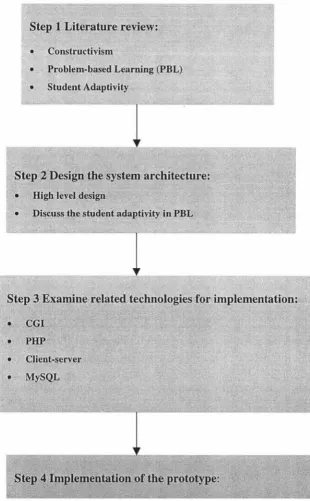
The following steps summarize the plan of this project that 1s used to reach the objectives described above:
• Step I: Literature review: it covers constructivism, problem-based learning, student
adaptivity in intelligent learning systems.
• Step 2: Design the system architecture: it introduces student adaptivity mechanism into PBL learning environment, and build up an architecture based on the literature review.
• Step 3: Exploit some related technologies, such as CGI, Client-server, and so forth.
-• Step 4: Implement the prototype.
The outline of steps is shown in Figure 1.1.
Step 1 Literature re\dew:
• Constructivism
• Problem-based Learning (PBL)
• Student Adaptivity'*
r
--
·
- d -·,,-...---'
§tep 2 Design the system architecture: t•,:;
• High level design
• Discuss the student ad!ptivicy in PBL
;:;;,:71
Step 3 Examine related technologies for implementation:
• CGI
•t CJienVserver
Step
4 ~1mplementaljo1r of'tpe prototype: ,w IA [image:16.565.115.425.136.637.2]1.6 Organization of the Thesis
The thesis consists of 8 chapters. They are outlined below:
Chapter 2 reviews the history and features of the constructivism theory.
Chapter 3 moves from constructivism onto problem-based learning area. It overviews the features of PBL, and discusses its advantages and disadvantages.
Chapter 4 investigates student adaptivity technology and introduces this technology to address the problem with PBL in theory.
Chapter 5 designs the system architecture based on the above research results, and describes its mechanism.
Chapter 6 examines the related technologies, such as CGI, PHP, Client-server, and describes the implementation of the prototype based on the architecture.
Chapter 7 discusses how the student adaptivity works in this prototype.
Chapter 8 concludes the contributions of this project and presents some further consideration about this project in future.
-Chapter 2
Literature Review: Overview of Constructivism
2.1 Introduction
In this chapter, the history of learning theories is briefly reviewed, and the importance of learning theories is discussed. Then the definition of constructivism and its features
are described in detail.
2.2 Historical Foundations
Current learning theories have roots that extend far into the past. The problems that today's theorists and researchers investigate are not new but simply variations on a timeless theme:
• Where does knowledge come from?
• How do people come to know?
Two opposing positions on the origins of knowledge-empiricism and rationalism have existed for centuries and are still evident, to varying degrees, in the learning theories of today. A brief description of these views will help to understand the current learning viewpoints of behaviorism, cognitivism, and constructivism.
illustrated by Hulse et al. ( 1980), can be built from the less complex ideas of branches and leaves, which in turn are built from the ideas of wood and fiber, which are built from basic sensations such as greenness, woody odor, and so forth.
Based on this theory, instructional design issues focus on how to manipulate the environment in order to improve and ensure the occurrence of proper associations.
• Rationalism is the view that knowledge derives from reason without the aid of the senses (Schunk, 1991 ), and humans learn by recalling or "discovering" what already exists in the mind. For example, the direct experience with a tree during one's lifetime simply serves to reveal that which is already in the mind. The "real" nature of the tree becomes known, not through the experience, but through a reflection on one's idea about the given instance of a tree. In summary, knowledge arises through the mind. Based on this theory, instructional design issues focus on how best to structure new information in order to facilitate the learners' encoding of this new information, as well as the recalling of that which is already known.
The empiricist provided the framework for many learning theories during the first half of this century, and it was against this background that behaviorism became the leading psychological viewpoint (Schunk, 1991 ). Because behaviorism was dominant when instructional theory was initiated (around 1950), the instructional design technology that arose alongside it was naturally influenced by many of its basic
assumptions and characteristics.
In the late l 950's, learning theory began to make a shift away from the use of behavioral models to an approach that relied on learning theories and models from the cognitive sciences. Psychologists and educators began to de-emphasize a concern with observable behavior and stressed instead more complex cognitive processes such as thinking, problem solving, language, concept formation and information processing (Snelbecker, 1983). Within the past two decade, a number of authors in the field of instructional design have openly and consciously rejected many of traditional behavioristic assumptions in favor of a new set of psychological assumptions about learning drawn from the cognitive sciences. Whether viewed as an open revolution or simply a gradual evolutionary process, there seems to be the general acknowledgment that cognitive theory has moved to the forefront of current learning theories (Bednar
-et al., 1991 ). This shift from a behavioral orientation (where the emphasis is on
promoting a student's overt performance by the manipulation of stimulus material) to
a cognitive orientation (where the emphasis is on promoting mental processing) has
created a similar shift from procedures for manipulating the materials to be presented
by an instructional system to procedures for directing student processing and
interaction with the instructional design system (Merrill et al., 1981).
The philosophical assumptions underlying both the behavioral and cognitive theories
are primarily objectivistic; that is: the world is real, external to the learner. A number
of contemporary cognitive theorists have begun to question this basic objectivistic
assumption and are starting to adopt a more constructive approach to learning and
understanding: knowledge is a function of how the individual creates meaning from
his or her own experiences. Constructivism is not a totally new approach to learning.
Like most other learning theories, constructivism has multiple roots in the
philosophical and psychological viewpoints of this century, specifically in the works
of Piaget, Bruner, and Goodman (Perkins, 1991 ). In last decade, however,
constructivism has become a "hot" issue as it has begun to receive increased attention
in a number of different disciplines, including instructional design (Bednar et al.,
1991).
2.3 Importance of Learning Theory
Learning theories typically are divided into two categories: behavioral and cognitive.
However, in the last decade constructivism is added as a third category because of its
recent emphasis in the instructional design literature (e.g., Bednar et al., 1991; Duffy
and Jonassen, 1991; Winn, 1991 ). In many ways the viewpoints of three categories
overlap, yet they are distinctive enough to be treated as separate approaches to
understand and describe learning.
Why these learning theories are highlighted in research and practice?
• First, learning theories are the source of verified instructional strategies, tactics,
attempting to select an effective prescription for overcoming a given instructional
problem.
• Second, learning theories provide the foundation for intelligent and reasoned
strategy selection. Instructional designers must have an adequate repertoire of
strategies available, and possess the knowledge of when and why to employ each.
This knowledge depends on the designer's ability to match the demands of the task
with an instructional strategy that helps the learner.
• Third, integration of the selected strategy within the instructional context is of
critical importance. Learning theories and research often provide information
about relationships among instructional components and the design of instruction,
indicating how specific techniques/strategies might best fit within a given context
and with specific learners (Keller, 1979).
• Finally, the ultimate role of a theory is to allow for reliable prediction (Richey,
1986). Effective solutions to practical instructional problems are often constrained
by limited time and resources. It is paramount that those strategies selected and
implemented have the highest chance for success. As suggested by Warries
( 1990), a selection based on strong research is much more reliable than one based
on "instructional phenomena."
It is essential to mention further that students exposed to the three instructional
approaches described above would gain different competencies, and there is no single
"best" approach. Given that learning is a complex, drawn-out process and learning is
influenced by many factors, the suitable learning theory it depends on the concrete
learning.
-2.4 Definition of Constructivism
Constructivism is a theory about learning and is a philosophical view on how we come to understand or kno. Before we go further to discuss the constructive learning theory, let us have a look the definition of learning.
2.4.1 What is Learning?
Learning has been defined in numerous ways by many different theorists, researchers and educational practitioners. Although universal agreement on any single definition is nonexistent, many definitions employ common elements. The following definition by Shuell (I 991) incorporates these main ideas: "Learning is an enduring change in behavior, or in the capacity to behave in a given fashion, which results from practice or other forms of experience" (p. 2).
To the objectivists, knowledge and truth exist outside the mind of the individual and are therefore objective, and learners are told about the world and are expected to replicate its content and structure in their thinking (Jonassen, 1991 ). The role of education in the objectivist view is therefore to help students learn about the real world. It is asserted that there is a particular body of knowledge that needs to be transmitted to a learner. Learning is thus viewed as the acquisition and accumulation of a finite set of skills and facts.
To the constructivist, learning is described as a change in meaning constructed from experience (Newby et al., 1996). Constructivists believe that knowledge and truth are constructed by people and do not exist outside the human mind (Duffy and Jonassen,
1991 ). This is radically different from what objectivism conceives learning to be.
2.4.2 Features of Constructivism
To compare and understand learning theories, Schunk ( 1991) lists five definitive
questions:
I. How does learning occur?
2. Which factors influence learning?
3. What is the role of memory?
4. How does transfer occur? and
5. What types of learning are best explained by the theory?
2.4.2.1 Learning Occurrence in Constructivism
Constructivism is a theory that equates learning with creating meaning from
experience (Bednar et al., I 991 ). Even though constructivism is considered to be a
branch of cognitivism (both conceive of learning as a mental activity), it distinguishes
itself from traditional cognitive theories in a number of ways. Most cognitive
psychologists think of the mind as a reference tool to the real world; constructivists
believe that the mind filters input from the world to produce its own unique reality
(Jonassen, 1991).
Constructivists do not share with cognitivists and behaviorists the belief that
knowledge is mind-independent and can be "mapped" onto a learner. Constructivists
do not deny the existence of the real world but contend that what we know of the
world stems from our own interpretations of our experiences. Humans create meaning
as opposed to acquiring it. Since there are many possible meanings to glean from any
experience, we cannot achieve a predetermined, "correct" meaning. Learners do not
transfer knowledge from the external world into their memories; rather they build
personal interpretations of the world based on individual experiences and interactions.
-Thus, the internal representation of knowledge is constantly open to change; there is
not an objective reality that learners strive to know. Knowledge emerges in contexts
within which it is relevant. Therefore, in order to understand the learning, which has
taken place within an individual, the actual experience must be examined (Bednar et
al., 1991).
2.4.2.2 The Factors of Influencing Learning in Constructivism
Both learner and environmental factors are critical to the constructivist, as it is the
specific interaction between these two variables that creates knowledge.
Constructivists argue that behavior is situationally determined (Jonassen, 1991 ). Just
as the learning of new vocabulary words is enhanced by exposure and subsequent
interaction with those words in context (as opposed to learning their meanings from a
dictionary), likewise it is essential that content knowledge be embedded in the
situation in which it is used. Brown et al ( 1989) suggest that situations actually
co-produce knowledge through activity. Every action is viewed as "an interpretation of
the current situation based on an entire history of previous interactions" (Clancey,
1986). For this reason, it is critical that learning occurs in realistic settings and that the
selected learning tasks be relevant to the students' lived experience.
2.4.2.3 The Role of Memory in Constructivism
The goal of instruction is not to ensure that individuals know particular facts but
rather that they elaborate on and interpret information. A concept will continue to
evolve with each new use as new situations, negotiations, and activities recast it in a
different, more densely textured form. Therefore, "memory" is always under
construction as a cumulative history of interactions. Representations of experiences
are not formalized or structured into a single piece of declarative knowledge and then
stored in the head. The emphasis is not on retrieving intact knowledge structures, but
on providing learners with the means to create novel and situation-specific
the problem at hand. For example, the knowledge of "design" activities has to be used
by a practitioner in too many different ways for them all to be anticipated in advance.
Constructivists emphasize the flexible use of pre-existing knowledge rather than the
recall of prepackaged schemas (Spiro et al., 1991 ). Mental representations developed
through task-engagement are likely to increase the efficiency with which subsequent
tasks are performed to the extent that parts of the environment remain the same.
Memory is not a context-independent process.
Clearly the focus of constructivism is on creating cognitive tools which reflect the
wisdom of the culture in which they are used as well as the insights and experiences
of individuals. There is no need for the mere acquisition of fixed, abstract,
self-contained concepts or details. To be successful, meaningful, and lasting, learning
must include all three of these crucial factors: activity (practice), concept
(knowledge), and culture (context) (Brown et al., 1989).
2.4.2.4 Transfer of Knowledge
The constructivist position assumes that transfer can be facilitated by involvement in
authentic tasks anchored in meaningful contexts. Since understanding is "indexed" by
experience, the authenticity of the experience becomes critical to the individual's
ability to use ideas (Brown et al., 1989). An essential concept in the constructivist
view is that learning always takes place in a context and that the context forms an link
with the knowledge embedded in it (Bednar et al., 1991 ). Therefore, the goal of
instruction is to accurately portray tasks, not to define the structure of learning
required to achieve a task. If learning is decontextualized, there is little hope for
transfer to occur. One does not learn to use a set of tools simply by following a list of
rules. Appropriate and effective use comes from engaging the learner in the actual use
of the tools in real-world situations. Thus, the ultimate measure of learning is based
on how effective the learner's knowledge structure is in facilitating thinking and
performing in the system in which those tools are used.
-2.4.2.5 The Best Types of Learning Based on Constructivism
The constructivist view does not accept the assumption that types of learning can be
identified independent of the content and the context of learning (Bednar et al., 1991 ).
Constructivists believe that it is impossible to isolate units of information or divide up
knowledge domains according to a hierarchical analysis of relationships. Although the
emphasis on performance and instruction has proven effective in teaching basic skills
in relatively structured knowledge domains, much of what needs to be learned
involves advanced knowledge in ill-structured domains.
Jonassen ( 1991) has described three stages of knowledge acquisition (introductory,
advanced, and expert) and argues that constructive learning environments are most
effective for the stage of advanced knowledge acquisition, where initial
misconceptions and biases acquired during the introductory stage can be discovered,
negotiated, and if necessary, modified and/or removed. Jonassen agrees that
introductory knowledge acquisition is better supported by more objectivistic
approaches (behavioral and/or cognitive) but suggests a transition to constructivistic
approaches as learners acquire more knowledge which provides them with the
conceptual power needed to deal with complex and ill-structured problems.
In summary, central to the tenet of constructivism is that learning is an active process.
In her Educational Psychology textbook, Woolfolk ( 1993) described the constructivist
view of the learning process as follows: "The key idea is that students actively
construct their own knowledge: the mind of the student mediates input from the
outside world to determine what the student will learn. Learning is active mental
work, not passive reception of teaching" (p485). Hence, according to the
constructivist perspective, learning is determined by the complex interplay among
learners' existing knowledge, the social context, and the problem to be solved.
Although various authors have described the characteristics of constructivist
instruction (e.g. Brooks and Brooks, 1993; Cognition and Technology Group, 1993;
Collins et al., 1991; Honebein et al., 1993), two characteristics are central to these
• Good problems: constructivist instruction asks learners to use their knowledge to
solve problems that are meaningful and realistically complex. The problems provide the context for the learners to apply their knowledge and to take ownership of their learning. Good problems are required to stimulate the exploration and reflection necessary for knowledge construction.
• Collaboration: the constructivist perspective supports that learners learn through interaction with others. Learners work together as peers, applying their combined knowledge to the solution of the problem. The dialogue that results from this combined effort provides learners with the opportunity to test and refine their understanding in an ongoing process. There is another aspect of collaboration in a constructivist learning environment, which involves the role of the teacher.
2.5 Summary
This chapter has reviewed constructivism theory in detail. Constructivism is not a totally new learning theory, and is developed from multi-disciplines such as the philosophy and psychology. In last decade, constructivism has been highlighted by a
number of different disciplines, especially instructional design.
One popular summary of constructivism theory is pointed out by Lebow ( 1993). He noted that:
... traditional educational technology values of replicability, reliability, communication, and control (Heinich, 1984) contrast sharply with the sever primary constructivist values of collaboration,
personal autonomy, generativity, reflectivity, active engagement, personal relevance, and pluralism (p.5).
The instructional principles outline by Lebow leads to a wide variety of learning environments. However, the problem-based learning environment is the almost ideal and most popular area that implements the constructivism principles. In chapter 3, the problem-based learning area is going to be reviewed.
-Chapter 3
Literature Review: Overview of Problem-Based Learning
3.1 Introduction
This chapter reviews one of the best exemplars - problem-based learning for
constructivism, which is a constructivist learning environment and is described by
Barrows (1986, 1998) at the Southen Illinois Unvieristy Medical School. The history
of problem-based learning and its definition are discussed. Then we look into some
existing computer assisted learning environment where problem-based learning has
been implemented.
3.2 History
Problem-based Learning (PBL) as a general model was developed in medical
education. The original problem-based curriculum at McMaster University, featuring
small learning groups with a faculty tutor, was established some thirty years ago
(Neufeld, 1974, Spaulding, 1991). As a newly created school, McMaster began with
this revolutionary problem-based curriculum after a reasonably luxurious four-year
opportunity to set it up. A few years later two more new schools, widely spaced
across the globe one at Maastricht University in the Netherlands and the other at
University of Newcastle in Australia, undertook problem-based learning curricula.
There was much cross-fertilization between all three schools. Many faculties from
Maastricht and Newcastle spent months to years at McMaster as they were planning
their curricula.
Over twenty years ago, the University of New Mexico School of Medicine created
another based learning revolution by establishing an alternative,
of students and ran parallel with their traditional curriculum. The initial development
of this curriculum was financed by an external grant from the Kellogg Foundation and
required changes in curriculum design and teaching that were quite different from
their traditional curriculum. Promoting this new method for teaching students among
the faculty was a new and difficult challenge for the small, dedicated, alternative
curriculum faculty at New Mexico (Kaufman, 1985). They were pioneers in creating
the change from traditional to problem-based curricula. Subsequently, other medical
schools such as Harvard, Bowman Gray, Rush and Southern Illinois University
established alternative, parallel curricula and faced the challenge of faculty and
curriculum conversion.
Over the last decade, many new and developing countries around the world have also
initiated problem-based curricula (Kantrowitz, 1987), such as schools including
Harvard and Sherbrooke University in Canada have converted their entire, previously
conventional, curricula to problem-based learning (Anderson, 1991, Des Marchais et
al., 1992). The University of Kentucky School of Medicine developed a
problem-based learning curriculum in surgery and more recently problem-based learning has
been incorporated in psychiatry and surgical clerkships at Southern Illinois
University.
Currently, it has been refined and implemented in over sixty medical schools. At this
point problem-based learning cannot be considered as an experimental method in
medical education. It has probably been more thoroughly studied and evaluated than
have the traditionally accepted educational methods used in medical school.
In recent years, the Problem-based Leaning model has been adopted in an increasing
number of other areas including business schools (Milter and Stinson, 1993), Schools
of Education (Duffy, 1994); Architecture, Law, Engineering, Social Work (Boud and
Feletti 1991); and high school (Barrows and Myers, 1993).
-3.3 Definition of PBL
Although a number of researchers have given the definition to PBL from different
views, it should be noted that the definition of PBL is ambiguous (Albanese et al.,
1993). For the most part, PBL is a learner-centered educational method.
Problem-Based Leaming involves the use of complex, "real-world" problems as the stimulus
and framework for learning. It is based on the premise that students will be motivated
to "want to know" and solve the problem posed because it is presented in a context
that simulates real world situations. Acquiring knowledge in the context in which it is
meant to be used facilitates recall and application of concepts and skills learned
(Gijselaers, 1996). In PBL, learners are progressively given more and more
responsibility for their own education and become increasingly independent of the
teacher for their education. PBL produces independent learners who can continue to
learn on their own in life and in their chosen careers. The responsibility of the teacher
in PBL is to provide the educational materials and guidance that facilitate learning.
PBL is a motivating way to learn as learners are involved in active learning, working
with real problems and what they have to learn in their study is seen as important and
relevant to their own lives. The objectives of PBL is to produce learners who will:
• Engage the problems they face m life and career with initiative and
enthusiasm.
• Problem-solve effectively using an integrated, flexible and usable knowledge
base.
• Employ effective self-directed learning skills to continue learning as a lifetime
habit.
• Continuously monitor and assess the adequacy of their knowledge,
3.4 Features of PBL
3.4.1 Basing on Real World Problems
In PBL, the learning is based on the messy, complex problems encountered in the real
world as a stimulus for learning and for integrating and organizing learned
information in ways that will ensure its recall and application to future problems. The
problems in PBL are also designed to challenge learners to develop effective
problem-solving and critical thinking skills.
3.4.2 The Curriculum Based on Problems
The PBL curriculum is different from the conventional instruction. The senes of
problems encountered by learners with the learning process make up the curriculum
for PBL.
The related problems are put together as a group to stimulate learning of content
appropriate to the course. In the PBL process learners characteristically learn far more
and in areas relevant to their personal needs.
3.4.3 Learner Self-directed Learning Process
In the PBL learning process learners encounter a problem and attempt to solve it with
information they already possess allowing them to appreciate what they already know.
They also identify what they need to learn to better understand the problem and how
to resolve it.
Once they have worked with the problem as far as possible and identified what they
need to learn, the learners engage in self-directed study to research the information
needed finding and using a variety of information resources (books, journals, reports,
online information, and a variety of people with appropriate areas of expertise). In this
way learning is personalized to the needs and learning styles of the individual.
-The learners then return to the problem and apply what they learned to their work
with the problem in order to more fully understand and resolve the problem.
After they have finished their problem work the learners assess themselves and each
other to develop skills in self-assessment and the constructive assessment of peers.
Self-assessment is a skill essential to effective independent learning.
3.4.4 The PBL Teachers Work as Tutors
In problem-based learning, the traditional teacher and student roles change. The
students assume increasing responsibility for their learning, giving them more
motivation and more feelings of accomplishment, setting the pattern for them to
become successful life-long learners.
The faculties in turn become resources, tutors, and evaluators, guiding the students in
their problem solving efforts. As learners become more proficient in the PBL learning
process the tutor becomes less active.
3.4.5 Emphasizing on Collaborative Learning Group
In a PBL environment, students are asked to solve a given problem. The problem is
posed to the students before relevant information has been presented through any
medium, including texts or lectures, about the subject matter underlying the problem.
Learning is ideally in small groups of 5 to 7 learners, which students work together to
analyze the problem and determine what information they already have and what
information they do not know and need to learn in order to solve the problem.
3.5 Advantages and Disadvantages of PBL
The justification for PBL is based on its compatibility with modem theories of adult
learning, together with evidence of efficacy in some areas. Most students enjoy the
active participation, which PBL fosters and consider the process to be relevant,
stimulating and even fun (Des Marchais, 1993). On the other hand, teachers tend to
enjoy the increased student contact (Albanese et al., 1993). There is convincing
evidence that PBL fosters self-directed learning skills, and this may help students to
be life-long learners (Shin, 1993, Blumberg, 1992). The main advantages of PBL are:
• Leaming and teaching is more enjoyable for students and teachers
• The learning environment is more stimulating
• Self-directed learning skills are enhanced and retained
• Promotes deeper rather than superficial learning
• Increases interaction between students and faculty
• Improves motivation to learn
3.5.2 Disadvantages of PBL
The main disadvantages of PBL are:
• The criticism most often voiced is that PBL is costly, in demands of staff time and
teaching materials and other physical resources. Both initial and on-going costs
should be considered -- considerable energy and resources are needed over several
years to develop the curriculum and to train tutors and students in the PBL
process. Once up and running, a PBL curriculum can be demanding of staff time;
Des Marchais estimated that the introduction of PBL at Canada's University of
Sherbrooke increased the teaching load by 30% (Des Marchais, 1993).
• PBL can be stressful and discomfort for both students and staff, at least until they
become familiar with the process (Berkson, 1993). Most students come to PBL
-from educational backgrounds where teachers direct learning and are accustomed
to subject-based learning passing exams, one subject at a time. They are not used
to setting their own learning objectives or creating their own learning plans.
By contrast, PBL does not limit what students may choose to learn, and the
process may provide little guidance on the best ways of achieving learning goals.
Students may be concerned that their learning strategies are misdirected or
inefficient. This is the main concern that this thesis tries to address by introducing
student adaptivity technologies to help students.
• Learn less: Learner want to learn it all, immediately, but they can not (Woods,
1994). In fact, for each case, individuals learn a bit, but in depth; over many
problems, they learn much, in depth.
• Inefficiency: another disadvantage of PBL is its relative inefficiency (Woods,
1994) -- some research suggests that PBL curricula cover about 80% of what
might be accomplished in a conventional curriculum in the same period (Albanese
et al., 1993).
3.6 Implementation of PBL in Computer Assisted Learning
Environment
Over the last decade, computer-assisted learning technologies have been used in
various aspects in problem-based learning to improve PBL's effectiveness and
students' study results. Computer technologies are mainly used within PBL
environment in the following aspects.
3.6.1 Effective and Efficient Information Resources
In the conventional problem-based learning, students need to research the information
and solution for the problems faced by using a variety of information resources, such
Computer occurs as a convenient and effective alternative for information resource.
For example, Medici (Devitt et al., 1995), Web browser support for PBL (Pennell et
al., 1995).
The Medici consists of a shell constructed in HyperCard and Toolbook into which
cases can be placed. The cases are built up as a series of blocks and the information
can be explored from one block to the next by sequential or branched.
The W eh browser support for PBL system was intended to improve undergraduate
biological science students' investigative competencies. It uses HTML to organize the
learning support material, and the knowledge base includes text, images, sounds and
digital video. The material is organised to allow the solution of a graded series of
problems with theory experiments and references (Figure3.1 ). The Internet links are
included to general biochemistry references and in the glossary to link to relevant
information. A web search engine is provided to supplement the sources. The system
largely applies hypermedia and multimedia technologies to support the PBL. It is a
typical example in using computer technologies to provide resources for support PBL.
THE PROBLEMS
Non-specific Defence
Non-Cellular Cellular
Theory
References
Specific Defence
Disorders of hnmune Function
Figure3. l: Relationship between the problems to the knowledge base
-3.6.2 Simulation of Real World Problems
One of main characteristics in PBL process is based on real world problems, but in
traditional PBL the 'real world' problem most are presented in text and some pictures.
Computer programs can be effectively used to simulate real world problems occurring
in economics, medicine, and so forth. For example the future cash flow changes of a
big company can be simulated to wee how different input values will affect the profit
of the company. In medicine, the development of simulation programs that offer
clinical simulation with gradual revelation of data can allow the presentation of
realistic scenarios that are instructional, stimulation and enjoyable.
3.6.3 Support Collaborative Learning
Various educational theorists, such as Vygotsky (1978), Lave and Wenger (1991),
have stressed the importance of social interaction to learning. The term "Computer
Support for Collaborative Leaming" (CSCL) is used to focus the study of the use of
computer-based collaboration tools in instruction. CSCL supports:
• Leaming across geographic and temporal distances
• Group, peer-to-peer, and peer-to-expert learning
• Synchronous/asynchronous help
• Formal and informal instruction
In a PBL environment, learning processes depend upon collaborative interaction
within the learning group. For instant, Collaborative Learning Laboratory (CLL)
(Koschmann, et al., 1990) introduced CSCL technology into PBL environment. Each
participant has a private screen and a shared public screen. The projected screen
serves the role of a blackboard, flip chart, and overhead projector in a more traditional
face-to-face meeting. The private screen serves as an electronic desktop to be
organized and used by the individual participant. The researchers claimed that the
3.6.4 The Advanced Distance Education (ADE) Project (ADE, 2002)
The Advanced Distance Education (ADE) is a project that has been largely exploiting
the potential of computer technologies in medical distance education. ADE project is
developing tools for the creation of adaptive, Web-based courseware incorporating
artificial intelligence. It developed both problem-based learning (PBL) courses and
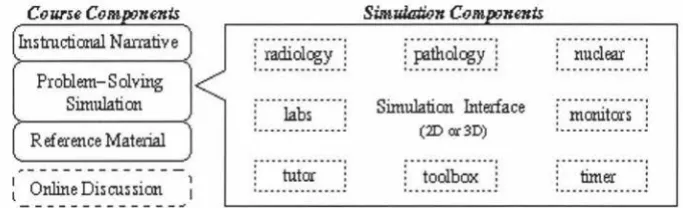
traditional case-based courses. In particular, an agent-assisted, computer-based
architecture (Figure3.2) is applying to implement the PBL.
C ourse C ompo1um ts
Imtructianal Narrative ]
Problem-Solving Simulation
Reference Material
: Online Discimian ---J
i.
radiology .i
---,
: labs :
·---,
'
.
: tutor :
·---Simulation Interlace (2D o:r3D)
... ,
!
..
toolbcoc .. !---,
! .. nuclear .. _ ;
[image:37.562.86.428.250.354.2]... ,
!
_
monitors __i... ,
l
timer ·
·---Figure 3.2: Key elements of a typical course module (Johnson and Shaw, 1997)
The PBL in ADE project employs the above three computer assisted techniques that
are providing information resources in a variety of formats, problem-solving
simulation, and online discussion to support collaborative learning. The students are
given an instructional narrative and presented with the case, in the form of an
interactive problem solving simulation that includes a pictorial view of the patient and
information about the patient such as lab tests, pathology results, and X-rays are
accessed by students. On-line reference materials and on-line discussion are provided.
In addition, a pedagogical agent (Adele) monitors the student's actions and provides
feedback and guidance as appropriate. The Adele agent is used to adapt the system to
the needs of individual students. But the adaptivity in the system is limited. The agent
developed is based on the specific patient case and the similar students' background.
It defines the task order or pattern to be performed and then compares the student's
action against the task order to recommend the actions to perform. It can not provide
further helps, such as students need to refer to or further study some relevant material
according to students' level (e.g. beginning or advanced), or some further guidance
for next step.
-3.7 Summary
Following the review of constructive theory, this chapter discussed what 1s the
problem-based learning (PBL) and its feature and advantages/disadvantages.
Finally, the computer assisted PBL are described. The computer technologies are
comonly used to provide information resources, simulation of the real world problems
and collaborative learning facilities. However, few systems implemented the student
adaptivity in PBL environment to address one of difficulties in PBL application
-students easily become frustrated by lack of information.
Chapter 4
Literature Review: Student Adaptivity
4.1 Introduction
This chapter reviews student adaptivity technology. Some basic concepts and
mechanisms of student adaptivity are discussed. Finally, the key technique of student
adaptivity in intelligent learning systems: student model is presented.
4.2 Overview of Student Adaptivity
4.2.1 What is Student Adaptivity?
The student adaptivity is a core research topic in intelligent learning environment
(Nikov et al., 1999). The student adaptivity enable the systems to tailor themselves
based on individual student's performance and background. The goal of student
adaptivity is that not only "every one should be computer literate" but also that
"computers should be user literate" (Browne et al., 1990). It also makes the learning
systems more effective and efficient.
The level of adaptivity within intelligent learning environments varies from system to
system. On one hand, systems can be adaptabel - allowing the users to change certain
system parameters and adapt systems behavior accordingly. On other hand, systems
can be adaptive - changing their behaviour automatically based on the system's
assumptions about the user needs.
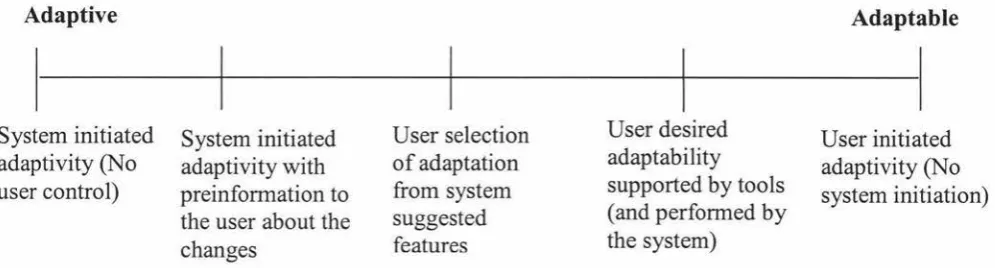
Oppermann et al. (1997) summarized the complete spectrum of adaptivity that exist in
learning systems (Figure 4.1).
-Adaptive
System initiated adaptivity (No user control)
System initiated adaptivity with preinformation to the user about the changes
User selection of adaptation from system suggested features
User desired adaptability supported by tools ( and performed by the system)
Adaptable
[image:40.559.27.525.79.213.2]User initiated adaptivity (No system initiation)
Figure 4.1: the whole spectrum of the concept of adaptation (Oppermann et al., 1999)
4.2.2 Mechanism of Student Adaptivity in Intelligent Educational Systems
...
Student Model Module Domain Model
(Representation of knowledge base}
• Initial test
•
Performance measuring•
Direct • Model Tracing .... I CEl Iquestioning
•
Issue tracing .... ... ' iI
~
• Stereotype • Data ageing ....
• OthPr " · rnles I CE2 I I CE3
I
"--
I~
j
~
I
Initialise~Vt,
I
ICES II CE4 I
i
Domain-independent Domain-specific Information Each curriculum element (CE) is linked to Information • Overall competence level following contents in expert module • Factual data • Competence levels for CEs
•
Its explanation• Historical data • Misconceptions for CEs
A set of related instruction units
•
•
...
• Other ...•
•
•
Related misconceptions in bug catalogue•
Rules for setting content preferences Possible relationships between CEs•
Exploration space control•
Prerequisite•
Multinle renresentation annroach•
Navigational priority•
I
UndateI
....
...
.
T
+
Specific preferences
Expert Module
Content preferences
•
Instruction units (lectures, examples,•
Curriculum sequence problems, tests, simulations, etc) stored in•
Active help and feedback multimedia objects (text, slides, animations,•
Passive help question answer videos, and audio)Re-mediation methods
•
Bug catalogue (misconceptions, re-mediation•
•
.
..
•
methods) Ex•>lanations for CEs (curriculum elements)Navigation preferences .. .
...
.
~. ...•
Information resources•
Navigation paths and tools , ...•
Amount of information presented Tutoring Module•
.
..
,rInterface preferences ~ Adaptive actions Capture of
student actions
...
•
Multimedia objects•
Responses•
Navigation objects n to problems•
Integration of multimedia objects•
Problem-•
...
solving...
processesI
InitialiseI
•
...
Glob~l preferences
n Content, navigation, interface preferences ... ···•·•···· ... .... ... . ... ... ...
•
I
InitialiseI
~,
I ... ... ...
I
•
Stereotype ...I
Interface Module [image:41.563.7.517.40.747.2].. ...
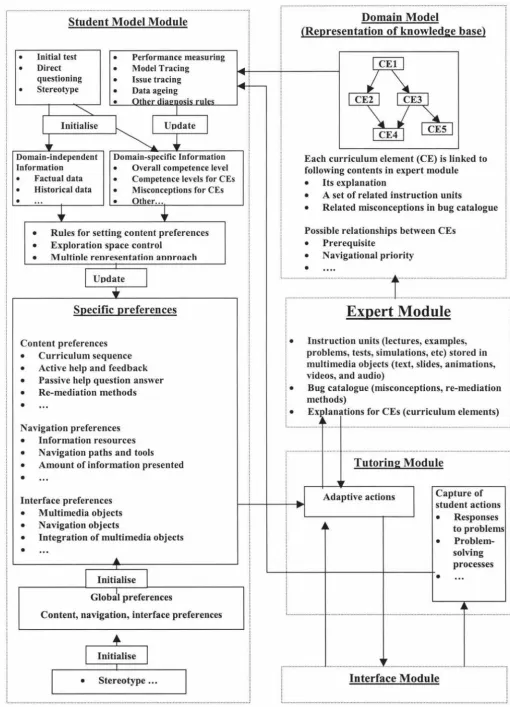
Figure 4.2: Structure of student model module and its relationship with other modules (Han, 2001)
30
4.2.3 Implementation of Student Adaptivity from Application Level
In an intelligent learning system, the same teaching material can be presented in different formats and order for a specific student. That is adaptive presentation. In
addition, in web-based environment, the links among pages can be adapted for
individual students. That is called as adaptive navigation.
• Adaptive presentation: Based on a specific student's learning goals, knowledge
level, personal preferences, the content and format of courseware (including text
and multimedia), can be adapted to fit the student's needs (Brus1lovsky, 2000). The adaptive presentation is a mature technique and has been tested successfully
for improving student's learning effectiveness and efficiency (Boyle et al., 1994).
There are different approaches used to implement the adaptive presentation, such as sorting information order, giving prerequisite explanations, adding additional
explanations, comparing related concepts, and preparing variants for one concept.
Sorting information order: The system 1s able to order the information of a
concept to fit a particular student's needs.
Giving prerequisite explanations: Before presenting information about a concept,
if system recognises that the particular student needs to know the concept's
prerequisite information, then the prerequisite information will be presented to the
student first.
Adding additional explanations: To the same concept, different individual student may access information at various levels based on the student's model. Some information may be hidden from a specific student if he does not need to know
; this information (Hook et al., 1996). This approach was used in KN-AHS (Kobsa
V V
et al., 1994), ITEM/IP (Brusilovsky, 1992), and Anatom-Tutor (Beaumont, 1994).
Preparing variants of one concept: Depending on studies' capabilities, system
may provide the same content or concept in different formats, suitable to
particular students' attributes.
There are some ex1stmg systems using adaptive presentation technology, for
example, ITEM/IP (Brusifovsky, 1992), De Bra's adaptive course on Hypertext
(Calvi et al., 1997), ELM-ART, and InterBook (Diego et al., 2000).
• Adaptive navigation: the basic mechanism of adaptive navigation is similar to the
adaptive presentation. But the adaptive navigation attempts to adapt and define the
navigation paths or navigation space for a specific student. In practice, it is
implemented by modifying the visible links, such as sorting, annotating or hiding
the links of pages. There are different levels of approaches to provide the
navigation adaptivity to the students:
Global orientation: It helps the students to understand the overall course structure
and his/her absolute position in the hyper-space.
Global guidance: It helps students find the shortest way to the information they
want. The most direct method is to provide the student with the links to follow at
every browsing step.
Local orientation: It helps the student by pointing out what is around and his/her
relative position in the local hyper-space.
Local guidance: It helps students move one navigation step by suggesting the
most relevant links from the current node. The example systems are: ISIS-Tutor,
SYPROS (Gonschorek et al., 1995), HyperTutor and Hynecosum (Vassileva,
1996), WebWatcher (Armstrong et al., 1995), and Adaptive HyperMan (Mathe et
al., 1996).
-4.3 Student Model
Student adaptivity is the core of intelligent educational system. How successful an
intelligent educational system is largely depends on how good student adaptivity it
provides. The student model is the most important component that makes
individualised adaptation possible.
4.3.1 What is Student Model?
A student model stores the student's skill, knowledge, interests, practices, goals, any
other information related to the student (Self, 1994). It is constantly updated in
accordance with the dynamic features of the student skills, knowledge, and
proficiency during the learning process, because the student is acquiring knowledge
continuously (Neilsen, 1990, Brusilovsky, 1994, Vassileva, 1995).
Brusilovsky (1994) pointed out that student models are usually classified according to
the nature and form of information contained in the models. Based on the relationship
with the subject domain, the information held in student models could be divided into
two groups: domain dependent information and domain independent information.
• Domain dependent information: It represents a reflection of the student's state and
level of knowledge and skills in term of a particular domain (Brusilovsky, 1994)
• Domain independent information: It contains the student's learning goals,
cognitive aptitudes, measures for motivation state, preference about the
presentation method, factual and historic data, etc.
4.3.2 Purposes of Student Model
The purposes of student model is to monitor and record the student's behaviour,
answers, and problem-solving strategies, and then to analyse them in order to