Generic Constructions of RIBE via Subset Difference
Method
Xuecheng Ma1,2and Dongdai Lin1,2
1 State Key Laboratory of Information Security, Institute of Information Engineering, Chinese Academy
of Sciences, Beijing 100093, China
2 School of Cyber Security, University of Chinese Academy of Sciences, Beijing 100049, China
{maxuecheng,ddlin}@iie.ac.cn
Abstract. Revocable identity-based encryption (RIBE) is an extension of IBE which can support a key revocation mechanism, and it is important when deploying an IBE system in practice. Boneh and Franklin (Crypto’01) presented the first generic construction of RIBE, however, their scheme is not scalable where the size of key updates is linear in the number of users in the system. The first generic construction of RIBE is presented by Ma and Lin with complete subtree (CS) method by combining IBE and hierarchical IBE (HIBE) schemes. Recently, Lee proposed a new generic construction using the subset difference (SD) method by combining IBE, identity-based revocation (IBR), and two-level HIBE schemes.
In this paper, we present a new primitive called Identity-Based Encryption with Ciphertext Delegation (CIBE) and propose a generic construction of RIBE scheme via subset difference method using CIBE and two-level HIBE as building blocks. CIBE is a special type of Wildcarded IBE (WIBE) and Identity-Based Broadcast Encryption (IBBE). Furthermore, we show that CIBE can be constructed from IBE in a black-box way. The ciphertext in our generic RIBE scheme can be reduced to bo constant by using IBBE. Instantiating the underlying IBBE scheme with a proper concrete scheme, we can obtain a RIBE scheme with constant-size public parameter, ciphertext, private key and O(r) key updates in the selective-ID model. Additionally, our generic RIBE scheme can be easily converted to a sever-aided RIBE scheme which is more suitable for lightweight devices.
Key words: Generic Construction, Revocable IBE, Subset Difference, DKER
1
Introduction
Identity-Based Encryption (IBE) was introduced by Shamir [47], to eliminate the need for main-taining a certificate based Public Key Infrastructure (PKI) in the traditional Public Key Encryp-tion (PKE) setting. The first IBE scheme was proposed by Boneh and Franklin [9] in the random oracle model [4]. Since then, there are many follow-up works [6, 7, 50, 21, 51, 15, 10, 2, 3, 11–13, 22, 52, 53, 19]. A hierarchical IBE (HIBE) scheme [23, 25] generalizes the concept of IBE by forming levels of a hierarchy. For an`-level HIBE, a hierarchical identity is a vector of maximal`identities, and a user at levelican generate a secret key for its descendants at levelj (wherei < j≤`).
To address the challenge of key revocation in IBE setting, Boneh and Franklin [9] presented the notion of revocable IBE and proposed a naive method to add a simple revocation mechanism to any IBE system as follows. A sender encrypts a message using a receiver’s identity concatenated with the current time period, i.e.,id||Tand the Key Generation Center (KGC) issues the private keyskid||tfor each non-revoked user in every time period. However, BF-RIBE scheme is inefficient.
The number of private keys issued in every time period is linear in the number of all users in the system hence the scheme does not scale well when there are a large number of users.
It attracted many follow-up works concerning R(H)IBE schemes with DKER [20, 27, 29, 31, 32, 35, 39, 40, 42, 46, 49].
Server-aided RIBE [41, 16, 37] is a variant of RIBE where almost all of the workload on the user side can be delegated to an untrusted third-party server. The server is untrusted in the sense that it does not possess any secret information. Each user only needs to store a short long-term private key without having to communicate with KGC.
Ma and Lin [34] proposed a generic construction of RIBE using complete subtree method by combining IBE and HIBE in a black-box way which solved the open problem presented in [44]. In their first scheme, an update key consists ofO(r·`) IBE private keys and a ciphertext consists of
O(`) IBE ciphertexts whereris the number of revoked users and`is the bit length of an identity. And they also made some optimization using HIBE or IBBE [17] which makes the ciphertext size constant. Currently, Lee [30] proposed a generic RIBE scheme with the subset difference method by using IBE, identity-based revocation (IBR), and two-level HIBE schemes as basic building blocks. Their scheme reduced the size of an update key fromO(r·`) key elements toO(r) key elements but the ciphertext size increased toO(`2) number of IBE and IBR ciphertexts. In addition, they showed how to reduce the ciphertext size by extending their generic RIBE scheme to use the more efficient LSD method instead of using the SD method.
1.1 Our Contributions.
In order to construct a generic RIBE scheme using SD method, we first present a new primitive called identity based encryption with ciphertext delegation (CIBE). Contrary to HIBE where an identity secret key can decrypt ciphertexts encrypted under itsdescendants, an identity secret key can decrypt ciphertexts encrypted under itsancestorsin a CIBE scheme. In addition, the plaintext encrypted under an identityid is confidential if the adversary does not know the secret key of id
or descendants of id. It is obvious that the new primitive CIBE is a special type of wildcarded IBE (WIBE)[1] where the wildcard “*” just appears at the end portion of the pattern. It can also be viewed as a special type of IBBE where we encrypt a plaintext under all descendants of id.3 Moreover, we will show that CIBE can be constructed from IBE in a black-box way.
In this paper, we propose a generic construction of RIBE with SD method by combining CIBE and a two-level HIBE. Our technique and building blocks are different from Lee’s generic RIBE scheme although both of our two schemes use SD method. In our generic construction, the key update size isO(r) CIBE keys and the ciphertext is O(`2) CIBE ciphertexts and one HIBE ciphertext. Furthermore, CIBE can be constructed from IBE in a black-box way so we can give a generic construction of RIBE with SD method by using IBE and HIBE as building blocks. However the secret key size of the generic CIBE scheme from IBE isO(`) which results in a O(r·`) size of key update in the generic RIBE scheme. Although the key update is not short as that of Lee’s construction and the ciphertext size is bigger than that of generic construction using CS method [34], it shows the possibility that generically construct RIBE with SD method using IBE and HIBE and we wish to give a CIBE scheme with shorter secret key from IBE in the future. Furthermore, we can construct CIBE from WIBE (IBBE), our generic RIBE scheme consists of O(r) WIBE (IBBE) secret keys in key update andO(`2) WIBE (IBBE) ciphertexts and one HIBE ciphertext in a ciphertext. In addition, the layered SD (LSD) method can be applied to our generic RIBE scheme which reduces the ciphertext and the update key toO(`1.5) CIBE ciphertexts and 4rCIBE private keys, respectively. Last but not least, we can reduce the ciphertext size by using IBBE solves the open problem presented by Lee [30]. Note that it is difficult to reduce the ciphertext size in Lee’s scheme since it uses an IBR scheme. Instantiating the underlying IBBE and HIBE schemes with proper concrete schemes, we can obtain a RIBE scheme with constant-size public parameter, ciphertext, private key andO(r) key updates in the selective-ID model.
1.2 Our Technique
Let us first describe the generic RIBE scheme using CS method proposed by Ma and Lin. Ma and Lin observed that the design principle of CS method in the symmetric setting [36]. In symmetric
3
Broadcast encryption [36], every user corresponds to a leaf node in a complete binary tree and holds all secret keys corresponding to the nodes in the path from root to the associated leaf. The non-revoked users are covered by complete subtrees and the plaintext is encrypted by secret keys corresponding the root nodes of the subtrees which cover all the non-revoked users. A user is not revoked if and only if there is a ciphertext encrypted under a secret key corresponding a node in the path from the root to its associated leaf node. In RIBE setting, Ma and Lin view an identity
idas a leaf in a complete binary tree with depth|id|. A plaintext is encrypted under the identifiers of nodes in the path from the root toid using IBE and KGC broadcast a set of IBE secret keys associated with the root node of the complete subtrees which cover all non-revoked users. The key update consists of secret key of one ancestor of id iff idis not revoked. We only describe the behind idea for realizing revocation mechanism in the scheme of Ma and Lin. For the security reason, they divided the plaintexts into two secret shares, one is encrypted using HIBE and the other is encrypted using IBE under all ancestors of id.
Unlike CS method that covers revoked users by complete subtrees, SD method covers non-revoked users using subsetsCVR ={Si,j} whereSi,j is presented by two nodes (vi,vj) and vi is an ancestor ofvj andSi,j contains all leaves which are descendants ofvibut not ofvj. TheAssign algorithm assigns secret keys corresponding nodes which are adjacent to the nodes in the path from root tovid but not ancestors ofvid. LetP Vid={Si,j0 }denote the node subset assigned toid whereSi,j0 is presented by (v0i,vj0). The assign algorithm and cover algorithm guarantees thatidis not revoked iff there existsSi,j ∈CVR andS0i,j∈P Vid such thatvi=vi0 andv0j is an ancestor of
vj. In order to apply SD method to RIBE, we divide the plaintext into to shares. One is encrypted underid||Tusing HIBE and the other is encrypted underTconcatenating corresponding nodes in
P Vid using CIBE. KGC broadcasts CIBE secret keys{skTSi,j}Si,j∈CVR in timeT. The ciphertext
delegation property of CIBE guarantees that the CIBE ciphertext part can be decrypted using key update iff there is an identity in the ciphertext which is a prefix ofSi,j.
1.3 Related Works
Revocable IBE. The first revocable IBE scheme from any IBE was presented by Boneh and
Franklin [9], however their proposal was not scalable and need a secret channel. Boldyreva et al. [5] proposed the first scalable RIBE combining fuzzy IBE and CS method. A number of secure and efficient RIBE schemes using a broadcast method for key updates have been proposed [14, 28, 33, 40, 44, 48]. Most of the RIBE schemes follow the CS method for update keys, but Lee et al. [31] showed that an RIBE scheme with the SD method can be designed to reduces the size of update keys. Recently, Ma and Lin [34] proposed a generic RIBE construction with the CS method by combining IBE and HIBE schemes. Subsequently, Lee proposed a generic RIBE scheme with SD method using IBE, IBR and HIBE as building blocks.
Revocable HIBE. Seo and Emura [34] presented the first revocable HIBE (RHIBE) scheme
with history-preserving updates, wherein a low-level user must know the history of key updates performed by ancestors in the current time period which makes the scheme very complex. Sub-sequently, Seo and Emura [45] presented a new method to construct RHIBE that implements history-free updates. After that, there are some follow-up works concerning about efficiency [32], stronger security [29] or assumptions without pairing [28].
2
Preliminaries
2.1 Notations
Throughout the paper we use the following notation: We useλas the security parameter and write
negl(λ) to denote that some functionf(·) is negligible inλ. An algorithm is PPT if it is modeled as a probabilistic Turing machine whose running time is bounded by some functionpoly(λ). IfSis a finite set, thens←Sdenotes the operation of picking an elementsfromS uniformly at random. IfA is a probabilistic algorithm, then y ←A(x) denotes the action of running A(x) on input x
the length ofuandu||v denotes their concatenation. LetBT be a complete binary tree. For two stringss andt of length`, we uses=∗ tto denote smatchest ands6=∗t to denotes does not matcht. We define s=∗tiffsi =ti∨ti=∗ for alli∈ {1, ..., `} ands6=∗t iffsi6=ti∧ti6=∗for somei∈ {1, ..., `}.
2.2 Identity-Based Encryption with Ciphertext Delegation
An IBE with ciphertext delegation schemeCIBEconsists of four algorithmsSetup, KeyGen, Enc, andDec, which are defined as follows:
1. Setup(1λ):The setup algorithm takes as input a security parameter 1λ and outputs a master keyMK and public parameterPP.
• KeyGen(MK,id): This algorithm takes as input the master secret key MK and an identity
id∈ {0,1}`, it outputs the identity secret keysk
id.
• Enc(PP,id,µ): This algorithm takes as input the public parameterPP, an identityid∈ {0,1}`0 where`0 ≤`, and a plaintextµ, it outputs a ciphertextc.
• Dec(skid,c): This algorithm takes as input a secret keyskid for identityid and a ciphertextc,
it outputs a plaintextµ.
Correctness:The correctness of CIBE is defined as follows: For all security parameters 1λ, two identitiesid∈ {0,1}`0,id0 ∈ {0,1}` and plaintextµ, the following holds:
Pr[Dec(skid0,Enc(PP,id, µ)) =µ] = 1 whereidis a prefix of id0, (PP,MK)←Setup(1λ) andsk
id0 ←KeyGen(MK,id0).
Multi-Identity Adaptive Security:For any PPT adversaryA, there is a negligible function
negl(·) such that the following holds:
AdvAIND-mCID-CPA=|Pr[IND-mCID-CPA(A)= 1]−1
2| ≤negl(λ) whereIND-mCID-CPA(A)is shown in Figure 1.
If q= 1, we call the above experiment as single-identity adaptive security (IND-CID-CPA).
Ad-Experiment IND-mCID-CPA(A) :
1. (PP,MK)←Setup(1λ) 2. (µ0, µ1,id∗1, ...,id
∗
q) ← AKeyGen(MK, ·)
(PP) whereq is a polynomial of λ, |µ0| =|µ1|and for each queryid to KeyGen(MK,·) we have that anyid0∈ {id∗1, ...,id∗q} is not a prefix of id (or equal to
id). 3. β← {0,1}
4. {c∗i ←Enc(PP,id ∗
i, µβ)}i∈[q] 5. β0 ← AKeyGen(MK,·)
(PP,c∗1, ...,c
∗
q) and for each query id to KeyGen(MK,·) we have that any
id0∈ {id∗1, ...,id∗q}is not a prefix of id(or equal toid).
6. Output 1 ifβ=β0and 0 otherwise.
Fig. 1.The multi-identity adaptive security experiment of CIBE
ditionally, we can define the selective security analogously where the adversary first commit the challenge identities before obtaining the public parameter. Obliviously, single-identity security is a special case of multi-identity security. For the other direction, we will show that single-identity security implies multi-identity security.
Proof. Since the proof for the adaptive-ID security and that for selective-ID security are essentially the same, we only show the proof for the former.
We prove the lemma by hybrid arguments. First, we defineq+ 1 hybrid gamesH0, ...,Hq where
H0 is the realIND-mID-CPAgame and for alli∈[q],Hi is the same asHi−1except the way that the challenger generates the challenge ciphertext. InHi, the challenger computes the challenge ciphertext as{c∗
j ←Enc(PP,id∗j,0)}j∈{1,...,i} and{c∗j ←Enc(PP,id∗j, µβ)}j∈{i+1,...,q}where0is an all-zeros string with the same length ofµ0 and β is randomly chosen from{0,1}. Let Si denote the event that the output of IND-mCID-CPA game is 1 inHi. In Hq, the challenge ciphertext is encryption of zeros so Pr[Sq] = 12. We will show that |Pr[Si−1]−Pr[Si]| ≤negl(λ) for all i∈[q] and finish the proof. We construct a PPT algorithmBsuch that|Pr[Si−1]−Pr[Si]|is equal to the probability thatBbreaks single-identity adaptive-ID security of CIBE. The detail of the algorithm
Bis as follows:
1. B’s challenger sends the public parameter PPtoBandBforwards it toA.
2. WhenA queries secret key for identityid,B makes secret key query forid and sendsskid to
A. Then Asends q challenge identitiesid∗1, ...,id∗q and two plaintexts (µ0, µ1) with the same length.
3. B randomly chooses a bit β and sends (0, µβ,id∗i) to its challenger, where |0| =|µ0| =|µ1|. The challenger randomly chooses a bit b and outputsc∗i =Enc(PP,id∗i,0) if b= 0 and c∗i =
Enc(PP,id∗i, µβ) if b = 1. Then, B computes {c∗j ← Enc(PP,id∗j,0)}j∈{1,...,i−1} and {c∗j ←
Enc(PP,id∗
j, µβ)}j∈{i+1,...,q}. Finally, it outputsc∗= (c∗1, ...,c∗q).
4. B answers the secret key queries as Step 2. A outputs a guess β0 of β. B outputs b0 = 0 if
β0 =β and outputsb0= 1 otherwise.
Note that the identityidAsubmits to secret key oracle with the restriction that no one identity in
{id∗
1, ...,id∗q}is a prefix of id. For alli∈ {0,1, ..., q},Bdoes not query secret key foridwhere there exists a challenge identity that is a prefix ofidinHi. Ifb= 0,Bperfectly simulates the challenger in Hi, and otherwise, it perfectly simulates that in Hi−1. Moreover, the probability that b0 =b satisfies:
Pr[b0 =b] = Pr[b0=b|b= 0] Pr[b= 0] + Pr[b0=b|b= 1] Pr[b= 1] = 1
2Pr[b
0 =b|b= 0] + 1 2Pr[b
0 =b|b= 1]
= 1 2Pr[b
0 =b|b= 0] + 1
2(1−Pr[b
0 6=b|b= 1])
= 1 2+
1 2(Pr[β
0=β|b= 0]−Pr[β0=β|b= 1])
= 1 2+
1
2(Pr[Si]−Pr[Si−1])
The single-identity adaptive security of CIBE guarantees that |Pr[b0 = b]− 1
2| ≤ negl(λ) so
|Pr[Si]−Pr[Si−1]| ≤negl(λ) for alli∈[q]. Hence,|Pr[S0]−Pr[Sq]|=|Pr[S0]−12| ≤negl(λ). We complete the proof.
We can construct CIBE from IBE in a black-box way. The Setup, Enc and Dec algorithms are the same of those of underlying IBE scheme. To generate a secret key for an identityid in CIBE scheme, we generate secret keys for all prefixes ofid usingKeyGenalgorithm of IBE.
2.3 Wildcarded Identity-Based Encryption
A wildcarded identity-based encryption scheme consists of four probabilistic polynomial-time (PPT) algorithms (Setup, KeyGen, Enc, Dec) defined as follows:
• Setup(1λ): This algorithm takes as input the security parameter 1λ, and outputs a public parameterPP and a master secret keyMK.
• KeyGen(MK,id): This algorithm takes as input the master secret key MK and an identity
id∈ {0,1}`, it outputs the identity secret keysk
• Enc(PP,P,µ): This algorithm takes as input the public parameterPP, a patternP ∈ {0,1,∗}`, and a plaintextµ, it outputs a ciphertextc.
• Dec(skid,c): This algorithm takes as input a secret keyskid for identityid and a ciphertextc,
it outputs a plaintextµ.
The following correctness and security properties must be satisfied:
− Correctness: For all security parameters 1λ, any identity id∈ {0,1}`, any pattern P ∈
{0,1,∗}`and plaintext µ∈ M, the following holds:
Pr[Dec(skid,Enc(PP, P , µ)) =µ] = 1
whereid=∗P, (PP,MK)←Setup(1λ) andskid←KeyGen(MK,id).
− Adaptive Security: For any PPT adversary A, there is a negligible function negl(·) such that the following holds:
AdvAIND-WID-CPA=|Pr[IND-WID-CPA(A)= 1]−1
2| ≤negl(λ) whereIND-WID-CPA(A)is shown in Figure 2.
Experiment IND-WID-CPA(A) :
1. (PP,MK)←Setup(1λ)
2. (µ0, µ1, P∗) ← AKeyGen(MK,·)(PP) where |µ0| =|µ1| and for each queryid to KeyGen(MK,·) we have thatid6=∗P∗.
3. β← {0,1}
4. c∗←Enc(PP, P∗, µβ)
5. β0← AKeyGen(MK,·)
(PP,c∗) and for each queryidtoKeyGen(MK,·)we have thatid6=∗P∗.
6. Output 1 ifβ=β0and 0 otherwise.
Fig. 2.The adaptive security experiment of WIBE
It is obvious that CIBE is a special type of WIBE when encrypt under an identityid∈ {0,1}`0 we encrypt under a patternP =id|| ∗ ||...||∗where |P|=`and `0 ≤`. In addition, CIBE is also a special type of IBBE, when encrypt under an identityidwe encrypt under all descendants of id
(includingid) using IBBE.
2.4 Hierarchical Identity-Based Encryption
An HIBE scheme consists of four algorithmsSetup,KeyDer, Enc, and Dec, which are defined as follows:
• Setup(1λ, `):The setup algorithm takes as input a security parameter 1λ and maximum hier-archical depth`. It outputs a master keyMKand public parameter PP.
• KeyDer(PP,skid|k−1,id|k):This algorithm takes as input a secret keyskid|k−1of hierarchical
iden-tity id|k−1 = (I1,...,Ik−1)∈ Ik−1, a hierarchical identityid|k = (I1,...,Ik)∈ Ik and the public parameterPP. Note thatskid|0 =MK. It outputs a secret keyskid|k forid|k.
• Enc(id|k, µ,PP). The encryption algorithm takes as input a hierarchical identityid|k= (I1, ..., Ik)∈
Ik, a messageµ, and public parametersPP. It outputs a ciphertextc
id|k.
• Dec(cid|k,skid|k,PP):The decryption algorithm takes as input a ciphertext cid|k, a private key skid|k, and public parameters PP. It outputs a messageµor⊥.
Correctness:For all (PP,MK)←Setup(1λ), all id| k0, id
0|
k1, Dec(Enc(id
0|
k1, µ,PP),skid0|k1,PP) = µ, whereid|k0is a prefix ofid
0|
k1skid|k0 ←KeyDer(PP,MK,id|k0) andskid0|k1 ←KeyDer(PP,skid|k0,id
0| k1).
AdvIND-HID-CPA
A =|Pr[IND-HID-CPA(A)= 1]−
1
2| ≤negl(λ) whereIND-HID-CPA(A)is shown in Figure 3.
Experiment IND-HID-CPA(A) :
1. (PP,MK)←Setup(1λ)
2. (µ0, µ1,id∗)← AKeyDer(MK,·)(PP) where|µ0|=|µ1|and for each queryidtoKeyDer(MK,·)we have thatidis not a prefix ofid∗.
3. β← {0,1}
4. c∗←Enc(PP,id∗, µβ)
5. β0← AKeyDer(MK,·)
(PP,c∗) and for each queryidto KeyDer(MK,·)we have thatidis not a prefix ofid∗.
6. Output 1 ifβ=β0and 0 otherwise.
Fig. 3.The adaptive security experiment of HIBE
2.5 Subset Difference Method
The subset difference (SD) method is a special instance of the subset cover framework introduced by Naor, Naor, and Lotspiech [36] which becomes a general methodology for scalable revocation. There is a complete binary treeBT with 2` leaves. In our generic RIBE scheme, we view user identity as a leaf inBT. We defineTi as a complete binary subtree where its root is nodevi. For two nodes in the tree (vi,vj) such that vi is an ancestor ofvj, a valid subtree Ti,j is defined as
Ti− Tj. A valid subset Si,j is represented by (vi,vj) which is defined as the set of leaf nodes that belong toTi,j, i.e. a leafu∈Si,j iffvi is an ancestor ofubutvj is not. For a full binary treeBT and a subsetRof leaf nodes,ST(BT, R) is defined as the Steiner Tree induced by the set Rand the root node, that is, the minimal subtree ofBT that connects all the leaf nodes in R and the root node. Specifically, the subset difference method is defined as follows:
• SD.Setup(Nmax) : This algorithm takes as input the maximum number Nmax of users. Let
Nmax= 2`for simplicity. LetBT denote a complete binary tree of depth`. The corresponding leaf node in the tree of an identity id ∈ {0,1}` is the terminal node walking from the root directed byid. For an identity id=id0||id1||...||id`−1, if idi is 0, go left, otherwise go right at depthi. Note that the root is at depth 0. We set the identifier of the root as 2, so the identifier of corresponding node ofidis 2||id. The collectionS ofSDis the set of all subsets{Si,j}where
vi, vj ∈ BT andvi is an ancestor ofvj.
• SD.Assign(BT,id) : This algorithm takes as input the tree BT and an identity id ∈ {0,1}`. Letvid be the corresponding leaf node inBT ofid. Let (vk0, vk1, ..., vk`) be the path from the
root nodevk0 to the leaf nodevk` =vid and (vk10, ..., vk
0
`) be the nodes just “hanging off” the
path, i.e. they are adjacent to the path but not ancestors ofvid. It first sets a private setP Vid
as an empty set. For alli∈ {k0, k1, ..., k`}andj∈ {k10, ..., k0`} wherevi is an ancestor ofvj, it adds the subsetSi,j presented by two nodes (vi,vj) intoP Vid. It outputs the private setP Vid.
• SD.Cover(BT, R) : This algorithm takes as input the tree BT and a revoked set R of users. It first sets a subtree T as ST(BT, R), and then it builds a covering set CVR iteratively by removing nodes fromT untilT consists of just a single node as follows:
(a) It finds two leaf nodesvi andvj inT where the least-common-ancestorv ofviandvj does not contain any other leaf nodes ofT in its subtree. Letvl andvk be the two child nodes ofv wherevlis an ancestor ofvi andvk is an ancestor ofvj. If there is only one leaf node left, it makes vi=vj to the leaf node,v to be the root ofT andvl=vk =v.
(b) If vi 6=vl, then it adds the subset Sl,i to CVR; Similarly, ifvj 6=vk , it adds the subset
(c) It removes fromT all the descendants ofv and makesv a leaf node. It outputs the covering setCVR={Si,j}.
• SD.Match(CVR, P Vid) : This algorithm takes input as a covering set CVR = {Si,j} and a private setP Vid=S0i,j. It finds two subsetsSi,j andSi00,j0 such thatSi,j∈CVR,Si00,j0 ∈P Vid
, and (vi=vi0)∧(vj=vj0∨vj is a descendant ofvj0) . If it found two subsets, then it outputs (Si,j, Si00,j0). Otherwise, it outputs⊥.
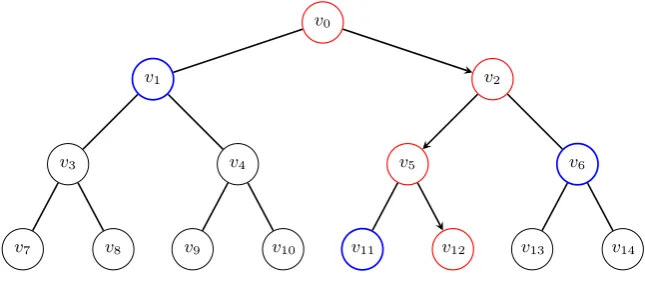
We give an example of SD.Assign algorithm and SD.Cover algorithm in Figure 4 and Figure 5 respectively.
v0
v1 v2
v3 v4 v5 v6
v7 v8 v9 v10 v11 v12 v13 v14
Fig. 4.A private assign to nodev10in SD method
For nodev12,P Vv12 is{(v0,v1),(v0,v6),(v0,v11),(v2,v6),(v2,v11),(v5,v11)}
v0
v1 v2
v3 v4 v5 v6
v7 v8 v9 v10 v11 v12 v13 v14
Fig. 5.A cover set forR= (v9, v10) in SD method
R={v9, v10},CV ={(v0, v4)}.
In order to present our generic RIBE scheme, we first define two functions which encodeCVR,T
andP Vidto identities respectively. For nodesvi= 2||vi,1||...||vi,landvj=vj,0||...||vj,m whereviis an ancestor ofvj, we defineHK: (vi, vj)→ {0,1,2}|vj|which mapsSi,jto the identifier ofvjinTvi
whereTvidenotes the complete subtree rooted atvi.HK(vi, vj) = 2||vj,1||, ...,||vj,l−1||2||vj,l+1, ...,||vj,m.
If|vi|= 1,i.e.vi is the root ofBT, it is vj and ifm=l+ 1, it is 2||vj,1||, ...,||vj,l−1||2||vj,m. Note that the identifier of the root ofBT is 2. Let HE :{0,1}` → {{0,1,2}`+1} be a function map-ping an identity id ∈ {0,1}` to a set of encodings of S
i,j ∈ P Vid. Specifically, HE(x) is defined as follows. Obtain P Vid by computing SD.Assign(BT,id). Output {HK(Si,j)}Si,j∈P Vid. From the
{(v0,v1),(v0,v6),(v0,v11),(v2,v6),(v2,v11),(v5,v11)}andHE(P Vv12) ={20,211,2100,
221,2200,2120}. There exists “20” which is a prefix of “201” sincev12 is not revoked. Moreover,
P Vv9is{(v0,v2),(v0,v3),(v0,v10),(v1,v3),(v1,v10),(v4,v10)}andHE(P Vv9) ={21,200,2011,220,2211,
2021}. There exists no element inHE(v9) which is a prefix of “201” sincev9 is revoked.
3
A Generic Construction of Revocable Identity-Based Encryption
3.1 Definition and Security Model
Similar to the definition in [44], a revocable IBE scheme has seven probabilistic polynomial-time (PPT) algorithms (Setup, KeyGen, KeyUp, DkGen, Enc, Dec, Revoke) with associated message spaceM, identity space ID, and time spaceTb.
• Setup(1λ, Nmax) : This algorithm takes as input a security parameterλand a maximal number of users Nmax. It outputs a public parameter PP, a master secret key MK, a revocation list
RL(initially empty), and a stateST.
• KeyGen(MK,id, ST) : This algorithm takes as input the master secret keyMK, an identityid, and the stateST. It outputs a secret keyskid and an update stateST.
• KeyUp(MK,T, RL, ST) : This algorithm takes as input the master secret keyMK, a time period T∈Tb, the revocation listRL, and the stateST. It outputs a key updateKUT.
• DkGen(skid,KUT) : This algorithm takes as input a secret keyskid and the key updateKUT. It
outputs a decryptiondkid,Tor a special symbol⊥indicating thatidwas revoked.
• Enc(PP,id,T, µ) : This algorithm takes as input the public parameterPP, an identityid, a time periodTand a messageµ∈ M. It outputs a ciphertextc.
• Dec(dkid,T,c) : This algorithm takes as input a decryption secret key dkid,Tand a ciphertext.
It outputs a messageµ∈ M.
• Revoke(id,T, RL) : This algorithm takes as input an identityid, a revocation timeT∈Tb and the revocation listRL. It outputs a revocation listRL.
It satisfies the following conditions:
− Correctness:For allλand polynomials (inλ)N, allPPandMK output by setup algorithm
Setup, allµ∈ M,id∈ ID, T∈Tb and all possible valid states ST and revocation listRL, if identity idwas not revoked before or, at time Tthen there exists a negligible functionnegl(·)
such that the following holds:
Pr[Dec(dkid,T,Enc(PP,id,T, µ)) =µ]≥1−negl(λ)
whereskid←KeyGen(MK,id, ST),KUT←KeyUp(MK,T, RL, ST) anddkid,T←DkGen(skid,KUT). − Adaptive Security: For any PPT adversary A, there is a negligible function negl(·) such
that the advantage ofAsatisfies:
AdvAIND-RID-CPA=|Pr[IND-RID-CPA(A)= 1]−1
2| ≤negl(λ)
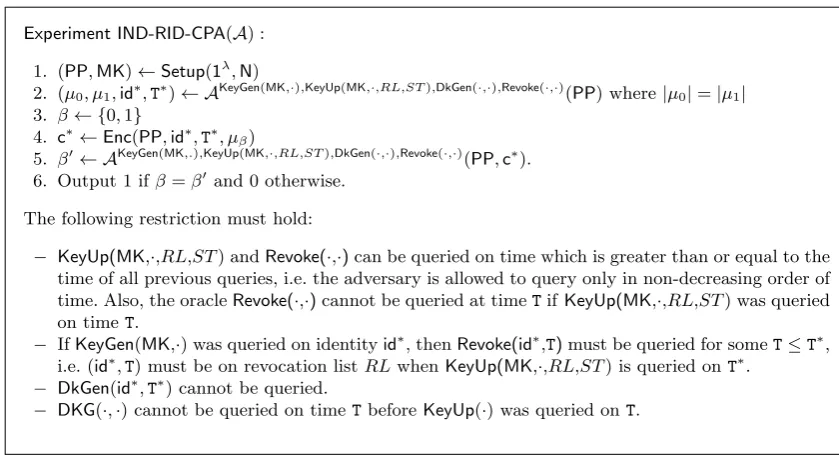
where IND-RID-CPA(A) is shown is Figure 6. Note that the experiment defined in Figure 6 captures decryption key exposure attack.
3.2 Construction
Let (CIBE.Setup,CIBE.Enc,CIBE.KeyGen,CIBE.Dec) be a CIBE scheme withID={0,1,2}[`+1,2`+1] and (HIBE.Setup,HIBE.Enc,HIBE.KeyDer,HIBE.Dec) be a two-level HIBE scheme where the ele-ment identity is in {0,1}`. We assume the HIBE scheme and the CIBE scheme have the same plaintext spaceMwhich is finite and forms a group with the group operation “ + ”.
Utilizing the above primitives, we will show how to construct a generic RIBE scheme Π = (Setup,KeyGen,KeyUp,DkGen,Encrypt,Decrypt,Revoke) as follows. In our RIBE scheme, the plain-text space is M and identity space is {0,1}`. Moreover, we assume the time period space
b
Experiment IND-RID-CPA(A) :
1. (PP,MK)←Setup(1λ,N)
2. (µ0, µ1,id∗,T∗)← AKeyGen(MK,·),KeyUp(MK,·,RL,ST),DkGen(·,·),Revoke(·,·)(PP) where|µ0|=|µ1| 3. β← {0,1}
4. c∗←Enc(PP,id∗,T∗, µβ)
5. β0← AKeyGen(MK,.),KeyUp(MK,·,RL,ST),DkGen(·,·),Revoke(·,·)
(PP,c∗). 6. Output 1 ifβ=β0and 0 otherwise.
The following restriction must hold:
− KeyUp(MK,·,RL,ST) andRevoke(·,·)can be queried on time which is greater than or equal to the time of all previous queries, i.e. the adversary is allowed to query only in non-decreasing order of time. Also, the oracleRevoke(·,·)cannot be queried at timeTif KeyUp(MK,·,RL,ST) was queried on timeT.
− IfKeyGen(MK,·) was queried on identityid∗, thenRevoke(id∗,T)must be queried for someT≤T∗, i.e. (id∗,T) must be on revocation listRLwhenKeyUp(MK,·,RL,ST) is queried onT∗.
− DkGen(id∗,T∗) cannot be queried.
− DKG(·,·) cannot be queried on timeTbeforeKeyUp(·) was queried onT.
Fig. 6.The adaptive security experiment of revocable IBE
• Setup(1λ, N
max) : RunHIBE.Setup(1λ,2)→(HPP,HMK) andCIBE.Setup(1λ)→(CPP,CMK).
SD.Setup(1λ, N
max). Output MK=HMK, an empty revocation listRL, a secret state ST =
CMKand public parameterPP= (HPP,CPP).
• KeyGen(PP,MK,id) : ParsePPas (HPP,CPP), and outputhskid←HIBE.KeyDer(HPP,HMK,id).
• KeyUp(PP, ST, RL,T) : If there exists (id0,T0)∈ RL for some T0 ≤ T, add the identifier of
id0 in BT to R. Then, obtain CVR,T ={Si,j} by running SD.Cover(BT, R). For each Si,j ∈
CVR,T, computecskSi,j ←CIBE.KeyGen(CPP,CMK,T, HK(Si,j)). Output updated key KUT= {Si,j,cskSi,j}Si,j∈CVR,T.
• Enc(PP,id,T, µ) : Parse PP as HPP and CPP. Randomly choose µ0, µ1 with the condition that µ =µ0+µ1. Computec0 ←HIBE.Enc(HPP,id||T, µ0). For each id0 ∈HE(id), compute
cid0 ←CIBE.Enc(CPP,T||id0, µ1). Outputc={c0,T,{id0, cid0}id0∈H
E(id)}.
• DkGen(skid,KUT) : ParseKUTas{Si,j,cskSi,j}Si,j∈CVR,T. ObtainP Vidby computingSD.Assign
(BT,id). IfSD.Match(CVR,T, P Vid) outputs (Si,j,Si00,j0), fetchcskSi,j; otherwise, output⊥and
abort. Computehskid,T←HIBE.KeyDer(HPP,hskid,T). Outputdkid,T= (hskid,T,T, Si,j,cskSi,j). • Dec(PP, c,skid,T): Parse skid,T as (hskid,T,T, Si,j,cskSi,j). Parse c as c0,T
0,{id0, c
id0}id0∈H
E(id).
if T 6= T0, abort; Otherwise, find the identifier id0 which is a prefix of HK(Si,j), compute
µ1←CIBE.Dec(CPP,cskSi,j, cid0) andµ0←HIBE.Dec(HPP,hskid,T, c0). Outputµ=µ0+µ1. • Revoke(ST, RL,T,id) : It adds (id,T) toRLand outputs the updated revocation listRL.
3.3 Security Analysis
Theorem 1. The revocable IBE is adaptive-ID (selective-ID) secure with decryption key exposure resilience if the underlying CIBE scheme and the underlying two-level HIBE scheme are adaptive-ID (selective-adaptive-ID) secure.
Proof. We will prove the adaptive-ID security and the proof for selective-ID security is exactly the same. For any PPT adversary against the adaptive-ID security with DKER of revocable IBE, we can construct a PPT algorithmBagainst the adaptive-ID security of the underlying CIBE or HIBE scheme.Brandomly guesses an adversarial type among the following two types which are mutually exclusive and cover all possibilities:
Note that B’s guess is independent of the attack that A chooses, so the probability that B
guesses right is 12. We separately describeB’s strategy by its guess.
Type-1 adversary:We will show that if adversaryA1makes a type-1 attack successfully, there exists an adversaryB1breaking the multi-identity adaptive security of CIBE defined in Figure 1.
B1 proceeds as follows:
• Setup: B1 obtains a public parameter CPP from its challenger. It generates (HPP,HMK)←
HIBE.Setup(1λ,2) and sends (HPP,CPP) toA1. B
1 keepsHMK as the master secret key and initial revocation listRLand an identifier setR as empty set.
• KeyGen: When receiving a secret key query forid, if there exists a record of (id,hskid) return
hskid. Otherwise,B1generates the secret key normally by runninghskid←HIBE.KeyDer(HMK,id)
and record (id,hskid).
• Revoke:B1 receives (id,T) fromA1, and adds (id,T) toRL.
• KeyUp:Upon receivingT, for all (id0,T0)∈RLwhereT0 ≤T, add the identifier ofid0 in BT to
R. Then, obtainCVR,T={Si,j}by runningSD.Cover(BT, R). For eachSi,j∈CVR,T, compute HK(Si,j). Query secret keys for{T||HK(Si,j)}Si,j∈CVR,T. OutputKUT={Si,j,cskSi,j}Si,j∈CVR,T.
• DkGen:When receiving (id,T), if there exists a record (id,hskid) fetch hskid. Otherwise, B1 normally runs theHIBE.KeyDeralgorithm withHMKand record (id,hskid). Note thatKeyUp(T)
has been queried before.B1outputsDkGen(hskid,KUT).
• Challenge:A1outputs an identityid∗, a time periodT∗and two plaintextsµ0,µ1with the same length.B1randomly samplesµ← Mand sends{T∗||id0}id0∈H
E(id∗)as challenger identities and µ00=µ0−µandµ01=µ1−µas the challenge plaintexts. The challenger randomly chooses a challenge bitβand sends the challenge ciphertexts{cid0 ←CIBE.Enc(CPP,T||id0, µβ)}id0∈H
E(id∗)
toB1.B1then computesc∗0=HIBE.Enc(HPP,id∗||T∗, µ) and sendsc∗= (c∗0,T∗,{id 0, c
id0}id0∈H
E(id∗))
toA1.
• Guess:A1 outputs a guess bitβ0 andB1set β0 as its guess.
Due toid∗has been revoked at or beforeT∗,vid∗is not covered byCVR,T, i.e.SD.Match(CVR,T, P Vid∗) outputs⊥. The property of the encoding functionHE andHK guarantees that no one identifier
id0inH
E(id∗) is a prefix ofHK(Si,j) whereSi,j∈CVR,T. SoB1does not ask any secret key queries foridwhere some challenge identity is a prefix ofid.B1perfectly simulatesA1’s view so thatB1’s challenge bit is alsoA1’s challenge bit.B1just forwardsA1’s guess so the probability thatB1wins in multi-identity adaptive security game of CIBE scheme is equal to the probability thatA1wins in adaptive-ID security with decryption key exposure game of RIBE scheme.
Type-2 adversary: If there exists an adversaryA2 who makes a type-2 attack successfully, we can construct an adversaryB2 breaking adaptive-ID security of the underlying HIBE scheme.
B2 proceeds as follows:
− Setup: B2 obtains a public parameter HPP from its challenger. It generates (CPP,CMK)←
CIBE.Setup(1λ) and sends (HPP,CPP) toA
2. B2 keepsCMKas the state.
− KeyGen:When receiving a secret key query forid,B2just forwards the secret key query to its challenger and sends the challenger’s response toA2.
− Revoke:B2 receives (id,T) fromA2, and adds (id,T) toRL.
− KeyUp:WhenA2makes a key update query for timeT,B2generates the updated key normally by usingCMK.
− DkGen:Upon receiving (id,T).B queries secret key oracle for id||T and obtains hskid||T. Note
thatKeyUp(T) has been queried. Then runs theDkGenalgorithm normally.
− Challenge:A2outputs a challenge identity id∗, a time periodT∗ and two plaintextsµ0 andµ1 with the same length.B1 randomly samplesµ← Mand sendsid∗||T∗,µ00=µ0−µandµ01=
µ1−µto its challenger.B1 receives the challenge ciphertextc∗0=HIBE.Enc(HPP,id∗||T∗, µ0β) where β is B2’s challenge bit chosen randomly by its challenger. For each id0 ∈ HE(id∗), computecid0 ←CIBE.Enc(CPP,T||id0, µ1) and sendsc={c∗0,T∗,{id0, cid0}id0∈H
E(id∗)}toA2. − Guess:A2 outputs a guess bitβ0 andB2setsβ0 as its guess.
For theKeyUporacle,B2can respond by itself because it has the state. For theKeyGenoracle,
thatB2’s challenge bit is alsoA2’s challenge bit.B2just forwardsA2’s guess so the probability that B2 wins in adaptive-ID security game of HIBE scheme is equal to the probability that
A2 wins in adaptive-ID security with decryption key exposure game of RIBE scheme. When we put the results for two types of adversary together, we can conclude that the revocable IBE is adaptive-ID secure if both the underlying IBE and HIBE schemes are adaptive-ID secure.
3.4 Extensions
Layered Subset Difference.In our generic RIBE construction, the ciphertext and update key areO(`2) CIBE ciphertexts plus a HIBE ciphertext and 2rCIBE private keys respectively where
` is the bit length of identity and r is the number of revoked users. We can use layered subset difference (LSD) method [24] to reduce the ciphertext size. If we replace the SD algorithms by LSD algorithms in our generic RIBE construction, the ciphertext and the update key areO(`1.5) CIBE ciphertexts plus a HIBE ciphertext and 4r CIBE private keys respectively.
Constant Ciphertext.Due to CIBE is a special type of IBBE, we can directly replace CIBE by IBBE. The ciphertext in this generic construction consists ofO(`2)/O(`1.5) IBBE ciphertexts plus a HIBE ciphertext if we use SD/LSD method. In addition, we can replace allO(`2)/O(`1.5) IBBE ciphertextsci encrypted under set Si by one IBBE ciphertext c encrypted under a setS =∪Si since allciencrypt the same plaintext. So we can reduce the ciphertext to be one IBBE ciphertexts and one HIBE ciphertext.
Server-Aided RIBE.In server-aided model, there is a semi-honest server without any secret key information that takes almost all the workload on users. The server is curious but honestly performs the procedure. More specifically, the server partially decrypts the ciphertexts using the key update and leaves less decryption task to users. It is easy to convert our scheme to be server-aided, given the key update KUT = {Si,j,cskSi,j}Si,j∈CVR,T and a ciphertext c = {c0,T,{id
0, c
id0}id0∈HE(id)}, the sever first computesP Vid←SD.Assign(BT,id). IfSD.Match(CVR,T, P Vid) outputs (Si,j,Si00,j0), fetch cskSi,j from KUT and compute µ1 ← CIBE.Dec(CPP,cskSi,j, cid0) where id
0 is a prefix of
HE(Si,j). Finally, the sever sends (c0,T, µ1) as the transformed ciphertext to the receiver. The receiver only needs to operate the key extraction and decryption algorithm of underlying HIBE scheme. The receiver does not need to communicate with KGC in every key update.
3.5 Instantiation
If we instantiate the underlying two-level HIBE scheme with BBG-HIBE [8] and the underlying IBBE scheme with a IBBE scheme with constant size public parameter, ciphertext and private key presented in [26], we can obtain a selectively secure RIBE with constant public parameter, ciphertext, private key andO(r) key update. To the best of our knowledge, it is the first RIBE scheme that simultaneously realizes constant size of public parameter, ciphertext, private key and O(r) number of key update. Additionally, if we instantiate the underlying two-level HIBE scheme with BBG-HIBE [8] and the underlying WIBE scheme with BBG-WIBE scheme [1], we can obtain an adaptively secure RIBE in the random oracle where the sizes of ciphertexts and key update areO(`2.5) andO(r) respectively (using LSD method). The ciphertext-policy attribute-based encryption presented in [38] implies WIBE and combining the result in [18] that HIBE can be constructed from IBE, we can obtain a RIBE scheme based on RSA.
4
Conclusion
be converted to a server-aided RIBE scheme and be instantiated efficiently. We can reduce the ciphertext size using IBBE and the instantiated RIBE scheme has constant-size public parameter, ciphertext, private key andO(r) key update. We can obtain RIBE based on RSA assumption if we instantiate the underlying buildings based on RSA.
References
1. Michel Abdalla, Dario Catalano, Alexander W. Dent, John Malone-Lee, Gregory Neven, and Nigel P. Smart. Identity-based encryption gone wild. InAutomata, Languages and Programming, 33rd
In-ternational Colloquium, ICALP 2006, Venice, Italy, July 10-14, 2006, Proceedings, Part II, pages
300–311, 2006.
2. Shweta Agrawal, Dan Boneh, and Xavier Boyen. Efficient lattice (H)IBE in the standard model. In
EUROCRYPT 2010, volume 6110 of Lecture Notes in Computer Science, pages 553–572. Springer,
2010.
3. Daniel Apon, Xiong Fan, and Feng-Hao Liu. Fully-secure lattice-based IBE as compact as PKE.
IACR Cryptology ePrint Archive, 2016:125, 2016.
4. Mihir Bellare and Phillip Rogaway. Random oracles are practical: A paradigm for designing efficient protocols. InCCS ’93,, pages 62–73. ACM, 1993.
5. Alexandra Boldyreva, Vipul Goyal, and Virendra Kumar. Identity-based encryption with efficient revocation. InCCS 2008, pages 417–426. ACM, 2008.
6. Dan Boneh and Xavier Boyen. Efficient selective-id secure identity-based encryption without random oracles. InEUROCRYPT 2004, volume 3027 of Lecture Notes in Computer Science, pages 223–238. Springer, 2004.
7. Dan Boneh and Xavier Boyen. Secure identity based encryption without random oracles. InCRYPTO 2004, volume 3152 ofLecture Notes in Computer Science, pages 443–459. Springer, 2004.
8. Dan Boneh, Xavier Boyen, and Eu-Jin Goh. Hierarchical identity based encryption with constant size ciphertext. InEUROCRYPT 2005, pages 440–456, 2005.
9. Dan Boneh and Matthew K. Franklin. Identity-based encryption from the weil pairing. InCRYPTO 2001, pages 213–229, 2001.
10. Dan Boneh, Craig Gentry, and Michael Hamburg. Space-efficient identity based encryption without pairings.IACR Cryptology ePrint Archive, 2007:177, 2007.
11. Xavier Boyen. Lattice mixing and vanishing trapdoors: A framework for fully secure short signatures and more. In Public Key Cryptography - PKC 2010, volume 6056 of Lecture Notes in Computer
Science, pages 499–517. Springer, 2010.
12. Xavier Boyen and Qinyi Li. Towards tightly secure lattice short signature and id-based encryption.
InASIACRYPT 2016, volume 10032 ofLecture Notes in Computer Science, pages 404–434, 2016.
13. David Cash, Dennis Hofheinz, Eike Kiltz, and Chris Peikert. Bonsai trees, or how to delegate a lattice basis. J. Cryptology, 25(4):601–639, 2012.
14. Jie Chen, Hoon Wei Lim, San Ling, Huaxiong Wang, and Khoa Nguyen. Revocable identity-based encryption from lattices. InACISP 2012, volume 7372 ofLecture Notes in Computer Science, pages 390–403. Springer, 2012.
15. Clifford Cocks. An identity based encryption scheme based on quadratic residues. In Bahram Honary, editor,Cryptography and Coding, pages 360–363, Berlin, Heidelberg, 2001. Springer Berlin Heidelberg. 16. Hui Cui, Robert H. Deng, Yingjiu Li, and Baodong Qin. Server-aided revocable attribute-based encryption. In Computer Security - ESORICS 2016, volume 9879 of Lecture Notes in Computer
Science, pages 570–587. Springer, 2016.
17. C´ecile Delerabl´ee. Identity-based broadcast encryption with constant size ciphertexts and private keys. In ASIACRYPT 2007, volume 4833 of Lecture Notes in Computer Science, pages 200–215. Springer, 2007.
18. Nico D¨ottling and Sanjam Garg. From selective IBE to full IBE and selective HIBE. InTCC 2017, volume 10677 ofLecture Notes in Computer Science, pages 372–408. Springer, 2017.
19. Nico D¨ottling and Sanjam Garg. Identity-based encryption from the diffie-hellman assumption. In
CRYPTO 2017, volume 10401 ofLecture Notes in Computer Science, pages 537–569. Springer, 2017.
20. Keita Emura, Jae Hong Seo, and Taek-Young Youn. Semi-generic transformation of revocable hier-archical identity-based encryption and its DBDH instantiation. IEICE Transactions, 99-A(1):83–91, 2016.
21. Craig Gentry. Practical identity-based encryption without random oracles. In Serge Vaudenay, editor,
EUROCRYPT 2006, pages 445–464, Berlin, Heidelberg, 2006. Springer Berlin Heidelberg.
23. Craig Gentry and Alice Silverberg. Hierarchical id-based cryptography. InASIACRYPT 2002, volume 2501 ofLecture Notes in Computer Science, pages 548–566. Springer, 2002.
24. Dani Halevy and Adi Shamir. The LSD broadcast encryption scheme. InAdvances in Cryptology -CRYPTO 2002, 22nd Annual International Cryptology Conference, Santa Barbara, California, USA,
August 18-22, 2002, Proceedings, volume 2442 of Lecture Notes in Computer Science, pages 47–60,
2002.
25. Jeremy Horwitz and Ben Lynn. Toward hierarchical identity-based encryption. InAdvances in Cryp-tology - EUROCRYPT 2002, International Conference on the Theory and Applications of
Crypto-graphic Techniques, Amsterdam, The Netherlands, April 28 - May 2, 2002, Proceedings, volume 2332
ofLecture Notes in Computer Science, pages 466–481, 2002.
26. Liang Hu, Zheli Liu, and Xiaochun Cheng. Efficient identity-based broadcast encryption without random oracles. JCP, 5(3):331–336, 2010.
27. Yuu Ishida, Junji Shikata, and Yohei Watanabe. Cca-secure revocable identity-based encryption schemes with decryption key exposure resistance. IJACT, 3(3):288–311, 2017.
28. Shuichi Katsumata, Takahiro Matsuda, and Atsushi Takayasu. Lattice-based revocable (hierarchical) IBE with decryption key exposure resistance. InPublic-Key Cryptography - PKC 2019 - 22nd IACR International Conference on Practice and Theory of Public-Key Cryptography, Beijing, China, April
14-17, 2019, Proceedings, Part II, volume 11443 ofLecture Notes in Computer Science, pages 441–471,
2019.
29. Kwangsu Lee. Revocable hierarchical identity-based encryption with adaptive security. IACR
Cryp-tology ePrint Archive, 2016:749, 2016.
30. Kwangsu Lee. A generic construction for revocable identity-based encryption with subset difference methods. IACR Cryptology ePrint Archive, 2019:798, 2019.
31. Kwangsu Lee, Dong Hoon Lee, and Jong Hwan Park. Efficient revocable identity-based encryption via subset difference methods. Des. Codes Cryptography, 85(1):39–76, 2017.
32. Kwangsu Lee and Seunghwan Park. Revocable hierarchical identity-based encryption with shorter private keys and update keys. Des. Codes Cryptography, 86(10):2407–2440, 2018.
33. Benoˆıt Libert and Damien Vergnaud. Adaptive-id secure revocable identity-based encryption. In
CT-RSA 2009, volume 5473 ofLecture Notes in Computer Science, pages 1–15. Springer, 2009.
34. Xuecheng Ma and Dongdai Lin. A generic construction of revocable identity-based encryption.IACR
Cryptology ePrint Archive, 2019:299, 2019.
35. Xianping Mao, Junzuo Lai, Kefei Chen, Jian Weng, and Qixiang Mei. Efficient revocable identity-based encryption from multilinear maps. Security and Communication Networks, 8(18):3511–3522, 2015.
36. Dalit Naor, Moni Naor, and Jeffery Lotspiech. Revocation and tracing schemes for stateless receivers.
InCRYPTO 2001, volume 2139 ofLecture Notes in Computer Science, pages 41–62. Springer, 2001.
37. Khoa Nguyen, Huaxiong Wang, and Juanyang Zhang. Server-aided revocable identity-based encryp-tion from lattices. InCryptology and Network Security - 15th International Conference, CANS 2016,
Milan, Italy, November 14-16, 2016, Proceedings, volume 10052 ofLecture Notes in Computer Science,
pages 107–123, 2016.
38. Vanga Odelu, Ashok Kumar Das, Muhammad Khurram Khan, Kim-Kwang Raymond Choo, and Minho Jo. Expressive CP-ABE scheme for mobile devices in iot satisfying constant-size keys and ciphertexts. IEEE Access, 5:3273–3283, 2017.
39. Seunghwan Park, Dong Hoon Lee, and Kwangsu Lee. Revocable hierarchical identity-based encryption from multilinear maps. CoRR, abs/1610.07948, 2016.
40. Seunghwan Park, Kwangsu Lee, and Dong Hoon Lee. New constructions of revocable identity-based encryption from multilinear maps.IEEE Trans. Information Forensics and Security, 10(8):1564–1577, 2015.
41. Baodong Qin, Robert H. Deng, Yingjiu Li, and Shengli Liu. Server-aided revocable identity-based encryption. In Computer Security - ESORICS 2015, volume 9326 of Lecture Notes in Computer
Science, pages 286–304, 2015.
42. Geumsook Ryu, Kwangsu Lee, Seunghwan Park, and Dong Hoon Lee. Unbounded hierarchical identity-based encryption with efficient revocation. In WISA 2015, volume 9503 of Lecture Notes
in Computer Science, pages 122–133. Springer, 2015.
43. Amit Sahai and Brent Waters. Fuzzy identity-based encryption. InEUROCRYPT 2005, volume 3494
ofLecture Notes in Computer Science, pages 457–473. Springer, 2005.
44. Jae Hong Seo and Keita Emura. Revocable identity-based encryption revisited: Security model and construction. InPublic-Key Cryptography - PKC 2013 - 16th International Conference on Practice
and Theory in Public-Key Cryptography, Nara, Japan, February 26 - March 1, 2013. Proceedings,
volume 7778 ofLecture Notes in Computer Science, pages 216–234. Springer, 2013.
46. Jae Hong Seo and Keita Emura. Revocable hierarchical identity-based encryption via history-free approach. Theor. Comput. Sci., 615:45–60, 2016.
47. Adi Shamir. Identity-based cryptosystems and signature schemes. InCRYPTO ’84, volume 196 of
Lecture Notes in Computer Science, pages 47–53. Springer, 1984.
48. Atsushi Takayasu and Yohei Watanabe. Lattice-based revocable identity-based encryption with bounded decryption key exposure resistance. In ACISP 2017, volume 10342 of Lecture Notes in
Computer Science, pages 184–204. Springer, 2017.
49. Yohei Watanabe, Keita Emura, and Jae Hong Seo. New revocable IBE in prime-order groups: Adap-tively secure, decryption key exposure resistant, and with short public parameters. InCT-RSA 2017, volume 10159 ofLecture Notes in Computer Science, pages 432–449. Springer, 2017.
50. Brent Waters. Efficient identity-based encryption without random oracles. In Ronald Cramer, editor,
EUROCRYPT 2005, pages 114–127, Berlin, Heidelberg, 2005. Springer Berlin Heidelberg.
51. Brent Waters. Dual system encryption: Realizing fully secure ibe and hibe under simple assumptions. In Shai Halevi, editor,CRYPTO 2009, pages 619–636, Berlin, Heidelberg, 2009. Springer Berlin Hei-delberg.
52. Shota Yamada. Asymptotically compact adaptively secure lattice ibes and verifiable random functions via generalized partitioning techniques. InCRYPTO 2017, volume 10403 ofLecture Notes in Computer
Science, pages 161–193. Springer, 2017.
53. Jiang Zhang, Yu Chen, and Zhenfeng Zhang. Programmable hash functions from lattices: Short signatures and ibes with small key sizes. InCRYPTO 2016, volume 9816 ofLecture Notes in Computer