INSIDE REDUCTIVE ABSTRACTION (still): sensation, visual
perception and the aesthetic experience of the object
Anne Mestitz BFA (Hons) MFA
Submitted in the fulfillment of the requirements for the Doctorate of
Philosophy (Fine Arts) by Research at the University of Tasmania
Signed statement of originality
This thesis contains no material, which has been accepted, for a degree or diploma by the University or any other institution. To the best of my knowledge and belief, it incorporates no material previously published or written by another person except where due acknowledgement is made in the text.
Anne Mestitz
Signed statement of authority of access to copying
This thesis may be made available for loan and limited copying in accordance with the Copyright Act 1968.
Acknowledgements
I wish to acknowledge with gratitude the excellent support and
progressive structure offered by the Research Higher Degrees Program at the University of Tasmania.
I am indebted to my Supervisors Paul Zika and Jonathan Holmes for their constant support, professionalism and for miraculously keeping me focused.
I wish to acknowledge the expert assistance and friendship of Phil Blacklow, Stuart Houghton and Fred Fisher.
I wish to thank Marcelo Stamm for our brief but weighty conversations on the nature of colour and the role of the perceiver.
To Oliver
“The kingdom of art commences where the air feels lighter and things, free from formal fetters, begin to cut whimsical capers.”
Contents
ABSTRACT 6
PART 1
1.1
Introduction
8
1.2
Swatch Australia
19
1.3
Colouring-out
21
PART 2
2.1
Introduction
23
2.2
Delivery
23
2.3
Ballistic Voices
28
2.4
OMG
32
2.5
Cosmic Solver Red 1278
41
2.6
Tilted Constant
46
2.7
Tune
50
2.8
Interference Field
53
2.9
All that I am
62
2.10
Notwithstanding Then
68
2.11
Overview
71
PART 3
3.1
Conclusion
76
3.2
What Next?
79
APPENDICES
1.
Works Cited
80
2.
Other References of Interest
83
3.
List of Illustrations
87
4.
Works Exhibited
88
ABSTRACT
In the late 1950’s, Latin America witnessed the advent of Neo
-concretism and, in North America, Minimalism. Both movements were driven by the need to liberate painting into actual space, to make the painting an object. The same need lies at the heart of my work, which throughout this project enables a re-thinking of Reductive Abstraction. Whilst retaining the formal elements of Reductive Abstraction (within the syntax of objects) – colour, form, line and geometric shapes – my aim is to expose the apprehension of this body of work as being expressive of something subjectively intuited in the making process. This process begins with the manipulation of simple things such as mount card, match-sticks and paint in a state of reverie. Shapes are cut and glued and folded and assembled into models for
contemplation. From these models, questions arise which determine whether I proceed with a larger-scale object.
This project does not comprise a set task – to make reductive art and write about it – but rather, it is a process of becoming: both to the senses and, ultimately, to a deeper kind of understanding. It is a process realized through the making of art in the studio and the exploration of a series of research questions posited throughout the time of its making. A project, therefore, that aims to examine the process of doing within the studio and, through this doing, extrapolate some answers – and, hopefully, more questions.
I acknowledge, and argue the relevance of, the choice of the gallery as a site for the exhibition of Reductive Abstraction. This is a body of work made specifically in a research-based setting; that which is both historically encoded and seeking a new state of presentness. What
expectation is considered by using the gallery as a frame for work that, in turn, utilizes the gallery as a particular space? I consider here a
fusion, or site-space, rather than a relevant positing of a site-specific work within a gallery-specific space.
The exegesis demonstrates a foremost interest in Aesthetic theory, including the writings of Immanuel Kant, Henri Bergson, Willhelm Worringer, Arthur Danto and Andrew Benjamin; coupled with close examination of the artists and theorists engaged within Minimalism and Neo-concretism such as Anne Truitt, Peter Cripps, Helio Oiticica, Robert Morris, Rosalind Krauss, Feriera Gullar, Donald Kuspit and Frances Colpitt. There is also reference to artists such as Piet Mondrian, Anish Kapoor and Robert Mangold.
PART 1
1.1
Introduction
Reductive Abstraction is the language of figurative art, non-representational art, hard-edge geometric art, non-objective art and concrete art. In the late 1950’s, Latin America witnessed the advent of Neo-concretism and, in North America, that of Minimalism. Whilst retaining their formalist roots both movements set out to create new and special objects which were an emergent form of painting and sculpture. In Brazil, the Neo-concrete artists imbued their
foundations of Concrete Art with a sensibility and expression which invited participation by the viewer. The Minimalists, rather than focussing on the expression of a feeling, strove to liberate painting into actual space, to make the painting an object and in some instances to serialize the objects. Neo-concrete Art and Minimalism were strongly influenced by the European tradition at that time – in particular French Neo-plasticism and Russian Constructivism. Both were cognisant of the theory of phenomenology put forward by Maurice Merleau-Ponty and the writings of Susanne Langer (a philosopher based in New York). The work of the Cubists, Mondrian and Malevich influenced, and were cited, in the theories put forward by the Neo -concrete art group. The common denominator of these movements was the spatial engagement of the objects whereby the viewers body is implicated in either the handling the object, the durational
apprehension of the object in space and the subsequent perception of the object as a whole. In this way, the term Reductive Abstraction has become entangled in the movements of Neo -concretism and
Minimalism rather than that of Abstract Expressionism ( for example, the work of Anne Truitt as opposed to the work of Jackson Pollock) . The crux of this research project lies in the complex conundrum of re -configuring the nature of Reductive Abstraction; that which is hinged on the concepts of rationality, propositions, objectivity and
of work as being expressive of something subjectively intuited in the making process.
Can these works question the orthodoxies of Reductive Abstraction? Is it possible to reconfigure Reductive Abstraction in another visual language? There is a difference between repeating the language of Reductive Abstraction and reconfiguring that language in new ways. I seek to remain within Reductive Abstraction (still) yet, through the dialogue of the process of realization with the work, make possible a sense of its presentness or ‚embodied meaning‛ in contemporary culture.
Arthur Danto, in his essay ‘Embodied Meanings as Aesthetical Ideas’, writes of his ‚effort to break away from the Kant-Greenberg aesthetic of form, and instead develop an aesthetics of meaning,‛1 whereby he calls works of art ‚embodied meanings.‛2 This aesthetic discourse assists in the search for meaning of Reductive Abstraction by claiming that ‚art is about something and hence possesses meaning<art work embodies its meaning, which is what art criticism addresses.‛3 The aesthetic qualities which, in the current age of pluralism may be antithetical to taste, are ‚internal to the meaning of works of art construed as embodied meanings.‛4 Danto espouses Kant’s
description of the spirit as a presentation of aesthetical ideas, defining it instead as ‚an idea that has been given sensory embodiment < something that is both given to sense and intellect – where we grasp meaning through the senses, rather than a color or a taste or a sound.‛5 The exploration of colour as part of the being of objects is fascinating; particularly if, in light of Danto’s theory, we consider the aesthetical idea as being ‚merely one meaning given through another, as in irony
1 Danto, Arthur C. „Embodied Meanings as Aesthetical Ideas‟ cited in Journal of Aesthetics and Art Criticism. Winter 2007, p126. Viewed 7 July 2010,
<http://www.sztaki.hu/providers/eper/articles/embodied_meanings.html>
2 Ibid. p126
3 Ibid. p125
4 Ibid. p127
or in metaphor.‛6 For example, does colour contain latent meaning manifest at the time of apprehension? If so, does this meaning
challenge the objective nature of Reductive Abstraction? Is it possible to consider colour both the subject and the object? Colour is, as Stephen Melville states, in most instances both ‚subjective and objective, physically fixed and culturally constructed, absolutely proper and endlessly misplaced < *it+ can appear as an unthinkable scandal.‛7
At the start of this project there was a desire to work out the thought and action inside Reductive Abstraction. ‚Inside Reductive
Abstraction‛ alludes to an introspective as well as external
examination of the notion in art: to be abstract. Firstly it is important to point out the nature of the project itself, just as one would discuss the nature of a work of art. This project does not comprise a set task – to make reductive art and write about it – but rather, it is a process of
becoming: both to the senses and, ultimately, to a deeper kind of
understanding. This notion of becoming engages philosophically with
the potential of the works to come into being in an emergent way
through process, intuition and experimentation. It is a process realized through the making of art work in the studio and the exploration of a series of research questions posited throughout the time of making. A project therefore that aims to examine the process of doing within the studio, and through this doing extrapolate some answers – and more questions. By discussing the process of thought engaged in the making of reductive abstract art, I seek to offer some insight into its historical and emotional structure, evo lving from a kind of reverie and experience. It is precisely in the abstract nature of the work that this experience is offered, allowing a glimpse of
something beyond the self-reflexive object.
I started by placing a ┬-shaped structure on the studio wall. A line drawing was then added, using the face of the wall as a vertical plane.
6 Ibid. p127
The structure was now a cross-like form. This form was only
perceptible as a whole by standing in a particular spot, marking the position of a single-perspective viewpoint. I placed an orange vinyl dot (about the size of a jam lid) on the floor to mark this spot. Because I felt unsettled by the meaning or symbolism of the cross-shape, I decided to discard it as a potential module for exploration. I instead became fascinated by the orange dot. Its place on the floor seemed incongruous and incomplete. Over a number of days, I placed another , then another until five dots in total hovered over the grey -painted rectilinear format of the studio floor. Essentially, this small
experiment was conceptually tuning the idea of a particular syntax employed by Reductive Abstractionists – geometric forms, colour and composition arranged in a particular tacit way in a certain place. With the addition of each dot, the others gained more significance –
somewhat analogous to musical notation – yet remained illogical and disparate. This punctuation was enhanced by the energy of the colour orange.
I felt the urge at this stage to apply a proposition. The viewer was cued into standing on the orange dots by way of an obscure sign, reading Stand on the Orange Dots in Electronic Font, with an orange dot below. Although an abstract-type font and therefore
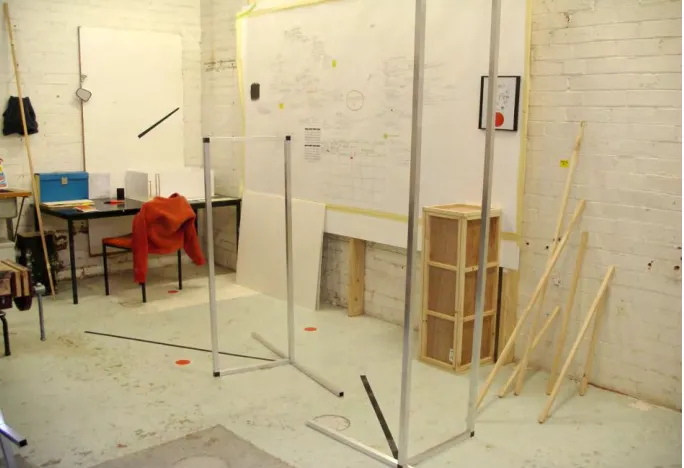
Figure 1: Studio (May 2008)
The orange dot intervention, despite its simplicity, placed the subject (myself) in a site (the studio) of habitation and was, in an elemental way, a working through the process and manner of Reductive Abstraction within installation. Stand on the Orange Dots is not considered an artwork, but rather a furnishing of the studio and a trigger to my mind towards potential research questions.
What then, using this experiment as a starting point, is Reductive Abstraction? There is an inherent integrity in using particular
geometric forms which, either singularly or in multiple, correspond to both the space in which they are situated and to the relationship
between the work and the viewer within that space. Jung describes the process of intuition as one which ‚mediate*s+ perceptions in an
unconscious way‛8 and the placement of the forms and the motivation for the selection of various modules feel like random choices but are, in fact, all part of an intuitive process.
Colour energises forms and, when there is more than one form, sets up a motion in the space. Stand on the Orange Dots is framed by the floor area, not as a painting on the wall. This project seeks to investigate objects which, by the nature of their three-dimensionality, posit a
different perspective of viewing and apprehension within the chosen site of the gallery.
The installation of work in a gallery (for example, OMG in the Entrepot Gallery) is another component examined within this project.
Installation is a fundamental tool and, as Rosalind Krauss articulates, ‚folds the actual space of the gallery or museum into the matrix of the assembled object such that, as the stage on which the object appears, it becomes essential to the object’s very existence.‛9 Several of the works undertaken during this project were considered for a particular site and thereby site-referenced to activate that particular site. There is a need to acknowledge the choice of the gallery as a site for exhibition of these works, made specifically in a research-based setting. This is a concept perhaps best explained using the following example: imagine that I chose to situate the work outside of the gallery; viewed as part of the framework of the everyday. In comparison to Krauss’s description of installation within the gallery, think of the art obje ct as one folded in to the environment of the everyday, so much so that it actually
becomes that environment. Only then can we understand that to be in a
gallery is to be a part of ‚the gallery‛ as an institution for the viewing of art.
The Neoconcrete Art movement (1959-1961) is a starting point for the contextualization of the works in this research. Helio Oiticica, a major artist and exponent of the movement, passionately takes up the notion of art becoming an environment and part of the fabric (quite literally, as is the case with Parangoles10) of the everyday outside the institution. In order to do so, Oiticica turns his sensory experiments into performance and installation. My project will be examining the nature of his earlier work undertaken within the gallery context rather than the later
performative works. The gallery as a site for exhibition of my works is integral to the understanding of their meaning. As Ad Reinhardt
9 Krauss, R.E. Perpetual Inventory. An October Book. The MIT Press: London and USA 2010, p48-49
states, ‚art is art-as-art and everything else is everything else<the one meaning in art-as-art, past or present, is art meaning.‛11
This statement by Reinhardt is critical in elucidating why I chose the particular artists discussed within this exegesis. Artists such as Helio Oiticaca, Piet Mondrian, Robert Morris and Anne Truitt a mongst others produced work that exemplified junctures in the changing nature of art in such a way that the work – being art about art - presaged experimentation and reconfiguration of the semantics and concerns of art to come. The artists chosen specific ally provided a platform on which it is possible to formulate an argument for what the studio works seek to attain – a reconfiguration of Reductive
Abstraction to reflect the present. The present is not rational, it is not certain and it is not static. The present is irrational, uncertain and in a state of flux. The art works that I create come directly from collec ted random thoughts and actions. These thoughts and actions consist of sporadic piecing together of cut or drawn objects and deep inspections of colour variants. Underpinning these intuitive actions there is a conscious framework or aesthetic sensibility which leans towards Reductive Abstraction and the urge to separate myself from the depiction of the ‘real’ and create what is ‘actual’ and ex pressive of whatever condition consumes me at the time. There is – as Susanne Langer describes in relation to semblance - a ‚disengagement from belief – the contemplation of sensory qualities without their usual meanings‛12 allowing an object with no particular significance the primacy of appearance.
It is important to make the distinction between my drive towards abstraction – a form of expression that addresses the noun to be abstract
as a particular way of perceiving the world – and the verb to draw away from. Ferrieira Gullar, a poet and writer for the Neo -concrete
movement in Brazil, succinctly articulates my intentions with his description of a non-object as ‚a special object through which a
11 Farrow,Clare(Editor). A Reinhardt, J Kosuth, F Gonzalez-Torres: Symptoms of
Interference, Conditions of Possibility. Art & Design Profile No 34. Academy Group Ltd: UK 1994, p21
synthesis of sensorial and mental experiences is intended to take place.‛13 The special object is not a differentiation from a concrete object but rather an abstract ‚thing in itself.‛14
The object within a painting is a representation of an object. This representation of an object is depicted in an illusionistic space. The format or surface of the support (canvas/paper/board etc) is where the imagination of the artist projects an image of some thing which, in turn, becomes representational of that thing. The format or surface of that thing is held – whether in actuality or through the suggestion of an outlined shape – by a frame which is ‚the mediator between fiction and reality, a bridge and barrier, protecting the picture, the fictitious space, while also facilitating its communication with the external, real, space.‛15
Conversely, the object of sculpture is an actual object which is present in a three-dimensional form. This present object occupies actual space. I use the word actual intentionally as this derives from the word active, implying a state of existence at this particular moment in time or, in other words, something that is real or present. The object can be seen to be autonomous and the space it occupies real, as opposed to an imagined or fictitious space. When the art object is placed within a gallery setting, this site becomes yet another framing: the voluminous empty negative space of the room in which the object is placed. This placement in a delineated space is not unlike the placement of a
representation of something within a painting frame. It i s at this point that I consider the art object a figure. The object can be said to be both present/actual/real and to represent something else, that which is not visible but felt.
13 Gullar, Ferreira. „Theory of the Non-Object‟ cited in „Neoconcretism and Minimalism: On Ferreira Gullar‟s Theory of the Non-Object‟ by Michael Ashbury. Cosmopolitan
Modernisms(Edited by Kobena Mercer) InIVA and MIT Press: London 2005, p170
14 Worringer, Willhelm. „Abstraction and Empathy‟ cited in Art in Theory 1900-2000: An Anthology of Changing Ideas (New Edition). (Edited by Charles Harrison and Paul Wood). Blackwell Publishing: USA 2003, p69
Some sculptural objects can be considered to be grounded by their inertia or mass, always succumbing to gravitational force. This is often enhanced by the placement of objects on plinths or bases.
Commonly used as a means of support, these bases suggested that the mass of the object was such that it required a further object to secure its position as one eternally bound and subject to weight.
In her discussion of reductionism, Frances Colpitt describes it as having ‚two different senses<one sees modernism as historically reductive by contrasting new work with old, [while] the o ther
attributes reductive intentions to the Minimalists.‛16 I see modernism as an opening-out or continuum which is constantly reinventing itself and refining its language in many ways. This ongoing movement of art from one form to several others is made clear by Theodor Adorno who states: ‚True art challenges its own essence< *And+ is a
historically changing constellation of moments.‛17 Colpitt’s intentional reduction is the artist’s deliberate abstraction or simplification to the essence of an object as a thing-in-itself, or what Donald Judd, an artist and writer of the North American Minimalist tradition, calls a specific object: one that is ‚neither painting nor sculpture.‛18 The work
undertaken in the studio is not an act of deliberate reduction or drawing-out from something in reality, but rather the utilization of simple forms or tropes to serve a purpose. Although pertaining to reductive objects, the ultimate purpose of Reductive Abstraction, for me, is the creation of art as a means of communicatio n.
Does affect constitute representation? If the Reductive Abstraction I am engaging with is a form of expression that builds on previous conceptions, does it represent expression as a figure or sign of something? Abstract forms are figures, in that they seem to be in constant relation to something else; whether it be the space that they
16 Colpitt, Frances. Minimal Art: The Critical Perspective. UMI Research Press: USA 1990, p115
17 Adorno, Theodor. „Aesthetic Theory‟ cited in Aesthetics: A Comprehensive Anthology. (Edited by Steven M. Cahn and Aarom Meskin). Blackwell Publishing: UK 2008, p359
occupy or the space of the viewer (literally and cognitively). Reductive art is said to be non-representative and non-figurative, and yet these ‚non-mimetic shapes<reflect human experience by pure visual expression and spatial relations.‛19 I cannot imagine a work of Reductive Abstraction that fails to represent something, even if it is simply the sensation or thingness of what is before the viewer. David Batchelor concisely addresses the issue of representation and
abstraction by stating:
It may be argued that a Mondrian or a Rothko or Le Witt is an image of something, but not an image of some thing. It seems safer to think of the work as representing, or attempting to express, a kind of conception or understanding of a world, to be like that world in an abstract way… it acquires its meaning by being placed in a relationship of difference with related antecedent works.20
Here again is the mention of historical predeterminanc y in the
modernist art object(s), whereby there is a need to elucidate further. In the course of this research investigation I will reflect upon and make reference to specific art works; not only as a deliberate effort to expand my knowledge on Reductive Abstraction, but also to conclude that ‚reduction does not yield certainty, but something like its
opposite, which is ambiguity and multivalence.‛21
The real object of the art object is in doubt. Objects are substantial. This substantiality is determined by the material, the weight, the scale, the volume, the mode of making and the ultimate form of the object. An object is palpable by the eye, touch and mind. The word ‘object’ comes from the Latin objectum, or ‚thing thrown before (the mind).‛22
19 Arnheim, Rudolf. Art and Visual Perception: A Psychology of the Creative Eye (New Edition).University of California Press: Berkley and Los Angeles 1974, p145
20 Batchelor, David. „Abstraction, Modernism, Representation‟ cited in Thinking Art: Beyond Traditional Aesthetics (Edited by Andrew Benjamin and Peter Osbourne). Institute of Contemporary Arts: London 1991, p55
21 Varnedoe, Kirk. Pictures of Nothing. Princeton University Press: Washington 2006, p56
The aesthetic of an abstract object is, for me, an active attention to an abstract sensate experience which is internalized. To be an inanimate object implies a kind of inertia and leads to the question: how can I animate the object in order to create a sensate exp erience? What then becomes of the real object? There is a sense that the object-ness of the object is confounded during the course of its making.
I am drawn in particular to Donald Kuspit’s essay, ‘The Abstract Self -Object,’ which discusses a certain type of abstract painting as offering ‚a rigorous disequilibrium, which affords a primitive recognition of our own inner disequilibrium.‛23 Whereas Kuspit addresses a psychoanalytical response to Reductive Abstraction, Willhelm Worringer (1881-1965), a philosopher, expands the concept of disequilibrium by stating that the urge to abstraction is an effort to still anxiety through the use of cosmic geometry.24 However, the
suppression or stilling of anxiety through the use of geometry does not exclude or absent anxiety from the completed work. During the course of my research, I have found that the irony of effort can be reversed in such a way that the inherent anxiety of abstraction is then projected back upon the viewer.
To conclude, it will be revealed that the aesthetic experience of witnessing a work of Reductive Abstraction can be seen to be both perceptual and conceptual. This is a paradox that I have sought to challenge through the construction of objects for installation. The works will pursue such questions as: By animating the object –
particularly through colour spatialization and the relative positioning of objects in space - can the object create a sensate and subjective experience?
Swatch Australia, discussed below and followed by a discussion on
colour assists as further introduction to the thoughts and processes that led to particular relevant work in Part Two .
23 Kuspit, Donald. „The Abstract Self-Object‟ cited in Abstract Art in the Late Twentieth Century. (Edited by Frances Colpitt).Cambridge University Press: UK 2002, pp131-140
1.2
Swatch Australia
Swatch Australia25is a work in which nature is reduced to a simple manifestation of colour, taking the form of colour swatches displayed on a television screen. Although the kind of reduction that I wish to engage with in this research project is one that acts upon concepts or thoughts and feelings (as opposed to the distillation of literal things), several aspects of Swatch Australia set the stage for key components of the research to follow. As a small child, I used to press my face up to the black and white television screen and become mesmerized by the little organic squiggles that fizzed before my eyes. They had a trance-like effect and I would try to get as close as possible in the hope that the source of the pictures would reveal itself to me. Swatch Australia is an attempt to emulate this experience for a small child today. I
deliberately chose ‘Nature Australia,’ a generic montage of wildlife images and scenes, as an artificial reflection of the experience of nature. With the DVD running, I pressed my camera lens flush to the screen and took a series of about 250 photographs. These were then manipulated into solid colour swatches and edited using movie-making software that flashed between each one at approximately 80 beats per minute, or slightly above resting heart rate. This prevented the viewer from being lulled into a trance-like state and, in fact, created an environment that was slightly agitated and unnerving. One of the most important aspects of this work is the desire to experiment with the effects of monochromatic colour. Colour
experimentation is central to this project, especially with consid eration to paint. During the process of making Swatch Australia, I strove to push the subject of colour to express something beyond passive
experience and to stimulate a response that is relentless and surprising in its visual agitation.
Swatch Australia utilized what I call a kind of immaterial colour and it is
material colour which is the foundation of this research. Material colour engages form and is concrete. There is a relationship to its site of placement – as an object in that site – and, in this way, the viewer negotiates the space in relation to where the objects of colour are situated.
The use of immaterial colour had the potential to create a project based on sensory immersive environments with coloured light, which is not the aim of this project. This sort of colour is formless and ephemeral. The immaterial nature of coloured light has a nascent urge to pervade space and the site in which it is contained. Coloured light touches existing structures but it is not tangible like an object with the
property of a particular colour. Paradoxically, often the coloured -light environment of the gallery is so thick with the immaterial substance of colour that the colour itself becomes almost tangible. My investigation includes a focus on the colour materiality of painted objects that have been rendered intangible.
Figure 2: Swatch Australia 2008,Mixed media installation of variable dimensions
1.3 Colouring-out
Colouring-in is a common childhood pastime that establishes the boundedness of colour within a delineated frame or shape. To colour -in is to adhere to a two-dimensional format: an activity -in which go-ing ‚over the lines‛ implies a failure of control and an entering of a no -mans land where colour simply does not appear or exist.
A primary element of this research is to investigate the manipulation of colour and, in some instances, attempt to give primacy to the cognizance of colour. In doing so, I am seeking a colouring -out: an irrational unconstrained use of colour.
If I take a brown rock (an object from the natural world) and split it open, it will still be brown inside. Objectively seen, brown is a passive
property inherent in the rock. It can be said that this rock is brown and will remain brown until something is deliberately added to it or a natural transformation takes place. However, if I take orange -coloured paint and apply it to an object, orange becomes that object’s surface
colour; the materiality being the paint pigment within which it is carried as a property of that pigment. The orange paint appears subjectively and is an active additive property of the object. It can be said that thisobject is orange but I prefer to think of it as: this object is oranging26. Oranging, being a gerund of doing orange, activates the prehension of the colour orange and implies that the subsequent sensate experience is subjective and capable of arousing emotion. The rock can also be seen to be capable of browning in a sensate way, but I wish to clarify the deliberate action of the artist as one that determines
the appearance of the art object. In painting, colour is manipulated in order to create an optical illusion of space. Conversely, in the history of sculpture, colour has been associated with surface appearance and hence a property of the sculptural object itself, denying colour the role of subject.
There is a difference between the way we conceive the colour of an animate object, one that represents some thing which can be named, and that of an art object. The appearance of an unexpected colour on an animate object is susceptible to doubt. Consider the following analogy: during a football game you notice that a Caucasian player has a blue shoulder. This provokes the intuitive response that perhaps the player has suffered an injury and has therefore bruised his shoulder. Looking around the immediate vicinity of the field, you notice that the line markings on the field are blue. The appearance of a second blue – the blue of the line markings – is enough to create an element of doubt that undercuts the reasoning process of your initial deduction. It is now indeterminate whether the blueness of the footballer’s shoulder is that of the line-markings or the result of a bruise. In the case of an art object – one that seeks to be abstract and to conceive colour beyond appearance – the same doubt does not apply since it is accepted that the artist has predetermined that the object will be a particular colour. The colour, in this instance, is both subject and object and has achieved a chromatic autonomy. Surprisingly, despite colour’s primacy as syntax, it is not often the subject. During an interview in 2006, Daniel Buren ceded that ‚it is certainly curious to note that colour has mainly been banished from the field of art.‛27 Colour is non-existent without form and yet there is a formless quality to its nature. Colour is a product of naming; an attribute given to all solids, liquids and gases. It is a sensation created by light reflecting off different forms and can therefore be subject to the vicissitudes of light. In order to be
understood, it can only be spoken of in relation to other things. As soon as colour is seen only to lay upon a surface in order to be inaugurated into the general appearance of something other, ‚the subject will always kill colour and we will not notice it‛28. This implies a kind of death, a flatness, a surrender to the stable. The colour I wish to saturate myself in is one that is not merely a prope rty of an object,
26 Batchelor, David (Editor). Colour: Documents of Contemporary Art. Whitechapel and MIT Press: London and USA 2008, p222
but rather colour – as a material pigment – as the subject, relative to time and space.
PART 2
2.1 Introduction
The main body of the exegesis is covered in this section. I have chosen to examine each discreet work chronologically in order to reveal my making and thinking process in regards to how this project was
pursued. Under each sub-heading titled by the name of the particular work; the description, process, other artists’ work and theoretical context are discussed. In each of these discussions I will unfold the answer to how this research work reconfigures the language of Reductive Abstraction; thus positing it in a contemporary context.
2.2
Delivery
Delivery29 is literally the transference of colour as a thing -in-itself from one place to another. The crates are varying sizes and colours and are placed in an upright position with the lids removed. The scale of the crates is such that each corresponds to the height the viewer, who is required to incline their head to peer inside. Upon looking into each crate the viewer is afforded a subjective response to each individual colour which is enhanced by the fact – due to multiple crates of colour being present – that comparisons can be made. As Yves Klein states:
Every nuance of colour is, in a sense, an individual, a living creature of the same species as the primary colour, but with the character and personal soul of its own. There are many nuances: gentle, angry, violent, sublime, vulgar, peaceful.30
This work asks the question ‚can colour be a spatially sculptural thing-in-itself?‛ By experimenting with commercial paints, I have realized
29 Delivery is the first work completed for inclusion in the PhD exhibition of works.
that the thingness of colour is made apparent when the paint is flat (matte) and luminous. The paint selected for the five crates was commercial paint from the Solver Paints range, including the colours
Ultramarine Blue, Rose Madder, Hansa Yellow, Fluorescent Green and
Fluorescent Orange. In order to present colour as a subject I chose the standard carrier of an artwork (the crate) to contain the colour which then was to be delivered to the gallery for exhibition. In this way, colour was delivered to the gallery as an object. I wanted to see how the reconfiguration of the support or format for the means of
‚carrying‛ colour alters the way it is perceived by the viewer. The fact that the crates are delivering colour to the gallery is of equal
importance to the experience of each individual colour and Delivery
served to demonstrate this notion.
Figure 6: Crate making instructions to myself to prevent missing a step.
Clearly, there is an intention here to ‚unbind‛ the bounded notion of colour from the wall: to speak of colour as liberated from surface, as being a material subject in itself. Each colour has primacy and an intended autonomy.
Hélio Oiticica (1937-1980), the youngest member of the Neo-concrete movement, was an artist intensely interested in the structure of colour and the viewers’ haptic response to colour constructions. Oiticica writes of his work:
Structure rotates, then, in space, becoming itself also temporal: „structur e time‟. Structure and colour are inseparable here, as are time and space, and the fusion of these four elements, which I consider dimensions of a single phenomenon, comes about in the work.31
In the work Box bolide 12, one of many in a series, Oiticica disrupts the distinction between painting and sculpture in the creation of a sliding box construction containing raw pigment, earth, corrugated cardboard, mirror, glass and a fluorescent lamp. Oiticica imbues his fetish with colour in materials that are tactile and various in their textures,
enticing the viewer to touch and experience the work to the extent that they are in the environment of colour32. The colours Oiticica uses are warm colours such as deep orange, ochre yellow and peach. The
mirror acts as an internal self-reflexive device to emphasize and reveal the inside of the box, or what seems like the internal organs of a body -box; inviting further exploration of the materials. As Mário Pedrosa33 states, the viewer ‚becomes attracted to an action‛ and ‚once there, [takes] part in a process of direct communication through gesture and action.‛34 In describing his own experience with Box bolide 12, Pedrosa
31 Batchelor, David (Editor). Colour: Documents of Contemporary Art. Whitechapel and MIT Press: London and USA 2008, p126
32 Pedrosa, Mário(Annotated translation by Michael Asbury 2004). „Environment Art, Postmodern Art: Helio Oiticica.‟ Cited in Open Systems: Rethinking Art c1970. 1 June – 18 September 2005. Tate Publishing: London 2005, p182
33 Mário Pedrosa, awriter and art critic, has written on his experience with the work of Oiticica and it is this act of handling and engaging with the work such as the Nuclei or Bolides (Boxes) that is integral to the understanding of the concepts he pursued.
further writes that the work’s excessive colour saturation ‚*becomes+ visible, one [can] feel its physical presence, reflect upon it, touch it, stand on it, breath it.‛35
Figure 7: Hélio Oiticica Box Bolide 12 1964-1965, mixed media assemblage, 400mm x 1400mm x 500mm
Ferreira Gullar describes the convergence of painting and sculpture as being integral to the aims of Neo-concretism, resulting in ‚special objects – nonobjects – for which the denominations of painting and
sculpture no longer apply.‛36 Neo-concrete art is distinguished from the prevailing Concrete art, which Gullar believes is ‚inf luenced by a dangerously acute rationalism.‛37 For him, the very same mechanical and mathematical theories of construction that characterised the Concrete movement also served to negate the expressive or affective potential of the art works it produced. Whereas Concretism relied on a rationalistic discourse in order to confirm its output as objective, the Neo-concretists were ‚against objectification and exteriorization <
35 Ibid. p182
36Gullar, Ferreira. „Neo-concrete Manifesto‟ cited in Geometric Abstraction: Latin American Art from the Patricia Phelps de Cisneros Collection. Yve-Alain Bois, Paulo Herkenhoff, Ariel Jimenez, Luis, Mary Schneider Enrique. Yale University Press: New Haven and London 2001, p152
[instead their work] opened toward an affective space and a more fluid and pliant relationship between inside and outside.‛38 The aim was not to advocate an alteration in the syntax of reductive non -figurative art, but rather to produce a conception of art as ‚something which amounts to more than the sum of its constituent elements;‛39 a new state of presentness in time and space, representative not of a formula, but a sensate experience of an indeterminate form.
2.3
Ballistic Voices
Ballistic Voices is not included in the final submission but, like Swatch,
[image:28.612.181.383.433.606.2]has had some valuable input into the direction of this research project. The form of the cone is one that has fascinated me since the beginning of my research. I had previously been collecting various cone artefacts and had made some small forms based on the shape of a cone. I had also been playing with the literal materiality of paint by making (or allowing the making of) solid lumps of paint. I had an obsession with the beauty of being able to hold paint and only paint in the palm of my hand; with paint as a self-reflexive material that is both subject and object.
Figure 8: Daniel Santbech, Problematum Astronomicorum (Basel: 1561)
38 Amor, Monica. „From Work to Frame, In Between, and Beyond: Lygia Clark and Hélio Oiticica, 1959-1964.‟ Grey Room, Winter 2010, p21.
<http://www.mitpressjournals.org/toc/grey/ -/38>
I happened upon an image of Aristotle’s ‘Ballistic Theory’40 - a drawing of a cannon accompanied by graphic line markings that described an object’s desire to return to Earth. The poetic notion of an object with a desire and a will captured my imagination.
Months later, I was curated into a show with the premise and title ‘Chance Encounters’. I immediately thought of connecting my feelin gs about the materiality of paint with the potential of the cone formation as a vehicle for its (colour) expulsion
[image:29.612.182.530.311.605.2]The work consisted of two conical-shaped, large, mounted objects facing each other at either end of the gallery space. The floor space stretching between them had several randomly placed amorphous discs of coloured paint on the floor.
Figure 10: Detail of conical contraption
Figure 9: Ballistic Voices 2009 steel, MDF, paint, rubber (Installation Long Gallery Hobart)
Figure 11: Ballistic Voices 2009 steel, MDF, paint, rubber (Installation SASA Gallery Adelaide)
Ballistic Voices invites the viewer to make the association between sound and coloured objects. The slang ‚to go ballistic‛ implies a burst of irrational anger and conjures the notion of voices shooting out into space and then falling to earth. In an abstracted way, the work is a representation of voices that have fallen transformed into silent
synaesthetic discs of colour on the floor. It is an exploration of colo ur and its perceptual and transformative qualities: its synaesthetic
ability, its ability to repel and attract, its material manifestations and its ability to trigger memory. The ballistic voices are spent. If we think of the voices as material colour, the black voids in the cone-shaped apparatus depict this state of depletion.
both subjective and instinctual, resulting in responses such as ‚I like that one‛ and ‚that one is yucky.‛ Unlike the flat paint that I used for most of the work completed in this research project, Ballistic Voices
[image:31.612.180.507.234.489.2]utilizes gloss paint, which is more reflective and appears more as a surface. Regardless, the viewer is still required to read the discs as objects of ‘pure’ paint in order to negotiate physically and mindfully what is presented in the gallery space. The conundrum of objects and colours is, after all, simply a conundrum of objects and colours.
Figure 12: Ballistic Voices work in progress 2009
Ballistic Voices veered beyond the scope of the research project because
its formal elements are, firstly, abstracted from reality and, secondly, organic rather than geometric in nature.
What interests me about this work is the introduction of the concept of synaesthesia. Synaesthesia is ‚the production from a sense-impression of one kind of an associated mental image of a sense -impression of another kind.‛41 In language, it is commonplace to make these
associations through metaphor and, in addition, to mix the language
across disciplines – such as colours having tones and music being
chromatic.
In Ballistic Voices, there are three colours per disc. The paint used is a commercial water-based enamel gloss. This particular type of paint, I discovered through experimentation, contains the mo st polymers and hence is the most elastic and least likely to split or crack when poured. The selections of colours I believe were subliminally chosen for their garish, and at times unpleasant, nature. Due to the proximity of
several colours on a single disc there is a further random occurrence of an uncomplimentary mixture of primary, secondary and tertiary
colours. Some of the colours feel as well as look ugly and the sound of these colours, because of their relations, is jarring on the ears.
Interestingly, the gloss paint (as opposed to the flat paint used in the previous work Delivery) acts entirely differently. I feel that the gloss paint does not stimulate an experiential sensation or vibration42 like the flat paint. The gloss nature of the paint becomes a surface which is reflective of the light in its immediate surroundings, as opposed to the flat paint, which has the effect of giving off light as colour.
2.4
OMG
At the outset of this whole project, I made a conscious decision to utilize the institutional framework as a site for the display of Reductive Abstraction. But what function does this site -space
perform? I write site-space because I cannot accept the gallery as either – site or space – singularly: a site implying a place where particular things occur or a space being the thing-in-itself; the air, the floor, the walls, the light and so on. What expectation is considered by using the gallery as a frame for work that, in turn, utilizes the gallery as a
particular space? Is the gallery then a frame? Perhaps what should be
considered here is a fusion, or site-space, rather than a relevant positing of a site-specific work within a gallery-specific space?
During a trip to Paris in 2002, I witnessed a retrospective on
[image:33.612.181.403.251.496.2]Mondrian’s work at the Musee D’Orsay.43 My lasting impression of this exhibition, sustained with striking clarity, is the progression of paintings through various modes of representation. For me, the critical junctures occurred in the gridded paintings and those of the Plus-Minus series. Instead of a closed system of formal abstraction, these works achieved a kind of opening-out beyond the picture plane, thus implying a further sense of space beyond that enclosed within the frame.
Figure 13: Piet Mondrian Composition with Red, Yellow, Blue and Black 1921, oil on canvas, 59.5cms x 59.5 cms
Composition with Red, Yellow, Blue and Black is an oil on canvas painting measuring 59.5 x 59.5 cm. Mondrian completed this work in 1921, thus making it one of the earliest precursors to the grid paintings that were to occupy the artist until his death in 1944. Composition consists of a lattice-like black grid composed of varying sizes of rectangular and square spaces. These spaces reveal either the white ground or the colours red, yellow black or dark blue. The work also appears to consist of some sections of a mist-like grey which have been omitted from the title. Mondrian’s title implies that, as the artist, he has
deliberately created a self-referential objective painting; a composition on canvas of particular colours arranged in a relational way. Here, Mondrian employs a constructive and rational discourse in order to establish a ‚neutral expression.‛44 A similar effect can be observed in the artist’s use of formal geometric elements arranged in such a way as to create a ‚dynamic rhythm.‛45 Yet, in looking and reflecting upon this work, I cannot control my visual fixation on a section of grid that leaves the picture plane at the bottom right-hand side of canvas. This audacious gesture – which defies the notion that the viewer’s gaze must remain within the illusionistic space of the picture – signifies the beginning of Mondrian’s exploration of the lattice -intersected canvas, effectively demonstrating that all lines painted within a picture frame also carry the ability to enter the outer space beyond the object of the painting. A yellow rectangle at the top right and bottom left of
Composition’s canvas, along with a small red rectangle towards the
bottom right-hand corner, also leave the picture plane as if slipping outward; but, visually, they do not command the same attention of the black intersecting line. This single frame-dissecting line creates a sense of incongruity and a potential for something else to happen. The effect of being lead out of the picture is countered by the strength of a red enclosed square which commands the largest area of the canvas, contained slightly off-centre and to the left. It is this square which carries the responsibility of keeping the viewer’s gaze within the picture. It is, in other words, one framed monochrome of repeated framed monochromes within an allegorically frameless canvas. In his later works, Mondrian engages with a system that is open, yet hermetically unified;46 one in which the coloured parts upon the surface of the painting – beneath or within the grid – are relational to each other. This open system, with the grid structure intersecting to all edges of the canvas, actually appears more rational and achieves
44 Mondrian, Piet. „Plastic Art and Pure Plastic Art‟ cited in Art in Theory 1900-2000: An Anthology of Changing Ideas (New Edition).(Edited by Charles Harrison and Paul Wood). Blackwell Publishing: USA 2003, p391
45 Ibid. p391
the equilibrium and ‚universal expression of reality‛47 that Mondrian sought to emulate. Here, the grid no longer floats with a single anchor point to the space beyond; rather, it is, by association, part of the space beyond. There is a strong sense throughout Mondrian’s writi ng of a teleological trajectory which he embraces through the understanding that ‚time is a process of intensification, an evolution from the individual towards the universal, of the subjective towards the objective; towards the essence of things and of ourselves.‛48
Paintings are objects at a vertical angle. The parallel plane that they occupy against the wall determines their status as grounded objects whose viewing primacy is a single surface. The viewer’s body is also vertical and therefore parallel to the body of the painting. The
sculptural object is traditionally grounded to the floor and therefore horizontal. The viewer’s body – vertical in relation to this horizontality – circumambulates the object in actual space and time, perceiving multiple planes at varying angles to complete the perception of the objects entirety.
The architectural grid within Entrepot Gallery is one that, for me, speaks directly to the canonical grid of art history; that thing that modernism moves from in order to reinvent itself over and over. OMG
is a work that seeks to exploit the boundaries between painting -sculpture and viewer-installation; thereby establishing a discourse between Reductive Abstraction and the modernist grid of Mondrian’s later paintings.
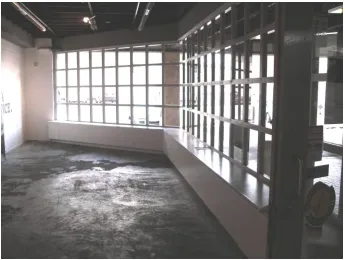
Entrepot Gallery is a small gallery space which is longer than it is wide. Upon entering through the door the viewer is confronted directly with a long facing wall. Turning right and looking down the length of the space the street can be seen through an angled wall of gridded windows at the end which continues up the right hand side until it meets the doorway.
47 Ibid., Mondrian, p391
Figure 14: Empty Enrepot Gallery.
If I take the vertical enclosed plane of the Entrepot Gallery window grid and reconstruct a similar grid which is unframed and fragmented, occupying a different planar angle in actual space, there remains a dialogue with the history of painting because the surface form or plane remains intact. Despite these planes becoming objects due to their occupation in actual space, they nevertheless remain planar: the negotiation of the viewing position is determined by their angle.
OMG’s grid – constructed of painted wood – occupies the gallery in three sections. These sections are hung from the ceiling in such a way that the planes crescendo upwards from the base of the window and outwards into the space of the gallery. Each section of wood that forms the frames of the grid-structure are coloured randomly, either white or black, confusing any sense of wholeness that a similar monochromatic structure would maintain. The entire face of the wooden painted sections of each plane, directed outwards toward the windows, is covered with chrome vinyl tape. This has the intention of reflecting Entrepot’s own architectural grid back upon i tself. Planes of orange, magenta and green of varying sizes (coloured vinyl on
window grid, across the space and lodged against the wall and floor space opposite. There is an intentional attempt to fix these planes to the wall randomly and to give the sense that the planes, like
[image:37.612.181.559.178.460.2]Mondrian’s intersecting black lines, are continuing beyond the present, actual space into an other, outer space.
Figure 15: OMG 2009, wood, paint, aluminium and vinyl (Installation Entrepot Gallery, Hobart)
The grid structures of OMG are primarily relational to their site-space. The site of the Entrepot Gallery allows for an opening -out; a fracturing and a dispersion of the grid within the space. The decisio n to float the grid was made in opposition to the alternative: a falling grid. To fall is to acknowledge gravity and to signify a collapse, whereas floating is an act of physical defiance that offers a forward imaginary motion in space. From this point in the research, there is a desire to defeat the inertia of the grounded object and cause the objects to have an effect of hovering upon the surface or in space. To hover implies a
weightlessness and tends towards animation of the object. As opposed to the grounded object, which gives the appearance of being inanimate
intended disruption of the rational order; a spon taneous motion that works to confound ‚the absolute stasis of the grid.‛49 The initial viewpoint of OMG is a slightly distanced position at the doorway entrance to the gallery space. There is enough viewing space to take in the work as a whole and get a sense of the at-onceness of the
installation. The viewer is alternatively able to enter the gallery and move around within the installation, bodily experiencing their own sense of the planes hovering overhead. This allows the viewer a multi -viewpoint of the work whereby the site can be viewed through its structures.
Up until this point, I have called the person who looks at a work of art a viewer. If we take the position of a person who enters the gallery as a site for Reductive Abstraction which is a site-referential installation or the position of a person sensating the colour of a work such as
Cosmic Solver Red 127850, the term viewer is no longer applicable. The viewer instead becomes a perceiver – acting in the present moment – and is one with the situation and event through sensory involvement and experience. To be a perceiver implies a more subjective response than a viewer, but not to the point of becoming a participant whose engagement is required to complete the work.
Gullar cites Mondrian in the ‘Theory of the Non-object’ as
understanding ‚that the new painting, proposed in those pure planes, requires a radical attitude, a restart.‛51 This influence is also
demonstrated by Mondrian’s pre-emptive desire for the continuation and realization of art ‚by the unification of architecture, sculpture and painting.‛52 It is only by being ‚purely constructive,‛53 Mondrian notes, that ‚a new plastic reality will be created.‛54 This is a concept
49 Krauss, Rosalind. „The Originality of the Avant-Garde: A Postmodernist Repetition‟ cited in October, Vol.18 (Autumn 1981). The MIT Press, p54
50 See following chapter on the work Solver Cosmic Red 1278.
51 Gullar, Ferreira. „Theory of the Non-Object‟ cited in „Neoconcretism and Minimalism: On Ferreira Gullar‟s Theory of the Non-Object‟ by Michael Ashbury. Cosmopolitan
Modernisms(Edited by Kobena Mercer) InIVA and MIT Press: London 2005, p171
52 Ibid., Mondrian, p392
53 Ibid. p392
which Oiticica interprets with his work Grand Nucleus 1960-1966.55 Here, the painted planes or panels are seen to be hanging in actual space in a maze-like configuration. Oiticica developed Grand Nucleus
[image:39.612.180.550.266.518.2]through an intense study of colour. It presents an environment whereby changing hues of colour can be seen to permeate from the centre of several hanging double-sided painted planes in the gallery space. Although not visible in the image, through interaction and movement between several double-sided panels, the perceiver is offered a glimpse of ‚panels in tones of viol et at the nuclear centre unfolding into a range of luminous yellows.‛56
Figure 16: Hélio Oiticica Grand Nucleus 1960 -1966, oil and resin on wood fibreboard
I recently attended a survey show of Peter Cripps’ work titled ‘Peter Cripps: Towards an Elegant Solution 8 June – 25 July 2010’ held at ACCA in Melbourne. Peter Cripps had been recommended to me as an artist of interest during my Honours year in 1998 in light of a work composed of Siting devices, resembling in part his Field Work. I was
55 This work was recently reconstructed in the Tate Modern, Lond on and the Museum of Fine Arts, Houston in 2007 under the exhibition title „Helio Oiticica: The Body of Colour‟ cited in Modern Painters. Summer 2010, p63
unsuccessful in locating any image documentation of Field Work so this was my first encounter with his work.
Figure 17: Peter Cripps Another History for H.B. and B.L. 1991 (recreated here at ACCA 2010), wooden
panels and aluminium
At the entrance to the main gallery of ACCA I was confronted with
Another History for H.B. and B.L. and was struck with its conceptual and
structural similarity to OMG. Initially, rather than taking in the work as something new, I could not help stare at the way Cripps had
wall of the space. Although unsymmetrical, Another History for H.B. and B.L. creates a perpetually cyclical space that is both conceptual and visual: painting- ground, panel-wall, surface-perceiver, perceiver-site, object-space and back to painting-ground. The participation of the perceiver is paramount as they walk through the space and become implicated in its creation in an animated way.
Another History for H.B. and B.L., for me, served to highlight the fact that the panel structures of OMG are in the act of traversing space. Not unlike the lines of the Mondrian's Composition, which leave the space of the painted frame, they represent both an imbeddin g in and passing through of the gallery wall. The perceiver is caught in a kind of crossfire with the panels at their feet, which includes a cross
segment from the grid that alludes to the presaging of my latter exploration of singular objects in the site of the gallery. OMG is a challenge to the illusionistic space of painting to enter the real world of objects – abstract objects that are negotiated by the perceiver. As Cripps states in regards to his own object-making, ‚These objects are intended to rival every day objects in the world.‛57
2.5
Cosmic Solver Red 1278
Whilst making the work Delivery, I noticed that the effect offered by fluorescent-type paint had the potential to defy surface constraints and pervade space.
The question arose: could I make the appearance of colour a subjective experience with a three dimensional form? I decided to create another, separate crate, thereby focussing on a singular object unrelated
conceptually to those being ‘delivered’ to the gallery in my previous work. In order to achieve this effect, my colour choice had to be such that the colour itself – its very thing-ness as an object – possessed such presentness as to override the presence of the object it was being applied to.
I had been staring daily at the Solver Paints Colour Chart, focussing in particular on the Brite-Glo colours. I think I was allowing myself to be drawn to a colour without making a conscious choice based on reason. I settled on the colour Solver Cosmic Red 1278 and decided to make a crate to the height of slightly below average eye-level but not low enough to be able to see the inside of the crate. This was important as I wanted to experiment with seeing the colour before actually seeing where the colour came from. This was a wooden crate measuring H 1400mm x D 1000mm x W 1000mm, containing the colour Cosmic Red 1278. I titled the work Solver Cosmic Red 1278, after the colour of the same name on a Brite-Glo colour chart. To see the actual colour within the crate the perceiver is required to peer over the edge.
During construction, I wandered into a second-hand bookshop and serendipitously purchased a copy of ‘TheDoors of Perception’ by Aldous Huxley58 in which the author describes the effects of self
-experimentation after taking Mescalin. An hour and a half after taking the drug, Huxley reports his experience as being ‚neither agreeable nor disagreeable < it just is.‛59 He later writes that:
Spatial relationships [cease] to matter very much … place and distance cease to be of much interest. The mind does its perceiving in terms of intensity of existence, profundity of significance, relationships within pattern.60
For Huxley, colours achieve ‚an incandescence so intensely bright‛ that, when gazing at a chair, ‚the percept had swallowed up the concept I was so completely absorbed in looking, so thunderstruck by what I actually saw, that I could not be aware of anything else‛61 Pinned in the back of the book, I found a condensed version of an article written by Huxley for ‘Life’ magazine in 1954, titled ‘A Case for PSI’62. This article introduced me to William James’ notion of cosmic consciousness, as well as the work of Dr Richard Maurice Bucke, a psychiatrist with his own description of cosmic consciousness. Bucke writes that cosmic consciousness is an experience wherein:
The person, suddenly, without warning, has a sense of being immersed in a flame, or rose-colored cloud, or perhaps rather a sense that the mind is itself filled with such a cloud of haze.63
Whilst investigating the properties of Cosmic Red, I inadvertently stumbled upon cosmic consciousness as a state in which that particular colour is experienced.
58 Huxley, Aldous. The Doors of Perception. Chatto & Windus: London 1954
59 Ibid., p12
60 Ibid. p14
61 Ibid. p42
62 Huxley, Aldous. „A Case for PSI‟. Life. Time Inc: New York 1954
The first outcome of Cosmic Solver Red 1278 was that the luminescent quality of Cosmic Red pervaded the interior negative space of the crate such that, upon looking inside, the colour appeared to take on the form of a single mass. The colour was spatialized to the extent that the contours within the crate were lost in a visual thickness of colour. This mass was one that projected from inside the crate onto the face of the perceiver looking from above, its red glow even reaching as far as the ceiling. Secondly, the transformative qual ity of the colour alluded to a simultaneous desire to avert the gaze whilst driving the gaze to
continue to stare into the depth of the crate, creating a vertiginous experience.
[image:44.612.180.560.336.481.2]It is useful to ask, after the act of confrontation, what gives the feeling64 in Anish Kapoor’s Untitled 199565.
Figure 19 and 20: Anish Kapoor Untitled 1995. Plaster, acrylic paint and pigment. Diameter 201cms
Kapoor calls such a work ‚a ‘proto -object’< an object that comes into being before language, aesthetics, thought and conditioning.‛66 There is a suspended temporal moment of consumption by colour, a redding
64 Langer, Susanne. „Feeling and Form‟ cited in Aesthetics: A Comprehensive Anthology (Edited by Steven M. Cahn and Aaron Meskin). Blackwell Publishing: UK 2008. In this essay Langer, an American philosopher, distinguishes between “expression” as a symbol or presentation of a concept and an “expression as a feeling” which is contrary to an expression of cognition.
65 This work was seen at the Asia Pacific Triennial of Contemporary Art, Queensland Art Gallery, 2006
66 Poddar, Sandhini. „Suspending Disbelief: Anish Kapoor‟s Mental Sculpture‟ cited in Anish Kapoor: Memory (published on the occasion of the exhibition). The Solomon R.