Inquisitive Conditional-Doxastic Logic
MSc Thesis
(Afstudeerscriptie)
written byBenjamin Sparkes
(born 31/05/1989 in Bristol, United Kingdom)
under the supervision ofDr. Ivano CiardelliandDr. Floris Roelofsen, and submitted to the Board of Examiners in partial fulfillment of the requirements for the degree of
MSc in Logic
at theUniversiteit van Amsterdam.
Date of the public defense: Members of the Thesis Committee:
August 30 2016 Dr. Ivano Ciardelli
Abstract
This thesis develops inquisitive conditional-doxastic logic, obtained by enriching classi-cal multi-agent plausibility models with issues for each agent. The aim of these models is to allow for a finer approach to modelling inquiry.
Issues capture informative and interrogative content, and so by associating an issue to an agent we are able to capture both their information state and their inquisitive state, while a plausibility map on worlds captures their doxastic state. Moreover, inquisitive plausibility models allow for conditionalisation on both informative and interrogative content.
Two conditional-doxastic modalities are introduced and axiomatised; aconsiders
modality unique to inquisitive conditional-doxastic logic, which conditionalises on is-sues with respect to both an agent’s doxastic and inquisitive state, and a generalisation of (conditional) belief, which conditionalises solely on an agent’s doxastic state.
We show that inquisitive conditional-doxastic logic encodes the same assumptions concerning conditionalisation and doxastic logic. And, just as conditional-doxastic logic may be taken as the static counterpart to a dynamic logic of belief revi-sion, inquisitive conditional-doxastic logic can be taken as the static counterpart to a dy-namic logic of belief revision within an enriched setting that includes formal resources to model interrogatives.
Inquisitive conditional-doxastic logic is shown to be sound and complete with re-spect to inquisitive plausibility models, and it is shown that both (conditional) belief and knowledge modalities can be defined in terms of the considers modality. However, we also show that the entertains modality of inquisitive epistemic logic cannot be de-fined by the considers modality. Therefore, as the basic inquisitive conditional-doxastic logic is axiomatised solely by the considers modality over the base inquisitive seman-tics it cannot be used to reason about an agent’s inquisitive state independently of their doxastic state.
Acknowledgements
First and foremost, I would like to thank my supervisors Floris Roelofsen and Ivano Ciardelli for their support in writing this thesis. The many meetings we had, and emails exchanged, were never less than inspirational. I had not anticipated how challenging the project would be, and working through many of the problems that presented themselves with Ivano has improved my understanding of logic immensely, and without Ivano’s ex-cellent guidance this thesis would not have been completed. Ivano, it has been a privilege working with you.
I would also like to thank the members of my thesis committee, Soroush Rafiee Rad, Katrin Schulz, and Frank Veltman for their questions and comments.
Thanks also to all the people at the ILLC who have taught me so much, there are too many of you to name individually! And thanks in particular to Maria Aloni, who has been a superb and incredibly supportive mentor.
Contents
Introduction 3
1 Inquisitive Semantics 5
1.1 Inquisitiveness, informally . . . 5
1.2 InqD . . . 6
2 Inquisitive Epistemic Logic 15 2.1 Epistemic Logic . . . 15
2.2 Inquisitive Epistemic Logic . . . 16
3 Inquisitive Conditional-Doxastic Logic 21 3.1 Conditional-Doxastic Logic . . . 21
3.2 Inquisitive conditional-doxastic Logic . . . 26
3.3 Inquisitive Plausibility Models . . . 26
3.3.1 The Considers Modality . . . 29
3.3.2 Conditional Belief . . . 33
3.4 Axioms & Rules . . . 36
3.4.1 Axioms forICDLEnriched with Operators for Conditional Be-lief and Knowledge . . . 36
3.4.2 Observations . . . 37
3.5 The Road Ahead . . . 38
4 Inquisitive Conditional-Doxastic Models 39 4.1 Inquisitive Conditional-Doxastic Models . . . 39
4.2 Observations . . . 41
4.3 Soundness ofICDLwith Respect to icdms . . . 42
4.4 Some Rules and Theorems ofICDL. . . 46
5 Connexions 48 5.1 From icdms to Plausibility Models . . . 48
5.2 From Inquisitive Plausibility Models to icdms . . . 53
5.3 The Entertains Modality Is Not Definable inICDL. . . 55
6 Completeness ofICDL 57 6.1 Introduction . . . 57
6.2 Foundations for the Canonical Model . . . 58
6.2.1 Syntactic Characterisation of Atoms, States, and Propositions. . 64
6.3 The Canonical Model . . . 67
7 Inquisitive Plausibility Logic 77
7.1 Inquisitive Plausibility Logic . . . 77
7.1.1 Binary Operators . . . 82
7.2 Inquisitive Plausibility Neighbourhood Models . . . 86
7.3 Axioms and Rules ofIPL . . . 87
7.4 Completeness . . . 90
7.4.1 Preliminaries . . . 90
7.4.2 Constructing the Canonical Model . . . 91
7.4.3 The Support Lemma . . . 91
7.5 Connexions Between ipms and ipnms . . . 94
7.5.1 From ipnms to ipms . . . 94
7.6 From ipms to ipnms . . . 97
7.7 Results . . . 99
7.8 Additional Observations . . . 99
8 Conclusion 102 A Dynamics 104 A.1 Updates on ipms . . . 104
A.2 Inquisitive Dynamic Conditional-Doxastic Logic and Inquisitive Dy-namic Plausibility Logic . . . 105
A.3 Results . . . 106
Cheat Sheet 109
Introduction
Inquisitive semantics is a semantic framework based on a notion of meaning intended to capture both informative and inquisitive content, formally modelled viaissues, in order to analyse information exchange—seen as process of raising and resolving issues.
We restrict ourselves to a propositional language in this thesis, which allows us to characterise issues as downward closed sets of sets of possible worlds. The logicInqD
(Ciardelli, Groenendijk, and Roelofsen 2015) captures the relation of entailment be-tween issues characterised this way.InqDis introduced and outlined in chapter 1.
Inquisitive epistemic logic (Ciardelli 2014b) extendsInqDto an epistemic setting, by associating to each of a set of agents an issue, intended to capture the information available to an agent and the issues they entertain.
In this way the relationship between inquisitive epistemic logic andInqDparallels the relationship between epistemic logic and propositional logic (cf. Ciardelli 2015, §7.2) For, in epistemic logic an information state—a set of possible worlds—is associated to each agent in order to capture the information available to them. Using the information states associated to agent’s in epistemic logic the propositional attitude of knowledge can be formally modelled. Following this parallel, inquisitive epistemic logic models the propositional attitudes of both knowledge and ofentertainingan issue, with the attitude of entertaining standing in the same relation to issues as knowledge does to classical proposition. Chapter 2 introduces epistemic logic in section 1 and inquisitive epistemic logic in section 2.
However, epistemic logic does not have sufficient expressive power to capture the im-portant propositional attitude ofbelief. This is captured bydoxasticlogic, or Moreover, anepistemic-doxasticlogic may be used to capture to interaction between the proposi-tional attitudes of knowledge and belief (cf. Stalnaker 2006). So, a natural progression of inquisitive epistemic logic may be to investigate a logic capturing the proposition at-titude with respect to issues which parallels belief, and its interaction with the atat-titude of entertaining.
Alternatively, one may study the attitude of conditional belief—intending to capture what an agent believes conditional upon certain information being true, and how this relates to other conditional beliefs. From this point of view an analysis of belief is a special case of conditional belief, when no information is conditionalised on. Not only does this approach attempt to analyse a more general propositional attitude, but from a formal point of view the resulting logic allows for the reduction of a dynamic logic of conditional belief, where agent’s may learn new information, to be reduced to a static logic. This establishes a strong connexion between conditional belief and belief revision (indeed, conditional beliefs can be thought of as a ‘plan’ for what will be believed in the information being conditionalised on is established to be true).
propo-sitional attitude of (conditional)consideringan issue in parallel to believing a classical proposition. This is the subject of chapter 3, which constitutes primary theoretical chap-ter of this thesis. Section 3.1 introduces conditional-doxastic logic, which is then gen-eralised to an inquisitive setting in section 3.2, termedinquisitive conditional-doxastic logic.
The primary semantic structures for interpreting inquisitive conditional-doxastic logic are introduced in section 3.3. These are a generalisation of the plausibility models used to interpret conditional-doxastic logic, termed inquisitive plausibility models.
Given a base semantic structure section 3.3.1 contains a detailed study of (condi-tional) considering, while section 3.3.2 investigates the properties of conditional belief with respect to issues. Still, the theoretical point of view adopted is largely a formal one. We do not aim to connect the formally defined attitude of considering an issue with an informal concept, nor do we look to defend the assumptions made by Baltag and Smets in the base conditional-doxastic logic. These considerations are important, but due to the complexity of axiomatising inquisitive conditional-doxastic logic are beyond the scope of this thesis.
However, our axiomatisation of inquisitive conditional-doxastic logic allows us to observe that the interrogative content of issues can be ‘factored out’ of the process of conditionalisation. Importantly this establishes that the notion of conditionalisation captured by inquisitive conditional-doxastic logic is the same as that captured by con-ditional-doxastic logic. This is one of the key results of the thesis—belief revision as modelled by conditional-doxastic logic can be straightforwardly generalised to a notion of meaning that captures information and inquisitive content, and moreover the pro-cess of conditionalisation this relies upon can be isolated to the informative content of the propositions (i.e. issues) used to modelled this notion of meaning. Inquisitive conditional-doxastic logic, and this process of conditionalisation is the concern of the following three chapters.
The completeness of inquisitive conditional-doxastic logic with respect to the class of inquisitive plausibility models is established via showing that inquisitive conditional-doxastic logic is complete with respect to an alternative class of models, detailed in chap-ter 4 and the transformations between the two types of models is detailed in chapchap-ter 5. This strategy follows the approach of Baltag and Smets (2006) to the completeness of conditional-doxastic logic with respect to plausibility models. Still, we do pause in sec-tion 4.1 to note how the alternative semantic structures can offer a different perspective on inquisitive conditional-doxastic logic.
Chapter 6 then establishes the soundness and completeness of inquisitive condi-tional-doxastic logic with respect to both classes of models via the results of the pre-ceding chapters.
However, while conditional-doxastic logic axiomatises both conditional belief and knowledge with respect to plausibility models, inquisitive conditional-doxastic logic fails to axiomatise entertaining with respect to inquisitive plausibility models. Moreover, we show in section 5.3 of chapter 5 that the modality corresponding to entertaining is not definable in terms of the modality correspond to considering (while in section 3.4.2 of chapter 3 we show that the modalities corresponding to conditional belief and knowl-edge on inquisitive plausibility modelsaredefinable in terms of conditional belief).
Chapter 1
Inquisitive Semantics
1.1
Inquisitiveness, informally
At the core of inquisitive semantics is a notion of meaning, intended to provide an ade-quate foundation for the analysis of the exchange of information in linguistic discourse. A fundamental distinction is made between theinformativeandinquisitivecontent of a sentence. The former is understood as what must be the case if the sentence is true, and the latter as information sufficient to resolve the issue raised by the sentence. For example, in uttering ‘has Sue contacted you yet?,’ I presuppose that Sue has intended to contact you, and I also raise the issue of whether or not she has done. Moreover, it seems Irequestan informative response to the issue raised, and thus the sentence con-tains inquisitive content. Contrast this to an utterance of ‘Sue intends to contact you,’ corresponding to the presupposition on the previous utterance which contains only in-formative content, and invites no response. However, as Ciardelli, Groenendijk, and Roelofsen (2012, §6.2) note, when raising an issue a speaker may also merelyinvitea response to the issue raised. Not all interrogatives thus identified require a response.
Classically, the meaning of a sentence is identified with itstruth-conditions, relative to a world of evaluation for intensional constructs. This gives an account of informative content; the restriction of logical space (conceived as a set of possible worlds) such that the sentence is true given any given world.
Worlds are maximally specific, in the sense that either'or:'holds at a world for any given sentence', and therefore the truth conditions of a sentence partition logical space into two sets—those in which the sentence is true, and those in which the sentence is false. Given that worlds are maximally specific it follows that every interrogative is resolved in each worlds. For example, given a worldwit will either be the case that Sue has contacted you, or that Sue has not contacted you, whence the issue raised by the interrogative ‘has Sue contacted you yet?’ is settled.
epis-temic state which differ with respect to the truth of'. Following this intuition we think of sets of worlds asinformation states. If an information state contains a single world, then that state has maximal information. However, if the information state contains multiple worlds, then it contains only partial information, crucially missing additional content that would allow one to distinguish between them.
Therefore, by evaluating sentences from arbitrary collections of worlds it is not guar-anteed that there will be sufficient information to establish the information sufficient to resolve an issue, and so information states do not in general contain sufficient content to resolve any arbitrary interrogative.
This method of evaluation gives rise to a notion of support with respect to both in-formative and inquisitive content. In the case of the former an information state entails the informative content of a sentence just in case every world in the information state is one in which its informative content is true. While in the case of the latter, an informa-tion state entails the inquisitive content of a sentence just in case the informainforma-tion state entails at least one resolution of an interrogative, which in turn reduces to at least one resolution of the interrogative being true in every world of the information state.
The notion of support will be formalised in the following section by defining sup-port conditions for formulas constructed from a dichotomous syntax of declaratives and interrogatives. Still, both types of formula will express a singular type of proposi-tion, consisting of the information states in which the formula is supported. Coupled with a collection of rules of inference this system comprises the logic termedInqD, first detailed in Ciardelli, Groenendijk, and Roelofsen (2015). InqD will form the core of our investigations into inquisitive conditional-doxastic logic and inquisitive plausibility logic. However, the underlying conception of a proposition, how these ought to relate to one another, and an alternative (but equivalent) logic, termedInqBthis gives rise to, was first presented in Ciardelli and Roelofsen (2009) and systematically investigated in Ciardelli (2009). Ciardelli and Roelofsen (2011) is a concise introduction toInqBand summarises many important results and properties of this logic.
1.2
InqD
Logical Language
The choice ofInqDas the base language to formalise the propositional case of inquisitive semantics allows us to make a distinction between declaratives and interrogatives at a syntactic level. The language is constructed by simultaneous recursion as follows: Definition 1.2.1(Syntax ofInqD).LetAtbe a set of atomic formulas.
1. For anyp2At; p2LŠ
2. ? 2LŠ
3. If˛1; : : : ; ˛n2LŠthen‹f˛1; : : : ; ˛ng 2L‹
4. If' 2Lıand 2Lıthen'^ 2Lı, whereı 2 fŠ; ‹g
5. If' 2LŠ[L‹and 2Lıthen' ! 2Lı, whereı 2 fŠ; ‹g 6. Nothing else belongs to eitherLŠorL‹
We refer to the elements ofLŠas declaratives and the elements ofL‹as
In addition to this we will adopt the convention of using lower case Latin letters
p; q; : : : to denote elements ofAt, ˛; ˇ; range over declaratives, ; ; range over interrogatives, and'; ; range over the whole language. Furthermore, we define:'
as' ! ?(from this it is immediate that:' is always a declarative), and' $
for.' ! /^. ! '/. Finally a basic interrogative of the form‹f˛;:˛gwill be abbreviated by‹˛and referred to as apolar interrogative.
Semantics
Models forInqD do not differ from possible world models for classical propositional logic, they consist of a set of possible worlds, and a valuation function specifying the atomic formulas true at each world.
Definition 1.2.2(Models forInqD).AnInqDmodel for a setAtof atomic formulas is a pairM D hW; Vi, where:
– W is a set, whose elements we refer to as possible worlds
– VWW !}.At/is a valuation map, stating for eachw2W the atomic formulas true atw
The inquisitive turn comes from evaluating formulas frominformation states, rather than worlds, and taking the fundamental semantic notion to be that of anissue—a col-lection of information states. As in Ciardelli and Roelofsen (2014a) the motivating idea is that an issue is identified with the information sufficient for its resolution, whence its characterisation.
Definition 1.2.3(States and issues).LetM D hW; Vibe anInqDmodel.
Aninformation stateis a setsW of possible worlds.1
Anissueis a non-empty setI of information states which is downward closed: if
s2Iandt s, thent 2I.
Given a modelMwe denote byIMthe set of all issues overW. We will suppress
the subscriptMwhen the set of possible worlds is given by context.
As Ciardelli (2014b, 99, fn. 2) highlights, the notion of a resolution is a generalisation of the notion of abasic answerfrom the interrogative frameworks of Hintikka (1999, 2007) and Winiewski (1996). Still, the termresolutionis used as a reminder that this is a technical notion, relative to the framework of inquisitive semantics.
Downward closure ensures that for any information state that resolves an issue, the refinement of that information state with further information will also resolve the issue. This corresponds to the property of persistence, defined below.
For any issueIthere is a corresponding information statejIj ´SI. GivenjIj Ds
for some information stateswe may say thatI is an issueovers, for anyt 2I will be such thatt s. The following fact is a consequence of downward closure.
Fact 1.2.4. For an issueP, and worldw;fwg 2P iffw2 jPj.
We now formulate the semantics ofInqDvia the notion ofsupportbetween informa-tion states and formulas. Intuitively, an informainforma-tion state can be thought of as incom-plete information about the actual world. For example, we can capture all and only the information contained in the formulapby taking the state consisting of exactly those worldswsuch thatp 2 V .w/. For a declarative˛to be supported insamounts to˛
being established by the information available ins, while for an interrogativeto be supported amounts tobeing resolved by the information available ins.
Definition 1.2.5(Support conditions forInqD).
LetM D hW; Vibe anInqDmodel andsan information state: 1. M; spiffp2V .w/for allw2s
2. M; s?iffsD ;
3. M; s‹f˛1; : : : ; ˛ngiffM; s˛1or : : : orM; s˛n
4. M; s'^ iffM; s'andM; s
5. M; s'! iff for everyt s; ifM; t 'thenM; t
The characteristics of support for a propositional atom, and conjunction parallel the truth conditions for the same operators from classical propositional logic. The support condition for implication differs importantly, ensuring that' implies just in case any refinement of the information state chosen for evaluation which supports' also supports . Thus, that any possible resolution of' given the information guaranteed by the state of evaluation, will also resolve . Finally, support for basic interrogatives follows the idea that an interrogative is supported just in case one of its resolutions is supported.
A fundamental property of support conditions is that they arepersistent, in the fol-lowing sense.
Fact 1.2.6( Persistence). For all formulas', ifM; s'andt s, thenM; t'. An intuitive consequence of persistence is that the refinement of any information state which resolves an interrogative will continue to do so.
We define the proposition expressed by', modulo a modelMand denoted byŒŒ'M,
as the set of all states inMwhich support'. We will suppress the subscript if the relevant model is determined by context.
Definition 1.2.7(Inquisitive propositions).For anInqDmodelM and formula',
ŒŒ'M ´ fsjM; s'gdenotes the proposition expressed by'.
By persistence every proposition is an issue, and we may often use the terms inter-changeably, allowing context to disambiguate.
Figure 1.1 depicts the propositions expressed by some simple formulas. The figure also serves to highlight how the meaning of an interrogative is captured byInqD. For example, the polar interrogative‹pof 1.1f selects collections of possible worlds that supportpand:p, corresponding to the components of the basic interrogative‹fp;:pg. So, to resolve‹pit is sufficient to establish information that supports eitherp or:p
11 10
01 00
(a)ŒŒp
11 10
01 00
(b)ŒŒq
11 10
01 00
(c)ŒŒp^q
11 10
01 00
(d)ŒŒp!q
11 10
01 00
(e)ŒŒ>
11 10
01 00
(f)ŒŒ‹p
11 10
01 00
(g)ŒŒ‹fp; qg
11 10
01 00
(h)ŒŒ‹p^‹q
11 10
01 00
(i)ŒŒp!‹q
11 10
01 00
[image:12.595.143.457.133.282.2](j)ŒŒ‹p!‹q
Figure 1.1: The inquisitive propositions expressed by some simple formulas. 11 repre-sents a world where bothp andqare true,10a world where onlypis true, etc. For simplicity we draw onlymaximalsupporting states. Thus,phas in total 4 supporting states,‹p!‹qhas 9, and>has 16.
Figure 1.2 depicts aspects of the complex interrogativep ! ‹q in greater detail. Here, for each information state inŒŒp!‹q, wheneverpis supported,‹qis supported. So, as in the state the statef11; 10gresolvingpdoes not give rise to the issue of whether
qit is not a constituent of the proposition. A still more perspicuous was to understand this is that intersectingŒŒpwithŒŒp!‹qconstitutes establishingpand raising the issue ofqor:q, as shown in figure 1.2.2
11 10
01 00
11
(a)ŒŒp
11 10
01 00
(b)ŒŒp!‹q
11 10
01 00
11
(c)ŒŒp\ŒŒp!‹q
Figure 1.2
Derivation System3
The natural deduction system of InqDis shown in figure 1.3. Here'; range over all propositions while˛; ˇrange only over declaratives.
Conjunction and implication both have their standard introduction and elimination rules, from falsum one can infer any proposition, while double negation is restricted to declaratives, an aspect of this category we shall explore below. Furthermore, the rules for the interrogative operator are disjunctive, following the correspondence between supports for an interrogative andn-ary disjunction. The introduction rule simply states
2Note that the language ofInqDrestricts the application of conjunction to formulas of the same type;
either declarative or interrogative. Therefore,p^‹qis not a well-formed formula. However, as is clear from the support conditions ofInqD,pis semantically equivalent to‹fpg, and soŒŒ‹fpg ^‹qis the proposition corresponding to the intersectionŒŒpwithŒŒp!‹qin this example.
Conjunction Implication
' '^
'^ '
'^
Œ'
.. ..
.'! /
.'! / '
. /
Interrogative Kreisel-Putnam
ai
‹f˛1; : : : ; ˛ng
Œ˛1
.. ..
' : : : Œ˛n
.. ..
' ‹f˛1; : : : ; ˛ng
‹fg˛1g'‹fg˛ng
˛!‹fˇ1; : : : ; ˇng
‹f˛!ˇ1; : : : ; ˛!ˇng
Falsum Declarative double negation
?
[image:13.595.123.471.122.346.2]' ::˛˛
Figure 1.3: The natural deduction system ofInqD.
that if some˛iis established, then any interrogative‹f˛1; : : : ; ˛ngfor which˛iis a
reso-lution is resolved, while the elimination rule states that if an interrogative‹f˛1; : : : ; ˛ng
is resolved, and each of its resolutions entails', then we can infer', corresponding to the intuition that an interrogative can only be established if at least one its resolutions is. The unique rule ofInqDis Kreisel-Putnam. Intuitively this rule states that if a declar-ative implies an interrogdeclar-ative, then it must imply some resolution of that interrogdeclar-ative. The formal requirement of Kreisel-Putnam within inquisitive semantics is observed in Ciardelli and Roelofsen (2011, §3.6), while the relation that holds when an interrogative implies another is explored in Ciardelli (2014a, §3).
As is standard we will write˚ ` to mean that there exists a proof whose set of undischarged assumptions is included in˚, and whose conclusion is .
Theorem 1.2.8(Soundness and completeness of InqD).
InqDis sound and (strongly) complete with respect toInqDmodels.
Proof. See Ciardelli (2014a).
An important property of InqDis its status as an intermediate logic, a fact estab-lished by its equivalence toInqB(Ciardelli 2009), and the fact that the latter includesIPC, cf. Ciardelli (2009, p. 25). Therefore, inquisitive propositions inherit many characteris-tics of intuitionistic propositions, and in particular every intuitionistic tautology has an expression inInqD. Some are straightforward, as in the following fact.
Fact 1.2.9. For any modelM, states, and formula',M; s' ! ::'.
Another property ofInqDinherited from its status as an intermediate logic are the
using implication elimination by superscripting the assumption with a numbern, and notingnwith the application of the rule.
Proposition 1.2.10. For'; ; 2LInqDthe following rules are derivable:
' !. !/ .'^ /! .Imp:/
.'^ /! '!. !/ .Exp./
Proof.
'!. !/
Œ'^ 1 ' .^e/
! .!e/
Œ'^ 1 .^e/
.'^ /! .!i;1/
Œ'2 Œ 1
'^ .^i / .'^ /!
.!e/
! .!i;1/ '!. !/ .!i;2/
As noted above, the semantics forInqDdiffers from classical propositional logic in its notion of support. However, classical truth conditional semantics can be recovered from support conditions by evaluating formulas relative to those states which contain exactly one world.
Definition 1.2.11(Truth).Given anInqDmodelM,'is true at a worldw2W just in caseM;fwg', which we abbreviate toM; w'.
From this definition, in conjunction with persistence, we can derive the following clauses.
Proposition 1.2.12(Truth conditions forInqD).
LetM D hW; Vibe anInqDmodel andwan arbitrary element ofW: 1. M; wpiffp2V .w/
2. M; w²?
3. M; w‹f˛1; : : : ; ˛ngiffM; w˛1or : : : orM; w˛n
4. M; w'^ iffM; w'andM; w
5. M; w' ! iffM; w²'orM; w
Inspection shows that these are the familiar truth conditions from classical proposi-tional logic, provided the interrogative operator is interpreted asn-ary disjunction. Definition 1.2.13(Truth set).We define thetruth-setof a formula' in a modelM as the set of all worlds inM in which'is true:j'jM ´ fw2W jM; w'g.
Fact 1.2.14. For any formula',j'jM DSŒŒ'M.
We also observe that the support conditions for a declarative can be given in terms of its truth conditions.
Proposition 1.2.15. M; s˛iff8w2s; M; w˛.
Fact 1.2.16. For any modelM, worldw, and formula',M; w'iffM; w::'.
Corollary 1.2.17. For any declarative˛,M; s˛iffM; s::˛.
Corollary 1.2.18. For any modelM, states, and formula',j'j D j::'j D jŠ'j.
In particular, the proposition expressed by taking the declarative variant of a formula is uniquely characterised by its truth conditions, and conversely as a consequence of this, declaratives in general can be semantically characterised as those propositions wholly determined by their truth conditions.
Proposition 1.2.19. For any formula',ŒŒŠ'D}.jŠ'j/D}.j'j/.
Proof. Š'is a declarative, so by proposition 1.2.15M; s Š'iff8w 2 s; M; w ˛. Equivalently,s 2 ŒŒŠ'iffs jŠ'j, iffs 2 }.jŠ'j/. ThereforeŒŒŠ' D }.jŠ'j/. That
}.Š'/D}.j'j/follows immediately from corollary 1.2.18.
We termj'j theinformative content of'. And, following proposition 1.2.19 we introduce the parallel notation for issues, allowing us to talk of the ‘informative content’ of an issue, independently of when an issue corresponds to a proposition.
Definition 1.2.20.For any issueP,ŠP ´}.jPj/.
As the following corollary of proposition 1.2.19 in conjunction with corollary 1.2.17 shows, inquisitive propositions corresponding to declaratives are wholly determined by their informative content.
Corollary 1.2.21. For any declarative˛,ŒŒ˛D}.j˛j/.
One particular application of corollary 1.2.17 is the case of conditionals. The set of declaratives is inductively defined so that interrogatives can only occur in a declarative as the antecedent of an implication. As is shown below, only the informative content of such a formula is relevant to the evaluation of the conditional.
Proposition 1.2.22. !˛Š!˛
Entailment of a formula by a set of formulas is defined as preservation of support. Definition 1.2.23(Entailment).
˚ iff for any modelM and states, ifM; s˚thenM; s .
Ciardelli (2014a, p. 114) explores entailment in detail. For now, this definition allows us to observe thatInqDis a conservative extension of classical proposition logic, in the following sense.
Fact 1.2.24(Conservativity). Let be a set of classical formulas. Then, ˛iff
entails˛in classical propositional logic.
Resolutions
The idea of informationresolvingan interrogative provided conceptual motivation for the support conditions of inquisitive semantics. We are now able to give a syntactic counterpart, for complex as well as basic interrogatives, by defining a set of resolutions for any given formula ofInqD.
– R.˛/D f˛g
– R.‹f˛1; : : : ; ˛ng/D f˛1; : : : ; ˛ng
– R.^/D f˛^ˇj˛2R./andˇ2R./g
– R.'!/D fV˛2R.'/.˛!f .˛//jf WR.'/!R./g
The adequacy of this definition is shown by the following proposition.
Proposition 1.2.26. For anyM; sand';M; s'iffM; s˛;for some˛2R.'/.
This also gives rise to the following normal form result. Proposition 1.2.27(Normal form). For any':' ‹R.'/.4
This proposition states any given formula in the language ofInqD is semantically equivalent to a ‘basic’ interrogative of the form‹f˛1; : : : ; ˛ng. These results ground our
basic perspective onInqD, and an understanding of the system that we will extend when we introduce doxastic modalities: a state supports an interrogative just in case it contains sufficient information to resolve the interrogative.
We introduce two final pieces of notation. First, proposition 1.2.15 and fact 1.2.16 allow us to define a ‘pseudo negation’ operator for declaratives, which is semantically equivalent to the negation of the declarative. More importantly, the double pseudo-negation of a declarative is syntactically equivalent to the declarative itself.
Definition 1.2.28(Pseudo-negation).
˛´
ˇ if˛is of the form:ˇ
:˛ if˛is of the formˇ
Proposition 1.2.29. For any declarative˛:
1. ˛D˛
2. ˛a` :˛
Proof.
1. Immediate.
2. If˛is of the formˇthen˛D :˛, and so trivially˛a` :˛. If˛is of the form
:ˇthen we need to show thatˇa` ::ˇ. We observe thatˇ ` ::ˇ, as::ˇ `ˇ
follows immediately via the rule declarative double negation elimination. Recall:ˇ
abbreviatesˇ! ?.
ˇ Œ:ˇ1
? .!e/ ::ˇ .!i;1/
While we do not have current use for this operator, it will become useful when prov-ing completeness of the conditional doxastic extension of InqD. The following fact is easily verifiable, given the soundness and completeness ofInqD.
Fact 1.2.30. :.:˛1^ ^ :˛n/a` :.˛1^ ^ ˛n/
With this fact in hand we can define truth conditional disjunction with respect to declaratives.
Definition 1.2.31(Truth conditional disjunction).˛1_ _˛n´ :.˛1^ ^˛n/
By fact 1.2.30 support and truth conditions for disjunction can be derived.
S: M; s˛_ˇiff8w2s; M; w˛_ˇ
T: M; w˛_ˇiffM; w˛orM; wˇ
Remark1.2.32 (Alternative characterisation of informative content). With disjunction defined we can associate an alternative formula to the informative content of a inquisi-tive proposition. For, given a formula',Š'´WR.'/.
There will be some useful formal applications of this alternative characterisation. Furthermore, it offers an alternative perspective on a familiar notion. It’s what must be the case in a possible world for an interrogative to be solvable at that world.
However, we will generally avoid this terminology and notation.
We conclude this chapter by restating the resolution theorem from Ciardelli (2014b), with respect toInqD, a feature of the logic whose preservation will prove essential in its generalisations.
The concept of a resolution is generalised to sets of formulas in the following way. Definition 1.2.33(Resolutions of set).The setR.˚ /of resolutions of a set of formulas
˚contains those sets of declaratives such that:
1. for all'2˚, there is an˛2 such that˛2R.'/
2. for all˛2 , there is a'2˚such that˛2R.'/
This allows a statement of the following theorem.
Theorem 1.2.34(Resolution theorem). ˚ ` iff for all 2 R.˚ /there exists some
˛2R. /such that `˛.
Which has a semantic counterpart in the following fact.
Chapter 2
Inquisitive Epistemic Logic
2.1
Epistemic Logic
In the previous chapter we saw how possible world semantics could be generalised via the notion of support to provide a framework for modelling interrogatives. An indepen-dent generalisation uses possible world semantics to describe and reason about what agent’s know about the worlds and each other. We term the framework arising from thisepistemic logic.
Inquisitive semantics and epistemic logic share a conceptual insight, viz. modelling information states as collections of possible worlds. While inquisitive semantics uses this to investigate a generalised notion of a proposition, epistemic logic uses informa-tion states to model the informainforma-tion an agent has. We have semantic structures of the following kind.
Definition 2.1.1(Epistemic models).An epistemic model for a setAtof atomic formulas and a setAof agents is a tuple:M D hW;faga2A; Vi, where:
– W is a set of possible worlds
– VW W ! }.At/is a valuation map, stating for each worldw 2 W the atomic formulas true atw
– ais an epistemic mapW ! }.W /associating to each world an information
statea.w/, satisfying the following conditions:
Factivity:for anyw2W,w2a.w/
Introspection:for anyw; v2W, ifv2a.w/, thena.v/Da.w/
As inInqDmodels, the valuation map specifies those atomic formulas true at a world, and the truth conditions of complex formulas are given on the basis of these. To inter-pret an agent’s epistemic state we require additional vocabulary, achieved by augmenting the base language with modal operatorsKafor each agenta 2 A, interpreted via the
epistemic state of an agent at a world as follows:1
Definition 2.1.2(Knowledge).M; wKa'iff8v2a.w/; M; v'
This clause states that an agentaat a worldwin a modelM knows that'iff the truth of'is established by the epistemic state ofaatw. In other words,'is true at any world compatible with the agent’s current knowledge.
While worlds in these models are described only by first-order information, by rela-tivising an agent’s epistemic state to a world we can think of a possible world as capturing not only first-order facts, but also higher-order facts about the epistemic state of agent’s, just as first and higher-order facts are determinate in the actual world.
Factivity requires an agent’s information state never rules out the actual world. As a consequence, an agent can know a piece of information only if it is true of the actual world. This ensures knowledge is factive, meaning that ifaknows', then'is true of the actual world. Formally, this meansKa'!'is a theorem of epistemic logic.
Introspection requires that if an agent has insufficient information to rule out a world, then their information state is the same in both worlds. This ensures an agent always knows their own information state, as their own information state must be con-stant over all the worlds compatible with the agent’s information. In other worlds, it is impossible for an agent’s to be uncertain about their own epistemic state. If an agent knows'then she knows that she knows', and if she doesn’t know', she knows this too. As with factivity, this means bothKa' !KaKa'and:Ka' !Ka:Ka' are
theorems of epistemic logic.
11 10
01 00
(a)Kap
11 10
01 00
(b)Ka.p_q/
11 10
01 00
(c)Ka.p^q/
11 10
01 00
(d)Ka.p!q/
11 10
01 00
[image:19.595.137.452.337.409.2](e)Ka>
Figure 2.1: Epistemic states for an agent at world11, paired with the strongest formula characterising that state. As in figure 1.1,10represents a world wherepis true andq
false, etc. In order to distinguish epistemic states, which are sets of worlds, from issues we use lines with a heavier weight.
2.2 Inquisitive Epistemic Logic
We have seen how information states play an important role in both inquisitive seman-tics and epistemic logic. Clearly, then, it is possible to construct a logic to reason about how the epistemic states of multiple agents relate to issues, by moving from truth to support conditions in order to interpret epistemic models. However, the framework of inquisitive semantics allows for a richer enhancement of epistemic logic by modelling not only the relation between an agent’s epistemic state and issues, but also by provid-ing sufficient semantic structure to model the inquisitive state of an agent in tandem with their epistemic state. To do so we use the framework of inquisitive semantics to associate to each agent an issue over their epistemic state.
Issues will be used to represent an agent’s inquisitive state, with these capturing the
epistemic goalsof an agent.
We model an issue over an agent’s epistemic state following the idea that a fundamen-tal epistemic goal is to have true beliefs, and resolving an issue should be conductive to this. In other words, we assume an agent entertains an interrogative only if one or more of its resolutions could be true of the actual world from the agent’s perspective.
Worlds outside an agent’s epistemic state support information known to be false, and so cannot be possible resolutions. If the issue were over a subset of their epistemic state, then it would become possible for the agent to have, or learn, information which conflicts with any resolution of the issue held. Such an issue would have the potential to, and may in fact be, epistemically misleading.
The requirements of factivity and introspection on epistemic states inherited from epistemic models, and the latter is extended to an agent’s inquisitive state, following the idealisation away from agent’s uncertainty about their own epistemic states.
Using issues to capture the inquisitive states of agents at a world we haveinquisitive epistemic models(iems).
Definition 2.2.1(Inquisitive epistemic models).An inquisitive epistemic model for a set
Atof atomic formulas and a setAof agents is a tuple:M D hW;f˙aga2A; Vi, where: – W is a set of possible worlds
– VWW !}.At/is a valuation map, stating for eachw2W the atomic formulas true atw
– ˙a is a state mapW ! I associating to each worldw 2 W an issue˙a.w/
satisfying the following conditions:
Factivity:for anyw2W,w2a.w/, wherea.w/´S˙a.w/2
Introspection:for anyw; v2W, ifv2a.w/, then˙a.v/D˙a.w/
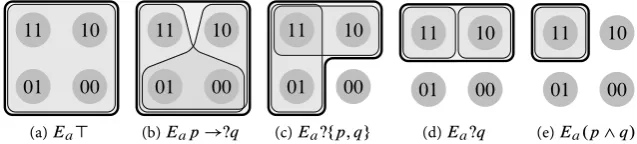
11 10
01 00
(a)Ea>
11 10
01 00
(b)Eap!‹q
11 10
01 00
(c)Ea‹fp; qg
11 10
01 00
(d)Ea‹q
11 10
01 00
[image:20.595.135.454.449.521.2](e)Ea.p^q/
Figure 2.2: Examples of issues over epistemic states.
The language used to interpret these models is obtained by enriching the language ofInqDwith operators for knowledge, as inEL, and a modality termedentertains. Definition 2.2.2(Syntax ofIEL).ForAtbe a set of atomic formulas. We add to the syntax ofInqD(definition 1.2.1) the following clause:
7. If' 2LŠ[L‹, thenKa'; Ea'2LŠ, fora2A
In order to interpret the additional operators we introduce the following support clauses to those ofInqD:
Definition 2.2.3(Support conditions forIEL).LetM be anIELmodel, andsan informa-tion state.
2From this we observe that an agent’s epistemic state can be recovered from their inquisitive state,
6. M; sKa'iff8w2s; M; a.w/'
7. M; sEa'iff8w2sand8t 2˙a.w/; M; t '
The truth condition for the entertains modality is derived from the above support condition, as the support condition straightforwardly quantifies over all the worlds in a given state of evaluation.
Definition 2.2.4(Truth clause for entertains).M; wEa'iff8t 2˙a.w/; M; t '
Just as with knowledge, the semantic clause internalises the semantic consequence relation of the base logic; truth at a world for the former, and support by an information state for the latter.
Moreover, as inquisitive semantics defines support relative to information states we can simplify the semantic clause for knowledge, by directly assessing the agent’s state. Fact 2.2.5. M; sKa'iff8w2s;8v2a.w/; M; v'
That epistemic states are information states proves important, for any information state can be transformed into an issue by taking its downward closure, as issue are simply downward closed sets of states. So, just asa.w/describes an agent’s epistemic state,
}.a.w//can be interpreted to detail every possible refinement of an agent’s epistemic
state.3In this way, restrictions on}.
a.w//correspond to selections of epistemic states
an agent could, in principle, attain. This is analogous to howa.w/\ j'jwill typically
be a subset ofa.w/specifying the refinement of the agent’s epistemic state with the
knowledge that'is true. More generally,}.a.w//D fa.w/\ jPj jP 2Ig.
Our interest is in restrictions to}.a.w//that correspond to issues, capturing
re-finements to the agent’s epistemic state sufficient to resolve certain rere-finements to the agent’s epistemic state. For example, as in figure 2.2c an agent may know thatp_qis true of the actual world, and entertain whetherporqis true, but be disinterested in whetherp^ :q,p^q, or:p^qis true, though these will be sufficient to resolve the issue entertained by the agent. Therefore, the issue associated to the agent corresponds to the proposition‹fp; qg.
Our interpretation of the entertains modality adds to this the notion that the agent intends, or desires, to attain any of the states selected, intuitively be establishing—or learning—sufficient information to resolve the issue entertained. This allows us to cap-ture an agent’s goals via interrogatives, specifically those whose resolutions are part of the goals of the agent. Therefore, via this interpretation of the entertains modality, an agent entertains an interrogative just in case they desire to have knowledge (equiv. be in an epistemic state) which resolves it.4
For example, figure 2.2 can be read left to right as the development of an agent’s epis-temic and inquisitive states. They begin in an ignorant state with no goals, and therefore entertain no proposition stronger than what is currently known,>. And, subsequently, as in 2.2b they refine their epistemic goals, and the information states characterising the
weakeststates they consider desirable arep !qandp ! :q. These formulas are the weakest resolutions top !‹q, and entail all others. Therefore, we can say the agent entertains the issue ofp!‹q.
3This caveat is important,a.w/may contain epistemic states which cannot be achieved, in the same manner as conditionalisation, if interpreted as learning (discussed below) details the result of agents con-ditionalising on information that cannot be learnt. Thatfvg 2}.a.w//for everyv2a.w/expresses the fact that the agent doesn’t know which world is actual, not that the actual world is undetermined.
4This gives an additional rationale for the requirement that˙
2.2c suggests a significant shift in the agent’s goals upon learning that eitherporq
is the case, as she revises her goals to establishing which. Note that we are applyingIEL
purely descriptively, and make no assumptions about the agent’s process of revision. In following chapters when conditionalisation, and eventually revision, are introduced, we will assume such leaps of reasoning are not made. Instead, we will suppose a process similar to the move from 2.2c to 2.2d, where the latter state is completely determined by the former and the information learnt, namelyp.
In 2.2e the agent has reached a stage of complete knowledge, and consequently can desire no better epistemic state than that which they are currently in. However, and as with any epistemic state, by internalising the notion of support the agent (formally) entertains every proposition supported by their current state. This ambiguity between whether a given proposition is entertained on the basis of a resolution or not can be avoided by defining a modality to capture those issues the agent does not know a reso-lution to. Ciardelli and Roelofsen (2014a) term thiswondering.
Wa'´Ea'^ :Ka'
A simple inspection shows that in figures 2.2a and 2.2e the agent wonders about no proposition, while in the remaining figures that agent wonders about the propositions entertained.
For wondering to be defined with respect to states in addition to worlds the support condition for the knowledge modality is required. We first observe that, as the truth condition for knowledge universally quantifies over an information state, and a declar-ative is supported only if it is supported at every world in the information state, in the case of declaratives it can be simplified to the following definition, given the inquisitive notion of support.
Fact 2.2.6(Truth condition forKmodality). M; wKa'iffM; a.w/'
TheKmodality describes an agent’s epistemic state, and thus is naturally modelled as a declarative, allowing us to define the following support clause for it.
Fact 2.2.7(Support condition for theKmodality in terms of its truth conditions).
M; sKa'iff8w2s; M; wKa'
The following fact, used to axiomatiseIEL(cf. Ciardelli (2014b)), shows knowledge is distributive with respect to interrogatives, meaning an agent knows an interrogative just in case they know (at least) one of its resolutions.
Fact 2.2.8. Ka‹f˛1; : : : ; ˛ng !Ka˛1_ _Ka˛nis valid with respect to iems.
In full, the following axioms and rules of inference augment the rules of inference ofInqDfor a sound and complete system,IEL, with respect to iems.
1. Ea.'! /!.Ea' !Ea /
2. Ea˛!˛
3. i)Ea'!EaEa'and ii):Ea'!Ea:Ea'
4. Ka.'! /!.Ka'!Ka /
5. Ea˛$Ka˛
6. Ka‹f˛1; : : : ; ˛ng !Ka˛1_ _Ka˛n
;..
..
' Ea'
;..
..
Finally we remark on an alternative approach to the definition of an agent’s epis-temic agenda. For, we can view the process as relativising the possible episepis-temic states to the resolutions of a collection of issues which the agent wishes to resolve. In this case an agent’s epistemic agenda may be represented syntactically, as a set of interrogatives
f1; : : : ; kg, with the natural assumption that the informative content of eachiis
entailed by the agent’s epistemic state. Semantically, this corresponds to taking˙a.w/
to be}.a.w//\ŒŒ1\: : :\ŒŒj.
Representing the epistemic agenda of an agent in this way is from a purely formal perspective unnecessary, as the catalogue of which interrogatives determine the agent’s agenda is lost when condensed to the semantic object˙a.w/when an iem is defined.
Therefore, beyond the intuitive appeal of this approach, we have little to say about it. Fact 2.2.9(Soundness and completeness ofIEL). IELis sound and complete with respect to iems.
Chapter 3
Inquisitive Conditional-Doxastic
Logic
The previous chapter brought together inquisitive semantics and epistemic logic. We now turn to synthesising inquisitive semantics with conditional-doxastic logic to form
inquisitive conditional-doxastic logic.
Conditional-doxastic logic has two interrelated, but distinct interpretations. First, as a static logic, describing both an agent’s doxastic and epistemic states (beliefs and knowledge, respectively) and how the states appear when conditionalising on arbitrary pieces of information. Second, as the static reduction of a dynamic logic which describes how an agent’s doxastic and epistemic states are revised upon learning new information. The latter interpretation allows conditional-doxastic logic to be treated as a formal tool, which need not have any value independent of its dynamic counterpart. The for-mer, on the other hand, requires a clear interpretation of conditional-doxastic logic, from which its value can be understood. Furthermore, this perspective will be more gen-eral, precisely because it deals with conditionalising on arbitrary pieces of information— in particular, information that cannot (truthfully) be learnt. The following section takes this former perspective, and uses this perspective to motivate the way in which inquis-itive semantics and conditional-doxastic logic are synthesised in the remainder of this chapter.
Before continuing let us briefly mention a third perspective that can be taken on conditional-doxastic logic, viz. as extending classical logic with classical and non-monotonic implications. This perspective can similarly be applied mutatis mutandis to inquisitive conditional-doxastic logic, we will only briefly return to this approach.
3.1 Conditional-Doxastic Logic
As with inquisitive semantics, epistemic logic, and inquisitive epistemic logic, tional-doxastic logic builds on the basis of possible world semantics. Indeed, condi-tional-doxastic logic is a straightforward generalisation of epistemic logic, where instead of associating to each agent an single information state, an information state is associ-ated to each agent for every classical proposition.
follows Baltag and Smets (2006).
Both Board and Baltag and Smets highlight the connexion between the process of belief revision captured byCDLand the AGM account of belief revision, detailed in Al-chourrón, Gärdenfors, and Makinson (1985). Furthermore, the process of condition-alisation that underlies the logic from a semantic point of view can be found in Stal-naker (1996, §3), who also connects this characterisation to Alchourrón, Gärdenfors, and Makinson (1985), and identifies this account as the first he is aware of.
In short, following Baltag and Smets (2006), conditional-doxastic logic can be inter-preted using semantic structures termedconditional-doxastic models(cdms).
We letP; Q; : : : denote arbitrary information states relative to logics with an inter-pretation based on classical propositional logic (i.e. in the remainder of this section). Definition 3.1.1(Conditional-doxastic models).
A conditional-doxastic model for a setAtof atomic formulas and a setAof agents is a tupleM D hW;fsPaga2A;P2}.W /; Vi, where:
– W is a set of possible worlds
– VWW !}.At/is a valuation map, stating for eachw2W the atomic formulas true atw
– sPa is a doxastic mapW !}.W /associating to each worldw2W an informa-tion statesPa.w/satisfying the following conditions:
Safety ifw2P thensPa.w/¤ ;
Introspection ifv2sPa.w/thensQa.w/DsQa.v/
Adjustment sP
a.w/P
Success ifsQa.w/\P ¤ ;thensPa.w/¤ ;
Minimality sPa\Q.w/DsPa.w/\Q;ifsPa.w/\Q¤ ;
Note the change in notation of an agent’s state map fromain epistemic models to
sain conditional-doxastic models. This is intended to represent an underlying change
in thetypeof information the state contains, from the current epistemic state of an agent, to their current (conditional) doxastic state.
IntuitivelysPa.w/captures those worlds in which an agent’sa’s beliefs are true, given
that they takeP to be true.
The syntax of conditional-doxastic logic is given by adding a conditional belief op-erator to classical propositional logic, as in the following definition:
'´pj :' j'^' jBa''
With the enriched language ofCDLand state maps for agents, we can interpret dox-astic maps through the following semantic clause. As is standard we writesa.w/for
sja j.w/.
Definition 3.1.2(Conditional belief).M; wBa'iff8v2sa.w/WM; v'. An agent takingPto be true and their resulting doxastic state can be interpreted in various ways. For example, an agent may takeP to be true just in case they learnP, or just in case they are informed ofP from a source they deem reliable.
More abstractly, we can interpret conditional belief as describing perceived entail-ment relations between propositions given the agent’s current doxastic state, whereBa'
reads ‘the agentabelieves'conditionally on .’ For the moment we will not give a con-crete interpretation of what conditionalising onP amounts to, and observe only that sPa.w/encodes some function of an agent and a piece of information, satisfying certain
The first of these issafety, which ensures an agent’s doxastic state will always be consistent with a proposition true of the actual world. In other words, an agent will never rule out the potential truth of, a proposition true of the actual world.
Introspectionfollows the same motivation as in epistemic models. We assume agents know their own conditional doxastic states, amounting to the assumption that agents have a fixed attitude to any given piece of information, and they cannot revise their own (conditional) beliefs about their conditional beliefs.
Adjustmentensures that an agent conditionalising on some information results in a state in which that information is true.
Successstates that if an agent’s knowledge is consistent with the truth ofP, then they can consistently conditionalise onP.1Together withadjustment, success ensures that if
P is consistent with an agent’s epistemic state, then conditionalising onP will not lead to a trivial doxastic state supportingP.
In additionminimalityensures this non-trivial belief amounts to the agent mini-mally adjusting their doxastic state to exclude the possibility thatP is false. More gen-erally, minimality ensures that if the agent’s beliefs will only be revised when they are contradicted by the information conditionalised on. As a consequence, when condition-alising on more specific information agents conditional doxastic states are the result of iterated conditionalisation, so long as each iterative step does not lead to an inconsistent state, as the following fact highlights. Therefore,so long asan agent can consistently iter-atively conditionalise onP1; : : : ; Pk, this amounts of conditionalising onP1\ \Pk.
It is only when for somei; j such thatsP1\\Pi
a .w/\Pj D ;that an agent will revise
their conditional doxastic state.2
These conditions characterise a certain kind of belief revision, given by a process of conditionalisation that, beyond some background assumptions about what can be con-ditionalised on, an the relationship between conditionalising at distinct worlds, is in-tersective when conditionalising on information that is consistent with an agent’s given conditional doxastic state, but does not (directly) constrain the agent if they condition-alise on information inconsistent with that state. This latter case is left to be specified by the model, and thus the agent being modelled.
While conditional-doxastic models do not explicitly encode an agent’s epistemic state, this can be recovered by taking the union of all their doxastic maps, following the intuition that an agent’s epistemic map captures those worlds compatible with their knowledge, which in turn are those worlds, which, from the agent’s point of view could be the actual world, and which the agent could given some additional information, re-vise their epistemic state in order to approximate. In other words, an agent knowsP
just in caseP is believed under any conditions. Formally,a.w/ ´ SP2I sPa.w/,
which in turn can be captured by the syntactic definitionKa' $ Ba:'?,3stating an
agent knows'just in case conditionalising on its negation would lead them to a state of inconsistency. By this reduction it is immediate that the knowledge modality satis-fies introspection, as conditional belief does. Furthermore, the safety condition ensures knowledge is factive.
1N.b. success can also be stated as: if
a\P ¤ ;, thensPa.w/¤ ;, givena.w/´SQ2IsQa.w/. As, for success to applyPneed only be consistent withsomeconditional doxastic statesQa.w/.
2N.b. iterative conditionalisation is not associative. For example, given a plausibility model from the
following section, consisting of three worldsw; v; usuch thatw <w
a v <wa u, and propositionsP1D
fv; ugandP2D fw; v; ug, thensPa1.w/DsPa1.w/\P2D fvg, whichsPa2.w/D fwg ¤sPa2.w/\
P1D ;, whences P1
a .w/\P2¤s P2
a .w/\P1. 3Note, we also have the following equivalence:B:'
a ? $Ba:'', allowing us to define knowledge as
With epistemic states regained, we can observe that an agent’scurrentdoxastic state can be captured by conditionalising on any proposition they know to be true, as this will incur no revision of their doxastic map. Indeed, as it is trivially the case that every agent knows>, be can define plan belief that'as conditional belief that'given>. Thus, we writeBa'forBa>'.
Interpreting conditionalising on'aslearning'interpretation of the state map con-ditions can be given a dynamic twist.
Safety, then, expresses that an agent can always consistently to learn a piece of in-formation which is true of the actual world. Introspection states an agent continues to be introspective upon learning new information. Adjustment states that learning is effective—if an agent learnsP, they come to believeP. Success states that if a piece of in-formation is consistent with an agent’s epistemic state it can be learnt. Finally, minimal-ity states that an agent’s beliefs are never given up when learning information consistent with their (conditional) doxastic state. Importantly, on this interpretation learning does not affect the agent’s current epistemic state. Therefore,sPa.w/does not capture what the agent believes upon learningP, but how the agent’s current doxastic state would appear upon learningP.
Following Baltag and Smets (2006, pp. 15–16), conditional-doxastic logic is axioma-tised by augmenting any sound and complete axiomatisation of classical logic with the following collection of axioms, and an additional rule of inference.
1. Ba.'!/!.Ba' !Ba/
2. Ba:''!'
3. i.Ba' !BaBa and ii.:Ba' !Ba:Ba'
4. Ba''
5. Ba':' !Ba:'
6. :B :'!.Ba^'$Ba.'!//
7. From`'infer`Ba'
The first axiom ensures that conditional beliefs are closed under (conditionally) be-lieved consequence, while the following axioms correspond in a one-one manner to the conditions imposed on doxastic maps. With this, Baltag and Smets (2006) show thatCDL
is sound and complete with respect to conditional-doxastic models. Furthermore, they establishICDLis sound and complete with respect toplausibility models(pms). These are semantic structures of the following kind.
Definition 3.1.3(Plausibility models).A plausibility modelM for a set Atof atomic formulas and a setAof agents, is a tuple:hW;fwagaw22AW; Vi, where:
1. W is a set of possible worlds
2. VWW !}.At/is a valuation map, stating for eachw2W the atomic formulas true atw
3. w
a associates to each worldwand agentaa well-preorder4over a subset ofW
satisfying the following conditions:
Factivity w2a.w/;wherea.w/´ fvj 9uW vwa ug
Introspection ifv2a.w/thenxva yif and only ifx wa y
4A binary relationw
a which is reflexive, transitive, and such that for every sets fvj 9uWvwa ug there existsv2ssuch thatvw
Defining Minw
aP ´ fv 2P j v
w
a ufor allu2 Pgas the set ofwa minimal
elements ofP, conditional belief is interpreted on plausibility models via the following clause:
Definition 3.1.4(Belief).M; wBa'iff8v2Minw
aj j; M; v'
Baltag and Smets (2006, p. 14) show that every pm can be transformed into a cdm, and conversely everyfinitecdm can be transformed into a pm, preserving the interpre-tation ofCDLformulas.5 This transformation is sufficient to establishCDLas sound and complete with respect to plausibility models. Therefore, plausibility models can be seen as quantitative counterparts to the essentially qualitative conditional-doxastic models forCDL. For, the interpretation of conditional belief now relies on an interpretation of an agent’s ordering of worlds, often explicated in terms of ‘degree of belief ’ or ‘plausibil-ity.’ In the case of the lattervwa uis read to state that atwthe agentaconsidersvat least as likely to be the actual world asu, following the mantra that belief aims at truth. Reflexivity and transitivity follow immediately from the conception ofwa
represent-ing a plausibility orderrepresent-ing, while the requirement of well-foundedness ensures that an agent will never have an infinite chain of worlds, each of which she considers strictly more plausible. Factivity and introspection follow from the same motivation as with respect to epistemic models, as they now pertain to the epistemic state of an agent. This assumes an agent has a plausibility ordering over all the worlds compatible with her knowledge, yet this assumption seems no more controversial as introspective condi-tionalisation with respect to an arbitrary proposition as assumed by conditional-doxas-tic models. Naturally, we can assume knowledge is not captured by plausibility models, in which case factivity amounts the assumption that an agent always assigns some plau-sibility to the actual world, and introspection ensures agents are certain of their own plausibility orderings.
The correspondence between cdms and pms, when interpreted viaCDL, establishes both classes of models represent equivalent assumptions about how agents condition-alise on information, which is captured qualitatively by cdms and quantitatively by pms. In this sense axioms 1 – 6 capture general assumptions about conditionalisation, from which further principles can be derived. Indeed, axiom 2 is equivalent to the principle that knowledge entails belief,K˛' !Ba', if knowledge is abbreviated through
condi-tional belief, as above. And, using the same abbreviation, the principles of introspection can be rewritten asBa '!KaBa'and:Ba' !Ka:Ba'.
Two well-known examples of derived principles are cautious and rational mono-tonicity: .B '^B /!B ^'and.Ba'^ :B :/! Ba^', respectively.
While the principles taken as axioms, with the exclusion of minimality, and cautious monotonicity, are largely uncontroversial rational monotonicity has generated some discussion. In effect, this principle states that when an agent conditionalises on infor-mation consistent with their (conditional) belief, this inforinfor-mation will not undermine any of their current (conditional) beliefs, and derives from minimality.6 See Stalnaker (1994) for a proposed counterexample, but note this would only show rational mono-tonicity/minimality should not be abasicprinciple of conditionalisation, requiring ad-ditional assumptions to be valid.
Finally, this abstract perspective on conditionalisation allowsCDLto be related to
5A generalisation of this transformation is fully detailed in chapter 5.
6For an informal demonstration, given minimality we have the following as a theorem ofCDLW
:Ba:!.Ba.!'/$B ^