DETERMINANTS OF FARMER UPTAKE OF EFFECTIVE SOIL CONSERVATION TECHNOLOGIES IN
THE CENTRAL HIGHLANDS OF KENYA
1*
James K. Mutegi,
2Julia N. Ameru,
1
International Plant Nutrition Institute (IPNI), SSA Program c/o IFDC
Compound, Duduville
2
Kenya School
3
Embu University College, P.O. Box 6
4Kenyatta University
5
Chuka University, P.O. Box 109
ARTICLE INFO ABSTRACT
An on farm study was conducted to determine farmers’ experiences, perceptions and adoption of agroforestry soil conservation technologies in central highlands of Kenya. There were clear indications from earlier studies that appropriate imple
on sloping agricultural terrain could reduce soil erosion by over 50%, boost soil fertility and increase crop yields. The concern was finding out what would drive farmers to either adopt or fail to adopt such
measurements of impacts of agroforestry contour hedges on the farmer fields in Tharaka Nithi County, in Kenya. It was done through two survey campaigns and a farmer evaluati effectiveness of established agroforestry soil conservation hedges. Ninety nine percent (99%) of both trial and non
especially on the sloping agricultural terrains. Thei
agroforestry species for soil conservation were: species that yield high quality fodder, improves crop production, enhances soil fertility and control erosion simultaneously. Farmers’ perceptions of importance of
attendance and training, land size and average slope of land. A number of explained the adoption pattern of agroforestry soil conservation hedges at
They were farmers contact with extension agents, education, farm income, livestock ownership, land size, membership to group or cooperative, gender and age. The coefficients for land size, age and access to off
adoption. We conclude that farmers are likely to adopt technologies that provide multiple benefits. Better policy support for
financing are necessary for boosting adoption of effective soil and water management technologies.
Copyright © 2015. James K. Mutegi et al. This is an open access article distributed under the Creative Commons Att use, distribution, and reproduction in any medium, provided the original work is properly cited.
INTRODUCTION
The role of biological hedges in soil conservation has widely been recognized in literature (Scroth et al., 1995; Breman and
Kessler, 1997). Grass strips in Chiangmai of Thailand (Syers,
1997) and live hedges of Calliandra and Leucaena
and Kenya (Roose and Ndayizigiye, 1997, Angima, 1996,
Mutegi et al., 2008) substantially reduced soil losses on s
agricultural landscapes of up to 40% slope.
*Corresponding author: James K. Mutegi
International Plant Nutrition Institute (IPNI), SSA Program c/o IFDC Africa Division, ICIPE Compound, Duduville- Kasarani, P.O. Box 30772
ISSN: 0975-833X
Vol.
Article History:
Received 26th August, 2015
Received in revised form
19th September, 2015
Accepted 21st October, 2015
Published online 30th November,2015
Key words:
Adoption, Perception, Agroforestry, Soil conservation
Citation: James K. Mutegiet al., 2015. “Determinants of farmer uptake of effective soil conservation technologies in the central hig
Kenya” International Journal of Current Research
RESEARCH ARTICLE
DETERMINANTS OF FARMER UPTAKE OF EFFECTIVE SOIL CONSERVATION TECHNOLOGIES IN
THE CENTRAL HIGHLANDS OF KENYA
Julia N. Ameru,
3Daniel N. Mugendi,
4James B. Kung’u and
International Plant Nutrition Institute (IPNI), SSA Program c/o IFDC-East & Southern Africa Division, ICIPE
Compound, Duduville- Kasarani, P.O. Box 30772-00100 Nairobi
Kenya School of Government, P.O. Box 23030-00604, Nairobi
Embu University College, P.O. Box 6-60100, Embu-Kenya
Kenyatta University, P.O Box 43844, Nairobi, Kenya
Chuka University, P.O. Box 109-60400, Chuka, Kenya
ABSTRACT
An on farm study was conducted to determine farmers’ experiences, perceptions and adoption of agroforestry soil conservation technologies in central highlands of Kenya. There were clear indications from earlier studies that appropriate implementation of agroforestry strategies especially on sloping agricultural terrain could reduce soil erosion by over 50%, boost soil fertility and increase crop yields. The concern was finding out what would drive farmers to either adopt or fail to adopt promising technologies. This study was carried out during implementation of field measurements of impacts of agroforestry contour hedges on the farmer fields in Tharaka Nithi County, in Kenya. It was done through two survey campaigns and a farmer evaluati effectiveness of established agroforestry soil conservation hedges. Ninety nine percent (99%) of both trial and non-trial farmers confirmed their knowledge of occurrence and effect of soil erosion especially on the sloping agricultural terrains. Their perceptions of characteristic of the best agroforestry species for soil conservation were: species that yield high quality fodder, improves crop production, enhances soil fertility and control erosion simultaneously. Farmers’ perceptions of importance of agroforestry soil conservation hedges varied significantly (P<0.01) with field day attendance and training, land size and average slope of land. A number of
explained the adoption pattern of agroforestry soil conservation hedges at
They were farmers contact with extension agents, education, farm income, livestock ownership, land size, membership to group or cooperative, gender and age. The coefficients for land size, age and access to off-farm income were negative implying an inverse relation between these variables and adoption. We conclude that farmers are likely to adopt technologies that provide multiple benefits. Better policy support for agricultural advisory services, quality inputs, land tenure and
financing are necessary for boosting adoption of effective soil and water management technologies.
is an open access article distributed under the Creative Commons Attribution License, which use, distribution, and reproduction in any medium, provided the original work is properly cited.
The role of biological hedges in soil conservation has widely
., 1995; Breman and
). Grass strips in Chiangmai of Thailand (Syers, Leucaena in Rwanda
Roose and Ndayizigiye, 1997, Angima, 1996,
) substantially reduced soil losses on steep
International Plant Nutrition Institute (IPNI), SSA Program c/o IFDC-East & Southern Kasarani, P.O. Box 30772-00100 Nairobi
Studies have also shown that agro
improve food production concurrently with reducing soil and nutrient losses (Sanchez et al, 1997
agricultural technology, adoption of agro
depends on the farmer’s perception of the potential benefits accruing to them (Avilla, 1990).
as a three step process involving: detachment of soil particles by either wind or water from the earth surface, transportation of detached particles, and deposition of these particles at another site (Sfeir-Younis and Dragun, 1993
farmers see movement of soil from one place to another as a result of deposition, and could see small rills and observe
International Journal of Current Research
Vol. 7, Issue, 11, pp.22137-22144, November, 2015
INTERNATIONAL
Determinants of farmer uptake of effective soil conservation technologies in the central hig
International Journal of Current Research, 7, (11), 22137-22144.
DETERMINANTS OF FARMER UPTAKE OF EFFECTIVE SOIL CONSERVATION TECHNOLOGIES IN
James B. Kung’u and
5Antony K. Njue
East & Southern Africa Division, ICIPE
00100 Nairobi
00604, Nairobi
Kenya
An on farm study was conducted to determine farmers’ experiences, perceptions and adoption of agroforestry soil conservation technologies in central highlands of Kenya. There were clear mentation of agroforestry strategies especially on sloping agricultural terrain could reduce soil erosion by over 50%, boost soil fertility and increase crop yields. The concern was finding out what would drive farmers to either adopt or fail to adopt promising technologies. This study was carried out during implementation of field measurements of impacts of agroforestry contour hedges on the farmer fields in Tharaka Nithi County, in Kenya. It was done through two survey campaigns and a farmer evaluation of effectiveness of established agroforestry soil conservation hedges. Ninety nine percent (99%) of both trial farmers confirmed their knowledge of occurrence and effect of soil erosion r perceptions of characteristic of the best agroforestry species for soil conservation were: species that yield high quality fodder, improves crop production, enhances soil fertility and control erosion simultaneously. Farmers’ perceptions of agroforestry soil conservation hedges varied significantly (P<0.01) with field day attendance and training, land size and average slope of land. A number of variables significantly explained the adoption pattern of agroforestry soil conservation hedges at between 0.1 and 6% level. They were farmers contact with extension agents, education, farm income, livestock ownership, land size, membership to group or cooperative, gender and age. The coefficients for land size, age and negative implying an inverse relation between these variables and adoption. We conclude that farmers are likely to adopt technologies that provide multiple benefits. agricultural advisory services, quality inputs, land tenure and innovative financing are necessary for boosting adoption of effective soil and water management technologies.
ribution License, which permits unrestricted
Studies have also shown that agro forestry practices can improve food production concurrently with reducing soil and
, 1997). However, like any other
agricultural technology, adoption of agro forestry technologies on the farmer’s perception of the potential benefits ). Scientists perceive soil erosion as a three step process involving: detachment of soil particles by either wind or water from the earth surface, transportation of d particles, and deposition of these particles at another
Younis and Dragun, 1993). On the other hand,
farmers see movement of soil from one place to another as a result of deposition, and could see small rills and observe
INTERNATIONAL JOURNAL OF CURRENT RESEARCH
development of gullies by water erosion but the exact extent of soil erosion and associated impacts on crop yields and environment remain unclear to them (Brouwers, 1993, Kerri
and Sanghi, 1993). They may therefore not be induced to
reverse it (Brouwers, 1993). Furthermore, unlike outsiders whose perceptions are often controlled by a single objective when promoting a technology, farmers are faced with multiple objectives in search for their livelihood. In adoption of any one technology farmers therefore make a compromise with their multiple objectives, resources, level of problem, urgency of household need and profitability among others. Therefore the best soil conservation practice from the farmers’ point of view is not necessarily the one that conserves most soil (Kerri and
Sanghi, 1993). Often, they may understand that the problem
can be reduced but the alternatives they are aware of to address the problem may be too costly relative to perceived benefits. The extent and effects of soil erosion in central highlands of Kenya has partly been documented and in accordance to the available data the trend is worrying. The extent is as high as 150-200 t/ha/yr (Angima, 2000) and the effect include dam siltation, eutrophication, methemoglobinemia and bottom water hypoxia (Justic et al., 1995).
Although scientifically proven effective, mechanical soil conservation technologies have failed to reduce average soil losses to a tolerable level, and regulate water pollution. This is mainly due to low adoption owing to perceived limitations of benefits they can provide (Okoba et al., 2005). It therefore follows that farmer' perceptions and attitudes need to be understood simultaneously with biophysical characteristics of several soil and nutrient management methods in order to develop an acceptable problem solving recipe for soil conservation. Against this backdrop this study was initiated to assess farmers’ perceptions in relation to adoption of introduced agroforestry contour hedges for soil conservation in Tharaka Nithi County, central highlands of Kenya. The main objectives of the study were: To document farmers’ knowledge and attitudes in regards to soil erosion and declining soil fertility and to understand the farmers’ perceptions of soil erosion and agroforestry soil conservation technologies.
The reference treatments were double tree hedges of Calliandra, Leucaena, napier, and a control (without any hedge) planted along the contour of sloping arable landscapes. These treatments were replicated in a Random Complete Block Design (RCBD) so as to represent the 5-10%, 10-20%, 20-30% and >30% slopes on 33 smallholder farms. Each farm was treated as a block. A detailed description of the treatment structure and experimental design are presented in Mutegi et al.
(2008).
METHODOLOGY
Description of the study area
The study was conducted in Kirege Sub-location, in Tharaka Nithi County, within the Rockefeller funded African Career Award project on use of agroforestry trees for soil nutrient management (Mutegi et al., 2008). Kirege Sub-location covers an area of about 7.6 km2 (Jaetzold et al., 2007). According to agro-ecological conditions, this area lies in the upper midland zones (UM2-UM3) (Jaetzold et al., 2007), on the eastern slopes of Mt Kenya at an altitude of approximately 1500 m above the sea level, annual mean temperature of about 20 C and annual
bimodal rainfall varying from 1200 to 1400 mm. The slopes of land under crop agriculture range between 0 and 60% with 10-20% slopes being the most common. The soils of this area are mainly humic Nitisols (FAO, 1990) equivalent to paleustalf in the USDA soil taxonomy system (Soil Survey Staff, 1990). The area is highly populated with a population of over 700 persons per km2 (Republic of Kenya, 2009) and therefore a high pressure on land with intense competition between various enterprises. Table 1 presents a summary of effect of erosion on crop yield variables in the most common slope category (the 10-20% slope). The maize crop yield measurements showed that the seasonal erosional driven crop yield losses could exceed 50%. In addition to lower grain yield erosion substantially reduced the total aboveground biomass reducing the potential of the plots to benefit from a build-up of organic matter through incorporation of resulting above and belowground biomass.
Soil and nutrient management with agro forestry
Field measurements results reported in Mutegi et al. (2008) and
Angima et al. (2000) show that in the study area, agroforesty
hedges could reduce soil erosion by more than 60%. Further
Mutegi et al. (2008) and Mugendi et al. (2000) showed that in a
business as usual scenario the farms in the region lose over 200 kg N ha-1 to sub-soil via leaching. Once these nutrients dis-appear into the sub-soil they become in accessible to most annual crops. This represents a loss of applied nutrients/loss of money invested in purchase of fertilizer and a potential source of nitrogen pollution to underground water aquifers. As indicated earlier, nitrate pollution is a potential health hazard. Excess nitrates (levels >50 mg L−1) in the drinking water cause health risks such as conversion of haemoglobin to methemoglobin, which depletes oxygen levels in the blood
(WHO, 2008). Forman et al. 1985 reported additional
consequences among people who consumed drinking water containing high levels of nitrates: enlargement of the thyroid gland, increased incidence of 15 types of cancer and two kinds of birth defects, and even hypertension. In addition, increasing rates of stomach cancer caused by increasing nitrate intake have been reported (Payne, 1993). Follow up measurements, two years after establishment of agroforestry contour hedges
(Mutegi et al, 2008) showed that the tree hedges had reduced N
accumulation in the sub-soil. The 30-90 cm depth nitrogen bulge zone observed at initiation of the trial had changed to a nitrogen depletion zone. More nitrogen had accumulated in the surface 0-30 cm depth in tree hedge plots than in the control and napier hedge plots. This was associated with the deep nitrogen capture and recycling capacity, nitrogen leaching regulation and nitrogen fixing capacity of these leguminous tree species (Mugendi et al., 2000, Mutegi et al., 2007).
Data collection
gradients ranging from 5-35% slopes in a randomized complete block design (RCBD) with individual farms representing blocks.
These farmers were then provided with seedlings, trained and supported to establish agroforestry hedges for soil conservation nursery groups were also established in the same area with the project facilitation from where both trial and non-trial farmers would get as many other seedlings as they required. There was an open farmers’ field/evaluation day at the end of every season for 2 years. The evaluations involved farmers walking through different trial farms to learn about the technologies. The visited trial farmer would explain the benefits and losses he was realizing from the hedges. During these occasions farmers would also have an opportunity to compare different treatments either for crop yield differences or for indication of
[image:3.595.68.528.120.199.2]soil conservation. They would later discuss the observations and fill the questionnaires.
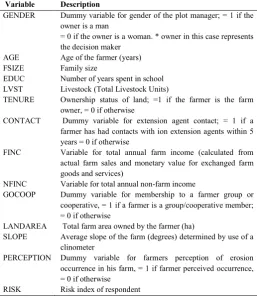
Table 2. Definition of variables used in Logit model
Variable Description
GENDER Dummy variable for gender of the plot manager; = 1 if the
owner is a man
= 0 if the owner is a woman. * owner in this case represents the decision maker
AGE Age of the farmer (years)
FSIZE Family size
EDUC Number of years spent in school
LVST Livestock (Total Livestock Units)
TENURE Ownership status of land; =1 if the farmer is the farm
owner, = 0 if otherwise
CONTACT Dummy variable for extension agent contact; = 1 if a
farmer has had contacts with ion extension agents within 5 years = 0 if otherwise
FINC Variable for total annual farm income (calculated from
actual farm sales and monetary value for exchanged farm goods and services)
NFINC Variable for total annual non-farm income
GOCOOP Dummy variable for membership to a farmer group or
cooperative, = 1 if a farmer is a group/cooperative member; = 0 if otherwise
LANDAREA Total farm area owned by the farmer (ha)
SLOPE Average slope of the farm (degrees) determined by use of a
clinometer
PERCEPTION Dummy variable for farmers perception of erosion occurrence in his farm, = 1 if farmer perceived occurrence, = 0 if otherwise
RISK Risk index of respondent
This was also supposed to act as a way of exposing as many farmers as possible to the technologies. Additional field surveys were carried out 4 years after the research group had left farmers to continue on their own. From a list of 195 adopters and 179 non-adopters of contour hedges, we randomly selected 60 farmers under each category using computer-aided randomization procedures. Adopters were defined as farmers who had planted at least 50 metres of calliandra or leucaena trees in contour hedge pattern (from the time of research group-farmer contact) on slopes >5% arable land and maintained them for at least 2 years. Non adopters were defined as farmers who had not planted leguminous shrubs in a hedge pattern in their arable farms since the time of farmer-research group contact. Structured questionnaires were used as survey instruments. The questionnaires were pre-tested on 12 randomly selected adopters and non-adopters, analyzed and then revised to incorporate farmers’ suggestions on various observations and practices related to contour agroforestry hedges in their farms and villages.
Table 1. Relationship between observed soil erosion classes with selected maize crop growth parameters within the 10-20% slope category in Kirege (Mutegi et al., 2008)
Soil loss (t ha-1y)
Grain weight Stover weight TAGB Plant height (cm)
t ha-1
40-100 1.9a 0.2 (8) 7.0a 0.2 (8) 10.2a 0.5 (8) 247.3a 5.0 (8) 100-150 1.5a 0.2 (8) 7.3a 0.2 (8) 4.1b 0.3 (8) 259.0a 8.5 (8) 150-200 1.5a 0.2 (6) 5.6b 0.5 (6) 3.2bc 0.1 (6) 226.2b 8.6 (6) >200 0.9b 0.3 (4) 3.3c 0.2 (4) 1.6c 0.1 (4) 190.1c 2.8 (4)
[image:3.595.303.561.260.559.2]Analytical model and statistical analysis
To evaluate farmers’ adoption decisions in relation to agroforestry contour hedges, a Logit model (Maddala, 1983) was used. Logit model assumes that the probability of an individual making a given choice is a linear function of individual attributes. Logit analysis is mainly used when dependent variable takes on discrete categorical (0, 1) values rather than continuous numerical values. Its appropriateness in technology adoption studies has been reported in a number of studies (Adesina and Sirajo, 1995; Lapar and Pandey, 1999). Relevant variables were selected after thorough review of literature (Ervin and Ervin, 1982; Adesina and Sirajo, 1995;
Lapar and Pandey, 1999), and from more than 3 years’
experience with farmers in the central highlands of Kenya. The definition of all the variables in the empirical model were as shown in Table 2. Age (AGE) was hypothesized to negatively affect adoption since younger farmers are likely to perceive a longer time horizon than older farmers.
Education (EDUC) on the other hand was expected to have a positive influence on adoption. Educated farmers have been found to have a higher likelihood of adopting soil conservation technologies (Ervin and Ervin, 1982). The family size (FSIZE) as used herein is a measure of number of people in a household. Large family sizes may indicate more labor availability to establish and manage contour hedges. CONTACT is a dummy variable that took the value 1 if a farmer had interaction/s with agroforestry extension agent within the last 5 years preceding interview and 0 if otherwise. Often, extension agents expose and encourage farmers to take up technologies that have worked for similar conditions elsewhere. It was therefore hypothesized that CONTACT would be positively related to adoption of contour hedges. We hypothesized that membership to farmer groups like tree nursery groups and cooperatives (GOCOOP) would correlate positively to adoption due to knowledge flow between members. Total annual farm income (FINC) measures the income a farmer derives from his farming activities.
Depending on FINC level, it might either imply that a farmer has resources to engage additional labour to establish and manage hedges or not. Total annual non-farm income (NFINC) also referred to as off farm income measures income associated with non-agricultural activities like office employment, consultancies and non-agricultural businesses. Studies have indicated mixed response of farmers’ adoption behaviour to availability of non-farm income. While a number of studies have shown a positive correlation between non-farm income and adoption of agroforestry technologies, others have shown an inverse or no relationship between non-farm income and adoption of such technologies (Adesina et al. 2000). TENURE is a dummy variable for the tenure status of land. Farmers with insecure tenure may not adopt soil conservation technologies due to uncertainty of capturing long-term benefits and vice versa for those with secure land tenure. The farmers’ perception of risk (RISK), such as outbreak of pests and diseases or loss of short-term income associated with new technologies affects technology adoption. Farmers who avoid risk may be reluctant to sacrifice their short-term returns for less certain benefits of new conservation practices. This implies that operators with a higher risk index hypothetically would have less confidence in beneficial effects of new technologies. In order to evaluate the prevailing trend, we evaluated
operators risk index against adoption of biological soil conservation technologies on a scale of 1-10. These plus other qualitative variables related to perception and adoption were analyzed by use of SPSS software.
RESULTS
Farmers’ perception of causes and impacts of soil erosion
Farmers were asked to identify the causes and effects of soil erosion. Majority of the farmers identified lack of ground surface cover, high rainfall and topography as the main causes of soil erosion (Table 3). Over 60% of the farmers associated soil erosion with declining land productivity and hunger. About 20% believed that soil erosion was the main cause of land preparation difficulties and pollution of rivers.
Characteristics of appropriate species for soil conservation
The question of characteristics of species preferred for hedgerow is crucial for judging other hedge qualities that could encourage uptake of agroforestry hedges for soil conservation. Over 60% of the surveyed farmers preferred species that would either provide fodder, improve crop production, enhance soil fertility, produce fruits or play two or more of these roles simultaneously. Only less than 40% of the respondents preferred species that would control soil erosion (Table 4).
Farmers’ perceptions of positive and negative attributes of contour hedges
Farmers’ decisions on soil conservation technologies are highly influenced by benefits, losses and risk perceptions
(Ruthenberg, 1985). Technologies perceived to have higher
positive values and lower risks, have a higher likelihood of adoption and vice versa (Kerri and Sanghi, 1993). Farmers perceived more positive impacts than negative impacts of using contour hedges for soil conservation (Table 5). Thirty seven percent of the respondents had not observed any negative characteristics of contour hedges by the end of third season (Table 5).
Household characteristics of adopters and non-adopters
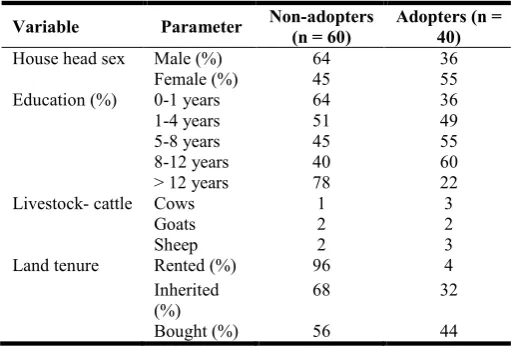
The household characteristics of interviewed farmers in respect to adoption or non- adoption of contour hedges were as shown in Table 6. A higher percentage of female led households (55%) than male (36%) had adopted these technologies 4 years after termination of field trials. Adoption rose with the level of formal education from 0-1 years of education category to 8 -12 years of education category and then declined sharply beyond there. The adopters had on average more heads of livestock
[image:4.595.312.554.693.778.2]than non-adopters. Farmers who had bought their land had the highest adoption rate (56%) followed by t hose who had
Table 3: Farmers perceptions of causes of soil erosion
Cause of soil erosion No. of responses
(n=160) %
Lack of surface cover 55 34
High rainfall 44 28
Topography 43 27
Over-cultivation 12 8
Table 4: Farmers’ perceptions of characteristics of appropriate species for soil conservation (n = 100)
Characteristic Responses %*
Fodder producing 86 86
Improving crop production 77 77
Enhancing soil fertility 67 67
Producing fruits 63 63
Control soil erosion 35 35
Able to give cash on sale 32 32
[image:5.595.35.291.212.403.2]*Total % higher than 100 because of multiple responses
Table 5: Farmers’ knowledge of positive and negative contribution of hedgesafter three seasons of experimentation
[image:5.595.34.290.455.628.2]Evaluation Responses
(n=100)* % * Positive evaluation
Provide high quality fodder 85 81
Enhance crop production 81 77
They control soil erosion 64 61
Provide cheap source of organic fertilizer
60 57
Improve soil fertility 41 39
Low cost of establishment 39 37
Source of income 20 19
Negative evaluations
None 39 37
Maintenance labor requirement is high 80 76 Shortage of planting materials 57 54 Competition with associated crops 30 28
Makes ploughing difficult 20 19
Harbors rodents and pests 15 14
*In most cases there were multiple responses
Table 6: Household characteristics of adopters and non-adopters of agroforestry hedges for soil conservation
Variable Parameter Non-adopters (n = 60)
Adopters (n = 40)
House head sex Male (%) 64 36
Female (%) 45 55
Education (%) 0-1 years 64 36
1-4 years 51 49
5-8 years 45 55
8-12 years 40 60
> 12 years 78 22
Livestock- cattle Cows 1 3
Goats 2 2
Sheep 2 3
Land tenure Rented (%) 96 4
Inherited (%)
68 32
Bought (%) 56 44
inherited land (32%). The least adopters were farmers who hand rented land who registered less than 10% adoption.
Determinants of adoption of contour hedges
The Logit model was significant at 10% level. The model correctly predicted 72% of both adopters and non-adopters. Eight variables were significant in explaining adoption of contour hedge technology at 5-10% level (Table 7). They were farmers contact with extension agents-significant at P= 0.001 level, education P= 0.005 level, farm income at P= 0.01 level, livestock and land size at P= 0.02 level, membership to group or cooperative and gender at P= 0.05 and age at P = 0.06 level.
The coefficients for land size, age and access to off-farm income were negative implying an inverse relation between these variables and adoption. Surprisingly, farmers’ perception of occurrence of soil erosion, slope of land and risk perceptions were not significant drivers for adoption.
DISCUSSION
Farmers seemed to understand very well the causes and effects of soil erosion. However, despite this understanding, soil erosion was not a top criteria for selection of appropriate species for soil conservation. Similarly, other studies showed that, farmers seldom adopt technologies for purposes of soil conservation (Shaxson 1989; Okoba et al., 2005). They adopt soil conservation technologies to improve crop yield, improve soil fertility and improve land value in addition to other more urgent benefits (Okoba et al., 2005). Viewed in the context of huge soil losses in excess of 100 tons/ha and yield decline levels represented in Table 1, this implies a need for extension and other stakeholders to work more closely with farmers to put long term effects of land degradation in perspective, to enable them to manage their farms for sustainability of production.
A key notable additional long term benefit of tree hedges is the role of trees in capture and sequestration of carbon. However, just like soil erosion benefits, carbon sequestration benefits are not likely to induce farmers to adopt agroforestry tree hedges unless a good system of payment for ecosystem services is developed, to enable them to see/realize immediate gains. Both locally and globally, carbon sequestration processes are crucial due to their role in mitigating and adapting agricultural systems to climate change (Verchot et al., 2007). The Calliandra and
Leucana trees that were used as tree hedges in this trial (Mutegi
et al., 2008) yielded between 3 & 4 tons of dry foliage biomass per hectare per year. When returned to the soil, this translates to annual carbon inputs of between 1.3 and 1.8 tons/ha/yr.
If soil conservation hedges are adopted in over 40,000 ha of similar sloping landscapes in central highlands of Kenya, with foliage retention in the soil, the amount of annual inputs into the soil would range between 54 x 103 and 72 x 103 tons. Although over 50% of this carbon could be lost within the first 10 years via microbial decomposition, about 10% of remaining more stable carbon has a residence time of more than 40 years
(Mutegi et al., 2012). A habitual year after year use of these
technologies could therefore have a significant positive impact on the environment, soil health and crop yields. However, Tissues that limit adoption need to be understood and addressed for this to happen. Over and above the beneficial impacts on water quality, a principal ecological benefit of soil conservation and restoration is the increase in the C pool in the soil and the terrestrial biosphere with the attendant negative feedback on climate change.
education is critical for technology uptake and diffusion. On the other hand, low adoption amongst those educated beyond 12 years could be attributed access to alternative livelihood sources like farm employment. The negative impact of off-farm employment on adoption of agroforestry hedges is also supported by the inverse relationship between off farm income and adoption observed in the Logit model results (Table 7).
The rise of adoption with the number of livestock owned by individual farmers is attributable to farmers’ realization of the potential of Calliandra and Leucaena to act as excellent alternatives to commercial concentrates. About 20% of interviewed non-trial farmers actually used all the Calliandra and Leucaena biomass to feed livestock instead of incorporating the biomass to the farms directly. Majority of other farmers (50%) incorporated about 55% of biomass in their farms and used the reminder to feed livestock. It is for this reason a positive and significant relationship was also observed between the number of livestock owned and adoptionin the Logit model results. Murithi (1998) observed that 45% of the farmers in central highlands of Kenya buy commercial dairy meal (nominally 16 percent crude protein) to supplement their livestock diet.
However, they complain that the price ratio between dairy meal and milk is un-favorable, that they lack cash for buying enough dairy meal, that its nutritive value is suspicious and highly variable, and that it is difficult for them to transport dairy meal from the market to the homestead (Franzel et al., 1999). The economic analysis carried out on the importance of Calliandra as a source of fodder by Franzel et al. (1999), revealed that after planting, a farmer with an average of 500 shrubs would earn an extra US$130 per year either through increased milk production or through reduced purchase of dairy meal. On the other hand Nyaata (1998) showed that Leucaena could act interchangeably with Calliandra in provision of quality fodder for livestock. The low adoption among farmers under land rental arrangements can be associated with insecurity of tenure.
This is in agreement with Napier and Sommers (1993) finding that tenant farmers are unlikely to want to bear the full cost of technology while the benefits are long term and therefore shared with the landlords. Similarly, systems based on revolving cultivation of land amongst family members and communal land ownerships where the degree of certainty of
eventual ownership is not very clear may have a similar effect as is the case with farmers with inherited land. Therefore, agroforestry soil conservation hedges may be more relevant where farmers have a long-term security of tenure over discrete areas of land. This is so especially when we consider that contour hedges take long time to accrue other benefits like soil organic matter build-up and related improvement in soil
structure (Ruthenberg, 1985). The positive and significant correlation between perception of soil erosion and field day attendance and training (FDDAT) was expected since field days provided farmers with exposure and training about the adverse effects of soil erosion, means of soil conservation and easier and more cost effective ways of establishing agroforestry hedges. Such exposure and training broadens farmers’ perspective irrespective of their level of education and age. The negative relationship between land size and adoption implies that farmers with large farm holdings had lower probability of adopting agroforestry soil conservation hedges. This could probably be because farmers with large tracts of land could not easily feel the impact of loss of small portions of land to degradation as compared to farmers with small plots who had to take maximum care of their land since they didn’t have anywhere else to shift to in event their small pieces turned unproductive.
Implications for policy
This work shows the benefits of soil conservation with agroforestry trees at local, regional and global level. The results of this study are scalable to other steep arable highlands of Kenya and Africa at large. Further, the study gives pointers to key areas that should be addressed through policy to improve adoption of such technologies. These areas include:
[image:6.595.67.522.159.331.2]i. Extension service –The correlation between extension service and adoption was high. The extension worker – farmer ratio in Kenya is currently estimated at 1:1000 against the international standard recommendation of 1:400. The low ratio complicates the capacity of extension workers to reach all the farmers with information and demonstration of the best ways of implementing technologies. As is the case with most other African states, Kenya scaled down recruitment of agricultural extension workers in 1990’s owing to the Structural Adjustment
Table 7. Logit model results of factors affecting farmers’ adoption of contour hedges in Chuka division, Central highlands of Kenya
Variable Estimate Standard error t-Statistic p- value
GENDER 1.062 0.512 1.09 0.05
AGE -0.03 0.031 1.31 0.06
FSIZE 0.152 0.127 1.71 NS
RISK -0.302 0.533 0.59 NS
EDUC 3.39 1.12 2.91 0.005
TENURE 1.04 0.481 2.84 0.005
LVST (TLU)* 1.59 0.821 1.93 0.02
FINC 1.61 0.512 1.95 0.01
NFINC -0.191 0.622 0.46 NS
CONTACT 1.83 0.523 3.12 0.001
GOCOOP 2.43 0.921 2.753 0.05
SLOPE 0.66 0.473 1.25 NS
PERCEPTION 0.53 0.330 0.27 NS
LAND AREA -1.53 0.723 1.84 0.02
Intercept -7.43 2.12 -3.56 0.005
Percent correct predictions 72.3%
Log of likelihood function -54.21
* TLU-Tropical livestock unit = live weight equivalent to 250 kg, NS= Not significant
Programs (World Bank 1994). Consequently, over the time, the number of citizens enrolling for agricultural courses declined significantly. Although the private sector can play a significant role, emerging evidence suggests that, private extension is not a substitute for public extension (Muyanga
and Jayne, 2006). Public-private partnership models have
been proposed as better models for delivering extension to smallholder Kenyan farmers. Since resolving the issue of the number of trained extension is long-term, innovative extension approaches such as e-extension and use of various forms of media can be embraced to compliment face to face extension. Overall, there is need to re-work the Kenyan extension policy and strategy to improve the quality of extension and areas that can be covered with appropriate extension messages.
ii. Land tenure-Weak land ownership arrangements discourage farmers from adopting soil conservation technologies. Kenya is dotted with regions where land ownership is un-clear. Often inhabitants of such regions are either squatters who cannot make decisions concerning long term investment on land. It is crucial that the state improves land ownership arrangement for better adoption of technologies that have long term impacts on soil, water and other environmental issues like climate change. iii. Input quality regulation-The technologies demonstrated
in this paper worked because of quality tree seeds. Low quality seeds lead to poor crop/plant establishment and performance, reducing farmers’ return on investments. This could make farmers to perceive non-performance of appropriate technologies leading to low adoption. The issue of sale of low quality seeds disguised as quality seed is common in Kenya. For better agricultural and soil/water management results with agroforestry, there is a need for development and enforcement of seed policies.
iv. Innovative financing-Most of the smallholder Kenyan farmers live on less than 2 dollars per day. They are therefore unable to invest on land management technologies opting to use the little finances they get for more urgent household needs like health and education. Agroforestry soil conservation technologies require finances to purchase seeds and to engage labor for implementation. Farmers therefore, need support in terms of affordable credits to implement soil and water management technologies.
Conclusion and recommendations
This study revealed that farmers would be more comfortable adopting technologies that provide multiple benefits simultaneous with soil conservation and not those that solely address soil erosion. Their decision to adopt is not influenced by perception of occurrence of soil erosion, slope of land or risk perceptions. The farmers’ level of education, age, land size and number of livestock are important variables in as far as adoption of agroforestry hedges for soil conservation are concerned. Enacting and supporting appropriate policies on agricultural extension, quality inputs, land tenure and innovative financing is crucial for boosting adoption of effective soil and water management technologies.
Acknowledgement
This work was funded by Rockefeller through an Africa Career Award Grant. We thank the Kirege farmers for hosting the trials and cooperating with the research teams during
interviews. We are highly indebted to Kenyatta University for managing the grant.
REFERENCES
Alliance for a Green Revolution in Africa (AGRA) 2008. Soil Health Program Business Planning Process. Country Report for Kenya. 60 pp.
Angima, S.D. 1996. Potential use of contour Calliandra
calothysus hedges with napier grass (Pennisetum
purpureum) for soil erosion control in a high potential area of Embu,Kenya. MSc thesis, Kenyatta University, Kenya. Angima, S.D., O’neill, M.K., Omwega, A.K. and Stott, D.
2000. Use of tree/grass hedges for soil erosion control in the central highlands of Kenya. J soil and water conservation 55:478-482.
Avilla, M. 1990. Agroforestry Research goes to the farm. Agroforestry Today 2: 10-12
Breman, H. and Kessler, J.J. 1997. The potential benefits of agroforestry in the Sahel and other semi-arid Regions. European Journal of Agronomy 7: 25-33
Brouwers, J.H. 1993. Rural People’s Response to Soil Fertility Decline: Adja Case (Benin). Published PhD Dissertation, Wageningen Agricultural University.
Eswaran, H, Lal, R. and Reich, P.F. 2001. Land degradation: an overview. In. Bridges, E. Michael; Ian D. Hannam; L Roel, Olderman: Frits W.T. Penning, Sombapanit (eds). Response to land degradation. Oxford and IBH Publishing Co. Pvt. Ltd., New Delhi and Calcutta.
Franzel, S.H., Arimi, F Murithi and Karanja, J. 1999. Calliandra calothyrsus: Assessing the Early Stages of Adoption of a Fodder Tree in the Highlands of Central Kenya, AFRENA ReportNo.127, Agroforestry Research Network for Africa, Nairobi: International Centre for Research in Agroforestry.
Forman, D., Al-Dabbagh, S., Doll, R. 1985. Nitrates, nitrites and gastric cancer in Great Britain. Nature 313: 620–625. Jaetzold, R., Schmidt, S., Berthold, H and Shisanya, C. 2007
Farm management handbook of Kenya vol. II: Natural Resources and Farm Management -2nd edition. Sub-Part C Eastern Province. Ministry of Agriculture, Kenya
Jama, B. and Pizarro, G. 2008. Agriculture in Africa: Strategies to Improve and Sustain Smallholder Production Systems. Annals of New York Academy of Sciences 1136:218-232.
Justic, D., Rabailis, N., Turner, R., Dortch, Q. 1995. Changes in nutrient structure of river dominated coastal waters: Stoichiometric nutrient balance and its consequences. Estuarine, Coastal and Shelf Science 40: 339-356
Kerr, J.M. and Sanghi, N.K. 1993. Indigenous Soil and Water Conservation in India’s Semi-Arid Tropics. In: Baum., Peter Wolf and Michael A Zobisch (eds). Acceptance of Soil and Water Conservation: Strategies and Technologies. Volume 3. Topics in Applied Resources Management in Tropics. The German Institute of Tropical and Subtropical Agriculture, Witzenhausen, Federal Republic of Germany. Lal, R.2014. Soil conservation and ecosystem services.
International Soil and Water Conservation Research, 236-47
science Society of East Africa Conference held in Mombasa, Kenya.
Murithi, F.M. 1998. ‘Economic evaluation of the role of livestock in mixed smallholder farms of the central highlands of Kenya’, PhD thesis, Department of Agriculture, University of Reading, UK
Mutegi, J.K., Mugendi, D.N., Verchot, L.V., Kung’u, J.B. 2008. Combining napier grass with leguminous shrubs in contour hedgerows controls soil erosion without competing with crops. Agroforestry Systems 74: 37-49. DOI 10.1007/s10457-008-9152-3.
Muyanga, M. and Jayne, T.S. 2006. Agricultural extension in Kenya: practice and policy lessons. Tegemeo Institute of Agricultural Policy and Development. Tegemeo Working paper 26. Egerton University, Njoro, Nakuru, Kenya. 35pp. Napier, T.L. and Sommers, D.G. 1993. Soil Conservation in the
Tropics: A Prerequisite for Social Development. In: Baum, Peter Wolf and Michael A Zobisch (eds). Acceptance of Soil and Water Conservation: Strategies and Technologies. Volume 3. Topics in Applied Resources Management in Tropics. The German Institute of Tropical and Subtropical Agriculture, Witzenhausen, Federal Republic of Germany. Nyaata, O. 1998. Management of Calliandra calothrysus in
association with Pennisetum purporeum for increased dry season forage production on smallholder dairy farms of central Kenya. PhD thesis, Department of agriculture, University of Reading, UK
Payne, M.R. 1993. Farm waste and nitrate pollution. In: Jones JG, editor. Agriculture and the environment. pp. 63–73. Horwood, New York.
Reij, C. and A. Waters-Bayer, 2001. Farmer innovation in Africa. A source of inspiration for agricultural development. Earthscan, 362 p.
Republic of Kenya 2009. Population and housing census report. Central Bureau of Statistics (CBS), Nairobi, Kenya. Government printer.
Roose, E. and Ndayizigiye, F. 1997. Agroforestry water and soil fertility management to fight erosion in tropical mountains of Rwanda. Soil Technology 11 (1): 109-119 Ruthenberg, H. 1985. Innovation Policy for Small Farmers in
the Tropics: The Economics of Technical Innovations for Agricultural Development. Edited by Jahnke, HE. Clarendon press, Oxford.
Sanchez, P.A., Shepherd, K.D., Soule, M.J., Place, F.M., Buresh, R.J., Izac, A.N., Nderitu, C.G. and Woomer, P.L. 1997. Soil fertility replenishment in Africa: A natural
resource capital. In: Buresh RJ, Sanchez PA and Calhoun FG (eds) Replenishing Soil Fertility in Africa. SSSA Special Publication Number 51. Soil Science Society of America and American Society of Agronomy, Madison, Wisconsin, pp. 1-46
Schroth, G., Oliver, R. Balle, P., Gnahoua, G.M., Kachanakanti, N., Leduce, B., Mallet, B., Peltier, R. and Zech, W. 1995. Alley cropping with Gliricidia sepium on high base status soil following forest clearing: effects on soil conditions, plant nutrition and crop yields. Agroforestry systems 32(3): 261-276
Sfeir-Younis, A. and Dragun, A.K. 1993. Land and Soil Management Technology: Technology Economics and Institutions. West view Press Oxford.
Shaxson, T.1989. Land husbandry- A framework for soil and water conservation. Ankey Soil and Water Conservation Society.
Soil Survey Staff, 1990. Keys to soil taxonomy. SMSS Tech. Monograph No.19, 4th edition.
Syers, K. 1994. Soil erosion and soil fertility management. In: Banskota M and Karki As (eds) Sustainable Development of Fragile Mountain Areas of Asia, ICIMOD Regional Conference Report, 13-15 December, 1994, Kathmandu Verchot, L.V., van Noordwijk, M., Kandji, S., Tomich, T.,
Ong, C., Albrecht, A., Mackensen, J., Bantilan, C., Anupama, C.K. and Palm, C., 2007. Climate change: Linking adaptation and mitigation through agroforestry. Mitigation and Adaptation Strategies for Global Change, 12: 1381-1386.
WHO 2008. Guidelines for drinking-water quality- Third Edition: Incorporating the first and second addenda. Volume 1. Recommendations. World Health Organization, Geneva website. Available: http://www.who.int/ water_sanitation_health/dwq/GDWPRecomdrev1and2.pdf. Accessed 10 May 2015.
World Bank 2004. Agriculture Investment Sourcebook: Investments in Agricultural Extension and Information Systems (Module 3). Washington DC
World Bank 1994. Adjustment in Africa. Reforms, Results, and the Road Ahead. The International Bank for Reconstruction and Development/ The World Bank, Washington D.C. New York: Oxford University Press