Siemon, Callingham, Day, Horne, Seah, Stephens, & Watson
2018. In Hunter, J., Perger, P., & Darragh, L. (Eds.). Making waves, opening spaces
From Research to Practice: The Case of Mathematical Reasoning
Dianne Siemon RMIT University <[email protected]>
Rosemary Callingham University of Tasmania <[email protected]>
Lorraine Day University of Notre Dame <[email protected]>
Marj Horne RMIT University <[email protected]>
Rebecca Seah RMIT University <[email protected]>
Max Stephens The University of Melbourne <[email protected]>
Jane Watson University of Tasmania <[email protected]>
Mathematical proficiency is a key goal of the Australian Mathematics curriculum. However, international assessments of mathematical literacy suggest that mathematical reasoning and problem solving are areas of difficulty for Australian students. Given the efficacy of teaching informed by quality assessment data, a recent study focused on the development of evidence-based Learning Progressions for Algebraic, Spatial and Statistical Reasoning that can be used to identify where students are in their learning and where they need to go to next. Importantly, they can also be used to generate targeted teaching advice and activities to help teachers progress student learning. This paper explores the processes involved in taking the research to practice.
Introduction and Theoretical Background
A capacity to solve unfamiliar problems and reason mathematically is a desired goal of mathematics education at all levels. Defined broadly in the Australian Curriculum: Mathematics (Australian Curriculum, Assessment & Reporting Authority [ACARA], 2015) as a “capacity for logical thought and actions”, mathematical reasoning has a lot in
common with mathematical problem solving, but it also relates to students’ capacity to see beyond the particular to generalise and represent structural relationships. This ability is a key aspect of further study in mathematics and thereby further studies in science, technology and/or engineering (Wai, Lubinski, & Benbow, 2009).
“fluency is disproportionately the focus of most externally set assessments” (Sullivan, 2011, p. 8).
Teaching informed by quality assessment data has long been recognised as an effective means of improving mathematics learning outcomes (e.g., Black & Wiliam, 1998; Goss, Hunter, Romanes, & Parsonage, 2015; Masters, 2013). It is also evident that where teachers are supported to identify and interpret student learning needs, they are more informed about where to start teaching, and better able to scaffold their students’ mathematical learning (Callingham, 2010; Clarke, 2001). As Wiliam, (2006, p. 6) stated
What we do know is that when you invest in teachers using formative assessment … you get between two and three times the effect of class size reduction at about one-tenth the cost. So, if you’re serious about raising student achievement … you have to invest in teachers and classrooms, and the way to do that is in teacher professional development focused on assessment for learning.
At the time, the terms ‘assessment of learning’, ‘assessment for learning’ and
‘assessment as learning’ were being used to draw attention to the different purposes of assessment (e.g., Earl & Katz, 2006). Since then, Wiliam (2011) and others (e.g., Masters, 2013) have blurred this distinction to recognise that any “assessment functions formatively to the extent that evidence about student achievement is elicited, interpreted, and used by teachers, learners, or their peers to make decisions about the next steps in instruction” (Wiliam, 2011, p. 43, our emphasis).
Referred to as targeted teaching in the context of the Scaffolding Numeracy in the Middle Years (SNMY) project (Siemon & Breed, 2006), the process of eliciting, interpreting and using assessment evidence to inform subsequent teaching and learning requires valid assessment tools, evidence-based learning progressions, professional learning, and the flexibility to use classroom time effectively (Siemon 2016). Consistent with Wiliam’s (2006) observations, targeted teaching has been shown to lead to effect sizes well beyond what would otherwise be expected. For example, a 2013 study exploring the use of SNMY materials for multiplicative thinking in 28 Australian secondary schools, used matched data from 1732 students across Years 7 to 10 to show that the average achievement of students grew above an average effect size of 0.6. This result indicates an influence beyond what might have been expected, although the results varied considerably between schools, (Siemon, 2016).
The demonstrated efficacy of adopting a targeted teaching approach to multiplicative thinking, prompted the design of the Reframing Mathematical Futures II (RMFII) project (see Siemon, 2017). The aim was to build a sustainable, evidence-based, learning and teaching resource to support the development of mathematical reasoning in Years 7 to 10
that could function formatively in the way described by Wiliam (2011). That is, to inform a deeper, more connected approach to teaching mathematics that recognises and builds on what learners already know and takes them beyond low-level skills and routines.
Methodology
For the purposes of the RMFII project, mathematical reasoning was defined in terms of three core elements:
i. core knowledge needed to recognise, interpret, represent and analyse algebraic, spatial, statistical and probabilistic situations, and the relationships/connections between them;
ii. an ability to apply that knowledge in unfamiliar situations to solve problems, generate and test conjectures, make and defend generalisations; and
iii. a capacity to communicate reasoning and solution strategies in multiple ways (i.e., through diagrams, symbols, orally and in writing).
A design-based research approach was used as the intent was to “directly impact practice while advancing theory that would be of use to others” (Barab & Squire, 2004, p. 8). Thirty-two secondary schools from each State and Territory with the exception of the Australian Capital Territory participated in the project. One teacher from each school was supported to work with up to 6 other teachers in their school to trial the mathematical reasoning assessment tasks and activities. From 2015 to 2017, approximately 80 teachers, and 3500 students in Years 7 to 10 were involved in the project. Project schools were visited at least twice a year by a member of the research team and residential professional learning opportunities were provided on an annual basis. An additional 1500 or so Year 5 to 10 students from other schools participated in the trialling of the assessment tasks.
The research plan was designed in terms of three overlapping phases. Phase 1 used rich tasks and scoring rubrics to test the hypothetical learning trajectories derived from the literature for each reasoning strand. Rasch modelling (Bond & Fox, 2015) was used to analyse the data and inform the development of Draft Learning Progressions for algebraic, spatial and statistical reasoning. Phase 2 focussed on the preparation, trial and use of multiple assessment forms both to validate the forms and to test the Draft Learning Progressions. This phase also included the analysis of student and teacher on-line surveys, and the development of teaching advice and professional learning modules to support a targeted teaching approach to mathematical reasoning. The final phase of the project is focussing on the development and publication of project outcomes and reports. This paper will focus on a key part of Phase 2, the development of teaching advice from the analysis of student responses to the final assessment forms.
By the end of the third round of assessment, it was evident that the scales produced as a result of the Rasch analysis were stable. At this stage, specialist members of the research team met as appropriate to interrogate the student responses located at similar points on the scale to decide whether or not there were qualitative differences in the nature of adjacent responses with respect to the sophistication of the mathematics or mathematical reasoning involved and/or the extent of cognitive demand required. This process established cut off points between Zones and supported the development of broad descriptions of the characteristic behaviours evidenced at each Zone to serve as interpretations.
point but less than a 50% chance of scoring at the level required for items located above that point. This means that there are some aspects of the behaviours identified within the relevant Zone that need to be consolidated and established to deepen students’ understanding and others that need to be introduced and developed to progress their learning to the next Zone.
Given the strong research base for using low threshold high ceiling tasks in mixed ability groups (e.g., Sullivan, 2011), and feedback from project school teachers that they wanted to explore more effective and engaging ways of teaching, the research team focussed on identifying rich tasks that would address a range of learning needs across a number of Zones.
Results
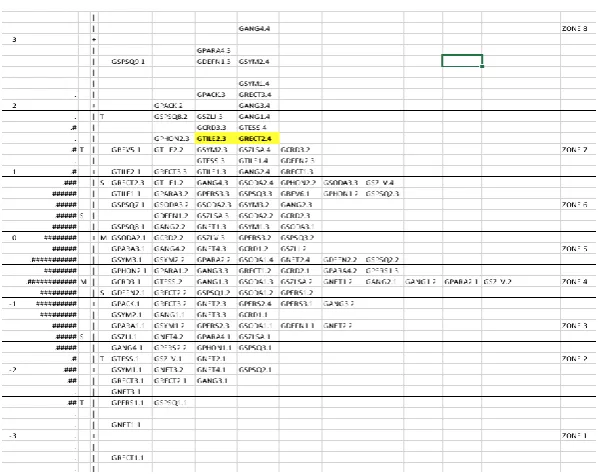
The approach and findings are exemplified for spatial reasoning. The variable map for spatial reasoning produced as a result of the Rasch analysis is shown in Figure 1. Item responses are ranked from easiest (bottom of the map) to most difficult (top of the map).
[image:4.595.155.456.429.666.2]Those items at the same or very similar levels of difficulty were interrogated to identify similarities or differences in the reasoning required. Responses exhibiting similar levels of reasoning were grouped together to form eight relatively discrete, hierarchical Zones. For example, GTILE2.3 indicates a correct response (coded as 3) to an item (GTILE2) that requires students to minimise the perimeter of a rectangular tiling feature made up of 36 square tiles and identify its dimensions. It is located in Zone 7 alongside GRECT2.4 that required students to correctly identify all 6 rectangles in a display of 12 polygons (all but one a quadrilateral) and explain their reasoning (coded as 4).
Figure 1. Excerpt from the variable map for spatial reasoning for MR1 and MR2 (n = 1041).
the Spatial Reasoning Learning Progression (left hand column) with related advice for teachers about the types of activities needed to consolidate the learning and move the students forward on the right. The italicised text indicates the big organising ideas for spatial reasoning. The activities referred to in the Teaching Implications column are available to teachers via a drop box or from indicated websites.
Table 1
Example of Teaching Advice for Zone 3 of the Spatial Reasoning Learning Progression.
Zone 3 Behaviours Teaching Implications
Hierarchy and properties
Uses one or two properties (insufficient) to explain reasoning about shapes (e.g., triangles and quadrilaterals).
Beginning to coordinate multiple information sources, but justification limited to using part of the information (e.g., check net to see if it will make a cube).
Makes and names familiar 2D shapes, but may not recognise right angles, parallel lines, or properties in non-standard representations.
Represents 3D objects in limited ways (e.g., may show only part of the object). Sees objects and groups of objects as a whole but has difficulty in analysing components independently.
Transformation and location
Visualises objects mostly from own perspective
Uses coordinates in first quadrant only. Beginning to manipulate visual images and coordinate information.
Geometric Measurement
Demonstrates awareness of measurement attributes.
Uses one or two attributes (in-sufficient) to explain their reasoning about measurement (e.g. considers length but forgets impact of width/height)
Beginning to be aware of volume and capacity and the relationship between length, area and volume.
Consolidate and Establish:
Hierarchy and properties
Provide experiences in different contexts where students explain their reasoning about shape identification (e.g., ‘Feely Box’; ‘Property Chart’ [nrich.maths.org]).
Find/identify shapes presented in non-standard orientations using one or two specific properties. Construct specific shapes with compass and straight edge and/or ‘Geogebra’ using properties. Draw 3D objects from different
perspectives and build objects from different perspective drawings.
Transformation and location
Identify 2D shapes that have been transformed under simple reflections and rotations. Use different maps to identify features from coordinates; place items on maps given coordinates for both street and Cartesian maps
Measurement
Order shapes and objects by area and volume and justify choices. Recognise and identify specific angles such as right angle, straight angle and reflex angle.
Introduce and Develop:
Identify parallel lines and right angle in the environment and in diagrams. Use correct geometric language such as diagonal, rotation, perpendicular. Justify answers working in groups to encourage language use. Create an illustrated class chart of geometric language.
Examine families of 2D shapes and 3D objects, describing what is the same and what is different. Give directions on a map of their local area using N S E & W and perspective of traveller
Introduce formal units of length and use them to calculate of perimeter, area and volume explaining solutions. Explore relationships between length, perimeter, area and volume
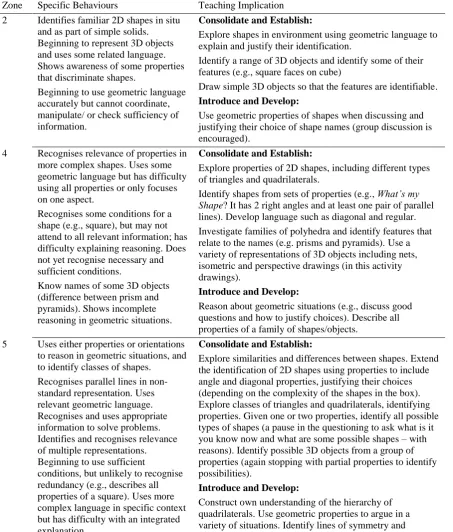
that can be asked. For example, questions that contain “is it like …?” or the use of names of shapes or objects can be banned. While this activity is particularly good for Zone 3 it also can support learning in the preceding and later Zones as shown in Table 2. Zone 3 has been omitted as it is described above and only behaviours and teaching implications relevant to the Feely Box activity have been included from the Zones 2, 4 and 5.
Table 2
Example of how the Feely Box can be Utilised Across Zones to Support Mixed Ability Teaching.
Zone Specific Behaviours Teaching Implication
2 Identifies familiar 2D shapes in situ and as part of simple solids. Beginning to represent 3D objects and uses some related language. Shows awareness of some properties that discriminate shapes.
Beginning to use geometric language accurately but cannot coordinate, manipulate/ or check sufficiency of information.
Consolidate and Establish:
Explore shapes in environment using geometric language to explain and justify their identification.
Identify a range of 3D objects and identify some of their features (e.g., square faces on cube)
Draw simple 3D objects so that the features are identifiable.
Introduce and Develop:
Use geometric properties of shapes when discussing and justifying their choice of shape names (group discussion is encouraged).
4 Recognises relevance of properties in more complex shapes. Uses some geometric language but has difficulty using all properties or only focuses on one aspect.
Recognises some conditions for a shape (e.g., square), but may not attend to all relevant information; has difficulty explaining reasoning. Does not yet recognise necessary and sufficient conditions.
Know names of some 3D objects (difference between prism and pyramids). Shows incomplete reasoning in geometric situations.
Consolidate and Establish:
Explore properties of 2D shapes, including different types of triangles and quadrilaterals.
Identify shapes from sets of properties (e.g., What’s my
Shape? It has 2 right angles and at least one pair of parallel lines). Develop language such as diagonal and regular.
Investigate families of polyhedra and identify features that relate to the names (e.g. prisms and pyramids). Use a variety of representations of 3D objects including nets, isometric and perspective drawings (in this activity drawings).
Introduce and Develop:
Reason about geometric situations (e.g., discuss good questions and how to justify choices). Describe all properties of a family of shapes/objects.
5 Uses either properties or orientations to reason in geometric situations, and to identify classes of shapes. Recognises parallel lines in non-standard representation. Uses relevant geometric language. Recognises and uses appropriate information to solve problems. Identifies and recognises relevance of multiple representations. Beginning to use sufficient
conditions, but unlikely to recognise redundancy (e.g., describes all properties of a square). Uses more complex language in specific context but has difficulty with an integrated explanation.
Consolidate and Establish:
Explore similarities and differences between shapes. Extend the identification of 2D shapes using properties to include angle and diagonal properties, justifying their choices (depending on the complexity of the shapes in the box). Explore classes of triangles and quadrilaterals, identifying properties. Given one or two properties, identify all possible types of shapes (a pause in the questioning to ask what is it you know now and what are some possible shapes – with reasons). Identify possible 3D objects from a group of properties (again stopping with partial properties to identify possibilities).
Introduce and Develop:
questions about symmetry are encouraged).
The use of activities such as Feely Box with the whole class allows students to be extended from their current knowledge base. The encouragement of discussion and justification within the groups is critical in allowing all students to develop ideas further. The activity also focuses on all three overarching big ideas in spatial reasoning – visualisation, language, and discourse and representations, in this case drawing.
Discussion and Practical Implications
It is often claimed that educational research does not usefully inform the work of teachers or lead to sustained improvements in practice at scale. The RMFII project set out explicitly both to involve teachers in the research and to provide useful, evidence-based materials for teachers that could be translated to practice at scale (Cobb & Jackson, 2011). The decision to focus on algebraic, spatial and statistical reasoning across Years 7 to 10 was ambitious but felt necessary to provide the sort of evidence and resources needed to support a significant and sustained change in practice away from low-complexity, procedural exercises to teaching based on a deeper understanding of the big idea and the connections between them (Sullivan, 2011). Of course, the risk in this is that the grain size is large, and the descriptions of the different Zones may overgeneralise and possibly mask the very particular difficulties that some students might have. It is important therefore that learning progressions are understood for what they are – they do not imply a single, one-way path to learning. Nor are they exhaustively definitive. The descriptions at each Zone are better understood as highly probable behaviours that provide some guidance as to how to interpret or make sense of similar but unreferenced behaviours.
The commitment to work with teachers ‘where they were at’ (e.g., they could choose assessment tasks and teaching activities relevant to what they were teaching), meant that they were more likely to provide feedback and make suggestions as to how tasks/activities could be improved. Teacher feedback was particularly valuable in refining the scoring rubrics to clarify ambiguities and better reflect the language used by teachers. The tasks and items also proved valuable in generating discussion among teachers. While the content of many of the tasks and items addressed the curriculum, many went beyond this to address the big ideas identified in the literature. These tasks and items prompted rich discussions in the professional learning sessions and helped deepen teachers’ knowledge of the mathematics and its connection to other aspects of mathematics.
Mathematical proficiency is a key goal of the Australian Curriculum: Mathematics
(ACM). Described in terms of understanding, fluency, problem solving and reasoning, each proficiency is characterised in terms of the content descriptors at each level of the curriculum. For example, at Year 8 reasoning “includes justifying the result of a calculation or estimation as reasonable, deriving probability from its complement, using congruence to deduce properties of triangles, finding estimates of means and proportions of populations” (ACARA, 2018). There is little advice beyond this to indicate exactly what might be involved in developing mathematical reasoning or the sort of difficulties students might experience in deducing, justifying and/or explaining their thinking.
important mathematical ideas and processes – in this case, mathematical reasoning - and provides research informed advice about how to use that information to inform teaching.
A design-based research approach was used by the RMFII project to develop, test and refine learning progressions for algebraic, spatial and statistical reasoning. This involved iterative rounds of assessment and the use of Rasch modelling (Bond & Fox, 2015) to scale the items used from easiest to most difficult in each of the three reasoning strands. The evidence that this produced was then used to identify and flesh out eight relatively discrete levels of increasingly sophisticated reasoning. Referred to as Zones to reflect Vygotsky’s (1978) notion of the Zone of Proximal Development, the behaviour evidenced in the zones was then used to develop teaching advice that indicates what needs to be consolidated and established and what needs to be introduced and developed at each Zone. The practical implications arising from these research-based outputs1 are described below.
Evidence-based Learning Progressions. Although originally focused on Years 7 to 10, the assessment trials in non-project schools have shown that the learning progressions2 are relevant for Years 5 and 6 as well. One of the most valuable practical aspects of the learning progressions is that they identify the big ideas that underpin each content strand of the ACM. Not all content descriptors in the ACM are equal and the identification of big ideas and the connections between them can assist teachers make more informed decisions about curriculum priorities. Another is that they provide teachers with a clearer idea about where students are in their learning and where they need to go to next in relation to the big ideas. By showing how reasoning develops in each area over time, the learning progressions effectively provide a road map that helps teachers navigate the curriculum content areas of the ACM in a way that supports a deeper, more connected approach to teaching mathematics in Years 5 to 10.
Valid Assessment Forms. Well over 88 tasks were developed, trialled and validated to create the learning progressions. Tasks generally comprised more than one item and scoring rubrics for each item were provided to reflect the definition of mathematical reasoning used in the project. The tasks generally enabled all students to make a start and provided opportunities to display their reasoning. For example, the Hot Air Balloon task requires students to (i) construct a graph from a table of values (time vs height), (ii) determine how long the balloon stayed at or above 250 metres, and (iii) identify when the balloon was at 400 metres and explain their reasoning. The tasks with their component items were presented as Forms with 5 to 7 tasks per form. Mixed Forms (tasks from two areas) and Standard Forms (tasks from one area only) were trialled to explore reasoning both within and across strands. Feedback from project schools suggested that they would be more interested in standard forms. As a result, four Standard Forms for each strand have been developed together with the associated scoring rubrics. Maximum score totals are different for each Form to prevent the inappropriate use of raw scores. This necessitated the provision of a Raw Score Translator for each Form that can be used to locate students on the respective learning progression for mathematical reasoning. The Forms can be used as pre-tests to determine where students are in their learning with respect to the relevant learning progression and the information derived from this can be used to inform planning and teaching. A parallel Form can then be used as a post-test to determine if there has been a qualitative shift in student behaviour and to provide feedback on the effectiveness of what was planned and taught.
This in turn supported the development of targeted teaching advice for each zone that is focused on consolidating and establishing the content and reasoning evident in the behaviours associated with that zone as well as introducing and developing the key ideas, strategies and forms of mathematical reasoning needed to progress to the next zone. An example of the teaching advice for one zone in the spatial reasoning learning progression is provided in the paper. Given the demonstrated efficacy of reform-oriented pedagogical practices at this level (e.g., Boaler, 2006), a key consideration in preparing the teaching advice was to include a range of indicative, rich tasks, investigations and/or problems (e.g., the Feely Box task) that can be used with mixed ability groups to address aspects from more than one zone. Many of these multi-zone activities have been drawn from existing, well known resources such as maths300 (http://www.maths300.com). For example,
Mountain Range Challenge (adapted from Unseen Triangles, lesson 20 maths300) uses the context of a mountain range to explore a visual growing pattern based on equilateral triangles. It is referred to in the teaching advice for Zones 3, 4, 5 and 6 of the algebraic reasoning learning progression.
Professional Learning. Wiliam (2006) emphasised the critical importance of professional learning in sustaining an evidence-based approach to teaching and learning mathematics. Annual residential and regular online professional learning sessions were provided throughout the project. Among other things, the sessions explored what was involved in algebraic, spatial and statistical reasoning, and how this could be supported through the use of rich tasks in mixed ability groups. In partnership with AAMT, many of these have been developed into a series of online professional learning modules, the aim of which is to support school-based, teacher learning communities to understand, explore and use the resources provided by the RMFII project to make better, more informed decisions than they might have made otherwise about what to teach and how they might teach it to more fully engage students in the enterprise of learning mathematics.
Notes:
1. It is anticipated that all of the outputs from the RMFII project will be available from mid 2018 via the Dimensions Portal being developed by the Australian Association of Mathematics Teachers 2. The final forms of all three learning progressions will be included in a forthcoming book to be
published by Sense
References
Australian Curriculum, Assessment and Reporting Authority (ACARA). (2015). Australian Curriculum: Mathematics, Version 8.1, 15 December 2015. Sydney, NSW: Author.
Barab, S. & Squire, K. (2004), Design-Based Research: Putting a stake in the ground. The Journal of the Learning Sciences, 13(1), 1-14
Black, P. & Wiliam, D. (1998). Assessment and classroom learning. Assessment in Education: Principles, Policy & Practice, 5(1), 7-73
Boaler, J. (2006). “Opening our Ideas”: How a detracked mathematics approach promoted respect, responsibility, and high achievement. Theory Into Practice, 45(1), 40-46
Bond, T. & Fox, C. (2015), Applying the Rasch Model: Fundamental measurement in the human sciences
(3rd Ed.). Mahwah, NJ: Lawrence Erlbaum
Callingham, R. (2010). Mathematics assessment in primary classrooms: Making it count. Proceedings of the 2010 ACER Research Conference. http://research.acer.edu.au/research_conference/RC2010/
Clarke, D., (2001). Understanding, assessing and developing young children’s mathematical thinking: Research as a powerful tool for professional growth. In J. Bobis, B. Perry & M Mitchelmore (Eds.),
Cobb, P. & Jackson, K. (2011). Towards an empirically grounded theory of action for improving the quality of mathematics teaching at scale. Mathematics Teacher Education and Development, 13(1), 6-33 Day, L., Stephens, M., & Horne, M. (2017). Developing learning progressions to support mathematical
reasoning in the middle years: Algebraic reasoning. In A. Downton., S. Livy., & J. Hall (Eds.), 40 years on: We are still learning! (Proceedings of the 40th annual conference of the Mathematics Education Research Group of Australasia, Melbourne, pp. 655-658). Adelaide: MERGA
Earl, L. & Katz, S. (2006). Rethinking classroom assessment with purpose in mind: Assessment for learning, assessment as learning, assessment of learning. Alberta, BC: Western and Northern Canadian Protocol for Collaboration in Education
Goss, P., Hunter, J., Romanes, D., & Parsonage, H. (2015). Targeted teaching: how better use of data can improve student learning. Melbourne: Grattan Institute
Horne, M. & Seah, R. (2017). Learning progressions to support mathematical reasoning in the middle years: Geometric reasoning. In A. Downton., S. Livy., & J. Hall (Eds.), 40 years on: We are still learning!
(Proceedings of the 40th annual conference of the Mathematics Education Research Group of Australasia, Melbourne, pp. 659-662). Adelaide: MERGA
Masters, G. (2013). Reforming educational assessment: Imperatives, principles and challenges. Australian Education Review, No. 57, 1-57
Shield, M. & Dole, S. (2013). Assessing the potential of mathematics textbooks to promote deep learning.
Educational Studies in Mathematics, 82(2), 183-199.
Siemon, D. (2016). Addressing the STEM challenge through targeted teaching: What’s the evidence?
Proceedings of the 2016 ACER Research Conference (pp. 74 – 78).
Siemon, D. (2017). Developing learning progressions to support mathematical reasoning in the middle years: Introducing the Reframing Mathematical futures II project. In A. Downton., S. Livy., & J. Hall (Eds.),
40 years on: We are still learning! (Proceedings of the 40th annual conference of the Mathematics Education Research Group of Australasia, Melbourne, pp. 651-654). Adelaide: MERGA
Siemon, D. & Breed, M. (2006, November). Assessing multiplicative thinking using rich tasks. Paper presented to 2006 Conference of the Australian Association for Research in Education, Adelaide. Retrieved from https://aare.edu.au/data/publications/2006/sie06375.pdf
Siemon, D., Breed, M., Izard, J. & Virgona, J. (2006). The derivation of a learning and assessment framework for multiplicative thinking, In J. Novotna, H. Moraova, M. Kratka & N. Stehlikova (Eds.),
Proceedings of the 30th conference of the International Group for the Psychology of Mathematics Education (Vol.5, pp.113-120). Prague: PME.
Siemon, D. & Virgona, J. (2002). Reflections on the Middle Years Numeracy Research Project — Is it a case of too much too soon, for too many? In B. Barton, K. Irwin, M. Pfannkuch & M. Thomas (Eds),
Mathematics Education in the South Pacific. Proceedings of the 25th Annual Conference of the Mathematics Education Research Group of Australasia Inc. (Vol. 2, pp. 617–624). Sydney: MERGA. Sullivan, P. (2011). Teaching mathematics: Using research-informed strategies. Australian Education Review
No. 59. Melbourne: ACER
Thomson, S., De Bortoli, L., & Underwood, C. (2016). PISA 2015: A first look at Australia’s results. Melbourne: ACER Press
Thomson, S., Wernert, N., O’Grady, E., & Rodrigues, S. (2016). TIMSS 2015: A first look at Australia’s results. Melbourne: ACER Press
Vygotsky, L. S. (1978). Mind in society: The development of higher psychological processes. Cambridge, MA: Harvard University Press.
Wai, J., Lubinski, D. & Benbow, C. (2009. Spatial ability for STEM domains: Aligning over 50 years of cumulative psychological knowledge solidifies its importance. Journal of Educational Psychology, 101(4), 817-835
Watson, J. & Callingham, R. (2017). Developing learning progressions to support mathematical reasoning in the middle years: Statistical reasoning. In A. Downton., S. Livy., & J. Hall (Eds.), 40 years on: We are still learning! (Proceedings of the 40th annual conference of the Mathematics Education Research Group of Australasia, Melbourne, pp. 663-667). Adelaide: MERGA
Wiliam, D. (2006, September). Assessment for learning: why, what and how? Presentation to the Cambridge Assessment Network, University of Cambridge. Retrieved from http://www.dylanwiliam.org/Dylan_Wiliams_website/Presentations.html