A New Model on Cation Distribution
in Cation-Disordered Li
1+xTM
1-xO
2Cathodes
Yang Huanga*,, Long Liub, Min Gaoa*
a. China Spallation Neutron Source (CSNS), Institute of High Energy Physics (IHEP), China Academy of Science (CAS), Dongguan, 523803, China
b. Shandong Analysis and Test Center, Qilu University of Technology (Shandong Academy of Sciences), Jinan 250014, China
* Yang Huang, E-mail: [email protected] * Min Gao, E-mail: [email protected]
Abstract
The search for new materials that could improve the energy density of Li-ion batteries (LIB) is one of today’s most challenging issues. Recently, cation-disordered lithium-excess metal oxides have emerged as a promising new class of cathode materials for LIB, due to their high reversible capacities and nice structural stability. However, a full structural model of the Li-transition metal (TM) sharing sublattice and the origin of short range ordering (SRO) of cation ions requires further investigation. In this work, we put forward a Monte Carlo strategy of building a cation-disordered rocksalt material supercell model. The cation ions of Li1.0Ti0.5Ni0.5O2 (LTNO) are placed at the FCC sublattice sites with the constraint of Pauling’s electroneutrality rule, instead of a random way. This constraint causes the Li-Ti and Ni-Ni clustering (the cation short range ordering). Based on this model, we discussed the relationship between the short range ordering, the local distorting, the theoretic capacity and the order-disorder strengths. A unified understanding of these factors in cation-disordered materials may enable a better design of disordered-electrode materials with high capacity and high energy density.
Keywords: cation-disordered Li-excess cathodes, short range ordering, local distorting, theoretic capacity, order-disorder strength
1.
Introduction
Since the first commercial application in last century, the Li ion batteries (LIB) have
been attracting the continuous attentions due to its high energy density among rechargeable batteries. There has been a continuous research effort to improve the specific energy density of LIBs for emerging applications such as electric vehicles. One
of the bottlenecks to this is developing higher capacity cathode materials which is vital to the cost, weight, and volume of a battery [1, 2]. Cathode compounds operate by reversibly releasing and reinserting lithium ions during charge and discharge, respectively. This process must be reversible and any permanent damage on the structure is undesirable to improve its cycle performance. To do this, a robust host structure is necessary which offers the accessible channels for Li intercalation and de-intercalation.
In the past decades, several kinds of cathode materials have been developed and applied in the commercial LIBs [3-5], such as LiCoO2 which has a layered
rocksalt-type structure and offers 2D slabs for Li diffusion, LiMn2O4 which has a spinel structure
and offers 3D network tetrahedral sites for Li diffusion, LiFePO4 which has an olivine
structure and offers 1D channels for Li diffusion. In these compounds, Li and other cation ions are separated into respective sublattice and form well-ordered structures. To a general consideration, no mixing between Li and other cations is important for obtaining high-capacity cathode materials with good cycle life. In some cases, improvements in ordering have led to notable increases in power or energy density [6-8].
In recent years, Lee et al. unlocked the potential of cation-disordered oxides for rechargeable lithium batteries [9-12]. In these cathode materials, both Li and transition metal (TM) share the same sublattice which is a cubic close-packed lattice of octahedral sites, and Li diffusion proceeds by hopping from one octahedral site to another octahedral site via an intermediate tetrahedral site (o-t-o diffusion) [13]. The inter-mediate tetrahedral site shares faces with four octahedral sites which could be occupied by Li or TM. The migration barriers for this o-t-o hopping relates to the four face sharing cations. The ab initio calculation shows that only the intermediate tetrahedral sites involving no face-sharing TM ions (0-TM channel) allows for reasonable Li hopping rates [9,10]. To sustain macroscopic ion migration, these 0-TM diffusion channels need to span the entire structure, or in other words, the diffusion channels need to form a percolating network. Intuitively, the more number of 0-TM channels, the more likely they percolate. As the 0-TM channel is coordinated by four Li ions, the more contents of Li ions benefits the 0-TM percolating network. Using the percolation theory, Urban et al. pointed out that the necessary prerequisite for Li transport in cation-disordered oxides is an excess of Li over TM of at least 10%, in line with the general strategy to utilize Li-excess chemistries to achieve higher energy densities [9, 10]. The experimentally synthesized Li-excess cation-disordered cathodes usually have about 300 mAhg−1 capacities, nearly twice than those of traditional cathode materials [14-17].
Also, the cation disorder can enhance the structural stability upon Li extraction, as the Li ions are extracted uniformly from the bulk. The experimental results show that the volume changes of these materials are below about 5% during charge/discharge process [18-20]. Minimising volume fluctuations is beneficial for all electrodes, but is especially important for solid-state batteries in order to prevent fracturing of the solid electrode/electrolyte interfaces and as such cation-disordered electrodes are particularly attractive for all-solid batteries.
compounds, a number of key fundamental issues remain unaddressed. As stated before, Li and TM ions occupy the same sublattice in the cation-disordered materials. In regard to their concrete arrangement in the sublattice, the theoretic methodology in being just take them as in a disordered way, so no short range ordering (SRO) is considered. In fact, though the distribution of cation ions can be taken as completely disordered in the long-range scale, in the short range regarding several coordinating shells of the central cation ions, whether there exist some tendencies for outer cation coordinating is to be discussed. In practice, as chemical incompatibility (ionic radii, charge, electronic-structure et al.) between different cation ions is common, not all cation ions can be perfectly miscible and compatible in the same sublattice [21-23]. So some cation ions will ‘repel’ with each other and distribute themselves at a farther distance in the sublattice. Several experiments have proven this idea and show that there do exist some SRO in the synthesized cation-disorder materials [24-27]. In this paper, we focus on the SRO in the rock-salt type cation-disorder materials. We point out that the Pauling's rule of electroneutrality which constrains the assignment of cation ions in cation-ordered ones may also apply to the cation-disordered materials to some degree, resulting in the arising of SRO and clustering between cation ions. Based on our new model, we make clear the relationships between the SRO, the local distorting, the theoretic capacity and the order-disorder strengths. Our modeling methodology can be taken as an improvement of the previous theoretic treatments of sublattice-sharing crystals. Also, the design of experimental verification is direct and legible which is our focus for the next time.
In the second section, the structure of rocksalt-type cation-disorder materials and the Pauling's rule of electroneutrality are briefly reviewed. Then we put forward a Monte Carlo method of building the Li1.0Ti0.5Ni0.5O2 (LTNO) structure with the constraints of
Pauling’s rule and search the final thermal equilibrium structure with an atomistic potential model. In section 3, the clustering of Li-Ti and Ni-Ni in the LTNO structure is discussed. Furthermore, we prove that this clustering has some impressive impacts on the local distorting, the theoretic capacity and the order-disorder energy.
2. Methodology
2.1 The structure of cation-disordered materials
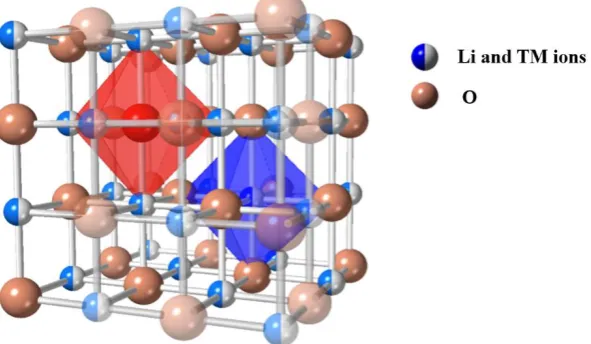
The structure of cation-disordered are related to that of the cubic rock salt (NaCl) as shown in figure 1. The space group isFm-3m. O ions occupy the 4bWyckoff sites, forming
a face-centered cubic (FCC) sublattice while Li and TM ions occupy the 4aWyckoffsites
Figure 1. The structure of cation-disordered cathode materials
2.2 Pauling's rule of electroneutrality in ordered rock salt oxides
In ternary ordered rock salt oxide systems, AaBbOa+b, the two cation ions, A and B,
usually have different valence. However, there only exist certain combinations of A, B around O ions where Pauling's rule of electroneutrality must be followed. This rule tells that the sum of electrovalencies, z/n (z=charge, n=coordination no.) of the nearest neighbouring cation ions should equal the charge, x of O ions, i.e. ∑z/n=x. This occurs in the general formula ABO2, A2BO3 and A5BO6, for which A is monovalent and B is
tri-, tetra- and heptavalent, respectively [28].
ABO2 has OA3B3 octahedra; ∑ 𝑧 𝑛⁄ = (3 × 1 6⁄ ) + (3 × 3 6⁄ ) = 2
the representative ternary oxides are: LiCoO2, LiNiO2, a-NaFeO2 et al.
A2BO3 has OA4B2 octahedra; ∑ 𝑧 𝑛⁄ = (4 × 1 6⁄ ) + (2 × 4 6⁄ ) = 2
the representative ternary oxides are: Li2MnO3, Li2TiO3 et al.
A5BO6 has OA5B octahedra; ∑ 𝑧 𝑛⁄ = (5 × 1 6⁄ ) + (1 × 7 6⁄ ) = 2
the representative ternary oxide is: Li5ReO6 et al.
2.3 Building the initial disordered structure of LTNO with the
constraint of Pauling's rule.
For the disordered rocksalt-type multicomponent oxides like LTNO[29, 30], the
general idea is that Li, Ti and Ni ions occupy the same sublattice and are randomly distributed on the lattice points. As far as we know, there are no theoretical model and calculations about the specific arrangements of cation ions within the sublattice. However, several works on the layered rocksalt-type Li-excess materials xLi2MnO3
∙(1-x)LiMO2 (M= Co or Ni) where Li, Mn and M occupy the some TM layer jointly show
there exist some rules of cation arrangements rather than a fully random distribution [31, 32]. Some evidences of elemental clustering, forming local Li2MnO3-like and
LiMO2-like environments in the TM planes, has been reported.
Reconsidering the structure of xLi2MnO3·(1-x)LiMO2, it is clear that the Li2MnO3
and LiMO2 components follow the Pauling's rule of electroneutrality, as the ions in
Obviously, the maintaining of local electroneutrality is not only a strict rule in the ordered structure, in the disordered structure, the cation ions also tend to keep some degree of local electroneutrality through clustering into the ‘right’ local assignments. As a simple generalization, we considered the electroneutrality in the cation-disordered rocksalt-type Li1+xTM1-xO2 where Li and TM share the same FCC sublattice.
This is a typical structure for layered rocksalt-type Li-excess materials where Li and TM are located at the same TM layers. We studied that if the applying of Pauling's rule to the cation-disordered rocksalt-type Li1+xTM1-xO2 will lead to the cation clustering
and SRO. For the convenience of discussion, we take LTNO as the example. In the following paragraph, the idea about building of the initial structure of LTNO by a Monte Carlo process with a constraint of the Pauling's rule is described and further discussions based on this initial structure will be presented in the following sections. All we do below can be used to study other Li-excess cation-disordered materials.
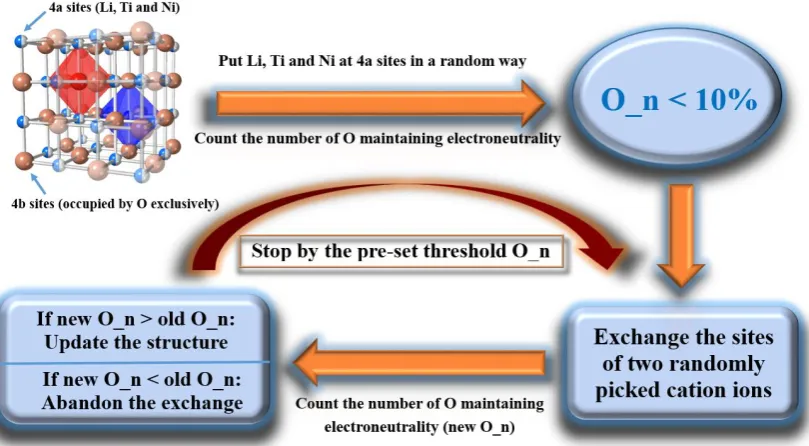
A 10×10×10 supercell of LTNO is established. Initially, the O ions are placed on the 4bWyckoff sites to form the anion sublattice and Li, Ni and Ti on the 4aWyckoff sites in
a random way, without any electroneutrality constraints. Then the electroneutrality is considered. We calculated the net charge of each O ion in the structure. The net charge is defined by the Pauling's rule of electroneutrality, Q = −2 + ∑6𝑖=1𝑍𝑖/6 (Zi = +1 for
Figure 2. The detailed process of the Monte Carlo strategy establishing an initial configuration of LTNO
2.4 Search the thermal equilibrium structure with an atomistic
potential model
The structures established in the last section is just a rough model for LTNO, as no interatomic interactions and thermodynamics process are considered. So they could not describe the thermal-stable structures which can be observed at laboratories. In this section, we use an atomistic model to drive the LTNO into thermal equilibrium. The structures with different levels of electroneutrality constraint established in the last section are simulated by the molecular dynamics (MD) methods which is executed on DL-POLY (Version 4.07) [33]. Periodic boundary condition were applied in all directions. Atomic motions and Coulombic interactions were calculated by the Verlet algorithm and Ewald method respectively. The time step was 1 fs. The system was relaxed for 10 ps firstly and then run for 100 ps at 300K. A Nose–Hoover thermostat was used to regulate the system’s temperature at specific temperatures.
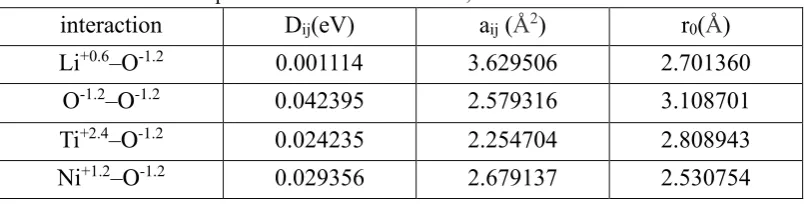
The Morse function is used here to represent the short range repulsion and partial charges are set to each ion to include the Coulomb interactions. The mathematic expression of our potential model is shown in below equation (1).
U(𝑟) =𝑍𝑖𝑍𝑗𝑒
2
𝑟 + 𝐷𝑖𝑗[{1 − 𝑒
−𝑎𝑖𝑗∙(𝑟−𝑟0)}2− 1] (1)
in which Dij is the bond dissociation energy, aij is a function of the slope of the
potential energy well, and r0 is the equilibrium bond distance. Zi is the partial charge of
ions.
parameters slightly, which can make a better fitting of the experimental structures of Li2TiO3 (C2/c, a=5.2189Å, b=8.6686Å, c=5.0865Å) and NiO (Fm-3m, a=b=c=4.2043
Å). Relaxing the Li2TiO3 and NiO unit cell with this set of optimized potential
parameters, the structural parameters of the relaxed unit cell accords well with the experimentally measured ones within error < 4%, proving their suitability for our work.
Table 1 Potential parameters used in this article, terms not listed are set to zero.
interaction Dij(eV) aij(Å2) r0(Å)
Li+0.6–O-1.2 0.001114 3.629506 2.701360
O-1.2–O-1.2 0.042395 2.579316 3.108701
Ti+2.4–O-1.2 0.024235 2.254704 2.808943
Ni+1.2–O-1.2 0.029356 2.679137 2.530754
3. Results and discussion
3.1 The short range ordering and phase segregation
We firstly investigate the local cation environments with different constraints of
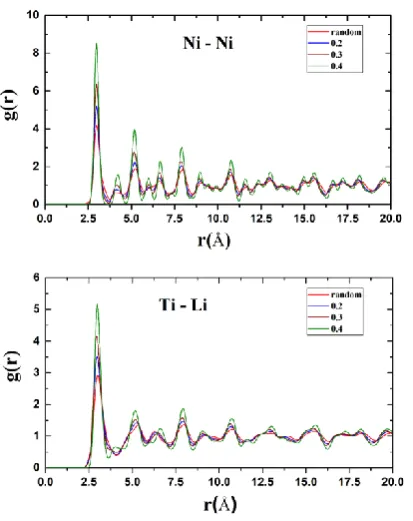
electroneutrality (O_n). To study the coordination relations between cation ions in a clear and statistic way, we calculated the atomic pair distribution function g(r) between individual cation ions which counts the probability of the coordinating ion appearing at a certain distance from the center ion.
Recalling the details of Pauling’s rule which infers a charge balance between each O ion and its first shell coordinating cation ions, only O4Li2Ti and O6Ni units stratify the electroneutrality. With the increasing number of O ions in electroneutrality, more and more O4Li2Ti and O6Ni units are built in the system, leading to the clustering of Li-Ti and Ni-Ni. In other words, the phase segregation of Li2TiO3 and NiO arises in the system.
Figure 3. up: the g(r) function of Ni and Ni. down: the g(r) function of Ti and Li. Different colors for different constraints of electroneutrality.
3.2 The local distortion
In an ordered structure, the cation ions usually have a single or a few local high-symmetry environments, whereas in a disordered structure there exist a large number of distinct low-symmetry environments. The inhomogeneity of local chemical environ- ments will cause microscopic strains on the ions located at the ideal positions. To relax the strains, the ions would deviate from the ideal positions, resulting in local distortions. This is predicted by the ab initio calculation [35]. The local distortions do exist in cation-disordered Li-TM oxides, and take much larger magnitudes than that in ordered ones on average.
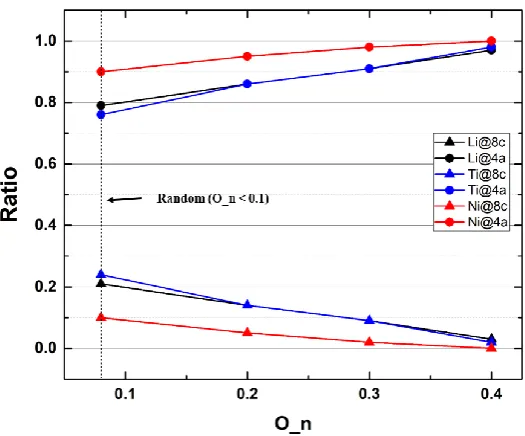
Here, we also inspect the local distortion phenomenon in LTNO driven into equilibration states by MD simulation. The figure 4 shows the final structure in thermal equilibration where cation ions are distributed randomly in the initial model (left) and with an electroneutrality constraint of 0.4 in O_n (right). The anions and the cations are still located at the vicinity of the lattice points and keep the completeness of the crystal structure. As expected, the local distortions are observed. Some cation ions located at 4a sites (the center of octahedron) in the initial structure ‘slide’ to the 8c sites (the center of tetrahedron) during the thermodynamics process. On the other hand, this ‘slide’ phenomenon is not observed in the arrangements of O ions, proving the toughness of the anion sublattice. The complex local chemical environments resulting from the cation disorder do have some influence on the final stable structure. The energy hypersurfaces at some 4a sites are raised and at some 8c sites are lowered, so the cation ions slide to the 8c sites along the energy hypersurfaces.
shown in figure 5. Two obvious features can be seen in the data. The first is that the ratio of Ni at 8c sites are significantly less than those of Li and Ti, only about half of them. This result is supported by the ab initio calculation, which shows that TM cations with d0 electronic structure (Ti4+) accommodate large site distortions allowing the Ni2+
sites to remain close to their preferred geometry [35]. Another distinct feature is that the degree of local distortion decreases with the increasing O_n in the configuration, dropping to just 2% with the O_n value 0.4. As discussed in last section, the increasing of O_n results in the clustering of Li2TiO3 phases and NiO phases, which means the
degree of ordering phase in the system is increased, so reducing the local distortion.
Figure 4. The MD simulated structure of LTNO. Left: The cation ions are distributed in a random way in the initial configuration. Right: The cation ions are distributed with a constraint of O_n =
0.4 in the initial configuration.
Figure 5 The contents of cation ions at octahedral (8c) and tetrahedral (4c) sites varing with the electroneutrality constraint (O_n)
In the previous sections, we stated that only those Li ions connected to the 0-TM channels can hop to the nearby vacancies through the tetrahedral sites. So the theoretic capacity is limited by the number of 0-TM channels in the system. Here, we calculated the number of 0-TM channels with different electroneutrality constraints.
Figure 5 displays the number of 0-TM and 1-TM channels varying with the O_n in the initial MC building models. The 1-TM(Ni) and 1-TM(Ti) indicate the tetrahedral channels coordinating by one Ni or one Ti TM ion. With a more strict electroneutrality constraints, the numbers of 0-TM and 1-TM(Ni) decrease while the number of 1-TM(Ti) increases. As discussed before, the electroneutrality constraint leads to the clustering of Li-Ti and Ni-Ni. For the 0-TM and 1-TM(Ni) channel, they are coordinated by four Li ions and three Li ions, one Ni ion respectively. So the enhancing of Li-Ti and Ni-Ni coordinating should limit the number of 0-TM and 1-TM(Ni) channels. On the other hand, the 1-TM(Ti) channel is coordinated by three Li ions and one Ti ion. So the clustering of Li-Ti is preferred for them. In all, we can say with an electroneutrality constraint, the 0-TM channel which is favorable to the Li migration is limited and the number of active Li ions which can be de-intercalated from the bulk material decreases. As a result, the SRO reduces the theory capacity.
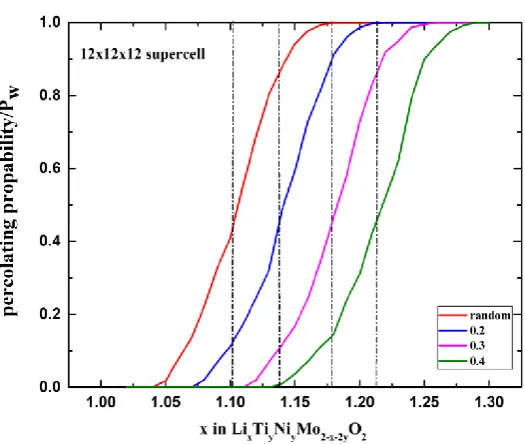
Then we consider the influence of SRO on the percolation threshold. Intuitively, since the electroneutrality constraint limits the 0-TM channels, it should decrease the percolating probability of 0-TM network in the system and raise the percolating thresholds. Here we calculate the percolating probability (Pw) of LTNO under different
O_n values and see if it is. To be noted, pentavalent Mo is added to keep the overall electraneutrality of the system as an excess of Li is added. Figure 6 shows the final results. It can be seen that the percolating probability (Pw) varies steeply with the
increase of Li content. In fact, it should be a step function with a discontinuity at the critical threshold xc (Pw = 1 for xLi > xc, Pw = 0 for xLi < xc)。Here, we calculate Pw in
a 12×12×12 supercell, it converges to a step function with much larger supercells [10]. However, the percolation threshold is always indicated by the center of the slopes (which are remarked by the vertical lines in the figure).We can see that in a random distribution hypothesis, the percolation threshold is about 1.1 which accords with that of previous calculation. However, with a more strict electroneutrality constraint (larger O_n value), the percolation threshold gradually increases. With O_n = 0.4, the calculated percolation threshold is even larger than 1.2 Li ions per formula unit. It is interesting that though the general guideline for designing 0-TM network percolating cation-disorderd cathode materials is adding excess of Li content which is no less than about 1.1 Li atoms per formula unit, our result shows that this guideline depends. In a high-electroneutrality system, the actual percolation threshold for Li excess may larger than the general idea. In fact, we have noticed that someone synthesized some Li-excess (xLi=1.2 per formula unit) cation-disordered cathode materials failing to show the
Figure 5 the number of 0-TM, 1-TM(Ni) and 1-TM(Ti) channels in the LTNOwith different electroneutrality constraints
Figure 6 the percolating propability of LixTiyNiyMo2-x-2yO2 with different electroneutrality.
3.4 The order-disorder energy
The theoretical calculation and practical application of Li-excess cation-disordered oxides as cathode materials has opened the vast configurational space of rocksalt-type oxides for designing new high-energy-density Li-ion batteries. Compared to the ordered phases of lithium metal oxides which are limited by several structures and several kinds of TM ions, any kinds of TM ions in the compositional space can be cooperated into the cation sublattices of cation-disordered oxide only if it keeps the electric neutrality in whole.
configurational order–disorder phase transition (TOD) and the energy difference
between the disordered state and the ordered state (EOD) for measuring intrinsic
cation-ordering strength [37]. They are quite useful guidelines for selecting the appropriate candidates when synthesizing the cation-disordered oxides in labs. But we noticed that these results are based on the hypothesis that cation ions are distributed randomly on the FCC sublattice. This ignores the intermediate configurations where the cation arrangement is partially disordered and the SRO exists. This condition is important as the SRO of cation ions generally inhabits in the synthesized materials so the guidelines based on random distribution of cation ions may overstate the cation-disordering strength in the materials.
We calculated the EOD of LiTi0.5Ni0.5O2 by including the configurations containing
different levels of SRO which is controlled by the electroneutrality O ions (O_n).
𝐸𝑂𝐷(𝑂_𝑛) = 𝐸𝐿𝑖1.0𝑇𝑖0.5𝑁𝑖0.5𝑂2(𝑂_𝑛) − 0.5𝐸𝐿𝑖2𝑇𝑖𝑜3− 0.5𝐸𝑁𝑖𝑂 (1)
Here, we considered Li2TiO3 and NiO as the precursors. So the energy difference
EOD indicates the formation energy of LiTi0.5Ni0.5O2 with different levels of SRO
synthesized in labs. Also, E is the enthalpy of LiTi0.5Ni0.5O2, Li2TiO3 and NiO from the
MD calculation in the previous section and normalized to eV per formula. As in the sections above, four different kinds of configurations are explored (random distribution and O_n<0.1, O_n=0.2, O_n=0.3 and O_n=0.4). The final results are presented in table 3 below.
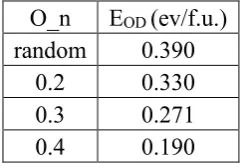
Table 2. the order-disorder energy (EOD) for different levels of electroneutrality (O_n) O_n EOD (ev/f.u.)
random 0.390
0.2 0.330
0.3 0.271
0.4 0.190
As expected, the order-disorder energy for all the disordered configurations take positive values. This indicates that the disordered configurations possess higher energy states in the configuration space respect to the ordered one. To drive the cation disordering, the system energy must be compensated from the outside environment. Furthermore, the configurations with larger disordering arrangements of cations (samller O_n) take larger order-disorder energy. As discussed before, the stronger local electroneutrality environments means the segregation of Li2TiO3 and NiO clusters. So
the energy should approach asymptotically that of 0.5Li2TiO3·0.5NiO with the
increasing of O_n. Ultimately, this helps to reduce the overall energy of the system and overcome the configuration entropy contribution that serves to randomize the distribution of cations in these oxides
3.5 Discussions
In the previous sections, we discussed the SRO, the local distortion, the capacity and
the order-disorder energy based on our MC models. Here, we will make a summary further and try to elucidate their relationships in a clear way.
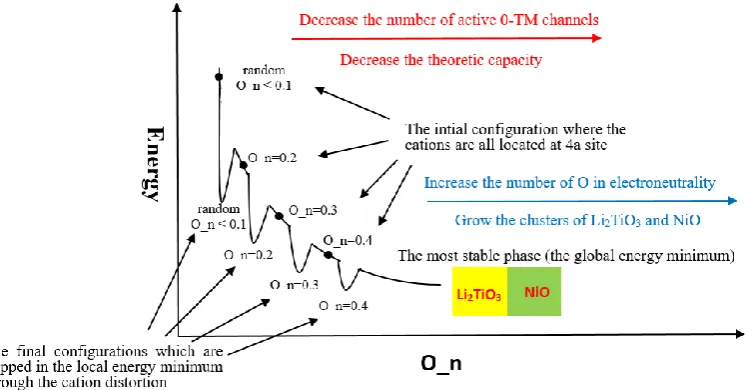
space is established where the abscissa represents the contents of O ions in electroneutrality (O_n) and the ordinate represents the energy. The energy varies with O_n in an inverse way as indicated by the parabola. The increase of O_n leads more O ions to keep in local electroneutrality and the phase segregation of Li2TiO3 and NiO.
This will lower the energy of the whole system. To be noted, the points on the parabola indicate the structures with perfect lattice and all the cation ions located at the 4a sublattice. However, these configurations are not stable in thermodynamics and they will ‘slide’ to the local energy minimum nearby by relaxing the cation ions to 8c sites which are indicated by the valleys connected to the parabola. Also, the increase of O_n can reduce this distortion, so the depth of the four valleys gets smeller to the higher end of the O_n axis. In the extreme cases, the Li2TiO3 and NiO will be separated out totally.
The system arrives to the global energy minimum in this case. However, the phase segregation of Li2TiO3 and NiO will break down the local Li excess environment and
decrease the content of 0-TM channels which benefits the Li transports. So the amount of accessible Li ions which are connected with the 0-TM network will decrease with a higher O_n value. This goes against the final electrochemical performance as it lowers the theoretic capacity. To this point, we expect that the cation ions should be distributed in a more ‘disordering’ way, lowering the phase segregation and improving the capacity. As the sketch indicates, the more disordering configurations are located at higher energy states. This puts forward a more severe requirement when synthesizing the Li-excess cation-disorder materials in labs. In fact, we have noticed that some cathode materials synthesized at low sintering temperatures (from 750 ℃ to 800 ℃) sometimes fail to meet the percolating capacity as the theory expects [27,36,38] while those synthesized at high sintering temperatures (around 1000-1100℃) always show high percolating capacities as expected[25, 39]. There is a more obvious comparison when synthesizing the same Li-excess cation-disorder material at different sintering temperatures and measuring their respective capacities by electrochemical methods [38] or reheating the materials and inspect the cation re-distribution by STEM/EDX mapping [40].
4. Conclusion
In this article, we focused on the cation arrangements in cation-disordered rock-salt
type oxides. With the Li1.0Ti0.5Ni0.5O2 model applied with Pauling’s rule of electro-
neutrality, the local electroneutrality demands for O ions result in the SRO of cation ions (enforce the Li-Ti and Ni-Ni coordination) and the phase segregation of Li2TiO3
and NiO.
Based on this model, we discussed the local distortion, the theoretic capacity and the percolation threshold, the order-disorder strengths. As the cation disordering exists, the complex local chemical environment causes the un-stabilization of cation ions at 4a sites which is the center of O octahedron. At the thermodynamics equilibrium condition, some cation ions will ‘slide’ to the 8c sites which is the center of O tetrahedron, leading to the local distortion arises and destroying the integrality of the rock-salt type lattice. However, when the electroneutrality constraints is applied, the phase segregation of Li2TiO3 and NiO will stabilize the cation ions at the 4a sites and reduce the local
distortion. Also, the reinforced Li-Ti coordination destroys the local Li excess environment, reducing the content of 0-TM channels in the sytem. This condition is detrimental for the theoretic capacity and a higher Li content is required for the 0-TM network percolating if SRO is considered. Finally, the order-disorder energy is calculated for configurations with different levels of SRO. The results indicate that the SRO lowers the system energies. To get more cation-disordered structures with lager theoretic capacities, the materials should be sintering at a high enough temperature to overcome the high enthalpy.
Acknowledgments: This work was supported by the China Postdoctoral Science Foundation (2018M641475), the National Natural Science Funds of China (Grant No. 11605106)
Reference
[1] M. Stanley Whittingham. Lithium Batteries and Cathode Materials. Chem. Rev. 2004, 104, 4271-4301.
[2] John B. Goodenough, Youngsik Kim. Challenges for Rechargeable Li Batteries. Chem. Mater. 2010, 22, 587–603.
[3] K. Mizushima, P.C. Jones, P.J. Wiseman, J.B. Goodenough. LixCoO2 (0<x≤1): a new cathode material for batteries of high energy density. Mat. Res. Bull., 1980, 15, 783-789.
Electrode Materials: Sfructural, Magnetic, and Electrochemical Studies. J. Electrochem. Soc., 1996, 143(4), 1168-1175.
[7] A. Rougier, I. Saadoune, P. Gravereau, P. Willmann, C. Delmas. Effect of cobalt substitution on cationic distribution in LiNi1-yCoyO electrode materials. Solid State Ionics,1996, 90, 83-90. [8] Zhonghua Lu, D. D. MacNeil, J. R. Dahna. Layered Li[NixCo1-2xMnx]O2 Cathode Materials for Lithium-Ion Batteries. Electrochemical and Solid-State Letters, 2001, 4(12), A200-A203.
[9] Jinhyuk Lee, Alexander Urban, Xin Li, Dong Su, Geoffroy Hautier, Gerbrand Ceder. Unlocking the Potential of Cation-Disordered Oxides for Rechargeable Lithium Batteries. SCIENCE, 2014, 343, 519-522.
[10] Alexander Urban, Jinhyuk Lee, Gerbrand Ceder. The Configurational Space of Rocksalt-Type Oxides for High-Capacity Lithium Battery Electrodes. Adv. Energy Mater. 2014, 4, 1400478. [11] Nancy Twu, Xin Li, Alexander Urban, Mahalingam Balasubramanian, Jinhyuk Lee, Lei Liu, Gerbrand Ceder. Designing New Lithium-Excess Cathode Materials from Percolation Theory: Nanohighways in LixNi2−4x/3Sbx/3O. Nano Lett. 2015, 15, 596−602.
[12] Nancy Twu, Michael Metzger, Mahalingam Balasubramanian, Cyril Marino, Xin Li, Hailong Chen, Hubert Gasteiger, Gerbrand Ceder. Understanding the Origins of Higher Capacities at Faster Rates in Lithium-Excess LixNi2−4x/3Sbx/3O. Chem. Mater. 2017, 29, 2584−2593.
[13] Kisuk Kang,Ying Shirley Meng, Julien Breger, Clare P. Grey, Gerbrand Ceder. Electrodes with High Power and High Capacity for Rechargeable Lithium Batteries. Science, 2006, 311, 977-980. [14] Jinhyuk Lee, Dong-Hwa Seo, Mahalingam Balasubramanian, Nancy Twu, Xin Li, Gerbrand Ceder. A new class of high capacity cation-disordered oxides for rechargeable lithium batteries:Li– Ni–Ti–Mo oxides. Energy Environ. Sci., 2015, 8, 3255-3265.
[15] M. Freire, N. V. Kosova, C. Jordy, D. Chateigner, O. I. Lebedev, A. Maignan1, V. Pralong. A new active Li–Mn–O compound for high energy density Li-ion batteries. Nature Materials, 2016, 15, 173–177.
[16] Jinhyuk Lee, Joseph K. Papp, Raphaële J. Clément, Shawn Sallis, Deok-Hwang Kwon, Tan Shi, Wanli Yang, Bryan D. McCloskey, Gerbrand Ceder. Mitigating oxygen loss to improve the cycling performance of high capacity cation-disordered cathode materials. Nature Communications, 2017, 8,981.
[17] Jinhyuk Lee, Daniil A. Kitchaev, Deok-Hwang Kwon, Chang-Wook Lee, Joseph K. Papp, Yi-Sheng Liu, Zhengyan Lun. Raphaële J. Clément, Tan Shi, Bryan D. McCloskey, Jinghua Guo, Mahalingam Balasubramanian, Gerbrand Ceder. Reversible Mn2+/Mn4+ double redox in lithium-excess cathode materials. Nature, 2018, 556, 85–190.
[18] Weiwen Wang, Jingke Meng, Xinyang Yue, Qinchao Wang, Xinxin Wang, Yongning Zhou, Xiaoqing Yang, Zulipiya Shadike, Zhengwen Fu. Synthesis and electrochemical properties of Li1.3Nb0.3Cr0.4O2 as a high-capacity cathode material for rechargeable lithium batteries. Chem. Commun., 2018, 54, 13809.
[19] Ruiyong Chen, Shuhua Ren, Michael Knapp, Di Wang, Raiker Witter, Maximilian Fichtner, Horst Hahn. Disordered Lithium-Rich Oxyfl uoride as a Stable Host for Enhanced Li + Intercalation Storage. Adv. Energy Mater. 2015, 5, 1401814.
[20] Wang Hay Kan, Dongchang Chen, Joseph K. Papp, Alpesh Khushalchand Shukla, Ashfia Huq, Craig M. Brown, Bryan D. McCloskey, Guoying Chen. Unravelling Solid-State Redox Chemistry in Li1.3Nb0.3Mn0.4O2 Single-Crystal Cathode Material. Chem. Mater. 2018, 30, 1655−1666.
Physics Today, 1955.
[22] Licia Minervini, Robin W. Grimes. Disorder in Pyrochlore Oxides. J. Am. Ceram. Soc., 2000, 83(8), 1873–1878.
[23] Chao Jiang, C. R. Stanek, K. E. Sickafus, B. P. Uberuaga. First-principles prediction of disordering tendencies in pyrochlore oxides. Physical Review B, 2009, 79, 104203.
[24] Wang Hay Kan, Biao Deng, Yahong Xu, Alpesh Khushalchand Shukla, Tao Bo, Shuo Zhang, Jin Liu, Piero Pianetta, Bao-Tian Wang, Yijin Liu, Guoying Chen. Understanding the Effect of Local Short-Range Ordering on Lithium Diffusion in Li1.3Nb0.3Mn0.4O2 Single-Crystal Cathode.2018, 4(9), Pages 2108-2123.
[25] Huiwen Ji, Alexander Urban, Daniil A. Kitchaev, Deok-Hwang Kwon, Nongnuch Artrith, Colin Ophus, Wenxuan Huang, Zijian Cai, Tan Shi, Jae Chul Kim, Gerbrand Ceder. Hidden structural order controls Li-ion transport in cation-disordered oxides for rechargeable lithium batteries. arXiv: 1806.06096
[26] Wang Hay Kan, Chenxi Wei, Dongchang Chen, Tao Bo, Bao-Tian Wang, Yan Zhang, Yangchao Tian, Jun-Sik Lee, Yijin Liu, Guoying Chen. Evolution of Local Structural Ordering and Chemical Distribution upon Delithiation of a Rock Salt–Structured Li1.3Ta0.3Mn0.4O2 Cathode. Adv. Funct. Mater. 2019, 1808294.
[27] Enyue Zhao, Lunhua He, Baotian Wang, Xiyang Li, Junrong Zhang, Yang Wu, Jie Chen, Shaoying Zhang, Tianjiao Liang, Yuanbo Chen, Xiqian Yu, Hong Lia, Liquan Chen, Xuejie Huang, Hesheng Chen, Fangwei Wan. Structural and mechanistic revelations on high capacity cation-disordered Li-rich oxides for rechargeable Li-ion batteries. Energy Storage Materials, 2019, 16 , 354–363.
[28] Glenn C. Mather, Christian Dussarrat, Jean Etourneau, Anthony R. West. A review of cation-ordered rock salt superstructure oxides. J. Mater. Chem., 2000, 10, 2219-2230.
[29] S.R.S. Prabaharana, M.S. Michael, H. Ikuta, Y. Uchimoto, M. Wakihar. Li2NiTiO4—a new positive electrode for lithium batteries: soft-chemistry synthesis and electrochemical characterization. Solid State Ionics, 2004, 172, 39–45.
[30] Rafael Trócoli, Manuel Cruz-Yusta, Julián Morales, Jesús Santos-Pena,On the limited electroactivity of Li2NiTiO4 nanoparticles in lithium batteries. Electrochimica Acta,2013, 100, 93– 100.
[31] Michael M. Thackeray, Sun-Ho Kang, Christopher S. Johnson, John T. Vaughey, Roy Benedeka S. A. Hackney. Li2MnO3-stabilized LiMO2 (M = Mn, Ni, Co) electrodes for lithium-ion batteries. J. Mater. Chem., 2007, 17, 3112–3125.
[32] J. Bareno, M. Balasubramanian, S. H. Kang, J. G. Wen, C. H. Lei, S. V. Pol, I. Petrov, D. P. Abraham. Long-Range and Local Structure in the Layered Oxide Li1.2Co0.4Mn0.4O2. Chem. Mater. 2011, 23, 2039–2050.
[33] Ilian T. Todorov, William Smith, Kostya Trachenko, Martin T. Dove. DL_POLY_3: new dimensions in molecular dynamics simulations via massive parallelism. J. Mater. Chem., 2006, 16, 1911–1918.
[34] Alfonso Pedone, Gianluca Malavasi, M. Cristina Menziani, Alastair N. Cormack, Ulderico Segre. A New Self-Consistent Empirical Interatomic Potential Model for Oxides, Silicates, and Silica-Based Glasses. J. Phys. Chem. B 2006, 110, 11780-11795.
2017,119, 176402.
[36] Ayuko KITAJOU, Kosuke TANAKA, Hidenori MIKI, Hideyuki KOGA, Toshihiro OKAJIMA, Shigeto OKADA. Improvement of Cathode Properties by Lithium Excess in Disordered Rocksalt Li2+2xMn1−xTi1−xO4. Electrochemistry, 2016, 84(8), 597–600.
[37] Alexander Urban, Ian Matts, Aziz Abdellahi, Gerbrand Ceder. Computational Design and Preparation of Cation-Disordered Oxides for High-Energy-Density Li-Ion Batteries. Adv. Energy Mater. 2016, 6, 1600488.
[38] Stephen L. Glazier, Jing Li, Jigang Zhou, Toby Bond, J. R. Dahn. Characterization of Disordered Li(1+x)Ti2xFe(1−3x)O2 as Positive Electrode Materials in Li-Ion Batteries Using Percolation Theory.
[39] RuiWang, Xin Li, Lei Liu, Jinhyuk Lee, Dong-Hwa Seo, Shou-Hang Bo, Alexander Urban, Gerbrand Ceder. A disordered rock-salt Li-excess cathode material with high capacity and substantial oxygen redox activity: Li1.25Nb0.25Mn0.5O2. Electrochemistry Communications, 2015, 60, 70–73.