EuropeAid
Environmental
Integration Handbook
for EC Development Co-operation
›
Part One | Rationale and concept
›
Part Two | Programming
Cataloguing data can be found at the end of this publication
European Commission EuropeAid Co-operation Office Rue de la Loi 41 - B -1049 Brussels
Relevant internet links :
http://ec.europa.eu/europeaid/
http://www.environment-integration.org
Neither the European Commission nor any person acting on behalf of the Commission is responsible for the use which might be made of the following information.
Manuscript completed in December 2006
© European Communities, 2007
Picture by EC/ J. Gerhinger
Prepared for EuropeAid Unit E6 by the Helpdesk Environment HDE - Avenue Louise 251 Bte 23 - B-1050 Brussels (Belgium)
Tel: +32 2 640 63 10 - Fax: +32 2 648 75 38 - E-mail: [email protected]
Table of Contents | 3 Environmental Handbook
Table of Contents
List of acronyms and abbreviations ...5
Executive Summary ... 10
Part One Rationale and Concepts
... 131. Introduction ... 15
1.1. Why do we need this handbook? ... 15
1.2. What is environmental mainstreaming? ... 16
2. Why mainstream the environment? ... 18
2.1. The environment and sustainable development ... 18
2.1.1. Environmental services and external costs ... 18
2.1.2. Sustainable development ... 19
2.2. The environment and poverty reduction ... 24
2.3. The environment and security ...25
2.4. Human rights, good governance and the environment ...26
2.5. Environmental sustainability is a high level commitment and obligation for the EC ...27
2.5.1. Global commitments ...27
2.5.2. The policy and legal basis for environmental integration in EC development co-operation ...28
2.5.3. Multilateral Environmental Agreements ...29
2.6. All sectors are involved: environmental opportunities, constraints and impacts ... 31
2.7. The added value of environmental mainstreaming ...32
Part Two Programming
...333. Environment in the programming phase...35
Part Three Aid Delivery Approaches
... 474. Environment in Sector Policy Support Programmes (SPSP)...49
4.1. Identification ...50
Table of Contents | 4 Environmental Handbook
4.2.1. Sector Programmes not requiring an SEA ...52
4.2.2. Sector Programmes requiring an SEA ...52
4.3. Implementation ...56
4.4. Evaluation ...56
5. Environment in General Budget Support (GBS) ...58
5.1. Identification ...61
5.2. Formulation ...62
5.3. Implementation ...65
5.4. Evaluation ...65
6. Environment in the Project Approach ...66
6.1. Identification ...66
6.2. Formulation ... 71
6.2.1. Projects not requiring an EIA at the formulation phase ... 71
6.2.2. Projects requiring an EIA ...72
6.2.3. Integrating the environment in the Financing Proposal ... 76
6.3. Implementation ...78
6.4. Evaluation ...80
Annexes
...83Annex 1 | Specific environmental issues in co-operation focal areas...85
Annex 2 | Terms of Reference for a CEP ... 108
Annex 3 | Screening for SEA ... 118
Annex 4 | Environmental integration in the SPSP Formulation Study ... 120
Annex 5 | Terms of Reference for an SEA ... 125
Annex 6 | Integrating the environment in the Logical Framework Approach ... 136
Annex 7 | Project EIA screening ... 142
Annex 8 | Terms of Reference for an EIA ... 150
Annex 9 | Environmental integration in project pre-feasibility and feasibility studies ... 164
Annex 10 | Indicators ... 168
Acronyms and abbreviations | 5 Environmental Handbook
List of acronyms and abbreviations
ACP Africa-Caribbean-Pacific
ADB Asian Development Bank
AFDB African Development Bank
CCLIP Conditional Credit Line for Investment Projects
CDM Clean Development Mechanism
CEA Country Environmental Analysis
CEP Country Environmental Profile
CFC Chlorofluorocarbon
CIDA Canadian International Development Agency
CITES Convention on International Trade and Endangered Species
CO2 Carbon dioxide
CSP Country Strategy Paper
DAC Development Aid Committee
DANIDA Danish International Development Agency
DCI Development Cooperation Instrument
Del Delegation
Dev Development
DFID Department for International Development (UK)
DG Directorate General
DIIS Danish Institute for International Studies
DPSRI Driver - Pressure - State of the Environment - Response - Impact
EC European Commission
EDF European Development Fund
EFR Environmental Fiscal Reforms
EIA Environmental Impact Assessment
EMAS Eco-Management and Audit Scheme
EMP Environmental Management Plan
Acronyms and abbreviations | 6 Environmental Handbook
EU European Union
EUEF European Union Energy Facility
EUWF European Union Water Facility
FAO Food and Agriculture Organisation
FLEGT Forest Law Enforcement, Governance and Trade
FSC Forest Stewardship Council
GBS General Budget Support
GDP Gross Domestic Product
GEF Global Environmental Facility
GFN Global Footprint Network
GHG Greenhouse gas
GMO Genetically-modified organism
GNP Gross National Product
HDI Human Development Index
HQ Headquarters
IAIA International Association for Impact Assessment
IADB Inter-American Development Bank
ICZM Integrated Coastal Zone Management
IF Identification Fiche
IGNARM Network on Indigenous Peoples, Gender and Nature Resource Management
IGWIA International Working Group for Indigenous Affairs
IISD International Institute for Sustainable Development
ILO International Labour Organisation
iQSG Inter-service Quality Support Group
ISO International Organisation for Standardisation
ITTA International Tropical Timber Agreement
ITTO International Tropical Timber Organisation
IUCN World Conservation Union
KULU Kvindernes U-landsudvalg (Women and Development)
Acronyms and abbreviations | 7 Environmental Handbook
MBS Macro-economic Budget Support
MEA Multilateral Environmental Agreement
MDG Millennium Development Goal
MS Medium-scale
MSC Marine Stewardship Council
MTEF Medium Term Expenditure Framework
NAP National Action Plan
NEAP National Environmental Action Plan
NGO Non-governmental organisation
NIP National Indicative Programme
NSSD National Strategy for Sustainable Development
NTFP Non-timber forest product
OECD Organisation for Economic Co-operation and Development
OVI Objectively Verifiable Indicator
PAF Performance Assessment Framework
PCM Project Cycle Management
PIC Prior Informed Consent
POP Persistent Organic pollutant
PPP Policy, Plan, Programme
PRSP Poverty Reduction Strategy Paper
PSR Pressure State Response
REC Regional Environmental Center for Central and Eastern Europe
REP Regional Environmental Profile
RIP Regional Indicative Programme
RSP Regional Strategy Paper
SEA Strategic Environmental Assessment
SIA Sustainability Impact Assessment
SIDA Swedish International Development Agency
SMART Specific, Measurable, Accurate, Realistic, Timely
Acronyms and abbreviations | 8 Environmental Handbook
SPSP Sector Policy Support Programme
SS Small-scale
ToR Terms of reference
UN United Nations
UNCBD United Nations Convention on Biological Diversity
UNCCD United Nations Convention to Combat Desertification
UNDP United Nations Development Programme
UNECE United Nations Economic Commission for Europe
UNEP United Nations Environment Programme
UNFCCC United Nations Framework Convention on Climate Change
UNFPA United Nations Population Fund
WB World Bank
WCED World Commission on Environment and Development
WCMC World Conservation Monitoring Centre
WHO World Health Organisation
WRI World Resources Institute
WSSD World Summit on Sustainable Development
Overview of Handbook structure | 9 Environmental Handbook
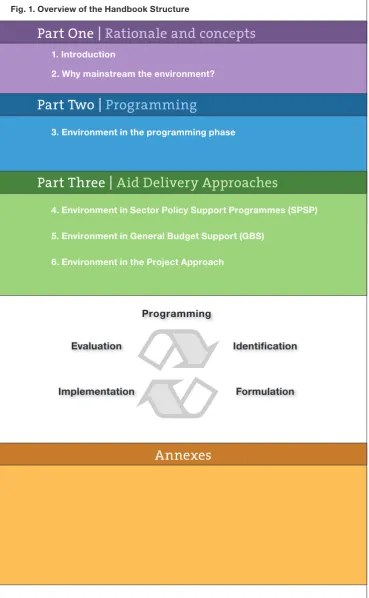
Fig. 1. Overview of the Handbook Structure
Part One |
Rationale and concepts
1. Introduction
2. Why mainstream the environment?
Part Two |
Programming
3. Environment in the programming phase
Part Three |
Aid Delivery Approaches
4. Environment in Sector Policy Support Programmes (SPSP)
5. Environment in General Budget Support (GBS)
6. Environment in the Project Approach
Annexes
Programming
Evaluation
Implementation
Identification
Executive Summary | 10 Environmental Handbook
Executive Summary
This handbook defines an operational framework for integrating the environment into EC development cooperation. The handbook is divided into 6 chapters: Chapters 1/2 illustrate the rationale and concepts along with the policy framework. Chapters 3 to 6 focus on programming and aid-delivery modalities and illustrate main tools and procedures. Annexes contain sector fiches (highlighting the main links between the environment and the individual areas of co-operation), screening questionnaires, and standard terms of references for Country Environmental Profiles and environmental assessments.
Rationale and Concepts (Chapters 1 and 2)
Environment is one of the three pillars of sustainable development and is particularly important for the poor, who are more vulnerable to natural resource degradation, pollution and ecological disasters. Environment is thus crucial for the overall objectives of co-operation: sustainable development and poverty reduction. Both environmental conditions affecting development actions and impacts resulting from them should thus be taken into account in development areas and activities. These include for example health, as many diseases are caused by pollution, and areas directly involved in the use of natural resources, such as fisheries, agriculture and forestry. However, because sectors are interdependent, all are influenced in some way by the environment. This rationale for environmental integration is reflected in the policy and legal framework for EC development co-operation, including Article 6 of the Amsterdam Treaty.
Environmental integration in programming (Chapter 3)
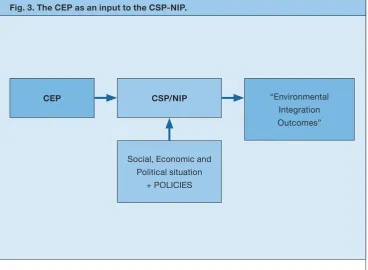
To enhance the efficiency of development activities, it is crucial to consider environmental issues from the very start of the cycle of operations. Consequently preparation of the Country Strategy Paper (CSP) and National Indicative Programme (NIP) has to address this topic. In order to adequately inform this process, the key tool is the Country Environmental Profile (CEP). The CEP is a report that contains a description and broad assessment of a country’s environmental situation, policy and regulatory framework, institutional capacities and environmental co-operation. The CEP is primarily meant to facilitate the integration of the environmental dimension in the country analysis, response strategies and multi-annual programming. The CEP should also be used to underpin policy dialogue.
Environmental integration in Sector Policy Support Programmes
(Chapter 4)
Executive Summary | 11 Environmental Handbook
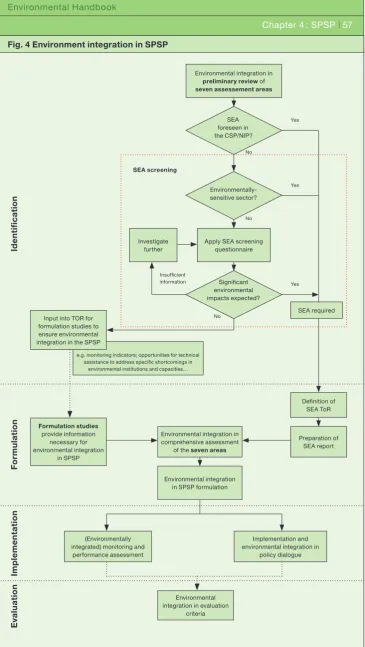
The key environmental tool in the assessment of the Sector Programme is the Strategic Environmental Assessment (SEA). The SEA should identify and assess the key linkages between the environment and the Sector Programme and provide recommendations for SPSP formulation and to enhance the Sector Programme. The SEA should be undertaken at the formulation stage, in close coordination with development partners, for sectors that have important links to the environment and in particular circumstances for other sectors, as determined by an SEA screening procedure.
For sectors not requiring an SEA, general guidance to integrate environmental considerations during formulation is proposed in the handbook. Based on the SEA or environmental assessment in the formulation study, the SPSP design may include environmental performance indicators and complementary actions (e.g. technical co-operation, capacity building, specific projects) to enhance the country’s environmental institutional and regulatory framework.
The conclusions of the environmental assessment should also be used to feed into the policy dialogue focusing on sector reform. Finally evaluation should check the overall process of environmental integration.
Environmental integration in General Budget Support (Chapter 5)
GBS supports a National policy / strategy or Poverty Reduction Strategy (PRS). Being a very particular aid delivery mechanism, it is subject to all EC commitments regarding environment integration but deserves specific treatment and poses new challenges in terms of environment integration. In these circumstances any SEA process of the policy/ strategy /PRS foreseen in the CSP-NIP should be led by the Government in co-ordination with donors and be supported by the EC in parallel to the GBS cycle.
Environmental integration in projects (Chapter 6)
Under the project aid delivery approach, it is important that:
- the problem analysis and the strategy analysis in the logical framework approach take into account the linkages between the social and economic conditions and the environment;
- the formulation of the project takes into account the environmental conditions affecting project performance such as efficiency and sustainability;
- the project is designed in such a way that it will use available opportunities to enhance the positive impacts and ensure that it will not result in significant negative impacts on the environment when implemented;
- implementation include good environmental practices (which can be identified by an Environmental Performance Review);
Executive Summary | 12 Environmental Handbook
- the evaluation of the projects also addresses linkages with the environment as part of the evaluation criteria.
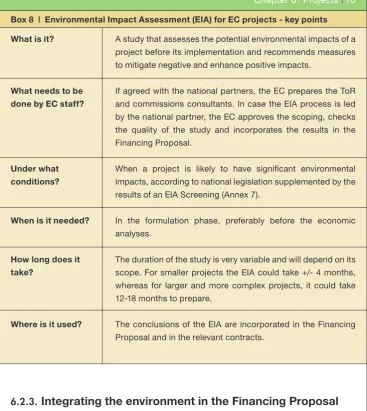
The Environmental Impact Assessment (EIA) is a key tool to assess the potential environmental impacts of a project before implementation and identify measures to mitigate negative and enhance positive impacts. An EIAscreening warns when an EIA must be undertaken, most likely for large scale infrastructure. An important output of the EIA is an Environmental Management Plan (EMP), which aims at ensuring that the required mitigation and enhancement measures are implemented in an effective way.
Environmental Handbook | 13
Part One
Chapter 1 : Introduction | 15
Environmental Handbook
1.
Introduction
1.1.
Why do we need this handbook
1?
The human impact on the natural environment has increased rapidly over the past century in response to population growth, rapid technological development, industrialisation and agricultural expansion. Unless we change our relationship with the environment, these increasing pressures will limit the planet’s capacity to supply the world’s economies with sufficient water, energy and other basic resources, and bring about substantial change that will create uncertainties and instabilities.
The undesirable environmental consequences of our activities can no longer be compensated for by the benefits of growth. Instead of increasing wealth, economic activities now risk creating a progressively less habitable planet, with diminishing natural resources and rising environmental management costs. These threats are global, but the impacts are most severe in the developing world. Any development model which ignores these consequences will fail to ensure continuing prosperity, particularly for the poorest communities.
This is especially relevant for the European Union’s external policies and assistance programmes as the EU is the most important2 donor worldwide. For these reasons the EC
has long undertaken an obligation to mainstream the environment into its development cooperation activities. However, progress accomplished remains modest in comparison with the scale of the commitments made and expectations raised, and to the existing opportunities to both reduce poverty reduction and improve the environment.
This handbook is part of the measures designed to fill this gap. It provides an introduction to the rationale and concepts for environmental integration and outlines an operational framework for ECstaff working in development co-operation covering the three main aid delivery modalities. While opportunities to incorporate environmental concerns exist throughout the various phases of the cycle of operations, emphasis is put on the upstream
stages of programming, identification and formulation, which is where the key decisions are made.
The objective is to enhance the capacity of non specialist staff to identify the key links between the environment and the main areas of development cooperation so as to enable an early consideration of environmental sustainability concerns in country programming and in the preparation of planned operations. This should lead to the identification of appropriate measures to be taken at formulation and implementation. Guidance in this handbook is to be complemented by environment Helpdesk support.
1 This handbook replaces the 2001(Draft) Edition of the EC Environmental Manual and preceding environmental manuals.
Chapter 1 : Introduction | 16
Environmental Handbook
This handbook does not intend to be comprehensive in terms of environmental analysis and integration tools. It rather concentrates on those that the EC has already committed to apply in the framework of development cooperation, in line with defined orientations within the international donor community. This has involved some simplification in an otherwise complex subject, where validated practices are not yet available in some areas (particularly in relation to the “new” forms of aid-delivery) and where part of what is done internationally still falls under the work in progress.
This handbook is therefore evolving in nature and its contents will be reviewed and completed as experience is accumulated and assessed, in close coordination with EU donors and development partners. Indeed, it is only through the consistent application of this guidance that practical experience will be generated on a sufficiently large scale to feed into the ongoing reflection on appropriate integration instruments.
1.2.
What is environmental mainstreaming?
In the EC, mainstreaming is “the process of systematically integrating a selected value/ idea/theme into all domains of the EC development co-operation to promote specific (transposing ideas, influencing policies) as well as general development outcomes”3.
In this handbook the environment is considered to include those bio-physical resources and conditions on which human lives and activities depend, and which in turn they influence (Box 1).
Mainstreaming involves an iterative process of change in the culture and practices of institutions. Mainstreaming the environment in EC development co-operation implies integration of environmental tools and approaches in the cycle of operations in order to bring about a better harmonisation of environmental, economic and social concerns.
Chapter 1 : Introduction | 17
Environmental Handbook
Box 1 | The world environment: some facts and figures
The world environment currently supports 41.9 million square kilometres of forest and woodland4, 35.3 million square kilometres of cultivated land5, 14 million species of plants,
fungi and animals6, and 6.46 billion people7.
The world environment is rapidly changing and in a ‘business as usual” scenario, without additional measures to protect the environment, these trends will intensify.
A third of the world’s land area (4 billion ha) is threatened by desertification, directly affecting 250 million people. 24 billion tons of topsoil are eroded each year8. 10% of arid
lands are degraded9.
14 million ha of tropical forest are destroyed each year10: rapid deforestation is particularly
common in poorer countries.
Globally a quarter of commercial fish stocks are overexploited11.
10% to 30% of mammals, birds and amphibians are threatened with extinction12.
The Earth’s temperature is likely to rise from between 1.4 and 5.8°C in the course of the century with profound repercussions on water cycles, natural catastrophes, agriculture, disease and biodiversity13.
3 million people die each year as a result of air pollution (1.6 million as a result of indoor pollution in developing countries)14.
1.1 billion people do not have access to safe drinking water. 1 to 2 billion people suffer from a lack of water15. 5 million people die each year as a result of contaminated water.
The 1999 estimate of 25 million environmental refugees is expected to double by 2010 and to reach 150/200 millions by 205016. Sea level rise alone could create 10 million new
environmental refugees in the next decade.
4 Millennium Ecosystem Assessment, 03/05: http://www.millenniumassessment.org
5 idem
6 UNEP-WCMC (2002) World Atlas of Biodiversity. Available at: http://stort.unep-wcmc.org/ imaps/gb2002/book/viewer.htm
7 UN Population Division (2004) World Population Prospects - the 2004 Revision. Available at:
http://esa.un.org/unpp/
8 Source: http://www.wateryear2003.org consulted 09/06/04.
9 Millennium Ecosystem Assessment, 03/05 http://www.millenniumassessment.org
10 FAO data, 1990-2000, in WWF, UNEP, WCMC and GFN (2004) Living planet report 2004, WWF: Gland.
11 Millennium Ecosystem Assessment, 03/05 http://www.millenniumassessment.org
12 idem 13 idem
14 WHO (2005) Indoor air pollution and health, WHO Fact Sheet 292, http://www.who.int/ mediacentre/factsheets/fs292/en/
15 Millennium Ecosystem Assessment, 03/05 http://www.millenniumassessment.org
Chapter 2 : Why mainstream? | 18
Environmental Handbook
17 Dasgupta, P (2004) Human Well-being and the Natural Environment, Oxford University Press: Oxford.
18 Millennium Ecosystem Assessment, 03/05 http://www.millenniumassessment.org
19 Costanza, R et al. (1997) The value of the world’s ecosystem services and natural capital, Nature, 387: 253-260.
2.
Why mainstream the environment?
2.1.
The environment and sustainable development
2.1.1.
Environmental services and external costs
Policies for development have generally concentrated on production and economic growth, without taking heed of the environment and the hidden functional services it provides. The result has been severe environmental damage with some of the poorest countries being worst affected. Amongst the poorest communities, natural resources such as fuel-wood and water are essential to life. The irony is that these common-property resources were depleted, annexed, or subject to over-exploitation, even while the country’s economy appeared to be growing vigorously. This helps explain the resilience of poverty in the face of demonstrable economic growth17.
The Millennium Ecosystem Assessment18 highlights, on a global scale, that environment -
through the goods and services it provides to the society and the economy - plays a critical role in our livelihoods. The natural environment provides four categories of service: provisioning (e.g. food, water, and fibre), regulating (e.g. climate, water and disease), cultural (e.g. spiritual, aesthetic, recreation and education) and supporting (e.g. primary production and soil formation). According to one estimate, the annual value of ecosystem services (US$33 trillion) is twice that of the combined GNP of all the world’s countries put together19.
Chapter 2 : Why mainstream? | 19
Environmental Handbook
The Rio declaration signed at the Earth Summit in 1992, states that: “National authorities should endeavour to promote the internalization of environmental costs and the use of economic instruments, taking into account the approach that the polluter should, in principle, bear the cost of pollution…” The principle of internalisation should encourage macro-economic and institutional reforms in developing countries, such as Environmental Fiscal Reforms20. It also influences the way co-operation is conducted by explicitly
focussing attention on development-induced environmental impacts. It also leads to the idea that environmental concerns should be integrated with economic and social concerns, as defined in the concept of Sustainable Development.
2.1.2.
Sustainable development
The principles of sustainable development, one of the EU development co-operation objectives21, have arisen from a growing recognition that the needs of current generations
must be reconciled with those of the future22, and that this requires dealing with economic,
environmental and social policies in a mutually reinforcing way23. Respect for future needs
means safeguarding the natural resource base (or natural “capital”) likely to be required to sustain future needs. In this sense the environment plays a central role since the question of sustainability arises as a direct response to concerns about issues of pollution, irreversible changes to ecosystems and climate, and the degradation of forests, fisheries, water supplies, biodiversity and other natural resources. Sustaining these resources into the future is also necessary to underpin social reforms that respect the rights of women, children and indigenous peoples, and which provide a more equitable distribution of wealth.
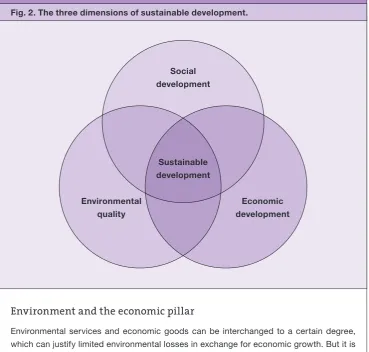
The three dimensions (Fig. 2) of sustainable development (environmental, economic and social) are referred to as the “pillars” of sustainable development. The pillars are distinct but closely interdependent. This means that the environmental pillar has links, which should be enhanced, with the economic and social pillars as explained hereafter.
20 EFR are promoted by OECD DAC. See OECD DAC (2003) Working Party on Development Co-operation and Environment, Scoping Workshop on “Reducing poverty through environmental fiscal reform (EFR)”, OECD: Paris (available online at: http://www.oecd. org/dataoecd/47/35/2505525.pdf) and OECD DAC (2005) Environmental Fiscal Reform for Poverty Reduction, OECD DAC: Paris (available online at: http://www.oecd.org/ dataoecd/14/25/34996292.pdf).
21 Article 177 of the European Community Treaty as modified in Amsterdam in 1997. 22 Sustainable development is defined as development that meets the needs of the present
Chapter 2 : Why mainstream? | 20
Environmental Handbook
Environment and the economic pillar
Environmental services and economic goods can be interchanged to a certain degree, which can justify limited environmental losses in exchange for economic growth. But it is important to remember that these substitutions have their limits; neither aspect should outweigh the other. Environmental services are not less valuable than economic goods. Breathing clean air, finding firewood for cooking, drinking clean water and being safe from floods…. all provide for essential human needs. So, despite the fact that the environment has suffered from unbalanced economic growth, the economic and environmental pillars play a complementary role in satisfying human needs. They also are interrelated. For instance, economic development can reduce our direct dependence on nature, and yet depends on the environment in several ways:
• Raw materials used in the production of goods come from nature, as does the energy needed for production and transport;
• The cost of extracting raw materials tends to increase when natural resources become rare or degraded;
• Environmental services have a crucial importance but are not included in national budgets because they are difficult to measure in financial terms;
[image:20.459.46.416.53.405.2]• Adverse environmental effects (e.g. pollution, floods or fires) can damage or destroy economic goods and equipment;
Fig. 2. The three dimensions of sustainable development.
Social development
Sustainable development
Environmental quality
Chapter 2 : Why mainstream? | 21
Environmental Handbook
• Labour productivity is linked to the nutrition and health of workers, two variables which are directly influenced by the environment;
• Sound environmental management and mainstreaming can reduce costs, through increased efficiency or through prevention, with an important potential for further development in this field;
• High quality environment is an important asset for tourism (as shown e.g. by the growth in ecotourism); it is also the basis for some indigenous peoples livelihoods, and for an important share of pharmaceutical production.
Environment and the social pillar
Environment is also closely linked to the social pillar. It affects people and especially the poor, who are particularly vulnerable to reduced availability of resources such as clean water, fertile soils, fuel-wood, wild foods, medicinal plants and other natural products. People are also vulnerable to unhealthy or unsafe environmental conditions. For example chronic respiratory diseases of people exposed to indoor air pollution in rural areas and to atmospheric air pollution in urban areas; diseases resulting from the consumption of contaminated water, poisoning due to the consumption of contaminated fish and shellfish (e.g. bio-accumulation of heavy metals). The impact can also be indirect. For example, soil erosion may lead to reduced land productivity, and thus to a decrease in nutrient in-take by the population; similar effects may be derived from the depletion of sources of protein (e.g. fish stocks, game) or medicinal plants. Just as a degraded environment will impact negatively on health, safety and livelihood, opportunities to enhance the environment will result in a positive impact on the poor.
Because social groups (women, minorities) may be affected differently by the environment, environmental changes may also have an impact on social relationships. For instance mercury used in gold washing pollutes rivers and may generate conflicts with fishermen. Similarly a development projects with adverse negative impacts on particular groups may face difficulties in implementing participatory approaches, which are considered as key conditions for sustainability. Moreover the depletion of shared resources may also exacerbate conflicts, as mentioned below under 2.3. On the other hand, sound environmental management is strongly dependent on institutional and social factors, such as legislation, decentralisation, good governance, land tenure, property rights, participation, conflicts, gender equity and empowerment of traditionally less represented groups.
Because of their particular importance in respect with EC co-operation, poverty, human rights and security issues are further developed in Sections 2.2, 2.3 and 2.4.of this handbook.
Chapter 2 : Why mainstream? | 22
Environmental Handbook
These peoples have usually achieved a sustainable use of their natural resources, based on a deep and specialised knowledge of their environment and its biodiversity. They are particularly vulnerable in all aspects of their economic, cultural and social life to external pressures on their environment. Development co-operation should be aware of the exceptional value that indigenous peoples have invested in their environment, and recognise their rights regarding land use, natural resources use, and intellectual property.
Guiding Principles for Sustainable Development
The EC has proposed the following Guiding Principles for Sustainable Development24:
promotion and protection of fundamental rights; intra- and intergenerational equity; open and democratic society; involvement of citizens; involvement of business and social partners; policy coherence and governance; policy integration; use of best available knowledge; precautionary principle25; and make polluters pay (see 2.1.1).
In addition to these principles, several important lessons on sustainability have emerged from experience in development co-operation, as follows.
Prevention and upstream decision making
Prevention is usually better than cure, and reducing future damage is an inherent objective of sustainable development. With respect to development co-operation, this principle implies a duty to take action in the face of unfavourable trends, and to integrate environmental considerations at an early stage of decision making. The optimum approach is thus to integrate environmental considerations upstream at the policy making and programming stage, and in the first phases of the cycle of operations. Integration of the environment early in the decision making process has however certain limitations: in particular the uncertainty of the real impacts of decisions taken. Follow-up monitoring is therefore necessary.
Local resource ownership
The management and harvest of natural resources implies some mixture of traditional, private or government involvement. A key lesson from studies of natural resource use is that sustainability requires long-term secure control and ownership of the resource26. A
user only has the incentive to conserve a resource if they feel that they or their descendants will reap the benefit of this moderation in the future27. An example of this may be provided
24 Communication to the Council and the European Parliament, Draft Declaration of Guiding Principles for Sustainable Development, COM (2005) 218 final (25.5.2005).
25 Principle contained in the Rio declaration but debated in Europe following a series of food crises: refer to the Communication from the Commission On the precautionary principle, COM(2000) 1 (02.02.2000).
26 Murray, M (2003) Overkill and sustainable use, Science 299: 1851-1853.
Chapter 2 : Why mainstream? | 23
Environmental Handbook
by community forestry, where forest land previously managed by State services is allocated to communities or decentralised institutions, creating incentives for sustainable management practices. Similarly studies suggest that secure property rights over land can be considered a precondition for pro-poor and sustainable economic growth28.
Participation
Sustainable development also advocates clear principles relating to transparency, participation and accountability in decision-making. Participation of stakeholders is recognised as a key sustainability factor in development co-operation. This should involve not only target beneficiaries (men and women), but also stakeholders potentially affected by environmental impacts, including traditionally less represented groups. The EC has also particular obligations under the Aarhus Convention29, which requires it to allow the public
and stakeholders to have a say in the decision-making process with respect to all environmental issues, including in development co-operation.
An ecosystem perspective
The ecosystem perspective takes a broader view of natural resources to look at the effects of use on supporting processes (nutrient and hydrological cycles and soil formation) and downstream on non-target species or neighbouring ecosystems. Accidental harvesting of non-target species can be sufficiently great to cause concern over their conservation. This is particularly true of the by-catch in fisheries. Land-based actions, such as fertiliser run-off and sewage disposal, can impact on neighbouring bodies of water. Frequently the whole watershed and river system is the appropriate ecological unit for assessment. Stakeholders from many sectors (e.g. agriculture, forestry, transport and town planning) need to be involved because different sector policies and activities impact on the same ecosystems, and policies need to be coherent30.
28 Cotula, L, Toulmin, C and Hesse, C (2004) Land tenure and administration in Africa, IIED: London.
29 UNECE (1998) Convention on access to environmental information, public participation in environmental decision making and access to justice in environmental matters.http://www. unece.org/env/pp/
Chapter 2 : Why mainstream? | 24
Environmental Handbook
2.2.
The environment and poverty reduction
The eradication of poverty in the context of sustainable development is the fundamental objective of EU development policy, as stipulated in European Consensus on Development31. Because
the environment plays a key role in the livelihoods of the poorest communities, it should be managed in such a way that it contributes to this overall objective of poverty alleviation.
Poverty can be described as the condition when basic human needs are unsatisfied. The poor lack capital and are often subject to an inequitable distribution of wealth; consequently their livelihoods are closely dependant on the productivity of natural resources and their own labour. This makes them vulnerable to any decline in the productivity of natural resources and to any unhealthy conditions (including unclean water, indoor air pollution, and toxic chemicals) that affect their capacity to work. Thus degraded environmental conditions have a direct and important relationship with poverty. The poor are also the most vulnerable to natural disasters such as floods, droughts, crop pests and environmentally-related conflicts.
Poor people lack the financial capital to invest and so often use any available natural “capital” to survive. For populations who depend on natural resources this process of consuming them often results in increasing poverty. Managing the environment to deliver pro-poor benefits (such as improved water supply and sanitation, improved management of local fisheries, or interventions in forestry and protected areas that involve local people) should be part of poverty alleviation strategies. This does not mean that what is done in the name of the environment is necessarily and by definition good for the poor but it does mean considering the effects of environmental changes on the poor and the factors affecting environment-poverty relationships. These include land tenure; access rights to natural resources; participation in land and resource management and the share of work between men and women with respect to the collection of basic resources like firewood and water. An analysis by major development partners (including the EC) comprehensively addresses the links between poverty reduction and environmental management32.
In certain cases however the question arises of whether safeguarding environmental services of global significance is compatible with poverty alleviation concerns. For example, choosing solar energy technology over coal or diesel fuel reduces GHG emissions, but may be more costly. Similarly protecting natural habitats for the conservation of biodiversity may require reducing the access of local communities to natural resources. As far as possible, conflict should be reduced or avoided, for example by promoting controlled eco-tourism or sustainable harvesting so as to provide revenue and local employment. Some mechanisms, such as the Global Environmental Facility (GEF33) grants cover the
incremental costs associated with transforming a project with national benefits that may have global environmental costs to one with both national and global benefits.
31 Joint Statement by the Council and the representatives of the governments of the Member Status meeting within the Council, the European Parliament and the Commission on European Union Development Policy: “The European Consensus”, Official Journal of the European Union, 2006/C 46/01, 24.02.2006.
32 DFID, EC, UNDP and WB (2002) Linking Poverty Reduction and Environmental Management -Policy Challenges and Opportunities.http://ec.europa.eu/comm/development/body/theme/ environment/docs/full_linking_poverty_en.pdf
Chapter 2 : Why mainstream? | 25
Environmental Handbook
2.3.
The environment and security
Mainstreaming environment in development co-operation activities may also contribute to stability and peace. There is a clear link between environment and security, and more precisely between the management of scarce or abundant natural resources and conflict.
Stress and competing demands on scarce environmental resources (e.g. drinking water, fertile soil - essential for food production and basic livelihood for large segments of the population), and the fight for access to and control over abundant and financially valuable environmental resources (e.g. timber, gum arabic) may lead to tensions, instability, and violent conflict. Stress on such resources (brought about by pasture and soil degradation, drought, or population growth and migration) can exacerbate tensions over access and lead to violent conflicts (e.g. second civil war 1983-2004 in Sudan which was fuelled by the dispute between the South and the North over oil and water; tension on water issues between India and Bangladesh).
Migration is a natural consequence of environmental stress: people are forced to leave their homelands because of the degradation or lack of environmental resources needed for their survival. It is estimated34 that up to 50 million people will be displaced due to
environmental degradation by 2010 and the effects of global warming (floods, droughts and expansion of desertification), and this figure could rise to 200 million by 2050. Environmental refugees can have an important impact on security and on the environment in the host areas. Refugee camps often create environmental problems and disputes between the refugees and the local population related to access to, control over and management of resources, which can lead to civil disorder, insecurity and violent conflict. It is crucial that environmental considerations are taken into account during post-conflict reconstruction processes, both to ensure that these efforts do not adversely impact the environment and that environmental pressures do not fuel renewed conflict.
On the other hand, it is important to note that environmental co-operation can be an extraordinary element of stability and peace and even of reconciliation. It is therefore essential to promote sustainable development and sustainable shared management of natural resources with the objective to protect the environment and at the same time to contribute to poverty reduction and stability. An interesting example comes from confidence building activities when two or more parties seek cooperative solutions to manage shared natural resources (e.g. water) that could otherwise become sources of conflict. Another instrument is the establishment of transfrontier conservation areas, sometimes known as “Peace Parks” which promote regional co-operation and biodiversity conservation. These usually extend far beyond designated protected areas and can incorporate a wide range of community-based natural resource management programmes.
Chapter 2 : Why mainstream? | 26
Environmental Handbook
2.4.
Human rights,
good governance and the environment
The EU is founded on the principles of liberty, democracy, respect for Human Rights and fundamental freedoms, and the rule of law. These principles should also underline the objectives for EC co-operation. Human rights are also a precondition for sustainable development and proper environmental protection. Rights to life and security, as established by the Universal Declaration of Human Rights and the right to health, as established by the Convention on the Rights of the Child cannot be fulfilled or are being violated when people become exposed to life-threatening environmental hazards such as toxic wastes, pollutants or hazardous radiations. The rights to have access to a means of subsistence and be free from hunger are also violated when land, water, or other natural resources become highly polluted or degraded.
A violation of a fundamental human right, such as the right to participate in the conduct of public affairs can also lead to environmental degradation. In a well-functioning democracy where good governance prevails, any plans or programmes that may have adverse environmental impacts will be shared openly with citizens, public government bodies and civil society. By allowing for transparency and participatory processes, citizens can voice their concerns and alternative solutions or remedial actions can be pursued to safeguard the environment and the public interest. It is therefore not surprising that human rights violations, including that of suppressing information, free media and the participation of people in decision-making processes are associated with many environmental catastrophes35.
As a consequence of the broad acceptance of the interdependence between the enjoyment of human rights and a healthy environment36, the more recent human rights instruments37
define the right to a healthy environment as a human right in itself. Similarly environmental instruments, such as the aforementioned Aarhus Convention38, attach importance to
important civil and political human rights principles such as access to information, participation and effective remedies.
Finally, these normative developments are also confirmed in the EC Communication on Governance and Development39, where the inter-relatedness and the synergies between
human rights protection, environmental protection and sustainable development are duly recognised.
35 Another archetypical example is unsustainable logging and the ensuing harmful deforestation as a consequence of the non-respect and violation of the rights of forest dependent peoples and communities who are often indigenous peoples or ethnic minorities.
36 For more on the interrelatedness and the interdependence between Human Rights and the Environment go to http://www.unhchr.ch/environment/index.html
37 These instruments are The Convention on the Rights of the Child (1989), ILO Convention No. 169 on Indigenous and Tribal Peoples in Independent Countries (1989), and the following regional instruments: The African Charter on Human and Peoples’ Rights (1981) and the Protocol of San Salvador to the American Convention on Human Rights (1988). 38 The Convention on Biological Diversity (1993) is another such example.
Chapter 2 : Why mainstream? | 27
Environmental Handbook
2.5.
Environmental sustainability is a high level
commitment and obligation for the EC
2.5.1.
Global commitments
Global concerns for linking environment and development have already quite a long history. Key steps include the 1972 United Nations Conference on the Human Environment held in Stockholm40, the 1987 Brundtland Report41, Our Common Future, and the United Nations
Conference on Environment and Development, held in Rio42 in 1992, which reaffirmed and
built on the Stockholm conference with the goal of establishing an equitable global partnership through the creation of new levels of co-operation by working towards international agreements which respect the interests of all and protect the integrity of the global environmental and developmental system. This lead to the definition by OECD of international development objectives of “environmental sustainability and regeneration”43
in 1996 and to a global commitment in 2000 for the “Millennium Development Goals” (MDG)44; the seventh of which (MDG 7) is “to ensure environmental sustainability” through
three specific targets45:
- Target 9: Integrate the principles of sustainable development into country policies and programmes and reverse the loss of environmental resources.
- Target 10: Halve, by 2015, the proportion of people without sustainable access to safe drinking water and basic sanitation.
- Target 11: Have achieved by 2020 a significant improvement in the lives of at least 100 million slum dwellers.
In 2002 at the World Summit on Sustainable Development the Johannesburg Plan of Implementation was initiated, which builds on the achievements made since the United Nations Conference on Environment and Development in 1992. The plan includes a commitment to enhance international co-operation and promotes the integration of the three components of sustainable development — economic development, social development and environmental protection — as interdependent and mutually reinforcing pillars45a.
40 Stockholm, 1972, Report of the UN conference on the human environment http://www.unep. org/Documents.multilingual/Default.asp?DocumentID=97&ArticleID=
41 World Commission on Environment and Development (WCED), 1987, Bruntland Report, http:// www.are.admin.ch/imperia/md/content/are/nachhaltigeentwicklung/brundtland_bericht.pdf
42 Rio Declaration on Environment and Development, 1992 http://www.unep.org/Documents. multilingual/Default.asp?DocumentID=78&ArticleID=1163
43 OECD (1996) Shaping the 21st Century, The contribution of development co-operation. OECD: Paris. http://www.oecd.org/dataoecd/23/35/2508761.pdf
44 The Millennium Development Goals were endorsed by world leaders in September 2000 at the UN Millennium Summit. The first one consists of eradicating extreme poverty. See http://www. un.org/millenniumgoals/
45 See corresponding indicators in Annex 10.
Chapter 2 : Why mainstream? | 28
Environmental Handbook
2.5.2.
The policy and legal basis for environmental integration
in EC development co-operation
The European Community has a longstanding commitment to address environmental concerns in its development programmes and projects, as part of a wider commitment to sustainable development.
Article 6 of the Amsterdam Treaty stipulates that “environmental protection requirements must be integrated into the definition and implementation of the Community policies and activities (…) with a view to promoting sustainable development”, as enshrined in the spirit of Agenda 21 of the 1992 Rio Earth Summit46. The systematic consideration of environmental
aspects into EC development co-operation, as in other policies, is part of a Cardiff process, launched in 1998 by the Council47. Consequently the EC’s Development Policy48 of 24 April
2000 identified the environment as a key cross-cutting issue to be mainstreamed into all priority themes and on 31 May 2001 the Council endorsed the EC proposed Strategy on Integrating the Environment into EC Economic and Development Co-operation49.
The European Consensus on Development explicitly recognises the links between development and environment, and highlights the need for a strengthened approach to mainstreaming of cross-cutting issues, by making systematic and strategic use of all resources available to this effect.50 This is in line with the 2005 Paris Declaration on Aid
Effectiveness, where donors committed to work towards harmonised approaches on environmental assessments at the sector and national level. Furthermore, the 2005 development policy identifies environment and sustainable management of natural resources
as well as water and energy (integrated water resources management and improving access to sustainable and clean energy services) as two of the nine areas for community action.
In this context the Coherence Communication51, prepared for the 2005 UN Summit, building on
earlier results from the WSSD in 2002, contains a number of specific commitments with respect to environment and efforts needed to achieve the MDGs, including MDG-7. In line with these commitments the European Council adopted in June 2006 a renewed EU Sustainable Development Strategy (building on the Gothenburg Strategy of 2001) which emphasizes the need to meet international responsibilities, reflecting the importance of the external dimensions of the three thematic pillars, including the environment, in EU policies52.
46 http://www.un.org/geninfo/bp/enviro.html
47 See: Commission Working Document, Integrating environmental considerations into other policy areas - a stocktaking of the Cardiff Process, COM(2004) 394 final, and Report of the Cardiff process.
48 Communication from the Commission to the Council and the European Parliament, The European Community’s Development Policy, COM(2000) 212.
49 Commission Staff Working Paper, Integrating the Environment into EC Economic and Development Co-operation, a global strategy, SEC (2001) 609.
50 § 102. It also includes reference to carry out strategic environmental assessments (SEA) on a systematic basis, including in relation to budget and sector aid.
51 Communication from the Commission to the Council, the European Parliament and the Economic and Social Committee, Policy Coherence for Development - accelerating progress towards attaining the Millennium Development Goals, COM(2005) 134 final.
Chapter 2 : Why mainstream? | 29
Environmental Handbook
Building on the European Consensus, the new instrument for development cooperation (DCI, replacing a long series of individual legal bases regulating a large number of individual cooperation programmes), foresees that environment and natural resources shall be addressed both under the geographic programme and under a dedicated thematic programme. In addition to supporting dedicated actions, the latter will aim at enhancing environmental integration efforts, including through global actions in support to partner countries53. Finally but very importantly, the DCI requires environmental screening and
impact assessments to be undertaken as appropriate for project and sector level interventions.
2.5.3.
Multilateral Environmental Agreements
Most Developing countries are parties to Multilateral Environmental Agreements (MEAs) and therefore have also obligations to fulfil these frameworks. The EC is determined to help them meet these obligations. The EC is a strong advocate for the mainstreaming of MEAs National Action Plans of developing countries in their national development strategies. Often referred to as the “Rio Conventions”, the three main MEAs are the UN Convention to Combat Desertification54 (UNCCD), the UN Convention on Biological Diversity55 (UNCBD)
and the UN Framework Convention on Climate Change56 (UNFCCC).
Developing countries are highly interested in the implementation of the UNCCD as this convention addresses an issue which is affecting mainly developing countries and is most directly related to development. Most of the African continent is affected by desertification and land degradation, as are important parts of Latin America and Central Asia. Developing country parties to the Convention have to develop a National Action Plan (NAP); an important effort in this direction has been made recently and most affected parties now have designed their NAP, but little progress has been made so far towards implementation. A central problem lies in the fact that these NAPs have been drafted as stand alone strategies, while most of the countries’ efforts are geared towards the implementation of national development strategies. A key issue is thus to link and integrate the UNCCD NAP into the national development strategies, in order to secure adequate funding to address the desertification problem. The Commission is supporting initiatives in this direction and is calling affected parties to mainstream these issues into their national strategies.
Loss of biodiversity has increased exponentially during the last decades and it is increasingly urgent to take decisive action in order to halt this loss. The UNCBD has been adopted to address this issue and includes texts on related problems (i.e. the Cartagena protocol on bio-safety). There is often a perception that biodiversity loss is not of great
53 Communication from the Commission to the Council and the European Parliament, External Action: Thematic Programme for environment and sustainable management of natural resources including energy, COM(2006) 20 final (25.01.2006).
54 http://www.unccd.int/
55 http://www.biodiv.org/
Chapter 2 : Why mainstream? | 30
Environmental Handbook
importance to development, therefore limiting action at that level. Increasing scientific evidence that biodiversity is at the basis of several economic and social sectors should help revert this thinking. The EC has put into place the “Biodiversity Action Plan for Economic and Development Co-operation”57 with the strategic objectives to mainstream
biodiversity objectives into co-operation strategies, plans and programs as well as in policy dialogue with developing countries. It also aims at supporting sustainable use of natural resources, particularly in relation to forests, grasslands and marine/coastal ecosystems, strengthening the capacity of relevant agencies involved in conservation and sustainable use of biodiversity and co-ordinating the implementation with third countries’, other donors’ and international institutions’ own biodiversity strategies.
The UNFCCC and the related Kyoto Protocol are increasingly key issues in international relations. Climate change is seen by many developing countries as a result of industrialised countries’ activity. In many cases they see themselves as victims of climate change and rightly point out the responsibility of developed countries. But many developing countries are now middle-income countries and their rising economic activity is progressively becoming an important source of greenhouse gas (GHG) emissions. This is especially the case for countries like China, India or Brazil. The EC has put forward an “EU Climate Change Strategy for support to partner countries”58. It is aiming on one hand to support
developing countries to adapt to the effects induced by climate change (adaptation activities) and also to support efforts to mitigate the effects of climate change by limiting the emission of GHG through e.g. cleaner energy, transportation, production processes. Apart from this Strategy, it is also essential that EC development strategies take climate change into account in order to design and implement adequate strategies, plans and programs.
Other Multilateral Environmental Agreements address other important international environmental issues. Amongst these are the Stockholm Convention on Persistent Organic Pollutants (POPs59), the Rotterdam Convention on Prior Informed Consent (PIC60) Procedure
for Certain Hazardous Chemicals and Pesticides in International Trade, and the Basel Convention on the Control of Transboundary Movements of Hazardous Wastes and their Disposal61.
57 Communication from the Commission to the Council and the European Parliament, Biodiversity action plan for economic and development co-operation, COM(2001) 162 final.
58 Included in the Communication from the Commission to the Council and the European Parliament on Climate Change in the Context of Development Cooperation, COM(2003) 85 final (11.03.2003).
59 http://www.pops.int
60 http://www.pic.int
Chapter 2 : Why mainstream? | 31
Environmental Handbook
2.6.
All sectors are involved: environmental
opportunities, constraints and impacts
Because environment plays a key role in human well-being and activities several sectors are particularly and directly dependent on the environment. These include for example health, as many diseases are caused by pollution or other degraded environmental conditions, and areas directly involved in the use of natural resources, such as fisheries, agriculture and forestry. However, because sectors are interdependent, all are influenced in some way by the environment. In this Handbook, environmental conditions are referred to as environmental opportunities if they have a positive influence on a sector (or a sector policy), and constraints if the influence is negative.
In turn human activities in all sectors produce effects or consequences on the environment (e.g. deforestation, biodiversity loss, soil erosion, air pollution, water contamination), which are usually referred to as environmental impacts. Impacts may be positive or negative, direct or indirect, visible or not. For example, sectors such as transport, energy, agriculture and industry directly pollute and consume natural resources. Other sectors, such as education, governance or macro-economic reform have more indirect impacts, through changing behaviour and practices affecting the environment (both positively and negatively). Depending on their intensity, duration, frequency, reversibility, cumulative or synergic nature and socio-economic consequences, potential impacts can be (or not) considered to be significant, important enough to justify mitigation or enhancement measures. Addressing issues related to these significant impacts may be part of the EC support to sector policies.
Some sectors are more vulnerable to environmental changes, others produce higher impacts, and all sectors have the potential for environmental integration. Using governance and institutions as an example, potential environmental integration entry points include: environmental institutions and capacities; legislative capacity; environmental law; environmental statistics; participation of civil society and decentralisation programmes. Issues that many sectors hold in common include: institutional environmental management, energy efficiency, waste minimisation and planning. A more comprehensive list of environmental entry points and guidance for a range of sectors/areas is given in Annex 1.
Sector Guidance
When a decision is made to work in a particular focal sector, the specific linkages of this sector with the environment should thus be identified. These linkages between the environment and all sectors are the reason why the environment is considered a “cross-cutting” issue, in addition to being a sector in itself.
Chapter 2 : Why mainstream? | 32
Environmental Handbook
2.7.
The added value of environmental mainstreaming
As a conclusion to this chapter environmental mainstreaming is not considered as a goal in itself but as a means to bring added value in the following ways:
• Addressing environmental aspects will improve the efficiency and effectiveness of poverty reduction efforts.
• Because co-management of the environment by all involved stakeholders means peaceful co-operation, peace and security will be strengthened too.
• The risk of environmental disasters and social crises caused by environmental degradation will be mitigated.
• The need for emergency aid will be reduced, as well as social, economic and financial costs saved by preventive action.
• Balanced and win-win solutions can be found between different concerns, including global and local, economic, social and environmental, material and cultural.
• Taking “externalities” into account will increase the economic performance of co-operation projects (even when financial performance is less favourable).
• Environmental awareness and capacity building for environmental management can have a tremendous empowerment potential for the poor, for women, for indigenous peoples and for all citizens in general in that they foster a culture of shared democracy, participation and rights-awareness.
• The interest of future generations will be respected resulting in increasingly sustainable development.
Environmental Handbook | 33
Part Two
Chapter 3 : Programming | 35
Environmental Handbook
3.
Environment
in the programming phase
The programming phase is crucial for environmental integration because key decisions concerning the overall co-operation process are made that might be difficult to adjust in later phases. Under geographical co-operation instruments, programming generally culminates in the production of Country Strategy Papers (CSP) and National Indicative Programmes (NIP)62. The main environmental integration tool at this stage is the Country
Environmental Profile (CEP).
The integration of environment during this phase serves two objectives:
• “To identify and avoid any harmful direct and indirect environmental impacts of the co-operation programme which can undermine sustainability and counteract achieving the development co-operation objectives of poverty reduction.
• To recognise and realise opportunities for enhancing environmental conditions, thereby bringing additional benefits to development and economic activities and advancing environmental issues which are a priority for the EC”63.
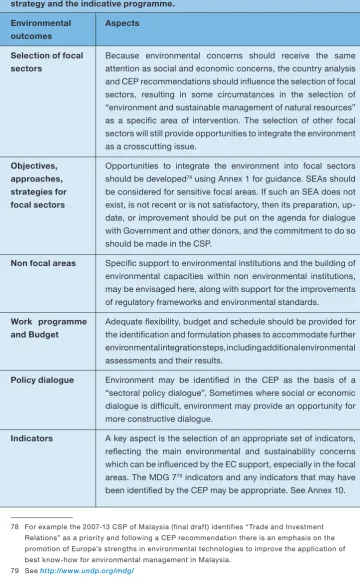
A comprehensive country analysis is an initial step in programming. This analysis focuses on the national situation and policies and includes an overview of past and ongoing co-operation with the EC as well as with other donors. Integrating the environment in this analysis provides opportunities to undertake policy dialogue and programming on a better understanding of the challenges posed by sustainable development, which is the long term objective of EC co-operation. The Country Environmental Profile provides the necessary information to integrate environmental concerns in the country analysis.
Chapter 3 : Programming | 36
Environmental Handbook
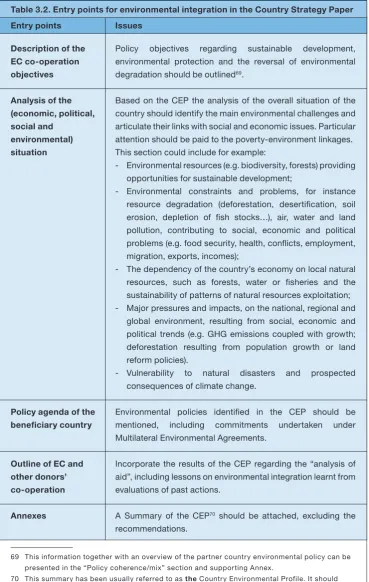
Summary Brief presentation of the main environmental problems, the main conclusions and recommendations.
Table 3.1. The contents of a Country Environmental Profile
State of the environment
A presentation of the state and trends of the environment in relation to development, including an identification of the main environmental problems to solve or avoid. This section addresses the relationship between the environment and the social and economic situation, and more particularly between poverty and environment.
Environmental policies and institutions
A presentation of the main features of the institutional, policy and regulatory framework leading to the identification of weaknesses and constraints on the capacity to address main environmental concerns. This section should include a review of the legislation and procedures regarding impact assessments and a review of the international obligations in the area of environmental protection.
Environment in the main policies and sectors
An identification of links between the main government policies (overall development and reform policies and strategy, such as a PRSP, and sector policies) and environmental sustainability issues, providing indications on the extent of existing environmental mainstreaming with a special attention paid to the “focal sectors” of EC intervention.
Analysis of aid A description of past and ongoing aid from the EC and other donors in the field of the environment, incorporating lessons learnt from major evaluations.
Assessment of opportunities to collaborate with other donors in pursuing common goals and seeking complementarities.
Conclusions and recommendations