Yue, H. and Zhang, J.F. and Wang, H. and Cao, L. (2004) Shaping of
molecular weight distribution using b-spline based predictive probability
density function control. In: American Control Conference 2004,
2004-06-30 - 2004-07-02, Boston. ,
This version is available at
https://strathprints.strath.ac.uk/38169/
Strathprints is designed to allow users to access the research output of the University of Strathclyde. Unless otherwise explicitly stated on the manuscript, Copyright © and Moral Rights for the papers on this site are retained by the individual authors and/or other copyright owners. Please check the manuscript for details of any other licences that may have been applied. You may not engage in further distribution of the material for any profitmaking activities or any commercial gain. You may freely distribute both the url (https://strathprints.strath.ac.uk/) and the content of this paper for research or private study, educational, or not-for-profit purposes without prior permission or charge.
Any correspondence concerning this service should be sent to the Strathprints administrator: [email protected]
The Strathprints institutional repository (https://strathprints.strath.ac.uk) is a digital archive of University of Strathclyde research outputs. It has been developed to disseminate open access research outputs, expose data about those outputs, and enable the
Proceeding of the 2004 American Control Conference
Boston, Massachusetts June 30 - J u l y 2,2004 ThP10.6
Shaping
of
Molecular Weight Distribution Using B-spline Based
Predictive Probability Density Function Control
Hong
Yue, JinfangZhang, Hong
Wang
and
Liulin
Cao
Abstracc-Issues of modelling and control of molecular weight distributions ( M W D s ) of polymerization products have been studied under the recently developed framework of stochastic distribution control, where the purpose is to design the required control inputs that can effectively shape the output probability density functions (PDFs) of the dynamic stochastic systems. The B-spline Neural Network has been implemented to approximate the function of MWDs provided by the mechanism model, based on which a new predictive PDF control strategy has been developed. A simulation study of MWD control of a pilot-plant styrene polymerization process has been given to demonstrate the effectiveness of the algorithms.
I. INTRODUCTION
The molecular weight distribution (MWD) of a polymer is one of the most important variables to be controlled in industrial polymerization processes because it directly affects many of polymer's end-use properties such as ther- mal properties, stress-strain properties, impact resistance, strength and hardness, etc [l], [2]. Therefore, there has been much incentive to control MWD accurately during polymerization. The research into the modelling and control of MWD in polymerization has constituted an important area in process control for a decade, where the aim is to select proper control strategies that can effectively control the shape of the molecular weight distribution following the quality requirements of the end-use polymer.
Information of molecular weight distributions for control and optimization is normally obtained from mathematical models because so far MWD is still very difficult to measure on-line. Mechanistic MWD models are developed based on the mass balance and energy balance principles, which include a set of differential equations describing the dynamics of the reaction species such as initiator, monomer, radicals and polymers of different chain length. These equations are functions of kinetic mechanism and reaction operation conditions of the polymerization pro- cess [3]. The control inputs can be chosen as initiator concentration, feed rate of monomer andlor chain transfer agent, reactor pressure and temperature, etc [4], [SI. As
This work i s supparted by Chinese NSFC grant 60128303 and UK's
Leverhulme Tnut grant FI000381D
H. Yue and H. Wang are with the Control Systems Centre, Uni- versity of Manchester InStiNte of Science and Technology, Manch-
ester M60 IQD, The United Kingdom h . yueeumist
.
ac.
uk; [email protected]1. Zhang is with the InstiNte of Automation, Chinese Academy of Sciences, Beijing 100080, China j i n f a n g . zhang e m a i l . i a . a c . c n
L. Cao is with the Department of Chemical Automation, Beijing
University ofchemical Technology, Beijing 100029, China c a o l l e f h t
the polymer chain length of interests is usually a huge number up to millions, direct solution of these hundreds of thousands of differential equations is unfeasible in most real situations and therefore various numerical techniques have been devised to solve this problem. An adaptive orthogonal collocation algorithm has been developed for the compu- tation of the entire MWD which allows broad, bimodal and fast changing distributions [6]. This technique has been implemented for the modelling of the dynamic evolution of MWDs during nonlinear emulsion polymerization reactions [7]. The method of finite molecular weight moments has been proposed for the calculation of MWD in free radical polymerization [SI. Some polymerization systems have also been modelled by statistical methods such as Markov chain [9], [IO], [ll], Weibull distribution 1121, [13] and Schultz- Zimm distribution [14]. For a large number of practical problems of linear polymerization under steady-state or quasi-steady state conditions, the MWD of polymer chains can be described satisfactorily by the generalized Schulz- Flory distribution [3], [IS], [16].
In recent years, various control strategies have been de- veloped for the MWD control of polymerization processes. The time optimal monomer and chain-transfer agent feed profiles were computed and implemented experimentally for the MWD control in non-linear emulsion copolymerization systems [SI. An optimal control solution to get the desired MWD of linear polymers within a minimum time has been developed based on on-line reaction calorimetry [17]. The two-step method was proposed in [18] and then modified and validated by an experimental study, which aims for getting the reactor temperature so as to obtain a polymer with a prescribed MWD in a free-radical polymerization batch reactor [I], [19]. The disturbance rejection has been considered in the on-line two-step method for MWD control [20]. Batch-to-batch modifications combined with multivari- ate statistical process control have been implemented to update manipulated variable trajectories so that the desired MWD can be achieved after several batches [21]. State estimation techniques such as extended K a h a n filtering have been implemented when it is desirable to monitor on-line MWD and other time-varying model parameters or unknown conditions [2], [22], [23], [24].
Most of the research studies are based on simulated reactors. Industry-scale closed-loop control of MWD is still a challenging subject not only because the lack of on-line measurement of MWD, but also due to lack of systematic solutions of output distribution control. In this paper, the idea of closed-loop control of output probability density
Pig. 1. styrene polymerization system in a CSTR pilot reactor
function (PDF) for non-Gaussian stochastic systems [25], [26], [27] has been introduced to develop control strategies for MWD control of polymerization processes, where the B-Spline neural network is used to approximate MWDs obtained from the physical model. The key advantage of using the B-spline decoupling models is that the obtained weights model of the MWD can be made mathematically
equivalent to any existing physical models for MWD systems subjected to a pre-specified small modelling error. A predictive control algorithm has been proposed to realize the dynamic tracking of the desired output distribution.
11. PROCESS MECHANISM MODELLING
The process in concem is a styrene bulk polymerization reaction in a pilot-plant continuous stirred tank reactor (CSTR) as shown in figure 1; in which styrene is the monomer for polymerization and azobisisobutyronitrile is used'as the initiator. These two flows are injected into the CSTR with a certain ratio adjusted by a Bruker HF'LC pump. The energy for the reaction is provided by the heated oil in the CSTRs jacket and the oil temperature is controlled by a Tool-Temp temperature control unit TT- 162E. To simplify the process, the reaction temperature is assumed to be kept constant. The total flow rate to the system, F , is composed of the flow of monomer, F,, and the flow of initiator, F,, i.e., F = F,
+
F;. The monomer input ratio is defined as c = F,,,/(F,+
F,).Bo%
F and c can be changed by the control system. In this work, adjustment of c is considered to be the means to control the MWD shape of the polystyrene product.The following free radical polymerization mechanisms are considered.
Initiation I
3
ZR* R ' f M - f f ; R I.
Chain propagation Rj+
M2
Rj+1Chain transfer to monomer Rj
+
M *K Pj+
RITermination by combination Rj
+
R,
2
K Pj+;where I is the initiator, M is the monomer,
R'
is the primary radical, Rj is the live polymer radical with chain length j, Pj is the dead polymer with chain length j . Kd,K,, K p , Ktrm and K t are reaction rate constants. A set of mass balance equations can be derived to describe the concentrations of the reaction species. .
_ -
d M - (MO - M ) / B - 2KJ
-
( K p+
Kt,,)MR (2)dt dR1
d t - -R1/9
+
2 K J-
KpMR1+
Kt,,M(R - R I )- K t R i R (3)
_ -
dR3 -Rj/S - K p M ( R 3-
R3-1) - Kt,,MR,(4)
_ -
-
dt
( j ? 2 ) (5)
where 0 = V / F is the average residential time of the reactants in the CSTR and
m
R = C R ~
( 6 )P = C P 3 (7)
J=1
is the total concentration of the radicals. By denoting
m
3=2
as the total concentration of the polymers, the following formulation for the total concentrations of radicals and polymers can be obtained from (3) to (7) as
- -RI9
+
2 K i l - K t R 2dR
d t
-
-dP Kt
d t 2
- -
- -PI9+
KtrmMR+
-RZ ( 9 )The initial concentrations of the initiator and monomer are related to the monomer input ratio c through I o = (1-c)P0
and MO = cMoo. Io" and Moo are the initial concentrations decided by the chemical system design and the ratio c can be adjusted according to the controller design algorithm.
Denote
(10)
Ki,, Kt R 1
a = 1 + -
+-+-
K p K p M K p M 9
the static solutions to the concentrations of the reaction species can be derived from (1)-(3) and (8)-(9) as
(15)
P = 9(Kt,,MR+-RZ) Kt 2
The dynamic model of MWDs with respect to time has been set up by the moment method together with a statistical distribution. The moments of the number chain- length distributions of radicals and polymers are defined as
U,
=C j m R j ,
m = 0 , 1 , 2 , . . . (16)+al
j = 1
+m
Z, =
Cjmpj,
m = 0 , 1 , 2 , . . . (17) j = 2It can be seen from (16) and (17) that U0 = R and ZO = P. The differential equations of the leading moments are derived using the generation function technique as follows
Once the moments of the dead polymer are obtained, the calculation of
MWD
can be carried out through a statistical distribution, chosen empirically in order to resemble the MWD of the actual solution. In this work, the well-known Weibull distributionis used, in which n = 1 , 2 , . ' ' stands for the discrete points of the distribution variable. The link between the leading moments (ZO, Z1,Zg) and the three Weibull parameters (g, z0,6) can be established in the same way as described in [13].
111. B-SPLINE PDF MODEL
Consider a continuous probability density function y(y, ut) defined on [a, b] interval, the linear B-spline neural network can be used to give an approximation of y(y, uk) [26]:
n
Y(Y,uk) = cW;(Uk)Bi(Y) + e o (25)
i=1
where ut is the control input at sample time k; Bi(y)(i = 1 , ' . .
,
n) are the pre-specified basis functions defined on the interval y E [a, b]; n is the number of basis functions; w;(ut)(i = 1,' .
. , n ) are the expansion weighs; eo repre- sents the approximation error which satisfies le/<
61 (J1 isa known small positive number). To simplify the expression, eo is neglected in the following. Due to the fact that the integration of a PDF over its definition domain should be 1, there are only n- 1 independent weights out of the original n weights [25]. Denote
b
G(Y) = B ~ ( Y ) - L ( Y ) / Bi(Y)dY,
i = l , . . . , n - 1 (27)
C(Y) = [Cl(Y), CZ(Y), ' " I %-l(Y)l (28)
vk
= [wl(uk), w Z ( u k ) ~ .",wn-1(uk)lT(29)the static B-spline PDF model (25) can be represented in a compact form as
Y(Y,Uk) = C(Y)Vk
+
L(Y) (30)Equation (30) is the static PDF model approximated by the B-spline neural network, in which C(y) is known when the basis functions B;(y), (i = 1 , .
' . ,
n) are chosen and fixed. DenoteM Y )
= Y ( Y > U k )-
L(Y)
(31) then (30) is transformed intof k b )
c(Y)vk
(32)For dynamic systems, it is assumed that the weights vector in (29) is dynamically related to the system by
f i + i = EVk
+
F U k (33)where E and F are known matrices with appropriate dimen- sions. Equation (33), together with the B-spline approxima- tion in (30), constitute the state-space dynamic model of the deterministic control input U k and the output PDF y(y, ut).
As y ( y , ~ k ) is related to ft(y) by (31), the output PDF can be derived from (32) and ((33) to be
f t ( Y ) =
c(Y)(l-
Z - l E ) - l ( F u k - i ) (34)This can be expanded to the following form according to matrix theory [26]
where
W - 1
c ( Y ) D j U k - i - j = dj,;Uk-i-jBi(y) (36)
All the parameters ai, (i - 1 , .
. .
,n - 1) and dj;.( j = 0,.
. .
,
n-
2 , i = 1 , ..
.,
n - 1 ) can be estimated by a standard least-square identification algorithm [26].i = l
IV. PREDICTIVE CONTROL OF OUTPUT PDF
The purpose of control algorithm design is to choose
a control sequence u k such that the actual output PDF
y(y,uk) is made as close as possible to a desired PDF
g(y). For the general control of output PDF, the following performance function is formulated that primarily contains a measure of the distance between the output PDF and the target PDF
1
b
J1 =
J,
(Y(Y>%)-
S(YVdY+
p%
(37)where X
>
0 is a pre-specified weighting factor thatimposes an energy constraint for the control input. For
the performance index (37), solutions to both static and
dynamic PDF systems are given in [26], where the static approach is based on gradient search and the dynamic control algorithm provides a compact global optimization solution.
In this paper, a new PDF control strategy is proposed
based on the long-range predictive control principle. Let
z - l be used as the unit back-shift operator, i.e., z-'uk =
w - 1 , then (35) can be reformulated as
a(z-')fk(Y) = P(Z-')Y)%-l (38)
where
n-I
a ( z - ' ) = 1
+
c a i z - ; (39)i=l "-2
D(z-1,y) = C(y)D,z-j (40)
j = O
In order to invent the predictive control strategy, the fol- lowing Diophantine equation is introduced
1 = Gq(z-')a(z-')
+
H,(z-')z?
(41)where q is the predictive step and
By multiplying G,(z-') on both sides of (38), there is
Gq(z-')a(z-')fk(~) = Gq(t-')P(z-',~)uk-~ (44)
Taking (41) into (44), the following predictive formulation
of the output PDF can he obtained
fk+q(Y) = Hq(z-')fk(Y)
+
Gq(z-')a(Z-',Y)Uk+q-iq = l , Z , . . . , p (45) Considering the following expansion
n+q-3
G,(z-')D(t-',y) =
1
sq,;z-' (46);=0
(53)
The following performance index is formulated for the purpose of predictive PDF control:
T
O k = IUk-1 U--2 " ' Uk-n+21
b
Jz
= [Wy,k,p) - A(y)IT[n(y,k,p)-
A(y)ldy+u:Ruk
(54)where A(y) = [a(y), a(y), . . .
,
a(y)lT E RP corresponds tothe target distribution by a(y) = g(y)-L(y) when the same
basis functions to approximate y( y, u k ) have been used. R
is the weighting matrix for the control input. Taking (47)
into (54) and denote
( 5 5 )
as the known term at the sample time k, the optimization
solution to (54) can be obtained by making aJz/aUk = 0
to be
uk
=-(L
fi(Y)Tfi(Y)dY+
R)-'
[(((Y) - A(Y))dYE(Y) =
H f k ( Y )
+
@ U kb
(56)
The coefficients gq,; and hq,j in the Diophantine equation
(41) can he obtained with a recursive derivation which is not given in detail here due to the page limit. Interested readers may contact the authors for the further information.
V. SIMULATION
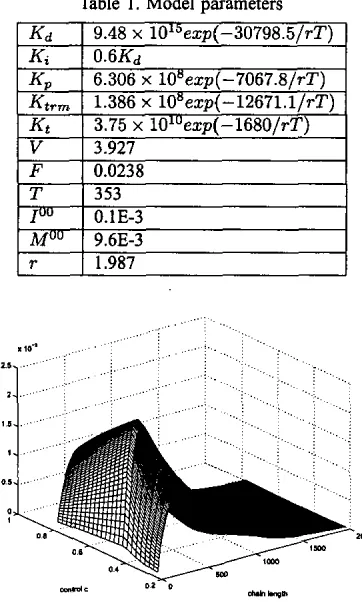
The styrene bulk polymerization process is described in section 11, whose main parameters used are listed in table 1. Seven forth-order univariate B-spline functions [28] are chosen to formulate the basis functions. The range of the
control input, i.e., the monomer input ratio c, is [0.2,0.8].
Simulation results are shown in figures 2
-
6. Comparingfig.2 with fig. 3, it can be seen that the B-spline MWD
model agrees well with the result from the mechanistic
model. Figures 5-6 show how the target MWD is achieved
by the predictive PDF control strategy after some control steps.
Table 1. Model parameters
, . I 6
/ " " " " ' I
3.927
Fig. 4. initial and target MWDs
-
4-- e
Fig. 2. MWD c w e s tiom mechanism model
e-.hi4n
r m l d e
Fig. 3. MWD N N ~ S tiom B-spline model
VI. CONCLUSIONS
In this paper, a B-spline approximation model has been used to decouple the static and dynamic effects of the control input on the output MWD shape. In this context, the control of the MWD shape can be realized through
_.I b c .
".**
Fig. 6. MWD curves during the control process
[image:6.614.315.525.64.682.2] [image:6.614.100.281.126.427.2] [image:6.614.97.287.472.621.2]the control of the weights (coefficients) in the B-spline expansion on the considered MWD. A physical model of the process was firstly developed and used as a starting point for the establishment of the equivalent B-spline models. This is then followed by a new predictive PDF control method, in which the control input is selected that minimizes a performance measure of the functional error between the target distribution and the estimated MWD. A simulation example is given for the dynamic MWD control system, where desired results have been achieved.
NOTATION
I initiator or its concentration (mol. L-')
Po
initial initiator concentration (mol . L-')I o
controlled ed initial initiator concentration (mol.
L - l ) Kd initiator decomposition rate constant (min-') K; initiation reaction constant ( L.
mol-'.
min-') K p propagation rate constant ( L.
mol-'.
min-') Kt,, chain transfer rate constant ( L .mol-' . min-') Kt termination rate constant ( L .mol-'.
min-') M monomer or its concentration (mol . L-')Moo initial monomer concentration (mol L-')
MO controlled initial monomer concentration ( m o l . L - ' )
Rj live polymer of chain length j or its concentration
(mol. L-')
R
total concentration of live polymer radicals (mol.
L-I) Pj dead polymer of chain length j or its concentration(mol.
L-')
P total concentration of dead polymer (mol . L - ' )
T
reaction temperature( K )
F total feed flow rate ( L
.
min-')V volume of reaction mixture ( L )
8 average residential time of reactants in the CSTR (min)
REFERENCES
[ I ] 1.-H. Chang and P.-H. Lino. "Molecular weight control of a batch polymerisation reactor: experimental shldy:' Id. Eng. Chem. Res., ~01.38, 1999, pp.144-153.
121 T.J. Crowley and K.Y. Choi. '%Experimental stodies on optiimal molec- ular weight distribution control in a batch-free radical polymerization process:' Chem. Eng Sci., ~01.53, 1998, pp.2769-2790.
[3] J. C. Pinto, "A me* representation of polymer chain size distri- butions, 1 Linear polymerization mechanisms at steady-state condi- tions:' Mac!"/. Theory Simul., vol.lO. 2001, pp.79-99.
[4] T. 1. Crowley and K Y. Choi, "Discrete optimal control ofmolecular weight distribution in a batch free radical polymerization process:' Ind. Eng Chem. R a . , ~01.36, 1997, pp.3676-3684.
[SI M. Mcente, C. Sayer, J. R. Leiza, G. Anamendi, E. L. Lima, 1. C. Pinto and J.M. Asua, "Dynamic optimization of non-linear emulsion copalymerization systems open-loop control of composition and molecular weight dishibution:' Chemieal Engineering 1, vol.85, 2002, pp.339-349.
[61 M. Nele, C. Sayer, J. C. Pinta, "Computation of molecular weight distributions by polynomial approximation with complete adaptation procedures:' Moeromol. Theory Simul., ~01.8, 1999, pp.199-213. [71 C. Sayer, P. H. H. Arauja, G. A m e n d i , J. M. Asua, E. L. Lima,
J. C. Pinto, "Modeling molecular weight distribution in emulsion polymerization reactions with transfer to polymer,':' 1 Po/y Sci. A: Pofx Chem., "01.39. 2001. pp.3513-3528.
[E] T. 1. Crowley and K Y. Choi, "Calculation of molecular weight distribution from molecular weight moments in free radical poly- merisation:' Ind. Eng. Chem. Re., ~01.36, 1997, pp. 1419.1423. [9] L. Christov, G. Georgiev, "An algorithm for determination of the
copolymer molecular weight distribution by Markov chain simula- tion," Macmmol. Theory Simui., ~01.4, 1995, pp.177-193. [IO] G . Storli, G. Poloni, M. Cociani, M. Morbidelk "Molecular weight
distribution in emulsion polymerization. 1. the homopolymer case:' 1 Poly, Sci. A: Poh. Chem., vo1.30, 1992, pp.731-750.
[ I l l G. Storti, 0 . Paloni, M. Caciani. M. Morbidelli, "Molecular weight distribution in emulsion polymerization. 11. the copolymer case:' 1
Po@. Sci. A: Poh. Chem., vol.30, 1992, pp.751-777.
[I21 L. Caa, H. Yue, "Mathematical models of microscopic quality far polybutadiene production:' 1 Beijing Imfilufe of Chem. Tech., val.2l, 1994, pp. 65 - 69.
[I31 H. Yue, L. Cao, "Reaction extent modeling of a butadiene poly- merization process:' in IFAC Inl. Symp. Advanced C o n h d o/Chem. Pmc.. . Pisa. . Italy.
..
June 14-16. 2000. ....
DO. 1043-1048.[I41 L. Can, N. Lu, "Modelling of a continuous PET process:' Joumol
o/Sysrem Simulalion, ~01.13, 2001, pp.536-538.
[IS] M. Nele, J. C. Pinto, "Molecular-weight multimodality of multiple
Flory distributions:' Maoomol. Theory Simul.. v0l.l I, 2002, pp.293- 7n7
1161 A. Sal-, L. M. Gugliotta, 1. R. Vega, G. R. Meira, 'blolecular
weight control in a starved emulsion polymerization of styrene:' h d Eng Chem Res, "01.37, 1998, pp.3582-3591.
[I71 M. Wcente, S. BenAmor. L. M. Gugliona, J.R. Leiza and J. M. Asua, "Control ofmolecular weight distribution in emulsion polymerisation
using on-line reaction calorimetry:' Ind. Eng. Chem. Re., ~01.40, 2001, pp.218-227.
[I81 T. Takamatsu, S. Shioya and Y. Okada, "Molecular weight distribu- tion control in batch polymerization reactor:' Ind. Eng. Chem. Res., ~01.27, 1998, pp.93-99.
[I91 J. S. Chang, 1. L. Lai, "Computation of optimal temperatore policy
for molecular weight Control in a batch polymerization reactor:' Ind
Eng Chem Res, ~01.31, 1992, pp.861-868.
[20] K. -Y. Yw, B. -G. Jeong and H.-K. Rhee, "Molecular weight distribution control in a batch polymerization reactor using the on-
Line two-step method:'Ind. Eng. Chem. Re., ~01.38, 1999, pp.4805- 4814.
[21] T.L. Clarke-Pringle and J.F. MacGregor, "Optimization of molecular- weight distribution using batch-to-batch adjustments," Ind. Eng. Chem. Res., ~01.37, 1998, pp.3660-3669.
[22] A. Echevamia, J. R. Leiza, 1. C. de la Cal, J. M. Asua. 'Molecular
weight distribution control in emulsion polymerization:' [AlChE 1,
~01.44, 1998, pp.1667-1679.
1231 M. F. Ellis. T. W. Taylor and K. F. Jensen. "On-line molecular weieht
. . "
distribution estimation and ~ontrol in batch polymerisation:' AIChE
Joural, ~01.40, 1994, pp.445-462.
[24] C. Kiparissides, P. Seferlis, G. Mourikas and A. 1. Moms, "Online optimisation control of molecular weight properties in batch free- radical polymerisation reactors:' Ind. Eng. Chem. Res., vo1.41, 2002, pp.6120-6131.
[25] H. Wang, "Robust control of the output probability density functions for multivariable stochaslic systems:' IEEE Tramaction on Aulomalic Conlrol, ~01.44. 1999, pp. 2103-2107.
[26] H. Wang, Bounded Dynomie Slochosric Syslems: Modelling ond
Conbol, Springer-Verlag London Limited, 2000.
[27] H. Yue and H. Wang, "Recent developments in stochastic distribution
control: a review:' Memuremen1 and Conml, vo1.36, 2003, pp.209- 215.
[28] Z. Cheng and S. Li, Numerical Appmximorion and Numericoi Solulionr IO Dr&erenriol Equoriom, Xian Jiaotong University Press,
Xian, China, 2000.