Model of Learning Ability
Thesis submitted for the degree of Doctor of Philosophy
Content
Content i
Figures and Tables iv
List of Figures iv
List of Tables vi
Acknowledgements vii
Abstract ix
1. Introduction 1
2. Scientific Problem Solving 8
2.1. On Paradigm 10
2.2. On Induction 17
2.3. On Observations 22
2.4. On Qualia 30
2.5. On Method 37
2.6. On Creativity 44
2.7. On Freedom of the Scientist 52
2.8. The Process of Scientific Problem Solving 59
2.9. Chapter Summary 65
3. The Problem Domain 66
3.1. Rationalities for Decision Taking 67
3.2. Systems 73
3.3. Value Systems 86
3.4. Cognitive Processes and Memory 94
3.5. Attention 102
3.6. Motivation and the Flow Experience 110
3.7. Expert Systems 121
3.8. Chapter Summary 131
4. Defining the Component Problems 133
4.1. Knowledge 134
4.1.2. Aspect 1: System of Knowledge 137
4.1.3. Aspect 2: Personal Knowledge 141
4.1.4. Aspect 3: Tacit and Explicit Knowledge 144 4.1.5. Aspect 4: Intuition, Skills, and Facts 148 4.1.6. Aspect 5: Knowledge of “That”, “How”, “What”, “Why” 151 4.1.7. Aspect 6: Representations of Knowledge 155
4.1.8. Aspect 7: Levels of Knowledge 158
4.1.9. Aspect 8: Value of Knowledge 161
4.2. Knowledge Increase 164
4.2.1. Definitions of Knowledge Increase 165
4.2.2. Aspect 1: Process of Knowledge Increase 168 4.2.3. Aspect 2: Increase of Personal Knowledge 171 4.2.4. Aspect 3: Increase of Tacit and Explicit Knowledge 174 4.2.5. Aspect 4: Increase of Intuition, Skills, and Facts 177 4.2.6. Aspect 5: Increasing Knowledge of “That”, “How”, “What”, “Why” 181 4.2.7. Aspect 6: Representations of Knowledge Increase 184 4.2.8. Aspect 7: Knowledge Increase at Different Levels 187
4.2.9. Aspect 8: Value of Knowledge Increase 191
4.3. Chapter Summary – Dimensions of the Inquiry 194
5. Problem Formulation 200
5.1. Approaching the Problem 200
5.2. Boundaries of the Problem 204
5.3. Stating the Problem 207
6. Descriptive Models 210
6.1. Definitions and Description 211
6.2. Learning Willingness 215
6.3. Learning Capability 224
6.4. Attention 232
6.5. Learning Ability 240
7. Simulative Models 245
7.1. Doctus KBS 247
7.2. The Knowledge Base of the Learning Willingness 255 7.3. The Knowledge Base of the Learning Capability 259
7.4. The Knowledge Base of the Attention 263
8. Conclusions 272
8.1. Main Findings 273
8.2. Ancillary Findings 278
8.3. Future Directions 281
9. Appendices 285
Appendix 1 Concepts Used in the Dissertation 286
Appendix 2 The Line of Discussion 287
Appendix 3 Case-Based Reasoning 288
Appendix 4 Informativity Calculation 289
Appendix 5 Value descriptions 289
References 292
Glossary of Terms and Acronyms 307
Figures and Tables
List of Figures
Figure 1: Family tree of the dissertation. ... 3
Figure 2: The spiral of discussion: top-view. ... 4
Figure 3: The spiral of discussion: side-view ... 5
Figure 4: The cognitive sciences. ... 14
Figure 5: The solution evolves from the component solutions. ... 60
Figure 6: Examining the problem with the increased knowledge. ... 62
Figure 7: The solution determines the problem. ... 63
Figure 8: Decision alternatives described. ... 68
Figure 9: Optimal, satisfactory and objectionless solutions... 71
Figure 10: General conception of system. ... 77
Figure 11: Hierarchy of values – nothing like a pyramid. ... 89
Figure 12: Reading in context. ... 97
Figure 13: Generalized model of cognition. ... 99
Figure 14: Two exercises on attention. ... 108
Figure 15: Maslow‟s hierarchy of needs. ... 113
Figure 16: The Flow experience. ... 120
Figure 17: The sorts of knowledge. ... 148
Figure 18: Is spelling important? ... 149
Figure 19: Knowledge and knowing – very different. ... 151
Figure 20: Knowledge orientation of organizations... 163
Figure 21: Absorbing a new schema. ... 169
Figure 22: The Müller-Lyer illusion. ... 180
Figure 23: Changing the discipline. ... 188
Figure 24: Knowledge increase of the master and of the advanced. ... 189
Figure 25: Plains for examining knowledge. ... 198
Figure 26: Problem domain, problem nodes, and what is examined. ... 201
Figure 28: The microstructure, the macrostructure and the global structure. ... 214
Figure 29: Two judgments about the new knowledge. ... 216
Figure 30: 3D picture of the Learning Willingness. ... 222
Figure 31: The Learning Willingness model from above. ... 223
Figure 32: Absorbing new knowledge. ... 225
Figure 33: Learning Capability by the number of schemata. ... 230
Figure 34: Learning Capability by the speed of changing relations. ... 230
Figure 35: Learning Capability by the meta-schemata. ... 231
Figure 36: The cognitive dimension of Flow experience. ... 233
Figure 37: Attention by number of schemata. ... 234
Figure 38: Attention by the speed of changing relations. ... 235
Figure 39: Attention by meta-schemata. ... 236
Figure 40: 3-D picture of the Learning Ability. ... 243
Figure 41: The Learning Ability model from above. ... 244
Figure 42: Refining ideas/hypotheses. ... 246
Figure 43: Attributes and values in Doctus. ... 249
Figure 44: Rule-Based Graph in Doctus. ... 250
Figure 45: Complex rules in rule list (1D) view of Doctus... 251
Figure 46: Rules in 2D view of Doctus. ... 252
Figure 47: Cases in Doctus. ... 253
Figure 48: From descriptive models to knowledge bases. ... 253
Figure 49: Factors of learning willingness. ... 255
Figure 50: Complex rules of influence in 1D... 258
Figure 51: Complex rules of learning willingness in 2D. ... 258
Figure 52: Factors of learning capability. ... 260
Figure 53: Complex rules of learning capability in 2D... 262
Figure 54: Factors of attention. ... 264
Figure 55: Complex rules of cognitive factor in 2D. ... 265
Figure 56: Complex rules of attention in 1D. ... 266
Figure 57: Hierarchy of attributes of learning ability. ... 268
Figure 58: Complex rules of learning ability in 2D. ... 270
List of Tables
Table 1: Demonstrative and plausible syllogism ... 18
Table 2: Knowledge typologies synthesized. ... 196
Table 3: Types of solutions. ... 209
Table 4: Influence between the two value systems. ... 217
Acknowledgements
In 1997 I was an MBA student waiting for the first class in decision making. Ac-tually, I was not in a very good mood – I really did not need another semester of
op-timization, mathematical programming, or anything of the sort. When Zoltán Barac-skai started the class by offering a flower to a girl in the first row, to play the usual game, loves-me-loves-me-not, I felt even worse… Then I heard: “Yes, we cheat, but we cheat in order to get to the truth.” I have raised my head: something important is going on! – and I became an apprentice of Zoltán Baracskai for the next six years.
The research that is presented in this dissertation is the product of research con-ducted in the last few years of my apprenticeship in Baracskai‟s workshop. More precisely, the research was conducted there but I moved to Glasgow, where I have got a lecturer position at Strathclyde University, without taking it to viva – so it had to be rewritten to meet the expectations of a PhD at my new institution.
If I wanted to list all the people who helped me in one way or another with this re-search and the dissertation writing, it would take a separate volume. All the people who were teaching me, and who I was teaching – I have learned a lot from them. All those whose works I was reading, and those, who read my writings – there were many useful comments. People that welcomed my ideas, and others, who rejected them – I benefited a lot from their critiques. Still, there are some people that I have to mention by name, although it is only a fraction of the full list. My mentor, Zoltán Baracskai, is largely responsible for me becoming a scientist and being happy in this role. I will never be able to repay this to him, fortunately, as he use to say, I do not
have to. I have to do the same thing for my future apprentices. My supervisors Fran Ackermann and Terry Williams have done much more than a supervisor usually has
Abstract
The problem domain of the investigation presented in this dissertation is knowl-edge increase. In particular the research is concerned with the process of knowlknowl-edge increase. The research problem formulated is formulated a posteriori: “Which factors determine the increase of personal knowledge that occurs by absorbing a particular new knowledge of an individual, who is a member of an organization, and how these factors work?”
To explore and shed light on this problem a number of disciplinary boundaries were engaged and some models, tools, descriptions, etc. were borrowed from a num-ber of related disciplines. These areas are briefly presented in the dissertation, re-stricting presentation to the relevant issues.
There are three models developed for this thesis and they are subsequently inte-grated into a fourth model. First the „Model of Learning Willingness‟ (MLW) is de-veloped to consider personal and organizational value systems. For this model, new concepts have been created, to indicate the position of new knowledge in both per-sonal and organizational value systems. Stable and the unstable states of the model are identified as well as how it is possible to pass from one state to another as result of an interaction between the two value systems by means of influencing each other.
Applying a „systems theory approach‟ on the cognitive psychology conception of knowledge, the impact of the characteristics of existing knowledge on the absorption of new knowledge is described. The developed model is called the „Model of Learn-ing Capability‟ (MLC). – This is the second model.
It is also necessary to pay attention to the ability to acquire new knowledge; this is described by the „Model of Attention‟ (MA)– the third model. This model is based
on two main factors, namely cognitive and social conditions.
Doctus Knowledge-Based Expert System, which was also the means of comparing the evolved hypotheses with the input from reality, namely observations and thought experiments.
The first insight from the model is a better understanding of the process of „knowledge increase‟. The model can also be used to support choosing the right per-son to learn a particular piece of new knowledge, to identify the reaper-son for someone not performing well with regards to learning and/or identifying a possible way of im-proving the process. Using the logic of the model experts can also be evaluated in the process of knowledge acquisition when building an expert system.
Considering the achieved results some new problems emerge: It is not known
1.
Introduction
“Reasonable people adapt themselves to the world.
Unreasonable people attempt to adapt the world to themselves. All progress, therefore, depends on
un-reasonable people.”
George Bernard Shaw
This dissertation is a story of knowledge increase about knowledge increase, of learning about learning. It could be said more precisely, as shall be shown throughout the dissertation, that the problem domain is „knowledge increase‟. The reason for choosing it is a rather subjective one, or more precisely two: at the time of the
deci-sion I had already done substantial reading and research about knowledge, and I was immensely interested in knowledge and learning. More detailed explanation of why exactly the process of knowledge increase is chosen will be given at the point of ex-act problem formulation in Chapter 5.
if they are interested in the topic at all, so a preliminary (if not entirely precise) prob-lem formulation is given here: it is not known which factors determine whether a person will learn a particular piece new knowledge, and how these factors work.
This problem is not covered in the literature, as will be shown in Chapter 4 (and to lesser extent in Chapter 3); knowledge increase is usually discussed in terms of teaching techniques. The result presented here is a model, the Model of Learning Ability. It consists of three component models, i.e. there are three major factors con-sidered to determine the learning ability of the person, i.e. whether she/he will be able to learn a particular new knowledge. The three component models are the Model of Learning Willingness, the Model of Learning Capability, and the Model of
Atten-tion. These three factors branch further into sub-factors.
As in case of all scientific research, the well-structured report about the results has nothing to do with the ill-structured process of getting to them regardless of the effort to maintain methodological rigour. Any research report accounts for a knowledge in-crease about the investigated problem. The special feature of this investigation is that the problem itself is „knowledge increase‟. This explains that in the dissertation the process of research is interwoven with the topic itself.
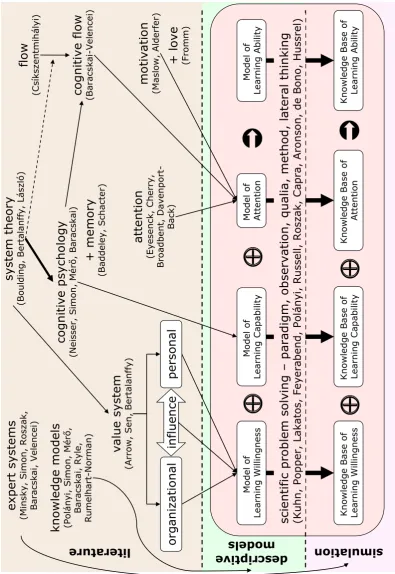
K n o w le dg e B a se o f L e a rn in g W il li n g n e ss K n o w le dg e B a se o f L e a rn in g C a p a b il it y K n o w le dg e B a se o f A tt e n ti o n K n o w le dg e B a se o f L e a rn in g A b il it y
M o d e l o f L e a rn in g W il li n g n e ss M o d e l o f L e a rn in g C a p a b il it y M o d e l o f A tt e n ti o n M o d e l o f L e a rn in g A b il it y
de sc rip tiv e mo de ls sim ulat io n lit er atu re v a lu e sy st e m (A rr o w , S e n , B e rta la n ff y ) p e rso n a l o rg a n iz a ti o n a l in fl u e n ce sy st e m t h e o ry (B o u ld in g , B e rta la n ff y , L á sz ló ) co g n it iv e p sy c h o lo g y (Ne isse r, S im o n , M é r , B a ra cs k a i) + m e m o ry (B a d d e le y , S ch a c te r) fl o w (C s ík s z e n tm ih á ly i) co g n it iv e f lo w (B a ra cs k a i-V e le n ce i) m o ti v a ti o n (M a sl o w , A ld e rf e r) s ci e n ti fi c p ro b le m so lv in g – p a ra d ig m , o b se rv a ti o n , q u a li a , m e th o d , la te ra l th in k in g (K u h n , Po p pe r, L a k a to s , F e y e ra be n d , P o lá n y i, R u s s e ll , R o sz a k , C a pr a , A ro n s o n , d e B o n o , H u s sr e l) + l o v e (F ro m m ) k n o w le d g e m o d e ls (P o lá n y i, S im o n , M é r , B a ra csk a i, R y le , R u m e lh a rt -No rm a n ) e x p e rt sy st e m s (M in sk y , S im o n , R o sz a k , B a ra csk a i, V e le n ce i) a tt e n ti o n (E y e se n ck , C h e rr y , B ro a d b e n t, D a v e n p o rt -B a ck )Figure 1: Family tree of the dissertation.1
1 This figure is repeated in the appendices, where it can be folded out to keep track of the
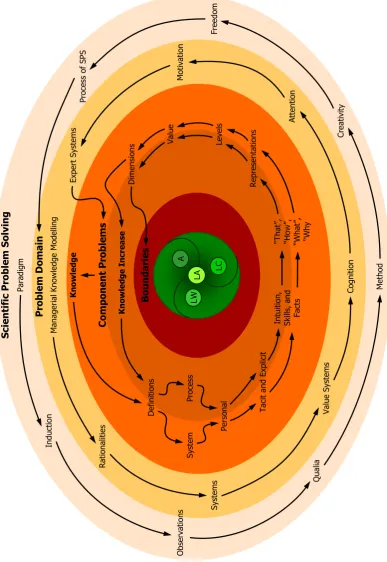
P a ra d ig m O b se rva ti o n s Q u a lia M e th od P roc e ss of S P S S c ie n ti fi c P ro b le m S o lv in g M a n a g e ri a l K n ow le d g e M od e lli n g R a ti on a lit ie s S y st e m s V a lu e S y st e m s C og n it ion C re a ti v it y A tt e n ti on F re e d om M ot iva ti on E x p e rt S y st e m s In d u ct io n P ro b le m D o m a in K n o w le d g e C o m p o n e n t P ro b le m s In tu it ion , S k ill s, a n d F a ct s D e fi n it ion s S y st e m P e rs on a l T a ci t a n d E x p lic it R e p re se n ta ti on s L e v e ls V a lu e D im e n si on s P roc e ss “ T h a t ” , “ H ow ” , “ W h a t ” , “ W h y K n o w le d g e I n c re a s e B o u n d a ri e s L W A L C L A
Figure 2: The spiral of discussion: top-view.1
1
The following abbreviations are used in this figure: LW – Learning Willingness, LC – Learning
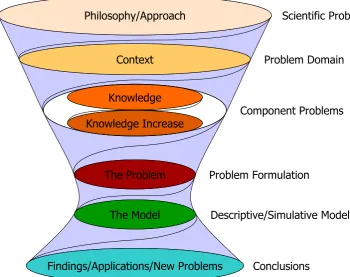
The line of argument is even more comprehensible, if we imagine drilling down, starting from the widest area on the top of the spiral and narrowing it gradually as we drill deeper and deeper. If we adopt this idea, the picture on Figure 2 (Appendix 2) can be regarded as a top-view of the „hole‟, while Figure 3 represents the side-view. Figure 2 is more detailed; it actually contains all the section-titles of the dissertation. Figure 3 is smaller, and comes in handy for a large-scale overview; the different cy-cles of the spiral appear on this picture as layers of the drilling. Inside the „hole‟ it is shown what is discussed at each layer and the corresponding chapter titles are indi-cated beside the picture.
Philosophy/Approach Philosophy/Approach
The Model The Model Context Context
Knowledge
Knowledge Increase Knowledge Knowledge
Knowledge Increase Knowledge Increase
The Problem The Problem
Descriptive/Simulative Models Problem Formulation
Component Problems Problem Domain
Scientific Problem Solving
Findings/Applications/New Problems
[image:17.595.116.467.288.565.2]Findings/Applications/New Problems Conclusions
Figure 3: The spiral of discussion: side-view
Most of the dissertation is structured into two-level titles; the first-level titles are called chapters and the second-level titles are called sections. The only exception is Chapter 4, where we have two sub-chapters (second-level titles) and the sections are arranged on third-level. This can be seen at Figure 3, there are two parts on the third level from above, the „knowledge‟ and the „knowledge increase‟. As it can be seen
on both pictures the „hole‟ is gradually narrowing until we arrive to the „problem‟ and the „model‟; these last two are in the centre of Figure 2, and they are of the same width (meaning that the model is supposed to cover the problem). The deepest layer of the „hole‟, corresponding to the Conclusions, is wider again, as it considers the possibilities of generalizing the results, their applications, and new problems. This last layer can only be seen on Figure 3; on Figure 2 it is covered and thus invisible.
The spiral starts from the outmost circle (on Figure 2, which corresponds to the topmost layer on Figure 3) focusing on the philosophical and methodological frame-works, which contain a set of pictures about the world of science; beliefs, what is and what is not accepted for this investigation, the methods used along with a rationale is
provided. This part includes one supplementary result, a method, which is developed for this inquiry and a problem which is identified in the field of philosophy of sci-ence.
The second cycle of the spiral (the second-top layer) getting closer towards the centre is the description of the problem domain; this involves a number of areas from different disciplines that are pertinent to the investigation, and includes several sup-plementary results and some restructuring of well-known models for the later use. Neither these supplementary results nor the restructuring fall into the mainstream of the development of the results of the present investigation, nevertheless, they are necessary to obtain the main results of the research.
The next cycle on the spiral (the third-top layer) towards the centre involves a more specific description of the component problems, before getting finally to the modelling stage. The definition of the component problems involves a critical and creative discussion of the specific background literature. This part, again, contains a number of smaller results, more or less relevant to the main results but all of them needed for the full picture. A significant achievement of this cycle is the synthesis of the different knowledge-typologies.
inquiry and of the validity of results are summarized, and the problem is, finally ex-plicitly formulated. This is the fourth-top layer on Figure 3.
The modelling stage begins with development of three descriptive sub-models, the Model of Learning Willingness (MLW), the Model of Learning Capability (MLC), and the Model of Attention (MA). These three sub-models are then integrated into a single Model of Learning Ability (MLA), which is the first main result of the disser-tation. The descriptive models are then converted into simulative ones, using the Doctus knowledge-based expert system shell, meaning, that the hypotheses are hereby compared to observations and thought experiments. The simulative model is the second main result of the dissertation. The models can be found on the fifth-top
level of Figure 3.
This, probably unusual, line of argument is responsible for the fact that the struc-ture of the dissertation may look unusual – but hopefully at first sight only. If we considered everything that happens before the modelling stage to be a background work; the proportion of the „real‟ investigation would seem very small. However, as described above, a lot of preparatory work was done in the „pre-modelling‟ parts, which is usually presented in the elaboration phase of the result – i.e. the „ pre-modelling‟ parts not only contain the literature review but also the restructuring of the models from the literature, as well as several subsidiary results.
2.
Scientific Problem Solving
“… [the sage]
creates but does not own what he has created, he acts but does not control,
he accomplishes creation but does not claim credit, and as he does not claim it for himself,
he does not lose it either.”
Lao Tzu1
This chapter – the first cycle of the line of discussion (topmost layer on Figure 3) – corresponds to what is usually called „methodology‟ in dissertations. There are good reasons for not using the usual term: it is overused and often misused; and this chapter is also not a typical chapter about methodology. It would be more
appropri-ate to speak of a mental framework and the process of scientific problem solving – these two are meant to be indicated by the chapter title.
In this dissertation a postmodern paradigm is adopted, which is in contrast to the
reigning positivistic paradigm.2 This is explained in the first section of the chapter.
The subsequent five sections are concerned with the devices/methods used, and ex-plaining in detail the strongly anti-methodological (in Feyerabend‟s sense) approach of the dissertation. The explanations are twofold: it is explained why some methods are not used (e.g. experiments) and also why some alternative methods are adopted (e.g. phenomenological observations) as well as what kind of assumptions are made. Distinction is made between the way of getting to the results and the evaluation of these results. For both these stages it is explained what is accepted and what is re-jected. The last section of the chapter before the chapter summary introduces the process of scientific problem solving as it happened during the present investigation.
1
Lao Tzu (cca. 4. century) Tao Te King, verse 2, my translation, based on the Hungarian translation by Sándor Weöres.
2
Although in the area of investigation positivism is not strong as in some other areas, the
in-terpretivist and various postmodern paradigms are more acknowledged. (e.g.
To speak about scientific problem solving, it is necessary to clarify how the terms “problem” and “problem solving” are used throughout this dissertation. Simon (1973) distinguished well-structured from ill-structured problems, where the term of ill-structured problems is residual, i.e. ill-structured is what is not well-structured. The criteria for well-structured problems, based on Simon (ibid, p. 183), are:
(1) there is a definite set of criteria to test the solution;
(2) the initial problem state, the goal state and all intermediate states may be represented;
(3) the transitions between the previous states can be represented;
(4) the acquired knowledge can be represented;
(5) the effects of environment can be represented; and
(6) “doable” amount of search and computing is required.
Baracskai (1997) suggests calling well-structured problems “tasks” and ill-structured problems “problems” (e.g. to avoid misunderstanding with students); this terminology is adopted in this thesis; actually “tasks” are not much mentioned but “problems” always refer to ill-structured problems. We can get a simpler description by rephrasing Simon‟s six criteria: we can find out that the tasks are to be accom-plished and the problems are to be solved. Solution of a problem requires creation of something that did not exist previously.
By accepting Baracskai‟s terminology we can also avoid the Csíkszentmihályi -Simon debate (Simon, 1988) about the relation between creativity and problem solv-ing. Another additional advantage of the terminology is an easy-to-perceive explana-tion of the problem structuring as a part or the whole of problem solving, i.e. if at the end of structuring of the initially ill-structured problem only a well-structured task remains to be accomplished, it can be regarded as a solution to the problem. (Eden, 1987)
exam-ined in seven subsequent sections, while the eighth describes the process of problem solving as it was employed during the present investigation.
2.1.
On Paradigm
“Years ago, white settlers came to this area and built
the first European-style homes. When Indian People walked by these homes and saw see-through things in the walls, they looked through them to see what the strangers inside were doing. The settlers were shocked, but it makes sense when you think about it: windows are made to be looked through from both sides. Since then, my People have spent many years looking at the world through your window. I hope
to-day I‟ve given you a reason to look at it through ours.
Mii gwetch.”
Marge Anderson, Marge1
There are several reasons why the paradigms should be discussed in a dissertation. First, every dissertation should indicate the paradigm into which its author belongs, as the result is expected to be valid within the same paradigm. This becomes even more important if the author does not belong to the main paradigm of the discipline or if she/he questions some aspects of the paradigm; then it is important to make clear her/his frame of thinking. Second, if there is something unusual in the para-digm, specific to the area of research, it makes it easier to those readers from the neighbouring disciplines to comprehend the dissertation. Third, there may be
para-digmatic changes going on within the discipline (or on a greater scale), which are no-ticed by the author and may affect the process, the result, or the presentation of the
problem solving. In this case it is useful to introduce these changes to the reader not only as they can affect the validity of the results but it also shows the author being familiar with the domain. Fourth, the deep involvement into the problem solving process may, as a side-effect, give to the author ideas about tackling problems in phi-losophy of science, e.g. to identify new problems regarding the conception of para-digms. All the four reasons are relevant here.
1 Marge Anderson, Marge (1999) Looking through our window: The value of Indian culture.
Before Kuhn (1962) developed the conception of scientific paradigms,1 it was
considered that scientific knowledge was continuously accumulated; i.e. that new layers were gradually added to the previous knowledge. This approach is sometimes referred to with the metaphor of the pyramid conception of knowledge (e.g. Barac-skai, 2000, p. 42).
According to Kuhn the scientific disciplines, as they one by one (starting with mathematics, astronomy, physics) separated from philosophy, first were in pre-paradigmatic state. In this period each scientist had to build her/his results “from the basics”, using only philosophy as foundation. When a discipline becomes mature (cf. Sections 4.1.8 and 4.2.8), a paradigm forms around it – until then we can speak of an
immature discipline. The paradigm determines what can – and must! – be taken for granted, it allows some devices/methods and forbids others, and establishes which problems are relevant for solving (Kuhn, ibid, p. 37). It does not only determine the valid answers but the valid questions as well. It can be said that a paradigm deter-mines how the scientist sees the world through her/his discipline; thus we may call it the window through which one sees the world. Usually there is only one paradigm in a discipline, rarely two. The period, while the paradigm lasts, is called the normal science. The normal science is the time of puzzle-solving, the existing results are fur-ther polished, and nothing radical happens (Kuhn, ibid, p. 52):
“Normal science… is a highly cumulative enterprise, eminently successful in its aim, the steady extension of the scope and precision of scientific knowledge. In all these respects it fits with great precision the most usual image of scientific work. Yet one standard product of the scientific enterprise is missing. Normal science does not aim at novelties of fact and theory and, when successful, finds none.”2
Sometimes a new conception appears which questions the foundations of the paradigm. This is the time of scientific revolution. As in any revolution, it is not sure that the new idea will win, but there is a fight. This period resembles the
1 Although, the conception is more general, it is applicable to non-scientific disciplines too.
2
paradigmatic science to some extent, inasmuch as scientists often once more go back to build their ideas from the basics.
This dissertation belongs to a postmodern paradigm of cognitive sciences.1 It is
really a and not the postmodern, as postmodern is, for now, a developing paradigm; thus there is no agreement yet about it. What postmodern scientists agree about is that they all reject positivism (all or parts of it) and that the postmodern comes after the modern. These two paradigms are examined throughout this chapter; with em-phasis on explaining what aspects of positivism are rejected and why in this domain of investigation. Being in an underdeveloped paradigm has its advantages and disad-vantages for the researcher: On the one hand it is very convenient that she/he can
de-cide what she/he accepts and what not, almost as defining a paradigm for her/his own research. On the other hand, this also requires an acceptable argument, and, as the re-searcher does not belong to the main paradigm,2 she/he is subject to more harsh
criti-cism and her/his results are accepted with much more difficulty. It would be reason-able to argue that one should not step out of the main paradigm, especially not in her/his PhD dissertation. However, if one does have a framework of beliefs, one must stick to it to remain convincing – and if one‟s beliefs do not allow belonging to the main paradigm, one must leave it.
As it was said previously in this section, Kuhn assigned paradigms to disciplines. Lakatos (1978) argued that the typical descriptive units of examination should not be single theories (as basis of disciplines) but rather scientific research programmes. In the last couple of decades we have witnessed that in cognitive sciences – as in many other areas as well, e.g. in virtually all fields of management – the mono-disciplinary problems have disappeared. We started to use three new terms (based on Klein, 1996):
1
More precisely, as we shall see later, the results of this dissertation are the most relevant to the field of knowledge management, but during the process of problem solving tools are bor-rowed from the variety of disciplines.
2 As we shall see later in this section there is an emerging paradigm in the problem domain
(1) Inter-disciplinary problems mean that the problem is considered to be in an empty zone between disciplines, not covered by any of them.
(2) Multi-disciplinary problems are supposed to be examined in their entirety from the point of view of all disciplines involved.
(3) The most recent terminology mentions trans-disciplinary problems, mean-ing that they are tackled usmean-ing tools of various disciplines but they are not examined in their entirety from the viewpoint of all these disciplines. Each discipline (or rather tools, methods, models, etc. of each discipline) is used only when it is necessary.
The three terms can be connected in a process of scientific problem solving: We
find a problem or, more often, a problem domain, not covered by any discipline, i.e. an inter-disciplinary problem (domain). A multidisciplinary team or, albeit rarely, a researcher with multi-disciplinary knowledge background, attempts to solve it, and they do it in a trans-disciplinary approach. In this dissertation the last terminology is adopted, as the emphasis is on the process of solving the problem.
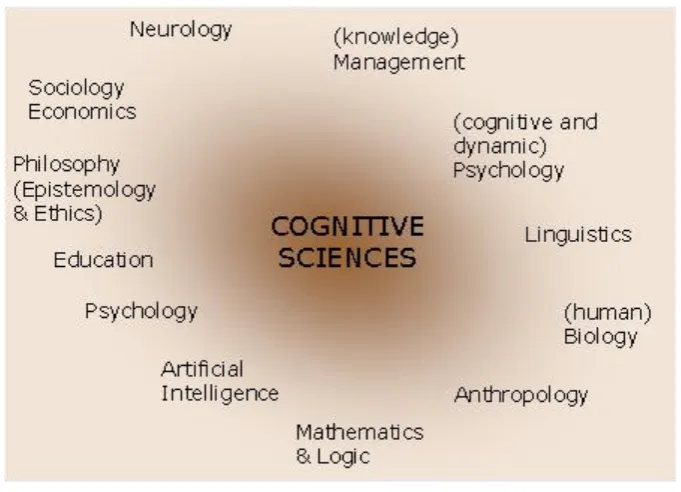
Now, we can get back to the cognitive sciences. Sometimes the term cognitive science is used – which is incorrect. If it is said that the cognitive science is a disci-pline, it is more incorrect. What we are talking about is neither one nor a discipline. What we are talking about, is a problem domain where a number of disciplines over-lap. For this dissertation it is regarded as on Figure 4. What is exciting about this problem domain is that a paradigm is forming around it. It does not mean that we are witnessing a birth of a new discipline, in which case the term cognitive science would be justified, but a formation of a trans-disciplinary paradigm, around a prob-lem domain. So, the cognitive psychologist will remain a psychologist, the artificial intelligence researcher will stick to information systems and the philosopher will not choose another profession. Most of the researchers will also pursue, at some times, other problems in their discipline; but when they are in their joint problem domain, they will share the same paradigm. As this paradigm is still forthcoming, the re-searchers use a modified version of the paradigms of their own disciplines when
approach of cognitive sciences is also positivistic. However, as we only have pre-liminary paradigm-parts here, not a complete well-established paradigm, the chances for the non-positivistic candidates are better than in most of the scientific disciplines. Another reason for this is that the problems of cognition encounter severe difficulties if trying to be positivistic – as it will be explained throughout the present Chapter. Before concluding this discussion of paradigms, we shall revisit Kuhn‟s original conception on paradigms and also have an outlook on some new ideas brought to mind during this research, also trying to outline the expected developments in phi-losophy of science on these grounds.
Figure 4: The cognitive sciences.1
When Kuhn developed his conception of scientific paradigms he only considered them to have a social dimension besides the trivial knowledge-dimension. He had shown how it is not only a question of knowledge which candidate paradigm is ac-cepted, who wins in the scientific revolutions; on the contrary, in his presentation, sociological factors also play an important role – usually more significant than the
knowledge provided by the paradigms. For instance Kuhn (ibid, pp. 157-158) shows that the new paradigm is never superior to the old one in its ability to solve problems;
1 The disciplines are only put there as neighbours around the problem domain of cognitive
it is accepted – amongst others – on the basis of what problem-solving ability it promises rather than on what it demonstrates:
“… less on past achievement than on future promise.”
So, the social dimension prevails against the knowledge-dimension. It should also be noted that Kuhn was right – at that time. Times, however, change. There are two changes very important for us: First, thanks to the globalization of science, the mem-bers of the whole scientific community in a discipline (or in a problem domain) can/could access each others‟ results in no time – if they could only have enough time to read all of it. Second, science became a hugely profitable business; by orga-nizing conferences one can make decent money; publishing journals is probably even
more profitable, at least if it can be judged by the major publishers‟ activity. E.g. Emerald Journals (n.d.) publishes more than 150 journal titles in the fields of man-agement and information science; Elsevier has more than 1,800 journals available in Science Direct (2004), meaning more than 4.6 million full-text HTML articles. Also Procter & Gamble has more scientists on its payroll than MIT, Harvard, and Berke-ley together. (Nordström-Ridderstråle, 2002, p. 96) These changes have given rise to two additional dimensions of discussing paradigms; today we should include the economical and the political dimension or, in other words, the dimensions of money and of power. These changes and their implication were observed during the present research and, although they do not affect directly this investigation, they are outlined as a problem in philosophy of science waiting for a solution. The described problem will not be examined here in further details; the identification of the problem is one of the spin-offs of this dissertation, and solving it remains for further research. Still, there is something remaining to be said about Kuhn‟s original conception and some ideas of the followers.
Kuhn, when he developed his conception of scientific paradigms, also established the meta-paradigm of paradigmatic science. The previously-outlined problem of new dimensions that should be included into investigation may be considered as a prob-lem of description only, but the probprob-lem that follows is definitely on this
decon-struction and sometimes even change of the place of building, Kuhn still maintained the building-metaphor throughout his book. Capra (1991, pp. 364-365) suggests that this metaphor should also be abandoned, and replaced by the network-metaphor. This would mean not only giving up the presently accepted foundation but the conception of foundation as well. It must be difficult beyond imagination. Only a few times in the history of science have we witnessed giving up some really basic foundations; e.g. Einstein must have needed enormous intellectual courage to question the abso-lute nature of space and time – a preconception so fundamental, that, before Einstein, we were not even aware of having it. Giving up the conception foundations should result in constantly maintaining a similar state – but if that is a norm not an
excep-tion, we can probably get used to it. Capra argues that the network metaphor would also mean a shift from structures to processes; the same shift that was also recog-nized to be important in business problem solving and was put forward by metaphors of TQM, BPR, and Organigraphs.
In Section 2.7 it will be argued that we should use metaphors instead of defini-tions in today‟s turbulent environment. If this conception is fused with Capra‟s ne t-work-conception of paradigms we get dynamically changing networks of metaphors – possibly a forthcoming postmodern conception of paradigms, that should, as was outlined previously, have four dimensions – the knowledge, the social, the economi-cal, and the political.
2.2.
On Induction
“Everything that happens once can never happen
again. But everything that happens twice will surely
happen a third time.”
The Alchemist1
Induction is a method at the very basis of the positivistic science. A separate sec-tion is dedicated to it because of its prevailing usage in spite of rejecsec-tion by most of the leading philosophers of science, as it is shown through examples here. First the nature of induction and its rejections are described, then it will be explained under which conditions it can be used, into what purpose and with which validity – as it is also done in this investigation.
Induction in logic is a process of getting from particular instances to a general law as opposed to deduction when a general rule is applied to particular cases. (AllRefer Encyclopaedia, 2004) There is a long debate going on among philosophers and
scien-tists beginning from Bacon, the founder of modern inductive method (Russell, 1946, p. 497); but it can actually be traced back to Plato and Aristotle. The argument is about the validity of induction as a proof of a hypothesis.2 Here are some powerful
opinions of high-ranked thinkers about induction:
“… induction is a bodily habit, and only by courtesy a logical process.” (Russell, 1948, p. 79)
“I do not believe that we ever make inductive generalisations… I believe that the prejudice that we proceed in this way is a kind of optical illusion… Now all this, I believe, is not only true for the natural but also for the social sciences…” (Popper, 1961, pp. 134-135)
1
Coelho, Paulo (1999) The Alchemist, Harper Collins, London, p. 164.
2 The induction is considered to be a source of valid knowledge, i.e. it is at the same time
The ultimate argument against induction was when Popper (1959) showed that no finite number of observations can prove a hypothesis;1 as Russell (1948, p. 435)
summarized it:
“There is nothing in the mathematical theory of probability to justify us in regard-ing either a particular or a general induction as probable, however large may be the ascertained number of favourable instances.”
If it is so, why do scientists still use induction in their arguments? To get a better understanding of the problem, let‟s trace its origin in the field of logic following Pólya‟s (1957, pp. 178-190) train of thought. Syllogism uses two fundamental ways of reasoning,2 modus tollens and modus ponens. (Philosophy Pages, 2004) The
de-monstrative (or rigorous) modus tollens is shown in the left column of Table 1, while the induction relies on modus tollens of plausible (also called heuristic) syllogism, shown in the right column of the table.
Table 1: Demonstrative and plausible syllogism
Demonstrative Plausible
If A then B If A then B
B false B true
A false A more credible
In relation «If A then B» if B is false, A is certainly false. However, if B is true, A can be either true or false. On the other hand, if B is true it is not false, which makes
A more credible (or at least not less credible). Taking a simple example: «If the fuel tank is empty the car does not start.» (If A then B) If the car starts (B false), we can be sure that the fuel tank is not empty (A false), however if the car does not start (B true) the fuel tank can be either full (A false) or empty (A true); but it is at least not certain that the fuel tank is full (A false), so it can be empty (A more credible).
1
Popper (1959) also showed that the principle of inductive inference – if wanting to remain
within the same conceptual framework – should also be introduced inductively, which then
requires inductive principle of higher level and so on, leading to infinite regress.
2 There are other ways of inference in syllogism, like hypothetical syllogism and disjunctive
The major difference between the two kinds of reasoning is that in the traditional modus tollens the conclusion is of the same nature as the premises (i.e. both are clear, sharp) and it is fully expressed and fully supported by the premises (i.e. no ad-ditional information modifies the conclusion); while in plausible modus tollens the conclusion is of different nature (i.e. not so sharp but vague), it is neither fully ex-pressed nor fully supported by premises (i.e. the conclusion can be changed if new information is acquired or even without that). It is clear that the conclusion becomes more credible but we cannot know how much more credible. Using Pólya‟s (1957, p. 189) description of the demonstrative modus tollens:
“If my neighbor and I agree to accept the premises, we cannot reasonably disag-ree about accepting also the conclusion, however different our tastes or other con-victions may be.”
Similarly describing the plausible modus tollens Pólya (1957, pp. 189-190) says:
“… my neighbor and I can honestly disagree how much more credible A becomes, since our temperaments, our backgrounds, and our unstated reasons may be differ-ent… the premises constitute only one part of the basis on which the conclusion rests, the fully expressed, the «visible» part of the basis; there is an unexpressed, invisible part, formed by something else, by inarticulate feelings perhaps, or unstated reasons. In fact, it can happen that we receive some new information that leaves our belief in both premises completely intact, but influences the trust we put in A in a way just op-posite to that expressed in the conclusion. To find A more plausible on the ground of the premises of our heuristic syllogism is only reasonable. Yet tomorrow I may find grounds not interfering at all with these premises, that make A appear less plausible, or even definitively refute it. The conclusion may be shaken and even overturned completely by commotions in the invisible parts of its foundation, although the pre-mises, the visible part, stand quite firm.”
There is, however, something called mathematical induction, which can cause confusion, as it is a method of rigorous proof from mathematics. If we understand the mathematical induction and its relation to inductive reasoning the underlying
The mathematical induction is applied on a set of items where the ith element can be expressed as function of i.1 Then three subsequent steps are applied:
(1) check if the hypothesis is true for the first element (i= 1);
(2) assume that the hypothesis is true for the nth element (i= n);
(3) check the validity of the hypothesis for the (n+1)th element using the as-sumption about the nth element.
As it has been presumed that all the elements of the set can be expressed as the function of their sequential number, these three steps mean a full verification, as starting from n= 1 all the items are covered. The important part is to understand what is done when this simple logic is applied (to actually perform mathematical induction
sometimes requires the highest mathematical skills, however, the logic behind is still simple): using mathematical induction we show that the hypothesis is true for one item and that the validity of the hypothesis does not depend on the variation of the items.
If we apply the train of thought of mathematical induction on induction as a way to prove a hypothesis, we see that the underlying presumption of induction is that the general statement (i.e. the hypothesis) does not change by variation of cases. This presumption falls outside the inductive reasoning, thus validity of induction depends on something outside the inductive inference (Russell, 1948, pp. 435-436):
“If an inductive argument is ever to be valid, the inductive principle must be stated with some hitherto undiscovered limitation. Scientific common sense, in prac-tice, shrinks from various kinds of induction, rightly, as I think. But what guides sci-entific common sense has not, so far, been explicitly formulated.”
This argument also dismisses the induction as a method of proof; on the other hand, it is exactly what gives us the area of application of induction in scientific re-search. As Ernst Mach has put it (Pólya, 1954, p. 108):
1
“Jacques Bernoulli‟s method is important also to the naturalist. We find what seems to be a property A of the concept B by observing the cases C1, C2, C3, … We
learn from Bernoulli‟s method that we should not attribute such a property A, found by incomplete, non-mathematical induction, to the concept B, unless we perceive that A is linked to the characteristics of B and is independent of the variation of the cases. As in many other points, mathematics offers here a model to natural science.”1
What is then the area of application for induction? By observing particular in-stances we can discover a general relation but we cannot prove its validity the same way. Induction is a useful source of ideas but it is valid only if the general statement does not vary by variation of the instances. In mathematics, induction leads the
re-searcher to the idea and then it is proved using mathematical induction; in this sense, the mathematical induction is actually complementary to the inductive reasoning. That is why Pólya (1957, p. 190) says:
“Heuristic reasons are important although they prove nothing.”
Popper (1959, pp. 7-9) also limits his argument to the proving power of induction, the “logic of knowledge” as he calls it, as opposed to the “psychology of knowl-edge”, which deals with the ways of getting to the ideas on which the scientific re-sults are based. He allows all ways of getting to new ideas (Popper, 1959, p. 8):
“… there is no such thing as a logical method of having ideas, or a logical recon-struction of this process. My view may be expressed by saying that every discovery contains «an irrational element», or «a creative intuition», in Bergson‟s sense.”
What do we do if we draw a general conclusion on basis of finite observations? We extrapolate the relation from the observed items to the whole set of them.2 The
trouble here is that extrapolation is known as probably the most unreliable method of
1 Pólya (1954, p. 111) notes that Mach believed that Jacques Bernoulli had invented the
method of mathematical induction but it was actually invented by Pascal.
2 In this train of thought we do not use sampling techniques in induction, which raises the
mathematics1 and it is also proved to lead nowhere in various disciplines. In
philoso-phy Russell‟s (1959) example became famous as „Russell‟s chicken‟ and perhaps the strongest argument comes from finance, known as the weak form of market effi-ciency (Fama, 1970).
What can justify us in saying that an observed relation does not depend on the variation of cases? Well, we have nothing else to rely on but the experience, the knowledge of the researcher – and it is bad news for the defenders of the objectivity of scientific pursuit: the experience is subjective. This means that we have to give up the objectivity (in the sense of being non-subjective) if we want to use induction. The greater the knowledge of the researcher in the domain the greater is the chance that
she/he can „sense‟ whether the observed relation is only true for the observed in-stances or it is a more general one. Of course, that „sensation‟ does not constitute rig-orous proof but it may be true nevertheless.
As it will be argued in Section 2.4 we have to be subjective in the present field of investigation anyway. If we accept the subjective nature of our knowledge we have no reason not to use induction, that is to say our experience, as a source of new ideas – of course they cannot be considered proved. In Section 2.5 a special form of induc-tion is developed, which was used in the present investigainduc-tion.
2.3.
On Observations
“Experience never fails. It is only our judgment which
fails, seeking in our experience things which
experi-ence is not able to provide.”
Leonardo da Vinci2
The previous section discussed under what conditions we can make use of induc-tion; that, if we allow subjectivity then induction can be a way or part of the way get-ting to results. To use induction, we need some kind of input from the reality. This
1
If a function is observed in a certain domain we should guess its behaviour outside that
domain – a rather unpromising enterprise.
2
section is concerned with the question of how to get this input. As scientific results are always about the reality, this input is important not only if we use induction but, at some stage, in all kinds of scientific research.
In natural sciences a common way for getting input from reality means conducting experiments. Experiments in a Galilean sense mean isolation of a part of the reality and keeping some of the parameters of this part of reality under control, while those parameters that are not under control are neglected. Therefore the experiment is sup-posed to represent the reality. The idea of controlling all the parameters is based on the presumption that all these parameters are measurable. Then an event is observed in this controlled environment; and this observation means measuring the changes of
the parameters, thus the experiments in this sense are supposed to be non-subjective. They are independent from the experimenter. The observation could be repeated countless times, by anybody, and the outcome would always be the same.
There are two aspects from which this conception could be asserted. The first is that experiments are also designed based on some ideas, some hypotheses. (Popper, 1961, p. 98)
“I believe that theories are prior to observations.... I do not believe, therefore, in the «method of generalization»… I believe, rather, that the function of observation and experiment is the more modest one of helping us to test our theories…”
Without preliminary ideas, the experimenter would not know what to measure, how to isolate the part of the reality, or what event to observe. This means that ex-periments are not sources of new knowledge but a way to increase the reliability of existing knowledge. This is an important role, so what was the reason to present ex-periments as something else? (Roszak, 1948, p. 103)
strate-gically inoffensive to the cultural authorities of the day: they would concentrate their attention on the clearcut indisputable facts of common experience – the weights and sizes and temperature of things. Facts first, they insisted. Ideas later.”
The second assertion comes from quantum physics. In experiments it is assumed that there is a reality „out there‟ and the experimenter observes it without being in-volved. However, as quantum physics has shown us, this assumption is not valid. The elementary particles demonstrate both wave and corpuscular characteristics – which are mutually exclusive. Which one will be manifest depends on the experi-menter – none has any meaning outside the experimental context (Davis, 1989, p. xiv):
“One experiment may reveal the wave nature of the electron, another the particle nature. Both cannot be manifested at once; it is up to the experimenter to decide which facet to expose by his choice of experiment.”
So, even in quantum physics we cannot observe the reality without affecting it, as, e.g., described by the thought experiment known as Schrödinger‟s cat. The exper i-ments, the measuring devices are designed by the experimenter, the experimental data are interpreted by the experimenter, and so on (Heisenberg, 1962, p. 25):
“… we have to remember that what we observe is not nature in itself but nature exposed to our method of questioning… quantum theory reminds us, as Bohr has put it, of the old wisdom that when searching for harmony in life one must never forget that in the drama of existence we are ourselves both players and spectators.”
Humans are immensely complex and they live in the web of other humans and human organizations, thus all the parameters and their interrelatedness cannot even be mapped, it is difficult to keep them under control, and it is impossible to see which can be neglected. This is already enough to pose the question, whether it is at all possible to use experiments in human affairs. There is an idea, how this difficulty could be overcome: When you believe that there is a single factor variation of which causes changes in another parameter, get this single factor under control and use a representative sample in relation to all the other parameters. (Aronson, 2004, pp. 332-338) There are two notes to be made on this approach. Firstly, to establish con-trol over the examined factor, a laboratory environment is needed, which means
arti-ficial isolation of a part of the reality (just as in natural sciences) resulting in exclu-sion of some environmental influences; as we are not aware of all influences we can-not be sure that we have can-not excluded something crucial. Secondly, for the same rea-son we also cannot be sure that we really have a representative sample in relation to all the other parameters.
Kvavilashvili and Ellis (in press, cited in: Eysenck, 2001, pp. 4-5) discuss these two remarks under the topic of ecological validity, which consists of two parts: (a) representativeness (natural situation vs. experimental situation); (b) generalisability (validity of findings in real world). The authors claim that psychological experiments lack ecological validity on both aspects. Aronson (ibid) acknowledges these and of-fers random assignment (anybody can participate the experiment) to give acceptable approximation from the viewpoint of the second remark while for the first he empha-sizes the importance of the design of the experiment, which, as he argues is more art than science. He also says that (ibid, pp. 339-340) experiments can be realistic in two different ways: experimental realism refers to people really displaying what is ob-served if the experimental situation would happen in the real world; mundane real-ism means how much the experimental situation reflects the real world. High ex-perimental realism is achievable while we can never be sure about mundane realism.1
Important conclusions can be drawn based on high experimental realism alone; this
1 Actually we can often be sure that such situations as in the experiment never occur in real
is how Aronson and some others became such successful experimental psychologists. But, as in the case of induction, it is more because of these exceptional individuals than because of the experiment (Slater, 2005, p. 53):
“Picture a scientist discovering a new antibiotic that works amazingly well on male rats in super-sterilized cages with one testicle only. That discovery lacks exter-nal validity, for most men have two testicles and, as a general rule, keep their living conditions less than sterile.”
Another way of coping with the impenetrable diversity of parameters in human experiments is to use a control group – as is often done – for which everything is the same (or at least the experimenters try to make everything the same), so it is
sup-posed that all the differences of the outcome are caused by the difference of the con-trolled parameter. This assumption may be asserted in terms of questioning the „con-trol‟ feature of control groups.
The next thing that does not work in human experiments is the repeatability. When we perform the experiment for the first time we change the starting conditions. This means that the same experiment cannot be performed ever again. We either have to face the situation or we have to work with different experimental subjects. So, we have only a single opportunity in case of human experiments.
All the features discussed so far that are specifically human are about the variety of parameters in some manner. To cope with this, human experiments are usually conducted with a number of people at the same time, trying to achieve representa-tiveness. Of course there is one limitation to the representativeness which surely re-mains: only people willing to participate in such experiments will be represented – usually they are students from the university at which the experimenter works. This all also means that huge effort and usually collaboration of many people is needed, which also means a lot of time and a lot of money.
well but the interpretation of immeasurable parameters leaves more space to indi-viduals). (2) The experiments are not carried out with objects but with human beings, who think, feel, may be in different moods, have different beliefs, etc. This is why in human experiments we do not talk about experimental objects but of experimental subjects.
Having human beings for experimental subjects involves a series of wholly new considerations as well. How to get people to be in similar moods (and the similar moods may still be something very different to different people); what would be the same situation for people with different beliefs and different value systems, and so forth. But most of all, the situation becomes complicated when we take the moral
is-sues into consideration. To get as close as possible to natural context, the experi-menter usually deceives the people volunteering to participate the experiment. After the experiment the experimenter explains to the participants what has actually hap-pened and what the inquiry was about, and the participants agree, with hindsight, that they were willing to participate. Sometimes things go wrong, and there is not only a need for explanation but the participants also need psychological treatment. Two ex-treme and well-known examples are introduced here.
A disastrous example of the deception was the obedience experiment of Milgram (1975). An experimenter, a fake experimental subject and a real experimental subject participated in this experiment. The experimental subjects were told that the inquiry is about the effect of punishment on learning; one of them was going to be the learner, the other the teacher. They draw, and the real experimental subject always got the role of the teacher. The experimenter instructed the teacher to administer electroshocks to the learner every time she/he made a mistake, increasing from the beginning 15V to 450V (30 grades, the high grades labelled “Danger: severe”, “XXX”, etc.). The learner started to complain at 150, gave a last scream at 300 and then went silent. The experimenter said that the silence was to be considered a wrong answer and the shocks were to be continued. How many people went “all the way”? 65%. Of course, they were debriefed when the experiment ended. Was it enough?
“Most seriously, he led them to believe that they were perilously harming another human being. Even after a friendly reconciliation with the supposed victim and a thorough debriefing, participants were left forever knowing that they were capable of such perniciousness.”
As one of the experimental subjects said decades later (Slater, 2005, p. 49):
“I was in the lab, and I only went to 150 volts. If I‟d gone any higher, believe me, I wouldn‟t be talking to you right now. That would be between me and my psychi a-trist.”
The second example was the Stanford Prison Experiment conducted by Zimbardo (1999-2005). The experimental subjects were told that they would be assigned the
role of a prisoner or the role of a guard. The deception was small at this time: the guards were told that the experiment focuses on the prisoners but they were also un-der surveillance. In this case the deeper deception was created by the illusion of the jail. The scene was set in the Stanford County Jail. Even Zimbardo, impersonating the prison superintendent, started to think more of how to prevent an assumed escape than how to run the experiment. The guards had to recognize that in such a situation they (or more precisely some of them) were capable of becoming violent, exercising their power and so on. But there was another reason why the experiment ended after only six days instead of the planned two weeks. Using Zimbardo‟s ( Haney-Banks-Zimbardo, 1973, p. 69) summarizing words:
“The prisoners experienced a loss of personal identity and the arbitrary control of their behaviour which resulted in a syndrome of passivity, dependency, depression and helplessness.”
reality, i.e. the researcher is directly observing what is going on during the experi-ment. Another direct way is if the researcher does not artificially isolate a part of re-ality but performs observation in natural context. There are some more or less struc-tured versions of this kind of observations, e.g. variations of action research. In hu-man domains we can also have indirect inputs from reality, i.e. we can survey people in the form of questionnaires and interviews (which may be more or less structured) or we can simply talk to them. Some unstructured ways of getting inputs from reality are examined in further details in the next section.
There is a special branch of inquiry called thought experiments. There are two major types of it: In the first we devise an experiment that cannot be performed (1)
for now due to e.g. technical difficulties but it may be possible to perform it at some time in the future; (2) for an overriding consideration, e.g. ethical considerations, apart from which in principle, it could be carried out. In both cases we think about what the outcome of the experiment would be if our knowledge is right. Probably the most famous thought experiment is the Einstein-Podolski-Rosen (EPR) effect (Penrose, 2004, pp. 582-591). It was originally imagined by Einstein, arguing against non-local variables, he said, that if the argument of quantum physicists was right, it should have such and such an outcome. A slightly modified version of the experi-ment was carried out years later, when the technology became advanced enough, and the outcome was what Einstein had predicted. The second type of thought experi-ments is often used by Gestalt psychologists. In this type we relate our experience and/or well-known phenomena to our hypothesis, e.g. if our model is correct, in such and such situation we should observe such and such outcome – is this what our ex-perience says? Of course, as in the case of induction, we have to give up the re-quirement of non-subjectivity to use this second type of thought experiments – it is also based on experience, which is subjective.
In the present dissertation, exclusively unstructured inputs are used from the real-ity, partly as direct observations and partly as talking about it and performing thought experiments of the second kind. This is coherent with the postmodern nature of the