1
Trends in European Household Credit
Solid or shaky ground for regulatory changes?
Elina Pyykkö
*ECRI Commentary No. 7 / July 2011
Introduction
The financial crisis has undoubtedly affected the European financial markets and much has been done to develop and strengthen the financial system. The regulatory reform agenda agreed by G-20 countries in 2009 has fuelled continuing discussion about the mechanisms to create a financial system that promotes sustainable economic growth. Consumer credit markets have been one of the main areas of focus in this discussion, as regaining consumer confidence and lending to households to promote growth are considered key factors in the recovery from the financial crisis. The European Commission’s proposal for a directive on mortgage credit to consumers will have a crucial impact on the development of household credit markets.
Amid the series of new legislation a question receiving less attention is whether these regulatory attempts are directed optimally. What are the different pieces of legislation actually regulating? Are the financial markets in a sufficiently sustainable position to enable them to keep functioning through all these new directives? In particular, what is the extent of the recovery in household credit markets since the financial crisis? The purpose of this commentary is to present a snapshot of the current status of the household credit market, in order to provide insights and a basis for these questions. By looking at the development of various kinds of household credit during the period surrounding the crisis, the commentary assesses whether there are patterns that should be taken into account, especially when evaluating the potential of the mortgage credit directive for developing the market.
Recent developments in European household credit markets
The growth in total loans to European households has been positive but volatile since the drop in late 2008. A recent breakdown of the household credit markets among member states shows that the UK is still the biggest market for mortgage credit in Europe, followed by Germany, France and Spain (see Figure 1). When considering all loans to households, however, the level of total credit to households is largest in Germany. New member states are still very small players in the European market for mortgage credit.
*
Elina Pyykkö is a Researcher at the European Credit Research Institute of CEPS in Brussels. She holds a
PhD in Financial Accounting from the University of Oulu, Finland. Comments by Karel Lannoo, CEO of
Figure 1. Credit to EU-27 households in April 2011 (€ billions) 0 200 400 600 800 1000 1200 1400 1600 Ge rm an y Un it e d Ki n gd o m Fr an ce Sp ai n It al y Ne th e rl an d s De n m ar k Sw e d e n Por tu ga l Au st ri a Ir e lan d G
reece Pola
n d Be lgi u m Fin la n d Cz e ch R e publ ic Lu xe m b o u rg Hu n ga ry Ro m an ia C ypr us Slo va kia Bu lg ar ia Slov e n ia La tv ia Li th ua ni a Es to n ia Ma lt a
Housing loans Consumer loans Other loans
Source: European Central Bank.
The total loans to European households amounted to about 60% of European GDP in 2010(see Figure 2).†
Yet, the weight of the old member states in the household credit market calls for a division of countries into classes to avoid comparing countries with diverse market conditions and financial systems. Therefore, the countries can be classified into northern member states, southern member states and new member states. Northern member states comprise all the traditional EU member states that have fairly strong and stable credit markets, while southern member states include Spain, Italy, Greece and Portugal, which have experienced considerable instability in their credit markets during the last few years. The third group of countries includes the 12 newest member states, where the credit markets are still very small.
Using the above-mentioned division demonstrates that in relation to overall European GDP, housing loans in northern and southern member states make up the largest form of household credit, with the share of northern member states being more than three times that of southern member states. Housing loans in the new member states amounted to only 1% of overall European GDP. Looking at the general development of various types of credit to households as a percentage of European GDP during the last five years, it seems that across country and credit classes, only the level of housing loans in the northern member states has increased significantly in volume since the financial crisis. This finding, however, reflects the overall dominance of northern member states in GDP and the total loans to households of the EU-27 countries.
† European Credit Research Institute, Lending to Households in Europe (1995-2010): ECRI Statistical Package
Figure 2. Credit to EU-27 households as a % of GDP
32% 31% 29% 32% 34%
8% 9%
9%
9% 10%
1% 1%
1%
1% 1%
0% 10% 20% 30% 40% 50% 60% 70%
2006 2007 2008 2009 2010
New MS Other Loans
New MS Consumer Loans
New MS Housing Loans
South MS Other Loans
South MS Consumer Loans
South MS Housing Loans
North MS Other Loans
North MS Consumer Loans
North MS Housing loans
Sources: ECRI Statistical Package 2011 and European Central Bank.
[image:3.595.168.432.553.711.2]A comparison with overall EU-27 GDP is useful for assessing the structure and size of the household credit markets in Europe, but for the purpose of comparing credit trends with other markets, using averages of country-specific ratios of household credit to domestic GDP provides a more refined picture. Even though changes in domestic GDP have to be taken into consideration when interpreting these figures, GDP is chosen as a denominator to incorporate the overall economic landscape into the analysis. In domestic terms, housing loans have been growing in relation to domestic GDP in all country classes (see Figures 3a-3c). This growth has also continued throughout the five-year period surrounding the financial crisis, with only northern member states experiencing a decline in 2008. Therefore, it seems that in relative terms, southern and new member states did not experience declines in their housing loans during the financial crisis. Meanwhile, consumer credit grew significantly only in the new member states, but just until 2009. Growth in other loans to households relative to GDP is observed only in southern member states during the last three years, possibly reflecting the effects of the tightening in state financial conditions on households’ needs to finance activities other than consumption.
Figure 3a. Average credit to households as a % of domestic GDP in the northern member states
48% 49% 47% 53% 54%
7% 7% 7%
7% 7%
11% 11% 10%
11% 10%
0% 10% 20% 30% 40% 50% 60% 70% 80%
2006 2007 2008 2009 2010
Other loans Consumer loans Housing loans
Figure 3b. Average credit to households as a % of domestic GDP in the southern member states
39% 42% 42% 44% 47%
8% 8% 9%
8% 9%
7% 7% 7%
8%
10%
0% 10% 20% 30% 40% 50% 60% 70%
2006 2007 2008 2009 2010
Other loans Consumer loans Housing loans
Sources: European Central Bank and ECRI Statistical Package 2011.
Figure 3c. Average credit to households as a % of domestic GDP in the new member states
15% 20%
21% 25%
26% 7%
8% 9%
10% 9%
7%
7% 7%
7% 7%
0% 5% 10% 15% 20% 25% 30% 35% 40% 45%
2006 2007 2008 2009 2010
Other loans Consumer loans Housing loans
Sources: European Central Bank and ECRI Statistical Package 2011.
Figure 4a. Cumulative growth in housing loans 0% 50% 100% 150% 200% 250% 300% 20 06 Ja n 2 006 A p r 200 6J u l 20 06 Oc t 20 07 Ja n 2 007 A p r 200 7J u l 20 07 Oc t 20 08 Ja n 2 008 A p r 200 8J u l 20 08 Oc t 20 09 Ja n 2 009 A p r 200 9J u l 20 09 Oc t 20 10 Ja n 2 010 A p r 201 0J u l 20 10 Oc t 20 11 Ja n 2 011 A p r
Northern Member States Southern Member States New Member States
[image:5.595.170.429.325.481.2]Source: European Central Bank.
Figure 4b. Cumulative growth in consumer loans
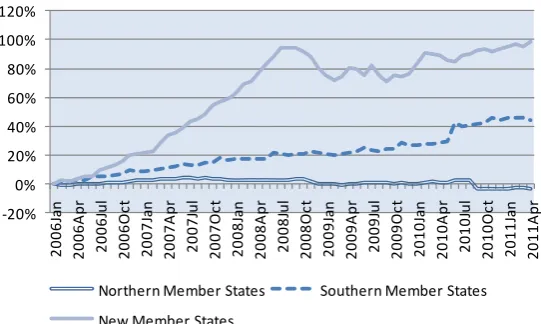
‐20% 0% 20% 40% 60% 80% 100% 120% 140% 160% 20 06J an 20 06Ap r 20 06J u l 20 06 Oct 20 07J an 20 07Ap r 20 07J u l 20 07 Oct 20 08J an 20 08Ap r 20 08J u l 20 08 Oct 20 09J an 20 09Ap r 20 09J u l 20 09 Oct 20 10J an 20 10Ap r 20 10J u l 20 10 Oct 20 11J an 20 11Ap r
Northern Member States Southern Member States New Member States
Source: European Central Bank.
Figure 4c. Cumulative growth in other loans to households
‐20% 0% 20% 40% 60% 80% 100% 120% 2006J an 2006Ap r 2006J u l 2006Oc t 2007J an 2007Ap r 2007J u l 2007Oc t 2008J an 2008Ap r 2008J u l 2008Oc t 2009J an 2009Ap r 2009J u l 2009Oc t 2010J an 2010Ap r 2010J u l 2010Oc t 2011J an 2011Ap r
Northern Member States Southern Member States
New Member States
[image:5.595.164.435.531.693.2]Also in consumer loans and other loans to households, the new member states have experienced substantially stronger growth during the last five years in comparison with the old member states. In fact, lending for purposes other than housing in northern member states has consistently decreased since the financial crisis. Consumer loans have also decreased in southern member states, while other loans to households are still growing among these countries. Even though the growth of consumer and other credit to households in the new member states has continually been stronger than in other member states, the levels attained by these types of credit in the new member states are currently only the pre-crisis levels. The figures also show that in every country class, the reactions to the financial crisis as well as yearly variations are stronger in lending for purposes other than housing. This indicates that this type of lending is more volatile and dependent on market conditions than lending for house purchases.
Therefore, the current growth in the market for credit to households is mainly in housing loans. This is of course an interesting observation given that mortgage credit markets are not under specific EU legislation. In this context, the European Commission is developing regulation specifically for the mortgage credit markets. Yet the evidence presented in the above figures suggests that the growth in European retail markets for housing loans may have not reached sustainable levels. Growth seems to be more persistent only in new member states, which still comprise just a small portion of total European housing loans.
Implications for the EU-wide legislation
One of the primary objectives of the mortgage credit directive is to promote consumer protection by requiring clearer information to be provided to the consumer, better assessments of consumers’ ability to repay the loans and more reliable advice. The execution of these objectives is proposed through a harmonised, annual percentage rate of charge (APRC), minimum pre-contractual information, advertising rules and obligatory creditworthiness and suitability assessments. There are, however, major challenges involved in the implementation. The mortgage credit markets of the member states have many distinct characteristics. The general legal framework differs in the member states as do the taxation regimes, and the level of market development and sophistication can also vary substantially. The level of consumer protection is also highly divergent among countries, not to mention cultural differences. Thus, measuring the necessary level of optimal consumer protection to boost confidence is very difficult on an EU-wide basis.
Consumers behave differently depending on the costs of credit. The assorted levels of financial capability of consumers as well as distinct problems among member states create different risks and resulting cost structures. Foreign currency borrowing is one good example of a risk that is encountered only in certain member states.
Figure 5. Interest rates on housing loans
0 2 4 6 8 10
2006J
an
2006A
p
r
2006J
u
l
2006Oc
t
2007J
an
2007A
p
r
2007J
u
l
2007Oc
t
2008J
an
2008A
p
r
2008J
u
l
2008Oc
t
2009J
an
2009A
p
r
2009J
u
l
2009Oc
t
2010J
an
2010A
p
r
2010J
u
l
2010Oc
t
2011J
an
2011A
p
r
Northern Member states Southern Member states
New Member States
Source: European Central Bank.
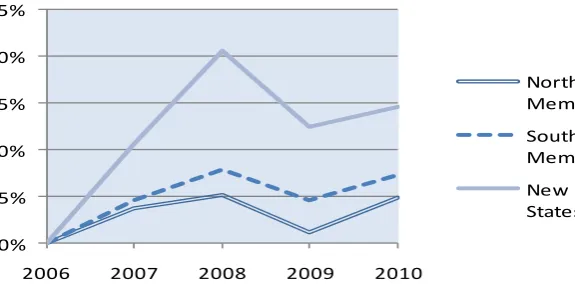
Another indication of consumer behaviour can be provided by observing the consumption behaviour of households. Figure 6 presents the cumulative growth of average, final consumption expenditure of households per capita in the EU country classes. To assess the changes in the context of the financial crisis, growth is measured relative to the levels of 2006. We can see that households in the northern member states have been more conservative in their consumption behaviour, as their consumption started decreasing in the year of the financial crisis. In the southern member states, it took longer for households to adjust their consumption to the financial crisis. Since 2008, the pattern of household consumption has been following a similar trend in both groups of old member states. In the new member states, the reactions in household consumption during the period surrounding the financial crisis have been more pronounced in comparison with the old member states. Household consumption grew significantly until the end of 2008, followed by a sharp drop in 2009, but it recovered in a strong positive trend in 2010.
Figure 6. Cumulative growth of household expenditure per capita
0% 5% 10% 15% 20% 25%
2006 2007 2008 2009 2010
Northern Member States
Southern Member States
New Member States
[image:7.595.134.422.566.711.2]These differences in household consumption patterns are also likely to reflect the differences in attitudes and general culture of households among the member states, which should be taken into consideration when developing EU-wide legislation on mortgage credit. European mortgage markets are inherently domestic in nature, which is why questions have been raised about the rationale for EU-level action. Mortgage markets are heavily driven by consumer behaviour, and thus in view of the cultural and local issues relevant for the consumer it may be more convenient for the member states to take action themselves.
[image:8.595.138.459.410.588.2]Another major concern arising from the proposed legislation is that as a result of the lenders’ obligation to assess the borrower’s creditworthiness, responsible lending practices may result in reduced access to credit. Similarly, the new capital requirements referred to as ‘Basel III’ may have an effect on the lending behaviour of banks. Particularly in periods of distress, raising capital becomes more expensive, which is why capital may significantly drive the incentive structure of banks. If the markets are in an unstable state when these sorts of requirements are implemented, the extent of this possible impact may be considerable. These challenges may also have a detrimental effect on competition. The number of credit institutions has already decreased from the pre-crisis levels in all classes of member states (see Figure 7). This development is likely to be mainly a natural outcome of the consolidation and efficiency measures undertaken after the financial crisis. At the same time, Figure 7 also demonstrates that the markets are still undergoing substantial structural changes, and the degree of reaction varies among the different member states.
Figure 7. Cumulative growth in the number of credit institutions
‐14%
‐12%
‐10%
‐8%
‐6%
‐4%
‐2% 0% 2% 4%
2006 2007 2008 2009 2010 Northern Member
States
Southern Member
States
New Member States
Source: European Central Bank.
Conclusions
has shown where some of the inherent difficulties lie. The diversity in macroeconomic, social and cultural aspects may involve diverse needs for consumer protection among member states. Therefore, the EU-wide legislation may prove inadequate for some countries, while for others it may just pose an additional cost without significant improvements to the functioning of the market. Promoting more responsible lending may also prove challenging: if creditors find creditworthiness assessments too constraining, this may lead to a decrease in lending activity. This effect may be exacerbated if the new regulation is introduced while the markets continue to be unstable and recovering from the financial crisis.
European Credit Research Institute
The EUROPEAN CREDIT RESEARCH INSTITUTE (ECRI) is an independent research institution devoted to the study of banking and credit. It focuses on institutional, economic and political aspects related to retail finance and credit reporting in Europe but also in non-European countries. ECRI provides expert analysis and academic research for a better understanding of the economic and social impact of credit. We monitor markets and regulatory changes as well as their impact at the national and international levels. ECRI was
founded in 1999 by the CENTRE FOR EUROPEAN POLICY STUDIES (CEPS) together with a consortium
of European credit institutions. The institute is a legal entity of CEPS and receives funds from different sources. For further information, visit the website: www.ecri.eu.
ECRI Commentary Series
ECRI Commentariesprovide short analyses of ongoing developments with regard to credit markets in
Europe. ECRI researchers as well as external experts contribute to the series. External experts are invited to suggest topics of interest for ECRI Commentaries.
ECRI Statistical Package
Since 2003, ECRI has published a highly authoritative, widely cited and complete set of statistics on consumer credit in Europe. This valuable research tool allows users to make meaningful comparisons among all 27 EU member states and with a number of selected non-EU countries, including the US and Canada. For further information, visit the website: www.ecri.eu or contact [email protected].
.
European Credit Research Institute (ECRI)
Place du Congrés 1 B-1000 Brussels, Belgium
Tel.: +32-2-2293911 Fax: +32-2-2194151 Email: [email protected] Web: www.ecri.eu