Inside the Spring 2011 EUSA Review:
Message from Incoming Chair and Outgoing EUSA Review Editor Amie Kreppel 2
EUSA Review Forum: EU as a Global Actor since Lisbon Guest Editor – Jolyon Howorth
The European External Action Service and Smart Power Mai’a Davis Cross 3
Principles and Values Underpinning EU Foreign and Security
Policy in an Emerging Multi-Polar World Jolyon Howorth 5 Two’s Company: But is it Enough? Reflections on Anglo-French
Defence Cooperation Anand Menon 7
Matching Ambitions to Resources: Paying for CFSP in an Era
of Fiscal Restraint Zachary Selden 10
Economics Interest Section
Government Debt and Fiscal Rules in Europe – A New Proposal Andrew Hughes Hallett 13
EU as a Global Actor Interest Section
Developing EU Diplomacy in a Changing World Michael Smith 16
Teething problems of the European External Action Service Jost Morgenstern 18
EU Public PolicyInterest Section
Studying the Fine Print: Policy Convergence and the New
Transatlantic Agenda Laurie Buonanno and Neill Nugent 20
Book Reviews: 23
European Environmental Agency. The European Environment. State and Outlook: Synthesis and The European Environment. State and Outlook: Assessment of Global Megatrends.
Reviewed by Michel Gueldry
Hermann Schmidt (ed). European Parliament Elections after Eastern Enlargement. Routledge, 2010. Reviewed by Magda Giurcanu
:
and increased cooperation and collaboration with other organizations including the European Consortia for Political Research (ECPR) and the ECSA-World group. In other words – the next two years look to busy and challenging and I look forward to working together with both the EUSA Executive Committee and EUSA members in general as we head towards the 2013 meeting in Baltimore.
-Amie Kreppel Message from Incoming Chair and Outgoing
EUSA Review Editor
This issue of the EUSA Review marks the end of my two-year term as Editor as I transition to my new role as Chair of EUSA. I am happy to report that newly elected Executive Committee member Nicolas Jabko (Johns Hopkins University) will be taking over as of the Fall 2011 issue. In addition, another new Executive Committee member, Susanne Schmitt (University of Bremen) will be taking over the EUSA Review’s book review section. To facilitate the book review process there is now a new opportunity to sign up as a potential book reviewer on the EUSA homepage. We especially encourage junior scholars to submit their information, since we may be less aware of their interests and areas of expertise.
The EUSA Executive Committee also includes two additional new members elected during the spring Mi-chelle Egan (American University) and Mitchell Smith (University of Oklahoma) together with continuing members Adrienne Heritier (European University In-stitute) and Berthold Rittberger (University of Munich). For a complete list of the current Executive Committee and their roles see the EUSA website.
In addition to welcoming four new members to the Executive Committee, I am happy to be able to an-nounce the launch of several new initiatives for EUSA.
Following a good deal of hard work from outgoing Executive Committee member Erik Jones (SAIS-Bo-logna) has worked to build a collaborative relationship with the Brussels based EU policy magazine E!Sharp that will allow members of EUSA to submit short (500-700 words) editorials to the online publication. Ad-ditional details and instructions on how to submit are available at the EUSA website.
We are also moving forward with the planned special issue of the Journal of European Public Policy (JEPP) incorporating some of the best papers pre-sented at the 2011 EUSA meeting in Boston. Thanks to an agreement with JEPP the EUSA conference special issue should become a regular event linked to our conference. This will provide an excellent forum for showcasing the high caliber of EU related research presented during the conference. We expect this first special issue to be published in late 2011 or early 2012.
Other ongoing initiatives include the development (in collaboration with the ‘Teaching the EU’ EUSA-Section) of a special “Teaching the EU” workshop in conjunction with the 2013 EUSA conference (through a proposal to the EU Life Long Learning Programme)
From the Chair
How to Support the European Union Studies
Association!
Library Membership
* To build the EU-related library collection. $150 / year
Sustaining Membership
* Free conference access for up to 4 graduate students.
* One free 1-page advertisement/announcement in the Review per year. $1,000 / year
Contributing Membership
* 25% conference fee reduction for up to 4 gradu-ate students.
* 50% reduction on one 1/2-page advertisement in the Review per year. $500 / year
EU as a Global Actor since Lisbon
Guest Editor- Jolyon Howorth
Jolyon Howorth is Jean Monnet Professor of Eu-ropean Politics ad personam and Emeritus Professor of European Studies at the University of Bath (UK). He has been a Visiting Professor of Political Science at Yale since 2002. From 2008-13, he will be Visiting Professor of Political Science and International Affairs, dividing his teaching between the Political Science Department and the International Affairs Council. He is a Senior Research Associate at the Institut Français des Relations Internationales (Paris), a Fellow of the Royal Society for the Arts (UK), Chevalier dans l’Ordre des Palmes Académiques (France), and Member of the Advisory Boards of the European Institute for Public Ad-ministration (Netherlands), the Centre for the Study of Security and Diplomacy (UK), the Institute for Strategic Research (Paris) and the European Business School (London). He spent the spring semester 2010 on leave in Berlin serving as a Research Professor at the Kolleg Forschergruppe, Otto Suhr Institute (Freie Universität) and working on a book project on foreign and security policy in the EU.
He has published extensively in the field of Europe-an politics Europe-and history, especially security Europe-and defense policy and transatlantic relations - fourteen books and two hundred journal articles and chapters in books. Re-cent books include: Security and Defence Policy in the European Union, Palgrave, 2007; Defending Europe: the EU, NATO and the Quest for European Autonomy, Palgrave, 2003 (edited with John Keeler); European Integration and Defence: the Ultimate Challenge? Paris, WEU-ISS, 2000.
The European External Action Service and Smart Power
Mai’a Davis Cross
On 1 December 2010, the EU inconspicuously launched the new European External Action Service (EEAS). Much of the world was unaware that any-thing had changed. But despite its quiet beginnings, the EEAS is actually a major innovation in the field of diplomacy as the first supranational diplomatic service of its kind. To be sure, it was not created from scratch. It builds upon the infrastructure of the 136 Commission delegations around the world that were already in place. But the powers of the new EU delegations are
signifi-cantly broader and more ambitious than the old Com-mission delegations. Rather than being responsible for enacting the policies of just one institution, the EEAS is charged with coordinating, shaping, and enacting the entire body of EU foreign policy, under the command of the EU’s foreign policy chief, Catherine Ashton. In this sense, rather than being an offshoot of just one EU institution, the EEAS is set to become the embodiment of common EU foreign policy, and is in the process of cultivating a distinctive institutional identity.1
Of all the Lisbon Treaty’s innovations, the EEAS most demonstrates the EU’s commitment to smart power.2 I define smart power as the strategic and
simultaneous use of both hard and soft power. The EEAS is still in its first year and it is too soon to know what role it will ultimately have, but its very existence is an important indication of the EU’s evolving approach to foreign policy. From the 2003 Iraq war to the current Libya crisis, it is easy to point out the recent, high-profile episodes in which member states were not readily able to coordinate their foreign policies, but it would be a mis-take to draw any conclusions from these events alone. As discussed below, from a longer-term perspective, the fact that Europeans were willing to launch an ambitious, new multinational diplomatic institution shows that they are taking smart power seriously. This bodes well for the EU’s ability to be better prepared in the face of crises, and to become a more consistent foreign policy actor.
What is smart power and how does the EEAS con-tribute to it? Joseph Nye has written extensively about different forms of power. He defines hard power as coercive. It is the ability of A to force B do something it would not otherwise do. By contrast, soft power inspires attraction, the ability to make B want what A wants. In order to recognize smart power, it is important to note that the tools of power do not necessarily correlate with either hard or soft power specifically. That is, it would be wrong to assume that hard power is equated with military might and soft power with diplomacy. Rather, military, diplomatic, economic, and cultural tools can all be used either to coerce or to attract. For example, militaries used for humanitarian aid and disaster relief can be a source of attractive power, as can militaries that are efficient and well-run. Similarly, diplomacy can be coercive, using the tools of sanctions, hard bargaining, or shaming. But diplomacy is also the key instrument of engagement, persuasion, and mutual understanding. Thus, a variety of different tools could be at work in crafting the strategic combination of hard and soft power.
ber states and EU institutions more closely together, facilitating better coordination of hard and soft power. This is of course key to achieving effective smart power. Member states have been the main purveyors of hard power, while the EU has been more of a source of soft power. This is true both in response to unanticipated crises as well as in terms of policy emphases. The EU has been reluctant to coerce (or to appear to coerce) because it is a multinational actor that is committed to institutional and legal processes that are transparent and voluntary. Hard power tactics would go against its normative character. Indeed, the EU resorts to hard power only to support its most important norms and values, such as to stop human rights violations or discourage authoritarian practices. Typically, the EU draws upon its wealth of soft power. Depending on the audience, the EU is attractive because of its democratic norms, model of regional integration, commitment to enlarging its membership, history of overcoming a violent past, and so on.
By contrast, member states have tended to control the hard power side of foreign policy, to the extent that this is necessary, because it is much easier for them to act decisively and legitimately in ways that involve coercion. When it comes down to it, statesmen still have the distinct authority to make difficult foreign policy decisions unilaterally and to implement them as quickly as they deem necessary. Of course, member states also have a wealth of soft power resources at the same time, such as programs of educational exchange, cultural promotion, and public diplomacy. The creation of the EEAS shows the political will to bring these vari-ous tools of power together, and to set the stage for better coordination of both hard and soft foreign policy strategies.
Second, the creation of the EEAS is “smart” be-cause the EU is fundamentally a diplomatic actor. This is where its real strength lies. The primary way in which member states and EU institutions articulate their in-terests in the international arena is through diplomacy. The common market, Schengen zone, justice and home affairs issues, enlargement, and so on, were all built on a strong process of internal diplomacy among member states. High-level, professional diplomats based in Brussels push integration forward and translate new treaties into tangible policy. By strengthening this hall-mark of Europe – diplomacy – the EU capitalizes on what it does best. Without exception, member states have put forward their best and most qualified ambas-sadors to lead the new EU delegations, and at lower levels in the diplomatic hierarchy competition for EEAS postings has been fierce. Given that the success of the EU delegations will rest in part on the people who populate them, there is reason to believe that all parties
involved want to equip the EEAS to be a smart power actor. Diplomats are well-positioned and professionally trained to use soft power consistently, and hard power when necessary. By focusing on diplomacy as the tool for future EU foreign policy, and then endowing the new institution with the best and the brightest, Europeans have clearly shown a commitment to smart power. Third, the EEAS enables the member states to articulate their common voice more strongly. In do-ing so, it amplifies both hard and soft power. Indeed, the oft-repeated goal of member states to speak with one voice comes from an understanding that by act-ing together, Europe is stronger. Collectively, the 27 member states have much at their disposal – over half a billion people, the largest economy in the world, the second-highest level of military spending globally, the largest contribution of foreign aid, transnational collabo-ration in research and development, and so on. For several decades now, member states have renewed and strengthened their goal to speak with one voice in foreign policy matters: from the 1970 European Political Cooperation to the 1992 Common Foreign and Secu-rity Policy to the 1998 European SecuSecu-rity and Defense Policy. Now in 2011, with the EEAS, Europeans have one of the largest diplomatic services in the world. This new diplomatic body is distinctive in that it actually puts thousands of high-level foreign policy experts on the ground who will be able to judge first-hand how events impact EU interests and goals. They will also be able to shape responses to these events, and to build strong relationships that they can draw upon when unexpected crises strike in the future. This will serve to make both Europe’s hard and soft power more visible.
In sum, the EEAS facilitates better coordination of hard and soft power, capitalizes on a successful tradi-tion of professional diplomacy, and amplifies hard and soft power. The potential for effective smart power clearly exists. Of course, it is still up to the member states to decide what they will allow the EEAS to do, and how far it will go in its development. Ashton has already faced the challenge of coordinating diverse member-state positions in the wake of several crises. The EEAS is ideally suited to exercise smart power, but it must still have a mandate to act. Stronger leadership going forward is necessary so that member states are encouraged to see their diplomatic creation reach its potential.
Coreper started out with a limited mandate to prepare Council meetings. By many accounts, it has now grown into the central engine of EU integration. This occurred in large part because of the initiative of these highly experienced ambassadors. Could the EEAS also achieve this kind of authority and influence on the global stage? This may be a more challenging proposition, but as already noted, it is off to a good start. Moreover, the fact that European leaders launched this new entity in the first place shows a commitment to smart power. These leaders now have a stake in the outcome, and the right ingredients are in place for success.
Mai’a Davis Cross, University of Southern California
Endnotes
1 Richard Whitman, 2010. “Strengthening the EU’s External
Representation: The Role of the European External Action Service,” European Parliament.
2 Smart power is typically defined as the effective combination
of hard and soft power. I purposefully seek to take effective-ness out of the definition so that the concept can be more analytically useful, rather than just a policy concept.
Principles and Values Underpinning EU Foreign and Security Policy in an
emerging Multi-Polar World Jolyon Howorth
“What are we for, what do we believe, what are we prepared to do? Does Europe really have any collec-tive sense of how it can and should stand up for the principles and ideas that (with US help) shaped our current destiny? Do we have in Europe any remain-ing value-driven vision of the world?”
--- Chris Patten
The early pages and articles of the Lisbon Treaty are replete with references to the principles and values which guide the EU’s internal and external action.1
Ar-ticle 10a states that:
“The Union’s action on the international scene shall be guided by the principles which have inspired its own creation, development and enlargement, and which it seeks to advance in the wider world: democracy, the rule of law, the universality and indivisibility of human rights and fundamental freedoms, respect for human dignity, the principles of equality and solidarity, and respect for the principles of the United Nations Charter and inter-national law.”
The repeated articulation of these grandiose prin-ciples and values makes it very clear what the EU
for-mally considers to be the underlying normative frame-work for its interaction with the rest of the world. The problem, however, lies in the implementation of these high principles. There are two fundamental issues here. First, a distinction needs to be made between, on the one hand, the EU as a powerful institutional bargaining mechanism, where bargaining gains can be achieved through Europe’s sheer weight within negotiating frame-works; and, on the other hand, situations in which the EU explicitly strives to deploy its principles and values in an endeavour to change third state behaviour. An example of the former case would be negotiations within the WTO; an example of the latter case would be sanc-tions policy against a country like Belarus. The second fundamental issue to be discussed is: what leverage does the EU actually enjoy with the rest of the world and how successful is it (or could it be) in promoting and having accepted by others its explicitly articulated values and interests?
The EU, some argue, derives its global influence directly from the fact that it is perceived by other actors as a “normative power” which has trail-blazed peace-ful coexistence and cooperation among its member states, an attractive socio-economic “model” based on the welfare state and a multilateral, rules-based approach to international relations and interactions.2 For one scholar, “the most important factor shaping the international role of the EU is not what it does or what it says, but what it is”.3 However, the EU should
be wary of attempting to project itself as a paragon of global good citizenship. The notion that the EU is appreciated or valued around the world solely on the grounds that it is a “normative power” is an internally generated European self-image and is not supported by hard external evidence. The first serious study of global views of the European Union suggested that – contrary to this internal myth – the Union qua Union is not perceived as a “model” by other regional actors.4
Other studies of the external image of the EU concur.5
post-1945 period, while still in business, are all beyond their sell-by date and badly in need of root-and-branch reform. Any reforms, to be effective, must reflect the new balances of a global order featuring rising powers purveying a new and different range of value systems. Such actors promote a different vision of the relation-ship between the individual and society, between law and justice, between freedom and coercion, between savings and money, between investment and profit, between markets and regulation, between work and leisure, between traditional mores and personalised lifestyles, between human rights and states rights. In short, they call into question many Western assump-tions about the very existence of “universal values”. This presents a quadruple challenge to the EU in terms of intervention in global affairs.
At the first level, it requires a pragmatic approach to the coming challenges of institutional design. Sev-eral academic theoreticians of Europe’s global role have argued that since the EU does not command the central power resources of a nation state, it cannot implement a traditional foreign policy characterised by interest-based bargaining and power struggling, but has gradually developed a “structural foreign policy” through which it attempts to “influence in an enduring and sustainable way the relatively permanent frame-works within which states relate to each other”.6 Such
theorists see the EU exerting significant influence over the anarchic international system theorised by realists and particularly by neo-realists, thereby “modifying the basic structural conditions” in which international rela-tions takes place, and “leading to an environment more favourable to peace and the values of civilian powers”.7
The key issue here is the extent to which the EU will prove successful in reaching a “global grand bargain” with the rising powers over the nature of the future international institutional framework.8
At the second level, that of a principled foreign policy, on issues as diverse as climate change, food safety, the death penalty, environmental policy, the rights of children and women, landmines, sustainable development and democracy promotion, the EU has tried to adopt a principled position in international nego-tiations. Yet it is important to keep a sense of perspec-tive. On climate change, “the rhetoric, the plethora of initiatives, directives, and interventions have not been matched by outcomes.”9 On development aid, it has
been calculated that the cost to the Global South of the EU’s protectionist Common Agricultural Policy amounts to several times the value of all the European aid monies disbursed. The EU roundly condemns torture but has been complicit in assisting the US policy of “extraordinary rendition”.10 The International Criminal
Court and the Ottawa Treaty banning land-mines were
non-EU initiatives. The EU is still made up of member states who behave exactly as all states have behaved since the Treaty of Westphalia. In evaluating the EU’s commitment to hard and fast values and principles in foreign policy, elements of hypocrisy and double stan-dards are legion. The EU has made some significant effort to develop a “principled foreign policy” but it still has a very long way to go.
At the third level, it requires a sophisticated ap-proach to values-competition. How should the EU deal with global actors who do not share its vision of “uni-versal” human rights? The Union promotes a strong self-image as a purveyor of human rights in its foreign policies.11 Yet the “human rights card” is applied and
enforced with considerable elasticity and selectivity and it is very difficult to detect a principled thread driving the CFSP. While recognising that other civilisations espouse different values, the EU should give serious thought to the most effective way of engaging in “values competition” without risking unnecessarily deleterious material consequences and without compromising its basic beliefs. Media-assisted scuffles around the pas-sage through Western cities of the Olympic flame in 2008 did nothing for the people of Tibet and much to enflame Chinese nationalism among a younger gen-eration which had hitherto been relatively immune to it. Such activity was counter-productive. A new approach to this issue is urgently required.
At the fourth level, it requires lucidity in terms of the principles and means underlying the (muscular) promotion of human security. The European Security Strategy states that “We are committed to upholding and developing International Law. The fundamental framework for international relations is the United Na-tions Charter. The UNSC has the primary responsibility for the maintenance of international peace and secu-rity.” Yet, in 1999, fourteen EU/NATO member states agreed to wage war on Serbia in the absence of any UN mandate. In 2003, the EU was split right down the middle over the crisis in Iraq. In 2011, the EU (qua EU) was hopelessly divided over its policy towards the Arab Spring in general and intervention in Libya in particular, for which a firm UNSC mandate existed. Twenty years ago, the EU could legitimately argue that it was not able to intervene effectively in the Balkans. After twenty years of preparation and the emergence of CSDP, it could not make any such claim over Libya. The problem was not capacity but political will. If the EU wishes to be effective as a normative power, it must come to terms with the circumstances under which it will henceforth be prepared – collectively – to apply hard power. Otherwise, it will rightly stand accused of being an international actor based largely on hot air.
Endnotes
1 See Preamble, Articles 1a, 2 (1), 2 (5), 10a (1 & 2) etc 2 Ian Manners, Europe and the World, London, Palgrave,
2009; Karen E. Smith, European Union Foreign Policy in a Changing World, Cambridge, Polity, 2008; Mario Telo, Europe: a Civilian Power? European Union, Global Gover-nance, World Order, London, Palgrave, 2006; Zaki Laïdi, EU Foreign Policy in a Globalized World: Normative Power and Social Preferences, London, Routledge, 2008; Sonia Lucarelli & Ian Manners (eds.), Values and Principles in European Union Foreign Policy, London, Routledge, 2006.
3 Ian Manners, “Normative Power Europe: a contradiction
in terms”, Journal of Common Market Studies, 40/2, 2002, p.252.
4 Martin Ortega (ed.), Global Views on the European
Union, Paris, EU-ISS, 2004, Chaillot Paper #72
5 Thus Lorenzo Fioramonti and Sonia Lucarelli conclude
their study of perceptions of the EU in eight key countries with the observation that “the EU does not seem to be widely regarded as a ‘normative power’. [It] tends to be regarded as a (neo-)liberal power, not too dissimilar from the USA” – “How do the others see us? European political identity and the external image of the EU”, in Furio Cerutti & Sonia Lucarelli, The Search for a European Identity: val-ues, policies and legitimacy of the EU, London, Routledge, 2008
6 Stephen Keukeleire, The European Union as a Diplomatic
Actor, Discussion paper 71, Centre for the Study of Diplo-macy, University of Leicester, 2000, p.14.
7 Mario Telò, Europe A Civilian Power, London, Palgrave,
2006, p.228. See also Zaki Laïdi, La Norme sans la Force, Paris, Sciences-Po, 2005.
8 Robert Hutchings & Frederick Kempe, “The Global
Grand Bargain”, Foreign Policy, November 2008
9 Dieter Helm, “EU Climate-Change Policy- a critique” in
Dieter Helm and Cameron Hepburn, The Economics and Politics of Climate Change, Oxford University Press, 2009
10 According to a European Parliament Report in February
2007, the CIA operated 1,245 flights involving the trans-port of suspects to torture bases overseas, often with EU complicity. See, in particular, the UK’s complicity in this and other shameful practices with respect to the island of Diego Garcia, in David Vine, Island of Shame: The Secret History of the US Military Base on Diego Garcia, Princeton University Press, 2009
11 Rosa Balfour, “Promoting human rights and democracy
in the EU’s neighbourhood: tools, strategies and dilem-mas”, in Rosa Balfour and Antonio Missiroli, Reassessing
the European Neighbourhood Policy, EPC Issue Paper No.54, 2007; David Chandler (ed.), Rethinking Human Rights. Critical approaches to international politics¸ Lon-don, Palgrave, 2002; Gorm Rye Olsen, “Promotion of democracy as a foreign policy instrument of ‘Europe’: limits to international idealism”, Democratization, 7/2, Summer 2000; Karen Smith, “The EU, human rights and relations with third countries: ‘foreign policy’ with an ethical dimen-sion?” in Margot Light and Karen Smith (eds.), Ethics and Foreign Policy, Cambridge University Press, 2001; Richard Youngs, “Normative dynamics and strategic interests in the EU’s external identity”, Journal of Common Market Stud-ies, 42/2, 2004
Two’s Company: But is it Enough? Reflections on
Anglo-French Defence Cooperation Anand Menon
On 2 November 2010, David Cameron and Nico-las Sarkozy met at London’s Lancaster House. There, they announced their intention to sign a Defence & Security Co-operation Treaty to develop ‘co-operation between our Armed Forces via the sharing and pooling of materials and equipment including through mutual interdependence, the building of joint facilities, mutual access to each other’s defence markets, and industrial and technological co-operation.’
The following examines the implications of this agreement for the ability of Europeans to intervene effectively in international security affairs. It argues that Franco-British collaboration certainly represents a useful means for each country to disguise and even potentially mitigate the impact of falling defence budgets and overstretched capabilities. Yet bilateral collabora-tion, whilst a useful supplement to broader multilateral European schemes, is in no sense a replacement for them. Even France and the UK have limited military ca-pabilities at their disposal and are finding it increasingly difficult to sustain large scale military deployments. In apparently choosing bilateral cooperation as an alter-native to the European Union’s Common Security and Defence Policy (CSDP), they risk undermining a policy designed to reinforce those very capabilities.
The Roots of Bilateralism
years, as a consequence of which military personnel will be cut by 10%, there will be a 40% reduction in the number of tanks and artillery, and a decrease in the number of surface ships from 23 to 19. In addition, the flagship aircraft carrier HMS Ark Royal will be decom-missioned, and the fleet of Harrier jets will be removed from service.
Budget cuts have certainly been the most signifi-cant driving force behind the decision by both states to undertake more far-reaching cooperation with partners. Other factors, however, help explain why bilateral col-laboration was its chosen form. Both states are jeal-ous of their standing as global powers, and both are more willing than many of their European partners to contemplate the deployment of military force as a tool of international statecraft. Both, however, are suffering from a declining ability to intervene effectively in military conflicts. Problems in finding the requisite number of troops for interventions in theatres such as Afghanistan, or aircraft for the ongoing campaign in Libya testify to their declining ability to deploy hard power.
At the same time, the policies of the two countries have gradually converged. Certainly, there still remain differences of priority in their foreign policies. Both Cameron and Sarkozy were anxious to stress that the London treaties do not limit national autonomy over defence matters. In the case of the Libyan intervention, London and Paris initially took very different positions regarding whether intervention should occur under a NATO framework. Yet, equally, whilst the last decade and a half has seen London reconcile itself to the need for Europeans to have some defence capabilities of their own coordinated via the European Union, Paris, for its part, began a halting rapprochement with NATO that culminated in President Sarkozy’s 2009 decision to take his country back into the alliance’s integrated military structures.
Most importantly for our purposes, the London dec-laration testifies to a further, and potentially disquieting, convergence. In stark contrast to another Franco-British bilateral dealing with defence matters - some twelve years previously at the French resort of Saint Malo - no mention was made of the European Union or the defence policies that had been launched by that fateful meeting between Tony Blair and Jacques Chirac. The rationale for the creation of an EU defence capacity was that it might help improve European mili-tary capabilities. Dismay at the inability of Europeans to intervene effectively to halt conflict in the Balkans led British and French political leaders to seek both a policy instrument that might allow Europeans to act together outside the framework of NATO, and a solu-tion to the capabilities gap opening with the United States. In London, fears that this gap might lead to
American disillusionment with, and conceivably even disengagement from, NATO added a sense of urgency to this quest. From this emerged the European Security and Defence Policy (renamed Common Security and Defence Policy by the Lisbon Treaty), intended both to provide this intervention tool and as a means of inspiring other member states to engage seriously in a process of capability improvement.
Over a decade after its inception, however, there is little evidence that CSDP has had the impact hoped for. Several member states have shown themselves to be singularly lacking in the political will to make use of the Union’s new military instrument. German abstention in the vote over UNSC 1973 was merely the most recent in a long line of examples of member states proving unwilling to use ESDP to deploy military force.
Meanwhile, capabilities improvements initiatives, capabilities conferences and capabilities pledges have come and gone, with no recognizable impact on Eu-ropean militaries characterized by ill adaption to the post-Cold War world. Although EU member states have some half a million more men in arms than the US, around seventy per cent of their land forces cannot operate outside national territory. Even those forces that exist and can be deployed cannot always work together effectively. Four European states use Chinooks, but with different configurations, meaning that spare parts are not interchangeable.
Little wonder, then, that the two most militarily pow-erful EU member states, and consequently the states which bear the brunt of European military interventions, seem to have chosen bilateral cooperation as a way of addressing the increasing constraints upon their national defence policies. It is easy to understand the attraction of bilateral cooperation. For one thing, it neatly avoids the myriad problems inherent in discussing security amongst twenty-seven states with very different conceptions of what ‘security’ means. Paris and London at least share a belief in the continued need for Europeans to be able to deploy military force globally. For another, cooperation with Paris is, for the Conservative members of Britain’s coalition government, politically far more palatable than multilateral cooperation within an EU framework, as Liam Fox, British Defence Minister, made abundantly clear at the time of the signing of the treaties.
The Limits of Bilateralism
of as many member states as possible has been all too clearly underlined by the problems Britain has encoun-tered in maintaining its contribution to NATO’s missions in Afghanistan and Libya. Even before start of the Libyan bombing campaign, senior military figures were warning that a prolonged intervention would render the country incapable of intervening in the event of unrest in states where it has more significant interests such as Bahrain or Oman (Financial Times 6 March 2011). Respected academic commentators (and the Labour opposition) have, for their part, argued that operations in North Africa have undermined the conclusions drawn by the recent strategic defence review – particularly the decisions to scrap Britain’s Harrier fleet, cut the number of Tornados, and decommission the country’s aircraft carrier (The Sunday Telegraph, 29 May 2011).
Of course Britain and France are the leading military powers in the EU. Between them they account for some 45% of all European military spending. Yet purely bilateral cooperation thus excludes more than half of Europe’s military potential. The implications of this have been clearly illustrated in North Africa. In the early phases of operation, the US carried out around half of the airstrikes in Libya. The withdrawal of 40 US strike planes in early April meant that other coalition members have had to take their place. Immediately following the US withdrawal, however, there were signs that coalition partners were struggling to make up the resultant shortfall (9The Daily Telegraph 6 April 2011).
Even Britain and France, therefore, have only lim-ited military capabilities. And it is precisely amongst the other member states that there is the most need for the kind of stimulus that collaborative schemes could, conceivably, provide. For one thing, the fact that the European Union now engages in military deployments has helped convince member states traditionally reluc-tant to contemplate the use of hard power to participate in such operations. Who could have imagined that Ire-land would play a central role in military deployments to sub-Saharan Africa? In order that the EU reach its full potential as an international security actor, it is im-perative that any means possible be deployed to entice those states that do not have military power hardwired into their political DNA (as do the British and French) to be more active in this area.
Moreover, multilateral institutions represent the only credible means of cajoling states into making painful reforms to their procurement policies and opening up their markets to their partners. Even basic information sharing between member states raises the prospect of painful cuts to national defence expenditures being coordinated. Meanwhile, the underused European De-fence Agency has the potential to provide institutional support for initiatives aimed at liberalizing and
rational-izing the European defence market.
The existence of institutions created to ensure particular outcomes is, clearly, not enough in and of itself to ensure that these outcomes transpire. For all the talk of capabilities improvements, little or nothing of note has transpired to date. The EDA, meanwhile, has been around for some six years and has registered only small-scale successes in its attempts to open up na-tional defence markets and foster greater collaboration between member states. Nor is there any real prospect of the reforms ushered in by the Lisbon treaty leading to much immediate improvement (Menon, 2011).
Yet one way of attempting to induce such progress is precisely via committed leadership by those states ideally situated to provide it – Britain and France. As the Union’s leading military powers, they bear a par-ticular responsibility for the success of CSDP (which they themselves largely designed). For all this, neither London nor Paris has, to date, shown any great en-thusiasm for strengthening the institutions associated with CSDP. Whilst Britain has been the most vocal in repeatedly blocking requests for adequate funding for the EDA (the Conservatives in opposition openly toyed with the idea of Britain leaving the organization), the French have also shown little interest in being bound by institutions that might limit their autonomy in defence matters.
Yet these are the very states that have most to gain from a process which generated increased military capabilities and an enhanced desire amongst their partners to deploy them. Moreover British and French defence industries are amongst the most competitive in Europe. Liberalization of the marketplace, via, for instance, a strengthening of the European Defence Agency and steps to extend single market provisions to the defence equipment sector, should, then, benefit their firms disproportionately.
Whilst success if far from guaranteed, the best way for both states to ensure progress over capabilities (and secure significant comparative advantage for their firms in a liberalized market) is to press for an opening of procurement markets, promote collaborative ventures, and ensure the EDA is sufficiently resourced to play its intended role effectively. Leadership by Paris and London could play a crucial role in driving this agenda forward.
Conclusion
role within them, and how best to influence them. The London treaties, moreover, whilst limited, certainly hold out the prospect of resource savings for both states, making limited capabilities go further and retarding, if not reversing, decline.
Underpinning the Franco-British deal is the belief on the part of both states that they can continue to cling to their ambitions of global military power without sacrificing any degree of national control over their de-fence machineries. Autonomy clearly takes precedence over the effective aggregation of resources via pooling resources or specialization.
Yet if Europeans, including the French and British, aspire to exert real influence over international secu-rity affairs, they must do so collectively, or not at all. And for this to happen, Europe’s most powerful states must take the lead in attempting to revitalize CSDP, committing themselves to working with their partners in an attempt to ensure that all member states pull their weight and work collaboratively to maximize the capabilities the Union can bring to bear in the event of a need to intervene with military force. There are, of course, no guarantees of success. Several European states have shown such disinterest in security and such a willingness to free ride on the protection offered by others that it may be that even multilateral institutional inducements and pressures have little impact on their approaches to defence. Yet, ultimately, it is only through genuinely multilateral initiatives that Europe can hope to impact effectively on international security affairs. Franco-British cooperation does not necessarily work against such multilateral schemes, but it is crucial that it not be seen as an alternative to them.
Anand Menon, University of Birmingham
Bibliography
Menon, A. (2011) ‘European Defence Policy from Lisbon to Libya’. Survival, Vol. 53, No. 3, p.pp. 75-90.
Matching Ambitions to Resources: Paying for CFSP in an Era of Fiscal Restraint
Zachary Selden
The European Union is building the institutional capability to play a larger role in global security affairs and, despite the emphasis on the non-military aspects of security, there is an acknowledged need to develop improved power projection capabilities to engage in the full range of tasks incorporated under the broad rubric of crisis management. European militaries, however, are for the most part still in the process of transforming
themselves from static defense forces into deployable forces that are useful for the sort of crisis manage-ment missions in which the EU envisages itself play-ing a larger (and more independent) role in the future. Therefore, doing so will entail distinct costs that have only been partially dealt with to date.
We should not discount the progress that has been made in pooling assets and the strategic agreement between France and the United Kingdom as ways to manage the costs of European ambitions. Despite this progress, however, there are near-term and long-term trends that will significantly impact on European spending on defense and foreign affairs in general. In the near term, there is the on-going sovereign debt crisis in the Eurozone that has obvious implications for spending across the board. Yet, even if this is solved relatively painlessly, there is a more consequential long-term demographic trend that will impact on spending for security and defense for many years to come. The critical test of whether the EU can manage those trends and produce a CFSP with significant, deployable and sustainable power behind it will be how the member states reform their militaries and shift spending away from personnel budgets and toward procurement and operations.
The Debt Crisis and its Effects on Spending
The global economic downturn and the sovereign debt crisis have distinct implications for defense spend-ing across Europe. Although there are variations across the member states, the aggregate figures for 2008 and 2009 are telling. In that year Europe-wide GDP shrank by 5.6%. Overall government expenditure rose by 2.4% in that period while defense expenditures fell by 3.5%.1 It is of course impossible to balance the
na-tional budgets of the members of the EU through cuts in defense expenditures that only in a few countries amount to more than 2% of GDP, but in times of fiscal constraint, defense budgets are a relatively easy target for reductions.
that those reductions represent the bottoming out of defense budgets and that further reductions will not be implemented. The sovereign debt crisis affecting Ireland, Greece, Portugal and other states in the EU has not yet been properly factored into the equation. The fund established to bail out those states and ensure the stability of the Euro is currently 750 billion Euros, but depending on the depth and breadth of the crisis, that fund may have to be significantly increased.3
It appears unlikely that Portugal, Greece or Ireland will experience economic growth at levels that will en-able them to pull themselves out of the crisis without restructuring at least part of their debt.4 The countries in
question will be unlikely to be able to support increased or even stable funding for their militaries, but much of the rest of Europe will also be fiscally constrained for some time to come as a result of their lending prac-tices. German and French banks, for example, hold approximately 900 billion Euros in Greek, Portuguese and Irish debt that may become worth far less in the near future if a restructuring of that debt becomes nec-essary.5 In order to prevent defaults that would have
disastrous consequences for the viability of the common currency, holders of that debt may be forces to accept large write-downs on their investments.6 Large-scale
public funding would then be needed to ensure the vi-ability of exposed banks in Germany and France. In other words, it does not take extreme scenarios of the fragmentation of the Eurozone or the exit of Greece from the common currency to project an extended fis-cal crunch across Europe that will force governments to channel funds to maintain the stability of the banking system.
Although defense spending is a small percentage of total government spending, it represents a target of opportunity for national leaders seeking additional bud-getary savings and ways to channel existing resources toward the critical function of stabilizing the banking sector. Compared to other budget items that the public is deeply concerned about such as health, pensions and other benefits they directly experience, defense is not a core concern of most European publics and there are few domestic political ramifications to cutting into the defense budget.
The Effects of an Aging Europe on European Defense and Security
The debt crisis and its impact on European budgets is a relatively short-term problem. The longer-term issue for European defense budgets, however, is a demographic shift with profound consequences. As a number of studies spell out with some precision, the population of most European countries is aging rapidly, meaning that retirement benefits and health care for the
aged will be paid from a smaller tax base. Thus, while
Europe is attempting to build the means to act indepen-dently from the United States, Europe will be set upon by a host of difficult choices whose likely resolutions will deprive Europe of the financial resources it needs to invest if it is to develop the capabilities needed to play a truly independent role in military operations beyond its current level.
The average age of the population of Europe will increase dramatically in the next twenty to thirty years, although there is considerable variation between in-dividual members of the EU. According to estimates by the Center for Strategic and International Studies, 46 % of the population of Italy and Spain and 35 % of the population of France will be above the age of 60 in 2040.7 Given current benefits, each retiree in Germany
will have to be supported by 1.6 workers and each Ital-ian and Spanish working age person will have to support one retiree. The consequences of this situation should not be underestimated. Either benefits will have to be reduced, taxes will have to increase, governments will have to borrow more to sustain the aging population or immigration will have to sharply increase to supply the workforce and rebalance the population.8
Some members of the EU are engaging in reforms along those general lines, but the political consequenc-es of this path are readily apparent to those leaders who faced protests over increases in retirement ages or university fees in France and the UK. The negative political consequences of taking steps to ensure the vi-ability of the welfare state that directly impact on citizens’ benefits or incomes makes another option more likely in the near-term: shifting resources from other forms of government spending to shore up the pension system. Among the likely candidates for further cuts are defense and international affairs budgets.
Shifting Resources Within National Defense Budgets
Given those general conditions, it is unlikely that most European militaries will have the financial resourc-es to develop improved power projection capabilitiresourc-es. In fact, further decreases are likely as national leaders seek to wring budgetary savings out of defense and security to pay for other issues that are more relevant to their political future. Some savings have already been found in pooling assets and sharing resources, and there is no doubt more work that can be done in this area. However, the real test will be shifting resources within national defense budgets so that the increasingly limited total amounts are spent more on operations and procurement and less on personnel.
Any national defense budget rests on a tripod of spending on operations, procurement and person-nel with smaller fractions spent on infrastructure and research and development. Ideally there should be a rough balance between the three legs of the tripod in any military that engages in expeditionary operations. Yet, for the most part, European defense budgets are heavily weighted toward personnel. Most spend well above 30% of their national budgets on personnel and several, including Belgium and Portugal spend more than 70% on personnel. The result is that only a small fraction of each Euro in the national defense budget is spent on operations or procurement. In other words, most of the defense budget is spent on maintaining militaries that cannot go where they are needed with the equipment necessary to perform the missions and tasks that the EU has designated for itself. Serious reform must start with recalibrating the balance between personnel and other expenditures within the national defense budgets so that operations and procurement are favored in an era of fiscal restraint. Unfortunately, the trend appears to be somewhat in the opposite direc-tion. In 2008 the members of the EU spend an average of 54% of their defense budgets on personnel. That rose to 56% in 2009.
The EU can improve the match between its resourc-es and its ambitions, but it requirresourc-es a realistic appraisal of what is possible in an era of financial restraint. To the extent that existing resources can be shifted from personnel to procurement and operations, and common capabilities, asset sharing and pooling can be exploited, there is room to develop considerable additional capa-bility. Doing so, however, will require a concerted effort on the part of European political leaders to make the public case for it in the face of competing priorities that are of more direct relevance to the voting public.
Zachary Selden, University of Florida
Endnotes
1 European Defence Agency, Defence Data 2009
(pub-lished March 2011). (http://www.eda.europa.eu/Libraries/ Documents/EDA-factsfigures-2009_21_2.sflb.ashx)
2 Tomas Valasek, Surviving Austerity: The case for a new
approach to EU military collaboration, Centre for European Reform, 2011, p.7 (http://www.cer.org.uk/pdf/rp_981.pdf)
3 Harry Farrell and John Quiggin, “How to Save the
Euro-and the EU,” Foreign Affairs, May/June 2011.
4 International Monetary Fund, Europe: Strengthening
the Recovery, p. xii (http://www.imf.org/external/pubs/ft/ reo/2011/eur/eng/ereo0511.pdf).
5 “Exposure to Greece Weighs on French, German
Banks,” The Wall Street Journal, February 17, 2010.
6 “The Only Real Option Left for Greece is Debt
Restruc-turing,” Der Spiegel, May 9, 2011.
7 Richard Jackson and Neil Howe, The 2003 Aging
Vulner-ability Index: An Assessment of the Capacity of Twelve Developed Countries to Meet the Aging Challenge, (Wash-ington, DC., Center for Strategic and International Studies, 2003).
8 The US will face a similar problem but it is buffered by
two factors: the population is not aging nearly as quickly as in Europe and retirees are more reliant on private pen-sions and savings than government benefits.
9 European Defence Agency, Defence Data 2009. 10 Ibid.
Economics Interest Section
Government Debt and Fiscal Rules in Europe – A New Proposal1
Andrew Hughes Hallett
The SGP and government debt in Europe
The stability and growth pact (SGP) doesn’t seem to have worked in its current form; the reason be-ing that the focus has been mostly on the government budget deficit limit of 3% of GDP (with a large list of exceptions) and very little focus (until the most recent revision of the SGP) on government net debt relative to GDP. Yet in the current financial crisis in Europe, it is debt that is the major concern and what drives the likelihood of sovereign debt defaults. As a result there has had to be a shift in focus by market participants and economists towards levels of government debt and what might represent the best fiscal rules to maintain sustainability in these debt levels.
In this short note, a new approach to imposing debt limits as a form of fiscal restraint in Europe is pro-posed, and some of the issues entailed in implementing such a proposal are explored.
The Analytic Framework
Stabilising the economy at a given debt target: The identity describing the evolution of an economy’s public debt burden is given by:
(
)
d pdef
=
+ −
r g d m
−
(1)where d represents the public debt-to-GDP ratio,
d
denotes the change in that ratio per unit of time, pdef is the primary deficit (defined such that pdef > 0 implies a deficit), r is the average real rate of interest charged on debt, g is the rate of growth of output in real terms, andm
is the change in the ratio of the money stock to GDPper unit of time (Bohn 1998, de Grauwe, 2009). The reasoning here is that if the debt to GDP ratio grows, one of four things happen: the deficit increases, or the real interest rate increases (implying higher payments on existing debt), or the rate of growth in the economy falls (hence raising the debt to GDP ratio), or the rate of growth of monetary expansion falls. The latter im-poses a lower inflation tax on existing nominal debt and thereby raises the current real debt burden.
First assume that the rate of money growth,
0
m
=
. If that is the case, the debt ratio will stabilise if0
d
=
. In view of the debt dynamics in (1), this happenswhen
( )
pb= r g d− (2)
Congratulations to EUSA
Prize Winners!
EUSA Award for Lifetime Achievement
in European Studies
Jeremy Richardson
EUSA Award for Best Book Published
in 2009 or 2010
Sara Hobolt Europe in Question
Honorable Mention
Paul Craig The Lisbon Treaty: Law, Politics and Treaty Reform
Marc Howard The Politics of Citizenship in Europe
EUSA Award for Best Dissertation
Defended in 2009 or 2010
Nikoleta Yordanova
Legislative Organisation of the European Parliament: The Role of Committees
EUSA Award for Best Paper Presented
at the 2009 EUSA Conference
where pb is the budget’s primary surplus defined as ( ) /
pdef = G T Y− = −pb (G is government spending net of interest payments, and T are total government revenues). Thus if r > g, the government must run a primary surplus to stop the debt burden rising, and an even larger one to reduce the debt burden.2 And that
primary surplus will need to be bigger, the greater is r > g and the greater is the initial debt burden d. Failing that, the debt burden will rise. But if r < g, the govern-ment may run a primary deficit as long as it is not larger than the term on the right of (2).
Nothing in this analysis says what debt level will or should be reached at the end of the correction process; or whether that position will be stable or not. To investigate these questions, we need to specify a primary surplus reaction function that governments would choose to follow - or could be made to follow. As things stand, the debt burden will shrink without limit so long as the primary surplus is always set larger than the right hand side of (2). But it will rise, again without limit, if that inequality is reversed.
Neither of those two scenarios is either plau-sible or desirable. However, we can get a grip on how to solve these questions if we use the “fiscal space”
analysis of Ostry et al. (2010). On the basis of data from 23 advanced economies, Ostry et al. find a statistically significant cubic relationship for the setting of primary surpluses as a function of debt levels.3 This gives rise
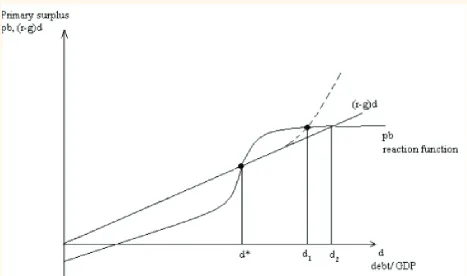
to an S-shaped reaction function, as shown in Figure 1, which describes how the average OECD economy had actually set its primary surpluses as debt burdens rose: the left hand side of (2). The right hand side of (2) also rises with debt: it is the straight line in the diagram for the case when r > g.
As drawn, there are two intersection points; one at d*, and one at d2. The first, d*, represents the equilibrium value, where the debt ratio will ultimately settle so long as we are still operating below the level of d2. This is an equilibrium because, for d < d*, the primary surplus pb is less than (r-g)d. So . But for d*< d < d2, we have pb > (r-g)d so . However at d2 and beyond, the debt burden increases without limit since pb ≤ (r-g)d. Hence, there is a stable equilibrium at d* and an unstable one at d2.
The Aim and Strategy of Debt Control
[image:14.612.72.539.399.675.2]If we have a serious idea of the optimal level of debt, derived perhaps from a theoretical model of
the advantages and disadvantages of holding debt for promoting growth, employment or smoothing (and to be able to resolve that question would in itself be an important innovation), or if a common debt target is set for administrative or political convenience at (say) 60% for all Eurozone countries, then the institutional part of the problem is to find a set of fiscal rules or budgetary constraints that set the debt ratio, by choice of pb, to adjust according to (2) until d* is reached - and then to estimate d2 in order to be able to stay well away from it.
Discussion
The framework above separates the fiscal control problem into two parts: a) the zone of safety (stability); b) the critical value beyond which debt explodes. The research here suggests that instead of implementing a “one-size-fits-all” fiscal policy that there are in fact 4-zones for each member state that would depend on the values of r and g. This is in stark contrast to the existing SGP which treats all member states as subject to the same rules, and it suggests that fiscal rules should be applied on a case-by-case basis according to the level of growth and real interest rates in a member state rather than a fixed deficit to GDP ratio as has been the case under the SGP.
The above analysis suggests that a sufficiently large primary surplus needs to be run once a certain ratio of debt to GDP is reached. The important point here is to determine where the critical point d2 for each member state and then to devise a fiscal rule that as-sures that the member state has to run a sufficiently large primary surplus once a lower value for the debt to GDP ratio is reached. That way this will assure that the critical point is not reached as if exceeded then debt default becomes almost certain.
Andrew Hughes Hallett, George Mason University, USA, and the University of St Andrews, Scotland
References
Aschauer D. A. (2000), “Do States Optimise? Public Capital and Economic Growth”, Annals of Regional Science, 34, 343-63.
Bohn, H. (1998), “The Behaviour of US Public Debt and Deficits”, Quarterly Journal of Economics, 113, 949-963 Checherita, C. and P. Rother (2010), “The Impact of High and Growing Government Debt on Economic Growth: An Empirical Investigation in the Euro Area”, Working Paper 1237, European Central Bank, Frank-furt.
De Grauwe, P. (2009), “Economics of Monetary Union”, Oxford University Press (8th edition), Oxford
Ostry, J., A.R. Ghosh, J.I.Kim and M.S. Qureshi (2010), “Fiscal Space”, IMF Position Note SPN/10/11, IMF, Washington DC (September).
Reinhart, C., and K. Rogoff (2009),”This Time it is Dif-ferent: a Panoramic View of Eight Centuries of Financial Crises”, Princeton University Press, Princeton, NJ.
Endnotes
1 This a summary of the paper “Is there a Need for a New
Fiscal Framework in the Euro Area” by Andrew Hughes Hallett and Svend E. Hougaard Jensen (Copenhagen Business School) that was presented at the EUSA confer-ence in Boston, March 2011. Patrick M. Crowley (Texas A&M University – Corpus Christi) also contributed to this summary of the paper.
2 Values of pb > (r – g)d will ensure falling debt burdens,
0
d
<
.
3 One may hypothesize a relationship of this form on the
multipolar or even an ‘interpolar’ or ‘non-polar’ system. Alongside this question of power distribution goes a second question about what might be described as political opportunity structures in the world arena. Opportunity structures can be open or closed to the presence and voices of new actors, and they create incentives or constraints affecting not only the actors themselves but also the formulation of international rules or conventions. As a result, ‘diplomatic spaces’ in the world arena have changed and are changing.
These changes in the global context for diplo-macy have been associated with two key changes in the nature of diplomatic activity. The first concerns the institutional structures within which diplomacy takes place, which have diversified and expanded, giving rise to what has been described as ‘multi-stakeholder diplomacy’. The second concerns the ways in which new forms of diplomacy fulfil the functions identified above: deliberation, representation, communication and negotiation. As a result of these changes, the concept of ‘diplomacy’ has both expanded and become more contestable, at both the ‘actor’ level and the systemic level.
The EU’s Emerging System of Diplomacy
Much attention has been paid to the ways in which the new institutional framework for EU diplomacy has been established and developed. One key element is distinctive to the EU: it is in itself a system of diplo-macy, embodying a process of continuous negotiation and deliberation among the member states and a range of other stakeholders. So the institutions of the EU’s sys-tem of ‘external’ diplomacy, and the rules and resources it brings to bear on its external policies, reflect internal diplomatic compromises and constraints. Within the EU institutions themselves, the perceived disruptive effects of the establishment of the High Representative/Vice-President (HRVP) and the European External Action Service (EEAS) have sharply focused this process. The HRVP and the EEAS consequently confront questions about their institutional status that will impact on the perceived legitimacy and credibility of EU diplomacy. At the same time, the EU is seeking to implant itself more fully into the global diplomatic system, and in a way to reproduce a conventional diplomatic machine at the EU level, at a time when that global system of diplomacy is itself in flux.
It is clear from this that Lisbon did not un-equivocally resolve the question of the EU’s system of diplomacy. It provided for institutions, but not without leaving these institutions open to question and chal-lenge. It provided for resources, both administrative and financial, but not without leaving open the issue of the budget and of the ways in which personnel would be Developing EU Diplomacy in a
Challenging World Michael Smith
Since the entry into force of the Lisbon Treaty, attention has largely been focused on the construction of the EU’s new diplomatic machinery. The purpose of this short paper is to explore some ways in which the development of the EU’s diplomacy since Lisbon re-lates to the changing nature of diplomacy more broadly, and to the challenges of a turbulent global environ-ment. In doing this, the paper distils work with which I have been engaged in a Jean Monnet Multilateral Research Network, based at Loughborough University and embodying a partnership with Maastricht Univer-sity (Netherlands) and Katholieke Universiteit Leuven (Belgium).1 The paper addresses three aspects of the
problem: first, the changing diplomatic context; second, the EU’s emerging system of diplomacy; and finally, two key areas of external challenge, relations with the Great Powers, and relations with the ‘Arab spring’. The Changing Diplomatic Context
In assessing the EU’s emerging system of diplomacy, it is important to put it into the context of diplomacy more generally. Diplomacy can be presented as the means of formulating and implementing exter-nal action through four key processess: deliberation, representation, communication and negotiation. It is not simply the passive implementation of decisions taken elsewhere by politicians – rather, it embodies an active process through which a diplomatic actor faces the world. Diplomatic action at one level is simply what diplomats do, in terms of the four processes outlined above, but it also takes place within a broader context of structures, strategies, institutions, rules and cultures that constitutes the diplomatic system, which has both a national (or European) and global face to it (Hocking and Smith 2011). The interaction of the national (or Eu-ropean) system of diplomacy with the global system is thus central to analysis of its effectiveness and impact. The core elements of diplomacy have been crystallized and given additional force by the changing diplomatic context. In particular, they have been affected by four key dimensions of change. The first of these is the changing distribution of power in the world arena since the end of the Cold War. We have moved from the Cold War system of dominant bipolarity, through an effectively unipolar system centred on the United States into what many have characterised as an emerging
attached to the system. It initiated a set of diplomatic practices, but did not settle the question of the relations between those practices and the existing, deeply em-bedded practices of national or European institutions. It called for a strategic approach to diplomacy, but did not resolve the issues of international status and credibility that inevitably lie behind any EU strategic diplomacy (Joint Report 2010).
As a result, the first eighteen months of the post-Lisbon era have been inevitably preoccupied with the domestic arrangements essential to giving life to the EU’s system of diplomacy. But the world will not wait for this kind of exercise to be completed, and equally inevitably there have arisen key international challenges that have constituted a test of the emerging diplomatic machine.
Two Challenges to EU Diplomacy
Two major challenges during the past eighteen months have tested the legitimacy and credibility of the EU’s new system of diplomacy. The first of these is the ‘great power’ test – the challenge of establishing EU diplomacy in a world where emergent and actual great powers are entering into new alignments. The second is the ‘neighbourhood’ test’ – and particularly the test generated by the impact of radical change in the southern Mediterranean, in the form of the ‘Arab spring’. To what extent has the emerging diplomatic system of the EU met these tests?
On the ‘great power’ test, the evidence in the short term seems negative. Although the HRVP has established good working relationships with the USA and especially with Secretary of State Hillary Clinton, it is not clear yet what the benefit is of at last having a specific telephone number or email address for Europe. Indeed, whilst the Americans might know the number, it is clear that on many key issues they don’t yet call it, preferring to deal with individual EU member states according to the needs of a pragmatic realist policy (Smith 2011). The Chinese, partly preoccupied with their adversarial partnership with the USA, equally show a reluctance to recognise Brussels as the fount of European diplomacy. Indeed, one significant char-acteristic of the post-Lisbon period so far is that both Beijing and Washington have followed a more calibrated multi-level diplomacy towards the EU, differentiating strongly between the EU and the member states. Two of the other ‘strategic partners’ identified by the EU, India and Brazil, are ruled especially by their regional preoccupations and their commercial objectives, and this combination does not leave much space for the EU to insert itself diplomatically. Finally, the evidence on EU relations with Russia remains ambiguous: here is the nearest of neighbours, and a key strategic actor, but
one that speaks a different diplomatic language from that of the normative and multilateralist EU on many issues. It does not appear that the call by some for a strengthened set of strategic partnerships as the core of a new ‘great power diplomacy’ on the part of the EU has yet produced a coherent diplomatic response either from the EU or from its putative partners, and the EEAS’ review of these partnerships has apparently spawned little that is new (EEAS, 2010).
On the test of the ‘neighbourhood’ and spe-cifically of the ‘Arab Spring’, the lessons so far seem equally negative. Here is an issue – or a set of issues – where the EU has had a pre-existing institutional engagement, underpinned by resources in the form of economic assistance and market power, and a clear political interest in intervening for the cause of democra-tisation and stabilisation. But this has been a crisis (or a succession of crises), in which events are unpredictable and in which the deliberative aspect of EU diplomacy is distinctly disadvantaged. As a result, the diplomatic space that existed for the EU in the early stages of the process seems to have been unexploited and to have closed down, in favour of diplomacy by contact group and intervention by a coalition of the willing including leading EU member states. At the same time, there has been self-conscious abstention by other leading member states, and a distinct lack of consensus on the day to day management of the unfolding challenge. As Sven Biscop has argued, this does not preclude the development of an effective EU diplomacy in the longer term, based on a definition of the EU’s vital in-terests, on the identification of clear priorities and on the dedication of appropriate capabilities, economic, diplomatic and eventually military, to the management of the long-term stability of the southern Mediterranean region (Biscop 2011). The difficulty is that the lack of consensus on intervention in the region may feed back into the ‘internal’ diplomacy of the EU and create issues for the future development of EU crisis management capabilities. Another difficulty is that the attempt by the EU to conduct a diplomacy towards the region informed by specifically European norms and values may not coincide with the demands or aspirations of peoples within the region, and thus that it will lack credibility (Youngs 2011).
Conclusion