R E S E A R C H A R T I C L E
Open Access
The effectiveness of an integrated collaborative
care model vs. a shifted outpatient collaborative
care model on community functioning, residential
stability, and health service use among homeless
adults with mental illness: a quasi-experimental
study
Vicky Stergiopoulos
1,2,3*, Andrée Schuler
1, Rosane Nisenbaum
1,4, Wayne deRuiter
5, Tim Guimond
3,
Donald Wasylenki
2,3, Jeffrey S. Hoch
1,6,7, Stephen W. Hwang
1,8, Katherine Rouleau
9,10and Carolyn Dewa
2,5Abstract
Background:Although a growing number of collaborative mental health care models have been developed, targeting specific populations, few studies have utilized such interventions among homeless populations. This quasi-experimental study compared the outcomes of two shelter-based collaborative mental health care models for men experiencing homelessness and mental illness: (1) an integrated multidisciplinary collaborative care (IMCC) model and (2) a less resource intensive shifted outpatient collaborative care (SOCC) model.
Methods:In total 142 participants, 70 from IMCC and 72 from SOCC were enrolled and followed for 12 months. Outcome measures included community functioning, residential stability, and health service use. Multivariate regression models were used to compare study arms with respect to change in community functioning, residential stability, and health service use outcomes over time and to identify baseline demographic, clinical or homelessness variables associated with observed changes in these domains.
Results:We observed improvements in both programs over time on measures of community functioning, residential stability, hospitalizations, emergency department visits and community physician visits, with no significant differences between groups over time on these outcome measures.
Conclusions:Our findings suggest that shelter-based collaborative mental health care models may be effective for individuals experiencing homelessness and mental illness. Future studies should seek to confirm these findings and examine the cost effectiveness of collaborative care models for this population.
Keywords:Homeless persons, Collaborative mental health care, Mental disorders, Mental health services
* Correspondence:[email protected]
1Centre for Research on Inner City Health, Keenan Research Centre of the Li Ka Shing Knowledge Institute of St. Michael’s Hospital, 30 Bond St, Toronto, Ontario M5B 1W8, Canada
2
Department of Psychiatry, University of Toronto, 250 College Street, 8th floor, Toronto, Ontario M5T 1R8, Canada
Full list of author information is available at the end of the article
Background
Homelessness continues to be a major social concern throughout North America, with an estimated 150,000 individuals experiencing homelessness each year in Canada and 1.4 million in the US [1–3]. In Toronto, Canada’s largest urban center, approximately 28,000 different individuals used emergency shelters during 2008 [4], and single men outnumbered single women in shelter use, using 70 % of beds compared with 29 % for women [5].
Among individuals experiencing homelessness there is a high prevalence of mental illness and addictions. A recent systematic review reported a pooled prevalence estimate of 12.7 % for psychotic disorders and 11.4 % for mood disorders such as major depression [6]. Substance use disorders are also widespread in this population, with a pooled prevalence estimate of 37.9 % [6]. In addition, individuals facing homelessness also experience chronic medical conditions [7, 8], neurocognitive impair-ment [9, 10], and have higher mortality rates than people who are housed [11–13]. They face several barriers to accessing health services and appropriate disease manage-ment [11, 14, 15], and often rely on emergency depart-ment visits or inpatient hospitalizations for their health care [16–19].
Studies from the United States and Canada suggest that intensive case management (ICM), assertive com-munity treatment (ACT) and Housing First approaches are effective interventions for people experiencing homelessness and mental illness [20–25]. The high costs associated with such specialized services have lim-ited their availability in many urban centers, however, and the mental health needs of people facing homeless-ness remain largely unmet [15].
Additional, more easily available models of service delivery for this disadvantaged population are therefore urgently needed, particularly for individuals in need of less intensive models of service delivery. It has been suggested that programs that integrate both the health and social components of care are likely to be most effective [26]. Shelter-based collaborative mental health care arrangements are examples of such pro-grams [27–29]. In collaborative mental health care models, patients, their families, their caregivers, and health providers from primary and mental health care settings work together to provide more coordinated services for individuals with mental health needs [30]. A substantial body of evidence suggests that collabora-tive care models are effeccollabora-tive in reducing psychiatric symptoms and in enhancing quality of care among in-dividuals with depression being treated in a primary care setting [31, 32]. Moreover, a growing number of studies are showing the beneficial effects of such models for other psychiatric disorders across primary
care, specialty and mental health settings, including improvements in mental health and physical health symptoms, and functional outcomes [30, 33–37]. What is less well understood is the effectiveness of these models for disadvantaged populations, such as people experiencing homelessness, or key model ingredients underlying successful outcomes [35].
Although a growing number of collaborative mental health care models have been developed, few studies have utilized such interventions among homeless populations [30, 38, 37]. A study of a Shared Care Clinical Outreach Service to provide multidisciplinary care to individuals ex-periencing homelessness demonstrated that it is possible to adapt a collaborative mental health care model for this population [39]. A pilot study of a shelter-based collabora-tive mental health care team by our group showed posicollabora-tive housing outcomes among 49 % of participants and clinical improvement among 35 %, 6 months after program enrollment [40]. It must be noted however, that the pilot study`s sample was recruited from a single site, thus limit-ing the generalizability of study findlimit-ings.
Methods The setting
Integrated multidisciplinary collaborative care (IMCC). Agency A is a 780-bed shelter that provides care each year for over 4000 men experiencing homelessness in Toronto, Ontario. Agency A has received funding for a shelter-based multidisciplinary health team and has adopted an IMCC model of service delivery in partnership with a local teaching hospital.
In the integrated care or liaison attachment model, an on-site psychiatrist or mental health worker becomes an integral part of a primary care team [42]. In this model, shelter staff and health care providers work as a single team and share a common electronic medical record. A psychiatric consultant works onsite four half days per week at Agency A. The consultant time is divided into two-thirds direct patient care and one-third indirect patient discussion and educational support to the team members to support the provision of mental health care. The IMCC model offers increased ease of referral, an interdisciplinary stepped approach to care, increased communication between diverse providers, coordinated care plans, and more integrated and comprehensive shelter based care and case management.
Shifted outpatient collaborative care model (SOCC). Agency B is a smaller 480-bed shelter located in To-ronto, Ontario, that provides assistance for men over the age of 18 with similar unmet health and social services needs. Agency B has adopted the SOCC model of service delivery [41, 44], where a psychiatric consultant, not linked administratively to the shelter, provides outpatient care in the shelter setting.
At Agency B, the consultant time, half a day per week, is divided into two-thirds direct patient care and one-third indirect patient discussion and educational support to the shelter staff. The consultant psychiatrists share an electronic medical record with select shelter staff. Pri-mary and mental health care are not integrated, and referrals to mental health are initiated by shelter staff. Agency B does not offer primary care or nursing services on site. Instead, such services are accessed through neighboring primary care centres. Other health provider support is obtained, as needed, through referral to other community agencies. The SOCC model focuses on the provision of timely psychiatric care, and offers increased ease of referral, an increased communication between shelter staff and the on-site psychiatrist, including review of treatment progress and care coordination/case man-agement plans.
The psychiatric consultants involved in both models were drawn from the psychiatric staff of an urban aca-demic hospital and shared an electronic medical record. Psychiatric consultations were available within approxi-mately two weeks of referral at each of the two shelters.
Both shelters served men with complex mental health and social needs, and received referrals from a range of organizations, including hospitals, other community orga-nizations, probation offices, as well as self-referrals. Shel-ter A focused on providing on site comprehensive care, while shelter B prioritized connection to off-site, commu-nity based health services. Both programs served men on-site, transitioning to other programs and services upon housing placement. Potential study participants were referred to a research assistant by shelter staff between November 2008 and November 2010. Research personnel explained the study in detail, and obtained written in-formed consent. The study protocol was approved by the Research Ethics Boards at the Centre for Addiction and Mental Health and St. Michael’s Hospital.
Study participants
Individuals were eligible for inclusion in the study if they: (1) were homeless and 18 years of age or over; (2) met criteria for one or more of the following mental disorders: schizophrenia or related psychotic disorder, bipolar affective disorder, major depressive disorder, an anxiety or substance use disorder. Participants were asked to identify their diagnoses, given by the consult-ing psychiatrists; (3) did not have psychiatric follow up in the community. Exclusion criteria were: (1) having a mood or psychotic disorder secondary to a general medical condition; and (2) being a danger to themselves or others.
Data collection process
Study participants were interviewed at baseline, 6 and 12 months and received a $20 honorarium for each interview completed. Study participants were encour-aged to contact research staff monthly with updated contact information and received $5 for each month they checked-in. The 12 month outcomes were consid-ered the primary outcomes.
Measures
Community functioning was assessed using the self-rated version of the Multnomah Community Ability Scale (MCAS). The MCAS is a standardized 17-item measure of functioning of individuals with mental illness living in the community [54, 55].
described below. Number of days in shelter or streets was assessed only at baseline as categories of < 30 days, 31–90 days and > 90 days over the past 12 months but was not used in the residential stability model because proportion of lifetime homelessness was already included.
Psychiatric symptom severity was assessed by trained interviewers using the Brief Psychiatric Rating Scale (BPRS) [58–60], a widely used outcome measure in psychiatry [61] with good inter-rater reliability [59, 62]. The BPRS consists of 24 psychiatric symptom constructs rated in a 7-point scale.
Alcohol and substance use was assessed using the Ad-diction Severity Index (ASI), a structured interview instru-ment that yields information about the severity of lifetime and (previous 30 days) drug and alcohol use [63].
Self-reported data on health care utilization, includ-ing hospitalizations in the past 6 months, emergency department (ED) visits in the past 6 months, and com-munity physician visits in the previous 30 days were collected using a series of service use logs developed by the CMHEI.
Statistical analysis
We estimated that sample sizes of 64 participants per group would achieve 80 % power to detect a 4.5 point difference in MCAS change from baseline to 12 months between the IMCC and SOCC groups with common standard deviation of change equal to 9.00 in both groups [64], with significance level of 0.05 [65, 66], and using a two-sided two-sample t-test. A half standard deviation is thought to represent a moderate effect size, in line with previous research [57, 67].
We used chi-square or Fisher’s exact tests to compare baseline characteristics of participants at the two pro-gram sites with respect to categorical variables. We ex-amined the normality assumption of the residuals after regressing continuous variables on program site indica-tor, and then performed thet-test or the non-parametric Wilcoxon rank-sum test, as appropriate. Logistic regres-sion was used to examine factors related to completing at least one follow-up study visit. The following covari-ates were included in this logistic regression model as they had been identified through univariate analyses to be associated with the outcome variable: English as the first language learned, education (those who had less than high school education), imputed baseline BPRS scores, and baseline self-reported diagnosis of schizo-phrenia. The following covariates were also included in the model although they were not significantly associ-ated with the outcome variable: a baseline self-reported diagnosis of substance related disorder and at least one ED visit at baseline. To avoid deletion of important con-founders from multivariate analyses [68], all the variables of interest that attained a significance level of 0.25 in
univariate analyses were considered for inclusion in the final model [69, 70]. At baseline, six participants were missing 1 or 2 items on the BPRS. When calculating the BPRS score, we imputed values for missing items as the average of the available items when the total number of missing items was 2 or less, and then summed the items.
Regression models
Linear mixed models were used to compare programs with respect to changes in community functioning (MCAS) scores over the study period. Twenty-two par-ticipants were missing MCAS data at baseline, and all but one participant was missing 4 or less items. When calculating the MCAS score, we imputed values for missing items as the participant average of the available items when the total number of missing items was 4 or less, and then summed the items. When greater than 4 items were missing, the data were not imputed. The average of the available items for the participant has been suggested as a “reasonable choice” when the scale reliability is at least 0.70 [71]. For the current data, Chronbach’s alpha reliability was 0.70, 0.72 and 0.79 for baseline, 6 months and 12 months, respectively.
A negative binomial model with repeated measures, assuming exchangeable covariance structure was used to compare programs with respect to changes in residential stability over the study period because the variance was much larger than the mean.
We applied generalized estimating equations (GEEs) with the logit link to compare programs with respect to changes in the probabilities of hospitalizations (at least one hospitalization in the last 6 months), emergency de-partment (ED) visits (at least one ED visit in the last 6 months), and community physician visits (at least one community physician visit in the last 30 days) over the study period. The choice of correlation structure was made using the quasi-likelihood under the independence model criterion (QIC).
For each outcome variable of interest, two regression models were calculated. In the first model we included program, time, and tested the interaction between pro-gram and time. Secondly, we added the following covar-iates to the multivariate model: baseline self-reported diagnosis of schizophrenia, baseline self-reported diag-nosis of substance related disorder, Caucasian ethnicity, indicator of foreign-born, proportion of lifetime home-less at baseline (years homehome-less divided by age), im-puted MCAS scores at baseline (except for the MCAS model as this was the outcome variable), and imputed BPRS score at baseline.
Results
Participant characteristics
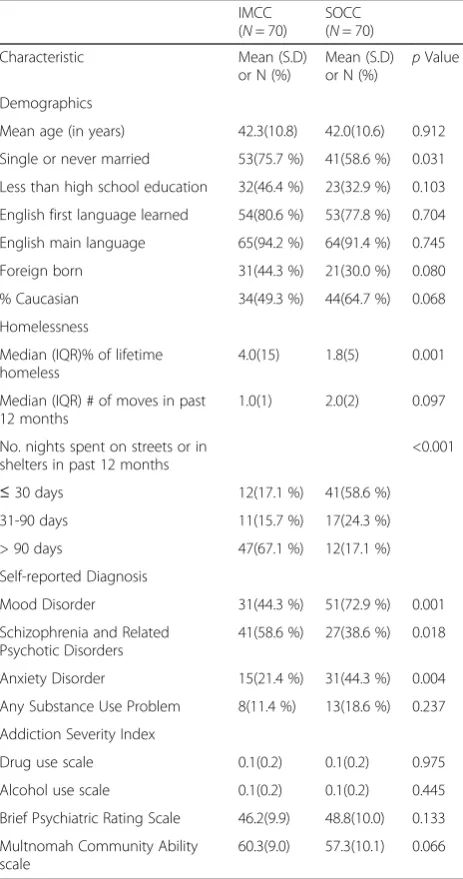
Table 1 describes the key demographic and clinical char-acteristics of the participant sample at baseline. In total, 142 male participants were recruited to the study: 70 from the IMCC program, and 72 from SOCC program. Only data from participants who completed the entire baseline visit were included in the analysis. The final sample included 70 participants from the IMCC model and 70 participants from the SOCC model. Participants had a mean age of 42.1 ± 10.7 years, and had been homeless for a median of 2.57 % of their lifetime. More than half of the sample was white (56 %).
The prevalence of mood disorders, schizophrenia or schizoaffective disorders, and substance-related disorders in the sample was 59 %, 49 %, and 15 % respectively.
No significant group differences were observed on the MCAS, drug use and alcohol use scales of the ASI, or the BPRS at baseline. IMCC participants were more likely to be single or never married, were homeless for a greater median percentage of their lifetime, and had a higher prevalence rate of schizophrenia and related psychotic disorders. The prevalence of mood disorders and anxiety disorders was higher among SOCC participants.
Follow-up rates
At 6 months, 58.6 % of IMCC and 71.4 % of SOCC partic-ipants were interviewed. Missing interviews at the 6-month visit resulted from participants declining (N= 19), not found (N= 21), incarcerated (N= 4), moved (N= 2), deceased (N= 2), or hospitalized (N= 1). At 12 months, 55.7 % of IMCC and 64.3 % of SOCC participants were interviewed. Missing 12-month interviews resulted from participants declining (N= 27), not being found (N= 20), incarcerated (N= 5), died (N= 2), or hospitalized (N= 2). There were no significant differences in the proportion of participants who completed at least one follow-up visit between the IMCC and SOCC programs (71.4 % vs. 78.6 %,χ2 = 0.952, df = 1,p= 0.33). The likelihood of com-pleting at least one follow-up visit was higher among par-ticipants who learned English as their first language (Odds Ratio = 3.33; 95 % CI = 1.21–9.25) and lower among those who had a diagnosis of schizophrenia (Odds Ratio = 0.33, CI = 0.13–0.82).
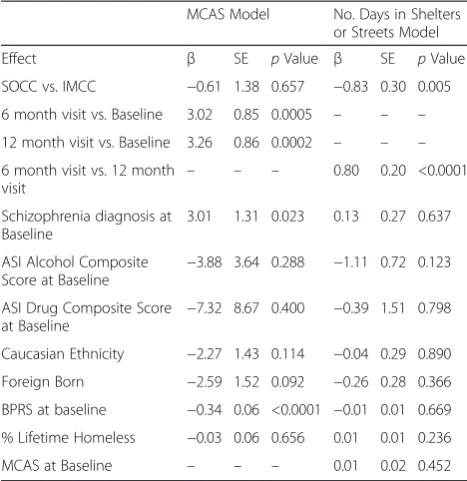
Primary outcome: Community functioning scores over time Linear mixed model analyses showed that there was a main effect of time: community functioning scores at 6 months were 3.02 units higher than at baseline (p= 0.0005). More-over, community functioning scores at 12 months were 3.26 units higher than at baseline (p =0.0002). However, the improvement in community functioning over time did not differ between groups, as the test for the interaction between program (IMCC, SOCC) and time was not signifi-cant (Fig. 1). A self-reported diagnosis of schizophrenia was associated with greater improvement in community functioning scores over time (about 3.01 units on the aver-age over time; p= 0.023). Higher BPRS values at baseline were associated with less improvement in community functioning scores over time (p< 0.0001); every unit of the BPRS was associated with a decrease of 0.34 units on the community functioning scale over time (Table 2).
Number of days in shelters or streets
[image:5.595.57.289.276.716.2]A repeated measures negative binomial model showed that there was a main effect of program; the estimated mean number of days in shelters or streets was lower for
Table 1Baseline demographic and clinical characteristics
IMCC (N= 70)
SOCC (N= 70)
Characteristic Mean (S.D)
or N (%)
Mean (S.D) or N (%)
pValue
Demographics
Mean age (in years) 42.3(10.8) 42.0(10.6) 0.912
Single or never married 53(75.7 %) 41(58.6 %) 0.031
Less than high school education 32(46.4 %) 23(32.9 %) 0.103
English first language learned 54(80.6 %) 53(77.8 %) 0.704
English main language 65(94.2 %) 64(91.4 %) 0.745
Foreign born 31(44.3 %) 21(30.0 %) 0.080
% Caucasian 34(49.3 %) 44(64.7 %) 0.068
Homelessness
Median (IQR)% of lifetime homeless
4.0(15) 1.8(5) 0.001
Median (IQR) # of moves in past 12 months
1.0(1) 2.0(2) 0.097
No. nights spent on streets or in shelters in past 12 months
<0.001
≤30 days 12(17.1 %) 41(58.6 %)
31-90 days 11(15.7 %) 17(24.3 %)
> 90 days 47(67.1 %) 12(17.1 %)
Self-reported Diagnosis
Mood Disorder 31(44.3 %) 51(72.9 %) 0.001
Schizophrenia and Related Psychotic Disorders
41(58.6 %) 27(38.6 %) 0.018
Anxiety Disorder 15(21.4 %) 31(44.3 %) 0.004
Any Substance Use Problem 8(11.4 %) 13(18.6 %) 0.237
Addiction Severity Index
Drug use scale 0.1(0.2) 0.1(0.2) 0.975
Alcohol use scale 0.1(0.2) 0.1(0.2) 0.445
Brief Psychiatric Rating Scale 46.2(9.9) 48.8(10.0) 0.133
Multnomah Community Ability scale
60.3(9.0) 57.3(10.1) 0.066
SOCC participants [32.17 (95 % CI = 20.71–49.99)] relative to IMCC participants [73.88 (95 % CI = 52.96– 103.04)] (Table 2). A main effect of time was also ob-served; the estimated mean number of days in shelters and streets improved over time: at 6 months the mean number of days in shelters or streets was 72.87(95 % CI = 58.46–90.84) and at 12 months the mean number of days in shelters or streets was 32.62 (95 % CI = 21.80–48.80). However, the improvement in number of days in shelters and streets over time did not differ be-tween groups, as the test for the interaction bebe-tween program (IMCC, SOCC) and time was not significant (Fig. 2). None of the other variables was statistically significant.
Health services utilization
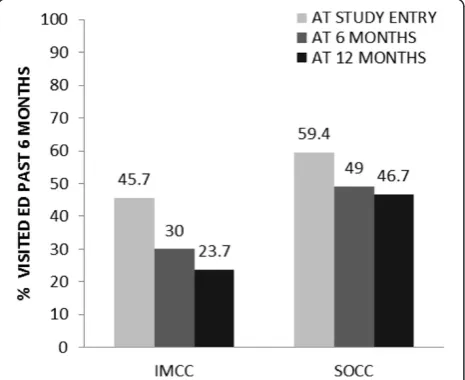
The proportion of patients who had at least one ED visit in the past 6 months at baseline, 6 months and 12 months is displayed in Fig. 3. The GEE analysis showed no significant interaction between program and time. However, the odds of any ED visits among SOCC participants were 1.8 times higher than for IMCC par-ticipants (OR = 1.79, 95 % CI = 1.04–3.07). Compared to baseline, the odds of an ED visit was lower at both the 6-month study visit (OR = 0.51, 95 % CI = 0.30– 0.87,) and 12-month visit (OR = 0.48, 95 % CI = 0.26– 0.90). The odds of any ED visit in the last 6 months was lower if the participant reported they received a diagnosis of schizophrenia (OR =0.50, 95 % CI = 0.30– 0.84) (Table 3).
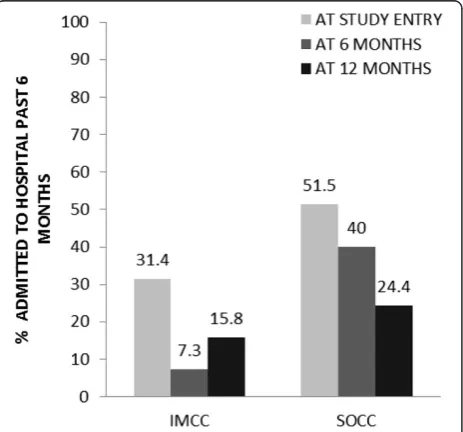
The proportion of patients who had at least one hospitalization in the past 6 months at baseline, 6 months and 12 months is displayed in Fig. 4. The GEE models showed significant main effects of program and time, but no interaction effect. Specifically, the odds of any over-night hospital stay in the prior 6 months among SOCC participants were 3.2 times greater than for IMCC partici-pants (OR = 3.15, 95 % CI = 1.61–6.17). The odds of an overnight hospital visit in the previous 6 months relative to baseline decreased over time; at both the 6-month study visit (Odds Ratio = 0.45, 95 % CI = 0.26–0.79) and 12-month visit (Odds Ratio = 0.33, 95 % CI = 0.17–0.63) (Table 3).
The proportion of patients who had at least one com-munity physician visit in the past 30 days at baseline, 6 months and 12 months is displayed in Fig. 5. The GEE analysis revealed significant main effects of gram, and time, however, the interaction between pro-gram and time was not significant with respect to any community physician visit in the past 30 days. The odds of any community physician visits in the past 30 days were 2.5 times greater among SOCC participants than for IMCC participants (OR = 2.54, 95 % CI = 1.39–4.63). The GEE analysis also showed significant improve-ments in outpatient service use over time; the odds of a community physician visit was higher at the 12-month visit relative to baseline (OR = 2.07, 95 % CI = 1.14–3.74) (Table 3).
[image:6.595.58.290.88.262.2]Fig. 1Community functioning scores over time. Mean community functioning scores obtained from the estimates in the linear mixed model with main effects of time, program and the interaction between time and program. Vertical lines correspond to 95 % confidence intervals. IMCC = integrated multidisciplinary collaborative care; MCAS = Multnomah Community Ability Scale; SOCC = shifted outpatient collaborative care
Table 2Statistical models for community functioning and no. days in shelters or streets
MCAS Model No. Days in Shelters or Streets Model
Effect β SE pValue β SE pValue
SOCC vs. IMCC −0.61 1.38 0.657 −0.83 0.30 0.005
6 month visit vs. Baseline 3.02 0.85 0.0005 – – –
12 month visit vs. Baseline 3.26 0.86 0.0002 – – –
6 month visit vs. 12 month
visit – – –
0.80 0.20 <0.0001
Schizophrenia diagnosis at Baseline
3.01 1.31 0.023 0.13 0.27 0.637
ASI Alcohol Composite Score at Baseline −
3.88 3.64 0.288 −1.11 0.72 0.123
ASI Drug Composite Score at Baseline
−7.32 8.67 0.400 −0.39 1.51 0.798
Caucasian Ethnicity −2.27 1.43 0.114 −0.04 0.29 0.890
Foreign Born −2.59 1.52 0.092 −0.26 0.28 0.366
BPRS at baseline −0.34 0.06 <0.0001 −0.01 0.01 0.669
% Lifetime Homeless −0.03 0.06 0.656 0.01 0.01 0.236
MCAS at Baseline – – – 0.01 0.02 0.452
[image:6.595.304.538.111.352.2]Discussion
The primary goal of this study was to compare the out-comes of two shelter-based collaborative mental health care models for homeless men with mental illness. We observed improvements in the entire sample over time on measures of community functioning, housing stability, and health care utilization, suggesting that the provision of shelter-based models of care may improve outcomes in this population. There was no evidence that receiving less resource intensive SOCC compared to IMCC services was associated with significantly different outcomes over the study period in terms of residential stability or health ser-vice use.
Significant improvements in community functioning, as assessed by the MCAS, were observed in both IMCC and SOCC participant groups over the follow-up period. This finding is in line with research from a previous study that compared homeless and vulnerably housed individuals with mental illness who received intensive case management or standard community services [57]. This study similarly found significant improvements in overall MCAS scores in both study groups [57]. Our find-ings are broadly consistent with those of a randomized controlled trial that compared an IMCC (attached liaison) model to usual care [36], conducted in a sample of partici-pants with heterogeneous mental health conditions. The IMCC model in that study consisted of access to a team of mental health professionals (community psychiatric nurses and psychologists) who had regular contact with the general practitioner, provided patient consultations, assessments, short-term psychological treatment, and assisted with referrals for patients who needed urgent care, in addition to a team of psychiatrists who met with the mental health professionals once a month and who met regularly with the general practitioners. Usual care in-volved referral of patients by the general practitioner to mental health services if needed. The authors found that quality of life improved over time, and there were no sig-nificant differences between the IMCC model and usual care [36].
With regards to housing, significant reductions in the mean number of days spent in shelters and streets were observed in both groups over the follow-up period. This finding is consistent with an earlier study by Stergiopou-los et al.[40] that found that a substantial proportion of shelter residents at the IMCC site obtained housing Fig. 3ED visits over time. IMCC = integrated multidisciplinary
collaborative care; SOCC = shifted outpatient collaborative care
[image:7.595.60.540.88.274.2] [image:7.595.58.291.516.706.2]within 6 months after referral to the program. Few stud-ies have examined the effects of collaborative mental health interventions on housing outcomes outside of the case management and assertive community treatment literature.
[image:8.595.56.543.100.398.2]Fig. 5Community physician visits over time. IMCC = integrated multidisciplinary collaborative care; SOCC = shifted outpatient collaborative care
Table 3Health service use generalized estimating equation models
Any ED Visits in the Past 6 months
Any Overnight Hospital Visits in the Past 6 months
Any Community Physician Visits in the Past 30 days
Effect Odds Ratio
[Exp(β)]
95 % CI p Value
Odds Ratio [Exp(β)]
95 % CI pValue Odds Ratio [Exp(β)]
95 % CI pValue
SOCC vs. IMCC 1.79 1.04–
3.07
0.035 3.15 1.61–6.17 0.001 2.54 1.39–4.63 0.002
6 M vs. Baseline 0.51 0.30–
0.87
0.014 0.45 0.26–0.79 0.006 1.31 0.73–2.35 0.358
12 M vs. Baseline 0.48 0.26–
0.90
0.021 0.33 0.17–0.63 0.001 2.07 1.14–3.74 0.017
Schizophrenia diagnosis at Baseline
0.50 0.30–
0.84
0.009 1.06 0.57–1.97 0.859 0.71 0.42–1.20 0.204
ASI Alcohol Composite Score at Baseline
1.01 0.19–
5.43
0.992 0.55 0.15–2.05 0.369 1.23 0.29–5.20 0.777
ASI Drug Composite Score at Baseline
0.85 0.03–
22.61
0.923 1.66 0.07– 39.65
0.756 15.28 0.45–516.21 0.129
Caucasian Ethnicity 1.48 0.85–
2.58
0.171 0.98 0.49–1.94 0.947 1.18 0.65–2.13 0.591
Foreign Born 0.86 0.49–
1.53
0.611 0.86 0.40–1.86 0.697 1.20 0.65–2.21 0.555
BPRS at Baseline 1.03 1.00–
1.05
0.061 1.02 1.00–1.05 0.093 0.99 0.96–1.02 0.425
% Lifetime Homeless 1.01 0.98–
1.04
0.603 1.01 0.97–1.05 0.737 0.99 0.96–1.02 0.345
MCAS at Baseline 1.03 1.00–
1.06
0.103 1.01 0.97–1.05 0.604 0.98 0.95–1.01 0.168
ASIAddiction Severity Index,BPRSBrief Psychiatric Rating Scale,EDemergency department;IMCCintegrated multidisciplinary collaborative care,MCASMultnomah Community Ability Scale,SOCCshifted outpatient collaborative care
[image:8.595.59.291.481.697.2] [image:8.595.306.538.510.696.2]Both the IMCC and SOCC programs appeared to re-duce the likelihood of urgent and acute care visits and in-crease the likelihood of outpatient treatment engagement in the community after 12 months. These findings are consistent with prior work in this area. Bradford et al. ob-served significant improvements in the proportion of indi-viduals who attended an initial follow-up appointment at a local community mental health centre following the introduction of a shelter-based intervention that provided intensive outreach of a personal support worker and weekly psychiatrist visits [27]. Podymow et al. observed reductions in the total number of ED visits among individ-uals facing homelessness and alcohol dependence who were enrolled in a shelter-based managed alcohol program [29]. Similarly, O’Toole et al. observed improvements in primary care use among veterans experiencing homeless-ness in a medical home clinical model [72]. We identified several factors associated with improvement in the study sample. Our finding that a self-reported diagnosis of a psychotic disorder at baseline was associated with im-proved outcomes on the MCAS is not surprising given that the MCAS was developed to assess impairments in community functioning among individuals with serious mental illness, and may better capture changes in commu-nity functioning over time in this group [54]. The likeli-hood of an ED visit was lower for participants with a self-reported diagnosis of schizophrenia. Although recent re-search has begun to examine predictors of frequent ED use [73–76], the association between certain psychiatric diagnoses (e.g., schizophrenia) and ED use among home-less populations remains to be determined. In this study, higher levels of psychiatric symptom severity at baseline were associated with poorer outcomes in community functioning over time. This finding is consistent with previous investigations that have shown an association between psychiatric symptom severity and deficits in com-munity functioning among individuals with severe mental illness [77, 78].
In our study we did not observe any statistically signifi-cant differences in community functioning, residential sta-bility, or health care utilization between the two models of care over time. Several factors may explain our findings. First, it is possible that the two models of care examined in this study are equally efficacious. Second, we had lower follow-up rates than expected, which may have limited the power to detect a difference over time between the two groups for each of the outcome measures. We have since implemented several approaches to improve follow-up rates with this population, including administering inter-views in jails or hospitals with participants who are incar-cerated or hospitalized, tracking participants through administrative databases and contact lists, and increased honoraria for monthly check ins and interviews, with excellent outcomes. Third, given the quasi-experimental
design of the current study, the improvements observed over time in both IMCC and SOCC programs may reflect regression to the mean rather than true program effects. Future studies that incorporate random allocation of par-ticipants to comparison groups can help reduce the effects of regression to the mean [79]. Nonetheless, our findings suggest that a less resource intensive model may be equally efficacious 12 months following program enrol-ment. Key ingredients underlying successful outcomes of collaborative mental health care models are not well understood, suggesting that a better understanding of mechanisms underlying model success is essential to guide further development and replication in diverse set-tings [35, 37]. Although a number of key components of effective collaborative mental health care have been identi-fied in the literature, including organizational commit-ment, linkages across service levels, consistently delivered interventions, staff training and supervision, care coordin-ation and clinical monitoring with agreed upon treatment protocols, it is not clear how many, or which of those components are necessary for program success [35, 37]. The SOCC model described in this study began with a shared commitment of shelter staff and the onsite psych-iatrist to improve mental health care and outcomes for shelter residents with mental health conditions. Consistent with core ingredients of effective models identified in the literature [35], SOCC improved access to psychiatric care at the shelter setting, improved communication between shelter staff and mental health specialists, and offered an opportunity for regular review of treatment progress and clinical supervision of shelter based case management plans. The model lacked the comprehensiveness and con-tinuity of primary care embedded models such as IMCC, but was less resource intensive and easier to implement.
This study has several limitations. First, self-report measures of community functioning and health service utilization were administered in the present study. There are limitations to the validity of self-reported survey findings, and future studies that utilize clinician-rated measures of community functioning, as well as administrative databases to obtain health service use data are needed. Second, we did not collect any data re-lated to the number of contacts with IMCC or SOCC clinicians, and it is possible that participants received variable“doses”of the intervention.
the continuum of services available to people experien-cing homelessness and mental illness. As models provid-ing comprehensive health care for participants on-site may foster dependency of the shelter system, less inten-sive models focused on connecting to housing and community-based treatment and rehabilitation programs may be preferable.
Conclusions
Our findings suggest that homeless men with mental illness experience significant improvements in commu-nity functioning, housing, hospitalizations, ED visits, and community based physician visits in both shelter-based collaborative mental health care programs over time. The lack of observable differences between the programs over the study period on key outcomes sug-gests that less resource intensive shifted outpatient col-laborative care models may offer an effective approach in many jurisdictions where the needs of homeless people with mental illness go largely unmet.
Competing interests
The authors declare that they have no competing interests.
Authors’contributions
VS and CD conceived of the study, interpreted results, contributed to the drafting of the manuscript and read and revised all drafts of the manuscript. AS assisted with data analysis, helped interpret the results, contributed to the drafting of the manuscript, and revision of drafts. RN analyzed the quantitative data, interpreted the findings and contributed to drafting of the manuscript. WD, TG, DW, JSH, SWH, and KR contributed to interpretation of the results as well as drafting and revising the final paper. VS, AS, RN, WD, TG, DW, JSH, SWH, KR, and CD have read and approve the final manuscript.
Acknowledgements
The study was funded by a Canadian Institutes of Health Research (CIHR) Partnerships for Health System Improvement grant to Drs. Stergiopoulos and Dewa, an Ontario Career Scientist Award for Dr. Stergiopoulos, and a CIHR/ Public Health Agency of Canada Applied Public Health Chair to Dr. Dewa.
Author details
1
Centre for Research on Inner City Health, Keenan Research Centre of the Li Ka Shing Knowledge Institute of St. Michael’s Hospital, 30 Bond St, Toronto, Ontario M5B 1W8, Canada.2Department of Psychiatry, University of Toronto, 250 College Street, 8th floor, Toronto, Ontario M5T 1R8, Canada.3Mental Health Services, St. Michael’s Hospital, 30 Bond St, Toronto, Ontario M5B 1W8, Canada.4Dalla Lana School of Public Health, University of Toronto, 155 College Street, 6th Floor, Toronto, Ontario M5T 3M7, Canada.5Centre for Research on Employment and Workplace Health (CREWH), Centre for Addiction and Mental Health, 455 Spadina Avenue, Suite 300, Toronto, Ontario M5S 2G8, Canada.6Centre for Excellence in Economic Analysis Research (CLEAR), Keenan Research Centre of the Li Ka Shing Knowledge Institute of St. Michael’s Hospital, 30 Bond St, Toronto, Ontario M5B 1W8, Canada.7Institute of Health Policy, Management and Evaluation, University of Toronto, Health Sciences Building, 155 College Street, Suite 425, Toronto, Ontario M5T 3M6, Canada.8Division of General Internal Medicine, Department of Medicine, University of Toronto, St. Michael’s Hospital, 30 Bond St, Toronto, Ontario M5B 1W8, Canada.9Global Health Program, Department of Family and Community Medicine, University of Toronto, 263 McCaul Street, 3rd Floor, Toronto, Ontario M5T 1W7, Canada.10Department of Family and Community Medicine, St. Michael’s Hospital, 30 Bond St, Toronto, Ontario M5B 1W8, Canada.
Received: 17 March 2015 Accepted: 21 August 2015
References
1. Trypuc B, Robinson J. Homeless in Canada: A Funder’s Primer in Understanding the Tragedy on Canada’s Streets. Charity Intelligence Canada: King City, ON; 2009.
2. Segaert A. The National Shelter Study: Emergency Shelter Use in Canada 2005-2009. Ottawa. Canada: Homelessness Partnering Secretariat, Human Resources and Skills Development; 2012.
3. Solari CD, Cortes A, Henry M, Matthews N, Morris S. The 2013 Annual Homeless Assessment Report (AHAR) to Congress: Part 2 Estimates of Homelessness in the United States. Washington DC: The U.S. Department of Housing and Urban Development Office of Community Planning and Development; 2014.
4. City of Toronto Shelter Support and Housing Administration. 2009 Per Diem Rates for the Purchase of Service Shelter System and Results of the Review of the Per Diem Funding Model. Toronto, ON: City of Toronto; 2009. 5. City of Toronto Shelter Support and Housing Administration. Street Needs
Assessment Results 2009. Toronto, ON: City of Toronto; 2009. 6. Fazel S, Khosla V, Doll H, Geddes J. The prevalence of mental disorders
among the homeless in western countries: systematic review and meta-regression analysis. PLoS Med. 2008;5(12):e225.
7. Fazel S, Geddes JR, Kushel M. The health of homeless people in high-income countries: descriptive epidemiology, health consequences, and clinical and policy recommendations. Lancet. 2014;384(9953):1529–40. 8. Jones CA, Perera A, Chow M, Ho I, Nguyen J, Davachi S. Cardiovascular
disease risk among the poor and homeless - what we know so far. Curr Cardiol Rev. 2009;5(1):69–77.
9. Burra TA, Stergiopoulos V, Rourke SB. A systematic review of cognitive deficits in homeless adults: implications for service delivery. Can J Psychiatry. 2009;54(2):123–33.
10. Stergiopoulos V, Cusi A, Bekele T, Skosireva A, Latimer E, Schutz C, et al. Neurocognitive impairment in a large sample of homeless adults with mental illness. Acta Psychiatr Scand. 2015;131(4):256–68.
11. Hwang SW. Homelessness and health. CMAJ. 2001;164(2):229–33. 12. Hwang SW, Wilkins R, Tjepkema M, O’Campo PJ, Dunn JR. Mortality among
residents of shelters, rooming houses, and hotels in Canada: 11 year follow-up study. BMJ. 2009;339:b4036.
13. Sullivan G, Burnam A, Koegel P, Hollenberg J. Quality of life of homeless persons with mental illness: results from the course-of-homelessness study. Psychiatr Serv. 2000;51(9):1135–41.
14. Argintaru N, Chambers C, Gogosis E, Farrell S, Palepu A, Klodawsky F, et al. A cross-sectional observational study of unmet health needs among homeless and vulnerably housed adults in three Canadian cities. BMC Public Health. 2013;13:577.
15. Stergiopoulos V, Dewa C, Durbin J, Chau N, Svoboda T. Assessing the mental health service needs of the homeless: a level-of-care approach. J Health Care Poor Underserved. 2010;21(3):1031–45.
16. Folsom DP, Hawthorne W, Lindamer L, Gilmer T, Bailey A, Golshan S, et al. Prevalence and risk factors for homelessness and utilization of mental health services among 10,340 patients with serious mental illness in a large public mental health system. Am J Psychiatry. 2005;162(2):370–6.
17. Larimer ME, Malone DK, Garner MD, Atkins DC, Burlingham B, Lonczak HS, et al. Health care and public service use and costs before and after provision of housing for chronically homeless persons with severe alcohol problems. JAMA. 2009;301(13):1349–57.
18. Hwang SW, Chambers C, Chiu S, Katic M, Kiss A, Redelmeier DA, et al. A comprehensive assessment of health care utilization among homeless adults under a system of universal health insurance. Am J Public Health. 2013;103 Suppl 2:S294–301.
19. Tsai J, Doran KM, Rosenheck RA. When health insurance is not a factor: national comparison of homeless and nonhomeless US veterans who use Veterans Affairs Emergency Departments. Am J Public Health. 2013;103 Suppl 2:S225–31. 20. Coldwell CM, Bender WS. The effectiveness of assertive community treatment
for homeless populations with severe mental illness: a meta-analysis. Am J Psychiatry. 2007;164(3):393–9.
21. de Vet R, van Luijtelaar MJ, Brilleslijper-Kater SN, Vanderplasschen W, Beijersbergen MD, Wolf JR. Effectiveness of case management for homeless persons: a systematic review. Am J Public Health. 2013;103(10):e13–26. 22. Rosenblum A, Nuttbrock L, McQuistion H, Magura S, Joseph H. Medical
23. Tsemberis S, Gulcur L, Nakae M. Housing First, consumer choice, and harm reduction for homeless individuals with a dual diagnosis. Am J Public Health. 2004;94(4):651–6.
24. Aubry T, Tsemberis S, Adair CE, Veldhuizen S, Streiner D, Latimer E, et al. One-Year Outcomes of a Randomized Controlled Trial of Housing First With ACT in Five Canadian Cities. Psychiatr Serv. 2015;66(5):463–9.
25. Stergiopoulos V, Hwang SW, Gozdzik A, Nisenbaum R, Latimer E, Rabouin D, et al. Effect of scattered-site housing using rent supplements and intensive case management on housing stability among homeless adults with mental illness: a randomized trial. Jama. 2015;313(9):905–15.
26. Golden A, Currie W, Greaves E, Latimer J. Report of the Mayor’s Homelessness Action Task Force: Taking Responsibility for Homelessness: An Action Plan for Toronto. City of Toronto: Toronto, ON; 1999. 27. Bradford DW, Gaynes BN, Kim MM, Kaufman JS, Weinberger M. Can
shelter-based interventions improve treatment engagement in homeless individuals with psychiatric and/or substance misuse disorders?: a randomized controlled trial. Med Care. 2005;43(8):763–8.
28. Cathexis Consulting Inc. Ottawa Inner City Health Project Cost Effectiveness Analysis. Toronto, ON: 2002.
29. Podymow T, Turnbull J, Coyle D, Yetisir E, Wells G. Shelter-based managed alcohol administration to chronically homeless people addicted to alcohol. CMAJ. 2006;174(1):45–9.
30. Craven MA, Bland R. Better practices in collaborative mental health care: an analysis of the evidence base. Can J Psychiatry. 2006;51(6 Suppl 1):7s–72s. 31. Gilbody S, Bower P, Fletcher J, Richards D, Sutton AJ. Collaborative care for
depression: a cumulative meta-analysis and review of longer-term outcomes. Arch Intern Med. 2006;166(21):2314–21.
32. Katon W, Unutzer J, Wells K, Jones L. Collaborative depression care: history, evolution and ways to enhance dissemination and sustainability. Gen Hosp Psychiatry. 2010;32(5):456–64.
33. Bauer MS, Biswas K, Kilbourne AM. Enhancing multiyear guideline concordance for bipolar disorder through collaborative care. Am J Psychiatry. 2009;166(11):1244–50.
34. Druss BG, Rohrbaugh RM, Levinson CM, Rosenheck RA. Integrated medical care for patients with serious psychiatric illness: a randomized trial. Arch Gen Psychiatry. 2001;58(9):861–8.
35. Kelly BJ, Perkins DA, Fuller JD, Parker SM. Shared care in mental illness: A rapid review to inform implementation. Int J Ment Health Syst. 2011;5:31. 36. van Orden M, Hoffman T, Haffmans J, Spinhoven P, Hoencamp E.
Collaborative mental health care versus care as usual in a primary care setting: a randomized controlled trial. Psychiatr Serv. 2009;60(1):74–9. 37. Woltmann E, Grogan-Kaylor A, Perron B, Georges H, Kilbourne AM, Bauer
MS. Comparative effectiveness of collaborative chronic care models for mental health conditions across primary, specialty, and behavioral health care settings: systematic review and meta-analysis. Am J Psychiatry. 2012;169(8):790–804.
38. Archer J, Bower P, Gilbody S, Lovell K, Richards D, Gask L, et al. Collaborative care for depression and anxiety problems. Cochrane Database Syst Rev. 2012;10:Cd006525.
39. Boydell K, Volpe T. The Shared Care Clinical Outreach Service: a Descriptive Study. Toronto, ON: Centre for Addiction and Mental Health; 2001. 40. Stergiopoulos V, Dewa CS, Rouleau K, Yoder S, Chau N. Collaborative mental
health care for the homeless: the role of psychiatry in positive housing and mental health outcomes. Can J Psychiatry. 2008;53(1):61–7.
41. Browning S, Ford M, Goddard C, Brown A. A psychiatric clinic in general practice-a description and comparison with an outpatient clinic. Psychiatr Bull R Coll Psychiatr. 1987;11:114–7.
42. Craven MA, Bland R. Shared mental health care: a bibliography and overview. Can J Psychiatry. 2002;47(2 Suppl 1):iS-viiiS–1S-103S.
43. Creed F, Marks B. Liaison psychiatry in general practice: a comparison of the liaison-attachment scheme and shifted outpatient clinic models. J R Coll Gen Pract. 1989;39(329):514–7.
44. Mitchell AR. Psychiatrists in primary health care settings. Br J Psychiatry. 1985;147:371–9.
45. Biderman A, Yeheskel A, Tandeter H, Umansky R. Advantages of the psychiatric liaison-attachment scheme in a family medicine clinic. Isr J Psychiatry Relat Sci. 1999;36(2):115–21.
46. Jackson G, Gater R, Goldberg D, Tantam D, Loftus L, Taylor H. A new community mental health team based in primary care. A description of the service and its effect on service use in the first year. Br J Psychiatry. 1993;162:375–84.
47. Kates N, McPherson-Doe C, George L. Integrating mental health services within primary care settings: the Hamilton Family Health Team. J Ambul Care Manage. 2011;34(2):174–82.
48. Hansen V. Psychiatric service within primary care. Mode of organization and influence on admission-rates to a mental hospital. Acta Psychiatr Scand. 1987;76(2):121–8.
49. Tyrer P, Ferguson B, Wadsworth J. Liaison psychiatry in general practice: the comprehensive collaborative model. Acta Psychiatr Scand. 1990;81(4):359–63.
50. Kates N, Craven MA, Crustolo AM, Nikolaou L, Allen C, Farrar S. Sharing care: the psychiatrist in the family physician’s office. Can J Psychiatry. 1997;42(9):960–5. 51. Warner RW, Gater R, Jackson MG, Goldberg DP. Effects of a community
mental health service on the practice and attitudes of general practitioners. Br J Gen Pract. 1993;43(377):507–11.
52. Goldberg D, Jackson G, Gater R, Campbell M, Jennett N. The treatment of common mental disorders by a community team based in primary care: a cost-effectiveness study. Psychol Med. 1996;26(3):487–92.
53. Murray S. Evaluation of shifted out-patient clinics, psychiatry. Audit Trends. 1998;6:64–7.
54. Barker S, Barron N, McFarland BH, Bigelow DA. A community ability scale for chronically mentally ill consumers: Part I. Reliability and validity. Community Ment Health J. 1994;30(4):363–83.
55. Barker S, Barron N, McFarland BH, Bigelow DA, Carnahan T. A community ability scale for chronically mentally ill consumers: Part II. Applications Community Ment Health J. 1994;30(5):459–72.
56. Dewa CS, Durbin J, Wasylenki D, Ochocka J, Eastabrook S, Boydell KM, et al. Considering a multisite study? How to take the leap and have a soft landing. J Community Psychol. 2002;30(2):173–87.
57. Goering P. Making a difference: Ontario’s Community Mental Health Evaluation Initiative. Final report of the CMHEI Project. 2004. Retrieved from: http://ontario.cmha.ca/files/2012/07/Making_a_Difference_CMHEI_Final_ Project.pdf
58. Overall JE, Gorham DR. The Brief Psychiatric Rating Scale. Psychol Rep. 1962;10:799–812.
59. Ventura J, Green M, Shaner A, Liberman RP. Training and quality assurance on the BPRS:‘The Drift Busters’. Int J Methods Psychiatr Res. 1993;3(4):221–44.
60. Ventura J, Lukoff D, Nuechterlein KH, Liberman RP, Green M, Shaner A. Appendix 1: Brief Psychiatric Rating Scale BPRS Expanded Version 4.0 scales, anchor points and administration manual. Int J Methods Psychiatr Res. 1993;3:227–43.
61. Hedlund JL, Vieweg BW. The Brief Psychiatric Rating Scale (BPRS): a comprehensive review. J Oper Psychiatry. 1980;11:48–65.
62. Roncone R, Ventura J, Impallomeni M, Falloon IR, Morosini PL, Chiaravalle E, et al. Reliability of an Italian standardized and expanded Brief Psychiatric Rating Scale (BPRS 4.0) in raters with high vs. low clinical experience. Acta Psychiatr Scand. 1999;100(3):229–36.
63. McLellan AT, Luborsky L, Woody GE, O'Brien CP. An improved diagnostic evaluation instrument for substance abuse patients. The Addiction Severity Index. J Nerv Ment Dis. 1980;168(1):26–33.
64. Durbin J, Dewa C, Aubry T, Krupa T, Rourke S, Foo E. The use of Multnomah Community Ability Scale as a program evaluation tool. Can J Program Eval. 2004;19(3):135–57.
65. Clark C, Rich AR. Outcomes of homeless adults with mental illness in a housing program and in case management only. Psychiatr Serv. 2003;54(1):78–83.
66. Shern DL, Tsemberis S, Anthony W, Lovell AM, Richmond L, Felton CJ, et al. Serving street-dwelling individuals with psychiatric disabilities: outcomes of a psychiatric rehabilitation clinical trial. Am J Public Health.
2000;90(12):1873–8.
67. Goering PN, Streiner DL, Adair C, Aubry T, Barker J, Distasio J, et al. The At Home/Chez Soi trial protocol: a pragmatic, multi-site, randomised controlled trial of a Housing First intervention for homeless individuals with mental illness in five Canadian cities. BMJ Open. 2011;1(2):e000323.
68. Greenland S. Invited commentary: variable selection versus shrinkage in the control of multiple confounders. Am J Epidemiol. 2008;167(5):523–9. discussion 30-1.
69. Dales LG, Ury HK. An improper use of statistical significance testing in studying covariables. Int J Epidemiol. 1978;7(4):373–5.
71. Schafer JL, Graham JW. Missing data: our view of the state of the art. Psychol Methods. 2002;7(2):147–77.
72. O’Toole TP, Pirraglia PA, Dosa D, Bourgault C, Redihan S, O’Toole MB, et al. Building care systems to improve access for high-risk and vulnerable veteran populations. J Gen Intern Med. 2011;26 Suppl 2:683–8.
73. Chambers C, Chiu S, Katic M, Kiss A, Redelmeier DA, Levinson W, et al. High utilizers of emergency health services in a population-based cohort of homeless adults. Am J Public Health. 2013;103 Suppl 2:S302–10. 74. Ku BS, Scott KC, Kertesz SG, Pitts SR. Factors associated with use of urban
emergency departments by the U.S. homeless population. Public Health Rep. 2010;125(3):398–405.
75. Kushel MB, Perry S, Bangsberg D, Clark R, Moss AR. Emergency department use among the homeless and marginally housed: results from a community-based study. Am J Public Health. 2002;92(5):778–84. 76. Pearson DA, Bruggman AR, Haukoos JS. Out-of-hospital and emergency
department utilization by adult homeless patients. Ann Emerg Med. 2007;50(6):646–52.
77. Brown ES, Rush AJ, Biggs MM, Shores-Wilson K, Carmody TJ, Suppes T. Clinician ratings vs. global ratings of symptom severity: a comparison of symptom measures in the bipolar disorder module, phase II, Texas Medication Algorithm Project. Psychiatry Res. 2003;117(2):167–75. 78. Dickerson F, Boronow JJ, Ringel N, Parente F. Social functioning and
neurocognitive deficits in outpatients with schizophrenia: a 2-year follow-up. Schizophr Res. 1999;37(1):13–20.
79. Barnett AG, van der Pols JC, Dobson AJ. Regression to the mean: what it is and how to deal with it. Int J Epidemiol. 2005;34(1):215–20.
80. Kushel MB, Gupta R, Gee L, Haas JS. Housing instability and food insecurity as barriers to health care among low-income Americans. J Gen Intern Med. 2006;21(1):71–7.
81. Kushel MB, Vittinghoff E, Haas JS. Factors associated with the health care utilization of homeless persons. JAMA. 2001;285(2):200–6.
Submit your next manuscript to BioMed Central and take full advantage of:
• Convenient online submission
• Thorough peer review
• No space constraints or color figure charges
• Immediate publication on acceptance
• Inclusion in PubMed, CAS, Scopus and Google Scholar
• Research which is freely available for redistribution