RESEARCH
The effect of iron-fortified
complementary food and intermittent
preventive treatment of malaria on anaemia
in 12- to 36-month-old children: a
cluster-randomised controlled trial
Dominik Glinz
1*, Richard F. Hurrell
1, Mamadou Ouattara
2, Michael B. Zimmermann
1, Gary M. Brittenham
3,
Lukas G. Adiossan
4, Aurélie A. Righetti
5,6, Burkhardt Seifert
7, Victorine G. Diakité
8, Jürg Utzinger
5,6,
Eliézer K. N’Goran
2,9and Rita Wegmüller
1Abstract
Background: Iron deficiency (ID) and malaria co-exist in tropical regions and both contribute to high rates of anae-mia in young children. It is unclear whether iron fortification combined with intermittent preventive treatment (IPT) of malaria would be an efficacious strategy for reducing anaemia in young children.
Methods: A 9-month cluster-randomised, single-blinded, placebo-controlled intervention trial was carried out in children aged 12–36 months in south-central Côte d’Ivoire, an area of intense and perennial malaria transmission.
The study groups were: group 1: normal diet and IPT-placebo (n = 125); group 2: consumption of porridge, an
iron-fortified complementary food (CF) with optimised composition providing 2 mg iron as NaFeEDTA and 3.8 mg iron as
ferrous fumarate 6 days per week (CF-FeFum) and IPT-placebo (n = 126); group 3: IPT of malaria at 3-month intervals,
using sulfadoxine-pyrimethamine and amodiaquine and no dietary intervention (n = 127); group 4: both CF-FeFum
and IPT (n = 124); and group 5: consumption of porridge, an iron-fortified CF with the composition currently on the
Ivorian market providing 2 mg iron as NaFeEDTA and 3.8 mg iron as ferric pyrophosphate 6 days per week (CF-FePP)
and IPT-placebo (n = 127). The primary outcome was haemoglobin (Hb) concentration. Linear and logistic regression
mixed-effect models were used for the comparison of the five study groups, and a 2 × 2 factorial analysis was used to
assess treatment interactions of CF-FeFum and IPT (study groups 1–4).
Results: After 9 months, the Hb concentration increased in all groups to a similar extent with no statistically
signifi-cant difference between groups. In the 2 × 2 factorial analysis after 9 months, no treatment interaction was found on
Hb (P= 0.89). The adjusted differences in Hb were 0.24 g/dl (95 % CI −0.10 to 0.59; P= 0.16) in children receiving IPT and −0.08 g/dl (95 % CI −0.42 to 0.26; P= 0.65) in children receiving CF-FeFum. At baseline, anaemia (Hb <11.0 g/dl)
was 82.1 %. After 9 months, IPT decreased the odds of anaemia (odds ratio [OR], 0.46 [95 % CI 0.23–0.91]; P= 0.023),
whereas iron-fortified CF did not (OR, 0.85 [95 % CI 0.43–1.68]; P= 0.68), although ID (plasma ferritin <30 μg/l) was
decreased markedly in children receiving iron fortified CF (OR, 0.19 [95 % CI 0.09–0.40]; P < 0.001).
Conclusions: IPT alone only modestly decreased anaemia, but neither IPT nor iron fortified CF significantly improved Hb concentration after 9 months. Additionally, IPT did not augment the effect of the iron fortified CF. CF fortified with
© 2015 Glinz et al. This article is distributed under the terms of the Creative Commons Attribution 4.0 International License (http://creativecommons.org/licenses/by/4.0/), which permits unrestricted use, distribution, and reproduction in any medium, provided you give appropriate credit to the original author(s) and the source, provide a link to the Creative Commons license, and indicate if changes were made. The Creative Commons Public Domain Dedication waiver (http://creativecommons.org/ publicdomain/zero/1.0/) applies to the data made available in this article, unless otherwise stated.
Open Access
*Correspondence: [email protected]
1 Human Nutrition Laboratory, Institute of Food, Nutrition and Health,
Background
Anaemia in sub-Saharan Africa has many aetiologies, but iron deficiency (ID) and malaria are considered to be the major causes [1]. ID has been estimated to be responsible for more than one-third, and Plasmodium falciparum malaria for 24 % of all anaemia cases [1]. P. falciparum is highly endemic in rural Côte d’Ivoire [2] and is a major risk factor for anaemia in young children [3]. The proportion of anaemia attributed to these two causes varies with setting and population group [3, 4], and anaemia at the individual level may well result from both aetiologies.
Anaemia can be reduced in settings of seasonal trans-mission by intermittent preventive treatment (IPT) of malaria [5]. Iron fortification may reduce the prevalence of anaemia in children aged below 2 years [6], but its effectiveness in sub-Saharan Africa remains uncertain. Iron stable isotope studies have reported that inflamma-tion during afebrile malaria in women [7] and children [8] increases circulating hepcidin and decreases iron absorption. Therefore, IPT of malaria might improve the response to iron fortification in areas where malaria is highly endemic.
The aim of this study was to assess the effect of a com-bination of two highly bioavailable iron compounds [9] (i.e. CF-FeFum: ferrous fumarate combined with NaFeEDTA) added to a cereal-based complemen-tary food (CF) and IPT of malaria using sulfadoxine-pyrimethamine and amodiaquine (SP/AQ) administered once every 3 months. The interventions were given alone or in combination. The primary and secondary outcomes were assessed for treatment interaction using a 2 × 2
fac-torial analysis. The primary outcome measure was hae-moglobin (Hb) concentration. Secondary outcomes were iron status markers and Plasmodium prevalence. The study was conducted in children aged 12–36 months liv-ing in a rural part of south-central Côte d’Ivoire, where malaria transmission is perennial. The hypothesis was that a combined intervention with IPT of malaria and iron fortified CF would reduce anaemia and ID preva-lence to a greater extent than either intervention alone. A fifth study group was included to test the efficacy of the combination of NaFeEDTA and ferric pyrophosphate (CF-FePP), a combination that is currently being used on
the Ivorian market. Ferric pyrophosphate is considered to have a lower bioavailability than ferrous fumarate [9].
Methods
Study design and participants
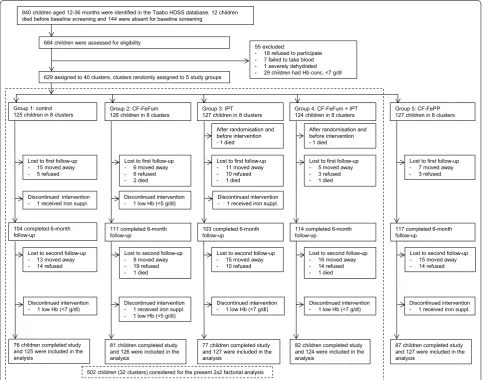
This 9-month cluster-randomised, single-blinded, pla-cebo-controlled intervention trial was conducted in the Taabo health and demographic surveillance system (HDSS) in south-central Côte d’Ivoire [10]. Recently it has been reported that the leading causes of death among children below 5 years of age in the Taabo HDSS are malaria, followed by acute respiratory tract infections and HIV/AIDS [11]. Malaria transmission is perennial with peaks occurring in the large rainy season (from April to August) and in the small rainy season (September/Octo-ber). The prevalence of P. falciparum infection ranges between 35 and 77 %, depending on season and age group [12, 13]. From the Taabo HDSS database, we identified 840 children aged 12–36 months in five villages, which were invited for baseline screening (Fig. 1) from mid-April to mid-May 2012. Inclusion criteria were: (1) Hb ≥7 g/dl; (2) no major chronic illnesses; (3) anticipated residence in the area for the entire study duration; and (4) no known allergies to sulfadoxine, pyrimethamine and amodiaquine.
At baseline screening, 629 eligible children were iden-tified and were grouped into 40 clusters based on prox-imity of their residence, with at least five clusters in each of the five villages and from 13 to 18 children in each cluster. Then the clusters were randomly assigned to five study groups by drawing cluster numbers from an opaque hat (“urn randomisation”) together with village authori-ties acting as witnesses. This public randomisation pro-cess was implemented to avoid any feelings of unfairness among the village population. Allocation ratio was 1:1 for all five study groups. The study groups were: group 1: normal diet (no dietary intervention) + IPT-placebo; group 2: iron fortified CF-FeFum + IPT-placebo; group 3: normal diet + IPT; group 4: CF-FeFum + IPT; and group 5: CF-FePP + IPT-placebo. Interventions lasted for 9 months.
Ethical considerations
The study was approved by the ethics committees of ETH Zurich (reference no. EK 2009-N-19) and Côte
highly bioavailable iron improved iron status but not Hb concentration, despite three-monthly IPT of malaria. Thus, further research is necessary to develop effective combination strategies to prevent and treat anaemia in malaria endemic regions.
Trial registration: http://www.clinicaltrials.gov; identifier NCT01634945; registered on July 3, 2012.
d’Ivoire (reference no. 061 MSLS/CNER). Village and health authorities, and parents/guardians of participat-ing children were informed about the purpose, pro-cedures, and potential risks and benefits of the study. Parental written informed consent was obtained for each child before randomisation. The trial was regis-tered at clinicaltrials.gov (identifier NCT01634945). An independent data safety and monitoring board assessed study progress, provided expertise and assessed the safety of the interventions.
Complementary food production, preparation and feeding
The roller-dried maize- and soy-flour based CF was pro-duced at Protein Kissèe-La (PKL) in Abidjan. Detailed porridge production procedures and composition are
described in additional tables (see Additional file 1). The iron fortified CF contained 2.0 mg iron as NaFeEDTA, 3.8 mg iron as ferrous fumarate, and 0.6 mg native iron in a daily serving of 25 g dry weight porridge. The com-mercial iron fortified CF-FePP (study group 5) con-tained 2.0 mg iron as NaFeEDTA, 3.8 mg iron as ferric pyrophosphate, and 0.6 mg native iron in a daily serving of 25 g dry weight porridge (see Additional file 1). The children consumed the porridge once a day in the early morning, 6 days a week providing 38.4 mg fortification iron per week (6.4 mg per serving). The native and for-tificant iron dose of 6.4 mg per day covered 110 % of the recommended nutrient intake (RNI) for children aged 1–3 years, assuming an intermediate iron bioavailability of 10 % [14]. Children assigned to study groups 2 and 4
684 children were assessed for eligibility
629 assigned to 40 clusters, clusters randomly assigned to 5 study groups
Group 4: CF-FeFum + IPT 124 children in 8 clusters Group 2: CF-FeFum
126 children in 8 clusters Group 3: IPT 127 children in 8 clusters Group 1: control
125 children in 8 clusters
114 completed 6-month follow-up
111 completed 6-month
follow-up 103 completed 6-month follow-up 104 completed 6-month
follow-up
82 children completed study and 124 were included in the analysis
81 children completed study and 126 were included in the analysis
77 children completed study and 127 were included in the analysis
76 children completed study and 125 were included in the analysis
Lost to first follow-up - 5 moved away - 3 refused - 1 died Lost to first follow-up
- 6 moved away - 6 refused - 2 died
Lost to first follow-up - 11 moved away - 10 refused - 1 died Lost to first follow-up
- 15 moved away - 5 refused
Lost to second follow-up - 16 moved away - 14 refused - 1 died Lost to second follow-up
- 8 moved away - 19 refused - 1 died
Lost to second follow-up - 15 moved away - 10 refused Lost to second follow-up
- 13 moved away - 14 refused
55 excluded:
- 18 refused to participate - 7 failed to take blood - 1 severely dehydrated - 29 children had Hb conc. <7 g/dl 840 children aged 12-36 months were identified in the Taabo HDSS database. 12 children
died before baseline screening and 144 were absent for baseline screening
502 children (32 clusters) considered for the present 2x2 factorial analysis Discontinued intervention
- 1 received iron suppl. Discontinued intervention- 1 low Hb (<5 g/dl) Discontinued intervention- 1 received iron suppl.
Discontinued intervention
- 1 low Hb (<7 g/dl) Discontinued intervention- 1 received iron suppl. - 1 low Hb (<5 g/dl)
Discontinued intervention
- 1 low Hb (<7 g/dl) Discontinued intervention- 1 low Hb (<7 g/dl)
Group 5: CF-FePP 127 children in 8 clusters
117 completed 6-month follow-up
87 children completed study and 127 were included in the analysis
Lost to first follow-up - 7 moved away - 3 refused
Lost to second follow-up - 15 moved away - 14 refused
Discontinued intervention - 1 received iron suppl. After randomisation and
before intervention - 1 died
After randomisation and before intervention - 1 died
Fig. 1 Trial profile. CF-FeFum complementary food fortified with NaFeEDTA + ferrous fumarate; CF-FePP complementary food fortified with
NaFeEDTA + ferric pyrophosphate, IPT intermittent preventive treatment of malaria, Hb haemoglobin, HDSS health and demographic surveillance
[image:3.595.57.542.90.470.2]received CF-FeFum. Children assigned to study group 5 received CF-FePP.
In each of the 16 clusters where children (n = 250) received the CF-FeFum and in eight clusters where children (n = 127) received CF-FePP, one cooking area was installed. Trained women cooks prepared serv-ings (25 mg dry matter) for each child individually, supervised the feeding, and recorded the daily amount of uneaten porridge for each child. Staff from Taabo HDSS monitored all cooking locations and cooks daily. The study investigator (or a study team member) monitored the progress of the study at least once every week.
Children allocated to study groups 1 and 3 received no nutritional intervention and the families were instructed to continue their normal dietary habits. From previous studies in Côte d’Ivoire, it has been found that young children (2–5 years) in rural areas consume mainly cas-sava, plantain and sauces prepared with okra or pea-nuts [15, 16], and have estimated a mean iron intake of 5.5 mg/day and a mean phytic acid intake of 107 mg/day [15, 16]. This represents about 45–90 % of their recom-mended daily intake, assuming a dietary iron absorption from 5 to 10 %.
IPT of malaria
At baseline, 3 and 6 months post-intervention, children assigned to IPT groups (groups 3 and 4) received one dose of SP (500 mg sulfadoxine plus 25 mg pyrimeth-amine, or half of the dose if body weight ≤10 kg), and three daily doses of amodiaquine (200 mg on days 1 and 2, and 100 mg on day 3, or half of the dose if body weight
≤10 kg). Children assigned to groups 1, 2 and 5 received identical-appearing placebo tablets.
The trial medications (IPT and placebo) were pur-chased from Kinapharma Limited (Accra, Ghana). They were coded using different colours for blister packs and packaging. To mask the bitter taste of amodiaquine, the trial medication was dissolved in approximately 4 ml Fanta (SOLIBRA; Abidjan, Côte d’Ivoire). The first dose was administered under supervision of a local nurse, the second and third doses were administered by chil-dren’s mothers/guardians. The mothers/guardians were asked to keep empty pill packages for verification of drug administration. This was done by staff from Taabo HDSS, who visited all children 2 days after the first administra-tion. Children who vomited or did not complete treat-ment were re-dosed.
Blinding of treatments and follow‑up
Since half of the children did not receive the CF, this treatment was not blinded to either subjects or inves-tigators. IPT was single blinded, i.e. the subject, staff
from the HDSS, any caregivers (except study physician, see below) and the study nurses who administered the drugs were blinded, but the study supervisor (DG) and physician (LGA) had access to study group assignment. The concealment for IPT was assured by using two dif-ferent colors for packaging (see above “IPT of malaria”). Sick children reporting to the local health centres were treated according to national guidelines irrespective of their study group assignment.
Mothers/guardians of participating children were encouraged to refer the child to the nearest health cen-tre as soon as the child presented a symptom of illness, especially fever, and report the sick visit to Taabo HDSS staff. Each participating child received a study identity card to facilitate subject identification. At the time of study implementation, all consultations and treatments for children aged <5 years were free of charge in Côte d’Ivoire.
Outcomes and laboratory methods
Biomedical parameters were investigated at base-line, after 6 months, and after 9 months. The follow-up blood samples were taken within a 2-week period, i.e. at 6 months starting end of November until early December 2012, and at 9 months starting at the beginning of March 2013. The specified primary outcome was Hb concentra-tion. Hb concentration, using a COULTER® Ac·T diff2™ (Beckman Coulter Inc.; Brea, USA), was measured. Anaemia was defined by Hb concentration below 11.0 g/ dl [17]. Secondary outcomes were iron status marker and
Plasmodium prevalence.
Thick and thin blood films were stained with Giemsa and were examined microscopically for Plasmodium spe-cies and parasitaemia, as described elsewhere [18]. Most of the infections were expected to be with P. falciparum
since infections with Plasmodium ovale and Plasmodium malariae are rare [2]. Clinical malaria was defined as a positive rapid diagnostic test (RDT; ICT ML01 malaria Pf kit; ICT Diagnostics, Cape Town, South Africa) and a tympanic temperature >37.5 °C or recent fever episodes reported by the mother/guardian.
Sample size and statistical analysis
The sample size calculation was based on a previous study among infants (aged 6–24 months) in this region of Côte d’Ivoire [12]. In that study, the standard deviation (SD) was 2.0 g/dl at a mean Hb concentration of 9.7 g/ dl. The aim was to detect an Hb difference of 0.8 g/dl, so allowing for a dropout rate of 20 %, it was estimated that 125 children per group were needed to achieve a power level of 90 % at a 5 % level of significance.
After baseline assessment, it was decided to randomise the children into clusters for practical reasons and hence, we deviated from the protocol with randomisation on individual level. The effect of clusters was taken into account with multi-level modelling, whereas individu-als are first and clusters the second level (as described below).
Data were analysed with STATA version 13.1 (Stata-Corp LP; College Station, USA), including all randomised children. The residuals of the continuous variables were assessed for normality. Variables with non-normal dis-tributed residuals were logarithmically transformed. An intention-to-treat analysis was pursued with mixed (fixed and random) linear regression multi-level mod-els to account for random effects due to repeated meas-ures within clusters (clusters are second level). A logistic regression was used taking into account random effect for analysis of prevalence (i.e. binary) data. For compari-sons between groups, the models include study group assignment as fixed effects and children’s age as covari-ate. CRP was added as covariate for analysis of PF as out-come variable.
Treatment interaction (CF-FeFum × IPT) was assessed by including study groups 1–4 in a 2 × 2 fac-torial analysis. Continuous outcomes are presented as adjusted differences and log-transformed outcomes as adjusted ratios. The mixed-effect multi-level mod-els for the 2 × 2 analysis include intervention as fixed effects and children’s age as covariate (clusters are sec-ond level). CRP was added as covariate for analysis of PF as outcome variable. All models for the 2 × 2 factorial analysis were assessed for treatment interactions (CF-FeFum × IPT × time) for primary and secondary out-comes. If no interaction was found, the 2 × 2 factorial analyses were presented. In case of interaction, only the group comparison was presented.
Results
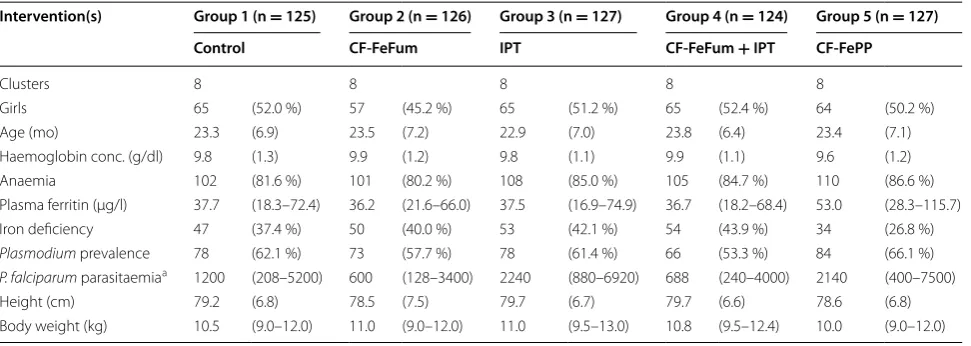
Six hundred eighty-four children were assessed for eligi-bility, of which 629 children were assigned to 40 clusters; these clusters were randomly assigned to five groups. Baseline characteristics are summarised in Table 1.
Compliance rates of porridge consumption were 92.5, 95.0 and 94.8 % for the study porridge administered to groups 2, 4 and 5, respectively. Compliance with IPT and IPT-placebo for study groups 1–5 were 97.6, 96.0, 96.9, 97.6 and 96.8 % at the first treatment (baseline), 95.2, 94.4, 92.9, 92.0 and 93.7 % at 3 months, and 91.1, 88.1, 81.1, 84.0 and 90.6 % at 6 months. Reasons for non-compliance of IPT of malaria included: children refusing to swallow the drug, vomiting after repeated dosing, or mothers/guardians did not consider the IPT important for their children.
Table 1 Baseline characteristics of the randomised study groups
Data are mean (SD), n (%) or median (interquartile range). Anaemia: Hb concentration <11 g/dl; iron deficiency: plasma ferritin <30 µg/l
CF-FeFum complementary food fortified with NaFeEDTA + ferrous fumarate, CF-FePP complementary food fortified with NaFeEDTA + ferric pyrophosphate, IPT intermittent preventive treatment of malaria
a parasites/µl of blood, only presented for infected children
Intervention(s) Group 1 (n = 125) Group 2 (n = 126) Group 3 (n = 127) Group 4 (n = 124) Group 5 (n = 127) Control CF‑FeFum IPT CF‑FeFum + IPT CF‑FePP
Clusters 8 8 8 8 8
Girls 65 (52.0 %) 57 (45.2 %) 65 (51.2 %) 65 (52.4 %) 64 (50.2 %)
Age (mo) 23.3 (6.9) 23.5 (7.2) 22.9 (7.0) 23.8 (6.4) 23.4 (7.1)
Haemoglobin conc. (g/dl) 9.8 (1.3) 9.9 (1.2) 9.8 (1.1) 9.9 (1.1) 9.6 (1.2)
Anaemia 102 (81.6 %) 101 (80.2 %) 108 (85.0 %) 105 (84.7 %) 110 (86.6 %)
Plasma ferritin (µg/l) 37.7 (18.3–72.4) 36.2 (21.6–66.0) 37.5 (16.9–74.9) 36.7 (18.2–68.4) 53.0 (28.3–115.7)
Iron deficiency 47 (37.4 %) 50 (40.0 %) 53 (42.1 %) 54 (43.9 %) 34 (26.8 %)
Plasmodium prevalence 78 (62.1 %) 73 (57.7 %) 78 (61.4 %) 66 (53.3 %) 84 (66.1 %)
P. falciparum parasitaemiaa 1200 (208–5200) 600 (128–3400) 2240 (880–6920) 688 (240–4000) 2140 (400–7500)
Height (cm) 79.2 (6.8) 78.5 (7.5) 79.7 (6.7) 79.7 (6.6) 78.6 (6.8)
[image:5.595.57.543.514.687.2]As shown in Fig. 1, about one-third of the children were lost to follow-up over the 9 months intervention. Protocol deviation concerned nine children (1.4 %) who discontinued the interventions: three children were excluded because of Hb <7 g/dl over the course of the study and were treated with iron supplementation; two were excluded because of Hb <5 g/dl and were treated with blood transfusions; and four were excluded because they received iron supplements by the parents/guard-ians. Eight children died and the cause of death was determined by verbal autopsy. Two deaths occurred before the intervention started but after baseline screening and randomisation. The remaining six deaths occurred over the course of the 9-month study period: none died in groups 1 and 5; in group 2, two died of pneumonia and one from malaria; in group 3, one died from malaria with subsequent anaemia; and in group 4, two died from malaria.
Haemoglobin and anaemia
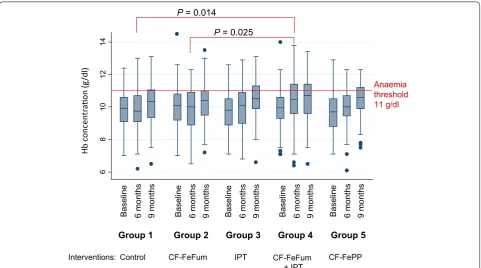
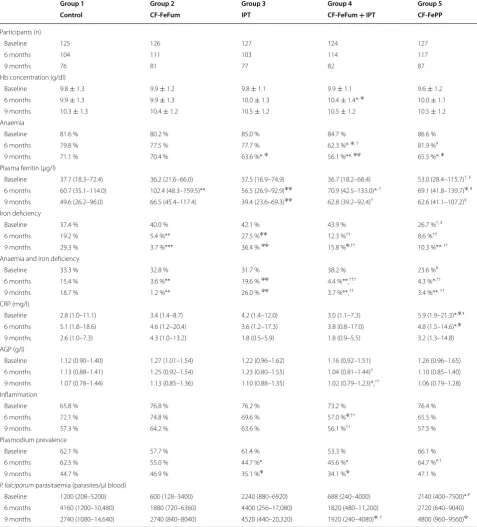
Haemoglobin concentration did not differ between the five groups at baseline. The observed increase in the five groups was not different after 9 months (Table 2). After 6 months, a transient effect (during the rainy season) was observed, when Hb concentration increased significantly
in children in group 4 (receiving IPT and CF-FeFum) when compared to group 1 (control, P = 0.014) or group 2 (children receiving CF-FeFum, P = 0.025) (Fig. 2). After 9 months, the decrease of anaemia was signifi-cantly higher in groups 3, 4 and 5 than in groups 1 or 2 (Table 2).
Treatment interactions (CF-FeFum × IPT) were assessed with the 2 × 2 factorial analysis including groups 1–4. No interaction was found between interven-tions for Hb concentration (P = 0.89). After 9 months, no effect of interventions on Hb concentration was found. Similar to the five group comparison, we observed a transient effect after 6 months, when Hb concentra-tion increased significantly in children receiving IPT (n = 251; adjusted mean difference 0.35 g/dl [95 % CI 0.04–0.66; P = 0.027]). The increase of Hb concentra-tion after 9 months was no longer significant (0.24 g/dl [95 % CI −0.10 to 0.59; P = 0.16]) (Table 3). Children receiving IPT showed lower odds of being anemic after 6 and 9 months (odds ratio [OR], 0.46 [95 % CI 0.24–0.90;
P = 0.023] and OR, 0.46 [95 % CI 0.23–0.90; P = 0.024]) (Table 4). The iron fortified CF-FeFum had no effect on anaemia prevalence after 6 and 9 months (OR, 0.64 [95 % CI 0.33–1.25; P = 0.19] and OR, 0.85 [95 % CI 0.43–1.68;
P = 0.64]).
6
8
10
12
14
Anaemia threshold 11 g/dl
9 months
6 months
Baseline
Control CF-FeFum IPT CF-FeFum + IPT
9 months
6 months
Baselin
e
9 months
6
months
Baseline Baselin 6 months 9 months
e
9 months
6
months
Baseline
CF-FePP
Hb concent
ra
o
n(
g/
dl
)
P= 0.014
P= 0.025
Group 1 Group 2 Group 3 Group 4 Group 5
Interventions:
Fig. 2 Haemoglobin concentration at baseline, 6 and 9 months for each study group. CF-FeFum complementary food fortified with
NaFeEDTA + ferrous fumarate, CF-FePP complementary food fortified with NaFeEDTA + ferric pyrophosphate, IPT intermittent preventive treatment
[image:6.595.58.540.417.685.2]Table 2 Group comparison analysis
Data are mean ± SD, % or median (IQR). Changes between baseline to 6 months and baseline to 9 months were compared between groups with random effect models. Anaemia: Hb concentration <11 g/dl; iron deficiency: plasma ferritin <30 µg/l; inflammation: CRP ≥5.0 mg/l or AGP ≥1.0 g/l; and P. falciparum parasitaemia: parasites/µl blood, only presented for infected children at the specific time points
CF-FeFum complementary food fortified with NaFeEDTA + ferrous fumarate, CF-FePP complementary food fortified with NaFeEDTA + ferric pyrophosphate, IPT intermittent preventive treatment of malaria, AGPα-1-acid-glycoprotein, CRP C-reactive protein, Hb haemoglobin concentration, IQR interquartile range */**/***Increase/decrease in groups 2, 3, 4 and 5 significantly different compared to increase/decrease in group 1, *P < 0.05, ** P < 0.01, *** P < 0.001
Ψ/ΨΨ/ΨΨΨ Increase/decrease in groups 3, 4 and 5 significantly different compared to group 2, ΨP < 0.05, ΨΨP < 0.01, ΨΨΨ P < 0.001
†/††/††† Increase/decrease in groups 4 and 5 significantly different compared to group 3, †P < 0.05, ††P < 0.01, †††P < 0.001 ¥/¥¥/¥¥¥ Increase/decrease in group 5 significantly different compared to group 4, ¥P < 0.05, ¥¥P < 0.01, ¥¥¥P < 0.001
Group 1 Group 2 Group 3 Group 4 Group 5
Control CF‑FeFum IPT CF‑FeFum + IPT CF‑FePP
Participants (n)
Baseline 125 126 127 124 127
6 months 104 111 103 114 117
9 months 76 81 77 82 87
Hb concentration (g/dl)
Baseline 9.8 ± 1.3 9.9 ± 1.2 9.8 ± 1.1 9.9 ± 1.1 9.6 ± 1.2
6 months 9.9 ± 1.3 9.9 ± 1.3 10.0 ± 1.3 10.4 ± 1.4*, Ψ 10.0 ± 1.1
9 months 10.3 ± 1.3 10.4 ± 1.2 10.5 ± 1.2 10.5 ± 1.2 10.5 ± 1.2
Anaemia
Baseline 81.6 % 80.2 % 85.0 % 84.7 % 86.6 %
6 months 79.8 % 77.5 % 77.7 % 62.3 %*, Ψ, † 81.9 %¥
9 months 71.1 % 70.4 % 63.6 %*, Ψ 56.1 %**, ΨΨ 65.5 %*, Ψ
Plasma ferritin (µg/l)
Baseline 37.7 (18.3–72.4) 36.2 (21.6–66.0) 37.5 (16.9–74.9) 36.7 (18.2–68.4) 53.0 (28.4–115.7)†, ¥
6 months 60.7 (35.1–114.0) 102.4 (48.3–159.5)** 56.5 (26.9–92.9)ΨΨ 70.9 (42.5–133.0)*, † 69.1 (41.8–139.7)Ψ, ¥
9 months 49.6 (26.2–96.0) 66.5 (45.4–117.4) 39.4 (23.6–69.3)ΨΨ 62.8 (39.2–92.4)† 62.6 (41.1–107.2)¥
Iron deficiency
Baseline 37.4 % 40.0 % 42.1 % 43.9 % 26.7 %†, ¥
6 months 19.2 % 5.4 %** 27.5 %ΨΨ 12.3 %†† 8.6 %††
9 months 29.3 % 3.7 %*** 36.4 % ΨΨ 15.8 %Ψ,†† 10.3 %**, ††
Anaemia and iron deficiency
Baseline 33.3 % 32.8 % 31.7 % 38.2 % 23.6 %¥
6 months 15.4 % 3.6 %** 19.6 % ΨΨ 4.4 %**,††† 4.3 %*,††
9 months 18.7 % 1.2 %** 26.0 % ΨΨ 3.7 %**,†† 3.4 %**, ††
CRP (mg/l)
Baseline 2.8 (1.0–11.1) 3.4 (1.4–8.7) 4.2 (1.4–12.0) 3.0 (1.1–7.3) 5.9 (1.9–21.3)*,Ψ,¥
6 months 5.1 (1.8–18.6) 4.6 (1.2–20.4) 3.6 (1.2–17.3) 3.8 (0.8–17.0) 4.8 (1.5–14.6)*,Ψ
9 months 2.6 (1.0–7.3) 4.3 (1.0–13.2) 1.8 (0.5–5.9) 1.8 (0.9–5.5) 3.2 (1.3–14.8)
AGP (g/l)
Baseline 1.12 (0.90–1.40) 1.27 (1.01–1.54) 1.22 (0.96–1.62) 1.16 (0.92–1.51) 1.26 (0.96–1.65) 6 months 1.13 (0.88–1.41) 1.25 (0.92–1.54) 1.23 (0.80–1.55) 1.04 (0.81–1.44)† 1.10 (0.85–1.40)
9 months 1.07 (0.78–1.44) 1.13 (0.85–1.36) 1.10 (0.88–1.35) 1.02 (0.79–1.23)*,†† 1.06 (0.79–1.28)
Inflammation
Baseline 65.8 % 76.8 % 76.2 % 73.2 % 76.4 %
6 months 72.1 % 74.8 % 69.6 % 57.0 %Ψ,†† 65.5 %
9 months 57.3 % 64.2 % 63.6 % 56.1 %†† 57.5 %
Plasmodium prevalence
Baseline 62.1 % 57.7 % 61.4 % 53.3 % 66.1 %
6 months 62.5 % 55.0 % 44.7 %* 45.6 %* 64.7 %¥,†
9 months 44.7 % 46.9 % 35.1 %Ψ 34.1 %Ψ 47.1 %
P. falciparum parasitaemia (parasites/µl blood)
Baseline 1200 (208–5200) 600 (128–3400) 2240 (880–6920) 688 (240–4000) 2140 (400–7500)*,¥
[image:7.595.57.535.107.635.2]Iron status
At baseline, the PF concentration was slightly higher in children in group 5 (receiving CF-FePP) than in chil-dren in groups 3 and 4 (Table 2). At 6 months, the PF concentration increased significantly more in groups 2 and 4 than in groups 1, 3 and 5. After 9 months, the increases in groups 2 and 4 were higher than in group 3. The increase after 9 months in group 4 was higher than in group 5 (Table 2). ID decreased significantly in all three groups receiving iron for 9 months (groups 2, 4 and 5). The decrease of ID in group 2 was higher than in group 4 (Table 2).
In the 2 × 2 factorial analysis, no treatment interaction
on PF concentration (P = 0.55) was found. From baseline
to 6 and 9 months, the PF concentration was increased by 33 % (95 % CI 14–51 %) and 36 % (95 % CI 16–56 %), respectively, in children receiving CF-FeFum (Table 3). Children receiving CF-FeFum were significantly less likely to be iron deficient after 6 months (OR, 0.28 [95 % CI 0.14–0.56; P < 0.001]) and 9 months (OR, 0.19 [95 % CI 0.09–0.40; P < 0.001]) (Table 4). The 2 × 2 factorial
analysis showed no effect by IPT on ferritin concentra-tion and ID prevalence.
Plasmodium prevalence and inflammation
Plasmodium prevalence was not different between the five study groups at baseline. After 6 months (end of rainy season), the decrease of malaria prevalence in groups 3 and 4 (all receiving IPT) was significantly higher than in groups 1, 2 and 5 (all receiving IPT-placebo) (Table 2).
After 9 months, the Plasmodium prevalence decreased in all groups, but the decrease in study 2 was lower than in groups 3 and 4. Inflammation parameters (AGP and CRP) in all five groups showed no major differences at baseline, except CRP in group 5 was significantly higher than in groups 1, 2 and 4.
In the 2 × 2 factorial analysis, no interaction between the two treatments on malaria prevalence was found (P = 0.78), on AGP concentration (P = 0.18) or on CRP (P = 0.52). In the 2 × 2 factorial analysis, neither inter-vention significantly affected the P. falciparum preva-lence at 6 or 9 months follow-up. CRP concentration was reduced by 47 % after 9 months (95 % CI 2–92 %) in chil-dren receiving IPT (Table 3). Children receiving IPT had lower odds to have an elevated inflammation status after 6 months (OR, 0.52 [95 % CI 0.29–0.94; P = 0.030]), but this effect was not observed after 9 months (Table 4).
Figure 3 shows the prevalence of anaemia in the five study groups. Anaemia was stratified into anaemia with ID (spotted) or anaemia without ID (shaded). This figure displays the dynamic of anaemia with and without ID in the present study population over the 9 months period.
Discussion
This randomised controlled trial examined the effects of CF fortified with highly bioavailable iron compounds and IPT of malaria in 12- to 36-month-old children in an area of intense malaria transmission in West Africa. To the authors’ knowledge, this is the first trial assessing the treatment interaction of iron-fortified CF and IPT of
Table 3 Main effects of iron fortified CF-FeFum and IPT of malaria
a Assignment at baseline
b Adjusted for age, Hb concentration at baseline and factorial design
c Adjusted for age, C-reactive protein concentration, PF concentration at baseline and factorial design d Adjusted for age, C-reactive protein concentration at baseline and factorial design
The effects were assessed in 12- to 36-month-old Ivorian children at 6 and 9 months. The estimations are based on a 2 × 2 factorial analysis using a linear regression model taking into account random effects
Effect of iron fortified complementary food Effect of intermittent preventive treatment of malaria
Received CF‑FeFuma n
= 250 Received IPTa n = 251 No CF‑FeFuma n
= 252 IPT‑placeboa n = 251
Adjustedb difference of Hb concentration g/dl (95 % CI)
6 months 0.11 (−0.20 to 0.42; P= 0.49) 0.35 (0.04 to 0.66; P= 0.027)
9 months −0.08 (−0.42 to 0.26; P= 0.65) 0.24 (−0.10 to 0.59; P= 0.16)
Adjustedc ratios of log-transformed PF concentration (95 % CI)
6 months 1.33 (1.14 to 1.51; P= 0.001) 0.95 (0.76 to 1.13; P= 0.58)
9 months 1.36 (1.16 to 1.56; P < 0.001) 0.91 (0.70 to 1.11; P= 0.37)
Adjustedd ratios of log-transformed CRP concentration
6 months 1.04 (0.63 to 1.45; P= 0.84) 0.77 (0.36 to 1.18; P= 0.27)
[image:8.595.55.540.492.665.2]Table 4 Odds ratios for anaemia, iron deficiency, malaria and inflammation prevalence
a Assignment at baseline b Adjusted for age
c Adjusted for age and CRP concentration
d Inflammation is defined as CRP >5 mg/l and/or AGP >1 g/l
Odds ratios were assessed in 12- to 36-month-old Ivorian children at 6 and 9 months. The estimations are based on a 2 × 2 factorial analysis using a logistic regression model taking into account random effects
Effect of iron fortified complementary food Effect of intermittent preventive treatment of malaria
Received CF‑FeFuma n = 250 Received IPTa n = 251 No CF‑FeFuma n
= 252 IPT‑placeboa n = 251
Odds ratiosb of anaemia (Hb concentration <11 g/dl) (95 % CI)
6 months 0.64 (0.33 to 1.25; P= 0.19) 0.46 (0.24 to 0.90; P= 0.023)
9 months 0.85 (0.43 to 1.68; P= 0.64) 0.46 (0.23 to 0.90; P= 0.024)
Odds ratiosc of iron deficiency (plasma ferritin concentration <30 µg/l) (95 % CI)
6 months 0.28 (0.14 to 0.56; P < 0.001) 1.52 (0.76 to 3.04; P= 0.23)
9 months 0.19 (0.09 to 0.40; P < 0.001) 1.64 (0.79 to 3.42; P= 0.19)
Odds ratiosb of malaria prevalence (P. falciparum) (95 % CI)
6 months 1.17 (0.68 to 2.01; P= 0.58) 0.59 (0.34 to 1.02; P= 0.057)
9 months 1.30 (0.71 to 2.39; P= 0.39) 0.61 (0.33 to 1.12; P= 0.11)
Odds ratiosb of the inflammation statusd (95 % CI)
6 months 0.66 (0.37 to 1.19; P= 0.17) 0.52 (0.29 to 0.94; P= 0.030)
9 months 0.82 (0.44 to 1.51; P= 0.52) 0.77 (0.42 to 1.43; P= 0.41)
0% 10% 20% 30% 40% 50% 60% 70% 80% 90% 100%
Baseline 6 months 9 months
Group 1:Control
Baseline 6 months 9 months
Group 2: CF-FeFum
Baseline 6 months 9 months
Group 4:CF-FeFum + IPT
0% 10% 20% 30% 40% 50% 60% 70% 80% 90% 100%
Baseline 6 months 9 months
Group 3:IPT
Anaemia without iron deficiency Anaemia and iron deficiency
Baseline 6 months 9 months
Group 5: CF-FePP
Fig. 3 Prevalence of anaemia at baseline, 6 and 9 months for each study group. Anaemic children are separated into children with iron deficiency and no iron deficiency. Iron deficiency was reduced in anaemic children receiving CF-FeFum or CF-FePP. IPT modestly reduced anaemia, without
affecting iron deficiency. CF-FeFum complementary food fortified with NaFeEDTA + ferrous fumarate, CF-FePP complementary food fortified with
[image:9.595.57.541.104.317.2] [image:9.595.57.539.403.651.2]malaria with a 2 × 2 factorial design. The main findings are: (1) no interaction between IPT of malaria and CF on Hb concentration, anaemia or ID; (2) iron fortified CF had no effect on Hb concentration or anaemia prevalence but substantially decreased the prevalence of ID; (3) IPT of malaria modestly reduced anaemia; and (4) iron forti-fication with FeFum or FePP had the same effect on Hb concentration, although anaemia decreased more in chil-dren receiving FePP.
Despite covering >90 % of the iron RNI with com-pounds expected to have high bioavailability, after 9 months, iron fortification had no significant effect on Hb concentration or anaemia prevalence. The results dif-fer from a subgroup analysis from a recently published Cochrane review that reported a positive effect of iron fortification at point of consumption with micronutri-ent powders on anaemia prevalence in malaria-endemic regions [6]. However, micronutrient powders contain more iron than fortified complementary foods and, in the four selected studies utilised for the subgroup analy-sis, the malaria prevalence was below 10 % in one study, malaria parasitaemia was poorly defined in the other three studies and concomitant anti-malarial treatments were not reported. Hence, the effect of iron fortification on anaemia in malaria-endemic regions remains unclear.
ID was defined as PF <30 µg/l and was based on recom-mendations from WHO [17] for populations with high prevalence of infections. The prevalence of inflammation in the study population was high; more than two-thirds of the children had an elevated CRP and/or AGP. The potential confounding effect of inflammation was taken into account by adjusting the linear regression models for CRP concentration. Both iron fortified CF increased PF and sharply decreased ID, consistent with two previous studies conducted in Côte d’Ivoire that failed to show a significant effect of iron fortification on Hb concentra-tion in school-aged children but did decrease ID [21, 22].
Treatment with SP/AQ clears P. falciparum parasi-taemia [23], and is protective against reinfection for 28–35 days [24, 25]. Malaria transmission is perennial in this part of Côte d’Ivoire, with high entomological inoculation rates (117–409 infectious bites per person per year) [26]. Hence after the protective effect of the IPT had faded, children were at high risk of re-infection and many of them indeed became re-infected between the IPT treatments. However, the protection of each IPT course was sufficiently long to reduce the risk of anaemia. This protective effect of IPT against anaemia is consist-ent with a meta-analysis of six IPT trials conducted in areas where malaria transmission is seasonal or perennial with the reported relative risk of anaemia decreased by 21 % (95 % CI 8–33 %) [5]. In the present study, although children assigned to IPT were less likely to be anemic, the
increase of the adjusted Hb concentration was not sig-nificantly different when compared to children receiving placebo. In other words, at study end, the differences of Hb concentrations were small despite the apparent fall in frequency of anaemia in children receiving IPT (Fig. 2).
No evidence was found that IPT of malaria improves the efficacy of iron fortified CF by facilitating iron absorption or erythropoiesis, which are reported to be diminished during P. falciparum infection [7, 27]. However, both iron fortified CFs (CF-FeFum and CF-FePP) improved iron sta-tus in children similarly regardless of whether or not they received IPT. This finding may be explained by a recent study reporting that serum hepcidin in iron deficient chil-dren is decreased, even in the presence of P. falciparum
infection [28]. The lack of an interaction between both interventions on anaemia prevalence is consistent with a previous study in 12- to 16-week-old Tanzanian infants who received iron supplementation with or without IPT of malaria [29]. This study found no additional effect on anaemia when iron supplementation was combined with IPT. Compared to the present study, the Tanzanian chil-dren were much younger and iron was given as higher dose supplements over a shorter period. However, the fact that IPT of malaria in the Tanzanian and the current study had a stronger effect on anaemia prevalence than iron alone suggests that infection with P. falciparum is the predominant risk factor for anaemia in young children.
The present study was implemented at the transition zone of tropical rainforest in the South and the savannah in the North [30] and, although the transmission of malaria is perennial in this part of Côte d’Ivoire, there is also some natural fluctuation in malaria transmission between the dry and the rainy season [3, 31]. The study included the rainy season (baseline to 6 months) and the dry season (6–9 months). The prevalence of P. falciparum infec-tion in the control group did not change during the first 6 months, but it decreased by almost one-third over the last 3 months. Although Hb concentration did not change in the control group during the first 6 months, it increased during the last 3 months of intervention. The effect of IPT on Hb appeared to be stronger at the end of the rainy sea-son (at 6 months). This suggests the abatement of malaria transmission during the dry season likely influenced the impact of the treatments, and may have been responsible for the differences in outcomes at 6 and 9 months.
demonstrated efficacy [9]. An effective anti-malarial regi-men with a relatively long half-life was used, but, never-theless, many children became re-infected by the time of the next follow-up.
Limitations of the present study include possible con-founding by seasonal variations in malaria transmission, the relatively high drop-out rate (attrition bias), and the use of a single iron biomarker (i.e. PF) to define iron sta-tus. Inherited haemoglobinopathies are unlikely to play a major role in anaemia in this population, as previous studies in this region reported 83 % of subjects to have normal Hb genotype, and only 8, 7 and 1 % carried an S allele, C allele, and had sickle cell anaemia, respectively [12]. Likewise, other micronutrient deficiencies, such as vitamin A, although present, were not associated with anaemia in the same region [12]. Hookworm contributes to anaemia in many tropical regions, but the prevalence of hookworm was very low in our study subjects, similar to an earlier investigation [12].
Conclusions
The results of the present study confirm that anaemia is a major public health problem in young children in Côte d’Ivoire and requires urgent action. About half of the anaemic children were iron deficient and the iron forti-fied CF almost eliminated ID, but against the authors’ expectation, it did not decrease anaemia prevalence. This observation is in line with a recently published Cochrane review including anemic children living in malaria-endemic regions receiving iron supplementation and IPT for a 12-week period [32]. The authors reported a modest effect of IPT on Hb concentration, irrespective of whether the children received supplemental iron (sub-group analysis). The Cochrane review and the current findings argue that the effect of IPT on anaemia should be further investigated, maybe in combination with the reduction of malaria transmission, to be achieved through a combina-tion of vector control strategies (e.g. removal of potential breeding sites, use of long-lasting insecticidal nets, indoor residual spraying and IPT of malaria). The findings of the present study further show that iron fortification of CF is an effective fortification strategy to prevent negative health consequences due to ID. Moreover, these findings underline the multiple aetiologies of anaemia in tropical settings and point to combined interventions being neces-sary for its prevention or treatment.
Additional file
Additional file 1. Composition of the dried complementary food and
vitamin/mineral premix
Abbreviations
AGP: α-1-acid-glycoprotein; CF: complementary food; CF-FeFum: mentary food fortified with NaFeEDTA + ferrous fumarate; CF-FePP: comple-mentary food fortified with NaFeEDTA + ferric pyrophosphate; CRP: C-reactive protein; Hb: haemoglobin; ID: iron deficiency; IPT: intermittent preventive treatment of malaria; PF: plasma ferritin; SP/AQ: sulfadoxine-pyrimethamine and amodiaquine.
Authors’ contributions
DG, RFH, AAR, JU, EKN, RW designed research (project conception and development of overall research plan); DG, JU, EKN, RW had study oversight; DG, MO, LGA, VGD, JU, EKN conducted research (hands-on conduct of the experiments and data collection); DG, RFH, BS analysed data and performed statistical analysis; DG, RFH, MBZ, GMB, RW wrote first draft of the paper; and DG, RFH, RW had primary responsibility for final content. All authors read and approved the final manuscript.
Author details
1 Human Nutrition Laboratory, Institute of Food, Nutrition and Health, ETH
Zurich, Schmelzbergstrasse 7, 8092 Zurich, Switzerland. 2 Unité de Formation
et de Recherche Biosciences, Université Félix Houphouët-Boigny, Abidjan, Côte d’Ivoire. 3 Department of Pediatrics, Columbia University College of
Physi-cians and Surgeons, New York, USA. 4 Hôpital Général de Taabo, Taabo Cité,
Côte d’Ivoire. 5 Department of Epidemiology and Public Health, Swiss Tropical
and Public Health Institute, Basel, Switzerland. 6 University of Basel, Basel,
Swit-zerland. 7 Department of Biostatistics, Epidemiology, Biostatistics and
Preven-tion Institute, University of Zurich, Zurich, Switzerland. 8 Université Alassane
Ouattara, Bouaké, Côte d’Ivoire. 9 Centre Suisse de Recherches Scientifiques en
Côte d’Ivoire, Abidjan, Côte d’Ivoire.
Acknowledgements
We express our gratitude to all the participants and their mothers/guardians, the village chiefs, the Taabo health and demographic surveillance system staff and the communities supporting our study. The porridge was prepared during 9 months by volunteers, whose help was greatly appreciated. We are thankful for all the support by the Centre Suisse de Recherches Scientifiques en Côte d’Ivoire (CSRS), especially the Director-General Prof. Bassirou Bonfoh. We thank as well Dr. Aaron Grant from GAIN for his support during the study, we thank Dr. Jürgen Erhardt for measuring iron status, and we thank Luciano Molinari and Maria Andersson for statistical support. We are grateful to the members of the data safety and monitoring board, namely Prof. Thomas A. Smith, Prof. Sean Lynch, and Dr. Maria Andersson.
The study was funded by the Swiss National Science Foundation (SNSF; grant no. IZ70Z0_123900), Global Alliance for Improved Nutrition (GAIN; grant agreement 30CI01-ML), Swiss Tropical and Public Health Institute, and ETH Zurich. The funders were not involved in the design and conduct of the study, analysis and interpretation of the data, and decision to submit the paper for publication.
Compliance with ethical guidelines
Competing interests
The authors declare that they have no competing interests.
Received: 22 May 2015 Accepted: 25 August 2015
References
1. Kassebaum NJ, Jasrasaria R, Naghavi M, Wulf SK, Johns N, Lozano R, et al. A systematic analysis of global anemia burden from 1990 to 2010. Blood. 2013;123:615–24.
3. Righetti AA, Adiossan LG, Ouattara M, Glinz D, Hurrell RF, N’Goran EK, et al. Dynamics of anemia in relation to parasitic infections, micronutri-ent status, and increasing age in south-cmicronutri-entral Côte d’Ivoire. J Infect Dis. 2013;207:1604–15.
4. Staubli Asobayire F, Adou P, Davidsson L, Cook JD, Hurrell RF. Prevalence of iron deficiency with and without concurrent anemia in population groups with high prevalences of malaria and other infections: a study in Côte d’Ivoire. Am J Clin Nutr. 2001;74:776–82.
5. Aponte JJ, Schellenberg D, Egan A, Breckenridge A, Carneiro I, Critchley J, et al. Efficacy and safety of intermittent preventive treatment with sulfadoxine-pyrimethamine for malaria in African infants: a pooled analy-sis of six randomised, placebo-controlled trials. Lancet. 2009;374:1533–42. 6. De-Regil LM, Suchdev PS, Vist GE, Walleser S, Pena-Rosas JP. Home
fortification of foods with multiple micronutrient powders for health and nutrition in children under two years of age. Evid Based Child Health. 2013;8:112–201.
7. Cercamondi CI, Egli IM, Ahouandjinou E, Dossa R, Zeder C, Salami L, et al. Afebrile Plasmodium falciparum parasitemia decreases absorp-tion of fortificaabsorp-tion iron but does not affect systemic iron utilizaabsorp-tion: a double stable-isotope study in young Beninese women. Am J Clin Nutr. 2010;92:1385–92.
8. Glinz D, Hurrell RF, Righetti AA, Zeder C, Adiossan LG, Tjalsma H, et al. In Ivorian school-age children, infection with hookworm does not reduce dietary iron absorption or systemic iron utilization, whereas afebrile
Plasmodium falciparum infection reduces iron absorption by half. Am J Clin Nutr. 2015;101:462–70.
9. Hurrell RF, Ranum P, de Pee S, Biebinger R, Hulthen L, Johnson Q, et al. Revised recommendations for iron fortification of wheat flour and an evaluation of the expected impact of current national wheat flour fortifi-cation programs. Food Nutr Bull. 2010;31:S7–21.
10. Koné S, Baikoro N, N’Guessan Y, Jaeger FN, Silué KD, Fürst T, et al. Health & demographic surveillance system profile: the Taabo health and demo-graphic surveillance system, Côte d’Ivoire. Int J Epidemiol. 2014;44:87–97. 11. Koné S, Fürst T, Jaeger FN, Esso ELJC, Baïkoro N, Adiossan LG, et al. Causes of death in the Taabo health and demographic surveillance system, Côte d’Ivoire, from 2009 to 2011. Glob Health Action. 2015;8:27271.
12. Righetti AA, Koua AYG, Adiossan LG, Glinz D, Hurrell RF, N’Goran EK, et al. Etiology of anemia among infants, school-aged children, and young non-pregnant women in different settings of south-central Côte d’Ivoire. Am J Trop Med Hyg. 2012;87:425–34.
13. Righetti AA, Wegmüller R, Glinz D, Ouattara M, Adiossan LG, N’Goran EK, et al. Effects of inflammation and Plasmodium falciparum infection on soluble transferrin receptor and plasma ferritin concentration in different age groups: a prospective longitudinal study in Côte d’Ivoire. Am J Clin Nutr. 2013;97:1364–74.
14. FAO/WHO. Guidelines on food fortification with micronutrients. Geneva: World Health Organization; 2006.
15. Staubli Asobayire F: Development of a food fortification strategy to com-bat iron deficiency in the Ivory Coast. PhD thesis; Zurich: Swiss Federal Institute of Technology Zurich; 2000.
16. Wegmüller R: Dual fortification of salt with iodine and iron in Africa. PhD thesis; Zurich: Swiss Federal Institute of Technology Zurich; 2005. 17. WHO. Iron deficiency anaemia: assessment, prevention and control. A
guide for programme managers. Geneva: World Health Organization; 2001.
18. WHO. Diagnosis of malaria. Geneva: World Health Organization; 1990. 19. Erhardt JG, Estes JE, Pfeiffer CM, Biesalski HK, Craft NE. Combined
measurement of ferritin, soluble transferrin receptor, retinol binding protein, and C-reactive protein by an inexpensive, sensitive, and simple sandwich enzyme-linked immunosorbent assay technique. J Nutr. 2004;134:3127–32.
20. WHO: Assessing the iron status of populations. Second edition, including literature reviews. Geneva: World Health Organization, Centers for Disease Control and Prevention; 2007.
21. Wegmüller R, Camara F, Zimmermann MB, Adou P, Hurrell RF. Salt dual-fortified with iodine and micronized ground ferric pyrophosphate affects iron status but not hemoglobin in children in Côte d’Ivoire. J Nutr. 2006;136:1814–20.
22. Rohner F, Zimmermann MB, Amon RJ, Vounatsou P, Tschannen AB, N’Goran EK, et al. In a randomized controlled trial of iron fortification, anthelmintic treatment, and intermittent preventive treatment of malaria for anemia control in Ivorian children, only anthelmintic treatment shows modest benefit. J Nutr. 2010;140:635–41.
23. Sokhna C, Cissé B, el Ba H, Milligan P, Hallett R, Sutherland C, et al. A trial of the efficacy, safety and impact on drug resistance of four drug regimens for seasonal intermittent preventive treatment for malaria in Senegalese children. PLoS One. 2008;3:e1471.
24. WHO. Report of the techical tonsultation on intermittent preventive treatment in infants (IPTi), Technical Expert Group on Preventive Chemo-therapy. Geneva: World Health Organization; 2009.
25. Senn N, Rarau P, Stanisic DI, Robinson L, Barnadas C, Manong D, et al. Intermittent preventive treatment for malaria in Papua New Guinean infants exposed to Plasmodium falciparum and P. vivax: a randomized controlled trial. PLoS Med. 2012;9:e1001195.
26. Ouattara AF, Dagnogo M, Constant EAV, Koné M, Raso G, Tanner M, et al. Transmission of malaria in relation to distribution and coverage of long-lasting insecticidal nets in central Côte d’Ivoire. Malar J. 2014;13:109. 27. Hurrell RF. Iron fortification: its efficacy and safety in relation to infections.
Food Nutr Bull. 2007;28:S585–94.
28. Pasricha SR, Atkinson SH, Armitage AE, Khandwala S, Veenemans J, Cox SE, et al. Expression of the iron hormone hepcidin distinguishes different types of anemia in African children. Sci Transl Med. 2014;6:235re233. 29. Massaga JJ, Kitua AY, Lemnge MM, Akida JA, Malle LN, Ronn AM, et al.
Effect of intermittent treatment with amodiaquine on anaemia and malarial fevers in infants in Tanzania: a randomised placebo-controlled trial. Lancet. 2003;361:1853–60.
30. N’Goran EK, Utzinger J, Gnaka HN, Yapi A, N’Guessan NA, Kigbafori SD, et al. Randomized, double-blind, placebo-controlled trial of oral artemether for the prevention of patent Schistosoma haematobium infec-tions. Am J Trop Med Hyg. 2003;68:24–32.
31. Koudou BG, Tano Y, Doumbia M, Nsanzabana C, Cissé G, Girardin O, et al. Malaria transmission dynamics in central Côte d’Ivoire: the influence of changing patterns of irrigated rice agriculture. Med Vet Entomol. 2005;19:27–37.
32. Athuman M, Kabanywanyi AM, Rohwer AC. Intermittent preventive anti-malarial treatment for children with anaemia. Cochrane Database Syst Rev. 2015;1:Cd010767.
Submit your next manuscript to BioMed Central and take full advantage of:
• Convenient online submission
• Thorough peer review
• No space constraints or color figure charges
• Immediate publication on acceptance
• Inclusion in PubMed, CAS, Scopus and Google Scholar
• Research which is freely available for redistribution